Archive for the ‘Shiite’ category

NBC’s Engel: Officials Say Allies: Simply Don’t Trust” U.S. Under Obama Admin – The Five

March 28, 2015

NBC’s Engel: Officials Say Allies: Simply Don’t Trust” U.S. Under Obama Admin – The Five, Fox News via You Tube, March 27, 2015

(In other breaking news, today is Saturday, unexpectedly. Please see also, Iranian general in Sanaa to organize Yemen rebel counter-offensive for Saudi-led attacks.  — DM)


Column One: Managing Obama’s war against Israel

March 27, 2015

Column One: Managing Obama’s war against Israel, Jerusalem Post, Caroline Glick, March 26, 2015

ShowImageUS President Barack Obama meets with Prime Minister Benjamin Netanyahu at the White House, October 1, 2014. (photo credit:REUTERS)

As Max Boot explained Wednesday in The Wall Street Journal, the administration’s animosity toward Israel is a function of Obama’s twin strategic aims, both evident since he entered office: realigning US policy in the Middle East toward Iran and away from its traditional allies Israel and the Sunni Arab states, and ending the US’s strategic alliance with Israel.

Obama has reached a point in his presidency where he is prepared to give full expression to his plan to end the US’s strategic alliance with Israel.

He thinks that doing so is both an end to itself and a means of succeeding in his bid to achieve a rapprochement with Iran.

*********************

On Wednesday the Jerusalem Municipality announced it is shelving plans to build 1,500 apartments in the Har Homa neighborhood. Officials gave no explanation for its sudden move. But none was needed.

Obviously the construction of apartments for Jews in Jerusalem was blocked in the hopes of appeasing US President Barack Obama.

But is there any reason to believe he can be appeased? Today the White House is issuing condemnations of Israel faster than the UN.

To determine how to handle what is happening, we need to understand the nature of what is happening.

First we need to understand that the administration’s hostility has little to do with Israel’s actions.

As Max Boot explained Wednesday in The Wall Street Journal, the administration’s animosity toward Israel is a function of Obama’s twin strategic aims, both evident since he entered office: realigning US policy in the Middle East toward Iran and away from its traditional allies Israel and the Sunni Arab states, and ending the US’s strategic alliance with Israel.

Over the past six years we have seen how Obama has consistently, but gradually, taken steps to advance these two goals. Toward Iran, he has demonstrated an unflappable determination to accommodate the terrorism supporting, nuclear proliferating, human rights repressing and empire building mullahs.

Beginning last November, as the deadline for nuclear talks between the US and its partners and Tehran approached, Obama’s attempts to accommodate Tehran escalated steeply.

Obama has thrown caution to the winds in a last-ditch effort to convince Iranian dictator Ali Khamenei to sign a deal with him. Last month the administration published a top secret report on Israel’s nuclear installations. Last week, Obama’s director of national intelligence James Clapper published an annual terrorism threat assessment that failed to mention either Iran or Hezbollah as threats.

And this week, the administration accused Israel of spying on its talks with Iran in order to tell members of Congress the details of the nuclear deal that Obama and his advisers have been trying to hide from them.

In the regional context, the administration has had nothing to say in the face of Iran’s takeover of the Bab el-Mandeb Strait and the Gulf of Aden this week. With its Houthi-proxy now in charge of the strategic waterway, and with its own control over the Straits of Hormuz, Iran is poised to exercise naval control over the two choke points of access to Arab oil.

The administration is assisting Iranian Shi’ite proxies in their battle to defeat Islamic State forces in the Iraqi city of Tikrit. It has said nothing about the Shi’ite massacres of Sunnis that come under their control.

Parallel to its endless patience for Tehran, the Obama administration has been treating Israel with bristling and ever-escalating hostility. This hostility has been manifested among other things through strategic leaks of highly classified information, implementing an arms embargo on weapons exports to Israel in time of war, ending a 40-year agreement to provide Israel with fuel in times of emergency, blaming Israel for the absence of peace, expressing tolerance and understanding for Palestinian terrorism, providing indirect support for Europe’s economic war against Israel, and providing indirect support for the BDS movement by constantly accusing Israel of ill intentions and dishonesty.

Then there is the UN. Since he first entered office, Obama has been threatening to withhold support for Israel at the UN. To date, the administration has vetoed one anti-Israel resolution at the UN Security Council and convinced the Palestinians not to submit another one for a vote.

In the months that preceded these actions, the administration exploited Israel’s vulnerability to extort massive concessions to the Palestinians.

Obama forced Benjamin Netanyahu to announce his support for Palestinian statehood in September 2009. He used the UN threat to coerce Netanyahu to agree to negotiations based on the 1949 armistice lines, to deny Jews their property rights in Jerusalem, Judea and Samaria, and to release scores of terrorist murderers from prison.

Following the nationalist camp’s victory in last week’s election, Obama brought to a head the crisis in relations he instigated. He has done so for two reasons.

First, next week is the deadline for signing a nuclear agreement with Iran. Obama views Netanyahu as the prospective deal’s most articulate and effective opponent.

As Obama sees it, Netanyahu threatens his nuclear diplomacy with Iran because he has a unique ability to communicate his concerns about the deal to US lawmakers and the American people, and mobilize them to join him in opposing Obama’s actions. The letters sent by 47 senators to the Iranian regime explaining the constitutional limitations on presidential power to conclude treaties without Senate approval, like the letter to Obama from 367 House members expressing grave and urgent concerns about the substance of the deal he seeks to conclude, are evidence of Netanyahu’s success.

The second reason Obama has gone to war against Israel is because he views the results of last week’s election as an opportunity to market his anti-Israel and pro-Iranian positions to the American public.

If Netanyahu can convince Americans to oppose Obama on Iran, Obama believes that by accusing Netanyahu of destroying chances for peace and calling him a racist, Obama will be able to win sufficient public support for his anti-Israel policies to intimidate pro-Israel Democratic lawmakers into accepting his pro-Iranian policies.

To this end, Obama has announced that the threat that he will abandon Israel at the UN has now become a certainty. There is no peace process, Obama says, because Netanyahu had the temerity to point out that there is no way for Israel to risk the transformation of Judea and Samaria into a new terror base. As a consequence, he has all but made it official that he is abandoning the peace process and joining the anti-Israel bandwagon at the UN.

Given Obama’s decision to abandon support for a negotiated peace between Israel and the Palestinians, modes of appeasement aimed at showing Israel’s good faith, such as Jewish building freezes, are no longer relevant. Scrapping plans to build apartments in Jewish neighborhoods like Har Homa will make no difference.

Obama has reached a point in his presidency where he is prepared to give full expression to his plan to end the US’s strategic alliance with Israel.

He thinks that doing so is both an end to itself and a means of succeeding in his bid to achieve a rapprochement with Iran.

Given this dismal reality, Israel needs to develop ways to minimize the damage Obama can cause.

Israel needs to oppose Obama’s policies while preserving its relations with its US supporters, including its Democratic supporters. Doing so will ensure that it is in a position to renew its alliance with the US immediately after Obama leaves office.

With regards to Iran, such a policy requires Israel to act with the US’s spurned Arab allies to check Iran’s expansionism and nuclear progress. It also requires Israel to galvanize strong opposition to Obama’s goal of replacing Israel with Iran as America’s chief ally in the Middle East and enabling it to develop nuclear weapons.

As for the Palestinians, Israel needs to view Obama’s abandonment of the peace process as an opportunity to improve our diplomatic position by resetting our relations with the Palestinians. Since 1993, Israel has been entrapped by the chimerical promise of a “two-state solution.”

By late 2000, the majority of Israelis had recognized that there is no way to achieve the two-state solution. There is no way to make peace with the PLO. But due to successive governments’ aversion to risking a crisis in relations with Washington, no one dared abandon the failed two-state strategy.

Now, with Obama himself declaring the peace process dead and replacing it with a policy of pure hostility toward Israel, Israel has nothing to gain from upholding a policy that blames it for the absence of peace.

No matter how loudly Netanyahu declares his allegiance to the establishment of a Palestinian state in Israel’s heartland, Obama will keep castigating him and Israel as the destroyer of peace.

The prevailing, 23-year-old view among our leadership posits that if we abandon the two-state model, we will lose American support, particularly liberal American support. But the truth is more complicated.

Inspired by the White House and the Israeli Left, pro-Israel Democrats now have difficulty believing Netanyahu’s statements of support for the establishment of a Palestinians state. But those who truly uphold liberal values of human rights can be convinced of the rightness of Israel’s conviction that peace is currently impossible and as a consequence, the two-state model must be put on the back burner.

We can maintain support among Republicans and Democrats alike if we present an alternative policy that makes sense in the absence of an option for the two-state model.

Such a policy is the Israeli sovereignty model. If the government adopts a policy of applying Israeli sovereignty over Judea and Samaria in whole – as I recommend in my book The Israeli Solution: A One- State Plan for Peace in the Middle East, or in part, in Area C, as Economy Minister Naftali Bennett recommends, our leaders will be able to defend their actions before the American people, including pro-Israel Democrats.

Israel must base its policy of sovereignty on two principles. First, this is a liberal policy that will ensure the civil rights of Palestinians and Israelis alike, and improve the Palestinians’ standard of living.

Second, such a policy is not necessarily a longterm or permanent “solution,” but it is a stable equilibrium for now.

Just as Israel’s decision to apply its laws to united Jerusalem and the Golan Heights in the past didn’t prevent it from conducting negotiations regarding the possible transfer of control over the areas to the Palestinians and Syrians, respectively, so an administrative decision to apply Israeli law to all or parts of Judea and Samaria will not block the path for negotiations with the Palestinians when regional and internal Palestinian conditions render them practicable.

The sovereignty policy is both liberal and strategically viable. If the government adopts it, the move will rebuild Israel’s credibility and preserve Israel’s standing on both sides of the aisle in Washington.

Never before has Israel had to deal with such an openly hostile US administration. Indeed, until 2009, the very notion that a day would come when an American president would prefer an alliance with Khamenei’s Iran to its traditional alliances with Israel and the Sunni Arab states was never even considered. But here we are.

Our current situation is unpleasant. But it isn’t the end of the world. We aren’t helpless. If we act wisely, we can stem Iran’s nuclear and regional advance. If we act boldly, we can preserve our alliance with the US while adopting a policy toward the Palestinians that for the first time in decades will advance our interests and our liberal values on the world stage.

Gulf states, abandoned against Iran

March 26, 2015

Gulf states, abandoned against Iran, Israel Hayom, Dr. Reuven Berko, March 26, 2015

(At least the Gulf States are awakening. That’s a good start. — DM)

The West’s weakness and apathy toward Iran and the perilous predicament it has created in Yemen again prove the flimsy nature of those security and defense treaties. This lesson justifies Israel’s approach, which is based on the ability to defend itself on its own. In the meantime, following the Houthi takeover, Saudi Arabia has decided to deploy a massive military force along the border with Yemen. The first shot is in the chamber and the finger is already on the trigger.

**********************

Shiite Iran’s increasing involvement in Iraq, Syria and Lebanon, while exploiting the Shiite elements of the population in those target countries, is causing a great deal of concern among leaders of Arab Gulf states. The trauma of Iran’s attempt to topple the regime in Bahrain, where most of the population is Shiite, under the claim that Bahrain is Iran’s 14th province, is still fresh in their minds. The Iranian goal of using Bahrain as a bridgehead from which to spread across the Arabian Peninsula is still in play, despite Iran’s first effort being blocked in March 2011, when some 1,000 Saudi troops and 500 policemen from the United Arab Emirates entered Bahrain to save its regime.

Ever since Saddam Hussein’s sudden invasion of Kuwait, the Gulf states — Saudi Arabia, Oman, Kuwait, Qatar, Bahrain and the UAE — realized the need for a type of “Al Jazeera defense force” to pose a strategic deterrent against Iranian machinations on the peninsula. Their effort has not been a success. Through its latest intervention, via the mobilization of Shiite Houthi tribesmen to capture key targets in Yemen, including the primary port cities and airports in the south of the country leading to control of the Gulf of Aden, Iran is clearly reiterating its ambition of acquiring the straits of Hormuz and Bab el-Mandeb, which will allow Iran to paralyze the Red Sea and Persian Gulf waterways.

Arab stagnation combined with the West turning a blind eye to this Iranian aggression, alongside the willingness of Western powers to sign a deal allowing Iran to acquire a nuclear bomb, is causing sleepless nights among those Arab leaders who are again pushing the need to upgrade the capabilities of the “Al Jazeera defense force.”

Considering the lack of trust in the West and Yemen’s expected fall to the Houthis, the leaders of the Arab Gulf states are again working, feverishly, to build the military capability to curb Iran. As early as December 2009, with the goal of protecting the integrity of Arab territories situated in the Arabian Peninsula, the Arab League decided to establish a massive, unified, heavily funded, rapid-reaction military force comprising hundreds of thousands of troops and naval capabilities, capable of posing a deterrent and striking a decisive blow on the battlefield. Morocco and Jordan were also added to this coalition, as strategic depth, but the initiative ultimately failed to gain traction.

The recent gathering of these partner states in Riyadh gave birth to a multitude of agreements, including support and aid to Egypt, which is considered the strongest true military force in the Sunni Arab Middle East. Additionally, Saudi Arabia has lobbied for Pakistani support in the aftermath of Yemen’s inevitable fall, or worse, when Iran completes its nuclearization with American consent.

As the West falls victim to the fraud peddled by Mohammad Javad Zarif, Iran’s foreign minister, the Arabs (and Israel) have no illusions about Iran’s true intentions. Even as the Bahrain crisis was unfolding, the threats issued by many of Iran’s highest-ranking defense establishment officials — whether in the regime, the military or the Shura (parliament) — reflected the hostile nature of Iran’s foreign policy, and removed any doubt in the minds of neighboring Arab leaders.

Many of the Gulf states with signed security and defense pacts with the West, namely the United States, are currently feeling abandoned. Ever since the events in Bahrain, and to a greater degree following the recent developments in Yemen, the realization is growing in the Gulf that Iran’s aggressive goals and ambitions regarding the Arabian Peninsula have not changed and that they must take care of themselves.

The Arabs have recently come to the realization that not only will they not receive aid from the West in their hour of need, but that the West is forging a deal with Iran at their expense — a deal that will pose the greatest threat to their security. The situation that has been created provides an opportunity for Israel, even if clandestinely, to play a part in the geostrategic plans being formulated by states in the region, and which could help lead to an agreeable deal on the Palestinian issue — which is rather secondary in the current pan-Arab context.

The West’s weakness and apathy toward Iran and the perilous predicament it has created in Yemen again prove the flimsy nature of those security and defense treaties. This lesson justifies Israel’s approach, which is based on the ability to defend itself on its own. In the meantime, following the Houthi takeover, Saudi Arabia has decided to deploy a massive military force along the border with Yemen. The first shot is in the chamber and the finger is already on the trigger.

Ben Shapiro: Obama’s Faith in Iran

March 26, 2015

Ben Shapiro: Obama’s Faith in Iran, Truth Revolt via Front Page Magazine, March 26, 2015


TRANSCRIPT:

President Obama has made it one of his chief missions to reach out to the Islamic Republic of Iran. His attempt to cut a nuclear deal with Iran – a deal that would leave Iran with a huge number of centrifuges intact and a crippling sanctions regime against it largely removed – is merely the latest signal that the President has faith that the Iranian dictatorship can be an ally to the United States. In 2009, Obama said this:

My administration is now committed to diplomacy that addresses the full range of issues before us, and to pursuing constructive ties among the United States, Iran and the international community.  This process will not be advanced by threats.  We seek instead engagement that is honest and grounded in mutual respect. You, too, have a choice.  The United States wants the Islamic Republic of Iran to take its rightful place in the community of nations.

In 2009, Iran began shooting dissenters in the streets.

Obama said this particular shooting was “heartbreaking” and blathered about the arc of the moral universe bending toward justice. Then he went back to catering to the mullahs.

In 2011, Obama did virtually nothing when Iran began filling the vacuum left by the United States in Iraq. This week, Obama signaled that he was ready to cut a deal with Iranian-backed Syrian dictator Bashar Assad – a man he said “had to go” after Assad used weapons of mass destruction on his own people in 2011. Earlier this year, the Obama State Department labeled the radical Iranian-backed Houthis in Yemen – a group that burns American flags and screams “Death to the Jews” – a “legitimate political constituency.” This week, Obama celebrated the Iranian holiday of Nowruz at the White House, with Michelle Obama gushing, “I think it’s so fitting we’re holding this celebration here today.”

How wrong is Obama about Iran?

Let’s look back at history. In 1979, after Jimmy Carter let the Shah of Iran fall, the Ayatollah Khomeini took over. The new regime promptly popularized the slogan “Death to America,” and took Americans at the embassy hostage. Every Friday for the last 37 years, massive prayer sessions led by the mullahs chant that slogan. Here’s one from last year, as our friends at MEMRI reveal:


Murals like this one are not uncommon across Tehran.

It’s not just sloganeering. The bombing of the US Embassy in Beirut in 1983 was carried about by Hezbollah, a Shiite Iranian proxy group. The United States believes that Hezbollah was behind the bombing of US Marine barracks in Beirut that same year as well, and Reagan reportedly thought about bombing Iranian Revolutionary Guard stations in retaliation. The continuous kidnapping of Americans ended up leading to the Iran-Contra scandal when the Reagan administration began smuggling weapons to the Iranians in an attempt to free American hostages. During this period, the Iranian regime used child soldiers; the president encouraged those above the age of 12 to volunteer. A reported 95,000 children under the age of 18 were wounded or killed in the war.

Iran provided significant material support for the 9/11 hijackers. According to the 9/11 Commission Report:

Senior managers in al Qaeda maintained contacts with Iran and the Iranian-supported worldwide terrorist organization Hezbollah, which is based mainly in southern Lebanon and Beirut. Al Qaeda members received advice and training from Hezbollah. Intelligence indicates the persistence of contacts between Iranian security officials and senior al Qaeda figures after Bin Ladin’s return to Afghanistan…we now have evidence suggesting that 8 to 10 of the 14 Saudi “muscle” operatives traveled into or out of Iran between October 2000 and February 2001….In sum, there is strong evidence that Iran facilitated the transit of al Qaeda members into and out of Afghanistan before 9/11, and that some of these were future 9/11 hijackers.

The Commission concluded, “We believe this topic requires further investigation by the U.S. government.” No further investigation ever took place.

During the Iraq War, the Iranian government heavily facilitated the rise of Shiite militias dedicated to the murder of American troops. In Afghanistan, they provided material support to the Taliban to assist in the murder of American troops. All of this continued during the Obama administration. Obama’s own Chairman of the Joint Chiefs of Staff, Admiral Mike Mullen, said in 2011 that Iranian-backed militas were “killing our troops” in Iraq. He said that Iranian officials “know about it.” “Iran is playing an outsized role,” Mullen said. “That has to be dealt with. It’s killing our people.”

Obama’s solution: pull out of Iraq and hand the country over to Iran, which had already helped turn the country into shambles with its allied leader, Nouri Al-Maliki, cleaning security forces of Sunnis. His replacement is an even more pro-Iranian leader, Haider al-Abadi.

Even as the Iranian economy suffers from global sanctions and Saudi attempts to undercut Iranian oil prices, Iran’s expansionism grows. Iraq. Syria. Lebanon. Yemen. The Saudis live in fear. So do the Jordanians and the Egyptians.

Iranian power over the past three decades has meant thousands of dead Americans. But Obama keeps pushing for Iranian power nonetheless. Which means thousands more dead Americans in our future.

Egypt seizes Bab el Mandeb ahead of Iran. Saudis bomb Iran-backed Yemeni Houthis. US launches air strikes over Tikrit

March 26, 2015

Egypt seizes Bab el Mandeb ahead of Iran. Saudis bomb Iran-backed Yemeni Houthis. US launches air strikes over Tikrit, DEBKAfile, March 26, 2015

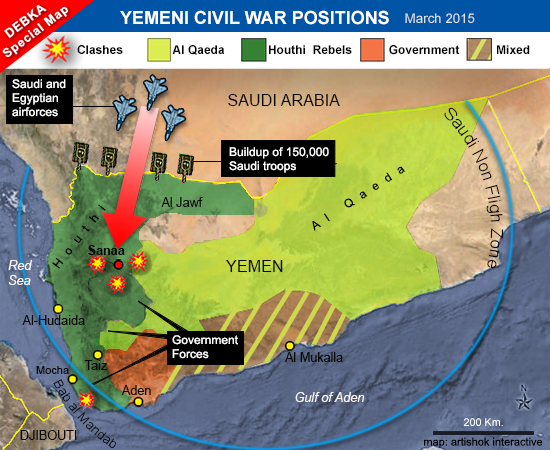
Yemen3_1

The separate operations in Yemen and Iraq attested to the widening breach between the Sunni Arab camp and the Obama administration and the former’s resolve to thwart US strategy for buying a nuclear deal with Tehran by empowering Iran to attain the rank of leading Middle East power.

**********************

In a surprise step, Egyptian marine naval and marine forces Thursday morning, March 26, seized control of the strategic Bab El-Mandeb Straits to foil Tehran’s plans to grab this important energy shipping gateway between the Red Sea, the Gulf of Aden and the Suez Canal, DEBKAfile’s military sources report from the Gulf. Egypt disguised the raid as a counter-piracy operation. It rounded off the Saudi-led air strikes launched the same morning against Iran-backed Houthi rebels in Yemen. These operations signaled the start of a major Sunni Arab revolt against Iran’s approaching takeover of Yemen, through its Houthi proxy, and advances in other strategic positions in the Middle East, with Washington’s support.

Thursday morning too, the US launched the US launched its first air strikes against Islamic State positions in the Iraqi city of Tikrit, rallying to the aid of the Iranian-commanded Iraqi operation, which had failed to dislodge the jihadis in two weeks of fighting.

The separate operations in Yemen and Iraq attested to the widening breach between the Sunni Arab camp and the Obama administration and the former’s resolve to thwart US strategy for buying a nuclear deal with Tehran by empowering Iran to attain the rank of leading Middle East power.

DEBKAfile reported earlier Thursday morning:

Iran’s Revolutionary Guards (IRGC) are now leading war action in four Mid East arenas: Syria, Iraq, Yemen and Lebanon, while building Shiite “popular” armies deferring to Tehran in three: Syria, Iraq and Yemen.

The formal announcements coming from Riyadh and Washington attempted to gloss over the open breach. The Saudis Wednesday indicated that their military buildup on the Yemeni was “purely defensive,” while Washington subsequently declared support for the Saudi-Gulf-Egyptian air strikes after they began.

According to our Washington sources, President Obama decided Wednesday to accede to the Iraqi premier Haider al-Abadi’s request for air support to de-stall the Tikrit operation against ISIS. Iran’s Al Qods Brigades chief, Gen. Qassem Soleimani, who commanded the operation from the start has departed the scene.

Nothing has been said to indicate whether the Iranian forces, including Revolutionary Guards officers, remain in the area. It appears that the Obama administration prefers as little as possible to be mentioned about US-Iranian battlefield coordination in Iraq versus the Islamists, especially since it was not exactly a big success. At the same time, US air strikes launched to support ground forces are bound to be coordinated with their commanders, who in this case happen to be mostly Iranian. In the last two weeks of the Tikrit operation, liaison between the US and Iranian military in Iraq was routed through the office of the Iraqi Prime Minister in Baghdad.

Early Thursday, Riyadh reported that the Saudi Royal Air Force had taken out Houthi air defenses, destroyed numerous Houthi fighter planes and were imposing a wide no-fly zone over Yemen.

Egypt is providing political and military support for Saudi-GCC operation against Houthi fighters in Yemen, the Egyptian state news agency said Thursday. Egypt’s Foreign Ministry was quoted as saying this support could involve Egyptian air, naval and ground forces, if necessary.

DEBKAfile’s military sources add: The Saudis declared Yemeni air space a no-fly zone to achieve to goals: (1) To deny the Yemeni forces advancing on the key port city of Aden access to air cover which would undoubtedly have been forthcoming from mutinous elements of the Yemeni air force. Without it, the rebel advance would be severely hobbled, and, (2) to prevent Iranian warplanes from landing at Yemeni air bases with deliveries of military equipment and ammunition their Houthi proxies.

Gulf sources disclose that Saudi Arabia has placed 100 warplanes and 150,000 troops with heavy weapons at the disposal of the operation against Iran’s Yemeni proxy, the Zaydi Houthis, as well as pressing into service Pakistani, Moroccan and Jordanian military units. This force is a sign that Riyadh intends of following up its air action with a ground invasion across the border into Yemen to crush the revolt in its backyard.

Developing…

Saudi Arabia launches airstrikes in Yemen, ambassador says

March 26, 2015

Saudi Arabia launches airstrikes in Yemen, ambassador says, Fox News, March 26, 2015

(Meanwhile, as Iranian supported Houthis take over much of Yemen, the U.S. is providing airstrikes in Tikrit to assist Iran and helping Iran to establish itself as a nuclear power. Please see also, US air force bombs Tikrit to aid Iran-led operation against ISIS. Saudi, Egyptian bombers strike Iran-backed Houthi rebels in Yemen. — DM)

032515_shep_Yemen2_640Iran-backed rebels bring Yemen to brink of civil war

Saudi Arabia launched airstrikes against the Houthi rebels in Yemen early Thursday, one day after the U.S.-backed Yemeni president was driven out of the country.

President Obama has authorized the provision of logistical and intelligence support to the military operations, National Security Council spokesperson Bernadette Meehan said late Wednesday night. She added that while U.S. forces were not taking direct military action in Yemen, Washington was establishing a Joint Planning Cell with Saudi Arabia to coordinate U.S. military and intelligence support.

Saudi Ambassador Adel al-Jubeir said the operations began at 7 p.m. Eastern time.

He said the Houthis, widely believed to be backed by Iran, “have always chosen the path of violence.” He declined to say whether the Saudi campaign involved U.S. intelligence assistance.

Al-Jubeir made the announcement at a rare news conference by the Sunni kingdom.

He said the Saudis “will do anything necessary” to protect the people of Yemen and “the legitimate government of Yemen.”

A Yemeni official earlier Wednesday would not say where Yemeni President Abed Rabbo Mansour Hadi fled to, but did tell Fox News: “He is safe. That’s all I can say at this point.”

Hadi’s departure marks a dramatic turn in Yemen’s turmoil and means a decisive collapse of what was left of his rule, which the United States and Gulf allies had hoped could stabilize the chronically chaotic nation and fight Al Qaeda’s branch here after the 2011 ouster of longtime autocrat Ali Abdullah Saleh.

Over the past year, the Shiite rebels known as Houthis, who are believed to be supported by Iran, have battled their way out of their northern strongholds, overwhelmed the capital, Sanaa, seized province after province in the north and worked their way south. Their advance has been boosted by units of the military and security forces that remained loyal to Saleh, who allied with the rebels.

With Hadi gone, there remains resistance to the Houthis scattered around the country, whether from Sunni tribesmen, local militias, pro-Hadi military units or Al Qaeda fighters.

Hadi and his aides left Aden after 3:30 p.m. on two boats, security and port officials told The Associated Press. He is scheduled to attend an Arab summit in Egypt on the weekend, where Arab allies are scheduled to discuss formation of a joint Arab force that could pave the way for military intervention against Houthis.

His flight came after Houthis and Saleh loyalists advanced against Hadi’s allies on multiple fronts. Military officials said militias and military units loyal to Hadi had “fragmented,” speeding the rebel advance. The officials spoke on condition of anonymity because they were not authorized to speak to reporters

Earlier in the day, the rebels seized a key air base where U.S. troops and Europeans had advised the country in its fight against Al Qaeda militants. The base is only 60 kilometers (35 miles) away from Aden.

In the province of Lahj, adjoining Aden, the rebels captured Hadi’s defense minister, Maj. Gen. Mahmoud al-Subaihi, and his top aide on Wednesday and subsequently transferred them to the capital, Sanaa. Yemen’s state TV, controlled by the Houthis, announced a bounty of nearly $100,000 for Hadi’s capture.

Hadi then fled his presidential palace, and soon after warplanes targeted presidential forces guarding it. No casualties were reported. By midday, Aden’s airport fell into hands of Saleh’s forces after intense clashes with pro-Hadi militias.

Aden was tense Wednesday, with schools, government offices, shops and restaurants largely closed. Inside the few remaining opened cafes, men watched the news on television. With the fall of the city appearing imminent, looters went through two abandoned army camps, one in Aden and the other nearby, taking weapons and ammunition.

The takeover of Aden, the country’s economic hub, would mark the collapse of what is left of Hadi’s grip on power. After the Houthis overran Sanaa in September, he had remained in office, but then was put under house arrest. He fled the capital earlier in March with remnants of his government and declared Aden his temporarty capital.

Yemen’s Foreign Minister Riad Yassin told Dubai-based Al-Arabiya TV satellite news network that he officially made a request to the Arab League on Wednesday to send a military force to intervene against the Houthis. Depicting the Houthis as a proxy of Shiite Iran, a rival to Sunni Gulf countries, he warned of an Iranian “takeover” of Yemen. The Houthis deny they are backed by Iran.

Mohammed Abdel-Salam, a spokesman for the Houthis, said their forces were not aiming to “occupy” the south. “They will be in Aden in few hours,” Abdel-Salam told the rebels’ satellite Al-Masirah news channel.

Earlier, Al-Masirah reported that the Houthis and allied fighters had “secured” the al-Annad air base, the country’s largest. It claimed the base had been looted by both Al Qaeda fighters and troops loyal to Hadi.

The U.S. recently evacuated some 100 soldiers, including Special Forces commandos, from the base after Al Qaeda briefly seized a nearby city. Britain also evacuated soldiers.

The base was crucial in the U.S. drone campaign against Al Qaeda in the Arabian Peninsula, which Washington considers to be the most dangerous offshoot of the terror group. And American and European military advisers there also assisted Hadi’s government in its fight against Al Qaeda’s branch, which holds territory in eastern Yemen and has claimed the attack on the French satirical magazine Charlie Hebdo in Paris.

U.S. operations against the militants have been scaled back dramatically amid Yemen’s chaos. U.S. officials have said CIA drone strikes will continue in the country, though there will be fewer of them. The agency’s ability to collect intelligence on the ground in Yemen, while not completely gone, is also much diminished.

The Houthis, in the aftermath of massive suicide bombings in Sanaa last week that killed at least 137 people, ordered a general mobilization and their leader, Abdel-Malik al-Houthi, vowed to send his forces to the south to fight Al Qaeda and militant groups.

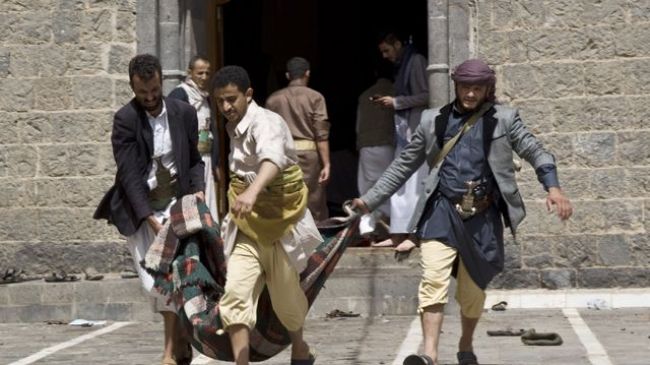
In Sanaa, dozens of coffins were lined up for a mass funeral of the victims Wednesday. Among the victims was a top Shiite cleric. Yemen’s Islamic State-linked militants have claimed responsibility for the attack.

The Houthis seized the capital, Sanaa, in September and have since been advancing south along with Saleh’s loyalists. On Tuesday, they fired bullets and tear gas to disperse thousands of protesters in the city of Taiz, known as the gateway to southern Yemen. Six demonstrators were killed and scores more were wounded, officials said.

The Houthis also battled militias loyal to Hadi in the city of al-Dhalea, adjacent to Taiz, Yemen’s third-largest city. Taiz is also the birthplace of its 2011 Arab Spring-inspired uprising that forced Saleh to hand over power to Hadi in a deal brokered by the U.N. and Gulf countries.

Hadi on Tuesday asked the U.N. Security Council to authorize a military intervention “to protect Yemen and to deter the Houthi aggression” in Aden and the rest of the south. In his letter, Hadi said he also has asked members of the six-nation Gulf Cooperation Council and the Arab League for immediate help.

Saudi Arabia warned that “if the Houthi coup does not end peacefully, we will take the necessary measures for this crisis to protect the region.”

Iran gathers power in Iraq as US further sidelined

March 18, 2015

Iran gathers power in Iraq as US further sidelined, Al-MonitorMohammed A. Salih, March 17, 2015

(The Iraqi – Iranian effort to retake Tikrit has been “stalled” for several days. — DM)

SULAIMANIYAH, Iraq — While the United States has invested trillions of dollars and thousands of lives since 2003 to bring Iraq into its orbit, today it is Iran that appears to have achieved that goal, albeit with far less costs in terms of money and lives, observers and analysts of Iraqi affairs agree.

There appears to be no better demonstration of Iran’s success in having firmly established its hegemony across Iraq than in the current operation to retake the Sunni-dominated province of Salahuddin in central Iraq. The operation to push out Islamic State (IS) militants from Tikrit and its surrounding areas in Salahuddin is being carried out by a ragtag force of Shiite Popular Mobilization Units (PMUs), the Iraqi army and some local Sunni tribes.

The largest military campaign so far against IS, the Salahuddin operation has been noted for the heavy involvement of Iranian military advisers and the conspicuous absence of the US military. While the United States has in the past aided similar operations by the Iraqi military and PMUs in areas such as Amerli and Baiji, no US warplanes are now dropping bombs in Salahuddin.

“The Iranians have checkmated the Americans, and I think the Americans now understand this,” Hayder al-Khoei, an Iraq expert at the London-based Chatham House, told Al-Monitor. “What’s interesting about the Salahuddin operation is that the Iraqis and the Iranians are proving to Americans: We don’t need your airstrikes.”

When IS swept large parts of northern and central Iraq in June, the jihadist group appeared unstoppable. During a forum last week in Sulaimaniyah, a city in Iraqi Kurdistan, Brett McGurk, US deputy assistant secretary of state for Iraq and Iran, admitted that a few days after IS’ onslaught in mid-June, his government’s assessment was that Baghdad might fall within 72 hours.

“Iran proved, despite its difficult economic conditions, that it is prepared … and stood by us in any way it could to defend our country and our Islam and common beliefs, and by that I don’t mean the Shiite sect but the genuine human values that govern in this region,” said Hussein al-Shahristani, Iraq’s minister of higher education and a powerful Shiite politician, during the forum. “Iraqis will not forget this favor.”

Iraqi leaders say Iran has provided around $10 billion worth of weaponry to their forces. Iranian military advisers have also not been shy to advertise their role in the battle to retake the key city of Tikrit, the hometown of their former No. 1 enemy, former leader Saddam Hussein.

Gen. Qasem Soleimani, head of the Iran’s Islamic Revolutionary Guard Corps’s (IRGC) elite Quds Force, has made no secret of his pivotal role on the front lines of Salahuddin. He is said to have been deeply involved in planning and executing the current battle.

Many of the major Shiite armed groups such as the Badr Brigades, Asaib Ahl al-Haq and Kataib Hezbollah are known to have been founded, trained and funded by the IRGC. It’s these forces that play the critical role in pushing back IS jihadists, according to media reports.

US military officials have expressed their concerns over Iran’s strong role in Salahuddin, fearing this could further alienate Sunni Arabs and Washington’s efforts to get them onboard to fight against IS. Amid all this, many observers are asking whether the United States was even invited to join the Salahuddin campaign.

“The Iranians and their Iraqi proxies wanted to demonstrate their power and that they can fight in any battlefield, whether it is in the … mixed sectarian areas or in Sunni-only areas such as the Tigris River Valley [in Salahuddin],” Michael Knights, a fellow at the Washington Institute for Near East Policy specialized in the military affairs of Iraq and Iran, told Al-Monitor.

The US absence in the Salahuddin theater comes despite Washington’s attempts to coordinate the “liberation” of Sunni areas from IS. A date was even announced by Pentagon officials for an operation to retake Mosul from IS. But by conducting the Salahuddin operation, Shiite paramilitary groups and their Iranian backers sent a message of their own.

“[Iran and Shiite forces] are the most significant partners to the Iraqi state. They planned this operation to ensure they would get [to Tikrit] first, before the Americans,” Knights added. “It’s a big propaganda victory for the PMUs.”

Knights said that the operation was initially planned without Iraqi Prime Minister Haider al-Abadi’s involvement. Official Iraqi army units were added only later, when Abadi got wind of the planning for the operation. Around 20,000 Shiite forces and 3,000 Iraqi soldiers are taking part in the Salahuddin assault, according to top US Gen. Martin Dempsey.

If the operation succeeds, most of the credit will go to PMU leaders such as Hadi al-Ameri and Abu Mahdi al-Muhandis and Quds Force Cmdr. Soleimani, Knights said.

The emergence of IS appears to have further consolidated Iranian clout in Iraq, as Iran’s generals and sponsored militias have taken the lead in fighting off IS in areas the jihadist group seized from the Iraqi army last summer.

Even though many believe much of the US arms assistance for Iraq ends up in the hands of the pro-Iranian Shiite paramilitary groups, these forces make little secret of their disdain for the United States, often peddling conspiracies that the United States and other countries deliver military aid to IS.

While Iran has jockeyed for influence in Iraq since 2003, the withdrawal of US troops from Iraq in late 2011 paved the way for a stronger Iranian role in Iraq. The Syrian crisis next door brought Tehran and Baghdad even closer together as both sides shared an interest in saving President Bashar al-Assad’s regime and preventing the rise of a Sunni-dominated order there.

Now, as Iraq continues to slide even further into Iran’s hemisphere of influence, many in Washington are questioning US arms deliveries to Baghdad. Concerns about military aid to Iraq have been amplified due to gross human rights violations committed by Shiite PMUs and Iraqi troops.

Kenneth Pollack, an expert on Middle East politics and military affairs with the Washington-based Brookings Institution, believes the United States should continue a strong relationship with Baghdad.

“I think the Americans drawing back will be the worst thing to do. That will drive the government in Baghdad even more deeply into the arms of the Iranians,” Pollack told Al-Monitor. “If Iraq is going to move to a place where Iran has less influence, it’s going to take a long time.”


Hero of the Middle East: The Israeli Messenger

March 18, 2015

Hero of the Middle East: The Israeli Messenger, The Gatestone InstituteBassam Tawil, March 18, 2015

In its evident, inexplicable eagerness to sign just about any deal with Iran to allow it nuclear weapons capability, the U.S. State Department has removed Iran and its proxy, Hezbollah — two of the world most undisguised promoters of terror — from its Foreign Terrorist Organizations List.

Iran’s President, Hassan Rouhani, has even openly admitted that Iran’s diplomacy with the U.S. is an active “jihad.” How much plainer does a message have to get?

The Islamists have nothing but contempt for Europe’s weakness.

The West needs to paralyze Iran, rather than appease it.

A series of significant defeats to Islamist organizations will counter the effects of their efforts to entice young people to join them, especially ISIS.

In these terrible times, critical for the future of our region, Netanyahu spoke to the representatives of the American people, despite the objections of many Israelis and Americans. He was willing to accept personal, political and diplomatic setbacks in order to look after his people’s security.

We are all also hoping that that the government of Israel will focus even more on bringing the Arabs of Israel into the Israeli fold. Otherwise a “fifth column” could form and harden that will drive them into the open and waiting arms of Hamas and other terrorist groups.

Arab-Israeli politicians might also focus more on helping such an effort, rather than, as many Arab politicians do, lash out and blame others for what is wrong — a lazy, destructive substitute for actually helping improve the lives of their people.

Ever since Israel’s Prime Minister, Benjamin Netanyahu, came back from his recent visit to the United States, it has repeatedly been shown that he was right to stand before Congress and issue his warnings. Tehran’s Ayatollahs have not only held a naval exercise in the Strait of Hormuz, where they targeted a simulated a U.S. Navy aircraft carrier, they also displayed new missiles that could paralyze all the shipping in the Gulf.

Iran has already surrounded the oilfields of the Middle East, and is openly increasing its efforts to bring down the “Big Satan,” the United States. Iran’s President, Hassan Rouhani, has even openly admitted that Iran’s diplomacy with the U.S. is an active “jihad.” How much plainer does a message have to get?

Iran has not only taken over Yemen, Lebanon and Syria It is also in the process of taking over — presumably with the help of its negotiations with the U.S. — Bahrain, Iraq, Libya and parts of South America, especially Venezuela, with its vast reserves of uranium, and Bolivia, now with a suspected nuclear installation.

In its evident, inexplicable eagerness to sign just about any deal with Iran to allow it to achieve nuclear capability, the U.S. State Department has removed Iran and its proxy, Hezbollah — two of the world’s most undisguised promoters of terror — from its Foreign Terrorist Organizations List, presumably at Iran’s request.

After Republican Senators sent a letter to Iran warning that any agreement with the U.S. would have to be endorsed by Congress, the Iranians used it to claim that the United States is so weak it is about to fall apart. The king of Saudi Arabia said that if the U.S. did not halt Iran’s nuclear program, Saudi Arabia would begin enriching its own uranium, to acquire a nuclear potential equal to that of Iran.

Ashraf Ramelah, president of the Christian human rights organization Voice of the Copts, asked House Speaker John Boehner to invite Egyptian President Abdel Fattah el-Sisi to address Congress, to warn America of the mistake it clearly intends to make. The members of the Arab League met in Riyadh to warn America of the approaching disaster.

U.S. Secretary of State John Kerry recently hinted that the agreement with Iran was not particularly urgent, and claimed that should the talks fail, the United States had alternatives.

Apparently with the sole objective of embarrassing Netanyahu, no one in the U.S. administration was willing to admit that he was right, or that unfortunately there were many American individuals and organizations actively intervening in the Israeli elections, with the goal of toppling Netanyahu. The U.S. Administration clearly wanted to replace him with Yitzhak Herzog, who is weak — another link in the chain of American foreign policy failures, from Allende and the Shah of Iran to Mubarak, all victims of the political and diplomatic elite’s ignorance and lack of political common sense.

The lesson President Obama has not yet learned from his experience with Arabs is that anyone who deliberately ignores or applauds when his own fanatic Muslim nationals (or guests) kill “infidels” will eventually be repaid with the killing of his own non-extremist Muslims. That is exactly what is going to happen in Iran, Turkey, Qatar, Lebanon and other countries that support terrorism.

The Western world should be wary, and not be tempted into breathing a sigh of relief because the Muslim Brotherhood condemned the burning of the Jordanian pilot. The Muslim Brotherhood, which consistently preaches the murder of innocents of every stripe, is currently trying to cover its tracks regarding murder carried out in the name of Islam through the taqiyya, which permits Muslims to lie to “protect” Islam — in this case against the global wave of outrage against Islamist terrorism. Perhaps they condemn the burning alive of the pilot because, according to Islam, only Allah can burn someone to death. But behind their pious declarations they are overjoyed by his death, and continue inciting their followers to murder more of those they have designated as “infidels,” while every day designating still more.

That Hamas and ISIS identify with one another, collaborate and have almost identical goals was made clear recently by the arrests Hamas operatives in the Palestinian Authority on the grounds that they vandalized the memorial set up in Ramallah for the murdered Jordanian pilot.

In their misguided, fumbling experiments, EU officials, along with the Arab League foreign ministers, are forming a united front to fight Islamist terrorism, while including the very countries known consistently to support it. These include Turkey, which mainly supports ISIS, and Qatar, which supports the Islamist terrorist organizations in the Sinai Peninsula and the Gaza Strip.

Despite the fact that the Muslim Brotherhood and the other Islamist terrorist organizations thrive in Arab states — although in some they have been outlawed — the West, especially the Obama Administration, doggedly refuses to outlaw them and insists they are peace-loving religious organizations. For some intriguing reason, the leaders of the Western world find it impossible to see the relationship between the Muslim Brotherhood and the Islamist terrorist organizations it fosters.

Obama’s behavior underlies the conspiracy theory, common in the Middle East, that he is a Muslim Brotherhood mole.

The U.S. Administration refuses to recognize the dangerous game Turkey is playing by ignoring the West’s sanctions on Iran. Despite the fact that Turkey is a member of NATO, it has, in fact, upgraded and improved its trade agreements with Iran.

The European Union, in its cowardice and folly, has removed Hamas, the Muslim Brotherhood’s Palestinian branch, from its list of designated terrorist organizations. Europe refuses to change its stance, even though barely a week ago, Egypt designated the entire Hamas movement a terrorist organization. Hamas supports ISIS in the Sinai Peninsula and within Egypt itself, as they attack government, security and civilian targets.

The Islamists have nothing but contempt for Europe’s weakness, and in the meantime, ISIS’s wave of success in Iraq and Syria, and its brand as “powerful,” encourage young, impressionable Muslims to join its ranks.

In the meantime, in the wake of rising Islamist sentiment in the Muslim communities of Europe and the U.S., imams and Islamist activists have been falling over themselves to reassure the public. They have opened mosques to casual visitors, in an effort to allay their fears and downplay the threat, as if a Westerner on a guided tour could possibly understand the degree of propaganda and incitement churned out behind closed doors, in classrooms and libraries.

* * *

The wages America pays Iran, in return for questionable aid it may or may not receive in the fight against ISIS, only serve to strengthen the Ayatollahs and their collaborators — Russia, Syria and Hezbollah — and ease the sanctions against Iran to make it stronger, enabling further expansion. And that is before Iran achieves nuclear weapons capability. What about after?

The saga will likely end with an agreement ending the sanctions on Iran, permitting it to build its nuclear bomb “for peaceful purposes,” while in the meantime Iran will have taken over Yemen, completed its new line of “defensive” missiles, of the sort that will be able to reach Europe and be loaded onto submarines.

The soon-to-be-signed agreement between Iran and the United States not only abandons the Sunni Arab states and Israel to their fates; it also paves the way for an inevitable nuclear arms race involving Sunni states, carried out in the vain hope that they will be able to contain the Shi’ites before they launch a nuclear Armageddon on the Middle East.

There is also the rumored approaching death of Iran’s Supreme Leader Ali Khamenei. Thus, any agreement signed with the Iranians won’t be worth the paper it is printed on, because no one knows who will replace him and if his replacement will agree to honor any commitments signed by the previous regime.

Instead of strengthening moderate Sunni states such as Egypt and the Gulf States, both of which are exploring an innovative, moderate, contemporary Islam, America has chosen to support the Muslim Brotherhood, which has fooled it into thinking it is not doing its utmost to weaken those moderate states.

The U.S. is driving a wedge into the unity of the Sunni Arab world and weakening its efforts to counter Iran.

To misrepresent the agreement with Iran, the Obama Administration enlisted European countries to create a smokescreen and media white noise, labeling Israel’s failure to reach a peace agreement with the Palestinians as the only important issue problem the Middle East.

They are using Europe to turn Israel into a leper, as if it is Israel’s bound duty to accept American dictates because of its dependence on the American veto in the UN. Obama’s National Security Advisor, Susan Rice, instead of focusing on the catastrophically serious Iranian threat, recently made the hostile statement that Israel must now resolve the Palestinian issue.

The efforts Israeli Prime Minister Benyamin Netanyahu has made to convince Congress not to support the agreement with Iran were brutally attacked by the White House, which is apparently only open to hearing opinions that agree with it.
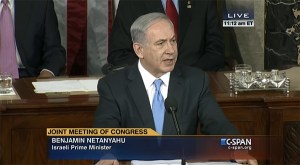
968Israel’s Prime Minister Benjamin Netanyahu speaks before the U.S. Congress, March 4, 2015. (Image source: C-SPAN video screenshot)

Despite reservations regarding Netanyahu’s hard line in Israel’s negotiations with Palestinians, many of us in the Middle East are of the opinion that he is another real hero of the Middle East.

Many people here are also hoping that as the Arab Israeli vote was the third largest bloc in the yesterday’s election, perhaps now the government of Israel will focus more on bringing the Arabs of Israel even closer and more comfortably into the Israeli fold. Otherwise, there is the serious possibility that a “fifth column” could form and harden, one that will drive the Arab Israelis into the open and waiting arms of Hamas and other terrorist groups.

We also hope that the Arab Israeli politicians will focus more on such an effort, rather than, as many Arab politicians do, lashing out and blaming others for what is wrong — a lazy, destructive substitute for actually helping improve the lives of their people.

In these terrible times, critical for the future of our region, Netanyahu spoke to the representatives of the American people, despite the objections of many Israelis and Americans. He was willing to accept personal, political and diplomatic setbacks in order look after his people’s security.

Throughout history, prophets have often been without honor in their own countries, and have been rejected by the very people who should pay attention to them. There is, it seems, in every culture, a deep and real wish to kill the messenger.

The West would do well to understand that anyone really interested in fighting terrorism needs to outlaw the Muslim Brotherhood movement — all its branches, wherever they are. Even more, it needs to paralyze Iran, rather than appease it.

The West’s dark, contradictory dealings with Turkey, Qatar, Iran and other shadowy regimes serve the growth of Islamist terrorist organizations. They destroy the chance for any success against radical Islam.

The fight against Islamist organizations needs to be creative, deliberate and continuous, to keep them from gaining even one victory either on the ground or in their propaganda campaigns. The Muslim public must not view them as attractive, or see joining them a sign of success. A series of significant defeats to Islamist organizations will counter the effects of their efforts to entice young people to join them, especially ISIS.

It is sad that in the face of the coming catastrophe, Western leaders — either blind, naïve or malevolent — are going to make a deal and appease Iran, just as a deal was made to appease Hitler in 1938.

Aiding Islamic Terrorists Is Our Foreign Policy

February 20, 2015

Aiding Islamic Terrorists Is Our Foreign Policy, Front Page Magazine, Daniel Greenfield, February 20, 2015

s3tttf7n-14138040081-370x350

In the White House, Obama has tried to shape an Islamist future for the Middle East, favoring Islamist governments in Turkey and Islamist movements such as the Muslim Brotherhood. He saw his role as paving the way for the next generation of regional regimes that would be explicitly Islamist.Obama’s foreign policy in the region has been an elaborate exercise in trying to draw up new maps for a caliphate. The inclusion of terrorist groups in this program isn’t a mistake. It’s not naiveté or blindness. It’s the whole point of the exercise which was to transform terrorist groups into governments.

Obama’s foreign policy in the region has been an elaborate exercise in trying to draw up new maps for a caliphate. The inclusion of terrorist groups in this program isn’t a mistake. It’s not naiveté or blindness. It’s the whole point of the exercise which was to transform terrorist groups into governments.

******************

Obama says that we are not fighting a war on Islam. What he leaves out is that under his administration the United States is fighting in a civil war that is taking place within Islam.

It’s not a conflict between the proverbial moderate Muslim and the raging fanatic. That was an outdated Bush era notion. Instead Obama has brought us into a fight between Muslim governments and Muslim terrorists, not on the side of the governments we were allied with, but on the side of the terrorists.

It’s why Egypt is shopping for French planes and Russian nukes. Yemen’s government was run out of town by Obama’s new Iranian friends in a proxy war with Saudi Arabia. And the Saudis are dumping oil.

Iran and Qatar are the regional powers Obama is closest to. What these two countries have in common, is that despite their mutual hostility, they are both international state sponsors of Islamic terrorism.

Obama’s diplomats will be negotiating with the Taliban in Qatar. Among the Taliban delegation will be the terrorist leaders that Obama freed from Gitmo. And Iran gets anything it wants, from Yemen to the bomb, by using the threat of walking away in a huff from the hoax nuclear negotiations as leverage.

In Syria and Iraq, Obama is fighting ISIS alongside Islamic terrorists linked to Al Qaeda and Iran. In Libya, he overthrew a government in support of Islamic terrorists. His administration has spoken out against Egyptian air strikes against the Islamic State Jihadists in Libya who had beheaded Coptic Christians.

At the prayer breakfast where he denounced Christianity for the Crusades was the foreign minister of the Muslim Brotherhood government of Sudan that has massacred Christians. Unlike Libya, where Obama used a false claim of genocide to justify an illegal war, Sudan actually has committed genocide. And yet Obama ruled out using force against Sudan’s genocide even while he was running for office.

The United States now has a strange two-tier relationship with the Middle East. On paper we retain a number of traditional alliances with old allies such as Egypt, Israel and Saudi Arabia, complete with arms sales, foreign aid and florid speeches. But when it comes to policy, our new friends are the terrorists.

American foreign policy is no longer guided by national interests. Our allies have no input in it. It is shaped around the whims of Qatar and Iran; it’s guided by the Muslim Brotherhood and defined by the interests of state sponsors of terror. Our foreign policy is a policy of aiding Islamic terrorists.

It’s only a question of which terrorists.

Obama’s familiar argument is that ISIS and Al Qaeda fighters shouldn’t be called Islamic terrorists. Not even the politically correct sop of “Radical Islam” is acceptable. The terrorists are perverting Islam, he claims. The claim was banal even before September 11, but it bears an entirely new significance from an administration that has put Muslim Brotherhood operatives into key positions.

The administration is asserting the power to decide who is a Muslim. It’s a theological position that means it is taking sides in a Muslim civil war between Islamists.

This position is passed off as a strategy for undermining the terrorists. Refusing to call the Islamic State by its name, using the more derogatory “Daesh,” denying that the Islamic terrorists are acting in the name of Islam, is supposed to inhibit recruitment. This claim is made despite the flood of Muslims leaving the West to join ISIS. If any group should be vulnerable to our propaganda, it should be them.

But that’s not what this is really about.

According recognition to a state is a powerful diplomatic tool for shaping world politics. We refuse to recognize ISIS, as we initially refused to recognize the USSR. Obama resumed diplomatic ties with Cuba. His people negotiate and appease the Taliban even though it was in its own time just as brutal as ISIS.

Obama is not willing to recognize ISIS as Islamic, but he does recognize the Muslim Brotherhood as Islamic. Both are violent and murderous Islamists. But only one of them is “legitimate” in his eyes.

Those choices are not about terrorist recruitment, but about building a particular map of the region. Obama refuses to concede that ISIS is Islamic, not because he worries that it will bring them more followers, this is a tertiary long shot at best, but because he is supporting some of their rivals.

The White House Summit on Countering Violent Extremism has brought a covert strategy out into the spotlight. Despite its name, it’s not countering violence or extremism.

The new director of the Center for Strategic Counterterrorism Communications, the axis of Obama’s CVE strategy, is Rashad Hussain who appeared at Muslim Brotherhood front group events and defended the head of Islamic Jihad. In attendance was Salam Al-Marayati of the Muslim Public Affairs Council, yet another Muslim Brotherhood linked group, who had urged Muslims not to cooperate with the FBI and defended Hamas and Hezbollah.

In Syria, the United States is coordinating with Assad and backing the Syrian rebels, who have their own extensive ties to the Muslim Brotherhood and even Al Qaeda. This could be viewed as an “enemy of my enemy” alliance, but this administration backed the Brotherhood before it viewed ISIS as a threat. Top Democrats, including Nancy Pelosi and John Kerry, had focused on outreach to Assad under Bush.

They’re not allying with Assad and the Brotherhood to beat ISIS. They’re fighting ISIS to protect the Brotherhood and their deal with Iran.

In the White House, Obama has tried to shape an Islamist future for the Middle East, favoring Islamist governments in Turkey and Islamist movements such as the Muslim Brotherhood. He saw his role as paving the way for the next generation of regional regimes that would be explicitly Islamist.

The Arab Spring was a deceptive code name for a clean sweep that would push out the old leaders like Mubarak and replace them with the Muslim Brotherhood and other likeminded Islamists. Islamic terrorism, at least against the United States, would end because their mission had been accomplished.

Stabilizing unrest by putting the destabilizers in charge wasn’t a new idea. Carter helped make it happen in Iran. And the more violent an Islamic terrorist group is, the more important it is to find a way to stop the violence by putting them in charge. The only two criteria that matter are violence and dialogue.

So why isn’t Obama talking to ISIS? Because ISIS won’t talk back. It’s impossible to support a terrorist group that won’t engage in dialogue. If ISIS were to indicate any willingness to negotiate, diplomats would be sitting around a table with headchoppers in less time than it takes a Jordanian pilot to burn.

And that still might happen.

Obama isn’t trying to finish off ISIS. He’s keeping them on the ropes the way that he did the Taliban. Over 2,000 Americans died on the off chance that the Taliban would agree to the negotiations in Qatar. Compared to that price in blood, the Bergdahl deal was small potatoes. And if Obama is negotiating with the Taliban after all that, is there any doubt that he would negotiate to integrate ISIS into Iraq and Syria?

Obama’s foreign policy in the region has been an elaborate exercise in trying to draw up new maps for a caliphate. The inclusion of terrorist groups in this program isn’t a mistake. It’s not naiveté or blindness. It’s the whole point of the exercise which was to transform terrorist groups into governments.

Stabilizing the region by turning terrorists into governments may sound like pouring oil on a fire, but to progressives who believe in root causes, rather than winning wars, violence is a symptom of discontent. The problem isn’t the suicide bomber. It’s our power structure. Tear that down, as Obama tried to do in Cairo, and the terrorists no longer have anything to fight against because we aren’t in their way.

Bush tried to build up civil society to choke off terrorism. Obama builds civil society around terrorists.

Obama does not believe that the terrorists are the problem. He believes that we are the problem. His foreign policy is not about fighting Islamic terrorists. It is about destroying our power to stop them.

He isn’t fighting terrorists. He’s fighting us.

Qatar, Egypt on a collision course

February 9, 2015

Qatar, Egypt on a collision course, Israel Hayom, Dr. Reuven Berko, February 9, 2015

This anti-Egypt agenda, which seems to be shared by Turkey, is fueled by the desire to realize the dream of installing a Sunni Islamic empire, all while undermining moderate Arab regimes and giving a nod to Iran, as a way of covering all bases — just in case.

******************

Qatar and Egypt are at odds, and the attempts by the late King Abdullah of Saudi Arabia to facilitate a reconciliation between them have failed.

Qatar’s relentless efforts to overthrow Egyptian President Abdel-Fattah el-Sissi’s regime and reinstate the Muslim Brotherhood to power are evident from the programs airing on the Doha-controlled Al-Jazeera television network, and from the publication of doctored wiretaps featuring the Egyptian president and his advisers, who allegedly “stole” Egypt away from the Muslim Brotherhood and the “holy” Mohammed Morsi.

This anti-Egypt agenda, which seems to be shared by Turkey, is fueled by the desire to realize the dream of installing a Sunni Islamic empire, all while undermining moderate Arab regimes and giving a nod to Iran, as a way of covering all bases — just in case.

Egypt’s decision to outlaw the Muslim Brotherhood has resulted in increased incitement by Qatar as well as in an escalation in terrorist attacks in Egypt and Sinai. Egyptian intelligence has linked the latest series of attacks to Ansar Beit al-Maqdis, an offshoot of the Islamic State group, as well as to Hamas’ Izzedine al-Qassam Brigades. Hamas and the Izzedine al-Qassam Brigades are very much Qatar’s “babies,” and their involvement in these terrorist attacks has prompted Egypt to outlaw both.

In response, Al-Jazeera has begun portraying Izzedine al-Qassam Brigades’ operatives, who have denounced Sissi as a traitor to Islam and Arabs everywhere, as heroes fighting for the liberation of “Palestine.” The Qatari television station has also been obsessively covering the riots and unrest instigated by the Muslim Brotherhood to undermine the regime, intimidate foreign investors, and reverse the image of stability Sissi’s government is trying to convey to the world.

The airing of secret wiretaps, on which Sissi is heard mocking the wealthy Persian Gulf states, at this time seeks to pit Cairo against the Gulf states, ahead of the World Economic Forum on the Middle East, which is scheduled to convene in Sharm el-Sheikh, in Egypt, in late February, and where Egypt will lobby for aid.

Sissi’s assertion about the current situation in the Middle East is correct: Sunni Arab states are being offered as sacrifice to Iran, which is pursuing its nuclear endeavors uninterrupted. These states understand that Egypt’s stability is a prerequisite for their own national security, and therefore aiding Cairo is a favor that could only work to their advantage.

At the end of the day, in a reality where Iran poses an existential threat to other Arab countries, pointing to the emir of Qatar as a leader drowning in gold while millions of Egyptians go hungry — as heard on the wiretaps — may prove to be a double-edged sword, which may end up striking Qatar itself.