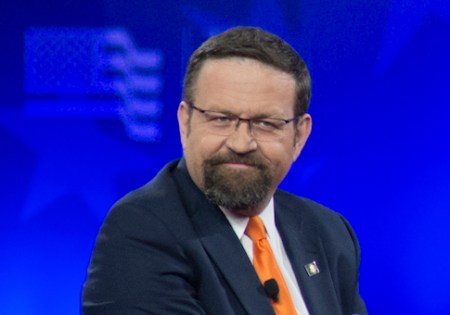
 Sebastian Gorka / AP
Today, Gorka sits at the apex of power in the White House as an aide to White House Chief Strategist Steve Bannon. As deputy assistant to the president, Gorka is the key national security figure on the Strategic Initiatives Group, currently led by Trump’s son-in-law Jared Kushner, Bannon and Chief of Staff Reince Priebus and made up of mainly business experts.
************************************
World War II bomber pilots liked to say if you’re not taking flak, you’re not over the target. By any measure, Sebastian Gorka, a counterterrorism adviser to President Donald Trump, is in the eye of an unprecedented flak storm from liberal press outlets. The enemy fire proves he must be doing something right thing.
“Look, these attacks are just too predictable,” Gorka said in an interview. “As they say in the military, ‘you’re only taking flak if you’re over the target.'”
For Gorka, the most revealing aspect of the many column inches devoted to the criticism is that “it’s never truly about our policies or the issues that matter most.”
“It’s always personal, always ad hominem,” he said in an interview at the Conservative Political Action Conference. “That tells you all you need to know about the other side’s true weakness. They can’t win on the merits of their case, so they ‘play the man, not the ball.'”
For the new president, Gorka is an antidote to the politically correct counterterrorism policies of the past eight years under Barack Obama.
The shift has set off controversy. Several news articles about Gorka in recent weeks were laced with personnel attacks, innuendo, and caustic comments from critics. The media assault came from the upper levels of the mainstream press including the New York Times, Washington Post, and Wall Street Journal. Other lesser publications such as Politico piled on. Vanity Fair labeled him Trump’s “jihad whisperer.”
All promoted a common—and to many observers false—narrative asserting that Gorka, deputy assistant to the president and member of the new Strategic Initiatives Group, is unqualified, anti-Islam, racist, fascist, or worse.
“I would be very concerned if the likes of Politico, the New York Times, and Washington Post were not attacking me. And Trump voters would be too,” Gorka said.
Gorka said the goals for the new Trump administration’s counterterrorism program and policies are simple. “As the president said [Friday] we will ‘obliterate’ groups like ISIS and wipe the scourge of radical Islamic terrorism from the face of the earth,” he said.
The media attacks prompted friends and supporters of Gorka on Capitol Hill and in the military and special operations community to voice their support.
“The bottom line is Sebastian Gorka’s work is a necessary tool for all special operations forces in developing critical thinking,” said an Army special operations officer familiar with Gorka’s counterterrorism lectures in Tampa, Florida, and Fort Bragg, North Carolina.
The officer said Gorka has been most valuable in helping hundreds of commandos properly identify and understand the nature of the threat posed by Islamist terrorists.
“Our biggest threat we face is tied to radical Islam,” the officer said. “We teach our Special Forces how to think, not what to think. [Gorka’s] speeches have been 100 percent factual and the reason he has spoken so often is that he has been able to connect with warrant officer candidates.”
“We’ve lived the last decade and a half of war and this is our lives. Having someone like Mr. Gorka who connects with our groups, gives us a solid foundation.”
Retired Army Lt. Gen. John M. Mulholland, a career Special Forces officer, said he has known Gorka from his counterterrorism lectures.
“Seb has always been first and foremost a patriot, dedicated to this country,” Mulholland said in an interview. “He has been very supportive to us in helping us understand the threat so we can apply our capabilities to support the nation against the unconventional warfare threat, in this case, the terrorism threat.”
Mulholland, former deputy commander of the U.S. Special Operations Command, said Gorka has helped special operations commandos to better understand the terrorism threat environment.
“Seb is one of those guys we always turn to to help us understand the threat, and he’s a great friend and supporter of our community and our mission and in helping us in our own endeavor to master the environment,” he added.
Retired Army Lt. Gen. Charles T. Cleveland, former commander of the Army Special Operations Command, also praised Gorka.
“What distinguished [Gorka] was the time he took to understand how the special operations soldiers, many who had multiple tours in the fight, saw the challenges and were dealing with them,” Cleveland said. “As a result, his instruction was crisp, relevant, and a useful part of their education on how to think about today’s threats, especially terrorism.”
Gorka also took part on some occasions on the commander’s advisory group sessions that included former senior civilian and military officials and academic experts.
“These events provided outside opinion on command doctrine and organizational proposals, and I greatly appreciated Dr. Gorka’s participation,” Cleveland said.
Retired Marine Corps. Col. Raymond C. Damm, a professor at Marine Corps University, said recent news stories attacking Gorka harkened back to a period “yellow journalism.”
“They were a hatchet job based on innuendo and painting a story a way you want it to be received,” Damm said.
Damm said Gorka taught at the Marine Corps University and “he made us better because he made us think.”
“Dr. Gorka can be polarizing because he does not follow the party line,” Damm said. However, Gorka helped Marines to better understand what motivates the terrorist threat. “And I am sorry, but being nice to them is not the answer,” Damm said. “They are scary and hate us because they have been taught to hate us their entire lives. Iron sharpens iron. Dr. Gorka made us better while he was here.”
Stephen Sloan, professor emeritus at the University of Oklahoma, said he has known Gorka since the 1990s.
“Over the years, I have served as an informal adviser on his dissertation and was one of his mentors as he pursued his career,” Sloan said. “Sebastian has always impressed me as a man of integrity who has strong feelings and is willing to state them. I believe his concerns about the threat of terrorism as to what he regards to be the new totalitarianism, in part, reflects his family history. His father was imprisoned and almost killed as a result of his opposition to Soviet occupation in Hungary.”
Sloan said Gorka has strong loyalties to America and is proud of his work with the U.S. military and “is concerned about meeting threats to U.S. national security. I appreciate and respect his dedication.”
Sloan said he does not agree with some of Trump’s policies and is concerned about Gorka’s views on how to respond to terrorism. “However, even though we may disagree during this time of intense political debate, I support his right to state his opinions without being condemned,” he said.
The unusual political attacks were not confined to newspapers. On social media, a little-known counterterrorism expert, Michael S. Smith, has launched verbal broadsides against Gorka on Twitter. Smith also tape recorded a call from the White House adviser questioning why Smith was criticizing Gorka so loudly when he had never met him.
The criticism prompted Rep. Robert Pittenger (R., N.C.), chairman of the Congressional Task Force on Terrorism, an advisory group Smith said he worked for, to issue a statement of support.
“Dr. Sebastian Gorka is a friend and trusted adviser on efforts to combat radical Islamic terrorism and increase the safety and security of American families,” Pittenger said in a statement.
Pittenger said Gorka has spoken to more than 600 parliamentarians from 60 nations on how to combat terrorism financing, money laundering, and other national security topics.
“Dr. Gorka has provided expert testimony at these forums and I applaud President Trump for bringing him to the White House,” he said.
Clark Fonda, an aide to Pittenger, said he knew Smith from the caucus. “We used to reject his input regularly,” he said. “I always found him to be unprofessional and a burden to work with, but I was absolutely stunned to see he would record a phone call and distribute it to Newsweek.”
Fonda said Smith also falsely billed himself as a current adviser to the Congressional Taskforce on Terrorism and Unconventional Warfare headed by Pittenger.
“He never ever contributes to what we do,” he said. “I haven’t even spoken to him in the two years I’ve been here.”
Rep. Trent Franks (R., Ariz.) also backed Gorka. “I have followed the recent press and social media attacks against Dr. Sebastian Gorka and am compelled to respond with disgust at the attempt to libel this American patriot,” Franks said in a statement.
Franks criticized media attacks falsely labeling Gorka as anti-Semitic. “Having called upon his expertise on counterterrorism repeatedly in Congress and used his analysis to inform our work, I can attest that Dr. Gorka is the staunchest friend of Israel and the Jewish people,” he said.
“Sebastian Gorka’s service to the nation, his reputation, and his national security credentials are all unimpeachable and I am thrilled he is now serving in the White House as deputy assistant to President Donald J. Trump.”
Gorka has emerged in recent years as one of America’s most outspoken counterterrorism experts. He has been a professor of military theory at the Marine Corps University as well as a vice president of the Institute of World Politics.
His military consulting work has included frequent lectures at the U.S. Army Special Operations Command in North Carolina and at the U.S. Special Operations Command in Tampa, Florida.
He also was a national security editor at Breitbart.com and is a frequent Fox News Channel contributor.
Today, Gorka sits at the apex of power in the White House as an aide to White House Chief Strategist Steve Bannon. As deputy assistant to the president, Gorka is the key national security figure on the Strategic Initiatives Group, currently led by Trump’s son-in-law Jared Kushner, Bannon and Chief of Staff Reince Priebus and made up of mainly business experts.
The mission of the SIG, as it is called, is to provide the White House with greater long-term strategic options in coordination with the National Security Council that normally is focused on dealing with day-to-day issues and crises. It also brings in outside experts.
Gorka came to the attention of Donald Trump in 2015 and worked with the campaign. It was Gorka who is said to have helped Trump criticize the politically correct counterterrorism formulations of the Obama administration.
Obama demanded that government abandon the use of the term radical Islam. Instead, politically correct terms were ordered in describing terrorism, including “workplace violence” for domestic attacks, and “violent extremism”—all in an effort to avoid using the word, Islam.
Trump loudly proclaimed during the presidential campaign that the threat and enemy to be countered under his counterterrorism policies and programs would be radical Islamic terrorism.
Along with his wife, Katherine Gorka, who is an adviser at the Department of Homeland Security, the Gorkas are now one of the most important power couples in Washington.
Gorka is said to have been a key advocate for the Trump executive order banning travelers from seven states linked to terrorism.
For Gorka, the current state of international terrorism, including both al Qaeda and the Islamic State, are all part of what he has termed the “global jihadist movement” a totalitarian movement not unlike the Cold War ideological foe of Soviet communism.
The 2012 book, Fighting the Ideological War, co-edited by Katherine Gorka, includes a chapter by Gorka that seeks to identify radical Islamic terror’s threat doctrine and how to attack it.
“Although we have proven our capacity in the last 10 years kinetically to engage our enemy at the operational and tactical level with unsurpassed effectiveness, we have not even begun to take the war to al Qaeda at the strategic level of counter-ideology—to attack it at its heart—the ideology of global jihad,” he wrote.
Defeating global jihadism requires clearly understanding the enemy and then attacking its ideology, he argues, something that has been lacking in U.S. government efforts.
Gorka’s bestselling book, Defeating Jihad: The Winnable War, concludes that despite differences among the Islamic terror groups they all share a vision of an Islamic supremacist worldview that poses a danger to western civilization.
At a recent Heritage Foundation event, “iWar: Waging Warfare in the Information Age,” Gorka said U.S. operations against terrorism for the past 16 years have been “whack-a-mole”—finding and killing terrorist leaders that are replaced by others.
Gorka said critics who call his style of aggressive counterterrorism programs and their advocates “Islamophobes” are absolutely wrong.
“Half of my students were Muslim and are on the front line and paying a heavy price, more than we are in America,” he said. “This is a war inside Islam, a war for the heart of Islam—which version will be preeminent.”
The United States needs to help western-oriented Muslim states, like Jordan and Egypt, to help defeat the radical jihadists, Gorka says.
Gorka, 46, grew up in England and was part of an intelligence unit of the British Army Reserve. He received his Ph.D. in political science from Corvinus University in Budapest. He spent four years as a member of the faculty at the Program on Terrorism and Security Studies at the George C. Marshall Center in Germany.
At the White House, Gorka is working to establish new strategies and policies he hopes will shift the focus to both military and intelligence to the counter-ideological realm.
One of the first steps said to be under consideration is declaring the Muslim Brotherhood, a key element of the global jihadist movement, to be a terrorist organization.
Under Obama, the U.S. government formally designated the Muslim Brotherhood as the U.S. government’s key alternative to be supported in the war against al Qaeda and later the Islamic State. A secret directive outlining the pro-Muslim Brotherhood policy, known as Presidential Study Directive-11, could be declassified in the future as a first step in the designation of the group as a terrorist organization.
Gorka’s outspoken views on terrorism and Islam and his high profile media appearances have made him a lightning rod for liberal left news outlets.
The New York Times falsely suggested Gorka, the British-born immigrant of Hungarian émigré parents, had Nazi sympathies—despite that fact that Gorka’s father fought against both the Nazis and the Communists in Hungary.
The Post sought to portray Gorka as a minor counterterrorism specialist on the “fringes” of Washington and sought out obscure critics to denounce him. One former CIA analyst told the newspaper he was “nuts” while knowing little about Gorka.
Politico‘s profile of Gorka quoted “puzzled” security experts who criticized him for his outspoken views on Islam, jihad, and the counterterrorism views that closely align with the new president.
The Wall Street Journal quoted numerous think tank terrorism experts who said they did not believe Gorka was part of the “mainstream” of experts.
Gorka said in the interview that victory needs to be defined in the war on terrorism.
“Personally, I want the black flag of jihad to become as despised around the globe as the black, red and white swastika flag of the Nazis is today,” he said. “Then we will have won.”





 anneinpt
 artaxes
 danmillerinpanama
 davidking1530
 Peter Hofman
 Joseph Wouk
 Peter
Peter Louisiana Steve
 WarSclerotic
Recent Comments