Archive for the ‘Sanctions’ category

Iran buys 100 Russian refueling aircraft for its air force to reach any point in the Mid East

July 22, 2015

Iran buys 100 Russian refueling aircraft for its air force to reach any point in the Mid East, DEBKAfile, July 22, 2015

IL78_MKI-IRAN_B_7.2015Russian IL78 MKI tanker aircraft sold to Iran

The Secretary of State can expect some really hard questions during his trip on exactly how the Vienna accord makes the region safer, when Iran’s first act after signing is to arm itself with a fleet of Russian in-flight fuel tankers to expand and strengthen its range and power for aerial aggression.

*********************

In defiance of the international arms embargo, Iran last week placed an order with Moscow for a huge fleet of 100 Russian IL78 MKI tanker aircraft (NATO: Midas) for refueling its air force in mid-flight, thereby extending its range to 7,300 km. This is reported exclusively by DEBKAfile from its military and intelligence sources. The transaction runs contrary to the terms of the nuclear accord the six world powers and Iran signed in Vienna earlier this month.

These tanker planes can simultaneously refuel six to eight warplanes. Their acquisition brings Israel, 1.200km away – as well the rest of the Middle East – within easy range of Iranian aerial bombardment. It also puts Iran’s air force ahead of Israel’s in terms of the quantity and range of its refueling capacity.

Whereas opponents of the Vienna deal have warned that Tehran will spend the billions of dollars released by sanctions relief as a bonanza for fueling its campaigns of terror in the region, it turns out that Iran’s first post-accord purchase is a heavy investment in the rearmament and upgrade of its armed forces’ aggressive capabilities.

The Israeli air force is familiar with the Russian airborne tanker from its use by the Indian air force with which Israel has close ties of cooperation. Its military engineers have also upgraded the Russian fuel tankers in service with the Uzbekistan air force.

Tuesday, July 21, DEBKAfile uncovered some of the tactics and escape clauses Iran has had built into its nuclear accord with the world powers for circumventing its provisions and commitments. The purchase of Russian refueling craft is a concrete example of this kind of evasion. Because the accord confirms the arms embargo in force until 2020, both Moscow and Tehran can maintain that the Russian aircraft industry will not be able to produce 100 new planes before the five years are up, and so the transaction is not a violation.

The huge Iranian-Russian military transaction therefore stands as the first palpable test of the Vienna accord, depending on whether US President Barack Obama or his Secretary of State John Kerry decides to make an issue of it. If they just let it go, it will set a precedent for the arms embargo clause of the nuclear accord to start unraveling.

Also Tuesday, Kerry gave an interview to the Al Arabia TV to prepare the way for his mission to the Gulf region on Aug. 3, which is to ease its rulers’ extreme unease over the ramifications of the nuclear accord. He asserted strongly to the interviewer: “I am not going to go through in great detail all the ways in which this agreement, in fact, makes the Gulf States and the region safer.”

The Secretary of State can expect some really hard questions during his trip on exactly how the Vienna accord makes the region safer, when Iran’s first act after signing is to arm itself with a fleet of Russian in-flight fuel tankers to expand and strengthen its range and power for aerial aggression.

Kerry doesn’t know how to “interpret” Iran’s vow to fund terrorists

July 21, 2015

Kerry doesn’t know how to “interpret” Iran’s vow to fund terrorists, Front Page Magazine, Daniel Greenfield, July 21, 2015

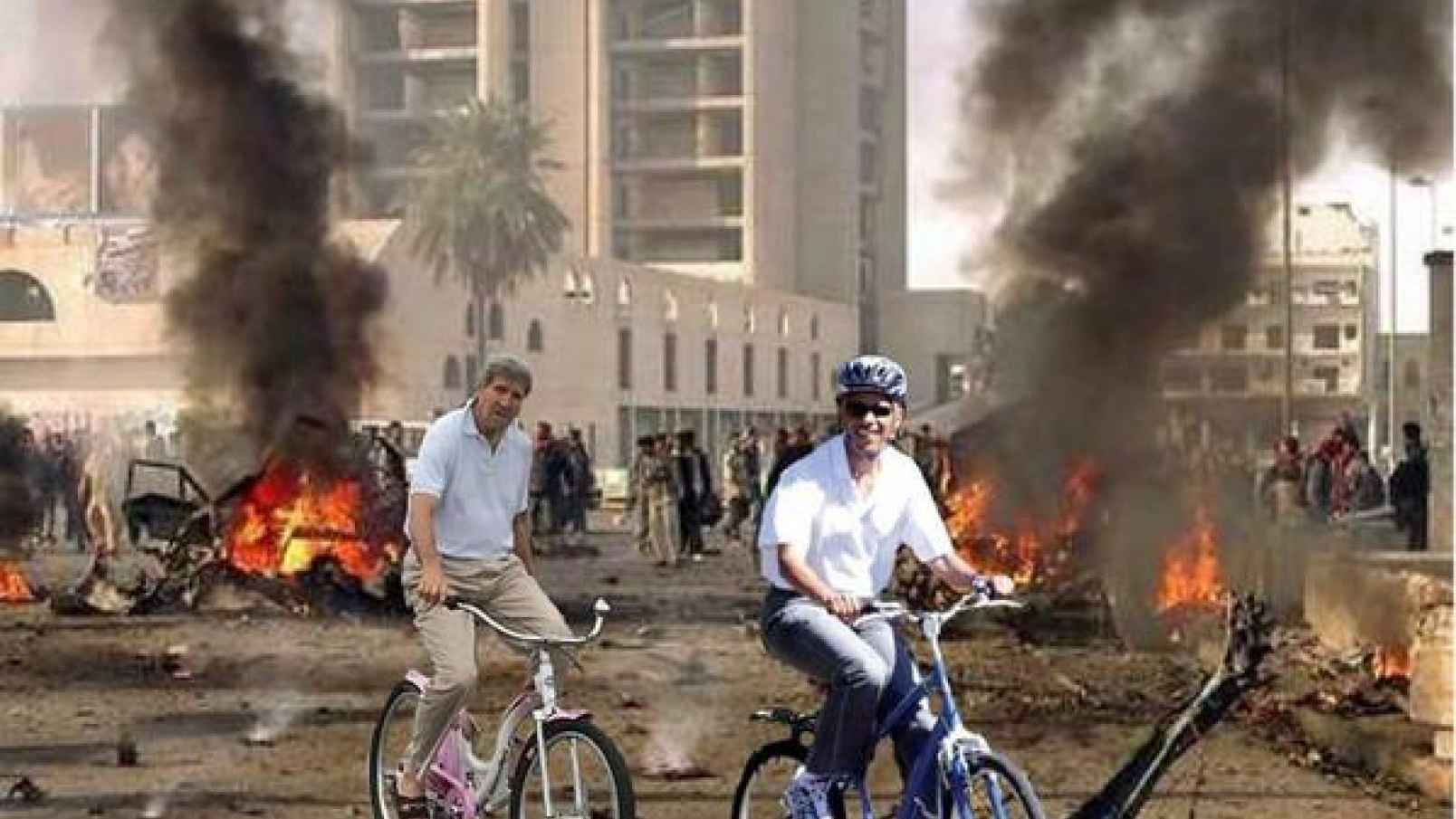
obama_kerry_bikes

John is going to have to go courting another terror state. North Korea has preemptively turned him down, but maybe Kerry can windsurf his way into North Korea and promise lots and lots of money if its dictator will pose for some photos in Vienna with America’s dumbest traitor.

*********************

Only liberals seem to need an interpretation of “Death to America”. John Kerry meanwhile wanders around the Middle East trying to interpret what Iran means when it vows to fund terrorists and fight America.

US Secretary of State John Kerry has acknowledged that Iranian Supreme Leader Ayatollah Ali Khamenei’s continued vows to defy the US are “very disturbing.”

“I don’t know how to interpret it at this point in time, except to take it at face value, that that’s his policy,” Kerry told Saudi-owned television station Al-Arabiya Tuesday. “But I do know that often comments are made publicly and things can evolve that are different. If it is the policy, it’s very disturbing, it’s very troubling.”

Don’t worry, given a little time, Kerry will find a way to interpret these comments not at “face value”.

Iran’s Supreme Leader Khamenei gave a particularly inflammatory speech just days after the deal, stating that the Islamic Republic’s policies toward the US have not changed.

“We will never stop supporting our friends in the region and the people of Palestine, Yemen, Syria, Iraq, Bahrain and Lebanon,” he continued, referring to the Iranian terror axis in the Middle East. “Even after this deal our policy towards the arrogant US will not change.”

Go and interpret a vow to keep funding Hezbollah, Hamas, the Houthis and Assad while fighting the US in the most positive way possible. If you’re good enough at it, you can get a gig at the State Department.

But you have to feel sorry for John Kerry, who pushed the Iran deal claiming that it would lead to a new era of diplomacy with Iran. Now John has been jilted once again. The Supreme Leader doesn’t seem to want to be his friend after all. Soon the Foreign Minister of Iran will stop returning his phone calls as soon as Iran gets $150 billion in sanctions relief.

And John is going to have to go courting another terror state. North Korea has preemptively turned him down, but maybe Kerry can windsurf his way into North Korea and promise lots and lots of money if its dictator will pose for some photos in Vienna with America’s dumbest traitor.

Islam, Imam Obama, Sir John of Kerry and a great deal for Iran | Part II

July 20, 2015

(The views expressed in this post are mine, and do not necessarily reflect those of Warsclerotic or its other editors. — DM)
Oh what a tangled web we weave, when first we practice to deceive.

Dealing from the Bottom

The current “deal” is based on a long-standing scam

Part I of this series, published on July 14, 2015, pointed out what should be a glaring consistency in the “Joint Comprehensive Plan of Action,” first made available on that date, and the November 24, 2013 Joint Plan of Actionneither provides for any “anytime -anywhere” inspections of Iran’s nuclear weaponization or missile sites. That consistency has been little remarked upon elsewhere.

Secretary Kerry now acknowledges that he never sought such inspections.

Leaving aside the twenty-four day lag between an IAEA request to inspect suspect facilities — which Kerry says is just fine — he claims that we now have a “unique ability” to get the U.N. Security Council to force inspections and reinstate sanctions. However, any effort to do so would almost certainly be vetoed by one or more Security Council members. The permanent members are China, France, Russia, the United Kingdom, and the United States — five of the members of P5+1 which approved the “deal.”

On July 16th, US Under Secretary of State Wendy Sherman said,

“I think this is one of those circumstances where we have all been rhetorical from time to time,” Sherman said in a conference call with Israeli diplomatic reporters. “That phrase, anytime, anywhere, is something that became popular rhetoric, but I think people understood that if the IAEA felt it had to have access, and had a justification for that access, that it would be guaranteed, and that is what happened.” [Emphasis added.]

Kerry also claimed that the massive financial boost for Iran resulting from the lifting of sanctions will not enhance Iran’s support for terrorism.

Speaking to the BBC after the nuclear agreement between Iran and six world powers was reached, Kerry said that the more than $100 billion that Iran is set to receive “is going to make all the difference in the world is just – it’s not true.”

Acknowledging Iran is an international player in wreaking terror across the globe, Kerry said, “What Iran has done for years with Hezbollah does not depend on money.” He similarly stated Iran’s support of the Houthi rebels against the government in Yemen has not “depended on money.” [Emphasis added.]

. . . .

In its most recent report, the State Department wrote, “Iran has provided hundreds of millions of dollars in support of Lebanese Hezbollah in Lebanon and has trained thousands of its fighters at camps in Iran.”

In 2010 alone, State reported “Iran provides roughly $100-$200 million per year in funding to support Hezbollah.”

Secretary Kerry is almost certainly wrong, on that as on other aspects of the “deal.”.

Here’s Megan Kelly’s wrap up.


Iran may reject the “deal.”

There are at least glimmers of hope that Iran may reject the “deal,” unanimously endorsed by the UN Security council today.

A UN Security Council resolution endorsing Iran’s nuclear deal that passed on Monday is unacceptable, the country’s Islamic Revolutionary Guards Corps commander Mohammed Ali Jafari was quoted as saying by the semi-official Tasnim News Agency.

“Some parts of the draft have clearly crossed the Islamic republic’s red lines, especially in Iran’s military capabilities. We will never accept it,” he was quoted as saying shortly before the resolution was passed in New York. [Emphasis added.]

The Iranian Parliament also has problems with the “deal.”

On Saturday, the Fars News Agency reported that the Majlis threatened to reject the agreement’s provision on ballistic missiles, which call for an international embargo on missile technology to be extended for eight years–a significant, last-minute concession by the U.S.

Iran wants unrestricted ballsitic missile development and access to conventional arms dealers abroad.

“The parliament will reject any limitations on the country’s access to conventional weapons, specially ballistic missiles,” said Tehran MP Seyed Mehdi Hashemi.

. . . .

In addition, the nuclear deal says that the Majlis will ratify the Additional Protocol (AP) to the Non-Proliferation Treaty–but it does not say when.

The AP is the key to long-term monitoring of Iranian nuclear research and development by the International Atomic Energy Agency (IAEA). Without approval of the AP, Iran may hide key information about its nuclear activity, and may accelerate advanced centrifuge research immediately when the nuclear deal expires, among other hazards. (Even then, its commitments under the AP will be somewhat voluntary.) [Emphasis added.]

. . . .

[W]hile the interim agreement of Nov. 2013 provided that Iran would ratify the AP within one year, there is no such deadline in the final Iran deal. The AP is merely to be applied “provisionally,” while the Majlis decides whether to accept it or not.

Meanwhile, if the Obama administration has its way, the U.S. Congress will have no opportunity to amend the deal–and will have to accept the lifting of international sanctions regardless of whether legislators accept or reject the agreement. [Emphasis added.]

Iranian leadership’s opposition to the “deal” appears to have come from Iran’s Supreme leader and the Iranian Parliament has the authority to reject the “deal.”

As expected, Ayatollah Ali Khamenei’s reaction to the nuclear deal was utterly different from that of President Hassan Rouhani. Right after the agreement was announced on July 14, Rouhani appeared on state television and praised the outcome. Yet when he and other officials visited Khamenei’s home a few hours later, the Supreme Leader did not say anything about the deal apart from a few lines thanking the negotiators. This reticence signaled to hardliners that they should increase their attacks on the agreement. [Emphasis added.]

America’s Supreme Leader, on the other hand, has been pushing vigorously to force the U.S. Congress to approve it, with no way to change it.


The “deal,” and Obama’s foreign policy in general, are rooted in His affinity for Islam

Obama may or may not be a Muslim. However, He thinks very highly of Islam and deems it the “religion of peace.” It would be ironic were Obama’s Iran “deal” to be rejected by Iran.

As observed in a Jerusalem Post article, with the thrust of which I agree, His affinity for Islam is at the root of His “deal.”

Obama is the first US president who genuinely conceives of Islam as not inherently opposed to American values or interests.

. . . .

It is through this Islamo-philic prism that the Obama administration’s attitude to, and execution of, its foreign policy must be evaluated – including its otherwise incomprehensible capitulation this week on Iran’s nuclear program. [Emphasis added.]

. . . .

The inspection mechanism provided for in the nascent deal make a mockery of Obama’s contention (July 14): “… this deal is not built on trust; it is built on verification,” and, “Because of this deal, inspectors will also be able to access any suspicious location… [They] will have access where necessary, when necessary.”

One can hardly imagine a more grossly misleading representation of the deal – so much so that it is difficult not to find it strongly reminiscent of the Muslim tactic of taqiya (the religiously sanctioned deception of non-Muslims). [Emphasis added.]

Indeed, immediately following the announcement of the agreement, Ben Rhodes, Obama’s deputy national security adviser, made a stunning admission to CNN’s Erin Burnett. Starkly contradicting the president’s contention of “access where necessary, when necessary,” Rhodes conceded, “We never sought in this negotiation the capacity for so-called anytime, anywhere,” which is diametrically opposed to the impression he conveyed in April this year when queried on this issue. [Emphasis added.]

In His capacity as America’s Imam in Chief, Obama has consistently claimed that the “religion of peace” has nothing to do with the Islamic State or with Islamic terrorism (of which he claims there is none) — such as the recent murder of four members of the U.S. Marines and one member of the U.S. Navy — committed in the name of Allah. The Daily Beast has posted some of the terrorist’s writings. They include these statements:

“I would imagine that any sane person would devote their time to mastering the information on the study guide and stay patient with their studies, only giving time for the other things around to keep themselves focused on passing the exam,” Abdulazeez wrote. “They would do this because they know and have been told that they will be rewarded with pleasures that they have never seen.”

This life is that test, he wrote, “designed to separate the inhabitants of Paradise from the inhabitants of Hellfire.”

. . . .

“We ask Allah to make us follow their path,” Abdulazeez wrote. “To give us a complete understanding of the message of Islam, and the strength the live by this knowledge, and to know what role we need to play to establish Islam in the world.” [Emphasis added.]

Obama apparently considers the Islamic Republic of Iran to be Islamic — and therefore peaceful — despite its widespread support for its terrorist proxies. That may explain the credence He gives to Supreme Leader Khamenei’s alleged fatwa preventing Iran from obtaining nukes. Obama and Khamenei have frequently referred to it in support of that proposition, although no text been produced. According to a Washington Post article dated November 27, 2013,

Oddly, the Iranian Web site does not provide the text of the original fatwa — and then mostly cites Western news reports as evidence that Khamenei has reiterated it on several occasions. The fatwa does not appear to be written, but in the Shiite tradition equal weight is given to oral and written opinions.

. . . .

Just about every Alfred Hitchcock thriller had what he called a “MacGuffin” — a plot device that gets the action going but is unimportant to the overall story. The Iranian fatwa thus appears to be a diplomatic MacGuffin — something that gives the Americans a reason to begin to trust the Iranians and the Iranians a reason to make a deal. No one knows how this story will end, but just as in the movies, the fatwa likely will not be critical to the outcome. [Emphasis added.]

Even if one believes the fatwa exists — and will not later be reversed — it clearly appears to have evolved over time. U.S. officials should be careful about saying the fatwa prohibits the development of nuclear weapons, as that is not especially clear anymore. The administration’s statements at this point do not quite rise to the level of  earning Pinocchios, but we will keep an eye on this issue. [Emphasis added.]

An April 6, 2015 article at the Middle East Media Research Institute provides additional information.

In March of this year Obama presented a Nowruz message to the people of Iran citing Khamenei’s alleged fatwa. Here’s a video from the White House.

Here are a few interesting excerpts:

“Our negotiations have made progress, but gaps remain,” he said. “And there are people, in both our countries and beyond, who oppose a diplomatic resolution. My message to you—the people of Iran—is that, together, we have to speak up for the future we seek. [Emphasis added.]

“As I have said many times before, I believe that our countries should be able to resolve this issue peacefully, with diplomacy,” Obama said. “Iran’s Supreme Leader Ayatollah Khamenei has issued a fatwa against the development of nuclear weapons, and President Rouhani has said that Iran would never develop a nuclear weapon. [Emphasis added.]

Isn’t that special! Why, in light of the alleged fatwa, does Iranian television broadcast simulations of nuclear attacks on Israel?

A short animated film being aired across Iran, shows the nuclear destruction of Israel and opens with the word ‘Holocaust’ appearing on the screen, underneath which a Star of David is shown, Israel’s Channel 2 reported on Tuesday.

Khamenei’s Death to America rants are considered an excellent reason to have a “deal.”

Similarly, the Reverend Jeremiah Wright was fond of saying “God Damn America.”

Obama apparently understood Khamenei’s words, but perhaps He didn’t understand Jeremiah’s words.


Conclusions

Elected on a platform of Hope and Change, Obama has brought us many changes; very few, if any, of those changes provide a basis for hope, at least until He has left office. Some will be difficult, if not impossible, even then to ameliorate. During His remaining time in office, He will continue to do His worst to eliminate any vestigial hope we may have. The “deal” with Iran is only one of the many changes for the worse that He has wrought.

Deep meaning of the Iran deal

July 18, 2015

Deep meaning of the Iran deal, Power LineScott Johnson, July 18, 2015

This deal does the opposite of rolling back Iran’s nuclear program. It funds, protects, and perfects the nuclear program.

*****************

Omni Ceren sent out several email messages yesterday updating his readers on the Iran agreement (Joint Comprehensive Plan of Action or “JCPOA”). I would like to bring the following excerpt from one of the messages to your attention. Omri writes:

The agreement commits the international community to actively helping Iran perfect its nuclear program over the life of the deal (!) On a policy level, it means Iran’s breakout time will be constantly shrinking. On a political level, it means that the deal will be seen as accomplishing the exact opposite of what the Obama administration promised Congress: instead of rolling back Iran’s nuclear program, it will commit the U.S. and its allies to funding and boosting it.

The commitments are sprinkled across the JCPOA and obligate a range of global powers:

Russian sponsorship/cooperation on nuclear research at Fordow — The Fordow Fuel Enrichment Plant (FFEP) will be converted into a nuclear, physics, and technology centre and international collaboration will be encouraged in agreed areas of research. The Joint Commission will be informed in advance of the specific projects that will be undertaken at Fordow…The transition to stable isotope production of these cascades at FFEP will be conducted in joint partnership between the Russian Federation and Iran on the basis of arrangements to be mutually agreed upon.

European sponsorship of nuclear security, including training against sabotage— E3/EU+3 parties, and possibly other states, as appropriate, are prepared to cooperate with Iran on the implementation of nuclear security guidelines and best practices…Co-operation through training and workshops to strengthen Iran’s ability to protect against, and respond to nuclear security threats, including sabotage.

International sponsorship/cooperation of Iranian fuel fabrication, which will help Iran complete its mastery of fuel cycle, making Iran’s program harder more opaque and difficult to regulate — The Joint Commission will establish a Technical Working Group with the goal of enabling fuel to be fabricated in Iran while adhering to the agreed stockpile parameters… This Technical Working Group will also, within one year, work to develop objective technical criteria for assessing whether fabricated fuel and its intermediate products can be readily converted to UF6.

This deal does the opposite of rolling back Iran’s nuclear program. It funds, protects, and perfects the nuclear program.

Iran’s supreme leader vows to continue anti-US policies

July 18, 2015

Iran’s supreme leader vows to continue anti-US policies, Ynet News, July 18, 2015

(Please see also, Back in Tehran… Khamenei adds red lines, Rouhani tries to resign, Jaafari hints at “fait accompli” soon. The linked July 12th DEBKAfile article claims that when Rouhani asked Khamenei to back off from some of his “red lines” and threatened to resign as president if he did not, Khamenei reminded him of the unpleasant fates of other presidents who had resigned. He and two other hard liners, Defense Minister Hosseim Dehqan and Revolutionary Guards chief Mohammad Ali Jaafari, told Rouhani 

in the stiffest terms that Tehran must not on any account bow to international pressure for giving up its nuclear program or the development of ballistic missiles.

Although Iran got just about everything it wanted, and forfeited nothing of substance, it remains possible that Iran will reject the “deal” as soon as sanctions are lifted and can not “snap back.”

In addition, please see Into the fray: Iran- Reaping the storm that Barack sowed…, contending that Obama’s affinity for Islam has much to do with the “deal.”– DM)


“If any of our security officials or members of parliament approve or denounce the deal before fully scrutinizing it, they will regret it,” Revolutionary Guard commander and head of Iran’s Basij organization, Mohammad Reza Naghdi told the Fars news agency on Friday.

*****************

Ayatollah Khamenei calls on country’s legislators to examine nuclear deal carefully before deciding whether to approve it, implying the accord has yet to win definitive backing in Tehran.

Supreme Leader Ayatollah Ali Khamenei withheld his verdict on Iran’s nuclear deal on Saturday but in a fiery address vowed enduring opposition to the United States and its Middle East policies, saying Washington sought Iran’s ‘surrender’.

In an speech at a Tehran mosque punctuated by chants of “Death to America” and “Death to Israel”, Khamenei said he wanted politicians to examine the agreement to ensure national interests were preserved, as Iran would not allow the disruption of its revolutionary principles or defensive abilities.

An arch conservative with the last word on high matters of state, Khamenei repeatedly used the phrase “whether this text is approved or not”, implying the accord has yet to win definitive backing from Iran’s factionalized political establishment.

59219580100388640360noIran’s Ayatollah Khamenei (Photo: AP)

“Whether the deal is approved or disapproved, we will never stop supporting our friends in the region and the people of Palestine, Yemen, Syria, Iraq, Bahrain and Lebanon. Even after this deal our policy towards the arrogant US will not change,” he said.

Under the agreement reached on Tuesday, sanctions will be gradually removed in return for Iran accepting long-term curbs on a nuclear program that the West has suspected was aimed at creating a nuclear bomb. Iran denies it seeks a nuclear bomb.

Khamenei’s combative remarks about US policies in the Middle East may sit awkwardly with a diplomatic offensive Foreign Minister Mohammad Javad Zarif plans in coming days in the wake of the deal.

‘Insult’

Iran regards its nuclear program as an emblem of national dignity and dynamism in the face of what it sees as decades of hostility from Western countries that opposed its 1979 Islamic revolution.

Khamenei did not echo criticisms of the deal made on Friday by a top cleric, Ayatollah Mohammad Ali Movahedi Kermani, who said in an address broadcast on radio that it reflected excessive demands by world powers that were an “insult”.

But Khamenei’s remarks radiated a broad mistrust of US intentions, claiming that successive American presidents had sought Iran’s “surrender”, and declaring that if war broke out America would come off worst, nursing “a broken head”.

“The Americans say they stopped Iran from acquiring a nuclear weapon,” Khamenei said.

“They know it’s not true. We had a fatwa (religious ruling), declaring nuclear weapons to be religiously forbidden under Islamic law. It had nothing to do with the nuclear talks.”

61618310100492640360noAnti-US and anti-Israel displays at al-Quds Day commemorations in Tehran (Photo: AFP)

Later on Saturday, the Supreme Leader praised Iranian negotiators who thrashed out the accord in marathon negotiations in Vienna.

“During the nuclear talks, we saw the Americans’ dishonesty over and over, but fortunately our officials fought back and in some cases showed revolutionary reactions,” Khamenei said during meetings with senior Iranian officials and ambassadors from several Muslim states, according to his official website.

But his remarks on Saturday did not shed light on Iran’s procedures for ratifying the accord, which are not known in any detail. Zarif will brief parliament on July 21, Iranian media have said, and the agreement will also be examined by the National Security Council, the country’s highest security body.

Zarif, who plans to visit several countries in the region, told fellow Muslim countries on Friday that Iran hoped the accord could pave the way for more cooperation in the Middle East and internationally.

In a message to Islamic and Arab countries on the Eid al-Fitr holiday at the end of Ramadan, Zarif said: “By solving the artificial crisis about its nuclear program diplomatically, a new opportunity for regional and international cooperation has emerged.”

‘Real terrorists’

Khamenei maintained that the Islamic Republic’s policies in the region would continue to defy the United States, and the nuclear deal was an exceptional instance of dialogue.

“We have repeatedly said we don’t negotiate with the US on regional or international affairs; not even on bilateral issues. There are some exceptions like the nuclear program that we negotiated with the Americans to serve our interests.”

He said US policies in the region were “180 degrees” opposed to Iran’s policies.

“The Americans dub the Lebanese resistance terrorists and regard Iran as a supporter of terrorism because of its support for the Lebanese Hezbollah, while the Americans themselves are the real terrorists who have created Islamic State and support the wicked Zionists,” Khamenei said.

Several Gulf Arab states have long accused Tehran of interference, alleging financial or armed support for political movements in several countries including Bahrain, Yemen and Lebanon. Shi’ite power Iran denies interference but vows undimmed support for the Syrian and Iraqi governments, who are both fighting insurgencies by a variety of Sunni armed groups.

Prominent conservatives have largely kept silent on the deal. Ali Akbar Velayati, a senior advisor to Khamenei, did not mention the agreement in his Eid al-Fitr message.

“If any of our security officials or members of parliament approve or denounce the deal before fully scrutinizing it, they will regret it,” Revolutionary Guard commander and head of Iran’s Basij organization, Mohammad Reza Naghdi told the Fars news agency on Friday.

Into the fray: Iran- Reaping the storm that Barack sowed…

July 18, 2015

Into the fray: Iran- Reaping the storm that Barack sowed…, Jerusalem PostMARTIN SHERMAN,July 16, 2015

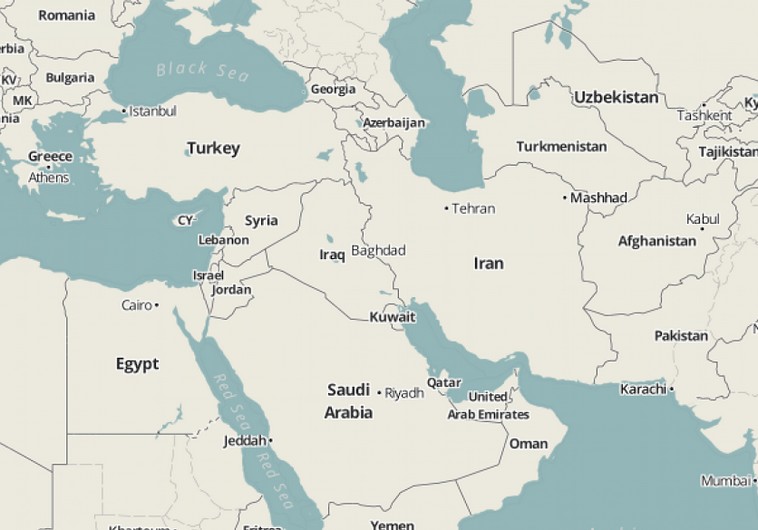
ShowImage (3)Map of Middle East. (photo credit:Courtesy)

It is through this Islamo-philic prism that the Obama administration’s attitude to, and execution of, its foreign policy must be evaluated – including its otherwise incomprehensible capitulation this week on Iran’s nuclear program.

********************

Obama is the first US president who genuinely conceives of Islam as not inherently opposed to American values or interests.

You’re absolutely right that John McCain has not talked about my Muslim faith – Barack Hussein Obama to ABC’s George Stephanopoulos, September 7, 2008

I also know that Islam has always been a part of America’s story Barack Hussein Obama, Cairo, June 4, 2009

Islam has always been part of AmericaBarack Hussein Obama, the White House, August 11, 2010

Islam has been woven into the fabric of our country since its founding Barack Hussein Obama, the White House, February 18, 2015

Barack Hussein Obama is the first US president who is explicitly and overtly unmoored, both cognitively and emotionally, from the moorings of America’s founding Judeo-Christian cultural heritage, and who genuinely conceives of Islam as not inherently opposed to American values or American interests.

A question of cultural affinity?

It is through this Islamo-philic prism that the Obama administration’s attitude to, and execution of, its foreign policy must be evaluated – including its otherwise incomprehensible capitulation this week on Iran’s nuclear program.

Almost two years ago, I wrote a column titled, “Will the West withstand the Obama presidency?” (11/28/2013). In it I warned: “For anyone who understands that the US Constitution is not a Shari’a-compliant document…

it should be alarmingly apparent that the Obama incumbency is a dramatic and disturbing point of inflection in the history of America and its Western allies… whose political practices and societal norms are rooted in Judeo-Christian foundations in a cultural rather than in any religious sense.”

There is little alternative explanation to account for the metamorphosis that has taken place in how the US has approached resolving the impasse with Tehran, as starkly laid out by two former secretaries of state, Henry Kissinger and George Shultz.

In a Wall Street Journal opinion piece, “The Iran Deal and Its Consequences” (April 7), they note that the negotiation has been turned “on its head.” As they point out: “For 20 years, three presidents of both major parties proclaimed that an Iranian nuclear weapon was contrary to American and global interests – and that they were prepared to use force to prevent it. Yet negotiations that began 12 years ago as an international effort to prevent an Iranian capability to develop a nuclear arsenal are ending with an agreement that concedes this very capability.”

Risible inspection mechanism

Even before the specifics of the risible inspection mechanism, which one Israeli minister aptly described as “worse than worthless,” Kissinger and Shultz laid out the difficulties that would render any extended inspection endeavor ineffective: “In a large country with multiple facilities and ample experience in nuclear concealment, violations will be inherently difficult to detect.”

With considerable prescience, they warn: “Devising theoretical models of inspection is one thing. Enforcing compliance, week after week, despite competing international crises and domestic distractions, is another. Any report of a violation is likely to prompt debate over its significance – or even calls for new talks with Tehran to explore the issue.

Envisaging the problems likely to arise in enforcing any agreement, they caution: “Compounding the difficulty is the unlikelihood that breakout will be a clear-cut event.

More likely it will occur… via the gradual accumulation of ambiguous evasions. When inevitable disagreements arise over the scope and intrusiveness of inspections, on what criteria are we prepared to insist and up to what point? If evidence is imperfect, who bears the burden of proof? What process will be followed to resolve the matter swiftly?”

Reminiscent of taqiya?

But even without the daunting generic difficulties described by Kissinger and Shultz, the inspection mechanism provided for in the nascent deal make a mockery of Obama’s contention (July 14): “… this deal is not built on trust; it is built on verification,” and, “Because of this deal, inspectors will also be able to access any suspicious location… [They] will have access where necessary, when necessary.”

One can hardly imagine a more grossly misleading representation of the deal – so much so that it is difficult not to find it strongly reminiscent of the Muslim tactic of taqiya (the religiously sanctioned deception of non-Muslims).

Indeed, immediately following the announcement of the agreement, Ben Rhodes, Obama’s deputy national security adviser, made a stunning admission to CNN’s Erin Burnett. Starkly contradicting the president’s contention of “access where necessary, when necessary,” Rhodes conceded, “We never sought in this negotiation the capacity for so-called anytime, anywhere,” which is diametrically opposed to the impression he conveyed in April this year when queried on this issue.

You couldn’t make this stuff up

For as it turns out, it provides the Iranians with ample warning of impending inspections on any suspected violation, and ample ability to forestall the definition of any given suspicious event as a possible violation.

Thus in the case of a suspected infringement in any undisclosed (to the international community) site, the Iranians will have at least 24 days’ notice. Moreover, inspectors will not be able to conduct surprise visits but will be required to “provide Iran the basis for such concerns and request clarification.” No kidding!!! But wait, there’s more.

If Iran’s explanations do not adequately assuage international concerns, inspectors “may request access to such locations” to make sure no illicit activity has occurred. But first they need to “provide Iran the reasons for access in writing and will make available relevant information.” You can’t make this stuff up.

But here’s the kicker: Should the Iranians and the inspectors prove unable to “reach satisfactory arrangements,” Tehran will resolve any concerns “through necessary means agreed between Iran and the IAEA.” If there is still no agreement two weeks after the initial inquiry is filed, the crisis will be resolved by vote in the so-called Joint Commission – consisting of the six world powers, a representative of EU and – wait for it – Iran.

Like warning drug dealers of a bust

Astonishingly, nearly all the decisions of the Joint Commission, tasked with overseeing/ administering the implementation of the deal, are to be made by consensus – which in effect gives Iran veto power over them. In the case of inspection access, it is sufficient for two of its eight members (say China and Russia) to abstain for Iran to block any decision it dislikes.

It is thus difficult to dispute Benjamin Netanyahu’s characterization of the deal during his address in the Knesset when he likened it to giving drug dealers notice of an impending raid: “It’s like giving a criminal organization that deals drugs a 24-day warning before inspecting its drug lab.”

But worse – the deal requires the international inspectors to expose the sources of intelligence that lead to the detection of the possible infringement – thereby virtually ensuring the termination of their effectiveness.

As Netanyahu remarked: “The agreement also requires the world powers to… show Iran the very intelligence for which they want to conduct the inspections in the first place.”

It is possible that all this could be nothing more than mind-boggling incompetence and blatant lack of foresight? Or are these glaring loopholes the reflection of intent.

Devil not in details

After all, the more you think about the unenforceable, unverifiable agreement just concocted in Vienna, the more implausible it seems. As Alan Dershowitz points out in a Jerusalem Post opinion piece this week, “The devil is not so much in the details as in the broad outlines of this deal.”

Rather than the detailed minutiae of the deal, it is its deeply flawed overall structure that makes it so difficult to comprehend – unless the motives for its conclusion are reexamined.

For unless one is imbued with the child-like naiveté to believe that the tyrannical clergy who head the totalitarian theocracy in Tehran, on seeing their defiant intransigence vindicated and having vast additional resources placed at their disposal, will suddenly change their worldview, the picture of emerging realities is decidedly bleak and bewildering.

The spectacle unfolding before us is almost incomprehensible by any rational criterion.

Virtually the entire developed world, led by the only superpower on the planet, has for all intents and purposes conceded a legitimized path to weaponized nuclear status for a fanatical fundamentalist regime, ideologically bent on the destruction of America and its allies, and a major proliferator of terrorism, committed to attaining regional hegemony at the expense of relatively pro-Western governments.

Despite dwarfing Iran in terms of military might, economic wealth, physical size and population, Tehran’s interlocutors have provided it with vast resources to enormously enhance its nefarious pursuits across the region and beyond.

The New Middle East: Conflicts on steroids

The ominous consequences are not difficult to foresee.

As Ariel Ben Solomon, the Post’s Middle East correspondent, wrote in a recent report, “Iran deal to see Middle East conflicts go on steroids,” “A stronger Iran will translate into a more robust Hezbollah in Lebanon, Houthi movement in Yemen, and Shi’ite forces in Iraq and Syria, and increasing sectarian strife fueled by Shi’ite minorities or Iranian agents throughout the Arab world.” (July 16) There is precious little reason for believing any other outcome is plausible.

In a July 15 interview, New Jersey Democrat Sen. Bob Menendez lamented another aspect of the deal, relating to easing restrictions on conventional weapons to Iran: “When you lift the arms embargo to a country that is the major sponsor of… terrorism in the world and is already destabilizing the region in Yemen, Lebanon, Syria [and] Iraq, to give them – after they are going to get $100 billion-150b. in economic relief – the opportunity to buy conventional weapons and improve their missile technology doesn’t seem to me to be in the national interest of the United States.”

The intriguing question is, of course, does this seem to President Obama to be in the national interest of the United States? And if so, why so? If so, how so?

‘No alternative’: A mindless mendacious mantra

The almost Pavlovian response of the apologists for the Iran deal is that its critics have not offered a feasible alternative. This is a claim – for want of a better word – so feeble that it barely merits a response.

As Sen. Menendez points out: “We never tested the proposition that dismantling elements of Iran’s illicit nuclear infrastructure was possible. It is pretty hard for me to believe that the world powers, sitting on one side of the table, the five permanent members of the Security Council plus Germany and the European Union looking at the Iranians… suffering under staggering sanctions… and falling oil prices couldn’t get a deal that eliminated some of that infrastructure.”

Rebutting John Kerry’s claim that such a goal was achievable only in “a world of fantasy,” Menendez retorted, “I don’t know that that is a ‘world of fantasy.’ Isn’t it possible with all the world on one side of the table, and Iran reeling with economic challenges, that you couldn’t have done better as relates to eliminating that nuclear infrastructure.”

Of course if the underlying assumption is that alternatives are only feasible if Iran deigns to accept them, then the apologists may be right. However, if the rationale were not to accommodate the ayatollahs, but to coerce them, the alternative is clear: Enhanced sanctions backed by the credible threat of military action aimed at destroying Iran’s nuclear facilities and their attendant infrastructure.

Arab arms race or Arab client states

But despite the overwhelming preponderance of power in their favor, the US and its Western allies seem to have forsworn the use of force, or even the credible specter thereof. As Kissinger and Shultz remark: “The threat of war now constrains the West more than Iran.”

This will clearly have a devastating impact on both friend and foe in the region.

It will destroy the confidence of US allies who will therefore be compelled to either acquire their own appropriate arsenals, as they can no longer rely on America for their security, or to become compliant client states of a hegemonic Iran.

For Iran it sends an equivocal message that it can violate the terms of the deal with impunity – for if what it encountered at Vienna is all the West can throw at it, what does it have to fear? There can be little doubt that what happened in Vienna this week has shredded America’s standing in the Middle East.

Some might even suspect that that was the purpose of the exercise.
Khamenei vs. Rouhani: Projecting Very Different Views on the Nuclear Deal

July 18, 2015

Khamenei vs. Rouhani: Projecting Very Different Views on the Nuclear Deal, World Affairs JournalMehdi Khalaji, July 16, 2015

(If Khamenei reneges on the deal, it will likely be impossible to “snap back” the sanctions. With improved Russian rockets, an attack on Iran’s nuclear facilities will be much more difficult.– DM)

In the United States, the same political body that was in charge of negotiating with Iran is also in charge of implementing the agreement. But in Iran, the president and his negotiators have little authority over foreign policy, the nuclear program, or military activities.

If [Khamenei] decides to stop implementing the deal in the next year or so, he would likely blame the West or the negotiating team for cutting such a deal, as he did in 2003 and 2004. His initial reaction to the new agreement has already sent discouraging signals about Iran’s willingness to comply with its commitments in the long term.

****************

The Supreme Leader’s initial reaction has sent discouraging signals about Iran’s willingness to comply with its commitments in the long term.

As expected, Ayatollah Ali Khamenei’s reaction to the nuclear deal was utterly different from that of President Hassan Rouhani. Right after the agreement was announced on July 14, Rouhani appeared on state television and praised the outcome. Yet when he and other officials visited Khamenei’s home a few hours later, the Supreme Leader did not say anything about the deal apart from a few lines thanking the negotiators. This reticence signaled to hardliners that they should increase their attacks on the agreement.

On July 15, in order to protect himself against these critics, Rouhani told the cabinet that Khamenei was “carefully following up” on the details of the final negotiations and “had meticulous supervision” over the process, to the point where the Supreme Leader “truly undertook much heavier responsibility in this regard” than any other official. But even this did not help him much. On July 14, Rouhani sent Khamenei a letter reporting on the deal’s results, but the Supreme Leader delayed his response by a day in order to show his lack of excitement about it. The letter thanked Khamenei for his “intelligent guidance and perpetual and explicit support to the negotiating team,” who “could successfully implement all policies determined by the Supreme Leader and respect redlines set” by him. Khamenei’s delayed answer — hardly a third as long as the president’s letter — avoided any wording that might indicate his total satisfaction with the accord, his direct role in the negotiations, or his responsibility for the deal. Instead he wrote, “The text needs to be studied carefully and go through the predicted legal process. Then, if it is approved, it needs to be protected against potential violations of the deal by the other party.”

Khamenei also failed to mention who should approve the deal. Rouhani’s team and the hardliners are currently in the midst of a hot dispute about whether that responsibility lies with the Majlis or the Supreme National Security Council. The hardliners insist on parliament, arguing that all international agreements should be adopted by the legislative branch of the government. Yet Rouhani’s team says that only the Supreme Council should review and endorse it. Not coincidentally, the president is the titular head of that council.

SHARP HARDLINER CRITICISM

On July 16, hardliner website Raja News published the third part of an article series titled “Some Aspects of the Deal Which Should Remain Unveiled,” by Ali Akbar Taheri. The article explains how the final deal reached by Rouhani’s negotiating team crosses six different redlines previously set by the Supreme Leader:

  1. Long-term limitations on the nuclear program. Khamenei has said that Iran should not agree to ten-year limitations because “ten years is a lifetime.” According to the article, however, the signed agreement contains at least fourteen Iranian commitments lasting ten or more years (e.g., a twenty-five-year limit on inspections and surveillance over enrichment of mined uranium; a fifteen-year ban on uranium enrichment at the Fordow facility).
  2. Unconventional inspections and access to military facilities. Khamenei has explicitly rejected such measures, but the final agreement allows the International Atomic Energy Agency (IAEA) to conduct surveillance in all factories that enrich mined uranium, among other things. The agency can also ask to inspect military facilities such as Parchin if they deem it necessary.
  3. Limitations on enrichment at Fordow. Khamenei has opposed any such restrictions at the mountain facility, but the final agreement contains several.
  4. Delayed lifting of some sanctions. Khamenei previously insisted that all sanctions be rescinded as soon as the deal is signed, but the agreement indicates that some U.S. congressional sanctions and EU sanctions will not be lifted right away, if at all.
  5. IAEA conditionality. Khamenei has often expressed his distrust of the IAEA and declared that sanctions relief should not be conditioned on Iran’s implementation of the deal. Yet UN sanctions will not be lifted until the IAEA verifies that Tehran has complied with the agreement’s terms.
  6. Limits on centrifuge research. Khamenei has said that no restrictions should be placed on Iran’s nuclear research for the duration of the deal. Yet the agreement includes a ten-year limit on enrichment R&D related to the IR-4, IR-5, IR-6, and IR-8 centrifuges, among other things.

The article also downplays Rouhani’s claim about lifting sanctions related to weapons, noting that “these sanctions would be replaced by limits [imposed on Iran’s weapons trade]…[E]very missile that is able to carry a nuclear warhead would be limited, all Shahab missiles and satellite carriers and so on.” In addition, the article claims that Russian foreign minister Sergei Lavrov said the following: “Russia and China wanted weapons sanctions to be lifted, but despite our support the Iranian team itself agreed to continuation of the sanctions for the next five years!”

On July 16, at an event called “The Beginning of the Math Class” (a sarcastic title indicating that the time of verification has begun), hardline analyst Fouad Izadi criticized the deal from a different angle: “If the U.S. Congress rejects the agreement, America would not be bound to implement it, but if Iran implements the agreement, it will lose all leverage.” Izadi, who is close to the Islamic Revolutionary Guard Corps, went on to claim that in the case of disagreement between Iran and the P5+1, “the arbiter is the UN Security Council,” which means that the United States and other P5+1 members would essentially become the arbiters of their own dispute. “If Iran gets accused of violating the agreement, [these countries] can issue a resolution against it,” he said, but if the United States or another party is so accused, “the Security Council cannot issue a resolution because one of them could just veto it.” He also pointed out that the Majlis should approve the agreement, and that it should condition Iran’s implementation of the deal on U.S. congressional approval, explaining that “the U.S. president will not be in office in nineteen months, and after him the U.S. administration would not be bound by the agreement if Congress disapproves it.”

Also on July 16, the hardline newspaper Kayhan claimed that the largely insignificant financial reaction to the nuclear deal — i.e., no sharp changes in the stock market or exchange rate — shocked those who have been “overexcited” about the negotiations. “People expected the foreign currency rate to drop and the national currency value to go up,” said one article, “and now they ask why the opposite has happened.”

CONCLUSION

In the United States, the same political body that was in charge of negotiating with Iran is also in charge of implementing the agreement. But in Iran, the president and his negotiators have little authority over foreign policy, the nuclear program, or military activities. Instead, those sectors are under the purview of Supreme Leader Khamenei, who is usually reluctant to take any public responsibility for major decisions. Furthermore, he has repeatedly expressed his distrust toward Americans, the West, the UN, and the IAEA. And while he has more or less supported Iran’s negotiators in his public statements, he has clearly sought to distance himself from them as well. If he decides to stop implementing the deal in the next year or so, he would likely blame the West or the negotiating team for cutting such a deal, as he did in 2003 and 2004. His initial reaction to the new agreement has already sent discouraging signals about Iran’s willingness to comply with its commitments in the long term.

The irrelevance of Congress

July 17, 2015

The irrelevance of Congress, Power LineScott Johnson, July 17, 2015

The gambit undermines the Corker bill – to say nothing of American sovereignty – on multiple levels. On a policy level, the UNSCR on its own would compel American action even if Congress rejects the Iran deal. On a political level, the administration intends to take the UNSCR and go to lawmakers while they’re considering the deal and say ‘you can’t reject the agreement because it would put America in violation of international law.’

*********************

Omri Ceren writes to elucidate the unfolding process in the Iran deal brought to us by President Obama. Omni’s message explores the issue I noted yesterday here. This is important. Omni writes:

Lead negotiator Wendy Sherman confirmed for journalists yesterday that the Obama administration will, over the next few days, pursue a binding United Nations Security Council resolution (UNSCR) that will lift sanctions on Iran. The resolution was circulated yesterday by the U.S. and a leaked text is already online [1]. When asked how the move could be reconciled with the 60-day Congressional review period mandated by the Corker legislation, Sherman sarcastically responded that you can’t really say “well excuse me, the world, you should wait for the United States Congress” because there has to be some way for “the international community to speak.” [2]. She noted that at least the UNSCR would have a 90 day interim period before its mandatory obligations kick in.

The gambit undermines the Corker bill – to say nothing of American sovereignty – on multiple levels. On a policy level, the UNSCR on its own would compel American action even if Congress rejects the Iran deal. On a political level, the administration intends to take the UNSCR and go to lawmakers while they’re considering the deal and say ‘you can’t reject the agreement because it would put America in violation of international law.’

The pushback from the Hill yesterday was immediate and furious. Corker: “an affront to the American people… an affront to Congress and the House of Representatives” [3]. Cardin: “it would be better not to have action on the U.N. resolution” [4]. Cruz: “our Administration intended all along to circumvent this domestic review by moving the agreement to the UN Security Council before the mandatory 60-day review period ends” [5]. Kirk: “a breathtaking assault on American sovereignty and Congressional prerogative” [6]. McCarthy: “violates the spirit of the Iran Nuclear Agreement Review Act of 2015, which the President signed into law… inconceivable – yet sadly not surprising” [7].

The Washington Post article [by Karen DeYoung here covers some of those statements and has a bunch of background. The story will develop throughout the day and through the beginning of next week. It’s going to be particularly brutal given that the Corker legislation was created and passed to stop exactly this scenario.

Remember how we got here. The March 9 Cotton letter, signed by 47 Senators, declared that without Congressional buy-in any deal with Iran would not be binding on future presidents [8]. Iranian FM Zarif responded with a temper tantrum in which he revealed that the parties intended to fast-track an UNSCR that would make Congress irrelevant and tie the hands of future presidents: “I wish to enlighten the authors that if the next administration revokes any agreement with the stroke of a pen, as they boast, it will have simply committed a blatant violation of international law”[9]. That created a firestorm of criticism from the Hill [10]. Zarif doubled down from the stage at NYU: “within a few days after [an agreement] we will have a resolution in the security council … which will be mandatory for all member states, whether Senator Cotton likes it or not” [11].

And so Congress responded with the Corker legislation. 98 Senators and 400 Representatives passed the bill with the intention of preventing the Obama administration from immediately going to the U.N. after an agreement and making good on Zarif’s boast. President Obama signed the bill. Now the administration is doing exactly what the legislation was designed to prohibit.

______________________

[1] http://www.scribd.com/doc/271711382/Iran-Deal-Draft-UNSC-Resolution-as-Uploaded-by-Inner-City-Press#scribd
[2] http://www.c-span.org/video/?327147-1/state-department-briefing
[3] http://www.cbsnews.com/news/biden-woos-hill-democrats-on-iran-nuclear-deal/
[4] http://thehill.com/homenews/senate/248228-senators-balk-at-un-action-on-iran
[5] http://www.cruz.senate.gov/files/documents/Letters/20150716_LettertoPOTUSonIranDeal.pdf
[6] http://www.kirk.senate.gov/?p=press_release&id=1474
[7] http://www.majorityleader.gov/2015/07/16/un-not-consider-iran-deal-congress/
[8] http://www.cotton.senate.gov/content/cotton-and-46-fellow-senators-send-open-letter-leaders-islamic-republic-iran
[9] http://www.npr.org/sections/thetwo-way/2015/03/10/392067866/iran-calls-gop-letter-propaganda-ploy-offers-to-enlighten-authors
[10] http://www.thedailybeast.com/articles/2015/03/12/gop-goes-ballistic-over-plan-to-take-the-iran-nuke-deal-to-the-u-n.html
[11] http://freebeacon.com/national-security/zarif-a-few-days-after-deal-un-will-drop-all-sanctions-whether-sen-cotton-likes-it-or-not/

NOTE: Noah Rothman has more here.

The Deal Wasn’t About Iran’s Nukes

July 16, 2015

The Deal Wasn’t About Iran’s Nukes, Commentary Magazine, July 15, 2015

If you think the United States just struck a poor nuclear deal with Iran, you’re right; but if that’s your key takeaway, you’re missing the point. Iran’s nuclear program was last on the list of the Obama administration’s priorities in talking to Tehran. The administration readily caved on Iran’s nukes because it viewed the matter only as a timely pretense for achieving other cherished aims. These were: (1) preventing an Israeli attack on Iran; (2) transforming the United States into a more forgiving, less imposing power; (3) establishing diplomacy as a great American good in itself; (4) making Iran into a great regional power; and (5), ensuring the legacies of the president and secretary of state as men of vision and peace.

The administration has always viewed Israel as an intractable troublemaker and the main catalyst for the region’s woes. An Israeli strike on Iran, especially if supported by the United States, would have been yet another display of destabilizing Israeli aggression that put Middle East peace further out of reach. Barack Obama, therefore, repeatedly warned Israel against attacking Iran. Benjamin Netanyahu complied, and for his compliance White House officials taunted him in 2014 as a “chickenshit” whose window of opportunity had closed. That window is now barred. The Iran deal states that the U.S. will train Iranians to counter any sabotage attempts on its nuclear facilities and systems. This is aimed at frustrating Israeli action.

Obama came to office promising to limit American action as well. In his standard progressive view, the United States has been too eager to throw its weight around and impose its norms on other countries without giving sufficient thought to the resentment it might sow. He ended the war in Iraq and sought to remake the United States as a humble power. “Too often the United States starts by dictating,” he told a Saudi news outlet soon after being elected. He, by contrast, would do a lot of “listening.” The Iran negotiations became Obama’s magnum opus on the theme of listening. Americans listened to Iranians dictate terms, shoot down offers, insult the United States, and threaten allies. America has been humbled indeed.

But such humility is necessary if diplomacy is to be made into a nation-defining ethos. And if we could successfully negotiate with theocratic Iran, then surely Americans would see that diplomacy could conquer all. So, for the sake of proving this abstract principle, Obama foreclosed any non-diplomatic approach to Iran before a deal was reached. As he told Tom Friedman in April, “there is no formula, there is no option, to prevent Iran from getting a nuclear weapon that will be more effective than the diplomatic initiative and framework that we put forward — and that’s demonstrable.” So declared, so demonstrated.

Like the preeminence of diplomacy, the notion of Iran’s potential as a levelheaded regional power was a treasured abstract principle Obama hoped to substantiate through the nuclear talks. Once again, first came the declaration. Last December Obama speculated on the outcome of a completed nuclear deal: “There’s incredible talent and resources and sophistication inside of Iran, and it would be a very successful regional power that was also abiding by international norms and international rules, and that would be good for everybody.”

If Iran’s fanatical anti-Semitism called this sanguine view into question, that too could be explained. “Well the fact that you are anti-Semitic, or racist, doesn’t preclude you from being interested in survival,” he told the Atlantic’s Jeffrey Goldberg. “It doesn’t preclude you from being rational about the need to keep your economy afloat; it doesn’t preclude you from making strategic decisions about how you stay in power; and so the fact that the supreme leader is anti-Semitic doesn’t mean that this overrides all of his other considerations.” That the United States and Iran have now come to an agreement—whatever the details—is supposed to demonstrate the soundness of that principle.

As far as legacy, what politician doesn’t want one? For Obama, a nominal nuclear deal may make him feel as if he’s earned the Nobel Prize once furnished him as election swag. John Kerry’s own efforts to earn a Nobel by brokering Middle East peace became another footnote in the story of Palestinian obstinacy. He too had something to prove.

From the administration’s standpoint, the deal was a grand slam. If it left Iran as an official nuclear power on the perpetual verge of a breakout, well, that was always the bargaining chip to get everything else. And with the United States having shown extraordinary cooperation and forgiveness, the thinking goes, even a nuclear Iran will become a less bellicose and more collegial member of the community of nations. What good the deal has already done, the administration believes, will continue to pay dividends. As is his wont, Obama is now declaring as much. But by the time his vision is upended by facts, he’ll be out of office, and we won’t have the luxury of fighting reality with abstractions.

The Iran Deal: Making War More Likely?

July 16, 2015

The Iran Deal: Making War More Likely? American ThinkerStephen Bryen and Shoshana Bryen, July 16, 2015

The deal is done. Iran has sort-of promised it won’t build nuclear weapons, but even the promise has serious caveats: Iran can continue to build weapons platforms to deliver the non-existent weapons; it can cooperate with friendly countries to acquire enhancements to weapons delivery technology; and it can prevent entry to requested facilities by international inspectors for 24 days per request; it need not account for prior military activity. And Iran will be vastly richer.

Based on the world’s experience with the efficacy of multinational inspection regimes and with Iran specifically, it would be wise to assume that the Islamic Republic will move (continue?) covertly to build nuclear warheads, perhaps just leaving out the nuclear fuel. Iran will likely begin testing rockets so that they will be able to release a future nuclear weapon securely at the right moment to get the right blast effect.

The rocket is as important as the nuclear weapon it carries.

Nuclear weapons don’t go off if they plow into the ground, because as they disintegrate they can’t achieve the necessary chain reaction; they must explode above ground at a fixed altitude

Allowing Iran to openly acquire ballistic missile technology can shorten the time from weapons acquisition to weapons use, increasing the relative nervousness of the neighbors — not a recipe for stability. Israel will have to try to interdict and disrupt Iranian ballistic missile testing on an active and overt basis. Because Israeli is not a signatory to the Iran deal, it can expect to be censured by its allies and everyone else. But Israel will have no choice.

If a nuclear weapon were to be fired at Israel, in the few minutes from launch to impact Israel could, in theory, launch its own nuclear weapons from diverse platforms including land-based intermediate range ballistic missiles (IRBMs), from F-4’s and F-15’s, and from the newer Israeli submarines. Iran would face annihilation. It potentially could mean the same for Israel, although Israel’s anti-missile system may be sufficient to block the Iranian strike. A lot will depend on how good the Iranian technology is, how well tested it is, and what Israel’s countermeasures are.

The above scenario suggests this might be the time for Israel to place whatever nuclear cards it holds on the table. Israel has long been a presumed nuclear power, including by the CIA since the 1970s, and Secretary Robert Gates said so explicitly in his confirmation hearings. But Israel’s official posture remains “nuclear ambiguity” and a vague statement that Israel would not be the first to use nuclear weapons in the region, hinting that the program was designed as a deterrent. But given that Iran is likely on its way to being a nuclear power as well, and has threatened Israel specifically and directly with annihilation, Israel’s deterrence may well be enhanced by a less ambiguous posture.

While the first of the deal’s unintended consequences is that it forces Israel to officially become a nuclear power, there are others.

The deal increases the chances of direct conventional warfare between Israel and an emboldened and wealthier Iran. It may come as a consequence of Israel’s “interdict and defeat” effort in Syria; too many Iranian missiles in the hands of Hizb’allah; the deployment of Iranian troops in Syria threatening Israel; a firefight in the Golan or southern Lebanon; or conflict on the high seas. The list is a long one.

And Israel is not the only country that views Iran with alarm. Egypt and Saudi Arabia will urgently step up their search for nuclear capability. Egypt has gone down this road before and the Saudis have been leaning on Pakistan for a bomb.  Neither Egypt nor Saudi Arabia is inherently stable, and instability runs different scenarios. Saudi Arabia has IRBM delivery systems and F-15s that can be used to deliver a nuclear weapon. Egypt does not presently have the rockets, but it has a good nuclear science base that it gained in cooperation with different international partners. How viable its nuclear science pool is today is unclear; but in the 1980s Egypt was working with Iraq on the creation of plutonium fuel for weapons (at the Osirak reactor, among other locales) and was partnered with Argentina and perhaps others in building a version of the American Pershing II mobile nuclear missile. It is not unreasonable to think these programs or variants of them will in some way be revived.

The U.S. administration may think the Sunni Arab states have nowhere to turn for technology, but that would be wrong. Russia, for example, and China are more than capable under the right circumstances of cynically supporting both sides in the region — greatly enhancing the chances of war.

In the short term, the Saudis and Egyptians will need to rely on under-the-table relationships with Israel to resist pressure from Iran, which will grow apace thanks to the Washington-led deal; whether this can be concretized and turned into a workable and useful collective security pact is an important consideration. At a minimum, given the substantial barriers to overt cooperation, Egypt, Saudi Arabia, and the Gulf States will be heavily exposed and at risk for some time.

The security consequences do not only accrue to the regional countries, but to the United States and our European allies as well.

The U.S.-led deal leaves the Islamic Republic on the road to nuclear weapons capability, now or in five years or in ten — we don’t actually know because the administration gave up its demand for information on Iran’s previous military activities. The cost of this, which we already are seeing, is further diminution of American power and influence in the Middle East as neither our Arab allies nor Israel believe we can protect them. This fuels Russian as well as Iranian ambitions. Europe, which needs oil from the Middle East, can consequently be expected to back away from NATO, encouraging Russian nibbling on the margins of Europe — Estonia is already panicked. The Atlantic Alliance system andPax Americana that emerged from the ashes of WWII will collapse.

In the face of that possibility, the U.S. — whether in this administration or the next — will find that it cannot stand aside. In some manner, however halting, the United States will have to agree to do what Israel by circumstance is being forced to do, namely move militarily to truncate Iran’s nuclear program.

That being the case, it would be wise for the U.S. to pick up the leadership gauntlet earlier rather than later, and to do so in the company of as many friends and allies as it can muster.