Archive for the ‘Sanctions’ category

Iran, North Korea, nukes and Obama

March 30, 2015

Iran, North Korea, nukes and Obama, Dan Miller’s Blog, March 30, 2015

(The views expressed in this article are mine and do not necessarily reflect those of Warsclerotic or its other editors. — DM)

North Korea has ample nukes and wants money. Iran wants (and may already have) nukes, has money and will have more as sanctions are ended. The two rogue nations have long had a symbiotic relationship and it has not diminished. Yet “our” P5+1 negotiators, under the leadership of Obama’s minions, ignore that inconvenient problem as well as Iran’s missile development, “possible” nuclear weaponization and increasing regional hegemony.

I wrote about the Iran – North Korea connection back in 2013 in articles titled China, Iran and North Korea — a radioactive stew,  Iran, North Korea and Nuke Negotiations and elsewhere. As I noted in the radioactive stew article,

The main thing that puzzles me is why we continue to focus on Iran’s uranium enrichment. Is Iran (again) playing us for suckers? North Korea is fully capable of enriching uranium for Iran (or for anyone else) and would doubtless be happy to enrich as much as may be desired in exchange for the hard currency freely available to Iran if it were only to cease its own enrichment. North Korea needs the money and is not likely very particular about its sources. Just as our sanctions have not impacted Iran’s enrichment capabilities significantly, neither have they impacted those of North Korea. Perhaps we may awaken before it’s too late and notice Iran playing its Korean hole card in our high-stakes poker game.

We have not awakened and the problem has worsened since 2013.

Soure: American in North Korea

Soure: American in North Korea

In 2014, I summarized several earlier articles in one titled The Iran scam continues. There, I pointed out that the English language version of the interim P5+1 deal and the White House summary generally ignore “undisclosed” — but known — Iranian sites for missile and warhead development and the work done there– despite warnings from the International Atomic Energy Agency. I also noted the Iran – North Korea nexus. Again, the situation has become worse since then. As the magic date of March  31, 2015 arrives, Iran is still demanding – and likely will get — more and more concessions.

“The Iranians are again outplaying the Americans,” said one source in Europe familiar with the negotiations. “They know they’ll have to give up certain things eventually. So they’re digging in their heels on issues that mean everything and preparing to give ground on relatively minor issues—but not yet, and not until they see how much more the Americans are willing to give.” [Emphasis added.]

. . . .

“Iran has successfully dragged the administration toward their positions to attain massive concessions, and, sensing that kind of weakness, they are seeking to press their advantage to gain further ground on critical points,” according to the source, who added that on the sanctions relief front, Iran is seeking a rollback “without dismantling anything.” [Emphasis added.]

a1  Obama and Kahameni -building a toaster

What might Iran be willing to give up in order to get additional important concessions? How about stuff that North Korea will be pleased to do in exchange for a share of the extra funds Iran will have as sanctions are eliminated?

Occasionally but not often, news media raise the Iran – North Korea connection. For example, a March 29th article at the Washington Post by Ali Alfoneh and Reuel Marc Gerecht is titled What else is Iran hiding? Another article at the Daily Beast by Gordon G. Chang is titled Does Iran Have Secret Nukes in North Korea?

As noted in the Washington Post article,

The unfinished North Korean-designed reactor that was destroyed by Israeli planes on Sept. 6, 2007, at Deir al-Zour in Syria was in all likelihood an Iranian project, perhaps one meant to serve as a backup site for Iran’s own nuclear plants. We draw this conclusion because of the timing and the close connection between the two regimes: Deir al-Zour was started around the time Iran’s nuclear facilities were disclosed by an Iranian opposition group in 2002, and the relationship between Shiite-ruled Syria and Shiite Iran has been exceptionally tight since Bashar al-Assad came to power in 2000. We also know — because Ali Akbar Hashemi Rafsanjani, the former Iranian president and majordomo of the political clergy, proudly tells us in his multivolume autobiography — that sensitive Iranian-North Korean military cooperation began in 1989. Rafsanjani’s commentary leaves little doubt that the Iranian-North Korean nexus revolved around two items: ballistic missiles and nuclear-weapons technology. [Emphasis added.]

. . . .

The Iranian-North Korean contacts intensify in 1992, the year that Rafsanjani, with Rouhani at his side, launches a policy of commercial engagement with the Europeans. On Jan. 30, Rafsanjani receives intelligence minister Ali Fallahian and Mostafa Pourmohammadi, the ministry’s director of foreign espionage, to discuss “procurement channels for sensitive commodities.” On Feb. 8, Rafsanjani writes, “The North Koreans want oil, but have nothing to give in return but the special commodity. We, too, are inclined to solve their problem.” Rafsanjani orders defense minister Akbar Torkan to organize a task force to analyze the risks and benefits of receiving the “special commodity.” This task force recommends that the president accept the “risk of procuring the commodities in question.” Rafsanjani adds that “I discussed [this] with the Leader [Ayatollah Ali Khamenei] in more general terms and it was decided to take action based on the [task force’s] review.” [Emphasis added.]

It’s most unlikely that the “special commodity” and the technical know-how surrounding it have anything to do with ballistic missiles; Rafsanjani expresses anxiety that the “special commodity” could be intercepted by the United States, but doesn’t share this worry about missile procurement. In a March 9, 1992, journal entry, the cleric gloats about the U.S. Navy having tracked a North Korean ship bound for Syria but not two ships destined for Iran. Two days later, when the “special commodity” is unloaded, he writes: “The Americans were really embarrassed.” [Emphasis added.]

. . . .

Odds are good that North Korea helped to jump-start Iran’s nuclear-weapons program. If so, how long did this nefarious partnership continue?

Rouhani was Rafsanjani’s alter ego. He’s undoubtedly the right man to answer all of the PMD questions that the IAEA keeps asking and the Obama administration keeps avoiding. [Emphasis added.]

As noted at the Daily Beast article,

In October 2012, Iran began stationing personnel at a military base in North Korea, in a mountainous area close to the Chinese border. The Iranians, from the Ministry of Defense and associated firms, reportedly are working on both missiles and nuclear weapons. Ahmed Vahidi, Tehran’s minister of defense at the time, denied sending people to the North, but the unconfirmed dispatches make sense in light of the two states announcing a technical cooperation pact the preceding month.

. . . .

[N]o inspections of Iranian sites will solve a fundamental issue: As can be seen from the North Korean base housing Tehran’s weapons specialists, Iran is only one part of a nuclear weapons effort spanning the Asian continent. North Korea, now the world’s proliferation superstar, is a participant. China, once the mastermind, may still be a co-conspirator. Inspections inside the borders of Iran, therefore, will not give the international community the assurance it needs.

The cross-border nuclear trade is substantial enough to be called a “program.” Larry Niksch of the Center for Strategic and International Studies in Washington, D.C., estimates that the North’s proceeds from this trade with Iran are “between $1.5 billion and $2.0 billion annually.” A portion of this amount is related to missiles and miscellaneous items, the rest derived from building Tehran’s nuclear capabilities. [Emphasis added.]

Iran has bought a lot with its money. Mohsen Fakhrizadeh, thought to be Tehran’s chief nuclear scientist, was almost certainly in North Korea at Punggye-ri in February 2013 to witness Pyongyang’s third atomic test. Reports put Iranian technicians on hand at the site for the first two detonations as well.

The North Koreans have also sold Iran material for bomb cores, perhaps even weapons-grade uranium. The Telegraph reported that in 2002 a barrel of North Korean uranium cracked open and contaminated the tarmac of the new Tehran airport.

. . . .

Even if Iran today were to agree to adhere to the Additional Protocol, it could still continue developing its bomb in North Korea, conducting research there or buying North Korean technology and plans. And as North Korean centrifuges spin in both known and hidden locations, the Kim regime will have a bigger stock of uranium to sell to the Iranians for their warheads. With the removal of sanctions, as the P5+1 is contemplating, Iran will have the cash to accelerate the building of its nuclear arsenal.

So while the international community inspects Iranian facilities pursuant to a framework deal, the Iranians could be busy assembling the components for a bomb elsewhere. In other words, they will be one day away from a bomb—the flight time from Pyongyang to Tehran—not one year as American and other policymakers hope. [Emphasis added.]

Why does the Obama administration persistently avoid raising the Iran – North Korea nexus? Perhaps doing so would scuttle the “negotiations” and thereby Obama’s dreams about His legacy. Perhaps Obama is keen for Iran to have, and be in a position to use, nukes to enhance its hegemony over the Middle East and to displace Israel as well as regional Arab allies in the Gulf states. Since Israel is unwilling to commit suicide in present circumstances by agreeing to a two state solution with Palestinians — intent upon and capable of causing her destruction — that may well be His only way to bring to fruition His desire for Middle east “peace” through submission and “social justice.”

to follow the Constitution.  It's to old and too slow.

to transform the Middle East with social justice

Conclusions

The Iran – North Korea nexus, regardless of its importance, was not considered (or was considered but deemed too intractable to approach) when the framework for the P5+1 negotiations was decided and it will not be considered now. That’s bad and dangerous. If a deal with Iran evolves from the current mess, Obama will gloat about His legacy and the Mad Mullahs will gloat about having put one over on the weak and declining free world. That’s frustrating but otherwise of little consequence.

Because of the Iran – North Korea nexus, Iran would need little time to repair any damage Israel and/or her Arab allies might do to Iran’s existing or future nuclear infrastructure. What can and should be done? I wish I knew. Perhaps Iran’s borders could be sealed adequately to keep North Korean stuff out, but that would require an expensive long term commitment. Perhaps others will think of something better. I hope so.

Obama Admin Threatens U.S. Allies for Disagreeing with Iran Nuke Deal

March 27, 2015

Obama Admin Threatens U.S. Allies for Disagreeing with Iran Nuke Deal, Washington Free Beacon, March 27, 2015

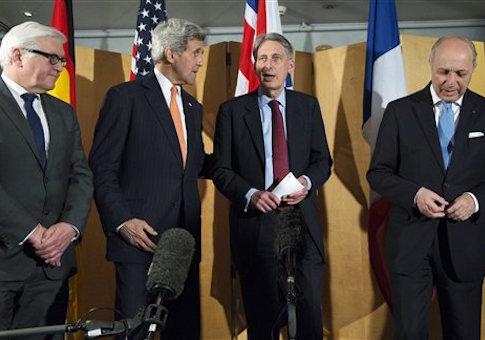
Iran Nuclear TalksFrom left, German Foreign Minister Frank Walter Steinmeier, U.S. Secretary of State John Kerry, British Foreign Secretary Philip Hammond and French Foreign Minister Laurent Fabius talk after Hammond made a statement about their meeting regarding recent negotiations with Iran over Iran’s nuclear program in London, England, Saturday, March 21 / AP

LAUSANNE, Switzerland—Efforts by the Obama administration to stem criticism of its diplomacy with Iran have included threats to nations involved in the talks, including U.S. allies, according to Western sources familiar with White House efforts to quell fears it will permit Iran to retain aspects of its nuclear weapons program.

A series of conversations between top American and French officials, including between President Obama and French President Francois Hollande, have seen Americans engage in behavior described as bullying by sources who spoke to the Washington Free Beacon.

The disagreement over France’s cautious position in regard to Iran threatens to erode U.S. relations with Paris, sources said.

Tension between Washington and Paris comes amid frustration by other U.S. allies, such as Saudi Arabia and Israel. The White House responded to this criticism by engaging in public campaigns analysts worry will endanger American interests.

Western policy analysts who spoke to the Free Beacon, including some with close ties to the French political establishment, were dismayed over what they saw as the White House’s willingness to sacrifice its relationship with Paris as talks with Iran reach their final stages.

A recent phone call between Obama and Hollande was reported as tense as the leaders disagreed over the White House’s accommodation of Iranian red lines.

Amid these tensions, U.S. Ambassador to France Jane Hartley met with her French counterpart, Gerard Araud, Monday to discuss a range of issues.

Benjamin Haddad, who has advised senior French political figures on foreign policy issues, said leaders in Paris have not been shy about highlighting disagreements they have with the White House.

“Fance, like other European countries, has negotiated for more than 10 years and endured most of the sanctions’ burden,” said Haddad, a research fellow at the Hudson Institute.

“The French want a deal, but they see no rush and repeat that Iranians need a deal more than we do, and that we shouldn’t fix artificial deadlines that put more pressure on us than Iran.”

One source in Europe close to the ongoing diplomacy said the United States has begun to adopt a “harsh” stance toward its allies in Paris.

“There have been very harsh expressions of displeasure by the Americans toward French officials for raising substantive concerns about key elements of what the White House and State Department negotiators are willing to concede to Iran,” said the source, who spoke on condition of anonymity. “That is because the clarifications expose just how weak the Americans’ deal is shaping up to be.”

“The meeting between the French ambassador in Washington and the president’s envoy to Paris—not a diplomat but a big fundraiser for his campaigns—comes amid these very harsh words that were spoken privately about the ambassador’s recent comments on the seeming American desperation for a deal, and the tough words that President Obama had for President Hollande in their phone call.”

Strategic differences remain between the United States and its allies over how a final deal should look, the source said. The French remain opposed to a recent range of concessions made by the Obama administration.

“We may agree that denying Iran a nuclear weapon ability is the goal, but apparently the view of what one can leave Iran and assure that is very different,” the source said.

“Clearly these are the differences that must be discussed. I don’t see France suddenly deciding that America is right and French objections to weakness are wrong, nor that silence is preferable to transparency.”

Haddad said the French are hesitant to rush into an agreement.

“The French want a robust deal with clear guarantees on issues like [research and development] and inspections to ensure that Iranians won’t be able to reduce breakout time during the duration of the agreement (also an issue of discussion), or just after thanks to research conducted during the period,” he said. “That is also why they disagreed on lifting sanctions.”

He also said the French “don’t trust Iran and believe an ambiguous deal would lead to regional proliferation.”

Another Western source familiar with the talks said the White House is sacrificing longstanding alliances to cement a contentious deal with Iran before Obama’s term in office ends.

“The President could be hammering out the best deal in the history of diplomacy, and it still wouldn’t be worth sacrificing our alliances with France, Israel, and Saudi Arabia—key partners in Europe, the eastern Mediterranean, and the Gulf,” the source said. “But he’s blowing up our alliances to secure a deal that paves Iran’s way to a bomb.”

A State Department spokesperson declined to comment on the issue.

Meanwhile, talks between the United States and Iran reached a critical juncture Thursday, as Secretary of State John Kerry met with his Iranian counterpoint to hash out differences over key points concerning Iran’s nuclear program.

The sides are hoping to reach a framework agreement by March 31 amid reports that Iran is demanding Saudi Arabia immediately halt airstrikes in Yemen, where Iran-aligned forces are working to bring down the Western-backed government.

The issue could complicate the talks as the United States attempts to balance its regional alliance with Iran in Iraq against competing interests with traditional allies in Saudi Arabia.

U.S. negotiators have reportedly softened their stance in recent days on a range of issues relating to Iran’s continued production of nuclear materials. One of Iran’s nuclear sites in Fordow could continue to operate, according to the Associated Press.

Obama speaks sweetly to Iran

March 20, 2015

Obama speaks sweetly to Iran, The White House via You Tube, March 19, 2015

(Oh well. It’s Obama. — DM)


A Statement on the Crisis in the U.S.—Israel Relationship

March 19, 2015

A Statement on the Crisis in the U.S.—Israel Relationship, Commentary Magazine, The Editors, March 19, 2015

(A lengthy but excellent summary, putting the relationship between the U.S. and Israel in perspective. — DM)

After six weeks of madness, Benjamin Netanyahu stood before Congress and delivered a speech about the nuclear threat posed by Iran. It was a terrific speech. It was not a remarkable speech, because nothing the Israeli prime minister said came as news to anyone who has been paying attention to the issue for the past decade.

What made his speech and its occasion of particular note were the atmospherics. It has been years since an address by a politician in the United States had been so hotly anticipated, and it wasn’t even to be delivered by an American. The anticipation was due entirely to Barack Obama’s incendiary response to the speaking invitation extended to Netanyahu in January by the Republican House leader, John Boehner.

The president’s displeasure and rage continued to grow, to the point that a few days before the speech, no less a personage than National Security Adviser Susan Rice said it would be “destructive of the fabric of the relationship” between the United States and Israel. On the day of the speech, the Democratic Middle East operative Martin Indyk declared on CNN that it was “the saddest and most tragic day” for the relationship in all his 35 years as a water-carrier.

In this case, we fear, the wish is father to the threat. Susan Rice and Martin Indyk see the relationship between Israel and the United States on a downward spiral because they and their boss want it so. Obama does not like the special status Israel seems to enjoy in the United States—not only because its particularistic and nationalist claim offends him ideologically, but because Israel’s popularity with the American people limits his freedom of action.

The relationship between the United States and Israel is in jeopardy because, from the moment his administration began, Barack Obama has consciously, deliberately, and with malice aforethought sought to jeopardize it. He did so in part because he is committed to the idea that Israel must retreat to its 1967 borders, dismantle its settlements, and will a Palestinian state into existence. He views Israel’s inability or unwillingness to do these things as a moral stain.

But the depth of Obama’s anger toward Israel and Netanyahu suggests that there is far more to it than that. Israel stands in the way of what the president hopes might be his crowning foreign-policy achievement: a new order in the Middle East represented by a new entente with Iran. Netanyahu’s testimony on behalf of his country and his people is this: A nuclear Iran will possess the means to visit a second Holocaust on the Jews in a single day. His testimony on behalf of everyone else is this: A nuclear Iran will set off an arms race in the Middle East that will threaten world order, the world’s financial stability, and the lives of untold millions. Simply put, Obama finds the witness Israel is bearing to the threat posed by Iran unbearable.

Elliott Abrams has called the speech kerfuffle a “manufactured crisis.” He is right, and the assembly line has been rolling without letup for six years.

Barack Obama came into office determined to put daylight between the United States and Israel. A few months after his inauguration, he met with Jewish leaders to discuss growing concerns about the bilateral relationship. One leader, Malcolm Hoenlein, told the president: “If you want Israel to take risks, then its leaders must know that the United States is right next to them.” Obama responded thus: “Look at the past eight years. During those eight years, there was no space between us and Israel, and what did we get from that? When there is no daylight, Israel just sits on the sidelines, and that erodes our credibility with the Arab states.”

Obama sought to make “daylight” almost immediately by picking fights with the new government of Benjamin Netanyahu, who came into office only weeks after Obama’s inauguration. The administration made no secret of its hopes that Netanyahu’s government would fall and be replaced by the supposedly more pliant opposition leader Tzipi Livni.

While the White House and the State Department have consistently portrayed Netanyahu as a man bent on obstructing Obama’s policies, the record shows otherwise. From the start, Netanyahu has sought to accommodate the Obama administration’s wishes as much as possible without jeopardizing Israel’s security.

In May 2009, Obama met with Netanyahu and told him bluntly that “settlements [on the West Bank] have to be stopped in order for us to move forward.” Israel complied; Netanyahu announced a 10-month settlement freeze, which was supposed to trigger a new round of U.S.-led peace talks. But for nine months Palestinian Authority President Mahmoud Abbas refused all invitations to negotiate. In the 10th month, Abbas sat through exactly two talks before abandoning negotiations once again. Yet Obama offered this assessment in a January 2010 interview with Time: “Although the Israelis, I think, after a lot of time showed a willingness to make some modifications in their policies, they still found it very hard to move with any bold gestures.”

Like all its predecessors, the Obama administration is a stern critic of Israel’s West Bank settlements and sees them as an obstacle to peace. But the administration’s particular obsession was not Jews sitting on remote hilltops or in areas many if not most Israelis saw as expendable—but rather the Jewish presence throughout unified Jerusalem. Though no American government had ever recognized Israeli sovereignty over the capital, the Obama administration was the first to consider normal growth in Jerusalem’s 40-year-old Jewish neighborhoods (in parts of the city that had been illegally occupied by Jordan, from 1949 to 1967) as a deliberate and outrageous provocation.

This came to a head in the spring of 2010 when a routine announcement of a housing project in one of those Jerusalem neighborhoods (which had specifically been exempted from the freeze) coincided with a visit to Israel by Vice President Joe Biden. Netanyahu found himself on the receiving end of a 43-minute telephone tirade from then-Secretary of State Hillary Clinton. She accused Netanyahu of sending a “deeply negative signal” that had “harmed the bilateral relationship.” Such condemnations were repeatedly echoed in the press from multiple administration figures.

The administration clearly hoped its expressions of rage could be leveraged to force Israel to agree to end such construction—and encourage the Palestinians to realize that the United States would back them in negotiations. But rather than isolate Netanyahu, the U.S. attack on Jewish Jerusalem strengthened him, because defending the unity of the city remains one of the few issues on which there is consensus in Israeli politics.

Even as relations continued to deteriorate—Israel’s then-ambassador to the United States, Michael Oren, told a group of Israeli diplomats in 2010 that U.S.–Israel relations were at their lowest point since 1975—Netanyahu moderated construction in settlements. By the first half of 2014, Israel was building at its slowest rate since the 2010 freeze. (Indeed, according to Israeli historian and archivist Yaacov Lozowick, no new settlements have been built since 2003.)

In May 2011, President Obama gave a major address responding to the Arab Spring protests, in which he chose to devote the last third to a plan for a new round of Israeli–Palestinian talks—a non sequitur if ever there has been one. The plan was to set the 1967 lines as the starting point for future negotiations. The speech was timed to be delivered the day before Netanyahu was to arrive in the United States for talks. Obama was attempting to force a fait accompli.

Netanyahu earned applause at home and in the U.S. for pushing back against Obama’s idea, which he rightly saw as an attempt to undermine Israel’s negotiating position. Days later, Netanyahu spoke to a joint session of Congress where both Republicans and Democrats cheered him as if he were the second coming of Winston Churchill, a spectacle that was rightly seen as a rebuke to Obama’s slap at the Israelis. (That episode is crucial to understanding the White House’s bitterness about Netanyahu’s recent speech to Congress.) And like the previous arguments with Israel, this one would yield no benefits to the United States, since not even this tilting of the diplomatic playing field toward the Palestinians would be enough to nudge them to make peace.

The general antipathy toward the Israeli prime minister led Washington Postcolumnist Jackson Diehl to ask, in November 2011, “Why do Sarkozy and Obama hate Netanyahu?” Diehl was writing on the revelation that Obama and then-French President Nicolas Sarkozy had made comments, picked up on a live microphone, about their dislike of the Israeli leader. Diehl pointed out that Obama’s problem with Netanyahu was obviously personal: “Netanyahu has been an occasionally difficult but ultimately cooperative partner. He can be accused of moving too slowly and offering too little, but not of failing to heed American initiatives.”

After this incident, the administration put its campaign against Israel on hold for the duration of the 2012 presidential election campaign. It ceased sparring with Netanyahu and even moved toward Israel on the subject of Iran.

Obama had always stated his opposition to an Iranian bomb, but he had also consistently demonstrated his desire for a rapprochement with Tehran. He was both slow and reluctant to embrace sanctions against the regime. Throughout this period, the administration seemed more anxious about preventing an Israeli strike against Iran’s nuclear facilities than it was about the nuclear threat itself. But in 2012, the president told the American Israel Public Affairs Committee that he would never be willing to merely “contain” a nuclear Iran. And during his foreign-policy debate with Mitt Romney, he pledged that any possible deal with Iran would require it to give up its nuclear program.

Once reelected, Obama reverted. He unleashed John Kerry, his new secretary of state, to pursue yet another futile quest for peace with the Palestinians. Despite

successful American pressure on Israel to agree to a framework that accepted most of the Palestinians’ demands throughout 2013, Abbas wouldn’t take yes for an answer. He eventually blew up the talks. The Obama administration responded by placing the blame for Kerry’s failure on Israel, arguing speciously that the problem was construction in Jerusalem and in the settlement blocs that would be retained by Israel in any peace deal.

This administration’s willingness to blame the Jewish state under virtually any circumstances was on display again, in the summer of 2014, after rocket barrages on Israeli cities prompted Israel to launch a counterattack on Hamas bases in Gaza. Though the chairman of the Joint Chiefs of Staff would later cite Israeli efforts to avoid civilian casualties in the fighting as a model for American troops, the White House and the State Department criticized Israel for the deaths of Palestinians—who were being used as human shields by Hamas. But far worse, and far more suggestive of Obama’s true feelings, was the White House’s decision to try and use arms supplies as a pressure point against Israel.

Throughout the Obama presidency, the president’s defenders (and Netanyahu, in his 2015 address to Congress) have spoken of the strengthening of the so-called strategic relationship with Israel as proof of Obama’s sincere support for the alliance. It is true that Obama continued funding for the Iron Dome missile-defense system initiated under the Bush administration and did not obstruct the fostering of close ties between the two countries’ defense and intelligence establishments. But the Gaza war revealed the president’s discomfort with that closeness. When he realized that the Pentagon, without his express permission, was resupplying Israel with ammunition needed for fighting Hamas, he called a halt to it—supposedly to send a signal he did not think Israel was being surgical enough with its surgical strikes. He denied Israel bullets in the middle of a shooting war.

Meanwhile, the administration’s secret negotiating track with Iran was making progress. And this brings us to the nub of the issue.

The true beating heart of the crisis between Israel and Obama is Iran. The Islamic Republic does not merely harbor genocidal fantasies about annihilating Israel; it boasts of them. The country was founded in 1979 on the theocratic vision of Ruhollah Khomeini, who made the destruction of Israel a defining national objective. More than three decades later, Iran’s leaders remain obsessed with the idea. It is, to their thinking, an unshakable Islamic obligation. As recently as last November, Supreme Leader Ali Khamenei publicly outlined a nine-point plan for eradicating the Jewish state.

More important than Tehran’s declarations are its actions. In 2002, an Iranian dissident revealed two secret Iranian nuclear sites, confirming—for those with eyes to see—the mullahs’ pursuit of a nuclear weapon. In 2010, the International Atomic Energy Agency (IAEA) declared that Iran had worked on, or is working on, the construction of a nuclear warhead and has experimented with detonation methods. IAEA inspectors have also found evidence that the Iranians have clandestinely enriched uranium to levels that exceed those needed for civilian energy and approach those required for a nuclear bomb.

Iran’s religious hatred of the Jewish state combined with its apparent pursuit of a nuclear weapon make it Israel’s chief security concern. The overused term “existential threat” is the only one that applies. As ISIS’s recent establishment of an Islamic caliphate shows, the nightmares of committed Muslim radicals can come true.

Obama came to office declaring he would not permit Iran to build a nuclear weapon and that “all options are on the table” for stopping it. Repeating this assurance, he succeeded in getting Israel to refrain from striking Iran on its own. Obama’s record, however, has discredited the suggestion that he would take military action if necessary. He has demonstrated an unyielding faith in diplomacy and seems to regard the use of force as almost necessarily reckless. What’s more, he hoped—and hopes—to use diplomacy to make the Shia theocracy “a responsible member of the international community,” in Susan Rice’s words. This fanciful goal seems to have become Obama’s priority. As his foreign-policy spokesman, Ben Rhodes, said: “This is probably the biggest thing President Obama will do in his second term on foreign policy. This is health care for us, just to put it in context.”

During his first term, Obama reached out to Tehran repeatedly. He went through several third parties to offer Iran access to civilian-grade nuclear energy. The mullahs rejected every overture. Despite Iran’s obstinacy, Obama began his second term covertly imploring the Iranians to sit down for direct talks with the United States. In 2013, Iran elected President Hassan Rouhani, a regime hardliner who had enjoyed a public-relations makeover as a “moderate.” The administration soon announced direct talks between Washington and Tehran, talks that had been planned behind Israel’s back. Netanyahu has been left to look on while the Obama administration chases a dangerous nuclear deal with Iran.1

As Washington crafted its deal, Obama administration officials took the opportunity to taunt Netanyahu for having complied with the president’s request not to strike Iran. “The thing about Bibi is, he’s a chickenshit,” an administration official told the Atlantic’s Jeffrey Goldberg. “The good thing about Netanyahu is that he’s scared to launch wars. It’s too late for him to do anything. Two, three years ago, this was a possibility. But ultimately he couldn’t bring himself to pull the trigger. It was a combination of our pressure and his own unwillingness to do anything dramatic. Now it’s too late.”

Israel’s prospects for a strike on Iran’s nuclear program have grown dim indeed. First, it’s a technically formidable undertaking. During these past few years, Iran’s nuclear sites have become more diffuse and entrenched. It may well be that the United States alone has the sufficient resources and weaponry to disable Iran’s air defenses and do meaningful damage to its various fortified facilities.

If Israel launches a strike that falls short of disabling the Iranian nuclear program, Israelis would face the same Iranian threat along with grave new problems. In addition to launching direct retaliatory strikes on Israel, Iran might respond by blocking the straits of Hormuz and driving up oil prices. Without the help of the United States, Israel would bear the global outrage (and perhaps punishment) for the resulting destabilization. And although Arab leaders would privately celebrate any blow dealt their Iranian enemy, they too would publicly admonish the Jewish state. This would inevitably further inflame the anti-Semitic and anti-Israel violence that now consumes the Muslim world.

And if the United States has explicitly recognized Iran’s right to enrich uranium, Israel would ostensibly be attacking a “legitimate” nuclear-power state against America’s wishes. With the American–Israeli alliance already at such a precarious point, this final act of Israeli disobedience could tear open an almost unthinkable breach in the bilateral relationship.

The fraying of the relationship has only served Obama’s larger purpose vis-à-vis Iran. As his effort to get Democratic members of the House and Senate to boycott Netanyahu’s speech demonstrates, Obama has spent six years implicitly setting up a loyalty test: Democrats will be showing their disloyalty to him if they show support for Israel as it does whatever it can to prevent Iran from getting the bomb.

The breach with the Obama administration illustrates a basic problem within the pro-Israel coalition inside the United States. During the 2012 campaign, Jewish Democrats were able to say that he had strengthened security cooperation between the two countries. Their argument was shaken during the Gaza war in 2014, when Obama cancelled the ammunition resupply.

Even so, the administration succeeded in the first months of 2015 in distracting many Jewish supporters of Israel from the looming bad deal with Iran by focusing their attention on the supposed breach of protocol represented by Netanyahu’s acceptance of Boehner’s invitation. Since most liberal Jews view Boehner and the GOP Congressional majorities with almost as much disdain as they do Israel’s enemies, and since many are not especially supportive of Netanyahu, they were disinclined to back him against the president.

Netanyahu was accused by the administration of injecting partisanship into the U.S.–Israel relationship, but the true culprit here was Obama. He was playing off the fact that his party’s members are far less supportive of Israel than Republicans are.

According to Gallup, support for Israel among Democrats is currently at almost exactly the same level it was in 1988. Now, as was true a quarter century ago, 47 percent of Democrats sympathize with Israel. That was before Israel signed the Oslo Accords, was subjected to an ongoing terror campaign, withdrew from the Gaza Strip and parts of the West Bank unilaterally, publicly declared support for the establishment of a Palestinian state, and made three separate final-status offers that would have given the Palestinians a state with its capital in Jerusalem. And before Iran began developing the bomb.

Republicans noticed. In 1988, their sympathy for Israel vis-à-vis the Palestinians was at about the same level as the Democrats’; today it’s at 83 percent. Independents noticed as well. In 1988, 42 percent of independents sympathized with Israel; today that number has jumped 17 points to 59.

Israel’s good-faith negotiations and sacrifices for peace in the face of unrelenting terror and incitement won over Republicans and independents. Democrats remain unmoved. That consistency, and the partisan gap it is creating in support for Israel, is far from reassuring.

During the war with Hamas last summer, the Israel Defense Forces uncovered some 30-plus tunnels running from Gaza into population centers in Israel to be used for mass terror attacks against Israeli civilians. The war itself was touched off by steady rocket fire from Gaza into southern Israel. Israel’s goal was to stop the rocket fire and neutralize the tunnels, not to overthrow Hamas or retake the Gaza Strip. When those objectives were reached, Israel withdrew.

Yet a CNN poll found that only 45 percent of Democrats considered Israel’s counteroffensive justified, compared with 56 percent of independents and 73 percent of Republicans. According to Gallup, only 31 percent of Democrats considered Israel’s
actions justified. Astoundingly, a Pew poll recorded that Democrats were evenly divided on whether Israel or Hamas was to blame for the war.

Pro-Israel Democrats don’t simply have an ‘Obama problem.’ The president did not create Israel’s status as a wedge issue for his party. He has only exploited it.

Certainly, the supportive voting record of Democratic members of Congress acts as an important check on the rougher treatment Israel would receive from an unfiltered expression of the party’s activist base. But it also masks the anti-Zionist populism so prevalent on college campuses and among leftist political pressure groups, and the anti-Israel sentiments expressed by many black and Latino activists as well.

That filter can’t catch everything, even in this age of scripted politics. During the 2012 Democratic National Convention, it was revealed that references to God and to Jerusalem as the undivided capital of Israel had been removed from the Democratic Party’s platform. Party officials moved to add the language back in, which required a voice vote from the Democratic Party delegates in the hall. The motion to restore the references was soundly defeated.

Los Angeles Mayor Antonio Villaraigosa, who was emceeing the proceedings, was visibly shocked. He asked for a re-vote. The motion lost again, with the crowd growing more agitated. Villaraigosa looked off stage for direction. He turned back to the audience, held one more vote, and, amid a hail of boos, declared the motion passed—despite its obvious and raucous defeat for the third time in a row.

The incident was important not only because it showed that the party’s delegates were opposed to traditional pro-Israel language in the party’s platform, but also because that language had been removed in the first place either at the behest or approval of the Obama campaign. Obama’s two presidential campaigns have been notable for their ability to tap into the zeitgeist of the party’s core supporters.

“Obviously, this is much bigger than two men,” CNN’s Dana Bash said on March 1, two days before Netanyahu’s address to Congress. Indeed it is. And it puts American Jews in a bind. American Jews still care deeply about Israel—and still vote overwhelmingly Democratic. Recent polls show a subtle rightward shift, but it is far too early to tell if that shift will stay in place in 2016 and beyond. (Jimmy Carter hemorrhaged Jewish votes in 1980; in 1984, Walter Mondale won most of them back.) Nonetheless, the Democrats are expected to nominate Hillary Clinton, who served as Obama’s secretary of state and has had her own share of dustups with Netanyahu. And veterans of the Obama administration will no doubt staff future Democratic White Houses. Is this, then, the shape of things to come? If the answer is to be no, Jewish Democrats are going to have to do more than find presidential nominees who paper over this internal divide with platitudes.

They will have to address the growing conflict between American Zionism and American liberalism. They will need not happy talk but confrontation of hard truths. That will require recognizing that the momentum is with the Occupy Wall Street protesters’ adopting the Palestinian cause as their own, with the American professoriate shaping higher-education curricula along with the minds and worldviews of their students, and with the progressive activists who fill the arena at presidential nominating conventions and seek to remake the Democratic Party platform in their image.

It means American Jewish organizations are going to have to recognize that it will become more and more difficult to square the circle. AIPAC tried just that in 2014, when it acquiesced to Democratic pressure and did not send out its 10,000-strong team of citizen activists to lobby members of Congress to support new sanctions.

AIPAC was caught between a rock and a hard place, but its leaders surely know they made a terrible error in 2014—and have changed their tune this year. Seen from one perspective, the failure to push sanctions decreased the administration’s leverage at the negotiating table; from the other, it gave Obama the freedom to acquiesce to Iran’s own demands.

On Capitol Hill, opposition to a nuclear Iran has always been as bipartisan as support for Israel. Obama is making every effort to turn it into a partisan issue so that he can peel off enough Democrats to sustain a veto of legislation that would block a bad deal. Netanyahu’s triumph before Congress made his job harder. Israel’s prime minister did what he set out to do—to lay before Congress and the American people the nature of the threat and the danger of such a deal.

Americans who care about Israel, and American Jews who care not only about the Jewish state but also the condition of the Jewish soul in the United States, must now follow his example. We cannot relent in our efforts to fight against those who seek to drive a wedge between Israel and America—on campuses, in the media, within elite institutions, and within both the Democratic and Republican parties. The impending end of Obama’s political career should make it easier for Israel’s government to make its case against appeasement in both 2015 and 2016 as well as shore up wavering American Jewish support. The manufactured crisis Barack Obama began in 2009 is not yet a full-bore crisis either within the Democratic Party or within the American body politic. But it will become one—if this existential threat, this spiritual existential threat to American Jewry, is not dismantled.


Footnotes

1 The salient facts are these: First, the Obama administration agreed to Tehran’s demand that the United States ease sanctions on Iran in advance of any confirmed nuclear agreement. Second, the administration recognized Iran’s right to enrich uranium to 5 percent despite the fact that all Iranian enrichment is prohibited by the United Nations Security Council. Third, Iran has ignored negotiation deadlines to win reported concessions that would render the deal pointless. These include the right to 5,000–6,000 working centrifuges, enough to fuel a nuclear bomb within a year. The administration has also reportedly included a “sunset clause,” which could free the Iranians from the strictures of a deal within 10 years.

Grand Gas Project Signifies Futility of Anti-Iran Sanctions: President

March 17, 2015

Grand Gas Project Signifies Futility of Anti-Iran Sanctions: President, Tasnim News Agency (Iranian), March 17, 2015

(Iran claims to have done quite well with sanctions, or what sanctions remained after November of 2013, despite all the money it has been spending in Iraq and Syria, not to mention terrorism elsewhere. Why, then, the demand that all sanctions be removed instanter? Will Kerry ask? Not likely.– DM)

139312261516169584940403

TEHRAN (Tasnim) – Iranian President Hassan Rouhani described the inauguration of the 12th development phase of the massive offshore South Pars gas field as a testimony to the ineffectiveness of the Western sanctions against Iran.

“The inauguration of the 12th phase illustrates that sanctions, pressures, and illegal and inhumane measures cannot push the (Iranian) nation back,” President Rouhani said in a Tuesday ceremony in the southern province of Bushehr for the official coming into service of the giant gas field’s 12th phase.The president explained that Iran’s gas production now exceeds 100 million cubic meters, stressing that such a great job has been accomplished while the country has been slapped with the cruel sanctions.Iran has also experienced economic growth and inflation reduction with the sanctions being in place, Rouhani added.

According to Oil Minister Bijan Namdar Zanganeh, the 12th phase, which has been totally designed and developed by the local experts, has cost more than $7.5 billion.

The 12th phase can produce 80 million cubic meters of gas and 120,000 barrels of gas condensates on a daily basis, bringing the country $17.5 million in revenue every day.

Zanganeh has also hailed the new phase as a helpful source of revenue while Iran is hit by “cruel economic sanctions” and the global oil price decline has diminished the country’s financial resources.

The 12th phase extends over an area of approximately 205 square kilometers along Iran-Qatar joint border. Located at a distance of 105 kilometers from the coast, the 12th phase alone contains about 5 percent of the whole gas reserves in the South Pars filed.

South Pars is part of a wider gas field that is shared with Qatar. The larger field covers an area of 9,700 square kilometers, 3,700 square kilometers of which are in Iran’s territorial waters (South Pars) in the Persian Gulf.

Having the U.N. Security Council bless a deal wouldn’t make it binding under our Constitution.

March 15, 2015

Having the U.N. Security Council bless a deal wouldn’t make it binding under our Constitution, National Review online, Andrew C. McCarthy, March 14, 2015

So, as we warned earlier this week, the international-law game it is.

It is no secret that Barack Obama does not have much use for the United States Constitution. It is a governing plan for a free, self-determining people. Hence, it is littered with roadblocks against schemes to rule the people against their will. When it comes to our imperious president’s scheme to enable our enemy, Iran, to become a nuclear-weapons power — a scheme that falls somewhere between delusional and despicable, depending on your sense of Obama’s good faith — the salient barrier is that only Congress can make real law.

Most lawmakers think it would be a catastrophe to forge a clear path to the world’s most destructive weapons for the world’s worst regime — a regime that brays “Death to America” as its motto; that has killed thousands of Americans since 1979; that remains the world’s leading state sponsor of jihadist terrorism; that pledges to wipe our ally Israel off the map; and that just three weeks ago, in the midst of negotiations with Obama, conducted a drill in which its armed forces fired ballistic missiles at a replica U.S. aircraft carrier.

This week, 47 perspicuous Republican senators suspected that the subject of congressional power just might have gotten short shrift in Team Obama’s negotiations with the mullahs. So they penned a letter on the subject to the regime in Tehran. The effort was led by Senator Tom Cotton (R., Ark.), who, after Harvard Law School, passed up community organizing for the life of a Bronze Star–awarded combat commander. As one might imagine, Cotton and Obama don’t see this Iran thing quite the same way.

There followed, as night does day, risible howls from top Democrats and their media that these 47 patriots were “traitors” for undermining the president’s empowerment of our enemies. Evidently, writing the letter was not as noble as, say, Ted Kennedy’s canoodling with the Soviets, Nancy Pelosi’s dalliance with Assad, the Democratic party’s Bush-deranged jihad against the war in Iraq, or Senator Barack Obama’s own back-channel outreach to Iran during the 2008 campaign. Gone, like a deleted e-mail, were the good old days when dissent was patriotic.

Yet, as John Yoo observes, the Cotton letter was more akin to mailing Ayatollah Khamenei a copy of the Constitution. The senators explained that our Constitution requires congressional assent for international agreements to be legally binding. Thus, any “executive agreement” on nukes that they manage to strike with the appeaser-in-chief is unenforceable and likely to be revoked when he leaves office in 22 months.

For Obama and other global-governance grandees, this is quaint thinking, elevating outmoded notions like national interest over “sustainable” international “stability” — like the way Hitler stabilized the Sudetenland. These “international community” devotees see the Tea Party as the rogue and the mullahs as rational actors.

So, you see, lasting peace — like they have, for example, in Ukraine — is achieved when the world’s sole superpower exhibits endless restraint and forfeits some sovereignty to the United Nations Security Council, where the enlightened altruists from Moscow, Beijing, and Brussels will figure out what’s best for Senator Cotton’s constituents in Arkansas. This will set a luminous example of refinement that Iran will find irresistible when it grows up ten years from now — the time when Obama, who came to office promising the mullahs would not be permitted to acquire nuclear weapons, would have Iran stamped with the international community seal of approval as a nuclear-weapons state.

Down here on Planet Earth, though, most Americans think this is a bad idea. That, along with an injection of grit from the Arkansas freshman, emboldened the normally supine Senate GOP caucus to read Tehran in on the constitutional fact that the president is powerless to bind the United States unless the people’s representatives cement the arrangement.

Obama, naturally, reacted with his trusty weapon against opposition, demagoguery: hilariously suggesting that while the Alinskyite-in-chief had our country’s best interests at heart, the American war hero and his 46 allies were in league with Iran’s “hardliners.” (Yes, having found Muslim Brotherhood secularists, al-Qaeda moderates, and Hezbollah moderates, rest assured that Obama is courting only the evolved ayatollahs.) When that went about as you’d expect, the administration shifted to a strategy with which it is equally comfortable, lying.

Obama’s minions claimed that, of course, the president understands that any agreement he makes with Iran would merely be his “political commitment,” not “legally binding” on the nation. It’s just that Obama figures it would be nice to have the Security Council “endorse” the deal in a resolution because, well, that would “encourage its full implementation.” Uh-huh.

Inconveniently, the administration’s negotiating counterpart is the chattiest of academics, Iranian foreign minister Mohammad Javad Zarif. Afflicted by the Western-educated Islamist’s incorrigible need to prove he’s the smartest kid in the class — especially a class full of American politicians — Zarif let the cat out of the bag. The senators, he smarmed, “may not fully understand . . . international law.”

According to Zarif, the deal under negotiation “will not be a bilateral agreement between Iran and the U.S., but rather one that will be concluded with the participation of five other countries, including all permanent members of the Security Council, and will also be endorsed by a Security Council resolution.” He hoped it would “enrich the knowledge” of the 47 senators to learn that “according to international law, Congress may not modify the terms of the agreement.” To do so would be “a material breach of U.S. obligations,” rendering America a global outlaw.

This, mind you, from the lead representative of a terrorist regime that is currently, and brazenly, in violation of Security Council resolutions that prohibit its enrichment of uranium.

Clearly, Obama and the mullahs figure they can run the following stunt: We do not need another treaty approved by Congress because the United States has already ratified the U.N. charter and thus agreed to honor Security Council resolutions. We do not need new statutes because the Congress, in enacting Iran-sanctions legislation, explicitly gave the president the power to waive those sanctions. All we need is to have the Security Council issue a resolution that codifies Congress’s existing sanctions laws with Obama’s waiver. Other countries involved in the negotiations — including Germany, Russia, and China, which have increasingly lucrative trade with Iran — will then very publicly rely on the completed deal. The U.N. and its army of transnational-progressive bureaucrats and lawyers will deduce from this reliance a level of global consensus that incorporates the agreement into the hocus-pocus corpus of customary law. Maybe they’ll even get Justice Ginsburg to cite it glowingly in a Supreme Court ruling. Voila, we have a binding agreement — without any congressional input — that the United States is powerless to alter under international law.

Well, it makes for good theater . . . because that is what international law is. It is a game more of lawyers than of thrones. In essence, it is politics masquerading as a system governed by rules rather than power, as if hanging a sign that says “law” on that system makes it so.

At most, international law creates understandings between and among states. Those understandings, however, are only relevant as diplomatic debating points. When, in defiance of international law, Obama decides to overthrow the Qaddafi regime, Clinton decides to bomb Kosovo, or the ayatollahs decide to enrich uranium, the debating points end up not counting for much.

Even when international understandings are validly created by treaty (which requires approval by two-thirds of the Senate), they are not “self-executing,” as the legal lexicon puts it — meaning they are not judicially enforceable and carry no domestic weight. Whether bilateral or multilateral, treaties do not supersede existing federal law unless implemented by new congressional statutes. And they are powerless to amend the Constitution.

The Supreme Court reaffirmed these principles in its 2008 Medellin decision (a case I described here, leading to a ruling Ed Whelan outlined here). The justices held that the president cannot usurp the constitutional authority of other government components under the guise of his power to conduct foreign affairs. Moreover, even a properly ratified treaty can be converted into domestic law only by congressional lawmaking, not by unilateral presidential action.

Obama, therefore, has no power to impose an international agreement by fiat — he has to come to Congress. He can make whatever deal he wants to make with Iran, but the Constitution still gives Congress exclusive authority over foreign commerce. Lawmakers can enact sanctions legislation that does not permit a presidential waiver. Obama would not sign it, but the next president will — especially if the Republicans raise it into a major 2016 campaign issue.

Will the Security Council howl? Sure . . . but so what? It has been said that Senator Cotton should have CC’d the Obama administration on his letter since it, too, seems unfamiliar with the Constitution’s division of authority. A less useless exercise might have been to CC the five other countries involved in the talks (the remaining Security Council members, plus Germany). Even better, as I argued earlier this week, would be a sense-of-the-Senate resolution: Any nation that relies on an executive agreement that is not approved by the United States Congress under the procedures outlined in the Constitution does so at its peril because this agreement is likely to lapse as early as January 20, 2017. International law is a game that two can play, and there is no point in allowing Germany, Russia, and China to pretend that they relied in good faith on Obama’s word being America’s word.

It is otherworldly to find an American administration conspiring against the Constitution and the Congress in cahoots with a terror-sponsoring enemy regime, with which we do not even have formal diplomatic relations, in order to pave the enemy’s way to nuclear weapons, of all things. Nevertheless, Republicans and all Americans who want to preserve our constitutional order, must stop telling themselves that we have hit a bottom beneath which Obama will not go. This week, 47 senators seemed ready, finally, to fight back. It’s a start.

Iran Declares Pre-emptive Victory in Nuke Talks

March 11, 2015

Iran Declares Pre-emptive Victory in Nuke Talks, Washington Free Beacon, March 11, 2015

(Unfortunately, he appears to be correct. Iran seems to have improved her arsenal substantially since November of 2013 and the sanctions relief, used to get Iran to “negotiate,” doubtless helped it to do so. Please see also Iran is an empire, Iraq is our capital.

What will Obama do if Iran declines even his “extremely reasonable” deal because Iran doesn’t want one? Blame it on the recent letter sent by Republican members of the Congress? — DM)

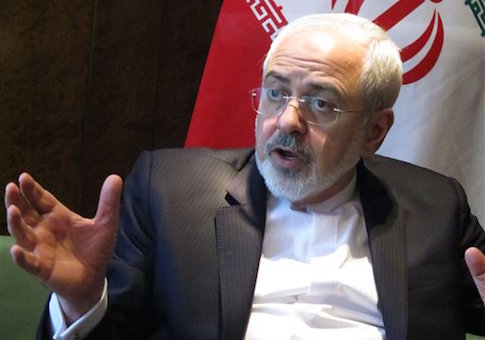
Iran minister says sanctions must be lifted before nuclear agreementIranian Foreign Minister Mohammad Javad Zarif / AP

Iran’s foreign minister and chief negotiator in nuclear talks with the West declared victory for his country, stating that no matter how the negotiations end, Tehran has come out “the winner,” according to remarks made on Tuesday and presented in the country’s state-run press.

Javad Zarif, the Islamic Republic’s foreign minister, stated in remarks before the country’s powerful Assembly of Experts, which recently installed a hardline new cleric as its leader, that the nuclear negotiations have established Tehran as a global power broker.

“We are the winner whether the [nuclear] negotiations yield results or not,” Zarif was quoted as saying before the assembly by the Tasnim News Agency. “The capital we have obtained over the years is dignity and self-esteem, a capital that could not be retaken.”

Zarif’s comments were accompanied by a host of bold military displays by Tehran in recent weeks, including the announcement of one new weapon that Iranian military leaders have described as a “very special” missile.

As the United States and Iran rush to hash out a final nuclear agreement ahead of a self-imposed July deadline, Zarif also lashed out at congressional Republicans who have expressed skepticism over the Obama administration’s diplomacy and have fought to exert control over the implementation of any deal.

Zarif dismissed as a “propaganda ploy” a recent letter signed by 47 Senate Republicans that warned Tehran against placing too much stock in a weak deal agreed to by the Obama administration.

Meanwhile, Iran’s military continues to unveil a range of new strategic missiles and advanced weapons meant to project strength throughout the region.

Iran disclosed during military drills late in February that it is developing a missile capable of being fired from a submerged submarine. Top Iranian military leaders have described the missile as a “very special weapon,” according to IHS Jane’s, a defense industry news source.

“I believe that this weapon is a strategic weapon,”Admiral Ali Fadavi, the naval commander of the Iranian Revolutionary Guard Corps (IRGC), said on state television, according to Jane’s. “It has special characteristics.”

Fadavi declined to provide additional details about the missile. “I would like to keep this information for the future. It is a very special weapon and the Americans cannot even surmise how strong and effective this weapon is.”

On Tuesday morning, the commander of Iran’s navy previewed the unveiling of “advanced surface and subsurface vessels” that will soon be incorporated into the country’s fleet, according to the state-run Fars News Agency.

Iran has put great stock in its navy, investing significant resources to bolster the force and make it a principal player in key global shipping lanes, including around the Strait of Hormuz, the Gulf of Oman, and the Caspian Sea.

Sea-based weapons were a major focus of recent high-level meetings between Iranian and Russian officials, who agreed to a new arms pact.

Earlier this week, Iran initiated into its fleet a new destroyer ship that is “armed with advanced anti-surface and anti-subsurface weapons and air defense systems,” according to military leaders quoted by Fars.

The ship was immediately deployed to the Caspian Sea, an area Iran views as critical to its interests.

Admiral Kordad Hakimi, a top Iranian navy official, told the country’s press that Iran is prepared to use force in the region.

“We have no security problem in the Caspian Sea today, [but] … the Navy is fully prepared to confront any threat,” he was quoted as saying.

Iranian officials have also bragged about being in full control of five out of nine major international waterways.

The Danger of Negotiating with Iran

March 9, 2015

The Danger of Negotiating with Iran, Washington Free Beacon, March 9, 2015

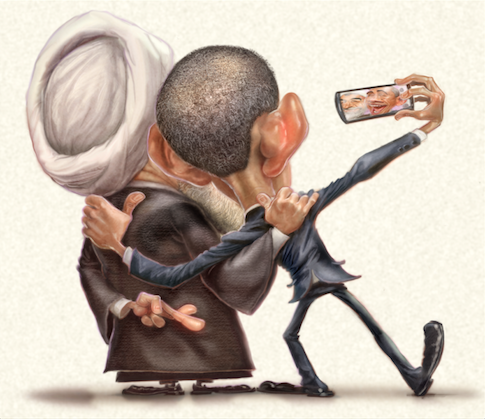
Obama-Rouhani-Selfie

Incentivizing defiance also undercuts diplomacy. In the year before Obama blessed talks with Iran, the Iranian economy had shrunk 5.4 percent. After talks, its economy grows. In order to bring Iran to the table, Obama has released more than $11 billion to Iran. To put that in perspective, that is equivalent to the last two years’ budget of the IRGC, a group responsible for the deaths of hundreds of Americans. What Obama has done is the equivalent of giving a toddler dessert first, and then asking him to come back to eat his broccoli.

How can these past successes be replicated? Sunset clauses, multinational contracts, and sanctions relief won’t do it. Only one thing will: Forcing the regime to choose between its nuclear ambitions and its survival.

*********************

As a candidate for president, Barack Obama made diplomacy with rogue regimes a signature issue. “The notion that somehow not talking to countries is punishment to them…is ridiculous,” he declared in 2007. In both his inaugural addressand his first television interview as president, he reached out to the Islamic Republic of Iran. “If countries like Iran are willing to unclench their fist, they will find an extended hand from us,” he told Al-Arabiya. In the six years since, whether firebrand Mahmoud Ahmadinejad or reformer-by-comparison Hassan Rouhani held the Iranian presidency, Obama has been so committed to a deal on Iran’s illicit nuclear program that he hasn’t let anything stand in his way—Congress, allies, or evenfacts.

Unfortunately, when it comes to the history of high-profile diplomacy with rogue regimes, Obama’s behavior is more the rule than the exception. If every senator looks in a mirror and sees a future president, then every president looks in a mirror and sees a brilliant statesman, a man who will be Nixon in China or Reagan in Reykjavik. In reality, what most should see is a reflection of Frank B. Kellogg, Aristide Briand, or Neville Chamberlain. With very little understanding of history, Obama, alas, sees only himself.

Albert Einstein is often credited (wrongly) with the adage that insanity is doing the same thing repeatedly while expecting different results. By that definition, Foggy Bottom is Bedlam. The U.S. military, in contrast, constantly forces soldiers to confront their mistakes—that is, after all, why sergeants-major chew out soldiers. Soldiers spend more time in the classroom dissecting exercises than they do in the field. Even when deployed, they never neglect after-action reports to determine what they might have done better.

In the last half century, however, the State Department has never conducted a “lessons learned” exercise to identify what went wrong with high stakes diplomacy. Nor does the State Department have any clear metrics to measure success and failure. State Department spokesmen often make declarations of progress that declassified records of talks—with Iran, North Korea, the Palestinians, Saddam Hussein’s Iraq, Muammar Gaddafi’s Libya, Pakistan or, increasingly, Turkey and Russia—belie.

Too many American diplomats dismiss the need to consider mistakes. Instead, many are committed to the belief that talking is a cost-free, risk-free strategy. Testifying before the Senate in support of Obama’s outreach to Iran, Nicholas Burns, the second undersecretary of state for foreign affairs under George W. Bush, promised, “We will be no worse off if we try diplomacy and fail.” Richard Armitage, another veterans of Bush’s State Department, has promoted a similar argument: “We ought to have enough confidence in our ability as diplomats to go eye to eye with people—even though we disagree in the strongest possible way—and come away without losing anything.”

But Armitage was wrong to project American values onto others. Americans may not see willingness to talk as weakness, but other cultures do. On the same day in 2008 that William J. Burns, Bush’s third undersecretary of state for foreign affairs, met an Iranian delegation in Geneva—the first public high-level meeting between American and Iranian diplomats in decades—Mohammad-JafarAssadi, the ground force commander of the Islamic Revolutionary Guard Corps (IRGC) declared that, “America has no other choice but to leave the Middle East region beaten and humiliated.”

But Armitage was wrong to project American values onto others. Americans may not see willingness to talk as weakness, but other cultures do. On the same day in 2008 that William J. Burns, Bush’s third undersecretary of state for foreign affairs, met an Iranian delegation in Geneva—the first public high-level meeting between American and Iranian diplomats in decades—Mohammad-JafarAssadi, the ground force commander of the Islamic Revolutionary Guard Corps (IRGC) declared that, “America has no other choice but to leave the Middle East region beaten and humiliated.”

American diplomats genuinely want peace, but cultural equivalence can kill. So too can ignorance of an adversary’s true goals. This is why Obama’s headlong rush into a deal with Iran will be disastrous.

Obama has had no shortage of cheerleaders. Secretary of State Hillary Clinton endorsed his embrace of diplomacy with rogue regimes.  “You don’t make peace with your friends,” she said, adding, “You have to be willing to engage with your enemies.” That may be true, but how you engage with rogues is important. And this is where Obama—and so many would-be statesmen before him—have gone wrong.

It is possible both to take diplomacy seriously and to remember that rogue regimes are a particular problem. There is, of course, no standard definition of “rogue,” but there is no universal definition of “terrorism” either. That doesn’t mean it doesn’t exist. In effect, rogueness is the diplomatic equivalent of pornography; attempting to define it calls to mind Justice Potter Stewart’s quip about pornography: “I can’t define it, but I know it when I see it.”

For the purposes of American policy, it wasn’t the “neocons” of the Bush administration who coined the concept, but rather the progressives within the Clinton administration. In 1993, Les Aspin, then the secretary of defense, warned that “the new nuclear danger we face is perhaps a handful of nuclear devices in the hands of rogue states or even terrorist groups.” The following year, Bill Clinton himself described Iran and Libya as “rogue states” in a speech before European officials. Secretary of State Warren Christopher, hardly a hawk, repeatedly referred to Iran as a rogue regime, and, in 1997, Madeleine Albright argued that “dealing with the rogue states is one of the great challenges of our time…because they are there with the sole purpose of destroying the system.”

Indeed, Iran checks every box for a rogue regime: It has sacked embassies at home and blown them up abroad. When, between 2000 and 2005, the European Union more than doubled its trade with Iran in the name of supporting “Dialogue of Civilizations,” Mohammad Khatami’s reformist administration poured the bulk of its hard currency windfall into nuclear and ballistic missile programs, constructing, for example, the undeclared and covert enrichment facility at Natanz.  Iranian leaders have also been unapologetic about ratcheting up terrorism and support for insurgencies in proportion to their sense of the West’s diplomatic desperation. In their wildest dreams, the Iranians never imagined seeing Western acquiescence to their domination not only of Syria and Lebanon, but also of Iraq, Yemen, and perhaps the Gaza Strip. The Iranians have only grown more truculent under Obama, sending naval warships through the Suez Canaland undertaking their first naval deployment to the Pacific Ocean since the 10th century.

Of course, the Iranian people themselves bear the brunt of the Islamic regime’s tyranny. Every time Iranian leaders speak of reform to the Western audience, public executions and crackdowns on religious minorities increase: Iranians understand the message: talk of reform is for external consumption only.

That hasn’t stopped every U.S. administration from seeking to bring Iran in from the cold. Obama may have reached his hand out to Iran, but he wasn’t the first: both Bushes, Clinton, Reagan, and Jimmy Carter each tried something similar. Revolutionary leaders only had American hostages to seize because Carter was determined to keep hopes for rapprochement alive, and to keep the embassy in Tehran open whatever the risks—Khomeini’s rhetoric notwithstanding. Then, as now, the president had the media in his corner. The day before Khomeini’s revolutionary thugs seized the U.S. embassy, Steven Erlanger, the New York Times’ future chief diplomatic correspondent, published an analysis arguing that “the religious phase [of Iran’s Revolution] is drawing to a close even as it is becoming formalized.” In other words, Carter was right. The naysayers who listened to what the Iranian leaders actually promised were not sophisticated enough to understand the nuanced position of the new regime.

But Carter did not stand alone in his hope of restoring the partnership between Tehran and Washington, nor are Democrats the only party who have expected dialogue to reform rogues. The Reagan-era “Arms for Hostages” scheme began as an effort to engage Iran and cultivate a new generation who might succeed Khomeini. And it was George H.W. Bush, not Obama, who used his inauguration topromise the Iranian leadership that, “Goodwill begets goodwill. Good faith can be a spiral that endlessly moves on.” President Ali Akbar Hashemi Rafsanjani publicly suggested that he was willing to play ball, and Bush was hooked. Only when Bush had the secretary general of the United Nations send an intermediary to Tehran did he learn that Rafsanjani’s interest in peace was a ruse. Rafsanjani, whom aides to Carter, Reagan, and George H.W. Bush all called a pragmatist at various times, subsequently suggested that Iran could annihilate Israel with a single nuclear bomb while Iran’s size would enable it to withstand any retaliation.

Bill Clinton turned the other cheek to Iran’s culpability in the 1996 Khobar Towers attack in order to give diplomacy a chance. After Khatami’s term ended, his own advisors began to brag about how they had played the United States. On June 14, 2008, Abdollah Ramezanzadeh, Khatami’s press secretary, hinted about the real motivation behind Iran’s reformist rhetoric. “We should prove to the entire world that we want power plants for electricity,” he said. “Afterwards, we can proceed with other activities.” Ramezanzadeh had this to say about the purpose of dialogue: “We had an overt policy, which was one of negotiation and confidence building, and a covert policy, which was continuation of the activities.”

When Obama declared on April 5, 2009, that “All countries can access peaceful nuclear energy,” the hardline daily Resalat responded with a front-page headline, “The United States capitulates to the nuclear goals of Iran.”

If Obama were serious about ending Iran’s nuclear threat, he would consider the lessons from past diplomacy with Iran. First, taking force off the table undercuts rather than eases diplomacy. Consider the hostage crisis. According to interviews with veterans of Carter’s Iran crisis team, Gary Sick, the 39th president’s point man on Iran, leaked word that the White House had agreed to table any military response. Hostage takers have since acknowledged that, once they learned that they could expect no military consequences, they transformed their 48-hour embassy sit-in into a 444-day crisis.

Desperation for a deal also backfires. After Iran seized the hostages, Secretary of State Cyrus Vance sought to talk to any Iranian who would listen. He sought a meeting with his Iranian counterpart, Abulhassan Bani Sadr. Bani Sadr made demands, but lost his post just two and a half weeks after the meeting was held. So Vance then sought to work with Bani Sadr’s successor, Sadegh Ghotbzadeh, a former trainer for Palestinian terrorists, who proved his revolutionary credentials by augmenting earlier demands. Steering into the Iranian political maelstrom has never worked.

Western diplomats, like community organizers, pride themselves on sensitivity. Multiculturalism is their religion and moral equivalence is their mantra. They seldom understand how adversaries feign grievance to put Americans on the defensive. Take, for example, Ambassador Thomas Pickering, a vocal proponent of engagement with Iran, who warned that Iranians “bristle at the use of the phrase ‘carrots and sticks,’” because it both depicted them as donkeys and implied noncompliance would lead to a beating. What Pickering and crew never realized, however, is that Iranians often use the phrase “carrots and sticks” themselves.

Likewise, Iranians often demand apologies for grievances real and imagined. When Albright apologized for the American role in the 1953 coup against Iranian Prime Minister Mohammad Mosaddeq, Tehran demanded compensation. Alas, Albright was apologizing to America’s co-conspirators: Due to right-wing Iranian fears of communism during the Cold War, the clergy had sided with the United States and the Shah over the left-leaning populist.

Incentivizing defiance also undercuts diplomacy. In the year before Obama blessed talks with Iran, the Iranian economy had shrunk 5.4 percent. After talks, its economy grows. In order to bring Iran to the table, Obama has released more than $11 billion to Iran. To put that in perspective, that is equivalent to the last two years’ budget of the IRGC, a group responsible for the deaths of hundreds of Americans. What Obama has done is the equivalent of giving a toddler dessert first, and then asking him to come back to eat his broccoli.

Obama recently dismissed a speech by Prime Minister Benjamin Netanyahu of Israel for being devoid of any “viable alternatives.” But Netanyahu was right: leverage matters. Reagan talked to the Soviet Union, but only after a massive military build-up that allowed him to negotiate from a position of strength. He never abandoned moral clarity. Only twice in history has the Islamic Republic reversed course after swearing to a course of no compromises. The first time was about what it would take to release the American hostages, and the second about what it would take to end the Iran-Iraq War. After the hostages were released on the first day of the Reagan presidency, Carter’s associates credited the persistence of diplomacy. This is nonsense: As Peter Rodman has pointed out, Iraq’s invasion of Iran had rendered Tehran’s isolation untenable. Khomeini needed to release the hostages or his country would have crumbled. Likewise, Khomeini considered ending the Iran-Iraq War in 1982, but the IRGC pushed him to continue it until “the liberation of Jerusalem.” After six years of stalemate and another half million deaths, Khomeini reconsidered. In his radio address, he likened accepting the ceasefire to drinking from a chalice of poison, but suggested that he had no choice if Iran was to survive.

How can these past successes be replicated? Sunset clauses, multinational contracts, and sanctions relief won’t do it. Only one thing will: Forcing the regime to choose between its nuclear ambitions and its survival.

Iran calls Obama’s 10-year nuclear demand ‘unacceptable’

March 3, 2015

Iran calls Obama’s 10-year nuclear demand ‘unacceptable’, ReutersArshad Mohammed, March 3, 2015

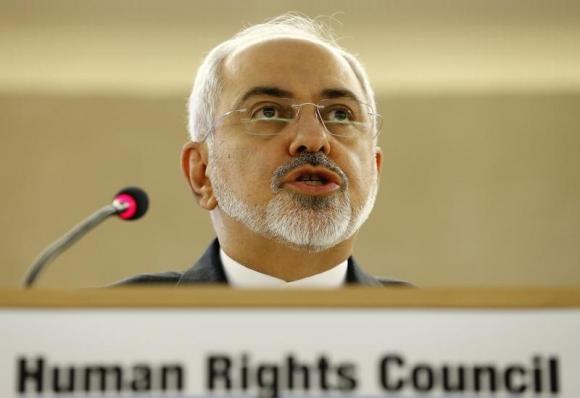
Iranian Foreign Minister  Zarif addresses Human Rights Council at UN in GenevaIranian Foreign Minister Mohammad Javad Zarif addresses the 28th Session of the Human Rights Council at the United Nations in Geneva March 2, 2015. CREDIT: REUTERS/DENIS BALIBOUSE

(Reuters) – Iran on Tuesday rejected as “unacceptable” U.S. President Barack Obama’s demand that it freeze sensitive nuclear activities for at least 10 years, but said it would continue talks aimed at securing a deal, Iran’s semi-official Fars news agency reported.

“Iran will not accept excessive and illogical demands,” Iranian Foreign Minister Mohammad Javad Zarif was quoted as saying by Fars.

“Obama’s stance … is expressed in unacceptable and threatening phrases … ,” he reportedly said, adding that negotiations underway in Switzerland would nonetheless carry on.

Zarif and U.S. Secretary of State John Kerry sat down for a second day of meetings hours after Obama had told Reuters that Iran must commit to a verifiable halt of at least 10 years on sensitive nuclear work for a landmark atomic deal to be reached.

The aim of the negotiations is to persuade Iran to restrain its nuclear program in exchange for relief from sanctions that have crippled the oil exporter’s economy.

The United States and some of its allies, notably Israel, suspect Iran of using its civil nuclear program as a cover to develop a nuclear weapons capability. Iran denies this, saying it is for peaceful purposes such as generating electricity.

Kerry and Zarif met in the Swiss lakeside town of Montreux as Israeli Prime Minister Benjamin Netanyahu prepared to criticize the diplomacy in a speech to Congress in Washington.

Despite the tough tone of Zarif’s remarks quoted by Fars, the Iranian struck a more conciliatory tone when he spoke briefly to reporters after about two hours of talks with Kerry.

Asked if the two sides had reached an agreement, Zarif replied: “We’ll try, that’s why we are here.”

“There is a seriousness that we need to move forward. As we have said all along, we need the necessary political will to understand that the only way to move forward is though negotiations,” he added.

Speaking after the morning round of talks, Kerry told reporters: “We’re working away. Productively.”

The two sides have set a deadline of late March to reach a framework agreement and of June for a comprehensive final settlement that would curb Iran’s nuclear activity to ensure it cannot be put to bomb making in return for the lifting of the economic sanctions.

Iran wants a swift end to sanctions in any deal — one of the sticking points in the high-level negotiations.

While the United States has played the lead role in the talks with Iran, it is representing five other major powers: Britain, China, France, Germany and Russia — a group collectively known both as the P5+1 and the E3+3.

Speaking in Geneva, German Foreign Minister Frank-Walter Steinmeier sounded an upbeat note, saying the negotiations had made more progress in the past year than in the previous decade.

“The talks between the E3+3 and Iran are also advancing well,” he told the U.N.-backed Conference on Disarmament. “I would even go so far as to say that in 10 years of negotiations, we never achieved as much progress as we have made this year.”

Iran’s Moves in the Middle East and Why You Should Care.

February 10, 2015

Iran’s Moves in the Middle East and Why You Should Care, The Watchman via You Tube, February 10, 2015