Krauthammer: Trump’s Russia reference set a trap for Clinton, Fox News via YouTube, July 27, 2016
The Real Implications of Deborah Wasserman Schultz’s Resignation, PJ Media, Roger L Simon, July 24, 2016

The most fascinating aspect of the controversy over the Democratic National Committee’s hacked emails that has resulted in Deborah Wasserman Schultz’s resignation—a quasi firing—is that everything was fine with Wasserman-Schultz until… she got caught.
While some Democrats, particularly Bernie supporters, were annoyed with Debbie before” Guccifer 2.0″ exposed the DNC emails, those same emails demonstrating favoritism to Hillary Rodham Clinton by the supposedly even-handed committee were readily available to a whole stream of people who never said word one.
It would be interesting to compile an annotated list of who they are, who was on the various rounds. Do they include those, like David Axelrod, who suddenly and eagerly called for Wasserman Schultz to bow out? I’d bet on some surprises. Whatever the case, were I a Sanders supporter, which I am not, I would obviously be furious.
It is quite possible that Bernie Sanders would currently be the Democratic Party nominee for president were it not for this conspiracy against him. We will never know. He came remarkably close even while enduring it. (I would imagine if a conspiracy surfaces on email, out of digital form in cloakroom whispers, it is even more pervasive.)
What is astonishing is that Sanders himself has turned into a eunuch, rolling over for this on the morning shows by making light of the situation. One can only wonder what his supporters think now that their hero is a sellout. (Perhaps they will learn the value of the missing Eleventh Commandment—”Never trust your leaders.”)
That the DNC server was so easily hacked is also quite astonishing since the break-in occurred after the Hillary Clinton email server story became front-page news. Don’t these people learn anything?
I am far from an expert in cybersecurity, but having run an online media company for seven years, I forced myself to learn enough to see the obvious—that those who hacked into the DNC server and other email accounts such as Sidney Blumenthal’s to Hillary Clinton, as was done by the original Guccifer, were simply clever amateurs, patient enough to guess their way in with simple-minded passwords. For the highly-trained sophisticated intelligence services of China, Russia, Germany, Israel, the UK, France, Pakistan and Iran (to name just a few) with access to super computers, such break-ins would be so routine they might be done in ten minutes. Our own NSA might have done in it three minutes. Maybe they did.
How did this outright cyber stupidity on the part of the DNC and Clinton come to pass? Two words: arrogance and corruption. They work together brilliantly.
How could you possibly trust these people to manage the war against radical Islam where cybersecurity is increasingly paramount? ISIS has certainly mastered YouTube. Who knows what else they can do? Sooner or later, they or their progeny will know plenty.
How the media plays this story will be revelatory. They treated Melania Trump’s cribbing a few lines of the most banal boilerplate from a Michelle Obama speech as a catastrophe that could upend a campaign. This is a hydrogen bomb by comparison. The governing committee of one of our two principal political parties attempted to steal an election—and was supremely incompetent in the process!
If the media does not meet its responsibility with this story and pursue it to the end, they will be exposing the bias we all know to such a degree they are endangering their own survival. The public, as Trump’s candidacy indicates, not to mention the polls, already despises the media. That same media may seem invincible, but they are vulnerable in their bottom line. Everybody is.
Still no confidence in the MSM? If you’re interested in searching the DNC email database yourself, you can do so here.
AND THIS UPDATE: People say they’re confused by the latest revelation that after having “resigned” from the DNC, Wasserman Schutlz has just been hired by Hillary’s campaign. I’m not. Washerman Schultz knows a great deal. Clinton would never want her angry and running off the reservation talking to people. As the man said, “Keep your friends close, but your enemies closer.”
MOST AMUSING BS IN THE STORY SO FAR: Clinton campaign manager Robby Mook claiming that the email leak was a Russian plot to get Donald Trump elected. WikiLeaks made fun of that one quickly enough. It’s sort of the equivalent of Hillary blaming her husband’s adulteries on “the great rightwing conspiracy.” It’s such a boldfaced lie you have to admire the person for having the guts to tell it. I rather doubt Putin is shivering in his boots over a President Hillary “Reset Button” Clinton.
President Of Pro-Kremlin Think Tank RIAC: Clinton, The Policy Professional, Preferable To Novice Trump, MEMRI, July 21, 2016
(Please see also, Russian Commentator On U.S. Elections: Clinton Is Better For Russia. — DM)
Igor Ivanov, the President of the Russian International Affairs Council (RIAC), and a former Russian Federation foreign affairs minister (1998–2004) attempted to prepare his readers for Hillary Clinton’s expected victory (the article was obviously written before the polls narrowed Clinton’s margin over Donald Trump). [1] Ivanov realizes that Russian public and elite opinion dislikes Clinton as “obsessed with human rights” and believes that Donald Trump can turn the page on US-Russia relations as he is not bound by Obama’s legacy. Moreover, the Russian elites have bitter memories of former U.S. president Bill Clinton whom they view as the architect of NATO’s eastward expansion into countries that were formerly Warsaw Pact members or Soviet republics. [2] Ivanov paints a rosier picture of Russia-US relations under Bill Clinton. Contrasting the rational and predictable behavior he expects from Hillary Clinton with the inconsistent and unpredictable behavior expected from Trump, Ivanov regards a Clinton victory as the preferable outcome.
In addition to bowing before an “inevitable” Clinton victory the Russian leadership maybe warming to the Democratic candidate due to Secretary of State John Kerry’s visit to Moscow and his lengthy talks with Russian President Vladimir Putin and Russian Foreign Minister Sergey Lavrov on greater US military cooperation with Russia in Syria.[3]
While some commentators take a cynical view of the talks and claim that ramped-up cooperation with Russia is an attempt by the Obama Administration to impress the American voters prior to the elections, or an admission that Washington’s Syria policy is bankrupt, Russia probably regards institutionalized cooperation mechanisms as a step forward. Ivanov claims that such cooperative mechanisms in all spheres and on all levels were missing in the 1990s, and their establishment would put US-Russia relations on a firmer footing.
Ivanov’s article appears below:
‘It Is…Easier To Achieve An Agreement With Experienced Professionals…A ‘Newcomer’ In International Politics Is… Harder To Work With’
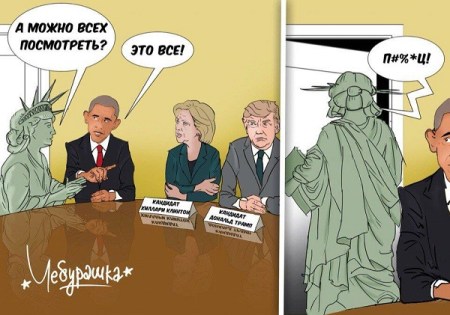 Twitter.com/sharzhipero, May 23, 2016.
On the table badges: candidate Hillary Clinton, candidate Donald Trump.
Statue of Liberty: Can I see all of them [all candidates for the U.S. presidency]?
U.S. President Barack Obama: That’s all of them
Statue of Liberty: Oh, f**k..
“Less than four months remain before America elects its President; the dramatic struggle has entered its final phase. […] As the polls show, it is widely assumed in Russia that the arrival of Donald Trump in the White House would benefit this country more than victory by Hillary Clinton. A populist and fierce opponent of the Washington establishment, Trump could, they say, turn the page in U.S.-Russia relations, which have seen better times, and open a new chapter without regard to the ‘legacy’ of Democrat Barack Obama.
“Hillary Clinton is known to arouse mixed feelings among Russians. Some know her as a relentless and at times inflexible negotiator. Others view her as a politician obsessed with human rights. And still others say that Moscow has always gotten along better with Republicans than with Democrats.
“My experience over the years – and I have talked face-to-face to the leaders of many countries – is telling me that there are hardly any substantial grounds for such fears or hopes. It is usually easier to achieve an agreement with experienced professionals, even if they are inflexible negotiators and difficult partners. They are predictable, rational, and they are well aware of their limitations. A ‘newcomer’ in international politics is usually harder to work with: the lack of experience often translates into inconsistent and unpredictable behavior; it leads to subjective, emotional and at times erroneous decisions that can be very hard to rectify later on.
“Speaking on June 17 [2016] at the Saint-Petersburg International Economic Forum, President Putin recalled his positive experience of working with the forty-second President of the United States, Bill Clinton.[4] I was Minister of Foreign Affairs at the time and remember those days very well. There was more than enough disagreement and difference between our countries back then too. But, unlike recent years, mutually respectful dialogue was never broken off and there was an understanding of how important U.S.-Russia relations were in terms of international stability. Naturally, Mrs. Clinton has her own view of American foreign policy. However, there is evidence that the ‘family experience’ will to a certain extent influence her actions if she wins the November election.
‘It Would Be Naïve To Believe That The State…Of Our Relations With The U.S Are Defined Exclusively By Who Sits In The Oval Office’
“This is not, however, the most important point. It would be naïve to believe that the state and dynamics of our relations with the United States are defined exclusively by who sits in the Oval Office, and that there is some easy and painless way to overcome the deep crisis in our bilateral relations. Miracles don’t happen in international politics. U.S. foreign policy has always been bipartisan, greatly inert, and the outcome of the presidential race alone cannot overturn the existing state of affairs.
‘It is hardly realistic to hope that the new administration will ‘come to its senses’ and be easy to deal with. No matter who wins the presidency, the strategic goal of preserving global leadership will remain unchanged, [all emphases added] though certain adjustments to the international agenda are, of course, possible.
“U.S.-Russia relations have entered a phase where the negative attitude that has accumulated over recent years has essentially grown into full-blown confrontation. This runs counter to our national interests and those of the United States as well. So it is important to take steps that would help reverse this dangerous trend. If we decide to wait and see what the new U.S. President and his or her team do, we lose time, and with it we lose the initiative.
“Frankly speaking, we failed to create a solid foundation for U.S.-Russia relations after the end of the Cold War. We did not try hard enough, engrossed in solving current international problems. This, in my view, makes the launch of a new negotiation process between Washington and Moscow the key goal, a process that would help develop common principles for our relations and jointly developed mutual commitments reflecting the interests of both sides.”
‘To Meet Just To Look Into Each Other’s Eyes Is Not Enough Anymore’
“What should we do first? This is the hardest part.
“In my mind, we first need to start working on arranging a bilateral summit. The longer it takes for such a meeting to happen, the more negative feelings will pile up. The meeting must be thoroughly worked through and it must have a strategic and future-oriented outcome. In today’s situation, to meet just to ‘look into each other’s eyes’ is not enough anymore.[5]
“Clearly, such a meeting will not solve all the numerous controversies we have at once. But this should not be the goal either. The meeting must set the course for the development of bilateral relations and form the necessary mechanisms for cooperation, which would help gradually overcome the present situation where cooperation in matters of strategic importance is held hostage by existing differences.
“Interaction at the presidential level will of course continue to remain the key element of the U.S.-Russia dialogue. But such interaction has to be complemented with a wide range of bilateral mechanisms, each devoted to a key area of cooperation. We need to breathe new life into the Strategic Stability Group,[6] where our two countries are represented by the leaders of the foreign and defense ministries. Dialogue between intelligence agencies has to be institutionalized as well. This would enhance mutual trust and create an atmosphere conducive to cooperation in fighting terrorism and in other fields. Particular attention needs to be paid to economic cooperation. Business-to-business cooperation has not become the shock-absorber that would limit or at least reduce the negative impact of differences in other areas. There is need for a mechanism that would stimulate economic cooperation at the governmental level, which would in turn promote better relations between our two countries in general.
“Another consultation mechanism should be created at the level of civil society. It should involve political and public figures, representatives of the media, science and culture – all those who influence public opinion in Russia and in the U.S. The proposed streamlining of U.S.-Russia dialogue might seem cumbersome and unrealistic at first. Unfortunately, it is the very lack of such a tight framework for dialogue on a wide range of pressing issues that has brought us to where we are today.
“In his telegram to President Obama on the occasion of Independence Day on July 4 this year, President Putin emphasized that ‘the history of US-Russia relations shows that when we act as equal partners and respect each other’s lawful interests, we are able to successfully resolve the most complex international issues for the benefit of both countries’ peoples and all of humanity.’
“Let us hope that Washington would take this invitation to dialogue seriously.”
Endnotes:
[1] Russiancouncil.ru, July 16, 2016
[2] See MEMRI Special Dispatch no. 6520, Russian Commentator On U.S. Elections: Clinton Is Better For Russia, July 19, 2016.
[3] Wall Street Journal, July 14, 2016.
[4] During the Plenary session of St Petersburg International Economic Forum, Putin said: “I worked with Bill Clinton, although for a very short time, and we had a very good relationship. I can even say that I am grateful to him for certain moments as I was entering the big stage in politics. On several occasions, he showed signs of attention, respect for me personally, as well as for Russia. I remember this and I am grateful to him. About Ms. Clinton. Perhaps she has her own view on the development of Russian-U.S. relations. You know, there is something I would like to draw [your] attention to, which has nothing to do with Russian-U.S. relations or with national politics. It is related, rather, to personnel policy. In my experience, I have often seen what happens with people before they take on a certain job and afterward. Often, you cannot recognize them, because once they reach a new level of responsibility they begin to talk and think differently, they even look different. We act on the assumption that the sense of responsibility of the U.S. head of state, the head of the country on which a great deal in the world depends today, that this sense of responsibility will encourage the newly elected president to cooperate with Russia and, I would like to repeat, build a more secure world.” Kremlin.ru, June 17, 2016.
[5] Ivanov appears to be referring to the June 2001 summit between Vladimir Putin and George W. Bush at the conclusion of which Bush told the press” “I looked the man in the eye. I found him very straight-forward and trustworthy – I was able to get a sense of his soul.” BBC.co.uk, June 16, 2001.
[6] Russia has established strategic stability groups with other countries and not only with the U.S. For example, in January 2003, the first meeting of the strategic stability group of Russia and Pakistan met to thrash out questions of proliferation of weapons of mass destruction and their delivery systems. Mid.ru, January 16, 2003.
Russian Commentator On U.S. Elections: Clinton Is Better For Russia, MEMRI, July 19, 2016
“The U.S. is now in a very difficult situation. It is far from certain that Trump’s reforms will save it. It is far from certain that Trump will be allowed to implement them. But Trump is the U.S.’s chance at revival, after which it will be able to return to an aggressive foreign policy under more favorable conditions. Whereas Hillary Clinton is Washington’s guaranteed way into the abyss. After her, no Trump will be able to save America.”
******************
Rotislav Ischenko, an analyst for ‘Russia Today’ had an interesting take on the American elections. While the Russian public prefers Trump because he is viewed as an antagonist of the American elite epitomized by Hillary Clinton, Ischenko is rooting for Clinton. Republicans, excluding George W. Bush, generally proved themselves more skillful practitioners of international politics who skillfully manipulated Russia. The Clinton Administration began the American overstretch that committed resources to meaningless and unachievable goals. Therefore those who would prefer a weakened America should hope for a Clinton victory that would translate into America’s continued decline.
A translation of Ischenko’s article appears below:[1]
‘A Democrat Means A Guaranteed And Accelerated Continuation Of The Current Decline Of The American Supremacy’
 Vitaly, Vk.com/13studiya, May 27, 2016. While Clinton and Trump are fighting in the ring, the public cheers for Russian President Vladimir Putin.
“Most Russian experts, observers and even ordinary citizens who exhibit as much interest in the American electoral campaign as in the Olympics or the Football World Cup, side with Donald Trump in this race. This comes as no surprise.
“Firstly, Hillary Clinton is a lady who is too unpleasant in all respects. Secondly, her revoltingly negative attitude to Russia is widely known. Thirdly, Trump is outrageously flamboyant and he fights the traditional American elite. Who in this world likes the traditional American elite? In short, the Russians, without any reservations, are giving the People’s Choice Award to Donald Trump.
“One must admit that Donald Trump can become a better president for America than Hillary Clinton. At least, a Republican may give it a chance, whereas a Democrat means a guaranteed and accelerated continuation of the current decline of the American supremacy.
“But the Russians who side with Trump are hoping he will be a better American president for Russia as well. This view is, however, problematic. I would even call such hopes groundless and, if we could vote in the American elections, I would deliberately give my support to the former State Secretary and the wife of the 42nd president of the U.S. [Hillary Clinton].
“Here are my considerations: Firstly, historically the policies of the Republicans have always been more flexible and less dogmatic. Even [U.S. President Ronald] Reagan who proclaimed the USSR to be ‘The Empire of Evil’ quickly realized what advantages Washington could gain from the [former President of the Soviet Union] Mikhail Gorbachev’s version of de-escalation of tension and became the best friend of the Soviet Union. His successor, George Bush senior, also a Republican, even actively campaigned against the USSR breakup. He even visited Kiev specifically in order to convince the Ukrainian elites aspiring for independence that they would be much more comfortable in the Soviet Union.
“The 40th and the 41st U.S. presidents [Reagan and George H. W. Bush] were not altruists. Their thinking was less straightforward than that of the Democrats, and they knew that the direct way to their goal is not necessarily the shortest. As part of the theory of indirect action, they tried to hug the USSR to death, and they almost succeeded. In fact, they did not need the Soviet Union to collapse. They only wanted to weaken it and reduce it to the rank of a junior partner who would pull chestnuts out of the fire for the American hegemony even more effectively than the EU.
“It was a beautiful operation that should have led to the clear victory of the U.S. with the least costs. Even the collapse of the USSR did not invalidate it – just made it more complicated: now it was Russia that had to be hugged to death.
But then the Democrats came, represented by the Clintons, and they ruined everything. They rushed to stake out a claim on seemingly important but, in reality, strategically meaningless territories (in particular, in Yugoslavia). At the same time, the policy of deterrence against Russia was applied more and more noticeably in the post-Soviet territories.
Moscow grew wary, and public opinion in Russia, initially favorable to the U.S., became diametrically opposite. The chance was wasted, and the U.S. entered an exhausting race to maintain its supremacy, which has by now stretched its battle lines and eaten practically all the free resources, at the same time allowing Russia to concentrate, consolidate and launch a counter-offensive.
‘The Foreign Policy Paradigm Determined By The Clintons… Did Not Allow The U.S. To Choke The USSR/Russia In The Least Costly And Most Effective Way’
Obama’s Democratic administration proclaimed that it was aware of the necessity for significant reforms. The Nobel Peace Prize laureate [U.S. President Barack Obama] did make an attempt to break with the past, fold military activity all over the world, avoid confrontation with Russia and China, and concentrate on the domestic problems of the U.S. He failed for a number of reasons.
“Firstly, [Obama], personally, was not ready for the presidential office. Obama pronounced stirring speeches more often than tried to implement his own ideas.
“Secondly, since he understood little in foreign policy, he tried to focus on his domestic reforms (necessary, but insufficient), and gave the run of the foreign affairs to the same people who had implemented the idea of global ‘pawn-grabbing’ [a tendency of foolish chess-players] during Clinton’s term, neglecting the U.S. strategic interests.
“Thirdly, by the time of Obama’s presidency, the U.S. had advanced so far in the implementation of the idea of violent suppression of all potential foreign opponents, it had adhered so long to the tactics of ‘conquer everything, lose nothing,’ that without a single iron directing will that would implement an alternative comprehensive concept, neither the military nor the politicians nor the diplomats were able to break out of the vicious circle of decisions the inevitability of which was dictated by previous decisions.
“As a result, Obama became trapped by Clinton’s foreign policy, ruinous for the U.S., which had been implemented before by Clinton himself and then by the Republican administration of Bush junior. During the latter’s term, the inability of Washington to suppress all its opponents by force became evident, but Bush junior had neither experience nor will sufficient to turn the state ship around. Besides, for most of Bush’s term, the U.S. was euphoric about its formal foreign victories (Iraq, Afghanistan), and this inertial motion did not arouse any significant concern in anyone except a small number of domain specialists.
“On the whole, the foreign policy paradigm determined by the Clintons that has lasted as the leading one for six presidential terms of three presidents did not allow the U.S. to choke the USSR/Russia in the least costly and most effective way. The same paradigm caused the U.S. to overstrain itself; its resource base is no longer up to the task of global domination.
‘When We Deal With Hillary, We Deal With An Unpleasant But Predictable [Politician]… Trump Is Not Burdened By Rules Of Morality, At Least Not More Than Hillary’
Today, the Washington elites are facing a choice again. They can pig-headedly continue the same policy of pressure by force, hoping that the opponent will break before the U.S. is exhausted. In fact, today it means hoping for a miracle, like the coup of 1917, which took Russia out of the First World War and delayed Germany’s downfall by 18 months. Hillary Clinton is a supporter of this policy.
We understand what she will do and how. We understand we will have to deal with hysterics, attempts to apply pressure, blatant rudeness and undisguised threat of war. But we also understand that it is not Hillary who will decide whether or not to push the button. And the people who will decide are much more level-headed. In short, when we deal with Hillary, we deal with an unpleasant but predictable and see-through politician who will continue to lead the U.S. along the way towards resource overstrain.
“Trump is no Bush junior. He is the focus of all the strong points of the Republican party. He is not burdened by rules of morality, at least no more than Hillary. But he is more flexible and sees other ways of solving the American problem, besides the pig-headed direct pressure. Above all, Donald Trump understands that without stabilizing the economy and the financial system of the U.S., all its claims to world domination are no more than wishful thinking, and the U.S. is in danger of quickly becoming ‘Upper Volta’ with missiles”.
“One must realize that Trump is not alone. Of course, he speaks against the traditional Republican establishment, but it does not mean he does not enjoy the support of influential back-stage circles, who have become aware of the ruinous character of Clinton’s policy and are trying a more creative approach. Without powerful support (taking into account how the American press is controlled by the party elites), Trump would simply never have been given the opportunity to speak. All his billions would not have sufficed for a serious campaign. One can assume that Trump will try to offer the U.S. something like the policy Putin has been implementing in Russia.
“Firstly, [Trump seeks] an acceptable compromise in foreign policy. The U.S. reduces its activity in the major conflict areas, on condition that it saves its face. Secondly, [he will shift to] focusing on domestic problems. That is, tough reforms leading to painful but decisive revitalization of the financial and economic systems, in particular, at the expense of the outside world (Trump has already acknowledged the possibility of the U.S. defaulting). Thirdly, play on the contradictions of the remaining major players, whom the U.S. will find it easier to play off against each other in the context of reduced international activity, because their necessity to defend themselves from common danger – Washington – will disappear, but the mutual contradictions will exacerbate.
“The U.S. is now in a very difficult situation. It is far from certain that Trump’s reforms will save it. It is far from certain that Trump will be allowed to implement them. But Trump is the U.S.’s chance at revival, after which it will be able to return to an aggressive foreign policy under more favorable conditions. Whereas Hillary Clinton is Washington’s guaranteed way into the abyss. After her, no Trump will be able to save America.”
Endnote:
[1] Ria.ru, May 19, 2016.
A policy of hypocrisy, Israel Hayom, Dr. Haim Shine, April 25, 2016
Judging by his approach to complex national and international issues, U.S. President Barack Obama is very frustrated. The frustration is natural for someone who made big promises, almost messianic ones, and is now leaving behind nothing more than a trail of shattered dreams. During his eight years in office, the United States has gone from being a leading superpower, a pillar of Western civilization, to a state that is hesitant, indecisive and alarmingly slow to respond. Its domestic economy is faltering, sowing uncertainty and insecurity among the large middle class.
Needless to say, the success enjoyed by Republican presidential candidate Donald Trump is an expression of a great number of Americans who grew up hearing about how their flag was raised on Japan’s Mount Suribachi on the island of Iwo Jima toward the end of World War II, and who are now watching with heartache as their beloved flag is being lowered to half-mast before being taken down altogether.
In an effort to gather up the pieces of his crumbling legacy, Obama set out on his final trip to the Middle East and Europe. America’s long-time allies feel betrayed. Their resentment is clear. Relationships between countries are not disposable. The Obama administration’s deference to Iran has had major implications on its ties with Saudi Arabia and the Gulf States. A divided Egypt is still paying the price for Obama’s support for the Muslim Brotherhood.
The state of Israel, which has led the struggle against a nuclear Iran for a long time, has by now come to terms with the fact that the United States was duped by the fake smiles of Iranian Foreign Minister Mohammad Javad Zarif and his friends in Tehran. Singing Passover songs in Hebrew won’t change the fact that Obama has not changed, after having sided entirely with the mendacious Palestinian narrative of victimhood.
Leaders in the Middle East cannot decide whether Obama is a naive president or one who is willing to sacrifice his fundamental values and his credibility just so he can leave behind what he sees as a positive sentence in the books of history — a sentence that will be erased with record speed.
Europe is also discouraged by the United States. Obama’s indecisiveness regarding the madness in Syria has allowed Russia to take significant steps in the Middle East and Europe. The failed efforts to confront the Syrian problem have contributed to the tsunami of migrants flooding Europe and all the resulting consequences for European society and its security. Add to this, of course, the financial crisis currently threatening to destroy the European Union, the seeds of which were sown in 1992 with the signing of the Maastricht Treaty in 1992.
It is against this backdrop that the British are expected to decide via referendum whether or not to remain a part of the European Union. During his recent visit to England, Obama spoke out strongly against Britain’s potential separation from the EU. This was a crude and disproportionate effort to meddle in another state’s affairs — an expression of his desire to evade blame for the collapse of the European Union. In his mind, British citizens are expected to forgo their opinions and best interests in favor of his legacy.
It is therefore unclear why Obama unleashed his fury at Prime Minister Benjamin Netanyahu when the latter made tireless efforts to convince Congress and the American public not be deceived by the dangerous nuclear deal. How much hypocrisy does it take to allow yourself to do things that you reprimand others for doing? Immanuel Kant saw this kind of behavior as a basic moral failure. Luckily for Britain’s citizens, Obama cannot veto their decision.
H/t Liberty Alliance
Israel, Turkey, Russia and Egypt, Gatestone Institute, Shoshana Bryen, April 17, 2016
(A blast from the past:
— DM)
♦ In 2011, the UN Palmer Commission Report found the blockade of Gaza — jointly administered with Egypt — to be legal, and said Israel owed Turkey neither an apology nor compensation.
♦ Lifting the Israel/Egypt embargo on Gaza would empower Hamas, and thereby the Muslim Brotherhood, Iran and ISIS — which would seem an enormous risk for no gain.
Turkish sources assert that Turkish-Israeli governmental relations are about to come out of the deep freeze. But this is a reflection of Turkey’s regional unpopularity and glides over Turkish demands for Israel to end the blockade of Gaza. To meet Turkey’s condition, Israel would have to abandon the security arrangement it shares with Egypt — which has increased Israel’s security and has begun to pay regional dividends. To restore full relations between Israel and Turkey would irritate Russia, with which Israel has good trade and political relations, and a respectful series of understandings regarding Syria. Israel’s relations with the Kurds are also at issue here.
After the 2010 Mavi Marmara flotilla — in which Turkey supported the Hamas-related Turkish organization, the IHH, in its effort to break the blockade of Gaza — Turkey made three demands of Israel: an Israeli apology for the deaths of Turkish activists; a financial settlement; and lifting the Gaza blockade, which Turkey claimed was illegal. The last would provide IHH with the victory it was unable to achieve with the flotilla.
 The Turkish-owned ship Mavi Marmara took part in a 2010 “Gaza flotilla” attempting to break Israel’s naval blockade of Gaza, which is in place to prevent the terrorist group Hamas from bringing arms into Gaza. (Image source: “Free Gaza movement”/Flickr)
In 2011, however, the UN Palmer Commission Report found the blockade of Gaza — jointly administered with Egypt — to be legal, and said Israel owed Turkey neither an apology nor compensation. In 2013, at the urging of President Obama and to move the conversation off the impasse, Prime Minister Netanyahu did apologize for the loss of life and agree to discuss compensation. While President Obama was pleased, Prime Minister Erdogan repaid the gesture by denigrating Israel on Turkish television and announcing he would force the end of the blockade. Israel’s condition — that the office of Hamas in Ankara be closed — was ignored.
Nevertheless, in February 2014, Turkish Foreign Minister Ahmet Davutoglu told Turkish television that Israel and Turkey were “closer than ever” to normalizing relations.” In December 2015, it was more of the same. And in February 2016, there was yet another announcement of imminent restoration of government-to-government ties. In March, Kurdish sources said Turkey was demanding weapons from Israel, but that Israel wanted to ensure that Turkey would not use them against Kurdish forces.
Israel finds itself in an odd position — choosing among those who want its cooperation.
Israel and Egypt have come to a deep understanding of the sources of instability and insecurity in Sinai, and the relationship between Hamas in Gaza and its primary sponsor, Iran, as well as ISIS. Former IDF Chief of Staff Benny Gantz told inFOCUS magazine recently:
Coordination between us is very high and very important because we have identical interests. Period. The way to achieve them might look different, but Egypt is a very important country. It is crucial to the world to ensure its stability – progress in the fight against ISIS that is present in Sinai, and protecting the Suez Canal, and other things… They are all good reasons for Egypt to take these responsibilities seriously and do something about the threats. I’m very happy to see what they’re doing. It is a good track.
This month, Egypt and Saudi Arabia upgraded relations with Egypt, ceding back to the Saudis two islands that Saudi Arabia had given Egypt in 1950 to help Egypt fight Israel in the Red Sea. According to a report in the Egyptian daily al-Ahram, as reported by the Jerusalem Post, the Egyptian government informed Israel of the parameters of the deal, noting that Riyadh would be obligated to honor all of Egypt’s commitments in the peace treaty with Israel, including the presence of international peacekeepers on the islands and freedom of maritime movement in the Gulf of Aqaba. Israel approved the deal “on condition that the Saudis fill in the Egyptians’ shoes in the military appendix of the peace agreement,” according to Defense Minister Moshe Yaalon.
This makes Saudi Arabia an active partner in the Camp David Accords. And it follows on the heels of the Gulf Cooperation Council (GCC) labeling Hezbollah “a terror organization” without the weasel words the Europeans used to condemn only the “military wing” of the organization.
In the face of these developments, it is hard to imagine a benefit that would accrue to Israel by negating the Israel-Egypt blockade of Gaza on behalf of Turkey.
Russia presents a similar series of circumstances. Relations between Russia and Turkey have taken a nosedive over the Syrian civil war, particularly after Turkey shot down a Russian plane. But even before that, Turkey’s support of Sunni jihadist organizations was a thorn in the side of Russia, which still fears Sunni jihad inside southern Russia.
Russia has goals in Syria and Israel also has requirements. In his inFOCUS interview, former Chief of Staff Gantz noted:
The [Israeli] Prime Minister and Chief of Staff [Gantz’s successor] flew to Russia and had some important of discussions of intentions, deconfliction, and we expressed our interests… stability, preventing terrorist activity… preventing armament that will go from Iran through Syria to Hezbollah, or from Russia to Syria and then to Hezbollah…. People can see what it is that Israel does once in a while when it has to protect itself.
Add to this Israel’s generally good economic and political relations with Russia and, again, it is hard to see the benefit that would accrue to Israel by forging closer relations with Turkey while Russia and Turkey are doing a slow burn.
Turkey is doing a faster burn on the Kurds. Having waged a fierce war against Kurdish separatists in southern Turkey, the Turkish government has taken military action against the Kurds of Iraq and Syria to prevent Kurdish forces from connecting two enclaves — one in Iraq and one in Syria — that could form the geographic beginning of an independent Kurdistan.
Even at the peak of Israeli-Turkish relations, Israel’s support of the Kurds has been a relatively open political secret. Although the Israeli government consistently denies providing weapons, reputable sources suggest, at a minimum, training for Kurdish forces. Most recently, Israel acknowledged buying oil from Kurdish sources in Northern Iraq, and IsraAid, an Israeli humanitarian organization, provided assistance to Kurdish refugees fleeing ISIS. Prime Minister Netanyahu has publicly supported the establishment of a Kurdish state.
For Israel to trade its increasingly important relations with Russia, with Egypt — and thereby with Saudi Arabia — and with the Kurds for Turkish political approval and a promise to buy Israeli natural gas would seem to be a bad deal. For Israel to accompany that with the lifting of the Israel/Egypt embargo on Gaza that would empower Hamas — and thereby the Muslim Brotherhood, Iran and ISIS — would seem an enormous risk for no gain.
Syrian official answers Netanyahu: We will use all available means to recapture the Golan, Jerusalem Post, Maayan Groisman, April 17, 2016
(Please see also, Netanyahu to battle Obama, Putin over the Golan. — DM)
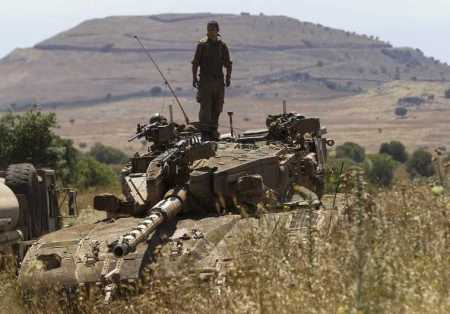 An IDF soldier stands atop a tank near Alonei Habashan on the Golan Heights, close to the ceasefire line between Israel and Syria. (photo credit:REUTERS)
In a first reaction to Prime Minister Benjamin Netanyahu’s declaration that “Israel will never leave the Golan Heights,” Syrian Foreign Minister Faisal al-Miqdad said Sunday that Syria is prepared to use every possible means to recapture the area, including military means.
“The Syrian Golan is an occupied Arab land according to the UN Security Council’s resolutions, and the presence of the United Nations Disengagement Observer Forces proves this,” Miqad said in an interview with the Lebanon-based TV channel al-Mayadeen.
“We have never renounced the resistance and we are ready to recapture the Golan in all possible ways, including military ways. Israel wants to provoke us, but we will never surrender,” Miqdad added.
“Neither Russian President Vladimir Putin nor any other president in the world would have accepted the indecent Israeli logic regarding the Golan,” Miqdad argued.
At the opening of a special cabinet meeting held for the first time ever on the Golan Heights on Sunday, PM Netanyahu declared: “The time has come after 40 years for the international community to finally recognize that the Golan Heights will remain forever under Israeli sovereignty.”
Netanyahu’s dilemma: Détente with Turkey or recognition of Syrian Kurds, DEBKAfile, April 4, 2016
 They were once good friends
Last Friday, April 1, President Reccep Tayyip Erdogan had his first encounter with a group of American Jewish leaders, at his request. The full details of its contents were hard to sort out because the Turkish translator censored his master’s words with a heavy hand to make them more acceptable to his audience. But Erdogan’s bottom line, DEBKAfile’s New York sources report, was a request for help in explaining to the Obama administration in Washington and the Netanyahu government in Jerusalem why they must on no account extend support to the Syrian Kurdish PYD and its YPG militia or recognize their bid for a separate state in northern Syria.
The Turkish president did not spell out his response to this step, but indicated that a Turkish invasion to confront the Kurdish separatists was under serious consideration in Ankara. His meaning was clear: He would go to war against the Kurds, even if this meant flying in the face of President Barack Obama’s expectation that Turkey would fight the Islamic State.
Relations between the Turkish and US presidents have slipped back another notch in the last two weeks. When he visited Washington for the nuclear summit, Erdogan was pointedly not invited to the White House and his request for a tete a tete with Obama was ruled out. The US president even refused to join Erdogan in ceremonially honoring a new mosque built outside Washington with Turkish government funding.
At odds between them is not just the Kurdish question, but Erdogan’s furious opposition to Obama’s collaboration with Russian President Vladimir Putin on the Syrian conflict, and the two presidents’ tacit accord to leave Bashar Assad in power indefinitely until a handover becomes manageable.
On Feb. 7, on his return for a Latin American tour, the Turkish president warned Obama that he must choose between Ankara and the Kurds, whom he called “terrorists.” By last week, the US president’s choice was clear. It was the Kurds.
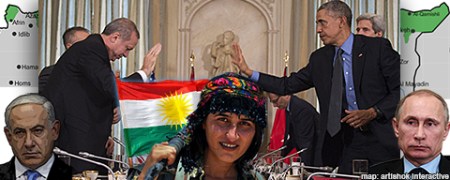
When Erdogan arrived home from Washington last week, he discovered that the roughly four million Syrian Kurds dwelling in three enclaves touching on the Turkish border had taken important steps to advance their goal for self-rule: They were drafting a plan for establishing a “Federal Democratic System” in their three enclaves – Hassakeh-Jazeera, Kobani and Afrin – and had announced the amalgamation of their respective militias under the heading the “Syrian Democratic Forces”.
Cold-shouldered in Washington as well as Moscow (since Turkish jets shot down a Russian fighter last November), Erdogan found himself let down by the Jewish leaders whom he tried to woo. They refused to support him or his policy on the Kurdish question for three reasons:
1. Ankara had for years consistently promoted the radical Palestinian Hamas organization. To this, Erdogan replied by denying he had backed Hamas only acted to improve the lives of the Gaza population. And, anyway, he said he had reacyed understandings with Israel on this issue..
2. His hostility towards Egyptian President Abdel-Fatteh El-Sisi. Erdogan’s response to this was a diatribe slamming the Egyptian ruler.
3. No clear reply had been forthcoming from Jerusalem by that time on Israel’s relations with Turkey or its policy towards the Kurds, despite the Turkish leader’s positive presentation of mended fences.
The current state of the relationship is laid out by DEBKAfile’s sources:
Prime Minister Binyamin Netanyahu is caught on the horns of multiple dilemmas: While reluctant to respond to Ankara’s suit for warm relations with a leader who is shunned by Obama and Putin alike, Turkey is nonetheless offering to be Israel’s best client for its offshore gas.
Israel’s friendship with the Kurdish people goes back many years. The rise of an independent or autonomous state in Syria and its potential link-up with the semiautonomous Kurdish region of Iraq would create an important new state of 40 million people in the heart of the Middle East.
Israel has no wish to make enemies of its longstanding friends by disowning them in favor of Turkey.
Already, Israel’s evolving ties with the Syrian Kurds have given Israel’s strategic position in Syria a new positive spin, upgrading it versus the Assad regime in Damascus and its Hizballah and Iranian allies, who are avowed enemies of the Jewish state. Those ties offer Israel its first foothold in northern Syria.
And finally, Erdogan is not the only opponent of Kurdish separatism; so too are important Sunni Muslim nations like Saudi Arabia and Egypt. By promoting the Kurds, Israel risks jeopardizing its rapidly developing ties with those governments.
Sisi asks Obama for military intervention to save Egypt from ISIS, DEBKAfile, March 28, 2016
Egyptian President Abdel Fatteh El-Sisi has sent a secret missive to President Barack Obama asking for urgent US military intervention in support of Egypt’s war on the Islamist State in Sinai, before the jihadis pose a real threat to Cairo. DEBKAfile’s exclusive intelligence and counterterrorism sources report that El-Sisi has come to the conclusion that Egyptian army lacks the ability to eradicate the terrorist peril without direct US military support.
In his note, he asks Washington to replicate in Sinai the format of US intervention in the war on ISIS in Iraq and Syria, namely, to send in special operations forces to establish bases and operate drones against jihadist targets. Unless stopped, he warns, the Islamic State is on the point of transforming the Sinai Peninsula into its primary forward base in the Middle East, bolstered by its branches of terror across North Africa, especially in Libya. US intervention is necessary to avert this.
So far, Sisi has received no answer from the White House and no sign of one in the pipeline.
Our military sources note that, given his record as former defense minister and a much-decorated general in the Egyptian army, an appeal to a foreign power for military assistance is out of character and would normally be found unacceptable in his own milieu. It must therefore be seen as a sign of extreme distress over Cairo’s failure to vanquish – or even contain ISIS, which now poses a strategic threat to Egypt proper.
In this situation, the generals in Cairo were dismayed to read a New York Timesleader on March 25, captioned “Time to Rethink US relationship with Egypt,” which faults the Egyptian regime’s human rights record and suggests that the relationship does Washington more harm than good.
The NYT concludes by saying, “Over the next few months, the president should start planning the possibility of a break in the alliance with Egypt. That scenario appears increasingly necessary.”
Since this article appeared out of the blue, it is feared in Cairo that it is President Obama’s way of spurring the Egyptian president’s SOS.
Some high-ranking military figures in Cairo have started talking about alternatives: If Washington refuses to come up with military assistance for fighting the Islamic State, perhaps the time has time to go elsewhere.
An Egyptian appeal to Moscow cannot be ruled out.




 anneinpt
 artaxes
 danmillerinpanama
 davidking1530
 Peter Hofman
 Joseph Wouk
 Peter
Peter Louisiana Steve
 WarSclerotic
Recent Comments