Archive for the ‘Russia – Syrian war’ category

Russian troops already engaged in battle against ISIS around Homs

September 17, 2015

Russian troops already engaged in battle against ISIS around Homs, DEBKAfile, September 17, 21015
Russia_Putin267

Contrary to the impression conveyed by Moscow that Russian troops in Syria are not engaged in combat and that none of the sophisticated arms deliveries were destined to the Syrian army, new developments belie both these claims. 

DEBKAfile’s military and intelligence sources report that on Wednesday, September 16, Russian R-166-0.5 (ultra) high-frequency signals (HF/VHF) vehicles were spotted on Highway 4, which links Homs and Aleppo. These vehicles, called “mobile war rooms” by the IDF and Western armies, were accompanied by BTR-82 troop carriers transporting Russian marines. The R-166-0.5 enables communication with forces located on battlefields as far as 1,000 kilometers away using high frequency and ultra-high frequency signals.

The communication systems are resistant to electromagnetic jamming so Russian forces operating deep inside Syria can report to their commanders at the main Russian base in Latakia or receive orders, intelligence data and even video from drones or planes.

Another feature is a cylinder on the side of the vehicle containing a folded antenna that can be raised to a height of 15 meters.

The R-166-0.5 is an integral part of Russia’s battlefield operations, so it would not be deployed unless long-distance troop movements were underway. The appearance of those vehicles in the Syrian theater provides a clear signal of Moscow’s intentions.

Our sources point out that during the past few days, fighters from the Islamic State in Iraq and the Levant (ISIS) succeeded in cutting off part of the highway between Homs and Aleppo for several hours. It marked a very dangerous development for the Syrian army and regime, because a permanent cutoff of Highway 4 would tighten the siege on Aleppo and possibly pave the way for the conquest of the second-largest city in Syria.

The movements by the armored vehicles show that the Russian troops are preparing to head into battle in order to prevent such a scenario.

Moscow has denied supplying new, sophisticated weapons to the Syrian army. However, a Syrian military source revealed Thursday, Sept. 17, that the Syrian military has recently started using new types of air and ground weapons supplied by Russia, underlining growing Russian support to Damascus that is alarming the United States and Israel. “New weapons – and new types of weapons – are being delivered,” said the source which described them as “highly accurate and effective.”  The army had started using them in recent weeks having been trained in their use in Syria in recent months. “We can say they are all types of weapons – be it air or ground,” he said.

DEBKAfile’s military sources reveal that the Russian shipments for the Syrian army include MI-28 MIL assault helicopters (NATO-coded Havoc), an all-weather aircraft, which can also serve as an anti-tank weapon against the mostly US-made tanks fielded by ISIS and Al Qaeda’s Nusra Front Syrian arm.

Our military and intelligence sources point out that Moscow has given itself room to maneuver in terms of its declared goals, telling Washington and Jerusalem during the past few days that its troops will defend their own interests if there is a need to do so. Thus, Russia aims to use its forces in any way that it deems fit.

DEBKAfile’s sources in Washington report an ongoing debate within the Obama administration regarding whether to accept the proposal that was raised during the telephone conversations this week between Russian Foreign Minister Sergei Lavrov and US Secretary of State John Kerry.

Moscow proposed military-to-military talks on ways to prevent a confrontation between its troops in Syria and those of the US-led coalition, saying that the talks would provide a complete and clear understanding of Moscow’s intentions.

Unlike Kerry, who is in favor of taking the Russians up on their proposal, some circles in the administration feel that such talks would ultimately give Russia the green light for its military involvement and that Moscow is in the process of grabbing control of running all military operations in Syria, including those by other countries and groups.

Last week, Gen. Qassem Soleimani, commander of Iran’s al-Quds brigades, visited Moscow for the second time since April.  DEBKAfile’s sources in Moscow point out that this time, unlike his previous visit, Soleimani met with Russia’s National Security Adviser Nikolai Patrushev and a number of generals directly connected to the buildup in Syria, but not with President Vladimir Putin.

The developments in Syria will also take center stage when Israeli Prime Minister Benyamin Netanyahu meets with Putin in Moscow on September 21.
Obama’s victory was won by a politician, not a statesman

September 13, 2015

Obama’s victory was won by a politician, not a statesman, Israel Hayom, Boaz Bismuth, September 13, 2015

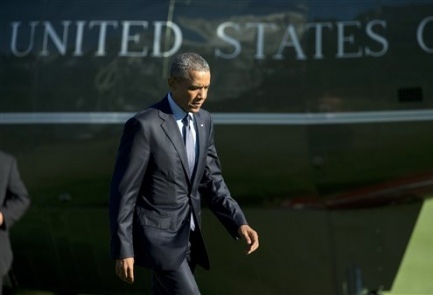
144213644746070861a_bU.S. President Barack Obama | Photo credit: AP

For once, however, Obama is right: Global warming is a burning issue that must be addressed, preferably starting in the Middle East, where the flames are unusually high.

*****************************

The U.S. House of Representatives voted Friday against the nuclear agreement with Iran, with a majority of 269 against, including 25 Democrats, and 162 in favor. This vote followed the expressed objections of 58 Senators, including four Democrats, who could not vote against the deal over a procedural win in the Senate on Thursday. It also followed a recent Pew Research Center survey showing that 49% of Americans oppose the deal, and only 21% support it.

Friday’s vote, albeit symbolic, proves that it is not the American people or their elected officials who want this deal — it is U.S. President Barack Obama who wants it, and what Obama wants, Obama gets.

The truth is, the U.S. does not believe Iran will adhere to the deal, but Obama, who since taking office has undermined the very foundations of the Middle East (and beyond), remains a savvy politician who knows exactly what needs to be done to push the nuclear deal through, despite the opposition it garners — opposition Obama is well aware of — so as to secure his legacy. Nevertheless, the nuclear deal is a victory won by a politician, not a statesman.

While Obama may have won the battle over the Iran nuclear deal, it was a procedural victory. History has taught us that the Senate rarely rejects a presidential foreign policy initiative.

The Iran nuclear deal would have been voted down if not for Obama’s considerable efforts. He understood the crucial need to present the Iran deal as an agreement, not as a treaty, which would have required he secure a two-thirds majority in the Senate, which he would not have been able to do. He also applied pressure on Democrats up for re-election, the majority of whom admitted the deal was far less than perfect.

According to American media, now that Obama has secured support for the Iran deal, he is turning his attention to global warming. For once, he is right — temperatures in the Middle East are scorching hot, and Obama had a hand in turning them up.

The recent sandstorm to cloud Israel was something of an ominous sign. The world has suddenly woken up to overt Russian presence in the Middle East. The Americans seem to have fallen asleep at the wheel, allowing Russian President Vladimir Putin to dictate a new reality on the ground, as he did in Ukraine. Could it be that Washington needed Moscow’s support for the Iran deal so badly it willingly dropped the ball?

The buildup of Russian forces in Syria has vast regional and international ramifications, which cannot be ignored. The West and Israel can no longer operate in Syria under the auspices of alleged “open skies,” and just in case that point was lost on anyone, Russia warned the U.S. against any “unintended incidents” on Syrian soil.

Russia has introduced its presence in the Middle East in a time when it could be seen as favorable. The international community wants to see the Islamic State group defeated, as do the Russians. Unlike in Ukraine, this time the Russians are on the same side as the good guys.

The Russians, however, are not alone: They have returned with the Iranians on their side, which is actually a gift from the U.S. — something that has irked the Saudis to no end, as they now have to find alternative avenues of dealing with both Moscow and Tehran.

For once, however, Obama is right: Global warming is a burning issue that must be addressed, preferably starting in the Middle East, where the flames are unusually high.

Putin’s offer to shield & develop Israel’s gas fields predated Russia’s military buildup in Syria

September 13, 2015

Putin’s offer to shield & develop Israel’s gas fields predated Russia’s military buildup in Syria, DEBKAfile, September 13, 2015

(Nice little gas field you have there. It would be a shame if something happened to it. — DM)


Leviathan480

More than a fortnight ago, Russian President Vladimir put a proposition to Israel for Moscow to undertake responsibility for guarding Israel’s Mediterranean gas fields, along with the offer of a Russian investment of $7-10 billion for developing Leviathan, the largest well, and building a pipeline to Turkey for exporting the gas to Europe, DEBKAfile reports. The offer was made to Prime Minister Binyamin Netanyahu in confidential phone conversations and through quiet envoys.

At the time, Putin did not share with Netanyahu his plans for an imminent buildup of marines, air force units, warships and missiles in Syria, although the plan had been worked out in detail with Tehran in late July. The Russian ruler put it this way: Leviathan abuts on the fringes of Lebanon’s economic water zone and is therefore vulnerable to potential sabotage by Iran, Syria or Hizballah, whether by commando or rocket attack.

A multibillion Russian investment in the field would make it a Russian project which neither Syria nor Hizballah would dare attack, even though it belongs to Israel.

But now the situation has assumed a different face. Russian forces are streaming to Latakia, and Moscow has declared the area from Tartous, Syria up to Cyprus closed to shipping and air traffic from Sept. 15 to Oct. 7 in view of a “military exercise including test firings of guided missiles” from Russian warships.

When he offered a shield for Israeli gas fields in late August, The Russian ruler knew that implementation would rest with Russian military forces on the spot, rather than Iranian and Syrian reluctance to harm Russian interests.

Then, on Aug. 30, Netanyahu discussed the new Russian proposition with Italian Prime Minister Matteo Renzi when they met in Florence, in the context of the former Italian Prime Minister Silvio Berlusconi’s involvement in Middle Eastern and European energy business and his close ties with Putin.

Berlusconi and Netanyahu are also good friends.

The Israeli prime minister never explicitly confirmed to Putin that he would consider the Russian transaction.

He hesitated because he sensed that a deal with Moscow for gas projects would be unacceptable to Washington and Noble Energy of Texas, which holds a 39.66 percent share in the consortium controlling Leviathan, as well as stakes in the smaller Tanin and Tamar gas wells.

Meanwhile, two Israeli ministers, Moshe Kahlon, finance, and Arye Deri, economy, consistently obstructed the final government go-ahead for gas production, tactics which also held Netanyahu back from his reply to Putin.

But when the fresh influx of Russian troops and hardware to Syria became known (first revealed by DEBKAfile on Sept.1), Netanyahu began to appreciate that, not only had Israel’s military and strategic situation with regard to Syria and the eastern Mediterranean been stood on its head, so too had foreign investment prospects for development projects in Israeli gas.

Israel’s strategic landscape had in fact changed radically in four respects:

1.  Its government can no longer accept as a working hypothesis (which never, incidentally, held up) the short term expectancy of the Assad regime. The injection of Russian military might, combined with the Iranian Revolutionary Guards forces, have given Assad a substantial lease of life.

The Israel Defense Forces must therefore revamp its posture on the Syrian front, and reassess its sponsorship of the select rebel groups which are holding the line in southern Syria against hostile Iranian or Hizballah cross-border attacks on northern Israel.

The changing attitude was suggested in views heard in the last couple of days from top Israeli security officials, who now say that leaving Assad in office might be the better option, after all.

2.  The new Russian ground, air and sea buildup taking shape in Syria provides a shield not just for the Assad regime but also Hizballah. This too calls for changes in Israel’s military posture.

3.  The Russian military presence in Syria seriously inhibits Israel’s flexibility for launching military action against Iranian or Hizballah targets when needed.

4. Three aspects of the new situation stand out prominently:

a)  The Russian air force and navy are the strongest foreign military force in the eastern Mediterranean. The US deplloys [sic] nothing comparable.

b)  Israel’s military strength is substantial but no one is looking for a military clash with the Russians, although this did occur four decades ago, when Israel was fighting for its life against Russian-backed Arab invasions.

c)  In view of the prevalence of the Russian military presence in the eastern Mediterranean, it is hard to see any foreign investor coming forward to sink billions of dollars in Israeli gas.

d)  Although Russia called Saturday, Sept. 12, for “military-to-military cooperation with the United States” to avert “unintended incidents” amid its naval “exercises” off the coast of Syria, the tone of the call was cynical. It is more than likely that Moscow may revert to the original Putin offer of a Russian defense shield for Israeli gas fields. But with such strong Russian cards in place in Syria, he may well stiffen his terms for this deal.

Russian submarine with 20 ICBMs and 200 nuclear warheads is sailing to Syria

September 7, 2015

Russian submarine with 20 ICBMs and 200 nuclear warheads is sailing to Syria, DEBKAfile, September 7, 2015

Dmitriy_Donskoy_BDmitri Donskoy TK-208 submarine heads for Syria

The world’s largest submarine, the Dmitri Donskoy (TK-208), Nato-coded Typhoon, has set sail for the Mediterranean and is destined for the Syrian coast, DEBKAfilereports exclusively from its military and intelligence sources. Aboard the sub are 20 Bulava (NATO-code SS-N-30) intercontinental ballistic missiles with an estimated up to 200 nuclear warheads. Each missile, with a reported range of 10,000km, carries 6-10 MIRV nuclear warheads.

The Russian sub set sail from its North Sea base on Sept. 4, escorted by two anti-sub warfare ships. Their arrival at destination in 10 days time will top up the new Russian military deployment in Syria.

President Vladimir Putin’s introduction of a nuclear force opposite Syrian shores builds up what first looked like an operation to fortify Assad’s regime in Damascus into a military expedition capable of an air and sea confrontation with US forces in the Middle East.

US Secretary of State John Kerry suggested as much Saturday, Sept. 5, when he expressed concern over reports of Russia’s “increasing military build-up in Syria” in a phone call to Russian Foreign Minister Sergey Lavrov. The State Department reported: “The Secretary made clear that if such reports were accurate, these actions could further escalate the conflict, lead to greater loss of innocent life, increase refugee flows and risk confrontation with the anti-ISIL coalition operation in Syria.”

Kerry was referring to potential Russian interference with US-led coalition air strikes against the Islamic State in Syria.

DEBKAfile’s sources in Washington and Moscow report that the dispatch of a nuclear sub to Syrian waters is taken as a strong message that the Kremlin will not let the US impede its military intervention in the Syrian conflict and will go to extreme lengths to keep the way open for the flow of Russian troops to the war-torn country.

This situation has gone a long way beyond Obama administration intentions when US-Russian talks were initially held for US forces posted in Turkey and Iraq, together with the Russian troops arriving in Syria, to launch a combined effort against the Islamic State. Those talks came to naught.

In its coming issue out Friday, Sept. 11, DEBKA Weekly 678 will reveal for the first time how Putin intends to array the Russian forces he is consigning to Syria, their operational planning, their military coordination with Iran and, above all, how the new Russian intervention in Syria may impact US Middle East policy and Israel.


Four parties caused Syria’s genocidal calamity. Should Israel get involved?

September 6, 2015

Four parties caused Syria’s genocidal calamity. Should Israel get involved? DEBKAfile, September 6, 2015

migrants_along_railways_5.9.15Refugees flooding into Europe

Chapter by chapter, a long list of the guilty parties must bear responsibility for the Syrian catastrophe hacking the ruined country into bleeding parts.

1.  The first culprit is undoubtedly its insensate president Bashar Assad and his close family, who have had no qualms about spilling the blood of some 300,000 men, women, children and old people – some estimate as many as half a million – and making some 11 people homeless, to keep himself in power. No one has ever counted the number of people maimed and crippled by the war, but they are conservatively estimated at one million.

These figures add up to genocide or serial mass murder, which has been allowed to go into its fifth year.

2.  Iran warrants second billing for this mass crime.

Tehran has laid out the stupendous sum of some $40 billion to keep the mass marderer Assad in power with total disregard for his methods of survival. The motives behind the ayatollahs’ military and political boost are well recorded. Worth mentioning here is that Tehran not only pressed its Lebanese proxy, the Shiite Hizballah group, into service alongside Assad’s army, but sent its its own generals to orchestrate the war, led by the Al Qods Brigades chief Qassem Soleimeni.

We can reveal here that 22 Iranian generals have died fighting for the Assad cause.

3. The third place belongs to the United States and President Barack Obama. His refusal to put American boots on the ground may have been the correct decision for the US, but it had four direct consequences:

a)  The slaughter of the Syrian people continued unchecked. Even after President Obama declared that chemical warfare was a red line, he backed down at the last minute against intervening and ordered the US fleet to draw back from the Syrian coast.

To this day, Assad continues to use chemical weapons to poison his enemies.

b)  Obama and his Secretary of State John Kerry let Iran use its military backing for Assad as a high card in the negotiations for a nuclear accord. Instead of making it a condition for a deal against the lifting of sanctions, Washington allowed Tehran to come away from the table with US non-intervention in Syria as one of its concessions for buying Iran’s assent to the Vienna deal.

Tehran, in a word, won Washington’s tacit approval for propping up the atrocious Syrian ruler.

c)  The rest of the world, including the United Nations and the European Union, followed the Obama administration’s lead and stood aside as at least 11 million Syrians became homeless refugees.

The lifeless body of a three-year old Syrian child washed up from the sea has figured in the Western media as a symbol of the tragic fate of Syria’s refugees. However, his tragedy came after the hair-raising atrocities endured by millions of those refugees for nearly five years.

Many families were forced to sell their daughters as sex slaves to buy food, their young sons to pedophile predators. The slave markets were centered on the Persian Gulf. Young Alan Kurdi died aged three. Many thousands of Syrian refugee children still live in appalling circumstances. No humanitarian organization has started an outcry or a campaign to rescue them.

d)  US refusal to intervene in the most savage humanitarian tragedy the world has seen for many decades opened the door to the belligerent branch of al Qaeda, the Islamic State of Iraq and the Levant, to march into the vacuum. The videotaped records of beheadings, the massacre of the Iraqi Yazdi people, the enslavement of its women and the burning alive of “apostates,” followed in quick succession.

The strongest nation in the world fought back with an ineffective trickle of air strikes on ISIS targets, allowing the group to go forward to conquer terrain and gain in strength.

4.  Russia bears a heavy weight of guilt – and Israel would do well to watch its cynical conduct and draw the right conclusions. Like the ayatollahs, President Vladimir Putin led the second world power to total commitment for keeping Bashar Assad in power. Among other motivations, Putin pursued this policy to settle a score with Obama for the overthrow of Libya’s Muammar Qaddafi.

With one world power on the sidelines and a second jumping in with two feet, the Syrian imbroglio was bound to have devastating historical repercussions.

Throughout the Syrian conflict, Israel refrained from interfering, with only one exception: It supported Syrian rebel groups holding a strip of southern Syria, as a buffer against Iranian, Hizballah and Syrian army encroachment on its northern borders.

More than a thousand injured Syrians were treated and their lives saved in Israeli hospitals after receiving first aid at a field hospital on the Israeli-Syria border.

The esteemed Israeli historian Prof. Shlomo Avinery said Sunday, Sept 6, that Prime Minister Binyamin Netanyahu did the right thing in steadfastly keeping Israel out of the Syrian conflict. He very much doubted that Syrian refugees would seek asylum in a country they regard as the Zionist enemy.

Israel’s opposition leader Isaac Herzog nonetheless urged the government to take in a limited number of Syrian asylum seekers from among those flooding into Europe, and not to forget that “we are Jews.”

 One wonders why he never had a word to say about US dereliction when Assad committed his atrocities across Israel’s border.

Herzog’s favorite advice to Netanyahu is to go to Washington right now, beard President Obama in the Oval Office and hammer out an agreed policy on Iran.

Netanyahu referred to the Syrian refugee crisis at the weekly cabinet meeting Sunday: “While Israel is not indifferent to the human tragedy of refugees from Syria and Africa, it is a small country that cannot throw its doors open to them,” he said.

“We have conscientiously treated thousands of wounded from the fighting in Syria, and we have helped them rebuild their lives,” the prime minister recalled. “But Israel is a very small country, with neither demographic nor geographic depth, and therefore we must control our borders.”

Regarding a visit to Washington, the prime minister has a problem: Just as President Obama has not invited any Syrian refugees to come to America, he has not issued Netanyahu with an invitation to come to DC, whether to discuss the Iranian or the Syrian questions.

John Kerry “deeply concerned” about Russian buildup in Syria

September 6, 2015

John Kerry “deeply concerned” about Russian buildup in Syria, Front Page Magazine, Daniel Greenfield, September 6, 2015

kerry_whitehousegov

Can I just say for the record that I remain deeply concerned that John Kerry is the Secretary of State instead of the headwaiter at a third rate French restaurant in Washington D.C.

*********************

Hold on to your hats. John Kerry is “deeply concerned” about something. Not just “concerned,” but deeply concerned. The gloves are really coming off now. Also possibly the pants.

Secretary of State John Kerry told his Russian counterpart on Saturday the United States was deeply concerned about reports that Moscow was moving toward a major military build-up in Syria widely seen as aimed at bolstering President Bashar al-Assad.

This is no vague concern. John Kerry wanted there to be no doubt as to his exact degree of concern.

The official, speaking on condition of anonymity, said Moscow’s exact intentions remained unclear but that Kerry called Russian Foreign Minister Sergei Lavrov to leave no doubt of the U.S. position.

Deep. Concern.

In response to Russian troop movements, Kerry called Lavrov and expressed “deep concern” and then had an anonymous flunky leak the conversation to Reuters to show how tough a line he was taking.

This is the SmartPower(TM) diplomacy that has brought twelve continents and several galaxies to their knees. This is the awesome diplomatic powerhouse that is known and respected around the world. Somewhere Lavrov is giggling like a little girl while replaying the tape of the conversation to a bunch of the FSB’s finest while Putin gets another shot of Botox between the eyes.

“The secretary made clear that if such reports were accurate, these actions could further escalate the conflict, lead to greater loss of innocent life, increase refugee flows and risk confrontation with the anti-ISIL coalition operating in Syria,” the State Department said, using an acronym for Islamic State.”

These days Lavrov probably doesn’t wait for Kerry to hang up to start laughing. And can you blame him?

But don’t worry. John Kerry doesn’t just throw around loaded words like “deep concern” on any old occasion. Okay, he does.

“The United States is deeply concerned by Nigeria’s enactment of the Same Sex Marriage Prohibition Act.”

“Well, let me just affirm very, very clearly we are deeply concerned about what is happening in Iraq.”

“We. . .remain deeply concerned about the large deployments of Russian forces in Crimea and along the eastern border with Russia.”

Can I just say for the record that I remain deeply concerned that John Kerry is the Secretary of State instead of the headwaiter at a third rate French restaurant in Washington D.C.

Russia gearing up to be first world power to insert ground forces into Syria

September 1, 2015

Russia gearing up to be first world power to insert ground forces into Syria, DEBKAfile, September 1, 2015

Russian_airborn_troops_syria_1.9.15Russian airborne troops for Syria

Despite strong denials from Moscow, Russian airborne troops are preparing to land in Syria to fight Islamic State forces. The surprise attack on Monday, Aug. 31, by ISIS forces on the Qadam district of southern Damascus, in which they took over parts of the district – and brought ISIS forces the closest that any Syrian anti-Assad group has ever been to the center of the Syrian capital – is expected to accelerate the Russian military intervention.

Moscow is certainly not ready to endanger the position of President Bashar Assad or his rule in Damascus, and views it as a red line that cannot be crossed. If Russia intervenes militarily in this way, Russia will be the first country from outside the Middle East to send ground forces into the Syrian civil war.

DEBKAfile’s military sources report that discussions by the Russo-Syrian Military Commission, which was established last month in Moscow to coordinate the intervention, accelerated during the last few days.

Our intelligence sources point out that the concerted activities of the commission are taking place amid the nearly complete paralysis of the US Central Command-Forward-Jordan (CCFJ), where operations against the rebels in southern Syria, including those holding positions across from Israel’s Golan, are coordinated. Officers from Jordan, Saudi Arabia, Qatar and Israel are attached to the CCFJ.

Most of the operations of the CCFJ have been halted due to a conflict that erupted between the Syrian rebels and the U.S. Central Command, CENTCOM. The US military is opposed to the rebels cooperating with Al-Qaeda-linked groups, such as the Al-Nusra front, while the rebels claim that this cannot be avoided fir they are to defeat the forces of Bashar Assad and Hizballah.

The paralysis of the CCFJ is spurring the Russians to try to show that their “central command” for Syria is operating without any difficulties.

In recent weeks, the Russians have taken four military steps related to Syria:

1. On Aug. 18, six of Russia’s advanced MIG-31 Foxhound interceptor aircraft landed at the Syrian Air Force’s Mezze Airbase, which is the military section of Damascus international airport. After the fighters landed, they were immediately followed by giant Russian Antonov AN-124 Condor cargo planes carrying 1,000 of Russia’s 9M133 Kornet anti-tank missiles.

The advanced jets are intended to serve as air support for the Russian units that arrive in Syria.

2. Before the Russian planes landed in Damascus, Moscow reached an agreement with Washington for the removal of NATO’s Patriot missile batteries from Turkey. The removal was carried out gradually during the month of August, thus preventing the possibility that NATO Patriot missiles could hit Russian fighters carrying out operations in Syrian airspace.

3. During the last week of August, a large number of Russian troops, mostly logistical teams whose job is to lay the groundwork for the arrival of the combat units, arrived in Syria. The troops were seen in Damascus and in Jablah district of Lattakia province, where the Russian forces are building a military base.

4. Our intelligence sources also report that Moscow has started to supply Damascus with satellite imagery of the ground situation on the different fronts.

DEBKAfile’s military and intelligence sources report that all of these preparatory steps by Moscow for the introduction of ground forces are being carried out in coordination with Washington and Tehran.

The more that the three capitals tighten their coordination in support of Assad, the sooner the Russian intervention is expected to take place.