Archive for the ‘Rouhani’ category

Islam, Imam Obama, Sir John of Kerry and a great deal for Iran | Part II

July 20, 2015

(The views expressed in this post are mine, and do not necessarily reflect those of Warsclerotic or its other editors. — DM)
Oh what a tangled web we weave, when first we practice to deceive.

Dealing from the Bottom

The current “deal” is based on a long-standing scam

Part I of this series, published on July 14, 2015, pointed out what should be a glaring consistency in the “Joint Comprehensive Plan of Action,” first made available on that date, and the November 24, 2013 Joint Plan of Actionneither provides for any “anytime -anywhere” inspections of Iran’s nuclear weaponization or missile sites. That consistency has been little remarked upon elsewhere.

Secretary Kerry now acknowledges that he never sought such inspections.

Leaving aside the twenty-four day lag between an IAEA request to inspect suspect facilities — which Kerry says is just fine — he claims that we now have a “unique ability” to get the U.N. Security Council to force inspections and reinstate sanctions. However, any effort to do so would almost certainly be vetoed by one or more Security Council members. The permanent members are China, France, Russia, the United Kingdom, and the United States — five of the members of P5+1 which approved the “deal.”

On July 16th, US Under Secretary of State Wendy Sherman said,

“I think this is one of those circumstances where we have all been rhetorical from time to time,” Sherman said in a conference call with Israeli diplomatic reporters. “That phrase, anytime, anywhere, is something that became popular rhetoric, but I think people understood that if the IAEA felt it had to have access, and had a justification for that access, that it would be guaranteed, and that is what happened.” [Emphasis added.]

Kerry also claimed that the massive financial boost for Iran resulting from the lifting of sanctions will not enhance Iran’s support for terrorism.

Speaking to the BBC after the nuclear agreement between Iran and six world powers was reached, Kerry said that the more than $100 billion that Iran is set to receive “is going to make all the difference in the world is just – it’s not true.”

Acknowledging Iran is an international player in wreaking terror across the globe, Kerry said, “What Iran has done for years with Hezbollah does not depend on money.” He similarly stated Iran’s support of the Houthi rebels against the government in Yemen has not “depended on money.” [Emphasis added.]

. . . .

In its most recent report, the State Department wrote, “Iran has provided hundreds of millions of dollars in support of Lebanese Hezbollah in Lebanon and has trained thousands of its fighters at camps in Iran.”

In 2010 alone, State reported “Iran provides roughly $100-$200 million per year in funding to support Hezbollah.”

Secretary Kerry is almost certainly wrong, on that as on other aspects of the “deal.”.

Here’s Megan Kelly’s wrap up.


Iran may reject the “deal.”

There are at least glimmers of hope that Iran may reject the “deal,” unanimously endorsed by the UN Security council today.

A UN Security Council resolution endorsing Iran’s nuclear deal that passed on Monday is unacceptable, the country’s Islamic Revolutionary Guards Corps commander Mohammed Ali Jafari was quoted as saying by the semi-official Tasnim News Agency.

“Some parts of the draft have clearly crossed the Islamic republic’s red lines, especially in Iran’s military capabilities. We will never accept it,” he was quoted as saying shortly before the resolution was passed in New York. [Emphasis added.]

The Iranian Parliament also has problems with the “deal.”

On Saturday, the Fars News Agency reported that the Majlis threatened to reject the agreement’s provision on ballistic missiles, which call for an international embargo on missile technology to be extended for eight years–a significant, last-minute concession by the U.S.

Iran wants unrestricted ballsitic missile development and access to conventional arms dealers abroad.

“The parliament will reject any limitations on the country’s access to conventional weapons, specially ballistic missiles,” said Tehran MP Seyed Mehdi Hashemi.

. . . .

In addition, the nuclear deal says that the Majlis will ratify the Additional Protocol (AP) to the Non-Proliferation Treaty–but it does not say when.

The AP is the key to long-term monitoring of Iranian nuclear research and development by the International Atomic Energy Agency (IAEA). Without approval of the AP, Iran may hide key information about its nuclear activity, and may accelerate advanced centrifuge research immediately when the nuclear deal expires, among other hazards. (Even then, its commitments under the AP will be somewhat voluntary.) [Emphasis added.]

. . . .

[W]hile the interim agreement of Nov. 2013 provided that Iran would ratify the AP within one year, there is no such deadline in the final Iran deal. The AP is merely to be applied “provisionally,” while the Majlis decides whether to accept it or not.

Meanwhile, if the Obama administration has its way, the U.S. Congress will have no opportunity to amend the deal–and will have to accept the lifting of international sanctions regardless of whether legislators accept or reject the agreement. [Emphasis added.]

Iranian leadership’s opposition to the “deal” appears to have come from Iran’s Supreme leader and the Iranian Parliament has the authority to reject the “deal.”

As expected, Ayatollah Ali Khamenei’s reaction to the nuclear deal was utterly different from that of President Hassan Rouhani. Right after the agreement was announced on July 14, Rouhani appeared on state television and praised the outcome. Yet when he and other officials visited Khamenei’s home a few hours later, the Supreme Leader did not say anything about the deal apart from a few lines thanking the negotiators. This reticence signaled to hardliners that they should increase their attacks on the agreement. [Emphasis added.]

America’s Supreme Leader, on the other hand, has been pushing vigorously to force the U.S. Congress to approve it, with no way to change it.


The “deal,” and Obama’s foreign policy in general, are rooted in His affinity for Islam

Obama may or may not be a Muslim. However, He thinks very highly of Islam and deems it the “religion of peace.” It would be ironic were Obama’s Iran “deal” to be rejected by Iran.

As observed in a Jerusalem Post article, with the thrust of which I agree, His affinity for Islam is at the root of His “deal.”

Obama is the first US president who genuinely conceives of Islam as not inherently opposed to American values or interests.

. . . .

It is through this Islamo-philic prism that the Obama administration’s attitude to, and execution of, its foreign policy must be evaluated – including its otherwise incomprehensible capitulation this week on Iran’s nuclear program. [Emphasis added.]

. . . .

The inspection mechanism provided for in the nascent deal make a mockery of Obama’s contention (July 14): “… this deal is not built on trust; it is built on verification,” and, “Because of this deal, inspectors will also be able to access any suspicious location… [They] will have access where necessary, when necessary.”

One can hardly imagine a more grossly misleading representation of the deal – so much so that it is difficult not to find it strongly reminiscent of the Muslim tactic of taqiya (the religiously sanctioned deception of non-Muslims). [Emphasis added.]

Indeed, immediately following the announcement of the agreement, Ben Rhodes, Obama’s deputy national security adviser, made a stunning admission to CNN’s Erin Burnett. Starkly contradicting the president’s contention of “access where necessary, when necessary,” Rhodes conceded, “We never sought in this negotiation the capacity for so-called anytime, anywhere,” which is diametrically opposed to the impression he conveyed in April this year when queried on this issue. [Emphasis added.]

In His capacity as America’s Imam in Chief, Obama has consistently claimed that the “religion of peace” has nothing to do with the Islamic State or with Islamic terrorism (of which he claims there is none) — such as the recent murder of four members of the U.S. Marines and one member of the U.S. Navy — committed in the name of Allah. The Daily Beast has posted some of the terrorist’s writings. They include these statements:

“I would imagine that any sane person would devote their time to mastering the information on the study guide and stay patient with their studies, only giving time for the other things around to keep themselves focused on passing the exam,” Abdulazeez wrote. “They would do this because they know and have been told that they will be rewarded with pleasures that they have never seen.”

This life is that test, he wrote, “designed to separate the inhabitants of Paradise from the inhabitants of Hellfire.”

. . . .

“We ask Allah to make us follow their path,” Abdulazeez wrote. “To give us a complete understanding of the message of Islam, and the strength the live by this knowledge, and to know what role we need to play to establish Islam in the world.” [Emphasis added.]

Obama apparently considers the Islamic Republic of Iran to be Islamic — and therefore peaceful — despite its widespread support for its terrorist proxies. That may explain the credence He gives to Supreme Leader Khamenei’s alleged fatwa preventing Iran from obtaining nukes. Obama and Khamenei have frequently referred to it in support of that proposition, although no text been produced. According to a Washington Post article dated November 27, 2013,

Oddly, the Iranian Web site does not provide the text of the original fatwa — and then mostly cites Western news reports as evidence that Khamenei has reiterated it on several occasions. The fatwa does not appear to be written, but in the Shiite tradition equal weight is given to oral and written opinions.

. . . .

Just about every Alfred Hitchcock thriller had what he called a “MacGuffin” — a plot device that gets the action going but is unimportant to the overall story. The Iranian fatwa thus appears to be a diplomatic MacGuffin — something that gives the Americans a reason to begin to trust the Iranians and the Iranians a reason to make a deal. No one knows how this story will end, but just as in the movies, the fatwa likely will not be critical to the outcome. [Emphasis added.]

Even if one believes the fatwa exists — and will not later be reversed — it clearly appears to have evolved over time. U.S. officials should be careful about saying the fatwa prohibits the development of nuclear weapons, as that is not especially clear anymore. The administration’s statements at this point do not quite rise to the level of  earning Pinocchios, but we will keep an eye on this issue. [Emphasis added.]

An April 6, 2015 article at the Middle East Media Research Institute provides additional information.

In March of this year Obama presented a Nowruz message to the people of Iran citing Khamenei’s alleged fatwa. Here’s a video from the White House.

Here are a few interesting excerpts:

“Our negotiations have made progress, but gaps remain,” he said. “And there are people, in both our countries and beyond, who oppose a diplomatic resolution. My message to you—the people of Iran—is that, together, we have to speak up for the future we seek. [Emphasis added.]

“As I have said many times before, I believe that our countries should be able to resolve this issue peacefully, with diplomacy,” Obama said. “Iran’s Supreme Leader Ayatollah Khamenei has issued a fatwa against the development of nuclear weapons, and President Rouhani has said that Iran would never develop a nuclear weapon. [Emphasis added.]

Isn’t that special! Why, in light of the alleged fatwa, does Iranian television broadcast simulations of nuclear attacks on Israel?

A short animated film being aired across Iran, shows the nuclear destruction of Israel and opens with the word ‘Holocaust’ appearing on the screen, underneath which a Star of David is shown, Israel’s Channel 2 reported on Tuesday.

Khamenei’s Death to America rants are considered an excellent reason to have a “deal.”

Similarly, the Reverend Jeremiah Wright was fond of saying “God Damn America.”

Obama apparently understood Khamenei’s words, but perhaps He didn’t understand Jeremiah’s words.


Conclusions

Elected on a platform of Hope and Change, Obama has brought us many changes; very few, if any, of those changes provide a basis for hope, at least until He has left office. Some will be difficult, if not impossible, even then to ameliorate. During His remaining time in office, He will continue to do His worst to eliminate any vestigial hope we may have. The “deal” with Iran is only one of the many changes for the worse that He has wrought.

Iran’s supreme leader vows to continue anti-US policies

July 18, 2015

Iran’s supreme leader vows to continue anti-US policies, Ynet News, July 18, 2015

(Please see also, Back in Tehran… Khamenei adds red lines, Rouhani tries to resign, Jaafari hints at “fait accompli” soon. The linked July 12th DEBKAfile article claims that when Rouhani asked Khamenei to back off from some of his “red lines” and threatened to resign as president if he did not, Khamenei reminded him of the unpleasant fates of other presidents who had resigned. He and two other hard liners, Defense Minister Hosseim Dehqan and Revolutionary Guards chief Mohammad Ali Jaafari, told Rouhani 

in the stiffest terms that Tehran must not on any account bow to international pressure for giving up its nuclear program or the development of ballistic missiles.

Although Iran got just about everything it wanted, and forfeited nothing of substance, it remains possible that Iran will reject the “deal” as soon as sanctions are lifted and can not “snap back.”

In addition, please see Into the fray: Iran- Reaping the storm that Barack sowed…, contending that Obama’s affinity for Islam has much to do with the “deal.”– DM)


“If any of our security officials or members of parliament approve or denounce the deal before fully scrutinizing it, they will regret it,” Revolutionary Guard commander and head of Iran’s Basij organization, Mohammad Reza Naghdi told the Fars news agency on Friday.

*****************

Ayatollah Khamenei calls on country’s legislators to examine nuclear deal carefully before deciding whether to approve it, implying the accord has yet to win definitive backing in Tehran.

Supreme Leader Ayatollah Ali Khamenei withheld his verdict on Iran’s nuclear deal on Saturday but in a fiery address vowed enduring opposition to the United States and its Middle East policies, saying Washington sought Iran’s ‘surrender’.

In an speech at a Tehran mosque punctuated by chants of “Death to America” and “Death to Israel”, Khamenei said he wanted politicians to examine the agreement to ensure national interests were preserved, as Iran would not allow the disruption of its revolutionary principles or defensive abilities.

An arch conservative with the last word on high matters of state, Khamenei repeatedly used the phrase “whether this text is approved or not”, implying the accord has yet to win definitive backing from Iran’s factionalized political establishment.

59219580100388640360noIran’s Ayatollah Khamenei (Photo: AP)

“Whether the deal is approved or disapproved, we will never stop supporting our friends in the region and the people of Palestine, Yemen, Syria, Iraq, Bahrain and Lebanon. Even after this deal our policy towards the arrogant US will not change,” he said.

Under the agreement reached on Tuesday, sanctions will be gradually removed in return for Iran accepting long-term curbs on a nuclear program that the West has suspected was aimed at creating a nuclear bomb. Iran denies it seeks a nuclear bomb.

Khamenei’s combative remarks about US policies in the Middle East may sit awkwardly with a diplomatic offensive Foreign Minister Mohammad Javad Zarif plans in coming days in the wake of the deal.

‘Insult’

Iran regards its nuclear program as an emblem of national dignity and dynamism in the face of what it sees as decades of hostility from Western countries that opposed its 1979 Islamic revolution.

Khamenei did not echo criticisms of the deal made on Friday by a top cleric, Ayatollah Mohammad Ali Movahedi Kermani, who said in an address broadcast on radio that it reflected excessive demands by world powers that were an “insult”.

But Khamenei’s remarks radiated a broad mistrust of US intentions, claiming that successive American presidents had sought Iran’s “surrender”, and declaring that if war broke out America would come off worst, nursing “a broken head”.

“The Americans say they stopped Iran from acquiring a nuclear weapon,” Khamenei said.

“They know it’s not true. We had a fatwa (religious ruling), declaring nuclear weapons to be religiously forbidden under Islamic law. It had nothing to do with the nuclear talks.”

61618310100492640360noAnti-US and anti-Israel displays at al-Quds Day commemorations in Tehran (Photo: AFP)

Later on Saturday, the Supreme Leader praised Iranian negotiators who thrashed out the accord in marathon negotiations in Vienna.

“During the nuclear talks, we saw the Americans’ dishonesty over and over, but fortunately our officials fought back and in some cases showed revolutionary reactions,” Khamenei said during meetings with senior Iranian officials and ambassadors from several Muslim states, according to his official website.

But his remarks on Saturday did not shed light on Iran’s procedures for ratifying the accord, which are not known in any detail. Zarif will brief parliament on July 21, Iranian media have said, and the agreement will also be examined by the National Security Council, the country’s highest security body.

Zarif, who plans to visit several countries in the region, told fellow Muslim countries on Friday that Iran hoped the accord could pave the way for more cooperation in the Middle East and internationally.

In a message to Islamic and Arab countries on the Eid al-Fitr holiday at the end of Ramadan, Zarif said: “By solving the artificial crisis about its nuclear program diplomatically, a new opportunity for regional and international cooperation has emerged.”

‘Real terrorists’

Khamenei maintained that the Islamic Republic’s policies in the region would continue to defy the United States, and the nuclear deal was an exceptional instance of dialogue.

“We have repeatedly said we don’t negotiate with the US on regional or international affairs; not even on bilateral issues. There are some exceptions like the nuclear program that we negotiated with the Americans to serve our interests.”

He said US policies in the region were “180 degrees” opposed to Iran’s policies.

“The Americans dub the Lebanese resistance terrorists and regard Iran as a supporter of terrorism because of its support for the Lebanese Hezbollah, while the Americans themselves are the real terrorists who have created Islamic State and support the wicked Zionists,” Khamenei said.

Several Gulf Arab states have long accused Tehran of interference, alleging financial or armed support for political movements in several countries including Bahrain, Yemen and Lebanon. Shi’ite power Iran denies interference but vows undimmed support for the Syrian and Iraqi governments, who are both fighting insurgencies by a variety of Sunni armed groups.

Prominent conservatives have largely kept silent on the deal. Ali Akbar Velayati, a senior advisor to Khamenei, did not mention the agreement in his Eid al-Fitr message.

“If any of our security officials or members of parliament approve or denounce the deal before fully scrutinizing it, they will regret it,” Revolutionary Guard commander and head of Iran’s Basij organization, Mohammad Reza Naghdi told the Fars news agency on Friday.

Into the fray: Iran- Reaping the storm that Barack sowed…

July 18, 2015

Into the fray: Iran- Reaping the storm that Barack sowed…, Jerusalem PostMARTIN SHERMAN,July 16, 2015

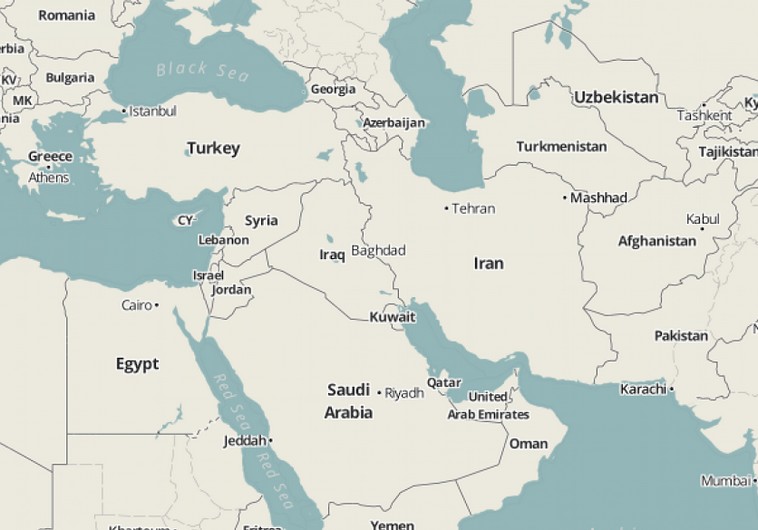
ShowImage (3)Map of Middle East. (photo credit:Courtesy)

It is through this Islamo-philic prism that the Obama administration’s attitude to, and execution of, its foreign policy must be evaluated – including its otherwise incomprehensible capitulation this week on Iran’s nuclear program.

********************

Obama is the first US president who genuinely conceives of Islam as not inherently opposed to American values or interests.

You’re absolutely right that John McCain has not talked about my Muslim faith – Barack Hussein Obama to ABC’s George Stephanopoulos, September 7, 2008

I also know that Islam has always been a part of America’s story Barack Hussein Obama, Cairo, June 4, 2009

Islam has always been part of AmericaBarack Hussein Obama, the White House, August 11, 2010

Islam has been woven into the fabric of our country since its founding Barack Hussein Obama, the White House, February 18, 2015

Barack Hussein Obama is the first US president who is explicitly and overtly unmoored, both cognitively and emotionally, from the moorings of America’s founding Judeo-Christian cultural heritage, and who genuinely conceives of Islam as not inherently opposed to American values or American interests.

A question of cultural affinity?

It is through this Islamo-philic prism that the Obama administration’s attitude to, and execution of, its foreign policy must be evaluated – including its otherwise incomprehensible capitulation this week on Iran’s nuclear program.

Almost two years ago, I wrote a column titled, “Will the West withstand the Obama presidency?” (11/28/2013). In it I warned: “For anyone who understands that the US Constitution is not a Shari’a-compliant document…

it should be alarmingly apparent that the Obama incumbency is a dramatic and disturbing point of inflection in the history of America and its Western allies… whose political practices and societal norms are rooted in Judeo-Christian foundations in a cultural rather than in any religious sense.”

There is little alternative explanation to account for the metamorphosis that has taken place in how the US has approached resolving the impasse with Tehran, as starkly laid out by two former secretaries of state, Henry Kissinger and George Shultz.

In a Wall Street Journal opinion piece, “The Iran Deal and Its Consequences” (April 7), they note that the negotiation has been turned “on its head.” As they point out: “For 20 years, three presidents of both major parties proclaimed that an Iranian nuclear weapon was contrary to American and global interests – and that they were prepared to use force to prevent it. Yet negotiations that began 12 years ago as an international effort to prevent an Iranian capability to develop a nuclear arsenal are ending with an agreement that concedes this very capability.”

Risible inspection mechanism

Even before the specifics of the risible inspection mechanism, which one Israeli minister aptly described as “worse than worthless,” Kissinger and Shultz laid out the difficulties that would render any extended inspection endeavor ineffective: “In a large country with multiple facilities and ample experience in nuclear concealment, violations will be inherently difficult to detect.”

With considerable prescience, they warn: “Devising theoretical models of inspection is one thing. Enforcing compliance, week after week, despite competing international crises and domestic distractions, is another. Any report of a violation is likely to prompt debate over its significance – or even calls for new talks with Tehran to explore the issue.

Envisaging the problems likely to arise in enforcing any agreement, they caution: “Compounding the difficulty is the unlikelihood that breakout will be a clear-cut event.

More likely it will occur… via the gradual accumulation of ambiguous evasions. When inevitable disagreements arise over the scope and intrusiveness of inspections, on what criteria are we prepared to insist and up to what point? If evidence is imperfect, who bears the burden of proof? What process will be followed to resolve the matter swiftly?”

Reminiscent of taqiya?

But even without the daunting generic difficulties described by Kissinger and Shultz, the inspection mechanism provided for in the nascent deal make a mockery of Obama’s contention (July 14): “… this deal is not built on trust; it is built on verification,” and, “Because of this deal, inspectors will also be able to access any suspicious location… [They] will have access where necessary, when necessary.”

One can hardly imagine a more grossly misleading representation of the deal – so much so that it is difficult not to find it strongly reminiscent of the Muslim tactic of taqiya (the religiously sanctioned deception of non-Muslims).

Indeed, immediately following the announcement of the agreement, Ben Rhodes, Obama’s deputy national security adviser, made a stunning admission to CNN’s Erin Burnett. Starkly contradicting the president’s contention of “access where necessary, when necessary,” Rhodes conceded, “We never sought in this negotiation the capacity for so-called anytime, anywhere,” which is diametrically opposed to the impression he conveyed in April this year when queried on this issue.

You couldn’t make this stuff up

For as it turns out, it provides the Iranians with ample warning of impending inspections on any suspected violation, and ample ability to forestall the definition of any given suspicious event as a possible violation.

Thus in the case of a suspected infringement in any undisclosed (to the international community) site, the Iranians will have at least 24 days’ notice. Moreover, inspectors will not be able to conduct surprise visits but will be required to “provide Iran the basis for such concerns and request clarification.” No kidding!!! But wait, there’s more.

If Iran’s explanations do not adequately assuage international concerns, inspectors “may request access to such locations” to make sure no illicit activity has occurred. But first they need to “provide Iran the reasons for access in writing and will make available relevant information.” You can’t make this stuff up.

But here’s the kicker: Should the Iranians and the inspectors prove unable to “reach satisfactory arrangements,” Tehran will resolve any concerns “through necessary means agreed between Iran and the IAEA.” If there is still no agreement two weeks after the initial inquiry is filed, the crisis will be resolved by vote in the so-called Joint Commission – consisting of the six world powers, a representative of EU and – wait for it – Iran.

Like warning drug dealers of a bust

Astonishingly, nearly all the decisions of the Joint Commission, tasked with overseeing/ administering the implementation of the deal, are to be made by consensus – which in effect gives Iran veto power over them. In the case of inspection access, it is sufficient for two of its eight members (say China and Russia) to abstain for Iran to block any decision it dislikes.

It is thus difficult to dispute Benjamin Netanyahu’s characterization of the deal during his address in the Knesset when he likened it to giving drug dealers notice of an impending raid: “It’s like giving a criminal organization that deals drugs a 24-day warning before inspecting its drug lab.”

But worse – the deal requires the international inspectors to expose the sources of intelligence that lead to the detection of the possible infringement – thereby virtually ensuring the termination of their effectiveness.

As Netanyahu remarked: “The agreement also requires the world powers to… show Iran the very intelligence for which they want to conduct the inspections in the first place.”

It is possible that all this could be nothing more than mind-boggling incompetence and blatant lack of foresight? Or are these glaring loopholes the reflection of intent.

Devil not in details

After all, the more you think about the unenforceable, unverifiable agreement just concocted in Vienna, the more implausible it seems. As Alan Dershowitz points out in a Jerusalem Post opinion piece this week, “The devil is not so much in the details as in the broad outlines of this deal.”

Rather than the detailed minutiae of the deal, it is its deeply flawed overall structure that makes it so difficult to comprehend – unless the motives for its conclusion are reexamined.

For unless one is imbued with the child-like naiveté to believe that the tyrannical clergy who head the totalitarian theocracy in Tehran, on seeing their defiant intransigence vindicated and having vast additional resources placed at their disposal, will suddenly change their worldview, the picture of emerging realities is decidedly bleak and bewildering.

The spectacle unfolding before us is almost incomprehensible by any rational criterion.

Virtually the entire developed world, led by the only superpower on the planet, has for all intents and purposes conceded a legitimized path to weaponized nuclear status for a fanatical fundamentalist regime, ideologically bent on the destruction of America and its allies, and a major proliferator of terrorism, committed to attaining regional hegemony at the expense of relatively pro-Western governments.

Despite dwarfing Iran in terms of military might, economic wealth, physical size and population, Tehran’s interlocutors have provided it with vast resources to enormously enhance its nefarious pursuits across the region and beyond.

The New Middle East: Conflicts on steroids

The ominous consequences are not difficult to foresee.

As Ariel Ben Solomon, the Post’s Middle East correspondent, wrote in a recent report, “Iran deal to see Middle East conflicts go on steroids,” “A stronger Iran will translate into a more robust Hezbollah in Lebanon, Houthi movement in Yemen, and Shi’ite forces in Iraq and Syria, and increasing sectarian strife fueled by Shi’ite minorities or Iranian agents throughout the Arab world.” (July 16) There is precious little reason for believing any other outcome is plausible.

In a July 15 interview, New Jersey Democrat Sen. Bob Menendez lamented another aspect of the deal, relating to easing restrictions on conventional weapons to Iran: “When you lift the arms embargo to a country that is the major sponsor of… terrorism in the world and is already destabilizing the region in Yemen, Lebanon, Syria [and] Iraq, to give them – after they are going to get $100 billion-150b. in economic relief – the opportunity to buy conventional weapons and improve their missile technology doesn’t seem to me to be in the national interest of the United States.”

The intriguing question is, of course, does this seem to President Obama to be in the national interest of the United States? And if so, why so? If so, how so?

‘No alternative’: A mindless mendacious mantra

The almost Pavlovian response of the apologists for the Iran deal is that its critics have not offered a feasible alternative. This is a claim – for want of a better word – so feeble that it barely merits a response.

As Sen. Menendez points out: “We never tested the proposition that dismantling elements of Iran’s illicit nuclear infrastructure was possible. It is pretty hard for me to believe that the world powers, sitting on one side of the table, the five permanent members of the Security Council plus Germany and the European Union looking at the Iranians… suffering under staggering sanctions… and falling oil prices couldn’t get a deal that eliminated some of that infrastructure.”

Rebutting John Kerry’s claim that such a goal was achievable only in “a world of fantasy,” Menendez retorted, “I don’t know that that is a ‘world of fantasy.’ Isn’t it possible with all the world on one side of the table, and Iran reeling with economic challenges, that you couldn’t have done better as relates to eliminating that nuclear infrastructure.”

Of course if the underlying assumption is that alternatives are only feasible if Iran deigns to accept them, then the apologists may be right. However, if the rationale were not to accommodate the ayatollahs, but to coerce them, the alternative is clear: Enhanced sanctions backed by the credible threat of military action aimed at destroying Iran’s nuclear facilities and their attendant infrastructure.

Arab arms race or Arab client states

But despite the overwhelming preponderance of power in their favor, the US and its Western allies seem to have forsworn the use of force, or even the credible specter thereof. As Kissinger and Shultz remark: “The threat of war now constrains the West more than Iran.”

This will clearly have a devastating impact on both friend and foe in the region.

It will destroy the confidence of US allies who will therefore be compelled to either acquire their own appropriate arsenals, as they can no longer rely on America for their security, or to become compliant client states of a hegemonic Iran.

For Iran it sends an equivocal message that it can violate the terms of the deal with impunity – for if what it encountered at Vienna is all the West can throw at it, what does it have to fear? There can be little doubt that what happened in Vienna this week has shredded America’s standing in the Middle East.

Some might even suspect that that was the purpose of the exercise.

Khamenei vs. Rouhani: Projecting Very Different Views on the Nuclear Deal

July 18, 2015

Khamenei vs. Rouhani: Projecting Very Different Views on the Nuclear Deal, World Affairs JournalMehdi Khalaji, July 16, 2015

(If Khamenei reneges on the deal, it will likely be impossible to “snap back” the sanctions. With improved Russian rockets, an attack on Iran’s nuclear facilities will be much more difficult.– DM)

In the United States, the same political body that was in charge of negotiating with Iran is also in charge of implementing the agreement. But in Iran, the president and his negotiators have little authority over foreign policy, the nuclear program, or military activities.

If [Khamenei] decides to stop implementing the deal in the next year or so, he would likely blame the West or the negotiating team for cutting such a deal, as he did in 2003 and 2004. His initial reaction to the new agreement has already sent discouraging signals about Iran’s willingness to comply with its commitments in the long term.

****************

The Supreme Leader’s initial reaction has sent discouraging signals about Iran’s willingness to comply with its commitments in the long term.

As expected, Ayatollah Ali Khamenei’s reaction to the nuclear deal was utterly different from that of President Hassan Rouhani. Right after the agreement was announced on July 14, Rouhani appeared on state television and praised the outcome. Yet when he and other officials visited Khamenei’s home a few hours later, the Supreme Leader did not say anything about the deal apart from a few lines thanking the negotiators. This reticence signaled to hardliners that they should increase their attacks on the agreement.

On July 15, in order to protect himself against these critics, Rouhani told the cabinet that Khamenei was “carefully following up” on the details of the final negotiations and “had meticulous supervision” over the process, to the point where the Supreme Leader “truly undertook much heavier responsibility in this regard” than any other official. But even this did not help him much. On July 14, Rouhani sent Khamenei a letter reporting on the deal’s results, but the Supreme Leader delayed his response by a day in order to show his lack of excitement about it. The letter thanked Khamenei for his “intelligent guidance and perpetual and explicit support to the negotiating team,” who “could successfully implement all policies determined by the Supreme Leader and respect redlines set” by him. Khamenei’s delayed answer — hardly a third as long as the president’s letter — avoided any wording that might indicate his total satisfaction with the accord, his direct role in the negotiations, or his responsibility for the deal. Instead he wrote, “The text needs to be studied carefully and go through the predicted legal process. Then, if it is approved, it needs to be protected against potential violations of the deal by the other party.”

Khamenei also failed to mention who should approve the deal. Rouhani’s team and the hardliners are currently in the midst of a hot dispute about whether that responsibility lies with the Majlis or the Supreme National Security Council. The hardliners insist on parliament, arguing that all international agreements should be adopted by the legislative branch of the government. Yet Rouhani’s team says that only the Supreme Council should review and endorse it. Not coincidentally, the president is the titular head of that council.

SHARP HARDLINER CRITICISM

On July 16, hardliner website Raja News published the third part of an article series titled “Some Aspects of the Deal Which Should Remain Unveiled,” by Ali Akbar Taheri. The article explains how the final deal reached by Rouhani’s negotiating team crosses six different redlines previously set by the Supreme Leader:

  1. Long-term limitations on the nuclear program. Khamenei has said that Iran should not agree to ten-year limitations because “ten years is a lifetime.” According to the article, however, the signed agreement contains at least fourteen Iranian commitments lasting ten or more years (e.g., a twenty-five-year limit on inspections and surveillance over enrichment of mined uranium; a fifteen-year ban on uranium enrichment at the Fordow facility).
  2. Unconventional inspections and access to military facilities. Khamenei has explicitly rejected such measures, but the final agreement allows the International Atomic Energy Agency (IAEA) to conduct surveillance in all factories that enrich mined uranium, among other things. The agency can also ask to inspect military facilities such as Parchin if they deem it necessary.
  3. Limitations on enrichment at Fordow. Khamenei has opposed any such restrictions at the mountain facility, but the final agreement contains several.
  4. Delayed lifting of some sanctions. Khamenei previously insisted that all sanctions be rescinded as soon as the deal is signed, but the agreement indicates that some U.S. congressional sanctions and EU sanctions will not be lifted right away, if at all.
  5. IAEA conditionality. Khamenei has often expressed his distrust of the IAEA and declared that sanctions relief should not be conditioned on Iran’s implementation of the deal. Yet UN sanctions will not be lifted until the IAEA verifies that Tehran has complied with the agreement’s terms.
  6. Limits on centrifuge research. Khamenei has said that no restrictions should be placed on Iran’s nuclear research for the duration of the deal. Yet the agreement includes a ten-year limit on enrichment R&D related to the IR-4, IR-5, IR-6, and IR-8 centrifuges, among other things.

The article also downplays Rouhani’s claim about lifting sanctions related to weapons, noting that “these sanctions would be replaced by limits [imposed on Iran’s weapons trade]…[E]very missile that is able to carry a nuclear warhead would be limited, all Shahab missiles and satellite carriers and so on.” In addition, the article claims that Russian foreign minister Sergei Lavrov said the following: “Russia and China wanted weapons sanctions to be lifted, but despite our support the Iranian team itself agreed to continuation of the sanctions for the next five years!”

On July 16, at an event called “The Beginning of the Math Class” (a sarcastic title indicating that the time of verification has begun), hardline analyst Fouad Izadi criticized the deal from a different angle: “If the U.S. Congress rejects the agreement, America would not be bound to implement it, but if Iran implements the agreement, it will lose all leverage.” Izadi, who is close to the Islamic Revolutionary Guard Corps, went on to claim that in the case of disagreement between Iran and the P5+1, “the arbiter is the UN Security Council,” which means that the United States and other P5+1 members would essentially become the arbiters of their own dispute. “If Iran gets accused of violating the agreement, [these countries] can issue a resolution against it,” he said, but if the United States or another party is so accused, “the Security Council cannot issue a resolution because one of them could just veto it.” He also pointed out that the Majlis should approve the agreement, and that it should condition Iran’s implementation of the deal on U.S. congressional approval, explaining that “the U.S. president will not be in office in nineteen months, and after him the U.S. administration would not be bound by the agreement if Congress disapproves it.”

Also on July 16, the hardline newspaper Kayhan claimed that the largely insignificant financial reaction to the nuclear deal — i.e., no sharp changes in the stock market or exchange rate — shocked those who have been “overexcited” about the negotiations. “People expected the foreign currency rate to drop and the national currency value to go up,” said one article, “and now they ask why the opposite has happened.”

CONCLUSION

In the United States, the same political body that was in charge of negotiating with Iran is also in charge of implementing the agreement. But in Iran, the president and his negotiators have little authority over foreign policy, the nuclear program, or military activities. Instead, those sectors are under the purview of Supreme Leader Khamenei, who is usually reluctant to take any public responsibility for major decisions. Furthermore, he has repeatedly expressed his distrust toward Americans, the West, the UN, and the IAEA. And while he has more or less supported Iran’s negotiators in his public statements, he has clearly sought to distance himself from them as well. If he decides to stop implementing the deal in the next year or so, he would likely blame the West or the negotiating team for cutting such a deal, as he did in 2003 and 2004. His initial reaction to the new agreement has already sent discouraging signals about Iran’s willingness to comply with its commitments in the long term.

Obama’s Iran Deal Has the Makings of a Catastrophe

July 15, 2015

Obama’s Iran Deal Has the Makings of a Catastrophe, National Review Online via Middle East forum, Daniel Pipes, July 14,2015.  Originally published under the title, “Could the Iran Deal Be the Worst International Accord of All Time?”

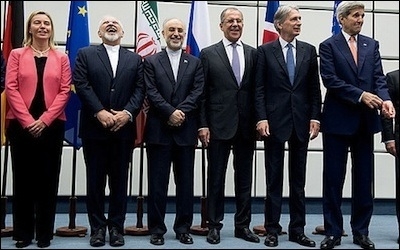
1497Iran’s negotiators (second and third from left) have good reason to be happier than their Western counterparts.

The conduct of the Iran nuclear negotiations has been wretched, with the Obama administration inconsistent, capitulating, exaggerating, and even deceitful. It forcefully demanded certain terms, then soon after conceded these same terms.

*********************

Barack Obama has repeatedly signaled during the past six and a half years that that his No. 1 priority in foreign affairs is not China, not Russia, not Mexico, but Iran. He wants to bring Iran in from the cold, to transform the Islamic Republic into just another normal member of the so-called international community, ending decades of its aggression and hostility.

In itself, this is a worthy goal; it’s always good policy to reduce the number of enemies. (It brings to mind Nixon going to China.) The problem lies, of course, in the execution.

The conduct of the Iran nuclear negotiations has been wretched, with the Obama administration inconsistent, capitulating, exaggerating, and even deceitful. It forcefully demanded certain terms, then soon after conceded these same terms.

Secretary of State John Kerry implausibly announced that we have “absolutely knowledge” of what the Iranians have done until now in their nuclear program and therefore have no need for inspections to form a baseline. How can any adult, much less a high official, make such a statement?

The administration misled Americans about its own concessions: After the November 2013 Joint Plan of Action, it came out with a factsheet which Tehran said was inaccurate. Guess who was right? The Iranians. In brief, the U.S. government has shown itself deeply untrustworthy.

The agreement signed today ends the economic sanctions regime, permits the Iranians to hide much of their nuclear activities, lacks enforcement in case of Iranian deceit, and expires in slightly more than a decade. Two problems particularly stand out: The Iranian path to nuclear weapons has been eased and legitimated; Tehran will receive a “signing bonus” of some US$150 billion that greatly increases its abilities to aggress in the Middle East and beyond.

The United States alone, not to speak of the P5+1 countries as a whole, have vastly greater economic and military power than the Islamic Republic of Iran, making this one-sided concession ultimately a bafflement.

Of the administration’s accumulated foreign-policy mistakes in the last six years, none have been catastrophic for the United States: Not the Chinese building islands, the Russians taking Crimea, or the collapse into civil wars of Libya, Yemen, Syria, and Iraq. But the Iran deal has the makings of a catastrophe.

Attention now shifts to the U.S. Congress to review today’s accord, arguably the worst treaty not just in American history or modern history, but ever. Congress must reject this deal. Republican senators and representatives have shown themselves firm on this topic; will the Democrats rise to the occasion and provide the votes for a veto override? They need to feel the pressure.

How Iran describes the nuclear deal

July 15, 2015

How Iran describes the nuclear deal, Power LineJohn Hinderaker, July 14, 2015

Throughout the negotiation process, Iran’s government has been more forthright and more reliable in characterizing the parties’ interim agreements than the Obama administration. So it is worth noting what the Iranians say the deal entails. This is from FARS, Iran’s news agency:

Iran’s President Hassan Rouhani said his country has achieved all its four goals in the agreement that his foreign minister Zarif signed with the six world powers in Vienna on Tuesday.

President Rouhani said his nation started talks with the world powers in a bid to remove all sanctions while maintaining its nuclear program and nuclear progress as two main goals.

All sanctions, including the financial, banking, energy, insurance, transportation, precious metals and even arms and proliferation sanctions will be, not suspended, but terminated according to the Tuesday agreement as soon as the deal comes into force, he said, adding that Iran will only be placed under certain limited arms deal restrictions for five years.

Meantime, Iran will inject gas into its highly advanced IR8 centrifuge machines, continue its nuclear research and development, and keep its Arak Heavy Water Facility and Fordo and Natanz enrichment plants under the agreement, he said, elaborating on Iran’s gains.

Another goal, Rouhani said, was taking Iran off Chapter Seven of the UN Charter, “and we did it”.

More details on the deal:

The agreement, the Joint Comprehensive Plan of Action (JCPOA), will be presented to the United Nations Security Council (UNSC), which will adopt a resolution in seven to 10 days making the JCPOA an official document.

Based on the agreement, which has been concluded with due regard for Iran’s red lines, the world powers recognize Iran’s civilian nuclear program, including the country’s right to the complete nuclear cycle.

The UNSC sanctions against the Islamic Republic, including all economic and financial bans, will be lifted at once under a mutually agreed framework and through a new UN resolution.

None of the Iranian nuclear facilities will be dismantled or decomissioned.

Furthermore, nuclear research and development activities on all types of centrifuges, including advanced IR-6 and IR-8 machines, will continue.

The nuclear-related economic and financial restrictions imposed by the United States and the European Union (EU) targeting the Iranian banking, financial, oil, gas, petrochemical, trade, insurance and transport sectors will at once be annulled with the beginning of the implementation of the agreement.

The arms embargo imposed against the Islamic Republic will be annulled and replaced with certain restrictions, which themselves will be entirely removed after a period of five years.

Additionally, tens of billions of dollars in Iranian revenue frozen in foreign banks will be unblocked.

I have now read the agreement in its entirety–you, too, can read it here–and I think the Iranians’ description is accurate. I also agree with what Paul wrote earlier today.

Some aspects of the agreement are technical and can’t be well understood without knowledge of nuclear engineering or the history of various sanctions that have been imposed. But those details are immaterial. Loopholes could make the agreement slightly worse, but no technical interpretation can save it.

The mullahs may cheat on the agreement, or they may not. They may decide to walk away from the agreement at some point and openly develop nuclear weapons, or they may not. It makes very little difference. There are no undertakings in the agreement that go beyond 10 years (in most instances) or 15 years (in a few). The Ayatollah takes the long view: ten or fifteen years are nothing. In the meantime, what does Iran get?

First, and most important, it gets in excess of $100 billion in currently-frozen assets. This will happen in the near future, on or about the agreement’s Implementation Date. I think this prospect is what is making Iran’s leaders so jubilant. With that money, they can step up their support for allies in Syria, Yemen and Iraq, and their support for terrorism everywhere. (By way of perspective, the entire United States military budget for the current fiscal year is only $560 billion.) To the extent that they spend some of it at home, it will help cement their position domestically.

Second, the agreement grants Iran international legitimacy. Since the revolution of 1979 and the seizure of America’s embassy in Tehran, Iran has been treated as a rogue state. Under the agreement, that status comes to an end. Investment in Iran will be permitted and likely will flourish. Sanctions will be removed and Iran’s nuclear program will not only be tolerated, it will be explicitly recognized and to some degree supported by the international community. The agreement contemplates that upon implementation, “the Iranian nuclear programme will be treated in the same manner as that of any other non-nuclear-weapon state party to the NPT [non-proliferation treaty].” It is hard to overstate how important this legitimacy is to the regime.

The third benefit to Iran’s rulers is perhaps the most important, and is closely linked to the first two. The agreement guarantees that, at least for the foreseeable future, the mullahs will remain in power. Realistically, the only way Iran could be denied a nuclear arsenal in the long term is through regime change. Early in the Obama administration, that seemed like a plausible scenario, but the administration declined to aid, or even encourage, anti-regime forces when such support might have made a difference. Now, with the mullahs both flush with cash and blessed with international legitimacy, their grip on power is probably stronger than ever. Nuclear weapons will follow, sooner or later, at a time of the regime’s choosing. And in the meantime, Iran’s ability to make mischief in the Middle East and around the world (e.g., through its newfound alliance with Venezuela) has been greatly enhanced.

TIME TO CALL OBAMA AND KERRY WHAT THEY ARE: TRAITORS

July 15, 2015

TIME TO CALL OBAMA AND KERRY WHAT THEY ARE: TRAITORS, Front Page Magazine, Daniel Greenfield, July 14, 2015

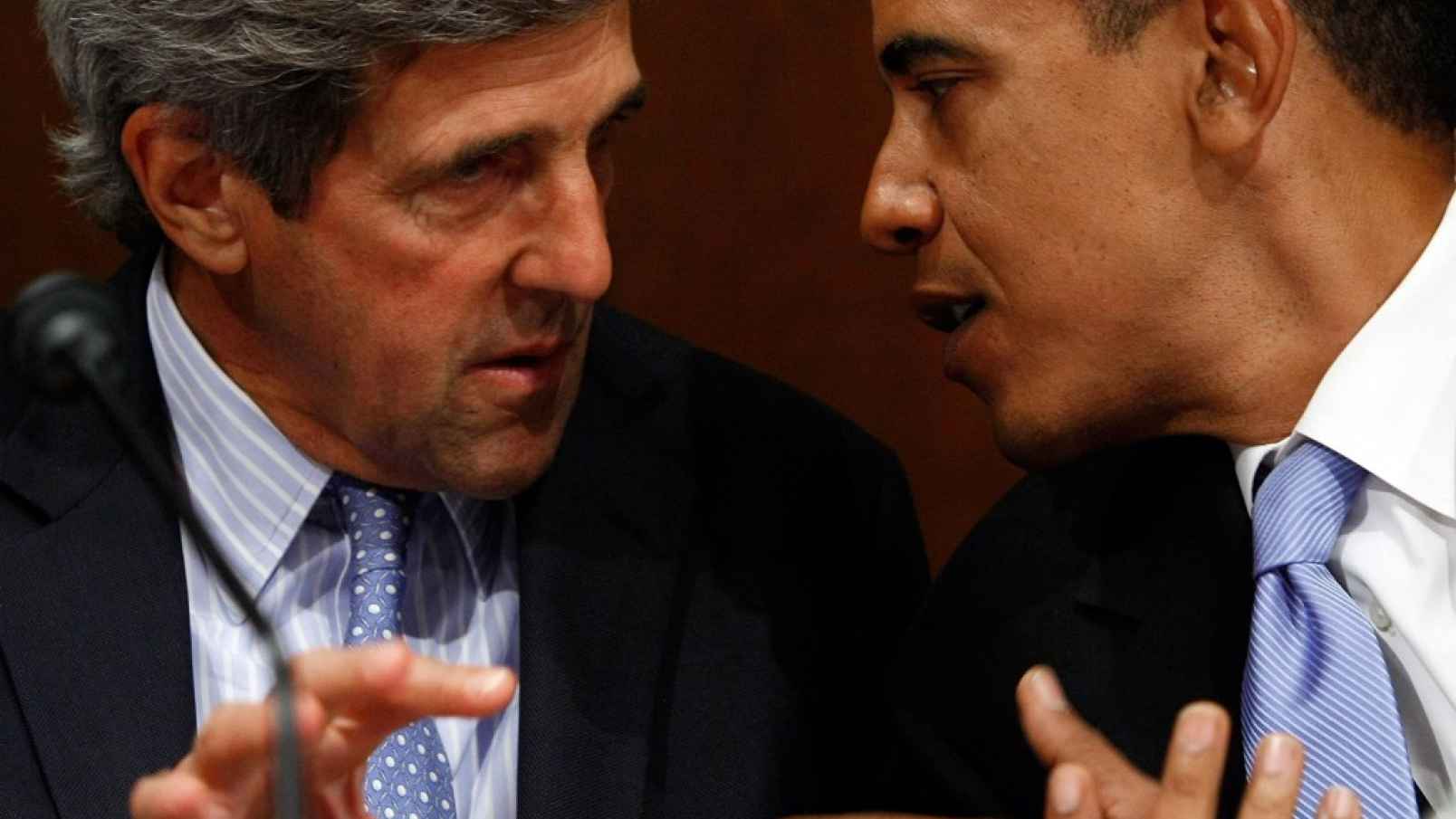
kerry_2

Obama isn’t Chamberlain. He doesn’t mean well. Kerry isn’t making honest mistakes. They negotiated ineptly with Iran because they are throwing the game. They meant for America to lose all along.

******************

The last time a feeble leader of a fading nation came bearing “Peace in our time,” a pugnacious controversial right-winger retorted, “You were given the choice between war and dishonor. You chose dishonor, and you will have war.” That right-winger went on to lead the United Kingdom against Hitler.

The latest worthless agreement with a murderous dictatorship is being brandished by John Kerry, a man who instinctively seeks out dishonor the way a pig roots for truffles.

John Kerry betrayed his uniform and his nation so many times that it became his career. He illegally met with the representatives of the North Vietnamese enemy in Paris and then next year headed to Washington, D.C. where he blasted the American soldiers being murdered by his new friends as rapists and murderers “reminiscent of Genghis Khan.”

Even before being elected, Kerry was already spewing Communist propaganda in the Senate.

Once in the Senate, Kerry flew to support the Sandinista Marxist killers in Nicaragua. Just as Iran’s leader calling for “Death to America” didn’t slow down Kerry, neither did the Sandinista cries of “Here or There, Yankees Will Die Everywhere.”

Kerry revolted even liberals with his gushing over Syria’s Assad. Now he’s playing the useful idiot for Assad’s bosses in Tehran.

For almost fifty years, John Kerry has been selling out American interests to the enemy. Iran is his biggest success. The dirty Iran nuke deal is the culmination of his life’s many treasons.

It turns America from an opponent of Iran’s expansionism, terrorism and nuclear weapons program into a key supporter. The international coalition built to stop Iran’s nukes will instead protect its program.

And none of this would have happened without Obama.

Obama began his rise by pandering to radical leftists on removing Saddam. He urged them to take on Egypt instead, and that’s what he did once in office, orchestrating the takeover of the Muslim Brotherhood in Egypt and across the region. The Muslim Brotherhood was overthrown by popular uprisings in Egypt and Tunisia, but Obama had preserved the Iranian regime when it was faced with the Green Revolution. Now Iran is his last best Islamist hope for stopping America in the Middle East.

Obama and Kerry had both voted against designating Iran’s IRGC terrorist ringleaders who were organizing the murder of American soldiers as a terrorist organization while in the Senate. Today they have turned our planes into the Air Force of the IRGC’s Shiite Islamist militias in Iraq.

Throughout the process they chanted, “No deal is better than a bad deal.” But their deal isn’t just bad. It’s treason.

Obama isn’t Chamberlain. He doesn’t mean well. Kerry isn’t making honest mistakes. They negotiated ineptly with Iran because they are throwing the game. They meant for America to lose all along.

When Obama negotiates with Republicans, he extracts maximum concessions for the barest minimum. Kerry did the same thing with Israel during the failed attempt at restarting peace negotiations with the PLO. That’s how they treat those they consider their enemies. This is how they treat their friends.

A bad deal wasn’t just better than no deal, it was better than a good deal.

Obama did not go into this to stop Iran from going nuclear. He did it to turn Iran into the axis of the Middle East. After his failures in the rest of the region, this is his final act of spite. With the fall of the Muslim Brotherhood and the decline of Islamists in Turkey, supporting Iran is his way of blocking the power of his successors in the White House to pursue a more pro-American foreign policy.

Obama made this deal to cripple American power in the Middle East.

Iran get to keep its nuclear facilities, its reactors, including the hidden underground fortified Fordow facility which Obama had repeatedly stated was, “inconsistent with a peaceful program.”

The deal gives Iran a “peaceful” nuclear program with an equally peaceful ballistic missile program. It puts into place a complicated inspection regime that can be blocked by Iran and its backers. It turns Iran into the new North Korea and the new Saddam Hussein, lavishing money on it while running future administrations through a cat and mouse game of proving violations by the terrorist regime.

And Obama made sure the Iran deal was written to make the proof as hard to obtain as possible.

U.S. Will Teach Iran to Thwart Nuke Threats

July 14, 2015

U.S. Will Teach Iran to Thwart Nuke Threats, Washington Free Beacon, July 14, 2015

> (AP Photo/Ebrahim Noroozi)

The United States and other world powers will help to teach Iran how to thwart and detect threats to its nuclear program, according to the parameters of a deal reached Tuesday to rein in Iran’s contested nuclear program.

Under the terms of a deal that provides Iran billions of dollars in sanctions relief, Iran and global powers will cooperate to help teach Iran how to manage its nuclear infrastructure, which will largely remain in tact under the deal.

Senior Iranian officials, including the country’s president, celebrated the deal as a victory for the country. Iran’s state controlled media quoted President Hassan Rouhani as saying that the deal will “remove all sanctions while maintaining [Tehran’s] nuclear program and nuclear progress.”

In what is being viewed as a new development, European countries and potentially the United States agreed to “cooperate with Iran on the implementation of nuclear security guidelines and best practices,” according to a copy of the agreement furnished by both the Russians and Iranians.

This will include “training courses and workshops to strengthen Iran’s ability to prevent, protect and respond to nuclear security threats to nuclear facilities and systems as well as to enable effective and sustainable nuclear security and physical protection systems,” according to the text.

Additional “training and workshops” would work to “strengthen Iran’s ability to protect against, and respond to nuclear security threats, including sabotage, as well as to enable effective and sustainable nuclear security and physical protection systems,” the text states.

The language was viewed as disturbing by analysts and experts who said such cooperation could help protect Iran against efforts by the Israelis or other countries to sabotage the Islamic Republic’s nuclear program in the future.

“The United States and its partners have just become the international protectors of the Iranian nuclear program. Instead of rolling back the Iranian nuclear program, we’re now legally obligated to help the Iranians build it up and protect it,” said one Western source present in Vienna and who is apprised of the details of the deal.

In addition to teaching Iran how to protect its nuclear infrastructure, world powers pledge in the agreement to help Iran construct next-generation centrifuges—the machines that enrich uranium—at its once-secret nuclear site in Fordow, where Iran has been suspected of housing a weapons program.

Fordow is an underground and fortified military site that is largely immune from air strikes by those seeking to eradicate Iran’s nuclear infrastructure.

While Iran will not be permitted to enrich nuclear material with these centrifuges, the know-how gained from operating these advanced centrifuges could help it advance clandestine nuclear weapons work, experts say.

The Obama administration had once vowed that Iran would have to fully dismantle its centrifuge program. However, this demand was walked back as the Iranians demanded greater concessions over the past months.

“Now the international community will be actively sponsoring the development of Iranian nuclear technology,” Omri Ceren, an analyst from the Israel Project (TIP), wrote in an email to reporters. “And since the work will be overseen by a great power, it will be off-limits to the kind of sabotage that has kept the Iranian nuclear program in check until now.”

Meanwhile, Iranian President Rouhani celebrated the deal in a speech that detailed how the country received everything it was looking for from the United States.

This includes the full rollback on sanctions on Iran’s financial, energy, and banking sectors, as well as others, and the suspension of international resolutions banning the sale of arms to Tehran.

Iran will also move forward with work on its advanced centrifuges and also “continue its nuclear research and development,” according to Rouhani’s comments. “All our goals materialized under the deal,” Rouhani said, according to Fars.

Iran’s nuclear reactors in Arak—which could provide with a second pathway to a nuclear weapon—also will continue to operate under the deal. It will continue in conjunction with the nuclear enrichment plants located in Fordow and Natanz.

Rouhani went on to say that Iran “will scrutinize implementation of the agreement” to ensure that the United States and other world powers uphold their end of the bargain.

Back in Tehran… Khamenei adds red lines, Rouhani tries to resign, Jaafari hints at “fait accompli” soon

July 12, 2015

Back in Tehran… Khamenei adds red lines, Rouhani tries to resign, Jaafari hints at “fait accompli” soon, DEBKAfile, July 12, 2015

(To the extent accurate, this is a fascinating account of what happened on June 29th, when Rouhani returned to Tehran for “consultation.” — DM)

ROUHANI-JAFARIPresident Rouhani vs Ali Jaafari

Iran’s top leaders remain ambivalent about whether or not to sign the comprehensive nuclear accord with the six world powers in Vienna as 22 agonizing months of negotiation falter on the brink. The all-powerful supreme leader Ayatollah Ali Khamenei’s latest comment was far from helpful. Saturday, July 11, he said publicly: “The US is the true embodiment of global arrogance,” the fight against which “could not be interrupted” even after the completion of the nuclear talks. He also boasted that the Islamic Republic had “managed to charm the world” by sticking with those negotiations.

DEBKAfile’s Iranian sources report that Khamenei’s remarks reflect the struggle between the pro- and anti-nuclear deal factions at the highest level of the Iranian leadership. For now, President Barack Obama’s odds of less than 50 percent on a final accord may well describe the balance in Tehran.

On June 29, President Hassan Rouhani was planning to resign when he asked the supreme leader to receive him first. He was upset by Foreign Minister Mohamed Zavad Zarif’s recall from Vienna to Tehran for a tough briefing. Zarif had warned the president that the talks were doomed unless Iran gave some slack. The foreign minister said that the six foreign ministers were preparing to leave Vienna in protest against Iran’s intransigence.

Rouhani when he met Khamenei warned him that Iran was about to miss the main diplomatic train to its main destination: the lifting of sanctions to save the economy from certain ruin.

The supreme ruler was unconvinced: He referred the president to the conditions for a deal he had laid down on June 23 and refused to budge: Sanctions must be removed upon the signing of the final accord; international atomic agency inspectors were banned at military facilities, along with interviews with nuclear scientists; and the powers must endorse Iran’s right to continue nuclear research and build advanced centrifuges for uranium enrichment.

Rouhani hotly stressed that those conditions had become a hindrance to the deal going through and insisted that sanctions relief was imperative for hauling the economy out of crisis.

Khamenei disputed him on that point too. He retorted that the revolutionary republic had survived the eight-year Iranian-Iraqi war (1979-187) with far fewer resources and assets than it commanded at present.

For back-up, the supreme ruler asked two hardliners to join his ding-dong with the president: Defense Minister Hosseim Dehqan and Revolutionary Guards chief Mohammad Ali Jaafari.

Both told Rouhani in the stiffest terms that Tehran must not on any account bow to international pressure for giving up its nuclear program or the development of ballistic missiles.

In a broad hint to President Rouhani to pipe down, Khamenei reminisced about his long-gone predecessor Hassan Bani-Sadr (president in 1980-1981) who was not only forced out of office but had to flee Iran, and the former prime minister and presidential candidate Mir Hossein Moussavi, who has lived under house arrest for six years since leading an opposition campaign.

The supreme leader then set out his thesis that the danger of Iran coming under attack had declined to zero, since Europe was in deep economic crisis (mainly because of Greece) and because the US president had never been less inclined to go to war than he is today.

Jaaafri added his two cents by commenting that after a succession of fiascos, Obama would go to any lengths to reach a nuclear deal with Iran as the crowning achievement of his presidency.  The Revolutionary Guards chief then added obliquely: “Before long we will present the West with a fait accompli.”

He refused to elaborate on this when questioned by the president, but it was taken as a reference to some nuclear event.

Rouhani left the meeting empty-handed, but his letter of resignation stayed in his pocket.

The next day, when Zarif landed in Vienna to take his seat once more at the negotiating table, he learned about a new directive Khamenei had sent the president, ordering him to expand ballistic missile development and add another five percent to its budget – another burden on Iran’s empty coffers.

Khamenei’s office made sure this directive reached the public domain. Zarif too was armed with another impediment to a deal. Khamenei instructed him to add a fresh condition: The annulment of the sanctions imposed against Iran’s missile development and arms purchases.

Deadlines, red lines

July 3, 2015

Deadlines, red lines, Israel Hayom, Ruthie Blum, July 3, 2015

(Please see also, Iran’s Nuclear Negotiators Emboldened by Islamic Ideology: Cleric at (Iranian) Tashim News Agency. — DM)

The regime in Tehran has made its position clear. So has the White House. It will take a miracle — or a military strike — to prevent Iran from building nuclear bombs.

**********************

The deadline for a nuclear deal between the P5+1 powers and Iran was extended on Tuesday, when too many bones of contention remained unresolved on June 30. The new date set by the parties to finalize the “framework for an agreement” reached in Lausanne three months ago is July 7.

This means that there are four days to go before the current talks in Vienna bear fruit in the form of an official document. If such a piece of paper is signed, two leaders will feel particularly vindicated: U.S. President Barack Obama and Iranian President Hassan Rouhani — the former for playing out his fantasy of peace through diplomacy and the latter for delivering the goods to his boss, Ayatollah Ali Khamenei.

The rest of the world, however, will be in mortal peril. And Israel will be forced to act fast.

The only sliver of a silver lining in this otherwise black cloud is that Islamists sometimes play their cards wrong. Buoyed by the weakness of the West in the face of their fanaticism, they often take their visions of grandeur to heights that even American and European appeasers cannot accept. So by next week, it is possible that the Iranian negotiators will overstep their counterparts’ bounds, and everyone will return to the country from whence they came with nothing but another date and venue to show for their efforts.

But because the stakes are nuclear weapons in the hands of a mullah-led regime bent on global hegemony — and working toward it through proxy terrorist organizations — one cannot count on the above scenario.

A number of recent statements are cause for concern.

On Thursday, Iranian Foreign Minister Mohammad Javad Zarif told reporters: “The negotiations are moving forward and we should be hopeful. Today is a good day.”

This was an abbreviated version of what his deputy, Abbas Araqchi, said the day before in a TV interview: “A positive atmosphere is ruling the negotiations, and the spirit for going forward exists in all delegations, but this doesn’t mean that all delegations, including us, are ready to reach an agreement at any price.”

Araqchi also defined a “good deal” as one that would honor Khamenei’s “red lines.”

These were spelled out in a June 23 speech by Khamenei (and included in a June 30 Middle East Media Research Institute report): “In contrast to what the Americans are insisting on, we do not accept long-term restrictions for 10 to 12 years.

“Research, development and construction will continue. … They say, ‘Don’t do anything for 12 years,’ but these are particularly violent words, and a gross mistake.

“The economic, financial and banking sanctions — whether related to the Security Council or the American Congress and administration — must be lifted immediately with the signing of the agreement. The remainder of the sanctions will also be lifted within a reasonable time frame. The Americans are presenting a complex, convoluted, bizarre, and stupefying formula for [removing the] sanctions, and it is unclear what will emerge from it, but we are clearly stating our demands.

“The lifting of the sanctions must not depend on Iran carrying out its obligations. Don’t say, ‘You carry out your obligations and then the IAEA will approve the lifting of the sanctions.’ We vehemently reject this. The lifting of the sanctions must take place simultaneously with Iran’s meeting of its obligations. We oppose the delay of the implementation of the opposite side’s obligations until the [release of] the IAEA report [verifying that Iran has met its obligations], because the IAEA has proven repeatedly that it is neither independent nor fair, and therefore we are pessimistic regarding it.

“They say, ‘The IAEA should receive guarantees.’ What an unreasonable statement. They will be secure only if they inspect every inch of Iran. We vehemently reject special inspections [that are not customary for any country except Iran], questioning of Iranian personnel, and inspection of military facilities.

“Everyone in Iran — including myself, the government, the Majlis [parliament], the judiciary, the security apparatuses, and the military, and all institutions — want a good nuclear agreement … that is in accordance with Iran’s interests.

“Although we wish the sanctions lifted, we see them as [having brought us] a particular kind of opportunity, because they made us pay more attention to domestic forces and domestic potential.”

A few days later, on June 29, Obama’s deputy national security adviser, Ben Rhodes, gave an interview to The Atlantic’s Jeffrey Goldberg at the Aspen Ideas Festival.

When asked whether Obama believes a deal will exact change in Iran’s behavior, Rhodes replied: “We believe that an agreement is necessary … even if Iran doesn’t change. … That said, we believe that a world in which there is a deal with Iran is much more likely to produce an evolution in Iranian behavior than a world in which there is no deal. In fact … if the notion is that Iran has been engaged in these destabilizing activities under the last several years when they’ve been under the pressure of sanctions, clearly sanctions are not acting as some deterrent against them doing destabilizing activities in the region. … [T]he point is … in a world of a deal, there is a greater possibility that you will see Iran evolve in a direction in which they are more engaged with the international community and less dependent upon the types of activities that they’ve been engaged in.”

The regime in Tehran has made its position clear. So has the White House. It will take a miracle — or a military strike — to prevent Iran from building nuclear bombs.