Archive for the ‘Rouhani’ category

Iranian Hezbollah Organization Issues Threats Of Physical Harm Against Former Iranian Presidents Rafsanjani And Khatami, Calls On President Rohani To Cancel JCPOA

May 3, 2016

Iranian Hezbollah Organization Issues Threats Of Physical Harm Against Former Iranian Presidents Rafsanjani And Khatami, Calls On President Rohani To Cancel JCPOA, MEMRI, May 3, 2016

“Mr. President, you bear responsibility for every martyr whose blood has been spilled. If you look at all the breaches of promise and disruptions by ‘the Great Satan,’ America, and declare firmly that you are cancelling the JCPOA because of America’s violations [of it], history will never forget your heroic and revolutionary move; the heart of the Imam Mahdi will also rejoice because of you.

**************************

In an April 12, 2016 interview, Mahdi Abdi, the director of affairs for the northwestern provinces and towns for the coordination council of the fundamentalist organization Hezbollah Iran, which is affiliated with Iran’s ideological circles, warned leaders of Iran’s pragmatic camp, including Expediency Council chairman and former president Hashemi Rafsanjani and former president Mohammad Khatami, not to undermine the status of Iranian Supreme Leader Ali Khamenei. The interview was published by the organization’s Hezbollah Press website.

Echoing Khamenei’s accusations of treason against Rafsanjani,[1] Abdi accused both Rafsanjani and Khatami of treason, and threatened them with physical harm. He also demanded that they stop calling for the release of the 2009 Green Protest leaders – former Majlis speaker Mehdi Karroubi and former prime minister Mir-Hossein Mousavi, as well as Mousavi’s wife – who have been under house arrest since 2011.

Reminding Iranian President Hassan Rohani of what happened to Iranian officials who criticized Iran’s Islamic Revolution and the path of its founder Ayatollah Ruhollah Khomeini, Abdi warned him to neither trust the U.S. nor follow it, or to face the consequences. He also called on him to cancel the JCPOA.

The following are the main points of the interview. It should be noted that following its publication, the piece was removed from the website.

“This Is Hezbollah’s Final Warning To Hashemi [Rafsanjani] And The Grey Fox, [Former President] Mohammad Khatami, And To Anyone Who Even Thinks About Marginalizing The Imam Khamenei”

“The heart of [Iranian] Hezbollah is bleeding because of the tremendous disloyalty and the great treason of the unwise and two-faced [pragmatic camp leaders Rafsanjani and Rohani]. Imam Khamenei need not feel alone today because certain individuals who are betraying Islam and the Revolution are daring to boast and to express opinions in society, while others dare to speak about an end to the arrest of the hated leaders of the ‘2009 fitna’ [Mousavi and Karroubi]. [These traitors are] publishing [such statements] freely online and talking about it, and [expecting] the security apparatuses to remain silent.

“The hated leaders of the ‘fitna’ should thank God that they are under arrest. Otherwise, Hezbollah would not have given them a chance to breathe. This is Hezbollah’s final warning to Hashemi [Rafsanjani] and the grey fox, [former president] Mohammad Khatami, and to anyone who even thinks about marginalizing the Imam Khamenei, trampling the principles and foundations of the Islamic Revolution, and seeking to present the plan for a leadership council [as Rafsanjani recently proposed as a replacement for the position of Supreme Leader] in order to weaken the Rule of the Jurisprudent.

“If they are thinking of sparking more ‘fitna’ in Iran, Hezbollah will activate its popular punishment units, the ones called The Martyrs For the Revolution and Islam, and, once and for all, blind the eyes of the ‘fitna.'”

To President Rohani: “Hezbollah Obeys The Orders Of The Imam Khamenei And Will Never Allow These Things, Which Contradict Islam, To Be Carried Out In Iran”

“Mr. President [Rohani], many times the Koran called on Muslims to learn from history. We look at history today and see what became of those who trusted foreigners, especially those who trusted the bloodthirsty ‘Great Satan’ America. They all suffered harm, and ultimately ended up regretting having trusted America.

“If Islamic Iran wishes today to receive aid from the ‘arrogant nations,’ chiefly America, it must turn its back on the civilization of Islam and on the descendants of [Imam] Ali [that is, the Shi’ites] and must melt into their false civilization, must deny jihad, must abandon the oneness of God, and must enable them [i.e. the ‘arrogant nations’] to boycott Iran, using the human rights [issue] as an excuse. Or, much like the backwards Arab countries, [Iran] must hand over its interests and its oil in favor of the interests of the arrogance and of America, must back down from the explicit Koranic commandment about supporting the oppressed, and must form a friendly alliance with the occupying Israel.

“All the above contradict the original, noble civilization of Mohammad’s Islam. Hezbollah obeys the orders of the Imam Khamenei, and will never allow these things, which contradict Islam, to be carried out in Iran – because all the days are [the days of] Ashura [the Shi’ite days of mourning for the Imam Hossein who died in the Battle of Karbala in 680] and all the lands are [the lands of] Karbala – unless we lose our minds. Hezbollah will never forget all of this.

“Mr. President, tomorrow history will judge, and coming generations will ask: ‘Has the nation achieved anything from pouring concrete into the heart of Iran’s science [i.e. into the heavy water reactor in Arak, as required under the JCPOA]? Why do the officials still trust foreigners, although they repeatedly break their promises?’

“Mr. President, you bear responsibility for every martyr whose blood has been spilled. If you look at all the breaches of promise and disruptions by ‘the Great Satan,’ America, and declare firmly that you are cancelling the JCPOA because of America’s violations [of it], history will never forget your heroic and revolutionary move; the heart of the Imam Mahdi will also rejoice because of you.

“In the Islamic Republic [of Iran], the president, in his various terms of office, is legitimate so long as he truly believes, in thought and in action, in the rule of the jurisprudent. We must learn from history – from the fate of people such as [president Abolhassan] Bani Sadr [deposed in 1981] and [Ayatollah Hossein Ali] Montazeri [designated heir of Ayatollah Khomeini, who spent the latter years of his life under house arrest until his death in 2009], who trampled the line of [the rule of the jurisprudent], and were shamed and humiliated.”

Abdi concluded the interview by referring to a tweet by Rafsanjani about the current era as “an age of talks and not missiles”[2] and said: “It is enough to respond to Rafsanjani with a single word, and to say that had the Islamic State [ISIS] entered Iran and captured your daughter, you would have known the value of Iran’s missile and defense industry, and of the heroic deeds of the brave men of the IRGC.”


Endnotes:


[1] See MEMRI Special Dispatch No. 6373, Power Struggle Between Iranian Supreme Leader Khamenei’s Ideological Camp And Rafsanjani’s Pragmatic Camp Intensifies – Part III: Iranian Supreme Leader Ali Khamenei Speaks Out Against Pragmatic Camp Leaders Rafsanjani, Rohani, April 5, 2016.
[2] MEMRI Special Dispatch No. 6373, Power Struggle Between Iranian Supreme Leader Khamenei’s Ideological Camp And Rafsanjani’s Pragmatic Camp Intensifies – Part III: Iranian Supreme Leader Ali Khamenei Speaks Out Against Pragmatic Camp Leaders Rafsanjani, Rohani, April 5, 2016.


U.S., Iran Are Negotiating An Obama-Rohani Meeting

April 21, 2016

U.S., Iran Are Negotiating An Obama-Rohani Meeting, MEMRI, April 20, 2016

Following Khamenei’s recent harsh attacks on what he termed the U.S. administration’s misconduct and its failure to implement the economic and banking aspects of the JCPOA,[4] Khamenei’s representatives from Iran’s pragmatic camp have been openly talking with U.S. officials in order to extract from the U.S. more concessions that are not part of the JCPOA.

***************************

Intense U.S.-Iran negotiations appear to be underway at this time, on various levels. They have included meetings this week in New York between Iranian Foreign Minister Zarif and U.S. Secretary of State Kerry, and an April 14 Washington meeting between Central Bank of Iran governor Valiollah Seif and U.S. Secretary of the Treasury Jack Lew.[1]

According to an April 19 report on the Iranian website Sahamnews.org, which is affiliated with Iran’s Green Movement, President Obama asked to meet with Iranian President Hassan Rohani in two secret letters sent in late March to both Iranian Supreme Leader Ali Khamenei and President Rohani.

According to the report, Obama wrote in the letters that Iran has a limited-time opportunity to cooperate with the U.S. in order to resolve the problems in Syria, Iraq, and Yemen, and promised that if Iran agreed to a meeting between him and Rohani, he would be willing to participate in any conference to this end.

The Sahamnews report further stressed that Supreme Leader Khamenei discussed the request with President Rohani, that Rohani said that Iran should accept the request and meet with Obama, and that such a meeting could lead to an end to the crises in the region while increasing Iran’s influence in their resolution. Rohani promised Khamenei that any move would be coordinated with him and reported to him. According to the report, Khamenei agreed with Rohani.

The Sahamnews report also emphasized that Khamenei’s recent aggressively anti-U.S. speeches were aimed at maintaining an anti-U.S. atmosphere among the Iranian public, whereas in private meetings he expresses a different position.

Further hints regarding Obama’s wish to meet with Iranian officials could be found in both American[2] and Iranian[3] media.

Following Khamenei’s recent harsh attacks on what he termed the U.S. administration’s misconduct and its failure to implement the economic and banking aspects of the JCPOA,[4] Khamenei’s representatives from Iran’s pragmatic camp have been openly talking with U.S. officials in order to extract from the U.S. more concessions that are not part of the JCPOA.

After Secretary of State Kerry’s April 19 New York meeting with Foreign Minister Zarif, the two announced that their discussions would continue on April 22. Zarif said that the meeting had been aimed “to ensure that Iran obtains the interests that it anticipates [receiving] from the JCPOA… The main focus of the talks concerned the correct implementation of the JCPOA so that the sides, especially the Iranian people, will receive what is coming to them under this agreement.”[5]

Secretary of State Kerry said that progress had been made in several issues, and that the two would meet again on April 22: “We agreed to – we’re both working at making sure that the JCPOA, the Iran agreement – nuclear agreement – is implemented in exactly the way that it was meant to be and that all the parties to that agreement get the benefits that they are supposed to get out of the agreement. So we worked on a number of key things today, achieved progress on it, and we agreed to meet on Friday. After the signing of the climate change agreement, we will meet again to sort of solidify what we talked about today.”[6]


Endnotes:

[1] Wall Street Journal, April 15, 2016.

[2] See, for instance, an article in Foreign Affairs, March 7, 2016, by a representative of the National Iranian American Council.

[3] Kayhan (Iran), April 3, 2016. See also MEMRI Special Dispatch No. 6373, Power Struggle Between Iranian Supreme Leader Khamenei’s Ideological Camp And Rafsanjani’s Pragmatic Camp Intensifies – Part III: Iranian Supreme Leader Ali Khamenei Speaks Out Against Pragmatic Camp Leaders Rafsanjani, Rohani, April 5, 2016.
[4] See MEMRI Special Dispatch No. 6373, Power Struggle Between Iranian Supreme Leader Khamenei’s Ideological Camp And Rafsanjani’s Pragmatic Camp Intensifies – Part III: Iranian Supreme Leader Ali Khamenei Speaks Out Against Pragmatic Camp Leaders Rafsanjani, Rohani, April 5, 2016.
[5] ISNA (Iran), April 20, 2016.

[6] State.gov, April 19, 2016.

Khamenei Criticizes Top Political Rivals: Favoring Talks over Missiles Constitutes Treason

April 4, 2016

Khamenei Criticizes Top Political Rivals: Favoring Talks over Missiles Constitutes Treason, MEMRITV via You Tube, April 4, 2016

https://www.youtube.com/watch?v=RWBl15Wmw6Q

According to the blurb posted beneath the video,

In two recent public speeches, Iranian Supreme Leader Ali Khamenei, in a pointed reference to a Tweet made by Expediency Council Chairman Rafsanjani, said that those who say that today is an era of talks, not of missiles, are committing treason. Khamenei rejected President Rouhani’s call to instate an economic and cultural model – which he termed JCPOA 2, 3, and 4 – for the benefit of society, and said that this would constitute an abandonment of the principles of Islam and of the Islamic Revolution. He further criticized the U.S., saying: “the Americans have not upheld their commitments” in the JCPOA.

Rouhani threatened unless he keeps Iran’s “provocative”

April 2, 2016

Rouhani threatened unless he keeps Iran’s “provocative” DEBKAfile, April 2, 2016

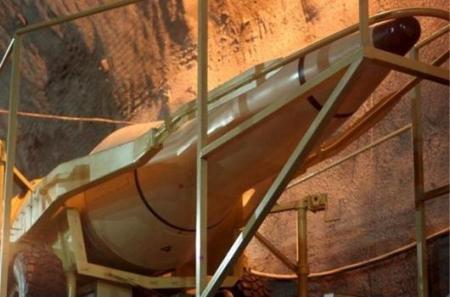
A missile is seen inside an underground missile base for Iran's Islamic Revolutionary Guards Corps (IRGC) Aerospace Force at an undisclosed location in this undated handout photo courtesy of Fars News. REUTERS/farsnews.com/Handout via Reuters

A missile is seen inside an underground missile base for Iran’s Islamic Revolutionary Guards Corps (IRGC) Aerospace Force at an undisclosed location in this undated handout photo courtesy of Fars News. REUTERS/farsnews.com/Handout via Reuters

President Barack Obama said Friday April 1, that “Iran has so far followed the letter of the [nuclear] agreement [with the six powers], but, he added, “the spirit of the agreement involves Iran also sending signals to the world community and business that it is not going to be engaging in a range of provocative actions that may scare business off,” such as fire-testing nuclear-capable ballistic missiles, calling for Israel’s destruction and providing Hizballah with missiles.

At a news conference ending the two-day nuclear summit in Washington, Obama went on to say: “Some of the concerns that Iran has expressed, we are going to work with them to address.” But meanwhile, he said, the US and its allies are taking steps to help Iraq benefit from the agreement by facilitating trade and banking transactions with the Islamic Republic; and the US Treasury Department is seeking to set clearer investment guidelines for Iran.

Two days earlier, on Wednesday, March 30, the Obama administration was reported acting to give Iran limited access to US dollars, since the almost complete lifting of sanctions in January, which netted Tehran an injection of approximately $150 billion “hasn’t provided the country with sufficient economic benefits.”

DEBKAfile’s analysts note the inherent contradiction in the US president’s approach to Tehran: He wants Iran to be compensated with a never-ending shower of dollars for agreeing to limit its nuclear program, but “the US and its allies” cannot question how the money is spent.

So while the West, under orders from Washington, must scramble to boost the Iranian economy, Tehran may continue to test ballistic missiles until they are nuclear capable, and top up the Hizballah terrorists’ arsenal with ever deadlier tools of death.

This glaring inconsistency arises from a fact largely hidden from the world public: last year’s landmark nuclear accord was concluded by Iran’s President Hassan Rouhani and Foreign Minister Mohammed Javad Zarif – not by the real powers in Tehran, supreme leader Ayatollah Ali Khamenei, the Revolutionary Guards chiefs and the ayatollahs at the head of the fundamentalist Shiite movement.

Indeed, even Rouhani was never allowed to formally sign the deal, much less gain Khamenei’s ratification.

But now, Rouhani’s fate depends on keeping those ruling elites happy.  He has found himself in the position of their hostage, a cash machine for keeping the funds for the Islamic Republic’s projects termed by President Obama “provocative” constantly on tap.

Those projects which are currently in full spate clearly leave every little over from the $150bn to even start lifting the Iranian economy out of its mess, while the Rouhani’s government carries the can for that too. Indeed, DEBKAfile’s Iranians sources disclose, the president is forced to earmark 50 percent of the funds released by sanctions relief for items listed under “defense”, namely,  the nuclear and missile development programs, Iran’s overseas military operations, including the Syrian war, subsidizing the Lebanese Hizballah, and establishing new terrorist organizations for attacks on Israel, such as the Al-Sabirin, on the Golan.

These enterprises eat up billions of dollars. Just Iran’s operations in Syria and support for Hizballah cost Tehran $2 billion every month.

Syrian president Bashar Assad didn’t surprise anyone when he revealed that the five-year civil war in his country had cost $200 billion so far. With this kind of spending on “defense,”  the Iranian economy will continue to decay, while Rouhani’s government, which promised the people a better life after the nuclear accord, must bow to the will of the hard-liners or face the consequences.

Our Iranian sources report that Obama’s inconsistent approach to Iran has sharpened the discord between the two major political camps in Tehran and put the “reformists” in extreme peril should they dare to defy the hard-liners who hold the levers of power. Khamenei has publicly threatened to liquidate such opposition leaders as Rouhani and his ally, former president Ayatollah Akbar Hashemi Rafsanjani.

President Rouhani has been put by Obama’s policy in the position of having to keep Tehran’s hungry war- and terror-mongers flush with cash, if he is to save himself and fellow “reformists” from “liquidation.”

The supreme leader was pretty blunt when he said on Friday, March 29, “Those who say the future is in negotiations, not in missiles, are either ignorant or traitors.” This comment underlined Iran’s overriding commitment to developing nuclear missiles and a warning to “traitors” of their fate: execution or a life sentence in a grim Iranian jail.

Fundamentalists and Revolutionary Guards steal Iran’s elections

February 26, 2016

Fundamentalists and Revolutionary Guards steal Iran’s elections, DEBKAfile, February 26, 2016

Rafsanjani_RouhaniOpposition leaders to Khamenei Hashemi Rafsanjani (l.) and President Hassan Rouhani

US President Barack Obama and Secretary of State Kerry fondly hoped that the nuclear agreement signed with Iran would bring to the surface a new type of leader – more liberal and less liable to restart the nuclear program – in the twin elections taking place in the Islamic Republic Friday, Feb. 26.

They are in for a disappointment, say DEBKAfile’s Iran analysts.

But one change is almost certain. The Iranian voter will be choosing for the first time on one day a new parliament (Majlis) and the Assembly of Experts, the only body competent to choose the republic’s next supreme leader. The incumbent, 75-year-old Ayatollah Ali Khamenei, is not expected to outlast the four-year term of the next Assembly of Experts. He has been struggling with prostate cancer for more than five years. Treatment and surgery have failed to halt its spread to other parts of his body. And strong medication is necessary to keep him looking alert and vigorous in his public appearances.

Speculation is already rife in Tehran about who the next Assembly of Experts will choose as his successor.

Seen from the perspective of Iran’s Islamic regime, the supreme leader’s overarching duty is to continue the legacy of its revolutionary founder, Ayatollah Ruhollah Khomeini and his successor, Ali Khamenei.

Rather than meeting the expectations of the US president, his main job is to continue strengthening Iran on its path of religious extremism, ideological subversion, export of the Shiite revolution (by terror) and the continuation of the nuclear program.

The biggest political bombshell of the election campaign was a proposal by former President Hashemi Rafsanjani to establish a national leadership council now, instead of choosing a new leader later. This was intended to replace the single dictatorial rule of the supreme leader by a collective leadership.

Iran’s fundamentalists, especially the powerful Revolutionary Guards Corps (IRGC), were in uproar about a proposal they viewed as so dangerous for the regime that they threatened to confiscate the Rafsanjani clan’s extensive property and put him on trial for corruption and fraud.

His beloved son Mahdi has already been in jail for months on those charges.

But Rafsanjani is not easily cowed. He knew that if he backed down, the extremists would crack down on him still harder.

So this week, he announced that he had pulled the strings which gave Hassan Rouhani victory in the last presidential election. And, in the campaign leading up to the Assembly of Experts vote, he threw his support behind a moderate cleric, Hassan Khomeini, who happens to be the grandson of the Islamic regime’s iconic founder.

The IRGC and radical mullahs thereupon launched an offensive to thwart what they believed to be Rafsanjani’s dangerous plan to establish a triumvirate with Rouhani and Khomeini Junior to head a future government.

Senior radical clerics, such as ayatollahs Ahama Alam-Alhoda, Mohammad Mesbah-Yazdi, Ahmad Jannati, and Mohammad Yazi, slandered him and fought to remove his candidates for the twin slates.

They branded the former president and members of a “reformist” list as British agents, a particularly malicious charge because the UK is still seen in Iran as a symbol of colonialism and meddler in foreign politics.

Ayatollah Khamenei himself harshly denounced “foreign agents” as “addicted to foreign influence,” who should be barred from the Assembly of Experts.

Young Khomenei saw the light and withdrew his candidacy for its membership. But Rafsanjani stood out to the last as a central figure in the two campaigns, even after a majority of the candidates condemned as “moderates and reformists” were barred from the elections.

In the end, the two slates were left with no more than 30 moderate candidates out of a total of 3,000 vying for the 375 seats in the two bodies.

Their defeat as a group was predestined, and the two elections leave Iran more politically and religiously radicalized than before.

A key figure expected to take center stage in the new parliament is Gholam-Ali Haddad-Adel, whose daughter is married to Khamenei’s mover-and-shaker son. Another is Haddad-Adel, one of Khamenei’s top advisers, who heads a faction of religious fundamentalists and IRGC officers. He is the frontrunner to succeed Ali Larijani as Speaker of the next Majlis.

They are all expected to gang up to prevent President Rouhani from running for a second term when it runs out in two years – contrary to the Obama administration’s hopes. They will also do their best to make him a lame duck and whipping boy for all the country’s economic ills for the remainder of his presidency.

He will find the new parliament less cooperative than the outgoing House under Larijani when he tries to introduce liberal policies.

Unofficial results of the two elections are expected to be released Friday night. The extremists and hardliners have engineered them so that they will win big and set Iran on a course that it is even more radical than before on such key issues as its nuclear weapons program and intervention in Syria and other Middle East conflicts. They will keep the feud with Saudi Arabia alive and pursue every possible means of venting their bottomless hatred of Israel and seeking its destruction.

The Moral Cost of Appeasing Iran

February 24, 2016

The Moral Cost of Appeasing Iran, Gatestone InstituteMohshin Habib, February 24, 2016

♦ The leaders of both France and Italy set aside their values to appease the president of Iran.

♦ In France, protesters demanded that President François Hollande challenge the Iranian president about his country’s human rights abuses. France’s leadership, however, raised no questions of that sort. Instead, Mr. Rouhani was welcomed as a superstar.

♦ According to a 659-page report by Human Rights Watch, Iran’s human rights violations under Mr. Rouhani’s governance have been increasing. Social media users, artists and journalists face harsh sentences on dubious security charges.

♦ In November, the Iranian Supreme Court upheld a criminal court ruling sentencing Soheil Arabi to death for Facebook posts “insulting the Prophet” and “corruption on earth.”

Right after signing the Iran nuclear deal with itself — Iran still has not signed it, and even if it did, the deal would not be legally binding — members of the P5+1 (the five permanent members of the UN Security Council plus Germany) have been showing their eagerness to establish improved relations with their imaginary partner.

Last month, after the lifting of international sanctions, Iran’s president, Hassan Rouhani, went on a five-day trip to Italy and France.

Officials from the host countries were so enthusiastic to welcome the Iranian president, it was as if they were unaware of Iran’s multiple violations of The Treaty on the Non-Proliferation of Nuclear Weapons (NPT) — which Iran did sign in 1968. They also seemed unaware of Iran’s expansion into Syria, Lebanon and Yemen, as well as Iran’s continuing role in sponsoring global terrorism.

Although both the leaders of France and Italy seemed eager to appease the president of Iran, in Paris, thousands of demonstrators gathered on the streets to protest Mr. Rouhani’s visit, and staged mock executions to highlight Iran’s dire human rights violations. In 2014, for instance, at least nine people were executed on the charge of moharebeh (“enmity against God”).

Even today, dozens of child offenders remain on death row in Iran. According to Iranian law, girls who reach the age of 9 and boys who reach the age of 15 can be sentenced to capital punishment. A recent report by Amnesty International called Iran one of the world’s leading offenders in executing juveniles. Despite the country’s ratification of the Convention on the Rights of the Child — which abolishes the use of the death penalty against offenders under the age of 18 — the UN estimates that 160 minors remain on death row.

The Iranian delegation, according to The New York Times, had asked Italian officials to hide all statues leading to the grand hall of the Capitoline Museums — where a news conference between Prime Minister Matteo Renzi and the Iranian president took place — to avoid any “embarrassment” for Rouhani, who casts himself as a moderate and reform-seeker. So on the first stop of Mr. Rouhani’s European visit, statues were encased in tall white boxes. In addition, “The lectern, was placed to the side — not the front — of an equestrian statue of the emperor Marcus Aurelius, apparently to avoid having images of the horse’s genitals appear in news photographs.”

As any kind of image is haram (forbidden) in Islam, any form of statue is considered idolatry.

Many Italians expressed their outrage over the decision to censor the statues. They accused the government of betraying Italian history and culture for the sake of economic interests.

An Iranian women’s rights organization, My Stealthy Freedom, condemned the Italian government’s decision. In a post on their Facebook page, the group wrote:

“Italian female politicians, you are not statues, speak out. Rome covers nude statues out of respect for Iran’s president in Italy and Islamic Republic of Iran covers Italian female politicians in Iran. Dear Italy. Apparently, you respect the values of the Islamic Republic, but the problem is the Islamic Republic of Iran does not respect our values or our freedom of choice. They even force non-Muslim women to cover up in Iran…”

In France, protesters demanded that President François Hollande challenge the Iranian president about his country’s human rights abuses. France’s leadership, however, raised no questions of that sort. Instead, Mr. Rouhani was welcomed as a superstar.

Big business deals were signed. France’s car-maker Peugeot and Iran’s leading vehicle manufacturer, Khodro, are engaged in a €400 million partnership. France’s energy giant, Total, signed a Memorandum of Understanding to buy crude oil from Iran. Total will reportedly begin importing 160,000 barrels of oil per day starting on February 16. Twelve days after the West lifted economic sanctions, Airbus announced that Iran Air had agreed to purchase 118 new planes. The deal is estimated at $25 billion.

Prime Minister of France Manual Valls hailed his country’s trade agreements with Iran. “France is available for Iran,” he said.

During a recent visit to Tehran, Germany’s Foreign Minister, Frank Walter Steinmeier, asked the Iranian president to keep Germany in mind as a future stop on his next trip to Europe.

Meanwhile, according to a US State Department report, Iran has pledged to continue its assistance to Shiite militias in Iraq. Many of these militias have poured into Syria and are now fighting alongside the Assad regime. Rouhani’s government also continues to support its Lebanese proxy Hezbollah, and Palestinian militants in Gaza.

For many years, the Iranian president has kept up close ties with leaders of Hezbollah, including Abbas Moussavi (the former leader of Hezbollah who was killed in 1992) and Hassan Nasrallah. In March 2014, Mr. Rouhani publicly pledged support for Hezbollah.

Rouhani’s Defense Minister is a former Islamic Revolutionary Guards Corps (IRGC) officer, Brig. Gen. Hossein Dehghan. He commanded IRGC forces in Lebanon is Syria during Hezbollah’s founding years from 1982-1984.

Last September, Dehghan said that Tehran will continue arming Hezbollah, Hamas and any group that is part of the “resistance” against the U.S. and Israel. Iran, he explained, considers America to be the Great Satan.

“Hizbullah,” Dehghan stated, “does not need us to supply them with rockets and arms. Israel and the U.S. need to know this. Today, Hamas, the Islamic Jihad, and Hizbullah have the capability of producing their own resources and weapons themselves. Nevertheless, we shall not refrain from supporting them.”

As well as Dehghan, almost all of Rouhani’s appointments are either former members of the IRGC or other revolutionary institutions, such as Iran’s Judiciary and Intelligence Ministries.

Iran’s human rights violations under Rouhani’s governance have been increasing. A 659-page report published by Human Rights Watch concludes that Iranian authorities have repeatedly clamped down on free speech and dissent. “In a sharp increase from previous years, Iran also executed more than 830 prisoners.”

806Since Hassan Rouhani (right) became the president of Iran, the surge in executions has given Iran the world’s highest death penalty rate per capita.

Social media users, artists and journalists face harsh sentences on dubious “security” charges. In May 2014, four young men and three unveiled women were arrested after a video showing them dancing to the popular song “Happy” went viral on YouTube. They were sentenced to up to a year in prison and 91 lashes on several charges, including “illicit relations.”

In November, the Iranian Supreme Court upheld a criminal court ruling sentencing Soheil Arabi to death for Facebook posts “insulting the Prophet” and “corruption on earth.”

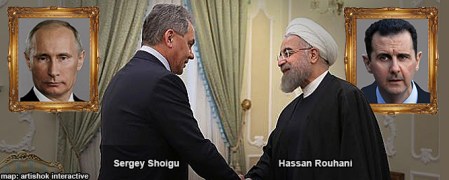
Shoigu in Tehran to rescue Putin’s plan from Assad’s Iranian-backed obstructionism

February 22, 2016

Shoigu in Tehran to rescue Putin’s plan from Assad’s Iranian-backed obstructionism, DEBKAfile, February 22, 2016

Shoigu_Ruhani

President Vladimir Putin this week mounted a rescue operation to unsnarl his blueprint for a solution of the Syrian crisis from the blockage placed in its path by none other than Bashar Assad. The Syrian ruler won’t hear of Moscow’s proposals for ending the war, or even the cessation of hostilities approved last week in Munich by the 17-member Syria Support Group.

DEBKAfile reports that the strains between Moscow and Damascus this week have blown back onto the working relations between the Russian, Syrian and Iranian military commands running the war in Syria.

US Secretary of State John Kerry, referring to the lack of progress toward a ceasefire during a visit to Amman Sunday, Feb. 21, pointed mainly at the Syrian opposition. Its High Negotiations Committee insists first on an end to the sieges, a halt on Russian bombardment and the inclusion of the jihadist Nusra Front in the ceasefire.

But, according to our sources, the main monkey wrench has been thrown into the mix by Assad.

When Putin discovered that the Syrian ruler had won the secret backing of Tehran in h is refusal, he decided to send the supreme commander of the Russian campaign in Syria, Defense Minister Gen. Sergei Shoigu, to Tehran Sunday, Feb. 21, with a personal message for President Hassan Rouhani.

Gen. Shoigu laid before Rouhani the extent to which Russian intervention had turned the tide of the Syrian war in favor of the regime, and the great advantages of a political resolution that would end the conflict in a way that enhanced Russian and Iranian influence in the region to the maximum.

The Russian general stressed that at the end of the proposed political process, Assad would be required to step down. This concurrence was incorporated in the Putin-Obama deal for working together to solve the Syrian crisis.

But Rouhani was unmoved, according to the statement he issued at the end of the interview.

“The crisis in Syria can only be solved through political negotiation and respect for the rights of the country’s government and people, who are those taking the final decision regarding its future,”  he said.

This was taken in Moscow as Iran’s rejection of at least one element of the Putin plan – imposing a solution on Assad – but not the plan in its entirety. This qualified response was meant to nudge Moscow closer to Teheran and Moscow and pull away from Washington.

The Shoigu mission therefore did not lessen the strains between Russia, Iran and Assad – at least for now, according to DEBKAfile’s sources.

Although all the parties concerned agree that the war must be ended by political means, those means are the subject of controversy between Moscow and its allies. The Russians are seeking a staged advance towards the final goal by first scaling down military operations, the while gradually refocusing their efforts on political and diplomatic arrangements.

But Syrian and Iranian leaders want to keep the focus on the military course.

Moscow wants the Assad regime to make concessions for paving the way to a cease-fire, and to accept a transitional government taking over in Damascus with representation for the opposition. The Syrian dictator would then gradually transfer his powers to the stand-ins as they assume responsibility for the various branches of government.

But both Assad and Tehran are adamantly opposed to a transitional government being installed – or any other political steps being pursued – before the rebel forces are totally defeated in non-stop military operations – first in the north and then in the south.

Neither the Syrian ruler nor Iran show any sign of relenting, or appreciating that the dramatic progress achieved in the past month by Syrian army, Iranian and Hizballah forces were down to Russian military support and especially its air campaign against their enemies. They feel safe in their intransigence because they assume that Putin can’t afford to abruptly pull his military support from under their feet to make them bow to his demands.

After five months in which Moscow and the Russian air force have provided the Iranian leadership and Assad with signal victories on the ground, President Putin has been brought up short by the same Iranian-Syrian negative obstructionism, that has defied every effort to end the brutal five-year war, which has cost 470,000 lives, left 1.9 million injured, displaced half the country’s population of 23 million and left a Syria ravaged beyond recognition.

Rouhani: Nuclear Deal ‘One of Iran’s Greatest Successes’ Against the West

January 22, 2016

Rouhani: Nuclear Deal ‘One of Iran’s Greatest Successes’ Against the West, AlgemeinerDavid Daoud, January 22, 2016

(The next time Obama touts the nuke “deal” as one of his greatest achievements, will he agree with Rouhani?– DM)

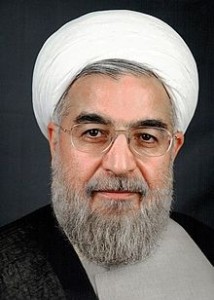
220px-Hassan_Rouhani-214x300Iranian President Hassan Rouhani. Photo: Wikipedia.

Iran’s president has expressed his complete satisfaction with the outcome of the nuclear deal reached between the Islamic Republic and world powers in July, regime-aligned Tasnim News Agency reported on Thursday.

Hassan Rouhani hailed the Joint Comprehensive Plan of Action (JCPOA) – which went into effect on Sunday – as “one of Iran’s greatest successes” against the West. He stressed that Iran had only agreed to the final version of the deal after “30 months of tough talks,” and that Tehran’s negotiators almost walked away three times.

Rouhani said that Iran had made sure the JCPOA would lead to the termination of the United Nations’ nuclear-related sanctions against Tehran, accomplishing the country’s long-term goals and objectives “without exception.”

Iran’s President Promises “Year of Economic Boom”

January 11, 2016

Iran’s President Promises “Year of Economic Boom” Tasnim News Agency, January 11, 2016

Iranian president

Iranian President Hassan Rouhani on Monday vowed that the next Iranian calendar year (starts on March 21) would be a year of economic prosperity for the nation with the upcoming termination of anti-Tehran sanctions based on a nuclear deal with world powers.

Within a few days, the cruel sanctions against the Iranian nation would be lifted, Rouhani said, addressing a ceremony to inaugurate two new phases of the giant South Pars Gas Field in the southern Iranian city of Assaluyeh.

The president predicted positive economic growth for this year despite all the hardships, vowing that the next year will be a “Year of Economic Boom” given the lifting of anti-Iran sanctions.

He also referred to the inauguration of new phases of the gas field, and highlighted the fulfillment of his government’s promises in the fields of energy, oil, gas, and petrochemical industry.

In the next solar year of 1396, all phases of the South Pars Gas Field will be completed, he promised.

His remarks came one day after Iran and six world powers wrapped up expert-level talks in Geneva on Sunday after they studied the ways to put into practice the landmark deal on the country’s nuclear program.

During the two-day meeting, the two sides’ experts tried to finalize measures prior to the implementation of the deal, dubbed as the Joint Comprehensive Plan of Action (JCPOA).

“The countdown has begun for the implementation day and the removal of (anti-Iran) sanctions,” Foreign Ministry’s Director General for International and Political Affairs Hamid Baeedinejad said in a message shared on his Instagram page of the Iran nuclear deal.

Iran and the Group 5+1 (Russia, China, the US, Britain, France and Germany – also known as the P5+1 or E3+3) on July 14 reached a conclusion on a 159-page nuclear agreement that would terminate all sanctions imposed on Tehran over its nuclear energy program after coming into force.

Experts believe that Iran’s economic growth would rise remarkably after the deal takes effect.

The Elephant In The Room

October 2, 2015

The Elephant In The Room, Middle East Media Research Institute (MEMRI), Yigal Carmon*, October 2, 2015

(Please see also, Iran wants to renegotiate parts of the nuke “deal.” That may be good. Have opponents of the “deal” given up? If so, why? — DM)

It may be that these opponents believe that the agreement is a done deal that cannot be stopped and that the current U.S. administration will follow through with it no matter what. This approach reflects not realism but ignorance. Obviously the administration wants to follow through with the deal. But the deal is no longer in it hands. It is Khamenei who is throwing a spanner in the works, declaring that he will not implement the agreement that the West believed it concluded on July 14.

In order to get Iran to implement the agreement, the language of the JCPOA will have to be changed and a new Security Council resolution will have to be passed. While in theory this would not be impossible, it would require a new process, entailing, at the very least, a public political debate in the West – one that would reveal Iran’s unreliability as a partner and would cost valuable time. And time is not on the side of the U.S. administration.

*****************

On September 3, 2015, not two months after the July 14 announcement of the Joint Comprehensive Plan of Action at Vienna and its celebration at the White House and in Europe, Iranian Supreme Leader Ali Khamenei dropped a bombshell.

In a speech to the Iranian Assembly of Experts, he backtracked from the agreement, demanding a new concession: that the sanctions be “lifted,” not merely “suspended.”[1] If that term is not changed, said Khamenei, there is no agreement. If the West only “suspends” the sanctions, he added, Iran will merely “suspend” its obligations. Giving further credence to his threat, he announced that it is the Iranian Majlis that must discuss and approve the agreement (or not), because it represents the people – when it is well known that the majority of its members oppose it, and Iranian President Hassan Rohani made every effort to prevent such a discussion in the Majlis from taking place.

Adding insult to injury, Ali Akbar Velayati, senior advisor to Khamenei and head of Iran’s Center for Strategic Research, said on September 19 that the negotiations, concluded and celebrated less than two months previously on July 14, are actually “not over yet.”[2]

Khamenei’s demand to replace “suspension” with “lifting” is not just semantic. It is a fundamental change, because the snapback of sanctions – the major security mechanism for the entire agreement – cannot take place with “lifting,” but only with “suspension.”

Ever since Khamenei dropped this bombshell, the Western media has maintained total silence, as if this were a trivial matter not worthy of mention, let alone analysis.

One might understand this reaction on the part of those who support the deal. Perhaps they are shocked, at a loss, and therefore hope that if they pretend they don’t see it, it doesn’t exist. Indeed, this is the futile policy regularly adopted by ostriches.

However, one cannot but be astounded by the silence on the part of the opponents of the deal, including – oddly enough – Israel and the U.S. Republicans. One would expect these opponents to pounce on Khamenei’s statement and raise hell over Iran’s infanticide of the two-month-old agreement. One would expect them to bring it to the forefront of a new debate over the deal in any possible forum – in the U.S., the U.N., and the E.U.

But – nothing.

It may be that these opponents believe that the agreement is a done deal that cannot be stopped and that the current U.S. administration will follow through with it no matter what. This approach reflects not realism but ignorance. Obviously the administration wants to follow through with the deal. But the deal is no longer in it hands. It is Khamenei who is throwing a spanner in the works, declaring that he will not implement the agreement that the West believed it concluded on July 14.

In order to get Iran to implement the agreement, the language of the JCPOA will have to be changed and a new Security Council resolution will have to be passed. While in theory this would not be impossible, it would require a new process, entailing, at the very least, a public political debate in the West – one that would reveal Iran’s unreliability as a partner and would cost valuable time. And time is not on the side of the U.S. administration.

Right now, Iran is exposed almost daily as the ally of Russia against the U.S. Three months after the “historic” agreement declared by the White House, Iran continues to seek “Death to America,” and the Iranian foreign minister, the “hero” of the agreement, needs to apologize in Iran for “accidentally” shaking hands with the U.S. president. The truth of the agreement is emerging, and it is not certain that what Iran is now demanding will pass.

Interestingly enough, the White House’s first reaction was to brush off Khamenei’s demand. Iran, said Josh Earnest, should just do what it what it had undertaken to do in the agreement, and stop roiling the waters.[3]

A more sober response followed. There was hope that the meeting set for September 28 between the P5+1 and Iranian foreign ministers, on the margins of the 70th session of the U.N. General Assembly, would produce a solution, but this hope was in vain. Iranian President Rohani fled back to Iran, on the pretext of the hajj tragedy in Mecca, and no one in the West knows how to proceed.

The Western media, for its part, is perpetuating its total blackout on the issue, hoping perhaps for a miracle in the secret U.S.-Iran talks, which this administration has been conducting for years. But even a secret U.S. concession will be no solution. Even if it were to offer a secret commitment to remove the sanctions altogether, Khamenei will not be satisfied. He openly challenged the U.S., and he needs its public capitulation. He will celebrate publicly any secret concession. Moreover, any new U.S. concession will prompt Khamenei to make ever more demands.

The most recent developments, and the emergence of Russia as a new-old contender for power vis-à-vis the U.S. in the world, particularly in the Middle East, will only encourage Khamenei to cling to his tried and true ally, Russia. Indeed, this administration has no objection to Russia’s resurgence in the Middle East, but Russia’s blatant anti-U.S. stance in every venue except in the private, honeyed Putin-Obama talks will ultimately lead even the blindest of Democrats to realize that Iran is indeed an enemy of the U.S. – as Iran plainly declares – and that any further concessions to it make no sense.

It seems that the worst nightmare of the supporters of the deal – that Iran will do away with the July 14 agreement – is about to come to pass.

*Y. Carmon is president and founder of MEMRI.

Endnotes:

[3] Earnest said: “What we have indicated all along is that once an agreement was reached, as it was back in mid-July, that we would be focused on Iran’s actions and not their words, and that we will be able to tell if Iran follows through on the commitments that they made in the context of these negotiations. And that is what will determine our path forward here. We’ve been crystal clear about the fact that Iran will have to take a variety of serious steps to significantly roll back their nuclear program before any sanctions relief is offered – and this is everything from reducing their nuclear uranium stockpile by 98 percent, disconnecting thousands of centrifuges, essentially gutting the core of their heavy-water reactor at Arak, giving the IAEA the information and access they need in order to complete their report about the potential military dimensions of Iran’s nuclear program. And then we need to see Iran begin to comply with the inspections regime that the IAEA will put in place to verify their compliance with the agreement. And only after those steps and several others have been effectively completed, will Iran begin to receive sanctions relief.  The good news is all of this is codified in the agreement that was reached between Iran and the rest of the international community. And that’s what we will be focused on, is their compliance with the agreement.” Whitehouse.gov, September 4, 2015.


