Archive for the ‘Putin’ category

I got Syria so wrong

October 15, 2015

I got Syria so wrong, Politico, October 15, 2015

Fully complicit in the Assad regime’s impressive portfolio of war crimes and crimes against humanity, Iran relies on its client to secure its overland reach into Lebanon. And Russia works to sustain Assad as a rebuke to Washington. All the while, the eastern part of Syria is run by the self-styled Islamic State, or ISIL, itself a criminal enterprise. For the most part, the two titans of crime — the Assad regime and the Islamic State — have been able to live and let live, concentrating their hideous repertoires of violence on civilians and on armed rebels offering a nationalistic alternative to both. The result is widespread and profound hopelessness. Many Syrians are giving up on their beloved Syria. They are voting with their feet.

*********************

I spent early 2011 trying to ease tensions between Syria and its neighbors. I never predicted the brutality that would come from inside.

Now and then I am asked if I had predicted, way back in March 2011 when violence in Syria began, that within a few years a quarter-million people would be dead, half the population homeless and hundreds of thousands of defenseless civilians terrorized, traumatized, tortured and starved. The companion question, more often than not, is if I had forecast the failure of the West to offer any protection at all to Syrian civilians subjected to a systematic campaign of mass homicide. Having first been exposed to Syria as a teenage exchange student, I was expected by questioners to know something about the place. And as a State Department officer, I was assumed to know something about my government.

But no. It took me the better part of eighteen months to comprehend fully the scope of an unfolding humanitarian and political catastrophe. By September 2012, when I resigned my State Department post as adviser on Syrian political transition to Secretary of State Hillary Clinton, I knew that Syria was plunging into an uncharted abyss — a humanitarian abomination of the first order. And I knew that the White House had little appetite for protecting civilians (beyond writing checks for refugee relief) and little interest in even devising a strategy to implement President Barack Obama’s stated desire that Syrian President Bashar Assad step aside. But at the beginning, nothing drawn from my many years of involvement in Syria inspired accurate prophesy.

That Russia’s recent military intervention in Syria has shocked the Obama administration is itself no surprise. For nearly two years, Washington had chased Moscow diplomatically in the belief that the Kremlin’s soothing words about supporting political transition in Syria were truthful. That which was obvious to many — Russia’s desire to perpetuate Assad in office — is now jarringly clear to the administration. That training and equipping anti-Assad rebels to fight anyone but Assad has been dropped like a bad habit by an administration warned not to proceed along these lines is hardly a bolt from the blue.But the White House is not alone in failing to accurately forecast the severity of the Syrian disaster.

The major reason for my lack of foresight: It didn’t have to turn out this way, and I remain mildly surprised that it did. It is not that Syrians were without grievances concerning the way they were being governed. Widespread unemployment, underemployment and opportunity deficits were already prompting those with means among the best and brightest to leave the country. Although the regime’s corruption, incompetence and brutal intolerance of dissent were hardly state secrets, Assad was not universally associated by Syrians with the system’s worst aspects: “If only the president knew” was a phrase one heard often. Some Syria watchers believed that the Arab Spring would visit the country in the form of political cyclone. I did not. I did not think it inevitable that Assad — a computer-savvy individual who knew mass murder could not remain hidden from view in the 21st century — would react to peaceful protest as violently as he did, with no accompanying political outreach. And as Syria began to descend into the hell to which Assad was leading it, I did not realize that the White House would see the problem as essentially a communications challenge: getting Obama on “the right side of history” in terms of his public pronouncements. What the United States would do to try to influence Syria’s direction never enjoyed the same policy priority as what the United States would say.

Back in early 2011, it seemed possible not only to avoid violent upheaval in Syria but to alter the country’s strategic orientation in a way that would counter Iran’s penetration of the Arab world and erase Tehran’s land link to its murderous Hezbollah militia in Lebanon. Much of my State Department time during the two years preceding Syria’s undoing was thus spent shuttling back and forth between Damascus and Jerusalem, trying to build a foundation for a treaty of peace that would separate Syria from Iran and Hezbollah on the issue of Israel.

There was a degree of idealism in my quest, born in the brain of an American teenager many years before. But there was another personal element as well. Long before Hezbollah murdered Mr. Lebanon — Prime Minister Rafik Hariri — in 2005, it had brutally and pathologically tortured to death a friend of mine serving as an unarmed United Nations observer, Marine Lt. Col. Rich Higgins. Peace between Israel and Syria would require Damascus to cut all military ties to Hezbollah. It would require Syria to stop facilitating Iran’s support to Hezbollah. It would set the stage for a Lebanon-Israel peace that would further marginalize Lebanon’s murder incorporated. Peace for its own sake is good. But the prospect of beating Hezbollah and its Iranian master was inspiring. This prospect, more than anything else, motivated the mediation I undertook as a deputy to Special Envoy George Mitchell in the State Department.

Assad, told me in late February 2011 that he would sever all anti-Israel relationships with Iran, Hezbollah and Hamas and abstain from all behavior posing threats to the State of Israel, provided all land lost by Syria to Israel in the 1967 war — all of it — was returned. My conversation with him was detailed in terms of the relationships to be broken and the behavior to be changed. He did not equivocate. He said he had told the Iranians that the recovery of lost territory — the Golan Heights and pieces of the Jordan River Valley — was a matter of paramount Syrian national interest. He knew the price that would have to be paid to retrieve the real estate. He implied that Iran was OK with it. He said very directly he would pay the price in return for a treaty recovering everything.

Israeli Prime Minister Benjamin Netanyahu was interested. He was not at all eager to return real estate to Syria, but he found the idea of prying Syria out of Iran’s grip fascinating. And the negative implications for Hezbollah of Lebanon following Syria’s peace accord with Israel were not lost on him in the least. Although there were still details to define about the meaning of “all” in the context of the real estate to be returned, Netanyahu, too, knew the price that would ultimately have to be paid to achieve what he wanted.

But by mid-April 2011 the emerging deal that had looked promising a month earlier was off the table. By firing on peaceful demonstrators protesting police brutality in the southern Syrian city of Deraa, gunmen of the Syrian security services shredded any claim Assad had to governing legitimately. Indeed, Assad himself — as president of the Syrian Arab Republic and commander in chief of the armed forces — was fully responsible for the shoot-to-kill atrocities. Even so, he told Barbara Walters in a December 2011 ABC TV interview, “They are not my forces, they are military forces belong[ing] to the government . . . I don’t own them, I am the president. I don’t own the country, so they are not my forces.”

Before the shooting began the United States and Israel were willing to assume Assad had sufficient standing within Syria to sign a peace treaty and — with American-Israeli safeguards in place — make good on his security commitments before taking title to demilitarized territories. But when he decided to try to shoot his way out of a challenge that he and his first lady could have resolved personally, peacefully and honorably, it was clear he could no longer speak for Syria on matters of war and peace.

Some of my U.S. government colleagues from bygone days tell me we dodged a bullet: that an uprising against the Assad regime’s arrogance, cluelessness and corruption in the middle of treaty implementation would have caused real trouble. Others believe we were too slow: that a treaty signing in early 2011 could have kept the gale force winds of the Arab Spring from unhinging Syria. I don’t know. I don’t know if Assad or Netanyahu would, in the end, have done a deal. What I do know is that I felt good about where things were in mid-March 2011. What I also know is that by mid-April hope of a treaty was gone, probably never to return in my lifetime.

Assad’s decision to apply lethal violence to something that could have been resolved peacefully was the essence of betrayal. He betrayed his country so thoroughly as to destroy it. Four years on, he reigns in Damascus as a satrap of Iran and a dependent of Moscow. In the end, he solidified Israel’s grip on land lost in 1967 by his defense minister father.

Fully complicit in the Assad regime’s impressive portfolio of war crimes and crimes against humanity, Iran relies on its client to secure its overland reach into Lebanon. And Russia works to sustain Assad as a rebuke to Washington. All the while, the eastern part of Syria is run by the self-styled Islamic State, or ISIL, itself a criminal enterprise. For the most part, the two titans of crime — the Assad regime and the Islamic State — have been able to live and let live, concentrating their hideous repertoires of violence on civilians and on armed rebels offering a nationalistic alternative to both. The result is widespread and profound hopelessness. Many Syrians are giving up on their beloved Syria. They are voting with their feet.

There is no end in sight to this vicious bloodletting. Iran and Russia could stop the gratuitous mass murder but opt not to do so. Moscow now facilitates it with military intervention. The United States could stop it or slow it down significantly without invading and occupying Syria — indeed, without stretching the parameters of military science. But it has adamantly refused to do so. Meanwhile, the minions of the Islamic State loot and destroy the world heritage site of Palmyra while subjecting much of eastern Syria to their own brand of violent rule and internal terror.

Both sides of this debased criminal-terrorist coin need to be addressed urgently. Assad’s barrel bombing of Deraa in the south — where peaceful protests against regime brutality first attracted international notice in March 2011 — along with his bombing of Aleppo and Idlib in the north must be stopped cold. These horrific devices kill the innocent and recruit for the Islamic State: precisely as they are intended to do. Means exist far short of invasion and occupation to make it difficult for Assad regime helicopters to deliver their deadly cargoes. What is required is a clear statement of intent by Obama, one communicated to the Department of Defense, so that options can be produced for presidential decision and execution.

With regard to ISIL, a professional ground combat component provided by regional powers is desperately needed to work with coalition aircraft to sweep this abomination from Syria and permit a governmental alternative to the Assad regime to take root inside Syria. With central and eastern Syria free of both the regime and ISIL, an all-Syrian national stabilization force can be built. Western desires for a negotiated end to the Syrian crisis would be based, under these circumstances, on more than a wish and a hope.

The United States should neither seek nor shy away from confrontation with Russian forces in Syria. Moscow will not like it if its client’s ability to perform mass murder is impeded. Russia will not be pleased if ISIL, its false pretext for military intervention in Syria, is swept from the table. Ideally, Russia will not elect to escort regime aircraft on their mass homicide missions. And it would be difficult for even Russian President Vladimir Putin to articulate outrage if ISIL is crushed militarily. But if Russia seeks out armed confrontation with the United States in Syria, it would be a mistake for Washington to back down. People like Putin will push until they hit steel. And he will not stop in Syria.

Having failed miserably as a prophet in 2011 does not deter me from predicting the following: Obama will bequeath to his successor a problem of gargantuan dimensions if he does not change policy course now. Left to the joint ministrations of Assad and the Islamic State, Syria will continue to hemorrhage terrified, hungry and hurt human beings in all directions while terrorists from around the globe feast on the carcass of an utterly ruined state. Western Europe now reaps a whirlwind of desperate and displaced humanity it thought would be limited to Syria’s immediate neighborhood.

My failure to predict the extent of Syria’s fall was, in large measure, a failure to understand the home team. In August 2011, Barack Obama said Assad should step aside. Believing the president’s words guaranteed decisive follow-up, I told a congressional committee in December 2011 that the regime was a dead man walking. When the president issued his red-line warning, I fearlessly predicted (as a newly private citizen) that crossing the line would bring the Assad regime a debilitating body blow. I still do not understand how such a gap between word and deed could have been permitted. It is an error that transcends Syria.

I want the president to change course, but I fear that Syrians — Syrians who want a civilized republic in which citizenship and consent of the governed dominate — are on their own. I’ve been so wrong so many times. One more time would be great. It would mean saving thousands of innocent lives. It would mean real support for courageous Syrian civil society activists who represent the essence of a revolution against brutality, corruption, sectarianism and unaccountability. It would mean the reclamation of American honor. It would mean preserving my near-perfect record of getting things wrong. It would be a godsend.

“Russia” calling “another US’ bad bluff”!

October 15, 2015

“Russia” calling “another US’ bad bluff”! Zero Point via You Tube, October 14, 2015


According to the blurb below the video,

The US has now thrown in the towel on the ill-fated strategy of training Syrian fighters and sending them into battle only to be captured and killed by other Syrian fighters who the US also trained..

The Pentagon’s effort to recruit 5,400 properly “vetted” anti-ISIS rebels by the end of the year ended in tears when the entire world laughed until it cried after word got out that only “four or five” of these fighters were actually still around. The rest are apparently either captured, killed, lost in the desert, or fighting for someone else..

This has cost the US taxpayer somewhere in the neighborhood of $40 million over the last six months..
Because this latest program was such a public embarrassment, the Pentagon had to come up with a new idea to assist Syria’s “freedom fighters” now that they are fleeing under bombardment by the Russian air force only to be cut down by Hezbollah..

The newest plan: helicopter ammo. No, really. The US has now resorted to dropping “tons” of ammo into the middle of nowhere and hoping the “right” people find it..

Here’s CNN:

U.S. military cargo planes “gave” 50 tons of ammunition to rebel groups overnight in northern Syria, using an air drop of 112 pallets as the first step in the Obama Administration’s urgent effort to find new ways to support those groups..

Details of the air mission over Syria were confirmed by a U.S. official not authorized to speak publicly because the details have not yet been formally announced..

C-17s, accompanied by fighter escort aircraft, dropped small arms ammunition and other items like hand grenades in Hasakah province in northern Syria to a coalition of rebels groups vetted by the US, known as the Syrian Arab Coalition..

And here’s a bit more color from GOP mouthpiece Fox News:

The ammunition originally was intended for the U.S. military’s “train and equip” mission, the official said. But that program was canceled last week..

“So now we are more focused on the ‘E’ [equip] part of the T&E [train & equip],” said the official, who described equipping Syrian Arabs as the focus of the new strategy against ISIS..

The Defense Department announced Friday that it was overhauling the mission to aid Syrian rebel fighters. After the program fell far short of its goals for recruiting and training Syrian fighters, the DOD said it would focus instead on providing “equipment packages and weapons to a select group of vetted leaders and their units so that over time they can make a concerted push into territory still controlled by ISIL”..

The shift also comes as Russia continues to launch airstrikes in Syria, causing tension with the U.S. amid suspicions Moscow is only trying to prop up Bashar Assad..

Col. Steve Warren, spokesman for the U.S.-led anti-ISIS coalition, confirmed that coalition forces conducted the airdrop..

“The aircraft delivery includes small arms ammunition to resupply counter-ISIL ground forces so that they can continue operations against ISIL. All aircraft exited the drop area safely,” he said in a statement. All pallets successfully were recovered by friendly forces, a U.S. official said..

The US just paradropped 50 tons of ammo on pallets into the most dangerous place on the face of the planet with no way of ensuring that it falls into the “right” hands (it goes without saying that the term “right” is meaningless there). Meanwhile, the Russians are dropping bombs on the same extremists who are set to receive the guns the US is dropping..

Of course if it does somehow fall into the “wrong” hands, it wouldn’t be the first time (see Mosul and recall the $500 billion worth of weapons Washington “misplaced” in Yemen) and as we said a few days ago, this is at least great news for the military-industrial complex. It means more “terrorist attacks” on U.S. “friends and allies”, and perhaps even on U.S. soil – all courtesy of the US government supplying the weapons – are imminent…

Russia and Iran Moving to Corner the Mideast Oil Supply

October 15, 2015

Russia and Iran Moving to Corner the Mideast Oil Supply, American ThinkerSteve Chambers, October 15, 2015

It looks like Vladimir Putin and the ayatollahs are preparing to corner the world’s oil supply – literally.

Last May I wrote on this site that Iran was in the process of surrounding the Saudi/Wahhabi oil reserves, along with those of the other Sunni Gulf petro-states.  I added that, “Iran’s strategy to strangle Saudi/Wahhabi oil production also dovetails with Putin’s interests.  As the ruler of the second largest exporter of oil, he would be delighted to see the Kingdom’s production eliminated or severely curtailed and global prices soar to unseen levels.  No wonder he is so overtly supporting Iran.”

We’ve now seen Putin take a major, menacing step in support of the Iranians by introducing combat forces into Syria.  Many analysts argue that he’s doing this both to protect his own naval base at Tartus and as some sort of favor to the Iranians.  Are those really sufficient inducement for him to spend scarce resources and risk Russian lives, or does he have bigger ambitions in mind?  Given the parlous state of Russia’s economy, thanks in very large part to the recent halving of oil prices, he must relish the opportunity now presented to him, in an axis with Iran, to drive those prices back to prior levels.

The Iranians, for their part, must welcome this opportunity as well, for two huge reasons: first, when sanctions are finally lifted, thanks to their friend in the White House, Iran’s oil production will only aggravate the current global excess oil supply, reducing their cash flow (although they will still repatriate the $150 billion released by the nuclear deal).  They and the Russians must both be desperate to find a way to prevent further oil price declines.  And second, Iran’s mortal sectarian enemies and rivals for leadership of all of Islam are the Saudi/Wahhabi clan, so the prospect of simultaneously hurting them while strengthening themselves must seem tremendously tantalizing.

To achieve this, the Russian-Iranian axis can pursue the encirclement strategy of the Arabian Peninsula that Iran has already been overtly conducting, as I described in May, and is evident by referring to the map below.

195414_5_

Iran and its allies already control the border across the Saudi/Wahhabi Kingdom’s northern frontier, although the Iranian grip on the Syrian portion is tenuous – hence the Russian intervention.  Now Iran is also fighting a bitter proxy war with the Kingdom in Yemen, where Iran is backing coreligionist Shi’ites.  From Yemen, Iran can also threaten the Bab-al-Mandeb that provides access to the Red Sea, multiplying the pressure it already exerts on the Kingdom by threatening the Strait of Hormuz at the entrance to the Persian Gulf from its own territory.

Moreover, Iran is widely believed to be supporting the Shi’a who live on top of the Saudi/Wahhabi oil reserves in the Eastern Province.  The natural affinity between the Shi’a of Arabia and Iran has long worried the royal family and led them to discriminate against their Shi’ite subjects, fostering resentment among them.  Attacks on the Shi’a community early this year have increased tensions.  On top of all that, Iran is reportedly behind the recent Shi’a unrest in Bahrain, which Iran considers it lost “14th province” – much as Saddam viewed Kuwait in the late 1980s.

With this being the current state of the Mideast chessboard, consider how the game can unfold.  With Russian assistance, Iran can save its Syrian puppet and reinforce its defensive enclave in the Allawite homeland in the northwest of its putative boundaries.  Then the combined forces of the axis can turn on ISIS, all the while boasting of doing the world a favor, and reduce its territorial control if not extirpate it entirely.  Of course, the Saudi/Wahhabis will probably do whatever they can to assist their vicious ideological offspring, but it would be hard to bet against the axis.

As the axis pacifies Syria, it can then begin pressure the Saudi/Wahhabis and other Sunni petro-states to curtail their oil production enough both to accommodate the increased Iranian flow and to lift prices back to acceptable levels.  $100 a barrel must sound like a nice target.

The axis’s initial pressure will probably be diplomatic, applied by both principal powers.  However, with Iran’s foothold-by-proxy in Yemen and their influence in the Eastern Province and Bahrain, it could easily foment more general violence against the Saudi/Wahhabis, even within the Kingdom itself.  Iran could likewise twist Bahrain’s arm and thereby rattle the cages of the lesser Sunni petro-states.  Then, by trading a reduction in oil for a reduction in violence, the axis could achieve its objective.

If not, the Iranians could escalate the violence further.  Perhaps ideally from the Iranian perspective, the Saudi/Wahhabis would overreact and provide Iran with an excuse to strike directly at the geographically highly concentrated Arabian oil fields and support facilities.  Iran might not be willing to risk royal retaliation by attacking on its own, but it could be emboldened with Russian backing by air and sea, and perhaps even a nuclear umbrella.  In that scenario, the proud Arabs would be forced to bow to the will of their ancient Persian foes – particularly since it is obvious that the US under its current president could not be relied upon for support.

An attack on the Kingdom’s fields would cause a severe and lengthy disruption of Mideast oil supply, which would dreadful for the rest of the world – but certainly not the worst-case scenario.  Such a disruption would precipitate another nasty global recession and could severely weaken the US, Europe, and China, all of whose economies are fragile and probably brittle.  Thus the damage inflicted could far outlast the disruption itself.  This could be yet another highly attractive incentive for Putin and his ayatollah allies.

So, Putin and the ayatollahs have powerful motives to corner the world’s oil market and therefore the US and the rest of the world are facing an enormous risk.  The horrible pity of this is that the US could easily demonstrate the futility of the Russian-Iranian axis trying to take the world hostage with Mideast oil, simply by opening up our surface deposits of oil shales in the Rockies.  As I showed in this analysis last March, these resources could make Mideast oil irrelevant.

The US’ surface oil shales are completely different from the deep shales that are accessed through directional drilling and fracking and that grab all the headlines; the deep shales are a mere side show in terms of reserves.  The surface shales hold up to 3 trillion barrels of oil versus about 50 billion barrels of tight oil accessed by fracking.  The total global proven reserves of oil are 1.6 trillion barrels, and the Canadian tar sands have 1.6 to 2.5 trillion barrels (although they’re officially listed at 175 billion barrels, which are incorporated in the global total).  So, the US and Canada together essentially can triple the global supply of oil, and at prices in the $60-75/barrel range.  Meanwhile, Mideast reserves are about 800 billion barrels – half of Canada’s oil sands, perhaps less than a third of the US surface shales.  The world no longer needs the Muslim oil.

Unfortunately, the vast majority of the Rockies surface shales sit on Federal land, and while George W. Bush opened up those lands for development, Obama rescinded that policy.  These reserves now sit almost entirely idle.

As with any petroleum deposit, these surface shale reserves can’t be turned on with the wave of a wand.  But they can be opened for development with just a pen, and not even a phone.  For the protection of this country, and the good of the world, our current president should immediately open these reserves for development, with great fanfare.  If he will not use our military to protect our interests, he should at least use our economic weapons.

There is no time to lose.  Russia is on the march, in unison with the emboldened and enriched Iranians, thanks again to our president.  Putin and the ayatollahs know they will enjoy only another 464 days with this president and that none of his likely replacements will be so complacent and flexible, to use his own term.  We should therefore expect that they will want to make as much hay as they can while the sun reflects off of Obama’s insouciant grin.


Jack Abramoff – Jihad in Israel!

October 14, 2015

Jack Abramoff – Jihad in Israel! The United West via You Tube, October 14, 2015


Czar Putin defends the West

October 14, 2015

Czar Putin defends the West, American ThinkerJames Lewis, October 14, 2015

Vladimir Putin isn’t a nice liberal, but he is a realist, which is much more than any Western leader can say today. Without realism it is impossible to act morally. Without realism, everything turns into an Obamaesque kabuki play.

********************************

Well, Obama has systematically undercut our friends in the Middle East, and Vladimir Putin is picking up the pieces. Obama promised big change — only not the ones we see happening. As Obama promised the radical left, America is now drastically weakened; but oddly enough, peace hasn’t busted out all over.

So here comes the Czar of all Russias to rescue Christian civilization from a bloody nightmare in Syria and Iraq. While the United States is supplying major weapons to brutal Sunni gangs who keep committing horrific war crimes, jihadis are taking advantage of the chaos to make genocidal attacks on Arab Christians, Egyptian Copts, Orthodox Armenians, Kurds, Yazidis, and Druze. (And each other — of course.)

Every time another domino falls, this administration looks more shell-shocked. Their comforting delusions are crumbling. Today they’ve stopped even pretending to understand what’s going on.

Even Obama’s surrender to Iran’s nuclear obsessions is now failing. Today, none of the European “partners” in that miserable appeasement are still willing to sign Obama’s Diktat; not even the Iranians, who are getting everything they want without Obama. It’s a total capitulation, with sinister consequences to come soon.

The Germans have doubled their profitable trade with Tehran, while  Russia and China are making huge military and nuclear power plant sales. Seven thousand Iranian Revolutionary Guards are fighting against U.S.-sponsored jihadis in Syria, along with ten times as many Hizb’allah fighters. Iran’s strategic noose around Saudi Arabia is tightening, and the naval chokepoint of Aden is under direct military threat.

The CIA failed to predict Putin’s intervention in Syria, yet for months everybody from Israel to Saudi Arabia has been sending top-level negotiators to Moscow. It’s the only thing they could do, after we threw them to the sharks. For nations in mortal peril, it’s any port in a storm.

And yes, it’s a fair bet that all the players carried gifts for the Tsar, to make sure they would not be victimized by the new hegemon.

The CIA failed to predict the Russian move into Syria. But you don’t need a huge intelligence “community” to see the obvious. This White House isn’t interested in the truth anyway. Obama can’t stand being contradicted, and the CIA is responding by not telling him what he doesn’t want to hear.

Syria’s President Assad is as ruthless as any dictator in the Middle East, but he based his power on protecting minorities, like his own Alawites. Like Muammar Gadaffi in Libya, he kept a precarious peace among hostile factions.

Christian bishops in the Middle East see Putin as their sole protector in the double bind between jihad and a militantly atheist West. To persecuted minorities in the Middle East, Putin has seized the moral high ground.

We have no idea what Putin is going to do next. Russia has the potential of becoming a major stabilizing force in the Middle East. But his convictions are becoming clearer. He understands Syria along the lines of his war with Chechnya: His actions there were ruthless but effective. ISIS has thousands of Chechnyan jihadis, now with combat experience, and ready to assault Russia. Putin will not tolerate that, just as China won’t tolerate its own Muslim rebels in Syria-Iraq returning to attack its vulnerable Uighur flank.

Putin carries street cred in a world of jihadist gangs. In 2002, Chechnyan terrorists murdered school children in Beslan and bombed the Dubrovka Theater. Putin reacted with brutal efficiency. His rise to power since that time is based on knocking down the Chechnyan rebellion, by bombarding entire cities. Much of Putin’s popularity among regular Russians is based on his brutal suppression of violent Islam.  But the Islamists attacks still continue.

Obama has just spent half a billion dollars to arm and train “Syrian moderates,” who took the money and ran, to join the worst terrorist gangs in the neighborhood. This week we heard that 70% of our military equipment sent to “Syrian moderates” ended up in the hands of ISIS.

I know we’re not supposed to say words like “Christian civilization,” but Vladimir Putin believes them. He isn’t wrong. For four centuries, until Lenin murdered the last Romanovs in 1918, the Tsars prided themselves on being the defenders of Christianity. Like the Vatican, the Russian Orthodox Church claims a direct line of apostolic descent from the early Christian churches, by way of the Byzantine Empire. And yes, there were plenty of wars between Polish Catholics and Russian Orthodox.

There was cruel persecution of Jews whenever a scapegoat was wanted. But today the Ottoman Turks are still remembered with a special horror in Eastern and Southern Europe. Sometimes you have to choose between bad and worse.

(Several years ago Pope Benedict quoted the Byzantine Emperor Manuel Paleologus II, condemning the sadistic cruelties of jihadist Islam. Telling the truth horrified liberals around the world, the way it always does. That quote came from a time shortly before the Byzantine Empire was destroyed by jihad, leaving the remaining Orthodox Churches bereft of their original lands.)

Putin has his picture taken regularly with the Patriarch of Moscow, probably for political reasons, but also because he has a deep sense of history. Unlike every cowardly Western liberal politician who can’t say the words “Muslim barbarism,” Putin is very clear about jihad. He understands the history of horrific Muslim assaults on Russia. He knows that jihad war has not changed one little bit in a thousand years. Like Samuel Huntington, the first historian of the jihad war, Putin also understands in a very profound way that this is a war for civilization.

Vladimir Putin isn’t a nice liberal, but he is a realist, which is much more than any Western leader can say today. Without realism it is impossible to act morally. Without realism, everything turns into an Obamaesque kabuki play.

Putin was raised by an Orthodox mother and a Marxist father. He came to power by brutally putting down a Muslim terrorist rebellion in Chechnya, using the standard Russian method of bombarding entire cities until they surrendered.

As a rising KGB colonel, Putin saw his world falling apart under Gorbachev, who tried to liberalize the Soviet Empire, only to see it collapse. In his eyes, democratic liberalism doesn’t work, Soviet Marxism didn’t work, and he certainly doesn’t want nuclear jihad to win.

Americans are used to thinking of Soviet Russia as a militant atheist regime, which tried to destroy religious faith wherever it could, for seven or eight decades. One of the astonishing facts of the 20th century is the survival of traditional religion under decades of Marxist oppression. It sometimes seems as if faith tends crumble in rich consumer societies; but persecution and misery bring it back.

When the Soviet Union was beginning to crumble in the late 1980s, some members of the Central Committee were quoted as exclaiming “Bozhe moye!” — My God!! whenever another piece of bad news came in. Religion had survived, even at the secret heart of the heart of the Communist Party. The same is happening in China today.

So Putin has gone back to the Tsarist practice of using the Orthodox Church to build national unity. He is also religiously tolerant as long as it’s peaceful. As long as they don’t threaten the Tsar, people can practice their faith. (But not when it comes to militant gay movements).

If Putin is smart, he won’t abuse his new credibility and power in the Middle East. Russia stands to gain numerous benefits, as long as it is perceived to be preserving an acceptable balance of power. That also means finding a position between Iran and Saudi Arabia, between Israel and Iran, and between Europe and the oil it depends on. Russia can reap huge benefits just from protecting mutually hostile oil regimes from each other; by saving their cookies, Putin also gets into the oil game.

Putin now runs the biggest military near the world’s oil spigot, even as shale deposits are quickly being exploited all over the world.

This is a time of constant probing to discover the parameters of the new hegemony.

So far, Putin’s intervention has been cheap,  taking advantage of historically stupid moves by the Euro-American Left. Putin can use his new-found influence in the Middle East to rebuild Russia’s economy in a world of fast-falling oil prices.


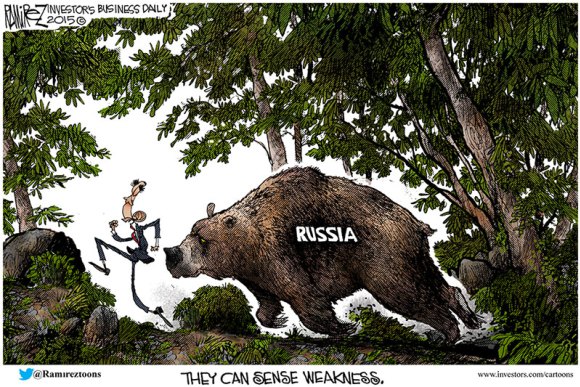
There is a bear in the woods…

October 14, 2015

There is a bear in the woods… Power LineJohn Hinderaker, October 13, 2015

Vladimir Putin thinks Barack Obama has mush for brains, but that’s not the worst of it. Michael Ramirez updates the bear in the woods theme.

cTOON1013.jpg.cms_


Putin: Obama has “mush for brains”

October 13, 2015

Putin: Obama has “mush for brains,” Power LineJOHN HINDERAKER, October 13, 2015

Vladimir Putin once again showed his deep respect for Barack Obama, as he complained about the incompetence of U.S. policy in Syria:

“Now, we often hear that our pilots are striking the wrong targets, not IS,” Putin said at an investment forum in Moscow explaining that Russia had asked Washington to provide a list of targets.
But Washington declined.

“‘No, we are not ready for this’ was the answer,” Putin quoted them as saying. “Then we thought again and asked another question: then tell us where we should not strike. No answer too,” he said, adding: “That is not a joke. I did not make this up.”

“How is it possible to work together?” he asked. “I think some of our partners simply have mush for brains, they do not have a clear understanding of what really happens in the country and what goals they are seeking to achieve.”

While Putin didn’t use Obama’s name, his meaning is clear enough: just as he is personally aware of the situation in Syria and Russia’s communications with the U.S., his American counterpart is, or should be, aware as well. Barack Obama has become an international piñata, a figure of fun for whom other leaders need no longer pretend to have respect.

World view: Politics may force Obama to ‘over-react’ militarily in Syria

October 11, 2015

World view: Politics may force Obama to ‘over-react’ militarily in Syria, BreitbartJohn J. Xenakis, October 11, 2015

(Fine. But what advice will he take from whom before he does something? Perhaps his favorite military political adviser?

PJ boy and Obama

— DM)


obamaz-640x480

Palestinian-Israeli violence continues in Gaza and West Bank

g151009bPalestinian protesters in Gaza on Friday (AP)

Six Palestinians were killed and hundreds of Palestinians and Israeli were wounded on Friday as several weeks of violence continued. ( “9-Oct-15 World View — Israeli-Palestinian violence spreads across West Bank as anger grows”)

Ismail Haniyeh, the leader of Hamas, which governs Gaza, applauded the recent Palestinian knife attacks on Israelis, and called for a “third intifada.” By contrast, Israeli Prime Minister Benjamin Netanyahu “strongly condemned the harming of innocent Arabs.” Both Israeli and Palestinian security forces are on high alert, with more violence expected. Fox News/AP

Obama administration announces an abrupt change of policy in Syria

The Obama administration’s widely ridiculed $500 million program to train and equip Syrian rebels to fight the so-called Islamic State (IS or ISIS or ISIL or Daesh) was “paused” on Friday as a publicly admitted failure. The program was supposed to train thousands of rebels, but the public was shocked several weeks ago when the administration admitted that only “four or five” had been trained, despite the program’s huge price tag.

As Foreign Policy magazine put it: “On Capitol Hill, it’s been called “a joke,” a “total failure,” and “a bigger disaster than I could have ever imagined.” And now we have another name for it: dead.”

A new program has been announced. The new program will provide air support and basic equipment and training to vetted opposition group leaders who are already fighting ISIS and who are committed to fighting ONLY ISIS, and not the regime of Syria’s president Bashar al-Assad.

Brett McGurk, whose title is “White House deputy envoy to the Global Coalition to Counter Islamic State,” described the new program as follows:

“Is it best to take those guys out and put them through training programs for many weeks, or to keep them on the line fighting and to give them additional enablers and support? I think the latter is the right answer, and that’s what we’re going to be doing.”

According to Secretary of Defense Ash Carter: “I remain convinced that a lasting defeat of ISIL in Syria will depend in part on the success of local, motivated and capable ground forces. I believe the changes we are instituting today will, over time, increase the combat power of counter-ISIL forces in Syria and ultimately help our campaign achieve a lasting defeat of ISIL.”

The old policy was criticized and mocked from the day it was announced last year. The new policy is receiving similar treatment. A NY Times editorial titled “An Incoherent Syria War Strategy” points out that the strategy of finding and arming rebel groups that want to fight ISIS but who are going to be forbidden from fighting the al-Assad regime makes no sense:

“The initial plan was dubious. The new one is hallucinatory, and it is being rolled out as the war enters a more perilous phase now that Russia has significantly stepped up its military support of Mr. Assad’s forces.

There is no reason to believe that the United States will suddenly be successful in finding rebel groups that share its narrow goal of weakening the Islamic State, also known as ISIS or ISIL, but not joining the effort to topple Mr. Assad. Washington’s experience in Syria and other recent wars shows that proxy fighters are usually fickle and that weapons thrust into a war with no real oversight often end up having disastrous effects.”

This harsh criticism from a newspaper that regularly slobbers over President Obama symbolizes how much even the left-wing mainstream media, not to mention foreign media throughout the Mideast, now views the Obama administration as weak and rudderless, lurching from one policy to the next. (As another example, it had been widely expected that Secretary of State John Kerry would win this year’s Nobel Peace Prize for the Iran nuclear deal, but even the loony Norwegians have lost faith.) VOA and NY Times

Obama administration may be forced into greater military role

I’ve written many times about the Harry Truman’s Truman Doctrine of 1947, which made America policeman of the world. The justification is that it’s better to have a small military action to stop an ongoing crime than to let it slide and end up having an enormous conflict like World War II. Every president since WW II has followed the Truman Doctrine, up to and including George Bush. Barack Obama is the first president to repudiate the Truman Doctrine, essentially leaving the world without a policeman.

Call it Kismet or Karma or God’s Will (or call it an unstoppable generational trend), but America does have an exceptional role in the world, and repudiating that role does not end it. Obama’s policy of apologizing for America has held sway for over six years, but now powerful political pressures are growing to force a change. Those forces are being driven by massive shifts in public attitudes towards Obama, both in the US and abroad, as reflected in worldwide criticism of him in the media as a weak president.

According to the left-leaning Washington Post:

“Russia’s military moves in Syria are fundamentally changing the face of the country’s civil war, putting President Bashar al-Assad back on his feet, and may complicate the Obama administration’s plans to expand its air operations against the Islamic State. …

But others within the administration, and many outside experts, are increasingly worried that if President Obama does not take decisive action — such as quickly moving to claim the airspace over northwestern Syria and the Turkish border, where Russian jets are already operating — it is the United States that will suffer significant damage to both its reputation and its foreign policy and counterterrorism goals. …

The current internal administration debate is largely the same one that has kept the administration out of significant intervention in Syria’s civil war for the past four years. On one side, Russia’s involvement has strengthened the winning argument that the United States should avoid direct involvement in yet another Middle East conflict and should continue directing its resources toward countering forces such as the Islamic State that pose a direct threat to U.S. national security.

On the other side, the argument is that it makes no strategic sense for the United States to concede Russian dominance of the situation: If Russia succeeds in keeping Assad in power, the problems in the West caused by both the Syrian war and militant expansion will only get worse.”

The article describes two sides of the debate whether to intervene in Syria, but does not draw the obvious conclusion that the weight of political opinion is moving sharply towards the side of some kind of intervention — although those that say that “it makes no strategic sense … to concede Russian dominance” do not agree on what steps should be taken to avoid conceding.

The left-leaning Brookings Institution makes the claim that intervention in Syria is costing Russia enormously, and so “For the United States, avoiding the temptation to over-react is still the key guideline.”

But the article then goes on to describe problems with doing nothing, and even conclude:

“Finally, the United States and its allies could deliver a series of airstrikes on the Hezbollah bands around Damascus. That would be less confrontational vis-à-vis Russia than hitting Assad’s forces. Hezbollah has already suffered losses in the Syrian war and is not particularly motivated to stand with Assad to the bitter end, away from own home-ground in Lebanon. (Israel would appreciate such punishment, too.)”

I almost can’t believe my eyes reading this recommendation. American warplanes around Damascus would almost certainly come into contact with Russian warplanes, and even if they didn’t, bombing al-Assad’s close ally Hezbollah could be the trigger that sets off a wider war in this generational Crisis era.

Policy can sometimes act like a rubber band that be stretched in one direction so far that when it’s released, it snaps back in the other direction violently. After six years of constantly apologizing for America, the pressure is on President Obama to do something different. Brookings advises Obama about “avoiding the temptation to over-react,” but Obama may be politically forced to decide that with his previous policies so widely criticized and mocked, he has to take some step to prove to the world that he’s a tough leader after all, and he may have to over-react, because no half-measure will provide the proof he needs. Washington Post and Brookings Institution.

Fast-roping toward war in the Middle East

October 10, 2015

Fast-roping toward war in the Middle East, Washington Times, Ken Allard, October 8, 2015

(Oh well,


Not on our side

— DM)


Home to the Arab world’s largest population and the region’s geopolitical crossroads, Egypt had been a key American strategic ally ever since Anwar Sadat. But Mr. Obama backed the Islamist dictatorship of Mohammed Morsi, even after 30 million Egyptians took to the streets in July, 2013 to force his overthrow. When Mr. Obama cut off military ties with the new Egyptian regime of President Abdel Fattah al-Sisi, the Russians swiftly stepped in to reverse a generation of American statecraft. Unlike the amateurs in the West Wing, Russian strategists and diplomats have no difficulty connecting dots or reading maps.

Neither do our few remaining allies in the Middle East, who can be forgiven for drawing their own conclusions, given the Egyptian reversal, those Syrian red-lines, the recent Iranian arms control deal and the steady expansion of Iranian influence throughout the region.

*****************************

The Russians are rapidly reinforcing their bridgehead in Syria, adding ground troops to their air, marine and naval forces. It is a classic air, land and sea intervention by a military establishment that understands how combined arms build synergies and broaden capabilities. As Jed Babbin pointed out in these pages on Wednesday, the broad-shouldered Russian intervention is the direct counterpoint to the “inaction, indecision and dithering” that have long characterized President Barack Obama’s foreign policy.

Russian President Vladimir Putin has called Mr. Obama’s bluff. He has also deployed a Russian expeditionary force bristling with robust anti-aircraft and ground-attack weapons, even firing cruise missiles from warships in the Caspian Sea. Such a deployment is precisely what Mr. Putin believes necessary to insure that Russian jets and helicopters dominate the skies over Syria. Fox News reports that Russian jets have already shadowed U.S. Predator drones on three occasions, a quiet but unsubtle message that the unmanned aircraft are flying only because of Russian forbearance.

Depending solely on Mr. Putin’s strategic objectives, that prevailing restraint can vanish in an instant. Union and Confederate commanders, for example, routinely practiced counter-reconnaissance throughout the Shenandoah Valley campaign of 1864. When planning a surprise attack or defending a vulnerable position, their first objective was to prevent enemy cavalry from having an unobstructed view of one’s own dispositions. What cavalry did back then, air forces and satellites do today.

Updating an ancient principle for the digital age, Norman Schwarzkopf destroyed Saddam Hussein’s radars, reconnaissance systems and intelligence assets before American airpower launched the opening salvos of Operation Desert Storm. Today’s Russian generals grew up practicing the basic principles of Soviet electronic warfare: Intercept the enemy’s communications, jam him or destroy him. Above all: Use the electromagnetic spectrum and state-of-the-art Russian air defenses to offset hi-tech American airpower. In Syria, that campaign has already begun.

Pandering to an American public that is militarily and strategically illiterate, some presidential candidates have reflexively called for “no-fly zones” to be set up in Syria. Predictably, Donald Trump has even expressed enthusiasm for Mr. Putin’s alleged intent to combat ISIS. But seriously, folks, why would Vladimir Putin go to the considerable trouble of staging the largest foreign deployment of Russian forces since the Cold War only to cater to western conceits about no-fly zones? Even if he did, who would set up and enforce them? Having made a power play to control Syria (and therefore a major chunk of the Middle East) why on earth would Mr. Putin content himself solely with attacking ISIS? (If you are having trouble following this logic, then you probably are a member of the White House staff “perplexed” by Russian objectives.

As a highly trained KGB apparatchik, Syria is not Mr. Putin’s first rodeo. While it has become obligatory in Washington policy salons to deplore Crimea and eastern Ukraine, Egypt’s recent history offers a better clue to Russia’s long-range goals.

Home to the Arab world’s largest population and the region’s geopolitical crossroads, Egypt had been a key American strategic ally ever since Anwar Sadat. But Mr. Obama backed the Islamist dictatorship of Mohammed Morsi, even after 30 million Egyptians took to the streets in July, 2013 to force his overthrow. When Mr. Obama cut off military ties with the new Egyptian regime of President Abdel Fattah al-Sisi, the Russians swiftly stepped in to reverse a generation of American statecraft. Unlike the amateurs in the West Wing, Russian strategists and diplomats have no difficulty connecting dots or reading maps.

Neither do our few remaining allies in the Middle East, who can be forgiven for drawing their own conclusions, given the Egyptian reversal, those Syrian red-lines, the recent Iranian arms control deal and the steady expansion of Iranian influence throughout the region. Because it is a tough and unforgiving neighborhood, where would you place your bets if you lived there? Do you ally yourself with the rising regional power or the one seemingly intent only on defeat and retreat? As a friend points out, “Obama only attacks oilmen, Wall Street, the police, pro-lifers, the NRA, Christians, conservative Republicans, and traditional U.S. allies. Remember when they were the good guys?”

In this confusing world, it is important to remember that things can get worse, particularly given the fog of war with lots of heavily armed aircraft moving at high speeds over surprisingly small operating areas. War is justly famed for confounding the best intentions, for proving that the only assumption which holds true is the one you were certain could never happen.

How ironic that the place where three of the world’s great religions were born might yet spark a global confrontation where no holds are barred.

“Early signs of Russian intent”

October 10, 2015

“Early signs of Russian intent” Power LinePaul Mirengoff, October 10, 2015

That’s the front page headline of today’s Washington Post (paper edition). The story is about signs in August that Putin was mobilizing for a military offensive in Syria. Despite these signs, the Obama administration was “caught flat-footed” when the Russian offensive materialized two months later.

In a larger sense, “Russian intent” has long been clear. Putin has said he consider the fall of Soviet power a geopolitical catastrophe. He wants to restore Russian influence to the maximum extent feasible.

With Obama’s ascent to the White House, the “maximum extent feasible” increased dramatically. Putin figured this out in 2009 when Obama visited Russia. As I wrote at the time, his visit left the Russians giddy with the realization that they could steal the American president’s pants.

Russia isn’t the only American adversary whose “intent” Obama has failed to grasp. Iran is an equally dramatic case. Obama somehow came to believe that reaching a nuclear deal favorable to Iran would lead to improved relations with the mullahs and to arrangements to help “stabilize” the region.

But this week, as Scott has discussed, Iran’s “Supreme Leader” banned any further negotiations with the United States. What’s left to negotiate? They already have Obama’s pants.

Let’s return, though, to the Post’s story about signs in August that Russia was preparing to take military action in Syria. According to Post reporters Greg Miller and Karen DeYoung:

Among the first clues that Russia was mobilizing for a military offensive in Syria were requests Moscow began making in ­mid-August for permission to cross other countries’ territory with more and larger aircraft.

“We were getting the word the Russians were asking for inordinate overflights,” a senior Obama administration official said, referring to reports from U.S. allies receiving the requests. Russia was seeking clearance for not only cargo planes but also “fighter aircraft and bombers” that Syrian pilots had never been trained to fly, the official said. “It was clear that something pretty big was up.”

Something big was, in fact, up. By October, the Russians were pounding Syria rebels with air strikes.

Among those pounded were rebels trained and armed by the U.S. According to the Post, these rebels — our proxies — “appeared to get no warning” from the U.S. “that they were in the Russian jets’ cross hairs.”

This is how the U.S. treats its friends and allies in the Age of Obama.

Here’s perhaps the most shocking passage in the the Post’s depressing account:

Hesitation to take stronger action against the Russian move, [some White House official] said, stemmed in part from the administration’s belief, based on an interpretation of signs earlier in the year, that Russian President Vladimir Putin was moving toward withdrawing support from Assad and supporting talks that would lead to his departure.

They have got to be kidding. Putin is a bully. He has repeatedly demonstrated that, in the absence of serious resistance, he doesn’t withdraw, he advances.

So jarring is Obama’s naivety (or willful blindness) that his former Secretary of Defense Robert Gates called him on it in a Washington Post op-ed this week (co-written by Condollezza Rice). Among the zingers were these:

President Obama and Secretary of State John F. Kerry say that there is no military solution to the Syrian crisis. That is true, but Moscow understands that diplomacy follows the facts on the ground, not the other way around.

and, even more pointedly:

Putin’s move into Syria is old-fashioned great-power politics. (Yes, people do that in the 21st century.)

Meanwhile, according to the Post, the Pentagon says it is “sharply scaling back its effort to build a force to battle the Islamic State.” And our regional partners in the fight against the Islamic State (ISIS) have deepening (and well-founded) doubts about the “coalition” Obama purports to lead.

The Post reports that CIA director John Brennan has gone to the Middle East “amid concerns that the coalition might be fraying, worries that intensified after allies including the Saudi defense minister and Jordan’s King Abdullah II made summer visits to Moscow.” (Emphasis added)

I wonder whether Brennan will even be able to look Saudi and Jordanian officials in the eye. I’m almost sure he wouldn’t be able to do so with the rebels his agency trained, the Russians pummeled, and Obama apparently now is turning his back on.


