Archive for the ‘Putin’ category

‘Yesterday Russia Turned A New Page In The History Of The World’

October 1, 2015

Chairman Of The Hizbullah-Affiliated ‘Al-Akhbar’ Daily On Russian Air Campaign In Syria: ‘Yesterday Russia Turned A New Page In The History Of The World,’ Middle East Media Research Institute, October 1, 2015

In an article published in the Hizbullah-affiliated Lebanese daily Al-Akhbar on October 1, 2015, the chairman of the newspaper’s board of directors, Ibrahim Al-Amin, predicted that Russia’s air campaign in Syria will be merely a prelude to a larger military offensive involving ground operations by the Syrian Army, Iran, Hizbullah, and even the Iraqi Popular Mobilization Forces. Al-Amin is known to have close ties to Hizbullah, and in the past he has proven a reliable source on matters relating to the Iran-Syria-Hizbullah axis.
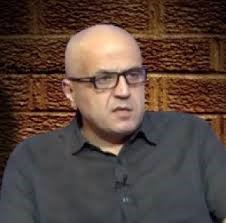
24967Ibrahim Al-Amin (source: Siyese.net)

The following is the translation of the article:

“…This is the first test for the granddaughter of the Eastern dynasty [i.e. Russia] since World War II, and it is the first field test of whether America’s unipolar position in the world over the past quarter century has truly been broken. Above all, this is a repositioning of Russian military force in the direct labor market of the regions of ‘cold’ confrontation with the U.S.-led West… Today we find ourselves before the best opportunity of putting Syria on a path to a true solution, even if it be prefaced by fire.

“As for the facts, the Russian air force carried out the first missions of a working program laid out in detailed form in an existing plan of cooperation between Moscow and its allies in the war in Syria and Iraq. This is a plan that is coordinated down to the finest details with the two allies Syria and Iran, and consequently with Hizbullah [as well]… What happened yesterday, and which will soon reach its culmination, is a necessary preface to a larger military action that will include a land component undertaken by other forces in the alliance. To put it more directly, [Russia’s] aerial bombardment of [the rebels’] command and control centers, major weapons arsenals, and artillery positions will be a preface to a military operation carried out by the Syrian army on the ground, with direct support from Iran and Hizbullah, and even from the Iraqi Popular Mobilization Forces… It may be emphasized that Russia’s activity yesterday means clearly that all the discussions in New York didn’t change an iota in the military plan of action…

“The signs of surprise and astonishment on [the faces of] the Americans, the Westerners, the Israelis, the Turks, and the Saudis are an additional proof of the weakness of the prior coordination regarding the fate of the initiatives surrounding the Syria crisis. In fact, the step taken by Russia is a kind of dare to all those who employed every violent means they could against the Syrian regime. If they decide to broaden the confrontation, they will be forced to deal with the new realities, which today are openly represented by the Russian military presence, and tomorrow will be represented by an open Iranian military presence as well…

“This must not hide from our eyes the picture of the complicated reality, which tells us that the joy felt by the regime elements in Syria must not turn into any slackening, not on the part of the regime itself, and not on the part of all those who fight alongside it. It would be naive to consider the Russian strikes sufficient to counter the enemies. It would rather be realistic to profit from the support of Russia – which is a supporting actor, and is not [itself] a member of the axis of resistance – in order to prepare to wage harsh and decisive battles in a number of places in Syria. This is a matter that requires raising the level of readiness and mobilization, and the creation of operative means of benefitting from the Russian military arsenal that is present in or coming to Syria.

“Yesterday Russia turned a new page in the history of the world. However far its military action in the field reaches, it is the political and strategic results that will remain more important. These results will invite those who delude themselves in thinking that America is still the leader of the world and controller of its fate to revise their stance. Those who do not want to change their minds, let them stay as they wish, but they should take into account that they must rely on themselves more than at any time in the past. This goes for Syria, Iraq, Palestine, and even the Arabian Peninsula and North Africa!”
Obama’s show of weakness

October 1, 2015

Obama’s show of weakness, Israel Hayom, Prof. Abraham Ben-Zvi, October 1, 2015

The U.S. has been relegated to dragging its feet in a trail blazed by the Russian leader, as Washington is left to practically beg Moscow for a seat at the table where Assad’s fate will be determined.

******************

U.S. President Barack Obama’s address to the U.N. General Assembly on Monday was his worst and most embarrassing yet. Despite the fact that it has been seven years since he was elected president, it seems Obama has yet to learn anything from his growing list of failures, especially when it comes to foreign policy.

Obama continues to naively preach about the importance of traditional diplomacy and broad international cooperation as a prerequisite to conflict resolution; and he does so despite the fact that his decision to prematurely withdraw American troops from Iraq, compounded by his aversion to putting boots on the ground in Syria, have done nothing but breed violence, fanaticism and radical Islamism in the Middle East.

Against the backdrop of the bloody conflicts in Syria, Iraq and Yemen, Obama delivered a disconnected and utterly surreal speech before the U.N., lauding democracy and international agreements, even deficient, hollow ones, like the nuclear deal with Iran.

Beyond the sanctimonious sermon to nations and movements without any loyalty to the principles of Western democracy, Obama’s speech lacked any new message. On the contrary — he essentially legitimized Russia’s military presence in Syria, and the pivotal role Moscow has appropriated in the region due to American inaction against Syrian President Bashar Assad.

This inexcusable failure, which followed Washington’s acquiescence in allowing Russian President Vladimir Putin become the new mediator in the chemical warfare crisis in Syria in 2013, has afforded Moscow a coveted opportunity to become a major player in the Middle East, one shaping a new political and security reality.

The U.S. has been relegated to dragging its feet in a trail blazed by the Russian leader, as Washington is left to practically beg Moscow for a seat at the table where Assad’s fate will be determined.

Indeed, if you strip the envelope of democracy vs. dictatorship from Obama’s speech, it becomes more than evident that he is not only willing to foster partnerships with tyrants and oppressive regimes, but also that the dispute between the White House and the Kremlin over Syria is marginal, as it focuses on Assad’s status in the new political order that will be forged in Syria once the fighting subsides.

The American Gulliver, it seems, is coming to terms with the end of the single-world power hegemony. While the Russian military airlift to Syria continues in full swing, Obama is content with philosophical reflections on the desired nature of the new world order, yielding to the new balance of power emerging in the war-torn country.

One can only lament the fact that the U.S. president’s incomprehensible weakness only undermines the very democratic dream he himself has outlined.

This was evident in the meeting between Obama and Putin following their respective U.N. addresses. Despite Obama’s desire to give his Russian counterpart the cold shoulder, the fact the he declared before dozens of world leaders that the U.S. has “no desire to return to a cold war” took the sting out of his message.

This was nothing but an attempt at damage control over the harm caused to the U.S.’s prestige and status in the global theater by drawing new red lines to limit Russia’s operation in the Middle East. The problem is that we already know how blurry those red lines are when it comes to Syria.

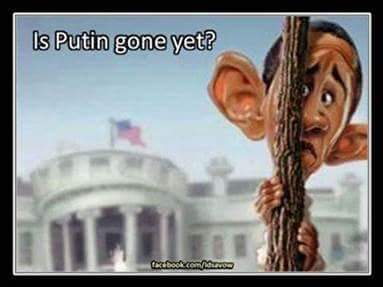
Cartoon of the day

October 1, 2015

H/t Freedom is just another word

gone

Putin Plays Mideast Chess as Obama Looks On

October 1, 2015

Putin Plays Mideast Chess as Obama Looks On, American ThinkerJonathan F. Keiler, October 1, 2015

(Unfortunately, Obama was “in the game” which led to the nuke “deal” with Iran. There, he was not incompetent; he got what he sought. — DM)

Obama has made a lot of foreign policy mistakes in office, but his capitulation on the Iranian nuclear talks followed by Russia’s move into Syria is impossible to explain away as anything but a stupendous strategic fiasco.  Incompetence is too nice a word.  Obama was never even in the game.

*********************

It is sometimes said that in negotiations with foreigners, American leaders play checkers, while their wilier opponents play chess.   There is perhaps some truth to this, as American leaders sometimes chase short-term political results, a consequence of democratic governance and constantly changing leadership.  By contrast, despotic Persians are credited with inventing chess, and in modern times autocratic Russians have been its master, and so it is tempting to say of President Obama’s dealings with those two countries that the analogy holds.

But that is way too charitable.  As Vladimir Putin skillfully reasserts Russian power and influence in the Middle East with Islamic Persian Iran as a willing partner, a more apt analogy might be that while the Russians and Iranians move their chessmen, isolating and threatening opposing pieces, Obama is not even at the table, but rather childishly looking on, as he pushes diplomatic dirt around the Middle East sandbox.

For over 150 years, a primary objective of Western diplomatic and military strategy was to keep the Russians out of the Middle East and Southwest Asia.  In the 1850s, the British and French went to war in Crimea to protect the Ottomans from Russian predation and to preserve the balance of power.  Later, the so-called “Great Game” centered on similar British efforts to frustrate Russian domination of Iran and Afghanistan.  A century later, the United States took up the task, offsetting Russian influence in newly socialist Arab dictatorships by backing Israel and more traditional Arab monarchies in the Middle East, while openly and successfully opposing the Soviet incursion into Afghanistan.

Today, one can’t even say there remains any Western strategy regarding Russia.  Western Europe has mostly forfeited its military and political influence overseas to support decadent welfare states, even as it is being progressively and deliberately overwhelmed by millions of Islamist migrants.  Under Obama, who supports and admires Europe’s demise, the United States has increasingly joined in the decline.  The laughable Libyan campaign, “fought” by Europeans while the U.S. led from behind, set an example of pursuing a feckless, feel-good military campaign without regard for consequences or traditional strategic concerns.  Obama’s encouragement of the so-called Arab Spring and its Islamist provocateurs almost lost Egypt and did lose Syria, with catastrophic humanitarian and geopolitical results.

Putin is taking advantage of American weakness and inaction.  A half-century of successful American effort to keep the Russians out of the Middle East has been forfeit in a few months of breathtaking American diplomatic and military incompetence.  Obama’s capitulation in the Iran deal effectively completed the groundwork for the Russian move, Putin having carefully monitored America’s year-long and ineffectual air campaign against ISIS.  Putin now claims that Russia’s push into Syria is to redeem the campaign against ISIS with Russian troops fighting with Syria and Hezb’allah.  Embarrassed by Putin at the U.N., Obama gave up any pretense of strength, effectively welcoming the Russian “intervention” against ISIS.  Unexplained is why a large percentage of Russian anti-ISIS forces are heavily equipped with anti-aircraft weapons, something that even a flaccid NATO command cannot ignore, inasmuch as ISIS have an air force.  Those weapons are useful only against NATO or Israeli aircraft.

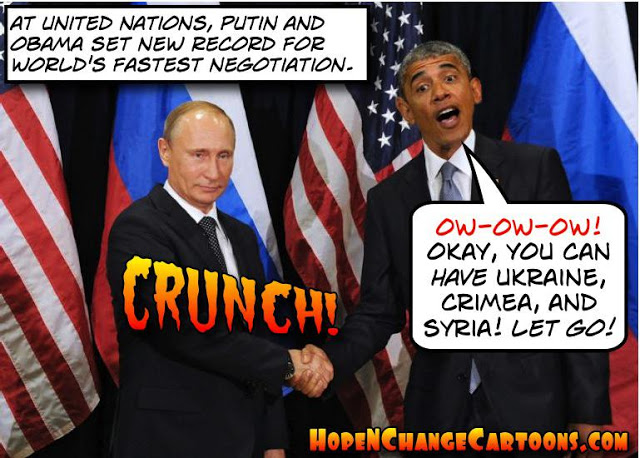
So lost was Obama before his meeting with Putin at the U.N. that his stated strategy for dealing with the Russian strongman was to ask him what he was doing.  From the stiff and awkward body language of the president following the meeting (a painful handshake and awkward smile) it is clear that Putin told Obama at least some of the story, whether Obama liked it or not.  Most particularly, his client Bashar Assad will remain in power with Russian backing, regardless of Obama’s view on the matter.  But likely Obama had known what he was in for, and just going through the motions.  The day before, Secretary of State of State John Kerry responded to a question about how long the U.S. could tolerate the survival of Assad, saying, “… it doesn’t have to be on day one or month one or whatever.”  Right, dude, whatever.  Between Obama and Kerry, it is now fair to assume that our much muddled and irresolute Syrian policy is “whatever,” which means we just don’t care.  We take our toys and go home.

If Obama was hoping, as he and his supporters implied, that the Iranian deal would produce a more moderate, cooperative Iran, Putin and the mullahs are doing all they can to demonstrate how wrong he was.  If he was hoping that “international pressure” and the conflict in Ukraine would moderate Putin’s aggressive strategies, he was wrong again.  And if he thinks that by quitting, he has left Putin an unwinnable game, the Russian leader aims to prove him wrong again.  And since Obama is almost always wrong when it comes to foreign policy, it’s a fool’s errand to bet against Putin.

In chess, before going for the opponent’s king, typical strategy calls for supporting one’s important pieces, while threatening and isolating opposing pieces.  The Russians and Iranians are now going about this with a vengeance, without the United States or the West making any noticeably effective counter-moves.  Russia is backing and protecting Assad and has closely allied itself with a newly empowered (thanks largely to Obama) Iran.  Meanwhile, traditional American allies in the region, Israel, Egypt, and the Arab monarchies are indeed increasingly threatened and isolated.  The stage is being set for a Russo-Iranian endgame that could prove disastrous to America’s traditional allies and the West in general.

Some of Obama’s liberal supporters dismiss such analysis as over the top, and insist that Putin’s moves have more to do with domestic politics than a long-term Middle Eastern power play.  They point out Putin’s problems at home, and the relative weakness of the Russian military.  However, relative Russian weakness means little when moving into a power vacuum created by Obama’s flight from international responsibilities and, to a large extent, reality.  And besides, this has been the basic way liberals have sought to excuse Obama whenever he is pushed around by a foreign leader (which is almost always).  Putin’s got problems, so he invades Ukraine, threatens the Baltic States, and moves into Syria.  The Chinese have problems, so they push naval vessels into American waters and fortify disputed Western Pacific archipelagos.  Korea’s got problems, Iran’s got problems, and none of their aggressive actions has anything to do with the dilettante in the White House.  It’s all about solving problems at home with international temper tantrums.

Obama has made a lot of foreign policy mistakes in office, but his capitulation on the Iranian nuclear talks followed by Russia’s move into Syria is impossible to explain away as anything but a stupendous strategic fiasco.  Incompetence is too nice a word.  Obama was never even in the game.


Obama’s U.N. message — kick me, I won’t feel a thing

September 30, 2015

Obama’s U.N. message — kick me, I won’t feel a thing, Power LinePaul Mirengoff, September 30, 2015

Obama’s options are to counteract the expansion or offer lectures while Russia gives him a “back kick.” Like so much of his conduct, Obama’s U.N. speech amounts to pasting a “kick me” sign on his backside.

*********************************

“History, Stephen said, is a nightmare from which I am trying to awake. . .What if that nightmare gave you a back kick?”

This passage from Ulysses captures the Obama presidency in the realm of foreign policy. History, the nightmare from which the president is trying to escape, has given him a “back kick” — in Iraq, Syria, Libya, Ukraine, and Yemen for example — and he risks becoming a laughingstock as a result.

But there’s a twist. President Obama denies he has been kicked. His nightmare thus becomes ours.

Obama’s speech to the United Nations illustrates the problem. Elliott Abrams, describing the speech as “surreal,” writes that it “is filled with nice lines that unfortunately bear no relationship to his seven years of foreign policy — and in some cases, no relationship to reality.”

Abrams supports this claim by analyzing what Obama had to say about Syria, Libya, Ukraine, and Cuba. The analysis is well worth reading.

I want to focus, though, on a portion of just one passage. Obama stated:

I stand before you today believing in my core that we, the nations of the world, cannot return to the old ways of conflict and coercion. We cannot look backwards. We live in an integrated world — one in which we all have a stake in each other’s success. . . .And if we cannot work together more effectively, we will all suffer the consequences. That is true for the United States, as well.

The disdain for history is evident and, in a sense, warranted. But it doesn’t follow from the fact that history has been unpleasant that we cannot (or should not) look back at it. History has much to teach us.

One lesson is that Obama’s claim that “we cannot return to the old ways of conflict and coercion” is rubbish. The world not only can “return” to them, it has (and never stopped).

Another lesson is that conflict and coercion don’t necessarily cause “all” to “suffer” bad “consequences.” Often conflict and coercion produce winners and losers. The losers suffer, but the winners, though often paying some price, thrive for decades and sometimes centuries.

The fact that we “live in an integrated world” doesn’t alter this reality. If Obama knew anything about history, he would understand that integration isn’t new. Europe and large portions of Asia were integrated by trade and migration more than two thousand years ago. In important ways, today’s world, with its religious wars and mass movement of peoples, bears more resemblance to the ancient one than to yesterday’s world of seemingly solid nation states (which was also integrated).

Obama wasn’t offering a history lesson, though. The speech was an exercise in self-justification — an attempt to demonstrate that although he looks like a loser, he isn’t really one because the old world of losers and winners has been extinguished. This farcical claim will only enhance Obama’s status as a laughingstock.

But the speech had a serious side, I think. It seems to me that Obama was sending this message to Putin: Russia will suffer if you don’t cooperate with the U.S. In fact, Obama mentioned the sanctions against Russia and their consequences (“capital flight, a contracting economy, a fallen ruble, and the emigration of more educated Russians”) in his speech.

The message isn’t implausible. Russia reportedly is starting to run short on foreign currency reserves, thanks in part to sanctions. Russia also runs the risk of military overreach if it continues to become more involved in Syria. Its dirty little war in Ukraine enjoys only mixed support at home and polls show little appetite by Russians for large scale military involvement in Syria. (Just as we had Vietnam, Russia had Afghanistan).

But Putin is a skillful operator. He doesn’t need lessons from Obama.

Taking on ISIS to a serious degree would require a level of military engagement that might erode Putin’s domestic support. But it’s unlikely that Putin is serious about doing ISIS in (though I’m pretty sure he would like to). He just dangles this prospect, as Iran does, to tantalize Obama.

Putin’s goals, it seems to me, are (1) to work with Iran to help Assad maintain control over a portion of Syria, (2) cement relations with Iran, and (3) diminish U.S. influence in the region. He may well be able to accomplish these objectives without a level of military involvement that might hurt him at home.

As for Russia’s finances, they appear to be a looming problem. Ironically, however, Obama has undercut the Russia sanctions by lifting those on Iran. The Iran deal will boost the Russian economy by enabling Russians to sell all manner of weapons to the mullahs.

These sales alone won’t solve Russia’s economic problems. It needs a strong rebound of oil prices, which may or may not be in the cards.

But history suggests that “capital flight, a contracting economy, a fallen ruble, and the emigration of more educated Russians” won’t be sufficient to dissuade an autocrat like Putin from expanding Russia’s influence in Eastern Europe and the Middle East.

Obama’s options are to counteract the expansion or offer lectures while Russia gives him a “back kick.” Like so much of his conduct, Obama’s U.N. speech amounts to pasting a “kick me” sign on his backside.

Humor | Shaky Ground

September 30, 2015

Shaky Ground, Hope n’ Change, September 30, 2015

Shaky Ground

On Monday, Vladimir Putin met briefly with Barack Obama at the United Nations because he was  hungry and wanted to eat the president’s lunch, drink his milk shake, and then gobble up other nations for dessert.

Actually, we think that only happened metaphorically, but we’re not 100% sure because it’s hard to imagine President Dweebypants being in a room with Putin for more than 15 seconds without basically giving the Russian strongman everything he wants.

The two leaders were at the U.N. to explain their differing approaches to the twin crises of Syria and ISIS. Putin believes in arming Syria and its murderous dictator, Assad, and combining forces with other nations to crush ISIS and then crush anyone else who doesn’t like the idea of Putin taking over the world.

Obama, on the other hand, basically said that Assad is a stinker and Putin is on the wrong side of history, and that the United States – which has the most powerful military in the world – was immediately launching a “wish initiative” which consists of hoping (and hoping damn hard) that things will somehow magically “transition” in a way which benefits our national interests.

Mr. Obama also reaffirmed, while wearing his frowny face, that he wouldn’t hesitate to use military force to protect our country or our allies (Iran, last time we looked) but that he really doesn’t want to because the sort of military forcefulness which Putin is employing so successfully is “butch” and lacks panache.

Frankly, Hope n’ Change is embarrassed to have this babbling milquetoast appearing at the U.N. and confirming the increasingly terrified world’s belief that the United States is no longer in the superpower business. We’re also depressed thinking just how much more damage this nitwit can do with his remaining days in office.

First US-Russian air clash builds up as Moscow orders US planes to exit Syrian air space

September 30, 2015

First US-Russian air clash builds up as Moscow orders US planes to exit Syrian air space, DEBKAfile, September 30, 2015

SU-25-30.9.15Russian warplanes head to Syria

A day after the White House said that “clarity” on Russian intentions in Syria had been achieved at the Obama-Putin summit in New York, the Russian President Vladimir Putin notched up the military tensions around Syria Wednesday, Sept. 30. A senior US official said that Russian diplomats had sent an official demarche ordering US planes to quit Syria, adding that Russian fighter jets were now flying over Syrian territory. US military sources told Fox News that US planes would not comply with the Russian demand. “There is nothing to indicate that we are changing operations over Syria,” a senior defense official said.

Earlier, Putin sought from the Russian upper house, the Federation Council, authorization for the use of military force abroad. He did not specify the country or region, but the only part of the world where Russia is currently building up its ground, air and naval forces outside the country is Syria.

A short time after the request, the Federation Council announced that it had unanimously authorized the use of Russian military force in Syria. The last time Putin sought this authorization was in early 2014 when he decided to annex the Crimean Peninsula from Ukraine. His action now contradicts his assertion to CBS on Sept. 28: “Russia will not participate in any troop operations in the territory of Syria or in any other states. Well, at least we don’t plan on it right now.”

DEBKAfile’s military sources report that Russian preparations for military action in Syria are clearly not limited to that country. They are being run by a joint coordination forward command and war room established a few days ago by Russia, Iran, Iraq and Syria in Baghdad. It is designed as the counterpart of the US Central Command-Forward-Jordan war room established north of Amman for joint US-Saudi-Qatari-Israeli-Jordanian and UAE operations in support of Syrian rebel operations against the Assad regime.

Two rival power war rooms are therefore poised at opposite ends of the Syrian arena – one representing a US-led alliance for operations against Assad, and the other a Russian-led group which is revving up to fight on his behalf.

Conspicuous in the swiftly evolving Syrian situation is the detailed advance planning which went into the Russian military buildup and partnerships, and the slow perception of what was going on, on the part of the United States and Israel.

Tuesday, US Defense Secretary Ashton Carter instructed his staff to establish a communication channel with the Kremlin to ensure the safety of US and Russian military operations and “avoid conflict in the air” between the two militaries. The Russian defense ministry shot back with a provocative stipulation that coordination with the US must go through Baghdad, an attempt to force Washington to accept that the two war rooms would henceforth communicate on equal terms.

Israel’s Defense Minister Moshe Ya’alon denied Tuesday night that Israel was coordinating its operations with the Russian army, stressing that Israel reserves the IDF’s right to freedom of action over Syria and would continue to prevent arms supplies reaching terrorist organizations such as Hizballah.

Meanwhile, six advanced Russian SU-34 strike fighter jets landed at Latakia’s Al-Assad international airport, after flying to their destination through Iraqi airspace.

The Russian military buildup is assuming far greater proportions than either imagined, far outpacing US or Israeli efforts at coordination.

Russia and Iran, the UN’s darlings

September 29, 2015

Russia and Iran, the UN’s darlings, Israel Hayom, Boaz Bismuth, September 29, 2015

The situation in the Middle East is very complicated these days, particularly when it comes to the ongoing strife in Syria. On Monday, Russian President Vladimir Putin and Iranian President Hassan Rouhani both gave speeches at the U.N. General Assembly in New York that in normal times could have been dismissed as amusing. But in the era of Islamic State, everyone is suddenly trying to appear to be righteous, including Putin and Rouhani.

Putin, for example, believes that Syria’s future must include Bashar Assad, the tyrant who is responsible for the deaths of 250,000 of his own people. As Putin said, “Only Assad is fighting against Islamic State.” Meanwhile, Rouhani declared, “No country should use terrorism to interfere in another country’s affairs.” Let us remember that these were addresses delivered to the world, rather than jokes uttered on a satire program. What a farce.

The sad reality that exists in the Middle East these days is what allowed these two leaders to make such “comical” statements. The growth of Islamic State and the failure of the U.S.-led coalition against it have given Russia and Iran a great opportunity to bolster their international status.

For the Russians, this is a chance to erase memories of their actions in Ukraine and the Crimean Peninsula. For the Iranians, this provides an opening to deflect attention away from 35 years of exporting terrorism around the globe. Russia and Iran are both fortunate that Islamic State exists.

Putin met with U.S. President Barack Obama on Monday to tell him that the purpose of Russia’s increased military presence in Syria was to fight Islamic State. He also told Obama that the rebuilding of Syria would require the rebuilding of the Assad regime.

Obama was right on Monday when, in his own address to the U.N. General Assembly, he said that Assad must have no political future in Syria. Unfortunately, there are two small things that contradict Obama’s view of the situation. First, the pre-civil war Syria no longer exists. And second, all reconstruction proposals for Syria include a transition period during which a role for Assad would be necessary. And who knows how many years this transition would take?

Obama may not want Assad in power, but in reality, an Assad regime backed by Russia and Iran is what there is in Syria. Since Obama reiterated on Monday that the U.S. cannot solve global problems by itself, perhaps he should have added how wonderful it is to have Russia and Iran to help him. This is the woeful state of our world today.

Obama’s General Assembly address was his second-last before he leaves the White House in January 2017. In Monday’s speech, he tried to outline what his legacy will be. One must give Obama credit for adhering to his outlook, even after all of the mishaps he has been personally responsible for.

Russia and Iran were the big winners in New York on Monday. Putin, who was ostracized after Russia’s annexation of Crimea last year, is now the world’s great hope in the fight against Islamic State. And Iran is already talking about a “new world order,” thanks to the nuclear deal it signed with world powers in July.

And what does this all mean for Israel? “The Zionist regime is the root of all terrorism,” Rouhani said in his speech on Monday. How hopeful!

What is the solution for all this? Who knows? Perhaps we will get the answer at the U.N. General Assembly in 2016.

Putin to Obama: Kiss my…

September 29, 2015

Putin to Obama: Kiss my… , Power LineScott Johnson, September 29, 2015

It’s a sort of PUTIN TO OBAMA moment. Cameron Joseph’s cover story is here. Like everyone else in world politics — everyone outside the White House, that is — Putin has Obama’s number.

NYDN

Israel’s biggest fears are materializing

September 27, 2015

Israel’s biggest fears are materializing, Israel Hayom, Boaz Bismuth, September 27, 2015

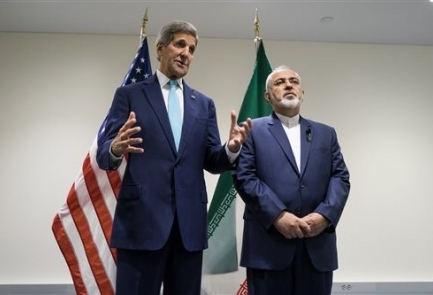
144334028328300476a_bThe Munich moment is upon us. U.S. Secretary of State John Kerry with Iranian Foreign Minister Mohammad Zarif at U.N. headquarters on Saturday | Photo credit: AP

Washington is reaching out to Russia, which is openly helping Syrian President Bashar Assad, who is working in conjunction with Iran, which in turn supports Hezbollah. Now Europe is prepared to talk to Assad, but what about us, for heaven’s sake?

Two years ago to the day, in September 2013, U.S. Secretary of State John Kerry compared Bashar Assad to Adolf Hitler, after the Syrian dictator once again used chemical weapons against his own people. “This is our Munich moment,” Kerry said at the time.

As far as the Americans were concerned, Assad had crossed a line. In those days (more like in those hours, actually), Washington briefly believed that a failure to respond to Assad’s actions would send a dangerous message to Iran regarding its nuclear ambitions.

“Will [Iran] remember that the Assad regime was stopped from those weapons’ current or future use, or will they remember that the world stood aside and created impunity?” Kerry asked at the time. History and retrospect have turned what may have been Kerry’s greatest speech into remarks entirely detached from reality.

The United States did not attack, Assad is still in power, and an ominous nuclear deal has been signed with Iran. It is no wonder that there is a new kind of atmosphere in the region, under American auspices. There are no more good guys and bad guys; everyone is a partner. And thanks to this new reality, Assad now has a renewed license to rule, after having received a license to kill.

Washington is reaching out to Russia, which is openly helping Assad in Syria, who is working in conjunction with Iran, which in turn supports Hezbollah. Europe (Angela Merkel), in the meantime, startled by its refugee crisis, is already prepared to talk with Assad; the same Assad who was compared to Hitler only two years ago. But what about us, for heaven’s sake?

Regretfully, Israel’s biggest fears are now materializing. Instead of being the architects and shaping a new reality in the Middle East, Washington is falling into line with the existing reality. Russia, Syria and Iran are enjoying the consequent vacuum. When the cat is away, the mice will play. Now, all of a sudden, even Hezbollah chief Hassan Nasrallah is letting himself go on television, beaming with joy. Aside from the 75 tanks Damascus is giving him, he now sees his two patrons (Damascus and Tehran) become partners with the West, without having to change one bit.

There is no diplomatic vacuum

The latest developments in Syria are not encouraging: Assad’s first target, with Russia’s help, is expected to be the Nusra Front rebel group, which not only threatens Assad but is also a bitter enemy of the Islamic State group. In other words, somewhat paradoxically, Islamic State could initially benefit from the Russian intervention in Syria.

And one final word about Iran’s rapprochement with the international community: We have been told repeatedly that this was only about the nuclear deal, but in reality we can see cooperation between the U.S. and Iran in Iraq and in the war against Islamic State. We can also see American-Iranian dialogue regarding Syria’s future, and on Saturday night we learned of a gigantic deal worth upwards of $21 billion between Iran and Russia. This time I am forced to agree with Secretary Kerry: This really does look like a Munich moment.