Archive for the ‘Peace process’ category

The art of the ‘no deal’ with the PA

February 14, 2017

The art of the ‘no deal’ with the PA, Israel Hayom, Ruthie Blum, February 14, 2017

Meanwhile, even Fatah and Hamas can’t bury the hatchet, other than literally, in the backs of one another’s operatives. But the one thing the two terrorist groups do share is a mutual antipathy to Israel and the aim to eradicate the Jewish state. The author of “The Art of the Deal” and his secretary of state will learn this soon enough, if they don’t know it already. In any case, the appointment of world-renowned expert in Islamic terrorism Sebastian Gorka as deputy assistant to the president is a sign that they want to be told the truth. Let us hope that Netanyahu feels welcome and comfortable enough during his visit in Washington to do the same.

****************************

There is much speculation about Israeli Prime Minister Benjamin Netanyahu’s upcoming meeting at the White House with U.S. President Donald Trump. Typically, rather than waiting to hear the outcome of Wednesday’s deliberation, Israelis have been analyzing a conversation that has yet to take place, and weighing in on the extent to which the Jewish state can count on the new administration in Washington to embrace the policies of the Israeli government, and on the level of personal chemistry that emerges between the two leaders.

The assumption is that the Joint Comprehensive Plan of Action — the nuclear deal reached between Iran and world powers in July 2015 — will be on the agenda, and that the issue of achieving a two-state solution between Israel and the Palestinian Authority will be raised. The second topic includes several directly related issues, such as the possibility of the relocation of the U.S. Embassy in Israel from Tel Aviv to Jerusalem, and the newly passed Judea and Samaria Settlement Regulation Law, which retroactively grants permits to a number of outposts on privately owned Palestinian land.

Whatever the upshot of the meeting, however, one thing is certain: The Trump administration will not be able to broker an agreement that resolves the Palestinian-Israeli conflict, no matter how talented, smart or well-intentioned Jared Kushner — the president’s son-in-law who is purportedly being charged with this task — may be.

The charade in which Netanyahu has participated since he announced his conditional support for Palestinian statehood in a televised address to the nation in June 2009, is that there is a “solution” to the ongoing war waged by the Arabs in Judea and Samaria, Gaza and east Jerusalem against the very existence of the Jewish state. Netanyahu knows better than anybody else that this is as much an exercise in rhetoric as it is in futility. He is fully aware that the only way for peace to be possible is for the Palestinians to oust their corrupt and evil leaders in Fatah and Hamas and — in striving for the freedom and prosperity they have been denied by the honchos in Ramallah and Gaza City — emulate Israeli society.

If such a day ever comes, no more than five minutes will be required for the sides to agree on the technicalities — maybe 10, if the negotiators get stuck in traffic on the way to the table.

The same holds true for Iran, which is why the JCPOA was not flawed due to the wording of its clauses, but rather to the fact that the mullah-led regime in Tehran had no intention of reaching any genuine agreement with the “infidels” it wishes to annihilate. Its goal was not to have international sanctions lifted in order to get on with the business of improving the economic lot of the Iranian people. It simply wanted a more unfettered path to obtaining nuclear weapons with which to impose its hegemony on the Middle East and force the rest of the world to capitulate to its Islamist will.

Meanwhile, even Fatah and Hamas can’t bury the hatchet, other than literally, in the backs of one another’s operatives. But the one thing the two terrorist groups do share is a mutual antipathy to Israel and the aim to eradicate the Jewish state. The author of “The Art of the Deal” and his secretary of state will learn this soon enough, if they don’t know it already. In any case, the appointment of world-renowned expert in Islamic terrorism Sebastian Gorka as deputy assistant to the president is a sign that they want to be told the truth. Let us hope that Netanyahu feels welcome and comfortable enough during his visit in Washington to do the same.

Netanyahu’s big chance

February 12, 2017

Netanyahu’s big chance, Israel National News, Jack Engelhard, February 12, 2017

(President Trump’s “disapproval” of settlement building consists of suggesting that it is not conducive to furthering the “peace process” and that announcements of more settlement building should be more muted. The “peace process” and “two state solution” are dead, at the hands of the Palestinian Authority and Hamas. More settlement building certainly won’t revive the corpses, but won’t make either more dead either. It seems likely that President Trump knows that. — DM)

For eight years now we’ve been waiting for Israel to get a sympathetic hearing in the White House. That never happened with Obama.

Finally, with President Donald Trump, this is Israel’s big chance and Prime Minister Benjamin Netanyahu’s big moment when the two meet this week.

Let’s not get this wrong and my guess is that there will be smiles and handshakes all around – but will anything be resolved?

Netanyahu’s job is to close the deal with Trump who is certain to be attentive but Netanyahu must remember the motto of salesmanship – “always be closing.”

Do not assume anything and do not take it for granted that Trump is fully aware of Israel’s position regarding Jerusalem and “the territories.”

Trump, with other things on his mind and other allies to consider, must be reminded that, one, he promised to move the United States Embassy to Jerusalem, and two – the Jewish communities of Judea and Samaria are the heart of the Jewish State. Trump may know this already but Netanyahu’s task is to “keep closing.”

If both leaders stick to the mantra of a “two-state solution” then we’re back to square one.

Planting a hostile “Palestinian state” into the Jewish heartland is no answer and it has been no answer ever since the 1967 “three Nos at Khartoum,” and it gets downright genocidal when we go back to 1941 and find the Grand Mufti of Jerusalem, Amin al-Husseini, sitting on Hitler’s lap in order to learn how it’s done.

If Trump knew this but forgot, Netanyahu would do well to remind him.

Also what happened when Israel gave up Gaza and the torrent of Hamas rockets that followed.

Forget for a moment Israel’s loss of land and sovereignty under such a “solution.” But imagine a situation whereby the IDF would need Mahmoud Abbas’ permission to fly over “Palestinian territory?” This needs to be explained to this American President in terms of his own love of sovereignty.

Who says the Palestinian Arabs want peace? People who knife, shoot and bulldoze innocent civilians are in no shape to share anyone’s country.

Trump should be made aware of this.

Let alone the fact that the Palestinian Arabs, who were invented in 1964, have no historical claims to the Holy Land.

That, too.

So that should be off the table and it’s too bad that Netanyahu keeps bringing it up when instead he should be talking about the problem both countries face – Radical Islam. That is language Trump understands. The United States and Israel – we are both in the same boat on this and it’s up to Neyanyahu to bring that up as Item Number One that needs a solution.

Trump knows Radical Islam and that’s why he insists on “extreme vetting” against possible terrorists entering the United States.

At the same time, however, Trump has expressed some disapproval of ‘settlement building’. He has expressed himself politely on this issue because he intends to be a true friend of Israel and friends should be allowed to disagree. But there should be no disagreement if Netanyahu gets it right.

This would be Netanyahu’s reminder to Trump, on Wednesday, that the same type of people who are wrong for America are wrong for Israel — and to replace Jewish settlements with Palestinian Arab settlements is like extending a formal invitation to ISIS.

That too is language Trump would understand.

In one sitting Benjamin Netanyahu can undo the damage of the past eight years and herald the start of a beautiful friendship.

If he’s as good a salesman as he is a politician.

The Dangers of the January 15 “Peace Talks” in Paris

January 9, 2017

The Dangers of the January 15 “Peace Talks” in ParisTheJerusalemCenter via YouTube, January 8, 2017


John Kerry’s speech on Israel: delusional and disgraceful

December 29, 2016

John Kerry’s speech on Israel: delusional and disgraceful | Anne’s Opinions, 29th December 2016


John Kerry delivers his speech on Israel and the peace process at the State Dept. on 28 Dec. 2016

John Kerry delivers his speech on Israel and the peace process at the State Dept. on 28 Dec. 2016

The Obama Administration’s “January surprise” took its next steps today with John Kerry’s absurd and outrageous speech on Israel, in which he claimed to lay out his vision of Middle East peace but which in practice was simply a screed attacking the settlements as he accused the Israeli government of being led by the most extreme elements:

US secretary of state John Kerry on Wednesday laid out his “comprehensive vision” for the future of Middle East peacemaking, saying that a two-state solution was the “only way to ensure Israel’s future as a Jewish and democratic state,” but promising that the US would not seek further UN action on the conflict.

Can we trust him and his boss on that promise that they won’t seek further UN action? I’m not willing to bet on it.

In a speech that lasted well over an hour, Kerry described settlements as a central obstacle to achieving an agreement between the sides and declared that Israeli actions in the West Bank were putting the two-state solution, which he said was the sole path to peace, “in serious jeopardy.”

Kerry argued that settlement construction in the West Bank was being “strategically placed in locations that make two states impossible” and said the “the status quo is leading toward one state, or perpetual occupation.”

Settlement expansion, he declared, “has nothing to do with Israel’s security.”

Castigating the coalition of Prime Minister Benjamin Netanyahu, he said it was “the most right-wing in Israel history with an agenda driven by the most extreme elements. The result is that policies of this government, which the prime minister himself just described as more committed to settlements than any in Israel’s history, are leading … towards one state. In fact,” he added, “Israel has increasingly consolidated control over much of the West Bank for its own purposes.

With less than a month as secretary of state, Kerry sought to champion the two-state outcome he worked to achieve throughout the last four years, saying it was the only path forward. Incoming president Donald Trump has signaled he may not be committed to the two-state framework.

He rambled on in this vein for the rest of his speech. You can read more at the link, and the entire text is here.

What is much more worthwhile is to watch and listen to Netanyahu’s blistering counter-attack:

David Horovitz of the Times of Israel blasted Kerry, saying that he did everything but call Israel apartheid.

About half an hour into John Kerry’s valedictory lecture from the State Department on Wednesday evening, Israel’s most popular television station, Channel 2, stopped broadcasting it live and switched to other programming. The country’s two other main TV stations, Channels 1 and 10, had already electronically left the building. Given that Kerry’s anti-settlement and anti-occupation address was primarily directed at the Israeli public, the ratings-conscious schedulers’ impatient transition to other material rather encapsulates the climate in which the secretary’s extensive remarks were being received here.

Many in the Israel of 2016 would share some of the arguments they largely didn’t hear Kerry deliver on Wednesday evening. Many recognize the dangers of being permanently intertwined with millions of hostile Palestinians, and fear that the expansion especially of those settlements and outposts that lie to the east of the security barrier increases that risk, and thus puts a two-state solution in danger, threatening Israel’s Jewish character, or its democracy, or both. Kerry’s was a fiery critique, indeed, marked by the allegation that the settlement movement is driving the agenda of the Israeli government, and that Netanyahu has been allowing some of the most extreme voices to draw Israel closer to the Zionist nightmare of a single bi-national state between the Mediterranean Sea and the Jordan River. Just about the only charge Kerry didn’t lob, this time, was apartheid.

But the secretary and his president long ago lost much of the Israeli public, even many of the settlement critics, by underestimating the depth of Palestinian opposition to the very fact of the Jewish state’s existence. The president and his secretary have underestimated, too, the consequent scarring — physical and psychological — that the Israeli public has accumulated over decades of war, terrorism, and demonization as the Palestinians and those who championed their cause have sought Israel’s obliteration.

… He mentioned terrorism and incitement. But the Obama administration never truly internalized the impact of these endless decades fighting off attempted destruction. And Kerry has self-evidently never been willing to internalize that in the vicious Middle East of the past few years, talking up the possibility of relinquishing control over adjacent West Bank history — with its recent history of suicide bomb factories, with Hamas angling to take control, with a hostile Iran emboldened to the east by the Obama Administration’s own nuclear deal — is just that for most Israelis: talk.

We left south Lebanon. Hezbollah took over. We left Gaza. Now it’s ruled by Hamas. When the secretary expresses his “total confidence” that Israel’s security requirements in the West Bank can be met via sophisticated multi-layered border defenses and such, he quite simply loses Israel.

We left south Lebanon. Hezbollah took over. We left Gaza. Now it’s ruled by Hamas. When the secretary expresses his “total confidence” that Israel’s security requirements in the West Bank can be met via sophisticated multi-layered border defenses and such, he quite simply loses Israel.

He would have had more chance of success — or at least of creating a climate in which prospects of progress would be brighter — had he focused more of his attentions on the toxic climate among Palestinians. They are relentlessly educated on the illegitimacy of Israel, with that narrative hammered home over social media, by their political and spiritual leadership, sometimes in their schools. He never strategically attempted to tackle that process of indoctrination.

Easier to place overwhelming blame on the settlers rather than the Palestinians. Or, heaven forbid, on yourself.

Herb Keinon at the Jerusalem Post had similar harsh criticisms of Kerry’s viewpoint:

Long, and without many new elements in it. What a tired-looking, hoarse Kerry did for more than an hour was pretty much compile the “greatest hits” from numerous speeches he and US President Barack Obama have given over the last number of years on the Mideast.

Nevertheless, two elements of the speech were striking.

The first was the insistence that the only solution to the conflict is either two-states, or one. This is the mantra that has been repeated for so long, that it has become axiomatic. But it also drowns out any possibility of creatively looking at other options, a different way.

If the efforts to negotiate two states has failed for so long, perhaps it is time to consider whether there may be other options that might bring Egypt and Jordan into the equation. Perhaps what is needed is a reassessment of all the the assumptions over the last 23 years that have ended in the current stalemate — first and foremost that the only option is two states from the Mediterranean to the Jordan River.

For instance, in 2010 former National Security Council Giora Eiland spelled out a plan for a Jordanian-Palestinian federation, in which the West Bank and Gaza would be states in an expanded Jordanian kingdom.

Another idea would see the establishment of a Palestinian state, but it would be based on land swaps between Egypt, Israel and a future Palestinian entity that would significantly expand the size of Gaza, allow Israel to retain a good percentage of the the West Bank, and provide Egypt with a land link to Jordan.

These ideas are too often dismissed as unrealistic, something that the Palestinians would never accept. Kerry reinforces that way of thinking with his stating as truth that it is either two states or one state.

The Kerry speech was also telling in that it included a call for Israel to withdraw from the territories and uproot settlements. This is a demand for Israel to make huge compromises. There was, however, no comparable demand for compromise on the Palestinian side.

Kerry called, and says that the US has done so on innumerable occasions, for the Palestinians to stop the terrorism and the incitement, and to build up good governing institutions. But those are not compromises.

A Palestinian compromise would be to recognize that — given everything going on in the Middle East — Israel must retain security control of the Jordan Valley. A compromise would be for the Palestinians to state that they are giving up on the “right of return,” and that they recognize Israel as the homeland of the Jewish state.

Keinon’s conclusion was absolutely spot-on:

Throughout his career, both in the senate and as secretary of state, Kerry’s speeches on Israel give the listener a sense that he knows what is better for Israel, its future, and security than the Israelis themselves. His speech Wednesday night was true to that rather patronizing form.

The reactions to Kerry’s speech in the United States were similarly scathing. First we have the heart-warming supportive statement from President-elect Donald Trump:

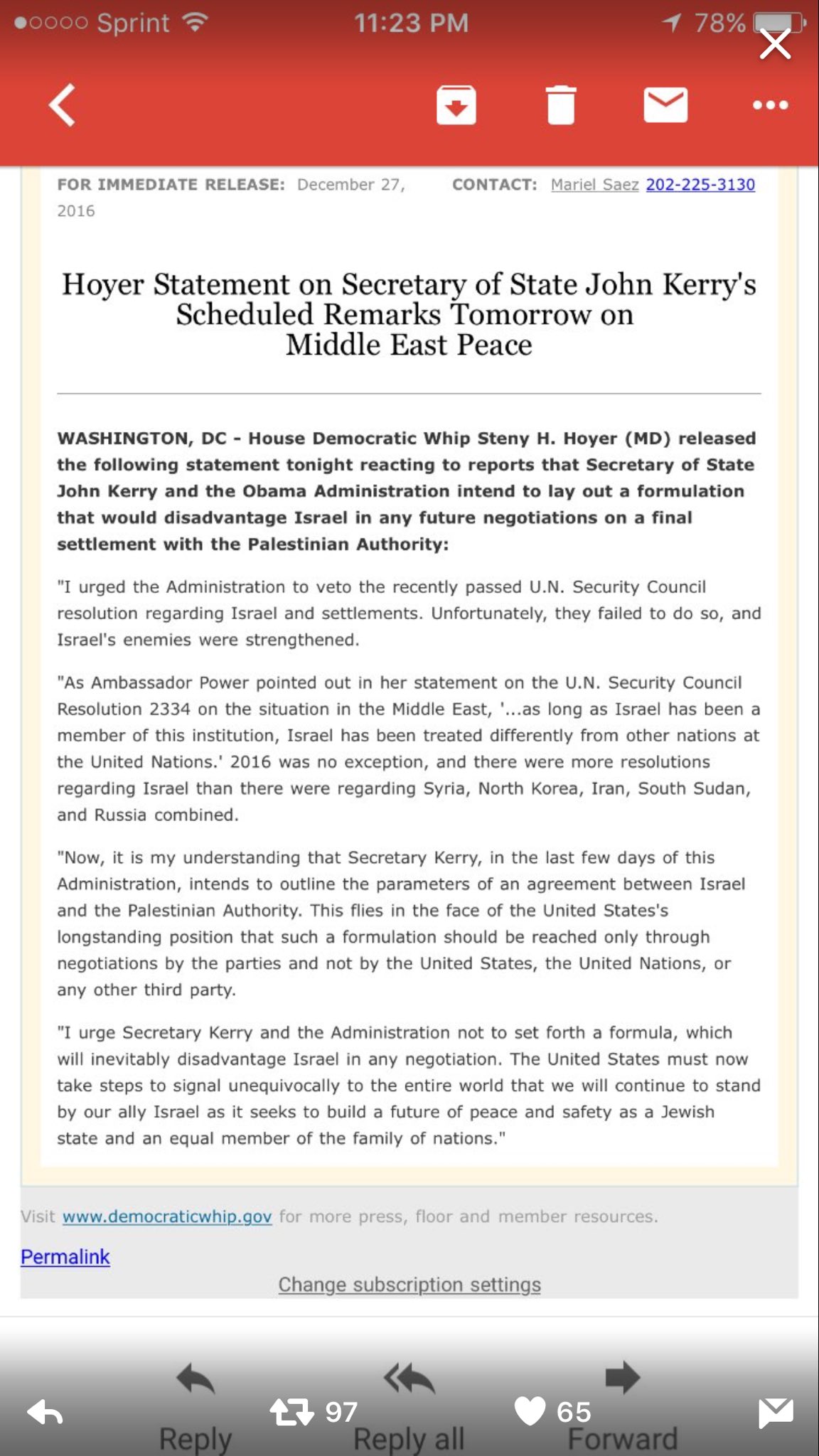
But it’s not only the Republicans who have rejected the Obama regime’s direction. Below is the statement by the House Democratic Whip Steny Hoyer:

Steny Hoyer's reaction

Steny Hoyer’s reaction


Thank you for your support, Mr. Hoyer. You are on the right path towards restoring Israelis’ and Jews’ trust in the Democratic Party.

Here is a selection of other reactions via Twitter:

https://twitter.com/NoahPollak/status/814148546387591169

https://twitter.com/AnneBayefsky/status/814162426711117824

https://twitter.com/VictorShikhman/status/814168167740309505

And one final tweet which includes a map that encapsulates the entire Middle East problem, and at the same time clearly demonstrates Kerry’s (and his boss’s) blindness when it comes to Israel:


Trump and Sisi discuss Middle East peace

December 23, 2016

Trump and Sisi discuss Middle East peace, Israel National News, Elad Benari, December 23, 2016

trumpandsisiTrump and Sisi meet in New YorkReuters

“The presidents agreed on the importance of affording the new U.S. administration the full chance to deal with all dimensions of the Palestinian case with a view of achieving a full and final settlement,” he added.

Sisi recently praised Trump and said he expected greater engagement in the Middle East from his administration.

******************************

Egyptian President Abdel Fattah al-Sisi on Thursday night spoke with U.S. President-Elect Donald Trump, Sisi’s office said, according to Reuters.

The call came hours after the UN Security Council postponed indefinitely a vote on Egypt’s draft resolution denouncing Israeli “settlements”.

“During the call they discussed regional affairs and developments in the Middle East and in that context the draft resolution in front of the Security Council on Israeli settlement,” said Sisi’s spokesman, Alaa Yousef.

“The presidents agreed on the importance of affording the new U.S. administration the full chance to deal with all dimensions of the Palestinian case with a view of achieving a full and final settlement,” he added.

Thursday’s vote on the UN Security Council resolution was reportedly postponed after Sisi instructed his nation’s delegation to push for a delay in the vote.

Trump had earlier called for the United States to veto the resolution, as it has traditionally done with similar proposals. American officials indicated that the Obama administration was planning to abstain from voting or even to vote yes.

Sisi recently praised Trump and said he expected greater engagement in the Middle East from his administration.

The Egyptian President has also been at the forefront of the effort to resume talks between Israel and the Palestinian Authority, having several months ago urged Israelis and Palestinian Arabs to seize what he said was a “real opportunity” for peace and hailed his own country’s peace deal with Israel.

The comments were welcomed by Prime Minister Binyamin Netanyahu, who stressed that “Israel is ready to participate with Egypt and other Arab states in advancing both the diplomatic process and stability in the region.”

Palestinian Authority (PA) chairman welcomed Sisi’s call as well, saying he welcomed the Egyptian president’s efforts to achieve peace and establish a Palestinian state.

Who will rid me of this troublesome Kerry?

December 6, 2016

Who will rid me of this troublesome Kerry? | Anne’s Opinions, 6th December 2016

The answer to my rhetorical question in the title is President-elect Donald Trump.

John Kerry wagging his finger at

John Kerry wagging his finger at “naughty” Israel for the last time

In a parting shot at his nemesis, outgoing Secretary of State John Kerry takes aim at Binyamin Netanyahu, the settlements, and Israel. His Jeremiad sounds awfully familiar, and – yes – he has spouted off the same nonsense time and time again.

Let’s have a look at his latest – and last, thank goodness! – complaints about an Israel that will not heed his warnings:

First the mildly good news:

It seems increasingly unlikely, though not impossible, that the Obama administration will lend its hand to a resolution that might discomfit the Israeli government at the UN, or otherwise seek to bequeath a framework for Israeli-Palestinian peace.

But then comes the rest:

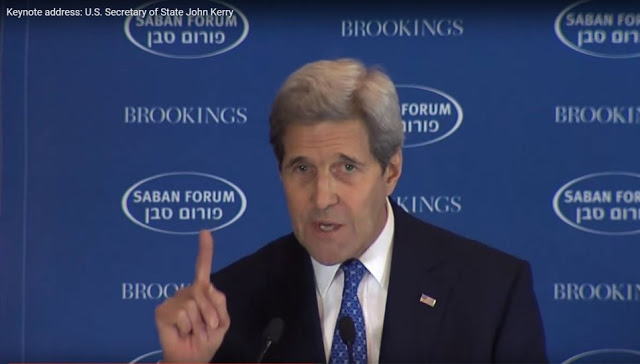
Outgoing Secretary of State John Kerry did a great deal more than discomfit the prime minister and his coalition on Sunday, however. In remarks at the Saban Forum in Washington, DC, Kerry unloaded almost four years of bitter frustration at Benjamin Netanyahu and his colleagues, warned that Israel is heading toward “a place of danger,” and cited the settlement enterprise as the central catalyst for that potential disaster.

A different, brighter future, he indicated, was attainable for Israel. But the settlers were destroying it, he said. And his unfortunate role, he made sadly clear, had been to serve these past four years as the prophet who can see the tragedy approaching, but whose warnings go unheeded.

No, said the secretary, ceding a point to Netanyahu, who had spoken by satellite just before him, the settlements “are not the cause of the conflict.” But, Kerry repeated several times, they most certainly constitute a core “obstacle” to its solution. “Let’s not kid each other here,” he advised. “You can’t just wipe it away by saying it doesn’t have an impact. It does have an impact.”

Oh, bla bla bla. The core obstacle to the solution of the crisis is the Arabs’ refusal to recognize a Jewish state in ANY of the land of Israel. The settlements are a convenient tool, a perfect excuse for a politically correct world where history has been turned on its head and indigenous rights have been reversed, making the occupiers (the Arabs) the “indigenous natives” and turning the Jews into imperialist colonialist invaders.

He didn’t blame Netanyahu personally for utilizing settlements with the deliberate goal of ensuring that there can be no two-state solution. But the Israeli right, Kerry said, was strategically bringing more and more Jews into the West Bank, and locating them in very specific locations, with precisely that goal — to ensure that there could be no viable Palestinian state. And Netanyahu was presiding over the process.

The vast majority of “settlers” (I apologize for the term but I use it as shorthand) are living in greater Jerusalem or the large settlement blocs, which under any peace plan ever proposed are going to remain under Israeli sovereignty. In which case, why is it a problem for Jews to live there?

Next we come to Kerry’s hubris as “Israel’s saviour”:

The way he told it, his has been a thankless task — essentially trying to save Israel from itself,

Sorry not sorry Mr. Kerry. We Israelis know how to look after ourselves a lot better than you can, or than you think you can (small difference).

The ongoing building is backed by the right “because they don’t want peace,” he said flatly. “They want to block peace,” said Kerry. “That’s the history of the settler movement, my friends.”

That is such a disgusting slur and slander against the Israeli right, the settlers, and all of Israel in fact since the government represents the entire country, that really our Foreign Ministry should look into suing Kerry for libel.

Is Kerry implying that Israelis want war?? That we prefer to live by the sword? Does he reference Palestinian terrorism at all? Does he make mention of the violence that descended upon us when we DID cede territory in Gaza?

Or is it simply that what he calls “peace” does not mean what he thinks it means?

“Peace” does not mean surrendering to your enemies, or even simply ceding up front any demands they make of you just to have a quiet life and to bring them to the negotiating table.

“Peace’ means the absence of war, normalization of relations, trade, tourism, cooperation, and the prevention of violence from terrorists and other hostile elements. None of this should be contingent on giving up strategically priceless territory.

Vouchsafing new details of his 2013-2104 deal-making efforts, now that he’s so close to the end of his term, Kerry detailed some of the security provisions that, he argued, could enable a substantial Israeli withdrawal, and facilitate a small, demilitarized Palestinian “city state” in the West Bank. The Jordanians were ready to build a sophisticated security fence on their side of the Jordan Valley, and the Palestinians on their side. Israeli troops would have been able to helicopter to trouble spots in minutes. There were “all kinds of ways” for Israel to deploy its soldiers in times of crisis, he said, referring to the proposals memorably castigated by then defense minister Moshe Ya’alon in 2014 as “not worth the paper they’re printed on.”

Not only were his proposals worthless, even if they had been of value at the time, later developments, such as the “Arab Spring” and the rise of ISIS would have rendered them useless, and worse, would have placed Israel in an untenable position militarily and diplomatically.

… Stability and tranquility were not out of reach for Israel, Kerry suggested, but wouldn’t be attained if “all the time you are building up your presence” in what the Palestinians see as their state.

But does Kerry have anything to say about the illegal Arab construction in Israel? Not to mention the ongoing destruction by the Waqf on the Temple Mount. Is building illegal only for Jews? If so, there’s a word for that: antisemitism.

And as for that idea beloved by Netanyahu of a regional Arab peace first, and accommodation with the Palestinians somewhere down the line, forget about it. “There will be no separate peace with the Arab world,” he insisted.

Again, events have overtaken Mr. Kerry. Israel is on speaking terms at the very least with many of her most obdurate enemies, including Saudi Arabia, besides “cold peace partners” like Jordan and Egypt.

I was gratified to see that others are of the same opinion as me regarding Kerry’s outrageous statements.

Ruthie Blum in Israel Hayom says Good Riddance Mr. Kerry:

But let’s face it: Even Bozo the Clown would be better than Secretary of State John Kerry.

To be fair to Kerry, he was following the foreign policy spelled out by Obama four years earlier: that America was about to embark on a new path, reaching out to enemies who would suddenly transform into friends when faced with a more gentle and multicultural America — one that “leads from behind.”

Nevertheless, it was Kerry who did most of the shuttling, predominantly to the Middle East, alternating between his many trips to Europe to grovel before his Iranian counterpart, and visits to Israel, where he expressed severe displeasure with Prime Minister Benjamin Netanyahu for not behaving similarly with the Palestinian Authority.

“I come to you as somebody who is concerned for the safety and the security of the State of Israel — for the long-term ability of the State of Israel to be able to be what it has dreamt of being, and what the people of Israel, I believe, want it to be,” he said, implying that it has not lived up to that dream.

Again that patronizing arrogance.

He then professed his concern for the Jewish state, claiming to “want to see this thing develop into the full-blossomed beacon that Israel has the potential of being.” Indeed, he went on, “Israel has all these skills,” in so many realms “that it could be sharing with Egypt, with Jordan, with the Emirates, with Saudi Arabia, with all of these countries. … But the issue is, how do get from here to there?”

Netanyahu could have pointed out that attempting to get “from here to there” has been his guiding principle — one that he has been putting into practice with every Arab and African country that is open to it. This year alone, he has forged friendly relations and cooperation with Cairo. He has even made enormous strides with the Saudis, who consider Israel an ally in preventing Iran from acquiring the nuclear weapons that Kerry and his boss handed the mullahs on a silver platter.

Ouch.

He continued by lambasting settlements, while claiming he understands that they are not the root cause of the conflict, saying that he “cannot accept the notion that they do not affect the peace process — that they aren’t a barrier to the capacity to have peace.”

And here was the clincher. He said he knows this, because “the Left in Israel is telling everybody they are a barrier to peace and the Right supports it, openly supports it, because they don’t want peace.”

And there you have it. Kerry’s utter gall. His accusation that most Israelis oppose peace. Not that we long to live without fear of being stabbed, car-rammed, torched, blown up by bombs and hit by rocket fire by hate-filled terrorists bent on our annihilation. Not that we have relinquished most of the West Bank and all of Gaza to those killers. Not that every territorial withdrawal has been accompanied by an escalation in violence against us.

Meanwhile the indefatigable Elder of Ziyon has done his homework and notes that Kerry outright lied about the basic facts of the Oslo Accords in his Saban Forum speech:

John Kerry, speaking at the Saban Forum this past weekend, said:

When Oslo was signed in 1993, the vision was that with the signing of Oslo, Area C – everybody knows there’s Area A, B, C – Area A is Palestinian security and administrative control, Area B is a split between administrative and security control, and Area C, which is 60 percent of the West Bank, is just Israel security and administrative still. But the deal of Oslo in 1993 was over the next year and a half Area C would be transferred to the Palestinian control administratively. Well, it didn’t happen for a number of different reasons. We won’t go into that now.

Kerry had good reason not to go into it – because it is a complete fiction.

The original 1993 Oslo Accords did not divide the territories into Areas A, B and C. That was Oslo II, in 1995, not 1993.

Oslo II mentioned very little about redeploying Israeli control.

The Wye River Agreement of 1998 did say Israel was to withdraw from a percentage of Area C, but the bulk was going to remain under Israeli control. It was never implemented after Netanyahu, who opposed it, lost a vote of no-confidence. But there were a whole lot of terror attacks in the md-90s that would seem to be a violation of Oslo.

Kerry didn’t mention Hamas or suicide bombings or terror.

He didn’t mention those inconvenient facts because they do not fit his politically correct world-view where the “poor brown people” can do no wrong and the “white people” (played by the Israeli Jews) can do no right.

For some more interesting reading on Kerry and his malicious ignorance on Israel and the Middle East, read this excellent article about him on the Winds of Jihad blog: “Ignorant Of Islam, Frustrated And Confused About the Middle East, Incapable Of Grasping Reality, Quick To Blame Israel”. It’s from 2013 but still as relevant as ever.

In short, Kerry is a puffed-up arrogant blowhard with a one-eyed view of the world, particularly the Middle East, and the time can’t come quickly enough when we shall see the back of him.

The only ethnic cleansing that the world accepts is that of the Jews

September 12, 2016

The only ethnic cleansing that the world accepts is that of the Jews | Anne’s Opinions, 12th September 2016

Binyamin Netanyahu brought down the opprobrium of the world onto his head on Friday when he stated two categorical truths: the first: the Palestinians want to ethnically cleanse Jews off their land. The second: that it is absurd that such ethnic cleansing is a pre-condition to “peace”.

Here is Bibi’s statement:

The United with Israel article reports on the video which has gone viral:

Israel’s prime minister rejected international criticism of Israeli construction in Judea and Samaria on Friday, equating it to “ethnic cleansing” of Jews and insisting the Israeli communities in Judea and Samaria are not an obstacle to peace, in a video that drew a rare rebuke from the United States.

Benjamin Netanyahu said in a video posted online that he has “always been perplexed” by claims that Israeli building in Judea and Samaria is “an obstacle to peace.”

He pointed to Israel’s Arab minority, which enjoys citizenship and voting rights.

“No one would seriously claim that the nearly 2 million Arabs living inside Israel, that they’re an obstacle to peace,” Netanyahu said. “Yet the Palestinian leadership actually demands a Palestinian state with one precondition: No Jews. There’s a phrase for that: It’s called ethnic cleansing.”

“It’s even more outrageous that the world doesn’t find this outrageous,” he added. “Since when is bigotry a foundation for peace?”

Of course such simple, clear truths are unacceptable to the liberal, progressive, enlightened, oh-so-politically correct State Department which never met a terrorist it couldn’t love. They condemned Netanyahu’s video as “inappropriate”:

Washington on Friday fumed at comments made by Prime Minister Benjamin Netanyahu in a video released online in which he accused the Palestinians of advocating ethnic cleansing of the Jewish population in the West Bank.

US State Department spokeswoman Elizabeth Trudeau told reporters the administration is “engaging in direct conversations with the Israeli government” about the video.

“We obviously strongly disagree with the characterization that those who oppose settlement activity or view it as an obstacle to peace are somehow calling for ethnic cleansing of Jews from the West Bank. We believe that using that type of terminology is inappropriate and unhelpful,” Trudeau said.

She said Israel expansion of settlements raises “real questions about Israel’s long-term intentions in the West Bank.”

I would like to throw the State Departments words back in their face and ask them why the Palestinians’ demands for ethnic cleansing of Jews from Judea and Samaria do not raise real questions about the Palestinian Authority’s long-term intentions in the West Bank”.

As expected, beyond Washington’s seething, Netanyahu’s words also aroused condemnation from the usual suspects, as the JPost reports:

The Zionist Union’s Tzipi Livni responded to the video, saying that the US is now saying that all the settlements are obstacles to peace, including those inside the large settlement blocs, while in the past Israel received recognition for those blocs.

“I worked to get diplomatic benefit while paying a political price, while Netanyahu is trying to get political benefit while paying a diplomatic price,” she said.

Tzipi Livni might wave her diplomatic credentials around, but the truth is that she achieved nothing during her vaunted peace-processing career. The highlight of her career was the lopsided UN Resolution 1701 after the Second Lebanon War which handed a political victory to Hezbollah.

Ayman Odeh, head of the Joint List, slammed Netanyahu for comparing Israeli Arabs to “settlers.”

Netanyahu, he said, “is comparing a minority born here, who has lived in the place for generations, which Israel came and foisted itself upon, to settlers that were transferred against international law to occupied territory, all the while trampling the human rights of the residents of the West Bank and Gaza.”

But reality, he said, “never bothered Netanyahu.”

I don’t expect anything different from Odeh, but he really must be called out for the bunch of lies that he spouts. Calling the Palestinians “a minority born here who has lived in the place for generations” is a verifiable untruth. The land was empty and desolate, and the Arabs were uninterested in it until the Jews returned to their homeland and made it flourish. It is the Jews who are indigenous to Israel – which includes our Biblical and historical heartland, Judea and Samaria – not the Arabs, and the only time the land was Judenfrei was for a mere 19 years, a blink in the eye of history, from 1948-1967.

With every other nation, the world applauds as indigenous peoples return to their homelands. But as always, when it comes to the Jews, when they are ethnically cleansed, they’d better stay ethnically cleansed! The hypocrisy and absurdity, as Netanyahu points out, are breathtaking.

As for the video itself, people are scratching their heads wondering what prompted Netanyahu to publish this provocative statement davka now. The JPost gives a bit of background:

The brief video is the eighth that Netanyahu has made since David Keyes took over from Mark Regev as Netanyahu’s English spokesman in March. The Prime Minister’s Office views these videos as a very effective way to get the premier’s unfiltered message out to millions of people. Some 750,000 people have seen this video since it was uploaded Friday, and the number of those who have seen the others – which have dealt with issues varying from Israeli Arabs to gay rights – have been seen by tens of millions of people.

Raphael Ahren in the ToI further explains Netanyahu’s intentions. He notes that this is not the first time Netanyahu has made decried Palestinian ethnic-cleansing of the Jews in videos, speeches and interviews:

“Ethnic cleansing for peace is absurd. It’s about time somebody said it. I just did,” Netanyahu said at the end of the two-minute clip. But Netanyahu did not invent this controversial comparison on Friday afternoon, when the clip appeared on his social media accounts. He has made the argument, in various mutations, throughout his political career. In the 2000 edition of his book “A Durable Peace,” written before his watershed Bar-Ilan speech conditionally accepting the two-state solution, he flatly rejected the notion of a “hostile, Judenrein Palestinian state.” Even if the entire world supports it, the campaign for a West Bank free of Jews is based “not on justice but on injustice,” he argued at the time.

Amid the widespread criticism Netanyahu’s latest video elicited, many are wondering about his motives. Ethnic cleansing is widely considered a crime against humanity; the clip can thus be seen as a premeditated slap in the face of the Americans and indeed the entire international community for demanding that Israel agree to such a practice, some pundits said.

Others blamed the polls. Over the weekend, a second survey within a week showed Netanyahu’s Likud trailing the centrist Yesh Atid, indicating that for the first time since 2012, Likud would no longer be the country’s biggest party if elections were held today. Several analysts argued that Netanyahu provoked the ethnic cleansing drama to deflect criticism over his handling of last week’s train crisis and galvanize his right-wing supporters, relations with the US and the rest of the world be damned.

But the fact that Netanyahu and his aides have made the “ethnic cleansing” talking point before appears to discredit this theory. It is more likely that Netanyahu and Keyes — who, before he entered the Prime Minister’s Office, was known for his unorthodox style of political activism — released the clip as just one more of their ongoing series of hasbara (pro-Israel advocacy) videos, not expecting it would lead to such outrage.

The point of these videos, … is to make Israel’s case directly to the masses via social media, thus circumventing the ostensibly biased mainstream media.

Ahren then embarks on a Talmudic pilpul dissection of what constitutes “ethnic cleansing” – as if Bibi’s words are devoid of anything but political showboating:

Notwithstanding the emotions Netanyahu’s use of the term “ethnic cleansing” evoked this weekend, and the fact that Palestinian activists often use it to describe Israel’s actions in 1948, is the description factually sound?

Golden Oldie from 1994: Ethnic cleansing of the Jews

Golden Oldie from 1994: Ethnic cleansing of the Jews

There is no clear legal definition of “ethnic cleansing.” The Cambridge Dictionary describes it as “the organized, often violent attempt by a particular cultural or racial group to completely remove from a country or area all members of a different group.”

A commission of experts examining the war in Yugoslavia in the 1990s — when the term was invented — established ethnic cleansing as a “purposeful policy designed by one ethnic or religious group to remove by violent and terror-inspiring means the civilian population of another ethnic or religious group from certain geographic areas.”

On the face of it, the forced evacuation of Jewish settlers from the West Bank for the benefit of Palestinian Arabs appears to fit the bill. Palestinian leaders have been adamant that “not a single Israeli” will be accepted in their future state.

On the other hand, proponents of an Israeli withdrawal are not calling for the violent removal of settlers by Palestinians, but rather for a coordinated evacuation of settlements in the framework of a peace agreement.

As previous Israeli withdrawals from Sinai and Gaza have shown, a proportion of ideologically and religiously motivated activists would likely have to be evacuated by force — though hardly by “terror-inspiring means.”

That is absolutely not the point. See the Dry Bones cartoon from above, still accurate after over 20 years. The point remains that the Palestinians refuse to have one single Israeli in their midst, as Palestinian “President-for-Life” Mahmoud Abbas himself declared. Keeping a territory “pure” for one ethnicity only, and demanding the expulsion of other nationalities, in however peaceful a manner, remains ethnic cleansing. This “word-washing” of the Palestinians’ rejectionism has to stop if we are ever to arrive at any kind of non-violent accommodation with each other.

As an aside, Abbas even rejects Syrian Palestinians, fleeing for their lives from the civil war, heartlessly telling them to “go to Israel or die in Syria”. So much for brotherly love.

Dennis Ross

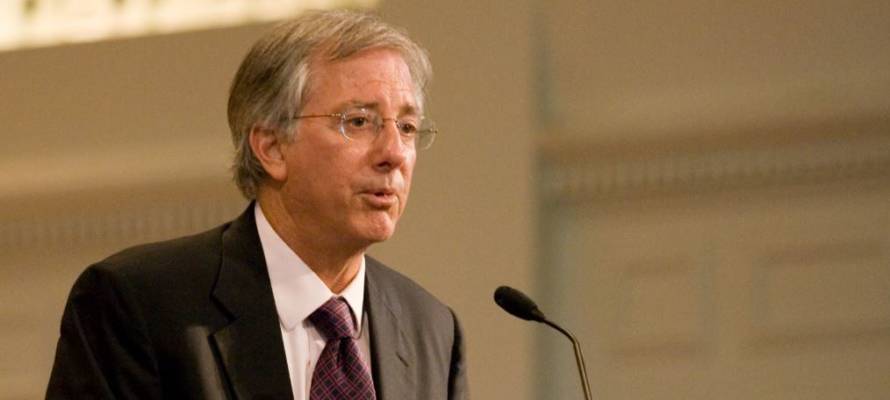
Former US Mideast envoy Dennis Ross

In a further reminder, if any were necessary, of the dangers of the US Adminsitration’s exacerbating the problems in the conflict, here comes Dennis Ross asserting that if Hilary Clinton is elected she should seek more Israeli concessions.

If Hillary Clinton is elected US president, she should launch a behind the scenes initiative to bring about changes in Israel’s policies, according to former Clinton adviser and US Mideast envoy Dennis Ross.

Ross’s remarks came during a panel discussion at Georgetown University’s School of Foreign Service on Thursday.

Ross said that “even though negotiations with the Palestinian Authority won’t work now,” Israeli Prime Minister Benjamin Netanyahu should take steps of his own. “He should, at a minimum, announce an official policy that there will be no further Israeli construction east of the security barrier,” Ross said.

Numerous Israeli settlements would be affected by such a policy, including the communities in the Jordan Valley. Ross said such unilateral concessions would be consistent with “the traditional Zionist way of shaping your own destiny.”

No Mr. Ross! That is NOT the Zionist way. The Zionist way is to take our own destiny in our own hands, to settle our own land any way we wish, and not to kow-tow to foreign meddlers who most definitely do not have our own interests at heart.

The Zionist way is to reject the Exile, to reject the ghetto way of living where we had to be afraid of the powers that be. The Zionist way is to reclaim our own narrative, our own history, our own land and our own destiny.

‘Uneaten birthday cakes next to pools of blood’

June 9, 2016

‘Uneaten birthday cakes next to pools of blood’, Israel Hayom, Ruthie Blum, June 9, 2016

The rest of us in Israel, meanwhile, will be treated by the international community to reprimands about the need for peace, just as we are already being bombarded on local talk shows with the urgency for “an agreement with the Palestinians.” Like the terrorist attacks themselves, these pronouncements are repeated virtually without let-up.

***********************

An Israeli parliamentarian who arrived on the scene of Wednesday night’s Palestinian terrorist attack in Tel Aviv summed up in a phrase what terrorism is all about.

“Uneaten birthday cakes next to pools of blood,” is how Likud MK Amir Ohana described what he encountered in the immediate aftermath of the shooting spree at the Max Brenner chocolate shop and cafe in the Sarona shopping complex.

No matter how precisely witnesses describe the attacks Israelis experience on a regular basis — the fear, the screams, and the killings — it is rare for words to capture carnage so well.

Yes, “uneaten birthday cakes next to pools of blood” tells us everything we need to know about the setting and its significance in the twisted, brainwashed minds of young people in the Palestinian Authority. It is precisely what the two young men, relatives from the village of Yatta near Hebron who brought makeshift assault rifles with them to an eatery on a summer’s eve, had envisioned. It was exactly their goal to slaughter Jews, some of them in casual dress and flip-flops, enjoying a respite from the oppressive heat of the day, others dressed to the nines, celebrating personal milestones.

Indeed, “uneaten birthday cakes next to pools of blood” says it all. It is a reminder of the funerals that will soon take place and the devastation entire families will feel for the rest of their lives; the months of physical rehabilitation and trauma awaiting those who were injured; and the tears of mothers, fathers, sons and daughters praying at bedsides.

“You never get used to it,” said a surgeon from the Sourasky Medical Center, where the wounded — among them one of the two terrorists — are being treated.

The rest of us in Israel, meanwhile, will be treated by the international community to reprimands about the need for peace, just as we are already being bombarded on local talk shows with the urgency for “an agreement with the Palestinians.” Like the terrorist attacks themselves, these pronouncements are repeated virtually without let-up.

The difference this time is the addition of the discussion about how Avigdor Lieberman, Israel’s new defense minister, who assumed his role only last week, is going to meet the challenge, particularly as a proponent of the death penalty for terrorists, which the Jewish state does not have. Natch.

This is something the Arabs in Judea and Samaria, east Jerusalem and Gaza are keenly aware of, along with the knowledge that if they engage in particularly gruesome violence, they will be hailed as heroes by their society and leaders. Those who are killed while murdering Jews can look forward not only to paradise in the afterlife, but being martyrs after whom sports arenas, cultural events and streets are named.

Thankfully, Lieberman — whose alleged first order of business over the weekend was to strike terrorist bases in Syria — did not talk politics. Instead, he gave a brief press conference at the scene of the attack with Prime Minister Benjamin Netanyahu. Netanyahu had just landed in Tel Aviv from a two-and-a-half-day trip to Russia, ostensibly to mark the 25th anniversary of the establishment of full diplomatic relations with Moscow, but really to cement growing ties with Russian President Vladimir Putin. This is the sad but necessary upshot of the Obama administration’s attitude toward Israel in particular and the Middle East in general.

Netanyahu understands that he has to have an alternative ally on whom to rely when it comes to safeguarding Israel from the dangers posed by the civil war in Syria, chief among them Iran’s presence and Palestinian proxy Hezbollah. Oh, and there’s the Islamic State group, too, which is also increasing its foothold in the Sinai, along Israel’s southern border, adjacent to Gaza. You know, where Hamas continues to build tunnels through which to smuggle weapons and kidnap and kill Israelis.

For his part, Putin is only too happy to oblige and replace the United States as the world’s superpower, a status his country lost when the Soviet Union fell 26 years ago. And the Palestinian “problem” was no more connected to that past event than it is to today’s global reality. It is simply a convenient excuse employed to hold Israel accountable and responsible for all ills. It is the politically correct contemporary anti-Semitic outlook, according to which Jews control the world.

What a hoot. We can’t even eat our birthday cakes at a chocolate shop without pools of our blood being spilled.

Peace: A deceptive, dictatorial word

May 20, 2016

Peace: A deceptive, dictatorial word, Israel Hayom, Martin Sherman, May 20, 2016

No matter how many far-reaching compromises and gut-wrenching concessions Israel has made, they have never been enough to elicit any commensurate counter-concessions from the Arabs. Indeed, rather than satiate the Arab appetite, they have merely whetted it, with each Israeli gesture only leading to further demands for more “gestures.”

****************************

After a long absence, “peace” is back in the headlines, due in large measure to this week’s visit to Israel by French Foreign Minister Jean-Marc Ayrault, who came to try to promote a new French initiative that somehow, by as yet unspecified means, would resuscitate the moribund “peace process.”

Perversely planned to take place without either Israel or the Palestinians, the principal protagonists, the conference has now fortuitously been delayed to accommodate the schedule of U.S. Secretary of State Kerry, who apparently had better things to do than take part in yet another doomed charade to forge “peace” in the Middle East.

However, despite its ill-conceived rationale and dauntingly dim prospects, the planned summit can and should serve one constructive purpose: to focus attention not only on what the quest for the elusive condition of “peace” really entails, but on the even more fundamental question of what is actually meant, and what can realistically be expected, when we talk of “peace” as a desired goal, particularly in the context of the Middle East and particularly from an Israeli perspective.

Indeed, the need for such clarification becomes even more vital and pressing because of recent reports of possible Egyptian involvement in attempts to initiate “peace” negotiations with Arab regimes teetering on the brink of extinction and involving a perilous Israeli withdrawal to indefensible borders. All this in exchange for grudging recognition as a non-Jewish state by a partially no longer existent, partially disintegrating, Arab world.

A dictatorial word

It takes little reflection to discover that, in fact, “peace” is a word that is both dictatorial and deceptive.

It is dictatorial because it brooks no opposition. Just as no one can openly pronounce opposition to a dictator without risking severe repercussions, so too no one can be openly branded as opposing peace without suffering grave consequences to personal and professional stature.

Life can be harsh for anyone with the temerity to challenge the tyrannical dictates of the politically correct liberal perspectives. As British columnist Melanie Phillips remarked several years ago in an interview on Israel’s Channel 1: “Believe me, it [failing to abide by political correctness] has a very chilling effect on people, because you can lose your professional livelihood, your chances of promotion, you lose your friends.”

In a surprisingly candid admission, The New York Times’ Nicholas Kristof wrote that “universities are the bedrock of progressive values, but the one kind of diversity that universities disregard is ideological. … We’re fine with people who don’t look like us, as long as they think like us.”

This peer-imposed doctrinaire uniformity has had a debilitating impact on the quality of intellectual discourse in general, and on the question of “peace” in the Middle East in particular.

A New York Times opinion piece by Arthur C. Brooks cautioned: “Excessive homogeneity can lead to stagnation and poor problem solving.” Citing studies that found a “shocking level of political groupthink in academia, he warned that “expecting trustworthy results on politically charged topics from an ideologically incestuous community [is] downright delusional.”

A deceptive word

The considerable potential for defective analysis in the intellectual discourse on such a politically charged topic as “peace” also accounts for another detrimental attribute of the word.

Not only is it rigidly dictatorial, but, perhaps even more significantly, “peace” is a grossly deceptive word. It can be, and indeed is, used to denote two disparate even antithetical political situations. On the one hand, “peace” can be used to describe a state of mutual harmony between parties, but on the other hand it can just as aptly be used to characterize an absence of violence maintained by deterrence.

In the first meaning, “peace” entails a situation in which the parties eschew violence because they share a mutual perception of a common interest in preserving a tranquil status quo. In the second meaning, “peace” entails a situation in which violence is avoided only by the threat of incurring exorbitant costs.

The significance of this goes far beyond semantics. On the contrary. If it is not clearly understood, it is likely to precipitate calamitous consequences.

The perilous pitfalls of ‘peace’

It is crucial for practical policy prescriptions not to blur the sharp substantive differences between these two political realities. Each requires different policies both to achieve and, even more importantly, to sustain them.

The misguided pursuit of one kind of peace may well render the achievement — and certainly the preservation — of the other kind of peace impossible.

Countries with the mutual harmony variety of “peace” typically have relationships characterized by openness and the free movement of people and goods across borders. As in the relationship between Canada and the U.S., there is little or no effort needed to prevent hostile actions by one state against the other. Differences that arise are not only settled without violence, but the very idea of using force against each other is virtually inconceivable.

By contrast, in the second, deterrence-based variety of peace, such as those between the U.S. and USSR during the Cold War or between Iran and Iraq up to the 1980s, the protagonists feel compelled to invest huge efforts in deterrence to maintain the absence of war.

Indeed, whenever the deterrent capacity of one state is perceived to wane, the danger of war becomes very real, as was seen in the Iraqi offensive against an apparently weakened and disorderly Iran after the 1979 Islamic Revolution.

In this type of “peace,” there is no harmonious interaction between the peoples of the states. Movements across borders are usually highly restricted and regulated, and often prohibited.

It is not surprising to find that peace of the “mutual harmony” variety prevails almost exclusively between democracies, since its characteristic openness runs counter to the nature of dictatorial regimes.

The perils of pursuing one type of peace (mutual harmony) when only the other type (deterrence) is feasible were summed up over two decades ago by Prime Minister Benjamin Netanyahu in his acclaimed book “A Place Among the Nations: Israel and the World.” In it, he calls for making a clear distinction between the “peace of democracies” and the “peace of deterrence.”

“As long as you are faced with a dictatorial adversary, you must maintain sufficient strength to deter him from going to war. By doing so, you can at least obtain the peace of deterrence. But if you let down your defenses … you invite war, not peace,” he wrote.

Much earlier, in 1936, Winston Churchill underscored the dangers: “The French Army is the strongest in Europe. But no one is afraid of France. Everyone knows that France wants to be let alone, and that with her it is only a case of self-preservation. … They are a liberal nation with free parliamentary institutions. Germany, on the other hand, under its Nazi regime … [in which] two or three men have the whole of that mighty country in their grip [and] there is no public opinion except what is manufactured by those new and terrible engines — broadcasting and a controlled press fills unmistakably that part [of] … the would-be dominator or potential aggressor.”

Compromise counterproductive

To grasp the potential for disaster when a policy designed to attain a harmonious outcome is pursued in a political context in which none is possible, it is first necessary to recognize that, in principle, there are two archetypal configurations. In one, a policy of compromise and concession may well be appropriate; in the other, such a policy will be devastatingly inappropriate.

In the first configuration, an adversary interprets concessions as conciliatory, and feels obliged to respond with a counter-concession. Thus, by a series of concessions and counter-concessions, the process converges toward some amicably harmonious resolution of conflict.

However, in the second configuration, the adversary sees any concession as a sign of vulnerability and weakness, made under duress. Accordingly, such initiatives do not elicit any reciprocal gesture, only demands for further concessions.

But further concessions still do not prompt reciprocal moves toward a peaceable resolution. This process ill necessarily culminate either in total capitulation or in large-scale violence, either because one side finally realizes that its adversary is acting in bad faith and can only be restrained by force, or because the other side realizes it has extracted all the concessions possible by non-coercive means, and will only win further gains by force.

In such a scenario, compromise is counterproductive and concessions will compound casualties.

Whetting, not satiating, Arab appetites

Of course, little effort is required to see that the conditions confronting Israel today resemble the latter situation far more than the former. No matter how many far-reaching compromises and gut-wrenching concessions Israel has made, they have never been enough to elicit any commensurate counter-concessions from the Arabs. Indeed, rather than satiate the Arab appetite, they have merely whetted it, with each Israeli gesture only leading to further demands for more “gestures.”

If in any “peace” negotiations such compromises undermine Israeli deterrence by increasing its perceived vulnerability, they will make war, not peace, more imminent.

Indeed, it was none other than Shimon Peres, in recent years one of the most avid advocates of the land-for-peace doctrine (or dogma), who, in his book “Tomorrow is Now,” warned vigorously of the perils of the policy he later embraced.

After detailing how surrendering the Sudetenland made Czechoslovakia vulnerable to attack, Peres writes of the concessions Israel is being pressured to make today to attain “peace” : “Without a border which affords security, a country is doomed to destruction in war. … It is of course doubtful whether territorial expanse can provide absolute deterrence. However, the lack of minimal territorial expanse places a country in a position of an absolute lack of deterrence. This in itself constitutes almost compulsive temptation to attack Israel from all directions.”

e also warns: “The major issue is not [attaining] an agreement, but ensuring the actual implementation of the agreement in practice. The number of agreements which the Arabs have violated is no less than number which they have kept.” Since then, of course, their record has hardly improved.

Will Netanyahu 2016 heed Netanyahu 1993?

In 1996, shortly after Netanyahu was elected prime minister for the first time, Ari Shavit of Haaretz interviewed him on positions he had articulated in “A Place Among the Nations.”Shavit: “In your book, you make a distinction between … a harmonious kind of peace that can exist only between democratic countries, and peace through deterrence, which could also be maintained in the Middle East as it currently is. Do you think we need to lower our expectations and adopt a much more modest concept of peace?”

Netanyahu: “One of our problems is that we tend to nurse unrealistic expectations. … When people detach themselves from reality, floating around in the clouds and losing contact with the ground, they will eventually crash on the rocky realities of the true Middle East.”

Let us all hope that Netanyahu of today will heed the advice of Netanyahu of then. It is the only way Israel will be able to avoid the ruinous ravages of the deceptive and dictatorial word “peace.”

More Palestinian and Western Mistakes

November 21, 2015

More Palestinian and Western Mistakes, The Gatestone InstituteBassam Tawil, November 21, 2015

(Did Mohamed forbid all murder? Or is it OK to murder Jews? — DM)

  • The Palestinian “victims” — victims of their own credulousness — are known asshuhadaa, martyrs for the sake of Allah, victims of the misconception that Allah wants us to die for him. But Allah forbids us to murder. Muhammad forbids us to murder. The Qur’an forbids us to murder.
  • Europeans, in general, obviously want the Jews dead — so long as the murder cannot be traced back to them. They seem to be hoping that their boycott, divestment and sanctions (BDS) movement, combined with Arab and Iranian “hit men,” will do the job for them.
  • Also tragically, it has taken Mahmoud Abbas too long to realize that the ultimate objective of Hamas, the local representatives of the Muslim Brotherhood, after killing Israelis, is to have this violence cost the Palestinian Authority its existence in the West Bank. There, they openly plan to set up another Islamic emirate, like the one in the Gaza Strip.
  • The knife-wielding Palestinian children — and the other young people who commit murder — are also not a spontaneous occurrence. They do not simply “spring” full-blown from “imperialism,” “Syrian bombings” or an “endangered Al-Aqsa.” They are the product of a careful, methodical, ongoing tactic of brainwashing about how glorious it is to become a shaheed [martyr] by murdering.
  • We do need to liberated, but not from the people you think. We do not need help being liberated from Israel, which, even if it is harsh, has always been fair to us, but from the self-satisfied diplomats even now — in our name — swanning down the glossy halls of Europe.

The Palestinians have taken it upon themselves to sacrifice our younger generation — on the altar of pointlessness — again.

The Palestinians have been sending their children — still in their teens, and intoxicated by hatred and lies as the assassins of old were intoxicated by hashish — to the streets of Israel and the roads of the West Bank to murder Israelis again. And for what? Is Al-Aqsa mosque in danger? It is not. But the cynical, calculating Fatah, Palestine Liberation Organization (PLO), Hamas — and the Northern Branch of the Islamic Movement which has just been banned — are desperate to bring the Palestinian issue back to the headlines. They hope it would displace the true catastrophe of the chaos in Syria and Iraq, which has led to the flood of refugees to Europe.

The Palestinian “victims” — victims of their own credulousness — are known as shuhadaa, martyrs for the sake of Allah, victims of the misconception that Allah wants us to die for him. But Allah forbids us to murder. Muhammad forbids us to murder. The Qur’an forbids us to murder.

The Palestinian terrorists that murder Israelis usually die in the process; the question is, does murder keep the Al-Aqsa mosque out of “danger” — which it is not even in?

Do the senseless deaths on both sides advance the cause of a political solution and the establishment of a Palestinian state? No, only, apparently, to many Europeans — anti-Semitic racists who love Muslims as much as they hate Jews. These Europeans probably love Muslimsbecause they hate Jews.

Europeans, in general, obviously want the Jews dead — so long as the murder cannot be traced back to them. They seem to be hoping that their boycott, divestment and sanctions (BDS) movement, combined with Arab and Iranian “hit men,” will do the job for them. Sadly, the Palestinians, instead of looking like people who want peace, look like the Muslim extremists to whom the European racists offer ever more help. It seems inconceivable to these Europeans that we may not want to live with these savages any more than they do.

We do need to liberated, but not from the people you think. We do not need help being liberated from Israel, which, even if it is harsh, has always been fair to us, but from the self-satisfied diplomats even now — in our name — swanning down the glossy halls of Europe.

The Palestinians are, not surprisingly, trying to avoid negotiating for peace. As any Palestinian leader will be killed, and go down in Palestinian history as a traitor unless he is able to come back with 100% of Palestinian demands, Mahmoud Abbas would only end up having to turn down any realistic offer — in full view of the international community. The Palestinian leaders are clearly hoping, as anyone would, that these Jew-hating Europeans — and others who breezily turn Jewish heritage sites into Muslim heritage sites — will hand them the whole 100% on a plate, free of charge.

The knife-wielding Palestinian children — and the other young people who commit murder — are also not a spontaneous occurrence. They do not simply “spring” full-blown from “imperialism,” “Syrian bombings” or an “endangered Al-Aqsa.” They are the product of a careful, methodical, ongoing tactic of brainwashing about how glorious it is to become a shaheed [martyr] by murdering.

Do the dispatchers send their own children out to become suicide bombers? Do the dispatchers go themselves? No, the Palestinians and other terrorists prey on swayable, possibly depressed children — looking for love or a “cause” in their lives to counteract the internal emptiness — to commit murder.

These murders by our young — and of our young — are, tragically, the direct result of the inflammatory lies of Muslim extremists, both secular and religious. Here, these include the Palestinian Authority (PA), Fatah, Hamas, the Islamic Movement In Israel (banned last week), and ISIS.

Also tragically, it has taken Mahmoud Abbas too long to realize that the ultimate objective of Hamas, the local representatives of the Muslim Brotherhood, after killing Israelis, is to have this violence cost the Palestinian Authority its existence in the West Bank. There, they openly plan to set up another Islamic emirate, like the one in the Gaza Strip.

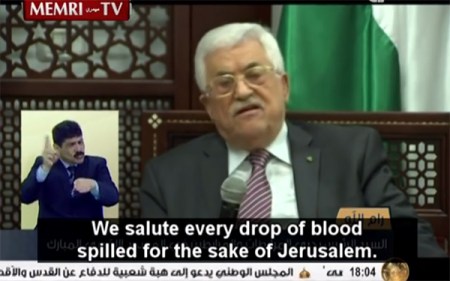
Abbas seems to have woken up, but only after the genie was out of the bottle. He then had no choice but to appeal to his only lifeline, Israel, for support — while at the same time threatening to end security coordination with it. His hate-propaganda nevertheless machine continues to promote the murder Israelis while carefully ignoring Israeli deaths. Abbas instead still focuses on the “martyrdom” of the terrorists and their supposedly “cold-blood executions” at the hands of Israelis whose “crime” is stop them as they are in the act of trying to slit Jewish throats.

1329Palestinian Authority President Mahmoud Abbas, speaking on PA television, September 16, 2015.

During the past six weeks, more than 70 Palestinians have been killed while trying to murder Israelis, and 12 Israelis have been murdered. Israel’s population, contrary to Palestinian expectations, has not collapsed and is, as usual, successfully moving to protect itself.

The real damage has been done to the Palestinian Authority’s credibility and to the belief, now held by fewer and fewer Israelis, that a political solution is possible.

The main questions still need to be directed to those who invented the slogan, “Al-Aqsa mosque is in danger”:

  • Is al-Aqsa mosque now less in danger? Given that, throughout the Middle East, mosques are being blown up one after another, Al-Aqsa mosque is not only in no danger, it is, on the contrary, eminently secure.
  • Has the recent Palestinian violence and terrorism moved the Israelis one inch toward surrendering?
  • Are the Islamists, including the Israeli-Arab members of Knesset, really working to benefit the lives and careers of the Palestinian people? Or, to benefit their own careers, are these politicians keeping their public whipped up like manipulated fighting dogs, and forever poor, to make sure that we will be forever dependent on them? This is a way you treat infants or animals, not people.

Fortunately, the attempt made by Hamas and its subcontractor for collective suicide, Ra’ed Salah’s Islamic Movement, to incite a religious war around the totally false slogan “Al-Aqsa mosque is in danger,” in order to oust Mahmoud Abbas and his cronies from the West Bank, the way they did in the Gaza Strip, has not succeeded. To begin with, their timing was off. The Arab and Muslim world is too busy engaging in mutual slaughter to bother itself with the lies of a gang of Palestinians. The Arab and Muslim world cannot be bothered with Israel, and it certainly cannot be bothered with preventing the overthrow of Mahmoud Abbas and the Palestinian Authority.

Even if the Israelis would like nothing better than to see Al-Aqsa mosque destroyed, a notion for which there is no evidence, they still protect it with the best of their police force, out of respect for others, as we all wish others would respect us. Protecting Al-Aqsa mosque guarantees Israel’s security by respectfully honoring the religion of people different from them. It is also a reminder that all of us might actually benefit from respectfully honoring the religions of others different from us.

It is absurd and offensive that after the Palestinians initiated — and then tried to justify the current wave of terrorism as “a legitimate non-violent peaceful protest against the occupation” — that they now cry crocodile tears about the supposed “Israeli executions” of Palestinian youths who take their knives and go Jew-hunting, but who then get killed in the process. Dimitri Diliani, of the Fatah Revolutionary Council, even had the effrontery to claim, falsely, to Russia Today TV, that Israelis, to justify their crimes, tried to plant knives near the bodies of the purportedly innocent Palestinians to frame them.

Mahmoud Abbas denied the Jews any access to the Temple Mount on the fabricated pretext that the Jews were defiling Al-Aqsa mosque. The Temple Mount, however is as sacred to Jews and Christians as to Muslims. To Jews, the Temple Mount is the location of their two Temples (the Second Temple was destroyed by the Romans in 70 C.E.); to Christians, it was at the Second Temple where Jesus expelled money-changers and those who sold doves (Matthew 21:12).

Ultimately, the American secretary of state, meeting with the King of Jordan and the Israeli prime minister, concluded that it was Israel that guarded Al-Aqsa and would continue to maintain the status quo. Thus the status quo was confirmed in Israeli’s favor.

The Palestinian Authority, Hamas and the Islamic Movement were left with nothing to say.

The upshot was that Mahmoud Abbas’s claim of defilement was rejected, and that Jews would still be allowed to visit. The Palestinians no longer serve as active participants; the Jordanians will continue to serve as religious administrators of Al-Aqsa Mosque, and the Israelis will continue as sovereign, and manage the security of the Temple Mount and Jerusalem.

Secretary Kerry’s repeated reference to the “Temple Mount, that is Al-Aqsa mosque” (Alharam Alshareef) to define the holy site struck a blow to both Mahmoud Abbas and the Islamists trying to deny the rights of the Jews. The Palestinian Authority has also — embarrassingly to many — been claiming that Jesus was a “Palestinian,” and trying to use the Temple Mount as an Islamic religious fulcrum for its baseless nationalist demands.

Secretary Kerry also put a stop to France’s pathetic attempts to curry favor with the Muslims living in its ghettoes when it proposed an international commission of inquiry to examine events in Al-Aqsa mosque. As Israel preserves full freedom of access throughout Jerusalem, the French can enter Al-Aqsa mosque and argue among themselves, but their attempts to enter Jerusalem through the back door was rejected by the Palestinians as an attempt to internationalize Jerusalem into a “Crusader city.”

When the Palestinians torched the Tomb of Joseph, it became clear that under Palestinian Authority control, Jewish and Christian holy sites in Jerusalem would be reduced to ashes, and that the Palestinians in the West Bank were no better than ISIS or the Taliban, which destroyed Palmyra and the ancient statues of the Buddha in Bamiyan.

The Jews, who dealt with two previous intifadas, are not particularly terrified by the thought of a third one. We have repeatedly seen that every violent Palestinian attempt has backfired and caused far more damage to us than to the Jews. The Palestinian Authority’s approval of Hamas’s incitement not only threatened its own downfall, but also looked as if it would precipitate the installation of an Islamic emirate in the West Bank — an event that would effectively have killed any dream of a Palestinian state.

Yes, the recent wave of stabbings and shootings has, to a small and transitory extent, diverted the world’s attention from the real tragedies of the Middle East. However, the millions of refugees in the Middle East (many knocking at the gates of Europe), will keep pushing to the sidelines the Palestinian cause; the slaughter; the mosques blown up; the churches burned down, and the genuine persecution of minorities, as opposed to the fairy tales invented by Mahmoud Abbas, Hamas and the seditious Israeli Arab members of Israel’s Knesset.

The other real loser is the trust between Arabs and Jews. Trust — with special thanks to Palestinian groups working fiercely against “normalization” rather than toward peace — has been totally eroded. Again, the only people we have hurt are ourselves: the demand of Israeli Arabs for equality is rapidly slipping down the list of public priorities. As the old Arab proverb says, “Ask someone with experience, not the doctor.”

At the end of the current violence that we began, will be left, as usual, with nothing to show for it, while the Israelis, who always rebound, will continue to thrive, prosper and move forward.

Clearly the time will soon come again for direct negotiations between the Palestinians and the Israelis — but the use of force, instead of than wresting concessions from the Israelis, will, as always, do just the opposite.