Archive for the ‘Palestinians’ category

Anti-Israel Double Standards Enable Assad’s Brutality

August 23, 2016

Anti-Israel Double Standards Enable Assad’s Brutality, Investigative Project on Terrorism,  Noah Beck,August 23, 2016
1789

Syria’s civil war claimed 470,000 lives since it started in March 2011, the Syrian Centre for Policy Research announced in February. That’s an average of about 262 deaths per day and 7,860 per month. The carnage has continued unabated, so, applying the same death rate nearly 200 days after the February estimate, the death toll is over 520,000.

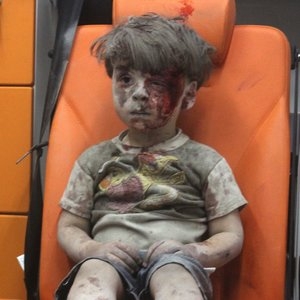
Such numbers are staggering, even by Middle East standards. However, the violence has become so routine that it only occasionally captures global attention, usually when a particularly poignant moment of human suffering is documented. The most recent example is Omran Daqneesh, a 5-year old Syrian boy who was filmed shell-shocked, bloody, and covered in dust after the airstrike bombing of his Aleppo apartment block.

The tragic image of Omran caused outrage around the world, as did the image of Aylan Kurdi, the drowned Syrian boy whose body washed up last September on a beach in Turkey. Yet Omran’s plight demonstrates that, nearly a year after the last child victim of Syrian horrors captured global sympathy, nothing has changed.

If anything, the violence in this multi-party proxy war seems to be getting worse. Since Aylan Kurdi’s drowning, Russia began blitz-bombing Syria in support of the Assad regime. The Syrian Observatory for Human Rights (SOHR) estimates that nine months of Russian airstrikes have killed 3,089 civilians – a toll that is greater, by some estimates, than the number of civilians killed by ISIS. By contrast, Syrian civilian deaths caused by U.S. airstrikes are probably in the hundreds (over roughly twice as much time, since U.S. airstrikes began in the summer of 2015).

But Syrian airstrikes are responsible for the bulk of civilian deaths in Syria. The Assad regime killed 109,347 civilians between March 2011 and July 2014 (88 percent of the total casualties at the time), according to estimates by the Syrian Network for Human Rights. That works out to about 91 civilian deaths per day. More recently, the SOHR documented 9,307 civilian deaths from 35,775 regime airstrikes over a 20-month period running from November 2014 through June 2016. Thus, roughly one innocent Syrian was killed every hour, during the 20 months that the SOHR documented civilian casualties caused by Russian and Syrian airstrikes.

Compare those figures to the number of innocent Palestinians killed by Israel from 2011 to 2014. According to Human Rights Watch (HRW), which has been accused of anti-Israel bias, 37 Palestinians were killed in 2011, 103 in 2012, 15 in 2013 and 1,500in 2014 – the year when Hamas fired rockets at Israel from highly populated Gazan areas. That’s a four-year total of 1,655. During roughly the same four-year period, the number of Syrian civilian deaths was about 76 times greater than the HRW total of Palestinian civilian casualties.

Yet the European Union singles out Israel for conflict-related consumer labels without any similar attempt to warn European consumers about goods or services whose consumption in any way helps the economies of countries responsible for the Syrian bloodshed, including Syria, Russia, and Iran. Human rights lawyer Arsen Ostrovsky has highlighted how none of those countries is targeted by those advocating a boycott of Israel out of a purported concern for human rights. Even more absurd, most of the results produced by a Google search for “academic boycott of Syria” or “academic boycott of Iran” concern academic boycotts of Israel. That asymmetry precisely captures the problem.

In addition to supporting the Assad regime in Syria and contributing to the violence there, Iran executes people for everything from drug offenses to being gay.

Indeed, the global outcry over Syrian suffering is embarrassingly weak when compared to reactions to Israel’s far less bloody conflict with the Palestinians. Imagine if Omran Daqneesh had been a Palestinian boy hurt by an Israeli airstrike on Gaza. College campus protests, the media, NGOs, and world bodies around the planet would be positively on fire. Israeli embassies would be attacked, French synagogues would be firebombed (eight were attacked in just one week during Israel’s 2014 war with Gaza), Jews around the world would be attacked, and condemnations would pour in from the EU, the United Nations, and the Obama administration. UN resolutions and emergency sessions would condemn the incident. International investigations would be demanded. Global blame would deluge Israel, regardless of whether Hamas, a terrorist organization, actually started the fighting or used human shields to maximize civilian deaths. Israel would be obsessively demonized despite any risky and unprecedented measures the Israeli military might have taken to minimize civilian casualties.

Moreover, when an occasional Syrian victim captures global attention, the protests are generally for some vague demand for “peace” in Syria, rather than blaming and demanding the punishment of Syria, Iran, and Russia, even though those regimes are clearly responsible for the slaughter. The starkly different reactions to Israel and Syria are even more shocking when it comes to the United Nations.

From its 2006 inception through August 2015, 62 United Nations Human Rights Council resolutions condemned Israel, compared to just 17 for Syria, five for Iran, and zero for Russia, according to the watchdog group UN Watch. The lopsided focus on Israel is equally appalling at the UN General Assembly, as UN Watch has highlighted. In each of the last four years, as the Syrian bloodbath claimed hundreds of thousands of lives, there were at least five times as many resolutions condemning Israel as those rebuking the rest of the world:

2012: 22 against Israel, 4 for the rest of the world

2013: 22 against Israel, 4 for the rest of the world

2014: 20 against Israel, 3 for the rest of the world

2015: 20 against Israel, 3 for the rest of the world

A corollary of the anti-Israel bias ensures that no Israeli victim will ever enjoy the kind of global sympathy expressed for Omran Daqneesh or Aylan Kurdi. When a Palestinian man enters the bedroom of a 13-year old girl and stabs her to death in her sleep,Obama says nothing even though she was a U.S. citizen and the world hardly notices. By contrast, imagine if the Israeli father of Hallel Yaffa Ariel had decided to take revenge by entering a nearby Palestinian home to stab a 13-year old Palestinian girl to death in her sleep. The global anger would be deafening.

Why do Israeli lives matter so much less? And why do student activists, the UN, the EU, the media, and the rest of the world focus so much more on alleged Palestinian civilian deaths than on Syrian civilian deaths? Doing so is woefully unjust to Syrians. It is also deeply unfair to Israel, which has endured terrorist attacks on its people throughout its existence as a state. It is the one country that, according to Col. Richard Kemp, former commander of British forces in Afghanistan, has done more to protect civilians during war than any other in the history of war.

The global obsession with condemning Israel not only defames a beleaguered democracy doing its best, it also enables the truly evil actors like the Assad regime and Hamas, by giving them a pass on some of the world’s worst crimes.

Robert Spencer on Black Lives Matter and the Leftist/Islamic Alliance

August 23, 2016

Robert Spencer on Black Lives Matter and the Leftist/Islamic Alliance, Jihad Watch via YouTube, August 23, 2016


Iranian Dissidents Visit Israel, View Iran after the Nuclear Deal

August 21, 2016

Iranian Dissidents Visit Israel, View Iran after the Nuclear Deal, Jerusalem Center via YouTube, August 21, 2016


Black Lives Matter Platform: Israel an ‘Apartheid State’ Carrying Out ‘Genocide’

August 3, 2016

Black Lives Matter Platform: Israel an ‘Apartheid State’ Carrying Out ‘Genocide’, Washington Free Beacon, August 3, 2016

More than one hundred activists braved scorching Brooklyn heat to rally at the Barclay's Center prior to marching through downtown Brooklyn to gather at Borough Hall. (Photo by Andy Katz/Pacific Press) *** Please Use Credit from Credit Field ***

More than one hundred activists braved scorching Brooklyn heat to rally at the Barclay’s Center prior to marching through downtown Brooklyn to gather at Borough Hall. (Photo by Andy Katz/Pacific Press)

The newly released platform of a group claiming association with the Black Lives Matter movement declares that Israel is an “apartheid state” that “practices systematic discrimination,” including “genocide … against the Palestinian people.”

The platform makes the accusations against only the Jewish state.

The document, posted online Monday, includes an extensive foreign policy section titled “Invest-Divest.” Substantial parts of the section are devoted to Israel and to what the group believes is a joint U.S.-Israeli campaign of global terror, militarization, and war.

“The US justifies and advances the global war on terror via its alliance with Israel and is complicit in the genocide taking place against the Palestinians,” the document says. The United States, the group says, “is an empire that uses war to expand territory and power. American wars are unjust, destructive to Black communities globally and do not keep Black people safe locally.”

The platform document promotes the Boycott, Divest, and Sanction (BDS) movement, which seeks to cripple Israel economically. The document lists as “resources” for readers the names of several leading BDS groups and calls on its members to fight against anti-BDS bills under consideration in several state legislatures. As a policy recommendation, the platform calls for an end of U.S. aid to Israel.

Black Lives Matter is also opposed to a security fence that Israel built in the early 2000s to stop Palestinian suicide bombers. During that period—commonly called the Second Intifada—Palestinian terrorists murdered approximately a thousand Israeli civilians in attacks. After the fence was constructed, attacks dropped precipitously. The Black Lives Matter document denounces the security fence as an “apartheid wall.”

Another Black Lives Matter grievance is the 2006 creation of AFRICOM, a regional U.S. military command that promotes closer ties between African governments, the African Union, and the U.S. military. “In reality, this effort was designed to expand western colonial control over the region, its people and their resources. AFRICOM is a major example of U.S. empire and is a direct threat to global Black liberation,” the platform states.

The platform calls for redirecting 50 percent of the US defense budget to providing reparations both domestically and abroad. American military spending, the activists say, are “resources and funds needed for reparations and for building a just and equitable society domestically,” yet they “are instead used to wage war against a majority of the world’s communities.” Reparations, the group says, should be provided “to countries and communities devastated by American war-making, such as Somalia, Iraq, Libya and Honduras.”

PM Netanyahu: “This video shook me to the core of my being.”

August 3, 2016

PM Netanyahu: “This video shook me to the core of my being.” Israeli PM via YouTube. August 2, 2016

Raising the Palestinian cause at the DNC

July 28, 2016

Raising the Palestinian cause at the DNC, Vice NewsDalia Hatuqa, July 28, 2016

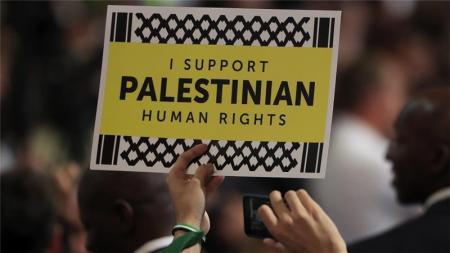
pal rightsA delegate holds a sign reading ‘I support Palestinian Human Rights’ at the Democratic convention in Philadelphia [Tannen Maury/EPA]

An issue that was once sidelined even in progressive circles, Palestine was pushed to the forefront of the electoral campaign this year, with Vermont Senator Bernie Sanders showing that policy change on a seemingly intractable conflict is possible.

For the first time, the platform reflected the right of Palestinians to “independence, sovereignty, and dignity” in addition to Israel’s security. In a recent poll (PDF) of American attitudes on the conflict, 49 percent of Democrats said they recommended economic sanctions or other more serious action to counter settlement construction.

***************

Philadelphia, Pennsylvania – Eva Putzova held a banner with a simple message just outside the Democratic National Convention (DNC) floor on Tuesday: “I support Palestinian rights.”

“I think it’s time that Democratic candidates – Hillary, Bernie or anybody else – start taking the issue seriously and start a real national conversation and get behind all human rights, including Palestinian rights,” said Putzova, a city council member from Flagstaff, Arizona.

She was among many pro-Palestine activists at the DNC this week who came out in a show of force unprecedented at other political conventions. They marched and rallied, held talks and town halls, carried signs and, at one point, raised a Palestinian flag on the convention floor.

“The issue is getting more media exposure, more people are aware,” Putzova said. “I think we are on the brink of changing the policy stands of the US, but it will take all of us to push the political elite. I think [Palestinians are] a community that has been marginalised for so long.”

An issue that was once sidelined even in progressive circles, Palestine was pushed to the forefront of the electoral campaign this year, with Vermont Senator Bernie Sanders showing that policy change on a seemingly intractable conflict is possible.

In a debate last April, he pushed Democratic presidential nominee Hillary Clinton to call the 2014 Israeli war on Gaza “disproportionate”. He said the US and Israel need “to treat the Palestinian people with respect and dignity” and that the US “has to play an even-handed role”. Sanders, however, was also criticised for not denouncing Israel more forcefully, and for the ousting of his campaign’s Jewish outreach director, who slammed Israel’s prime minister in a Facebook post.

A month later, Sanders assigned James Zogby, an advocate for Palestinian rights, and four others, including one of two Muslim congressmen, to the platform-writing committee, signalling his attempt to revise the party’s long-standing policy that favoured Israel.

“It took the work of a mass movement and a courageous person like Bernie Sanders, because if Bernie hadn’t elevated it, it wouldn’t have happened,” said Zogby, also President of the Arab American Institute, in a talk attended by pro-Palestine supporters in Philadelphia. “He gave us a qualitative boost forward.”

What’s on the platform?

On the DNC sidelines, pro-Palestine supporters discussed how the conflict with the Israelis was playing out on the domestic policy platform.

But in stark contrast to public support and activism, the party’s platform, which now supports a $15 minimum wage and Wall Street reform, did not include references to the Israeli occupation and its settlements.

Zogby said Clinton supporters cut out these references, fearing retribution from billionaire mogul and Republican donor Sheldon Adelson.  On an official level, Clinton’s backers said the call for negotiations for a two-state solution in the party’s platform was sufficient.

Going into the platform-writing committee, Zogby said he and other Sanders delegates were expecting to discuss removing a reference to Jerusalem being the “undivided capital” of Israel, and opposition to the Boycott, Divestment and Sanctions (BDS) movement.

“We wanted to strike the BDS line, we wanted to strike out a line on Jerusalem,” said Zogby, who is also on the DNC’s executive committee. “I thought that would be the fight. I had no idea the fight would end up being over occupation and settlements.”

They lost on all counts, and pro-Clinton supporters said they couldn’t change the language. “Here’s what they told me: ‘We can’t do it because Adelson will come out against us,'” Zogby said. “He will come after you no matter what you do. The people who like [Adelson] won’t vote for you.”

The platform committee discussions leading up to the DNC also spurred controversy, as civil rights activist and scholar Cornel West made an impassioned appeal to change the language to include “an end to occupation and illegal settlements”.

He called Palestine a “Vietnam War” issue for young Americans, and likened the party’s indifference to the conflict to the same apathy to “these Negroes” in the Jim Crow era.

Despite the fact that the resolution was voted down, some believe that the discourse on Palestine has shifted.

For the first time, the platform reflected the right of Palestinians to “independence, sovereignty, and dignity” in addition to Israel’s security. In a recent poll (PDF) of American attitudes on the conflict, 49 percent of Democrats said they recommended economic sanctions or other more serious action to counter settlement construction.

A changing conversation

“The conversation has improved a lot … it is broader and more inclusive,” said Congressman Keith Ellison of Minnesota, another Sanders pick on the DNC platform committee. “Over the past few years, members of Congress have gone to the Holy Land, not only to Israel, but also to Palestine. The perspective is changing, and it’s a good time to continue the work that you’re doing.”

Palestine supporters are banking on the presence of many activists and progressives in the city, in part because of Sanders’ candidacy, to expand and change the debate on the conflict.

They are also aware that the share of younger Americans sympathising with the Palestinian cause has risen significantly in recent years – from 9 percent in 2006 to 20 percent in July 2014, and finally to 27 percent today.

“We have seen some fairly remarkable changes in the landscape of how the issue of Palestine and Israel is being addressed – both in the news media and particularly within progressive circles,” said Mike Merryman Lotze, the American Friends Service Committee’s (also known as the Quakers) Palestine-Israel programme director.

“If we look back where the conversation was 15 years ago today, even really five years ago, we have to recognise that we are now in a fundamentally different place,” he said.

“That marks a shift … and that conversation has been pushed by the grassroots progressive movement.”

READ MORE: US Democratic Party – Closer to justice on Palestine?

The Case for Kurdish Statehood

July 11, 2016

The Case for Kurdish Statehood, Investigative Project on Terrorism, Noah Beck, July 11, 2016

1691

Why has the West been so supportive of Palestinian nationalism, yet so reluctant to support the Kurds, the largest nation in the world without a state?

The Kurds have been instrumental in fighting the Islamic State (ISIS); have generously accepted millions of refugees fleeing ISIS to the Kurdistan Regional Government (KRG); and embrace Western values such as gender equality, religious freedom, and human rights. They are also an ancient people with an ethnic and linguistic identity stretching back millennia and have faced decades of brutal oppression as a minority. Yet they cannot seem to get sufficient support from the West for their political aspirations.

The Palestinians, by contrast, claimed a distinct national identity relatively recently, are less than one-third fewer in number (in 2013, the global Palestinian population was estimated by the Palestinian Authority to reach 11.6 million), control land that is less than 1/15th the size of the KRG territory, and have not developed their civil society or economy with nearly as much success as the Kurds. Yet the United Nations, the European Union, the Arab League, and other international bodies have all but ignored Kurdish statehood dreams while regularly prioritizing Palestinian ambitions over countless other global crises.

Indeed, in 2014 the UK and Sweden joined much of the rest of the world in recognizing a Palestinian state. There has been no similar global support for a Kurdish homeland. Moreover, Kurdish statehood has been hobbled by U.S. reluctance to see the Iraqi state dismantled and by regional powers like Turkey, which worries that a Kurdish state will stir up separatist feelings among Turkish Kurds.

With an estimated worldwide population of about 35 million (including about 28 million in the KRG or adjacent areas), the Kurds are the fourth-largest ethnic group in the Middle East (after the Arabs, Persians, and Turks), and have faced decades of persecution as a minority in Turkey, Iran, and Iraq.

The 1988 “Anfal” attacks, which included the use of chemical weapons, destroyed about 2,000 villages and killed at least 50,000 Kurds, according to human rights groups (Kurds put the number at nearly 200,000). Several international bodies have recognized those atrocities as a genocide.

The Kurds in Turkey have also suffered oppression dating back to Ottoman times, when the Turkish army killed tens of thousands of Kurds in the Dersim and Zilan massacres. By the mid-1990s, more than 3,000 villages had been destroyed and 378,335 Kurdish villagers had been displaced and left homeless, according to Human Rights Watch.

The drive for Kurdish rights and separatism in Iran extends back to 1918, and – during its most violent chapter – cost the lives of over 30,000 Kurds, starting with the 1979 rebellion and the consequent KDPI insurgency.

A 2007 study notes that 300,000 Kurdish lives were lost just in the 1980s and 1990s. The same study states that 51,000 Jews and Arabs were killed in the Arab-Israeli conflict from 1950 until 2007 (and, because that total includes wars with Israel’s Arab neighbors, Palestinians are a small fraction of the Arab death toll).

Perhaps because of the Kurds’ own painful history, the KRG is exceptionally tolerant towards religious minorities and refugees. The KRG has embraced its tiny community of Jews, and in 2014, the Kurds rescued about 5,000 Yazidis trapped on Mount Sinjar after fleeing attempted genocide by ISIS. Last November, the Kurds recaptured the Sinjar area from ISIS, liberating hundreds more Yazidis from vicious oppression.

The KRG absorbed 1.8 million refugees as of December, representing a population increase of about 30 percent. The KRG reportedly needs $1.4 to 2.4 billion to stabilize the internally displaced people in its territory.

“Most of the refugees [in the KRG] are Arab Sunnis and Shia, Iranians, Christians, and others,” Nahro Zagros, Soran University vice president and adviser to the KRG’s Ministry of Higher Education, told the  IPT. “Yet there is no public backlash from the Kurds. And of course, we have been helping the Yazidi, who are fellow Kurds.”

The Kurdish commitment to gender equality is yet another reason that Kurdish statehood merits Western support. There is no gender discrimination in the Kurdish army: their women fight (and get beheaded) alongside the men. Last December, Kurdistan hosted the International Conference on Women and Human Rights.

The Kurds are also the only credible ground force fighting ISIS, as has been clear since the ISIS threat first emerged in 2014. ISIS “would have totally controlled the Baji oil field and all of Kirkuk had the [Kurdish] Peshmerga not defended it,” said Jay Garner, a retired Army three-star general and former Army assistant vice chief of staff who served during “Operation Provide Comfort” in northern Iraq. “Losing Kirkuk would have changed the entire war [against ISIS], because there are billions of dollars [per] week in oil flowing through there. The Iraqi army abandoned their equipment [while the Kurds defended Kirkuk, which has historically been theirs].”

Masrour Barzani, who heads the KRG’s intelligence services, says that Kurdish independence would empower the Kurds to purchase the type of weapons they need without the delays that currently hobble their military effort against ISIS. Under the present arrangement, Kurdish weapons procurement must go through Iraq’s Shia-led central government, which is also under heavy Iranian influence.

Besides bolstering the fight against ISIS, there are other geopolitical reasons for the West to support Kurdish statehood: promoting a stable partition of Syria, containing Iran, balancing extremist forces in the Middle East, and giving the West another reliable ally in a volatile region.

Now that Syria is no longer a viable state, it could partition into more sustainable governing blocs along traditional ethnic/sectarian lines with Sunni Arabs in the heartland, Alawites in the northwest, Druze in the south, and Kurds in the northeast. KRG leader Masrour Barzani recently argued that political divisions within Iraq have become so deep that the country must transform into “either confederation or full separation.”

Southeast Turkey and northwest Iran also have sizeable Kurdish areas that are contiguous with the KRG, but those states are far from disintegrating, and would aggressively resist any attempts to connect their Kurdish areas to the future Kurdish state. However, the Kurdish areas of former Syria should be joined to Iraqi Kurdistan as a way to strengthen the fledgling Kurdish state and thereby weaken ISIS.

In a recent article, Ernie Audino, the only U.S. Army general to have previously served a year as a combat adviser embedded inside a Kurdish Peshmerga brigade in Iraq, notes that Iran currently controls the Iraqi government and Iran-backed fighters will eventually try to control Kurdistan. He also makes the point that Western support for the Kurdish opposition groups active in Iran would force the Iranian regime to concentrate more on domestic concerns, effectively weakening Iran’s ability to pursue terrorism, expansionism, and other destabilizing activities abroad.

Because the Kurds are religiously diverse moderates who prioritize their ethno-linguistic identity over religion, a Kurdish state would help to balance out the radical Mideast forces in both the Shiite and Sunni camps. The Kurds are already very pro-American, thanks to their Western-leaning values, the U.S.-backed-no-fly zone, and the 2003 toppling of Saddam Husssein that made the KRG possible.

A Kurdish state would also have excellent relations with Israel, another moderate, non-Arab, pro-Western democracy in the region. Israeli Prime Minister Benjamin Netanyahu endorsed Kurdish independence in 2014, and Syrian Kurds – after recently declaring their autonomy – expressed an interest in developing relations with Israel.

By contrast, the Palestinian Authority slanders Israel at every opportunity: Abbas recently claimed in front of the EU parliament that Israel’s rabbis are trying to poison Palestinian drinking water. The Authority raises Palestinian children to hate and kill Jews with endless anti-Israel incitement coming from schools, media, and mosques. Palestinians have also shown little economic progress in the territories that they do control, particularly in Gaza, where Palestinians destroyed the greenhouses that donors bought for them in 2006 and instead, have focused their resources on attacking Israel with tunnels and rockets.

By almost any measure, a Kurdish state deserves far more support from the West. After absorbing millions of Syrian refugees while fighting ISIS on shrinking oil revenue, the KRG is battling a deepening financial crisis. Aggravating the situation, Iraq’s central government has refused – since April 2015 – to send the KRG its share of Iraqi oil revenue. The economic crisis has cost the KRG an estimated $10 billion since 2014.

U.S. Rep. Ed Royce, R-Calif., chairman of the House Foreign Affairs Committee, introduced House Resolution 1654 “to authorize the direct provision of defense articles, defense services, and related training to” the KRG. Fifteen months later, the bill is still stuck in Congress.

Helping the Kurds should be an even bigger priority for the European Union, which absorbs countless new refugees every day that ISIS is not defeated. If the EU were to fund the KRG’s refugee relief efforts and support their military operations against ISIS, far fewer refugees would end up on their shores.


Trump: “Incitement and preaching of hate by the Palestinian leadership…must end immediately”

July 3, 2016

Trump: “Incitement and preaching of hate by the Palestinian leadership…must end immediately” Jihad Watch

After seven and a half years of Obama ignoring “Palestinian” incitement and pressuring Israel to make disastrous concessions to the “Palestinian” jihadis, this is most refreshing. The “Palestinian” airwaves are filled with genocidal incitement on a constant basis. Yet few American politicians have ever been willing to point to this as a source of the ongoing violence.

Trump7

“Trump: PA must act against ‘barbaric’ attacks on Israelis,” Times of Israel, July 2, 2016:

Presumptive Republican presidential nominee Donald Trump called Friday for the Palestinian Authority to take action against violence by Palestinian terrorists, shortly after an Israeli man was killed in a shooting attack on his family’s car in the West Bank.

“Yet another terrorist attack today in Israel — a father, shot at by a Palestinian terrorist, was killed while driving his car, and three of his children who were passengers were severely injured,” Trump wrote on Facebook.

“I condemn this latest terrorist attack and call upon the Palestinian leadership to completely end this barbaric behavior,” he wrote.

“I also call upon President Obama to recognize and condemn each and every terrorist attack against our allies in Israel. This cannot become the ‘new normal.’ It has to stop!”

A day earlier, Trump urged the PA to take steps to halt incitement to violence, in his response to the “heinous murder” of 13-year-old Israeli-American Hallel Yaffa Ariel in her home in the settlement of Kiryat Arba.

“I am shocked by the heinous murder of 13 year old Hallel Yaffa Ariel, who was attacked by a Palestinian terrorist while she was sleeping in her bedroom. I extend my deepest condolences to the Ariel family,” Trump said.

“The continuing incitement and preaching of hate by the Palestinian leadership, and the glorification of terror must end immediately. I call upon the leadership of the Palestinian Authority to condemn this murder and to take concrete steps to end this barbaric behavior.”

By Saturday afternoon, Palestinian Authority President Mahmoud Abbas had yet to condemn either attack, although he has condemned previous violence against Israeli civilians. The PA also came under criticism for referring to Ariel’s killer as a “martyr.”

Trump vowed Thursday that as president he would protect Israel “100 percent,” telling a supporter at his rally in New Hampshire that, “Israel is a very, very important ally of the United States and we are going to protect them 100% — 100%. It’s our true friend over there.”…

Humor? | Let’s give all immigrants and Muslim “terror” groups what they want and need.

June 28, 2016

Let’s give all immigrants and Muslim “terror” groups what they want and need. Dan Miller’s Blog, June 28, 2016

(I marked the post as “Humor?” but it comes very close to reflecting Obama’s world view. The opinions implicit in this article are mine and do not necessarily reflect those of Warsclerotic or its other editors. — DM)

This is a guest post by Loretta Lynchmob, Supreme Attorney of Imam Obama’s Loving America. Her younger sister is among the singers in the following inspirational video, as is Hillary Clinton. Here are her, er, inspiring words.

I also participated in this dazzling performance on my way to support an abortion clinic:

Unfortunately, I did not have enough time to sing What the World Needs Now is Love before or after making my remarks following the White supremacist hate-group’s attack in Orlando, Florida during which almost two hundred innocent  homosexuals and lesbians were killed or wounded. That sad incident, of course, had nothing — absolutely nothing — to do with the wonderful Religion of Peace and Tolerance. Rather than listen to the haters who claim that it was on account of our their beautiful Islam, we must give all Muslims at home and abroad love, not hate.

This brings me to the major point of this article: Since everyone — including Muslim “terror” groups — wants the same loving sort of life that all good Americans want, we must give them what they want and need to end their totally justified “depredations.” To do so is Imam Obama’s Loving American way and we cannot do otherwise; that would not be who we are and would put us on the wrong side of hisherstory.

What do immigrants and the so-called terror groups want and what can we give them?

“Terror” groups, like the immigrants fleeing the poverty and repression they suffer in much of Latin America, want to have the same prosperity and freedom that we have in Imam Obama’s already-great America; America was never greater than under the heel of Obama. The Latin American immigrants want it here, the “terror groups” want it in the countries we wrongfully took from them to give to radical firebrands such as President al-Sisi in Egypt and Prime Minister Netanyahu in Occupied Palestine. They will have the prosperity and freedom they want and deserve only when we give them love, not hate. Trump offers hate, we offer love. Surely, ours is not only the better way, it is the only way.

Aside from our abiding, non-judgmental love, what can we give them? They are poor so we need to give them money and the stuff that money can buy. Based on our outpourings of love, they will not use the money to purchase automatic weapons and other types of assault rifles to use against innocents or even against us. Obama’s wonderful peace deal with Iran is a case in point: due to His wisdom in returning to Iran economic power and money of which she had been unjustly deprived, Iran has joined the world community as a peaceful power, opposed to “terrorism,” and will never have nuclear bombs. Only those in America who cling hatefully to their guns and their religion of hate see the world differently and use weapons of war on innocents.

We can, and must, also help them to learn more about democracy. We encouraged democracy when the Egyptian masses overthrew “their” dictator Mubarak and replaced him with their own peace-loving, tolerant President Morsi. That’s the way true democracy works. Then, sadly, a few thousand Egyptian enemies of the brave and peace-loving Muslim Brotherhood conducted a coup, led by an Egyptian general, and replaced President Morsi with a fascist dictator named al-Sisi. The people of Egypt have not forgotten about how democracy should work, and given a chance will again rebel against fascist al-Sisi and depose him in favor of another brave, peace-loving Muslim Brotherhood advocate. We must do everything we can to help them in their loving quest for true freedom and true democracy.

Much of Occupied Palestine is rich; that’s where the Jews live and parade with their filthy feet in what they call “Temple Mount.”

What do the Jews give their Palestinian brothers — who want only their love and sustenance? When they provide water, they poison it. They often cut off electricity to Gaza, with no better excuse than that their poverty-stricken supplicants there can’t pay for it! Is money all that matters? Is gross human suffering of no consequence?

We can, and must, do everything possible to send the Jews festering in Occupied Palestine back to wherever they came from. It’s only just and fair! The blessed United Nations is one hundred percent with us on this; too long have we vetoed Security Council resolutions even modestly adverse to “Israel.” Were we to sponsor a decree by the UN Security Council to rid Occupied Palestine of its Jews, it would pass without veto. If we believe in love — not the hate spewed by “Israel” — that’s precisely what we must do.

Hillary Clinton is indisputably the best-qualified person to take up Obama’s great work when He, sadly, must leave office next January. There is much left to be done, and only She can and will do it. Even the proprietor of this vile right-wing hate blog has said so. Trump, on the other hand, would destroy everything that Obama has done and thereby destroy America as we know and love her. A vote for Hillary is a vote for honesty, candor and, most important, love. A vote for he-of-the-orange hair is a vote for dishonesty, lies and hate.

****************

Editor’s comments

Ms. Lynchmob does a good job of articulating the differences between Trump and the Obama-Clinton cabal and their visions for America as seen by the left. How many in Obama’s America see things as she does?


Worrying signs in Democratic platform

June 27, 2016

Worrying signs in Democratic platform, Israel Hayom, Zalman Shoval, June 27, 2016

Israel and its allies in the Democratic Party cannot afford to be complacent in light of the prevailing trends in the drafting committee.

*************

As is the case every four years before U.S. presidential elections, Israelis try to figure out which candidate will be better for Israel. The answer is often: Whoever is elected.

This does not mean that both presumptive nominees, Hillary Clinton and Donald Trump, are identical political twins. What it does mean is that candidates’ rhetoric on the campaign trail usually has little impact on their overall policy once they become president. In any case, it is not wise for Israelis to speak out on such issues. And in any event, such talk has no bearing on the election’s outcome.

But this should not prevent us from discussing the official party platforms, which are updated ahead of each election. Israelis will find it hard to stay ambivalent about the emerging Democratic platform in light of its clauses dealing with the Israeli-Palestinian conflict. Although the new platform will only be formally adopted at the Democratic National Convention in July, the new language introduced over the weekend on Israel-related issues makes it abundantly clear that the party is distancing itself from its traditional pro-Israel stance.

This trend was evident in 2012 as well, when the Democratic Platform Drafting Committee removed a clause mentioning Jerusalem as Israel’s capital — only to have it reinserted following pressure by party leaders. This time the very nature of the drafting committee underscores the negativity toward Israel. Five members of the committee were appointed by Vermont Senator Bernie Sanders and six were appointed by former Secretary of State Hillary Clinton (and four more were appointed by the Democratic National Committee).

But what matters more is not the proportion of pro-Sanders members in the committee, but their identities. They include James Zogby, a leading pro-Arab activist; U.S. Representative Keith Ellison (D-Minn.), a Muslim; and Dr. Cornel West, a professor with provocative views on Israel who has embraced the boycott, divestment and sanctions movement and has come out against the Israeli “occupation.”

The Clinton campaign is fully aware of the electoral damage an anti-Israeli platform could inflict on her candidacy, not to mention the financial fallout on her fund-raising efforts, even if the platform is described as “balanced.” This is why her allies took pains to make sure the drafting committee hears out expert testimony from the likes of Dennis Ross, who served as a Clinton’s Middle East adviser, and former key Democratic lawmakers, but this did not sway the hard-core Sanders loyalists. Sanders has been invigorated by his impressive campaign against Clinton, while Clinton has had to deal with very low favorability ratings.

Thus, Sanders has had the upper hand in the ideological arm twisting, even though Clinton’s supporters have gone out of their way to describe the new language as a compromise that does not depart from the party’s traditional stance. They explained that it was designed to help party unity.

But here are the facts. Ellison, who represents Sanders on the committee, and Rep. Luis V. Gutierrez from Illinois, who represents Clinton, wrote a joint statement calling on party delegates to adopt the new language on Israel during the convention. They published it on left-wing organization J Street’s blog. Gutierrez recently returned from a trip to Israel and the Palestinian Authority organized by a pro-Palestinian group.

“Israelis today live in fear of acts of terror that can turn peaceful marketplaces and neighborhoods into scenes of violence and horror,” the two warned in their statement. “Palestinians struggle under an unjust occupation that deprives them of the rights, opportunities and independence that they deserve.” The statement made no mention of Palestinian incitement, of the Palestinians’ unwillingness to hold talks without preconditions, of Hamas, or of the real reasons behind the century-old conflict.

The committee has yet to publish its views on Jerusalem, but judging from how things have recently unfolded, keeping the 2012 language on the city is anything but guaranteed.

Some play down the importance of party platforms, and sometimes this dismissive approach has merits, including in Israel. Having said that, Israel and its allies in the Democratic Party cannot afford to be complacent in light of the prevailing trends in the drafting committee.