The Tribal Update Presents the UN Choir and the Media’s Expert Assessment, Latma TV via YouTube, September 23, 2011
(A flash from the not very different past. The situation is little different today. I wish Latma-TV were still functioning. — DM).
The Tribal Update Presents the UN Choir and the Media’s Expert Assessment, Latma TV via YouTube, September 23, 2011
(A flash from the not very different past. The situation is little different today. I wish Latma-TV were still functioning. — DM).
White House “Champion” Blasts Muslims Who Talk to Any Pro-Israel Jews, Investigative Project on Terrorism, December 7, 2016
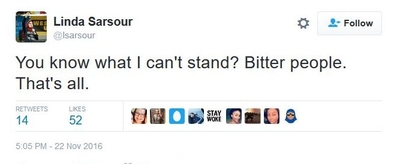
Palestinian activist Linda Sarsour took to Twitter Nov. 22 with a quick, venting post: “You know what I can’t stand? Bitter people. That’s all.”
Sarsour spoke at the annual American Muslims for Palestine (AMP) conference three days later. Evidently, she can’t stand herself.
Sarsour, who describes herself as a “racial justice and civil rights activist,” lashed out at Jews who extended a hand of friendship and solidarity over concerns that increasing hostility toward Muslims in America might lead to draconian government action. And she lashed out at fellow Muslims who accepted the gesture and joined in a new inter-faith dialogue.
Why the bitterness?
The Jews at issue support the state of Israel, support its existence and its vitality. Sarsour wants none of that.
“We have limits to the type of friendships that we’re looking for right now,” Sarsour told the AMP conference, “and I want to be friends with those whom I know have been steadfast, courageous, have been standing up and protecting their own communities, those who have taken the risk to stand up and say – we are with the Palestinian people, we unequivocally support BDS [boycott, divestment and sanctioning Israel] when it comes to Palestinian human rights and have been attacked viciously by the very people who are telling you that they’re about to stand on the front line of the Muslim registry program. No thank you, sisters and brothers.”
It’s a message that fit right in at the AMP conference. AMP claims its “sole purpose is to educate the American public and media about issues related to Palestine and its rich cultural and historical heritage.” But in practice, the group has defended Hamas and its leaders admit they seek “to challenge the legitimacy of the State of Israel.”
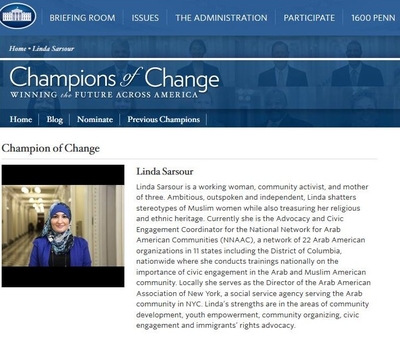
Sarsour, a media darling honored by the Obama White House as a “Champion of Change” and a high-profile surrogate for Bernie Sanders‘ failed Democratic presidential nomination campaign, seems to strike a different tone in public appearances. Her biography says she is “most known for her intersectional coalition work and building bridges across issues, racial, ethnic and faith communities.” That clearly wasn’t her intent at the AMP conference.
She acknowledges there’s a rift among Islamists about how hard a line to draw in the Israeli-Palestinian conflict, yet she was intent on pouring gasoline on the fire.
The “cracks in our community” are so wide, she said, they’re visible to “right-wing Zionists, Islamophobes, white supremacists.”
“They know where we’re divided. They know that we’re segregated,” she said. “So they, we could easily be targeted when we’re a fragmented community. But if we were a strong, united, steadfast community that stood up for each other first and foremost, you’d better believe that no opposition would ever be trying to take us down, because we’d be too big, too strong and too united.”
Some of her comments likely were directed at Anti-Defamation League chief Jonathan Greenblatt. Should a Trump administration create a registry for Muslims, an idea that does not seem to be on the table, Greenblatt recently pledged that “this proud Jew will register as Muslim.”
Sarsour not only rebuked the gesture, she cast Muslims who might respond more positively as sellouts of the Palestinian cause. Cooperation and solidarity gestures should only be reserved for those who share the depth of her hatred toward Israel, she said.
“I am tired of Muslims working towards acceptance and not respect of our communities. And I’m also tired of the Muslims willing to sell Palestine just for a little acceptance and nod from the white man and white power in these United States of America,” Sarsour said.
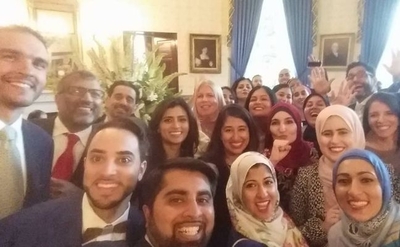 Sarsour, in the red hijab, poses with others at the White House Eid celebration.
Despite this extreme stance, Sarsour is a rising star among American Islamist activists. She has been welcomed to the White House at least 10 times during President Obama’s tenure, most recently in July for a celebration of the Muslim Eid holiday. Last year, a glowing New York Times profile described her as “a Brooklyn Homegirl in a Hijab.”
“But the most apparent thing about her voice is that it is exceedingly Brooklyn,” the story said. “She says ‘swag’ instead of ‘charisma.’ (‘Mr. B. has swag …) She calls her father, a Palestinian immigrant in his 60s, ‘Pops.’ Like the actress Rosie Perez in a hijab, Ms. Sarsour has perfected her delivery of the head-swaying ‘Oh no you dih-int’ and pronounces the word ‘Latino’ like, well, a Latino.”
Sarsour also says “nothing is creepier than Zionism,” and all-but accused the CIA of faking an attempted terrorist attack.
Those statements didn’t make the Times profile. And they didn’t prompt the Obama administration to reconsider the wisdom of elevating Sarsour’s clout with repeated White House access.
In February, just over a year after terrorists massacred the staff at the French magazine Charlie Hebdo, saying they “avenged the Prophet,” Sarsour told a Council on American-Islamic Affairs (CAIR) banquet in Chicago that she would not stand with the victims. The magazine was “a bigot and a racist” for publishing caricatures of Islam’s prophet Muhammad, she said. The images served to “vilify my faith, dehumanize my community [and] demoralize my prophet.”
Building off Sarsour’s rejection of anyone who breaks bread with Zionists, former AMP New York President Raja Abdulhaq defined the BDS movement – not as a tool to lead to peaceful negotiations – but as way to break Israel into total surrender.
Among the non-negotiable “rights” Abdulhaq says AMP and the BDS movement insist upon is the so-called “right of return” for Palestinians. That would lead to a huge influx of Palestinians into Israel, swamping the country demographically and ending its existence as a Jewish homeland.
That’s just fine with conference speaker Lamis Deek, an attorney and board memberfor CAIR’s New York chapter. She repeatedly described Israelis as “serial killers” intent on ethnic cleansing.
Like Sarsour, Deek expressed frustration at Muslims who accept other viewpoints.
“Nothing has set back the Palestinian movement in the U.S. more than demands by people who want to work and focus their efforts on [Washington] D.C., by their demands that we tame our demands for Palestine,” she said.
Dawud Walid, CAIR’s Michigan director, echoed the message about Muslim groups who appear too accommodating. “If these organizations claim to represent the Muslim community,” he said, “then when we see them doing things that go outside of the mainstream of the (UI word) of our community, we need to hold them accountable, and if they continue to step outside of the boundaries, then we should withdraw our support and make that very public.”
Walid has acknowledged that his employer, which works hard to project an image as a civil rights organization, really sees itself as “defenders of the Palestinian struggle.”
Deek, meanwhile, spoke of the harm done to the Palestinian cause by the U.S.-brokered Oslo Accords. While that initiative may have given Palestinians autonomy, it came at the cost of unity, she said.
It’s not clear what she means. But, since 2006, the Fatah-led Palestinian Authority has governed the West Bank while Hamas controls Gaza.
Oslo also made it more difficult to engage in terrorism – what Deek calls “armed resistance.”
Advocating more Palestinian violence is consistent for an AMP gathering. The organization’s message never mentions peaceful co-existence. An Investigative Project on Terrorism investigation found connections between at least five AMP officials and speakers and the defunct Hamas support network called the “Palestine Committee.”
During the 2014 war between Israel and Hamas, AMP’s then-National Campus Coordinator Taher Herzallah posted images of wounded Israelis, calling them “The most beautiful site (sic) in my eyes.” He defended indiscriminate Hamas rocket fire at Israeli civilian communities as “an audible cry for help” and “an act of resistance.”
Two clear messages emerged from the AMP conference. “Resistance” is better than renouncing violence and seeking peace. All Muslims who might disagree, even if they see eye-to-eye on other issues, are no longer welcome.
These extreme stands came from speakers who enjoy prominent political profiles and high-level contacts.
Sarsour is right about one thing. There is a rift in her community. She and her AMP panelists are the ones widening it.
Trump speaks with “president” of Taiwan, harasses her sexually, Dan Miller’s Blog, December 3, 2016
(The views expressed in this article are those of Pajama Boy’s father and do not necessarily reflect my views, those of the other editors, or Warsclerotic. — DM)
This is a guest post by a well-known political commentator, the father of Pajama Boy. He is a true “Obama patriot,” whose views should matter little after mid-day on January 20th.

Here are the thoughts of President Reject Obama:
President Elect Donald Trump violated all known rules of common decency by accepting a telephone call from Taiwanese “President” Tsai Ing-wen without My permission. Indeed, Ms. Tsai did as well by placing the call without My permission. Obviously, I would not have granted permission because it was just a trick, intended to embarrass Me and My fundamentally transformed country.
Chinese Foreign Minister Wang Yi said Saturday the call between Taiwan’s president and Trump was “just a small trick by Taiwan,” according to Hong Kong’s Phoenix TV.
Both should be ashamed and both are on the wrong side of both history and herstory. I will continue to treat the renegade Chinese province of Taiwan as an outcast from the community of well-behaved nations, while reassuring Chinese President Xi Jinping of My continued fealty. He is My good friend, the powerful leader China — and indeed our entire climate change ravaged world — needs.
Taiwan is not even a country. As noted here,
The call is widely believed to be the first between a U.S. president or president-elect and a leader of Taiwan since 1979, when diplomatic relations between the two were cut off. China regards Taiwan, a nearly 14,000 square-mile island off its coast, as a renegade province which should be returned to China ever since Gen. Chiang Kai-shek fled mainland China to Taiwan in 1949. [Emphasis added.]
The U.S. adopted a “One China” policy to help facilitate diplomacy with Beijing in 1972, and President Jimmy Carter formally recognized Beijing as the sole government of China in 1978. The U.S. embassy in Taiwan’s capital, Taipei, was closed in 1979. [Emphasis added.]
Since Ms. Tsai is merely the “president” of a rogue province of China not recognized by America, she is a make-believe president and a mere peon. It should be beneath the dignity of even a pitiful excuse for a President Elect like Trump even to consider talking with her.
Moreover, it is my understanding that Trump may well have attempted to harass her sexually, just as he does every female he encounters. Since they had “only” a telephone conversation and were probably separated by thousands of miles, it is possible that he did not attempt to grab her pussy, as he would have done had it been within reach.

Nevertheless, Trump doubtless lusted after her and “committed adultery” in what passes for his heart.
It is my sincere hope that, for as long as I am your President, America will continue to look up to, greatly admire and, in every other way possible, kowtow to the glorious People’s Republic of China, her generous leaders and her happy industrious workers. Our own workers should look up to and emulate them with great admiration, rather than childishly disparaging them and the products of their wholesome industry.
Editor’s comments
Since Taiwan is not a “real country” recognized by America, but is instead merely an estranged province of the People’s Republic of China, with no legitimate president other than Chinese President Xi Jinping, what’s the big deal? Had Trump accepted a phone call from (the ghost of) Homer Tomlinson, the self-proclaimed King of the World, would it have been seen as catastrophic?

Oh well.
President Elect Trump is committed to unraveling unfair trade deals with China and helping American businesses to compete fairly with Chinese businesses. China won’t like it, but as Pajama Boy’s father remarked a few years ago, “elections have consequences.” If that entails selling Taiwan more than we presently do, so be it.
Though the leaders of the U.S. and Taiwan in the last few decades have not been in contact, the U.S. has sold the island nation with weapons that the Chinese have perceived as an illegal act according to international law. In 2015, the U.S. sold $1.83 billion worth of weapons to Taiwan, which included anti-aircraft and anti-ship systems.
The more the merrier.
How about recognizing Taiwan as a sovereign nation, as we did until 1978 when President Carter withdrew recognition to appease China? Surely, Carter was not slighting the indigenous people of Taiwan. Was he?
“Taiwanese original inhabitants“) is the term commonly applied to the indigenous peoples of Taiwan, who number more than 530,000 and constitute nearly 2.3% of the island‘s population. Recent research suggests their ancestors may have been living on Taiwan for approximately 8,000 years before a major Hanimmigration began in the 17th century.[2]Taiwanese aborigines are Austronesian peoples, with linguistic and genetic ties to other Austronesian ethnic groups, which includes those of the Philippines, Malaysia, Indonesia, Madagascar and Oceania.[3][4] The issue of an ethnic identity unconnected to the Asian mainland has become one thread in the discourse regarding the political status of Taiwan. [Emphasis added.]
For centuries, Taiwan’s aboriginal inhabitants experienced economic competition and military conflict with a series of colonizing newcomers. Centralized government policies designed to foster language shift and cultural assimilation, as well as continued contact with the colonizers through trade, intermarriage and other intercultural processes, have resulted in varying degrees of language death and loss of original cultural identity. For example, of the approximately 26 known languages of the Taiwanese aborigines (collectively referred to as the Formosan languages), at least ten are now extinct, five are moribund,[5] and several are to some degree endangered. These languages are of unique historical significance, since most historical linguists consider Taiwan to be the original homeland of the Austronesian language family.[2] [Emphasis added]
Taiwan’s Austronesian speakers were formerly distributed over much of the island’s rugged central mountain range and were concentrated in villages along the alluvial plains. The bulk of contemporary Taiwanese aborigines now live in the mountains and in cities.
The indigenous peoples of Taiwan face economic and social barriers, including a high unemployment rate and substandard education. Since the early 1980s, many aboriginal groups have been actively seeking a higher degree of political self-determination and economic development.[6] The revival of ethnic pride is expressed in many ways by aborigines, including the incorporation of elements of their culture into commercially successful pop music. Efforts are under way in indigenous communities to revive traditional cultural practices and preserve their traditional languages. The Austronesian Cultural Festival in Taitung City is one means by which tribe members promote aboriginal culture. In addition, several aboriginal tribes have become extensively involved in the tourism and ecotourism industries with the goal of achieving increased economic self-reliance and preserving their culture.[7] [Emphasis added]
China’s dominion over Taiwan, and therefore over her indigenous people, seems likely to hasten their cultural genocide. Might that be why “The issue of an ethnic identity unconnected to the Asian mainland has become one thread in the discourse regarding the political status of Taiwan?” Where are the leftists, who loudly and routinely bemoan the ill-treatment of indigenous peoples elsewhere — except, of course, the indigenous Jews of Israel whom they seek to replace with Arabian Palestinians who want to eliminate them as part of their final solution to the “Jewish problem?”
The Israel-Palestinian impasse after Trump, Israel National News, Dr. Mordechai Nisan, December 1, 2016
There will likely be a dramatic shift in American Middle East foreign policy free of Oriental enthusiasms, abstract paradigms of a new regional order, and State Department ‘Arabists’ who consider Zionism the root cause of the conflict. Donald Trump’s hard-nosed political realism and sympathetic attitude toward Israel will at long last set the record straight. His pre-election statements point to a fundamental change which acknowledges that Israel alone decides on its national interests, based on sacred values, geo-strategic environment, and accumulated experience.
***************************
Soon after the end of the June 1967 Six Day War, Israel’s Foreign Minister Abba Eban met in New York with U.S. Secretary of State Dean Rusk. Eban was asked about Israel’s thinking on a future political settlement following her extraordinary military victory and territorial conquests. He responded that the Israeli government had decided on June 19 that in exchange for peace agreements, Israel would return the Sinai Peninsula to Egypt and the Golan Heights to Syria, while considering granting autonomy to the Arab population in the ‘West Bank’.
Rusk, Eban later recorded in his autobiography, could hardly believe what he was saying and responded that “he did not know of any case in modern history where a country, which had been attacked and emerged victorious, put forward such daring proposals so soon after.” President Johnson considered that Israel’s position was “constructive;” while Gideon Rafael, Israel’s Ambassador to the United Nations, later wrote that the Secretary of State was impressed by Israeli “moderation.”
When Donald Trump will meet with Binyamin Netanyahu, it is reasonable to assume that the President will ask the Israeli Prime Minister – fifty years after the Rusk-Eban exchange – how he envisions a political resolution of the conflict with the Palestinians.
***
After the liberation of Judea and Samaria from Jordanian rule, political controversy engulfed the Israelis into interminable division. Historically, the political Center-Left was not always, as it later evolved, opposed to Jewish settlement and Israeli territorial retention.
In May 1973 Minister of Defense Moshe Dayan said in a BBC TV interview: “Israel should remain for eternity and until the end of time in the West Bank…if Palestinians didn’t like this, they could go and establish themselves in an Arab country.” Prime Minister Golda Meir was decisive in her autobiography: “Obviously, no Israeli government could ever obligate itself to a permanent banning of Jews from any part of the Holy Land.”
Since the dramatic Likud victory in 1977, Israel’s political Left has withered. Their last and distant election victory was in 1999, having cast aside principles endorsed by Dayan and Meir and which later became the hallmark of patriotism and realism for Begin, Shamir, and Netanyahu.
***
n February 1945, toward the end of the Second World War, President Roosevelt assured King Abdul Aziz al-Saud “that he would do nothing to assist the Jews against the Arabs and would make no move hostile to the Arab people.” In 2017 President Trump can assure Prime Minister Netanyahu that he would do nothing to assist the Arabs against the Jews and would make no move hostile to the Israeli people.
This policy position will clear the political slate by burying the delusional Oslo Accords which failed to elicit mutual trust and reconciliation, cancelling the phony peace process which is all one-sided for the Palestinians, and invalidating the two-state solution whose complexity far surpasses its simple appellation. The Palestinians refuse to recognize the Jewish state, claiming all of Palestine for themselves.
Let us be clear on what we know about sociology, religion, and politics in Palestinian culture. A Palestinian state in Judea and Samaria would bear the defective features of harrowing clan tribalism, Islamic fanaticism, and simmering violence. This rogue and irredentist state would be a disaster for Arab autonomy – but not a Palestinian state – in Judea and Samaria is the maximum concession that Israel can offer without endangering its safety.
There will likely be a dramatic shift in American Middle East foreign policy free of Oriental enthusiasms, abstract paradigms of a new regional order, and State Department ‘Arabists’ who consider Zionism the root cause of the conflict. Donald Trump’s hard-nosed political realism and sympathetic attitude toward Israel will at long last set the record straight. His pre-election statements point to a fundamental change which acknowledges that Israel alone decides on its national interests, based on sacred values, geo-strategic environment, and accumulated experience.
Presidential candidate Donald Trump declared to a large and enthusiastic AIPAC audience on March 21, 2016: ‘the days of treating Israel as a second-class citizen will end on day one’ [following his inauguration].
***
Six components shape a political solution for the intractable conflict in the Land. Let us transcend sloganeering – like “territories for peace” – and scale the high ground for a new, radical, and sensible approach. With the encouragement and resources of Washington, a new Israeli plan may actually work.
Here is the six-point plan:
A/1: Jewish settlement in Judea and Samaria is the national and civilian expression of a biblical promise to the patriarch Abraham – the Land of Israel belongs to the ancient Jewish people.
A/2: Israeli sovereignty in Judea and Samaria is the only political condition that can provide the country with minimum strategic depth and topographical command, securing itself from military and security threats and perils.
B/1: Arab autonomy – but not a Palestinian state – in Judea and Samaria is the maximum concession that Israel can offer without endangering its safety.
B/2: Arab migration eastward to Jordan should be encouraged and financed in shaping new demographic and political realities in the spirit of the formula: the Palestinians east of the Jordan River and only Israel west of the river.
C/1: UNRWA, an international trough supplying resources for Palestinian terrorism and hateful propaganda against Israel, having routinized Palestinians’ dependency and subservience as wards of global exploitation must be shut down by America cancelling its financial support.
C/2: Palestinian refugees from 1948 – few of whom are still alive and whose progeny incongruously fills the refugee rolls – should be freed from their collective humiliation and squalor, as in Lebanon, through resettlement in Jordan, Iraq, South America, West Africa, and elsewhere.
The broad ramifications of this ABC plan will redraw the political and demographic map; out of the box, we can finally think again.
***
Trump launched a paradigm shift in America; can Netanyahu, with Trump’s support, launch his in Israel?
Donald Trump challenged, ridiculed, and vilified, the icons of Political Correctness: regarding the environment, government, globalization, trade, Islam, race and immigration.
The march of political folly must end. The unfolding circumstances can now sustain a historic paradigm shift on the century-old conflict between Arabs and Jews in the Holy Land.
Sent to Arutz Sheva by the writer, also appeared on Frontpage.com.
The UN’s Palestine Language, Gatestone Institute, A.J. Caschetta, November 30, 2016
For decades, UN agencies have slandered the Jewish state, most recently with the April 2016 accusation that it has been “planting Jewish fake graves” in Palestinian territory, and with UNESCO declaring last year that the ancient Jewish Biblical sites Rachel’s Tomb and the Cave of the Patriarchs are actually Muslim holy sites, and last month that the Temple Mount, where the Jewish Temples were destroyed in 587 BCE and 70 CE, is an Islamic site with no connection to Judaism.
West Bank: This territory was for millennia called Judea and Samaria. After the 1948 War of Independence, Transjordan annexed it, renamed it the “West Bank,” and occupied it for nearly two decades. In the Six Day War, after Jordan attacked Israel, Israel entered the territory and administered it until the Oslo Accords era, when Israel turned over much of the area to the Palestinian Authority.
Occupation: When it comes to Israel, the UN is obsessed with the word “occupation.” A recent Wall Street Journal article documents 530 General Assembly references to Israel as an “occupying power” versus zero for Indonesia (East Timor), Turkey (Cyprus), Russia (Georgia, Crimea), Morocco (Western Sahara), Vietnam (Cambodia), Armenia (Azerbaijan), Pakistan (Kashmir), or China (Tibet). Saying that Jews are “occupying” Judea is as nonsensical as saying Arabs are “occupying” Arabia or Gauls are “occupying” France.
Settlement: The UN uses the term to insinuate Israeli theft of “Palestine.” The Obama administration eagerly embraced this terminology. If there is an occupying force in Gaza, it is Hamas. The West Bank is “disputed territories” to anyone claiming a modicum of neutrality. As Elliot Abrams put it, “the term ‘settlement’ loses meaning when applied to Jews building homes in their nation’s capital city.”
US President-elect Donald Trump won the White House promising to reform our dysfunctional government. But will he also stand up to the even more dysfunctional United Nations?
As the Trump campaign emphasized in a position paper released November 2, the UN has long displayed “enormous anti-Israel bias.” For decades, UN agencies have slandered the Jewish state, most recently with the April 2016 accusation that it has been “planting Jewish fake graves” in Palestinian territory, and with UNESCO declaring last year that the ancient Jewish Biblical sites Rachel’s Tomb and the Cave of the Patriarchs are actually Muslim holy sites, and last month that the Temple Mount, where the First and Second Jewish Temples were destroyed in 587 BCE and 70 CE, is an Islamic site with no connection to Judaism. On the day America elected a new president, the UN adopted ten new resolutions against Israel.
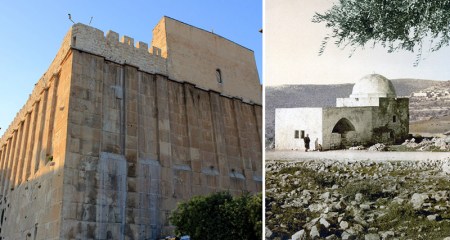 UNESCO last year declared ancient Jewish Biblical sites to actually be Muslim holy sites: the Tomb of the Patriarchs in Hebron (left) as the “Ibrahimi Mosque,” and Rachel’s Tomb in Bethlehem (right) as the “Bilal ibn Rabah Mosque.” (Images source: Wikimedia Commons)
The UN’s greatest achievements against the Jewish state have been rhetorical. By controlling the language of the Palestinian-Israel conflict, the UN has skewed the narrative falsely against Israel. This fabricated language is, in turn, absorbed and perpetuated by the media (both old and new), academics, politicians, and pop culture figures such as Roger Waters, further tainting the world’s perception of the conflict.
UN documents regularly use the term “occupied Palestine” and refer to “occupied Palestinian territory” (especially the “West Bank”) being stolen by Jewish “settlement activity.” All four UN terms — “Palestine,” “occupation,” “West Bank,” and “settlement” — are misleading.
Palestine: While UN documents regularly refer to “Palestine” and “the State of Palestine,” there is, in fact, no state of Palestine. As David Bukay shows “there has never been a land known as Palestine governed by Palestinians at any time in history.” Until recently there have never been a people nor a culture known as “Palestinian” distinct from “Arab.” The Arabs who lived in UN Mandated Palestine turned down statehood in 1947 by rejecting UN Resolution 181. In 1974 the UN recognized the PLO, a terrorist organization, as the official representative of the Palestinian people, paving the way for its emergence from the Oslo peace process under the guise of the Palestinian Authority (PA). In 2000, the PA turned down yet another offer of statehood because the offer did not recognize the “right of return” for millions of descendants of those displaced in 1948 to relocate to within Israel — a population transfer that would eliminate the existence of a Jewish state by demographic means. In 2012, the UN General Assembly upgraded the PA/PLO government to “Non-member Observer State”; UN rules dictate that new member states can only be created by the Security Council.
West Bank: The term “West Bank” is also a misnomer. In fact, this territory was for millennia called Judea and Samaria. After the 1948 War of Independence, Transjordan (now known as the Kingdom of Jordan) annexed it, renamed it the “West Bank,” and occupied it for nearly two decades. In the Six Day War, after Jordan attacked Israel, Israel entered the territory and administered it until the Oslo Accords era; then it turned over much of the area to the Palestinian Authority. The final borders of a Palestinian state were left contingent upon Palestinian progress in ending terrorism and bilateral negotiations over presumed land swaps.
Occupation: When it comes to Israel, the UN is obsessed with the word “occupation.” A recent Wall Street Journal article documents 530 General Assembly references to Israel as an “occupying power” versus zero for Indonesia (East Timor), Turkey (Cyprus), Russia (Georgia, Crimea), Morocco (Western Sahara), Vietnam (Cambodia), Armenia (Azerbaijan), Pakistan (Kashmir), or China (Tibet). UNESCO’s “Occupied Palestine” document uses the phrase “Israel, the occupying Power” thirteen times.
Most Palestinians in Judea and Samaria live under the governance of the Palestinian Authority. Referring to this territory as the “occupied West Bank,” is an unnecessary concession to the UN narrative. Saying that Jews are “occupying” Judea is as nonsensical as saying Arabs are “occupying” Arabia or Gauls are “occupying” France. Nevertheless many media sources (Washington Post, New York Times) use this term reflexively. New-media sources often take it a step farther. Any Google search combining the words “occupation” and “Israel” leads to a “People Also Ask” drop-down offering the following: “At the heart of the Israel/Palestine conflict today lies the question of the Palestinian territories occupied by Israel since the war of 1967, which include the West Bank, Gaza Strip and East Jerusalem.” Somehow Google missed the fact there have not been Israelis in Gaza since 2005.
Settlement: The term “settlement” evokes imagery of white European settlers encroaching on the ancestral territories of red, brown and black peoples, connoting the moral baggage of colonialism. The UN uses the term to insinuate Israeli theft of “Palestine.” In truth, many of the “West Bank settlers” bemoaned by the UN are not pioneers from other lands but infants, new members of growing families in long-established Jewish neighborhoods.
The Obama administration eagerly embraced this terminology. On July 27, Obama State Department spokesman John Kirby issued a statement that reads as though it were written at the UN. The document, entitled “Recent Israeli Settlement Announcements,” suggests that Obama’s State Department has come around to the UN’s way of thinking, especially in “strongly condemning” Israel for its “settlement activity” which it pronounces “corrosive to the cause of peace.”
Now that South Carolina governor Nikki Haley has been chosen as the Trump administration’s Ambassador to the UN, it will be up to her to challenge the UN’s ahistorical, slanted Palestine thinking. If there is an occupying force in Gaza, it is Hamas. What Israelis call Judea and Samaria, and Palestinians call the West Bank, are “disputed territories” to anyone claiming a modicum of neutrality. As Elliot Abrams put it, “the term ‘settlement’ loses meaning when applied to Jews building homes in their nation’s capital city.”
Moving the US Embassy to Jerusalem, Israel National News, Dr. Max Singer, November 30, 2016
(Please see also, Jimmy Carter wants UN to impose a Palestinian state by fiat, with US recognition. — DM)
The US State Department, which has always opposed moving the US embassy in Israel from Tel Aviv to Jerusalem, understands very well that any peace agreement between Israel and the Palestinians will leave at least western Jerusalem as Israel’s capital and part of sovereign Israel. So why will the State Department nevertheless advise President-Elect Donald Trump not to fulfill his promise to move the embassy?
Moving the embassy to Israel’s actual capital would provoke Arab anger at the US and lead to protests that might turn violent. The foreign policy establishment wishes to prevent this result and protect America’s status as an “honest broker.” It therefore continues to insist that because Jerusalem’s ultimate status can only be determined by agreement between Israel and the Palestinians, and that it would be wrong for the US to “prejudge” the outcome by acting on the truth that Israel’s capital is Jerusalem.
This is a perfect example of the kind of politically-correct establishment pettifogging that Trump campaigned against. Moving the embassy to Jerusalem is a low-cost action that he could take as soon as he is inaugurated, and one of the easiest and quickest changes in policy that he could implement. The new US consulate in Jerusalem was built with security features that would be needed for an embassy, so the move could be started almost immediately, without any prejudice to the Palestinian claim to eastern Jerusalem.
The State Department’s insistence on the diplomatic fiction that none of Jerusalem is part of Israel helps preserve the Palestinian hope that, someday, Israel will be forced to give up its capital and will be destroyed as the independent, democratic Jewish state.
That Palestinian hope is the main obstacle to peace. The Palestinians can only make peace when their community – and perhaps the Arab world of which it is a part – comes to understand that international pressure will never force Israel to acquiesce in its own destruction. One of the best ways the US can demonstrate that it will never consent to the Palestinian destruction of Israel is for Washington to stop ignoring blatant Palestinian lies that work against peace.
There is another way that an American truth-telling strategy could encourage peace. Palestinian leadership now tells its people – and most of them believe – that compromise with Israel would be immoral because Israel is a colonial invader that stole Palestinian land by force. By that argument, Israel has no moral claim to any of the land, and any concession to it would be dishonorable.
But Israel is descended from Jewish kingdoms that ruled parts of the land for centuries in ancient times. It too has a traditional base for moral claims to the territory (in addition to legal claims from the League of Nations mandate). If the Palestinians recognized this truth, they would see that compromise between the two groups, each of which has valid claims to the land, could be an honorable way to end the dispute and not a cowardly yielding to force.
To undermine this moral basis for compromise with Israel, Palestinian leadership flatly denies any ancient Jewish connection to the land. They claim, for example, that there never was a Jewish temple on the Temple Mount from which Jesus could have chased the money-changers. Yet their own history belies this claim. In 1929, the Supreme Moslem Council in Jerusalem, in its guide to the Mount, wrote: “[The Temple Mount’s] identity with the site of Solomon’s Temple is beyond dispute.”
The US may not be able to induce the Palestinian Authority to stop inciting its constituents and teaching its children to hate Israel. But there are ways in which the US can expose and eventually defeat Palestinian lies that work against peace; ways that do not require getting agreement from anyone.
Exploring these new approaches would constitute a striking change in diplomatic direction. There are many examples of the West rejecting truth on behalf of the Palestinians and their Arab supporters. For example, some Western countries went along with the recent denial by UNESCO of any ancient Jewish connection to the land of Israel. The US politely ignores the Palestinian lie that there was never a Jewish temple on the Temple Mount.
If the US consistently tells the truth about the ancient Jewish presence in Palestine, and publicly refuses to swallow the Palestinians’ false and anti-peace denials of history, the Palestinian leadership will not for long be able to keep the truth from their people, or at least from the large educated class.
The US has followed a policy of avoiding truths that are painful or embarrassing to the Arabs for at least 50 years. It hasn’t worked. Maybe it is time to try the strategy of telling the truth. Moving the US embassy to Jerusalem, in accordance with the long-standing congressional position, would be a good way for President Trump to make a start on a truth-telling strategy – as well as to fulfill a campaign promise.
Palestinians: The ‘Wall of Shame’, Gatestone Institute, Khaled Abu Toameh, November 28, 2016
“The equation facing the Palestinian factions is clear: Hand over the terrorists and there will be no wall. The Palestinians have proven that they are unable to take security matters into their own hands in this camp.” — Lebanese security official.
These anti-Palestinian practices are regularly ignored by the international community, including mainstream media and human rights organizations, whose obsession with Israel blinds them to Arab injustice. A story without an anti-Israel angle is not a story, as far as they are concerned
Typically, Western journalists and human rights activists do not even bother to report or document cases of Arab mistreatment of Arabs. This abandonment of professional standards is why apartheid laws targeting Palestinians in several Arab countries are still unknown to the international community.
The Lebanese authorities also say that they decided to build the wall after discovering several tunnels in the vicinity of Ain al-Hilweh, used to smuggle weapons and terrorists into and out of the camp.
The new wall will not solve the real problem — namely the failure to absorb the refugees and grant them citizenship. Palestinians living in Arab countries are denied citizenship (with the exception of Jordan) and a host of basic rights.
Now is the time for the international community to apply pressure to the Arab countries to start helping their Palestinian brothers by improving their living conditions and incorporating them into these countries.
The refugee problem will end the day their leaders stop lying to them and confront them with the truth, basically that there will be no “right of return” and that the time has come for them to move on with their lives
It is no secret that Arab countries have long mistreated their Palestinian brothers and sisters, governing them with inhumane laws and imposing severe restrictions on their public freedoms and basic rights. Building a wall around a Palestinian community to prevent terrorists from entering or leaving, however, has raised the bar on such infringements.
This is precisely what is happening in Lebanon these days. The construction of a security wall around Ain al-Hilweh, the largest Palestinian refugee camp (with a population of nearly 120,000), has drawn sharp criticism from Palestinians and revived memories of the abuse they regularly receive at the hands of their Arab brethren.
The Lebanese authorities say the Palestinians have left them no choice but to build the controversial concrete wall. The Palestinians, they say, refuse to cooperate against terrorists who have established bases within their camps. Yet that problem raises the question: “What has Lebanon done in the past half-century or so to help the Palestinians who fled to that country?” The answer: “Nothing.”
In fact, among all Arab countries, Lebanon has been arguably the worst in its treatment of the Palestinians. Palestinian refugees in Lebanon are denied access to adequate housing and certain categories of employment. According to Amnesty International: “Over half of Palestinian refugees live in decaying and chronically overcrowded camps and discriminatory practices are permitted under personal status laws and nationality laws.”
These anti-Palestinian practices are regularly ignored by the international community, including the mainstream media and human rights organizations, whose obsession with Israel blinds them to Arab injustice. While, every now and then, an organization does publish a report on the misery endured by Palestinians in Arab countries, these bodies rarely follow up on their work, thus creating the impression that they are doing so only for the sake of protocol.
As such, the plight of the Palestinians in many Arab countries continues to be a taboo, as far as the international community is concerned. Typically, Western journalists and human rights activists do not even bother to report or document cases of Arab mistreatment of Arabs. This abandonment of professional standards is why apartheid laws targeting Palestinians in several Arab countries are still unknown to the international community. Even when Western journalists and human rights advocates do hear about these violations, they prefer to look the other way. A story without an anti-Israel angle is not a story, as far as they are concerned.
So what is going on in Lebanon, and why are so many Palestinians furious with the Lebanese authorities?
Until a few years ago, the population of Ain al-Hilweh camp was 70,000. But the influx of refugees fleeing the civil war in Syria, since 2011, has increased the camp population to nearly 120,000. It turns out that many of these new “refugees” are actually terrorists fleeing from Syria and Iraq.
 A street celebration in Lebanon’s Ain al-Hilweh camp, July 2015. (Image source: Geneva Call/Flickr)
Ain al-Hilweh, like most of the camps in Lebanon, has always been a major headache for the Lebanon. It seems, however, that the Lebanese government has had enough.
For years, the Lebanese authorities, for whom the camp is “off-limits,” have been trying, unsuccessfully, to clean the camp of its hundreds of terrorists.
Lebanese security forces steer clear of the refugee camps in an attempt to avoid friction with the Palestinians living there. This evasion has allowed the camps to become hotbeds for various jihadi groups and terrorists who pose a threat not only to the national security of Lebanon, but to Palestinians themselves and neighboring Arab countries such as Jordan, Egypt and Syria (not to mention Israel).
Alarmed by this heightened threat, the Lebanese authorities recently began building a concrete wall around Ain al-Hilweh, sparking a wave of denunciations from Palestinians. The Palestinians claim that the new wall, which will be completed in 15 months, will turn the camp into a big open-air prison. They refer to it as the “Wall of Shame.” Their main argument is that it is disgraceful that any Arab country would build a wall surrounding a refugee camp at a time when Palestinians are asking the world to condemn Israel for building a security fence to prevent terror attacks against Israelis from the West Bank.
Camp residents claim that the Lebanese authorities have misled them concerning the construction of the wall. According to the residents, the authorities led them to believe that it was to be a small fence on the outskirts of parts of the camp and not a massive concrete wall surrounding the camp.
The Lebanese security authorities have chosen to call the new barrier the “Wall of Protection” — stressing that it is mainly intended to prevent terror attacks against Lebanon and stop the camps from becoming bases for terrorists and criminals. The authorities say that if anyone is to blame for the construction of the wall, it is the Palestinians themselves, who have refused to cooperate with the Lebanese government against the terrorists. “The goal is to prevent terrorists from infiltrating the camp,” explained a Lebanese security official. “The equation facing the Palestinian factions is clear: Hand over the terrorists and there will be no wall. The Palestinians have proven that they are unable to take security matters into their own hands in this camp.”
The Lebanese authorities also say that they decided to build the wall after discovering several smuggling tunnels in the vicinity of Ain al-Hilweh. These tunnels, they say, are being used to smuggle weapons and terrorists into and out of the camp.
Representatives of Ain al-Hilweh and other Palestinians have been holding marathon meetings with Lebanese government officials in the past few weeks to persuade them to halt the construction of the wall. The Palestinians in Ain al-Hilweh are now threatening that if the Lebanese government does not cancel the project, they will seek the intervention of other Arab, and also Western, countries, as well as the United Nations.
Notably, the Palestinian Authority (PA) leadership in the West Bank has not joined in the efforts to persuade the Lebanese government to drop the idea of building a wall around the camp. This avoidance probably springs from the PA leadership and its president, Mahmoud Abbas, being well aware that Ain al-Hilweh and other refugee camps in Lebanon have fallen into the hands of their enemies, namely Hamas, Islamic Jihad, Islamic State and Al-Qaeda.
The “Wall of Shame” appears particularly to bother Hamas leader Khaled Mashaal. Last week, he telephoned a number of Lebanese officials, including Prime Minister Tammam Salam and Parliament Speaker Nabih Berri, to warn about the consequences of the construction of the wall. Mashaal, who is based in Qatar and enjoys a luxurious life most Palestinians can barely dream of, urged the Lebanese government to halt construction if the wall and said that the wall jeopardized the lives of Palestinian refugees and would have “negative repercussions.”
Hamas’s spokesman in Lebanon, Ra’fat Murra, dismissed Lebanon’s security concerns for building the wall. He warned that the wall would turn the camp into an isolated enclave and exacerbate tensions between Palestinians and Lebanese. Murra, however, expressed readiness to cooperate with the Lebanese authorities in apprehending and handing over wanted terrorists who had found shelter inside Ain al-Hilweh.
Protests against the wall reached their peak when hundreds of Palestinians (and some Lebanese) took to the streets of the nearby city Sidon, in southern Lebanon, calling on the government to stop construction immediately. The protesters warned that the wall would further increase tensions between Palestinians and Lebanese, and further reduce the quality of life for the camp residents.
Lebanon may be justified in building a security wall around the Palestinian refugee camp. Without a doubt, Ain al-Hilweh and other camps have become hubs for terror groups and criminals, and Lebanon has every right to combat terrorism. Yet, Lebanon needs to come up with ways to assimilate, rather than alienate, the Palestinians. Furthermore, this is a problem that extends beyond Lebanon’s borders. The same applies to the camps in the West Bank, Gaza Strip and Syria and Jordan.
The continued mistreatment of Palestinians at the hands of Lebanon and other Arab countries is totally unjustified. The new wall, complete with watchtowers, that is being erected around Ain al-Hilweh may stop some terrorists from infiltrating the camp, but it will not solve the real problem — namely the failure to absorb the refugees and grant them citizenship. In point of fact, Palestinians living in Arab countries are denied citizenship (with the exception of Jordan) and a host of basic rights.
Now is the time for the international community to apply pressure to the Arab countries to start helping their Palestinian brothers by improving their living conditions and incorporating them into these countries. Holding Palestinians in refugee camps for more than six decades is deadly counterproductive. The camps become sanctuaries for terrorists who pose a threat to the national security and stability in these Arab countries. There is no reason why a Palestinian living in Lebanon or Egypt or Kuwait should be banned from purchasing his or her own home.
Moreover, Arab states’ lies concerning the return of refugees to former homes inside of Israel, so long a staple fed to the refugees, have far outlived their usefulness. The refugee problem will end on the day their leaders stop lying to them and confront them with the truth, basically that there will be no “right of return” and that the time has come for them to move on with their lives.
If the lies do not end, the day will come when these countries will be forced to place all the refugees behind walls and fences — a move not likely to enhance stability in these countries. Ain al-Hilweh should serve as a wake-up call to all those Arabs who continue to subject Palestinians to apartheid laws and practices.
Qatar’s Shopping Spree to Buy and Displace the West? Gatestone Institute,Giulio Meotti, November 11, 2016
Qatar sits on the executive board of the United Nations Educational, Scientific and Cultural Organization (UNESCO), the UN agency that has just erased 3000 years of Jewish history in Jerusalem, and has set its sights on the main chair at UNESCO: as the successor of UNESCO’s secretary general, Irina Bokova.
Human rights organizations have already promoted a campaign to prevent Qatar’s Kawari from taking the UNESCO seat. Citing a vast amount of anti-Semitic material present at the Doha Book Fair, Kawari’s flagship, the Simon Wiesenthal Center launched a campaign against his candidacy.
Qatar is the puppeteer behind UNESCO’s anti-Semitic resolution on Jerusalem, and a world center of Islamic extremism. Qatar does not make a secret of trying to submit Western culture to the Muslim crescent.
The Soviet Union, during the Cold War, invested in propaganda operations in the West to subvert capitalism and democracy. Communism found precious allies in the so-called “useful idiots” who facilitated Soviet work in academia, newspapers and publishing houses. Political Islam has been using the same convenient outlets and mechanisms to spread Islamic sharia law in the West.
The old role of Soviet propaganda has now been taken up by Islamic regimes. Qatar, for instance, is not only interested in buying large segments of Europe’s economy (Hochtief, Volkswagen, Porsche, Canary Wharf and Deutsche Bank), but also in playing a key role in Europe’s culture.
Qatar sits on the executive board of the United Nations Educational, Scientific and Cultural Organization (UNESCO), the UN agency that has just erased 3000 years of Jewish history in Jerusalem, and has set its sights on the main chair at UNESCO: as the successor of UNESCO’s secretary general, Irina Bokova.
The favorite for this race is, in fact, the former minister of culture of Qatar from 2008 to 2016, Hamad bin Abdulaziz al Kawari, who currently serves as “cultural adviser to the Emir,” Sheikh Tamim bin Hamad Al Thani. In 2017, the UNESCO leadership is supposed to go to a representative of the Arab world, according to the rule of geographic rotation; Kawari will have to defeat the candidacy of a Lebanese and an Egyptian.
Kawari recently landed in Rome, apparently to start his promotional tour, and he met with its mayor, Virginia Raggi, who received the Islamic emirate’s delegation. Kawari received an honorary degree from Tor Vergata University, Rome’s second most important university. The photo of the ceremony speaks volumes about political Islam’s level of penetration in Europe’s academic culture. Abdullah Bin Hamad Al Attiyah, Qatar’s former deputy prime minister, even spoke at Tor Vergata.
 Qatar’s Hamad bin Abdulaziz al Kawari (center), who serves as “cultural adviser to the Emir,” is pictured receiving an honorary degree from Rome’s Tor Vergata University last month. (Image source: Askanews video screenshot)
Kawari also had a meeting with Italy’s minister of culture, Dario Franceschini and minister of education, Stefania Giannini.
Last June, Kawari was also in the Vatican to meet with Pope Francis and sign an agreement between the Vatican Apostolic Library and the Qatar Foundation for Education. Kawari, fluent in Arabic, English and French, is an affable man of the world, at home in Paris, where he graduated from Sorbonne University; his climb to the leadership of UNESCO has the support of the rulers of the Gulf and Saudi Arabia.
Human rights organizations have already promoted a campaign to prevent Kawari from taking the UNESCO seat. Citing a vast amount of anti-Semitic material present at the Doha Book Fair, Kawari’s flagship, the Simon Wiesenthal Center launched a campaign against his candidacy. In a letter to Kawari, Shimon Samuels, Director for International Relations of the Wiesenthal Center, said the material on display every year in Doha “violates the values promoted by Unesco“.
Samuels listed at least 35 anti-Semitic titles, including nine editions of the anti-Semitic forgery The Protocols of the Elders of Zion, four editions of Mein Kampf by Adolf Hitler, and four editions of Henry Ford’s The International Jew. “From this point of view, Doha is far from Paris,” said Samuels, referring to the general headquarters of UNESCO.
Qatar is the puppeteer behind UNESCO’s anti-Semitic resolution on Jerusalem, and a world center of Islamic extremism. Doha just held a meeting between the Palestinian Authority’s leader, Mahmoud Abbas, and the heads of Hamas, a terrorist organization devoted to the destruction of the State of Israel. Qatar does not make a secret of trying to submit Western culture to the Muslim crescent. The only question is, which country’s culture will UNESCO erase next?
The Qatari royal family is now much involved in “the arts.” According to the BBC, “To take a recent example, the Qatari royal family sponsored the Tate’s Damien Hirst retrospective. It’s now moved to Doha, where Tate director Nicholas Serota attended the official launch.” Major works by Warhol, Bacon, Rothko, Koons and Hirst are all thought to have made their way to Qatar.
Qatar is buying academic chairs in Europe’s universities, such as the pact between Doha and Rome’s Tor Vergata. What is the university presumably expected to do for Qatar in exchange for that? Qatar academic purchases are also the subject of Le Monde’s investigation entitled, “Tariq Ramadan: le sphinx,” which details how Tariq Ramadan, the well-known European Muslim intellectual, was been able to obtain a chair at the University of Oxford. Mediapart, the French leftist magazine, ran a long exposé about Tariq Ramadan as “Qatar’s showcase.”
The Qatari monarchy, in 2015 alone, donated £11 million to renew Oxford’s St Antony’s College, where Tariq Ramadan works. Sheikha Moza, the wife of Emir Al Thani, inaugurated the magnificent building designed by the late architect, Zaha Hadid.
Qatar also financed the creation of an Islamic section at the Bloomsbury publishing house and the “Doha Debates” program that aired on the BBC. It would be interesting to know how Qatar’s sharia can find agreement with the sybaritic Bloomsbury’s British culture.
The attorney-general of Qatar also signed an agreement with the president of Sorbonne University, Philippe Boutry, in Paris, for the enrollment of hundreds of migrants from the Middle East. The Sorbonne accepted 600,000 euros a year, for three years.
Many British universities also receive large donations from Qatar. University College London, for example, has an archeology campus in Qatar. The Qatar Development Fund recently donated $4.3 million to the Margaret Thatcher Scholarship Trust at Oxford University.
Qatar is also having a shopping spree in American universities, and is funding their university departments in the Arabian desert. Universities such as Cornell, Carnegie Mellon, Georgetown, Texas A&M and Virginia Commonwealth have all signed agreements with Emir Al Thani. Each will receive $320 million dollars a year.
Students of American Universities based in Doha are also invited to attend the sermons of Yusuf al-Qaradawi, the spiritual mentor of the Muslim Brotherhood, who is known for his hate-ridden religious edicts. The Simon Wiesenthal Center has called it “outrageous” for Cornell University to decide to open a campus in Doha while the kingdom funds Hamas’s war against Israel.
The Financial Times once called Qatar “the world’s most aggressive deal hunter.” Emir Al Thani is now promoting a takeover of Western culture. But very few in Europe seem to care about that. Is it because “it is difficult to avoid its money and influence“, especially for an economically depressed Europe? With their telling silence, are they simply aligning with Qatar’s sharia rulers, and hoping they will chosen to be bought out next?
Palestinians: The “Mountain of Fire” Erupts Against Abbas, Gatestone Institute, Khaled Abu Toameh, August 25, 2016
♦ The Palestinian Authority is now paying the price for harboring, funding and inciting gang members and militiamen who until recently were hailed by many Palestinians as “heroes” and “resistance fighters.”
♦ Hamas’s dream of extending its control to the West Bank now seems more realistic than ever — unless Mahmoud Abbas wakes up and realizes that he made a big mistake by authorizing local and municipal elections.
♦ The blood pouring out in Nablus and other Palestinian towns is proof that Abbas is on his way to losing control over the West Bank, just as he lost Gaza to Hamas in 2007. In an emergency meeting held on August 25 in Nablus, several Palestinian factions and figures reached agreement that it would be impossible to hold the vote under the current circumstances.
Hours after his security officers lynched a detainee, Palestinian Authority President Mahmoud Abbas urged Palestinian businessmen living abroad to support the Palestinian economy by investing in the Palestinian territories. The Palestinian Authority (PA), he asserted, was “working to provide security and safety to encourage investment.”
According to Abbas, “The Palestinian territories are living in a state of security stability, which we are working to provide for residents and investors alike by enforcing the rule of law and enhancing transparency and accountability.”
It must be nice to create your own reality, especially if your true reality is that of the 81-year-old Abbas.
In his speech before the businessmen, Abbas neglected any reference to the latest wave of “security chaos” in PA-controlled areas in the West Bank, specifically Nablus, the largest Palestinian city.
Five Palestinians, including two PA police officers, were killed in the worst scenes of internecine violence to hit the West Bank in recent years. Abbas was either playing the businessmen for fools or hoping that they share his deaf and blind state.
The violence in Nablus did not come as a surprise to those who have been monitoring the situation in the West Bank in recent months.
In fact, scenes of lawlessness and “security chaos” have become part of the norm in many Palestinian cities, villages and refugee camps — a sign that the PA may be losing control to armed gangs and militias. Palestinians refer to the situation as falatan amni, or “security chaos.” An article published in Gatestone in June referred to the growing instances of anarchy and lawlessness in PA-controlled areas in the West Bank, first and foremost Nablus.
Palestinians refer to Nablus as the “Mountain of Fire” — a reference to the countless armed attacks carried out against Israelis by residents of the city since 1967. Current events in Nablus, however, have shown how easily fire burns the arsonist. The Palestinian Authority is now paying the price for harboring, funding and inciting gang members and militiamen who until recently were hailed by many Palestinians as “heroes” and “resistance fighters.” Unsurprisingly, most of these “outlaws” and “criminals” (as the PA describes them) are affiliated in one way or another with Mahmoud Abbas’s Fatah faction.
Nablus, the so-called Mountain of Fire, is now threatening to turn into a volcano that is set to erupt in the face of Abbas and his PA government.
The situation in Nablus the past few days raises serious questions about the ability of the PA to perform basic security measures and rein in armed gangs and militiamen. Moreover, the unprecedented violence has further shattered Palestinian confidence in the PA and its leaders ahead of the local and municipal elections, scheduled to take place on October 8.
Hamas’s dream of extending its control to the West Bank now seems more realistic than ever. Under the current circumstances, Abbas would be offering the West Bank to Hamas on a silver platter — unless he wakes up and realizes that he made a big mistake by authorizing the local and municipal elections.
And the businessmen who met with Abbas? One might guess that they are sophisticated enough to avoid a doomed investment. Nablus will no doubt do the trick: they are likely to go running from the mayhem of the PA-controlled territories.
Things lately began to unravel when on August 18, in the Old City of Nablus, two Palestinian Authority security officers, Shibli bani Shamsiyeh and Mahmoud Taraira, were killed in an armed clash with gunmen.
Hours later, PA policemen shot dead two Palestinian gunmen who were allegedly involved in the killing of the officers. The two were identified as Khaled Al-Aghbar and Ali Halawah. The families of the two men accused the PA of carrying out an “extrajudicial” killing, and claimed their sons were captured alive and only afterwards shot dead. The families called for an independent commission of inquiry into the circumstances surrounding the killing of their sons. Palestinian human rights organizations have also joined the call for an inquiry into the killings.
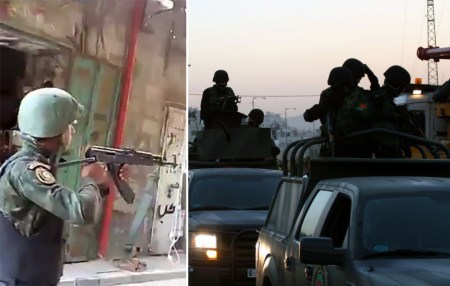 On August 18, two Palestinian Authority policemen were killed in an armed clash with gunmen in Nablus (left). In April of this year, a fierce gun battle erupted between Palestinian Authority policemen and members of the Jaradat clan in the refugee camp of Jenin (right). The clash started during an attempt to arrest a clan member.
In June, two other PA security officers, Anan Al-Tabouk and Uday Al-Saifi, were also killed in a shootout with gunmen in Nablus. The PA claimed that “outlaws” were behind the killings and vowed to punish the culprits.
Tensions in Nablus reached their peak on August 23, when scores of PA policemen lynched Ahmed Halawah, a former policeman suspected of leading a notorious gang belonging to Abbas’s Fatah faction. Halawah was beaten to death by PA policemen shortly after he was arrested and taken to the PA-run Jneid Prison in Nablus.
The PA leadership, which has since admitted that Halawah was lynched by its policemen, says it has ordered an inquiry into the case. Its leaders have described the lynching as an “unacceptable mistake.”
The lynching of the detainee sparked widespread protests throughout the West Bank, with many Palestinians calling for an immediate inquiry into the circumstances surrounding the case and demanding that those responsible be brought to trial.
The Palestinian Bar Association issued a statement strongly condemning the lynching of Halawah as a “crime and a human rights violation.” The Association called for holding those responsible, adding, “The regrettable and painful events, including the crime of killing Ahmed Halawah, do not serve the interest of the citizen or homeland and deepens divisions in our society.” It also called on the PA and its security forces to abide by the law and honor the human rights of the Palestinians and their public freedoms.
Alarmed by the widespread condemnations of the lynching of Halawah, some Palestinian Authority officials began issuing direct and veiled threats against Palestinian critics.
Palestinian lawyer Wael Al-Hazam, who called on Abbas to “withdraw” his security forces from Nablus, was visited by unidentified gunmen who sprayed his house with 14 bullets. The attorney and his family members were not hurt in the shooting attack, which was clearly designed to send a warning message to anyone who dared to raise his or her voice against human rights abuses by the PA security forces. And in this instance, the message arrived.
Shortly after the attack on his house, the lawyer issued a statement in which he said, “14 bullets are enough to silence me. I’m a man of the law and I cannot face bullets. My pen and voice are the only weapon I have. I do not possess armed militias to defend myself.” The attack on his house came shortly after PA security officers threatened the lawyer, warning him against appearing on a TV show to discuss the latest wave of violence in his city.
The turmoil in Nablus has prompted many Palestinians to call on Abbas to make a decision to postpone the upcoming municipal election in their city. In an emergency meeting held on August 25 in Nablus, several Palestinian factions and figures reached agreement that it would be impossible to hold the vote under the current circumstances.
Sarhan Dweikat, a senior member of Abbas’s Fatah, said that an election delay was needed, to
“protect the social fabric and preserve our national project, which is facing an existential threat in light of the security chaos and anarchy in Nablus. … Conditions in Nablus do not provide a positive climate for holding elections.”
It is hard to see how Abbas, delusional as he appears to be, would heed the calls to postpone the local and municipal elections. His pathetic attempt to persuade Palestinian businessmen to invest their money in PA-controlled areas at a time when the flames are engulfing his backyard is yet another sign of the man’s refusal — or inability — to see the reality on the ground.
This is the same president who claims that he is seeking to lead his people toward statehood and a better future. Incredibly, Abbas can probably continue to fool world leaders into believing that he and the Palestinian Authority are prepared for statehood. Yet the blood pouring out in Nablus and other Palestinian cities and villages is proof positive that Abbas is on his way to losing control over the West Bank, just as he lost the Gaza Strip to Hamas in 2007. If until now it seemed that Hamas posed the biggest threat to Abbas’s rule over the West Bank, it is now obvious that that is not so. The real threat, as brought home in blood in the West Bank, is coming from Abbas’s homegrown loyalists-turned-rebels.
Stunning: Egyptian Foreign Minister says Israel’s treatment of Palestinians not ‘terrorism’, American Thinker, Thomas Lifson,, August 24, 2016
It is an article of faith in the Arab world that Israel is guilty, guilty, guilty of terrorizing the poor Palestinians, which is why Jews deserve to be terrorized worldwide. The origins of violence lie exclusively on the Jews, too. So Arabs and all Muslims have a duty to defend their brothers and sisters by acts of extreme cruelty against Israelis in particular, and Jews in general.
This dogma is extremely important because it avoids any scrutiny of Koranic and other scriptural incitements of violence – even genocide – against Jews. I thus serves a dual purpose. And as a result, it must remain unquestioned. And for decades, there has been rhetorical solidarity on this point.
Until now.
The fall of the Muslim Brotherhood in Egypt and its replacement by the anti-MB regime of General Sisi, along with the spread of chaos in the Arab world has changed matters. Meanwhile, Israel is quietly building itself into a tiny superpower, its high tech economy and rapid development of offshore gas and onshore fracking making it a global economic power, able to finance a high tech military.
As a result, a stunning break with the past happened, beyond the notice of our mainstream media. The Jerusalem Post reports:
Egyptian Foreign Minister Sameh Shoukry said on Sunday that Israel’s actions against Palestinians does not constitute terrorism, eliciting an angry response from a Hamas spokesman who said Egypt’s top diplomat is blind.
Shoukry’s comments came during a Q&A session with students held at the Egyptian Foreign Ministry, where he was asked why Palestinians children killed in the conflict with Israel were not considered victims of terrorism.
“When looking at this issue, it can be defined as a ‘regime of force,’” the Egyptian media quoted Shoukry as saying. He said there was no evidence to link Israel to terrorist organizations.
“There is nothing that leads to this conclusion,” he said.
Shoukry added that Israel’s history has made it very sensitive to security issues, and as a result tightens control over its territory and border crossings to ensure its security.
The reaction has not been favorable among other Arab regimes. In public, at least. Speaking from Qatar, a major Clinton Foundation donor (and recipient of questionable favors):
Husam Badran, a Hamas spokesperson in Qatar, slammed the Egyptian foreign minister in a Twitter post, saying, “He who does not see the crimes of the Zionist occupation as terrorism is blind.”
The Egyptian cozying up with Israel is far ahead of public opinion there. It is inconceivable to me that Shoukry made these comments without first discussing them with Saudi Arabia, Egypt’s primary financial backer.
Tectonic plates are shifting in the Arab world, with some pragmatic leaders realizing that the primary problems of Arabs are created by themselves, and Israel has much more to offer as a friend than as a mortal enemy.
Hat tip: Clarice Feldman




 anneinpt
 artaxes
 danmillerinpanama
 davidking1530
 Peter Hofman
 Joseph Wouk
 Peter
Peter Louisiana Steve
 WarSclerotic
Recent Comments