Archive for the ‘Palestinian elections’ category

Palestinians: Presidents for Life, No Elections

April 1, 2016

Palestinians: Presidents for Life, No Elections, Gatestone InstituteKhaled Abu Toameh, April 1, 2016

♦ We hear often that Mahmoud Abbas is keen on having Palestinians vote in a democratic election. Yet Abbas turned 81 last week and appears ready to remain at the helm until his last day — free elections for Palestinians be damned. That makes sense: Hamas could easily best Abbas in such an election.

♦ Hamas and Abbas’s Fatah are still far from achieving any form of reconciliation. This, despite all the talk about “progress” that has been reportedly achieved in talks between the two parties taking place in Doha, Qatar.

♦ Hamas is also cracking down on journalists, academics, unionists and even lawyers in the Gaza Strip.

♦ Yet Abbas’s West Bank rivals Hamas in Gaza, in terms of a lack of human rights and freedom of speech. The idea of free and democratic elections there is a joke. Abbas will leave a legacy of chaos.

Best birthday wishes to Palestinian Authority (PA) President Mahmoud Abbas, who turned 81 last week. The octogenarian appears ready to remain at the helm until his last day — free elections for Palestinians be damned.

Abbas has inherited a tradition of tyranny. His predecessor, Yasser Arafat, was also president for life. Both have plenty of company, joining a long list of African presidents who earned the notorious title of “President for Life” – in Uganda, Equatorial Guinea, Angola, Zimbabwe, Sudan, Chad, Eritrea and Gambia. And let us not forget the Arab dictators in these ranks.

One might hope for at least a deputy — someone to fill the impending and inevitable power vacuum in the PA. Not likely.

Abbas has fiercely resisted demands from leaders of his ruling Fatah faction to name a deputy president or a successor. His reasoning: the time is not “appropriate” for such a move. Palestinians should instead concentrate their energies on rallying international support for a Palestinian state.

The PA president acquired his “private fiefdom,” as it is called by his detractors, in a January 2005 election, when Abbas was given a four-year mandate.

Such mandate seems to have been rewritten by the standing president. January 2016 marked the beginning of the eleventh year of Abbas’s four-year term in office. But it is business as usual in Ramallah.

We hear on a monthly basis that Abbas is keen on having Palestinians cast their ballots in a free and democratic vote. Yet we have seen no evidence to this effect. That make sense: Hamas could easily best Abbas in such an election. Despite his advancing age, Abbas still has clear memories of January 2006, when Hamas was permitted to run in the parliamentary election and won.

Abbas is also acutely aware that Hamas, which holds hostage nearly two million Palestinians in the Gaza Strip, would never allow a free vote there — especially for Abbas loyalists who have been seeking to undermine its rule.

Just a few days ago, a Hamas “military” court in the Gaza Strip sentenced two senior Palestinian Authority security officers, Sami Nisman and Naim Abu Ful, to 15 and 12 years in prison respectively, on charges of spying for the Palestinian Authority and plotting terror attacks against Hamas targets.

The verdicts are yet another sign that Hamas and Abbas’s Fatah are still far from achieving any form of reconciliation. This, despite all the talk about “progress” that has been reportedly achieved in talks between the two parties. Unconfirmed reports earlier this week leaked details of sticking points between Hamas and Fatah negotiators, have been meeting in Doha, Qatar, under the auspices of the Gulf state, towards forming a new unity government and holding new presidential and parliamentary elections. Qatar is the largest source of funds for the Muslim Brotherhood and its offshoot, Hamas.

Abbas’s fear of holding elections in the Gaza Strip is not without justification. In addition to the crackdown on his loyalists and security officers there, Hamas is also cracking down on journalists, academics, unionists and even lawyers.

Last week, Hamas security forces raided the offices of the Palestinian Bar Association in Gaza City and confiscated computers. The raid came as a result of the controversy surrounding the Bar Association not submitting lawyers’ financial and administrative records, in addition to complaints filed by some lawyers against the Bar Association, according to a statement released by the Palestinian Center for Human Rights (PCHR). The raid, some Palestinians claim, is in the context of Hamas’s effort to crack down on lawyers who are affiliated with the rival Fatah faction.

Yet Abbas’s West Bank rivals Hamas in Gaza, in terms of a lack of human rights and freedom of speech. The president’s security forces are in the midst of a massive and ongoing crackdown on political opponents of all stripes, making the idea of free and democratic elections there a joke. Abbas cannot tolerate the idea of having a deputy: how would he consider the establishment of a new party or the emergence of a potential candidate for the presidency.

Senior figures who have dared to challenge Abbas’s autocratic rule have already found themselves targeted by the president and his men. Ask former Prime Minister Salam Fayyad, who had his organization’s bank accounts seized by Abbas, or Mohamed Dahlan, the former Fatah commander and minister who was forced to flee the Palestinian territories after falling out with Abbas and his sons. Perhaps deposed PLO Secretary-General Yasser Abed Rabbo, who overnight was stripped of his powers and thrown to the dogs for speaking out against the president, would have a word to say. In Ramallah, they call them the “Abbas victims.”

909Palestinian Authority President Mahmoud Abbas (left), who turned 81 last week, has fiercely resisted demands from leaders of his ruling Fatah faction to name a deputy president or a successor. Senior figures who have dared to challenge Abbas’s autocratic rule have been targeted by the president — such as Mohamed Dahlan (right), the former Fatah commander and minister who was forced to flee the Palestinian territories after falling out with Abbas and his sons. (Image sources: U.S. State Dept., M. Dahlan Office)

We would need a crystal ball to know what will happen the day after Abbas disappears from the scene. Perhaps, say some, we shall witness a scene reminiscent of the old days of the Soviet Union “Politburo,” with the next president chosen by a group of Fatah and PLO leaders who will meet in Ramallah. This seems the most likely scenario, in the absence of any chance of free and democratic elections, and in light of the continued split between the two Palestinian entities in the West Bank and Gaza Strip.

We do not need a crystal ball, however, to know that Abbas will leave a legacy of chaos. His adamant refusal to name a deputy or even discuss the issue of succession in public has already created tensions among the top brass of the PLO and Fatah. The Palestinian public, for its part, has precious little confidence in its leaders.

The behind-the-scenes power struggle that has been quietly raging in Ramallah for the past few months is likely to lead to a state of paralysis in the Palestinian arena and leave the Palestinians without an acceptable leader. Or, as senior Fatah official Tawfik Tirawi put it, Abbas will be the last president for the Palestinians.

Palestinians are plagued with leaders who desire one thing: personal power. The Palestinians are marching away from achieving a state, partly because they seem incapable of the fundamental political principle of free and democratic elections. The day after does not look promising.
Abbas’s Trap: The Big Bluff

October 2, 2015

Abbas’s Trap: The Big Bluff, Gatestone InstituteKhaled Abu Toameh, October 2, 2015

(Please see also, Three cheers for Terroristine — DM)

  • Those who rushed to declare the death of the Oslo Accords fell into Abbas’s trap.
  • Abbas’s threats are mainly designed to scare the international community into pressuring Israel to offer Abbas more concessions. He is hoping that inaccurate headlines concerning the purported abrogation of the Oslo Accords will cause panic in Washington and European capitals, prompting world leaders to demand that Israel give Abbas everything he asks for.
  • Abbas knows that cancelling the agreements with Israel would mean dissolving his Palestinian Authority, and the end of his political career.
  • The tens of thousands of Arab refugees now seeking asylum in Europe could not care less about the “occupation” and settlements.
  • Ironically, Abbas declared that, “We are working on spreading the culture of peace and coexistence between our people and in our region.” But his harsh words against Israel, in addition to continued anti-Israel incitement in the Palestinian media, prove that he is moving in the opposite direction. This form of incitement destroys any chance of peace.

After weeks of threatening to drop a bombshell during his speech before the UN General Assembly, Palestinian Authority (PA) President Mahmoud Abbas on September 30 proved once again that he is an expert in the art of bluffing.

In the end, the bombshell he and his aides promised to detonate at the UN turned out to be a collection of old threats to abrogate signed agreements and a smear campaign against Israel.

There was nothing dramatic or new in Abbas’s speech. During the past few years, he and some of his aides have been openly talking about the possibility of cancelling the Oslo Accords if Israel does not fulfill its obligations towards the peace process.

In his speech, Abbas repeated the same threat, although some Western political analysts and journalists misinterpreted it as an announcement that he was abrogating signed agreements with Israel.

As one of Abbas’s advisors, Mahmoud Habbash, later clarified, “President Abbas did not cancel any agreements. He only made a threat, which is not going to be carried out tomorrow.”

Now, it is obvious that the talk about a bombshell was mainly intended to create tension and suspense ahead of Abbas’s speech. This is a practice that Abbas and his aides have become accustomed to using during the past few years in order to draw as much attention as possible.

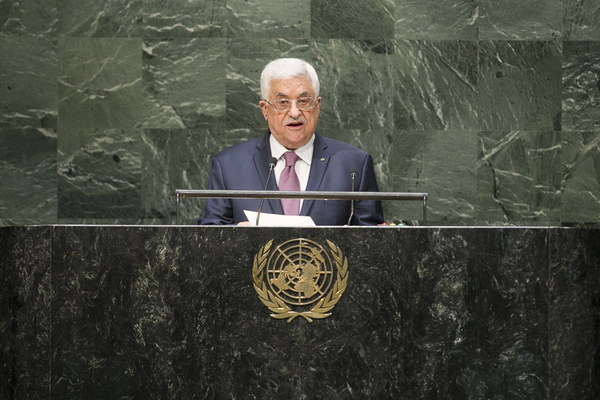
General Debate, 69th Session of the General Assembly Palestine-Bosnia-Samoa

General Debate, 69th Session of the General Assembly
Palestine-Bosnia-Samoa

The threat to cancel the Oslo Accords with Israel is not different from other threats that Abbas and his aides have made over the past few years. How many times has Abbas threatened in the past to resign from his post or suspend security coordination with Israel? In the end, he did not carry out any of these threats.

Abbas is unlikely, also this time, to carry out his latest threat to cancel the agreements with Israel. He knows that such a move would mean dissolving his Palestinian Authority and the end of his political career. But Abbas would like the world to believe that he has already cancelled the Oslo Accords. Judging from the inaccurate headlines in the international media, he seems to have achieved his goal.

Now, many in the international community are falsely convinced that Abbas has annulled all signed agreements with Israel. Those who rushed to declare the death of the Oslo Accords fell into Abbas’s trap.

Abbas’s threats are mainly designed to scare the international community into pressuring Israel to offer Abbas more concessions. He is hoping that the inaccurate headlines concerning the purported abrogation of the Oslo Accords will cause panic in Washington and European capitals, prompting world leaders to demand that Israel give Abbas everything he is asking for.

Abbas is also hoping that his recurring threats will put the Israeli-Palestinian conflict back at the world’s center stage. Abbas and the Palestinians feel that the world has lost interest in the conflict, largely due to the ongoing turmoil in the Arab world, the refugee crisis in Europe and the growing threat of the Islamic State terror group.

This concern was voiced by the PLO’s Saeb Erekat immediately after President Barack Obama’s speech at the UN General Assembly, which did not include any reference to the Israeli-Palestinian conflict.

Expressing “disappointment” over Obama’s speech, Erekat asked, “Does President Obama believe he can defeat ISIS and terrorism, or achieve security and stability in the Middle East, by ignoring the continued Israeli occupation, settlement expansion and the continued attacks on al-Aqsa Mosque?”

Of course, there is no direct link between Israeli “occupation” and settlements and the growing threat of radical Islam or the turmoil in the Arab world. The Islamic State is not beheading Muslims and non-Muslims because of the settlements or “occupation.” The Islamic State is not committing all these atrocities because it wants to “liberate Palestine.” Its main objective is to conquer the world after killing all the “infidels” in order to establish a sharia-ruled caliphate. The Islamic State would kill Erekat and Abbas — and many other Muslims — on its way to achieve its goal. In the eyes of the Islamic State, folks like Erekat and Abbas are a fifth column and traitors.

But instead of supporting the world’s war against the Islamic State and radical Islam, Abbas and Erekat want the international community to look the other way and devote all its energies and attention to the Israeli-Palestinian conflict. The tens of thousands of Arab refugees who are now seeking asylum in several European countries could not care less about the “occupation” and settlements. These people have lost everything they used to possess and their only dream is to either return to their homes and lands safely or start a new life in Europe and the US.

Abbas wanted worldwide attention in wake of the international community’s preoccupation with the refugee crisis and the radical Islam threat. For now, he appears to have achieved his goal, largely thanks to the international community’s misreading of his speech at the United Nations.

But while everyone is busy talking about Abbas’s bombshell, only a few have noticed that his speech consisted mostly of anti-Israel rhetoric that is likely to aggravate tensions between the Palestinians and Israel. Abbas used the UN General Assembly podium to make grave charges against Israel concerning “apartheid,” settlements and tensions on the Temple Mount. His fiery rhetoric, which has been partially welcomed by Hamas and other radical Palestinian groups, is likely to exacerbate tensions between Israelis and Palestinians and encourage more Palestinians to engage in violence.

It is this form of incitement that destroys any chance of peace between Israel and the Palestinians. This is the kind of rhetoric that prompts Palestinian youths to take to the streets and throw rocks and firebombs at Israeli civilians and policemen. Still, the international media, by and large, chose to ignore this destructive part of Abbas’s speech.

Ironically, Abbas declared in his speech that, “We are working on spreading the culture of peace and coexistence between our people and in our region.” But his harsh words against Israel, in addition to continued anti-Israel incitement in the Palestinian media, prove that he is moving in the opposite direction. As Abbas was addressing the UN General Assembly, some of his loyalists in Ramallah threatened and expelled Israeli Jewish journalists who came to interview Palestinians. This is certainly not a way to spread a “culture of peace and coexistence.”

Satire | Three cheers for Terroristine

October 1, 2015

Three cheers for Terroristine, Sultan Knish Blog, Daniel Greenfield, October 1, 2015

(He refers, of course, to “Palestine.” — DM)

We need a terrorist state. Where the politicians are terrorists, the police are terrorists and even the men sitting at the desk when you come in to drop off a form are terrorists.

3egypt081613

There are states that support terrorists, and give safe harbor to them, but that’s not good enough. We don’t want another Pakistan or Iran. We’re not half-assing it this time. What we want is the genuine article. Terrorists from the top down. Terrorists everywhere. A state where every branch of government and the entire country is nothing but terrorists.

Terroristine has been an ancient dream since 1973 or was it 1967. A generation of keffiyah draped thugs, KGB operatives and human rights activists have looked out into the darkness and called it into being. It is a vision of a country where everyone is a murderer and children are taught from a very young age that their purpose in life is to die killing people who don’t share their religion.

And now after decades of negotiations, treaties, suicide bombings, mutilations, billions of dollars in vanishing into Swiss bank accounts and the death of its Egyptian born leader of AIDS– Terroristine is closer than ever to coming into being.

Abbas, its unelected dictator, who has struggled long and hard so that one of his sons might have his own cigarette monopoly in Gaza, has come to the UN to promise that Terroristine will have “will actively contribute to the achievement of economic, cultural, and humanitarian progress of civilization.”

And who can doubt him? Certainly not Terroristinians who don’t have elections or a free press.

Terroristine, whose noble flag (that looks like nearly every other Arab flag) flies over the UN, has done wonders for civilization. Consider the airplane hijacking. The suicide bomber. Has there ever been a civilization that did as much for civilized living as the Terroristinians?

Every time you get groped at an airport, thank Terroristine. Without the Terroristinian contribution to civilization, you might actually be able to get on a plane in peace. Or visit the Twin Towers.

The Terroristinian contribution to human progress is unquestionable. But only one thing stands in the way of it unleashing its full Terroristinian potential for all mankind.

Them. Those pesky people who live in that country that is always in the way. You know the ones, with too many Nobel prizes, newly invented tomatoes and microchips. They stand in the way of the great cultural contributions of Terroristine. They must die so that Terroristine must live.

They must be thrown out of their homes, village by village and city by city, so that the noble Terroristinians can plant their rockets on the rubble of their houses, the charred remains of their fields, and point them at their cities.

Trying to end terrorism by creating a terrorist state makes is like trying to put out a fire with more fire. It can’t work, but we must try. So that we can say that we tried. Over and over again. We’ll keep trying until we run out of land to try with. And people to try with.

Until there’s nothing left but Terroristines everywhere. Until all the world is Terroristine. The question is can we make it happen? Yes, we can. Oh sweet Allah, yes we can.

Israel must return to the 1967 borders, which are really the 1948 borders. Why are the borders of the 1948 war, so much better than the borders of the Six Day War? Because the Terroristinians came closer to winning that war. Came closer to driving the Yahood into the sea and ululating over miles  of their corpses.

boy_bomb.preview

But the dream failed. Farmers armed with outdated rifles. Volunteer pilots from America and Canada. Refitted cargo ships filled with half-dead men, women and children straight from the camps. Used Czech artillery. They held off the armies of seven Terroristinian nations. Farm by farm, they stood off tanks and infantry. In Jerusalem, they fought for every house. And so the Zionist entity survived.

Allah curse them. They survived.

But now it’s back to 1948 again. Every war undone. Every defeat turned to victory. Cut Jerusalem in two. Drive out the farmers. Burn their land. Dig up their graves. March the borders back to 1948. And fly the Terroristinian flag over dust and rubble. Had they won in 1948 or 1967 or 1973, there would be no Israel and no Terroristine. The land would have become part of Syria, Egypt and Jordan. And only when the mobs of the faithful would drive out the tyrants to replace them with Islamic states, would there finally be a Terroristine.

But despite what Abbas says, there is still hope for a two state solution. And we must do everything in our power to salvage the two state solution so that there will be a state of civilization on one side and a state of terrorists on the other. Hospitals here, launching pads there. Schools here, bomb factories there. Life here, death here. We all know the story. Olive trees and bomb belts. Rocks and dead families in burning cars by the side of the road. Children with their throats cut.

A dream. A nightmare. Who even knows anymore.

Why do we need Terroristine? Peace. There can be no peace without a terrorist state. Not a chance of it. The only way we’ll ever have peace is to give the terrorists a country of their own. A country dedicated to terrorism. Only then will the Terroristinians finally give up on all the killing, and dedicate themselves to medical research, quantum mechanics and the arts. It hasn’t happened yet to. But it’s bound to.

After decades as an autonomous territory, spreading death and destruction, it’s time for Terroristine to finally be recognized as an independent state. With contiguous borders cutting Israel in half. It is the only hope for peace in the region. Would Sunnis and Shiites be killing each other from Yemen to Iraq? Assuredly not. The moment the flag of Terroristine rises above the wounded hills, and its peaceful anthem, “Palestine is My Revenge” is heard in the land, then a great echoing sigh will rise up from the mouths of one billion Muslims. And the violence will cease.

The international community is impatient. They want Terroristine and they want it now. Whatever Israel has offered in the past, it isn’t enough. It must offer more and more. Whatever it takes. We know the Terroristinians want their own state. Every time they walk out of negotiations or end them with a round of terrorist attacks, it shows their deep and abiding passion for a state. They want it so badly they aren’t willing to make a single concession for it. Or even negotiate for it.

That’s how committed they are to realizing their great dream to Terroristine. And who can blame them? Have any people suffered the way the Terroristinians have? (Besides all the people the Terroristinians have killed over the last 1,400 years.) Have any other people been wholly subsidized by a UN agency dedicated only to them? Have any other people inspired such a stylish fashion statement? No more excuses. The world demands Terroristine. Middle East peace demands Terroristine.

How much longer can Israel expect to draw out the necessary concessions with weak justifications about terrorism. We know they’re terrorists. That’s why we’re giving them a state. If they weren’t terrorists, they could go to the back of the line with the Jews, Kurds and Armenians.

From one corner of the Muslim world to the other, a cry goes out. “We Are All Terroristinians.” They cry it it Cairo and Damascus, in Tehran and Islamabad, in Dubai and Paris. They mosques go up, the asses go up and the bombs go off. And off to the peace negotiations we go.

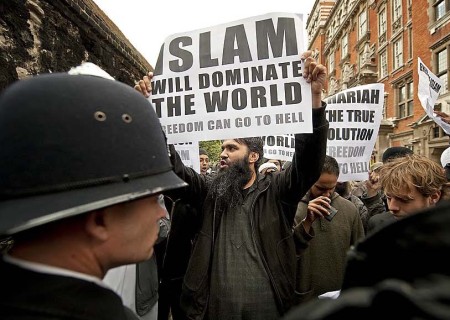
Islam will dominate the world

Everyone is impatient. Everyone is on fire. Especially the Terroristinians. Jewish store windows are smashed in London, Terroristinians butcher Rabbis in Jerusalem synagogues, fuming Terroristinians shoot up American recruiting centers. And the crowds cheer. “We Are All Terroristinians Now.”

It is a great day, I tell you. A great day for negotiating. ISIS impatiently beheads infidels to create its own Islamic Terroristine. In Afghanistan the word goes out, “We are the Taliban, we are the Afghan people, we are Terroristinians.” In Egypt and Turkey, they cry, “Khaybar Ya Yahood”. Churches burn. Soldiers die. The smoke rises to heaven. A man waits in line at the airport. His passport is Dutch, Welsh, German, American, it doesn’t matter. He is a Terroristinian. Yallah.

One day the borders of Terroristine will stretch from Spain to Pakistan. Or beyond Why settle for Jerusalem, when we can have London, Paris and Hamburg too. Why settle for anything at all? Allah is generous to the believers. Our people are in Africa. Even China. The Great Satan himself bows toward Mecca. The old governments are falling. The pawns of the Kufir are fleeing before our eyes.

We are all Terroristinians now. There is no other book on our shelves than the Koran. No law but Sharia in our hearts. And no nation but Terroristine. The ghost of Chamberlain stands outside No. 10 Downing Street promising peace. A Terroristinian refugee beheads him and holds up his spectral head to the cheers of the crowd. Rockets sail through the sky. The crowd cheers. Hip Hip Hooray. Hierosylma Est Perdita. Three cheers for Terroristine.

Palestinians: Why Salam Fayyad Lacks Popular Support

July 1, 2015

Palestinians: Why Salam Fayyad Lacks Popular Support, The Gatestone InstituteKhaled Abu Toameh, June 30, 2015

  • It is no secret that several senior Palestinian officials see themselves as potential successors to Abbas. Like his predecessor, Yasser Arafat, Abbas has stubbornly refused to share power with anyone. And like Arafat, he continues to run the Palestinian Authority as if it were his private fiefdom.
  • In Palestinian culture, it is more important if one graduates from an Israeli prison than from the University of Texas in Austin. A Palestinian who carries out an attack on Israel has more credentials among his people than one who studied at Harvard or Oxford universities.
  • It took Salam Fayyad too long to realize that no matter how many good things he does for his people, in the end he will be judged on the basis of his contribution to the fight against Israel, and not how much humanitarian and financial aid he provides.

In a surprise move, the Palestinian Authority (PA) has frozen the bank account of a non-profit organization headed by former Prime Minister Salam Fayyad.

The decision is seen in the context of PA President Mahmoud Abbas’s effort to undermine and discredit Fayyad. Abbas believes that Fayyad, who resigned in 2013, is seeking to replace or succeed him as president.

Following his resignation, the US-educated Fayyad established a Ramallah-based group called Future For Palestine. According to Fayyad, the group’s mission is to “enhance the resilience of Palestinian citizens in their homeland, especially in marginalized and severely impacted areas, by providing the basic development requirements.”

Abbas and the Palestinian Authority leadership did not like the idea from the beginning. Ever since Future For Palestine was established in August 2013, they have been working toward undermining the group and its founder, Fayyad.

The PA leadership is convinced that Fayyad is using the group to advance his own political goals and establish bases of power in the West Bank and Gaza Strip.

During the military confrontation between Israel and Hamas last year, Fayyad’s group launched acampaign to aid the residents of the Gaza Strip. The campaign included the purchase of tens of thousands of bottles of mineral water that were supposed to be dispatched to the Gaza Strip. The Palestinian Authority thwarted the campaign.

To justify the crackdown on Fayyad back then, the PA said that the former prime minister was part of a “conspiracy” to overthrow the Abbas regime. Some reports even suggested that Abbas had ordered his security forces to detain Fayyad for interrogation, but backtracked after threats from the US and several European governments.

Later, Abbas sent security officers to raid the offices of Future For Palestine and conduct a thorough search of its files. Some of Fayyad’s top aides were taken into custody and questioned about the sources of the group’s funding.

Last week, the campaign against Fayyad reached its peak when the Palestinian Authority announced that it has seized the assets of Future For Palestine, and accused the former prime minister of “money laundering.”

PA officials claimed that Fayyad’s group had received $10 million from the United Arab Emirates, a Gulf country that supports Abbas’s political enemy, ousted Fatah leader Mohamed Dahlan. The officials accused Dahlan and Fayyad of working together to topple the Abbas regime. Dahlan fled the West Bank several years ago after falling out with Abbas, who accused him of attempting to stage a coup against the Palestinian Authority leadership.

1135Former Palestinian Authority Prime Minister Salam Fayyad, pictured on January 25, 2013 at the World Economic Forum in Davos, Switzerland. (Image source: World Economic Forum)

Fayyad said this week that he is planning to take legal measures to cancel the decision to freeze his group’s assets. Denying the charge of “money laundering,” Fayyad added that Future For Palestine was operating within the framework of the law and did not commit any offense.

The decision to freeze the bank account of Future For Palestine came in the wake of increased talk about a behind-the-scenes power struggle to succeed the 80-year-old Abbas. The name of Fayyad has repeatedly surfaced as a potential successor to Abbas — a suggestion that has clearly enraged the Palestinian leader and his senior officials in Ramallah.

It is no secret that several senior Palestinian officials see themselves as potential successors to Abbas. These include, besides Dahlan, the chief of the PA’s General Intelligence Security Force in the West Bank, Majed Faraj, Palestinian Football Association Chairman Jibril Rajoub and Chief PLO negotiator Saeb Erekat.

Abbas believes that he has thus far succeeded in sidelining and discrediting at least two candidates: Fayyad and Dahlan. The charges made by Abbas against the two men are designed to depict them as agents of foreign countries who are plotting against him and the entire Palestinian people.

Like his predecessor, Yasser Arafat, Abbas has stubbornly refused to share power with anyone. And like Arafat, he continues to run the Palestinian Authority as if it were his private fiefdom.

Fayyad’s chances of succeeding Abbas are, anyway, very slim, if not non-existent. Fayyad is an independent figure who does not belong to Fatah, Hamas or any other political group. When he ran in the January 2006 parliamentary election at the head of the Third Way list, his group received two seats out of 132.

The reason most Palestinians did not vote for Fayyad is because he had not played any role in the “revolution” against Israel. In this culture, it is more important if one graduates from an Israeli prison than from the University of Texas in Austin. Fayyad did not participate in any armed attack on Jews and never supported the armed struggle against Israel. Nor did he send his son to throw stones or firebombs at Israelis. That is the real reason why people like Fayyad lack popular support.

If and when Abbas steps down, the only candidate who has a good chance of replacing him is one who was part of the “revolution.” A Palestinian who carries out an attack on Israel has more credentials among his people than one who studied at Harvard or Oxford universities. It took Salam Fayyad too long to realize that no matter how many good things he does for his people, in the end he will be judged on the basis of his contribution to the fight against Israel, and not how much humanitarian and financial aid he provides.

Establishing a Palestinian Islamist State

June 23, 2015

Establishing a Palestinian Islamist State, The Gatestone InstituteBassam Tawil, June 23, 2015

  • The United Nations’ verdict of guilty to Israel, in its “Schabas Report,” issued yesterday, was written even before the trial began.
  • Only the wide-eyed West still does not believe that Mahmoud Abbas is telling the truth when he assures the Palestinians of his intent to destroy Israel.
  • All public opinion polls in the Palestinian Authority (PA) indicate that if elections were held today, Hamas — whose only openly-stated reason for existing is to destroy Israel — would win in a landslide, as in 2006. Gaza has already been lost to Hamas and perhaps soon to ISIS. All evidence reveals that to establish a Palestinian state now would turn it into an Islamist terrorist entity.
  • Abbas thought that forming a Unity Government with Hamas would give the PA a unified front with which to harvest more money and diplomatic concessions from Europe. But last summer, Abbas was informed of a Hamas murder plot against him.

The Middle East is at it again. At the top of the list, no one, it seems, is even thinking of stopping Iran from acquiring nuclear weapons capability — and by extension at least several other countries in the region, including Saudi Arabia, Turkey and Egypt.

First, It is dangerous enough for any openly expansionist regime, theological or not, to have nuclear weapons; Iran has recently shown itself to be nothing if not expansionist. Second, and, if possible, worse, several of the countries around Iran — who correctly feel in its crosshairs, have already announced that they will be building or buying nuclear weapons as well; and have probably already started. The Islamic State (ISIS) is also rumored to be on the market for a nuclear warhead; you too can apparently buy one for around $400 million. So we shall all have uncontrolled and uncontrollable nuclear proliferation to look forward to.

On top of all that, the Americans and Europeans are rumored to be at it again, pressuring the Palestinian Authority (PA) to renew peace negotiations with Israel. The London-based newspaper, Al-Quds Al-Arabi, recently quoted a senior Palestinian who suggested that the PA Chairman, Mahmoud Abbas, meet with Israeli Prime Minister Binyamin Netanyahu to jump-start the stalled negotiations.

New signs of triggering antagonism between the Palestinians and Israel are also reflected in the Vatican’s recognition of the Palestinian Authority as the State of Palestine, despite the vandalizing of the Church of the Nativity in Bethlehem and other acts that led to the mass-exodus of persecuted Christians from the Palestinian territories, and despite the PA having joined with the terrorist group, Hamas, in the so-called Palestinian National Consensus Government [“Unity Government”]. This union enabled Israel to accuse it of responsibility for the war crimes that really only Hamas committed against Israeli civilians during the last war. At the same time, the tottering Palestinian Authority is trying to delegitimize Israel by accusing it of war crimes in the International Criminal Court (ICC). Neither of these attacks bodes well for either Israel or the PA.

The ICC in The Hague also recently announced that it would unilaterally investigate Israel for alleged war crimes committed in the last clash in the Gaza Strip. This project will not end well for the Palestinians, the Israelis or the politicized “Jim Crow” International Criminal Court. Meanwhile, the Unite Nations’ verdict of guilty, in its “Schabas Report,” issued this week, was written even before the trial began.

The Obama Administration has also increased its pressure on Israel with not-so-subtle threats. Susan Rice and other sources within the US administration openly claimed in early March that, in view of Israel’s “refusal” to make peace, and because of its interpretations of statements made by Netanyahu during this Israel’s elections this year, Washington would not veto unilateral European proposals to establish a Palestinian state.

President, Barack Obama, on May 22, tried to reassure the Jewish community to the contrary and said that he was “an honorary member of the [Jewish] tribe,” but his assurances are suspicious. Obama has earned a reputation for not telling the truth, from blaming the 2012 slaughter of Americans at Benghazi, Libya on a YouTube video (even two weeks after he knew the video was not the reason), to welching on his “red line” commitment when Syria’s government used chemical weapons on its own people.

The Israelis regard the American stance as an anti-Israeli vendetta based on Obama’s personal dislike of both Israel and Netanyahu. Although Netanyahu has said that now might not be the best time for a Palestinian state, he has, in fact, never changed his fundamental policy: that a Palestinian state could potentially be in Israel’s best interests.

What Netanyahu did say, with justification — as hard as it is to admit he was right — is that, given the current regional chaos, establishing a Palestinian state at this time would mean establishing a terrorist state in the West Bank. To do so now would simply lead to what is euphemistically called “further regional destabilization” — namely, war. Recognizing a Palestinian state at this time will also encourage terrorist activities by giving extremist Islamic elements — presently operating throughout North Africa, Yemen, Syria, Lebanon and Iraq — even more territory from which to expand their operations.

This new Islamic extremist land-and-power grab would be similar to that of Hamas after it took over the Gaza Strip, after when Israel unilaterally withdrew in 2005; or the ISIS takeover of Syria and Iraq when the US withdrew or failed to act. Currently, Hamas and ISIS in the Gaza Strip menace the security of both Israel and Egypt.

A new Islamic emirate in the West Bank at this time would also be dangerous for Jordan. Even without an Islamic emirate, Jordan has to cope with waves of refugees, among whom are Islamist terrorist operatives infiltrating the kingdom with the goal of overthrowing the Hashemites and turning Jordan into a territory ruled by ISIS or the Muslim Brotherhood. Given Iran’s efforts to exploit the weakness of Sunni Islam in Syria, Iraq, Yemen, Lebanon and Bahrain, there seems no need for another extremist Islamic arena in Jordan.

Considerable pressure is also now being directed at the Palestinian Authority to renew negotiations with Israel. Some of the pressure comes from former President Jimmy Carter’s possibly well-intentioned but totally counterproductive demand that the Palestinians hold elections.

All public opinion polls in the PA indicate that if elections were held today, Hamas, as in 2006, would win in a landslide.

Unfortunately, many decision-makers in both the United States and Europe view the situation through the lens of Western democracy and practices. The overwhelming Hamas victory in the student council elections at Bir Zeit University, near Ramallah, should have been a wake-up call. Unfortunately, it was ignored.

1042Hamas supporters march during a student council election rally at Bir Zeit University, near Ramallah, on April 20, 2015. The overwhelming Hamas victory in the student council elections should have been a wake-up call to the U.S. and Europe.

Mahmoud Abbas has a dilemma. If elections are held in the Palestinian Authority, and Hamas– whose only openly-stated reason for existing is to destroy Israel — wins, the PA will cease to exist and Israel will be able to avoid the peace process for all time.

If, however, elections are not held, Mahmoud Abbas will continue to rule without international or Palestinian legitimacy. Not only did his four-year term expire six years ago, but at this point, he barely represents the Palestinians in the West Bank.

The almost two million Palestinians on the other side of Israel, in Gaza, are represented almost exclusively by Hamas, with continuing attempted inroads by ISIS. Abbas is thus unable to represent “the Palestinian people” in any serious political process. The proposal for elections is therefore an embarrassment for Abbas, and is generally ignored.

Tragically, to shore up its status locally, the Palestinian Authority in the West Bank has taken a series of hasty, contradictory and dangerous steps. Since the PA’s chance at controlling the Gaza Strip has disappeared forever, the PA, to ensure its own continued survival, coordinates security with Israel to prevent further Hamas subversion in the West Bank.

In the meantime, senior figures in the PLO and the PA compete with Hamas in issuing strident, extremist messages to the Palestinian populace, which is consequently being radicalized — to the point now of supporting Hamas and ISIS.

Mahmoud Abbas and his high-ranking associates, nevertheless, continue to hold formal ceremonies to honor terrorists killed during attacks on Israeli targets.[1] Abbas also continues to commemorate “shaheeds” [those who die in the cause of Islam, often called “martyrs”] who killed dozens of Israeli civilians in suicide bombing attacks. Abbas erects monuments, names town squares after them, and holds sports and chess tournaments in their honor.

On this year’s Nakba Day — “the day of catastrophe,” which commemorated the 67th anniversary of the establishment of the State of Israel — during the May 15 ceremonies, Mahmoud Abbas promised the Palestinian masses that the occupied territories and the Palestinian diaspora would soon be restored to the independent state of Palestine. He also swore that the “resistance” — that is, armed violence and terrorism against Israel — would continue until the goal was achieved: destroying the State of Israel and establishing the Palestinian state on its ruins.

These intentions are not a secret to Israelis. They therefore do not trust his sincerity when he claims he wants “peace.” Only the wide-eyed West still does not believe that Mahmoud Abbas is telling the truth when he assures the Palestinians of his intent to destroy Israel.

The deliberate tension crafted by the Palestinian Authority has, as its only objective, bloodshed — both Palestinian and Israeli. This tactic can usually be seen when the level of violence falls below what the PA finds acceptable. It then trots out the old saw, first coined by the anti-Israeli Islamist sheikh Ra’ed Salah (whose right to free speech is protected by Israeli law), “Al-Aqsa mosque is in danger!”

At the beginning of May 2015, Sheikh Yusuf al-Dayis, the PA Minister of Religious Endowments [Waqf], made headlines in the Palestinian daily, Al-Quds, with the incendiary statement that the fate of the entire Muslim nation hung on the 35 acres of the Temple Mount. He even provided a list of what he claimed were Israeli “attacks” on Al-Aqsa mosque. Sadly for him, visitors to the Temple Mount can see every day the exorbitant security measures taken by the Israelis to protect the site. In point of fact, the record shows that every time the Palestinians want to provoke another pointless round of violence and slaughter, they say, “Al-Aqsa mosque is in danger!” It invariably causes hundreds of casualties on both sides and achieves absolutely nothing.

The last time a mosque actually was damaged was recently, in the Gaza Strip, when Hamas’s security forces removed the holy books, then used three bulldozers to raze a Salafist mosque. Hamas claimed it was in retaliation for an alleged Salafist attack on Hamas “jihad fighters” south of Khan Yunis. Sources in Gaza confirmed that seven Salafist-jihadi operatives were arrested in the mosque, and that Hamas had recently arrested 30 Salafist-jihadi Ansar Bayt al-Maqdis members. Having started terrorism in the Gaza Strip, Hamas is now reaping the result: terrorism there is “going viral.”

All evidence reveals that to establish a Palestinian state now would quickly turn it into an Islamist terrorist entity. Each time governments encourage Islamist movements, or ignore them in the hope that they will attack someone else, these movements have boomeranged into their own backyards and then moved on to their neighbors’. This will be the fate of Syria’s Bashar Assad, who let Hamas and other terrorist groups set up shop in Damascus. Former PA Chairman Yasser Arafat let Hamas into the neighborhood, and the Palestinian people are now being repaid by Hamas. Arafat wrongly assumed that letting Hamas in the door would serve him by forcing Israel to make concessions. Mahmoud Abbas thought that forming a Unity Government with Hamas would give the PA a unified front with which to harvest more money and diplomatic concessions from Europe. But last August, Abbas was informed of a Hamas murder plot against him. “We have a national unity government and you are thinking about a coup against me,” he said to Hamas’s leader, Khaled Mashaal.

The Islamist terrorist enclaves are wholly the fruit of the Muslim Brotherhood doctrine freely being spread around the Middle East and the democratic West. The so-far isolated incidents of bloodshed in Europe, Africa and the United States are just at the beginning stages of a long, bloody campaign to engulf the world.

Gaza has already been lost to Hamas and perhaps soon to ISIS. Libya and Lebanon may follow next. If the West pressures Palestinians and Israel to create a Palestinian state now, the West Bank and Jordan will be sure to follow. Enabling an expansionist Iran to have a nuclear threshold capability will also throw the region into war.

We, the Palestinians who live in the Palestinian Authority and within Israel, have not stopped dreaming of a Palestinian state, but we also witness the chaos around us and are relieved that so far the catastrophe has not harmed us or our families.

Some Palestinian politicians have turned to more extreme rhetoric to find favor with Israeli Arabs, but despite the tendency in Palestinian society towards extremism and terrorism, what is certain is that even if the establishment of the Palestinian state is postponed, most Palestinians hope the West will not make the mistake of permitting Iran to go nuclear. A nuclear Iran will create a nightmare that will make the Nakba look like a coming attraction.

____________________

[1] For recent examples, see: “Fatah glorifies arch-terrorist who planned killings of 125,” May 14, 2015; “PA honors 3 terrorists who lynched two Israeli reservists,” May 11, 2015; “PA sports presents terrorist murderers as role models,” May 4, 2015.

Who Is Blocking Palestinian Elections?

June 4, 2015

Who Is Blocking Palestinian Elections? The Gatestone InstituteKhaled Abu Toameh, June 4, 2015

  • Fatah is afraid that Hamas’s chances of winning the elections, especially in the West Bank, are very high. Hamas is not willing to relinquish control over the Gaza Strip, certainly not to Abbas and the Palestinian Authority, who were expelled from there in 2007.
  • Each party cares only about its own interests, while at the same time lying to the world that it is all Israel’s fault. Hamas continues to invest enormous resources in digging new tunnels, in preparation for a new war with Israel.
  • All this is being done with the help of anti-Israel governments around the world, and groups such as the Boycott, Divestment and Sanctions (BDS) movement, whose only goal is to delegitimize Israel and demonize Jews rather than to help the Palestinians.

One year after Palestinian Authority (PA) President Mahmoud Abbas announced the establishment of the Palestinian Fatah-Hamas “national consensus” government, the two rival parties remain as far apart as ever.

The “national consensus” government, headed by Prime Minister Rami Hamdallah, was formed after a series of “understandings” between Fatah and Hamas on the basis of previous “reconciliation” agreements between the two sides.

A year later, it has become obvious that the “national consensus” government has failed to achieve its main objectives: the reconstruction of the Gaza Strip; ending the conflict between Hamas and Fatah, and preparing for new presidential and parliamentary elections.

Fatah and Hamas can only blame each other for the failure of the latest attempt to end their dispute and do something good for their people. There is no way this time that they could lay the blame on Israel.

The two parties had a chance to cooperate on the reconstruction of the Gaza Strip in the aftermath of last year’s military confrontation between Israel and Hamas. The international community even offered to assist in the mission, but Fatah and Hamas chose to continue fighting each other at the expense of Palestinians in the Gaza Strip. Until today, the two rival Palestinian parties have not been able to reach agreement on a mechanism for the transfer of funds from international donors to the Gaza Strip.

Fatah claims that Hamas wants to steal the money, while Hamas is already accusing Fatah and the Palestinian Authority government of working to lay their hands on the funds.

Fatah and Hamas agreed back then that the Hamdallah government would remain in office for only six months — the period needed to prepare for long overdue presidential and legislative elections in the West Bank and Gaza Strip. But the “interim” government has just completed its first year in power, while the chances of holding new elections under the current circumstances are non-existent.

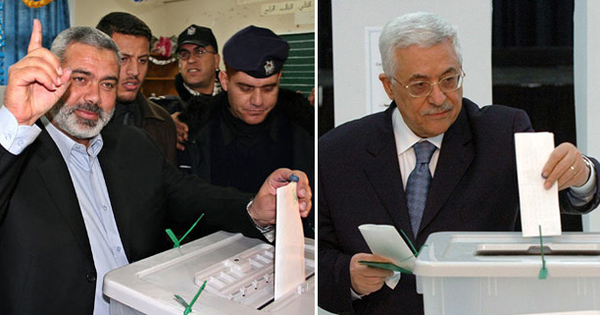
1096One man, one vote, one time? Hamas leader Ismail Haniyeh (left) and Fatah leader Mahmoud Abbas (also president of the Palestinian Authority) are pictured voting in the last election for the Palestinian Legislative Council, which took place in 2006.

Again, the two sides do not seem to be interested at all in sending Palestinians to the ballot boxes. Each side has many good reasons to avoid holding new elections in the West Bank and Gaza Strip.

First, Fatah and Hamas do not trust each other, and each side is convinced that the other would try to steal the vote. How can there be free and democratic elections while Hamas and Fatah continue to arrest and torture each other’s supporters in the Gaza Strip and West Bank?

Second, Fatah is afraid that Hamas’s chances of winning the elections, especially in the West Bank, are very high. That is because many Palestinians still do not trust Abbas and Fatah, whom they accuse of maintaining close security ties with Israel. Moreover, many Palestinians remain disillusioned with Fatah because of its failure to combat financial and administrative corruption and pave the way for the emergence of new leaders.

There is no way that Hamas and Fatah can cast the blame on Israel regarding the issue of elections. If they were really interested in holding new elections, they could do so with the help of the international community, as was the case with previous votes in 2005 and 2006. Israel even helped the Palestinian hold those elections.

When several Hamas candidates from east Jerusalem ran in the January 2006 parliamentary election, Israel did nothing to stop them. Israel even opened its post offices in the city to allow Arab voters from the city (who hold Israeli-issued ID cards) to vote in the election.

Charges made by some Palestinians and anti-Israel groups around the world, to the effect that Israel is responsible for “foiling” efforts to achieve Palestinian unity, are baseless. Although the Israeli government initially opposed the Fatah-Hamas “reconciliation” deal that was reached in 2014, it has not stopped the Palestinian prime minister and some of his cabinet members from visiting the Gaza Strip to pursue the implementation of the accord. In fact, Prime Minister Hamdallah has since visited the Gaza Strip twice, after receiving permission from Israel to go through the Erez border crossing.

Recently, ten Palestinian ministers were forced to leave the Gaza Strip, after Hamas placed them under house arrest in their hotel and banned them from meeting with locals. The ministers entered the Gaza Strip through the Erez border crossing. They came to the Gaza Strip to help solve the problem of thousands of Hamas government employees who have not received salaries for more than a year, and to discuss issues related to the reconstruction of the Gaza Strip.

So while Israel facilitated the visits by Hamdallah and his ministers to the Gaza Strip, it was Hamas that expelled them and prevented them from carrying out their duties. Had Israel expelled the ministers from the Gaza Strip or stopped them from entering the area, the country would have been condemned by the international community for “blocking” efforts to achieve Palestinian unity and rebuild the Gaza Strip.

Today, it has become unavoidably clear that Fatah and Hamas, and not Israel, are responsible for the ongoing plight of the Palestinians in the Gaza Strip. The two parties are unlikely to resolve their differences in the near future, further exacerbating the misery of their people. Each party cares only about its own interests, while at the same time lying to the world that it is all Israel’s fault. Hamas is not willing to relinquish control over the Gaza Strip, certainly not to Abbas and the Palestinian Authority, who were expelled from there in 2007. As for Abbas, he does not seem to be interested in regaining control over a problematic area such as the Gaza Strip, where most of the population lives under the poverty line and in refugee camps.

Yet instead of being honest with their people and admitting their failure to improve their people’s living conditions, Hamas and Fatah continue to wage smear campaigns against each other and, at the same time, also against Israel.

The campaigns that Hamas and Fatah are waging against Israel, particularly in the international community, are designed to divert attention from their failure to provide their people with basic services or any kind of hope.

While ignoring the plight of the Palestinians in the Gaza Strip, the Palestinian Authority leaders were prepared to invest huge efforts and resources in trying to have Israel suspended from the International Federation of Association Football (FIFA). It is as if the Palestinians had solved all their major problems and all that they needed to do now was to stop Israeli soccer players from playing in international matches.

Hamas, for its part, continues to invest enormous resources in digging new tunnels, in preparation for another war with Israel. The money that is being invested in the tunnels and the purchase and smuggling of weapons could benefit many families who lost their homes during the last war. But Hamas, like the Palestinian Authority, does not care about the misery of the Palestinians in the Gaza Strip. They want to fight Israel to the last Palestinian. And this is all being done with the help of anti-Israel governments around the world, and groups such the Boycott, Divestment and Sanctions (BDS) movement, whose only goal is to delegitimize Israel and demonize Jews rather than to help the Palestinians.