Archive for the ‘Pakistan’ category

A Strategy to Defeat Islamic Theo-fascism

January 7, 2016

A Strategy to Defeat Islamic Theo-fascism, American ThinkerG. Murphy Donovan, January 7, 2016

Surely, whatever passed for American foreign or military policy in the past three decades is not working. Just as clearly, in case anyone keeps score these days, the dark side of Islam is ascendant at home and abroad. What follows here is a catalogue of policy initiatives that might halt the spread of Islamic fascism and encourage religious reform in the Ummah.

Some observers believe that the Muslim problem is a matter of life and death. Be assured that the need for Islamic reform is much more important than either. The choices for Islam are the same as they are for Palestine Arabs; behave or be humbled. Europe may still have a Quisling North and a Vichy South; but Russia, China, and even America, at heart, are still grounded by national survival instincts – and Samuel Colt.

Call a spade a spade

The threat is Islam, both kinetic and passive aggressive factions. If “moderate” Islam is real, then that community needs to step up and assume responsibility for barbaric terror lunatics and immigrants/refugees alike. Neither America nor Europe has solutions to the Islamic dystopia; civic incompetence, strategic illiteracy, migrants, poverty, religious schisms, or galloping irredentism. The UN and NATO have no remedies either. Islamism is an Ummah, Arab League, OIC problem to solve. Absent moral or civic conscience, unreformed Islam deserves no better consideration than any other criminal cult.

Western Intelligence agencies must stop cooking the books too. The West is at war and the enemy is clearly the adherents of a pernicious ideology. A global war against imperial Islam might be declared, just as angry Islam has declared war on civilization.  A modus vivendi might be negotiated only after the Ummah erects a universal barrier between church and state globally. Islam, as we know it, is incompatible with democracy, civility, peace, stability, and adult beverages.

Oxymoronic “Islamic” states need to be relegated to the dustbin of history. If the Muslim world cannot or will not mend itself, Islamism, like the secular fascism of the 20th Century, must be defeated, humbled in detail. Sooner is better.

Answer the Ayatollahs

Recent allied concessions to Tehran may prove to be a bridge too far. If the Persian priests do not abide by their nuclear commitments, two red lines might be drawn around Israel. Firstly, the ayatollahs should be put on notice, publicly, that any attack against Israel would be considered an attack against America — and met with massive Yankee retaliation. Secondly, any future cooperation with NATO or America should be predicated on an immediate cessation of clerical hate speech and so-called fatwas, those arbitrary death sentences.

Clerical threats to “wipe Israel off the face of the earth” and “death to America” injunctions are designed to stimulate jihad and terror globally. The only difference between a Shia ayatollah and a Sunni imam in this regard these days seems to be the torque in their head threads.

Ostracize the Puppeteers

Strategic peril does not emanate from Sunni tacticians like Osama bin Laden, Mullah Omar, or Abu Bakr al-Baghadadi. Nor does the real threat begin with or end with al Qaeda, the Taliban, Hezb’allah, Hamas, or the Islamic State. Lethal threat comes, instead, on four winds: toxic culture, religious politics, fanatic fighters, and furtive finance, all of which originate with Muslim state sponsors. The most prominent of these are Saudi Arabia, the Emirates, Turkey, Iran, and Pakistan.

Put aside for a moment the Saudi team that brought down the Twin Towers in New York. Consider instead, the House of Saud as the most egregious exporter of Salifism (aka Wahabbism) doctrine, clerics, imams, and mosques from which ultra-irredentist ideologies are spread. The Saudis are at once the custodians of Islam’s sacredshrines and at the same time the world’s most decadent, corrupt, and duplicitous hypocrites. Imam Baghdadi is correct about two things: the venality of elites in Washington and Riyadh. The House of Saud, an absolutist tribal monarchy, does not have the moral standing to administer “holy” sites of any description — Mecca, Medina, or Disneyland.

The cozy relationship between Europe, the European Union, and Arabia can be summarized with a few words; oil, money, arms sales, and base rights. This near-sighted blend of Mideast obscenities has reached its sell-by date. The “white man’s burden” should have expired when Edward Said vacated New York for paradise.

Jettison Turkey and Pakistan

What Saudi Arabia is to toxic ideology in North Africa, Turkey and Pakistan are to perfidy in the Levant and South Asia. Turkey and Pakistan are Islam’s most obvious and persistent grifters. Turkey supports the Islamic State and other Sunni terror groups with a black market oil racket. Pakistan supports the Taliban, al Qaeda, and ISIS with sanctuary and tolerance of the world’s largest opium garden. Oil and drug monies from Arabia, Turkey, and South Asia are financing the global jihad. Turkey also facilitates the migration of Muslims west to Europe while sending Islamist fighters and weapons south to Syria and Iraq.

With the advent of Erdogan and his Islamist AKP, Turkey has morphed into NATO’s Achilles Heel, potentially a fatal flaw.  Turkey needs to be drummed out of NATO until secular comity returns to Ankara. Pakistan needs to be restrained, too, with sanctions until it ceases to provide refuge for terrorists. Pakistani troops harassing India could be more prudently redeployed to exterminate jihadists.

Sanctions against Russia and Israel are a study in moral and political fatuity whilst Arabs and Muslims are appeased midst a cultural sewer of geo-political crime and human rights abuses. If NATO’s eastern flank needs to be anchored in trust and dependability, Russia, Kurdistan, or both, would make better allies than Turkey. Ignoring Turkish perfidy to protect ephemeral base rights confuses tactical necessity with strategic sufficiency.

Recognize Kurdistan

Aside from Israel, Kurdistan might be the most enlightened culture in the Mideast. The Kurds are also the largest ethnic group in the world not recognized as a state. While largely Muslim, the Kurds, unlike most of the Ummah, appreciate the virtues of religious diversity and women’s rights. Indeed, Kurdish women fight alongside their men against Turkish chauvinism and Sunni misogyny with equal aplomb. For too long, the Kurds have been patronized by Brussels and Washington.

While Kurdish fighters engage ISIS and attempt to control the Turkish oil black market, Ankara uses American manufactured NATO F-16s to bomb Kurds in Turkey and Syria. Turkish ground forces now occupy parts of Iraq too. In eastern Turkey, Ergdogan’s NATO legions use ISIS as an excuse for bookend genocide, a cleansing of Kurds that might rival the Armenian Christian genocide (1915-1917).

195876_5_Kurdish angel of death

All the while, American strategic amateurs argue for a “no-fly” zone in contested areas south of Turkey. Creating a no-fly zone is the kind of operational vacuity we have come to expect from American politicians and generals. Such a stratagem would foil Kurdish efforts to flank ISIS and allow the Erdogan jihad, arms, and oil rackets to flourish. A no-fly zone is a dangerous ploy designed to provoke Russia, not protect Muslim “moderates.”

Putin, Lavrov, and the Russians have it right this time; Turkish and Erdogan family subterfuges are lethal liabilities, not assets.

Washington and European allies have been redrawing the map in Eastern Europe, North Africa, South Asia, and the Mideast since the end of WWII. The time has come to put Kurdistan on the map too. Kurdistan is a unique and exemplary case of reformed or enlightened Islam; indeed, a nation that could serve as a model for the Muslim world.  If base rights are a consideration, Kurdistan would be an infinitely more dependable ally than Turkey or any corrupt tribal autocracy in Arabia. America has a little in common with desert dictators — and fewer genuine friends there either. Indeed, at the moment America is allied with the worst of Islam.

Create New Alliances

NATO, like the European Union, has become a parody of itself. Absent a threat like the Soviet Union or the Warsaw Pact, Brussels has taken to justifying itself by meddling in East Europe and resuscitating a Cold War with the Kremlin. Indeed, having divided Yugoslavia, NATO now expands to the new Russian border with reckless abandon; in fact, fanning anti-Russian flames now with neo-Nazi cohorts in former Yugoslavia, Georgia, and Ukraine.

NATO support for the Muslims of one-time Yugoslavia is of a piece with support for Islamic troublemakers in Chechnya and China too. Throughout, we are led to believe that jihad Uighurs and caliphate Chechens are freedom fighters. Beslan, Boston, Paris, and now San Bernardino put the lie to any notion that Islamists are “victims” (or heroes). Indeed, the Boston Marathon bombing might have been prevented had Washington a better relationship with Moscow.

Truth is, America has more in common with Russia and China these days than we do with any number of traditional European Quislings. Indeed, it seems that Europe and America can’t take yes for an answer.

The Cold War ideological or philosophical argument has been won. Moscow and Beijing have succumbed to market capitalism. Islamism, in stark contrast, is now a menace to Russian, Chinese, and American secular polities alike. The logic of a cooperative or unified approach to a common enemy seems self-evident. America, China, and Russia, at least on issues like toxic Islam, is a match made in Mecca.

The late great contest with Marxist Russia and China was indeed a revolution without guns. Now the parties to that epic Cold War struggle may have to join forces to suppress a theo-fascist movement that, like its Nazi predecessor, will not be defeated without guns. The West is at war again, albeit in slow motion. Withal, questions of war are not rhetorical. Saying that you are not at war does not make it so. Once declared, by one party or the other, the only relevant question about war is who wins and who loses. Losers do not make the future.

If America and Europe were as committed to Judeo/Christian secular values as Islamists are committed to a sick religious culture, then the war against pernicious Islam would have been won decades ago. Or as Jack Kennedy once put it: “Domestic policy can only defeat us; foreign policy can kill us.

Trump Footnote

Donald Trump made several policy suggestions on the Islamism issue, one on immigration, the other on Mideast oil. On the former, he suggests a hiatus on Muslim immigration until America develops a plan or reliable programs to vet migrants. On Arab oil, he suggests, given the lives and treasure spent liberating Kuwait and Iraqi oil fields, America should have held those resources in trust and use oil revenues to finance the war against jihad, however long that takes. The problem with both Trump ideas is that they come perilously close to common sense, an American instinct in short supply these days.


A year of Taliban gains shows that ‘we haven’t delivered,’ top Afghan official says

December 28, 2015

A year of Taliban gains shows that ‘we haven’t delivered,’ top Afghan official says, Washington PostSudarsan Raghavan, December 27, 2015

As the fighting intensifies, the stakes are growing higher for the United States in its longest war. “I will not allow Helmand to fall,” Campbell told the Afghan officials in the recent meeting with the Afghan National Security Council. “But I can’t make you fight. You’ve got to want it more than we do.”

******************************

As the Afghan convoy entered the battered village, Taliban fighters opened fire. U.S.-trained Afghan policemen poured out of their Humvees and began wildly shooting their AK-47 rifles in every direction.

“The enemy is firing one bullet, and you are responding with dozens!” their commander, Col. Khalil Jawad, screamed into his radio in frustration. “Aim, then fire!”

A minute later, the militants melted away. On this day in early December in the southern province of Helmand, they had delivered their message: The Taliban is back, its fighters showing a battle discipline and initiative far superior to the Afghan security forces trained and equipped by the United States.

In private, top Afghan and American officials have begun to voice increasingly grim assessments of the resurgent Taliban threat, most notably in a previously undisclosed transcript of a late-October meeting of the Afghan National Security Council.

“We have not met the people’s expectations. We haven’t delivered,” Abdullah Abdullah, the country’s chief executive, told the high-level gathering. “Our forces lack discipline. They lack rotation opportunities. We haven’t taken care of our own policemen and soldiers. They continue to absorb enormous casualties.”

[Please refer to map here.]

With control of — or a significant presence in — roughly 30 percent of districts across the nation, according to Western and Afghan officials, the Taliban now holds more territory than in any year since 2001, when the puritanical Islamists were ousted from power after the 9/11 attacks. For now, the top American and Afghan priority is preventing Helmand, largely secured by U.S. Marines and British forces in 2012, from again falling to the insurgency.

As of last month, about 7,000 members of the Afghan security forces had been killed this year, with 12,000 injured, a 26 percent increase over the total number of dead and wounded in all of 2014, said a Western official with access to the most recent NATO statistics. Attrition rates are soaring. Deserters and injured Afghan soldiers say they are fighting a more sophisticated and well-armed insurgency than they have seen in years.

As of last month, about 7,000 members of the Afghan security forces had been killed this year, with 12,000 injured, a 26 percent increase over the total number of dead and wounded in all of 2014, said a Western official with access to the most recent NATO statistics. Attrition rates are soaring. Deserters and injured Afghan soldiers say they are fighting a more sophisticated and well-armed insurgency than they have seen in years.

As Afghan security forces struggle, U.S. Special Operations troops are increasingly being deployed into harm’s way to assist their Afghan counterparts. Since Nov. 4, four members of the U.S.-led coalition have been wounded in Helmand, said U.S. Army Col. Michael Lawhorn, a military spokesman. Officially, U.S. military personnel have a mandate only “to train, advise and assist” Afghan forces.

In the confidential October meeting, Gen. John F. Campbell, the commander of U.S. and allied forces in Afghanistan, told his Afghan counterparts that he was as guilty as they were of “just putting our finger in the dike in Helmand.”

But he was highly critical of Afghan security officials for “not managing” their forces in a way that ensured they got enough training, and for allowing “breakdowns in discipline” in the ranks. “The Taliban are not 10 feet tall,” he said. “You have much more equipment than they do. You’re better trained. It’s all about leadership and accountability.”

Campbell vowed “to fix Helmand.”

“I will use more of my SOF and enablers to buy you more space and time,” he said, referring to Special Operations forces. A senior U.S. defense official, speaking on the condition of anonymity because of military rules, said Campbell’s comments represented “an attempt to encourage the Afghans to take action in Helmand province.”

Progress unraveling

Helmand was a key focus in a major American offensive launched in 2010, after President Obama dispatched a “surge” of 30,000 troops to Afghanistan. Marja was the first place Marines launched operations, and by the end of the surge, in late 2012, the Taliban had been subdued in much of its southern heartland.

Now, the fresh concerns over Helmand arrive at the end of a year in which the Taliban and other insurgent groups, including the Islamic State, have steadily advanced, particularly in the north. They have taken advantage of the end of the U.S. and NATO combat mission, which has left a military and political vacuum, forcing Obama to extend the U.S. role by keeping at least 5,500 U.S. troops here after he leaves office.

A Pakistani military operation has also flushed hundreds of well-trained foreign fighters into Afghanistan, bolstering the Taliban and the Islamic State.

Meanwhile, the government is grappling with its own problems. The economy is crippled; high unemployment and corruption remain entrenched, breeding public resentment. Political infighting, policy disputes and leadership woes have deepened inside the administration of President Ashraf Ghani, who shares power with Abdullah, the chief executive. The cabinet remains incomplete, with no defense minister as the security issues become more serious.

The gains by the Taliban have come amid internal divisions and a leadership crisis triggered by the surprise announcement in the summer that its leader, Mohammad Omar, had been dead for more than two years. The contest for power and territory among Taliban factions, rather than weakening the movement, has spawned more uncertainty and violence.

The group’s infighting has blocked efforts by Ghani to bring the Taliban to peace talks. The insurgents’ new leader, Akhtar Mohammad Mansour, appears determined to prove his mettle and strengthen the Taliban’s bargaining position by escalating attacks, Western diplomats and analysts said. In September, the Taliban briefly seized Kunduz, the first city to fall since the demise of its regime, prompting the U.S. military to dispatch Special Operations troops and stage airstrikes to help the Afghan security forces retake control.

Now, the insurgents are on the doorsteps of several provincial capitals, applying more pressure on urban areas than in any year of the conflict. The clashes in Helmand have reflected the Taliban strategy that led to the takeover of Kunduz — seizing surrounding districts before moving in on the provincial capital. Already, the Taliban are in the enclave of Ba­baji, within the borders of Helmand’s capital, Lashkar Gah.

Helmand, which lies along the Pakistani border, is the source of much of the country’s opium, providing lucrative funding for the insurgents, who also collect “taxes” from the marble mining business. The province is home to the Kajaki Dam, which provides electricity to Helmand and to neighboring Kandahar, the cradle of the Taliban. In some districts, electricity bills are paid to the Taliban.

In the Afghan National Security Council meeting, Rahmatullah Nabil, the nation’s intelligence chief, described the province as “the biggest recruiting tool for the Taliban” and its “primary source of revenue.” Nabil resigned Dec. 10 to protest Ghani’s peace overtures to Pakistan, which is viewed with suspicion by most Afghans for its backing of the Taliban.

Losing control of Helmand

The 21-mile-long road from Lashkar Gah to Marja is peppered with craters from bombs planted by the Taliban. Stores are shuttered; villages are silent. The residents have fled.

A mile from a civil-order police base, built by U.S. Marines for $17 million, a charred, mangled Humvee lies in the middle of the highway. A rocket-propelled grenade tore into it, and the Taliban later set it afire. On a recent day, the base was as far as anyone could go, at least by road: Less than a mile ahead, the Taliban had buried more mines.

“They have destroyed bridges. They have burned our houses,” Ghul Mawla Malang, a tribal elder who leads Marja’s Afghan Local Police (ALP), a U.S.-funded pro-government militia, told top police commanders in a meeting at the base.

A few minutes later, the Taliban fired a few rounds toward the base. The senior officials cut short their visit and left in their Humvees.

If there was one province in Afghanistan that the Taliban should have found impenetrable, it was Helmand. The Afghan army has its entire215th Corps based here, numbering more than 18,000 soldiers. There are also thousands of Afghan police officers. Yet a few hundred Taliban fighters managed to overrun parts of Marja and other districts. Soldiers and police officers fled with little resistance or surrendered to the insurgents.

In Babaji, nine police officers including Abdul Qadim Hemat were unprepared last month when the Taliban fighters attacked their outpost. They were running out of ammunition. And reinforcements they had requested never turned up. “I watched seven comrades killed in front of me,” recalled Hemat, who soon fled along with the remaining officer. Both then deserted.

“We were surrounded, but we didn’t get any help,” Hemat said. “I will not shoot one bullet for the government again.”

In parts of Marja, villagers pine for U.S. troops — and the British forces who were once based here — to return.

“When they were here, Marja was as peaceful as this city,” said Ahmed Jan, who was bringing his 13-year-old nephew to a hospital in Lashkar Gah. A bullet had struck the boy in their village during fighting. “Now, the Taliban are like the government in my village. They drive police vehicles and Humvees, and they have raised their white flag over houses.”

A well-equipped enemy

In an interview, Gen. Mohammed Moeen Faqir, the commander of the 215th Corps, said that “only half of a percent” of his force may have deserted and that new recruits were filling the void. He noted that the police and ALP forces in Helmand were also under his command and that “whenever they needed reinforcements, I sent them.”

But the confidential transcript of the minutes from the National Security Council meeting presents a grimmer picture.

The Afghan army’s chief of staff, Gen. Qadam Shah Shaheem, said that limited reinforcements and new recruits couldn’t make up for force attrition in Helmand, according to the transcript, which was provided to The Washington Post by an official concerned by the insecurity in Helmand.

Some 40 percent of Afghan army vehicles in Helmand are broken, Shaheem said. He described a leadership crisis within the security forces, where “clashing personalities exist between the security pillars,” according to the transcript.

The morale of the security forces was low, said Nabil, the intelligence chief, and some soldiers had complained that they had not been home in two years. Junior commanders, he added, were “openly defying their superiors.” Gen. Mohammad Salem Ehsas, the top ALP commander, said that troops were tired and that there was poor coordination among the various security organs.

Campbell said that only about half the troop positions in the 215th Corps were manned. Western and Afghan officials said that was largely because of desertions, high casualty rates and a lack of new recruits.

“The blame game must stop now,” Campbell said. “If I hear one more policeman complain about the army or vice versa, I will pull my advisers immediately. It’s over. You’re Afghans first. Work together.”

Soldiers and police officers on the front lines say they face an enemy that is well trained and equipped with heavy artillery and machine guns, rockets and mortars — and a seemingly endless supply of ammunition. Taliban snipers now have night-vision scopes on their rifles. And as they have overrun bases, the militants have seized an arsenal of U.S. weaponry provided to the Afghans.

Nabil said the insurgents have night-vision goggles and have captured more than 45 Humvees in Helmand. They also have Russian-made ZSU antiaircraft guns with night capability, an abundant supply of mortars and a communications network that is difficult to infiltrate.

Stakes grow higher

U.S. Special Operations troops arrived in early November at an empty school in Chanjar, a front line about 15 miles west of the provincial capital. The walls of the compound bore the impact of shells the size of baseballs. A group of soldiers and police officers was stationed there. Taliban militants were in houses less than 20 yards away.

“The Americans told us that they wanted to push the Taliban back,” recalled Sgt. Abdul Mohamad. “They were here to give coordinates for an airstrike.”

But the Taliban fired a mortar, the men said, wounding one of the Americans. The Americans quickly left the area, in Nad Ali district, with their injured comrade.

Lawhorn, the U.S. military spokesman, confirmed that a U.S. coalition member was injured in the district Nov. 4.

Brig. Gen. Wilson Shoffner, the U.S. military’s top spokesman, said in an interview that U.S. troops were adhering to their limited mandate of “train, advise and assist” and that their Afghan counterparts were taking the lead.

But Afghans, including senior military officials, no longer even pretend that they can fight the Taliban effectively on their own.

“When the foreigners were here, we had plenty of facilities and equipment,” said 1st Lt. Naseer Ahmad Sahel, 30, a civil-order police company commander who was wounded last month in a firefight in Marja. “There were 100 cameras overlooking Marja alone.”

Faqir, the commander of the 215th Corps, said, “We don’t have the air support that we should have.”

As the fighting intensifies, the stakes are growing higher for the United States in its longest war. “I will not allow Helmand to fall,” Campbell told the Afghan officials in the recent meeting with the Afghan National Security Council. “But I can’t make you fight. You’ve got to want it more than we do.”

The San Bernardino Terrorists Weren’t Radicals — They Were Mainstream

December 15, 2015

The San Bernardino Terrorists Weren’t Radicals — They Were Maintream, Front Page Magazine, Daniel Greenfield, December 15, 2015

(Please see also, Islam — Radical, Extremist and Mainstream. — DM)

san-bern_1

[W]hat if Syed Farook and Tashfeen Malik were never “radicalized”? What if neither of them “influenced” the other? What if both were exactly what they appear to be, devout Muslims who hated America and believed that it was their religious duty to kill Americans? What if this attitude did not show up last week or last year? What if it was the way that their culture and religion taught them to live?

**************************

After Tashfeen Malik and Syed Farook killed 14 Americans in their corner of the Jihad over in San Bernardino, the media began its long laborious search for their moment of “radicalization”.

The assumption that the intersection of terrorism and Islam can only be an aberration lead to the conviction that there was some moment in time at which Malik and Farook became “radical extremists”. Initial reports pegged that moment of “radicalization” as having happened at some point during the twenty minutes after Farook left the party. When the amount of firepower and preparation made the idea of a twenty minute radicalization massacre seem silly, the media tried to stretch it back for weeks.

Now they’ve had to give in and pull back that dreadful moment of radicalization for years.

But what if Syed Farook and Tashfeen Malik were never “radicalized”? What if neither of them “influenced” the other? What if both were exactly what they appear to be, devout Muslims who hated America and believed that it was their religious duty to kill Americans? What if this attitude did not show up last week or last year? What if it was the way that their culture and religion taught them to live?

There are some easy ways to test that theory.

Syed Farook and Tashfeen Malik were Pakistani Muslims. Farook was a second-generation Pakistani immigrant who was born here, but when it came time for him to marry, he picked a Pakistani Muslim girl who shared his commitment to Islam and contempt for America. And that’s not unusual.

A fifth of Pakistanis want to leave their country, but they don’t like America. In a Gallup poll three years ago, 92% of Pakistanis disapproved of us. More significantly, 55% believed that more interaction between Muslim countries and the West posed a threat. In a Gallup poll, 62% of Pakistanis disliked us.

While officially Pakistan is our ally, it’s a fairly thin line between ISIS and the ordinary Pakistani.

83% of Pakistanis favor stoning adulterers, 80% support cutting the hands off thieves and 78% want to kill anyone who leaves Islam. Looking at numbers like these, we have to ask when the 4 out of 5 Pakistanis, or 144 million people were radicalized? That’s certainly a huge tiny minority of extremists.

A majority of Pakistanis grieved for Osama bin Laden and 44% believed that the dead terrorist leader was a martyr.

Pakistan carefully hid Osama bin Laden. Prime Minister Nawaz Sharif has been accused of meeting with the Al Qaeda leader by former officers of its ISI intelligence agency. Documents show that his brother attempted to negotiate with Al Qaeda and “reestablish normal relations” with the terror group.

The politics of Pakistan might seem far away to us, but Tashfeen Malik’s uncle is an important political figure with Sharif’s Pakistan Muslim League Nawaz party. The family is described as having connections to “militant Islam”, but then again so does the entire Pakistan Muslim League Nawaz party.

Its antecedents were in the Muslim League which committed horrifying atrocities in India to carve out an Islamic State. The atrocities committed by the Muslim League’s Islamic butchers might have even turned the stomach of ISIS. Long before ISIS, the Muslim League created its “impossible dream” of a Muslim Pakistan through mass murder, mass rape and terror aimed at Hindus, Sikhs and other non-Muslims. Horrors such as the Noakhali genocide and Direct Action Day were worse than ISIS.

They are also the reason why Pakistan exists. The current ruling party in Pakistan is the political stepchild of those abominations and atrocities. It’s also a quite popular political party.

Was it really Tashfeen Malik who was “radicalized” or was it Pakistan?

Around a quarter of Pakistanis support terrorist attacks on civilians in the United States. Under a third support attacks on American civilians working in Muslim countries. Around half supported attacks on American troops in Iraq and Afghanistan.

That’s a minority, but it still means that as many as 45 million Pakistanis support Muslim terrorist attacks in the United States. And Pakistani Muslims are one of the fastest growing groups in the United States.

The problem is obvious and we can’t make it go away with gun control and wishful thinking.

Tashfeen Malik and Syed Farook weren’t radical, they were mainstream. Most Pakistanis don’t run around killing people. But their country was made possible by genocide and it exists because of its repression of non-Muslim minorities at home and its sponsorship of terror against Hindus in India.

Over 40% of Pakistanis support Lashkar-e-Taiba, the Islamic terror group responsible for the Mumbai Massacre. It’s a Jihadist organization which declares that, “Jihad will continue until the Jews and Hindus throughout the globe meet their worst end”. Throughout the globe is a lot more expansive than India.

One of the worst Muslim terror plots in North America was a plan to kill thousands of Hindus in Toronto by Jamaat ul-Fuqra, a Pakistani terror group of black converts to Islam. It’s also responsible for a number of other attacks in the United States.

The ugly truth is that Malik and Farook weren’t radicals or extremists. Their attitudes and beliefs are mainstream in Pakistan. It’s only compared to the beliefs and attitudes of the average American that they appear deranged. But that’s a moral and cultural difference. It doesn’t mean that Farook and Malik were aberrant by Pakistani Muslim standards, only that they appear aberrant by our higher standards.

And attacking our standards is a big part of what Islamic terrorism is about.

We are not fighting radicals or extremists, but people who have a fundamentally different view of the world than we do. In their world, Muslims should rule over non-Muslims, leaving Islam should be met with murder and free speech should be illegal. These are values that the vast majority of Pakistani Muslims agree on.

Not all of them have considered how these values must be imposed, but most Germans didn’t think too hard about how Hitler would keep his promises and most Russians didn’t ponder too closely just how Lenin intended to fulfill his plans. Historically people who want a totalitarian result end up accepting the totalitarian means of bringing it about. The “radicals” just think harder about the means. The “moderates” accept the ends and don’t want to think about the means of achieving those ends.

But when the moderates are forced to choose whether they are willing to accept the means to preserve the ends, they shout “Heil Hitler”, they inform on their neighbors and dispatch them to gulags, they shout “Allahu Akbar” and celebrate the murder of Americans by the “radical extremists”.

Malik and Farook wanted an Islamic State where infidels would be kept down, Islam would be the law of the land and brutal Islamic punishments would be dispensed. That is what most Pakistani Muslims want.

The San Bernardino terrorist attack wasn’t caused by some phantom virus of “internet radicalization”, but by the toxic attitudes and values that permeate Pakistani Muslim society and have made it such a warm and willing host for Islamic terrorist groups. It’s not the internet that is a threat. It’s immigration.

High numbers of Pakistani Muslims support many of the same ideas and beliefs as ISIS. As the size of the Pakistani Muslim population in the United States grew, it was only a matter of time until a successful attack on this scale would happen. We may be able to stop the next attack, but only if we are willing to accept the hard truths about who are our enemies are and what they believe.

They aren’t radicals. They aren’t extremists. They’re the enemy.

Al Qaeda operates in southern Helmand province

October 24, 2015

Al Qaeda operates in southern Helmand province, Long War Journal, October 24, 2015

Foreign jihadists, including members of al Qaeda in the Indian Subcontinent (AQIS), are training at facilities in southern Helmand province in Afghanistan. The camps are used to prepare fighters to conduct attacks throughout Southeast Asia, according to reports reviewed by The Long War Journal. The discovery of the training centers in Baramcha, a town in southern Helmand province, indicates that al Qaeda and affiliated groups are training in multiple regions of Afghanistan.

Earlier this month, the US military raided two significant al Qaeda camps in the neighboring province of Kandahar. One of the facilities was approximately 30 square miles in size, according to a US military spokesman. [See LWJ report, US military strikes large al Qaeda training camps in southern Afghanistan.]

But reporting in the Indian and Pakistani press indicates that the camps in Kandahar are not the only ones where al Qaeda is training inside Afghanistan. These same reports indicate that al Qaeda-linked groups, such as the Indian Muhajideen and Laskhar-e-Jhangvi, are also training in the district of Dishu in Baramcha.

The training facilities in Baramcha are likely tied to al Qaeda’s relocation from northern Pakistan into Afghanistan.

AQIS, which was established in September 2014, is the newest regional branch of al Qaeda. It is led by Asim Umar, who was groomed by al Qaeda to assume a leadership position, and includes jihadists from several established groups in the region. The earliest plots conceived by AQIS focused on the Pakistani military and other security forces, as well as American and Indian interests.

Since the beginning of the year, Pakistani authorities have carried out multiple raids against the group. However, according to Pakistani officials, AQIS has relocated a significant portion of its operations into Helmand. The move by AQIS was made in anticipation of the Pakistani military’s Operation Zarb-e-Azb, an offensive that began in June 2014. The offensive has targeted al Qaeda and affiliated jihadist groups, including several from Central Asia. Some of these same organizations have helped fuel the Taliban’s advances in Afghanistan this year.

In April, Pakistani officials announced that they had broken up an AQIS cell in Karachi. However, a senior Pakistani counterterrorism official, Mohammed Arif Hanif, said that the jihadist group was using Helmand as a hub for its operations. “AQIS terrorists are provided assistance in Helmand from where they travel to Chaman, Quetta, Shikarpur and Karachi,” Hanif said, according to Dawn. A young Bengali suicide bomber who had targeted Pakistani Rangers had been traced back to Helmand, according to Pakistani officials. They added that AQIS had “relocated from Waziristan to Helmand province.”

In August, Dawn again reported that the Taliban was “sheltering” al Qaeda in Helmand. “The bond between us and our Taliban brothers is a solid ideological bond. They opted to lose their government and family members just to protect us,” Qari Abu Bakr, who works for As Sahab, al Qaeda’s propaganda arm, was quoted as saying. “There is no question of us moving apart now after going through this war together. Our common enemy does not know what is coming its way,” he added.

Al Qaeda has announced its relocation out of northern Pakistan. Earlier this month, an audio message featuring Hossam Abdul Raouf, a veteran al Qaeda leader who is close to Ayman al Zawahiri, was released online. Al Qaeda has “almost completely vacated Waziristan and Pakistan,” Raouf said in the recording. He explained that the “weight” of al Qaeda has been shifted to Syria and Yemen, because that is where al Qaeda’s efforts are most needed. But it is clear that al Qaeda has relocated senior leaders, including perhaps Raouf himself, to Afghanistan as well.

In July, the US killed Abu Khalil al Sudani, one of Osama bin Laden’s and Ayman al Zawahiri’s closest compatriots, in an airstrike in Paktika province. In October 2014, another veteran al Qaeda commander, Abu Bara al Kuwaiti, perished in a US airstrike in Nangarhar province.

The training facilities in Baramcha are, therefore, almost certainly part of al Qaeda’s broader effort over the past few years to entrench its operations inside Afghanistan once again.

Taliban control Dishu, training camps established

The conditions are ripe for al Qaeda and affiliated groups to train at camps in Baramcha. The Afghan government admitted that the wider Dishu district is under the control of the Taliban, The New York Times reported in June.

In 2014, Pajhwok Afghan News reported, citing Afghan police officials, that Taliban “training camps and hideouts of drug smugglers were operational in [the] Dishu and Khanishin districts” in Helmand.

“[T]he rebels had established training centers in the Baramcha area of Dishu district,” the Afghan news agency said in February of that year.

The Taliban and al Qaeda have used Baramcha to host training facilities because the town is located in the remote southern district and borders Pakistan’s Baluchistan province. The Afghan military and police find it difficult to project power in the area, and jihadists can quickly cross the border into Pakistan if threatened. The town is across the border from the Gerdi Jangal refugee camp, where one of the Taliban’s four regional military shuras is based.

The US military noted in October 2010 that Baramcha was a key node for the Taliban and “foreign fighters,” a term the US military often uses to mean al Qaeda.

“The area is a Taliban command and control area that consists of narcotics trafficking, weapons and ammunition storage, improvised explosive device factories, and foreign fighter training areas,” the now-defunct International Security Assistance Force noted in a press release announcing an operation to clear the Taliban and allied jihadists from the town.

US Marines and Afghan troops ultimately cleared Baramcha, but after US forces withdrew from the area in 2012, it quickly slipped back under the Taliban’s control, and the jihadists’ camps were back in operation.

Jihadists train in Baramcha

The Pakistani and Indian press have identified several jihadists who have passed through Baramcha for training over the past several years.

On Oct. 7, the Islamabad-based Daily Express reported that police captured Saeedullah, “an important member of Al Qaeda in the Indian Subcontinent.” According to police, Saeedullah (AKA Rizwan Mullah, Choti Dunya), who was arrested in Karachi, “confessed that he had received training from Amir Jawad in Baramcha city of Afghanistan.”

In April 2014, The Indian Express reported that two Pakistanis from Karachi, Abdul Waleed Rind and Fahim, were recruited by Riyaz Bhatkal, who was identified as the founder of the Indian Muhajideen. The two Pakistani jihadists, who were captured inside India in March 2014 before they could attack Indian soldiers, attended separate training camps in Baramcha.

“The training routine for Fahim and Waleed, even though they went separately to different camps, was quite similar – a 15-21 day capsule with three days dedicated to assembling and disassembling the AK-47, three days to do the same with 9 mm pistols, two days on grenades and ways to throw them,” The Indian Express reported. “The remaining days were used for physical training and endurance.”

And in August 2015, The Friday Times, a Lahore-based publication, reported that Abdul Kabeer Shakir, a leader in Ahle Sunnat Wal Jamaat (ASWJ), is “providing financial and other assistance” to “assassins” that are targeting Pakistani Shiites. ASWJ is the new name for the radical anti-Shiite Sipah-e-Sahaba Pakistan (SSP), which is closely allied with Lashkar-e-Jhangvi and other Pakistani terrorist groups.

“A source in law enforcement said the people involved in sectarian killings usually received training at a bordering village named Baramcha,” The Friday Times reported.

North Korea’s Serious New Nuclear Missile Threat

June 11, 2015

North Korea’s Serious New Nuclear Missile Threat, The Gatestone InstitutePeter Huessy, June 11, 2015

China . . . seems to want to curry favor with Iran because of its vast oil and gas supplies, as well as to use North Korea to sell and transfer nuclear technology to both North Korea and Iran, as well as other states such as Pakistan. As Reed again explains, “China has catered to the nuclear ambitions of the Iranian ayatollahs in a blatant attempt to secure an ongoing supply of oil”.

***********************

  • China continues to transfer, through its own territory, nuclear weapons technology involving both North Korea and Iran.
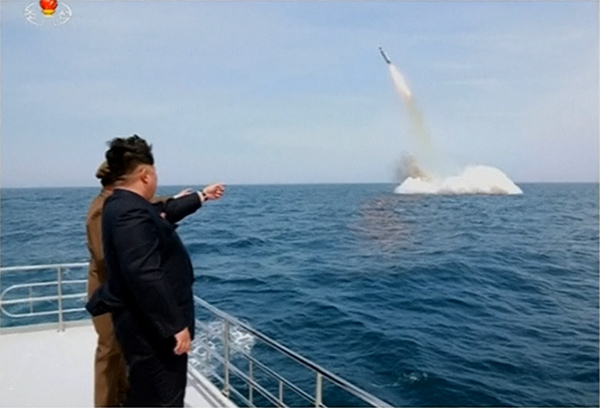
  • In April, North Korea launched a ballistic missile from a submerged platform. The North Korean underwater launch test was closely related to the further development of a missile-firing submarine capable of hitting the U.S. — “a first step,” according to Uzi Rubin, “in achieving a very serious and dangerous new military capability… it will take many years to build up the missile defenses, so we had better use the time wisely.”
  • Although the Chinese profess to be against nuclear proliferation, documented evidence illustrates just the opposite — as a means of asserting Chinese hegemony, complicating American security policy and undermining American influence.
  • Unfortunately, no matter how attractive a strategy of diplomatically ending North Korea’s nuclear program might look, it is painfully at odds with China’s established record of supporting nuclear proliferation with such collapsed or rogue states as Iran, Syria, Pakistan, North Korea and Libya.
  • China’s nuclear assistance to Pakistan did not stay just in Pakistan.

North Korea appears to have made significant progress in extending its capability as a nuclear-armed rogue nation, to where its missiles may become capable of hitting American cities with little or no warning.

What new evidence makes such a threat compelling?

North Korea claims to have nuclear warheads small enough to fit on their ballistic missiles andmissiles capable of being launched from a submerged platform such as a submarine.

Shortly after North Korea’s April 22, 2015 missile test, which heightened international concern about the military capabilities of North Korea, U.S. Secretary of State John Kerry urged China and our regional allies to restart the 2003 “six-party talks” aimed at eliminating nuclear weapons from the Korean peninsula and reining in North Korea’s expanding nuclear missile program.

There are some “experts,” however, who believe that North Korea’s threat is highly exaggerated and poses no immediate danger to the United States. Consequently, many believe that, given China’s oft-repeated support for a “nuclear weapons free” Korean peninsula, time is on America’s side to get an agreement that will guarantee just such a full de-nuclearization.

But, if North Korea’s technical advances are substantive, its missiles, armed with small nuclear weapons, might soon be able to reach the continental United States — not just Hawaii and Alaska. Further, if such missile threats were to come from submarines near the U.S., North Korea would be able to launch a surprise nuclear-armed missile attack on an American city. In this view, time is not on the side of the U.S. Submarine-launched missiles come without a “return address” to indicate what country or terrorist organization fired the missile.

The implications for American security do not stop there. As North Korea is Iran’s primary missile-development partner, whatever North Korea can do with its missiles and nuclear warheads, Iran will presumably be able to do as well. One can assume the arrangement is reciprocal.

Given recent warnings that North Korea may have upwards of 20 nuclear warheads, the United States seems to be facing a critical new danger. Would renewed negotiations with China, Japan, South Korea and North Korea really be able to address this threat?

Two years ago, Andrew Tarantola and Brian Barrett said there was “no reason to panic;” that North Korea was “a long way off” — in fact “years” — before its missiles and nuclear weapons could be “put together in any meaningful way.”

At the same time, in April 2013, an official U.S. assessment by the Defense Intelligence Agency stated the U.S. had “moderate” confidence that “North Korea had indeed developed a nuclear device small enough to mount on a ballistic missile.”

That was followed up two years later, on April 7, 2015, when the commander of Northcom, Admiral Bill Gortney, one of the nation’s leading homeland security defenders, said the threat was considerably more serious. He noted that, “North Korea has deployed its new road-mobile KN-08 intercontinental ballistic missile and was capable of mounting a miniaturized nuclear warhead on it.”[1]

At a Pentagon press briefing in April, Admiral Cecil Haney, Commander of the US Strategic Command and America’s senior military expert on nuclear deterrence and missile defense, said it was important to take seriously reports that North Korea can now make small nuclear warheads and put them on their ballistic missiles.[2]

And sure enough, in April, North Korea launched a ballistic missile from a submerged platform. Media reaction to the North Korean test has been confused. Reuters, citing the analysis of two German “experts,” claimed the North Korean test was fake — a not-too-clever manipulation of video images.

The Wall Street Journal, on May 21, 2015, echoed this view, noting: “[F]or evidence of North Korea’s bending of reality to drum up fears about its military prowess,” one need look no further than a consensus that North Korea “doctored” pictures of an alleged missile test from a submarine. This, they claimed, was proof that the “technology developments” by North Korea were nothing more than elaborately faked fairy tales.

However, Israeli missile defense expert Uzi Rubin — widely known as the “father” of Israel’s successful Arrow missile defense program — explained to this author that previous North Korean missile developments, which have often been dismissed as nothing more than mocked-up missiles made of plywood, actually turned out to be the real thing — findings confirmed by subsequent intelligence assessments.

Rubin, as well as the South Korean Defense Ministry, insist that on April 22, the North Korean military did, in fact, launch a missile from a submerged platform.[3]

1104Kim Jong Un, the “Supreme Leader” of North Korea, supervises the April 22 test-launch of a missile from a submerged platform. (Image source: KCNA)

What gave the “faked” test story some prominence were the misunderstood remarks of the Vice Chairman of the Joint Chiefs of Staff, Admiral James Winnefeld. He had said, on May 19, that the North Korean missile launch was “not all” that North Korea said it was. He also mentioned that North Korea used clever video editors to “crop” the missile test-launch images. Apparently, that was exactly what the editors did. The Admiral, however, never claimed in his speech at the Center for Strategic and International Studies there had been no successful missile test.[4]

The same day, a high-ranking State Department official, Frank Rose — Assistant Secretary of State for Arms Control, Verification, and Compliance — told a Korean security seminar on Capitol Hill that North Korea had successfully conducted a “missile ejection” test, but from an underwater barge rather than a submarine.[5]

To confuse matters further, additional pictures were released by the South Korean media to illustrate stories about the North Korean test. Those pictures, however, were of American missiles, which use both solid and liquid propellant; as a result, one photo showed a U.S. missile with a solid propellant smoke trail and one, from a liquid propellant, without a smoke trail. These photographs apparently befuddled Reuters’ “experts,” who may have jumped to the conclusion that the photos of the North Korean test were “faked,” when they were simply of entirely different missile tests, and had been used only to “illustrate” ocean-going missile launches and not the actual North Korean test.[6]

According to Uzi Rubin, to achieve the capability to eject a missile from an underwater platform is a significant technological advancement. The accomplishment again illustrates “that rogue states such as North Korea can achieve military capabilities which pose a notable threat to the United States and its allies.”

Rubin also stated that the North Korean underwater launch test was closely related to the development of a missile-firing submarine, “a first step in achieving a very serious and dangerous new military capability.”[7]

Admiral Winnefeld and Secretary Rose, in their remarks, confirmed that the North Korean test was not the “dog and pony show” some have claimed. In other words, the U.S. government has officially confirmed that the North Koreans have made a serious step toward producing a sea-launched ballistic missile capability.

While such an operational capability may be “years away,” Rubin warns that “even many years eventually pass, and it will also take many years to build up the missile defenses, so we had better use the time wisely.”[8]

Will diplomacy succeed in stopping the North Korean threats? U.S. Secretary of State John Kerry seemed to think it worth a try; so he began the push to restart the old 2003 “six-party” talks between the United States, North Korea, Russia, China, South Korea and Japan, to bring North Korea’s nuclear weapons under some kind of international control and eventual elimination.

After all, supporters of such talks claim, similar talks with Iran appear to be leading to some kind of “deal” with Tehran, to corral its nuclear weapons program, so why not duplicate that effort and bring North Korea back into the non-nuclear fold?

What such a “deal,” if any, with Iran, will contain, is at this point unknown. Celebrations definitely seem premature. If the “deal” with North Korea is as “successful” as the P5+1’s efforts to rein in Iran’s illegal nuclear weapons program, the prognosis for the success of diplomacy could scarcely be more troubling.

Bloomberg’s defense writer, Tony Carpaccio, reflecting Washington’s conventional wisdom, recently wrote that of course China will rein in North Korea’s nuclear program: “What might be a bigger preventative will be the protestations of China, North Korea’s primary trade partner and only prominent international ally. Making China angry would put an already deeply impoverished, isolated North Korea in even more dire straits.”

Unfortunately, no matter how attractive a strategy of diplomatically ending North Korea’s nuclear program might look on the surface, it is painfully at odds with China’s established and documented track record in supporting and carrying out nuclear proliferation with such collapsed or rogue states as Iran, Syria, Pakistan, North Korea and Libya, as detailed by the 2009 book The Nuclear Express, by Tom C. Reed (former Secretary of the Air Force under President Gerald Ford and Special Assistant to the President of National Security Affairs during the Ronald Reagan administration) and Daniel Stillman (former Director of the Lawrence Livermore National Laboratory).

Far from being a potential partner in seeking a non-nuclear Korean peninsula, China, say the authors, has been and is actually actively pushing the spread of nuclear weapons to rogue states, as a means of asserting Chinese hegemony, complicating American security policy and undermining American influence.

The problem is not that China has little influence with North Korea, as China’s leadership repeatedly claims. The problem is that China has no interest in pushing North Korea away from its nuclear weapons path because the North Korean nuclear program serves China’s geostrategic purposes.

As Reed and Stillman write, “China has been using North Korea as the re-transfer point for the sale of nuclear and missile technology to Iran, Syria, Pakistan, Libya and Yemen”. They explain, “Chinese and North Korean military officers were in close communication prior to North Korea’s missile tests of 1998 and 2006”.

Thus, if China takes action to curtail North Korea’s nuclear program, China will likely be under pressure from the United States and its allies to take similar action against Iran and vice versa. China, however, seems to want to curry favor with Iran because of its vast oil and gas supplies, as well as to use North Korea to sell and transfer nuclear technology to both North Korea and Iran, as well as other states such as Pakistan. As Reed again explains, “China has catered to the nuclear ambitions of the Iranian ayatollahs in a blatant attempt to secure an ongoing supply of oil”.

North Korea is a partner with Iran in the missile and nuclear weapons development business, as Uzi Rubin has long documented. Thus, it is reasonable to believe that China may see any curtailment of North Korea’s nuclear program as also curtailing Iran’s access to the same nuclear technology being supplied by North Korea. Any curtailment would also harm the Chinese nuclear sales business to Iran and North Korea, especially if China continues to use the “North Korea to Iran route” as an indirect means of selling its own nuclear expertise and technology to Iran.

It is not as if Chinese nuclear proliferation is a recent development or a “one of a kind” activity. As far back as 1982, China gave nuclear warhead blueprints to Pakistan, according to Reed. These findings indicate that China’s nuclear weapons proliferation activities are over three decades old.[9]

Reed and Stillman also note that nearly a decade later, China tested a nuclear bomb “for Pakistan” on May 26, 1990, and that documents discovered in Libya when the George W. Bush administration shut down Libyan leader Muammar Kaddafi’s nuclear program revealed that China gave Pakistan the CHIC-4 nuclear weapon design.

Unfortunately, China’s nuclear assistance to Pakistan did not stay just in Pakistan. The nuclear technology made its way from Pakistan to North Korea. For example, high explosive craters, construction of a 50 megawatt nuclear reactor (finished in 1986) and a secret reprocessing facility begun in 1987 all were done in North Korea with major Pakistani help from the A.Q. Khan “Nukes R Us” smuggling group, as Reed and Stillman document in their book.

Reed and Stillman write that when, amid disclosures in 2003 of a major Libyan nuclear weapons program, the U.S. government sought help in shutting down the Khan nuclear smuggling ring, “Chinese authorities were totally unhelpful, to the point of stonewalling any investigation into Libya’s nuclear supply network.”

More recently, Chinese companies have now twice — in 2009 and 2011 — been indicted by the Attorney for the City of New York for trying to provide Iran with nuclear weapons technology.

The indictments document that Chinese companies were selling Iran steel for nuclear centrifuges and other banned technology. A leaked State Department cable, discussing the indictments at the time, revealed “details on China’s role as a supplier of materials for Iran’s nuclear program,” and that “China helped North Korea ship goods to Iran through Chinese airports.”

And more recently, in April 2015, the Czech government interdicted additional nuclear technology destined for Iran — the origin of which remains unknown — in violation of current sanctions against Iran.

From 1982 through at least the first part of 2015, the accumulation of documentary evidence on nuclear proliferation reveals two key facts:

First, despite literally hundreds of denials by Iran that it is seeking nuclear weapons, and amid current negotiations to end Iran’s pursuit of nuclear weapons, there is solid evidence that Iran still seeks nuclear weapons technology; and that North Korea has nuclear weapons and is advancing their capability.

Second, China continues to transfer, through its own territory, nuclear weapons technology involving both North Korea and Iran.

Although the Chinese profess to be against nuclear proliferation, their track record from the documented evidence illustrates just the opposite.

In summary, it is obvious North Korea’s nuclear weapons and ballistic missiles are a serious threat to America and its allies. And China, from its proliferation record for the past three decades, is making such a threat more widespread.

In this light, is dismissing North Korea’s advances in military technology and ignoring China’s record of advancing its neighbors’ nuclear weapons technology really best for U.S. interests?

_______________________

[1] The Washington Post, May 20, 2015, Anna Fifield, “North Korea says it has technology to make mini-nuclear weapons“; and Admiral Bill Gortney, US NORAD Commander, quoted in “NORAD commander: North Korean KN-08 Missile Operational“, by Jon Harper, in “Stars and Stripes”, of April 7, 2015; the Admiral said: “Our assessment is that they have the ability to put a nuclear weapon on a KN-08 and shoot it at the homeland.” He said “Yes sir” when asked if the U.S. thinks North Korea has succeeded in the complicated task of miniaturizing a warhead for use on such a missile. North Korea has conducted three nuclear tests since 2006.

[2] Department of Defense Press Briefing by Admiral Cecil Haney, Commander, U.S. Strategic Command, March 24, 2015.

[3] Personal communication with Uzi Rubin, President of Rubincon, May 21, 2015.

[4] Admiral James Winnefeld, Remarks at the Center for Strategic and International Studies (CSIS) Briefing on Missile Defense, May 20, 2015.

[5] U.S. Department of State, Daily Digest Bulletin, Frank Rose, Remarks on “Missile Defense and the U.S. Response to the North Korean Ballistic Missile and WMD Threat”, May 20, 2015.

[6] Explanation provided by Israel missile expert Uzi Rubin, personal communication, May 20, 2015.

[7] Ibid.

[8] Ibid.

[9] According to Reed and Stillman, in “The Nuclear Express,” none of China’s nuclear help to Pakistan and Iran could have been possible without China’s transfer of the nuclear technology through Chinese airspace.

Al-Aqsa Mosque Sheik Rebukes Pakistan for Not Launching Nuclear Strike to Help Establish Caliphate

March 16, 2015

Al-Aqsa Mosque Sheik Rebukes Pakistan for Not Launching Nuclear Strike to Help Establish Caliphate, MEMRI via You Tube, March 16, 2015

(Al-Aqsa Mosque  “also known as Al-Aqsa and Bayt al-Muqaddas, is the third holiest site in Islam and is located in the Old City of Jerusalem.” — DM)


Now the Saudis are developing a nuclear arsenal

March 12, 2015

Now the Saudis are developing a nuclear arsenal, Examiner, March 12, 2015

(????????????? — DM)

US nuke testThe “Baker” explosion, part of Operation Crossroads, a nuclear weapon test by the United States military at Bikini Atoll, Micronesia, on 25 July 1946.

Thus far, South Korea has been secure behind America’s nuclear arsenal. But, that country seems to have lost confidence with President Obama as well. It also might be disposed to share the technology with Japan, a country that has cast an anxious eye toward North Korea and China. In turn, the latter country will become very much alarmed.

************************

One of the terrible side effects of the impending Munich-style nuclear arms deal between President Obama and Iran is the possibility of a Middle East nuclear arms race. Hot Air reported on Thursday that the other shoe has dropped, and Saudi Arabia and South Korea has signed a nuclear agreement. The agreement suggests that the Saudis have concluded that there is no hope for President Obama preventing Iran from acquiring the Bomb. Therefore, the Kingdom is moving to acquire a native nuclear enrichment capacity in advance of building a nuclear arsenal.

By pretending that it is engaged in serious diplomacy with Iran, the Obama administration has managed to frighten the rest of the region to death. Israel is the only other country in the Middle East with a nuclear arsenal. Nearby Pakistan has the Bomb as well, but its nuclear weapons are geared toward countering its main enemy, India. The Saudis have concluded that it is time for an Arabic bomb to counter the impending Iranian bomb. Thus proliferation and the bone chilling possibility that a nuclear weapon might find its way into the hands of terrorists proceeds apace.

It gets worse. South Korea, besides an infusion of petrodollars, gets access to the nuclear technology it will build for its new desert customers. South Korea faces a country, North Korea, run by an insane man with its nuclear arsenal. Thus far, South Korea has been secure behind America’s nuclear arsenal. But, that country seems to have lost confidence with President Obama as well. It also might be disposed to share the technology with Japan, a country that has cast an anxious eye toward North Korea and China. In turn, the latter country will become very much alarmed.

So, the president, with his “smart diplomacy,” is about to create more nuclear powers across the world. Moreover, these countries will have, under the right circumstances, every incentive to use their nuclear arsenals. Who would have thought it possible?

Sleeper Cell Documentary: Radical Islamic Camps in America

March 1, 2015

Sleeper Cell Documentary: Radical Islamic Camps in America, Counter Jihad ReportRyan Mauro, March 1, 2015

(“Islamophobia” or rational concern? Somehow, it seems unlikely that “jobs for jihadists” will deal satisfactorily with the problem. Thanks again to Counter Jihad Report, one of the few sites to deal adequately with such threats.– DM)


This Blaze TV episode of “For the Record” aired February 19, 2014 and is largely based on the research of Ryan Mauro of the Clarion Project. It exposes the network of Muslims of the Americas, a branch of the Pakistani group Jamaat ul-Fuqra, across the U.S. It is headquartered at “Islamberg,” New York.

Read about Mauro’s identification of an ul-Fuqra jihadist enclave in Texas:

Exclusive: Islamist Terror Enclave Discovered in Texas
The discovery led a dozen North American Muslim groups and Rep. Louie Gohmert (R-TX) to call on the State Department to list ul-Fuqra as a Foreign Terrorist Organization:

Muslims Join Clarion’s Call for ul-Fuqra to be Foreign Terrorist Org.
Texas Congressman: Terror Enclave Discovery ‘Appalling’

Pakistan: Between Civility and Fanaticism

January 31, 2015

Pakistan: Between Civility and Fanaticism, The Gatestone InstituteSalim Mansur, January 31, 2015

(The history of Pakistan, “the land (or home) of the pure,” may provide insights into the future of Egypt and other Islamic nations. — DM)

A country made for Muslims has turned into a nightmare for Muslims.

The wish of Mohammad Ali Jinnah, the father of Pakistan, was that the country evolved into a modern democratic state where Muslims, as a majority population, could feel at ease.

But the modernizers who succeeded the colonial authorities in taking power aroused expectations that were simply beyond their abilities to deliver.

But religious authorities were agitating, warning the bewildered masses that these defeats were divine punishments for betraying the true message of Islam by not faithfully abiding by its requirements.

Qutb in his writings recast the division in the world from the classic Muslim one between the House of Islam and the House of War, to one between Islam and jahiliyya, a condition of paganism that preceded the coming of Islam to Arabia. Jahiliyya has now become all-pervasive in the modern world, supposedly sparing none, including Muslims, except for that small coterie of Muslims who took flight [hijra] from the corrupted world and prepared for jihad [armed struggle].

Together, Hasan al-Banna, Abul A’la Maududi and Sayed Qutb fashioned political Islam as a closed system, in opposition to all other competing ideologies.

The theology of takfir — declaring other Muslims apostates or unbelievers; excommunication — obsessed with “unbelief,” has provided the politics of jihad [armed struggle] with the theological justification that arms any Muslim to freelance as a soldier of Allah.

The strategic requirement for advancing global jihad was to convince Muslims that they are liable to be found committing heresy if they support non-Muslim or infidel authorities, such as the United States and its allies, or if they wage war against Muslims, such as members of al-Qaeda.

The theology of takfir and jihad has now come full circle. Many Pakistanis, when they disagree, now find themselves trapped in denunciations that they are unbelievers.

It is from these madrasas that the jihadi fighters come forth as cannon fodder for an endless jihad that has become a growth industry in Pakistan. The entire political elite in Pakistan has profited, just as the Iranian elite continues profiting by doing the same.

For many, being “pure” required separating oneself from non-Muslims.

“The Taliban were not providing strategic depth to Pakistan, but Pakistan was providing strategic depth to the Taliban.” — Ahmed Rashid, foremost scholar of the Taliban.

The recent massacre of school children by Taliban jihadists in a Peshawar army school just lowered even further the bar of atrocities carried out under the banner of Islam in Pakistan. As authorities floundered in the face of mounting violence, with serious implications for new wars in the region, the 2014 Global Terrorism Index ranked Pakistan third behind Iraq and Afghanistan among countries most impacted by terrorism. In addition, the “failed states index” elevated the status of Pakistan to being among the top dozen failed states of the world.

According to the intelligence report of the last conversation before the murders, monitored by Pakistan’s security agency, one of the jihadists informed his handler, “We have killed all the children in the auditorium.” He then asked, “What do we do now?” The handler answered, “Wait for the army people, kill them before blowing up yourself.”[1]

When the mayhem was over, 132 children were dead, among 145 people killed by the jihadists.

The Peshawar massacre has once again, just as in 1971, opened a window onto internal fault lines rupturing the country: those of ideology, ethnicity, sectarianism, and class. Of these, the most severe is the rupture over ideology — between those who insist that the country is insufficiently Islamic and those who fear that religious extremism has brought the country to ruin. This ideological fault line also intensifies the other divisions.

There is not only the immense risk of Pakistan’s nuclear arsenal getting into the hands of Islamist terrorists, but that Pakistan has more or less turned into a safe-haven for them. For religious extremists of Islam, Pakistan has become a secure fortress, from which they can wage their global jihad.

The injunction against the deliberate killing of children has, unfortunately, often been breached in times of war; the Peshawar massacre of children by militants of Tehreek-e-Taliban Pakistan [TTP] were, apparently, revenge killings for the loss of their women and children as a result of Pakistan’s military operations in North Waziristan, along the border with Afghanistan.

The TTP leaders, however, went further. They defended their revenge killing in the name of Islam, as a jihad against their enemies. Umar Khorasani, a spokesman for the TTP, justified the massacre by comparing it to the massacre by the Prophet Muhammad of the Jewish tribe of Banu Qurayza, in which children were also killed.

In offering this justification, Khorasani’s reference to Sahih Bukhari — one of the authoritative sources for Sunni Muslims on the traditions (Sunnah) of the Prophet — carried the message that those who even question the religious legitimacy of the killings would be held responsible for igniting any violence against them by the Pakistani Taliban and their supporters, on the charge of having insulted the Prophet. Such a denunciation by the Taliban of their opponents is consistent with Pakistan’s blasphemy law; it forbids any remark that might be taken as insulting the Prophet or the Quran, with the maximum penalty of death, under which some members of the minority religious communities have been indicted — often unfairly — and held in prison.

The Peshawar massacre and the manner in which the TTP offered its justification for it, have roped the Pakistan’s political and military elite into a fix on how to refute Taliban’s interpretation of Islam’s sacred texts, without getting drawn into a potentially deadly conflict that would only deepen sectarian and ideological differences even more.

If the country is not to slide deeper into the lethal mix of Taliban-type fanaticism and armed globaljihad, the elite need to respond forcefully. The prospect, however, is gloomy.

The Pakistani Taliban is the creature of the ruling elite, especially the directorate of the Inter-Services Intelligence [ISI]. There is also a problem of widespread pride, nurtured by the elite over the past four decades, in Pakistan’s identity as an Islamic state. And since the identity of the elite is closely bound with the ideology of the religious establishment — and not merely with that of the Taliban — it follows that the various Islam-oriented parties and their supporters will fight to preserve their Islamist ideology.

The impasse in which Pakistan finds itself needs explaining. Pakistan was established on the basis of religion, on Islam, and the claim that Muslims in an undivided British India deserved a state of their own to preserve their religion and culture, for fear of losing both if ruled by the Hindu majority population once the British departed from the subcontinent.

The argument to have a separate state based on religion was flawed. But that flaw would only become apparent during the break-up of Pakistan in 1971 — despite the shared belief in Islam.

The circumstances under which India was partitioned in August 1947 still remains contentious, given the subsequent history of wars fought by the successor states, the unsettled nature of the Kashmir conflict, and the break up of Pakistan in 1971 as a reminder that this could happen again.

The pressure for partitioning India in 1947 largely succeeded because an exhausted Britain, after the Second World War in 1945, did not have the stomach to suppress the communal violence escalating between those who supported a separate Pakistan, and their opponents who insisted on keeping India united.

The seeds of religious extremism — adherence to Islam as the line of demarcation, using violence, if necessary, against non-Muslims — were embedded in the initial demand made to Britain for creating Pakistan.

The father of Pakistan, Mohammed Ali Jinnah (1876-1948), exploited this demand. He persuaded the British authorities to partition India. Jinnah himself was a nominal Muslim with a taste for things British. He was an Anglophile who barely spoke Urdu, the vernacular language of Muslims of northern India. He married a non-Muslim woman, the daughter of a wealthy Parsi (Zoroastrian) industrial magnate of Bombay (now Mumbai); and he died a little over a year after Pakistan had been launched in a sea of immense communal violence that accompanied its beginning.

For Jinnah, ironically, religion had been a matter of personal choice. He had taken to Islam as a lawyer, not as a theologian. He had been persuaded, against his earlier political inclinations as an Indian nationalist, that the Muslims in India deserved to have a state of their own in the eventuality that Britain granted India independence. His wish[2] was that the country evolve into a modern democratic state where Muslims, as a majority population, could feel at ease, as opposed to the unease they had felt as a minority population in an undivided India.

As Jinnah said to the assembled politicians of the new country, “Now I think we should keep in front of us as our ideal and you will find that in course of time Hindus would cease to be Hindus and Muslims would cease to be Muslims, not in the religious sense, because that is the personal faith of each individual, but in the political sense as citizens of the State.”[3]

But Jinnah was old, gravely ill, and probably could not even imagine that the forces of religious extremism he had unleashed would devour his vision of Pakistan as simply a peaceful homeland for the Muslims of India.
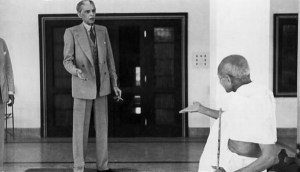
910Mohammed Ali Jinnah, the founder of Pakistan, in conversation with India’s Mahatma Gandhi

It did not take long, however, for all the various contradictions of ethnicity, language, sect, and class, to surface soon after Pakistan’s birth, between the Muslim refugees from India and the people who had been born there.

The country was also physically divided into two halves, separated in the middle by over a thousand miles of northern India. The demand for a Pakistan based on Islam had carried emotional appeal, but what Pakistan would mean as a Muslim state had not been given much thought.

Then there was a problem with Kashmir. Jinnah, according to biographers, felt cheated by the British. Kashmir, with a Muslim majority population, but ruled by a hereditary Hindu prince, was left to India, instead of Pakistan. Jinnah was prepared to force Kashmir’s union with Pakistan. But after pressure from the British military officers still in command of British India’s joint armed forces, Jinnah dropped his plans.[4]

Much of the divisiveness within Pakistan resulted in the inability of politicians to draft and ratify a constitution for nearly a decade – unlike India, where, after independence, a republican constitution for a parliamentary system of government was drafted, ratified, and adopted in fewer than thirty months.

In Pakistan, the irresolvable differences were over the nature of the Islamic state, its ideals and objectives, and how such a state was to be organized.

There were, on one side, modernist or reform-oriented Muslims, educated within the Western liberal tradition, with Jinnah as their model. They believed the Quran and the Sunnah (traditions of the Prophet) could be reconciled through liberal-reformist interpretation with the requirements of a modern democratic and representative form of government.

The religious establishment, on the other side, with its traditionalist-minded ulema (religious scholars), was insistent that the law of the land could be based only on the Quran and the Sunnah, which provided the complete and unalterable social and political code for an Islamic society. They required, therefore, that Shariah – Islamic law compiled in the 9th-12th centuries C.E. – was made the law of the land.

Then there was Abul A’la Maududi (1903-79), with the title of Maulana (a learned scholar), bestowed by his followers, as the founder and leader of Jamaat-i-Islami – the South Asian counterpart of Ikhwan-i-Muslimin (the Muslim Brotherhood), founded by the Egyptian, Hasan al-Banna (1906-49). Maududi went even farther by demanding that the constitution recognize the sole sovereignty of Allah, and the state as His agent, be limited only to implementing the Shariah.

Ultimately the difference in these two views was unbridgeable. As a result, holding the country together by authoritarian means became unavoidable.

Men in uniform replaced feckless politicians. General (later made Field Marshal) Ayub Khan, a military chief, seized power in October 1958, and set the pattern of military rule for the country. During the decade he ruled, he imposed on the country a constitution of his making; supervised economic development; invested in the defense establishment; worked to undermine the religious establishment; and in 1965 launched a poorly conceived war against India over Kashmir, which backfired. He was eventually forced, in the midst of political unrest across the country, to hand over power in 1969 to yet another general.

The military rule of Ayub Khan’s successor, General Yahya Khan, ended dismally in December 1971 with the break-up of Pakistan. It was preceded by an election for a national assembly in 1970, which Yahya Khan had arranged with the express purpose of handing power to a civilian government. But when a political party from East Pakistan won the largest number of seats in the assembly and was poised to form a government, Yahya Khan reneged on his promise. The people in East Pakistan (now Bangladesh) – estranged from those in West Pakistan (now Pakistan) over ethnic and language differences, and grievances over socioeconomic disparities – rose in opposition to military rule. The situation rapidly deteriorated, a civil conflict turned into a bloody military repression and massacre of unarmed people by the military. It ended with Pakistan declaring war against India, and the surrender of the Pakistani army to Indian forces in Dhaka, the capital of East Pakistan (now independent Bangladesh), on December 16, 1971.

After this humiliating defeat, Pakistanis in general were demoralized and the military discredited. In these circumstances, Zulfikar Ali Bhutto and the party he founded, the Pakistan People’s Party, maneuvered to fill the void. Bhutto belonged to the wealthiest landlord family in the province of Sind; as a young lawyer-politician, he had been appointed a junior minister in the military regime of Ayub Khan. His later disagreements with Ayub Khan’s policies, following the 1965 war fought by Pakistan and India over Kashmir, forced him out of the government and into opposition against military rule.

In the 1970 election Bhutto’s party had emerged with second largest number of seats in the national assembly, behind the party from East Pakistan. Bhutto claimed this as his mandate to form a civilian government, with himself as president, to replace military rule.

In 1973 he presented the country with its third constitution, and had it adopted by the national assembly. But, as the old differences over the nature of an Islamic state and the place of the Shariah resurfaced, the constitution failed to win the support of the religious establishment.

Bhutto was a populist and a demagogue. Although he was one of the most powerful feudal landlords in Pakistan, he nevertheless appealed for electoral support from students, workers and peasants by posing as a defender of the poor and oppressed in society, and, as an ally of China’s then supreme leader Mao Zedong, by embracing the left-wing politics of anti-imperialism. There was showmanship here, and some grandstanding as a leader of a third world nation. It was at this time – and soon after India tested a nuclear device in 1974 – that he determined that Pakistan must acquire nuclear capability of its own. His populism however would not save him from the wrath of the religious establishment.

But, as the country searched for an identity in the aftermath of 1971, Bhutto was temperamentally unsuited to calm the tensions around him. The Muslim religious leaders and their followers distrusted him as another liberal-secularist; he tried to appease them by meeting their demand in declaring as non-Muslims those belonging to the minority Ahmediyya sect within Islam.

In 1977, the military under General Zia ul-Haq staged a comeback, removed Bhutto from office and put him under arrest. While in prison he was indicted for plotting the murder of his political opponent, and put on trial. The court found him guilty, his appeal was denied, and he was hanged in April 1979.

Zia ul-Haq, the third military dictator to take power, ruled until his death in a mysterious plane crash in August 1988. He was a devout orthodox Sunni Muslim, and, unlike his two military predecessors – Ayub Khan and Yahya Khan – he publicly showed respect for Muslim religious leaders and their various organizations. He sought their support, and embraced their religiously directed political agenda to turn Pakistan officially into an Islamic society (Nizam-i-Islam).

ii.

The decades of sixties and seventies in the twentieth century were times of social and political unrest in the West. There was a crisis of values as the young questioned the dominant secular politics mostly concerned with material gain and economic well being, while America’s involvement in the war in Vietnam became increasingly divisive at home. The youth in general defied the authorities on both the Soviet and Western sides of the Cold War. They pushed counter-cultural movements and sought “enlightenment” through sexual freedom, drugs, music, and experimenting with the rites of non-European cultures.

In the Muslim world, the situation was vastly different. The thin veneer of modernity barely penetrated the surface of a world steeped in traditional culture. Islam as understood and practiced for generations sustained the vast majority of people at the edge of poverty. Colonialism had made only a small difference, once independence came, in preparing Muslim societies to meet the immense challenge the modern world posed for them. A tiny segment of the population had received a modern liberal education and had risen in the ranks of colonial administrations as junior civil servants, technocrats, and military officers. On their shoulders fell the task, as in Pakistan after 1947, to lead the country forward and somehow meet the swelling demands of the people for the promise of a better life.

The political leadership of the newly independent states generally looked to the West in terms of their own respective economic and social developments. Within the Muslim world – apart from the few oil-rich Arab states on the Gulf – there was a general consensus among those who held power that there was no alternative to the path for development as historically charted by the advanced Western countries, irrespective of whether those countries were capitalist democracies or socialist.

But the modernizers who succeeded the colonial authorities in taking power – the men in uniform who seized power through military coups due to the fecklessness of politicians, as in Egypt (Colonel Gamal Abdel Nasser) or in Pakistan (General Ayub Khan) – aroused expectations that were simply beyond their abilities to deliver.

The sixties and the seventies of the last century were the decades when the political roof caved in over the heads of the Muslim world’s modernizers. The immediate cause was military defeat. In the Arab world, the June war of 1967 with Israel was a catastrophic defeat for Egypt under Nasser; and, similarly, for Pakistan the December 1971 war with India was a colossal humiliation in which the army lost half the country when East Pakistan, with support of the Indian military, seceded to become an independent Bangladesh.

On the political margins of these Muslim countries, religious parties were agitating, warning the bewildered masses that these defeats were divine punishments for betraying the true message of Islam by not faithfully abiding by its requirements.

These were the decades when old theological debates from the medieval past of the Muslim world re-surfaced and were widely disseminated. Muslims were repeatedly told by religious scholars that to reverse their humiliations, they needed to return to their authentic past, to emulate the ways of their revered ancestors (salaf) and the companions of the Prophet, and to establish the rule of Islam.

In the Arab world, the Muslim Brotherhood of Hasan al-Banna and Syed Qutb (1906-66), and in Pakistan the Jamaat-i-Islami of Maulana Maududi, gained in popularity with a populace increasingly frustrated with its own political authorities.

In Egypt, Syed Qutb, as one of the leaders of the Muslim Brotherhood that declared a jihadagainst Nasser’s military-led government, was sent to the gallows. In death, Qutb became a martyr-scholar for a whole new generation of Muslims who were searching for meaning in the midst of cultural despair and political authoritarianism.

An earlier generation before 1967 in the Middle East – as elsewhere in Asia and Africa – had sought answers in the revolutionary politics of Marx and Lenin; had supported the Vietnamese communists in their war against the United States, and had admired Mao Zedong and the Chinese revolution.

In the period after 1967, and before the 1973 October war that brought the Arab oil-producing states to quadruple the price of oil and turn it into a political weapon, it was the writings of Syed Qutb that appealed to the young in the Middle East. Hasan al-Banna and the Muslim Brotherhood had turned Islam into a political doctrine – Islamism – as a total answer to all the problems of the Muslim world. Qutb had described the solution in terms of an Islamic state implementing Shariah as the fundamental law of the land. Al-Banna’s message was also directed at the lslamic ummah,the whole Muslim nation.

Qutb in his writings refined and deepened the message of al-Banna. In a significant departure from other Muslim thinkers of his time, Qutb recast the binary division in the world made by Muslim traditionalists, one between Dar al-Islam (House of Islam) and Dar al-Harb (House of War), into one between Islam and jahiliyya (a condition of barbarism or paganism) that had preceded the coming of Islam in Arabia.

Qutb developed this concept of jahiliyya as one of the key explanations for the decline of Islam in the world, and the miserably broken condition of Muslims in it. In his ultimately extreme view, and one that caught the imagination of his most devoted followers, jahiliyya had become all pervasive in the modern world, sparing none, including Muslims, except for that small coterie of Muslims who understood the situation, took flight (hijra) or withdrew from the corrupted world, and prepared for jihad (holistic struggle, including warfare) in the cause of Islam.

Qutb’s views were in part influenced by the writings of Abul A’la Maududi, in the extent to which Maududi had revived the theological views of medieval Muslim jurists on matters of God’s sovereignty in human affairs. Maududi’s innovation was in insisting that Islam was a complete system of faith and politics, in other words a totalitarian ideology promoting a social revolution, and the necessity of jihad as the instrument for realizing God’s plan on earth.

Together, Hasan al-Banna, Maududi, and Syed Qutb had fashioned political Islam as a closed system, in opposition to all other competing ideologies confronting Muslims. It was at once simple, rigidly based on the Quran and the Sunnah (traditions) of the Prophet, and provided Muslims with an armed doctrine of jihad to quell their doubts, overcome their fears, and direct them towards the objective of establishing an Islamic state or gaining martyrdom in the pursuit of it. When the Islamic revolution did successfully occur, however, it was in Iran, and in February 1979.

The Iranian followers of a religious leader in exile, Ayatollah Khomeini (1902-89), seized control of the popular uprising and eventually turned Iran into a theocratic Islamic republic.

Iran had been a monarchical regime, and the anti-monarchist revolution, even though Iranians followed the minority Shi’ite version of Islam, caught the imagination of the majority Sunni Muslims on either side of its borders. The leader of the Palestinian movement, Yasser Arafat, for instance, travelled to Tehran and embraced the founder of Iran’s Islamic revolution, Ayatollah Ruhollah Khomeini, as the leader of anti-imperialist revolution.

If Iranians could topple the Shah of Iran, an ally of the United States, then it was not unimaginable that Muslims elsewhere could also overthrow similarly pro-American or pro-Soviet authoritarian regimes that they felt had been repressing them into a state of jahiliyya. As a result, the year 1979 – the beginning of the fifteenth century in the Islamic calendar – became a pivotal year in the Muslim world.

Earlier, in November 1979, there had been a failed attempt by a small group of Saudi Wahhabi extremists to ignite a movement against the ruling House of Saud. They seized the grand mosque in Mecca, at the center of which stands the Ka’aba (the ancient cube-like structure), and held the grand mosque for several days until French paratroopers flushed them out. Although this effort was doomed to fail, it signified unrest within the most conservative Arab state, and the messianic wish for an even stricter version of Islam than the one practiced by Saudi rulers.

Then, at the end of 1979, came the Soviet invasion of Afghanistan. The occupation of a Muslim country by an infidel power became a magnet around which to rally Muslim jihadists, and encourage them to head for Afghanistan and join Afghan mujahideen (freedom fighters) in theirjihad against a military superpower.

iii.

Zia ul-Haq (1924-88), an army general who was then president, turned Pakistan into a frontline state in the decade long Afghan war. Zia viewed the Afghan war as the opportunity to reverse the humiliation of 1971, rebuild the morale of the army, and make Pakistan the key ally of the United States in the war against Soviet Communism.

Under Zia’s direction Islamabad forged a new strategic partnership with President Ronald Reagan’s Washington and the Saudi monarchy to help the Afghan mujahideen (freedom fighters) liberate their country from Soviet occupation.

But the blowback from the Afghan war in time has turned Pakistan from a cockpit of global jihadinto a land increasingly torn and bloodied by armed warriors of Islam.

On seizing power, Zia reached out to the religious establishment and made Islamization of Pakistan his military regime’s domestic priority. He believed the country suffered from a crisis of identity, for which it had paid dearly in 1971. Although the country had been established on the basis of Islam, Zia would regularly remind the people in public speeches and interviews, that the political leadership had failed to establish an Islamic-based society.

Zia’s solution was to encourage an Islamic identity to replace, or supersede, ethno-linguistic and sectarian identities that had weakened and divided the country. Accordingly, the measures he adopted were to make the fundamental law of the land, the Constitution, conform to the dictates of the Quran and the Sunnah, and implement the requirements of the Shariah in society. To push for the Islamization of the country, Zia established the Federal Shariah Court and the Shariah Appellate Bench of the Supreme Court.

What Zia could not have foreseen was how the Afghan war would become the petri-dish of Islamist theology and jihadi politics. As Arabs attracted by the appeal of jihad congregated in and around Peshawar, Afghanistan and the Afghan war became the cradle of the global jihadistmovement. The actual contribution of these “Afghan Arabs” in defeating the Soviet Union was negligible, but it was here they found a safe haven to engage in arcane theological debates that shaped the thinking and politics of those who had been radicalized through the writings of Syed Qutb and Maududi.

The Afghan war may be divided into three phases. The first was the war against the Soviet forces, ending with their full withdrawal in February 1989. The Soviet withdrawal marked the beginning of the second phase until 9/11. During this period, the war turned into an internal struggle among the various tribal groups and factions for the control of Afghanistan. Despite the fall of Kabul, the capital, to Afghan Taliban warriors under Mullah Omar in September 1996, this internal conflict raged on. The third phase began after the 9/11 terrorist attacks on New York and Washington, and led to the U.S. sending forces into Afghanistan to search out and destroy the al Qaeda leadership and network.

In Pakistan during the summer and fall of 1988 after the airplane crash that killed Zia, one could see that although the first phase of the Afghan war was winding down, the country was on edge and the military and security forces were everywhere. In Islamabad, at the Institute of Strategic Studies, one could hear the elite opinion about the Afghan war: that the Soviet defeat had been brought about by Pakistan, and that, despite risks, Zia’s bold vision had turned out right.

In helping the Afghan mujahideen liberate their country, Pakistan had acquired strategic depth in its confrontation with India. The victory also celebrated undoing the defeat of 1971, and providing the military establishment with experience in conducting asymmetrical warfare against an enemy larger in size and resources. Pakistan has always been obsessed with India, and the Afghan war gave its men in uniform new confidence on how to engage with India in Kashmir.

The build-up of the military with the offshore money that flowed into Pakistan from Saudi Arabia in aid of the Afghan war further entrenched the special place it occupies in the country. The observation first made by Sir John Morrice James, Britain’s High Commissioner to Pakistan during the rule of Ayub Khan – that re-arming the military by the Americans “was to risk creating a situation where it would not be so much a case of Pakistan having an army as of the Army having Pakistan”[5] – seemed uncannily true at the end of the Zia era. Since Pakistan’s independence in 1947, and at the end of the first phase of the Afghan war, the military had ruled Pakistan for more than half the period, and the men in uniform, given their self-important role as the guarantor of the country’s security, had acquired a sense of entitlement.

During subsequent visits, it seemed as if the victory in the Afghan war that gave most Pakistanis pride and the right to boast was an illusion. War had laid waste to Afghanistan. Virtually the entire Afghani population within the country – as well as in the neighboring countries of Pakistan and Iran – had been turned into refugees. Pakistan had become home for several million Afghan refugees, mostly of Pashtun/Pathan ethnicity, indistinguishable from Pathans on the Pakistani side of the frontier. With these refugees, the war inside Afghanistan was imported across the border into Pakistan, and the struggles of the Afghan mujahideen against Soviet occupation of their country invariably began to change the political landscape inside Pakistan.

The Afghan Taliban emerged from the ranks of its own refugee population in Pakistan. Their struggles against the Soviet forces in their country in turn persuaded their ethnic brethren, the Pakistani Pathans, to join them. In time, the distinction between Afghani and Pakistani Taliban dissolved even as the frontier between the two countries became irrelevant.

Ahmed Rashid, the world’s foremost expert on the Taliban, observed:

“Throughout Afghan history no outsider has been able to manipulate the Afghans, something the British and the Soviets learnt to their cost. Pakistan, it appeared, had learnt no lessons from history while it still lived in the past, when CIA and Saudi funding had given Pakistan the power to dominate the course of the jihad. Moreover, the Taliban’s social, economic and political links to Pakistan’s Pashtun borderlands were immense, forged through two decades of war and life as refugees in Pakistan. The Taliban were born in Pakistani refugee camps, educated in Pakistanimadrassas and learnt their fighting skills from Mujaheddin parties based in Pakistan. Their families carried Pakistan identity cards.”[6]

The Pakistani military, through its ISI intelligence services, had raised, trained, and armed the Taliban to be its proxy inside Afghanistan. The ISI provided key material and logistic support to the Taliban leader, Mullah Omar through the 1990s right to the present. In addition, the ISI’s deep connection with the Taliban, approved at the highest levels of the Pakistani military leadership, became the preferred approach for raising and supporting other Islamist militias to wage secret warfare against India in Kashmir. The ISI’s investment in Taliban was made for returns to its own liking, when needed, in terms of Pakistan’s strategic interests. So the idea of Afghanistan as a strategic depth for Pakistan, was made by Pakistan’s political establishment into an article of faith not to be doubted.

Ahmed Rashid also noted, however, that “the backwash from Afghanistan was leading to the ‘Talibanization’ of Pakistan. The Taliban were not providing strategic depth to Pakistan, but Pakistan was providing strategic depth to the Taliban.”[7] This was shown in the Afghan war, after September 11, 2001, when American and the allied forces under NATO/ISAF (North Atlantic Treaty

Organization/International Security Assistance Force) command found how difficult it was – and still is – to pacify Afghanistan when the Taliban have continued to operate out of safe havens inside Pakistan. The leaders of both the Pakistani and Afghani Talibans are able to slip back and forth across the border to hide with ease.

The Taliban were raised, on both sides of the border, in the Deobandi school of fundamentalist Islam, different in tradition from what the “Afghan Arabs” brought with them to Pakistan.

The “Afghan Arabs” are Arabs who headed for Afghanistan in 1979 following the Soviet invasion of that country. Osama bin Laden and his entire al Qaeda crew, for instance, came to be referred to as “Afghan Arabs” to distinguish them from native Afghans and this is why the quotes. The “Afghan Arabs” introduced the doctrine of takfir [excommunication] theology to non-Arab Muslimjihadis, especially the Afghani and Pakistani Talibans in their pursuit of global jihad.

The Deobandi school, originating out of the nineteenth century Darul Ulum Deoband – an Islamic school that took its name from the town, Deoband, located in north India where it was foundedcirca 1867 – has been, since it was established, the flag-bearer of jihadi movements in India and Central Asia.

The religious scholars at Deoband, were practitioners of taqlid (imitation): of strictly adhering to the authoritative interpretations of the traditional four schools of fiqh (jurisprudence) in Sunni Islam. They insisted that Muslims follow the Shariah-code as required by their faith and tradition.

The “Afghan Arabs” brought with them to Afghanistan and Pakistan the more rigid teachings of the medieval jurist, Ibn Taymiyya (1263-1328), especially his stringent pronouncements on apostasy and jihad.

The mainline consensus of Sunni Muslim jurists on what constitutes Muslim belief, in accordance with the Shariah’s minimal requirement, is the utterance of the Shahada, or the formula of the Islamic creed: “There is no god other than Allah and Muhammad is His Messenger.” The saying of obligatory prayers, keeping the fast during the month of Ramadan, making pilgrimage at least once in lifetime, and giving charity (zakat) have been traditionally considered the key pillars of Islam, as stipulated in the Quran, and abiding by them is evidence of Muslim piety.

Ibn Taymiyya ruled, however, that such minimal requirement was insufficient, especially when a Muslim ruler failed to implement the Shariah, and when any Muslim failed to engage in jihad(armed struggle) to demand the rule of Shariah. From such a standpoint, as Ibn Taymiyya underscored, when a Muslim ruler transgressed the Shariah-code, or set aside the rule of Shariah in territory under his control, he turned into an infidel, or apostate, and thereupon became a legitimate object for jihad.

Ibn Taymiyya’s medieval excursions into jurisprudence and theology, once revived, became the hallmark of the new generation of Arab Islamists. They made takfir (declaring someone to be an apostate or an unbeliever, excommunication) a signature instrument of their jihad, and readily used such pronouncements to attack their opponents.

The most striking example of this from recent history was in pronouncing takfir on President Anwar Sadat for signing the peace agreement with Israel. That act turned him into an object ofjihad, which eventually brought about his public assassination in October 1981.

Ibn Taymiyya’s hard line extremist thinking was a result of the upheaval in Arab lands during the Mongol invasion of the thirteenth century. His views were a marginal innovation in medieval Islamic theology, but nonetheless became the signature of the contemporary jihadis, the “Afghan Arabs.” In mainline traditional Sunni jurisprudence, the ulema (religious scholars) stressed the importance of obeying Muslim rulers and in avoiding fitnah (disorder or internecine warfare) as a major sin.

The theology of takfir, declaring other Muslims apostates, was, and is, riddled with Muslim-on-Muslim violence. From the earliest decades of Islamic history, Muslim extremists have given a theological justification for their violence against Muslims with whom they disagree, such as Shiites, and other minority sects.

Consequently, in contemporary times within the Muslim world, the fear or apprehension of early Muslim jurists – based on lessons, drawn from the earliest phase of Islamic history, of fratricide and tribal conflicts – has become widespread.

iv.

The theology of takfir, obsessed with “unbelief,” has provided the politics of jihad with the sort of theological justification that arms any Muslim to freelance as soldier of Allah.

A soldier, for instance, in the security detail of Salman Taseer – the governor of Punjab and Pakistan’s largest province with an estimated population of around one hundred million – shot him dead in January 2011 to punish him for his efforts to amend the blasphemy law in the penal code. Furthermore, Pakistani lawyers praised his murderer.

The law was first introduced in the colonial period, and the Zia regime further broadened its scope, as part of the Islamization process, by requiring anyone accused of insulting the Prophet or desecrating the Quran to be imprisoned ahead of an investigation.

After the swift defeat of the Taliban by American forces in Afghanistan in 2001, the “Afghan Arabs” of the al-Qaeda network were on the run in search of sanctuary. Many of them, including Osama bin Laden and his deputy, Ayman al-Zawahiri, found safe haven in the Pathan tribal areas of Waziristan within Pakistan, and dug in there for the long struggle of the global jihad. They indoctrinated the Taliban and other elements of the Pakistani jihadi militias based in Punjab with their highly polarized doctrine of takfir theology, culled from the writings of Ibn Taymiyya. (Among the most well known militias besides the Pakistani Taliban are the fiercely anti-Shia and Deobandi trained jihadists of Sipah-e-Sahaba and Lashkar-e-Jhangvi; the Jaish-e-Mohammad operatives in Kashmir; and jihadists of Laskar-e-Taiba, funded by the ISI, and accused of plotting the 2001 attack on the Indian parliament in New Delhi, and of carrying out the 2008 attack in Mumbai.)

For the jihadi theorists among “Afghan Arabs,” the strategic requirement for advancing globaljihad was to convince Muslims that they are liable to be found committing heresy if they support non-Muslim or infidel authorities, such as the United States and its allies, or if they wage war against Muslims, such as members of al Qaeda network.

The “Afghan Arabs” also sought to convince their jihadi allies among Muslims in the Afghanistan-Pakistan region, especially the Islamists among them, to declare their co-religionists apostates if they were found unwilling to establish Shariah rule in society and assist the global jihad.

The logic behind the doctrine of takfir theology for “Afghan Arabs” – as they instructed the Pakistani Islamists – was straightforward: Once Islamists in Pakistan – with many inside the military, and especially those inside the ISI – became convinced that Pakistan could not be considered any longer an Islamic state due to its role as a junior partner of the United States in the war against the global jihad – represented by Islamist organizations, such as al Qaeda – then the Pakistani Islamists would likely lead a revolt. A successful revolt in Pakistan would then make the country the most important base of global jihad.

The theology of takfir has borne fruit within Pakistan. The assassination in 2007 of Benazir Bhutto – a former prime minister and opposition leader and daughter of Ali Bhutto (hanged by the military in 1979) – and then of Salman Taseer, the governor of Punjab, in 2011, were two high profile jihadi executions. Since 2001, there has been a steady toll of victims from jihadi violence inside Pakistan. Taliban and jihadi militias have directed terrorist attacks and suicide missions against the minority Shia population; against Ahmediyyas, declared non-Muslims; against Christian and Hindu minorities; against Sufi shrines and Sufi Muslims (those devoted to a mystical tradition of spiritual Islam) as heretics; and even against Pakistani military targets, such as the naval base in Karachi in May 2011 and an air force installation in Peshawar in December 2012.[8]

In nearly four decades of strife, warfare, and jockeying for power inside Afghanistan, with the epicenter in the mountainous areas bordering on Pakistan, a culture of jihad and takfir took root. The Pakistan army, answerable to no higher authority than itself, contributed to the making of this culture. The Pakistan army is in part responsible for creating the jihadi militias, which have become monsters that cannot be entirely controlled by the ISI. It is also widely believed that the ISI and some segment of the military establishment are in league with Islamists, and supportive of the goals of global jihad.

The fecklessness and corruption of politicians and civilian authorities work to the advantage of the military establishment, still viewed by a majority of the people as the one institution – in spite of the record – trusted to maintain Pakistan’s security.

Because of Pakistan’s rivalry with India and the unwillingness of the Pakistani population, pushed by Islamist rhetoric, to negotiate with India a peaceful settlement of the Kashmir conflict – which, with rising civilian casualties has worsened over the years as a result of jihadi organized terrorism – the military establishment is unlikely to end its support for jihadi militias operating inside Kashmir from bases inside Pakistan. Similarly, by hanging onto the illusion of Afghanistan as some sort of strategic depth for Pakistan, the military will not disband the Pakistani Taliban.

The Islamization of Pakistan has given more official encouragement and “teeth” to Islamists armed with the theology of takfir. These Islamists have shown, that, when squeezed too hard by the military or civilian authorities, they are ready to bite with attacks on military installations, such as one on the naval base in Karachi, or by assassinations, such as in the killings of Salman Taseer and Benazir Bhutto.

Large segments of the Pakistani population live in poverty. The most impoverished region is in the tribal areas of northwest Pakistan, and home to the Taliban. For a vast majority of the people, basic needs in terms of medicine, clean water, nutrition, education and jobs are barely met by the state. The insult to the human dignity of those more or less abandoned to endless destitution is compounded by the lifestyle of the rich and the privileged. The people in the military are the most privileged among the Pakistanis, and resentment against them is not far below the surface of a society seething with tensions.

The Taliban attack on the Peshawar army school, and the murder of the children there, most of whom came from military homes, went beyond revenge. It signified class-based hostility against a system of privilege for a tiny minority. There are over one hundred specially built army schools, such as the one in Peshawar, for children of the military establishment and the civilian elite, to provide for modern education.

In contrast, there are nearly 14,000 madrasas (religious seminaries) where, under the supervision of Deobandi scholars, a Quran-based education of rote learning and memorization, ill-equipped for modern needs, is provided to an estimated two million children of the poor. It is from these madrasas that the jihadi fighters come forth as cannon fodder for an endless jihad that has become a growth industry in Pakistan. The entire political elite in Pakistan has profited, just as the entire Saudi elite has profited by funding the Islamists, and just as the entire Iranian elite continues to profit by doing the same.

Politics in Pakistan has carried in its blood stream the virus of religious fanaticism right from the outset of its creation. The name chosen for the country at birth, “Pakistan,” in Urdu means “the land (or home) of the pure.” For many, the significance of being a Pakistani came to mean striving, as Muslims, to be “pure,” and that a true believer required separating themselves from non-Muslims. But this mentality turned full circle. Infected by the theology of takfir and the politics of jihad, Pakistanis, when they disagree, now find themselves trapped in denunciations that they are unbelievers. A country made for Muslims has now turned into a nightmare for Muslims. The children killed in the Peshawar army school by Taliban were innocent of the politics of their elders, even as these children were their sad victims.


[1] Ismail Khan, “We have killed all the children… What do we do now?” Reported in Dawn(Karachi), 18 December 2014.

[2] As he indicated in his address to Pakistan’s Constituent Assembly meeting for the first time in Karachi in August 1947

[3] See Stanley Wolpert, Jinnah of Pakistan (New York: Oxford University Press, 1984), pp. 337-340.

[4] See Wolpert, Jinnah, pp. 347-354.

[5] Cited in Shuja Nawaz, Crossed Swords: Pakistan, its Army, and the Wars Within (Karachi: Oxford University Press, 2008), p. 200.

[6] Ahmed Rashid, Taliban: Militant Islam, Oil and Fundamentalism in Central Asia (New Haven & London: Yale University Press, 2000), p. 185.

[7] Rashid, Taliban, p. 187.

[8] See Declan Walsh, “Pakistani commandos regain control of Karachi military base,” in The Guardian (UK), 23 May 2011, for report on the attack on the naval base in the port city of Karachi; and see Ismail Khan, “Audacious attack on Peshawar PAF base,” in Dawn (Karachi), 16 December 2012 for report on the attack on the air force base in Peshawar.

Exclusive: Terror Org. Harbored by Pakistani Gov’t Now Backs ISIS

December 29, 2014

Exclusive: Terror Org. Harbored by Pakistani Gov’t Now Backs ISIS, Clarion ProjectRyan Mauro, December 29, 2014

Hafiz-Saeed-IPHafiz Saeed, leader of the Jamaat-ut-Dawa terror network has a $10 million bounty on his head issued by the U.S. government.

Saeed is also on record as criticizing the Islamic State for massacring Muslims as “apostates” and suggested it should focus on destroying Israel. Earlier this month, he said he’d say to the Islamic State, “I invite you, you are sitting near the Israel boarder, go and destroy the Israeli Jewish [sic].”

*************

The Clarion Project has learned from a first-hand source in Pakistan that the leader of Jamaat-ut-Dawa, a major terrorist group harbored by the Pakistani government, expressed support for the Islamic State in a recent sermon.

The story breaks as Pakistani embassy is condemning the television show Homeland for depicting Pakistani government officials as complicit in terrorism.

The Clarion Project’s source, whose identity has been verified and will be referred to as “Aamir,” recently attended a public sermon by Jamaat-ut-Dawa (JUD) leader Hafiz Muhammad Saeed at the group’s Jamia Markaz al-Qadsi headquarters in Lahore. JUD is a rebranding of Lashkar-e-Taiba (LET). The group is best known for the 2008 attacks in Mumbai, India that killed over 150 innocents.

The U.S. State Department lists JUD/LET as a Foreign Terrorist Organization and says it has links to Harakat ul-Jihad-i-Islami in Bangladesh, the Indian Mujahideen and Jaish-e-Mohammed. The U.S. Treasury Department says it works with Al-Qaeda, the Taliban and the Haqqani Network and targets U.S. and Afghan forces.

The event was heavily guarded with Saeed’s own security team equipped with assault rifles. The bulk of the sermon was dedicated to promoting jihad against the U.S. and India in order to “save Islam.” Saeed explicitly told attendees to donate to jihad and even recommended registering at a website to fight. Other reports have confirmed the placement of donation boxes for jihad at his events.

Saeed said that the current jihad against America is the same one that was waged against the Soviet Union and that the U.S. is already showing it will suffer the same fate. He boasted that America is so intimidated by him that it is even afraid of his name. Attendees responded with chants of jihad.

Aamir’s report matches Saeed’s bravado. After the U.S. announced a $10 million award for his information leading to his arrest, he held a public rally next to a Pakistani base that is only 40 minutes from the U.S. embassy.

“America should give that reward money to me,” Saeed joked. “I am here. I am visible.”

According to Aamir, Saeed explicitly endorsed jihad against the U.S. in Afghanistan, against India in Kashmir and against the U.S. in Iraq, where American forces are battling the Islamic State.

Saeed’s group is taking a similar stance as other Al-Qaeda-linked groups in endorsing the Islamic State as a group but stopping short of granting legitimacy to Abu Bakr al-Baghdadi as a caliph.

However, Saeed is also on record as criticizing the Islamic State for massacring Muslims as “apostates” and suggested it should focus on destroying Israel. Earlier this month, he said he’d say to the Islamic State, “I invite you, you are sitting near the Israel boarder, go and destroy the Israeli Jewish [sic].”

What Saeed said to an attendee indicates he is privately more supportive of the Islamic State than his public speeches reveal. Someone from the audience approached Saeed about his implied declaration of the Islamic State as an ally and asked about the group’s presence in Pakistan.

The source was shocked at Saeed’s answer. He said that the Islamic State represents pure Islam and predicted that it would take over Pakistan and seize its nuclear weapons. Saeed emphasized that the Islamic State means no harm towards Sunnis and so it should not be feared.

The immediate focus on nuclear weapons is in line with previous comments. In June, Saeed praised Pakistan’s nuclear arsenal and he took part in a rally in May celebrating the anniversary of Pakistan’s first nuclear weapons test.

In 2011, Saeed and another JUD leader said at a rally that Pakistan must wage jihad against India over Kashmir, even if it means nuclear war. Saeed has reportedly said that Pakistan should share its nuclear weapons with other Islamic countries. Abdul-Qadeer Khan, the “father” of Pakistan’s nuclear weapons arsenal, is linked to JUD/LET.

Aamir said that Islamist groups in the country are becoming more supportive of the Islamic State group, even if they don’t swear allegiance to it or endorse al-Baghdadi as caliph. Increasing numbers of individuals are pledging to it and even putting pro-Islamic State bumper stickers on their cars, he said.

Even tepid support from JUD would dramatically boost the Islamic State’s fortunes in Pakistan and Afghanistan, where its support is already rising. The Islamic State has been endorsed by the Jundullah terrorist group and six Pakistani Taliban commanders have sworn allegiance. It is also approaching Lashkar-e-Jhangv.

JUD is considered the “most dangerous terrorist group operating in South Asia” besides Al-Qaeda. It has been estimated to have 150,000 members, but a Pakistani journalist named Arif Jamal who wrote a book about JUD/LET says it commands at least 500,000 armed men.

It operates like a “state within a state” in Pakistan. It has boasted of having over 200 schools, as well as hospitals, charities, mosques and even ambulances and blood banks. The group has over 2,000 doctorsin its medical services and 60,000 subscribers to its monthly magazine published in Urdu.

In 1998, Saeed vowed his group would “ultimately plant the flag of Islam on [New] Delhi, Tel Aviv and Washington. All evil in the world emanated from the White House, which would be blown up…”

Its fierce Islamism and anti-Americanism creates a pool of recruits for groups like the Islamic State and encourages homegrown terrorism. It has an English website and Jamal says it has a major presence in the United Kingdom and a European headquarters in Paris.

“The U.S. and British governments have both acquired overwhelming evidence that ‘homegrown’ terror cells seeking instruction at ‘real’ terrorist training camps frequently end up at either facilities run by LET or JEM [Jaish-e-Mohammed]. JEM is essentially seen as an equal substitute for LET if the latter is unavailable,” says terrorism expert Evan Kohlmann.

The revelation that Saeed and JUD is speaking supportively of the Islamic State is an embarrassment for Pakistan when its government is railing against the American television show Homeland for presenting the Pakistani government as a sponsor of terrorism.

Aamir said the world needs to focus on the entire Pakistani infrastructure that promotes a “fascist totalitarian ideology.”

He named JUD, Jaish-e-Mohammed, Lashkar-e-Jhangvi, Tehreek-e-Nafaz-e-Shariat-e-Mohammadi and Tablighi Jamaat as Islamist groups who openly promote this ideology in Pakistan.

The madrasses indoctrinate children with a “sense of siege” by constantly saying that Islam and Muslims everywhere are facing a dire threat from non-Muslim oppressors and that only Muslims are fit to rule.

He said anti-Semitism is common in their education and that infidel adversaries are portrayed as cowards who run from confrontations with devout Muslims. There are even prayers for the elimination of Israel and poetry about jihad.

The Islamist clerics often preach that “Islam is a religion of peace,” but that does not mean non-violence. The violent jihad waged by “peaceful” Muslims is a response to the oppression of Zionists,infidels and kuffars. These same mosques will have copies of “44 Ways to Support Jihad” by Anwar al-Awlaki, for example.

When these clerics do condemn terrorism committed by Muslim extremists, it is framed as a byproduct of non-Muslim aggression (especially U.S. drone strikes) or even the work of an anti-Islam conspiracy.

Aamir expressed deep concern about the negative impact on society and especially women due to the Islamists’ use of sexual propaganda in indoctrinating boys before they even reach puberty. He said that stories of the Taliban and other terrorists’ sexually abusing boys are not hard to come by.

Pakistan’s status as an “ally” must not depend on its arrests of Al-Qaeda leaders like Khalid Sheikh Mohammed or its offensive against the Pakistani Taliban in North Waziristan. This is done because of their attacks inside Pakistan and is not part of a strategy against all Islamist terrorists and radicals.

From 2002 through 2014, Pakistan has been the recipient of $28 billion in U.S. aid. If Pakistan wants to be an ally of the U.S. and continue to reap those benefits, it needs to dismantle JUD and every other Islamist terrorist network operating from within its borders.

As it stands now, T.V. shows like Homeland are closer to reality than fiction.