Archive for the ‘Pakistan’ category

Arrests Breaks Up PIJ Recruitment Scheme

November 30, 2016

Arrests Breaks Up PIJ Recruitment Scheme, Investigative Project on Terrorism. Yaakov Lappin, November 30, 2016

1894

Israeli security forces led by the Shin Bet domestic intelligence agency have uncovered a recruitment drive by Palestinian Islamic Jihad operatives located in Pakistan, the Investigative Project on Terrorism has learned.

The operatives hail from Gaza and tried to recruit fellow students in Pakistan to create a West Bank cell, according to Israeli security sources.

The investigation illustrates the ease with which terror organizations, particularly Islamic Jihad and Hamas, recruit Palestinian students overseas, often taking advantage of extensive contact networks, the sources said.

The case is unusual for exposing Palestinian Islamic Jihad activity so far from the Palestinian territories and from Israel.

According to the Shin Bet’s investigation, 22-year-old Baha’a Abu Marhiah, a resident of the West Bank city of Hebron, is a Palestinian student who was recruited by two Palestinian Islamic Jihad operatives. Marhiah was studying for a law degree at a university in Lahore, Pakistan.

Two Islamic Jihad operatives from Northern Gaza’s Shati Refugee Camp were studying for doctorates at the same university.

Israeli security forces named them as Sharif Halabi, 34, a religious scholar and teacher, and Ramzi Shakshak, 32, who lectures at Al-Aqsa University in Gaza.

Halabi, who told students in Pakistan about “martyrs” in Gaza and incited them against Israel, gained Abu Marhiah’s trust and convinced him to join Palestinian Islamic Jihad, the investigation found.

Halabi allegedly told Abu Marhiah to keep in touch after returning to Hebron, and to await further instructions on how to conduct attacks, according to the Shin Bet. Today, Halabi and Shakshak are back in Gaza.

But Marhiah was arrested Sept. 22 in a joint Shin Bet, Israel Defense Forces, and police operation following his return.

In recent days, an IDF military court charged Abu Marhiah with carrying out a service for a banned organization, and holding contact with an enemy entity.

After Hamas, Islamic Jihad is the second largest terrorist organization in Gaza, with approximately 5,000 armed combatants split up into regional brigades and a domestically produced rocket arsenal which incorporates Iranian know-how.

Any expansion of Islamic Jihad from Gaza into the West Bank would also represent an Iranian push into the area.

Prior to 2002’s Operation Defensive Shield, Islamic Jihad maintained a high profile in the West Bank and launched a series of suicide bombing and shooting attacks against Israelis. Jenin and Hebron were considered strong areas for the organization. The terrorist group is now working strenuously to reinvigorate itself in the area.

Iran remains the principal financial backer of Palestinian Islamic Jihad in Gaza. Unlike Hamas, it has remained utterly loyal to Tehran and enjoyed sustained, continuous support from it.

While Hamas has distanced itself from Iran’s Shi’ite sectarian intervention in the region’s raging wars, particularly in Syria, Islamic Jihad has not.

In recent months, Iran has expanded efforts to create a zone of influence in the West Bank, according to Israeli defense assessments.

This included attempts by its proxies, Islamic Jihad and Hizballah, to set up terror cells there.

Israel identified and stopped efforts by Hizballah’s Unit 133, which seeks to set up terror cells among Palestinians and activate them, earlier this year.

Meanwhile Shin Bet periodically checks efforts by Islamic Jihad in Gaza to recruit West Bank attackers. Despite the successes, the Israel Defense Forces (IDF) central command assessed last year that Islamic Jihad was gaining strength in the West Bank.

The small, yet highly focused organization will continue acting as the principal flag bearer for Iran in the Palestinian arena.

Three Pakistani Muslims apprehended in U.S. at Arizona border

November 19, 2016

Three Pakistani Muslims apprehended in U.S. at Arizona border, Jihad Watch

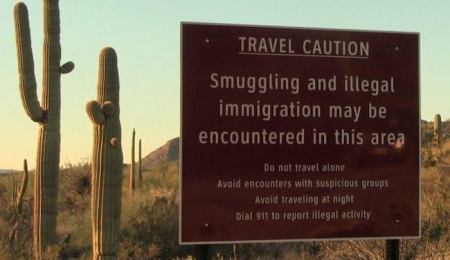
“We see, for example, how quickly those among us with the status of a stranger, an immigrant, or a refugee, become a threat, take on the status of an enemy. An enemy because they come from a distant country or have different customs. An enemy because of the color of their skin, their language or their social class. An enemy because they think differently or even have a different faith.” — Pope Francis, denouncing those who are concerned about people such as these three Pakistani Muslims.

border-sign-in-arizona

“EXCLUSIVE: Three Pakistani Men Apprehended in U.S. at Arizona Border,” by Brandon Darby, Breitbart, November 17, 2016:

Three Pakistani men were apprehended after crossing into the U.S. from Mexico in the Tucson Sector. A combination of sources — including official confirmation from Customs and Border Protection (CBP) — revealed the men were in fact apprehended and are currently in U.S. federal custody.

Breitbart Texas sources first released the information and CBP confirmed via email. CPB responded:

U.S. Border Patrol agents in Nogales, AZ, apprehended three Pakistani nationals on Nov. 11. As a standard procedure, agents processed the individuals and checked their identities against numerous law enforcement and national security related databases. Record checks revealed no derogatory information about the individuals. The individuals are currently in Federal custody while they await the outcome of their immigration cases.

Additional information on the individuals was obtained by federal agents working under the umbrella of CBP, but it is important to note that the additional details were not confirmed by CBP.

“One of them had a shit load of hits from a bunch of places he’s been. He had entered and exited numerous countries that were not in his route to the U.S. This raises red flags because people leaving a foreign country to come here usually take the quickest route, but one of them did not,” said one of the sources.

The source continued, “One of the men had his hair died blonde to disguise his appearance and all of the men spoke perfect English.”…

Pakistan: Christian girl kidnapped, raped because family refused to convert to Islam

October 6, 2016

Pakistan: Christian girl kidnapped, raped because family refused to convert to Islam, Jihad Watch

(Please see also, No Where to Go: Pakistani Christians Refused Asylum. — DM)

According to a 2014 report by the NGO Movement of Solidarity and Peace, as many as 700 Christian girls in Pakistan are kidnapped and forced into Islamic marriages every year. Many times, the police fail to take action….

Such abuse is well known, ongoing and widespread against Christians and other infidels in Pakistan and other Islamic states, and there is no outcry. Similar behavior has now spread into Europe, with Muslim rape gangs rampant in the UK, and still, largely there is no outcry. Surveys and the evidence of jihad attacks show that hatred and violence are being promoted in all too many mainstream mosques in the U.S., Canada and throughout the West, with no outcry. The noble principles of human rights in the West are rapidly being surrendered in the face of the fabricated propaganda concept of “Islamophobia.”

pakistan

“Pakistani Christian Girl Kidnapped, Raped After Family Refused to Convert to Islam”, by Samuel Smith, Christian Post, October 4, 2016:

A Pakistani Christian family was tied up and beaten by a group of Muslims who stormed their home last month looking to force the family to convert to Islam. But when the family refused to renounce their faith, their youngest daughter was abducted, raped and has yet to return home.

The London-based charity British Pakistani Christian Association has come to the aid of the Masih family, a family of 10 Christians caught in the grips of bonded labor (modern day slavery) near the city of Kasur in Eastern Pakistan.

According to BPCA, the family lived in a small home made of mud and had been constantly pressured by local Muslims to convert to Islam, as they were the only family in the neighborhood who hadn’t embraced Islam.

On the night of Sept. 15, a group of six Muslim men and a Muslim woman stormed the family’s home with guns, sticks and metal rods and severely beat members of the Christian family.

The group of intruders hoped that the family’s pain and suffering would cause them to reconsider their prior refusals to convert to Islam. Despite the pain, the family again refused to deny Christ and convert to Islam.

After the family refused to convert, the Muslims grew enraged and tied up and blindfolded all but two of the family members.

As the family consists of six daughters and two sons, the Muslims dragged the family’s 17-year-old daughter, Jameela, and 20-year-old son, Arif, and threw them into the back of a van parked outside of the home.

Arif, who was eventually able to escape out an open door while no one was looking, told BPCA that he and Jameela were taken to an unknown building in an unknown location that he later figured out was a mansion of some sort.

Arif explained that when they arrived at the mansion, they were both tortured separately. Despite the torture, Arif again refused to convert to Islam. While he could hear the screams of his sister, one of the captors told Arif that other Muslim men were taking turns raping his sister and that all he had to do to save his her was embrace Islam. However, he again refused to renounce Christ.

As the sun rose the next morning, Arif took advantage of an opportunity to escape when his blindfold slipped and he noticed that the door was left open with no one around monitoring him.

It took hours for Arif to return home, as he had to walk most of the way before he caught a ride on a rickshaw.

Having been taken so far from home, Arif is not able to recall the location of the mansion that he and his sister were taken too. He also believes that his sister was taken to another location because he did not hear her screams before he escaped the mansion.

The family is now living in a safehouse sponsored by BPCA in Pakistan. That is the same safehouse that another Christian family trapped in bonded labor stayed at while BPCA worked to secure their emancipation.

“This family is deeply traumatized but safe now. We will now begin the arduous task of helping them rebuild their lives in an atmosphere of safety,” BPCA Chairman Wilson Chowdhry said in a statement. “However, the captured daughter Jameela may well never be found and her malicious kidnapping is causing great anguish and despair. [For] Muslim despots [to be able to] kidnap Christian girls with such impunity is a blight on Pakistan’s international reputation.”

According to a 2014 report by the NGO Movement of Solidarity and Peace, as many as 700 Christian girls in Pakistan are kidnapped and forced into Islamic marriages every year. Many times, the police fail to take action and claim that the child left home and entered into Islamic marriage of her own will.

After the attack and kidnapping, the Masih family first went to their Muslim landlord, who not only told them to talk to the police but ordered them to go back to work the day after. The family attempted to file charges with the police. However, local police in Kasur refused to register the family’s case.

The police department was even pressured by Pakistani Sen. Kamran Michael to register the police report, however, Deputy Superintendent Abdul Qayoom Gondal refuses to register the case.

BPCA has hired a lawyer to take on the Masih’s case. According to BPCA, the lawyer was able to reach an agreement for the police to do a preliminary investigation. Thanks to corroborating witness statements, it is likely that a First Information Report will eventually be filed.

According to an application for a FIR, the perpetrators involved in the beating and kidnapping are Ghulam Muhamad, Ilyas Muhamed, Irfan Muhamad, M. Boota, M. Ashraf, M. Haroon and Umraan Bibi, all of whom are relatives.

BPCA reports that the assault on the Christian family occurred after the mother, 50-year-old Mumtaz Masih, was recently harassed by Muslim women in the neighborhood who were again looking to convert her and her family to Islam.

Irritated by the fact that her family kept getting harassed, Mumtaz and the women got into a heated exchange in which Mumtaz allegedly insulted the Muslim women, which could have triggered the violent attacks.

BPCA has launched a petition calling on the Pakistani government to end “the mass abduction, rape and forced marriage of Christians and other minority women, through tougher laws and stronger policing protocol.”…….

No Where to Go: Pakistani Christians Refused Asylum

October 6, 2016

No Where to Go: Pakistani Christians Refused Asylum, Clarion Project, Kaleem Dean, October 6, 2016

thailand-police-getty-640Police in Thailand (Photo: © Getty Images)

A Pakistani Christian pastor forced to flee to Thailand was denied asylum, leaving him with nowhere to turn.

After four years of struggling with the UNHCR (United Nations High Commissioner for Refugees) to prove his case was genuine, Baber Masih said of his plight and that of his wife and three children, “If we return to our country and get arrested due to blasphemy, we are afraid that everything that happens to people who get arrested under blasphemy laws would happen to us. The Muslim extremists of Pakistan could imprison us, kill or even burn us alive.”

Over the last number of months, the UNHRC turned away Pakistani Christians seeking asylum in Thailand. In the last two months alone, the files of more than 20 Christian families were closed, said Baber.

Once their files are closed, the UNHCR office informs the Thai Immigration about their status. Many are then arrested and put behind the bars in deplorable conditions, a fate of which Baber and his family are living in fear.

In addition, Baber reports the seeming arbitrariness of the judgments relating that another Christian was given refugee status whereas Baber’s plea was not considered to be true.

The UNHCR-Thailand uses the British Home Office guidelines to assess Pakistani Christian asylum seekers’ applications in Thailand. An article published by the Church Times notes, “The guidance currently reflects a tribunal ruling that Christians in Pakistan suffer discrimination, but this is not sufficient to amount to a real risk of persecution.”  It also states the Pakistani government is “willing and able to provide protection against such attacks, and internal relocation is a viable option.”

However, this assessment is contradicted by the British Foreign Office’s own guidelines, which state there is “not much protection of religious minorities from the government.”

Lord Alton of Liverpool presented his report expressing his deep concern over the treatment the UNHCR gives to Pakistani Christians. In his report, he stated, “The UK’s Home Office guidance on Pakistani Christians and Christian converts is being used to de-prioritize and de-legitimize Christian asylum-seekers’ applications — even if returning these individuals to Pakistan will leave them at a significant and real risk of attack, torture, or being killed.”

Baber further charges that the UNHRC has no parameters to investigate and gauge the depth of the seriousness of threats to Christian individuals and families in Pakistan.  Relating his story, Baber said, “On September 16, 2012, about 8 p.m., Muslim clerics/extremists attacked our home. They entered forcefully and started beating us with rods and clubs and abused us, calling us kafir(infidels) and churry (sweepers) and many other bad words.

“It seemed they wanted to burn us alive as they were shouting that they were going to do so.  We thank God that many people gathered quickly and rushed to our home because our women and children had locked themselves in a room and were crying and weeping very loudly as they heard us being beaten. Knowing the situation we decided to leave our homeland.

“We applied for asylum with UNHCR and received registrations in December of 2012. We were interviewed in the following year, and the year after our application was refused. We submitted an appeal to the UNHCR through the asylum access in 2014, but now after two years of struggle, the UNHCR has refused our case, closing our file permanently.”

The size of the minority population in Pakistan has decreased, from 25 percent in 1947 to a mere 3% today. The discriminatory laws against ethnic minorities have made their lives almost impossible. For example, since 1974, when Ahmadi Muslims were declared a “minority” in Pakistan, they have been relentlessly persecuted.

Their exodus from Pakistan continues unabated. Similarly, Hindus, Christians and Sikhas never miss an opportunity to flee from Pakistan.

Yet, the world seems to have closed its doors to Pakistani Christians, as Baber Masih and others like him have discovered. Even in America, the latest statistics show that of the 10,801 Syrian refugees accepted in fiscal 2016, only 56 are Christians, a mere 0.5 percent.

While the Islamic State commits genocide against Christians and other minorities, other countries, like Pakistan, wage an unremitting war of attrition against their minority populations. It is imperative that the world wakes up to this slow genocide from within.

NYC jihad bomber spent weeks getting “Islamic education” at pro-Taliban Pakistan seminary

September 25, 2016

NYC jihad bomber spent weeks getting “Islamic education” at pro-Taliban Pakistan seminary, Jihad Watch, Robert Spencer, September 25, 2016

This one is really going to leave New York Mayor de Blasio and other New York City authorities scratching their heads: they will be racking their brains trying to figure out how a pious young man instructed in the Religion of Peace could have become such a spectacular misunderstander of Islam. Does he have an ex-girlfriend in Chelsea? Was he “mentally unstable”? What, oh what, could have driven him to kill?

piecemaker

“Chelsea bombing suspect spent weeks at Islamist seminary in Pakistan,” by Kathianne Boniello, New York Post, September 25, 2016:

The alleged New Jersey terrorist charged with trying to blow up Chelsea last weekend with homemade bombs spent weeks getting an “Islamic education” at a Pakistani seminary, according to a report.

Ahman [sic] Khan Rahami spent three weeks in Kuchlak, an area described as a longtime “hub” for the Taliban, in 2011, a security official inside the country told the Guardian.

Rahami, 28, attended lectures at the Kaan Kuwa Naqshbandi madrasa.

US authorities have been tight-lipped with details of Rahami’s trips to Pakistan, acknowledging he was married during a visit to Quetta.

Security agencies inside Pakistan have tried to “hide all details” of his visits to Quetta, one anonymous official told the Guardian….

Fifteen years after the 9/11 attacks, al Qaeda fights on

September 12, 2016

Fifteen years after the 9/11 attacks, al Qaeda fights on, Long War Journal, September 11, 2016

All appeared lost for Osama bin Laden and al Qaeda in December 2001. In the years leading up to the 9/11 hijackings, bin Laden believed that the US was a “paper tiger” and would retreat from the Muslim majority world if al Qaeda struck hard enough. The al Qaeda founder had good reasons to think this. American forces withdrew from Lebanon after a series of attacks in the early 1980s and from Somalia after the “Black Hawk Down” episode in 1993. The US also did not respond forcefully to al Qaeda’s August 1998 embassy bombings in Kenya and Tanzania, or the USS Cole bombing in October 2000.

But bin Laden’s strategy looked like a gross miscalculation in late 2001. An American-led invasion quickly overthrew the Taliban’s regime just weeks after 19 of bin Laden’s men hijacked four airliners and crashed them into the World Trade Center, the Pentagon, and a field in Pennsylvania. Some of al Qaeda’s most senior figures were killed in American airstrikes. With al Qaeda’s foes closing in, bin Laden ordered his men to retreat to the remote Tora Bora Mountains. Here, bin Laden must have thought, al Qaeda would make its last stand. The end was nigh.

Except it wasn’t.

Bin Laden slithered away, eventually making his way to Abbottabad, Pakistan. When Navy SEALs came calling more than nine years later, in early May 2011, the world looked very different.

Documents recovered in bin Laden’s compound reveal that he and his lieutenants were managing a cohesive global network, with subordinates everywhere from West Africa to South Asia. Some US intelligence officials assumed that bin Laden was no longer really active. But Bin Laden’s files demonstrated that this view was wrong.

Writing in The Great War of Our Time: The CIA’s Fight Against Terrorism – From al Qa’ida to ISIS, former CIA official Mike Morell explains how the Abbottabad cache upended the US intelligence community’s assumptions regarding al Qaeda. “The one thing that surprised me was that the analysts made clear that our pre-raid understanding of Bin Laden’s role in the organization had been wrong,” Morell writes. “Before the raid we’d thought that Bin Laden’s deputy, Ayman al Zawahiri, was running the organization on a day-to-day basis, essentially the CEO of al Qaeda, while Bin Laden was the group’s ideological leader, its chairman of the board. But the DOCEX showed something quite different. It showed that Bin Laden himself had not only been managing the organization from Abbottabad, he had been micromanaging it.”*

Consider some examples from the small set of documents released already.

During the last year and a half of his life, Osama bin Laden: oversaw al Qaeda’s “external work,” that is, its operations targeting the West; directed negotiations with the Pakistani state over a proposed ceasefire between the jihadists and parts of the government;ordered his men to evacuate northern Pakistan for safe havens in Afghanistan;instructed Shabaab to keep its role as an al Qaeda branch secret and offered advice concerning how its nascent emirate in East Africa should be run; received status reports on his fighters’ operations in at least eight different Afghan provinces; discussed al Qaeda’s war strategy in Yemen with the head of Al Qaeda in the Arabian Peninsula and other subordinates; received updates from Al Qaeda in the Islamic Maghreb, including details on a proposed truce with the government of Mauritania; authorized the relocation of veteran jihadists to Libya, where they could take advantage of the uprising against Muammar al Qaddafi’s regime; corresponded with the Taliban’s leadership; and generally made decisions that impacted al Qaeda’s operations everywhere around the globe.

Again, these are just a handful of examples culled from the publicly-available files recovered in bin Laden’s compound. The overwhelming majority of these documents remain classified and, therefore, unavailable to the American public.

Al Qaeda has grown under Zawahiri’s tenure

The story of how bin Laden’s role was missed should raise a large red flag. Al Qaeda is still not well-understood and has been consistently misjudged. Not long after bin Laden was killed, a meme spread about his successor: Ayman al Zawahiri. Many ran with the idea that Zawahiri is an ineffectual and unpopular leader who lacked bin Laden’s charisma and was, therefore, incapable of guiding al Qaeda’s global network. This, too, was wrong.

There is no question that the Islamic State, which disobeyed Zawahiri’s orders and was disowned by al Qaeda’s “general command” in 2014, has cut into al Qaeda’s share of the jihadist market and undermined the group’s leadership position. But close observers will notice something interesting about al Qaeda’s response to the Islamic State’s challenge. Under Zawahiri’s stewardship, al Qaeda grew its largest paramilitary force ever.

Brett McGurk, the Special Presidential Envoy for the Global Coalition to Counter ISIL, warned about the rise of Al Nusrah Front during testimony before the Senate Foreign Relations Committee on June 28. “With direct ties to Ayman al Zawahiri, Osama Bin Laden’s successor, Nusra[h] is now al [Qaeda’s] largest formal affiliate in history,” McGurk said. US officials previously contacted by The Long War Journal said Nusrah could easily have 10,000 or more fighters in its ranks.

It is worth repeating that Nusrah grew in size and stature, while being openly loyal to Zawahiri, after the Islamic State became its own jihadist menace. Far from being irrelevant, Zawahiri ensured al Qaeda’s survival in the Levant and oversaw its growth.

image-posted-by-tilmidh-usamah-bin-ladin-1024x348

On July 28, Al Nusrah Front emir Abu Muhammad al Julani announced that his organization would henceforth be known as Jabhat Fath al Sham (JFS, or the “Conquest of the Levant Front”) and would have no “no affiliation to any external [foreign] entity.” This was widely interpreted as Al Nusrah’s “break” from al Qaeda. But Julani never actually said that and al Qaeda itself isn’t an “external entity” with respect to Syria as the group moved much of its leadership to the country long ago. Al Nusrah’s rebranding was explicitly approved by Abu Khayr al Masri, one of Zawahiri’s top deputies, in an audio message released just hours prior to Julani’s announcement. Masri was likely inside Syria at the time.

Julani, who was dressed like Osama bin Laden during his appearance (as pictured above), heaped praise on bin Laden, Zawahiri and Masri. “Their blessed leadership has, and shall continue to be, an exemplar of putting the needs of the community and their higher interests before the interest of any individual group,” Julani said of Zawahiri and Masri.

Most importantly, Al Nusrah’s relaunch as JFS is entirely consistent with al Qaeda’s longstanding strategy in Syria and elsewhere. Al Qaeda never wanted to formally announce its role in the rebellion against Bashar al Assad’s regime, correctly calculating that clandestine influence is preferable to an overt presence for many reasons. This helps explain why Nusrah was never officially renamed as “Al Qaeda in the Levant” in the first place. However, fifteen years after the 9/11 attacks, there is such widespread ignorance of al Qaeda’s goals and strategy that Nusrah’s name change is enough to fool many.

Al Qaeda has grown in South Asia as well. In Sept. 2014, Zawahiri announced the formation of Al Qaeda in the Indian Subcontinent (AQIS), which brought together elements of several existing jihadist organizations. AQIS quickly got to work, attempting to execute an audacious plan that would have used Pakistani arms against American and Indian ships. The plot failed, but revealed that al Qaeda had infiltrated Pakistan’s military.

Pakistani officials recently told the Washington Post that they suspect AQIS has a few thousand members in the city of Karachi alone. And al Qaeda remains closely allied with the Taliban while maintaining a significant presence inside Afghanistan. In October 2015, for instance, Afghan and American forces conducted a massive operation against two large al Qaeda training camps in the southern part of the country. One of the camps was approximately 30 square miles in size. Gen. John F. Campbell, who oversaw the war effort in Afghanistan, explained that the camp was run by AQIS and is “probably the largest training camp-type facility that we have seen in 14 years of war.”

With Zawahiri as its emir, al Qaeda raised its “largest formal affiliate in history” in Syria and operated its “largest training” camp ever in Afghanistan. These two facts alone undermine the widely-held assumption that al Qaeda is on death’s door.

Elsewhere, al Qaeda’s other regional branches remain openly loyal to Zawahiri.

From April 2015 to April 2016, Al Qaeda in the Arabian Peninsula (AQAP) controlled a large swath of territory along Yemen’s southern coast, including the key port city of Mukalla. An Arab-led coalition helped reclaim some of this turf earlier this year, but AQAP’s forces simply melted away, living to fight another day. AQAP continues to wage a prolific insurgency in the country, as does Shabaab across the Gulf of Aden in Somalia. Shabaab’s leaders announced their fealty to Zawahiri in February 2012 and remain faithful to him. They have taken a number of steps to stymie the growth of the Islamic State in Somalia and neighboring countries. Shabaab also exports terrorism throughout East Africa, executing a number of high-profile terrorist attacks in recent years.

Al Qaeda in the Islamic Maghreb (AQIM) continues to operate in West and North Africa, often working in conjunction with front groups. Like al Qaeda’s branches elsewhere, AQIM prefers to mask the extent of its influence, working through organizations such as Ansar al Sharia and Ansar Dine to achieve its goals. Late last year, Al Murabitoon rejoined AQIM’s ranks. Al Murabitoon is led by Mohktar Belmokhtar, who has been reportedly killed on several occasions. Al Qaeda claims that Belmokhtar is still alive and has praised him for rejoining AQIM after his contentious relations with AQIM’s hierarchy in the past. While Belmokhtar’s status cannot be confirmed, several statements have been released in his name in recent months. And Al Murabitoon’s merger with AQIM has led to an increase in high-profile attacks in West Africa.

In sum, AQAP, AQIM, AQIS and Shabaab are formal branches of al Qaeda and have made their allegiance to Zawahiri clear. Jabhat Fath al Sham, formerly known as Al Nusrah, is an obvious al Qaeda project in Syria. Other organizations continue to serve al Qaeda’s agenda as well.

Al Qaeda’s veterans and a “new generation” of jihadist leadership

As the brief summary above shows, Al Qaeda’s geographic footprint has expanded greatly since the Sept. 11, 2001 terrorist attacks. Some US officials argue that al Qaeda has been “decimated” because of the drone campaign and counterterrorism raids. They narrowly focus on the leadership layer of al Qaeda, while ignoring the bigger picture. But even their analysis of al Qaeda’s managers is misleading.

Al Qaeda has lost dozens of key men, but there is no telling how many veterans remain active to this day. Experienced operatives continue to serve in key positions, often returning to the fight after being detained or only revealing their hidden hand when it becomes necessary. Moreover, al Qaeda knew it was going to lose personnel and took steps to groom a new generation of jihadists capable of filling in.

3-aq-leaders-released-from-iran-1023x313From left to right: Saif al Adel, Abu Mohammed al Masri and Abu Khayr al Masri. These photos, first published by the FBI and US intelligence officials, show the al Qaeda leaders when they were younger.

Last year, several veterans were reportedly released from Iran, where they were held under murky circumstances. One of them was Abu Khayr al Masri, who paved the way for Al Nusrah’s rebranding in July. Another is Saif al Adel, who has long been wanted for his role in the 1998 US Embassy bombings in Kenya and Tanzania. At least two others freed by Iran, Abu Mohammed al Masri and Khalid al Aruri, returned to al Qaeda as well.

Masri, Al Adel, and Aruri may all be based inside Syria, or move back and forth to the country from Turkey, where other senior members are based. Mohammed Islambouli is an important leader within al Qaeda. After leaving Iran several years ago, Islambouli returned to Egypt and eventually made his way to Turkey, where he lives today.

Sitting to Julani’s right during his much ballyhooed announcement was one of Islambouli’s longtime compatriots, Ahmed Salama Mabrouk. The diminutive Mabrouk is another Zawahiri subordinate. He was freed from an Egyptian prison in the wake of the 2011 uprisings.

Al Qaeda moved some of its senior leadership to Syria and several others from this cadre are easy to identify. But al Qaeda has also relied on personnel in Yemen to guide its global network. One of Zawahiri’s lieutenants, Hossam Abdul Raouf, confirmed this in an audio message last October. Raouf explained that the “weight” of al Qaeda has been shifted to Syria and Yemen, because that is where its efforts are most needed.

The American drone campaign took out several key AQAP leaders in 2015, but they were quickly replaced. Qasim al Raymi, who was trained by al Qaeda in Afghanistan in the 1990s, succeeded Nasir al Wuhayshi as AQAP’s emir last summer. Raymi quickly renewed his allegiance to Zawahiri, whom Raymi described as the “the eminent sheikh” and “the beloved father.” Another al Qaeda lifer, Ibrahim Abu Salih, emerged from the shadows last year. Salih was not public figure beforehand, but he has been working towards al Qaeda’s goals in Yemen since the early 1990s. Ibrahim al Qosi (an ex-Guantanamo detainee) and Khalid al Batarfi have stepped forward to lead AQAP and are probably also part of al Qaeda’s management team.

This old school talent has helped buttress al Qaeda’s leadership cadre. They’ve been joined by men who signed up for al Qaeda’s cause after the 9/11 attacks as well. In July, the US Treasury Department designated three jihadists who are based in Iran. One of them, known as Abu Hamza al Khalidi, was listed in bin Laden’s files as part of a “new generation” of al Qaeda leaders. Today, he plays a crucial role as the head of al Qaeda’s military commission, meaning he is the equivalent of al Qaeda’s defense minister. Treasury has repeatedly identified other al Qaeda members based in Iran, Afghanistanand elsewhere.

Some members of the “new generation” are more famous than others. Such is the case with Osama’s son, Hamzah bin Laden, who is now regularly featured in propaganda.

This brief survey of al Qaeda is not intended to be exhaustive, yet it is still sufficient to demonstrate that the organization’s bench is far from empty. Moreover, many of the men who lead al Qaeda today are probably unknown to the public.

The threat to the West

Testifying before the Senate Armed Services Committee in February, Director of National Intelligence James Clapper warned that al Qaeda “nodes in Syria, Pakistan, Afghanistan, and Turkey” are “dedicating resources to planning attacks.” His statement underscored how the threats have become more geographically dispersed over time. With great success, the US worked for years to limit al Qaeda’s ability to strike the West from northern Pakistan. But today, al Qaeda’s “external operations” work is carried out across several countries.

During the past fifteen years, Al Qaeda has failed to execute another mass casualty attack in the US on the scale of the 9/11 hijackings. Its most recent attack in Europe came in January 2015, when a pair of brothers backed by AQAP conducted a military-style assault on the Charlie Hebdo office in Paris. AQAP made it clear that the Charlie Hebdo massacre was carried out according to Zawahiri’s orders.

Thanks to vigilance and luck, al Qaeda hasn’t been able to replicate a 9/11-style assault inside the US. Part of the reason is that America’s defenses, as well as those of its partner nations, have improved. Operations such as the 9/11 hijackings are also difficult to carry out in the first place. Even the 9/11 plan experienced interruptions despite a relatively lax security environment. (Most famously, for example, the would-be 20th hijacker was denied entry into the US at an Orlando airport in the summer of 2001.)

But there is another aspect to evaluating the al Qaeda threat that is seldom appreciated. It is widely assumed that al Qaeda is only interested in attacking the West. This is flat false. Most of the organization’s resources are devoted to waging insurgencies in Muslim majority countries.

The story in Syria has been telling. Although al Qaeda may have more resources in Syria than anywhere else, Zawahiri did not order his men to carry out a strike in the West. Al Qaeda’s so-called “Khorasan Group” laid the groundwork for such operations, but Zawahiri did not give this cadre the green light to actually carry them out. Zawahiri’s stand down order is well known. In an interview that aired in May 2015, for instance, Julani explained that the “directives that come to us from Dr. Ayman [al Zawahiri], may Allah protect him, are that Al Nusrah Front’s mission in Syria is to topple [Bashar al Assad’s] regime” and defeat its allies. “We have received guidance to not use Syria as a base for attacks against the West or Europe so that the real battle is not confused,” Julani said. However, he conceded that “maybe” the mother al Qaeda organization is plotting against the West, just “not from Syria.” Julani emphasized that this “directive” came from Zawahiri himself.

To date, al Qaeda has not lashed out at the West from inside Syria, even though it is certainly capable of doing so. Al Qaeda’s calculation has been that such an attack would be too costly for its strategic interests. It might get in the way of al Qaeda’s top priority in Syria, which is toppling the Assad regime. This calculation could easily change overnight and al Qaeda could use Syria as a launching pad against the West soon. But they haven’t thus far. It helps explain why there hasn’t been another 9/11-style plot by al Qaeda against the US in recent years. It also partially explains why al Qaeda hasn’t launched another large-scale operation in Europe for some time. Al Qaeda has more resources at its disposal today than ever, so the group doesn’t lack the capability. If Zawahiri and his advisors decided to make anti-Western attack planning more of a priority, then the probability of another 9/11-style event would go up. Even in that scenario, al Qaeda would have to successfully evade the West’s defenses. But the point is that al Qaeda hasn’t been attempting to hit the West nearly as much as some in the West assume.

In the meantime, it is easy to see how the al Qaeda threat has become more diverse, just as Clapper testified. AQAP has launched several thwarted plots aimed at the US, including the failed Christmas Day 2009 bombing. In 2009, al Qaeda also plotted to strike trains in the New York City area. In 2010, a Mumbai-style assault in Europe was unraveled by security services. It is not hard to imagine al Qaeda trying something along those lines once again. Other organizations tied to al Qaeda, such as the Pakistani Taliban, have plotted against the US as well.

Fifteen years after the 9/11 attacks, al Qaeda lives. Fortunately, Zawahiri’s men have not replicated the hijackings that killed nearly 3,000 Americans. But the al Qaeda threat looms. It would be a mistake to assume that al Qaeda won’t try a large-scale operation again.

*The spellings of al Qaeda and bin Laden are changed in this quote from Morell to make them consistent with the rest of the text.

“University of Jihad”: Pakistan Gives Millions To Maintain Extremist Madrassa

June 20, 2016

“University of Jihad”: Pakistan Gives Millions To Maintain Extremist Madrassa, Jonathan Turley’s Blog, Jonathan Turley, June 20, 2016

200px-jameah_darul_uloom_deoband

Two of the closest allies to the United States have long been primary sources for terrorists: Saudi Arabia and Pakistan. Both maintain Islamic schools or madrassas that espouse extreme views of Islam that justify the killing of homosexuals, blasphemers and others. While both countries continually insist that they are not supporting such groups, terrorists have been traced back to both countries in terms of support and education. Indeed, Pakistan continues to jail a doctor who helped the United States find Bin Laden but still receives massive U.S. aid. Now, it has been disclosed that Pakistan’s Khyber-Pakhtunkhwa government has allocated Rs 300 million to a madrassa known as the “University of Jihad” because of its infamous alumni of terrorists and extremists, including top Afghan Taliban leaders like the late Mullah Omar.

Khyber-Pakhtunkhwa Minister Shah Farman declared “I am proudly announcing that Darul Uloom Haqqania Nowshera will get Rs 300 million to meet its annual expenditures.” He will have to forgive the rest of the world not rejoicing at the government maintaining an extremist school that produces graduates who believe that throwing acid in the faces of little girls and blowing up markets are acts that please God.

The madrassa in Akora Khattak also claims such dubious graduates as Haqqani Network founder Jalaluddin Haqqani, Al-Qaeda in the Indian Subcontinent leader Asim Umar and slain Afghan Taliban chief Mullah Akhtar Mansoor. The reunions must be rather precarious events.

Minister for religious affairs Habibur Rehman insisted “Darul Uloom Haqqania is one of the oldest and largest seminaries of Pakistan and it deserves financial assistance.” Yes it is one of the oldest and most extremist schools in the world. That is not a good thing. However, Rehman, belongs to Jamaat-i-Islami, a party established to make Pakistan an Islamic state, governed by Sharia law. It opposes secularism and basic civil liberties in its extreme political objectives.

As the Administration (as with prior administrations) seeks billions in aid and support for such countries, it would be useful to be able to distinguish them from countries that we deem “evil” and supporters of terrorism.

Ralph Peters Blasts Clinton over Emails: Petraeus Stole a Candy Bar, Clinton Stole Fort Knox

June 11, 2016

Ralph Peters Blasts Clinton over Emails: Petraeus Stole a Candy Bar, Clinton Stole Fort Knox, Washington Free Beacon via YouTube, June 10, 2016

Iran supplying weapons, cash and training to Taliban

May 27, 2016

Iran supplying weapons, cash and training to Taliban, Jihad Watch

Sunnis and Shi’ites hate each other, but not as much as they hate the Infidel. Hence Iran’s support for the Taliban, as well as Hamas and Islamic Jihad: Sunnis who are waging jihad against Infidels are allies of Iran, as far as the mullahs are concerned. Such support also strengthens Iran’s ongoing maneuvering to be the leader of the Islamic world.

Taliban89
“Death of Mullah Mansoor highlights Taliban’s links with Iran,” by Jon Boone and Saeed Kamali Dehghan, Guardian, May 23, 2016:The killing of the Taliban chief on the main highway leading from the Iranian border shines new light on the movement’s complicated relationship with Tehran.Although it is Pakistan that has traditionally been condemned for secretly supporting Afghan insurgents, analysts say Iran also provides weapons, cash and sanctuary to the Taliban. Despite the deep ideological antipathy between a hardline Sunni group and cleric-run Shia state the two sides have proved themselves quite willing to cooperate where necessary against mutual enemies and in the pursuit of shared interests.

Mullah Mansoor first entered Iran almost two months ago, according to immigration stamps in a Pakistani passport found in a bag near the wreckage of the taxi he was travelling in when he was killed by a US drone strike.

The passport, in the name of Wali Muhammad, also showed he had only just returned to Pakistan from the border crossing of Taftan, some 280 miles (450km) away from the site where he was killed, an area called Ahmed Wal, where he had stopped for lunch.

On Monday, the Iranian foreign ministry denied that “such a person had entered Pakistan from the Iranian border”.

“Iran welcomes any efforts made in bringing stability and peace to Afghanistan,” said spokesman Hossein Jaberi-Ansari.

It is not known where Mansoor went inside Iran, whether his trip was secretly facilitated by the Iranian Revolutionary Guard or whether he stayed among the large populations of Afghans living in eastern Iran, especially in the cities of Mashhad and Zahedan.

The Taliban also have ties to Sunni extremist groups operating in the Iranian province of Sistan and Balochistan.

A Pakistani official from Dalbandin, a district bordering Iran, said he did not think Iran would back foreign insurgents with links to such groups.

“All Afghan militants hold Pakistani nationality, it is not written on their forehead whether he is a militant or not,” said the official, who did not wish to be identified.

Nonetheless police and intelligence officials in western Afghanistan often complain the local insurgency is being managed and supplied with weapons and training from Iran….

Pakistan: “Blasphemy” for Ethnic Cleansing

May 22, 2016

Pakistan: “Blasphemy” for Ethnic Cleansing, Gatestone InstituteLubna Thomas Benjamin, May 22, 2016

♦ After the attack, some villagers gathered and started threatening other Christians, demanding they either convert to Islam or move out of the area. Then an Islamic religious decree was issued, to hand over Masih to the local Islamic clerics so that he could be burned alive for blasphemy.

♦ Why was only Masih (a Christian) accused of blasphemy, when Bilal (a Muslim) had obviously watched the video in question?

♦ The Christians who are left are searching to find an alternate place to live, and are now facing hatred in the guise of a boycott. No one is selling them food or any daily essentials.

♦ In Punjab, harassing Christians has become a norm; a way of getting rid of them. Every time Christians are threatened and forced to leave the area, the charge is always blasphemy.

It started as a normal day in the remote Pakistani village of Chak-44 for Imran Masih, a Christian man, and Bilal, his Muslim friend, in mid-April. Masih had revealed to Bilal that the woman he had fallen in love with was a Muslim.

According to media reports, Masih was called away urgently and left his phone with Bilal, who apparently came across a video that appeared in Masih’s Facebook feed, which allegedly contained content against the Muslim Prophet Mohammad. Bilal’s accusation that Masih had viewed that video became the reason to charge Masih with blasphemy.

You start asking questions, such as: Wait a minute, who has committed blasphemy?

No one will probably ever even know what was on that video or whether Masih even watched it. But even if Masih did watch it, he was not the only one: Bilal also watched it. However, in a country where might is right, Bilal, a Muslim with the support of fellow villagers, is always right.

In an instant, a friend had become not only a stranger, but a liar.

Bilal called in two other Muslims to help beat up his Christian friend. A doctor who appeared at the scene to save Masih from the angry men was apparently also a Muslim clergyman. He asked Imran for an apology.

After the attack, some villagers gathered and started threatening other Christians, demanding they either convert to Islam or move out of the area. Then an Islamic religious decree was issued, to hand over Masih to the local Islamic clerics so that he could be burned alive for blasphemy.

What had those Christian residents done to infuriate the local Muslims? They had merely lived in this remote region of Punjab.

Why was only Masih (a Christian) accused of blasphemy, when Bilal (a Muslim) had obviously watched the video in question?

The news reports also indicate that three quarters of the area’s Christians have already abandoned their homes. The Christians who are left are searching to find an alternate place to live, and are now facing hatred in the guise of a boycott. No one is selling them food or any daily essentials.

1613Left: Imran Masih’s house in the village of Chak-44, Pakistan. Right: The Catholic Church in the village. (Images source: World Watch Monitor)

The history of Punjab brims with violence and the torching Christian homes. All these horrific incidents illustrate an intense hatred for Christians. Religion here is a force that could divide any friendship.

The government and human rights organizations are well aware of this hatred and violence. Here, harassing Christians has become a norm; a way of getting rid of them. Every time Christians are threatened and forced to leave the area, the charge is always blasphemy.

A few years ago, I covered the story of Rimsha Masih, an underage Christian girl charged with the blasphemy in the outskirts of Pakistan’s capital, Islamabad. As one talked to the shopkeepers and her neighbors, their eyes would fill with hate. “We want to get Christians out of here,” the residents would say. Using a young Christian girl and getting her charged with blasphemy seemed like the perfect plan.

In Pakistan, under the guise of blasphemy laws, the Muslim citizens have been getting rid of the Christians for years.