Archive for the ‘P5+1’ category

Obama and cognitive dissonance

January 26, 2015

Obama and cognitive dissonance, Dan Miller’s Blog, January 26, 2015

(The views expressed in this article are mine and do not necessarily reflect those of Warsclerotic or its other editors. — DM)

It has been argued that Obama’s cognitive dissonance is demonstrated by His dealings with Iran and His other disruptive efforts in the Middle East.  Perhaps the contrary is more accurate.

Basis of His foreign policies?

Basis of His foreign policies?

An article at Front Page Magazine by Bruce Thorton is titled The Dangers of Obama’s cognitive dissonance (also at Warsclerotic). It argues that Obama mistakenly believes that Iran and “we” want many of the same things and that He acts on that belief.

The heart of this mistake is the belief that whatever their professed beliefs, all peoples everywhere are just like us and want the same things we want. Since our highest goods are peace and prosperity, we think other nations’ privilege the same things. If peoples behave differently, it’s because they are warped by poverty or bad governments or religious superstitions, and just need to be shown that they can achieve those boons in rational, peaceful ways, especially by adopting liberal democracy and free-market economies. Once they achieve freedom and start to enjoy the higher living standards economic development brings, they will see the error of their traditional ways and abandon aggression and violence, and resolve conflicts with the diplomacy and negotiation we prefer. [Emphasis added.]

The Islamic Republic of Iran most likely does want peace and prosperity, but on its own terms.

Iran hangings by crane

Iran wants Islamic “peace” — the peace of universal submission to (a Shiite?) Allah — and at least sufficient prosperity to force its will on others who do not want “peace” of that sort. If Iran gets (or gets to keep) nuclear weapons, along with increasingly longer range missiles, it will be in an increasingly improved position to do that.

Obama may well have very similar goals for Iran. His demands that the P5+1 process continue despite Iran’s persistent refusals to make significant concessions, even as it continues to enhance its nuclear war machine, and His disposition to give Iran whatever concessions it wants, suggest that His and Iran’s objectives are similar. There is support for an alternative, that Obama is simply delusional. However, unless His closest, most trusted and therefore most important advisors are at least equally delusional, that alternative makes little sense. Although she appears to be a despicable person, Valerie Jarrett seems quite competent at what she does on His behalf. Others fall on their swords, fall into line and salute or leave.

Obama’s “extraordinary disconnect” in foreign policy was recently highlighted on CBS’ Face the Nation.

John Bolton said much the same.

Is it more likely that Obama merely fails to understand what’s happening, or that He understands and likes it? His State of Union address was full of foreign policy nonsense, much of it about Iran. However, it seems to have worked quite well with the large segment of the American public which neither understands nor cares about foreign affairs (except amusing affairs of a salacious nature) and believes that He strives mightily to give them the “free stiff” they believe they want, without understanding the economic hardships it has brought and will bring to them. If members of the public who already worship Him (and that includes most of the “legitimate news” media) continue to do so, it may well make little if any difference to Him or to His closest advisors whether those who disagree with Him still like, or continue to like, Him.

Leftist beliefs

After all, as we learned at the Democrat National Convention that nominated Obama for a second term, “we all belong to the Government,” it’s “one big happy family” and Obama is the head of “our family.”

In the final analysis, it may make little difference whether Obama is incompetent and delusional or is competent, understands His plans for Iran and the rest of the world far better than the rest of us and has perverse conceptions of evil and good.

Both theories are worth considering because both can help us to understand what He does, why He does it and what He intends to accomplish. However, delusional actions and intentions are difficult for those who are not delusional to understand and therefore to challenge. Actions and intentions that are, instead, based on a rational thought process — but one that views evil as good and good as evil — are easier to understand and therefore to challenge.

As I have watched Obama and His accomplishments over the years, I have come to lean toward the notion that He is competent, evil, understands what He is trying to achieve and likes it.
US-Saudi summit in Riyadh to deal with pivotal issues of oil prices, Iran and Yemen

January 24, 2015

US-Saudi summit in Riyadh to deal with pivotal issues of oil prices, Iran and Yemen, DEBKAfile, January 24, 2015

He will want to clear the air most urgently on three controversial items of burning interest to both leaders: Riyadh’s flat opposition to the multilateral nuclear deal with Iran and skepticism in the face of Obama’s conviction that a comprehensive accord will curtail the Islamic Republic’s drive for a nuclear weapon.

(Only if King Salman is truly demented would he agree with Obama on Iran and oil prices. Increases in Saudi oil production have hurt Iran while Obama’s Iran scam and relief from sanctions continue to help it. — DM)

Obama_King_Salman_bin_Abdulaziz__27.1.15Past meeting between President Barack Obama and King Salman, then Crown Prince

President Barack Obama, having decided to cut short the third day of his India visit, will arrive in Riyadh Tuesday, Jan. 27 with the First Lady, to offer US condolences on the death of King Abdullah and hold critical talks with his successor, King Salman Bin Abdulaziz.

He will want to clear the air most urgently on three controversial items of burning interest to both leaders: Riyadh’s flat opposition to the multilateral nuclear deal with Iran and skepticism in the face of Obama’s conviction that a comprehensive accord will curtail the Islamic Republic’s drive for a nuclear weapon.

Next, the US leader will try and persuade the new Saudi ruler to slow down oil production in order to put the brakes on plunging prices, an example which other OPEC members are sure to follow.

Finally, Obama and Salman must decide how to handle the fall of Yemen into the hands of Shiite Houthi rebels, who have seized the capital Sanaa with Iranian support and brought down the US-Saudi-sponsored president Abed Rabbo Mansour Hadi.

Two secondary issues will be the struggle against the Islamic State of Iraq and the Levant in the oil kingdom’s back yard, in which the US and Saudi Arabia are coalition partners; and the situation in the Syrian conflict.

Since this is an outsize agenda for one meeting, DEBKAfile’s sources in Washington and the Gulf expect Obama to focus in his initial encounter with Salman on the broad lines of the nuclear Iran dispute and oil prices. Detailed discussions on these and other issues will be set aside for US and Saudi officials of lower rank to hammer out in the coming weeks, as the new king begins to take hold of the reins of government.

A number of Middle East leaders will be following the outcome of this Riyadh summit with bated breath. Many are worried that Obama may persuade the new monarch to play ball with his Middle East policies, so effecting a radical reversal of the late Abdullah’s stance of flat opposition to Obama’s tactics in the region, aside from isolated cases.

A decision by Salman to accept America’s lead on the Iranian nuclear question and oil prices would be a serious blow for the anti-US Arab front, spearheaded hitherto by Saudi Arabia, Egypt and some of the Gulf emirates. It would also be a setback for Israeli Prime Minister Binyamin Netanyahu’s fight against Obama’s nuclear diplomacy for Iran. This policy was underpinned by the Saudi-Egyptian political and military partnership that aimed at stalling the deal crafted by Washington, which purported to lay to rest the nuclear controversy with Iran.

John Bolton on WMAL 1-22-15

January 23, 2015

John Bolton on WMAL 1-22-15, via You Tube, January 22, 2015

(Audio only. Amb. Bolton speaks of PM Netanyahu’s address to Congress, no-go zones and Obama’s fantasies about Islamic terrorism, the Islamic State and Iran. — DM)


Argentine Prosecutor Death in Iran Terror Case Gets Curiouser

January 23, 2015

Argentine Prosecutor Death in Iran Terror Case Gets Curiouser, Legal Insurrection, January 23, 2015

He documented enough of his charges that Interpol issued “red notices” for seven high-ranking Iranian officials, including Ali Akbar Rafsanjani and Ali Velayati, who were Iran’s president and foreign minister respectively at the time of the AMIA bombing. (Interpol does not have the power to arrest, so a “red notice” is as close as it comes to issuing an arrest warrant) Rafsanjani, despite being implicated in an act of terrorism in another nation is often referred to as a “moderate” nowadays. He is also considered to be a mentor to Iran’s current president, also often referred to as a “moderate,” Hassan Rouhani.

Alberto Nisman’s work exposed the danger that Iran poses to world security. Iran continues to violate international law with impunity and unfortunately there are too few Nisman’s daring to challenge Iran’s brazen misbehavior. His death will make the task of reining in Iran’s ambitions that much more difficult.

****************

2015-01-23_074410_Nisman-620x426

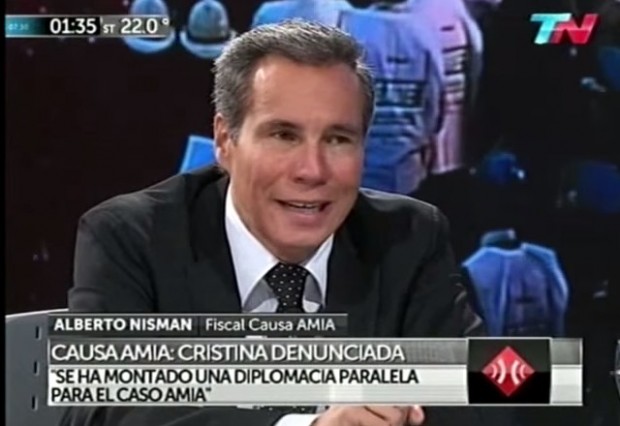
Sunday night Argentinian prosecutor Alberto Nisman was found shot to death in his apartment. Nisman had been scheduled the following day to present his criminal complaint against Argentinian President  Cristina Fernández de Kirchner before a closed session of Argentina’s congress.

The initial claim (one made by Kirchner herself on her Facebook page) that Nisman committed suicide hardly seemed credible at the time. How many people would kill themselves before the high point of their careers? Nisman had spent ten years investigating the 1994 AMIA Jewish center bombing in Buenos Aires and now he was about to charge the president and other officials of his country with conspiring to cover up the Iranian involvement in that attack. (Now Kirchner says he was killed but “suggests that Nisman was murdered on the instructions of his foreign masters in order to create a scandal damaging to her and to her government.”)

Subsequent revelations during the week have made the claim of suicide even less credible now. At Business Insider, Armin Rosen recounted some of those revelations.

The lack of an exit wound suggested the fatal shot was fired at a further distance than Nisman could have managed had the wound been self-inflicted. His last WhatsApp was a photo of stacks of documentation related to the next day’s testimony and Nisman had apparently given his maid a grocery list for the following week. A 10-person government security detail was reportedly pulled off of his apartment the night of his assassination. Most damningly, there was no gunpowder residue found on Nisman’s hands, physical evidence that he didn’t discharge a firearm prior to his death.

Fausta has more, including some gleaned from the Spanish press. Notably despite earlier claims that Nisman’s apartment was locked from the inside, there are reports that there were two other ways into his apartment that were not locked. Fausta is also right that Nisman’s murder is all about Iran. (Rosen also wrote, “no matter who’s responsible for Nisman’s death, the Iranian regime benefits.”)

Nisman’s work on the AMIA case was invaluable in documenting Iran’s efforts to build a terror infrastructure in South America. Matt Levitt, an expert on Hezbollah, who recently published a book about the Iran-backed terror organization, wrote this week, “As I was writing my book, trying to navigate the convoluted details of the AMIA bombing and other Hezbollah plots, Nisman was an invaluable resource.”

Nisman’s work wasn’t just academic though. He documented enough of his charges that Interpol issued “red notices” for seven high-ranking Iranian officials, including Ali Akbar Rafsanjani and Ali Velayati, who were Iran’s president and foreign minister respectively at the time of the AMIA bombing. (Interpol does not have the power to arrest, so a “red notice” is as close as it comes to issuing an arrest warrant) Rafsanjani, despite being implicated in an act of terrorism in another nation is often referred to as a “moderate” nowadays. He is also considered to be a mentor to Iran’s current president, also often referred to as a “moderate,” Hassan Rouhani.

The AMIA bombing was not the only time Iran’s leadership was implicated in an attack on foreign soil. In addition to Rafsanjani and Velayati, a red notice was issued for Ali Fallahian for the AMIA bombing. Rafsanjani, Velayati and Fallahian were all implicated in another terror attack on foreign soil.

A German prosecutor “without naming them … implicated Supreme Leader Ayatollah Khamenei, President Akbar Hashemi Rafsanjani, Foreign Minister Ali Akbar Velayati and Intelligence Minister Ali Fallahian” in the 1992 massacre at the Mykonos restaurant in Berlin.

Iran’s revolutionary government is lawless. The Iranian actors in these foreign terror attackes weren’t rogue operators but members of the country’s political elite. It’s something to keep in mind when the Obama administration insists that it will make a nuclear agreement with Iran that will make everyone safer and more secure.

Even assuming the P5+1 nations can come to an agreement with Iran (an agreement is hardly a foregone conclusion, Iran would probably be very happy with a series of temporary agreements that free up billions and don’t force it to dismantle any element of their nuclear program), what grounds are there to trust Iran to keep its commitments?

Remember that the crisis with Iran over its nuclear program stems from Iran’s violations of the Nuclear Non-Proliferation Treaty that it signed. Six UN Security Council resolutions – three of them unanimous – were passed imposing sanctions on Iran for its violations. Iran isn’t looking to come into compliance but to be granted absolution for its violations.

Alberto Nisman’s work exposed the danger that Iran poses to world security. Iran continues to violate international law with impunity and unfortunately there are too few Nisman’s daring to challenge Iran’s brazen misbehavior. His death will make the task of reining in Iran’s ambitions that much more difficult.

The death of an Iranian general on the Golan gave US Senators’ Iran sanctions bills military muscle

January 22, 2015

The death of an Iranian general on the Golan gave US Senators’ Iran sanctions bills military muscle, DEBKAfile, January 22, 2015

This was a dual threat: Israel would not stand by if Iranian and Hizballah forces moved into the Syrian Golan right up against its frontier. But in the wider context, Binyamin Netanyahu was signaling Obama in Washington and Khamenei in Tehran, that he no longer had any qualms about striking Iranian military targets if the two rulers failed to forge a workable, credible accord for keeping nuclear weapons out of Iranian hands.

The Israeli action added military muscle to the US Senate legislation on Iran –  in the face of Obama’s reluctance to embrace tactics he believes would be disincentives for Khamenei to play ball on the ongoing multilateral nuclear diplomatic track in Geneva.

*****************

netanyahu_us_congress_11.2.15Binyamin Netanyahu in former address to US Congress

It is hard to believe that the White House was caught by surprise over House leader John Boehner’s unusual invitation for Israeli Prime Minister Binyamin Netanyahu to address Congress on Feb. 11. After all, prior arrangements must have kept the Israeli embassy in Washington busy for weeks in a city, whose life blood is kept flowing by the mining and trading of information and secrets about friends and rivals alike.

All the same, it suited the four parties involved in this extraordinary event – Republican and Democratic lawmakers, the White House and Netanyahu – to pretend they were taken aback on Wednesday, Jan. 21 by the Speaker’s announcement of the prime minister’s coming address on “the grave threats radical Islam and Iran pose to our security and way of life.”

He accused President Barack Obama of “papering over” these threats over in his State of the Union speech a few hours earlier.

The White House said the invitation breached “typical protocol” but the administration would reserve judgment until they heard from Netanyahu about his plans.

The assumed air of astonishment greeting the invitation added an element of drama to the event. It also had the effect of further polarizing the camps for and against the Obama administration’s insistence on banking solely on diplomacy for containing Iran’s nuclear program.

Inevitable showdown

Obama and Netanyahu, who could never stand each other, have been at loggerheads for most of the six years of the former’s presidency over what is widely seen as the dead-end US Middle East policies he pursued in most major arenas such as Iraq, Yemen and Libya, the futile US air strikes against marching Islamist State soldiers, the unending Syrian conflict and the Palestinian issue.

The showdown building up for years between them may now be at hand. It will catch Obama and Secretary of State John Kerry fully engaged in a desperate pursuit of a comprehensive nuclear deal between Iran and the Six-World-Powers group. This deal could then be presented as an unquestioned success of Obama’s Middle East policies – indeed the only one.

Together with Iran’s President Hassan Rouhani and Foreign Minister Mohamed Zarif, US officials have roughed out a draft accord. But most American nuclear experts and Israel’s top political and military leaders view this paper as a bad agreement, because it would leave Tehran with the freedom and resources to jump back from low-grade enrichment to full-dress production of a nuclear bomb and missiles when international and economic circumstances were more convenient.

But Obama and Kerry are counting on the ayatollahs holding their horses until the end of 2016, when the US administration changes hands. The Iranian nuclear deal’s inevitable breakdown would then land squarely on the shoulders of the next president and secretary of state taking over in Washington, while Obama would have formally honored his commitment to prevent Iran from acquiring a nuclear bomb.

Khamenei between two compulsions

But this plan faces an outsize impediment: Rouhani and Zarif are holding back from putting pen to paper because of the strong objections posed by supreme leader Ayatollah Ali Khamenei and the Revolutionary Guards military chiefs.

Earlier this month, the issue reached boiling point in Tehran, DEBKAfile’s Iranian sources report: The Guards threatened to unseat Khamenei by a military coup if he let Rouhani and Zarif sign the draft into a comprehensive, binding nuclear accord.

Khamenei, never lost for a devious maneuver, began weaving between the two compulsions – American demands for more concessions to finalize the deal and demands by hardliners at home not to give way. The move he made was to throw a bone in the form of an offer to cut down on the number of centrifuges used in uranium enrichment.

Obama and Kerry hailed this as a breakthrough toward a deal, although the experts dismissed it as meaningless.

Obama propositions Netanyahu

On this basis, Obama phoned Netanyahu Monday night, Jan. 13, to ask him for Israel’s support for the evolving comprehensive nuclear accord with Iran.

In return, he offered closer US cooperation in various areas of interest to Israel, such as the Palestinian issue, if the prime minister would withhold or cool his support for US Senate sanctions legislation:

The Republican Mark Kirk and Democrat Robert Menendez seek to enact new sanctions on Iran if nuclear negotiations fail to meet their June 30 deadline for an accord.

Bob Corker, chairman of the Senate Foreign Relations Committee — supported by Republican Senators Lindsay Graham and John McCain — is pushing for legislation which does not contain sanctions but would require a Senate vote on any pact that is agreed upon in Geneva.

Netanyahu rejected Obama’s proposition.

The US President was therefore adamant in his State of the Union references to the Iranian nuclear issue: “New sanctions on Iran would all but guarantee that diplomacy fails, heightening the prospects of war.” He said.: “Between now and this spring, we have a chance to negotiate a comprehensive agreement that prevents a nuclear-armed Iran, secures America and our allies – including Israel – while avoiding yet another Middle East conflict.”

Obama did not elaborate on the parties who would take part in this hypothetical conflict, or explain why he limited himself to only two extreme scenarios – either a deal with Iran or tighter sanctions that would precipitate war.

Israel takes direct aim at Iran

It was no accident that two days before this speech, Obama had his answer from Israel. Sunday, Jan. 19, Israeli Air Force drones struck an Iranian-Hizballah military convoy near the Syrian Golan town of Quneitra. Six Iranian officers were killed, led by Gen. Mohamad Ali Allah Dadi, as well as the same number of high-ranking Hizballah operatives.

This was a dual threat: Israel would not stand by if Iranian and Hizballah forces moved into the Syrian Golan right up against its frontier. But in the wider context, Binyamin Netanyahu was signaling Obama in Washington and Khamenei in Tehran, that he no longer had any qualms about striking Iranian military targets if the two rulers failed to forge a workable, credible accord for keeping nuclear weapons out of Iranian hands.

The Israeli action added military muscle to the US Senate legislation on Iran –  in the face of Obama’s reluctance to embrace tactics he believes would be disincentives for Khamenei to play ball on the ongoing multilateral nuclear diplomatic track in Geneva.

It also explains why John Boehner invited Netanyahu to address Congress on Feb. 11.

However, until then, Iran, Hizballah, Syria and even Israel may not stand idle. And the Obama administration may also decide to round up its assets in a bid to spoil the prime minister’s run for re-election on March 17.

Mossad denies opposing harsher sanctions on Iran

January 22, 2015

Mossad denies opposing harsher sanctions on Iran, Ynet News, Itamar Eichner, January 22, 2015

Head of Israeli spy agency releases statement denying it was working with the Obama administration against Netanyahu on Iran issue.

In an unusual step, the Israeli spy agency Mossad released an official statement on Thursday afternoon in which it denied that it opposes imposing additional sanctions on Iran, as reported in a Bloomberg report earlier in the day.

The Mossad statement said, “Mossad chief Tamir Pardo met with a delegation of American senators on January 19, 2015. The meeting was held at the request of the senators and with the approval of the prime minister. Contrary to the report, the head of the Mossad did not say that he opposed additional sanctions on Iran. The Mossad chief emphasized in the meeting the remarkable efficacy of the sanctions imposed on Iran over the last few years in bringing Iran to the negotiating table.

“The Mossad chief stated that when negotiating with Iran, the ‘carrots and sticks’ approach needs to be taken and at present, there aren’t enough ‘sticks.’ The Mossad chief noted that without strong pressure, it would not be possible to bring to meaningful compromises from the Iranian side.

56024560100388640360noPardo and Netanyahu: On the same page (Photo: GPO)

“As for the use of the term ‘grenade’, the Mossad chief did not use that with regards to imposing sanctions, which, as mentioned, he considers to be the ‘sticks’ that would aid in achieving a good agreement. He used this term to describe the possibility of creating a temporary crisis in the talks, at the end of which the negotiations will be renewed under better terms. The Mossad chief specifically stated that the agreement currently being formulated with Iran is bad and might lead to a regional arms race.”

The Bloomberg report was published after US House Speaker John Boehner invited Prime Minister Benjamin Netanyahu to speak in front of Congress about the Iranian nuclear threat. Netanyahu has been urging the American administration to harden its sanctions policy. The Obama administration, Bloomberg reported, has been using the internal divide between the Mossad and Netanyahu to torpedo the bi-partisan proposal, penned by Senators Mark Kirk and Robert Menendez.

Meanwhile, Republican Senator Bob Corker, chairman of the Senate Foreign Relations Committee, has teamed up with Lindsay Graham and John McCain to propose a bill requiring the White House bring any deal with Iran to a vote in Congress.

The Obama administration opposes both measures and has warned the Senate to stay away from the delicate negotiations between Iran and world powers.

According to the report, Mossad officials have briefed the White House, as well as Republican legislators, on their opposition to the Kirk-Menendez bill, which would implement new sanctions on Iran if the negotiations fail to yield results by June 30 or the Islamic Republic fails to live up to its commitments.

Netanyahu, on the other hand, has expressed his support for the legislation, in particular, and sanctions on Iran, in general.

Evidence to Israeli interference in the Iran-US talks comes from comments made by Secretary of State John Kerry, who said an unnamed Israeli intelligence official had said the new sanctions bill would be “like throwing a grenade into the process.” When Menendez heard about the Mossad briefing, he demanded clarifications from Israel’s Ambassador to the US Ron Dermer.

Obama’s White Flag On Assad a Gift for Iran

January 21, 2015

Obama’s White Flag On Assad a Gift for Iran, Commentary Magazine, January 21, 2015

[T]he American white flag acknowledging his continued reign of terror is more than merely an admission that he can’t be pushed out of Damascus. It must now be understood as part of a comprehensive policy that is aimed at appeasing Iran. That presents a danger not only to the oppressed people of Syria but to every other nation in the region, including both moderate Arabs and Israel, who are targets of Iran’s predatory ambition.

************************

As anyone who has heard President Obama discuss his opposition to more sanctions being placed on Iran knows, the White House is deeply disturbed at the notion of the United States doing anything to disturb those who run the Islamist regime. Thus, the news that the United States is signaling what may be the formal end of its opposition to Bashar Assad’s rule over Syria must be seen in the context of a general American push for détente with that dictator’s allies in Tehran. This is bad news for the people of Syria who are seeking an alternative to Assad’s murderous rule–other, that is, than the ISIS terrorists. But it is very good news for the Iranians who are pleased about the way the rise of ISIS has led to a de facto alliance on the ground between the U.S. and Iran’s allies Assad and Hezbollah in the effort to fight ISIS. This has led not only to a tacit green light for Assad to go on killing Syrians but also for negotiations that seemed fated to grant a Western seal of approval for Iran’s aspiration to become a threshold nuclear power.

It must be acknowledged that at this point the United States has no good options open to it on Syria. If the U.S. had acted swiftly to aid moderate opponents to the Assad regime after the Arab Spring protests began, it might have been possible to topple Assad, something that would have been a telling blow to Iran’s ambitions for regional hegemony. But President Obama was characteristically unable to make a decision about what to do about it for years despite continually running his mouth about how Assad had to go. By the time he was ready to strike—after Assad crossed a “red line” enunciated by the president about his use of chemical weapons against his own people—the moderate option looked less attractive. The president quickly backed down and punted the task of cleaning up the chemical weapons to Assad’s Russian ally.

Even worse, after Obama’s precipitate withdrawal of U.S. forces from Iraq and inaction on Syria led to the rise of ISIS terrorists, Washington seemed more interested in using this crisis as an excuse to make common cause with Iran than in actually fighting the Islamist group. Thus, while U.S. air attacks on ISIS have barely made a dent in the terrorists’ grip on control of much of Syria and Iraq, the administration is signaling enthusiasm for Russian and United Nations-sponsored diplomatic events that will effectively doom a framework agreed to by the West last year in Geneva by which Assad would be forced to yield power.

The administration will defend this switch as something that will aid the effort to end a war that has killed hundreds of thousands. They also justify the tacit alliance with Iran, Assad, and Hezbollah on the Syrian battlefield as the only possible option available to those who wish to combat ISIS. At this point with non-Islamist Syrian rebels effectively marginalized and the battlefield dominated by the Iran/Hezbollah/Assad alliance and their ISIS foes, forcing Assad out may no longer be an option.

But the chain of events that led to this American move to allow Assad to survive despite his crimes must now be viewed from a different perspective than merely one of Obama’s Hamlet routine on difficult issues.

The decision to gradually back away from the president’s campaign pledge to dismantle the Iranian nuclear program and to engage in negotiations aimed at granting Tehran absolution for its ambitions will, if it results in an agreement, at best make Iran a threshold nuclear power. A weak nuclear deal will further buttress Iran’s hopes for regional hegemony by which it will further threaten moderate regimes and strengthen its Hezbollah and Hamas terrorist allies.

It’s not clear yet whether the Iranians will ever sign a nuclear agreement with the U.S. or if, instead, it will continue to run out the clock on the talks. That’s something that the president’s zeal for a deal may permit because he refuses to admit failure or pressure the Iranians as Congress would like him to do by toughening sanctions in the event the talks collapse.

But what we do know now is that this administration’s Syria policy must now be viewed through the prism of its infatuation with the idea of, as the president put it last month, letting “Iran get right with the world.”

Options for getting rid of the butcher Assad may be few these days. But the American white flag acknowledging his continued reign of terror is more than merely an admission that he can’t be pushed out of Damascus. It must now be understood as part of a comprehensive policy that is aimed at appeasing Iran. That presents a danger not only to the oppressed people of Syria but to every other nation in the region, including both moderate Arabs and Israel, who are targets of Iran’s predatory ambition.

Thawing U.S. ties: Cuba today, Iran tomorrow?

December 26, 2014

Thawing U.S. ties: Cuba today, Iran tomorrow? Al Arabiya NewsMajid Rafizadeh, December 26, 2014

(Please see also Obama’s Worst Lie About his Dirty Castro Deal is in his First Sentence.

Obama Cuba negotiations

Also, Obama’s need for a legacy consistent with his ideology trumps all else, including Iran’s abysmal human rights record, its theocratic government, its support for terrorism, its hatred for Israel and desire to eliminate her, its duplicity in its P5+1 negotiations and its insistence on getting (or keeping) nukes. True, removal of statutorily based sanctions would require congressional action. However, Obama has little interest in avoiding constitutional irregularities. No congressional approval was granted for the “temporary suspension” of sanctions and laws inconsistent with Obama’s desires can be and are waived. Litigation over the de facto removal of sanctions by executive order would take many years.– DM)

After almost 53 years of Cold War between the U.S. and Cuba, the transformation of ties between these two adversaries has sparked a considerable amount of debate with respect to the normalization of ties with other longstanding rivals. The possibility of resolving other diplomatic imbroglios, specifically the revival of diplomatic ties between the U.S. and Iran is a case that comes to mind.

Some Iranians showed their excitement on Twitter with regards to the Cuban deal. Some showed hope that their government will be next and they could soon see an American embassy in Tehran. However, others thought that an Iran-U.S. deal is an idealistic and unreachable dream.

Indeed, any normalization of diplomatic relationships between the Islamic Republic and the U.S. will likely have significant positive impacts on both nations, leading to a critical strategic and geopolitical shift in the Middle Eastern political chessboard. Currently, both countries have some shared strategic and geopolitical objectives in Iraq and Syria particularly when it comes to fighting ISIS.

A possible Iranian deal will remove the economic sanctions on the Islamic Republic, assisting Tehran to achieve its highest economic potential in exports, imports and wealth. The tourist industry would be revived in Iran, with many European and Americans fond of visiting thousands of years old historical sites in Esfahan Shiraz, Hamadan, and other provinces. Normalization of diplomatic ties will lead to the flow of (primarily) European companies to do business with the Islamic Republic. In addition, as Iranian youth have shown to be in favor of American brands and products, American manufactures will find a share in Iran’s market as well. Further, U.S. airplane companies will begin cooperation with Iranian airlines.

As many people are pondering on the likelihood of a deal similar to the recent Cuba agreement with Iran, the question is whether the executive order to lift the embargo on the Islamic Republic and conducting back channel diplomacy to fully open ties with Tehran is possible?

Iran’s file is more complicated and multilayered

There are some partial similarities between the Obama administration’s method to initiate a deal with Raul Castro’s government and the way it has recently approached the Islamic Republic. The major commonalities are the back channel diplomacy and talks.

Similar to the Cuban deal, the Obama administration has conducted back channel talks with Iranian politicians with respect to Iran’s nuclear program. In addition, President Obama sent a clandestine letter to Iran’s Supreme Leader Ayatollah Ali Khamenei highlighting some of the shared strategic, national and geopolitical interests that both nations have in the Middle East.

Nevertheless, these commonalities in diplomatic approaches have led some scholars, politicians, and policy analysts to jump to the conclusion that the same deal should be applicable to the case of Iran because such an approach was possible with Cuba and the embargo on Cuba was lifted.

But, not too fast.

Iran’s file is much more complicated, multifaceted and multilayered than the Cuban case. While Cuba is a small island close to the state of Florida with a population of approximately 11 million, Iran, with a population of over 80 million, is located in the complex geopolitical chessboard of the Middle East, and entangled among mixture of alliances and enmities in the oil rich region.

Second of all, from Washington’s perspective, Cuba has hardly been a serious threat to American strategic, geopolitical, or economic interests. On the other hand, the Islamic Republic has been a major player in scuttling U.S. foreign policy objectives and opposing its allies (including Israel) in the Middle East.

Third, several crucial regional developments are viewed from the prism of a zero-sum game for both Iranian and American officials. Iranian leaders are less likely to accept any compromises on their top foreign policy priorities, such as: keeping President Bashar al-Assad in power, withdrawing its financial, advisory, intelligence, and military support to the Iraqi and Syrian government, and assisting formidable proxies such as Hezbollah.

Fourth, there was no international consensus on the U.S. embargo and economic sanctions against the Cuban government. As a result, President Obama can issue an executive order to lift the embargo. Many European countries were doing business with the Cuban government and the United Nations repeatedly condemned U.S. sanctions. On the other hand, the four rounds of economic sanctions on Tehran came with the approval of the U.N. Security Council. Unlike Cuba, many regional and global powers are dubious about Iran’s nuclear and regional hegemonic ambitions.

Fifth, several developments in Iran, such as revelations of clandestine nuclear sites, the possibility of testing exploding detonators for nuclear weapons in Parchin military site, and the military dimension of Tehran’s nuclear program, have led to regional and international strain.

Finally, and more fundamentally, unlike Castro, Khamenei has shown no interest in fully normalizing diplomatic ties with the United States. For example, the Obama administration received no positive response from Khamenei through its diplomacy. In addition, there is no official public debate among Iranian politicians, across various spectrums of Iran’s political system, of even allowing the opening of an American embassy in Tehran. The U.S. domestic opposition to normalize ties with Iran, particularly from the Republicans, is much higher in comparison to the Cuban case. Although the Obama administration has taken some back channel steps to negotiate with the Islamic Republic, Iran’s supreme leader has not responded with signs of willingness to normalize relationships and he has been clear in not trusting the “Great Satan. “

The signal that Iranian leaders received from the Cuban deal is not what the Western media depicts- that Iran is optimistic about normalizing ties with the U.S.. The message that Tehran received was that the Islamic Republic has to persist in its policies and that economic sanctions will ultimately fail. As foreign ministry spokeswoman Marzieh Akfham articulated: “The defense by the Cuban government and people of their revolutionary ideals over the past 50 years shows that policies of isolation and sanctions imposed by the major powers against the wishes of independent nations are ineffective.”


Sanction Relief Empowering the Mullahs, Not Citizens

December 26, 2014

Sanction Relief Empowering the Mullahs, Not Citizens, Front Page Magazine, December 26, 2014

(Surprise! And to which P5+1 nations, and to which entities within them, might the benefits of sanctions relief authorizing increased trade between the them and Iran go? — DM)

iran_2677161b-450x350

Four major institutions are benefiting mostly from the economic sanctions relief: Iran’s military-industrial complex, the Office of the Supreme Leader, Ayatollah Ali Khamenei, a few top business figures who are connected with the government, and the Iranian Revolutionary Guard Corps (IRGC), through either legal and illegal imports and exports.

******************

There has always been an argument claiming that economic sanctions normally do not yield any result due to the notion that economic sanctions do not target the ruling elite and governmental official, but the ordinary people. This argument is partially accurate.

Nevertheless, we need to remember that some targeted economic sanctions against the Islamic Republic (particularly the sanctions in oil and gas sectors and financial and bank institutions) did endanger the hold on power of the ruling cleric in Iran, particularly the Supreme Leader, Ayatollah Ali Khamenei. That was the primary reason behind pushing the Iranian politicians to come to the negotiation table in nuclear talks.

On the other hand, the other side of the argument is that if economic sanctions are lifted, the major beneficiaries would be the ordinary people and the civilians. This argument would be accurate if the political and economic system of the given state is democratic, allows open opportunities for all, encourages the private sector, allows transparency, and holds those corrupt officials who commit illegal economic dealings accountable.

The Iranian political and economic system is devoid of the aforementioned standards. In fact, in states which the political system is mainly authoritarian or theocratic, and the economic system is monopolized by few people at top and is state controlled, any increase of wealth or flow of money will inevitably strengthening the ruling elite rather than the ordinary people.

To substantiate this argument, let us take a look on the ground in the Islamic Republic after the sanctions relief.

At the beginning, a majority of Iranian people were hoping that economic sanctions relief would alleviate their suffering, improve their standards of living, and push many families above the poverty line. Almost a year has passed since the Iranian government has been receiving sanctions relief.

After the interim nuclear deal and extension of the negotiations between the six world powers (known as the P5+1: China, France, Germany, Russia, the United Kingdom, and the United States) and the Islamic Republic, the Iranian government had received an estimated $7 billion.  Iran continues to receive approximately $700 million every month under the extension deal.

In addition, there has been some sanction suspension with respects to some of Iran’s major industries, including Iran’s auto sector, gold and precious metals, as well as Iran’s petrochemical exports. The Iranian currency, the rial, has appreciated due to the sanctions relief, Iran’s oil and non-oil exports have increased, its economy is showing signs of stabilization, Tehran’s stock exchange has soared and Iran’s exports and business dealings with several countries have ratcheted up.

The suspension of sanctions has definitely given both psychological and financial support to the Iranian government.  But the real question is how this money is being spent and which institutions benefit primarily from this sanctions relief. Are ordinary people benefiting from these sanctions relief and flow of money?

Nevertheless, some Iranian civilians have begun to believe that even economic sanctions relief or even the lifting of the whole economic sanctions regime from the Iranian government are not going to assist civilians, their financial day-to-day activities, or bring concrete changes on the ground.

Four major institutions are benefiting mostly from the economic sanctions relief: Iran’s military-industrial complex, the Office of the Supreme Leader, Ayatollah Ali Khamenei, a few top business figures who are connected with the government, and the Iranian Revolutionary Guard Corps (IRGC), through either legal and illegal imports and exports.

For example, the IRGC controls and owns a considerable amount of shares in the aforementioned industries which have witnessed sanctions relief. In the petrochemical industry, The IRGC military-industrial complex owns Zagros Petrochemicals; 40% of Pars Petrochemical Company, part of Arak Petrochemicals; 25% of Kermanshah Petrochemicals; as well as 19% of the shares of Maroun Petrochemicals.

This phenomenon of the monopolization of the economy applies in other sectors of Iran’s economy as well.  When it comes to Iran’s economic system, the Supreme Leader and IRGC do have a considerable amount of control and shares in almost all industries including financial institutions and banks, the transportation industry, automobile manufacturing, mining, commerce, and oil and gas sectors.

As a result, these types of sanctions relief will mostly benefit the ruling elite, primarily the Supreme Leader and Iran’s military-industrial complex, IRGC. Iranian people will hardly observe any benefits from this economic sanctions relief or lifting of economic sanctions.

It appears that the easing of sanctions are strengthening the ruling elite without any sign of redistribution of wealth. This is predominantly due to the fact Iran’s economic system is a state and military controlled system, it lacks transparency, as well as the reality that it is crippled with widespread corruption by the ruling elite and few on top.

If the intention of economic sanctions relief is to assist the Iranian people and alleviate their suffering, there ought to be more efficient approaches to develop some types of targeted sanctions relief (for example, being directed at Iran’s educational system, health care, etc.) which aim at empowering Iranian civilians and primarily the middle class.

Satire: How Obama briefly shut down North Korea’s internet

December 23, 2014

How Obama briefly shut down North Korea’s internet, Dan Miller’s Blog, December 23, 2014

Obama’s confidential adviser on all matters Islamic, Mohamed Allah-dork, is disgusted with Obama’s recent attack on North Korea’s internet because the methods He used were contrary to true Islamic doctrine. Concerned that his silence might be viewed as agreement with Obama’s methods, Allah-dork decided to divulge what really happened and how.

Mohamed Allah-dork

Mohamed Allah-dork

Great technological sophistication was needed to take down North Korea’s internet. Therefore, experts who had created the ObamaScare website, together with experts from the Federal Communications Commission (FCC), managed the project. Together, they provided an elegant solution which, unlike the ObamaScare website, worked perfectly (if only briefly) on the second attempt.

First, all of the glitches thus far identified in the ObamaScare website were recycled and combined in one enormous package. Next, FCC experts working diligently to degrade the U.S. internet devised a set of protocols to accomplish the same for North Korea. ObamaScare website experts then translated the FCC protocols into binary code and placed it in a massive glitch package for transmission by the National Security Agency (NSA) to all computers and internet hubs in North Korea.

Initially, the outages were limited, sporadic and hence disappointing. NSA had been unaware of the substantial time differences between Washington and North Korea and therefore made their transmissions during periods of highest internet usage in the Washington, D.C. area (during the day and early evening hours). When it was discovered that North Korea does not operate on Eastern Standard Time, NSA repeated the transmissions during periods of lowest D.C. area internet usage (late at night). That required overtime pay, but the necessary funds were easily diverted from the Department of Defense. The cyber attack worked beautifully until it failed.

According to Mohamed Allah-dork, the technology that Obama used to take down North Korea’s internet was un-Islamic for at least two reasons. First: no modern technology, including computers and the internet, is mentioned in the Holy Koran and all are therefore prohibited. Second: such technology — unlike tried and true Islamic methods — does not kill apostates and other infidels efficiently. Indeed, the first (but not, of course, the second) was the basis for the unwritten fatwa issued by Iran’s Supreme Leader declaring nuclear weapons un-Islamic. Iran does not even use modern technology to execute its domestic enemies.

Iran hangings by crane

Obama Clinton and Muslim Brotherhood

Allah-dork had explained to Obama that the Islamic Republic of Iran would never develop nuclear weapons due to the Supreme Leader’s fatwa and its basis in proper Koranic interpretation. Obama agreed, and that continues to be the foundation of His superb leadership of the P5+1 negotiations with Iran which, as all true Islamic scholars know, desires only Islamic peace and tranquility for all.

North Korea’s internet has recovered from Obama’s efforts. Although not previously reported, it is due to Allah’s displeasure with Obama’s deviation from true Islamic doctrine. Despite His universally understood transparency and candor, Obama will never admit the truth of Allah-dork’s revelations because He is embarrassed about the un-Islamic methods He used and their ultimate failure due to Allah’s displeasure. Hence, it is my civic duty to relay here what really happened and why.

The very highest credibility should be assigned to Allah-dork’s revelations because, as is well known, truth telling and the enlightenment it brings are among the greatest and most treasured of all Islamic values. Truth telling is no less important than slaughtering all who are unwilling to submit to the proper version of Islam, the religion of true (Islamic) peace everlasting.