Archive for the ‘P5+1’ category

Hizballah presses elite Radwan Force for conquering Galilee into saving stalled Zabadani battle

August 1, 2015

Hizballah presses elite Radwan Force for conquering Galilee into saving stalled Zabadani battle, DEBKAfile, August 1,2015

New_ninja_uniforms_of_Hezbollahs_elite_forcesNew “ninja” uniforms for Hizballah’s Radwan Force

Hizballah’s elite Radwan Force was originally designed to push in from Lebanon and conquer the Israeli Galilee. DEBKAfile’s exclusive military sources report that on Thursday, July 30 Hassan Nasralla saw he had no option but to press this high-value contingent into service, to extricate the combined Hizballah-Syrian armies from their month-long failure to recapture the key town of Zabadani – or even breach the defenses set up by the Al-Qaeda affiliated rebel Nusra Front.

This standoff with heavy casualties over the key town, which commands the main Damascus-Beirut highway, has become a symbolic make-or-break duel between the Iran-backed Shiite Hizballah and Al Qaeda’s Sunni Nusra Front. Nasrallah loses it at the cost of his organization’s credibility as a formidable fighting force.

Defeat would make western Damascus and eastern Lebanon more vulnerable to attack. And for Iran’s Lebanese proxy, it would leave an embarrassing question hanging in the air: If Hizballah under Iranian command combined with Syrian troops and backed by heavy artillery fire and air strikes can’t win a relatively small battle against no more than 1,200 rebel fighters across a nine-km square battleground, how much are its leaders’ boasts worth when they claim unbeatable prowess for winning major battles, including a war on Israel?

To save face in this landmark showdown, Hizballah decided to press into battle its most prestigious unit, named for Al-Hajj Radwan, the nom de guerre of Hizballah’s renowned military chief Imad Mughniye, whom Israel took out in February 2008.

Eight months ago, the Radwan Force lost its senior commanders. An Israeli air strike on Jan. 18 targeted a group of high Iranian and Hizballah officers on a visit to Quneitra on the Syrian Golan. They were surveying the terrain before relocating this elite unit to confront IDF positions on the Israeli Golan border. Iranian Gen. Ali Reza al-Tabatabai and the Hizballah district commander Jihad Mughniye (son of Imad) lost their lives in the Israeli raid and the plan was provisionally set aside.

If the Radwan Force manages to haul Hizballah out of its impasse in Zabadani, it may next be assigned to take up battle positions on the Golan.

But for now, its mission in the battle for Zabadani has three dimensions:

1.  To disarm the enemy by commando raids, a tactic to be borrowed from the rebels defending the town. On the night of July 24, the rebels preemptively struck Hizballah and Syrian army positions around the town and captured some of them. The decision to deploy Radwan appears to have come in response to that painful setback.

2.  To pull off a quick battlefield success at Zabadani, in view of intelligence reports that the Nusra Front and the Islamic State of Iraq and the Levant in northern Syria were preparing together to open a second front in Lebanon, in order to relieve the rebel force pinned down in Zabadani.

The two groups plan to cross into Lebanon and start attacking pro-Hizballah Shiite populations in the Beqaa Valley and the North. They propose to cut through the Bequaa Valley and head up to the important northern Lebanese city of Tripoli on the Mediterranean coast.

3.  Syrian President Bashar Asad is under extreme pressure for a battlefield success after admitting in a public speech last week to the loss of strategic territory to rebel forces and shrinking military manpower. He has earmarked a Zabadani victory – both as a turning-point for his flagging fortunes and for holding back the constant draining of his army by desertions and defections.

Our military sources reveal that, after Assad leaned hard on the Lebanese government and army to round up Syrian troops who went AWOL, Lebanese security forces went into action. They are picking up Syrian army deserters and putting them on buses driving in armored convoys into Syria. It doesn’t take much imagination to conjure up the fate of these unwilling returnees.

Cotton v. the White House: it’s no contest

August 1, 2015

Cotton v. the White House: it’s no contest, Power LineScott Johnson, July 31, 2015

White House spokesman Josh Earnest mocked Senator Tom Cotton as “an international man of mystery” this week. Earnest was alluding to Senator Cotton’s complaint regarding “secret side deals” that are integral to our catastrophic deal with Iran. Senator Cotton responds in this video compiling statements by administration officials, some of whom (unlike Earnest) are speaking unironically under oath.

Video via The Right Scoop.

Speaking of the Iran deal (10)

July 31, 2015

Speaking of the Iran deal (10), Power LineScott Johnson, July 31, 2015

(Is North Korea’s Minister of Hyperbolic Statements assisting Iran? — DM) 

I take it that the White House is willing to say and do just about anything in support of this catastrophic deal.

****************

AP Vienna bureau chief George Jahn reports: “Iran: US statements on attacking Tehran violates nuke deal” (subject-verb disagreement in the original, I hate to say). On Twitter, AP diplomatic correspondent Matt Lee concisely comments: “Already?!”

Here is Jahn’s report:

A senior Iranian official is accusing the U.S. of violating the nuclear deal with his country through comments indicating that the accord would make any attack on Tehran’s atomic program more efficient because it would result in greater insight about potential targets.

The July 14 deal foresees increased overview of Iran’s nuclear activities by the U.N.’s International Atomic Energy Agency. Reza Najafi, the IAEA’s chief Iranian delegate, quoted White House spokesman Josh Earnest as saying that would result in enhanced U.S. or Israeli military action against Iran — if needed — “because we’d been spending the intervening number of years gathering significantly more detail about Iran’s nuclear program.”

Israel is a harsh critic of the deal and says it is keeping all options open to prevent Iran from getting nuclear weapons. The Obama administration says the agreement has accomplished its goal of preventing Tehran from getting such arms.

Still, as part of White House pushback against congressional and other critics of the deal, Earnest, in his comments to reporters July 17 said that the U.S. “military option would remain on the table” if Iran breaks out of the deal and races to make a bomb.

Najafi, in a July 24 letter posted to the IAEA website on Wednesday, called Earnest’s statement “outrageous.” He said it “seriously undermines the very basic principles” needed to implement the deal, adding that the comments amount to “a material breach of the commitments” agreed to by the United States and the five other world powers at the negotiating table with Iran.

Citing Earnest, Najafi also suggested that Washington could try to violate provisions of the nuclear deal committing the agency during its Iran monitoring to “protect commercial, technological and industrial secrets as well as other confidential information coming to its knowledge.”

I take it that the White House is willing to say and do just about anything in support of this catastrophic deal. Behind closed doors, to take an example from yesterday, Obama told Democratic congressmen hearing him out on the deal that if they were to help override his veto of congressional disapproval of the deal, he would do everything in his power to  undermine their disapproval. Other than noting the White House’s willingness to say anything, I find the substance of Jahn’s report weird beyond immediate comment.

Obama goes nuclear on Iran deal opponents

July 31, 2015

Obama goes nuclear on Iran deal opponents, Front Page Magazine, Daniel Greenfield, July 31, 2015

(Please see also, Obama tells liberals: I can’t carry Iran deal on my own and The Iran Nuke Documents Obama Doesn’t Want You to See.– DM)

of

Obama will do anything to protect his legacy. And the fight has only begun.

***********************

Obama has decided that two wildly unpopular policies, one foreign and one domestic, will be the final legacy of his wildly unpopular administration. The domestic policy is gun control. The foreign policy is Iranian nukes. While Americans will be disarmed, Iran will be getting ready for its ballistic missiles.

Ramming through wildly unpopular policies is what this administration does best. More than anything else, this administration will be remembered for the mix of bullying, smears, pop culture distractions, outright lies, bureaucratic sabotage and blatant lawbreaking with which it achieved its policy goals.

Iran is no different.

The sales pitch is going badly. John Kerry has probably managed to dissuade more senators by testifying than he would have if he had taken the fifth. A viral video featuring the Iran lobby’s Thomas Pickering lecturing failed movie star Jack Black on the importance of the deal earned all the wrong kind of laughs.

Too many Democrats are still sitting on the fence. Some have come out against the deal. So the White House is looking for weak points in a potential coalition against the deal.

Its opening move is a classical “Divide and Conquer” strategy that tries to split pro-Israel Democrats from Republicans. The Democrats are being told that a rejection of the deal means war with Iran. If they don’t back the deal, they will be warmongers. Those who oppose the deal with Iran will face the same anti-war coalition that targeted those Democrats who supported Bush’s overthrow of Saddam.

The deal is too unappealing to be sold on its merits, so it is instead being presented as the only alternative to a war. Obama and Kerry love nuance when it comes to finding all the positive sides to making deals with Iran or the Taliban, but quickly abandon it at home in favor of a polarized argument in which opponents of their latest terrorist appeasement are warmongers and traitors.

Jewish Democrats, in particular, are being told that Israel and Jews will be blamed for such a war.

John Kerry has already come out and said that Israel will be blamed. That’s nothing new for the Democratic Party. It wasn’t that long ago when Senator Hollings was claiming that Bush had invaded Iraq and passed tax cuts for the “Jewish vote”. To Jon Stewart, Obama referenced the Iraq War and suggested that the people against the deal “are not going to be making sacrifices” if there is a war.

That type of rhetoric sounded better coming from politicians who had served in the military, instead of a career community organizer who refers to a “Corpse-man” and uses Marines as umbrella stands.

Jewish Democrats who oppose the deal will be “Senator Lieberman-ed”, primaried by the left, smeared and added to the list of neo-con warmongers. Non-Jewish Democrats may be allowed a place at the table, like Kerry or Hillary, but only after they serve a penal term of appeasement as Secretary of State.

The Pollard release meanwhile begins the process of splitting Republicans from a pro-Israel coalition. The leverage is once again accusations of treason. Obama’s supporters showed where their argument was bound to end up when they spread the #47Traitors hashtag targeting Senators opposed to the deal.

Israel certainly hadn’t arranged for Pollard’s release. The administration isn’t being accommodating or trying to win over anyone. It’s calculatedly turning a former spy into a talking point during a debate involving Israel to add weight to the treason talking point.

Democrats who oppose the deal will be smeared as warmongers. Republicans who oppose it will be tarred as traitors.

Pollard’s shelf life as a talking point will be limited, but it won’t be hard to manufacture further scandals. An official here or there will be investigated for inappropriate contacts with Israeli officials or pro-Israel groups. The charges will fall apart on any real scrutiny, but the story will have achieved its results.

The last time the left wanted to kneecap pro-Israel opposition to Iran, it manufactured the Rosen-Weissman case targeting two AIPAC officials heavily involved in lobbying for sanctions on Iran. The case fell apart, but not before AIPAC offices had been raided and the media had written up a spy drama. But the real goal had been to link AIPAC to Feith, Wolfowitz and other Republican enemies of the left.

Now that the left controls the White House, it has even more leeway for its political witch hunts.

Reviving the Pollard case sends Republicans the message that national security and pro-Israel policies are a contradiction in terms. It also intimidates Jewish critics of the deal on both sides of the aisle. This is an administration that has used the IRS against its political opponents, including pro-Israel opponents like Z Street, and will not hesitate to use every arm of government against its domestic political enemies.

While the “Israel Lobby” is an incessant topic, the Iran lobby which, until Hagel’s resignation, controlled the offices of the Vice President, the Secretary of State and the Secretary of Defense is a black topic. Just about every critic is passed off as a pawn of an Israeli or Jewish organization, but mentioning that Secretary of State John Kerry has an Iranian son-in-law with reported connections to Iran’s Foreign Minister is off limits.

Obama welcomed in people like Charles W. Freeman, a Chinese state oil company board member and apologists for PRC atrocities from Tiananmen Square to Tibet, and Hamas fan Robert Malley, who wouldn’t have passed a security check to be dogcatchers in a dogless town. But now suddenly everyone else will be held to standards that Obama’s people don’t recognize or abide by for themselves.

The White House and its allies define any opposition as treason. Unwilling to force Iran to abandon its nuclear program, they are instead going nuclear on opponents of the deal. If they can split up the burgeoning coalition in Congress against the deal with accusations of treason, their own treasonous efforts to let Iran go nuclear and force the United States out of the Middle East will succeed.

And even if the tactic alone doesn’t win the day, it’s still an effective distraction.

ObamaCare was even more unpopular than the Iran deal, but Obama and his media allies kept up a barrage of distractions, attacks, smears and publicity stunts. Pollard is another way to swallow up airtime with a counter-topic while keeping opponents off balance. If Obama can’t sell the deal on its merits, he can always keep shifting the conversation to keep opponents on the defensive.

Selling the Iran deal on its merits has failed. It’s now being sold as the only alternative to war. Obama and Kerry had insisted, “No deal is better than a bad deal”, but now argue that their bad deal is better than no deal. And they demand that critics of their deal take responsibility for the alternative.

The entire line of argument is an admission that the deal is indefensible. The only possible defense of it is an attack on critics. Some of these attacks are crude. Others are subtle. Some attack directly, while others induce doubt, apathy and division.

Right now the biggest threat to Obama is the possibility that enough Democrats will join Republicans in shutting the deal down. If that happens, one of Obama’s sunset policy agendas will die. Coming off a defeat on Iran will leave him in poor shape for a fight over gun control. It will hand him a major defeat and finish off his unilateral foreign policy of signing treaties and starting wars without Congress.

Obama will do anything to protect his legacy. And the fight has only begun.

The Iran Nuke Documents Obama Doesn’t Want You to See

July 31, 2015

The Iran Nuke Documents Obama Doesn’t Want You to See, The Daily Beast, Tim Mak, July 30, 2015

(Most transparent administration ever.

–DM)

47943959.cachedKevin Lamarque/Reuters

Congress passed a law called the Iran Nuclear Agreement Review Act, also known as Corker-Cardin, requiring the administration to formally submit the Iran nuclear deal, an unclassified verification assessment with any secret annexes, and other relevant materials to Congress.

The intention of that provision was for unclassified materials to be freely available so that an open debate on the public interest could occur. Members of Congress are pointing out that this is not what is happening—and are urging the Obama administration to allow their release.

******************

Seventeen unclassified Iran deal items have been locked in ultra-secure facilities ordinarily used for top secret info. Why is the Obama administration trying to bury this material?

Scattered around the U.S. Capitol complex are a series of Sensitive Compartmentalized Information Facilities, or SCIFs, which are typically used to hold Top Secret information.But today in these deeply secure settings are a series of unclassified documents—items dealing with the Iran nuclear deal that are not secret, but that the Obama administration is nevertheless blocking the public from reading.

The Obama administration delivered 18 documents to Congress on July 19, in accordance with legislation requiring a Congressional review of the nuclear deal. Only one of these documents is classified, while the remaining 17 are unclassified.

Yet many of these unclassified documents cannot be shared with the public or discussed openly with the press. The protocol for handling these documents, set by the State Department and carried out by Congress, is that these unreleased documents can only be reviewed ‘in camera’—a Latin term that means only those with special clearance can read them—and must be held in various Congressional SCIFs.

Most staffers were hesitant to discuss—let alone share—a number of these documents, even though they’re not classified, because they require security clearances to view. By mixing a classified document with unclassified documents, critics of this arrangement contend, important facts are being kept from the public just as Congress is deciding whether to support or oppose the Iran deal.

“The unclassified items… should be public. This is going to be the most important foreign policy decision that this Congress will make,” a Republican Senate aide told The Daily Beast. “This is the administration that once said it would be the most transparent administration in history. They’re not acting like it.”

“Many in Congress view the administration’s tactic of co-mingling unclassified documents with classified documents and requiring Congressional staffers to have secret clearances just to view certain unclassified documents as an attempt by the administration to limit open debate,” a second senior Republican Congressional staffer said.

Among the 17 unclassified documents are important texts related to the Iran nuclear deal: One document, titled “Elements of Iran’s R&D Plan,” is based on the “safeguards confidential plan [between] Iran and the IAEA,” a State Department official said, and so it can’t be released publicly. The document describes how Iran’s research and development on its nuclear program, including on its centrifuges, could progress over time.

Other unclassified documents may be diplomatically sensitive: One is a letter from the foreign ministers of France, Germany and the U.K. to Secretary of State John Kerry; another is a letter from Kerry to the three foreign ministers and his Chinese counterpart as well.

The set includes a discussion paper written before the final agreement, on how sanctions would be dealt with in the interim. Yet another is a draft statement by the U.S. government, to be issued on a future Iran deal implementation day.

Bloomberg View’s Eli Lake and Josh Rogin previously reported the existence of the 18 documents submitted by the Obama administration to Congress, as well as some descriptions of what the set contained.

The Iran nuclear deal is unlike other arms control agreements “because it’s so complex and has so many moving parts,” said Jeffrey Lewis, Director of the East Asia Nonproliferation Program at the James Martin Center for Nonproliferation Studies. “It goes into jaw-dropping detail.” So it’s not a complete surprise that there might be some sensitive ancillary documents to go along with the arrangement. Iran might not want the particulars of its nuclear research program in full public view, for instance.

The unreleased, unclassified documents are informative for Congress but not for public consumption, the State Department contends.

“Some of the documents are the types of documents which, like State Department cables and other internal USG documents, we would not post publicly but would share with Congress in appropriate circumstances. Others are documents that, while not part of the [Iran nuclear agreement] itself, pertain to it and we were clear with the other P5+1 members and Iran that we would be sharing those documents with Congress, and we have,” a State Department official said.

Added the official, “Congress has every document that we have, and every Member of Congress and every staff [member] with the necessary security clearance can review all of the documents.”

Some Democrats were supportive of the administration’s hush-hush approach. The documents are part of a sensitive diplomatic process involving Iran’s nuclear program, they argue, so it’s not surprising that there are some restrictions to the level of transparency the government will allow.

“The essential elements to make the decision on the deal are out there,” a senior Democratic aide said. “I don’t think there’s a lack of transparency or discussion on [the Iran deal], because you’ve had very detailed briefings and every member of Congress has been able to view these documents… The way they are stored is consistent and not unreasonable, and I don’t think there’s anything nefarious.”

Open government advocates, on the other hand, were appalled that unclassified documents this important were being kept both from public view—and, in a real way, from serious Congressional scrutiny.

“Keeping unclassified documents in a SCIF is overkill, even if the documents are sensitive or confidential. They simply don’t need the kind of sophisticated protection against clandestine surveillance that SCIFs are intended to provide,” said Steven Aftergood, a senior research analyst at the Federation of American Scientists, working to reduce government secrecy.

“The primary obstacle to congressional review that is created by this arrangement is the requirement to physically be present in the SCIF. Members of Congress cannot review the material in their offices, or share it with trusted colleagues or with subject matter experts. It is a significant hindrance to review,” he added.

Congress passed a law called the Iran Nuclear Agreement Review Act, also known as Corker-Cardin, requiring the administration to formally submit the Iran nuclear deal, an unclassified verification assessment with any secret annexes, and other relevant materials to Congress.

The intention of that provision was for unclassified materials to be freely available so that an open debate on the public interest could occur. Members of Congress are pointing out that this is not what is happening—and are urging the Obama administration to allow their release.

“A lot of both documents and discussion that have been held in a classified setting doesn’t have classified characteristics to it… to the extent that many [documents aren’t classified,] they should be made totally public, as far as I’m concerned, so that the public can evaluate for themselves,” Democratic Sen. Bob Menendez told The Daily Beast.

Republican Sen. Bob Corker, the chairman of the Senate Foreign Relations Committee, agrees. His spokesperson told The Daily Beast that he “believes that the administration should make these unclassified documents available to the public so the American people can see the details of the Iran nuclear deal.”

Column One: Obama strikes again

July 31, 2015

Column One: Obama strikes again, Jerusalem Post, Caroline Glick, July 30, 2015
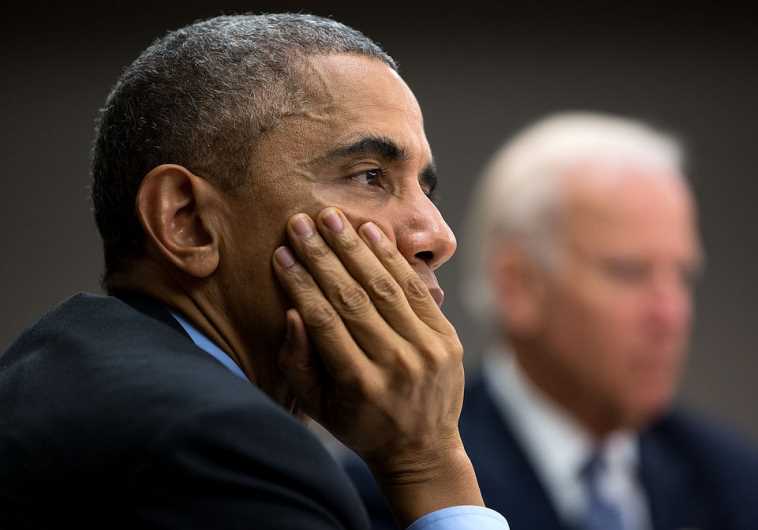
ShowImage (5)US President Barack Obama (L) and Vice President Joe Biden. (photo credit:OFFICIAL WHITE HOUSE PHOTO BY PETE SOUZA)

Most of the antiquities that ISIS plunders in Iraq and Syria make their way to the world market through Turkey. So, too, most of the oil that ISIS produces in Syria and Iraq is smuggled out through Turkey. According to the US Treasury, ISIS has made $1 million-$4m. a day from oil revenue.

Instead of maintaining its current practice of balancing its support for Turkey with its support for the Kurds, under the agreement, the West ditches its support for the Kurds and transfers its support to Turkey exclusively.

************************

While Israel and much of oficial Washington remain focused on the deal President Barack Obama just cut with the ayatollahs that gives them $150 billion and a guaranteed nuclear arsenal within a decade, Obama has already moved on – to Syria.

Obama’s first hope was to reach a deal with his Iranian friends that would leave the Assad regime in place. But the Iranians blew him off.

They know they don’t need a deal with Obama to secure their interests. Obama will continue to help them to maintain their power base in Syria though Hezbollah and the remains of the Assad regime without a deal.

Iran’s cold shoulder didn’t stop Obama. He moved on to his Sunni friend Turkish President Recep Erdogan.

Like the Iranians, since the war broke out, Erdogan has played a central role in transforming what started out as a local uprising into a regional conflict between Sunni and Shiite jihadists.

With Obama’s full support, by late 2012 Erdogan had built an opposition dominated by his totalitarian allies in the Muslim Brotherhood.

By mid-2013, Erdogan’s Muslim Brotherhood- led coalition was eclipsed by al-Qaida spinoffs. They also enjoyed Turkish support.

And when last summer ISIS supplanted al-Qaida as the dominant Sunni jihadist force in Syria, it did so with Erdogan’s full backing. For the past 18 months, Turkey has been ISIS’s logistical, political and economic base.

According to Brett McGurk, the State Department’s point man on ISIS, about 25,000 foreign fighters have joined ISIS in Syria and Iraq. All of them transited through Turkey.

Most of the antiquities that ISIS plunders in Iraq and Syria make their way to the world market through Turkey. So, too, most of the oil that ISIS produces in Syria and Iraq is smuggled out through Turkey. According to the US Treasury, ISIS has made $1 million-$4m. a day from oil revenue.

In May, US commandos in Syria assassinated Abu Sayyaf, ISIS’s chief money manager, and arrested his wife and seized numerous computers and flash drives from his home. According to a report in The Guardian published last week, the drives provided hard evidence of official Turkish economic collusion with ISIS.

Due to Turkish support, ISIS has become a self-financing terrorist group. With its revenue stream it is able to maintain a welfare state regime, attracting recruits from abroad and securing the loyalty of local Sunni militias and former Ba’athist forces.

Some Western officials believed that after finding hard evidence of Turkish regime support for ISIS, NATO would finally change its relationship with Turkey. To a degree they were correct.

Last week, Obama cut a deal with Erdogan that changes the West’s relationship with Erdogan.

Instead of maintaining its current practice of balancing its support for Turkey with its support for the Kurds, under the agreement, the West ditches its support for the Kurds and transfers its support to Turkey exclusively.

The Kurdish peshmerga militias operating today in Iraq and Syria are the only military outfits making sustained progress in the war against ISIS. Since last October, the Kurds in Syria have liberated ISIS-controlled and -threatened areas along the Turkish border.

The YPG, the peshmerga militia in Syria, won its first major victory in January, when after a protracted, bloody battle, with US air support, it freed the Kurdish border town of Kobani from ISIS’s assault.

In June, the YPG scored a strategic victory against ISIS by taking control of Tal Abyad. Tal Abyad controls the road connecting ISIS’s capital of Raqqa with Turkey. By capturing Tal Abyad, the Kurds cut Raqqa’s supply lines.

Last month, Time magazine reported that the Turks reacted with hysteria to Tal Abyad’s capture.

Not only did the operation endanger Raqqa, it gave the Kurds territorial contiguity in Syria.

The YPG’s victories enhanced the Kurds’ standing among Western nations. Indeed, some British and American officials were quoted openly discussing the possibility of removing the PKK, the YPG’s Iraqi counterpart, from their official lists of terrorist organizations.

The YPG’s victories similarly enhanced the Kurds’ standing inside Turkey itself. In the June elections to the Turkish parliament, the Kurdish HDP party won 12 percent of the vote nationally, and so blocked Erdogan’s AKP party from winning a parliamentary majority.

Without that majority Erdogan’s plan of reforming the constitution to transform Turkey into a presidential republic and secure his dictatorship for the long run has been jeopardized.

As far as Erdogan was concerned, by the middle of July the Kurdish threat to his power had reached unacceptable levels.

Then two weeks ago the deck was miraculously reshuffled.

On July 20, young Kurdish activists convened in Suduc, a Kurdish town on the Turkish side of the border, 6 kilometers from Kobani. A suicide bomber walked up to them, and detonated, massacring 32 people.

Turkish officials claim that the bomber was a Turkish Kurd, and a member of ISIS. But the Kurds didn’t buy that line. Last week, HDP lawmakers accused the regime of complicity with the bomber. And two days after the attack, militants from the PKK killed two Turkish policemen in a neighboring village, claiming that they collaborated with ISIS.

At that point, Erdogan sprang into action.

After refusing for months to work with NATO forces in their anti-ISIS operations, Erdogan announced he was entering the fray. He would begin targeting “terrorists” and allow the US air force to use two Turkish air bases for its anti-ISIS operations. In exchange, the US agreed to set up a “safe zone” in Syria along the Turkish border.

Turkish officials were quick to explain that in targeting “terrorists,” the Turks would not distinguish between Kurdish terrorists and ISIS terrorists just because the former are fighting ISIS. Both, they insisted, are legitimate targets.

Erdogan closed his deal in a telephone call with Obama. And he immediately went into action.

Turkish forces began bombing terrorist targets and rounding up terrorist suspects. Although a few of the Turkish bombing runs have been directly against ISIS, the vast majority have targeted Kurdish forces in Iraq and Syria.

Moreover, for every suspected ISIS terrorist arrested by Turkish security forces, at least eight Kurds have been taken into custody.

Then, too, Erdogan has called on AKP lawmakers to begin criminalizing their counterparts from the HDP. Kurdish lawmakers, he urged them, must be stripped of their parliamentary immunity to enable their arrests.

As Erdogan apparently sees things, by going to war against the Kurds, he will be able to reestablish the AKP’s parliamentary majority. Within a few weeks, if the AKP fails to form a governing coalition – and it will – then new elections will be held. The nationalists, who abandoned the AKP in June, will return to the party to reward Erdogan for fighting the Kurds.

As for that “safe area” in northern Syria, as the Kurds see it, Erdogan will use it to destroy Kurdish autonomy. He will flood the zone with Syrian Arab refugees who fled to Turkey, to dilute the Kurdish majority. And he will secure coalition support for the Sunni Arab militias – including those still affiliated with al-Qaida – which will be permitted by NATO to operate openly in the safe area.

Already the Kurds are reporting that the US has stopped providing air support for their forces fighting ISIS in the border town of Jarablus. Those forces were bombed this week by Turkish F-16s.

For their part, despite Erdogan’s pledge to fight ISIS, his forces seem remarkable uninterested in rolling back ISIS achievements. The Turks have no plan for removing ISIS from its strongholds in Raqqa or Haskiyah.

The Obama administration is presenting the deal with Turkey as yet another great achievement.

In an interview with Charlie Rose on Tuesday, McGurk explained that the deal was a long time in the making. It began with a phone conversation between Obama and Erdogan last October and it ended with their phone call last week.

In October, Obama convinced Erdogan not to oppose US air support for the Kurds in Kobani and to enable the US to resupply YPG fighters in Kobani through Turkey. In the second, Obama agreed not to oppose Erdogan’s offensive against the Kurds.

Two years ago, in August 2013, the world held its breath awaiting US action in Syria. That month, after prolonged equivocation amidst mountains of evidence, the Obama administration was forced to acknowledge that Iran’s Syrian puppet Bashar Assad had crossed Obama’s self-declared redline and used chemical weapons against regime opponents, including civilians.

US forces assembled for battle. Everything looked ready to go, until just hours before US jets were scheduled to begin bombing regime targets, Obama canceled the operation. In so doing, he lost all deterrent power against Iran. He also lost all strategic credibility among America’s regional allies.

To save face, Obama agreed to a Russian proposal to have international monitors remove Syria’s chemical weapons from the country.

Last summer, the administration proudly announced that the mission had been completed.

UN chemical weapons monitors had removed Syria’s chemical weapons arsenal from the country, they proclaimed. It didn’t matter to either Obama or Secretary of State John Kerry that by that point Assad had resumed chemical assaults with chlorine-based bombs. Chlorine bombs weren’t chemical weapons, the Americans idiotically proclaimed.

Then last week, the lie fell apart. The Wall Street Journal reported that according to US intelligence agencies, Assad not surrendered his chemical arsenal.

Rather, he hid much of his chemical weaponry from the UN inspectors. He had even managed to retain the capacity to make chemical weapons – like chlorine-based bombs – after agreeing to part with his chemical arsenal.

Assad was able to cheat, because just as the administration’s nuclear deal with the Iranians gives Iran control over which nuclear sites will be open to UN inspectors, and which will be off limits, so the chemical deal gave Assad control over what the inspectors would and would not be allowed to see. So, they saw only what he showed them.

Obama has gone full circle in concluding his deal with Erdogan. Since entering office, Obama has sought to cut deals with both the Sunni jihadists of the Muslim Brotherhood ilk and the Shi’ite jihadists of the Iranian ilk.

His chemical deal with Assad and his nuclear deal with the ayatollahs accomplished the latter goal, and did so at the expense of America’s Sunni Arab allies and Israel.

His deal last week with Erdogan accomplishes the former goal, to the benefit of ISIS, and on the backs of America’s Kurdish allies.

So that takes care of the Middle East. With 17 months left to go till Obama leave office, the time has apparently come for the British to begin to worry.

Iran’s Expendable President Rouhani

July 31, 2015

Iran’s Expendable President Rouhani, World Affairs JournalAli Alfoneh, July 30, 2015

7.30.15.alfoneh_0

In Washington the agreement is being sold in part as an effort to bolster the president against more hardline forces. The opposite, however, may well play out. By achieving a nuclear deal with Iran, Washington may have invested the entirety of its agreement and relations with Iran on an expendable politician.

**********************

While Iranian President Hassan Rouhani and Foreign Minister Mohammad-Javad Zarif celebrate their recent nuclear negotiating triumph, neither they nor their Washington-based fans should pop the Zamzam cola just yet. Back in Tehran, Rouhani and Zarif are encountering increasing resistance. With the Joint Comprehensive Plan of Action (JCPOA) in hand, Supreme Leader Ali Khamenei no longer needs the duo and is likely to cease shielding them from domestic criticism as he has in their first two years in office. Worse, fearing their popularity, Khamenei may encourage the Islamic Revolutionary Guards to launch a political attack against the president and his allies.

Rouhani is perhaps in a better position to defend himself than his “pragmatic” forerunners. Today, team Rouhani is not a one-man operation that emerged from nowhere but the product of the large “technocratic” and clerical network built by his mentor, former president Ali Akbar Hashemi-Rafsanjani.

Rouhani intends to mobilize the public for his cause. After all, he has come close to delivering his single major campaign pledge — solving the crisis over Iran’s nuclear program and eliminating the international sanctions regime. Seeing some economic promise, the average voter may vote Rouhani’s allies into parliament and the Assembly of Experts in February 2016, and eventually re-elect Rouhani in presidential elections the following year.

That scenario, however, would seem optimistic. In the past, Rafsanjani and Rouhani seldom reciprocated the loyalty of their protégés, and nor can they expect their former allies’ support in troubled times. The two mullahs did not lift a finger to save their friends when opponents, which sometimes included Khamenei, began to attack Rafsanjani’s too-powerful network during his presidency in the 1990s. When Gholamhossein Karbaschi, a reformist mayor of Tehran and a Rafsanjani ally, was targeted by a politically-motivated judiciary in 1998, Rafsanjani and Rouhani (then-secretary of the Supreme National Security Council) remained silent. If Khamenei unleashes the Guards against the president, Rouhani’s network of friends is vastly smaller and weaker than was Rafsanjani’s a decade earlier and, thus, would likely scatter in difficult times.

It is also near certain that Rouhani will be incapable of capitalizing on the sanctions relief to liberalize Iran’s economy and improve living standards for the average Iranian. To date, Rouhani has already repeatedly tried, and failed, to push the Guards (upper or lower case. I’m not sure?) out of the economy. Their intransigence probably received the tacit support of Khamenei, who can’t afford to lose his praetorians’ support. After all, it was the guards who brutally suppressed the pro-democracy Green Movement in 2009. The money from sanctions relief remains more likely to find its way to the companies owned by the IRGC and the semi-public foundations controlled by Khamenei than to state coffers, and the ordinary citizen.

At the street level, the nuclear deal remains immensely popular. But the Islamic Republic isn’t a democracy, and Khamenei has feared competition from the Rouhani-Rafsanjani camp. He has before successfully curtailed the political power of Rafsanjani, once the major domo of revolutionary mullahs, and occasionally tormented his children to remind the cleric of his place. The Supreme Leader will likely ensure that the Guardian Council, which approves candidates for public office, disqualifies candidates favored by the president and his allies. The purging of candidates will be intended to keep Rouhani’s supporters home, and allow anti-Rouhani forces to score huge electoral triumphs, thus checking the popular power of the executive branch.

Simultaneously, ever more belligerent statements by Khamenei and the hardline elite of the IRGC are gradually drowning out Rouhani and Zarif’s charm offensive towards the United States.

The cumulative impact of these efforts could be disastrous for Rouhani and his team.

In Washington the agreement is being sold in part as an effort to bolster the president against more hardline forces. The opposite, however, may well play out. By achieving a nuclear deal with Iran, Washington may have invested the entirety of its agreement and relations with Iran on an expendable politician.

Know Comment: American-Iranian fairy tales

July 31, 2015

Know Comment: American-Iranian fairy tales, Jerusalem PostDavid M. Weinberg, July 30, 2015

ShowImage (4)iran. (photo credit:REUTERS)

An updated list of the fictions peddled by the Obama administration in support of its pact with Iran.

Here is an updated scorecard of the misrepresentations advanced by the Obama administration in defense of its concordat with Iran. The list grows every day.

1. Iran will be motivated to keep the agreement.

False. Iran already may be plotting its escape from the agreement. Dr. Emily Landau of the Institute for National Security Studies points out that Iran has twice bolted – in 2004 and again in 2005 – when it felt that the agreements it concluded with the EU-3 were no longer serving its interests.

Lo and behold, the Joint Comprehensive Plan of Action has an explicit defection clause, which allows Tehran to exit the deal without any deliberations or warning if it feels that any of the P5+1 countries is reintroducing any form or degree of sanction against Iran.

So, Iran will pocket hundreds of billions of dollars in (almost-immediate and unconditional) sanctions relief, then sign hundreds of billions of dollars in investment and business partnership deals with the major French and German companies that are now in on the gold rush to Iran. Then it can accuse Congress or the next US president of being nasty and use that as the pretext for its “nuclear snapback.”

2. In case of Iranian violations, America can “snapback” sanctions.

The opposite is true. The agreement intentionally embeds the US in a web of time-consuming and complex multilateral processes that place significant and perhaps insuperable obstacles to both a snapback of economic sanctions and resort to an American military strike. Prof. Jeffrey Herf of the University of Maryland has detailed how the deal places sky-high barriers in the way of American enforcement in the event of Iranian violations.

Claudia Rosett of the Foundation for Defense of Democracies has shown that the nitty-gritty of the so-called sanction snapback provisions actually provide disincentives for the US and its partners to confront Iran in the event that Iran does cheat (which it has a long record of doing, and has done even during the recent nuclear talks). Moreover, Iran is supposed to get Western help and technology for defense against nuclear sabotage. So the US is essentially deterring itself from ever acting against Iran, no matter what. Which apparently is exactly what President Obama was after.

3. The deal will moderate or contain Iran’s aggressive ambitions in the Middle East.

Not at all. The nuclear deal seems to be just the first act in a longer drama of American retreat, retrenchment and accommodation as Obama hands the keys to the Persian Gulf and beyond to his new Shia friends.

Obama says that he “hopes” that “we can continue to have conversations with Iran that incentivize them to behave differently in the region, to be less aggressive, less hostile, more cooperative, to operate the way we expect nations in the international community to behave.” But, he adds, “We’re not counting on it. So this deal is not contingent on Iran changing its behavior.”

What a damning self-indictment. Is it believable that “conversations” are going to change or contain Iran? What is really needed, instead, says Prof. Walter Russell Mead of the New America Foundation, is a tough regional strategy to counter Iran’s rush for hegemony; an aggressive, anti- IRGC, anti-Assad, anti-Hezbollah policy.

But the White House never intended to contain Iran, says Dr. Michael Doran of the Hudson Institute. It has consistently displayed an aversion to countering Iran. America’s allies in the Middle East (and this list of allies supposedly still includes Israel) “have time and again begged the president to help them curtail Iranian influence in Iraq, Syria, Lebanon and Yemen, and time and again Obama has refused.”

Maj.-Gen. (res.) Yaakov Amidror of the Begin-Sadat Center for Strategic Studies expands on this in an-depth study published on Thursday.

Under cover of this accord, Iran is likely to greatly strengthen its grip on the Middle East, he writes. It will solidify its control of Yemen, including developing the capacity to block the Bab el-Mandeb strait in the Red Sea and thus threaten global trade and the Suez Canal, Egypt’s lifeline. It will take complete control of Lebanon.

With the help of other countries (perhaps even including the US) it will “save” the region by fighting ISIS, to become the true ruler of Iraq and of what would remain of Alawite Syria. Hezbollah will be given thousands of precise missiles, while enjoying Iranian backing and silent American approval.

Amidror: “There is little chance that America will follow through on its promise that after signing the agreement it will be more determined in its efforts to contain Iran. This claim is unrealistic and illogical, since once a rival state becomes a partner to an agreement, one does not increase efforts taken against it in other realms. It is the nature of agreements that cover a certain area of relations that they prevent pressure being applied in other areas, rather than increasing pressure. No one in the West will now be interested in jeopardizing either the agreement or trade relations with Iran. It is therefore likely that, despite the messages of reassurance coming from Washington, Iran will become much stronger over the next 15 years, internally, regionally, economically and militarily, with no opposition from the US.”

4. There was no better deal, and the alternative to this deal is war.

Both assertions are absolutely fallacious. More coercive diplomacy could have delivered a better deal. However, Obama refused to put maximum pressure on Iran. He was not willing to impose additional sanctions on Iran (as Prime Minister Netanyahu suggested and Congress wanted), or to threaten the use of military force. When you are in talks with a genocidal, terrorism-sponsoring regime and claim that you have no viable military option, you are not negotiating.

You are begging.

Prof. Fred Kagan of the American Enterprise Institute points out that there is a historical precedent for tougher diplomacy that works. The US Senate refused to ratify SALT II, ending the SALT process, but war between the US and the Soviet Union did not ensue. Both Jimmy Carter and Ronald Reagan instead increased the pressure on the Soviet Union dramatically. The lesson is that walking away from bad deals does not inevitably lead either to war or to the end of negotiations.

Iran orders from China 150 J-10 fighter jets that incorporate Israeli technology

July 30, 2015

Iran orders from China 150 J-10 fighter jets that incorporate Israeli technology, DEBKAfile, July 30, 2015

J-10Chinese Chengdu J-10 for Iranian air force

The scale of Iran’s multibillion acquisitions from China and Russia – 550 warplanes in all so far – indicates that Tehran’s top spending priority upon receipt of the funds released by the removal of sanctions, is to be a spanking new air force.

**********************

Iran is about to conclude a transaction with China for the purchase of the Chengdu J-10 multirole jet fighter, known in the West as the Vigorous Dragon, according to an exclusive report from DEBKAfile’s military and intelligence sources. Beijing has agreed to sell Tehran 150 of these sophisticated jets.

While the Chinese J-10 is comparable to the US F-16, our sources report that it is virtually a replica of the Lavi, the super-fighter developed by Israel’s aerospace industry in the second half of the 80s. Israel sold China the technology, after Washington insisted on Its discontinuing the Lavi’s production. The US also objected to the sale of the Lavi’s avionics, claiming that it contained some American components.

The Chinese plane comes in two versions – the multirole single-seat J-10A and the two-seat J-10B, which serves for training, ground assaults and electronic warfare.

Iran has additionally weighing the purchase in Moscow of 250 highly-advanced Sukhoi-Su-30MK1 twinjet multirole air superiority fighters, known in the West as Flanker-H.

On Wednesday, July 29, an Indian Air Force Su-30MK1 took part for the first time in a British air maneuver, Rainbow, where it dueled with the European Typhoon fighter.

The sophisticated Flanker has been found to have a major shortcoming. To carry eight tons of ordnance, it must use both of its AL-31FP engines, and the transition from one to two – and the reverse – often causes engine failure.

The Indian Air Force has reported three such malfunctions in a month, as well another shortcoming: The time needed for making the aircraft serviceable is too long. As a result, only half of the Indian fleet can be airborne at one time.

In a confrontation, the Iranian Air Force may find that, because of these drawbacks, the Chinese Su-30MK1 is outmatched by its American and European counterparts in the service of the Israeli, Saudi and UAE air forces.

On July 22, DEBKAfile revealed that Moscow and Tehran had concluded a giant transaction for the acquisition of a fleet of 100 IL78 MK1 (Midas) in-flight refueling planes for extending the range of its warplanes up to 7,300 km and able to refuel 6-8 planes at once.

DEBKAfile: The scale of Iran’s multibillion acquisitions from China and Russia – 550 warplanes in all so far – indicates that Tehran’s top spending priority upon receipt of the funds released by the removal of sanctions, is to be a spanking new air force.

Iran: Obama Admin Lying About Nuclear Deal for ‘Domestic Consumption’

July 30, 2015

Iran: Obama Admin Lying About Nuclear Deal for ‘Domestic Consumption’ Washington Free Beacon, July 30, 2015

( It’s clear that the Obama administration is lying, but what lies do the Iranian officials claim are being told? Do they involve the secret deals? — DM)

AP

Senior Iranian officials are accusing the Obama administration of lying about the details of the recent nuclear accord in order to soothe fears among U.S. lawmakers and Americans about the implications of the deal, which will release billions of dollars to the Islamic Republic while temporarily freezing its nuclear program, according to reports from Iran’s state-controlled media.

As Secretary of State John Kerry and other senior Obama administration figures launch a full-court press to convince Congress to approve the  deal, Iranian leaders are dismissing the rhetoric as “aimed at domestic consumption.”

Kerry and other top administration officials have been defending the deal on Capitol Hill in recent days, claiming that it will rein in the Islamic Republic’s contested nuclear program and fix its nuclear “breakout” period, the time required for it to obtain the amount of highly enriched uranium necessary for a nuclear weapon, at one year.

Critics have noted that the deal provides Iran with billions of dollars in sanctions relief that could be spent on terrorism and lifts bans on Iran’s export of weapons and construction of ballistic missiles.

When addressing claims this week by the administration that the deal shuts down Tehran’s nuclear infrastructure, Iranian officials scoffed and said that the Obama administration is misleading the public in order to sell the deal.

Hamid Baeidinejad, an official in the Iranian foreign ministry and one of the country’s nuclear negotiators, scoffed on Wednesday at the Obama administration’s comments, saying that they were meant to placate an American domestic audience.

“The remarks by the western officials are ambiguous comments which are merely uttered for domestic use and therefore we should say that there is no ambiguity in this (nuclear) agreement,” the Fars news agency quoted Baeidinejad saying in an interview with state-controlled radio.

Baeidinejad said that the Obama administration is misleading Americans about the deal in order to “calm opponents in the Congress and Zionist lobbies to soothe the internal conditions prevailing over debates on the nuclear agreement in that country,” Fars, which is also run by the Iranian state, reported.

As Congress spends 60 days reviewing the deal, which it may reject, the Iranian parliament is undertaking the same task.

During a meeting on Wednesday with Laurent Fabius, the French foreign minister, President Hassan Rouhani of Iran urged world powers to keep its commitments under the deal.

These includes lifting sanctions on the nearly $100 billion dollar financial empire of the Iranian Supreme Leader Ali Khamenei and agreeing to bar American inspectors from all Iranian nuclear sites.

“The Iranian government is standing strong on the path of (implementing) the agreement and we will remain committed to our undertakings as long as the other side remains loyal to its obligations,” Rouhani was quoted as saying during a meeting in Tehran with Fabius, who served as a key negotiator for the French.

Rouhani said the agreement could help Iran become a key player on the international stage.

“This agreement is not against any country and our cooperation and consultations to settle the regional problems, including fight against terrorism, humanitarian aids, and materialization of nations’ demands can prove it,” Rouhani was quoted as saying.

Meanwhile, Fabius was met at the airport by Iranian protestors who accused him of serving as an Israeli spy.

“The protesters chanted slogans such as ‘Aids, A French Gift to Iran’, ‘We Neither Forgive nor Forget’, ‘Fabius, Servant of the US, Spy of Israel’ and ‘No Welcome to Aids Lord,’” according to Fars.