Archive for the ‘Obama’ category

Islamic Jihad Chief, Iranian Officials to Discuss Regional Security Concerns

October 15, 2014

Islamic Jihad Chief, Iranian Officials to Discuss Regional Security Concerns, Fars News Agency (Iran), October 15, 2014

(According to Wikipedia,

The Islamic Jihad Movement in Palestine (Arabic: حركة الجهاد الإسلامي في فلسطين‎,Harakat al-Jihād al-Islāmi fi Filastīn) known in the West as simply Palestinian Islamic Jihad (PIJ), is a Palestinian Islamist organization formed in 1981 whose objective is the destruction of the State of Israel and the establishment of a sovereign, Islamic Palestinian state.[2] PIJ has been labelled a terrorist organisation by the United States,[3] the European Union,[4] the United Kingdom,[5] Japan,[6] Canada,[7] Australia,[8] New Zealand[9][10] and Israel. Iranis a major financial supporter of the PIJ.[11][12][13][14] Following the Israeli and Egyptian squeeze on Hamas in early 2014, PIJ has seen its power steadily increase with the backing of funds from Iran.[15] Its financial backing is believed to also come from Syria.

Iran is a welcome addition to the International Community’s anti-Israel world of nukes for (Islamic) peace. Please see also The danger of Obama’s strategy of linking Iran and ISIS for Israel. — DM)

Islamic Jihad MovementSecretary-General of the Islamic Jihad Movement Ramazan Abdullah arrived in Iran on Tuesday to confer with senior officials of the country on the latest security developments in region.

Abdullah, who arrived in Tehran last night, is to hold separate meetings with Secretary of Iran’s Supreme National Security Council (SNSC) Ali Shamkhani, and Member of Iran’s Expediency Council Saeed Jalili later today.

He will also hold meetings with some other Iranian officials during his stay in the country.

Late in August 2012, Supreme Leader of the Islamic Revolution Ayatollah Seyed Ali Khamenei asked participants in the 16th Non-Aligned Movement (NAM) summit in Tehran to pay special attention to the Palestinian issue, and called on the American backers of the Israeli regime to accept Iran’s proposal for holding a referendum in Palestine.

The Leader reminded the Zionists’ bloody occupation of Palestine over 6 decades ago, and blamed the Zionist regime for waging various wars, massacre and state-sponsored terrorism in the last decades.

He blamed the western world for supporting and defending the Zionist regime of Israel against the oppressed Palestinian nation.

The leader further renewed Iran’s solution to the Palestinian issue, calling for a “comprehensive referendum to be attended by all the indigenous residents of Palestine, including those refugees who have been away from their motherland for decades to determine the country’s fate”.

The Iranian supreme leader cautioned the US against the continue support and defense for the Zionist regime of Israel, reminding that decade-long support for the Israeli regime has incurred many costs and losses on the American people.

The leader called on the White House leaders to revise their Middle-East policy and “show courage and opt for the referendum solution” presented by Iran to put an end to the astronomical spending that has been inflicted on the American nation for its support for the Zionist regime of Israel.

To conclude his remarks, he urged for collective management of global issues, asking the NAM member states “not to be afraid of the bullying powers and remain loyal to their own causes”.

He reminded failure of communism and capitalism, and said the world is pregnant to new events, saying the Islamic Awakening and the US and Israeli failures in North Africa and the Middle-East are indicative of the very same fact.

Kurds make grisly discoveries after retaking ISIS-held territory

October 15, 2014

Kurds make grisly discoveries after retaking ISIS-held territory, Hot Air, Noah Rothman, October 14, 2014

(How serious are we and our coalition of the unwilling about at least degrading the Islamic State? — DM)

There is mixed news from the two fronts in Iraq and Syria where coalition airpower and indigenous partner forces on the ground are fighting Islamic State militants.

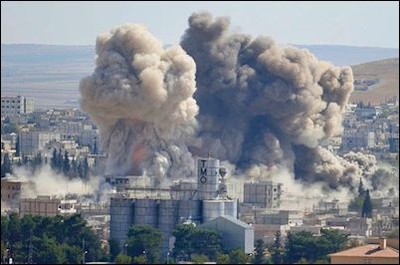
Near the Syrian border city of Kobani, reports indicate that Kurdish defenders are beginning to make some gains as they continue to defend the city against the ISIS onslaught. A key hill atop which ISIS fighters famously planted their flag late last week has reportedly been retaken by Kurdish forces.

“The advance came as the US said it had conducted 21 air strikes near the town, slowing down the IS advance,” the BBC revealed. “Tall Shair hill had been captured more than 10 days ago by IS militants.”

As ISIS retreated from the front near the Syrian-Turkish border, Kurdish forces made a series of gruesome discoveries.

“Refugees in Suruc, Turkey, have told how relatives and neighbors were beheaded by [ISIS] militants, while another spoke of how he had seen ‘hundreds’ of decapitated corpses in the besieged town,” The Independent reported on Tuesday.

Amin Fajar (38) a father-of-four who left Kobane and made it across the border and into Suruc, told a British newspaper: “I have seen tens, maybe hundreds, of bodies with their heads cut off.

“Others with just their hands or legs missing. I have seen faces with their eyes or tongues cut out – I can never forget it for as long as I live.”

The Daily Telegraph confirmed The Independent’s reporting about the activities in which ISIS engaged in the areas under their control:

“I have seen tens, maybe hundreds, of bodies with their heads cut off. Others with just their hands or legs missing. I have seen faces with their eyes or tongues cut out — I can never forget it for as long as I live,” Amin Fajar, a 38-year-old father of four, told the Daily Mail about the incredible scene in Kobane.

“They put the heads on display to scare us all.”

Another resident, 13-year-old Dillyar, watched as his cousin Mohammed, 20, was captured and beheaded by the black-clad jihadis as the pair tried to flee the battle-scarred town.

“They pushed him to the ground and sawed his head off, shouting, ‘Allahu Akbar,’ ” the boy said. “I see it in my dreams every night and every morning I wake up and remember everything.”

This unconfirmed video featuring Kurdish fighters in Kobani, flagged by Jeff Gauvin, reveals the extent of the damage done to the city over the course of weeks of fighting.

While America’s partners on the ground are enjoying some successes in Syria, the dispatches from Iraq are far more grim.

There, ISIS continues its siege on Anbar province in preparation for an assault on the capital city of Baghdad. After taking control of a military training base on Monday, CNN reported that ISIS has surrounded one of the largest Iraqi airbases in the country on Tuesday and is preparing to take it.

“According to police sources,” CNN’s Ben Wedeman reported, “the Ayman Asad Airbase, which is about 110 miles to the west of Baghdad – one of the biggest bases in Anbar province – is now surrounded by ISIS fighters, and the people on the base are expecting an attack within the coming hours on that base.”

“We understand that there are Iraqi soldiers who have already fled the base,” Wedeman continued. “We were getting reports for several hours that some of the soldiers had left, shedding their uniforms, leaving their weapons behind.”

That depressing revelation should concern military advisors who believe Iraqi forces defending Baghdad can hold out against an ISIS assault on Baghdad despite outnumbering the attackers by a reported six-to-one ratio. These latest developments reinforce the position of Army Chief of Staff Gen. Raymond Odierno who said with some trepidation recently he was only “somewhat” confident Baghdad could hold out.

Understanding multicultural words, phrases and other absurdities

October 15, 2014

Understanding multicultural words, phrases and other absurdities, Dan Miller’s Blog, October 14, 2014

(Some of this is directly pertinent to Israel and the Middle-East, some is pertinent only as U.S. politics affect both. It’s intended to be humorous, in a macabre way. — DM)

The Obama Nation’s multicultural society has become so politically correct and otherwise obtuse that words and phrases are used in any odd ways that may be desired — just as Humpty Dumpty did.

“When I use a word,” Humpty Dumpty said, in rather a scornful tone, “it means just what I choose it to mean—neither more nor less.”

“The question is,” said Alice, “whether you can make words mean so many different things.”

“The question is,” said Humpty Dumpty, “which is to be master—that’s all.”

Here are a few examples and explanations.

Religion of peace. Amish? Quakers? Of course not: it’s Islam. Although the Islamic State, according to Obama, is not “Islamic,” the Islamic Republic of Iran, Turkey, Qatar, Saudi Arabia, et al — which are “Islamic” — are among the world’s foremost sponsors of Islamic terrorism. However, that is irrelevant because Muslims would be offended.

ISIS scared

Here’s Andrew Klavan on how to survive an Islamic Quaker massacre:

Islamic extremists are extreme because they follow the Koran and demand Shari Law. So do “moderate Muslims.”

Modeate Muslim

Bitter clingers are Christians in fly-over country who support the Second Amendment, while revering and trying to live according to their Bibles. Islamists who cling to their scimitars, guns and suicide vests, while revering and trying to live by their Korans and Sharia law, are not bitter clingers.

Reid-knows-Terrorist

That’s racist! Unless you happen to be Black and therefore not conservative, see Great Uniter, below.

The science is settled and the debate is over. Ipse dixit.

Honest discussion. According to Attorney General Holder, Federal Dick, we need to have an honest discussion about race. “Honest” means agreeing with and favoring his people above all others. Or something.

Gender identity. Don’t like your gender? Try another; it’s probably on the house.

The war on women has long been fought by Republican scoundrels, not by Democrats like Billie BJ Clinton or various Islamic states such as Saudi Arabia, Iran and Turkey. The (non Islamic) Islamic State and other (non Islamic) freaks may be fighting a war on women and girls, whom they capture as sex slaves, use and sell. However, few engaged in fierce combat against the war on women seem to notice or care, so the vile war on women must still be exclusively a Republican thing.

War on women

Feminism rejects the vast powers that men have over women by, among many other things, demanding free contraception and abortion on request. Although opposed by some bitter clingers, both are needed to empower women and girls to have sex as often and with as many men as they may desire, with no illnesses (such as pregnancy) or other adverse consequences. Is lesbianism the cure? Should it replace heterosexual nymphomania?

Truth. “Beauty is truth, Truth is beauty. This is all ye know on Earth and all ye need to know.” Truth is beautiful only if it “sounds good” and can become a helpful sound bite to be memorized and used effortlessly.

Ketchup Kerry

Party of billionaires. This refers to Republicans. It does not mean Democrats who pay big bucks (up to $32,000 or more in some cases) to hear Obama tell them how filthy rich Republicans are ruining the country and how wonderful He is.

scrooge-mcduck-make-it-rain

As Gwyneth Paltrow, an impoverished working mother who only “makes $16 million per movie,” said at a recent Obama fundraiser thrown at her humble shanty in California, Obama is

a president who would be studied for generations, and a role model for everyone of this generation.

“It would be wonderful if we were able to give this man all of the power that he needs to pass the things that he needs to pass,” she told the crowd.

Having been reminded of His greatness, attendees contribute more big bucks. It’s a good thing Obama is not a narcissist.

Great uniter refers to Obama, who has done more to unite Blacks against Whites than any other American President. (Conservative Blacks, such as Allen West, Ben Carson and others are White, not Black.) Great progress, Big Guy! Oh. He’s also a like, way cool military strategist.

MissionAccomplished0067

Oh well. Try not to laugh cry; it may cause even more global warming, cooling, climate change and other demons not yet exploited discovered. As Jon Carson at BarackObama.com advised my spam filter just today,

We’re going to win on climate change. We don’t really have another option.

The question is how long will it take for the other side to take this fight seriously — to push the climate change deniers out of the way, and to defeat the powerful interest groups protecting the status quo.

We’re not waiting.

Climate change is already affecting Americans’ lives now — droughts, wildfires, and super storms have devastated every corner of the country.

UPDATE re the party of billionaires:

An article by Bryan Preston at PJ Tatler titled Democrat Billionaire Bankrolls Effort to Suppress Republican Votes asks whether

“Fat cats” such as Tom Steyer, who is using his billions to impact multiple races in key states in ways that no ordinary voter can? Of course not. He’s the right kind of fat cat, meaning he is on the left. Plus, he controls NextGen and pays Lehane a lot of money to come up with its strategies. The libertarian-minded Koch brothers are the wrong kind of fat cats, so the billionaire-funded NextGen, led by consummate Beltway insider Chris Lehane, is pushing Democrat candidates to attack them. [Emphasis added.]

According to a linked article at Politico, the NextGen strategy of demonizing Republican “billionaires” seems to be working. So is the NextGen strategy:

According to the Lehane [NextGen] memo:

“In virtually every state NextGen is electorally engaged, there is an issue where the Republican candidate”s anti-climate, anti-basic science beliefs has manifested itself in policies with harmful consequences for all voters in state, including Republican voters. Our Republican Haircut Strategy – a precision focus on a specific harm in target Republican markets – we will seek to degrade Republican performance.”  [Emphasis added.]

There’s a lot of loaded language in that — “anti-climate, anti-basic science beliefs” could describe anyone who ignores the fact that the climate scare-mongers keep being proved wrong, and that the data shows that the earth has not warmed in the past 15 to 18 years. Climate hysterics systematically rule out the role that the Sun plays in climate stability and change. Which is a very large thing to omit. And we cannot control it with any carbon trade scheme, tax, regulatory regime or any other means. [Emphasis added.]

Sheep eating

Having nothing substantive to say, the Dems apparently attract voters by misleading and scaring them. The farce continues apace.

Obama’s Kobani Crossroads

October 15, 2014

Obama’s Kobani Crossroads, Algemeiner, Noah Beck, October 14, 2014

(Obama needs high profile stuff and photo ops to keep his polls from falling even more dramatically than they have. He needs help from Iran and little if anything else matters. It will be rewarded. — DM)

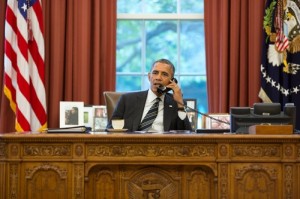
Obama on phone with RouhaniFrom the Oval Office, U.S. President Barack Obama speaks on the phone with Iranian President Hassan Rouhani on Sept. 27, 2013.

Instead of preemptively stopping ISIS from spreading into Iraq, Obama effectively waited until some high-profile beheadings forced him to focus on the danger. While such gruesome murders can reliably rally public opinion in favor of military action, the duty of the Commander-in-Chief is to lead and take military action when and how national security requires it, and not just when terrorists provoke some tardy and token airstrikes into empty buildings.

Kobani also has geostrategic importance to the Iranian nuclear threat. The more ISIS succeeds at capturing territory and recruiting fighters, a trend bolstered by Kobani’s fall, the more desperate the U.S. becomes for help from Iran, which, as leader of the Shiite world, is the natural enemy of the Sunni ISIS fighters.

[A]s Iran watches how feebly the U.S. responds to the loss of Iraq and how Obama cowers from a relatively minor fight in Kobani, the Ayatollahs can rest assured that there really is no U.S. military option to stop their nuclear program. This conclusion becomes all the more inevitable, when they look at Obama’s waning influence at home, as he enters the lame-duck period of his presidency.

*****************

President Obama has consistently disregarded the advice of his military experts on the ISIS threat. And he seems to have written off the Kurdish-Syrian town of Kobani, which may soon be overrun by ISIS.

Whatever the U.S. accomplished after about a decade of war in Iraq has, in a matter of months, deteriorated to a situation that may become unprecedented in its instability and threat to Western interests. Obama’s clumsy departure from Iraq, his military mismanagement of the mess that ensued, and his refusal to intervene in Syria – again, overruling his top security advisers – are what produced the current quagmire.

The loss of Christianity in Mosul didn’t have to happen. Obama’s tardy airstrikes managed to prevent the Mosul Dam from falling, but the city may never be the same. Similarly, why did the Yazidis have to find themselves besieged on Mount Sinjar before the U.S. took action?

Instead of preemptively stopping ISIS from spreading into Iraq, Obama effectively waited until some high-profile beheadings forced him to focus on the danger. While such gruesome murders can reliably rally public opinion in favor of military action, the duty of the Commander-in-Chief is to lead and take military action when and how national security requires it, and not just when terrorists provoke some tardy and token airstrikes into empty buildings.

As the next disaster is about to unfold on Obama’s watch, he should recognize that there is much more at stake with the fight for Kobani than just the loss to ISIS of a small town on the Syria-Turkey border.

Above all, letting Kobani fall means betraying our only ally fighting ISIS on the ground, and allowing them to be massacred while the world watches. What message does the U.S. send to Mideast partners and the world at large, if the Kurds are the only force providing the ground troops that Obama so desperately needs now, and yet Obama is unwilling to support them enough to avoid the horrific slaughter that will follow an ISIS victory in Kobani?

Kobani also has geostrategic importance to the Iranian nuclear threat. The more ISIS succeeds at capturing territory and recruiting fighters, a trend bolstered by Kobani’s fall, the more desperate the U.S. becomes for help from Iran, which, as leader of the Shiite world, is the natural enemy of the Sunni ISIS fighters. Because Iran also has one of the most powerful militaries in the region, and has – even before the ISIS crises – outmaneuvered the West in talks to curb Iranian nuclear ambitions, Iran could easily leverage the situation to secure tacit Western acceptance of its nukes. Indeed, Iran has already signaled its fight-ISIS-for-nukes strategy.

Even more important, as Iran watches how feebly the U.S. responds to the loss of Iraq and how Obama cowers from a relatively minor fight in Kobani, the Ayatollahs can rest assured that there really is no U.S. military option to stop their nuclear program. This conclusion becomes all the more inevitable, when they look at Obama’s waning influence at home, as he enters the lame-duck period of his presidency.

There is also a moral dimension to Kobani. Obama – in his 2009 and 2012 speeches on Holocaust Remembrance Day – proudly recalled how his great uncle helped to liberate a Nazi death camp. Yet Obama’s inaction in Syria has left about 200,000 dead, including many who were simply massacred, and Kobani may be where the next atrocities happen. Does the U.S. not hold itself to a higher standard than that of Turkey, which has thus far chosen just to watch the fighting a mere mile from its border?

Turkish history already includes genocides against the Armenian Christians and the Kurds (in the Dersim Massacre), so it’s no surprise that the Islamist regime of Recep Tayyip Erdoğan would let his army stand idly by, watching and waiting for ISIS to slaughter thousands of Kobani Kurds. But does the U.S. really want to be in the same camp as the Turks on this one? How much more shame will fall upon the United States, and the Obama legacy, when the Internet overflows with images of mass graves containing Kobani’s brave and abandoned fighters, along with Kurdish civilians who were too weak, infirm, or elderly to flee the approaching ISIS barbarism?

As if the above concerns weren’t enough to goad Obama into action, there is also the strategic impact of letting Kobani fall. As good as ISIS recruiting on social media already is, the popularity of this terrorist army among Islamists worldwide will surge when ISIS can boast about one more example of how even the mighty U.S. military can’t stop them.

Having foolishly telegraphed that he won’t send ground troops to confront ISIS, Obama can still try to convert his error into a feint by doing the opposite and sending troops to Kobani. At least that would restore some element of unpredictability to how ISIS regards U.S. military moves in the region.

Obama is effectively weeks away from the lame-duck portion of his presidency. If Republicans take Congress in next month’s midterm elections, then Obama will become that much more ineffectual. But the president can still try to demonstrate some leadership by changing his strategic approach to Mideast threats – if only to prevent his legacy from going into freefall. If the Middle East has only one lesson for Obama, it is that much can go terribly wrong in very little time. With Iranian nukes around the corner and ISIS on the march, two years of Mideast deterioration is a frighteningly long time to be on Obama’s watch.

Ruins of the Middle East

October 14, 2014

Ruins of the Middle East, National Review Online, Victor Hanson Davis, October 14, 2014

Obama shuns friends(Win McNamee/Getty Images)

Israel has nothing to do with the slaughter in Libya or Syria or Iraq, but it is a constant reminder that the United States is indifferent to its friends while it courts its enemies. As Obama’s new policy against ISIS is shaping up, Iran is emerging as more of an ally in his eyes than is Israel.

*****************

Obama shuns our friends and courts our enemies.

Obama’s unfortunate Middle East legacy was predicated on six flawed assumptions:

(1) a special relationship with Turkey;

(2) distancing the U.S. from Israel;

(3) empathy for Islamist governments as exemplified by the Muslim Brotherhood in Egypt;

(4) a sort of non-aggression agreement with Iran;

(5) expecting his own multicultural fides to resonate in the region;

(6) pulling out of Iraq and Afghanistan.

Let us examine what has followed.

Obama’s special relationship with Recep Erdogan proved disastrous from the get-go, as Erdogan immediately began to provoke Israel and promote Islamist revolutionaries. Turkey today not only dislikes the U.S., but also poses an existential problem for the West. It is a NATO member that is antithetical to everything NATO stands for: the protection of human rights and constitutional government against the onslaught of aggressive totalitarian regimes. Turkey is now operating like the old Soviet Union in using murderous proxies to enhance its own stature; for example, it finds ISIS useful in whittling down the Kurds. As a rule of thumb, any enemy of Erdogan’s Turkey — Israel, the Kurds, Greek Cyprus, Greece, Egypt — is likely to be far more friendly to the U.S. and NATO than are other nations in the region. If Turkey were attacked by ISIS, Syria, Iran, or the Kurds, would Belgium or Greece send in its youth under NATO’s Article V?

What did ankle-biting Israel accomplish other than giving Hamas a green light to send rockets into the Jewish State in hopes that we might do something stupid like slow down scheduled arms shipments to Israel or shut down Ben Gurion Airport for a day? Israel has nothing to do with the slaughter in Libya or Syria or Iraq, but it is a constant reminder that the United States is indifferent to its friends while it courts its enemies. As Obama’s new policy against ISIS is shaping up, Iran is emerging as more of an ally in his eyes than is Israel.

Our once-close relationship with Egypt is ruined. All that is left is U.S. foreign aid to Cairo, largely because we have no idea of how not to give a near-starving Egypt assistance. Obama, under the guidance of Hillary Clinton, Samantha Power, and Susan Rice, gyrated from Mubarak to Morsi to el-Sisi, as the U.S. went loudly full circle, from disowning the pro-American kleptocrat to embracing the anti-American theocrat to humiliating the neutral autocrat.

Obama kept quiet when a million Iranian protesters hit the streets in 2009 to show their disgust with theocratic corruption. Apparently the American president thought the pro-American tendencies of the young protesters were proof of their inauthenticity. Or  perhaps he saw them as sort of neocon democracy-pushers who would ruin his own chances of using his multicultural gymnastics to partner with Teheran.

Our serial deadlines for stopping uranium enrichment proved empty. Ending the tough sanctions has brought nothing but delight to the ayatollahs. In the view of Iraq and Syria, somehow the U.S. has become a de facto ally of the greatest enemy to peace in the region. Obama did not wish to stay in Iraq and work with the Sunni minority by pressuring the Maliki government. He threatened the Iranian puppet Assad and then backed off, and he ridiculed alike the dangers of the savage ISIS and the potential of the Free Syrian Army. Meanwhile, the U.S. is sort of bombing on and off to save the innocent and thereby helping the Iran–Assad–Hezbollah alliance.

In order to win over the Islamic street, Obama has tried almost everything to remind the Middle East that America is no longer run by a white male conservative from a Texas oil family. His multifaceted efforts have ranged from the fundamental to the ridiculous. The Al Arabiya interview, the Cairo Speech, the apology tour, the loud (but hypocritical) disparagement of the Bush-Cheney anti-terrorism protocols, the new euphemisms for jihadist terror, the multicultural trendy pronunciation of Talîban and Pâkistan, and references to his father’s religion and his own middle name resulted in American popularity ratings in many Middle Eastern countries lower than during the Bush administration. In the Middle East, the only thing worse than being unapologetically proud of past U.S. foreign policy is being obsequiously ashamed of it.

There were no Americans dying in Iraq when Barack Obama pulled the remaining troops out in order to win a reelection talking point. Iraq was a functioning state, saved by the successful U.S. surge. That’s why both Obama and Joe Biden praised the post-surge calm. When Obama bragged that he had ended the Iraq War (which was ended in early 2009) and then brought our troops home, he gave the Maliki government a green light to hound its Sunni enemies and reboot civil strife in Iraq, in a way that soon birthed ISIS. The same sort of Saigon 1975 scenario will follow in Kabul early next year, if Obama goes ahead with recalling all U.S. peacekeepers from Afghanistan. In just two flippant decisions, the prophet Barack Obama sowed the wind, and now we are reaping the whirlwind that followed from perceptions of U.S. decline, foreign-policy indifference, and a new void in the Middle East.

At this late date, amid the ruins of the last half-century’s foreign policy from Libya and Egypt to Syria, Iraq, and Iran, the U.S. should hunker down and distance itself from its enemies and grow closer to its few remaining friends. We need to arm the Kurds, and help them to save what is left of Kurdish Syria. We should inform Erdogan that either he joins the fight against ISIS or we will welcome a large and autonomous Kurdistan and would prefer that Turkeyleave NATO, as it should have long ago. We should forget the “peace process” and recognize that Hamas is an existential enemy of America and almost all our friends, and instead encourage an alignment of Egypt, the Kurds, Jordan, Israel, and a few of  the saner Gulf States against both ISIS and the new and soon-to-be-nuclear Iranian Axis.

A final note. In this period of fluid jihadism and changing alliances, we should make it extremely difficult for anyone from most Middle Eastern countries (except the few friendly nations mentioned above) to receive a visa to reside in the U.S., a first step in reminding the region that its cheap anti-Americanism has at least a few consequences. And just because ISIS is primordial does not mean that Assad and Iran are not medieval. They are not our friends just because they are enemies of our enemies; they simply remain our enemies squabbling with other enemies.

The present chaos of the Middle East was caused by our withdrawal from Iraq and a widespread sense that the U.S. had forfeited its old responsibilities and interests, and was either on the side of the Arab Spring Islamists or indifferent to those who opposed them. Tragically, while order may soon return, it is likely to be as a sort of Cold War standoff between a pro-Russian, pro-Chinese — and very nuclear – Iranian bloc, and a Sunni Mesopotamian wasteland masquerading as a caliphate, run by beheaders and fueled by petrodollars, with assistance from Turkey and freelancing Wahhabi royals from the Gulf.

Diplomat Warns Obama May Be Holding Secret Iran Talks

October 13, 2014

Diplomat Warns Obama May Be Holding Secret Iran Talks, Israel National News, Ari Yashar, October 13, 2014

img443859Barack Obama Reuters

Obama likely to extend Iran nuclear talks and flex on demands says senior Israeli source, even as Egypt wages diplomatic war on Israel.

**************

According to a senior diplomatic source in Jerusalem, the chances of a deal being reached on Iran’s nuclear program between it and world powers before the November 24 deadline are slim – but US President Barack Obama is liable to flex on several points, including the deadline.

“When there’s a will on the part of both leaders everything is possible, but Israel needs to stand guard so that a bad deal won’t be made,” the source told Walla!, warning against a deal that will leave the Islamic regime with thousands of centrifuges and breakout capability to quickly create a nuclear bomb.

The source further warned that the current American-led coalition against Islamic State (ISIS) terrorists in Iraq and Syria may impact the deal with Iran, as Obama’s administration has already backtracked about possible military cooperation with Iran.

There is a real danger that the US will hold secret talks with Iran and make agreements against Israeli interests, warns the source.

Indeed, Obama was revealed last November to have been holding secret talks with Iran for over half a year which led to a temporary agreement, and likewise reportedly had been easing sanctions on Iran for five months ahead of the deal.

“Iranian boastfulness has taken over their minds and they aren’t hurrying to reach an agreement that will contradict their red lines and add to their sanctions. That’s their real concern,” the source said of Iran.

On the other side, he added “the Americans want to reach a deal, and the true danger is that they will flex their position for the Iranians.”

“A nuclear Iran will undermine all of the balance in the region,” warned the source against a bad deal. “The Arabs won’t agree – not Saudi Arabia and not Egypt. The Egyptians already said officially that they will arms themselves with nuclear weapons (in the case of a deal). These are the dangers that senior officials are repressing.”

Egypt has also been increasingly hostile towards Israel according to the source, who says the Nile state backed by other Arab countries is pushing an initiative to have Israel recognized as a nuclear capable state – a process that is part of the diplomatic war on Israel.

“It doesn’t even interest anyone in Israel and that is serious,” warned the source. “Their goal is to weaken Israel.”

Cairo has been holding host to the truce talks between Israel and the Hamas terror organization, and just on Sunday hosted an international donor conference that saw world states pledge $5.4 billion for Gaza.


Rice Defends US Islamic State Strategy

October 13, 2014

Rice Defends US Islamic State Strategy, Washington Free Beacon, October 12, 2014

(Here’s a video clip of Susan “Blame it on the Video” Rice talking about Obama’s Islamic State strategy.

Does Obama have a problem? Do we? — DM)


Susan RiceSusan Rice / AP

While Rice insisted that there would not be any U.S. ground troops, or recommendations for them, statements by current and former military advisors suggested the comment was premature.

******************

On Sunday, National Security Advisor Susan Rice said the United States would not reevaluate the strategy to “degrade and destroy” the Islamic State of Iraq and the Levant (ISIS or ISIL), despite its recent territorial advances, and said that the Obama administration is still not considering boots on the ground.

“This is very early days of the strategy. The strategy is very clear. We’ll do what we can from the air. We will support the Iraqi security forces, the Kurds, and ultimately over time, the moderate opposition in Syria to be able to control territory and take the fight to ISIL,” Rice told NBC’s “Meet the Press.”

“There has been no recommendation from the American military commanders, either on the ground or here in Washington, that the United States put any ground combat forces into Iraq. That has not come up the chain to anyone at the White House and I don’t anticipate that it will,” Rice said. “The president has been very plain that this is not a campaign that requires, or even would benefit from, American ground troops in combat again.”

Rice’s defense of the American strategy came as many question its effectiveness as the Islamic State makes advances in Anbar province, a region that neighbors Baghdad, and Kobani, a Kurdish town in northern Syria, despite weeks of US-led airstrikes.

While Rice insisted that there would not be any U.S. ground troops, or recommendations for them, statements by current and former military advisors suggested the comment was premature.

Joint Chiefs of Staff General Martin Dempsey pointed to Mosul as an instance where U.S. ground troops may be recommended.

ABC’s Martha Raddatz asked Dempsey, “Would we be more effective against ISIS if we had U.S. troops on the ground spotting targets?”

“Yeah. There will be circumstances when the answer to that question will likely be yes, but I haven’t encountered one right now,” Dempsey said.

“Mosul will likely be the decisive battle in the ground campaign at some point in the future. When [the Iraqi Security Forces] are ready to go back on the offensive. My instinct at this point is that that will require a different kind of advising and assisting because of the complexity of that fight.”

Former Secretary of Defense Leon Panetta seemed to broadly echo that sentiment on CBS’s “Face the Nation,” and warned against taking options off the table.

“I’ve always felt that the President of the United States ought to keep every option available in dealing with this kind of enemy… I think you want to protect every possible option because we are dealing with a very resilient enemy and the only way you deal with a resilient enemy is with flexibility, adaptability, and the kind of determination that we’re going to need if we’re ever going to win this war.”

The overall strategy will take time, Panetta noted, but airstrikes alone will not win the war against ISIS.

“These airstrikes can help to a degree, I think they’ve helped kind of stifle some of the momentum in ISIS, but to make these airstrikes work you’ve got to have information on targets and you’ve got to be able to pinpoint where the enemy location is and that, frankly, is going to take time.”

“You’ve got to have boots on the ground,” Panetta continued, “maybe it doesn’t have to be American boots on the ground, but you have got to have people on the ground who can identify targets and who can help us develop the kind of effective airstrikes that are going to be needed if we’re going to be able to undermine, destroy this vicious enemy that we’re dealing with.”

Rice defended the air campaign, arguing that it was in the early stages, but “off to a strong start.”

“Our efforts have various, different lines of effort, as we call them. On the one hand, we’re trying to build up the capacity of the Iraqis, which means the Iraqi army, the Kurds – the Peshmerga inside of Iraq… we’re building up that capacity and we have seen some success in that regard. On the Syrian side, we also have a longer-term challenge of supporting the moderate opposition, and giving them, while they have great will, greater capacity to fight Assad and to fight ISIL.”

“So, this is going to take time,” Rice continued. “Our air campaign is off to a strong start… it can’t be judged by merely what happens in one particular town or in one particular region.”

Obama’s Vietnam

October 13, 2014

Obama’s Vietnam, American ThinkerBruce Walker, October 13, 2014

(The Korean mess was similar, particularly after China entered the conflict in mid – late 1950. Political attempts to end the conflict (1951 – 1953) by putting things back where they had been before the Russian sponsored June 25, 1950 invasion of South Korea resemble current negotiations with Iran over its nukes.

In Korea and Vietnam, we were not fighting for our homes and mothers; they were not at risk. In Korea, after China joined the conflict against us, we were fighting to maintain our status quo as a world power against alien cultures (mainly China) and to bring as many of our “boots on the ground” back home alive as possible. After initial successes and attempts to win, we no longer sought victory. Victory was not politically useful and had ceased to be an objective.

Have we learned much since then? It does not appear that we, or our “leaders,” have. Here we go again, this time with (as Obama has often pledged) no boots on the ground against the “not Islamic” Islamic State although it may in time threaten our homes and mothers, and with little interest in keeping Iran from getting (or keeping) nukes. — DM)


The “grand strategy” of Obama in the Middle East is an indecent flux of poll numbers and sound bites.  It is to react to crises that affect American public opinion until the media and the voters are lulled into thinking that he has done something.  The purpose of American national security policy is to make Barry look good.

The price for such selfishness is that innocent blood is spilt for ignoble vanities.  Today it is Kurdish blood, but because ISIS is the sort of existential threat to Western values that in time will demand either its defeat or our surrender, inevitably it will be the blood of our best and bravest that will wash away the venality of Obama and his Vietnam.

***************

Vietnam has long been recognized as a failure caused by political meddling in military operations, coupled with lying by Democrat presidents anxious to protect their image and popularity.  Although many Americans – count me in that group – believed that the cause of freedom demanded that communist aggression in Southeast Asia be stopped, implementing this policy demanded presidential leadership.  The man in the White House had to tell us why spending treasure and blood to win a war was in our nation’s interest, and he had to explain, at least in broad terms, how we were going to win.

Vietnam was a winnable war.  The idea that American military power could not stop a communist attack from the north and a guerrilla war from within South Vietnam was absurd.  As Goldwater accurately explained during his 1964 presidential campaign, our command of the air meant that if we let military leaders decide the targeting in North Vietnam, we could “bomb them back to the Stone Age.”  (This phrase was twisted by leftists to imply that he wanted to use nuclear weapons.)

Our four Iowa-class battleships – each with nine sixteen-inch guns, which could hit targets in 90% of North Vietnam with perfect precision – if all four were brought out of mothballs, had a combined rate of fire of one sixteen-inch shell every two seconds.  Every factory, every bridge, every railway, every anti-aircraft battery, every North Vietnamese Army post, every power generation plant – everything of any military, political, or economic value – could have been utterly destroyed in a few months.

Our minelayers, our bombers, and our submarines had the capacity to completely blockade Haiphong Harbor, where nearly all the munitions, weapons, and supplies the North Vietnamese came through, with an airtight quarantine.  The Ho Chi Minh Trail, if hit at irregular intervals by different types of attacks, could have been stopped cold.  The very preventable Holocaust that Cambodia and Vietnam endured happened because of gutless American presidents and in spite of the courage and honor of our fighting men.

Whatever the faults of George H. Bush, he fully grasped the reasons we failed in Vietnam, and he scrupulously avoided those in Desert Storm, a war against a much more powerful Iraq (we tend to forget that the battle-tested Iraqi army had outfought, in a decade-long war, an Iranian army three times as big.)  We had a specific goal, and we used every weapon we had to achieve that goal.  Leftists at the time predicted that this would be “another Vietnam,” but they were utterly and pathetically wrong.

Obama, now, is demonstrating that it is possible to repeat all the mistakes of Vietnam.  He is following what fifty years ago was called “escalation,” or the incremental response with American military power to communist aggression with the vague intention of raising the costs high enough so that the rational actors who were leading enemy forces would decide that peace was in their best interest.  ISIS leaders, like communists and like similar radical Islamists, are madmen obsessed with the destruction of those they cannot conquer.  These are the folks who successfully recruit suicide bombers.

Obama also fails to tell us what victory will look like.  Will we establish and support a free Kurdistan?  Is our goal to both defeat ISIS and the Assad regime and create a functioning democracy in Syria?  Are we trying to prevent a general conflagration in West Asia?  Obama doesn’t say, and, scary as this sounds, his dull-witted advisers – truly embarrassingly dumb folks – don’t know any more than he does what we are trying to do.

The “grand strategy” of Obama in the Middle East is an indecent flux of poll numbers and sound bites.  It is to react to crises that affect American public opinion until the media and the voters are lulled into thinking that he has done something.  The purpose of American national security policy is to make Barry look good.

The price for such selfishness is that innocent blood is spilt for ignoble vanities.  Today it is Kurdish blood, but because ISIS is the sort of existential threat to Western values that in time will demand either its defeat or our surrender, inevitably it will be the blood of our best and bravest that will wash away the venality of Obama and his Vietnam.

Nuke negotiations with Iran are worse than the 1951-53 peace process with North Korea

October 12, 2014

Nuke negotiations with Iran are worse than the 1951-53 peace process with North Korea, Dan Miller’s Blog, October 12, 2014

Parallels between the current negotiations with Iran over nukes and those with North Korea and China over the end of the U.S. – U.N. “police action” in Korea should be considered in evaluating the former. That is the purpose of this article.

Among the conclusions to be drawn is that Obama’s America and the rest of the “international community” are heading down a foolishly misguided path in nuke negotiations with Iran. The path is likely to lead to results more inconclusive and substantially worse than did negotiations to end the Korean Conflict. 

Korea negotiations

Negotiations looking to the end of the Korean conflict began on July 10, 1951 at Kaesong, a town occupied by North Korea. On November 25th, negotiations moved to neutral territory in Panmunjom, where they continued until July 19, 1953, just over two years after they had begun.

During the Korea negotiations — which South Korea opposed and at which North Korea and China, but not South Korea were represented — fighting continued with many casualties on all sides. The push for “peace” and political strategies to achieve it — mainly on the part of the United Nations, America and her allies —  overwhelmed military considerations. Those factors pushed the casualty rate higher than it would likely have been during more normal combat operations had there been no “peace process.” (Note: much of the information provided here on the Kaesong – Panmunjom peace process and the continuing combat which accompanied it is from T. R. Fehrenbach’s excellent book titled This Kind of War, first published in 1963. During the conflict, Mr. Fehrenbach served in Korea as a U.S. Army officer.)

The resulting agreement put the geographical situation back where it had been when North Korean troops – supplied, trained and led by Stalin’s Russia — invaded the South on June 25, 1950.

Still a horridly repressive country, North Korea still remains aggressive against South Korea and now has nuclear weaponry. In contrast Japan — which we nuked to end the war in the Pacific with fewer casualties than would otherwise likely have occurred had the war continued — has become one of few reasonably free, democratic and prosperous nations in Asia. Another is South Korea, far past the days of the Japanese occupation followed by the increasingly dictatorial reign of U.S. supported Syngman Rhee.

Iran nuke negotiations 

IranBombCartoon

Feelers for a nuke deal with Iran began as early as 2006, with multiple U.N. resolutions. A round of talks among the P5+1 representatives (United States, Russia, China, United Kingdom, and France, plus Germany) and Iran was held on February 26 – 27, 2013 in the Kazakh city of Almaty. Germany

is the key trading partner of Iran.[4] Iran’s nuclear program depends mainly upon German products and services. For example, the thousands of centrifuges used to enrich the uranium are controlled by Siemens “Simatic WinCC Step7” software.[5][6] Around 50 German firms have their own branch offices in Iran and more than 12,000 firms have their own trade representatives in Iran. Several well-known German companies are involved in major Iranian infrastructure projects, especially in the petrochemical sector, like Linde, BASF, Lurgi, Krupp, Siemens, ZF Friedrichshafen, Mercedes, Volkswagen and MAN (2008). (Emphasis added.]

Iran’s relationships with Russia and China are similar. Negotiations have continued at various venues since February of 2013 with little if any progress and have been extended through November 24, 2014. They seem likely to be extended further. By November 24th, they will have lasted one year and nine months. An extension could well prolong them beyond the two years consumed by negotiations over the Korean conflict.

Iran has benefited substantially from the amelioration of sanctions which pressed it into negotiations and which seem highly unlikely to be restored in any effective manner no matter what happens during the negotiations. Iran has very likely continued its efforts to obtain (or keep) and militarize nukes. P5 + 1 negotiators, with “guidance” from Obama, have yielded to many if not most Iranian demands pointing to that result.

Iran continues to refuse the U.N. “watchdog,” the International Atomic Energy Agency (IAEI), access to sites such as Parchin, where it is thought that Iran continues its nuclear weapons research but which the IAEI has not been permitted to inspect since 2005. According to the IAEI, it has

collected about 1,000 pages of information that point to attempts to develop such weapons.

Several meetings have resulted in little progress since Iran and the IAEA agreed late last year on a new effort to try and clear up the allegations.

The agency said Thursday that Iran presented no new proposals at the latest talks with IAEA experts. An IAEA statement gave no date for a new meeting.

The explosions at Parchin may have been workplace violence a workplace accident, sabotage or, perhaps more likely, an effort by Iran to hide its nuke developments because pressure to allow inspection by IAEI has increased significantly.

The timing of the blast is notable. On Monday night, a delegation from the IAEA landed in Tehran for a new round of talks scheduled for that Tuesday. The UN’s demand to inspect Parchin was set to be one of the top agenda items at the talks. [Emphasis added.]

Given the timing, it is certainly possible that the Iranians carried out the explosion themselves as a means of preventing the IAEA from demanding access.

The explosions at Parchin strongly suggest that Iran continues its nuclear weapons development while Obama and many others continue to live in a world of fantasy, hoping that Iran does not have, may not get and in any event will not use nukes.  Obama has not declared the Islamic Republic of Iran “non-Islamic,” so evidently He fantasizes that it (unlike the “non-Islamic” Islamic State) is benign and trustworthy.

Here is an Iranian video simulation of a nuclear attack on Israel:

According to the summary posted at You Tube,

A short animated film being aired across Iran, shows the nuclear destruction of Israel and opens with the word ‘Holocaust’ appearing on the screen, underneath which a Star of David is shown, Israel’s Channel 2 reported on Tuesday.

Israel may well be the first to suffer an Iranian nuclear attack if when Iran decides to use its nukes. Why would Iran — which continues to proclaim to the West its innocence of any past, present or future desire for nuclear weapons — try to convince its denizens otherwise? Just as South Korea had the most to lose, opposed and was not represented at the Korean peace process negotiations, Israel is not represented in the P5+1 peace process. She can do little more than sit on the sidelines and urge an international community that rejects her contentions to deny Iran nukes.

As was the case during the Panmunjom peace process, the human rights abuses by Iran appear to be deemed irrelevant. Despite Iranian President Rouhani’s pre-election promises to improve Iranian human rightsits human rights record remains little if any better than that of North Korea. Indeed, far from improving, the situation under “moderate” Iranian President Rouhani has worsened.

The Iranian regime executed more people per capita than any other country, executing as many as 687 people in 2013—an increase of 165 over the prior year.  In March 2014, Reuters quoted Dr. Ahmed Shaheed, the U.N. special rapporteur for human rights in Iran, as saying:  “I am still at a loss to understand how a reformist president should be in office and see such a sharp rise in executions.  The government hasn’t given an explanation, which I would like to hear.”

  • The United Nations cited an increase in the rate of executions in Iran under Rouhani’s presidency in the second half of 2013.  As the Office of the United Nations High Commissioner for Human Rights (OHCHR) noted in an April 2014 report:  “An escalation in executions, including of political prisoners and individuals belonging to ethnic minority groups such as Baloch, Ahwazi Arabs and Kurds, was notable in the second half of 2013.  At least 500 persons are known to have been executed in 2013, including 57 in public.  According to some sources, the figure may be as high as 625.”

  • Under Rouhani, Iranian authorities have executed more than two people per day in 2014.  As Iran Human Rights reported in June 2014:  “at least 320 prisoners have been executed in 2014 in Iran. Iranian official sources have announced at least 147 executions in the period between 1. January and 1. June 2014.  In addition, more than 180 executions have been reported by human rights groups and not announced by the official sources.  Based on these numbers, the Iranian authorities have executed in average, more than 2 people every day in the first five months of 2014.  This is despite the fact that there has been a 3 week’s halt in the executions around the Iranian New Year in March.” [All emphasis is in the original.]

Iran hangings by crane

It also appears to be deemed inconsequential that Iran is among the world’s foremost state sponsors of Islamic terrorism, perhaps because Obama and His minions refuse to recognize the nature of Islamic terrorism. Indeed, the State Department recently

issued a tweet endorsing a manual that promotes sharia and admonishes investigators not to use terms like “jihad,” which it describes as “a noble concept” in Islam.

. . . .

Upon reading the book, Toronto Star columnist Anthony Furey observes that it frowns on “liberal values,” forbidding such things as the intermingling of the sexes in civil society and the marriage of a Muslim woman to a non-Muslim, while promoting the treatment of adultery and premarital sex as crimes for which “punishments are harsh.”  [Emphasis added.]

Even if Iran does not itself use nukes against its enemies (e.g., Israel) how likely is it that it will provide nukes to its Islamic terrorist clients? It has been supplying them with conventional weapons for years.

Iranian negotiators, like the negotiators for North Korea and China, are skillful, well led and devious. They know what they want and will not accept less. “Our” negotiators? Not so much. Indefinite continuation of the Iran Scam negotiations helps rather than hurts Iran. Please see The Iran Scam continues for a summary of the problems as of January of this year. The situation has not got better and instead continues to worsen.

Summany

Obama's excellent foreign policy

The Korean “police action” was a deadly mess and its results were inconclusive. Ditto the 1951 – 1953 peace process and the attenuation of military strategy and tactics for the political purpose of achieving “success” at Panmunjom. In view of Obama’s likely willingness to continue negotiations with Iran for however long it may take to get a deal – any deal that He can claim will bring peace in His time – the results are likely to be far worse than merely inconclusive.

Iran even without nukes — assuming that it does not already have them — has been and continues to be a major problem. With nukes, it will become an even greater threat to world security, including that of the United States.

While North Korea has nukes, it has not yet used them. Since North Korea (unlike the Islamic Republic of Iran) is “not Islamic,” perhaps it may eventually do so. However, North Korea has more than enough problems for now. It continues to deteriorate economically and it is not now even known for sure whether Kim Jong-un remains in power, if he ever was.  As I noted here in January of 2013,

I disagree that Young Kim leads the direction in which North Korea travels and contended even prior to the death of Kim Jong-il, his father, that a regency would be needed to “guide” his steps. Kim Jong-un is only twenty-eight or so. He is simply too young, too unworldly, too untrained, and by himself too weak, to govern a nation — particularly one such as North Korea, where age is revered and poverty worse than we can imagine based on our own experiences is endemic. For those reasons, and because continuation of the Kim Dynasty was and remains necessary to prevent unfortunate events — among them the death or worse of those in Kim Jong-il’s inner circle — a regency was and remains necessary. There have been changes in the Kim Jong-un regency as central leaders have gained power and those at the periphery have lost it or been ousted. But there is still a regency and Kim Jong-un still seems to dance in step with the music it plays and directs.

Iran — with which North Korea has collaborated in nuke development — is very different. Supreme Leader Khamenei is its most powerful leader; “moderate” President Rouhani has comparatively little power. With the amelioration of sanctions, and despite Iran’s abysmal record of human rights abuses and continuing sponsorship of terrorism, Iran has grown economically as it continues to pursue nuclear weapons; its government seems more than merely stable because it has and uses forceful means to keep it so.

Conclusions

P5 +1 negotiations with the Persian rug merchants of Iran should terminate on November 24th and Iran should be told, clearly and emphatically, that any further attempt to augment its nuclear arsenal will be met with such force as may be needed to eliminate it. That of course assumes something quite unlikely, that such attempts will come to our attention. It also assumes with little basis that the “international community” will care enough to do anything substantial.

However, any Iranian attempt to use its nuclear weapons is more likely to be obvious, and the U.S., what’s left of Israel and others should respond forcefully. It can probably be done effectively even without boots on the ground.

It would be criminally insane to leave the matter up to the “international community” and the U.N. The U.N. in June of 1950, immediately following the North Korean invasion of South Korea, took several of its rare useful steps to respond to aggression. Then, however, Russia was boycotting the U.N. in its efforts to have Communist China admitted as a member. At the request of the U.N. as then very temporarily configured, members of what was then an international community of sorts sent troops and supplies to fight along with the American and South Korean troops. Had Russia been present in the Security Council, the U.N. could not and would not have taken those steps. The Russian boycott stopped soon after the initial U.N. actions and, by 1951, the U.N. and the “international community” were clamoring for an end of military conflict regardless of the outcome and its consequences. America now has far fewer friends there and the U.N. is now far worse than in June of 1950.

Hopefully, Obama will be out of office by the time that Iran uses its nuclear weapons and there may be someone in the Oval Office with sufficient courage, testicular fortitude, belief in freedom and democracy to collaborate with Israel in eliminating those weapons. That remains to be seen, but the prospects do not seem very encouraging.

Doggie heaven

Obama? That’s rather different.

ISIS: Can the West Win Without a Ground Game?

October 10, 2014

ISIS: Can the West Win Without a Ground Game? Middle East Forum, Jonathan Spyer, October 2014

(It should be (but appears not to be) obvious to our “leaders” that before we have a chance of “winning” the fight against the Islamic State, et al, we need to define “win” and to decide who are our allies and who are our enemies. That has not yet happened. As to ground troops, how many will we need to do what and where? Those questions need to be answered as well, based largely on answers to the first set of questions. — DM)

[A] lack of strategic understanding of the nature of the conflict being waged is preventing the development of a coherent response to the specific problem of the Islamic State, along with the parallel problems of Shia terror groups such as Hezbollah, and the ambitions of the Islamic Republic of Iran. At root is the failure to grasp the implacable nature of political Islam in both its Sunni and Shia variants at the present time.

From this original error, all further errors, and as we can see there are many, inevitably follow.

**********************

The United States and its allies have launched a military campaign whose stated goal is, in the words of President Barack Obama, to “degrade and ultimately destroy” the Islamic State (I.S., also known as ISIS or ISIL) established by Sunni jihadis in a contiguous land area stretching from western Iraq to the Syrian-Turkish border.
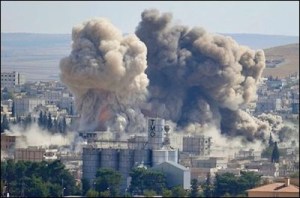
686Smoke rises from a U.S. air strike on Islamic State positions in Kobani.

As the aerial campaign begins in earnest, many observers are wondering what exactly its tactical and strategic objectives are, and how they will be achieved. A number of issues immediately arise.

Any state—even a provisional, slapdash, and fragile one like the jihadi entity now spreading across Iraq and Syria—cannot be “destroyed” from the air. At a certain point, forces on the ground will have to enter and replace the I.S. power. It is not yet clear who is to play this role—especially in the Islamic State’s heartland of Raqqa province in Syria.

In Iraq, the national military and the Kurdish Pesh Merga are now having some successes at chipping away at the Islamic State’s outer holdings. The role of U.S. air support is crucial here. But the center of the Islamic State is not Iraq, and both the Iraqi forces and the Pesh Merga have made clear that they will not cross the border into Syria. This leaves a major question as to who is to perform this task, if the objectives outlined by President Obama are to be achieved.

The answer we have heard most often of late is that elements among the Syrian rebels will be vetted by the U.S., trained in cooperation with the Saudis, and then deployed as the force to destroy the IS on the ground.

If this is indeed the plan, it is deeply problematic.

The Syrian rebels are characterized by extreme disunity, questionable effectiveness, and the presence of hardline Sunni Islamist elements among their most committed units. There are certainly forces of an anti-jihadist ideology among them—the most well-known being the Syrian Revolutionaries Front, headed by Jamal Ma’arouf from the Jebel Zawiya area in northern Syria, and the smaller Harakat Hazm. Both movements have benefitted from Western aid in recent months.

The problem, however, is that these organizations are quite prepared to work with salafi groupings whose worldview is essentially identical to that of the I.S., even if their methods are somewhat different. Thus, if we observe the recent fighting between Assad’s forces and rebels in the Quneitra area along the border with the Israeli Golan Heights, it is clear that the main contribution to rebel achievements came from the Jabhat al-Nusra group, which constitutes the “official franchise” of the core al-Qaeda group in Syria.

Reliable sources confirm that Nusra cooperates with other rebel groups in southern Syria and has even been prepared to minimize its own role, so as to allow other groups to present achievements as their own to Western and Arab patrons and thus secure a continued flow of arms, benefiting all factions.

What this means is that by championing these rebel elements as the ground force which will seek to enter and destroy a weakened I.S. in Raqqa province, the U.S. would be putting itself in the position of supporting one group of Sunni jihadis against another.

In Iraq, while the Kurdish Pesh Merga cooperates de facto with Iran, their alliance is pragmatic and tactical, one that the Kurds would gladly break given the possibility of clear Western sponsorship.

But the fierce condemnations in recent days (even by supposedly “pro-Western” rebel groups such as Hazm) of the U.S. bombing raids into Syria indicate that there is a deeper problem here. The alliance between these Sunni rebel groups and the salafis has a common anti-Western component to it.

It is, in any case, not clear if these Sunni rebels will prove able to defeat the I.S., but even if they were to do so, the presence of radical anti-Western elements among them attests to the danger of a policy of support and sponsorship of them.

Of course, the Sunni jihadis are not the only dangerous players on the ground. Another possible, no less troubling, outcome of the air campaign against the Islamic State could be the return of Bashar al-Assad’s forces to eastern Syria, from which they have been largely expelled over the last year. It is not at all hard to imagine a scenario in which once the I.S. has been weakened by Western air attacks, the Syrian military and its Iranian-backed allies will be able to make gains.

Indeed, the Iranian Revolutionary Guard Corps (IRGC) are already present in northern Iraq (and, of course, in Syria as well) and IRGC personnel have taken part in the fighting in Iraq in recent weeks. Qods force teams are reportedly located at Samarra, Baghdad, Karbala, and the former al-Sahra Air Base near Tikrit. Iran has deployed seven SU-25 ground attack aircraft which have played a role in offering air support to the Kurds and Iraqi special forces.

Following intensive Western bombing, the possibility of the Islamic State eventually being sandwiched between pro-Iranian forces on either side before being destroyed would be a real one. This would achieve the desired goal of destroying the jihadi entity, but it could end up handing a major victory to the Assad regime and its Iranian backers—enemies of the West of significantly greater potency and seriousness than the Islamic State itself.

Such a result would be somewhat reminiscent of the Iraq invasion of 2003, in which the destruction of the Sunni regime of Saddam Hussein ended up largely helping Iran.

How does the West get out of this mess? The discussion about which ground force should be used to replace the Islamic State is itself confused by a much larger misunderstanding regarding the nature of the war now taking place in Iraq and in Syria (and periodically spilling over into Lebanon).

The I.S. has now been depicted as the main problematic factor emerging from this conflict. But the Islamic State is in fact merely a particularly extreme and brutal manifestation of a broader process taking place in this area, in which political Islam of a Sunni variety is at war with the Shia political Islam of Iran and its proxies (especially Hezbollah and the Assad regime).

The I.S. may promote a particularly lurid and repulsive version of Sunni political Islam, but in its beliefs and in its practices it does not represent some unique presence in the Syrian and Iraqi context. Rather, it is little more than a particularly virulent manifestation of a strain of politics and ideology which is the primary cause of the conflict taking place across the region.

In the two scenarios discussed above, both quite plausible outcomes of a Western air campaign, the I.S. would be defeated and replaced by another version of Islamism—either that of its fellow Sunnis, or that of the rival Shi’ites.

A third possibility, however, is that the White House does not actually intend to pursue a policy intended to physically destroy the Islamic State in its heartland in northern Syria. Certainly, more recent statements emerging from the Administration appear to be preparing to “walk back” the President’s comments.

White House Chief of Staff Denis McDonough said in mid-September that success for U.S. policy vis-à-vis the I.S. would come when the group “no longer threatens our friends in the region, no longer threatens the United States.” This sounds like the introduction to a more modest policy of degrading I.S. capabilities, rather than seeking to “destroy” the Islamic State.

Of course, such a modified objective would end the dilemma over which ground forces to ally with. On the other hand, it would also have the effect of a tacit admission that the U.S. did not intend to promote its policy as originally stated by the President in the aftermath of the horrific murder of two U.S. citizens by the Islamic State.

But whether or not the goal of destroying the Islamic State is pursued with vigor, the current failure to see accurately what is happening in the Levant and Mesopotamia looks set to remain. This, in turn, looks set to prevent the emergence of a coherent policy and a coherent allocation of resources.

What is taking place across Syria and Iraq, and across their borders into Lebanon, Turkey, and Iran, is a sectarian war, made possible because of the decline of the police states which for half a century kept the lid on sectarian differences. The regional ambitions of Iran, which has clients and proxies in all three countries, exacerbate this dynamic. The attempts by Saudi Arabia to block Iran’s advance toward the Mediterranean, and by Qatar and Turkey to sponsor various Sunni jihadi elements, have produced a far more confused, and far less effective, Sunni side in this struggle.

The struggle itself, in turn, can be traced back to the failure by these states to develop coherent notions of citizenship or stable national identities in the post-Ottoman period. In other words, this war has been a long time coming, but now it is here.

Because the nature of this struggle is not widely grasped in the West, policy appears somewhat rudderless. This is reflected in the current discussion regarding the response to the Islamic State.

First, Assad was the enemy. This was made clear enough not only by his support for Hezbollah and attempts to nuclearize, but also by his unspeakable brutality and use of chemical weapons against his own citizens.

Then, when the brutality of some of the rebels became apparent, Western public interest in supporting the rebels receded. Soon the I.S. emerged as the new bogeyman. Declarations for its destruction became de rigueur, though it is far from clear how this is going to be carried out—and a de facto alliance with Iran and its clients, at least in Iraq, has emerged. This was seen in the expulsion of the I.S. from the town of Amerli, a pivotal moment in the major setbacks faced by the organization in recent days. In that town, Shi’ite militias were backed by American air power—to telling effect against the Sunni jihadis.

But is it really coherent policy to be backing murderous Shi’ite sectarians against murderous Sunni ones? It is not. Of course, when the West backs the Sunni rebels in Syria, the precise opposite is happening. Weaponry donated to “moderate” rebels then inevitably turns up in the hands of Sunni jihadis, who do most of the fighting associated with the Syrian “rebellion.” The result is that in Iraq the U.S. is helping one side of the Sunni-Shia war, and in Syria it’s helping the other side.

Only when it is understood that the West cannot partner with either version of political Islam does it become possible to formulate a coherent policy toward the Sunni jihadi forces, on the one hand, and toward the Iran-led bloc, on the other.

Such a policy must rest on the identification and strengthening of non-Islamist forces willing to band together and partner with the West. Not all of them are perfect characters, but they all understand the threat that political Islam poses.

Most obviously, there is a line of pro-American states along the southern side of the arena of the war. These are Israel, Jordan, and in a far more partial and problematic way, Saudi Arabia. Both Israel and Jordan have demonstrated that they are able to successfully contain the spread of the chaos coming out of the north. Both are well-organized states with powerful militaries and intelligence structures. Jordan has clearly benefitted from the deployment of U.S. special forces to prevent incursions by the I.S. Israel has also made clear that its resources will be available to assist the Jordanians should this be required. (Egypt, too, while not in the immediate vicinity of the conflict, can be a silent partner as well—as its campaign against the Muslim Brotherhood and tough line against Hamas have shown, it is nothing if not a virulent opponent to political Islam.)

This is what the proper coordination of allied states is supposed to look like. And it works in containing the conflict. To the east of the war’s arena is of course Iran. To its west is the Mediterranean Sea. To its north is a long, contiguous line of Kurdish control, shared between the Kurdish Regional Government of President Massoud Barzani in northern Iraq, as well as the three enclaves created by the PKK-linked Democratic Union Party (PYD) in northern Syria. The YPG militia, which is the military force in these enclaves, has fought the I.S. almost since its inception, and has largely prevailed in keeping the jihadis out of the Kurdish areas.

As part of a strategy of containment, the West should increase support for and recognition of both the Kurdish enclaves in the north of Syria and the Kurdish Regional Government itself. Both are elements capable of containing the spread of the jihadis from the north. It has become clear in recent days that the Pesh Merga, despite early setbacks, is a useful instrument in preventing the further advance westward of the Islamic State, and in so doing protecting the investment of international oil companies in the oil-rich parts of Iraq. The YPG militia, though poorly equipped, has also avoided major losses.

Such a principle of alliance will also encourage the West to reconsider the involvement of Turkey. As events of the last few years have shown, Turkey cannot be a reliable ally in the struggle against political Islam, because its ruling party, AKP, is itself an Islamist party. This is not a theoretical formulation. Turkey’s support for Islamist militias in northern Syria and its opening of its border for them has been a major contributing factor in the proliferation of these elements. There is also considerable evidence that Turkey at the very least turned a blind idea to the activities of the I.S. in the border area in 2013, and may well have offered some help to the jihadis in their fight with the YPG.

In order to grasp the rationale for a policy of dual containment, the nature of the war between rival sectarian forces must be grasped. There is also a need for the clear understanding that the effort to preserve at all costs the territorial integrity of “Iraq” and “Syria” is mistaken. Rather, what should take place is support for those forces committed to order, as listed above, and non-support for the forces of political Islam.

In other words: If political Islam (rather than one specific jihadi group, to quickly be replaced by another) is the real problem, then the real solution is to ally, forcefully and over the long haul, with those forces most committed to stopping it: Israel, Jordan, the Saudis, and the Kurds.

So it may be seen that a lack of strategic understanding of the nature of the conflict being waged is preventing the development of a coherent response to the specific problem of the Islamic State, along with the parallel problems of Shia terror groups such as Hezbollah, and the ambitions of the Islamic Republic of Iran. At root is the failure to grasp the implacable nature of political Islam in both its Sunni and Shia variants at the present time.

From this original error, all further errors, and as we can see there are many, inevitably follow.