Archive for the ‘Obama’ category

Argentine Prosecutor Death in Iran Terror Case Gets Curiouser

January 23, 2015

Argentine Prosecutor Death in Iran Terror Case Gets Curiouser, Legal Insurrection, January 23, 2015

He documented enough of his charges that Interpol issued “red notices” for seven high-ranking Iranian officials, including Ali Akbar Rafsanjani and Ali Velayati, who were Iran’s president and foreign minister respectively at the time of the AMIA bombing. (Interpol does not have the power to arrest, so a “red notice” is as close as it comes to issuing an arrest warrant) Rafsanjani, despite being implicated in an act of terrorism in another nation is often referred to as a “moderate” nowadays. He is also considered to be a mentor to Iran’s current president, also often referred to as a “moderate,” Hassan Rouhani.

Alberto Nisman’s work exposed the danger that Iran poses to world security. Iran continues to violate international law with impunity and unfortunately there are too few Nisman’s daring to challenge Iran’s brazen misbehavior. His death will make the task of reining in Iran’s ambitions that much more difficult.

****************

2015-01-23_074410_Nisman-620x426

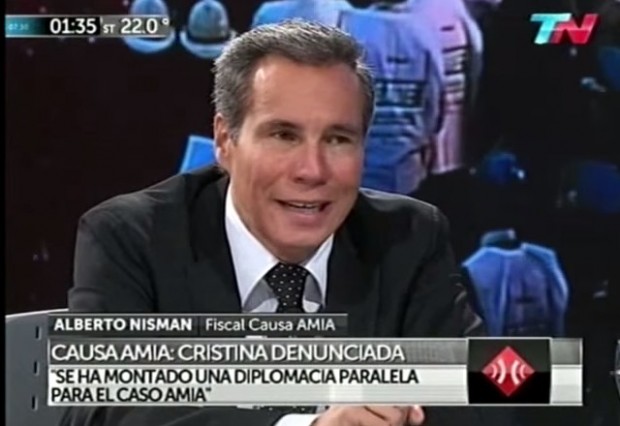
Sunday night Argentinian prosecutor Alberto Nisman was found shot to death in his apartment. Nisman had been scheduled the following day to present his criminal complaint against Argentinian President  Cristina Fernández de Kirchner before a closed session of Argentina’s congress.

The initial claim (one made by Kirchner herself on her Facebook page) that Nisman committed suicide hardly seemed credible at the time. How many people would kill themselves before the high point of their careers? Nisman had spent ten years investigating the 1994 AMIA Jewish center bombing in Buenos Aires and now he was about to charge the president and other officials of his country with conspiring to cover up the Iranian involvement in that attack. (Now Kirchner says he was killed but “suggests that Nisman was murdered on the instructions of his foreign masters in order to create a scandal damaging to her and to her government.”)

Subsequent revelations during the week have made the claim of suicide even less credible now. At Business Insider, Armin Rosen recounted some of those revelations.

The lack of an exit wound suggested the fatal shot was fired at a further distance than Nisman could have managed had the wound been self-inflicted. His last WhatsApp was a photo of stacks of documentation related to the next day’s testimony and Nisman had apparently given his maid a grocery list for the following week. A 10-person government security detail was reportedly pulled off of his apartment the night of his assassination. Most damningly, there was no gunpowder residue found on Nisman’s hands, physical evidence that he didn’t discharge a firearm prior to his death.

Fausta has more, including some gleaned from the Spanish press. Notably despite earlier claims that Nisman’s apartment was locked from the inside, there are reports that there were two other ways into his apartment that were not locked. Fausta is also right that Nisman’s murder is all about Iran. (Rosen also wrote, “no matter who’s responsible for Nisman’s death, the Iranian regime benefits.”)

Nisman’s work on the AMIA case was invaluable in documenting Iran’s efforts to build a terror infrastructure in South America. Matt Levitt, an expert on Hezbollah, who recently published a book about the Iran-backed terror organization, wrote this week, “As I was writing my book, trying to navigate the convoluted details of the AMIA bombing and other Hezbollah plots, Nisman was an invaluable resource.”

Nisman’s work wasn’t just academic though. He documented enough of his charges that Interpol issued “red notices” for seven high-ranking Iranian officials, including Ali Akbar Rafsanjani and Ali Velayati, who were Iran’s president and foreign minister respectively at the time of the AMIA bombing. (Interpol does not have the power to arrest, so a “red notice” is as close as it comes to issuing an arrest warrant) Rafsanjani, despite being implicated in an act of terrorism in another nation is often referred to as a “moderate” nowadays. He is also considered to be a mentor to Iran’s current president, also often referred to as a “moderate,” Hassan Rouhani.

The AMIA bombing was not the only time Iran’s leadership was implicated in an attack on foreign soil. In addition to Rafsanjani and Velayati, a red notice was issued for Ali Fallahian for the AMIA bombing. Rafsanjani, Velayati and Fallahian were all implicated in another terror attack on foreign soil.

A German prosecutor “without naming them … implicated Supreme Leader Ayatollah Khamenei, President Akbar Hashemi Rafsanjani, Foreign Minister Ali Akbar Velayati and Intelligence Minister Ali Fallahian” in the 1992 massacre at the Mykonos restaurant in Berlin.

Iran’s revolutionary government is lawless. The Iranian actors in these foreign terror attackes weren’t rogue operators but members of the country’s political elite. It’s something to keep in mind when the Obama administration insists that it will make a nuclear agreement with Iran that will make everyone safer and more secure.

Even assuming the P5+1 nations can come to an agreement with Iran (an agreement is hardly a foregone conclusion, Iran would probably be very happy with a series of temporary agreements that free up billions and don’t force it to dismantle any element of their nuclear program), what grounds are there to trust Iran to keep its commitments?

Remember that the crisis with Iran over its nuclear program stems from Iran’s violations of the Nuclear Non-Proliferation Treaty that it signed. Six UN Security Council resolutions – three of them unanimous – were passed imposing sanctions on Iran for its violations. Iran isn’t looking to come into compliance but to be granted absolution for its violations.

Alberto Nisman’s work exposed the danger that Iran poses to world security. Iran continues to violate international law with impunity and unfortunately there are too few Nisman’s daring to challenge Iran’s brazen misbehavior. His death will make the task of reining in Iran’s ambitions that much more difficult.

Islamic State Deepens Grip in Future Palestine

January 23, 2015

Islamic State Deepens Grip in Future Palestine, The Gatestone InstituteKhaled Abu Toameh, January 23, 2015

According to Israeli security forces, dozens of Hamas and Islamic Jihad members in the West Bank have defected to the Islamic State in recent months. Their main goal, according to sources, is to topple the Palestinian Authority and launch terror attacks on Israel.

Some 200 supporters of the Islamic State, who held up Islamic State flags, took to the streets of Gaza City to protest the latest cartoons published by the French satirical magazine, Charlie Hebdo. They also chanted slogans that called for slaughtering French nationals, and burned French flags. Attempts by Hamas to impose a news blackout on the protest failed, as photos and videos found their way to social media.

The glorification of terrorists and jihadists by the Palestinian Authority, and the ongoing anti-Israel incitement by both Hamas and the Palestinian Authority, is driving many Palestinians into the open arms of the Islamic State.

Hamas and other Palestinian groups are continuing to deny the obvious, namely that the Islamic State terror group has managed to set up bases of power in the West Bank and Gaza Strip.

The Palestinians do not feel comfortable talking about the fact that Islamic State is working hard to recruit Palestinians to its ranks.

The presence of Islamic State in the West Bank and Gaza Strip is an embarrassing development for both Hamas and the Palestinian Authority.

For Hamas, the fact that Islamic State has long been operating in the Gaza Strip is something that it does not want the world to know about.

Hamas cannot afford a situation where another Islamist terror group poses a challenge to its exclusive control over the Gaza Strip. Since it seized control over the Gaza Strip in 2007, Hamas has successfully suppressed the emergence of rival forces, first and foremost the secular Fatah faction headed by Mahmoud Abbas.

But if until recently it was Fatah that posed a challenge and threat to Hamas’s rule, now it is the Islamic State and its supporters in the Gaza Strip are openly defying the Islamist movement’s regime.

When the first reports about Islamic State’s presence in the Gaza Strip emerged last year, Hamas and other Palestinians were quick to dismiss them as “false.”

Salah Bardaweel, a senior Hamas official, said in February 2014 that the Islamic State “does not exist” in the Gaza Strip.

This week, however, it became evident that Hamas was lying when it denied the presence of Islamic State in the Gaza Strip.

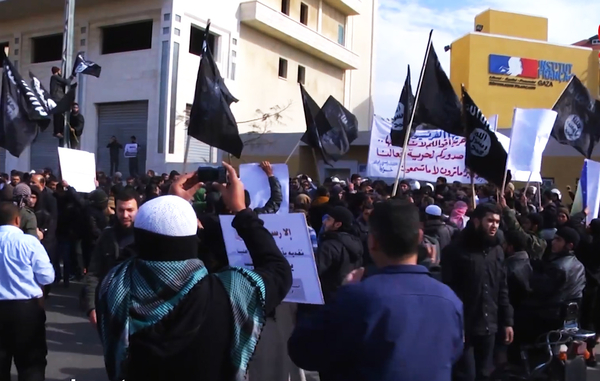
Some 200 supporters of the Islamic State, who held up Islamic State flags, took to the streets of Gaza City to protest the latest cartoons published by the French satirical magazine, Charlie Hebdo.

The protesters tried to storm the offices of the French Cultural Center in Gaza City. They also chanted slogans that called for slaughtering French nationals, and burned the French flag.

899Palestinians waving Islamic State flags attempt to storm the French Cultural Center in Gaza City. Some in the crowd carried posters glorifying the terrorists who carried out this month’s attacks in Paris. (Image source: ehna tv YouTube screenshot)

The protest apparently caught Hamas by surprise. Hamas security forces that were rushed to the scene dispersed the protesters and arrested seven Islamic State supporters.

Attempts by Hamas to impose a news blackout on the Islamic State protest failed, as photos and videos of the demonstration found their way to social media. Needless to say, Hamas-affiliated media outlets ignored the protest. They were hoping that the world would also not see the Islamic State demonstrators on the streets of Gaza City.

Hamas’s biggest fear is that scenes of Islamic State supporters marching in the heart of Gaza City will scare international donors and dissuade them from providing badly needed funds for the reconstruction of the Gaza Strip. Hamas is also afraid that Western officials working with the United Nations and relief agencies will stop visiting the Gaza Strip after watching the footage of Islamic State supporters.

In recent weeks, it has also become evident that Islamic State has some kind of a presence in the West Bank — a fact that poses a serious threat to Abbas’s Palestinian Authority [PA].

Just last week, Israel announced arrests of members of an Islamic State terror cell in the West Bank city of Hebron. The three Palestinian members of the cell confessed during interrogation that had planned to launch a series of terror attacks against Israel. The three suspects were identified as Waddah Shehadeh, 22, Fayyad al-Zaru, 21 and Qusai Maswaddeh, 23.

Until recently, Hamas was considered the number one threat to the Palestinian Authority in the West Bank. Now, however, it has become evident that Islamic State is also trying to set up bases of power in the West Bank. According to Israeli security sources, dozens of Hamas and Islamic Jihad members in the West Bank have defected to Islamic State in recent months. Their main goal, the sources, said, is to topple the PA and launch terror attacks on Israel.

Abbas is lucky that the Israeli security forces are still operating in the West Bank, including inside cities and towns controlled by the Palestinian Authority. Were it not for the IDF and various branches of the Israeli security establishment, Hamas, Islamic Jihad and Islamic State would have toppled the Palestinian Authority and beheaded Abbas and his officials a long time ago.

Still, Abbas does not feel comfortable acknowledging the fact that a growing number of Palestinians in the West Bank are joining Islamic State. Abbas fears is that if he admits that Islamic State is already operating in the West Bank, this could dissuade many Western countries from supporting his effort to persuade the world to support the creation of an independent Palestinian state. Like Hamas, Abbas also fears that Westerners would stop visiting Ramallah and other West Bank Palestinian cities once they learn about Islamic State’s presence in these areas.

Although Hamas and the Palestinian Authority are continuing to bury their heads in the sand and deny what is there, they cannot avoid responsibility for the emergence of Islamic State in the Gaza Strip and West Bank. The glorification of terrorists and jihadists by the PA and the ongoing anti-Israel incitement by both the PA and Hamas, are driving many Palestinians into the open arms of the Islamic State.

This is something that the UN Security Council members will have to consider the next time they are asked to vote in favor of the establishment of a Palestinian state. Otherwise, they will be voting for the creation of an Islamic, and not a Palestinian, state.

The death of an Iranian general on the Golan gave US Senators’ Iran sanctions bills military muscle

January 22, 2015

The death of an Iranian general on the Golan gave US Senators’ Iran sanctions bills military muscle, DEBKAfile, January 22, 2015

This was a dual threat: Israel would not stand by if Iranian and Hizballah forces moved into the Syrian Golan right up against its frontier. But in the wider context, Binyamin Netanyahu was signaling Obama in Washington and Khamenei in Tehran, that he no longer had any qualms about striking Iranian military targets if the two rulers failed to forge a workable, credible accord for keeping nuclear weapons out of Iranian hands.

The Israeli action added military muscle to the US Senate legislation on Iran –  in the face of Obama’s reluctance to embrace tactics he believes would be disincentives for Khamenei to play ball on the ongoing multilateral nuclear diplomatic track in Geneva.

*****************

netanyahu_us_congress_11.2.15Binyamin Netanyahu in former address to US Congress

It is hard to believe that the White House was caught by surprise over House leader John Boehner’s unusual invitation for Israeli Prime Minister Binyamin Netanyahu to address Congress on Feb. 11. After all, prior arrangements must have kept the Israeli embassy in Washington busy for weeks in a city, whose life blood is kept flowing by the mining and trading of information and secrets about friends and rivals alike.

All the same, it suited the four parties involved in this extraordinary event – Republican and Democratic lawmakers, the White House and Netanyahu – to pretend they were taken aback on Wednesday, Jan. 21 by the Speaker’s announcement of the prime minister’s coming address on “the grave threats radical Islam and Iran pose to our security and way of life.”

He accused President Barack Obama of “papering over” these threats over in his State of the Union speech a few hours earlier.

The White House said the invitation breached “typical protocol” but the administration would reserve judgment until they heard from Netanyahu about his plans.

The assumed air of astonishment greeting the invitation added an element of drama to the event. It also had the effect of further polarizing the camps for and against the Obama administration’s insistence on banking solely on diplomacy for containing Iran’s nuclear program.

Inevitable showdown

Obama and Netanyahu, who could never stand each other, have been at loggerheads for most of the six years of the former’s presidency over what is widely seen as the dead-end US Middle East policies he pursued in most major arenas such as Iraq, Yemen and Libya, the futile US air strikes against marching Islamist State soldiers, the unending Syrian conflict and the Palestinian issue.

The showdown building up for years between them may now be at hand. It will catch Obama and Secretary of State John Kerry fully engaged in a desperate pursuit of a comprehensive nuclear deal between Iran and the Six-World-Powers group. This deal could then be presented as an unquestioned success of Obama’s Middle East policies – indeed the only one.

Together with Iran’s President Hassan Rouhani and Foreign Minister Mohamed Zarif, US officials have roughed out a draft accord. But most American nuclear experts and Israel’s top political and military leaders view this paper as a bad agreement, because it would leave Tehran with the freedom and resources to jump back from low-grade enrichment to full-dress production of a nuclear bomb and missiles when international and economic circumstances were more convenient.

But Obama and Kerry are counting on the ayatollahs holding their horses until the end of 2016, when the US administration changes hands. The Iranian nuclear deal’s inevitable breakdown would then land squarely on the shoulders of the next president and secretary of state taking over in Washington, while Obama would have formally honored his commitment to prevent Iran from acquiring a nuclear bomb.

Khamenei between two compulsions

But this plan faces an outsize impediment: Rouhani and Zarif are holding back from putting pen to paper because of the strong objections posed by supreme leader Ayatollah Ali Khamenei and the Revolutionary Guards military chiefs.

Earlier this month, the issue reached boiling point in Tehran, DEBKAfile’s Iranian sources report: The Guards threatened to unseat Khamenei by a military coup if he let Rouhani and Zarif sign the draft into a comprehensive, binding nuclear accord.

Khamenei, never lost for a devious maneuver, began weaving between the two compulsions – American demands for more concessions to finalize the deal and demands by hardliners at home not to give way. The move he made was to throw a bone in the form of an offer to cut down on the number of centrifuges used in uranium enrichment.

Obama and Kerry hailed this as a breakthrough toward a deal, although the experts dismissed it as meaningless.

Obama propositions Netanyahu

On this basis, Obama phoned Netanyahu Monday night, Jan. 13, to ask him for Israel’s support for the evolving comprehensive nuclear accord with Iran.

In return, he offered closer US cooperation in various areas of interest to Israel, such as the Palestinian issue, if the prime minister would withhold or cool his support for US Senate sanctions legislation:

The Republican Mark Kirk and Democrat Robert Menendez seek to enact new sanctions on Iran if nuclear negotiations fail to meet their June 30 deadline for an accord.

Bob Corker, chairman of the Senate Foreign Relations Committee — supported by Republican Senators Lindsay Graham and John McCain — is pushing for legislation which does not contain sanctions but would require a Senate vote on any pact that is agreed upon in Geneva.

Netanyahu rejected Obama’s proposition.

The US President was therefore adamant in his State of the Union references to the Iranian nuclear issue: “New sanctions on Iran would all but guarantee that diplomacy fails, heightening the prospects of war.” He said.: “Between now and this spring, we have a chance to negotiate a comprehensive agreement that prevents a nuclear-armed Iran, secures America and our allies – including Israel – while avoiding yet another Middle East conflict.”

Obama did not elaborate on the parties who would take part in this hypothetical conflict, or explain why he limited himself to only two extreme scenarios – either a deal with Iran or tighter sanctions that would precipitate war.

Israel takes direct aim at Iran

It was no accident that two days before this speech, Obama had his answer from Israel. Sunday, Jan. 19, Israeli Air Force drones struck an Iranian-Hizballah military convoy near the Syrian Golan town of Quneitra. Six Iranian officers were killed, led by Gen. Mohamad Ali Allah Dadi, as well as the same number of high-ranking Hizballah operatives.

This was a dual threat: Israel would not stand by if Iranian and Hizballah forces moved into the Syrian Golan right up against its frontier. But in the wider context, Binyamin Netanyahu was signaling Obama in Washington and Khamenei in Tehran, that he no longer had any qualms about striking Iranian military targets if the two rulers failed to forge a workable, credible accord for keeping nuclear weapons out of Iranian hands.

The Israeli action added military muscle to the US Senate legislation on Iran –  in the face of Obama’s reluctance to embrace tactics he believes would be disincentives for Khamenei to play ball on the ongoing multilateral nuclear diplomatic track in Geneva.

It also explains why John Boehner invited Netanyahu to address Congress on Feb. 11.

However, until then, Iran, Hizballah, Syria and even Israel may not stand idle. And the Obama administration may also decide to round up its assets in a bid to spoil the prime minister’s run for re-election on March 17.

“Unity”? About What Exactly?

January 22, 2015

Unity”? About What Exactly? The Gatestone Institute, Jeremy Havardi, January 22, 2015

Meanwhile, Saudi Arabia tried to fool the world by joining France’s “Unity March” for free speech just two days after a young Saudi blogger, Raif Badawi, received the first installment of 50 lashes — out of the 1000 he is to get — “very severely,” the lashing order says. Badawi still has 950 lashes to complete.

Mahmoud Abbas, whose genocidal, jihadi partner, Hamas, was just declared not a terrorist group by the European Union, joined the forefront of the “Unity March” at the same time as a Palestinian human rights groups published a report accusing the Palestinian Authority of “waging war” against university students in the West Bank.

What “Islamophobia” motivated the killing of Jewish customers in a kosher supermarket? What had those victims done to deserve that?

We may like to imagine that this is not Islam, and that the faith promotes peace and nothing else. But the murderers say it is Islam, and they act accordingly.

Much of the media has offered up a context for these killings that is false.

The real story is that despite a few sporadic incidents, there has been no backlash against the Muslim community.

The recent rally for free speech and against the terrorism in Paris initially appeared to have generated a surge of defiance and resolve, not just in France but around the world. People were actually talking about a turning point in the battle against terrorism and radical Islam.

If only it were true.

The reality is that much of the political class and media remain in denial about the events in Paris.

Ban Ki Moon explained that the tragic events had nothing to do with religion. Signing a condolence book for the victims of the attacks, he said: “This is not a country, a war against religion or between religions… This is a purely unacceptable terrorist attack – criminality.”

France’s President François Hollande said that the Charlie Hebdo fanatics had “nothing to do with Islam,” and he was joined in this view by commentators on France24, as well as the German Interior Minister, Thomas de Maizière.

The Guardian’s Jonathan Freedland condemned the actions of a “handful of wicked fanatics against the rest of us.” The implication was that they merely acted in the name of Islam — purely coincidentally, as it were.

In the Daily Mail, Piers Morgan wrote that the perpetrators were “not ‘real’ Muslims” and that this was “not a religious war.” Why he thought he could act as the arbiter on that question is still unclear.

As for President Obama, he has effectively outlawed the term “Islamic terror.”

The United States, in what was widely seen as a snub, was only represented at the rally by the U.S. Ambassador to France, Jane Hartley. Since the President had declared in 2012 that “[t]he future must not belong to those who slander the prophet of Islam” — the implication was that they were not acting purely coincidentally.

There is in those comments a mixture of political correctness, wishful thinking and staggering ignorance. It is understandable and commendable not to lump a majority of law-abiding, patriotic and peaceful Muslims together with their violent counterparts. But calling for “unity” in a march leaves one asking: Unity about what exactly?

To pretend that there is a complete disconnect between Islam and terror is to ignore reality. Jihadis are gaining ideological succour from the tenets of their faith, drawing upon teachings promulgated by imams, including the late Anwar al Awlaki. We may like to imagine that this is not Islam, and that the faith promotes peace and nothing else. But the murderers say it is Islam, and they act accordingly.

To confront this problem properly, the ideological underpinnings of jihad need to be tackled comprehensively at source.

It is not enough to unite against terrorism, as every community must. We need to know what we are uniting for — free speech. And we need to know what we are uniting against — namely the militant war of extremist Islamism.

It is equally inaccurate to describe these jihadis as “lone wolves.” They will have spent time gaining combat experience abroad, perhaps in Yemen, Syria or Iraq, and will have received ideological indoctrination and funding from a network of other jihadis. They are recruits in a theocratic, totalitarian death-cult spread across the planet. It comes in different forms: Boko Haram, which slaughtered 2,000 people in Nigeria the weekend before last; the Taliban, which murdered schoolchildren in Pakistan; Hamas with its genocidal doctrine and many years of bombings, and the Islamic State, which seems busy ethnically cleansing nearly everyone in Syria and Iraq.

The murders in Paris, therefore, were merely the latest salvo in a global confrontation between jihadist Islam and its declared enemies, this time in the West.

Much of the media has offered up a context for these killings that is false. Within hours of the massacre at Charlie Hebdo, the Telegraph led with a feature on the growing problem of “Islamophobia” in France. The Guardian, too, weighed in; one story headlined: “Muslims fear backlash after Charlie Hebdo deaths as Islamic sites attacked”. The Spectator spoke of the killings as an “attack on Islam;” and Robert Fisk in the UK Independent referred to the legacy of the Algerian war as a motive for the attackers. Other news outlets voiced fears of a “backlash” against Muslims in France and elsewhere.

But the real story is that while there have been some sporadic incidents against mosques and Muslim owned businesses in France following the Charlie Hebdo attacks, there has been no backlash against the Muslim community. Muslims across France even joined in the unity rally, an act that would have been impossible were there a climate of widespread public hostility.

The majority of hate crimes in France, as in a number of other countries, affects the Jewish community. It was a Jewish supermarket that was attacked. This does not mean that there will not be attacks — all of them naturally deplorable — against Muslim innocents, only that fears of a major widespread assault seem highly exaggerated. The same fears of widespread attacks against the Muslim community also proved unfounded after the 7/7 London bomb attacks.

Lumping terrorism and “Islamophobia” together ignores the real motivation of the latest killers in France. One of them, Amedy Coulibaly, pledged allegiance to the Islamic State in a video address prior to the supermarket attack. This hardly suggests a rant against perceived intolerance or racism. Invoking racism here also suggests, in a shifting of blame, that we in the West are somehow at fault for the violent behaviour of these Islamist terrorists. What “Islamophobia” motivated the killing of Jewish customers in a kosher supermarket? What had those victims done to deserve that?

Another reason this is no turning point is that the press continues to engage in self-righteous self-censorship. Not one broadcaster — including the BBC, Fox, NBC and CNN — showed any of the Charlie Hebdo images that had been deemed provocative. Those outlets were joined by the Associated Press, which deliberately cropped a photograph of the magazine’s now-dead editor to avoid showing an image of the Prophet Muhammad. In a cringe replicated across almost all of Europe, not one major British newspaper published any of Charlie Hebdo’s satirical images of Islam, and only The Guardian showed the full front cover of the edition that the survivors published after the attack.

Big mistake. These newspapers and broadcasters are denying the public a dispassionate view of what the killers themselves say is causing them to kill. Worse again, by drawing a line against possibly offending Muslims — many of whom seem to have no problem offending Jews and Christians, among others, if not killing them — the media have acted as if there is already in place an unofficial blasphemy law: the terrorists’ key demand.

A violent mob, disastrously undermining Western values, is effectively dictating the boundaries of free speech.

It is all very well to praise Charlie Hebdo as an icon of free speech, but after the riots that followed the publishing of Muhammad cartoons in Denmark’s Jyllands Posten in 2006, Charlie Hebdo was virtually alone in reprinting them, and it was condemned widely for doing so.[1]

Time magazine, in 2011, likened Charlie Hebdo’s reprinting the cartoons as “the right to scream ‘fire’ in an increasingly over-heated theater.” In other words, the “Islamophobic” cartoonists were to blame for their own misfortune. There is a notion permeating Europe, that if you speak out, not only can you can be put on trial — as is the Dutch MP, Geert Wilders[2] — but that it will also, in an Orwellian twist, be your own fault; if you had just kept quiet, nothing unpleasant would be happening to you. Try telling that to the four Jews lying murdered on the floor of the French supermarket. What did they ever say?

Meanwhile, Saudi Arabia tried to fool the world by joining France’s “Unity March” for free speech just two days after a young Saudi blogger, Raif Badawi, received the first installment of 50 lashes — out of the 1000 he is to get — “very severely,” the lashing order says. He was taken after Friday prayers to a public square outside a mosque in Jeddah. His declared “crime” is “insulting Islam,” for writing thoughts such as, “My commitment is to reject any repression in the name of religion… a goal we will reach in a peaceful and law-abiding way.” Badawi still has 950 lashes to complete. If he lives. There is no medical help.

Palestinian Authority President Mahmoud Abbas — whose genocidal, jihadi partner, Hamas, was, in a burst of surrealism, declared not a terrorist group by the European Union — joined the forefront of the Unity March in Paris at the same time as a report was published by a Palestinian human rights group, accusing the Palestinian Authority of “waging war” against university students in the West Bank.

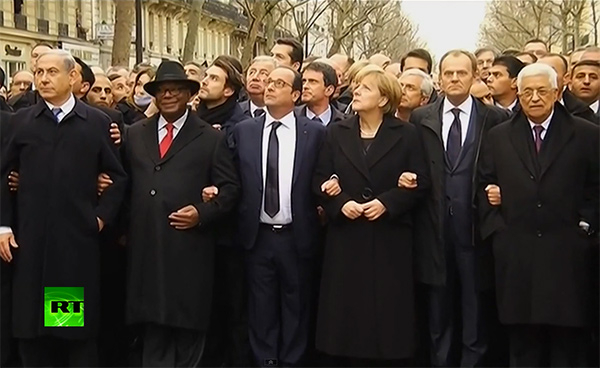
883World leaders link arms at the Paris anti-terror rally on January 11, 2014. Palestinian Authority President Mahmoud Abbas stands at the far right of the front row. (Image source: RT video screenshot)

Turkey, “named the world’s biggest jailor of journalists in 2012 and 2013” according to theWashington Post, was also there. Turkey “ended 2014 by detaining a number of journalists … including Ekrem Dumanli, editor in chief of Zaman, a leading newspaper” with links to an opposition movement.

Meanwhile, between January 8 and January 14, as over three million copies of Charlie Hebdowere selling out and four million more being printed, there was already talk in France of hardening its laws against free speech. So this may not be a turning point either for free speech or against radical Islam. So it may be a while before we can truly say, “Nous sommes Charlie.”

Jeremy Havardi is a historian and journalist based in London. His books include The Greatest Briton, analytical essays on Churchill.


[1] Ezra Levant, who reprinted the cartoons in Canada, was then compelled to appear before the Alberta Human Rights Commission to defend their publication, because of a complaint lodged by Syed Soharwardy of the Islamic Supreme Council of Canada and the Edmonton Council of Muslim Communities.

[2] As also was Lars Hedegaard (for speaking in his own drawing room), Suzanne Winters, Elisabeth Sabaditsch-Wolff, or at the very east need round-the-clock-bodyguards, such asFrench journalist Eric Zemmour, for saying that France might be facing a virtual civil war.

John Bolton: Obama on a Different Planet than Rest of Us, Wishing Away Threats to US

January 22, 2015

John Bolton: Obama on a Different Planet than Rest of Us, Wishing Away Threats to US, via You Tube, January 21, 2015


White House: Boehner Invite to Netanyahu Breach of Protocol

January 21, 2015

White House: Boehner Invite to Netanyahu Breach of Protocol, New York Times, January 21, 2015

Earnest says they are reserving judgment about the invitation until they’ve had a chance to speak to the Israelis about what Netanyahu might say.

*********************

ABOARD AIR FORCE ONE — The White House says House Speaker John Boehner’s invitation for Israel’s prime minister to come to Washington is a breach of normal diplomatic protocol.

President Barack Obama’s press secretary, Josh Earnest, says the White House has not heard from Israelis about whether Benjamin Netanyahu plans to speak to Congress Feb. 11. Earnest says they are reserving judgment about the invitation until they’ve had a chance to speak to the Israelis about what Netanyahu might say.

Earnest says typical protocol is that a country’s leader would contact the White House before planning to visit the United States. But Earnest says they didn’t hear about Boehner’s invitation until Wednesday morning, shortly before the speaker announced it publicly.

Earnest was speaking to reporters traveling aboard Air Force One to Idaho on Wednesday.

Andrea Mitchell: Obama’s Foreign Policy SOTU Claims “Not Close To Reality”

January 21, 2015

Andrea Mitchell: Obama’s Foreign Policy SOTU Claims “Not Close To Reality”, NBC via You Tube, January 21, 2015

(Consider the source, NBC. — DM)

Sisi’s Brave New Egypt?

January 21, 2015

Sisi’s Brave New Egypt? Front Page Magazine, January 21, 2015

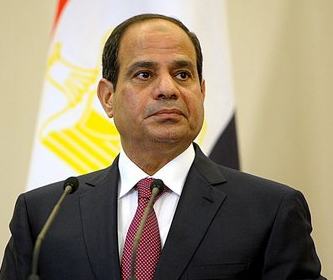
El-Sisi

Originally published by PJ Media.

Egyptian President Abdel Fattah al-Sisi continues to be the antithesis of longstanding mainstream media portrayals of him.

First there was his historic speech where he, leader of the largest Arab nation, and a Muslim, accused Islamic thinking of being the scourge of humanity—in words that no Western leader would dare utter. This remarkable speech—which some say should earn him the Nobel Peace Prize—might have fallen by the wayside had it not been posted on my website and further disseminated by PJ Media’s Roger L. Simon, Michael Ledeen, Roger Kimball, and many others, including Bruce Thornton and Robert Spencer.

Instead, MSM headlines on the day of and days after Sisi’s speech included “Egypt President Sisi urged to free al-Jazeera reporter” (BBC, Jan 1), “Egyptian gays living in fear under Sisi regime” (USA Today, Jan. 2), and “George Clooney’s wife Amal risks arrest in Egypt” (Fox News, Jan. 3).

Of course, the MSM finally did report on Sisi’s speech—everyone else seemed to know about it—but, again, to portray Sisi in a negative light. Thus, after briefly quoting the Egyptian president’s call for a “religious revolution,” the New York Times immediately adds:

Others, though, insist that the sources of the violence are alienation and resentment, not theology. They argue that the authoritarian rulers of Arab states — who have tried for decades to control Muslim teaching and the application of Islamic law — have set off a violent backlash expressed in religious ideas and language.

In other words, jihadi terror is a product of Sisi, whom the NYT habitually portrays as an oppressive autocrat—especially for his attempts to try to de-radicalize Muslim sermons and teachings (as discussed in this article).

Next, Sisi went to the St. Mark Coptic Cathedral during Christmas Eve Mass to offer Egypt’s Christian minority his congratulations and well wishing. Here again he made history as the first Egyptian president to enter a church during Christmas mass—a thing vehemently criticized by the nation’s Islamists, including the Salafi party (Islamic law bans well wishing to non-Muslims on their religious celebrations, which is why earlier presidents—Nasser, Sadat, Mubarak, and of course Morsi—never attended Christmas mass).

Accordingly, the greetings Sisi received from the hundreds of Christians present were jubilant. His address was often interrupted by applause, clapping, and cheers of “We love you!” and “hand in hand”—phrases he reciprocated. Part of his speech follows:

Egypt has brought a humanistic and civilizing message to the world for millennia and we’re here today to confirm that we are capable of doing so again. Yes, a humanistic and civilizing message should once more emanate from Egypt. This is why we mustn’t call ourselves anything other than “Egyptians.” This is what we must be—Egyptians, just Egyptians, Egyptians indeed! I just want to tell you that Allah willing, Allah willing, we shall build our nation together, accommodate each other, make room for each other, and we shall like each other—love each other, love each other in earnest, so that people may see… So let me tell you once again, Happy New Year, Happy New Year to you all, Happy New Year to all Egyptians!

Sisi stood side-by-side with Coptic Christian Pope Tawadros II—perhaps in remembrance of the fact that, when General Sisi first overthrew President Morsi and the Muslim Brotherhood, Pope Tawadros stood side-by-side with him—and paid a heavy price: the Brotherhood and its sympathizers unleashed a Kristallnacht of “reprisals” that saw 82 Christian churches in Egypt attacked, many destroyed.

It is also significant to recall where Sisi came to offer his well-wishing to the Christians: the St. Mark Cathedral—Coptic Christianity’s most sacred church which, under Muhammad Morsi was, for the first time in its history, savagely attacked, by both Islamists and the nation’s security (see pictures here).

Once again, all of this has either been ignored or underplayed by most mainstream media.

There is, of course, a reason the MSM, which apparently follows the Obama administration’s lead, has been unkind to Sisi. One will recall that, although Sisi led the largest revolution in world history—a revolution that saw tens of millions take to the streets and ubiquitous signs and banners calling on U.S. President Obama and U.S. ambassador to Egypt Anne Patterson to stop supporting terrorism (i.e., the Brotherhood)—U.S. leadership, followed by media, spoke only of a “military coup” against a “democratically elected president,” without pointing out that this president was pushing a draconian, Islamist agenda on millions who rejected it.

So what is the significance of all this—of Sisi? First, on the surface, all of this is positive. That Sisi would criticize the Muslim world and Islamic texts and thinking—in ways his Western counterparts could never—and then continue his “controversial” behavior by entering the Coptic Christian cathedral during Christmas mass to offer his greetings to Christians—a big no-no for Muslim leaders—is unprecedented. Nor can all this be merely for show. In the last attack on a Coptic church, it was two Muslim police officers guarding the church who died—not the Christian worshipers inside—a rarity.

That Sisi remains popular in Egypt also suggests that a large percentage of Egyptians approve of his behavior. Recently, for instance, after the Paris attacks, Amru Adib, host of Cairo Today, made some extremely critical comments concerning fellow Muslims/Egyptians, including by asking them “Are you, as Muslims, content with the fact that today we are all seen as terrorists by the world?… We [Egyptians] used to bring civilization to the world, today what? — We are barbarians!  Barbarians I tell you!” (More of Adib’s assertions here.)

That said, the others are still there—the Muslim Brotherhood, the Salafis, those whom we call “Islamists,” and their many sympathizers and allies.

Worst of all, they have that “corpus of [Islamic] texts and ideas” that has been “sacralized over the centuries” (to use Sisi’s own words) to support them—texts and ideas that denounce Sisi as an “apostate” deserving of death, and thus promising a continued struggle for the soul of Egypt.

Obama’s White Flag On Assad a Gift for Iran

January 21, 2015

Obama’s White Flag On Assad a Gift for Iran, Commentary Magazine, January 21, 2015

[T]he American white flag acknowledging his continued reign of terror is more than merely an admission that he can’t be pushed out of Damascus. It must now be understood as part of a comprehensive policy that is aimed at appeasing Iran. That presents a danger not only to the oppressed people of Syria but to every other nation in the region, including both moderate Arabs and Israel, who are targets of Iran’s predatory ambition.

************************

As anyone who has heard President Obama discuss his opposition to more sanctions being placed on Iran knows, the White House is deeply disturbed at the notion of the United States doing anything to disturb those who run the Islamist regime. Thus, the news that the United States is signaling what may be the formal end of its opposition to Bashar Assad’s rule over Syria must be seen in the context of a general American push for détente with that dictator’s allies in Tehran. This is bad news for the people of Syria who are seeking an alternative to Assad’s murderous rule–other, that is, than the ISIS terrorists. But it is very good news for the Iranians who are pleased about the way the rise of ISIS has led to a de facto alliance on the ground between the U.S. and Iran’s allies Assad and Hezbollah in the effort to fight ISIS. This has led not only to a tacit green light for Assad to go on killing Syrians but also for negotiations that seemed fated to grant a Western seal of approval for Iran’s aspiration to become a threshold nuclear power.

It must be acknowledged that at this point the United States has no good options open to it on Syria. If the U.S. had acted swiftly to aid moderate opponents to the Assad regime after the Arab Spring protests began, it might have been possible to topple Assad, something that would have been a telling blow to Iran’s ambitions for regional hegemony. But President Obama was characteristically unable to make a decision about what to do about it for years despite continually running his mouth about how Assad had to go. By the time he was ready to strike—after Assad crossed a “red line” enunciated by the president about his use of chemical weapons against his own people—the moderate option looked less attractive. The president quickly backed down and punted the task of cleaning up the chemical weapons to Assad’s Russian ally.

Even worse, after Obama’s precipitate withdrawal of U.S. forces from Iraq and inaction on Syria led to the rise of ISIS terrorists, Washington seemed more interested in using this crisis as an excuse to make common cause with Iran than in actually fighting the Islamist group. Thus, while U.S. air attacks on ISIS have barely made a dent in the terrorists’ grip on control of much of Syria and Iraq, the administration is signaling enthusiasm for Russian and United Nations-sponsored diplomatic events that will effectively doom a framework agreed to by the West last year in Geneva by which Assad would be forced to yield power.

The administration will defend this switch as something that will aid the effort to end a war that has killed hundreds of thousands. They also justify the tacit alliance with Iran, Assad, and Hezbollah on the Syrian battlefield as the only possible option available to those who wish to combat ISIS. At this point with non-Islamist Syrian rebels effectively marginalized and the battlefield dominated by the Iran/Hezbollah/Assad alliance and their ISIS foes, forcing Assad out may no longer be an option.

But the chain of events that led to this American move to allow Assad to survive despite his crimes must now be viewed from a different perspective than merely one of Obama’s Hamlet routine on difficult issues.

The decision to gradually back away from the president’s campaign pledge to dismantle the Iranian nuclear program and to engage in negotiations aimed at granting Tehran absolution for its ambitions will, if it results in an agreement, at best make Iran a threshold nuclear power. A weak nuclear deal will further buttress Iran’s hopes for regional hegemony by which it will further threaten moderate regimes and strengthen its Hezbollah and Hamas terrorist allies.

It’s not clear yet whether the Iranians will ever sign a nuclear agreement with the U.S. or if, instead, it will continue to run out the clock on the talks. That’s something that the president’s zeal for a deal may permit because he refuses to admit failure or pressure the Iranians as Congress would like him to do by toughening sanctions in the event the talks collapse.

But what we do know now is that this administration’s Syria policy must now be viewed through the prism of its infatuation with the idea of, as the president put it last month, letting “Iran get right with the world.”

Options for getting rid of the butcher Assad may be few these days. But the American white flag acknowledging his continued reign of terror is more than merely an admission that he can’t be pushed out of Damascus. It must now be understood as part of a comprehensive policy that is aimed at appeasing Iran. That presents a danger not only to the oppressed people of Syria but to every other nation in the region, including both moderate Arabs and Israel, who are targets of Iran’s predatory ambition.

Analysis: Former al Qaeda operative freed, sent home to Qatar

January 20, 2015

Analysis: Former al Qaeda operative freed, sent home to Qatar, Long War Journal, David Weinberg, January 20, 2015
Ali-Marri-thumb-400x253-5476Ali Saleh Kahlah al Marri, back in Qatar with his youngest son. Photo provided to the Peoria Journal Star by al Marri’s family.

Editor’s Note: For more on Qatar’s track record in fighting terrorism, see Dr. Weinberg’s report for the Foundation for Defense of Democracies’ Center on Sanctions & Illicit Finance, Qatar and Terror Finance, Part 1: Negligence.

The US government’s decision to repatriate al Marri to Qatar is a curious one, to say the least.

According to The Guardian (UK), al Marri’s nephew revealed that upon arrival in Doha, his uncle “was greeted by representatives from the Qatari interior and foreign ministries” and is now in “high spirits.” He thanked Qatari officials for exerting “tremendous efforts” for his uncle’s release.

********************

Editor’s Note: For more on Qatar’s track record in fighting terrorism, see Dr. Weinberg’s report for the Foundation for Defense of Democracies’ Center on Sanctions & Illicit Finance, Qatar and Terror Finance, Part 1: Negligence.

Ali Saleh Kahlah al Marri, an admitted former al Qaeda operative, has been released from a American jail and permitted to return home to Qatar.

No formal statement has been released yet by either government, but it is being reported that al Marri’s release was the result of a bilateral agreement between the Qatari and American governments. According to the US Bureau of Prisons, a prisoner with the same name and estimated age (ID number 12194-026) was freed on Friday.

Additionally, a source from al Marri’s family told the Qatari press he was recently released and arrived in Doha Saturday. Soon afterwards, the story was confirmed by Agence France Presse (AFP), which spoke to al Marri’s nephew.

This followed statements by two of his former attorneys that he was expected to be released within days. And photographs have been posted on social media that reportedly show al Marri coming home to his children for the first time in over a decade. A Kuwaiti newspaper posted video of a man identified as al Marri at the airport in Doha bumping noses with male relatives and kissing his mother’s feet.

An al Qaeda sleeper agent

Ali Saleh Kahlah al Marri was at one point the only enemy combatant detained on US soil. According to the terms of a plea deal he accepted in 2009, al Marri “was instructed by Khalid Sheikh Mohammed to enter the United States no later than September 10, 2001” and to await further instructions. Mohammed, also known as KSM, was serving at the time as the chief of al Qaeda’s external operations and is considered the mastermind of 9/11 attacks. According to the FBI in 2009, “Ali al-Marri was an al-Qaeda ‘sleeper’ operative working on U.S. soil.”

President George W. Bush indicated that the US intelligence community believes al Marri discussed various targets with KSM, including “water reservoirs, the New York Stock Exchange, and United States military academies.” Bush also described him as “a present and grave danger to US national security.”

The plea bargain accepted by al Marri acknowledged that his computer’s search history included research on “various cyanide substances” according to “the method taught by al Qaeda for manufacturing cyanide gas,” as well as research on “dams, waterways and tunnels in the United States, which is also consistent with al Qaeda attack planning regarding the use of cyanide gases”. The plea deal also noted that “between 1998 and 2001” he “attended various training camps because he wished to engage in jihad”.

In other court documents, US officials alleged that KSM chose al Marri to be an al Qaeda sleeper agent because he had a family and would therefore be less likely to attract suspicion. He was pulled over in a routine traffic stop two days after 9/11 when a police officer saw al Marri’s son standing up in the moving car’s back seat.

Al Marri was then briefly arrested on an old warrant for driving under the influence and raised authorities’ suspicions when he paid his $300 bail out of a briefcase full of bundles of hundred dollar bills. Al Marri would later acknowledge receiving these funds from an al Qaeda financial facilitator in the United Arab Emirates, Mustafa Hawsawi, whom KSM had instructed him to visit. Soon afterwards, al Marri was detained again when law enforcement officials confirmed a telephone at his home had been used to contact Hawsawi, whom they had already connected to one of the 9/11 hijackers.

Hawsawi was captured alongside KSM in early March 2003 and then held in the CIA’s controversial detention and interrogation program before being transferred to Guantanamo, where he remains in detention.

Reason for release unclear

Al Marri’s release seems to be the end result of a process set in motion by President Obama during his first month in office.

Al Marri had been held for years under solitary confinement at the Navy Brig in Charleston, South Carolina. But President Obama directed the government to reconsider his case in parallel to reviewing all the cases of detainees held at Guantanamo. The president ordered the Defense Department to transfer al Marri to the custody of the Justice Department, which would try him in a civilian court.

However, it is unclear as to why the United States released al Marri now. Taking into consideration what the judge called al Marri’s “unacceptable” treatment by the military, al Marri was sentenced to only an additional eight years and four months in prison in late October 2009. His sentence had already been reduced from fifteen years to account for his time in custody of the military. That would have meant a release in early 2018. The reasons for Al Marri’s early departure from prison have not been made public. He may have received credit for prior time served in civilian jails and possibly also for good behavior.

The Journal Star newspaper in Peoria, Illinois, where al Marri was living in 2001, reports that he was “was spirited out of the United States on Friday [Jan. 16], two days before he was scheduled to be released from a maximum security prison” in Florence, Colorado. The paper elaborated that “the move was unknown to his attorney Andrew Savage of Charleston, S.C., who had met with his client just one day before.”

Initially, it was unclear whether or not the US government had negotiated ground rules with the Qatari government to justify his repatriation there. However, a Qatari-owned Arabic news outlet based in London, al-Araby al-Jadeed, quotes sources close to al Marri’s family claiming that his release was the result of a bilateral agreement between the two governments.

Even if the United States did reach some sort of prior understanding about the terms of his release, Doha has violated these sorts of commitments in the past.

Qatar’s negligent record

The US government’s decision to repatriate al Marri to Qatar is a curious one, to say the least.

Ali al Marri’s brother, Jarallah Saleh Kahlah al Marri, was detained at the Afghanistan-Pakistan border shortly after 9/11 and subsequently held at Guantanamo. According to a leaked threat assessment prepared by Joint Task Force – Guantanamo (JTF-GTMO), Jarallah al Marri also spent time at al Qaeda training camps and was suspected of seeking to transfer $10,000 in operational funds to his brother at KSM’s direction. He was released back to Doha’s supervision in 2008.

The Qatari government violated a pledge to Washington on how it would handle Jarallah al Marri. He was repatriated based on an explicit, written commitment from Qatar that he would not be allowed to leave the country. Qatar even promised to notify Washington immediately if he merely tried to do so.

And yet Washington found out from British authorities that they had arrested Jarallah al Marri on charges of visa fraud, after he had been permitted to leave Qatar not once but twice without mention from the Qatari government. The US ambassador in Doha at the time concluded that the decision to let Jarallah travel was “almost certainly” a decision that involved Qatar’s attorney general, who outrageously contended he “was bound only by signed judicial assistance agreements and not diplomatic notes”.

At least once Qatar also withheld cooperation from the United States on the case of Ali al Marri himself. A leaked US cable from October 2008 stated that Qatar’s attorney general “decline[d] our judicial request on Ali al-Marri,” specifically refusing to honor “a long-standing request for banking records” involving him.

More broadly, Qatar has been labeled a permissive jurisdiction for terror finance by the US Treasury Department. It is home to several individuals on US or UN blacklists who allegedly provided high-level funding to al Qaeda. Local authorities have refused to charge the suspected al Qaeda financiers with a crime.

And the last time Qatar promised to keep an alleged senior terrorist operative “under control,” that individual showed up several years later on Treasury sanctions announcements as having again transferred hundreds of thousands of dollars to al Qaeda’s senior leadership abroad.

Received as a hero

Ali al Marri’s reception in Qatar so far should raise additional concerns in the counterterrorism community. The Qatari government has given no public sign it plans to supervise his activities, nor has it indicated disapproval of his prior al Qaeda role. It is unlikely he will face further charges in Qatari court, and he is not currently being detained.

Worse, al Marri is being received as a returning hero.

Abdulrahman al Nuaymi has been blacklisted by the US and UN on charges of terror finance yet enjoys legal impunity in Qatar. Al Nuaymi welcomed the news of Al Marri’s release on his Twitter account, while also minimizing any suggestion of wrongdoing on al Marri’s part.

“Praise Allah, Brother Ali Saleh Kahlah al-Marri has been released and returned to his country and his people after thirteen years in the prisons of global injustice (America),” a post on al Nuaymi’s Twitter feed reads.

Al Nuaymi is not the only one celebrating al Marri’s return. According to The Guardian (UK), al Marri’s nephew revealed that upon arrival in Doha, his uncle “was greeted by representatives from the Qatari interior and foreign ministries” and is now in “high spirits.” He thanked Qatari officials for exerting “tremendous efforts” for his uncle’s release.

Similarly, the editor-in-chief of one of Qatar’s main newspapers, al-Arab, proclaimed in Arabic on Twitter: “We thank Allah for his favor in returning Brother Ali Saleh Kahlah al-Marri, who was detained by America. Our congratulations to him and to his family, and many thanks to all those who followed his case and worked for his return.”

Another major Qatari paper, al-Sharq, covered his release without polemics, but it also elided any mention of al Marri’s plea bargain or its contents, including his admitted connection to al Qaeda and plotting against civilian targets. In fact, the story did not even note that he was accused of involvement with al Qaeda, instead simply stating that he was detained in the US in the aftermath of 9/11.

Only one of two articles by the Qatari-owned UK outlet al-Araby al-Jadeed included some limited details from al Marri’s plea bargain, but the article quoted Qatar’s former minister of justice basically dismissing those admissions as a means to an end for al Marri to get released. The paper also quoted the head of Qatar’s state-controlled National Human Rights Commission, who revealed that his group had been pushing US officials for years for Ali al Marri’s immediate release.

If this collective amnesia is reflective of how the Qatari authorities feel, Doha will likely give al Marri free rein, viewing him more as a victim than an admitted terrorist agent who plotted mass attacks against civilians for the sake of jihad. This risk seems especially acute given that a Twitter account appearing to belong to his brother, Jarallah, recently lavished praise upon Osama bin Laden and repeatedly publicized a fundraising campaign for Syria that was shut down after allegedly serving as a financial conduit for the Al Nusra Front, al Qaeda’s official branch in Syria.

During her confirmation hearings before the Senate Foreign Relations Committee, the current US envoy to Doha, Ambassador Dana Shell Smith, pledged that if confirmed she would monitor the so-called Taliban Five “continuously” at “the very top of my list of priorities.” The Taliban Five is a group of senior Taliban leaders who were exchanged for Sgt. Bowe Bergdahl last year. Qatar helped broker the swap.

Smith testified she would work “every morning when I wake up, every night when I go to sleep, to reassess whether these people [the Taliban Five] pose any threat whatsoever, to our national security.”

Smith may wish to add the al Marri brothers to the list of jihadists she monitors.