(Tip of the hat to Vermont Loon Watch. – DM)
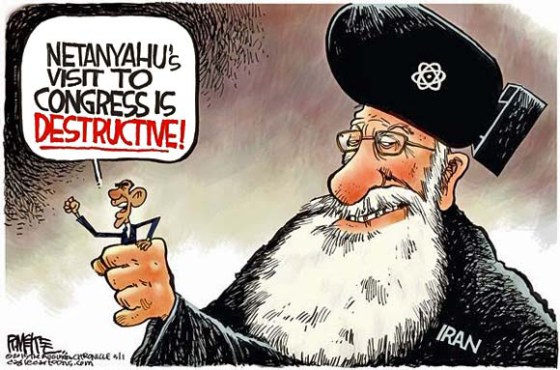
(Tip of the hat to Vermont Loon Watch. – DM)
Bring Back the Bush Doctrine—with One Addition, National Review Online, Andrew C. McCarthy, February 28, 2015
Our enemies are not driven by American foreign policy, our friendship with Israel, our detention of jihadists at Gitmo, or the supposed “arrogance” our current president likes to apologize for. Those are all pretexts for aggression.
Our enemies are driven by an ideology, Islamic supremacism, that is rooted in a classical interpretation of sharia — Islamic law. Islamic supremacism is rabidly anti-American, anti-Western, and anti-Semitic. It rejects the fundamental premise of our liberty: that people are free to govern themselves, rather than be ruled by a totalitarian legal code that suffocates liberty and brutally discriminates against non-Muslims and apostates. And sharia is an actual war on women — denying them equal rights under the law, subjecting them to unthinkable abuse, and reducing them in many ways to chattel.
****************
There is a path to victory in the fight against radical Islam, and our next president should embrace it.
What should be our strategy against ISIS? We ask the question without ever considering Iran. What concessions about centrifuges and spent fuel should we demand to prevent Iran from becoming a nuclear power? We ask the question never linking the mullahs’ weapons ambitions with its sponsorship of the global jihad . . . the only reason we dread a nuclear Iran. What should be the national-defense strategy of the United States against radical Islam, the most immediate and thoroughgoing security and cultural threat we face today?
I had the good fortune to be asked to participate in a CPAC panel Friday on defending America against rogue states. With 2016 hopefuls crowding the halls, it got me to thinking: What should we hope to hear from Republicans who want to be the party’s standard-bearer?
It is often said that we lack a strategy for defeating our enemies. Actually, we have had a strategy for 14 years, ever since the fleeting moment of clarity right after the 9/11 attacks.
That strategy is called the Bush Doctrine, and it remains the only one that has any chance of working . . . at least if we add a small but crucial addendum — one that should have been obvious enough back in 2001, and that hard lessons of history have now made inescapable.
The Bush Doctrine has become the source of copious rebuke. On the left, that’s because of that four-letter word (hint: It’s not “Doctrine”). On the right, there have been plenty of catcalls, too. The reaction, however, has been against what the Bush Doctrine evolved into, not against the Bush Doctrine as it was first announced.
The unadorned Bush Doctrine had two straightforward parts. First, because violent jihadists launch attacks against the United States when they have safe havens from which to plot and train, we must hunt down those terrorists wherever on earth they operate. Second, the nations of the world must be put to a choice: You are with us or you are with the terrorists. Period — no middle ground. If you are with the terrorists, you will be regarded, as they are regarded, as an enemy of the United States.
Before we get to that aforementioned addendum, it is important to remember why the Bush Doctrine was so necessary. For the nine years before it, we were living with the Clinton Doctrine.
That is the doctrine President Obama came to office promising to move us back to — and has he ever. It is the doctrine under which the enemy strikes us with bombs and weaponized jumbo jets, and we respond with subpoenas and indictments. It is the doctrine under which our enemies say, “allahu akbar! Death to America!” and we respond, “Gee, you know America has been arrogant. We can see why you’re so upset.”
The Clinton Doctrine — the one the Democrats will be running on in 2016, perhaps with its namesake leading the way — is the one that gave us a series of ever more audacious attacks through the 1990s: the 1993 World Trade Center bombing; a plot to bomb New York City landmarks such as the Lincoln and Holland Tunnels; a plot to blow American airliners out of the sky over the Pacific; the 1996 Khobar Towers bombing, in which Iran and al-Qaeda teamed up to kill 19 American airmen; the 1998 bombings of our embassies in Kenya and Tanzania that killed over 200 innocent people; detonating a bomb next to our destroyer, the U.S.S. Cole, in October 2000, killing 17 members of the U.S. Navy; and finally, the 9/11 atrocities, killing nearly 3,000 of our citizens.
And what has gradually restoring the Clinton Doctrine gotten us? While President Obama pleads for a deal that will inevitably make Iran a nuclear power, the mullahs continue to back anti-American terrorists and conduct military exercises in which they practice blowing up American ships. The Iraq so many Americans gave their lives for is now an extension of Iran. Afghanistan is being returned to the Taliban, which the president empowers by releasing its commanders. Libya is now a failed state where jihadists murder Americans with impunity and frolic in the former American embassy. Al-Qaeda is expanding through northern Africa, now a bigger, more potent threat than it was on the eve of 9/11. And yet it may pale compared with its breakaway faction, the Islamic State, which now controls more territory than Great Britain, as it decapitates, incinerates, and rapes its way to a global caliphate.
But Obama tells us there’s good news: Yemen is a success . . . or at least it was until it was recently overrun by an Iran-backed militia — oops. Well, we have indicted exactly one of the scores of terrorists who attacked our embassy at Benghazi. He got his Miranda warnings, of course, and he’ll be getting his civilian trial any month now. Hopefully, we’ll do better than Obama’s civilian trial of Ahmed Ghailani, the bomber of our embassies who was acquitted on 284 out of 285 counts.
Is it any wonder we’re losing?
Largely, it is because we’re worried about the wrong things — like whether we can sweep the enemy off its feet with enough Islamophilic, blame-America-first rhetoric. In reality, our enemies could not care less whether we — the infidel West — think their literalist, scripturally based belief system is a “perversion” of Islam. Radical Islam hears only one message from America: strength or weakness. The Clinton Doctrine is weakness cubed.
The Bush Doctrine, by contrast, is the path to victory — if we get that one addendum right.
It is this: Our enemies are not driven by American foreign policy, our friendship with Israel, our detention of jihadists at Gitmo, or the supposed “arrogance” our current president likes to apologize for. Those are all pretexts for aggression.
Our enemies are driven by an ideology, Islamic supremacism, that is rooted in a classical interpretation of sharia — Islamic law. Islamic supremacism is rabidly anti-American, anti-Western, and anti-Semitic. It rejects the fundamental premise of our liberty: that people are free to govern themselves, rather than be ruled by a totalitarian legal code that suffocates liberty and brutally discriminates against non-Muslims and apostates. And sharia is an actual war on women — denying them equal rights under the law, subjecting them to unthinkable abuse, and reducing them in many ways to chattel.
In the “you are with us or you are with the terrorists” view of national security, any Muslim nation, organization, or individual that adheres to Islamic supremacism is on the wrong side. Failing to come to terms with that brute fact is where the Bush Doctrine went awry.
Sharia and Western democracy cannot coexist. They are antithetical to each other. So insists Sheikh Yussuf Qaradawi, the Muslim Brotherhood jurist who is the world’s most influential Islamic scholar. It may be the only thing we should agree with him about.
The Bush Doctrine was allowed to evolve from an American national-security strategy to an illusion that our national security would be strengthened by promoting a chimera — sharia democracy. We put the lives of our best young men and women in harm’s way in the service of a dubious experiment: that we could build stable Islamic democracies that would be reliable American allies against jihadist terror.
Perhaps the worst thing about this experiment is not its inevitable failure. It is the sapping of America’s will that it has caused. Defeating our jihadist enemies is going to require a will to win, because the enemy’s will is strong — the jihadists truly believe Allah has already helped them vanquish the Soviet empire, and that we are next.
The American people vigorously support military operations that are essential to our defense. They support a vigorous war to defeat violent jihadists and their support networks. They understand that we cannot cede our enemies safe havens and nuclear weapons.
They do not support the notion that promoting our national security obliges us to move into hostile Islamic countries for a decade or three to civilize them. That’s not our job. Worse, when Americans become convinced that Washington — ever more remote from the public — thinks it is our job, they will not support military action, even action that is vital to protecting our nation. They will not trust the government to defeat our enemies without becoming entangled in Islam’s endless internal strife.
Understanding Islamic supremacism so we can distinguish allies from those hostile to us will restore the Bush Doctrine. And let’s not be cowed by the critics: Nothing I’ve said means endless war, or that we have to invade or occupy every country. But it does mean we should be using all our assets — not just military but intelligence, law-enforcement, financial, and diplomatic — to undermine regimes that support sharia supremacism. Cutting off that jihadist life-line is the path to victory — just as maintaining a strong military that is allowed to show it means business, that is not hamstrung by irresponsible rules of engagement, is the best way to ensure we won’t have to use it too often.
In Iran, where sharia is the law of the land, they persecute non-Muslims and apostates just like ISIS does. In Saudi Arabia, where sharia is the law of the land, they behead their prisoners just like ISIS does. A candidate who cannot tell liberty’s friends from liberty’s enemies is not fit to be commander-in-chief.
Obama Must Explain Why the Iran Deal Isn’t North Korea Redux, Commentary Magazine, Michael Rubin, March 1, 2015
(There are additional parallels. North Korea and Iran have comparable views of human rights, both make loud and frequent noises about obliterating their perceived enemies and both have allies willing if not anxious to sneak around sanctions. There are also differences. Iran is far more powerful than North Korea was or is and Iran’s intention to dominate the Middle East transcends North Korea’s desire to “unify” with South Korea on North Korea’s terms. Iranian governance is based on Islam, an unfortunately powerful world religion seeking world domination. North Korean governance is based on the “religion of Kim,” supreme internally but otherwise of little significance elsewhere. Iran also presents a greater danger to the U.S. than North Korea did. However, Obama won’t explain why the Iran deal isn’t “North Korea redux” because he quite likely neither knows nor cares and because it is. — DM)
The State Department has never conducted a lessons learned exercise about what went wrong with the North Korea deal. Perhaps it’s time. Diplomatic responsibility and national security demand it.
**********************
As the Obama administration rushes into a nuclear deal with Iran, it pays to remember the last time the United States struck a deal with a rogue regime in order to constrain that state’s nuclear program and the aftermath of that supposed success.
Bill Clinton had been president barely a month when North Korea announced that it would no longer allow International Atomic Energy Agency (IAEA) inspections, followed shortly thereafter by an announcement that it would withdraw from the NPT altogether within a matter of months. If Kim Il-sung expected Washington to flinch, he was right. The State Department aimed to keep North Korea within the NPT at almost any price. Chief U.S. negotiator Robert Gallucci and his aides explained in their book Going Critical, “If North Korea could walk away from the treaty’s obligations with impunity at the very moment its nuclear program appeared poised for weapons production, it would have dealt a devastating blow from which the treaty might never recover.” Unwilling to take any path that could lead to military action, Clinton’s team sought to talk Pyongyang away from nuclear defiance, no matter that talking and the inevitable concessions that followed legitimized Pyongyang’s brinkmanship.
As with President Obama relieving Iran of the burden of six United Nations Security Council resolutions which demanded a complete cessation of enrichment, Clinton’s willingness to negotiate North Korea’s nuclear compliance was itself a concession. After all, the 1953 Armistice required Pyongyang to reveal all military facilities and, in case of dispute, enable the Military Armistice Commission to determine the purpose of suspect facilities. By making weaker frameworks the new baseline, Clinton let North Korea off the hook before talks even began.
Just as Israeli (and Saudi and Emirati and Egyptian and Kuwaiti and Bahraini) leaders express frustration with the Obama administration regarding its naiveté and unwillingness to consult, so too did South Korea at the time chafe at Clinton’s arrogance. South Korean President Kim Young Sam complained to journalists that North Korea was leading America on and manipulating negotiators “to buy time.” And in a pattern that repeats today with regard to Iran, the IAEA held firmer to the demand that North Korea submit to real inspections than did Washington. The issue came to a head in September 1993 after the State Department pressured the IAEA to compromise on limited inspections.
In the face of Pyongyang’s defiance, Clinton was also wary that coercion could be a slippery slope to war. Just as President Obama and Secretary of Defense Chuck Hagel instructed U.S. forces in the Persian Gulf not to stand firm but rather to retreat if probed or pushed by Iran, Clinton sought to mollify Pyongyang, for example cancelling the joint U.S.–South Korea military exercise in 1994. Adding insult to injury, the Clinton administration criticized the South Korean government for being unwilling to compromise. Indeed, everything the Obama administration has done with regard to Israel over the past year—with the exception, perhaps, of the classless chickensh-t comment—was ripped right from the Clinton playbook two decades before when the White House sought to silence Seoul.
There followed months of baseless optimism in Washington, followed by disappointment quickly supplanted by denial. At one point, when it looked like Kim Il-sung’s intransigence might actually lead to war, former President Jimmy Carter visited Pyongyang and, whether cleared to or not, made concessions which diffused the situation. It was the diplomatic equivalent of Obama’s voided redlines. Nightlinehost Ted Koppel observed on May 18, 1994, “this administration is becoming notorious … for making threats and then backing down.”
On July 8, 1994, a heart attack felled Kim Il-sung. Kim Jong-il, his eldest son, took over. Negotiations progressed quickly. Gallucci and his team promised an escalating series of incentives—reactors, fuel oil, and other economic assistance. They kicked inspections of North Korea’s suspect plutonium sites years down the line.
What had begun as North Korean intransigence had netted Pyongyang billions of dollars in aid; it would go down in history as the largest reward for cheating and reneging on agreements until Obama granted Iran $11 billion in sanctions relief just for coming to the table. Columnist William Safire traced the steps of concessions on North Korea. “Mr. Clinton’s opening position was that untrustworthy North Korea must not be allowed to become a nuclear power,” he observed, but Clinton “soon trimmed that to say it must not possess nuclear bombs, and stoutly threatened sanctions if North Korea did not permit inspections of nuclear facilities at Yongbyon, where the CIA and KGB agree nuclear devices have been developed. But as a result of Clinton’s Very Good Deal Indeed, IAEA inspectors are denied entry to those plants for five years.” And Sen. John McCain, for his part, lamented that Clinton “has extended carrot after carrot, concession after concession, and pursued a policy of appeasement based … on the ill-founded belief that North Koreans really just wanted to be part of the community of nations.” Again, the parallels between Clinton’s and Obama’s assumptions about the desire of enemies to reform were consistent.
Clinton wasn’t going to broker any criticism of what he believed was a legacy-defining diplomatic triumph, all the more so when the criticism came from abroad. On October 7, 1994, South Korean President Kim Young Sam blasted Clinton’s deal with the North, saying, “If the United States wants to settle with a half-baked compromise and the media wants to describe it as a good agreement, they can. But I think it would bring more danger and peril.” There was nothing wrong with trying to resolve the problem through dialogue, he acknowledged, but the South Koreans knew very well how the North operated. “We have spoken with North Korea more than 400 times. It didn’t get us anywhere. They are not sincere,” Kim said. His outburst drew Clinton’s ire. He became the Netanyahu of his day. Meanwhile, the U.S. and North Korea signed the Agreed Framework. Gallucci and his team were “exhilarated.” They later bragged they “had overcome numerous obstacles in the negotiations with the North; survived the intense, sometimes strained collaboration with Seoul and the International Atomic Energy Agency; and marshaled and sustained an often unwieldy international coalition in opposition to the nuclear challenge, all under close and often critical scrutiny at home.”
Today, by some estimates, North Korea is well on its way to having 100 nuclear weapons and is steadily developing the ballistic capability to deliver them. Iran’s nuclear negotiators have cited North Korea’s negotiating strategy as a model to emulate rather than an example to condemn. Meanwhile, Obama has relied on many of the same negotiators to advance his deal with Iran.
The State Department has never conducted a lessons learned exercise about what went wrong with the North Korea deal. Perhaps it’s time. Diplomatic responsibility and national security demand it.
Obama to preempt all programming to address Climate change: March 3, Dan Miller’s Blog, The Most Reverend Mohamed Allah-scimitar, February 28, 2015
(The views expressed in this article are mine and those of my (imaginary) guest author, the Most Reverend Mohamed Allah-Scimitar. They do not necessarily reflect the views of Warsclerotic or any of its other editors.– DM)
This is a guest post by my (imaginary) guest author, the Most Reverend Mohamed Allah-scimitar, President Obama’s chief adviser on Islamic relations with Christians and Jews.

The Most Revereddd Mohamed Allah-scimitar
**********************
The worst crisis ever to face The Obama Nation — man-caused global warming climate change — continues to immobilize the country. It does so contemptuously despite the decades-long warming trend recognized by all reputable scientists. Therefore, President Obama will use the emergency broadcast system to preempt all other programming, including the internet, to address the nation on March 3.

Hell Niagara Falls freezes over

Violent right-wing Christian and Jewish extremist Islamophobes have contended that, by virtue of its timing, President Obama’s address is intended to preempt media coverage of Israeli Prime Minister Netanyahu’s remarks to the Congress on the alleged “existential threat” of a nuclear deal with Iran.
However, White House press secretary Josh Earnest vigorously denied their racist and therefore specious claims. He pointed out that Obama is extraordinarily busy fulfilling His duties as the President of all of His people. He has, therefore, made — and continues to make — historic efforts to help potential non-Islamic Islamic State recruits find jobs and hence to feel good about themselves. Do we want more of this non-Islamic violence? No? Then you should not watch Netanyahu’s address, even if you could.

President Obama also owes it to His people to continue His Herculean efforts to prevent the Republican Congress from destroying His country by passing legislation which He has to waste time vetoing, thereby attempting to impede His noble efforts to give His people — American citizens and American citizens in waiting — everything they need and want by executive decree action.
Unfortunately, the only time He has available coincides, unexpectedly, with PM Netanyahu’s frivolous speech — which nobody in his right mind would watch anyway because Netanyahu is an untrustworthy nattering nabob of negativism and a war criminal to boot.

Moreover, as explained by Robert Kagan in a February 27th Washington Post article, there is no need for anyone to hear Netanyahu’s meddlesome nonsense:
Do we really need the Israeli prime minister to appear before Congress to explain the dangers and pitfalls of certain prospective deals on Iran’s nuclear weapons programs? Would we not know otherwise? Have the U.S. critics of those prospective deals lost their voice? Are they shy about expressing their concerns? Are they inarticulate or incompetent? Do they lack the wherewithal to get their message out?
Not exactly. Every day a new report or analysis warns of the consequences of various concessions that the Obama administration may or may not be making. Some think tanks in Washington devote themselves almost entirely to the subject of Iran’s nuclear program. Congress has held numerous hearings on the subject. Every week, perhaps every day, high-ranking members of the House and Senate, from both parties, lay out the dangers they see. The Post, the New York Times, the Wall Street Journal and others publish countless stories on the talks in which experts weigh in to express their doubts. If all the articles, statements and analyses produced in the United States on this subject could be traded for centrifuges, the Iranian nuclear program would be eliminated in a week.
. . . .
Given all this, can it really be the case that the American people will not know what to think about any prospective Iran deal until one man, and only one man, gets up to speak in one venue, and only one venue, and does so in the first week of March, and only in that week? That is what those who insist it is vital that Israeli Prime Minister Benjamin Netanyahu speak before a joint meeting of Congress next week would have us believe. [Emphasis added.]
President Obama is greatly, and perfectly understandably, distressed that Netanyahu will offer nothing new in support of His legacy achievement of world peace in His time and that his address will therefore force Him to create insuperable problems for Israel. Indeed, He has already asked Iran, under the auspices of the United Nations, to mediate a binding peace agreement among Israel, the Palestinian Authority and Hamas. President Obama did not want to do it, because He loves Israel just as He would His only begotten son if He had one. However, in the circumstances Netanyahu has created, He has has no alternative. Only a vile Islamophobic Jew-hater like Netanyahu would destroy his own country by opposing President Obama’s grand plan for world peace.
As the world’s second greatest authority — second only to Obama — on Islam and its profoundly helpful relations with Jews and Christians everywhere, I call upon everyone in Israel and elsewhere to ignore whatever nonsense the soon-to-be-former Prime Minister of that insignificant beautiful little country may try to spew.
*************
Editor’s comment:
All citizens of the World with half a brain — and even less — should pay heed to The Most Reverend Mohamed Allah-scimitar’s profound words and trust only Dear Leader Obama. He, and only He, can and will do all that needs to be done to keep them warm, safe and content. Should they place unwarranted trust elsewhere, their Dear Leader may well be unable to achieve world peace whirled peas in His time.

Egypt goes to war on ISIS, masses troops against Islamist Libyan stronghold at Darnah, DEBKAfile, February 28, 2015
(Perhaps the Congress should invite President al-Sisi to address it on fighting the Non-Islamic Islamic State and its cohorts. How would Obama react?– DM)
The Egyptian president was stirred into action by the barbaric beheading on Feb. 15 of 21 Egyptian Coptic Christians who had found work in Libya.
*********************
Egyptian President Abdel-Fatteh El-Sisi has deployed his troops for all-out war on ISIS strongholds in Libya, the first Arab ruler to challenge the Islamists in a fellow Arab country, DEBKAfile’s military sources report.
His intiative dramatizes the spillover of the Islamist State’s threat across the Middle East, and the fading impetus of the US-led coalition effort to reverse Islamic State gains in Iraq and Syria.
Our Washington sources report that the Obama administration’s planned spring campaign to free Iraqi Mosul from the Islamic State’s occupation is stuck in the sand. Democratic and Republican lawmakers alike accuse the president of having no clear war strategy and of holding back from the US-led coalition the fighting manpower necessary for a successful operation.
Answering questions in the Senate Wednesday, Feb. 25, the coalition commander, retired Gen. John Allen, said he had no hard-and-fast timeline for the war. The influential Democratic Senator Barbara Boxer of California responded angrily: Your answers show one thing about the timeline defined by the White House as an enduring ground operation: “There is none.”
Jihadi John, who was filmed beheading ISIS victims, was revealed Thursday, Feb. 26, as a northwest Londoner of Kuwaiti descent called Mohammed Emwaz, who had been known to British intelligence. This was leaked by US sources to signal Washington’s aggravation over the relatively passive British role in the war on the Islamic State.
Also released was a video showing Islamic barbarians smashing priceless Assyrian artifacts in a Mosul museum – following which Friday, four ISIS members were burned alive for refusing to join the savage spree to vandalize the relics of an ancient world civilization.
Even so, US-led air strikes against ISIS targets in Syria and Iraq remain sporadic, no better than pinpricks.
The Egyptian president was stirred into action by the barbaric beheading on Feb. 15 of 21 Egyptian Coptic Christians who had found work in Libya.
El-Sisi first launched a series of air strikes against ISIS and allied Islamist militias in one of their Libyan strongholds in Darnah, following which he has now ordered Egyptian commando and marine forces to prepare for sea landings to seize the town and destroy the terrorist elements there, another landmark operation in the war on Islamist terror. .
Part of the Libyan terrorist movement and one of ISIS’s closest allies is the Ansar al-Sharia militia, which in September 2012 burned down the US consulate in Benghazi and murdered the US ambassador and three other American officials.
Cairo’s Darnah operation is believed to be days away. It is scheduled to take place at the same time as another anti-terrorist operation, which El-Sisi is planning to launch on Egypt’s longest-running front against the Islamist threat in Sinai, 2,000 kilometers east of Darnah. There, Egyptian and ground forces will go into action against the ISIS affiliate’s hideouts.
He is also considering aerial bombardments of the Gaza Strip to target Hamas’ military arm whose active collaboration with the jihadis has been confirmed by intelligence.
Some of the militias which have divided Darnah, a town of app. 50,000, among themselves, have declared their territories provinces of Abu Bakr Al-Baghdadi’s Islamic Caliphate.
According to our military sources, Egyptian forces will be assigned to attack the town from the north after a beach landing. They plan to link up with allied Libyan militias commanded by the former Qaddafi regime general Khalifa Hifter, who will come from Benghazi to strike the town from the south. Khalif and his armed men have been pursuing a relentless war on the inroads made by al Qaeda in Libya, as well as the Muslim Brotherhood, with quiet backing from Cairo.
The London-based Arabic Alquds Alarabi, which is known for its solid sources in the Middle East, reported this week that Gen. Hafter had recently paid at least two secret visits to Cairo to collect the weapons he needs for his part in the Darnah offensive and coordination.
After one of those trips, the paper reports, Hafter set out for Jordan where he had meetings with Israeli military and intelligence officials.
Iran’s Expansive Role In The Middle East And Latin America, And The Nuclear Negotiations, Center for Security Policy, Nancy Menges Luis Fleischman, February 26, 2015
(Aside from everything, what’s wrong with letting Iran get and use (or keep and use) nukes? Afer all, they are “our” partner for peace.)– DM)

As negotiations move forward on a nuclear arms agreement with the Islamic Republic of Iran, the United States along with the P5+1 appears to be oblivious to activities of Iran in the Western Hemisphere and other regions of the world.
In the Middle East, Iran has most recently supported insurgencies in both Bahrain and Yemen. The pro-Iranian Houthis just overthrew the American backed government in Yemen which we were working with on terrorism related issues.
In Syria, Iran and its proxy, Hezbollah, continue to support the Bashar Al Assad regime with Hezbollah fighting together with Assad’s forces. So far 200,000 people have been killed in Syria with millions dispersed in refugee camps in Jordan and Turkey. Hezbollah now has a perfect excuse to be involved in supporting Assad by invoking the need to defeat the bloody Islamic State. Hezbollah may think that this card could play well in the West which is trying to avoid direct intervention to defeat ISIS and would prefer that local forces to do the fighting.
In Iraq, hundreds of thousands of young Shiites are fighting as part of Iranian-backed militias, with a Shiite sectarian orientation likely to aggravate the sectarian strife prevailing in the country. These militias outnumber the Iraqi security forces, and in addition members of the Iranian revolutionary guards, the pro-Iranian Badr organization, and the pro-Iran Katain Hezbollah are heavily involved, mostly operating outside of Iraqi government control.
In Latin America ever since the election of the late Hugo Chavez to the presidency of Venezuela in 1998, Iran has become more embedded in the region in an effort to spread its influence. Several episodes and activities are illustrative of this point.
For at least ten years if not longer, there have been direct airline flights from Caracas to Tehran. Though these are commercial airlines no passengers are allowed and no one seems to know the cargo they carry but it is believed that weapons and members of Hezbollah or the Iranian Revolutionary Guards might be on those flights. Hezbollah has reportedly trained Venezuelan and other guerillas and has strengthened relations with a number of revolutionary regimes in the region. Likewise, tunnels built across the Mexican-American border are akin to those built by Hezbollah along the Israeli/Lebanese border.
In 2011, U.S. Attorney General Eric Holder accused the Iranian Quds Force of plotting to assassinate the Saudi Ambassador to the United States. Though Iran vehemently denied complicity, the American government pointed to high officials in the Iranian hierarchy with having approved the plan.
Another Iranian activity that goes largely unnoticed is Iran’s outreach to several small Caribbean nations. In return for financial assistance, these nations have issued passports to Iranian citizens who wish to enter the United States but could not do so using their Iranian passports. Venezuela and a number of other countries connected directly or indirectly to ALBA countries are providing passports to Iranians. One of those holding such a passport is Moshen Rabbani, the man believed to be behind the terrorist attacks against the Argentinean Jewish Community Center (AMIA) in 1994.
Iran has also been the recipient of uranium from Venezuela.
Most recently the government of Uruguay confirmed that an Iranian diplomat left the country after Uruguayan security suspected him of collecting intelligence about the Israeli embassy in Montevideo.
The diplomat was thought to have placed an explosive device near the Israeli embassy early in January. The device was not particularly powerful but investigations carried out by Uruguayan intelligence indicated the possibility of Iran’s involvement in this serious incident. It was not clear to the authorities whether the device was intended to do harm or was just testing their ability to respond.
But what is astonishing about this story is that two months earlier another incident occurred which was intentionally kept out of the public eye by the Uruguayan government. Indeed, on November 24, somebody placed a suitcase near the building that belonged to the old Israeli embassy in Montevideo. Although the suitcase was empty, cameras located a car belonging to the Iranian embassy nearby. Inside there was a man that the police could not identify immediately but it was assumed he was an Iranian diplomat. The police concluded that the empty suitcase was aimed at testing Uruguayan security forces’ ability to respond.
The Uruguayan government apparently decided to expel the diplomat, who himself, is an appointee of the former Iranian president Mahmoud Ahmadinejad. That appointee was a vocal anti-Semite, a Holocaust denier and apparently served as a translator in the conversations between Ahmadinejad and the late Venezuelan president, Hugo Chavez. Furthermore, the man was reportedly working in Uruguay with Muslim converts that have been activists in a radical left wing party. These individuals could well have been potential candidates for terrorist recruitment; an activity Iran has been systematically performing.
Interestingly enough, Uruguay has been and is a friendly country towards Iran (without being a close ally like Venezuela and the other ALBA countries). Uruguay’s outgoing president, Jose Mujica, declared in the past that his country would pursue relations with Iran because it is good and convenient for the country. The Uruguayan foreign minister Luis Almagro was a commercial attaché in Teheran for about five years and under his watch commercial relations between the two countries flourished. Likewise, a Uruguayan parliamentary delegation visited Teheran to strengthen relations and Almagro himself defined Uruguay and Iran as “two countries that fight against injustice and oppression”. (Almagro is the most likely candidate to be the next Secretary General of the Organization of American States).
The incident in Uruguay is another instance where Iran once again displays its nature as a terrorist entity that does not hesitate in using its embassies and the good faith of the host countries to apply its lethal methods. This is what Iran did in Argentina previous to the two deadly terrorist attacks against the Israeli Embassy and the Jewish community center.
Why shouldn’t Iran be doing so if there is no demand for Iran to stop supporting and encouraging terrorism? After all, a year ago Argentina signed a memorandum with Iran where representatives from that country would be part of the investigation into a terrorist attack where Iran remains the main suspect. By the same token, the chief investigator of the terrorist attack, Mr. Nisman, is dead because he dared to investigate a suspected cover up by the Argentinean government-a government that allegedly wanted to exonerate Iran.
Furthermore, the Argentinean foreign minister Hector Timerman summoned the American and Israeli Ambassadors and asked that these two countries stop meddling in Argentinean internal affairs and stop bringing Middle East conflicts to Argentina. The irony of this statement is that Iran chose Argentina as the target of its’ own intense hatred and violence.
Iranians probably laugh at these events where they are being given a pass over and over again. So, the fact that Iranians may have considered an attack on the Israeli Embassy in a country that is friendly to them such as Uruguay shows the ruthless nature of the regime and how little relations or agreements mean to them.
The negotiations between Iran and the P 5 +1 are mainly focused on Iran’s nuclear program. Thus, Iran is treated as a partner in a negotiation over a specific issue but Iran’s terrorist and treacherous nature is not a factor being considered in this equation.
At this point the U.S. strategy could well be to try to reach an agreement with Iran where the latter would be allowed to enrich uranium at a low level. However, there could be a possibility that if Iran decides to develop nuclear weapons, it could take the Iranians a short time to develop them from the moment they make the decision to do so.
The examples of Iran’s activities show several negative signs. First, if Iran can betray friendly countries like Uruguay, why wouldn’t it betray the P5+1? Likewise, what makes us think that we can live with a terrorist subversive Iran that not only has good chances of having a dominant role in a post-ISIS Syria and Iraq but also expands its influence and activities beyond the Middle East including regions as far as Latin America (from where Iran can strike the U.S. via a terrorist attack or by placing missiles in friendly countries such as Venezuela or Nicaragua)?
Iran presents a very complex challenge. Iran’s non –nuclear, threat is not being discussed, nor considered. This possible nuclear arms agreement should not be treated, as if it were something comparable to a commercial transaction. After all, as a nation state, Iran for the last thirty five years has been the foremost exporter of terrorism.. As the United States along with the P5+1 continues with its negotiations with Iran, they might question whether as a non-nuclear power, Iran presents a threat to world peace and stability and if so how will that play out once they were to become a nuclear power.
On moral blindness, Israel Hayom, Dror Eydar, February 27, 2015
1. Scholars who study our civilization a hundred years in the future will be able to point out the key geopolitical shifts in the Middle East, the collapse of the geographical nations and the return to the ancient social borders, and the rise of radical Islam. They will describe how the Islamic Republic of Iran took over countries like Yemen, Iraq, Syria and Lebanon, its tentacles of terrorism reaching every corner, including Gaza, Judea and Samaria.
They will study the Iranian nuclear issue and be able to quote hundreds of instances in which Iranian leaders vowed to destroy the Jewish state. But when they begin studying the Israeli society of our time, they will encounter a failure of logic. Amid a virtual consensus on preventing an Iranian nuclear bomb, they will not be able to understand the Israeli focus on bottles recycled by the prime minister’s wife, the electrician the prime minister hired and the frivolous reports that grabbed massive headlines while world powers were busy leaving Iran with the ability to manufacture a bomb. They will have trouble understanding what the Jews were arguing about while facing such an obvious threat.
In an effort to solve this mystery, the scholars will turn to historians who studied the 1930s in Europe: Western leaders’ willful blindness to Hitler’s explicit threats; Europe’s desperate longing for reconciliation with the fuhrer. They will review the history of France, which was warned in those years but failed to prepare an army. They will review Neville Chamberlain’s declaration of “peace for our time” while waving a worthless piece of paper. They will examine the history of European Jewry, which failed to accurately read the political map. Among other things, they will look at U.S. Jewry in the 1940s. They may read the memoirs of Rebecca Kook, the daughter of Hillel Kook, a prominent member of the Irgun.
2. In 1940, the members of the Irgun arrived in the U.S. at the behest of Ze’ev Jabotinsky, to recruit a Hebrew army to fight the Nazis alongside the allied forces. In 1942, when the extermination of Europe’s Jewry began to emerge, the delegation changed course and devoted themselves to saving Jewish lives. They had the nerve to challenge the official stance adopted by the Roosevelt administration — accepted with little opposition by the Jewish leaders of the United States — that the only way to save the Jews was to win the war.
The Irgun members pressured the leaders of the free world to make saving Jewish lives a goal of equal importance to winning the war, and to dedicate special resources to making it happen. They focused their efforts on campaigning in the media, among intellectuals, in the U.S. Congress and to the administration. They convinced then-President Franklin D. Roosevelt to establish the War Refugee Board — an executive agency created to save Jews. It is estimated that the board was responsible for saving 200,000 Jewish lives.
The future scholars will delve deep into the battle waged by the Jewish leadership in America against the Irgun’s delegation. The mudslinging campaign against them was not led by the administration. It was spearheaded by House Foreign Affairs Committee Chairman Sol Bloom — a New York Jew, Rabbi Stephen Samuel Wise and Nahum Goldmann of the American Jewish Congress and other Jewish leaders.
Every effort made by the Irgun delegation was met with criticism and active sabotage efforts. They claimed that their activity was too political, too vocal, too aggressive, and that in fact they did not represent anyone. Hundreds of letters were sent to senators and representatives and Jewish leaders. The letters said that the Irgun members were part of a fascist terrorist outfit from Palestine. Jewish activists handed out pamphlets warning that the delegation would bring catastrophe and destruction on the Jewish people.
Several explanations were provided for this hostile behavior. The main explanation was that Jewish leadership’s fear of tarnishing the image of the Jewish community. In a secret British Foreign Office document, Nahum Goldmann was quoted as saying that just as Hitler brought anti-Semitism to Europe, Hillel Kook would bring anti-Semitism to the U.S.
At the end of the 19th century, Germany’s Jews were also fearful of Zionism. It made them susceptible to accusations of dual loyalty, and labeled them as belonging in Palestine. That is why they resisted the Zionist movement and made extra efforts to be even more German than the rest of the Germans.
3. For the last 20 years, Prime Minister Benjamin Netanyahu has been warning anyone who would listen of Iran’s perilous ambitions. Much like Nazi Germany, Iran and radical Islam do not threaten only Israel but the entire free world. But the left-wing liberal mindset, inspired by U.S. President Barack Obama, complacently dismisses these warnings, often with a side of disrespect.
Over the last month, the White House and a long line of cultural figures and politicians have been confronting a far greater threat: Netanyahu’s upcoming speech at the U.S. Congress. The future historians will note the American Jews who disrespected the Israeli prime minister for fighting for the safety of his people. They will add to that list a number of Israelis who took pains to undermine Netanyahu’s legitimacy and sabotage his address.
One of these critics, Peter Beinart, recently slammed Nobel Peace Prize laureate Elie Wiesel for urging Obama to join him at Netanyahu’s address.
“Wiesel is acutely, and understandably, sensitive to the harm Jews suffer. Yet he is largely blind to the harm Jews cause,” Beinart wrote. Cause to whom? To the Palestinians, of course. The American Left is stuck in its 1980s elitist morality that refused to see that the reality has changed.
There is no occupation anymore, Mr. Beinart. Certainly not in the way that you and your friends make it out. The Arabs of Judea and Samaria enjoy expanded autonomy — a de facto state with a national anthem, a flag, a government and enormous budgets. It is true that the IDF is present on the outskirts, because we do not trust our neighbors. But incidentally, they, too, do not trust themselves to ward off Hamas and the radical Islamists. Israel in fact protects the lives of the Palestinian leadership and population from the perils of the Islamic caliphate, which has the ability to turn the lives of these Arabs into a hell devoid of human rights, and heads.
4. This blindness is not just geopolitical, but it is also moral. We are students of the great teacher Rabbi Akiva, who in the second century classified the commandment to “love your neighbor as you love yourself” (Leviticus 19:18) as a great principle of the Torah (Genesis Rabbah 24:7). In this he built on the work of Hillel the Elder who in the first century B.C.E. placed the entire Torah upon the foundation of this dictum (Babylonian Talmud: Tractate Shabbat 31a).
But the same Rabbi Akiva taught us that in the event of a conflict between your life and your neighbor’s life, “your brother shall live with you.” Namely, your own life comes first (Babylonian Talmud: Tractate Baba Mezi’a, 62a). That is the proper way to approach altruistic love. If you do not love your own life, or the lives of your own people, more than the lives of others, especially those who are hostile toward you, then you do not truly possess a moral understanding, but rather a nihilistic intellectualism that plays pretend in living rooms across the east and west coasts of the U.S.
Next Tuesday, truth seekers will be called upon to support Netanyahu when he addresses a joint session of Congress. The State of Israel needs your courageous support.
In an article published today, Washington Post columnist David Ignatius, a notorious Obama administration apologist, provided his latest endorsement of the president’s deeply flawed nuclear diplomacy with Iran. Ignatius also discussed some worrisome U.S. concessions to Iran that have not been previously disclosed.
During testimony to the Senate Foreign Relations Committee yesterday, Secretary of State John Kerry denied that the United States has proposed a final nuclear deal with Iran last only ten years. Although the ten-year limit has been leaked to many journalists, Ignatius confirmed that Obama officials want a deal with a “double-digit” duration of 10 to 15 years.
Ignatius also confirmed that a final deal will likely allow Iran to operate about 6,000 uranium centrifuges. He noted the Obama administration’s justification for allowing this: strict monitoring and intrusive inspections of Iranian nuclear facilities that will limit the “break-out time” – the time for Iran to make enough nuclear fuel for one weapon – to a year or more. (Click HERE to read the Center for Security Policy’s analysis of this issue.)
Ignatius failed to mention that the Iranian government has never fully cooperated with IAEA inspectors, refuses to answer the IAEA’s questions about weapons-treated nuclear activity, and did not allow IAEA inspectors to inspect all of its nuclear facilities during the nuclear talks. Ignatius also was strangely silent on yesterday’s revelations by the NCRI, an Iranian dissident group, that Iran has been operating a secret facility where it has been developing advanced uranium centrifuges and may be enriching uranium.
Ignatius’ column revealed some shocking new Obama administration concessions to Iran. According to Ignatius, although Iran will not be permitted to install more advanced centrifuges in a final agreement, it will be permitted to conduct “limited” research on advanced designs. Existing operational “non-permitted” centrifuges would be “dismantled,” either by pulverizing them or simply unplugging them.
So according to Ignatius, the Obama administration has proposed allowing Iran to continue to enrich uranium with thousands of centrifuges, ‘non-permitted’ centrifuges may only be turned off, and Iran will be permitted to continue to develop new centrifuge designs. Ignatius does not explain the purpose of Iran’s uranium enrichment. It can’t be to make nuclear fuel for Iran’s Bushehr power reactor since that would take about 200,000 centrifuges (Iran currently has about 19,000). As Israeli Prime Minister Benjamin Netanyahu has explained, there is only one purpose for Iran’s uranium enrichment program: to make nuclear bombs.
Ignatius also revealed the latest Obama administration concession to address Iran’s Arak heavy-water reactor which will be a source of about two weapons-worth of plutonium per year when completed in about a year to 18 months. Iran constructed this reactor in defiance of UN Security Council resolutions. U.S. and European government previously demanded this reactor be dismantled. The U.S. and its European allies reportedly backed away from this position over the last year by offering to let Iran operate the Arak reactor if steps were taken to ensure that it produced little plutonium either by a redesign (an irreversible approach) or fueling the reactor with enriched uranium.
According to Ignatius, “negotiators seem to have agreed on a compromise that will halt construction well before Arak becomes ‘hot’ with potential bomb fuel.” This appears to mean that construction of the Arak reactor will proceed without any alterations to its design or fueling and Iran will be trusted to halt construction just before the reactor is operational.
Ignatius fails to answer two crucial questions about the Arak reactor. Why does Iran need a plutonium-producing heavy-water reactor? Why has the United States proposed to let Iran to continue construction of this reactor?
As we learn more about the outline of a possible nuclear agreement with Iran, it is becoming more obvious that the Obama administration has made dangerous concessions that will not prevent or slow Iran’s pursuit of nuclear weapons out of its desperation to get a nuclear agreement with Tehran. Ignatius’ column also suggests the Obama administration is kicking several difficult issues down the road for a future president to deal with such as Iran’s uranium centrifuges and its plutonium-producing Arak reactor.
Charles Krauthammer said on Fox News last night that the Iranian nuclear negotiations are “simply catastrophic.” I agree. Congress needs to respond to President Obama’s nuclear sell-out to Iran by demanding an end to the nuclear talks and passing new sanctions requiring Tehran to comply with all UN Security Council resolutions on its nuclear program.
Special Report: How Iran’s military chiefs operate in Iraq, Reuters, February 24, 2015
 A tank belonging to the Shi’ite Badr Brigade militia takes position in front of a gas station in Suleiman Beg, northern Iraq in this September 9, 2014 file photo. CREDIT: REUTERS/AHMED JADALLAH/FILES
The face stares out from multiple billboards in central Baghdad, a grey-haired general casting a watchful eye across the Iraqi capital. This military commander is not Iraqi, though. He’s Iranian.
*********************
(Reuters) – The face stares out from multiple billboards in central Baghdad, a grey-haired general casting a watchful eye across the Iraqi capital. This military commander is not Iraqi, though. He’s Iranian.
The posters are a recent arrival, reflecting the influence Iran now wields in Baghdad.
Iraq is a mainly Arab country. Its citizens, Shi’ite and Sunni Muslims alike, have long mistrusted Iran, the Persian nation to the east. But as Baghdad struggles to fight the Sunni extremist group Islamic State, many Shi’ite Iraqis now look to Iran, a Shi’ite theocracy, as their main ally.
In particular, Iraqi Shi’ites have grown to trust the powerful Iranian-backed militias that have taken charge since the Iraqi army deserted en masse last summer. Dozens of paramilitary groups have united under a secretive branch of the Iraqi government called the Popular Mobilisation Committee, or Hashid Shaabi. Created by Prime Minister Haider al-Abadi’s predecessor Nuri al-Maliki, the official body now takes the lead role in many of Iraq’s security operations. From its position at the nexus between Tehran, the Iraqi government, and the militias, it is increasingly influential in determining the country’s future.
Until now, little has been known about the body. But in a series of interviews with Reuters, key Iraqi figures inside Hashid Shaabi have detailed the ways the paramilitary groups, Baghdad and Iran collaborate, and the role Iranian advisers play both inside the group and on the frontlines.
Those who spoke to Reuters include two senior figures in the Badr Organisation, perhaps the single most powerful Shi’ite paramilitary group, and the commander of a relatively new militia called Saraya al-Khorasani.
In all, Hashid Shaabi oversees and coordinates several dozen factions. The insiders say most of the groups followed a call to arms by Iraq’s leading Shi’ite cleric Grand Ayatollah Ali al-Sistani. But they also cite the religious guidance of Ayatollah Ali Khamenei, the supreme leader of Iran, as a key factor in their decision to fight and – as they see it – defend Iraq.
Hadi al-Amiri, the leader of the Badr Organisation, told Reuters: “The majority of us believe that … Khamenei has all the qualifications as an Islamic leader. He is the leader not only for Iranians but the Islamic nation. I believe so and I take pride in it.”
He insisted there was no conflict between his role as an Iraqi political and military leader and his fealty to Khamenei.
“Khamenei would place the interests of the Iraqi people above all else,” Amiri said.
FROM BATTLEFIELD TO HOSPITAL
Hashid Shaabi is headed by Jamal Jaafar Mohammed, better known by his nom de guerre Abu Mahdi al-Mohandis, a former Badr commander who once plotted against Saddam Hussein and whom American officials have accused of bombing the U.S. embassy in Kuwait in 1983.
Iraqi officials say Mohandis is the right-hand man of Qassem Soleimani, head of the Quds Force, part of Iran’s Revolutionary Guard. Mohandis is praised by some militia fighters as “the commander of all troops” whose “word is like a sword above all groups.”
The body he heads helps coordinate everything from logistics to military operations against Islamic State. Its members say Mohandis’ close friendships with both Soleimani and Amiri helps anchor the collaboration.
The men have known each other for more than 20 years, according to Muen al-Kadhimi, a Badr Organisation leader in western Baghdad. “If we look at this history,” Kadhimi said, “it helped significantly in organizing the Hashid Shaabi and creating a force that achieved a victory that 250,000 (Iraqi) soldiers and 600,000 interior ministry police failed to do.”
Kadhimi said the main leadership team usually consulted for three to four weeks before major military campaigns. “We look at the battle from all directions, from first determining the field … how to distribute assignments within the Hashid Shaabi battalions, consult battalion commanders and the logistics,” he said.
Soleimani, he said, “participates in the operation command center from the start of the battle to the end, and the last thing (he) does is visit the battle’s wounded in the hospital.”
Iraqi and Kurdish officials put the number of Iranian advisers in Iraq between 100 and several hundred – fewer than the nearly 3,000 American officers training Iraqi forces. In many ways, though, the Iranians are a far more influential force.
Iraqi officials say Tehran’s involvement is driven by its belief that Islamic State is an immediate danger to Shi’ite religious shrines not just in Iraq but also in Iran. Shrines in both nations, but especially in Iraq, rank among the sect’s most sacred.
The Iranians, the Iraqi officials say, helped organize the Shi’ite volunteers and militia forces after Grand Ayatollah Sistani called on Iraqis to defend their country days after Islamic State seized control of the northern city of Mosul last June.
Prime Minister Abadi has said Iran has provided Iraqi forces and militia volunteers with weapons and ammunition from the first days of the war with Islamic State.
They have also provided troops. Several Kurdish officials said that when Islamic State fighters pushed close to the Iraq-Iran border in late summer, Iran dispatched artillery units to Iraq to fight them. Farid Asarsad, a senior official from the semi-autonomous Iraqi region of Kurdistan, said Iranian troops often work with Iraqi forces. In northern Iraq, Kurdish peshmerga soldiers “dealt with the technical issues like identifying targets in battle, but the launching of rockets and artillery – the Iranians were the ones who did that.”
Kadhimi, the senior Badr official, said Iranian advisers in Iraq have helped with everything from tactics to providing paramilitary groups with drone and signals capabilities, including electronic surveillance and radio communications.
“The U.S. stayed all these years with the Iraqi army and never taught them to use drones or how to operate a very sophisticated communication network, or how to intercept the enemy’s communication,” he said. “The Hashid Shaabi, with the help of (Iranian) advisers, now knows how to operate and manufacture drones.”
A MAGICAL FIGHTER
One of the Shi’ite militia groups that best shows Iran’s influence in Iraq is Saraya al-Khorasani. It was formed in 2013 in response to Khamenei’s call to fight Sunni jihadists, initially in Syria and later Iraq.
The group is responsible for the Baghdad billboards that feature Iranian General Hamid Taghavi, a member of the Iranian Revolutionary Guard. Known to militia members as Abu Mariam, Taghavi was killed in northern Iraq in December. He has become a hero for many of Iraq’s Shi’ite fighters.
Taghavi “was an expert at guerrilla war,” said Ali al-Yasiri, the commander of Saraya al-Khorasani. “People looked at him as magical.”
In a video posted online by the Khorasani group soon after Taghavi’s death, the Iranian general squats on the battlefield, giving orders as bullets snap overhead. Around him, young Iraqi fighters with AK-47s press themselves tightly against the ground. The general wears rumpled fatigues and has a calm, grandfatherly demeanor. Later in the video, he rallies his fighters, encouraging them to run forward to attack positions.
Within two days of Mosul’s fall on June 10 last year, Taghavi, a member of Iran’s minority Arab population, traveled to Iraq with members of Iran’s regular military and the Revolutionary Guard. Soon, he was helping map out a way to outflank Islamic State outside Balad, 50 miles (80 km) north of Baghdad.
Taghavi’s time with Saraya al-Khorasani proved a boon for the group. Its numbers swelled from 1,500 to 3,000. It now boasts artillery, heavy machine guns, and 23 military Humvees, many of them captured from Islamic State.
“Of course, they are good,” Yasiri said with a grin. “They are American made.”
In November, Taghavi was back in Iraq for a Shi’ite militia offensive near the Iranian border. Yasiri said Taghavi formulated a plan to “encircle and besiege” Islamic State in the towns of Jalawala and Saadiya. After success with that, he began to plot the next battle. Yasiri urged him to be more cautious, but Taghavi was killed by a sniper in December.
At Taghavi’s funeral, the head of Iran’s Supreme National Security Council, Ali Shamkhani, eulogized the slain commander. He was, said Shamkhani, one of those Iranians in Iraq”defending Samarra and giving their blood so we don’t have to give our blood in Tehran.” Both Soleimani and the Badr Organisation’s Amiri were among the mourners.
A NEW IRAQI SOUL
Saraya al-Khorasani’s headquarters sit in eastern Baghdad, inside an exclusive government complex that houses ministers and members of parliament. Giant pictures of Taghavi and other slain al-Khorasani fighters hang from the exterior walls of the group’s villa.
Commander Yasiri walks with a cane after he was wounded in his left leg during a battle in eastern Diyala in November. On his desk sits a small framed drawing of Iran’s Khamenei.
He describes Saraya al-Khorasani, along with Badr and several other groups, as “the soul” of Iraq’s Hashid Shaabi committee.
Not everyone agrees. A senior Shi’ite official in the Iraqi government took a more critical view, saying Saraya al-Khorasani and the other militias were tools of Tehran. “They are an Iranian-made group that was established by Taghavi. Because of their close ties with Iranians for weapons and ammunition, they are so effective,” the official said.
Asarsad, the senior Kurdish official, predicts Iraq’s Shi’ite militias will evolve into a permanent force that resembles the Iranian Revolutionary Guard. That sectarian force, he believes, will one day operate in tandem with Iraq’s regular military.
“There will be two armies in Iraq,” he said.
That could have big implications for the country’s future. Human rights groups have accused the Shi’ite militias of displacing and killing Sunnis in areas they liberate — a charge the paramilitary commanders vigorously deny. The militias blame any excesses on locals and accuse Sunni politicians of spreading rumors to sully the name of Hashid Shaabi.
The senior Shi’ite official critical of Saraya al-Khorasani said the militia groups, which have the freedom to operate without directly consulting the army or the prime minister, could yet undermine Iraq’s stability. The official described Badr as by far the most powerful force in the country, even stronger than Prime Minister Abadi.
Amiri, the Badr leader, rejected such claims. He said he presents his military plans directly to Abadi for approval.
His deputy Kadhimi was in no doubt, though, that the Hashid Shaabi was more powerful than the Iraqi military.
“A Hashid Shaabi (soldier) sees his commander … or Haji Hadi Amiri or Haji Mohandis or even Haji Qassem Soleimani in the battle, eating with them, sitting with them on the ground, joking with them. This is why they are ready to fight,” said Kadhimi. “This is why it is an invincible force.”
The Islamic ‘Ghosts on the Roof’, Front Page Magazine,

Chambers’ warnings were largely ignored by Western leaders whose willful blindness to the true nature of communism sealed the fate of millions behind the iron curtain in Europe, in China, Korea, Cuba, Vietnam, Cambodia, and elsewhere.
Today, perhaps the ghosts of Mehemed II and Sulieman the Magnificent are looking down and smiling as Western leaders fecklessly attempt to negotiate with the Iranian mullahs and search for “root causes” of ISIS terror and aggression. The Muse of History would understand, and her sister Melpomene, unfortunately, still has work to do.
*********************
Seventy years ago, Winston Churchill, Franklin Roosevelt, and Joseph Stalin met at Yalta to lay the foundations of the post-World War II world order. Less than one month after their historic meeting,TIME magazine on March 5, 1945, published an unsigned article entitled “Ghosts on the Roof.” The article was written by Whittaker Chambers, then TIME’s foreign news editor and formerly a member of a Washington, D.C.-based Soviet espionage ring. Chambers broke with communism in the late 1930s and in doing so remarked to his wife that they were joining the “losing side” in the great world struggle between communism and the West.
Chambers’ repeated efforts during the late 1930s and early 1940s to alert the State Department and the FBI to communist penetration of our government and the existence and activities of the espionage ring fell on deaf ears, so he used his position at TIME to attempt to warn the American public about the true nature of communism and the goals of Stalin’s Soviet Union.
The Yalta Conference, which took place during February 4-11, 1945, was immediately heralded as foreshadowing a peaceful postwar world order. Chambers, having been in the belly of the beast, knew better. He showed “Ghosts on the Roof” to T.S. Matthews, TIME’s associate executive editor, but doubted thatTIME would publish it. According to Chambers’ biographer Sam Tanenhaus, Matthews showed it toTIME’s owner Henry Luce who called it “a forceful piece of journalism” but was otherwise non-committal on publishing it. Other TIME staffers urged Matthews not to publish the piece fearing that it would poison relations between the wartime allies. With some hesitation, and characterizing it as a “political fairy tale,” Matthews decided to publish it.
Chambers’ story has the ghosts of the murdered Russian Tsar Nicholas II and his family descend on the roof of the Livadia Palace, their former estate and the site where the “big three” allied war leaders negotiated the fate of the world. Clio, the Muse of History, greets them and discusses with Nicholas and Alexandra what just occurred there. Nicholas, the Tsarina remarks, is fascinated by Stalin. “What statesmanship! What vision! What power!,” says Nicholas. “We have known nothing like this since my ancestor, Peter the Great, broke a window into Europe by overrunning the Baltic states in the 18th century. Stalin has made Russia great again.”
“It all began with the German-Russian partition of Poland,” Chambers has Alexandra say, reminding readers that the Second World War was started by Hitler and Stalin. “Stalin,” says the Tsar, “is magnificent. Greater than Rurik, greater than Peter! . . . Stalin embodies the international social revolution . . . the mighty new device of power politics which he has developed for blowing up other countries from within.” The Royal couple then lists the countries conquered by Stalin—Rumania, Bulgaria, Yugoslavia, Hungary, Poland—and those soon to be conquered because of Western appeasement. The Tsarina marvels at Stalin’s ability to persuade Churchill and Roosevelt solve the issues of Central and Eastern Europe to Stalin’s liking in a friendly fashion, remarking that “even peace may be only a tactic of struggle.”
At the end of the tale, the Muse of History foresees the consequences of Yalta as “more wars, more revolutions, greater proscriptions, bloodshed and human misery.” If you can foresee such troubles, the Tsarina asks Clio, why don’t you prevent them. The Muse of History replies that she must leave something for her sister Melpomene, the Muse of Tragedy, to do.
Readers reacted negatively to the piece. TIME’s Moscow correspondent lost his access to Kremlin officials. Chambers, some said, was zealously trying to destroy U.S.-Soviet collaboration that was so essential to world peace. TIME’s own editors noted in a subsequent issue that they did not believe that U.S.-Soviet relations were doomed to failure.
History vindicated Whittaker Chambers. His courageous efforts to reveal the truth about communism and Stalin’s intentions are not unlike the current efforts by writers—several associated with this journal—to alert the United States and the world to the true nature and goals of Islamic jihadists.
In Chambers’ time, the West was confronted by a murderous, expansionist secular totalitarian ideology whose leaders sought a communist world empire. Today, the West is confronted by a murderous, expansionist religion-based totalitarian ideology whose leaders seek a world caliphate where all must submit to Allah or be eradicated.
Chambers’ warnings were largely ignored by Western leaders whose willful blindness to the true nature of communism sealed the fate of millions behind the iron curtain in Europe, in China, Korea, Cuba, Vietnam, Cambodia, and elsewhere.
Today, perhaps the ghosts of Mehemed II and Sulieman the Magnificent are looking down and smiling as Western leaders fecklessly attempt to negotiate with the Iranian mullahs and search for “root causes” of ISIS terror and aggression. The Muse of History would understand, and her sister Melpomene, unfortunately, still has work to do.




 anneinpt
 artaxes
 danmillerinpanama
 davidking1530
 Peter Hofman
 Joseph Wouk
 Peter
Peter Louisiana Steve
 WarSclerotic
Recent Comments