Bolton: Obama Didn’t Stab Netanyahu in the Back; He Did in the Front, National Review via Fox News via YouTube, December 27, 2016
Dem lawmaker: Israel waging ‘war on the American government’, Washington Examiner,
(How deplorably ungrateful of wicked Israel after all that Obama has done to for her. — DM)
 Rep. Jim McDermott, D-Wash., says Israelis attacking Obama for not giving them ‘everything they want.’ (AP Photo/Elaine Thompson)
McDermott added that because Israel “never could get 100 percent from Barack Obama, so they decided to attack him and use him as the reason why Trump should come in and give them everything they want.”
*******************************
A retiring Democratic congressman warned that the war-of-words over the United Nations’ vote on Israel settlements is the beginning of a rhetorical “war on the American government” by Israel.
Rep. Jim McDermott, D-Wash., made the comments Monday in an interview with MSNBC when asked to react to accusations that the Israeli government has proof that the Obama administration helped influence the U.N. Security Council’s vote to condemn Israeli settlements.
Ron Dermer, the Israeli Ambassador to the U.S., had said earlier on MSNBC that the Israelis would be sharing the proof to the incoming Trump administration only.
“What we are seeing is the beginning of a war on the American government [by Israel],” McDermott said in response to Dermer.
“We’re seeing the air war right now, we’re seeing all these tweets, all this kind of innuendo and all these half stories, and all this stuff is to create tremendous tension,” McDermott explained.
He added that creating the tension will help President-elect Donald Trump begin the “ground war” when he takes over the White House next month. That, McDermott said, is when “his appointees begin to carry out his actions in the departments across the government.”
“The American people are being subjected to a campaign of anxiety production,” McDermott said. “And it really is very, very disturbing to watch.”
McDermott added that because Israel “never could get 100 percent from Barack Obama, so they decided to attack him and use him as the reason why Trump should come in and give them everything they want.”
Israel is now “running their own war against us and our policies” because they are angry that Obama has pushed back against telling them to stop with settlements, McDermott said.
Bye Bye, Obama, PJ Media, Michael Ledeen, December 25, 2016
(Please see also, Is real change coming to Iran? Get ready for March 15, 2017. — DM)
What would President Trump do if Khamenei passed from the scene, and millions of Iranians took to the streets again? The president-elect has said he’s not a great enthusiast of regime change, but it’s hard to imagine he’d abandon the Iranians as Obama did seven years ago. He ought to be thinking it through.
Yes, I know good news is hard to swallow, but we are living in a revolutionary moment, of which the Trump election is a dramatic symptom. The crisis of the Islamic Republic would be a fitting end to the Obama era. He dreamt of a glorious strategic alliance with Iran, and a definitive lethal blow against Israel. How fitting with the Divine sense of humor to have the Palestinians and Iranians to wreck their own enterprises.
***********************
As I promised, as the days of Obama draw down, the jihadis are stepping up the terror tempo. They know that there will be no reprisals from the Oahu links, and they fear Trump’s lineup of tough guys in the cabinet, so they’re in a hurry to kill infidels while the killing’s good. Therefore we, along with the other Western nations, are at maximum risk right now, until roundabouts January 20th.
And the killing’s plenty good, isn’t it? Berlin, Zurich, Ankara, Moscow, with a very nasty plot uncovered in Melbourne, and yet another involving terrorists in Detroit, Maryland, and Virginia. Not to mention the ongoing slaughter in Syria, and, on Christmas day, Cameroon.
What does the “western world” do in response? Declare the Western Wall “occupied territory.” This is no accident, since the jihadis believe that they have unleashed holy war against infidels. That war will not end, in their view, until we infidels have been crushed and subjected to the will of a caliph. They’ve got plenty of support from the Russians, without whom thousands of Iranians and Iranian proxies would have been killed in Syria and Iraq, and the Assad regime would have been destroyed.
That would have been a better world, but Obama did not want that world. Nor did the feckless Europeans, who act as if profits on Iran trade compensate for the open subversion of public order. Indeed, as Christmas arrived we were treated to the spectacle of the bishop of Rome—aka Pope Francis–blaming material misery for the jihadist assault on the West. Thus the first Jesuit pontiff surrenders the moral high ground to his mortal enemies.
Maybe Obama should convert and run for pope.
Paradoxically, the jihadis and their secular allies are launching their new assault just as they are suffering systematic setbacks on the battlefield, their own internal conflicts are intensifying, and there are signs of a religious and patriotic revival within the boundaries of their archenemy, the United States. Walter Russell Mead neatly catches the irony that, just as Obama handed the Palestinians a resounding political victory, a sober look at the situation suggests that the Palestinians have not been this weak, this divided, or this helpless in many decades.
In like manner, the Iranian regime, flush with its success in Aleppo, is increasingly riven. Supreme Leader Ali Khamenei has had two medical events in the past 10 days, and the scrambling for the succession has resumed. You may have noticed that General Qasem Soleimani has returned to the front pages, which invariably happens when the leader is ill; the Revolutionary Guards want him as the strongman of the next regime (he can’t be supreme leader for lack of theological standing, but he could still be a dominant figure). And it isn’t all peaches and cream for Soleimani, as recent demonstrations in Tehran against the rape of Aleppo make clear. Iranian apologists love to tell us that Persian nationalism overwhelms internal tribal and sectarian divisions, but Iran has lost thousands in Syria, and the Persian nationalists don’t like their husbands and sons dying to save Bashar Assad.
What would President Trump do if Khamenei passed from the scene, and millions of Iranians took to the streets again? The president-elect has said he’s not a great enthusiast of regime change, but it’s hard to imagine he’d abandon the Iranians as Obama did seven years ago. He ought to be thinking it through.
Yes, I know good news is hard to swallow, but we are living in a revolutionary moment, of which the Trump election is a dramatic symptom. The crisis of the Islamic Republic would be a fitting end to the Obama era. He dreamt of a glorious strategic alliance with Iran, and a definitive lethal blow against Israel. How fitting with the Divine sense of humor to have the Palestinians and Iranians to wreck their own enterprises.
You never know. Life is full of surprises.
Fearing UN vote on principles of Palestinian statehood, PM ‘reaching out to Trump’, Times of Israel, December 25, 2016
 (AFP/Pool/Atef Safadi)
TV reports: Netanyahu is wary that Kerry will set out parameters for permanent accord, then outgoing Obama administration will seek Security Council approval.
Amid escalating fallout from the UN Security Council vote Friday that condemned Israel’s settlement activities, a furious Prime Minister Benjamin Netanyahu was reported on Sunday night to be attempting to “recruit” the incoming Trump administration and the US Congress to block a feared bid by the outgoing Obama administration to have the Security Council approve principles for a Palestinian state.
“They are spitting at us,” Netanyahu has told colleagues behind closed doors, Channel 2 news reported. “We will respond forcefully.”
Netanyahu held a 40-minute meeting with US Ambassador Dan Shapiro on Sunday evening, having summoned the envoy to explain why the US abstained in the vote on Resolution 2334, enabling it to pass 14-0, rather than vetoing it. He had earlier summoned the envoys of the 12 nations with representatives in Israel that voted for the resolution for a dressing-down at the Foreign Ministry.
Underlining Israel’s determination to press ahead with building beyond the pre-1967 lines, the Jerusalem municipality will this week approve some new homes in Ramat Shlomo and Ramot, neighborhoods captured in 1967 and subsequently annexed by Israel as part of Jerusalem, Channel 2 news reported.
Netanyahu is now reaching out to the incoming Trump administration, which takes office on January 20, and to friends in Congress, in the hope of “deterring” what he sees as further potential Obama administration-led diplomatic action against Israel, the Channel 2 report said. His aim is for the Trump team to make plain that his administration will “economically hurt” those countries that voted against Israel in the UN and that do so in the future.
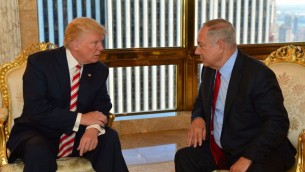 September 25, 2016. (Kobi Gideon/GPO)
Netanyahu’s fear is that Secretary of State John Kerry will set out principles or parameters for a Palestinian state in a speech that he has said he will deliver in the next few days on his Middle East vision. The prime minister fears that, in its final days, the Obama administration will seek to have a resolution enshrining those parameters adopted by the UN Security Council, the report said.
France is to hold a conference on the Israeli-Palestinian conflict on January 15, and Netanyahu expects that Kerry will attend, that the Middle East Quartet — the US, UN, Russia and EU — will coordinate their positions at that summit, and that they will then turn to the Security Council in the very last days of the Obama presidency, a Channel 10 report further suggested.
Such speculation was not confirmed by the Prime Minister’s Office, but Netanyahu has made public his outrage at the Obama administration several times since Resolution 2334 was passed, claiming that the president initiated and helped draft the resolution “behind Israel’s back.” He has variously called the resolution skewed, shameful and ridiculous — in part because it brands Jerusalem’s Old City, including the Temple Mount and Western Wall, “occupied Palestinian territory.”
Lighting festive Hanukkah candles at the Western Wall on Sunday night, Netanyahu stressed that Israel “cannot accept” the UN resolution, and asked: “How could they vote that [the Western Wall] is occupied territory? We were here much earlier.”
In an address on Saturday night, Netanyahu had likened President Barack Obama to the former president Jimmy Carter, who he said was “deeply hostile” to Israel. He described the vote in the Security Council as “the swan song of the old world that is anti-Israel.” Now, he said, “we are entering a new era. And as President-elect Trump said, it’s going to happen a lot faster than people think.” In this new era, it will be a lot more costly for those who seek to harm Israel, he warned.
The prime minister was also widely reported Sunday to have either canceled or opted not to schedule a meeting with Britain’s Prime Minister Theresa May at the World Economic Forum annual meeting in Davos next month; his spokesman said no such meeting had ever been arranged. He was also said to have chosen not to schedule a meeting with China’s President Xi Jinping. He has already recalled Israel’s ambassadors from Senegal and New Zealand, two of the four countries that co-sponsored the resolution. (Israel has no ties with the other two sponsors, Malaysia and Venezuela.)
Netanyahu also reportedly told his cabinet ministers at a meeting on Sunday morning to reduce to a minimum their engagement with all the countries that voted for the resolution and with which Israel has ties — China, Russia, France, the UK, Spain, Egypt, Angola, Ukraine, Uruguay, Japan, New Zealand and Senegal. They were told to minimize any visits to those countries, and that he would not receive visits from their foreign ministers.
On Saturday, Netanyahu canceled this week’s scheduled visit to Israel of Ukraine’s prime minister.
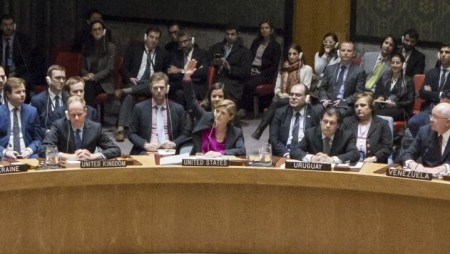 Samantha Power, center, the United States Ambassador to the United Nations, votes to abstain during a U.N. Security Council vote on condemning Israel’s settlements in the West Bank and east Jerusalem, Friday, Dec. 23, 2016 at United Nations Headquarters. (Manuel Elias/The United Nations via AP)
Addressing the weekly cabinet meeting in Jerusalem Sunday, Netanyahu reiterated his staunch opposition to Resolution 2334.
“We have no doubt that the Obama administration initiated it, stood behind it, coordinated its versions and insisted upon its passage,” he said.
Why Obama Has Hurt the Palestinian People Far More Than Israel, PJ Media, Roger L. Simon, December 24, 2016
By allowing and indeed instigating – it was apparently entirely his decision – the United States to “abstain” from the UN Security Council’s censure of Israel on the settler issue Barack Obama has certainly hurt Israel, but he has hurt the Palestinian people far more.
Obama’s action was entirely one of moral narcissism, coming as it did from his longtime pseudo-leftist distaste for Israel (see the Khalidi Tape) augmented by personal pique at its leader, Benjamin Netanyahu, leavened by self-regarding, actually quite destructive, virtue signaling. Obama’s unresolved anger about Donald Trump’s victory was undoubtedly also part of the mix.
The destructive aspect is the most significant in the long run, though it’s questionable whether the lame duck president sees it or even cares. Obama has encouraged Palestinian irredentism. He has given their leaders and the misbegotten Palestinian people a propaganda victory they don’t need that misleads them into thinking they have been following the right path.
Over the more than two decades since the Oslo Accords, the Palestinians have been given several chances at a two-state solution and have rejected all of them. In all those cases over ninety percent of what they asked for was on the table. In the instance of Ehud Barak and Arafat, some say it was a hundred percent. Arafat famously walked away – to Bill Clinton’s great, and in this case justifiable, chagrin.
Something wrong? Of course. Maybe the Palestinians, at least their leaders, didn’t and don’t really want a two-state solution. Those leaders have been on a gravy train, in many instances having become billionaires via international aid during the negotiations. They have had less than zero incentive to make a deal, especially since they suspected their more bloodthirsty brothers and sisters would kill them if they did. (A recent investigation shows that Arafat may actually have been poisoned by a competing Palestinian leader. We all know what happened to Gaza after the Israelis left voluntarily, when Hamas turned what was supposed to be the next Singapore into a free-fire zone.)
Meanwhile, the Palestinian people have been ginned up by those leaders – and jihadists world wide – to hate the Jewish people and dream of the Jewish state being pushed into the sea. Interesting in all this is the supposedly terminal settler issue. Palestinian Authority president Abu Abbas has declared that no Jews would be allowed to live in a future Palestinian state, while a million and a half Arabs already live in Israel. Is that, as Obama would say, “fair”? Since 1948, the entire Islamic world has virtually achieved Hitler’s goal of being Judenrein.
Nevertheless, the destruction of Israel is less likely than ever to occur, yet Obama decided to give at least tacit encouragement to that tired dream and give the Palestinians a false victory through his last minute chastisement of Israel. He did this in full knowledge that Donald Trump would take an opposite position within weeks. Obama’s action was basically a “grandstand play,” but not a harmless one because it undermined what Trump and his people may ultimately be trying to do more quietly. The Palestinians need nothing more than”tough love,” solid inducement to look at their situation realistically rather than through the highly-neurotic, always self-destructive lens of victimhood.
It’s no surprise that Trump is now calling for reduced US financial support for the UN. Did Obama want that? Did he really care about that either or was that all too just for show?
So Obama moves off stage as he has always been – the Moral Narcissist in Chief. His entire presidency has been about him, and on a global stage. And they say Trump is the narcissist.
Column One: Checkmating Obama, Jerusalem Post, Caroline Glick, October 27, 2016
Obama has waited eight years to exact his revenge on Israel for not supporting his hostile, strategically irrational policies. And he has no interest in letting bygones be bygones.
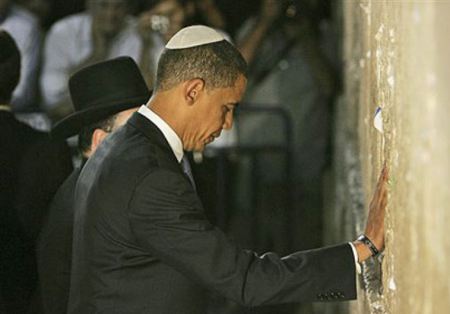 Obama at the Western Wall. (photo credit:AFP PHOTO)
In one of the immortal lines of Godfather 2, mafia boss Michael Corleone discusses the fate of his brother, who betrayed him, with his enforcer.
“I don’t want anything to happen to him while my mother is alive,” Corleone said.
Message received.
The brother was murdered after their mother’s funeral.
Last week it was reported that the Obama administration has delivered a message to the Palestinian Authority. The administration has warned the PA that the US will veto any anti-Israel resolution brought before the UN Security Council before the US presidential elections on November 8.
Message received.
Open season on Israel at the Security Council will commence November 9. The Palestinians are planning appropriately.
Israel needs to plan, too. Israel’s most urgent diplomatic mission today is to develop and implement a strategy that will outflank President Barack Obama in his final eight weeks in power.
Lobbying the administration is pointless. Obama has waited eight years to exact his revenge on Israel for not supporting his hostile, strategically irrational policies. And he has no interest in letting bygones be bygones.
Before turning to what Israel must do, first we need to understand what Israel can do.
A good place to begin is by considering what just transpired at UNESCO, where twice in a week, UNESCO bodies resolved to erase 3,000 years of Jewish history in Jerusalem and the Temple Mount.
The fight that Israel waged at UNESCO is not the fight it needs to wage at the Security Council. The stakes at the Security Council are far higher.
Like the UN General Assembly, UNESCO’s decisions are non-binding declarations that have no legal or operational significance. As such, there is no reason to expend great resources to fight them. For Israel, the goal of the fight at UNESCO is not to defeat anti-Israel initiatives. That is impossible given the Palestinians’ automatic majority.
The purpose of the fight at UNESCO is to humiliate European governments that side with antisemitic initiatives, and to weaken the congenitally anti-Israel body itself.
The government achieved both of these objectives. Italian Prime Minister Matteo Renzi’s disavowal of his own government’s abstention from the vote on the first resolution – like the similar position taken after the fact by the Mexican government – was a diplomatic victory for Israel.
So too, the fact that UNESCO’s own Secretary-General Irina Bukova felt compelled to disavow her own agency’s actions by rejecting the resolution’s denial of the Jewish people’s ties to Jerusalem was a significant victory for Israel. Her statement was deeply damaging for UNESCO and its reputation.
Finally, the fact that Tanzania and the Philippines voted against the resolution was a testament to Israel’s capacity to convince other governments to abandon their traditional pro-Palestinian voting pattern.
The Palestinians won the vote at UNESCO because they are more powerful diplomatically than Israel. They have an automatic anti-Israel majority. But they weren’t empowered by their victory. To the contrary. They were bloodied by it.
In a sign of their weakening hold on member nations, the Palestinians and Jordanians felt compelled to send a threatening letter to the members of UNESCO’s World Heritage Committee lest they dare to vote against the resolution. Powerful players don’t make threats. They don’t need to.
Israel’s experience at UNESCO teaches us that there are governments that are open to counteroffers. Israel doesn’t need to hide in America’s shadow. It is capable of working on its own to blunt the impact of the Palestinians’ automatic majority. And it will need to use all of its resources to fend off a US-backed assault at the Security Council.
Unlike UNESCO, the Security Council can pass legally binding resolutions. Israel needs to be prepared to bring all of its resources to bear to prevent such a resolution from being adopted against it. Obama’s intention to abandon Israel at the Security Council means that Israel comes to this battle severely hobbled.
But there is one advantage to the US’s betrayal.
Over the years, Israel’s ability to trust the US to veto anti-Israel resolutions at the Security Council was been a mixed blessing. On the one hand, the US has secured Israel from diplomatic assaults. But on the other hand, our ability to trust Washington has made us diplomatically lazy and ineffective.
Safe in Washington’s shadow, we have behaved as through all diplomacy is public diplomacy. That is, we have pretended that statecraft begins and ends with making the moral or strategic case for our side against the other guys.
But public diplomacy is just one diplomatic tool.
The Syrian regime, for instance, has no moral case for securing international support. Bashar Assad didn’t convince Russian President Vladimir Putin to support him by arguing that he is better than alternative regimes. He bought Putin’s support by offering him permanent air and naval bases in Syria.
Then there is Morocco, another weak state with no public diplomacy case to make. Last March, UN Secretary-General Ban Ki-moon outraged Rabat when he acknowledged the plain fact that Western Sahara, which Morocco occupies, is “occupied territory.”
Morocco quickly secured the support of Spain and France and launched an all-out onslaught against Ban. How did Morocco manage?
Morocco’s most powerful diplomatic resource is its control over migration flows from North Africa to Europe. Anytime it wishes, Rabat can open the migratory floodgates just as easily as it can keep them shut. And the French and Spanish know it.
In less than a month, Ban issued repeated abject apologies.
Game. Set. Match. Morocco.
From reports to date, it appears that shortly after the US elections on November 8, the Malaysians or Egyptians will submit a Palestinian-backed resolution that defines Israeli communities in united Jerusalem, Judea and Samaria as illegal. If the resolution is brought to a vote, the US will fail to veto it.
Such a resolution, or a resolution obligating Israel to withdraw to the 1949 armistice lines, would cause Israel grave harm.
So what resources does Israel have to prevent this from happening?
Of course, we have public diplomacy. And that might work with some friendly nations. But it won’t get us over the top. We need to learn from the Syrian and Moroccan examples and consider what we have to offer Security Council members in exchange for their support in scuttling the approaching onslaught against us.
One such resource is the US Congress. Israel’s allies in Congress are sickened by the Obama administration’s devastating Middle East policies. A solid majority of lawmakers can be trusted to support actions that will reinforce Israel’s position.
Israel has other resources as well that we can trade on. We have natural gas. And we have technologies that the governments of the world require to surmount the challenges of the 21 century. There is no reason to give these resources away when we can trade them for diplomatic support.
As for the Palestinians, as the UNESCO vote showed, they are less popular now than at any time in the past 40 years. All they have to offer is threats and antisemitism. Both are powerful weapons.
But they are no longer invincible.
Israel’s goal must be to use our resources at the Security Council in a manner that will make it impossible for Obama to enable an anti-Israel resolution to pass.
A method for achieving this goal has two components. The first component is to convince a friendly country on the Security Council to propose a balanced resolution that would counter the Palestinian-backed Israel-bashing one.
Such a resolution could include four points. First, it could deplore efforts to deny Jewish history in Jerusalem and the Temple Mount.
Second, it can condemn the PA/PLO for their continued unlawful funding of terrorists.
Third, it can urge Israel to restrain settlement construction in areas that in previous negotiations have been identified as likely territory for a future Palestinian state.
Fourth, it can call on Israel and the PA to reinstate negotiations immediately without preconditions.
Israel has friendly ties with a few Security Council members, among them Uruguay and New Zealand. In the final weeks of the Obama era, it is possible that Israel will be able to convince one of them to submit a balanced resolution along these lines.
Obama would be hard-pressed to oppose such a resolution in favor of one that singles Israel out for rebuke.
But that still is insufficient. Obama can make Uruguay and New Zealand a better offer if he wishes.
And so we move to the second aspect of the plan.
If we learn nothing else from the Obama era, we must recognize that the time has come for Israel to stop sufficing with just one Security Council veto. Most states have several. And we need a few more.
Russia today is the best place to start our search for a second veto.
Putin is a dealmaker. As his agreement with Assad showed, he is willing to consider attractive offers. Obviously, Israel won’t offer Russia bases. But we do have other things to offer Putin in exchange for a veto.
For instance, in exchange for a Russian veto at the Security Council, Israel can offer Putin to lobby the US Congress to cancel US sanctions against Russia over Russia’s annexation of Crimea.
Israel has no dog in that fight. And the sanctions are not getting the US anywhere.
Putin might go for the deal for two reasons. First, by stepping into the breach and defending Israel against Obama, he will humiliate Obama.
Second, if Israel succeeds with the Congress, he will reap economic rewards.
For his part, Putin wouldn’t even have to openly side with Israel. All he would have to do is announce that in the interests of regional stability, Russia will not support an unbalanced resolution on Israel and the Palestinians.
If Putin supports a balanced resolution, Obama will be checkmated. His plan to take revenge on Israel for not following him off the strategic cliff will be foiled. Israel will have survived his presidency.
None of this will be easy. And success is far from assured. There are many more ways for Israel to fail than succeed. Our diplomatic weakness remains a millstone around our neck. But as the UNESCO resolutions showed, attacking Israel is no longer cost free. We are not powerless in the grip of circumstances. We have cards to play.
And now is the time to play them for all they are worth.
Netanyahu: Palestinians’ ‘No Jews’ Demand is ‘Ethnic Cleansing for Peace’, PJ Media, Bridget Johnson, September 9, 2016
 Israeli Prime Minister Benjamin Netanyahu poses for a photograph with pupils on the first day of school in the Israeli Arab town of Tamra on Sept. 1, 2016. (AP Photo/Sebastian Scheiner)
Israeli Prime Minister Benjamin Netanyahu lashed out at calls for Israelis to accept an “ethnic cleansing for peace” deal with the Palestinians, who have long demanded any settlement expel Jews from Palestinian territories.
“I’m sure many of you have heard the claim that Jewish communities in Judea Samaria, the West Bank, are an obstacle to peace,” Netanyahu said in a video. State Department spokesman Mark Toner said Thursday that the United States is “concerned that things might be moving in the opposite direction given, on the one hand, and we’ve expressed our concern about this, ongoing Israeli settlement activity, but equally, we’ve been troubled by the fact that — or by the incitement to violence.”
“I’ve always been perplexed by this notion” of settlements being the problem, Netanyahu said. “Because no one would seriously claim that the nearly two million Arabs living inside Israel – that they’re an obstacle to peace. That’s because they aren’t. On the contrary.”
“Israel’s diversity shows its openness and readiness for peace. Yet the Palestinian leadership actually demands a Palestinian state with one pre-condition: No Jews. There’s a phrase for that: It’s called ethnic cleansing. And this demand is outrageous.”
The prime minister added that “it’s even more outrageous that the world doesn’t find this outrageous.”
“Some otherwise enlightened countries even promote this outrage. Ask yourself this: Would you accept ethnic cleansing in your state? A territory without Jews, without Hispanics, without blacks Since when is bigotry a foundation for peace?” he said. “At this moment, Jewish schoolchildren in Judea Samaria are playing in sandboxes with their friends. Does their presence make peace impossible? I don’t think so.”
“I think what makes peace impossible is intolerance of others. Societies that respect all people are the ones that pursue peace. Societies that demand ethnic cleansing don’t pursue peace.”
Netanyahu said he envisions “a Middle East where young Arabs and young Jews learn together, work together, live together side by side in peace.”
Muslim Terrorists and Jewish Anti-Semites Against Trump, Front Page Magazine, Daniel Greenfield, September 2, 2016

“I was often the ‘designated yeller.’”
That’s how Hillary Clinton described her relationship with the Israeli prime minister. Yelling and cursing was her particular specialty.
One marathon Hillary yelling session allegedly lasted 45 minutes. Afterward the Israeli ambassador said that relations between the United States and Israel had reached their lowest point.
Her favorite name for Netanyahu was, “F____ Bibi.”
But it wasn’t just about her hatred of any particular Israeli leader. The same year that Hillary was yelling herself hoarse at a man who had fought terrorists on the battlefield, she addressed the American Task Force on Palestine, a leading terror lobby, and blasted Israel and praised Islamic terrorists.
Hillary told the terror lobby, “I may have been the first person ever associated with an American administration to call for a Palestinian state.” She praised Mahmoud Abbas, the PA terror dictator who had boasted, “There is no difference between our policies and those of Hamas.”
She celebrated Naomi Shihab Nye who had written of the Hamas rocket attacks on Israeli cities, “Oppression makes people do desperate things.” Echoing her, Hillary denounced the “indignity of occupation”. A few years later she accused Israelis of a lack of “empathy” in understanding “the pain of an oppressed people.”
Perhaps they were too busy mourning their dead to emphasize with the terrorists who were killing them.
But fighting for her political life, Hillary and Huma dug through her closet and threw on a blue and white pantsuit. Her campaign placed an editorial in the Forward headlined, “How I Would Reaffirm Unbreakable Bond With Israel — and Benjamin Netanyahu.”
Probably by yelling “F___ Bibi” at him for another 45 minutes.
When Hillary Clinton promised to reaffirm her “Unbreakable Bond With Israel — and Benjamin Netanyahu” it was in the pages of The Forward. And, striving to sell a rotten radical to skeptical Jews, the left-wing paper has decided to run a piece claiming that “Trump Would Be Israel’s Worst Nightmare”. As if anyone in Israel goes to bed dreaming of eight years of Hillary.
The Forward shares Hillary’s view of Netanyahu. And it violently loathes Israel.
Its quick costume change from denouncing anything and everything about the Jewish State to a sudden bout of concern for Israel is as unconvincing as Hillary Clinton’s southern accent.
Jay Michaelson, the author of the editorial warning us how bad Trump would be for Israel, followed that up with another piece accusing Israel of being an apartheid state. During Passover, Michaelson’s seething hatred for the Jewish State had pushed him to declare, “I’m Seeking Freedom From the Organized Jewish Community This Passover.”
Should American Jews take their cues on how dangerous Trump would be for Israel from a guy who hates Israel? Who hates Israel so much that he can’t even stand the Jewish community?
The Forward, like Hillary, hates Israel. Its pages are dedicated to rationalizing, justifying and defending the Muslim hatred of Israel and Jews. There’s Lisa Goldman explaining that the Muslim anti-Semitism displayed at the Rio Olympics was really a “Jewish persecution complex” that lacked “nuance.” It’s not an outlier. The Forward’s view of Israel is as hostile and negative as any white supremacist website.
Or Hillary Clinton’s inbox where the likes of Max Blumenthal regularly made appearances.
Do the Forward or Hillary Clinton actually care about Israel? All they’re trying to do is keep the American Jews who don’t believe that Israel is an apartheid state or that Muslim anti-Semitism is the fault of the Jews on the Democratic reservation by scaring them with bedtime stories about Trump.
Michaelson warns us that Trump would destabilize the Middle East and endanger Israel. It’s hard to imagine how he could do so more than Hillary’s Arab Spring which turned Egypt over to the Muslim Brotherhood, sowed terrorist dragon’s teeth across the region, including an ISIS affiliate in the Sinai.
Trump would destroy American credibility, he tells us. What credibility? Nobody thinks we have any credibility now. Not on Syria, Iran, Libya, China, Russia or anything else. And much of that took place under Hillary Clinton.
Then we are told that Trump is an “extremist” because “moderate Saudi businessmen” don’t like him.
Whom should American Jews better take their guidance from than “moderate Saudi businessmen”? Perhaps Jay Michaelson, Hillary Clinton and the Forward. It’s hard to tell who in that gruesome bunch hates Israel more.
The “moderate” Saudi businessman whom Michaelson quotes is Saudi Arabia’s Prince Alwaleed bin Talal. Alaweed had his post 9/11 donation thrown back in his face after blaming America for the attack. And Moussaoui, the 20th hijacker, claimed that he was an Al Qaeda supporter.
He had also donated $27 million to terrorism against Israel at a telethon whose host declared on television, “Do not have any mercy, neither compassion on the Jews, their blood, their money, their flesh. Their women are yours to take, legitimately. Allah made them yours. Why don’t you enslave their women? Why don’t you wage jihad? Why don’t you pillage them?”
The Forward and Jay Michaelson would like American Jews to heed this warning about Trump’s extremism from a “moderate Saudi” who donated to the mass murder and rape of Jews.
Also, Jay Michaelson and the Forward warn American Jews not to vote for Trump because he “famously promised to “bomb the s___ out of ISIS.” This, according to Jay, ”would entail the murder of thousands of innocent people.” Some of whom might even be “moderate Saudi businessmen.”
Finally, we are warned that under Trump, “Egypt and Syria will soon resemble Hamas and Hezbollah: extremist, Islamist and violent.” This was formerly known as Obama and Hillary’s Arab Spring.
Michaelson contends that Republicans are voting from “that part of the brain that sends out constant ‘fight or flight’ messages based on threats and fear.” That’s an odd lack of self-awareness from a man who just desperately tried to hammer together some “fight or flight” messages on Trump.
But attacking Trump is easier than defending Hillary. And so we get this pathetic showing of Muslim terrorist financiers and Jewish anti-Semites against Trump. It’s as meaningful as Hillary’s pro-Israel pandering.
The real Hillary, the one caught with an inbox full of attacks on Israel, including approval for the bigotry of Max Blumenthal whose work was cited by the Kansas City Jewish Community Center gunman, is quite a different creature from the public Hillary who suddenly loves Israel.
The real Hillary, the one who kissed Arafat’s wife and listened placidly to her rant about Israeli poison gas, has a long anti-Israel history. Her time as Secretary of State has already given us a preview of her policies. She will continue demanding apartheid segregation for Jews living in ’67 Israel and she will go on pushing for more concessions to Islamic terrorists. She will back the Iran deal that she championed.
Hillary will go on financing Iran’s wave of Islamic terrorism while ignoring its nuclear violations.
But there is nothing extraordinary about any of this. Hillary is not a radical in a party of moderates. The Democratic Party has drifted so far into the fever swamps of the radical left that opposition to Israel is mainstream. The only reason that Hillary reserves her fulminations for phone calls and private emails is that even though her inner circle of advisers is vocally anti-Israel, some in her outer circle of donors are pro-Israel. And she still needs their support. At least while the election is still going on.
Israel has ceased to be a bipartisan issue. Jimmy Carter and Bill Clinton reversed JFK and LBJ’s pro-Israel policies. This rejection has been cloaked in euphemisms about “two states for two people”, but that really means championing the creation of Islamic terror states inside Israel.
This policy, which has until recently been bipartisan, represents the greatest threat to Israel.
Donald Trump is the first Republican presidential nominee to firmly break with it. Unlike Hillary, Trump hasn’t kissed Arafat’s wife or spent an hour on the phone yelling at the Prime Minister of Israel. Instead he has said that Jews should be able to keep on living and building houses in ’67 Israel.
Jews living as a free people in their own land is the essence of Zionism. And it’s a rejection of the hateful ravings of Hillary Clinton, the Forward and the “moderate” Saudi businessmen of Islamic terror.
Hezbollah’s Massive Arms Build-up in Lebanese Civilian Areas, Front Page Magazine, Joseph Klein, July 19, 2016

Every calendar quarter the United Nations Security Council holds an extensive debate on the Israeli-Palestinian “situation.” The Israeli and Palestinian UN representatives make speeches following the Secretary General’s report on the current status, which are normally predictable restatements of their respective positions. This time, however, Israel’s ambassador Danny Danon, addressing the Security Council at its July 12th meeting, presented new graphic evidence of Hezbollah’s alarming arsenal of rockets and missiles located in civilian areas of southern Lebanon.
Ten years ago, when Security Council Resolution 1701 was adopted, ending the war that had broken out between Israel and Hezbollah, the terrorist group was estimated to have had about 7000 rockets. The resolution called for Hezbollah and other armed groups not officially a part of the Lebanese government’s armed forces to relinquish their weapons. Instead, precisely the opposite has happened. Hezbollah never stopped its arms build-up, which has been funded and supplied principally from the world’s leading state sponsor of terror, Iran.
Hezbollah now has approximately 120,000 rockets and missiles aimed at Israeli civilian population centers. By way of comparison, Ambassador Danon said that “more missiles are hidden underground in 10,000 square kilometers [of Lebanon] than the above-ground 4 million square kilometers” of the European North Atlantic Treaty Organization countries.
Referring to aerial satellite imagery, based on the latest Israeli intelligence, Ambassador Danon demonstrated to the members of the Security Council the location of rocket launchers and arms depots that Hezbollah had placed in civilian areas. “The village of Shaqra has been turned into a Hezbollah stronghold with one out of three buildings used for terror activities, including rocket launchers and arms depots,” Ambassador Danon said. “Hezbollah has placed these positions next to schools and other public institutions putting innocent civilians in great danger.”
Hezbollah, aided and abetted by Iran, was “committing double war crimes,” the Israeli ambassador charged. “They are attacking civilians, and using Lebanese civilians as human shields,” he said. “We demand the removal of Hezbollah terrorists from southern Lebanon.”
Not surprisingly, Ambassador Danon’s presentation of irrefutable evidence of Hezbollah’s clear and present danger to Israeli and Lebanese civilians, and his demand for Security Council action, fell on deaf ears. In her own statement that followed Ambassador Danon’s remarks, U.S. Ambassador to the UN Samantha Power said not a word about what was just presented regarding Hezbollah. Instead, she stuck to her canned talking points that continue to draw a moral equivalence between acts of Palestinian terrorism and Israeli self-defense. “In recent months, there’s been a steady stream of violence on both sides of the conflict,” she said. Then Ambassador Power proceeded to criticize the building of Israeli settlements, as if again to draw a moral equivalence between housing construction and terrorism. She assailed what she called Israel’s “systematic process of land seizures, settlement expansions, and legalizations of outposts that is fundamentally undermining the prospects for a two-state solution.” All that Ambassador Power said about Lebanon was to decry the political stalemate in electing a new president and to state that “the United States is helping the Lebanese armed forces build the capabilities necessary to counter violent extremism and protect the Lebanese people.” If the Obama administration were truly interested in countering “violent extremism” in Lebanon and protecting the Lebanese people, it would start by doing everything possible to eliminate the violent extremist threat posed by Hezbollah’s massive rearmament. That, in turn, would require the Obama administration to reverse its appeasement course towards Iran and tighten, not loosen, the financial screws on the regime.
There is no doubt where the bulk of Hezbollah’s funding and arms is coming from. Even Secretary of State John Kerry acknowledged last January Iran’s leading role in arming Hezbollah.
The terrorist organization’s chief Hasan Nasrallah boasted last month about Iran’s bankrolling its operations:
“We are open about the fact that Hezbollah’s budget, its income, its expenses, everything it eats and drinks, its weapons and rockets, are from the Islamic Republic of Iran,” Nasrallah was quoted by Hezbollah’s official Al Ahed newspaper as saying. “As long as Iran has money we will have money. Hezbollah gets its money and arms from Iran, as long as Iran has money, so does Hezbollah. We extend gratitude to the Leader Imam, [His Eminence] Sayyed Khamenei, and to the leadership of the Islamic Republic and its government, president, scholars and people for their generous support which has never stopped.”
To add insult to injury, Nasrallah made his remarks while honoring the “martyrdom” of a top Hezbollah terrorist killed in Syria whom has been linked to the 1983 attack on the U.S. Marines barracks in Lebanon. That attack took the lives of 241 Americans. Now, Hezbollah is stronger than ever, with Iran’s “generous support.”
Iran continues to fund global terrorism, with its treasury being replenished thanks to the Obama administration’s largesse.




 anneinpt
 artaxes
 danmillerinpanama
 davidking1530
 Peter Hofman
 Joseph Wouk
 Peter
Peter Louisiana Steve
 WarSclerotic
Recent Comments