Archive for the ‘Nukes’ category

Obama Admin Threatens U.S. Allies for Disagreeing with Iran Nuke Deal

March 27, 2015

Obama Admin Threatens U.S. Allies for Disagreeing with Iran Nuke Deal, Washington Free Beacon, March 27, 2015
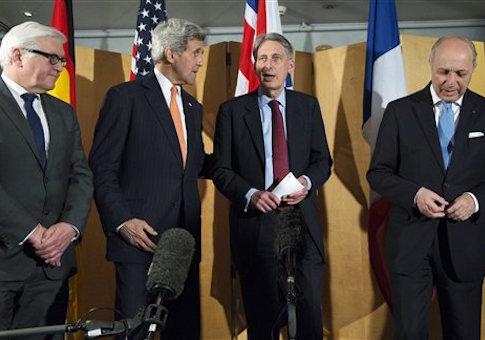
Iran Nuclear TalksFrom left, German Foreign Minister Frank Walter Steinmeier, U.S. Secretary of State John Kerry, British Foreign Secretary Philip Hammond and French Foreign Minister Laurent Fabius talk after Hammond made a statement about their meeting regarding recent negotiations with Iran over Iran’s nuclear program in London, England, Saturday, March 21 / AP

LAUSANNE, Switzerland—Efforts by the Obama administration to stem criticism of its diplomacy with Iran have included threats to nations involved in the talks, including U.S. allies, according to Western sources familiar with White House efforts to quell fears it will permit Iran to retain aspects of its nuclear weapons program.

A series of conversations between top American and French officials, including between President Obama and French President Francois Hollande, have seen Americans engage in behavior described as bullying by sources who spoke to the Washington Free Beacon.

The disagreement over France’s cautious position in regard to Iran threatens to erode U.S. relations with Paris, sources said.

Tension between Washington and Paris comes amid frustration by other U.S. allies, such as Saudi Arabia and Israel. The White House responded to this criticism by engaging in public campaigns analysts worry will endanger American interests.

Western policy analysts who spoke to the Free Beacon, including some with close ties to the French political establishment, were dismayed over what they saw as the White House’s willingness to sacrifice its relationship with Paris as talks with Iran reach their final stages.

A recent phone call between Obama and Hollande was reported as tense as the leaders disagreed over the White House’s accommodation of Iranian red lines.

Amid these tensions, U.S. Ambassador to France Jane Hartley met with her French counterpart, Gerard Araud, Monday to discuss a range of issues.

Benjamin Haddad, who has advised senior French political figures on foreign policy issues, said leaders in Paris have not been shy about highlighting disagreements they have with the White House.

“Fance, like other European countries, has negotiated for more than 10 years and endured most of the sanctions’ burden,” said Haddad, a research fellow at the Hudson Institute.

“The French want a deal, but they see no rush and repeat that Iranians need a deal more than we do, and that we shouldn’t fix artificial deadlines that put more pressure on us than Iran.”

One source in Europe close to the ongoing diplomacy said the United States has begun to adopt a “harsh” stance toward its allies in Paris.

“There have been very harsh expressions of displeasure by the Americans toward French officials for raising substantive concerns about key elements of what the White House and State Department negotiators are willing to concede to Iran,” said the source, who spoke on condition of anonymity. “That is because the clarifications expose just how weak the Americans’ deal is shaping up to be.”

“The meeting between the French ambassador in Washington and the president’s envoy to Paris—not a diplomat but a big fundraiser for his campaigns—comes amid these very harsh words that were spoken privately about the ambassador’s recent comments on the seeming American desperation for a deal, and the tough words that President Obama had for President Hollande in their phone call.”

Strategic differences remain between the United States and its allies over how a final deal should look, the source said. The French remain opposed to a recent range of concessions made by the Obama administration.

“We may agree that denying Iran a nuclear weapon ability is the goal, but apparently the view of what one can leave Iran and assure that is very different,” the source said.

“Clearly these are the differences that must be discussed. I don’t see France suddenly deciding that America is right and French objections to weakness are wrong, nor that silence is preferable to transparency.”

Haddad said the French are hesitant to rush into an agreement.

“The French want a robust deal with clear guarantees on issues like [research and development] and inspections to ensure that Iranians won’t be able to reduce breakout time during the duration of the agreement (also an issue of discussion), or just after thanks to research conducted during the period,” he said. “That is also why they disagreed on lifting sanctions.”

He also said the French “don’t trust Iran and believe an ambiguous deal would lead to regional proliferation.”

Another Western source familiar with the talks said the White House is sacrificing longstanding alliances to cement a contentious deal with Iran before Obama’s term in office ends.

“The President could be hammering out the best deal in the history of diplomacy, and it still wouldn’t be worth sacrificing our alliances with France, Israel, and Saudi Arabia—key partners in Europe, the eastern Mediterranean, and the Gulf,” the source said. “But he’s blowing up our alliances to secure a deal that paves Iran’s way to a bomb.”

A State Department spokesperson declined to comment on the issue.

Meanwhile, talks between the United States and Iran reached a critical juncture Thursday, as Secretary of State John Kerry met with his Iranian counterpoint to hash out differences over key points concerning Iran’s nuclear program.

The sides are hoping to reach a framework agreement by March 31 amid reports that Iran is demanding Saudi Arabia immediately halt airstrikes in Yemen, where Iran-aligned forces are working to bring down the Western-backed government.

The issue could complicate the talks as the United States attempts to balance its regional alliance with Iran in Iraq against competing interests with traditional allies in Saudi Arabia.

U.S. negotiators have reportedly softened their stance in recent days on a range of issues relating to Iran’s continued production of nuclear materials. One of Iran’s nuclear sites in Fordow could continue to operate, according to the Associated Press.

Ben Shapiro: Obama’s Faith in Iran

March 26, 2015

Ben Shapiro: Obama’s Faith in Iran, Truth Revolt via Front Page Magazine, March 26, 2015


TRANSCRIPT:

President Obama has made it one of his chief missions to reach out to the Islamic Republic of Iran. His attempt to cut a nuclear deal with Iran – a deal that would leave Iran with a huge number of centrifuges intact and a crippling sanctions regime against it largely removed – is merely the latest signal that the President has faith that the Iranian dictatorship can be an ally to the United States. In 2009, Obama said this:

My administration is now committed to diplomacy that addresses the full range of issues before us, and to pursuing constructive ties among the United States, Iran and the international community.  This process will not be advanced by threats.  We seek instead engagement that is honest and grounded in mutual respect. You, too, have a choice.  The United States wants the Islamic Republic of Iran to take its rightful place in the community of nations.

In 2009, Iran began shooting dissenters in the streets.

Obama said this particular shooting was “heartbreaking” and blathered about the arc of the moral universe bending toward justice. Then he went back to catering to the mullahs.

In 2011, Obama did virtually nothing when Iran began filling the vacuum left by the United States in Iraq. This week, Obama signaled that he was ready to cut a deal with Iranian-backed Syrian dictator Bashar Assad – a man he said “had to go” after Assad used weapons of mass destruction on his own people in 2011. Earlier this year, the Obama State Department labeled the radical Iranian-backed Houthis in Yemen – a group that burns American flags and screams “Death to the Jews” – a “legitimate political constituency.” This week, Obama celebrated the Iranian holiday of Nowruz at the White House, with Michelle Obama gushing, “I think it’s so fitting we’re holding this celebration here today.”

How wrong is Obama about Iran?

Let’s look back at history. In 1979, after Jimmy Carter let the Shah of Iran fall, the Ayatollah Khomeini took over. The new regime promptly popularized the slogan “Death to America,” and took Americans at the embassy hostage. Every Friday for the last 37 years, massive prayer sessions led by the mullahs chant that slogan. Here’s one from last year, as our friends at MEMRI reveal:


Murals like this one are not uncommon across Tehran.

It’s not just sloganeering. The bombing of the US Embassy in Beirut in 1983 was carried about by Hezbollah, a Shiite Iranian proxy group. The United States believes that Hezbollah was behind the bombing of US Marine barracks in Beirut that same year as well, and Reagan reportedly thought about bombing Iranian Revolutionary Guard stations in retaliation. The continuous kidnapping of Americans ended up leading to the Iran-Contra scandal when the Reagan administration began smuggling weapons to the Iranians in an attempt to free American hostages. During this period, the Iranian regime used child soldiers; the president encouraged those above the age of 12 to volunteer. A reported 95,000 children under the age of 18 were wounded or killed in the war.

Iran provided significant material support for the 9/11 hijackers. According to the 9/11 Commission Report:

Senior managers in al Qaeda maintained contacts with Iran and the Iranian-supported worldwide terrorist organization Hezbollah, which is based mainly in southern Lebanon and Beirut. Al Qaeda members received advice and training from Hezbollah. Intelligence indicates the persistence of contacts between Iranian security officials and senior al Qaeda figures after Bin Ladin’s return to Afghanistan…we now have evidence suggesting that 8 to 10 of the 14 Saudi “muscle” operatives traveled into or out of Iran between October 2000 and February 2001….In sum, there is strong evidence that Iran facilitated the transit of al Qaeda members into and out of Afghanistan before 9/11, and that some of these were future 9/11 hijackers.

The Commission concluded, “We believe this topic requires further investigation by the U.S. government.” No further investigation ever took place.

During the Iraq War, the Iranian government heavily facilitated the rise of Shiite militias dedicated to the murder of American troops. In Afghanistan, they provided material support to the Taliban to assist in the murder of American troops. All of this continued during the Obama administration. Obama’s own Chairman of the Joint Chiefs of Staff, Admiral Mike Mullen, said in 2011 that Iranian-backed militas were “killing our troops” in Iraq. He said that Iranian officials “know about it.” “Iran is playing an outsized role,” Mullen said. “That has to be dealt with. It’s killing our people.”

Obama’s solution: pull out of Iraq and hand the country over to Iran, which had already helped turn the country into shambles with its allied leader, Nouri Al-Maliki, cleaning security forces of Sunnis. His replacement is an even more pro-Iranian leader, Haider al-Abadi.

Even as the Iranian economy suffers from global sanctions and Saudi attempts to undercut Iranian oil prices, Iran’s expansionism grows. Iraq. Syria. Lebanon. Yemen. The Saudis live in fear. So do the Jordanians and the Egyptians.

Iranian power over the past three decades has meant thousands of dead Americans. But Obama keeps pushing for Iranian power nonetheless. Which means thousands more dead Americans in our future.

Saudi Arabia launches airstrikes in Yemen, ambassador says

March 26, 2015

Saudi Arabia launches airstrikes in Yemen, ambassador says, Fox News, March 26, 2015

(Meanwhile, as Iranian supported Houthis take over much of Yemen, the U.S. is providing airstrikes in Tikrit to assist Iran and helping Iran to establish itself as a nuclear power. Please see also, US air force bombs Tikrit to aid Iran-led operation against ISIS. Saudi, Egyptian bombers strike Iran-backed Houthi rebels in Yemen. — DM)

032515_shep_Yemen2_640Iran-backed rebels bring Yemen to brink of civil war

Saudi Arabia launched airstrikes against the Houthi rebels in Yemen early Thursday, one day after the U.S.-backed Yemeni president was driven out of the country.

President Obama has authorized the provision of logistical and intelligence support to the military operations, National Security Council spokesperson Bernadette Meehan said late Wednesday night. She added that while U.S. forces were not taking direct military action in Yemen, Washington was establishing a Joint Planning Cell with Saudi Arabia to coordinate U.S. military and intelligence support.

Saudi Ambassador Adel al-Jubeir said the operations began at 7 p.m. Eastern time.

He said the Houthis, widely believed to be backed by Iran, “have always chosen the path of violence.” He declined to say whether the Saudi campaign involved U.S. intelligence assistance.

Al-Jubeir made the announcement at a rare news conference by the Sunni kingdom.

He said the Saudis “will do anything necessary” to protect the people of Yemen and “the legitimate government of Yemen.”

A Yemeni official earlier Wednesday would not say where Yemeni President Abed Rabbo Mansour Hadi fled to, but did tell Fox News: “He is safe. That’s all I can say at this point.”

Hadi’s departure marks a dramatic turn in Yemen’s turmoil and means a decisive collapse of what was left of his rule, which the United States and Gulf allies had hoped could stabilize the chronically chaotic nation and fight Al Qaeda’s branch here after the 2011 ouster of longtime autocrat Ali Abdullah Saleh.

Over the past year, the Shiite rebels known as Houthis, who are believed to be supported by Iran, have battled their way out of their northern strongholds, overwhelmed the capital, Sanaa, seized province after province in the north and worked their way south. Their advance has been boosted by units of the military and security forces that remained loyal to Saleh, who allied with the rebels.

With Hadi gone, there remains resistance to the Houthis scattered around the country, whether from Sunni tribesmen, local militias, pro-Hadi military units or Al Qaeda fighters.

Hadi and his aides left Aden after 3:30 p.m. on two boats, security and port officials told The Associated Press. He is scheduled to attend an Arab summit in Egypt on the weekend, where Arab allies are scheduled to discuss formation of a joint Arab force that could pave the way for military intervention against Houthis.

His flight came after Houthis and Saleh loyalists advanced against Hadi’s allies on multiple fronts. Military officials said militias and military units loyal to Hadi had “fragmented,” speeding the rebel advance. The officials spoke on condition of anonymity because they were not authorized to speak to reporters

Earlier in the day, the rebels seized a key air base where U.S. troops and Europeans had advised the country in its fight against Al Qaeda militants. The base is only 60 kilometers (35 miles) away from Aden.

In the province of Lahj, adjoining Aden, the rebels captured Hadi’s defense minister, Maj. Gen. Mahmoud al-Subaihi, and his top aide on Wednesday and subsequently transferred them to the capital, Sanaa. Yemen’s state TV, controlled by the Houthis, announced a bounty of nearly $100,000 for Hadi’s capture.

Hadi then fled his presidential palace, and soon after warplanes targeted presidential forces guarding it. No casualties were reported. By midday, Aden’s airport fell into hands of Saleh’s forces after intense clashes with pro-Hadi militias.

Aden was tense Wednesday, with schools, government offices, shops and restaurants largely closed. Inside the few remaining opened cafes, men watched the news on television. With the fall of the city appearing imminent, looters went through two abandoned army camps, one in Aden and the other nearby, taking weapons and ammunition.

The takeover of Aden, the country’s economic hub, would mark the collapse of what is left of Hadi’s grip on power. After the Houthis overran Sanaa in September, he had remained in office, but then was put under house arrest. He fled the capital earlier in March with remnants of his government and declared Aden his temporarty capital.

Yemen’s Foreign Minister Riad Yassin told Dubai-based Al-Arabiya TV satellite news network that he officially made a request to the Arab League on Wednesday to send a military force to intervene against the Houthis. Depicting the Houthis as a proxy of Shiite Iran, a rival to Sunni Gulf countries, he warned of an Iranian “takeover” of Yemen. The Houthis deny they are backed by Iran.

Mohammed Abdel-Salam, a spokesman for the Houthis, said their forces were not aiming to “occupy” the south. “They will be in Aden in few hours,” Abdel-Salam told the rebels’ satellite Al-Masirah news channel.

Earlier, Al-Masirah reported that the Houthis and allied fighters had “secured” the al-Annad air base, the country’s largest. It claimed the base had been looted by both Al Qaeda fighters and troops loyal to Hadi.

The U.S. recently evacuated some 100 soldiers, including Special Forces commandos, from the base after Al Qaeda briefly seized a nearby city. Britain also evacuated soldiers.

The base was crucial in the U.S. drone campaign against Al Qaeda in the Arabian Peninsula, which Washington considers to be the most dangerous offshoot of the terror group. And American and European military advisers there also assisted Hadi’s government in its fight against Al Qaeda’s branch, which holds territory in eastern Yemen and has claimed the attack on the French satirical magazine Charlie Hebdo in Paris.

U.S. operations against the militants have been scaled back dramatically amid Yemen’s chaos. U.S. officials have said CIA drone strikes will continue in the country, though there will be fewer of them. The agency’s ability to collect intelligence on the ground in Yemen, while not completely gone, is also much diminished.

The Houthis, in the aftermath of massive suicide bombings in Sanaa last week that killed at least 137 people, ordered a general mobilization and their leader, Abdel-Malik al-Houthi, vowed to send his forces to the south to fight Al Qaeda and militant groups.

In Sanaa, dozens of coffins were lined up for a mass funeral of the victims Wednesday. Among the victims was a top Shiite cleric. Yemen’s Islamic State-linked militants have claimed responsibility for the attack.

The Houthis seized the capital, Sanaa, in September and have since been advancing south along with Saleh’s loyalists. On Tuesday, they fired bullets and tear gas to disperse thousands of protesters in the city of Taiz, known as the gateway to southern Yemen. Six demonstrators were killed and scores more were wounded, officials said.

The Houthis also battled militias loyal to Hadi in the city of al-Dhalea, adjacent to Taiz, Yemen’s third-largest city. Taiz is also the birthplace of its 2011 Arab Spring-inspired uprising that forced Saleh to hand over power to Hadi in a deal brokered by the U.N. and Gulf countries.

Hadi on Tuesday asked the U.N. Security Council to authorize a military intervention “to protect Yemen and to deter the Houthi aggression” in Aden and the rest of the south. In his letter, Hadi said he also has asked members of the six-nation Gulf Cooperation Council and the Arab League for immediate help.

Saudi Arabia warned that “if the Houthi coup does not end peacefully, we will take the necessary measures for this crisis to protect the region.”

US Declassifies Document Revealing Israel’s Nuclear Program

March 25, 2015

US Declassifies Document Revealing Israel’s Nuclear Program, Israel National News, Ari Yashar, Matt Wanderman, March 25, 2015

DimonaDimona nuclear reactor circa 1960sNational Security Archive/Flash 90

In a development that has largely been missed by mainstream media, the Pentagon early last month quietly declassified a Department of Defense top-secret document detailing Israel’s nuclear program, a highly covert topic that Israel has never formally announced to avoid a regional nuclear arms race, and which the US until now has respected by remaining silent.

But by publishing the declassified document from 1987, the US reportedly breached the silent agreement to keep quiet on Israel’s nuclear powers for the first time ever, detailing the nuclear program in great depth.

The timing of the revelation is highly suspect, given that it came as tensions spiraled out of control between Prime Minister Binyamin Netanyahu and US President Barack Obama ahead of Netanyahu’s March 3 address in Congress, in which he warned against the dangers of Iran’s nuclear program and how the deal being formed on that program leaves the Islamic regime with nuclear breakout capabilities.

Another highly suspicious aspect of the document is that while the Pentagon saw fit to declassify sections on Israel’s sensitive nuclear program, it kept sections on Italy, France, West Germany and other NATOcountries classified, with those sections blocked out in the document.

The 386-page report entitled “Critical Technological Assessment in Israel and NATO Nations” gives a detailed description of how Israel advanced its military technology and developed its nuclear infrastructure and research in the 1970s and 1980s.

Israel is “developing the kind of codes which will enable them to make hydrogen bombs. That is, codes which detail fission and fusion processes on a microscopic and macroscopic level,” reveals the report, stating that in the 1980s Israelis were reaching the ability to create bombs considered a thousand times more powerful than atom bombs.

The revelation marks a first in which the US published in a document a description of how Israel attained hydrogen bombs.

The report also notes research laboratories in Israel “are equivalent to our Los Alamos, Lawrence Livermore and Oak Ridge National Laboratories,” the key labs in developing America’s nuclear arsenal.

Israel’s nuclear infrastructure is “an almost exact parallel of the capability currently existing at our National Laboratories,” it adds.

“As far as nuclear technology is concerned the Israelis are roughly where the U.S. was in the fission weapon field in about 1955 to 1960,” the report reveals, noting a time frame just after America tested its first hydrogen bomb.

Institute for Defense Analysis, a federally funded agency operating under the Pentagon, penned the report back in 1987.

Aside from nuclear capabilities, the report revealed Israel at the time had “a totally integrated effort in systems development throughout the nation,” with electronic combat all in one “integrated system, not separated systems for the Army, Navy and Air Force.” It even acknowledged that in some cases, Israeli military technology “is more advanced than in the U.S.”

Declassifying the report comes at a sensitive timing as noted above, and given that the process to have it published was started three years ago, that timing is seen as having been the choice of the American government.

US journalist Grant Smith petitioned to have the report published based on the Freedom of Information Act. Initially the Pentagon took its time answering, leading Smith to sue, and a District Court judge to order the Pentagon to respond to the request.

Smith, who heads the Institute for Research: Middle East Policy, reportedly said he thinks this is the first time the US government has officially confirmed that Israel is a nuclear power, a status that Israel has long been widely known to have despite being undeclared.

Obama speaks sweetly to Iran

March 20, 2015

Obama speaks sweetly to Iran, The White House via You Tube, March 19, 2015

(Oh well. It’s Obama. — DM)


Grand Gas Project Signifies Futility of Anti-Iran Sanctions: President

March 17, 2015

Grand Gas Project Signifies Futility of Anti-Iran Sanctions: President, Tasnim News Agency (Iranian), March 17, 2015

(Iran claims to have done quite well with sanctions, or what sanctions remained after November of 2013, despite all the money it has been spending in Iraq and Syria, not to mention terrorism elsewhere. Why, then, the demand that all sanctions be removed instanter? Will Kerry ask? Not likely.– DM)

139312261516169584940403

TEHRAN (Tasnim) – Iranian President Hassan Rouhani described the inauguration of the 12th development phase of the massive offshore South Pars gas field as a testimony to the ineffectiveness of the Western sanctions against Iran.

“The inauguration of the 12th phase illustrates that sanctions, pressures, and illegal and inhumane measures cannot push the (Iranian) nation back,” President Rouhani said in a Tuesday ceremony in the southern province of Bushehr for the official coming into service of the giant gas field’s 12th phase.The president explained that Iran’s gas production now exceeds 100 million cubic meters, stressing that such a great job has been accomplished while the country has been slapped with the cruel sanctions.Iran has also experienced economic growth and inflation reduction with the sanctions being in place, Rouhani added.

According to Oil Minister Bijan Namdar Zanganeh, the 12th phase, which has been totally designed and developed by the local experts, has cost more than $7.5 billion.

The 12th phase can produce 80 million cubic meters of gas and 120,000 barrels of gas condensates on a daily basis, bringing the country $17.5 million in revenue every day.

Zanganeh has also hailed the new phase as a helpful source of revenue while Iran is hit by “cruel economic sanctions” and the global oil price decline has diminished the country’s financial resources.

The 12th phase extends over an area of approximately 205 square kilometers along Iran-Qatar joint border. Located at a distance of 105 kilometers from the coast, the 12th phase alone contains about 5 percent of the whole gas reserves in the South Pars filed.

South Pars is part of a wider gas field that is shared with Qatar. The larger field covers an area of 9,700 square kilometers, 3,700 square kilometers of which are in Iran’s territorial waters (South Pars) in the Persian Gulf.

Book review: The Islamic War

March 16, 2015

The Islamic War: Book review, Dan Miller’s Blog, March 16, 2015

(The views expressed in this article are mine and do not necessarily reflect those of Warsclerotic or its other editors. — DM)

The Islamic War, Martin Archer, 2014

The novel begins with a terror attack on a residential area in Israel, resulting in multiple causalities. It may, or may not, have involved members of the Iranian Revolutionary Guard. Menachem Begin is the Israeli Prime Minister and Ariel Sharon is the Defense Minister. The story begins immediately after the (postponed?) end of the Iran – Iraq war in 1988.

A massive armor, infantry, artillery and air attack on Israeli positions in the Golan follows the terrorist attack. The Israelis are outnumbered and suffer many thousands of casualties.

Israel had anticipated a simultaneous attack via Jordan, so most Israeli tank, infantry and air resources are deployed there, rather than in the Golan, to conceal themselves and await the arrival of Iranian, Iraqi and Syrian forces. They come and are defeated, most killed or fleeing. The Israeli forces then move into Syria and have similar successes there as well.

As the story evolves, it becomes evident that Israel must have known that the Iran – Iraq war had been allowed to fester to permit Iran, Iraq and Syria to develop a well coordinated plan to dispose of Israel, in hopes that a surprise attack could be made as soon as the Iran – Iraq war ended. Other events also suggest that Israel had prior notice:

Nuclear facilities of several hostile nations explode mysteriously.

The Israeli Navy had managed to infiltrate Iranian oil ports — apparently before the attack on the Golan — without being noticed. Then, at a propitious moment near the end of the fighting elsewhere, they destroyed all oil tankers in, entering or leaving port, along with all Iranian oil storage facilities.

The Israel Navy, which had suffered no losses, then moved to Saudi Arabia to protect her oil ports and ships coming to buy her oil and leaving.

As these events unfold, Israel, Egypt, Jordan, Saudi Arabia and Turkey* are negotiating a united front against Iran, Iraq and Syria, much to the displeasure of the U.S. Secretary of State, who wants a cease fire and return to the status quo ante. Fortunately, the U.S. President favors Israel and her coalition and generally ignores his SecState.

I won’t spoil the story by relating what happens at the end, but it’s very good for Israel, Egypt, Jordan, Saudi Arabia, Turkey and the Kurds, and very bad for Iran, Iraq and Syria. The novel is well worth reading, perhaps twice.

_____________

*Historical note: Turkey in 1988 was reasonably secular and also in other ways quite different from now. Egypt under President Al-Sisi is, in some but not all respects, similar to Egypt in 1988 under President Mubarak. Beyond a good relationship with Israel, Al-Sisi is working to modernize and reform Islam by turning it away from the violent jihad which drives both the Islamic State (Sunni) and the Islamic Republic of Iran (Shiite). Egypt remains under fire from the Obama administration due to the “coup” which ousted President Morsi, who had made Egypt essentially an arm of the Muslim Brotherhood. Egypt now helps to protect Israel with her military presence in the Sinai to oppose Hamas and Muslim Brotherhood activities there. Saudi Arabia and Jordan, like most countries in the Middle East, look out for the interests of their rulers first and are quite concerned about both the Islamic State and Iran.

UPDATE: US intel report scrapped Iran from list of terror threats

March 16, 2015

US intel report scrapped Iran from list of terror threats, Times of Israel, March 16, 2015

(This is to clarify and expand upon an earlier article on the same subject, also posted today. — DM)

An annual report delivered recently to the US Senate by James Clapper, the director of National Intelligence, removed Iran and Hezbollah from its list of terrorism threats, after years in which they featured in similar reports.

The unclassified version of the Worldwide Threat Assessment of the US Intelligence Communities, dated February 26, 2015 (PDF), noted Iran’s efforts to combat Sunni extremists, including those of the ultra-radical Islamic State group, who were perceived to constitute the preeminent terrorist threat to American interests worldwide.

In describing Iran’s regional role, the report noted the Islamic Republic’s “intentions to dampen sectarianism, build responsive partners, and deescalate tensions with Saudi Arabia,” but cautioned that “Iranian leaders—particularly within the security services—are pursuing policies with negative secondary consequences for regional stability and potentially for Iran.

“Iran’s actions to protect and empower Shia communities are fueling growing fears and sectarian responses,” it said.

The United States and other Western nations, along with a coalition of regional allies, both Sunni and Shiite, has been launching attacks against Islamic State targets in Iraq and Syria in recent months. The Sunni group, also known by its acronyms IS, ISIS and ISIL, is an offshoot of al-Qaeda that has carved out a self-proclaimed caliphate across large swaths of Syria and Iraq, both of whose governments are allied with Iran’s.

The Shiite Lebanese group Hezbollah, which is funded and mentored by Tehran, has been fighting the Islamic State, independently of the American-led campaign, both in Syria and Iraq.

Meanwhile, the US has been engaged in marathon talks with Iran in an effort to reach an agreement on its nuclear program. Tehran, according to the National Intelligence threat assessment, has “overarching strategic goals of enhancing its security, prestige, and regional influence [that] have led it to pursue capabilities to meet its civilian goals and give it the ability to build missile-deliverable nuclear weapons, if it chooses to do so.”

The report said that it was unclear whether or not Iran would eventually decide to build nuclear weapons, but noted that should the Iranian government decide to pursue such a course, it would face no “insurmountable technical barriers to producing a nuclear weapon.” It lingered on Iran’s pursuit of intercontinental ballistic missile technology as a likely delivery system for a nuclear weapon, and delineated Iranian threats in the realms of counterintelligence and cyber warfare.

According to one Israeli think tank, the removal of Iran and its proxy Hezbollah from the list of terror threats, where they featured in previous years, was directly linked to the campaign against the Islamic State.

063_464519556-e1425017740218-305x172Director of National Intelligence James Clapper in Washington, DC, February 26, 2015 (photo credit: Evy Mages/Getty Images/AFP)
 

“We believe that this results from a combination of diplomatic interests (the United States’ talks with Iran about a nuclear deal) with the idea that Iran could assist in the battle against the Islamic State in Syria and Iraq and maybe even in the battle against jihadist terrorism in other countries,” the Meir Amit Intelligence and Terrorism Information Center said in an analysis of the report (Hebrew PDF). It also noted the Iran and Hezbollah were both listed as terrorism threats in the assessment of another American body, the Defense Intelligence Agency.

“Islamic Revolutionary Guard Corps-Qods Force (IRGC-QF) and Lebanese Hezbollah are instruments of Iran’s foreign policy and its ability to project power in Iraq, Syria, and beyond,” that assessment, also submitted to the Senate of February 26, said in its section on terrorism. “Hezbollah continues to support the Syrian regime, pro-regime militants and Iraqi Shia militants in Syria. Hezbollah trainers and advisors in Iraq assist Iranian and Iraqi Shia militias fighting Sunni extremists there. Select Iraqi Shia militant groups also warned of their willingness to fight US forces returning to Iraq.”

Israel, as well as Sunni allies of the US, has often warned that Iran, through Hezbollah and other proxies, has been sowing instability in the region. An escalating dispute between Jerusalem and Washington over the terms of an eventual agreement on Iran’s nuclear program has seen Israeli official rail against the relatively conciliatory tone adopted by US officials toward Iran, in light of the shared interest in combating the Islamic State.

In a polarizing speech before a joint session of Congress on March 3, Prime Minister Benjamin Netanyahu sought to persuade American lawmakers of the folly of signing an agreement with Iran, and, comparing its leaders to those of the Nazi regime of World War II, cautioned that it “poses a grave threat, not only to Israel, but also [to] the peace of the entire world.”

Iran has made bellicose statements toward Israel, threatening to destroy the Jewish state, often citing Israeli talk of attacking its nuclear facilities, which it maintains are for peaceful purposes.

Hezbollah, which is based to Israel’s north in Lebanon and the Syrian Golan Heights, has largely refrained from attacking Israeli targets since the bloody Second Lebanon War of 2006, although there have been skirmishes along the border.

In one recent confrontation, Israel struck first, purportedly destroying a Hezbollah unit near the front line of the Golan Heights. Among the seven dead on January 18 were an Iranian general, a top Hezbollah commander and the son of another former commander in chief. Some two weeks later, Hezbollah took revenge, killing two Israeli soldiers and wounding seven in a cross-border attack.


Al-Aqsa Mosque Sheik Rebukes Pakistan for Not Launching Nuclear Strike to Help Establish Caliphate

March 16, 2015

Al-Aqsa Mosque Sheik Rebukes Pakistan for Not Launching Nuclear Strike to Help Establish Caliphate, MEMRI via You Tube, March 16, 2015

(Al-Aqsa Mosque  “also known as Al-Aqsa and Bayt al-Muqaddas, is the third holiest site in Islam and is located in the Old City of Jerusalem.” — DM)


Having the U.N. Security Council bless a deal wouldn’t make it binding under our Constitution.

March 15, 2015

Having the U.N. Security Council bless a deal wouldn’t make it binding under our Constitution, National Review online, Andrew C. McCarthy, March 14, 2015

So, as we warned earlier this week, the international-law game it is.

It is no secret that Barack Obama does not have much use for the United States Constitution. It is a governing plan for a free, self-determining people. Hence, it is littered with roadblocks against schemes to rule the people against their will. When it comes to our imperious president’s scheme to enable our enemy, Iran, to become a nuclear-weapons power — a scheme that falls somewhere between delusional and despicable, depending on your sense of Obama’s good faith — the salient barrier is that only Congress can make real law.

Most lawmakers think it would be a catastrophe to forge a clear path to the world’s most destructive weapons for the world’s worst regime — a regime that brays “Death to America” as its motto; that has killed thousands of Americans since 1979; that remains the world’s leading state sponsor of jihadist terrorism; that pledges to wipe our ally Israel off the map; and that just three weeks ago, in the midst of negotiations with Obama, conducted a drill in which its armed forces fired ballistic missiles at a replica U.S. aircraft carrier.

This week, 47 perspicuous Republican senators suspected that the subject of congressional power just might have gotten short shrift in Team Obama’s negotiations with the mullahs. So they penned a letter on the subject to the regime in Tehran. The effort was led by Senator Tom Cotton (R., Ark.), who, after Harvard Law School, passed up community organizing for the life of a Bronze Star–awarded combat commander. As one might imagine, Cotton and Obama don’t see this Iran thing quite the same way.

There followed, as night does day, risible howls from top Democrats and their media that these 47 patriots were “traitors” for undermining the president’s empowerment of our enemies. Evidently, writing the letter was not as noble as, say, Ted Kennedy’s canoodling with the Soviets, Nancy Pelosi’s dalliance with Assad, the Democratic party’s Bush-deranged jihad against the war in Iraq, or Senator Barack Obama’s own back-channel outreach to Iran during the 2008 campaign. Gone, like a deleted e-mail, were the good old days when dissent was patriotic.

Yet, as John Yoo observes, the Cotton letter was more akin to mailing Ayatollah Khamenei a copy of the Constitution. The senators explained that our Constitution requires congressional assent for international agreements to be legally binding. Thus, any “executive agreement” on nukes that they manage to strike with the appeaser-in-chief is unenforceable and likely to be revoked when he leaves office in 22 months.

For Obama and other global-governance grandees, this is quaint thinking, elevating outmoded notions like national interest over “sustainable” international “stability” — like the way Hitler stabilized the Sudetenland. These “international community” devotees see the Tea Party as the rogue and the mullahs as rational actors.

So, you see, lasting peace — like they have, for example, in Ukraine — is achieved when the world’s sole superpower exhibits endless restraint and forfeits some sovereignty to the United Nations Security Council, where the enlightened altruists from Moscow, Beijing, and Brussels will figure out what’s best for Senator Cotton’s constituents in Arkansas. This will set a luminous example of refinement that Iran will find irresistible when it grows up ten years from now — the time when Obama, who came to office promising the mullahs would not be permitted to acquire nuclear weapons, would have Iran stamped with the international community seal of approval as a nuclear-weapons state.

Down here on Planet Earth, though, most Americans think this is a bad idea. That, along with an injection of grit from the Arkansas freshman, emboldened the normally supine Senate GOP caucus to read Tehran in on the constitutional fact that the president is powerless to bind the United States unless the people’s representatives cement the arrangement.

Obama, naturally, reacted with his trusty weapon against opposition, demagoguery: hilariously suggesting that while the Alinskyite-in-chief had our country’s best interests at heart, the American war hero and his 46 allies were in league with Iran’s “hardliners.” (Yes, having found Muslim Brotherhood secularists, al-Qaeda moderates, and Hezbollah moderates, rest assured that Obama is courting only the evolved ayatollahs.) When that went about as you’d expect, the administration shifted to a strategy with which it is equally comfortable, lying.

Obama’s minions claimed that, of course, the president understands that any agreement he makes with Iran would merely be his “political commitment,” not “legally binding” on the nation. It’s just that Obama figures it would be nice to have the Security Council “endorse” the deal in a resolution because, well, that would “encourage its full implementation.” Uh-huh.

Inconveniently, the administration’s negotiating counterpart is the chattiest of academics, Iranian foreign minister Mohammad Javad Zarif. Afflicted by the Western-educated Islamist’s incorrigible need to prove he’s the smartest kid in the class — especially a class full of American politicians — Zarif let the cat out of the bag. The senators, he smarmed, “may not fully understand . . . international law.”

According to Zarif, the deal under negotiation “will not be a bilateral agreement between Iran and the U.S., but rather one that will be concluded with the participation of five other countries, including all permanent members of the Security Council, and will also be endorsed by a Security Council resolution.” He hoped it would “enrich the knowledge” of the 47 senators to learn that “according to international law, Congress may not modify the terms of the agreement.” To do so would be “a material breach of U.S. obligations,” rendering America a global outlaw.

This, mind you, from the lead representative of a terrorist regime that is currently, and brazenly, in violation of Security Council resolutions that prohibit its enrichment of uranium.

Clearly, Obama and the mullahs figure they can run the following stunt: We do not need another treaty approved by Congress because the United States has already ratified the U.N. charter and thus agreed to honor Security Council resolutions. We do not need new statutes because the Congress, in enacting Iran-sanctions legislation, explicitly gave the president the power to waive those sanctions. All we need is to have the Security Council issue a resolution that codifies Congress’s existing sanctions laws with Obama’s waiver. Other countries involved in the negotiations — including Germany, Russia, and China, which have increasingly lucrative trade with Iran — will then very publicly rely on the completed deal. The U.N. and its army of transnational-progressive bureaucrats and lawyers will deduce from this reliance a level of global consensus that incorporates the agreement into the hocus-pocus corpus of customary law. Maybe they’ll even get Justice Ginsburg to cite it glowingly in a Supreme Court ruling. Voila, we have a binding agreement — without any congressional input — that the United States is powerless to alter under international law.

Well, it makes for good theater . . . because that is what international law is. It is a game more of lawyers than of thrones. In essence, it is politics masquerading as a system governed by rules rather than power, as if hanging a sign that says “law” on that system makes it so.

At most, international law creates understandings between and among states. Those understandings, however, are only relevant as diplomatic debating points. When, in defiance of international law, Obama decides to overthrow the Qaddafi regime, Clinton decides to bomb Kosovo, or the ayatollahs decide to enrich uranium, the debating points end up not counting for much.

Even when international understandings are validly created by treaty (which requires approval by two-thirds of the Senate), they are not “self-executing,” as the legal lexicon puts it — meaning they are not judicially enforceable and carry no domestic weight. Whether bilateral or multilateral, treaties do not supersede existing federal law unless implemented by new congressional statutes. And they are powerless to amend the Constitution.

The Supreme Court reaffirmed these principles in its 2008 Medellin decision (a case I described here, leading to a ruling Ed Whelan outlined here). The justices held that the president cannot usurp the constitutional authority of other government components under the guise of his power to conduct foreign affairs. Moreover, even a properly ratified treaty can be converted into domestic law only by congressional lawmaking, not by unilateral presidential action.

Obama, therefore, has no power to impose an international agreement by fiat — he has to come to Congress. He can make whatever deal he wants to make with Iran, but the Constitution still gives Congress exclusive authority over foreign commerce. Lawmakers can enact sanctions legislation that does not permit a presidential waiver. Obama would not sign it, but the next president will — especially if the Republicans raise it into a major 2016 campaign issue.

Will the Security Council howl? Sure . . . but so what? It has been said that Senator Cotton should have CC’d the Obama administration on his letter since it, too, seems unfamiliar with the Constitution’s division of authority. A less useless exercise might have been to CC the five other countries involved in the talks (the remaining Security Council members, plus Germany). Even better, as I argued earlier this week, would be a sense-of-the-Senate resolution: Any nation that relies on an executive agreement that is not approved by the United States Congress under the procedures outlined in the Constitution does so at its peril because this agreement is likely to lapse as early as January 20, 2017. International law is a game that two can play, and there is no point in allowing Germany, Russia, and China to pretend that they relied in good faith on Obama’s word being America’s word.

It is otherworldly to find an American administration conspiring against the Constitution and the Congress in cahoots with a terror-sponsoring enemy regime, with which we do not even have formal diplomatic relations, in order to pave the enemy’s way to nuclear weapons, of all things. Nevertheless, Republicans and all Americans who want to preserve our constitutional order, must stop telling themselves that we have hit a bottom beneath which Obama will not go. This week, 47 senators seemed ready, finally, to fight back. It’s a start.


