Archive for the ‘Nukes’ category

Site inspections must be part of Iran deal: IAEA

May 27, 2015

Site inspections must be part of Iran deal: IAEA, Times of IsraelCECILE FEUILLATRE, May 27, 2015

(France’s foreign minister has also stated that France will not back any deal “unless it provided full access to all installations, including military sites.” – DM)

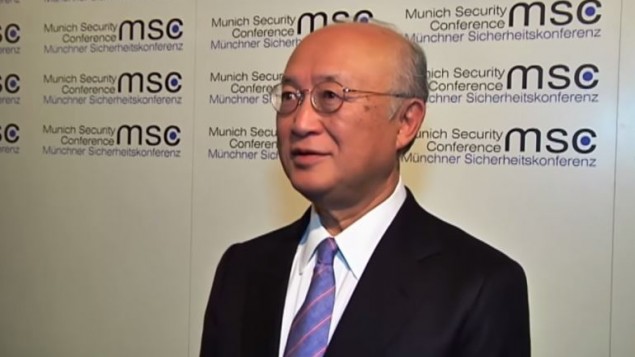
amino-e1432728404999-635x357Director-General of the International Atomic Energy Agency Yukiya Amano. (screen capture: YouTube/FRANCE 24 English)

UN nuclear agency chief Yukiya Amano says months needed to assess military aspects of Iranian nuclear sites.

PARIS, France (AFP) — If Iran signs a nuclear deal with world powers it will have to accept inspections of its military sites, the head of the UN’s atomic watchdog Yukiya Amano told AFP in an interview.

The question of inspections is shaping up to be one of the thorniest issues as world powers try to finalize a deal by June 30 to prevent Iran from developing a nuclear bomb.

Amano said Tehran has agreed to implementing the Additional Protocol of the Nuclear Non-Proliferation Treaty (NPT) that allows for snap inspections of its nuclear facilities, and if required, military sites.

However, differences have emerged over the interpretation of the protocol and the issue is far from resolved.

Iran’s supreme leader Ayatollah Ali Khamenei last week ruled out allowing nuclear inspectors to visit military sites or the questioning of scientists.

And Foreign Minister Mohammad Javad Zarif has said the protocol allows “some access” but not inspections of military sites, in order to protect national “military or economic secrets.”

In an interview with AFP and French daily Le Monde, Amano said that if a deal is reached, Iran will face the same inspections from the International Atomic Energy Agency (IAEA) as any of the 120 countries implementing the additional protocol.

“When we find inconsistency or when we have doubts we can request access to the undeclared location for example, and this could include military sites,” said the Japanese diplomat.

“Some consideration is needed because of the sensitiveness of the site, but the IAEA has the right to request access at all locations, including military ones.”

Iran and the so-called P5+1 group — Britain, China, France, Russia, the United States plus Germany — have been engaged for nearly two years in negotiations on Tehran’s nuclear drive.

The deal is aimed at preventing Iran from developing the atomic bomb in exchange for an easing of crippling economic sanctions.

The two sides signed a framework agreement on April 2 and began meeting in Vienna on Wednesday to start finalizing a deal which is due by June 30.

Possible military dimension

Iran has long asserted its nuclear program is for peaceful energy purposes, and that international concern about it seeking a nuclear bomb is misplaced.

According to the United States, Iran has agreed to cut the number of its centrifuges, used for enriching uranium, by two thirds from 19,000 to about 6,000, and will put excess nuclear equipment into storage monitored by the IAEA.

Iran has also reportedly agreed not to build any new facilities for enriching uranium for 15 years, cut back its stockpile of enriched uranium and mothball some of its plants.

However, Tehran is sensitive over the IAEA’s stringent oversight demands as the agency is at the same time trying to probe allegations that Iran tried to develop nuclear weapons prior to 2003, and possibly since.

Iran denies the allegations, saying they are based on hostile intelligence provided by the US Central Intelligence Agency (CIA) and Israel’s Mossad.

Western officials stress that these claims of “possible military dimensions” need to be cleared up before sanctions can be lifted, but the IAEA’s probe has been stalled since last August.

‘A huge operation’

Amano said that once there is a deal, “several months will be needed” to investigate whether there were any military dimensions to Iran’s research.

“It depends very much on the pace and the intensiveness of the cooperation from Iran. We have identified 12 areas to clarify.”

One notable area the IAEA is interested in is the Parchin military base, where they suspect tests relating to the development of nuclear weapons have taken place.

The IAEA has already visited the sprawling military base near Tehran but wants to return for another look.

Amano said it could take years “to give the credible assurance that all activities in Iran have a peaceful purpose”.

If a deal is reached with the P5+1, the IAEA will be charged with overseeing it and reporting back to the UN Security Council.

“This will be the most extensive safeguard operation of the IAEA. We need to prepare well, we need to plan well, it is a huge operation,” said Amano.

Currently the watchdog has between four and 10 inspectors in Iran at any given time, and if a deal is reached at least 10 will need to be on the ground daily.

The agency will also need to install cameras and seals on sensitive equipment.

Obama expounds the limits of Iran’s anti-semitism

May 23, 2015

Obama expounds the limits of Iran’s anti-semitism, Power LineScott Johnson, May 22, 2015

Assuming that Obama intends his remarks to be taken seriously, which I don’t, I find Obama’s comments among the stupidest and most ignorant he has ever uttered, although I concede on this point that that the competition is stiff.

*********************

In the course of his recent interview of President Obama — painful reading from beginning to end — Jeffrey Goldberg asked a somewhat challenging question regarding the Islamic Republic of Iran. “You have argued,” Goldberg observed, “that people who subscribe to an anti-Semitic worldview, who explain the world through the prism of anti-Semitic ideology, are not rational, are not built for success, are not grounded in a reality that you and I might understand. And yet, you’ve also argued that the regime in Tehran—a regime you’ve described as anti-Semitic, among other problems that they have—is practical, and is responsive to incentive, and shows signs of rationality.” Oh, wise man, how do you square this particular circle? Obama responded:

Well the fact that you are anti-Semitic, or racist, doesn’t preclude you from being interested in survival. It doesn’t preclude you from being rational about the need to keep your economy afloat; it doesn’t preclude you from making strategic decisions about how you stay in power; and so the fact that the supreme leader is anti-Semitic doesn’t mean that this overrides all of his other considerations. You know, if you look at the history of anti-Semitism, Jeff, there were a whole lot of European leaders—and there were deep strains of anti-Semitism in this country—

Goldberg (unfortunately) interrupted him at this point. Obama then continued:

They may make irrational decisions with respect to discrimination, with respect to trying to use anti-Semitic rhetoric as an organizing tool. At the margins, where the costs are low, they may pursue policies based on hatred as opposed to self-interest. But the costs here are not low, and what we’ve been very clear [about] to the Iranian regime over the past six years is that we will continue to ratchet up the costs, not simply for their anti-Semitism, but also for whatever expansionist ambitions they may have. That’s what the sanctions represent. That’s what the military option I’ve made clear I preserve represents. And so I think it is not at all contradictory to say that there are deep strains of anti-Semitism in the core regime, but that they also are interested in maintaining power, having some semblance of legitimacy inside their own country, which requires that they get themselves out of what is a deep economic rut that we’ve put them in, and on that basis they are then willing and prepared potentially to strike an agreement on their nuclear program.

This appears to have been good enough for Goldberg, but it should make a serious man cry. Let me count the ways.

Obama is in the process of finalizing an absurd arrangement with Iran that will at the same time obviate the cost of its pursuit of nuclear weapons and reward the regime for entering into the arrangement. They will reap the economic rewards of taking advantage of President Obama’s surrender to their (absurd) terms.

The Islamic Republic continues its program of ideological anti-Semitism and regional expansion. We await Obama’s “ratchet.” The regime evidently fears it not. This is glorified hot air.

Obama reiterates “military option [he’s] made clear[.]” The word “clear” here is the tell; it demonstrates that Obama is lying. There is no United States military option. Indeed, Obama’s public relations work on behalf of the Islamic Republic of Iran is suggestive of its removal from the shelf.

How does a seriously committed anti-Semitic regime weigh the costs and benefits of its anti-Semitism? I long for Professor Obama to draw from the well of his historical learning to apply the cost-benefit analysis to the Nazi regime of 1933-1945. Somebody get this man a copy of Lucy Dawidowicz’s The War Against the Jews, 1933-1945.

The Israelis draw the lesson they refer to in the slogan “Never again.” Emanuele Ottolenghi offers reflections that are precisely on point.

How does Professor Obama apply his cost-benefit analysis to the Iran’s 1979 bombing of the AMIA (Jewish) in Buenos Aires? It targeted Jews and killed 85 people. What costs was Iran prepared to incur? What costs has Iran incurred? The applicable cost-benefit analysis might illuminate how Iran thinks about the prospect of “eliminating” Israel by means of its proxies and with the nuclear weapons it is striving at all cost to obtain.

As for the regime’s alleged need to maintain a “semblance of legitimacy” inside Iran and therefore its alleged need to “get themselves out of a deep economic rut,” what does he mean? Obama is not saying that the regime lacks a semblance of legitimacy inside Iran at present. Obama himself continues to provide the regime something more than a “semblance of legitimacy.” Is the Supreme Leader feeling the pressure? No one outside Obama’s circle of friends can take this at face value.

Assuming that Obama intends his remarks to be taken seriously, which I don’t, I find Obama’s comments among the stupidest and most ignorant he has ever uttered, although I concede on this point that that the competition is stiff.

NOTE: Noah Rothman also takes a stab at doing justice to Obama’s comments here. It occurs to me that the words of Walter Laqueur in connection with Jan Karski’s mid-war report on the Holocaust in his book The Terrible Secret also apply here: “Democratic societies demonstrated on this occasion as on many others, before and after, that they are incapable of understanding political regimes of a different character….Democratic societies are accustomed to think in liberal, pragmatic categories; conflicts are believed to be based on misunderstandings and can be solved with a minimum of good will; extremism is a temporary aberration, so is irrational behavior in general, such as intolerance, cruelty, etc. The effort needed to overcome such basic psychological handicaps is immense….Each new generation faces this challenge again, for experience cannot be inherited.” In Obama’s world, I would add, experience can’t even be experienced. Ideological blinders render him obtuse (again assuming his words are to be taken at face value, which I don’t).

Relying on the U.S. for security is a mistake

May 21, 2015

Relying on the U.S. for security is a mistake, Al Arabiya News, Khalaf Ahmad Al Habtoor, May 21, 2015

(Al Arabiya is based in the United Arab Emirates and is majority-owned by Saudi broadcaster Middle East Broadcasting Center.– DM)

Obama says Iran’s newfound wealth will be used to improve lives rather than end up in the treasure chests of Hezbollah, the Shiite Yemeni Houthis, or other troublemakers under the Iranian wing. Sorry, but to me that smacks of naivety at best, snake oil at worst.

According to a Daily Telegraph investigation, Iran’s Supreme Leader controls “a financial empire” estimated to be worth $95 billion, more than even the grandiose Shah had managed to accumulate. That alone should tell Mr Obama that Iran has no intention of prioritising the needs of its people over its regional mischief makers.

****************

At a passing glance, President Barack Obama’s meetings with the leaders of the Arab Gulf States have borne fruit in terms of furthering mutual respect and as a building block to closer cooperation. But when one digs beneath the flimflam and the verbal pledges – with the exception of a joint missile defense system and a promise that deliveries of U.S. weapons would be fast-tracked – the recent Camp David Summit delivered few tangible benefits.

Indeed, more than a few commentators have described the meeting as a U.S.-hosted arms bazaar, one that will fill the coffers of American weapons manufacturers with billions of dollars. Plus the P5+1 – Iranian nuclear deal is set to enrich and empower Tehran once economic sanctions are lifted.

Obama says Iran’s newfound wealth will be used to improve lives rather than end up in the treasure chests of Hezbollah, the Shiite Yemeni Houthis, or other troublemakers under the Iranian wing. Sorry, but to me that smacks of naivety at best, snake oil at worst.

According to a Daily Telegraph investigation, Iran’s Supreme Leader controls “a financial empire” estimated to be worth $95 billion, more than even the grandiose Shah had managed to accumulate. That alone should tell Mr Obama that Iran has no intention of prioritising the needs of its people over its regional mischief makers.

Eradicating terrorism

The question is whether the leaders of the GCC countries should rightly feel secure from Iranian aggression now that the U.S. President has promised to come to their defense, militarily if deemed necessary. Naturally, that assessment would be made by the White House, not by the threatened states.

Without a signed and sealed security pact and in light of Obama’s track record of hesitancy in ending regional conflicts or eradicating terrorism, I don’t think so. Are we seriously to believe that the U.S. would declare war on Iran were we to be menaced?

Obama’s rhetoric speaks otherwise when he told the New York Times that internal threats to Gulf States are “bigger than Iran” and, at Camp David, he warned his guests not to “marginalise” Tehran. And even if Obama’s undertaking was rock solid, his term expires in just over 18 months. What happens then?

In any case, while there is nothing wrong with cementing better relations with the U.S., we must not on any account rely on its protection or that of any other world power. Yemen proves that we are able and willing to protect ourselves and our allies and when the proposed Joint Arab Force comes into play, our capabilities will be strengthened. We have no need of guardians or bosses in foreign capitals. We have strong, well equipped armies and air forces. We are not helpless, underage youths pleading to be defended, as characterised by sectors of the media.

Merely a public relations exercise

I would urge GCC heads of state to put Camp David under a microscope to ascertain whether it was a genuine attempt on Obama’s behalf to induce closer ties or merely a public relations exercise to bring Gulf States on board a bad deal rewarding Iran for its hostility, regional interference and its backing of terrorists.

In my opinion, trusting the Obama administration to rein in Iran would be a huge mistake. U.S. engagement with Iran was exactly the legacy Obama was after even before he moved into the Oval Office. And to that end he surrounded himself with pro-Iranian officials, such as Vice President Joe Biden, Secretary of State John Kerry and Deputy Secretary-of-State Bill Burns, who have all been championing détente with Iran for many years.

Obama’s personal adviser and family friend, Valerie Jarrett grew up in Iran, speaks Farsi, and was a main player along with Bill Burns in U.S.-Iranian secret talks to pave the way for official negotiations. The President’s National Security Council Director for Iran, Sahar Nowrouzzadeh is a former employee of the National-Iranian American Council, a pro-Iranian lobbying organisation.

The President’s own behaviour with regards to America’s long-time sworn enemy was suspect since the beginning. He has been sending the Iranians video Nawrus (New Year) messages and letters to Iran’s Supreme Leader. This year, Obama actually celebrated the Persian New Year at home with his wife and daughters.

Just as strange was Obama’s silence concerning Iran’s crackdown on street protests following elections. And if he condemns Tehran for its human rights abuses and lack of civil liberties, he must be whispering. Because all we hear from him is condemnation of predominately Sunni Arab states on those issues.

“The greatest supporter and plotter of terrorism”

Stranger still, while Obama comes across as the ayatollahs’ new best friend, just days ago, the Ayatollah Khamenei attacked the U.S. as “the greatest supporter and plotter of terrorism” and accuses Washington of pursuing its own interests making the region insecure, while branding America as the enemy of both Shiite and Sunni Muslims. Far from committing to stay out of Arab affairs, Khamenei stressed that his country would continue supporting “the oppressed people of Yemen, Bahrain and Palestine in every way possible.”

Are we really going to place our trust in America’s Commander-in-Chief when he claims backing the Free Syrian Army against the Syrian regime partnered with Iran and Hezbollah, even as his Air Force provides air cover to Iran’s Quds Force and pro-Iranian Shiite militias in Iraq’s Anbar province? This rabble with blood-stained hands – officially known as Popular Mobilisation Forces (Al-Shaabi) – has been deployed by Prime Minister Haider Al-Abadi and is directed by the commander of Iran’s Quds Force Qassem Soleimani. What is worse is that Iran is poised to send in ground troops as soon as it receives the go ahead from the government.

And what does Mr Obama say about the shocking news revealed by the Times and other papers to the effect that the government in Baghdad is turning away tens of thousands of desperate Sunni refugees fleeing the city of Ramadi, recaptured by ISIS? Nothing much as far as I can tell! Iraq families with nowhere to go are being treated worse than foreign foes, barred entrance into their own capital city unless they happen to have a local “guarantor.” This is a plan to reduce the Sunni population by sending them into the fray to die; there is no other explanation.

In reality, Saudi Arabia’s towns bordering northern Yemen are under direct threat from Houthis, while Iran, close to being literally under the Iranian boot, constitutes a grave threat to Gulf States. Does the Obama administration plan to wait until the horse has bolted before acting? The Iranian plot to dominate the region is taking shape before our eyes. We are being surrounded. Yet the U.S. president asks us to play nice with the plotters.

Qualitative military edge

The bottom line is we did not get what we asked for. Obama’s commitment to intervene in Syria to stop the regime’s killing spree was off the table along with a joint defense pact on the lines of those the U.S. has with Israel, Japan and South Korea. Moreover, he has turned down the Saudi request to purchase state-of-the-art F-35 Joint Strike Fighters to maintain Israel’s qualitative military edge over its neighbors.

And we certainly did not get what we need. Most importantly, any final agreement with Iran should be negotiated with the participation of Gulf states and co-signed by our leaders. Such agreement should not be limited to nuclear issues, but should be conditional upon Tehran’s commitment to quit meddling in the affairs of Arab countries, notably Syria, Lebanon, Iraq, Yemen and Bahrain whether directly (in the case of Iraq and Syria) or via its armed proxies (Lebanon and Yemen).

We should not trust any other countries but our own. We must not await instructions from the White House on how to pursue our own interests, as it is well-known that U.S. friendship is not proffered without strings. We must proceed with our mission to free Yemen of Houthi rabble, continue with our efforts to destroy ISIS and lend every support to that sector of the Syrian opposition fighting for a democratic, inclusive state – as opposed to terrorist groups that seek to drag Syria back to the Middle Ages.

Lastly, we should insist upon the stringent terms outlined above. And if those terms are not put in writing, the GCC should work to weaken the Iranian regime once and for all, beginning with material support for the oppressed Ahwazi Arab citizens of Iranian-occupied Arabistan – a region Iran now calls Khuzestan, which supplies the country with most of its oil and gas.

I fear that Camp David was a well-timed bluff and its weapons bounty no more than candies to sweeten the pill. I trust and believe that our leaders understand the score and will maintain independent strategies to counteract threats to our very existence. We cannot gamble with tomorrow on the words of one man, even if that man is the U.S. president.

Our region has been burned many times before. If the past is a good predictor of the future, we should recognise that ultimately we must become the masters of our own destiny, which is far too precious to be handed to the safekeeping of fair-weather friends.
Iran Runs Crying to UN

May 21, 2015

Iran to UN: Israeli defense minister threatened to nuke us
BY TIMES OF ISRAEL STAFF May 21, 2015, 7:43 am


(After calling for the destruction of Israel countless times, just what do you expect Iran? – LS)

Tehran claims Ya’alon’s comments on ‘steps’ Israel may take, alongside references to Hiroshima bombing, were an implicit threat.

Iran on Wednesday accused Israel of threatening the Islamic Republic with a nuclear strike, telling the UN Security Council that recent comments by Israeli Defense Minister Moshe Ya’alon were proof of “the regime’s aggressive nature,” according to Iranian media.

Ya’alon’s comments, made earlier this month at a conference hosted by a Tel Aviv-based nonprofit that seeks justice for victims of terror, mentioned “certain steps” Israel could take if it were out of other options, and referenced the US’s use of atomic weapons in Japan.

Iran’s ambassador to the UN, Gholam Ali Khoshrou, sent a letter on Wednesday to UN Secretary General Ban Ki-moon as well as to the UN Security Council in which he wrote that Ya’alon’s comments were tantamount to an admission that Israel has nuclear weapons and is willing to use them against other countries, the semi-official Fars news agency reported.

“Moshe Ya’alon’s recent remarks and the Zionist official’s implied reference to the possibility of using nuclear weapons against the Islamic Republic like what happened in Hiroshima and Nagasaki…shows more than ever the regime’s aggressive nature,” Khoshrou wrote.

“The impudent remarks have challenged the primary principles ruling the armed conflicts and the international humanitarian rights and weaken the international peace and security and therefore, the UNSC is expected to condemn these irresponsible remarks and clear threats of using nuclear bomb and massacre of civilians,” the letter added.

Israel has complained to the United Nations several times over explicit comments made by Iranian officials it says threaten the country’s extermination, as it has lobbied for world pressure to prevent Tehran from gaining nuclear capabilities.

While Jerusalem has engaged in saber-rattling against Iran in the past, and top officials still say they maintain the right to defend the country using whatever means necessary, most analyses estimate an Israeli strike would consist of conventional weapons used to thwart the country’s nuclear program.

Ya’alon’s comments, made in Jerusalem on May 5 at a conference hosted by the Shurat HaDin Israel Law Center, do not explicitly mention Iran or nuclear weapons. Instead the defense minister, speaking in English, made vague comments about “certain steps” Israel might consider against tyrannical regimes threatening the nation’s security.

Referring to “cases in which we feel like we don’t have the answer by surgical operations,” the defense minister said “we might take certain steps that we believe…should be taken in order to defend ourselves.

“Of course, we should be sure that we can look at the mirror after the decision, or the operation. Of course, we should be sure that it is a military necessity. We should consider cost and benefit, of course,” he said. “But, at the end, we might take certain steps.”

He then said he was reminded of US president Harry Truman who “was asked, How do you feel after deciding to launch the nuclear bombs, Nagasaki and Hiroshima, causing at the end the fatalities of 200,000, casualties? And he said, When I heard from my officers the alternative is a long war with Japan, with potential fatalities of a couple of millions, I thought it is a moral decision.

“We are not there yet,” Ya’alon then added.

Israel maintains a policy of what it calls nuclear ambiguity regarding its reported stocks of nuclear weapons, which it does not officially admit to having. Foreign reports, however, claim the country is in possession of thousands of atomic warheads.

A top adviser to Iranian Supreme Leader Ayatollah Ali Khamenei said Wednesday that over 80,000 Iranian missiles “are ready to rain down on Tel Aviv and Haifa” should Israel attack the Islamic Republic, in apparent response to Ya’alon’s comments.

Yahya Rahim Safavi, a former commander in the Iranian Revolutionary Guards Corps, told Fars Iran would “ruin” Israeli cities if faced with aggression by the Jewish state.

“The Zionists and the US are aware of the power of Iran and Hezbollah,” Safavi said, referring to the Lebanese terror organization backed by Tehran. “The Zionists have many problems and they know that Iran is too powerful for them grapple with.”

“We have displayed part of our military capabilities while we have kept many of our achievements and capabilities hidden to outsiders,” Safavi warned. “Our response will be crushing not just to the Zionist regime, but to any other aggressor who intends to take action against us.”

The veneer of civilization

May 19, 2015

The veneer of civilization, Israel Hayom, Sarah N. Stern, May 19, 2015

Throughout the negotiations with Iran over its nuclear program, U.S. President Barack Obama frequently stated that “no deal is better than a bad deal” and that “all options are on the table.”

And then, on April 2, after a framework agreement was concluded in Lausanne, Switzerland (but without even a piece of paper to wave, Neville Chamberlain-like), Obama said, “Do you really think that this verifiable deal, if fully implemented … is a worse option than the risk of another war in the Middle East?”

As soon as the choice was altered from “a good deal or no deal” to “either this deal or war,” we witnessed a sudden surge in Iranian swagger and bravado, in both their words and their actions.

On May 7, Iranian Revolutionary Guard Corps Deputy Commander Brig. Gen. Hussein Salami told Fars television: “We welcome war with the United States, as we do believe that it will be the scene for our success, to display the real potential of our power. We have prepared ourselves for the most dangerous scenarios, and this is no big deal.”

On May 12, Mojtaba Zolnour, a member of the IRGC and a close personal friend of Supreme Leader Ali Khamenei, said: “The government of the Islamic Republic of Iran has divine permission to destroy Israel. The noble Quran permits the Islamic republic to destroy Israel. Even if Iran gives up its nuclear program, it will not weaken this country’s determination to destroy Israel.”

This Iranian saber rattling has been accompanied by renewed provocations. On April 28, in the Strait of Hormuz — a major oil route — an Iranian crew commandeered the Maersk Tigris, a cargo ship flying under the flag of the Marshall Islands, a U.S. protectorate. They held the ship for six days before releasing it and its crew members. And just a few days after that, Iranian gunboats opened fire on the Alpine Eternity, a Singaporean-flagged ship, and tried to force it into Iranian territorial waters.

The more the U.S. treats Iranians with kid gloves so as not to offend them and to keep them at the negotiating table, the more the Iranians feel a renewed sense of triumph, and disdain toward the United States and its allies. (One would think the Americans were the ones who needed sanctions lifted to help our ailing economy).

On May 6, Jason Rezaian, a Washington Post reporter who has been held in an Iranian prison since July 2014, was charged with espionage. This trumped-up charge was a direct rebuke to the United States, demonstrating just how much contempt the Iranians have for the U.S. It is clear that the Iranians believe that we are determined to give them their cake, and to let them eat it, too. And like a spoiled child in the midst of a temper tantrum, the more we give the Iranians, the more they demand.

The sad fact is that the American negotiating team is basing its entire strategy on little more than wishful thinking. While visiting Beijing at the weekend, U.S. Secretary of State John Kerry said that a deal with Iran “will have a positive influence on North Korea” (although he did add that he wasn’t sure that the North Koreans were capable of “internalizing the message”). One wonders whether the secretary of state also believes in unicorns and fairies.

History indicates that the nuclear negotiations with North Korea were precisely what led to their possession of a nuclear bomb. It is actually the Iranians who have taken note and learned from the North Koreans, and not the other way around.

It has become increasingly obvious that the Obama administration does not know how to negotiate. It seems that they are intent on making a deal, any deal, with the Iranians. And the more they grovel, the more contemptible the United States becomes in the eyes of the Iranians.

That is why the United States Senate needs to hold a free and open debate on the details of the negotiations. Over the last two weeks, the leadership of both the House and the Senate did no one any favors by putting the Iran Nuclear Review Act of 2015 (Corker-Cardin) on the suspension calendar. This means it requires a straight up or down vote, with no room for attaching amendments or for discussion.

The real danger in the Iran Nuclear Review Act of 2015 is that it has turned this negotiation, which has the standing of an international arms treaty, into a bill that would require a veto-proof majority to block. That means that it will become law even if only 34 Senate Democrats support it. While a treaty requires a positive action of two-thirds of the Senate to approve it, now it will take two-thirds of the Senate to veto it, which is much more difficult to achieve, particularly during the immediate aftermath of a euphoric deal-signing ceremony, probably on the White House Lawn, replete with lofty speeches of “peace in our time.”

The framers of the Constitution were prescient when they required two-thirds of the Senate to ratify a treaty. And these negotiations are nothing short of a nuclear arms treaty that will impact the order of the world for generations to come.

When the final deal is signed on June 30, the U.S. Senate must insist that it has the international standing of a treaty and demand that if it does not have the support of 67 senators, it is null and void.

In the meantime, those congressmen and senators who want to pretend that they are attentive to the genuine concerns of the Saudis, the Israelis and patriotic Americans wary of the Iranian negotiations, are now able to hide behind the Iran Nuclear Review Act, this piece of paper that they recently signed.

As the late Congressman Tom Lantos — the only Holocaust survivor in the U.S. House of Representatives — was fond of saying, “The veneer of civilization is paper thin.”

Obama’s Not-So-Ironclad Guarantee

May 15, 2015

Obama’s Not-So-Ironclad Guarantee, Commentary Magazine, May 15, 2015

Now that the nuclear deal makes an Iranian bomb only a matter of when rather than if, the Gulf nations were hoping for more than just a carefully worded expression of American indifference.

***********

This was supposed to be the week when President Obama put on a show of his desire to reaffirm America’s support for its Arab allies. Saudi Arabia and the other Gulf states have spent the last year in the unusual position of agreeing more with Israel than the United States, as Obama pushes for détente with Iran. Like the Israelis, the Arabs are pondering their future in a region dominated by an Iranian nuclear threshold state that appears to be the lynchpin of the president’s foreign policy legacy. So to demonstrate his good will, Obama invited these nations to a summit at which he would convince them they had nothing to fear. But with the U.S. putting nothing on the table of substance that would allay those concerns about the weak nuclear deal being negotiated with Iran, the Saudi king and other leaders snubbed the event, turning it into a fiasco even before it began. But it turned out King Salman didn’t miss much. Though Obama offered what he called an “ironclad guarantee’ of America’s support for the Arabs, it was phrased in the kind of ambiguous language that rendered it meaningless. The meeting and especially the statement epitomized an Obama administration foreign policy that puts a premium on appeasing foes and alienating friends.

The wording of the president’s “guarantee” is a marvel of lawyerly ambiguity that any connoisseur of diplomatic doubletalk must appreciate:

In the event of such aggression or the threat of such aggression, the United States stands ready to work with our GCC partners to determine urgently what action may be appropriate, using the means at our collective disposal, including the potential use of military force, for the defense of our GCC partners.

Let’s unpack this carefully so we’re clear about what the United States isn’t promising its Arab allies. As even Obama’s cheerleaders at the New York Times noted, this “carefully worded pledge that was far less robust than the mutual defense treaty the Gulf nations had sought.” In the event of aggression, the U.S. isn’t going to spring into action to defend them. Instead it will “work” with them to “determine” what they might do. That falls quite a bit short of a hard promise of collective action, let alone the drawing of a line in the sand across which the Iranians may not cross. In other words, if something bad happens, Obama will talk with the threatened parties but he won’t say what he will do in advance or if he will do anything at all. If that is an “ironclad guarantee,” I’d hate to see what a less binding promise might sound like.

To understate the matter, this is not the sort of pledge that will deter an Iran that is emboldened by its diplomatic victory in the negotiations that let them their nuclear infrastructure and continuing working toward a bomb. Iran’s push for regional hegemony has also been boosted by the triumph of their Syrian ally Bashar Assad with the help of Tehran’s Hezbollah terrorist auxiliaries. With the Iran-backed Houthi rebels threatening to take over Yemen and Iran also resuming its alliance with Hamas in Gaza, the axis of Iranian allies has Arab states understandably worried about their future. Now that the nuclear deal makes an Iranian bomb only a matter of when rather than if, the Gulf nations were hoping for more than just a carefully worded expression of American indifference.

That’s why the statement at the end of the summit made no mention of America’s chief worry about the Gulf states: the possibility that the Saudis will, either acting alone or in concert with their neighbors, seek to match Iran’s nuclear potential. As critics of the Iran deal foretold, far from saving the Middle East from an Iranian bomb, it has set off an arms race that has will make the world a fare more dangerous place.

This omission will likely make the Iranians even more reluctant to give in to U.S. demands about sanctions, Tehran’s military research and the disposition of its stockpile of enriched uranium in the final stages of the nuclear talks. A better guarantee for the Arabs might have convinced the Islamist state that the president really meant business about strengthening the deal. In its absence, they have no reason to think Obama won’t fold as he has at every other stage of the negotiations.

Under the circumstances, it’s little wonder that Bahrain’s King Hamad preferred to go to a horse show London rather than confer with Obama. Just as Israel has learned that the United States is more interested in a new Iran-centric policy than it backing its traditional allies, so, too, must the Arabs come to grips with a new reality in which their Iranian foe is no longer restrained by the United States.

President Strangelove or, how I learned to stop worrying and love the bomb

May 14, 2015

President Strangelove or, how I learned to stop worrying and love the bomb, Jerusalem Post, David Turner, May 14,2015

Concerned about Soviet intentions in the region the Truman administration entered into the U. S.-Saudi Mutual Defense Assistance Agreement (MDA) in 1951. The Agreement provided the foundation for what would emerge as an American commitment to provide a defense umbrella for the region to protect American interests in the Middle East. American assurances to states in the region seemed intact until the GW Bush Administration invasion of Iraq. Trapped in a war it completely misjudged and soon realized it could not win the administration sought an accommodation with Iran to control Shi’ite militias battling the Americans.

The Bush policy of “accommodation” with Iran became the Obama policy of “appeasement” towards the Islamic Republic. Thus began a six-year-long quest to intended to encourage that country’s recalcitrant and hegemony ambitious leaders to abandon its nuclear weapons program. With the imminent 30 June deadline for signing an Agreement quickly approaching the president invited the Gulf Cooperation Council (GCC) states headed by Saudi Arabia to Camp David promising a mutual defense agreement assuring the Arab states of American protection in the event Iran proved a threat to the region. In addition to “assurances, the Saudis insisted on a signed and “formal alliance structure with the United States guaranteeingU.S. support against potential Iranian aggression.”

In advance of the conference the White House announced that President Obama would meet with the Saudi king the day beforeCamp David. But at the last minute, [d]ispleased with Washington’s dealings with Iran, with an emerging deal over its nuclear program and with US security proposals to Gulf Arab nations,” King Salman announced he would not meet with President Obama and would not attend the Camp Davidconference. In the end only two of six Gulf nations decided to attend with heads of state.

The king’s last-minute cancellation, his turn-down of a meeting with the leader of the Free World was described as “a calculated snub for the president’s policies on Iran and the Middle East.” It was revealed that Kerry, in his meeting with the Saudis the week earlier, told the king that Obama was not prepared to finalize according to the king’s timetable any agreement that might result at Camp David.

And then there was the fact that a mutual defense agreement with the Saudis, the 1951 MDA, already existed already assuring the Saudis protection under America’s nuclear umbrella. Mistrust of American intentions and assurances by America’s “allies” built up over the previous twelve years was palpable.

Bush and the Region

“Even before the inauguration [and, of course, the pretext of 9/11], Cheney asked outgoing Secretary of Defense William Cohen to provide Bush with a briefing focused on Iraq… [Bush appointee] Defense Secretary Rumsfeld saw, “September 11, 2001, as a potential “opportunity.””

Symptomatic of hubris resulting from power minus coherent policy President Bush ignored both Arab and Israeli warnings of Foreseen Consequences certain to follow should the administration follow through with its threat to invade Iraq.

“With his latest remarks, [Saudi, later king] Prince Abdullah joined the chorus of Arab complaints about the Bush administration’s talk of taking military action to oust Saddam Hussein and put an end to his programs to develop weapons of mass destruction. At virtually every stop in the Arab world, Mr. Cheney has been told that an American military strike would destabilize the region.”

And, according to Lawrence Wilkerson, a member of the State Department’s Policy Planning Staff, “[t]he Israelis were telling usIraq is not the enemy – Iran is the enemy.” Wilkerson said that the Israeli reaction to invading Iraq in early 2002 was, “If you are going to destabilize the balance of power, do it against the main enemy.”

Bush and the Bomb

Cut off the head of the snake,” the Saudi ambassador toWashington, Adel al-Jubeir, quotes the king as saying during a meeting with General David Petraeus in April 2008.

In a speech to the Knesset in 2008 to observe Israel’s 60thanniversary Bush told the Knesset, “America stands with you in firmly opposing Iran’s nuclear weapons ambitions. Permitting the world’s leading sponsor of terror to possess the world’s deadliest weapon would be an unforgivable betrayal of future generations.” Nowhere in his speech did Bush hint at his long held view that America was not prepared to enter another Middle East war, that there never was a military option with which to threaten Iran’s nuclear weapons program. No accident then that Bush chose war-averse Robert Gates as his defense secretary; and that Gates in turn chose war-averse Admiral “Mike” Mullen as head the Joint Chiefs of Staff. The dovish defense pair would for years be the president’s PR mouthpiece warning against even the threat of force to halt Iran’s nuclear program. The Gates/Mullen oft-repeated warning of “unforeseen consequences” became, over the years a common, almost mantra-like warning against any action against Iran.

No surprise then that the openly dovish, newly-elected President Obama invited Gates to remain on as his defense department head, “a show of bipartisan continuity in a time of war that will be the first time a Pentagon chief has been carried over from a president of a different party.”

Obama and the Region

By way of destabilizing the region Obama has not yet equaled the fallout of Bush’s invasion of Iraq. If Bush gifted Iraq to Iran, set the stage for the “Arab Spring,” Obama did not come in second for lack of trying. The new president followed Bush by targeting his own tyrant, Muamar Qadafi and transformingLibya, as did Bush in Iraq, a political wreck bordering on a failed state.  Libya today is ruled al-Queda, Islamic State and other terror organizations with two governments powerless to assert control. Bordering Egypt Libya today supplies both the Sinai Salafist insurgency and the terror enclave of Gaza with weapons. And as Bush ignored Israeli and Arab warnings regarding the impact of invading Iraq, Obama chose to those same Arab-Israeli warnings regarding his intention to depose America’s principal Arab ally, Hosni Mubarak of Egypt. In a single mindless move the U.S. followed up its Iraq disaster with Egypt. And followed the collapse of Egypt’s secular regime, insult to injury Obama endorsed as “democratic government” the same Muslim Brotherhood with a decades-long terror campaign against the government; the group behind the assassination of Anwar Sadat for having sought peace with Israel: the Muslim Brotherhood whose child, al-Quaeda, had flown airliners into New York’s World Trade Center! The list of Bush and Obama Administration policy failures seems to know no limits: Iraq redo, Bahrain,Yemen and the bloodbath of Syria. Lacking capacity to learn from ideology-based failures, it continually repeats its “unintended consequences.”

Obama and the Bomb

If Bush set the pattern for accommodation then the tactic at least had some “justification” as Iran’s IRGC was funding, arming and even leading the Shi’ite insurgency against Iraq’s American invaders. Not provoking Iran might have the result of limiting American casualties. But for Obama, recipient in advance of the Nobel Peace Prize for promising regarding “world peace”; for Obama to provide Iran, a state sponsor of Islamist terrorism a world forum to show up American weakness and enhance Iranian prestige; for Obama whose commitment on entering office was to promote nuclear non-proliferation: for Obama to provide Iran all the time necessary to achieve threshold nuclear armament status and, failing to contain Iran the consequence would be a nuclear arms race in the lands of the Arab Spring… Saudi Arabia,Turkey and Egypt are already moving to parity with Iran whileJordan and several Gulf states are at varying stages of planning.   

Obama, who promised nuclear non-proliferation, has turned out to be godfather to a nuclear arms race in the least stable, most militant region of the world!

Why the Snub? Saudis Know Obama’s Replaced Them With Iran

May 11, 2015

Why the Snub? Saudis Know Obama’s Replaced Them With Iran, Commentary Magazine, May 11, 2015

Will Obama get the message and change course? That’s even less likely than him embracing Netanyahu. An administration that came into office determined to create more daylight between itself and Israel has now embarked on a policy designed to alienate all of America’s traditional allies in order to appease a vicious Islamist foe. Anyone who thinks this will turn out well simply isn’t paying attention to the same events that have left the Saudis and other U.S. allies thinking they are more or less being left on their own.

**********************

If the Obama administration thought it’s half-hearted efforts to make up with Saudi Arabia and other Arab states outraged by its Iran policies, it’s got another thing coming. On Sunday, the Saudis told the White House that King Salman would not be attending meetings there or at Camp David this week. Later, Bahrain said its King Hamad would skip the same meeting. The snubs are as pointed as President Obama’s recent signals that he has no intention of meeting with Israeli Prime Minister Benjamin Netanyahu anytime soon. But while the president has little interest in patching things up with America’s sole democratic ally in the Middle East, he was quite interested in making nice with the Saudi monarch. But the Saudis and Bahrain, like the Israelis, are deeply concerned by the U.S. effort to create a new détente with Iran. It’s not just that Salman apparently has better things to do than to schmooze with Obama. The president may have thought he could essentially replace the Saudis with Iran as the lynchpin of a new Middle East strategic vision without paying a price. But the Saudis understandably want no part of this. The result will be a region made even more dangerous by the Arabs, as well as the Israelis, coming to the realization that they can’t rely on Washington.

The conceit of Obama’s strategy rests on more than a weak deal that he hopes will be enough to postpone the question of an Iranian bomb even as it essentially anoints Tehran as a threshold nuclear power. Rather it is predicated on the notion that once Iran is allowed to, in the president’s phrase, “get right with the world” and reintegrated into the global economy, it can be counted on to keep peace in a region from which Obama wants to withdraw.

That’s why the administration has tacitly allied itself with Iran in the struggle against ISIS in Iraq and, bowed to Tehran’s desire to leave its ally Bashar Assad in power in Syria even as they sought to restrain the Islamist regime’s Houthi friends in their effort to take over Yemen. But given Iran’s desire for regional hegemony, it’s reliance on terrorist allies like Hezbollah and Hamas as well as Assad’s criminal regime, the notion that it is a force for stability is as much a delusion as the idea that it is giving up its quest for nuclear weapons.

Just as important, the Obama foreign policy team was convinced that it could afford to ignore the Saudis’ concerns about their intended entente with Iran with as much impunity as it did those of Israel. As one expert quoted in the New York Times said, the Saudis have no alternative to the U.S. as a superpower ally. But it has not failed to escape their attention that “there’s a growing perception at the White House that the U.S. and Saudi Arabia are friends but not allies, while the U.S. and Iran are allies but not friends.”

Under the circumstances, the Saudis are now prepared to show the president the extent of their disdain. But it may not stop at that.

The Saudis, like the Israelis, know that America’s promises about both the nuclear deal and the future of the region are not worth much. The Iranians have been granted two paths to a bomb by the United States. One is by cheating via the easily evaded restrictions in the nuclear pact with little fear of sanctions being snapped back. The other is by patiently waiting for it to expire while continuing their nuclear research with little interference from a West that will be far more interested in trade than anything else.

That leaves the Saudis thinking they may need to procure their own nuclear option and to flex their muscles, as they have been doing in Yemen. It also sets up the region for what may be an ongoing series of confrontations between Iranian allies and the Saudis and their friends, a recipe for disaster.

Will Obama get the message and change course? That’s even less likely than him embracing Netanyahu. An administration that came into office determined to create more daylight between itself and Israel has now embarked on a policy designed to alienate all of America’s traditional allies in order to appease a vicious Islamist foe. Anyone who thinks this will turn out well simply isn’t paying attention to the same events that have left the Saudis and other U.S. allies thinking they are more or less being left on their own.

Iran and suspension of disbelief

May 8, 2015

Iran and suspension of disbelief, Israel Hayom, Yoram Ettinger, May 8, 2015

The term “suspension of disbelief” — coined in 1817 by the philosopher Samuel Taylor Coleridge — refers to a willingness to suspend one’s critical faculties and believe the unbelievable; sacrificing reality, common sense, doubt and complexity on the altar of a pretend reality, convenience and oversimplification; infusing a semblance of truth into an untrue narrative.

U.S. President Jimmy Carter’s policy toward Iran in 1977-1979 was characterized by suspension of disbelief: energizing the Ayatollah Ruhollah Khomeini while ignoring or underestimating his track record and his radical, supremacist and violent worldview. The betrayal of the Shah transformed Tehran from “the U.S. policeman in the Gulf” to the worst enemy of the U.S.

Currently, the suspension of disbelief undermines the U.S. posture of deterrence and vital U.S. national security and commercial interests. It was demonstrated by U.S. President Barack Obama, who — irrespective of Middle East reality — referred to the brutally intolerant, terror-driven, anti-U.S., anti-infidel, repressive, tumultuous Arab tsunami as the “Arab Spring.” He said it was “casting off the burdens of the past,” “a story of self-determination,” “a democratic upheaval,” “a peaceful opposition,” “rejection of political violence” and “a transition toward [multi-sectarian, multi-ethnic] democracy.”

Suspension of disbelief, coupled with the ayatollahs’ mastery of ‘taqiyya’ (Islam-sanctioned double-talk and deception), is what led U.S. Secretary of State John Kerry to assert on November 24, 2013 that “Iran’s Foreign Minister [Mohammad Javad] Zarif emphasized that they don’t intend to acquire nuclear weapons, and Iran’s supreme leader has indicated that there is a ‘fatwa’ [an authoritative religious ruling] which forbids them to do this.”

In an April 7, 2015 NPR interview, Obama made a reality-stretching assumption which underlines the Iran policy: “If in fact Iran is engaged in international business … then in many ways it makes it even harder for them to engage in behaviors that are contrary to international norms. … It is possible that if we sign this nuclear deal, we strengthen the hand of the more moderate forces in Iran.”

Rebutting Obama’s remarks, Amir Taheri, a leading authority on Iran, wrote: “Hope is not a sufficient basis for a strategy. … [The relatively moderate former President Akbar Hashemi] Rafsanjani has little chance of surviving a direct clash with [Supreme Leader Ayatollah Ali] Khamenei.

The Saudi frustration with U.S. policy on Iran — shared by all pro-U.S. Arab regimes — was expressed on April 25, 2015 by the opinion editor of the prestigious Saudi daily Asharq Al-Awsat, which echoes the position of the House of Saud: “While the U.S. considers the ayatollahs a legitimate partner to negotiation, Saudi Arabia and other Persian Gulf states are in a state of war with Iran, which is the main source of chaos in the region.” The editor-in-chief of the Saudi daily added: “Has the axis of evil collapsed to the extent that President Obama is courting one of its key members?! Isn’t this the same Tehran that has posed a clear and present danger to the Gulf states for the past 36 years?!”

• An agreement is not the goal, but a tool to achieve the real goal.

• Transforming an agreement to a goal undermines the real goal.

• Details of an agreement are less critical than the details of the ayatollahs’ 36-year track record of supremacist, apocalyptic and megalomaniacal violence, martyrdom, sponsorship of global Islamic terrorism, subversion of pro-U.S. Arab regimes, repression, anti-U.S. hate education- and policies, a systematic noncompliance with agreements and mastery of concealment.

• Such a track record warrants a “guilty until proven innocent” approach.

• Preconditioning an agreement upon a dramatic change in the conduct of the rogue, anti-U.S. ayatollahs would be “a poison pill” to a bad deal, but a vitamin to a good deal.

• A “bad deal” would nuclearize Iran; “no deal” would allow the U.S. to choose the ways and means to prevent Iran’s nuclearization.

• Nuclear capabilities would extend the life of the repressive, rogue ayatollah regime, precluding any hope for civil liberties or home-induced regime change.

• An agreement — not preconditioned upon the transformation of the ayatollahs — would compound their clear and present threat to vital U.S. interests.

• The transformation of the nature of the ayatollahs — as a precondition to an agreement — would prevent the nuclearization of the ayatollahs.

• Precluding the option of military pre-emption has strengthened and radicalized the rogue ayatollahs, and could lead to a nuclear war.

• Misrepresenting the option of military pre-emption as war defies reality, since it should be limited to surgical — no troops on the ground — air and naval bombings of critical parts of Iran’s nuclear infrastructure from U.S. bases in Bahrain, Qatar, Saudi Arabia, Oman and the Indian Ocean, or aircraft carriers.

• A U.S. military option forced Iran to end the 1980-1988 war against Iraq, convinced Libya to give away its nuclear infrastructure in 2003, and led Iran to suspend its nuclear development in 2003.

• “Ironclad” supervision and intelligence failed to detect the nuclearization of the USSR, China, Pakistan, India and North Korea.

• Unlike the USSR, which was deterred by Mutual Assured Destruction, the apocalyptic ayatollahs would be energized by MAD-driven martyrdom.

• The zeal to strike a deal has led to a U.S. retreat from six U.N. Security Council Resolutions, which aimed to prevent Iran’s nuclearization.

• A nuclear Iran, which celebrates “Death to America Day,” would devastate cardinal U.S. interests: toppling the oil-producing Arab regimes (impacting supply and price of oil) and other pro-U.S. Arab regimes; intensifying Islamic terrorism, globally and on the U.S. mainland; agitating Latin America; collaborating with North Korea; cooperating with Russia and destabilizing Africa and Asia.

• The track record of the ayatollahs on the one hand, and compliance with agreements on the other hand, constitute an oxymoron.

• Suspension of disbelief, in the case of Iran’s nuclearization, entails overlooking facts that highlight the implausibility of a viable agreement with the ayatollahs, thus damaging crucial U.S. interests and fueling a nuclear war.

Iran’s chutzpah

May 3, 2015

Iran’s chutzpah, Jerusalem Post editorial, May 2, 2015

Iran chutzpahIran. (photo credit:REUTERS)

Whenever we assume that Iran’s chutzpah can get no more egregious, Tehran’s powers-that be spare no effort to prove us wrong.

Their calculated ploy is transparent – since the Islamic Republic’s nuclear project is now the focus of global attention, its leaders have cynically decided to turn the tables on their critics. In the guise of holier-than-thou protectors of humanity, Iran last Monday demanded that everyone else in possession of nukes desist forthwith from upgrading them or from lengthening the shelf-life of these weapons.

Needless to say, the sanctimonious tit-for-tat was spitefully in-your-face.

Quite expectedly, Iranian Foreign Minister Mohammad Javad Zarif told participants at the Review Conference of the Parties to the Treaty on the Non-Proliferation of Nuclear Weapons in New York that it is Israel which poses the greatest menace to the Middle East and indeed to the entire world due to its alleged nuclear stockpiles.

The month long conference is held every five years and is attended by NPT signatory nations. Israel never signed the treaty and remains officially mum on whether it does or does not possess a nuclear arsenal.

Zarif brazenly branded Israel “the single violator of this international regime [the NPT]…,“ and said, “one of the most important issues in the NPT review process is to look into ways and means of bringing about the Israeli compliance with NPT.”

And if that message failed to hit home, Zarif also aimed his barbs at NATO, asserting that Iran and the other 117 non-aligned NPT signatories are “deeply concerned by military and security doctrines of the nuclear-weapon states as well as that of the North Atlantic Treaty Organization.”

Yet Israel, which Iran had time and again threatened to wipe off the map, was singled out for particular accusations of villainy. Iran shamelessly seized on a persistent Egyptian theme – an attempt to deprive Israel of whatever nuclear powers it is believed to possess and coerce Israel to sign the 1970 NPT.

In 2005, Egypt scuttled the NPT resolutions because they did not specifically target Israel’s purported nuclear weaponry. In 2010, Egypt, still under Hosni Mubarak, persuaded the US to address Israel’s nuclear capability in the final communiqué – making Israel the only state mentioned, unlike the openly nuclear Pakistan and India (which like Israel also had not signed the NPT).

Israel saw this as a sell-out by the Obama administration.

The conference said nothing about Iran but urged that Israel rid itself of nuclear arms and that it allow international inspectors to visit and monitor its installations.

What five years ago was considered as unprecedented hypocrisy by the NPT Conference has now magnified to truly grotesque proportions. If Iran was just an unnamed elephant in the room last time around, it has since grown emboldened enough to lay blame on others.

Presumably this is part and parcel of a scheme to deflect attention from Tehran’s nuclear ambitions while a deal that would allow it to develop atomic warheads is in the making.

On the face of it, Iran can claim moral equivalence. But this is a counterfeit claim. Iran and like-minded allies – to say nothing of the powers now negotiating a deal with the ayatollah regime – all know that Israel is as prudent a democracy as exists anywhere. If Israel actually has the bomb, then it has had it for more than 50 years – almost as long as the original “Atomic Club” members. In all that time no wrongful use was made.

Iran is the diametrical opposite to Israel – a regime professing extreme Islamist doomsday theology whose bywords are volatility and unpredictability. There’s no even handedness between a self-defending democracy and an expansionist, apocalyptic tyranny.

Moreover, it is outrageous to ignore the variety of WMD deployed in the internecine Arab massacres but speciously concentrate on the Middle East’s one beleaguered democracy. The implication is that democratic Israel can be pressured while autocratic Iran will get away with flagrant obstructionism. The good-guy will be disarmed while fanatic aggressors are armed to the teeth.

The danger is that bona fide democracies seem willing to play along with Iran and misdirect the frustration it foments by spotlighting Israel.