Archive for the ‘North Korean nukes’ category

Analysts Sound New Alarms on North Korea Missile Threat

May 31, 2017

Analysts Sound New Alarms on North Korea Missile Threat, Gatestone InstitutePeter Huessy, May 31, 2017

(What about the Iran – North Korea nexus? — DM)

The news media and independent experts have pointed out that North Korea’s ICBMs could reach Alaska, Hawaii or even the Pacific Northwest. But these missiles are said to have a range of 10,000 kilometers, which means they would hit Missouri, or 40 percent of the continental United States, said Klingner. “After they did the successful launch last year, now the estimate is probably 13,000 kilometers, which is all the way down to Miami, the entire continental U.S.”

***********************************

The North Koreans now have the range capability to strike the United States with a ballistic missile. “It is a matter of physics and math.” — USAF General John Hyten, Commander of United States Strategic Command, May 9, 2017.

“A major headache for the United States is that much of the financial and technological support for North Korea’s weapons programs comes from China.” — Joseph Bosco, Senior Fellow at the ICAS Institute for Korea-American studies.

North Korea just conducted its seventh missile test launch so far this year. No one should expect this activity to cease, and no one should be surprised by North Korea’s progressively more advanced weapons capabilities, analysts said at a recent Mitchell Institute forum on Capitol Hill, hosted by the author.

“During Kim Jung Un’s five years in power he has done twice, perhaps three times, as many launches of missiles as his father did in 18 years,” said Bruce Klingner, a senior research fellow at the Heritage Foundation.

The North Korean dictator is not showing any signs of slowing down, and he is determined to push forward the country’s program to enhance the medium and long-range missiles and nuclear warheads that now threaten the United States and its allies.

Klingner estimates that North Korea has 16 to 20 nuclear weapons. “And then, of course, the question or the debate is how far along they are,” he said. “I think it is pretty clear they’ve weaponized and miniaturized the warhead, that right now the Nodong medium-range ballistic missile is already nuclear capable.” This means U.S. allies Japan and South Korea are under a nuclear threat today, he stressed. “It is not theoretical, it is not several years in the future as some analysts or experts will tell you.”

The threats posed by North Korea are wide ranging, Klingner noted. “They’ve got, we estimate, 5,000 tons of chemical warfare agents.” And it has a sophisticated army of cyber warriors. “They are, perhaps, in the top five or top three countries in the world for cyber attack capabilities.”

Missile attacks are, it seems, what worries U.S. policy makers the most. A rising concern are submarine-launched ballistic missiles because of the immediate risk they create for South Korea. “The North Korean subs can come out on the east or west coast and threaten South Korea,” Klingner said.

North Korea successfully tested a Musudan intermediate-range ballistic missile last year, and they “flew it to an unusually high trajectory,” he said. “Had they lowered the trajectory and fired it for effect, the estimates are it could have ranged Guam. So that’s a new threat to a key node for the U.S. defense of the Pacific.”

Keeping U.S. officials up at night is the possibility of an ICBM launch. North Korea has developed several systems. One of its most advanced systems is a space launch vehicle, Klingner said. “But it’s the same technologies you would need to fire off an ICBM warhead.”

As USAF General John Hyten, Commander of United States Strategic Command, said on May 9th at a Strategic Deterrent Coalition nuclear symposium, that the North Koreans now have the range capability to strike the United States with a ballistic missile. “It is a matter of physics and math” he explained.

The news media and independent experts have pointed out that North Korea’s ICBMs could reach Alaska, Hawaii or even the Pacific Northwest. But these missiles are said to have a range of 10,000 kilometers, which means they would hit Missouri, or 40 percent of the continental United States, said Klingner. “After they did the successful launch last year, now the estimate is probably 13,000 kilometers, which is all the way down to Miami, the entire continental U.S.”

Another cause for alarm is the number of rocket engine tests, he said. “They took the first stage of a solid fuel ICBM, to see if it works.” Rocket scientists, just by looking at the photos, were able to say that they’re using two engines, which are better than the ones U.S. experts thought they were using. By the size and shape and color of the exhaust plume, analysts concluded, the North Koreans are “using a much-improved propellant than we thought.”

At the same forum, Joseph Bosco, a Senior Fellow at the ICAS Institute for Korea-American studies, noted “A major headache for the United States is that much of the financial and technological support for North Korea’s weapons programs comes from China”.

“Back in the late 1980s and early 1990s,” Bosco further explained, “North Korea began its program to develop nuclear weapons. China provided the necessary startup technology through the A.Q. Khan network in Pakistan….Today China accounts for 90% of North Korean trade with the outside world. Let’s face it, China keeps the Kim regime afloat, alive and well, and capable of continuing to invest in advancing it’s nuclear and missile programs.” Bosco said. “There is significant evidence that it directly facilitates the ongoing nuclear and missile programs through China’s banking system and the use of Chinese ports and airports for the trans-shipment of prohibited North Korean parts and technologies.”

Bosco further said that Defense Secretary Leon Panetta had told the Senate Intelligence Committee in 2012 that China was irrefutably providing advanced technology for North Korea’s ballistic missile program.

“It has been clear for 60 years that the sole cause of tension and instability between the Koreas has been Pyongyang’s own bizarre and dangerous behavior. Despite substantial aid and concessions from an accommodating South Korean government, China alone has the power to change that.”

Klingner said it remains to be seen how the Trump administration deals with these foreign policy predicaments. “When I’ve talked to folks in the administration they have described the policy as a heavy emphasis on sanctions and pressure and targeted financial measures.” The administration also apparently wants to augment ballistic missile defense and has indicated a “willingness to have our diplomats talk with their diplomats,” Klingner said. “The door has always been open, but it is North Korea that repeatedly closes the door.”

As Bosco emphasized, it is China that has to come clean.

It is also evidently China that has created a neighboring Frankenstein monster that keeps escaping from its nuclear laboratory. Reining-in North Korea is possible, but without strong Chinese economic and military pressure, which the Chinese seem loath to give, the North Korean nuclear challenge may be insurmountable.
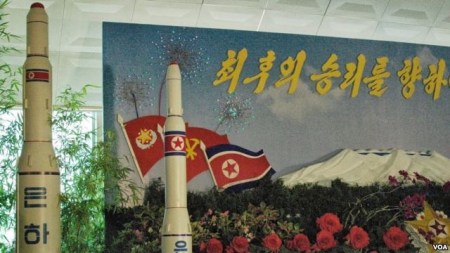
A model of the North Korean Unha-9 long-range rocket on display at a floral exhibition in Pyongyang. (Image source: Steve Herman/VOA News/Wikimedia Commons)

Dr. Peter Huessy is President of GeoStrategic Analysis, a defense consulting firm he founded in 1981, and was the senior defense consultant at the National Defense University Foundation for more than 20 years.
Japan vows ‘specific action’ with US to deter N. Korea

May 29, 2017

Japan vows ‘specific action’ with US to deter N. Korea, The HillKyle Balluck, May 29, 2017

(Please don’t tell us until after it’s done. — DM)

© Getty

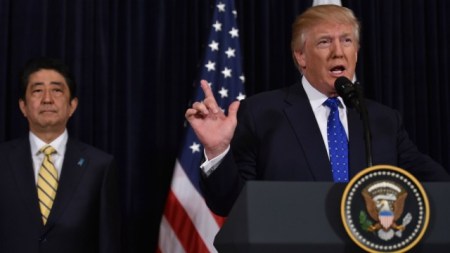
Japanese Prime Minister Shinzo Abe is vowing “specific action” with the U.S. to deter North Korea in the wake of Pyongyang’s latest missile test.

“As we agreed at the recent G7, the issue of North Korea is a top priority for the international community,” Abe told reporters on Monday, according to Reuters. “Working with the United States, we will take specific action to deter North Korea.”

The news service added that Japan protested the test.

U.S. Pacific Command said it detected the launch of a short-range ballistic missile from a site near Wonsan Airfield on Sunday. It tracked the missile for approximately six minutes until it landed in the Sea of Japan.

“We are working with our Interagency partners on a more detailed assessment. We continue to monitor North Korea’s actions closely,” U.S. Pacific Command said in a statement, adding that it “stands behind our ironclad commitment to the security of our allies in the Republic of Korea and Japan.”

A National Security Council spokesman said President Trump was briefed on the latest North Korean test.

Pyongyang said last week that it was ready to deploy a new medium-range missile as part of an “answer” to Trump’s policies. The North also fired a missile hours before Trump delivered a major speech in Saudi Arabia earlier this month.

Waiting for North Korea’s Next Nuclear Test

May 28, 2017

Waiting for North Korea’s Next Nuclear Test, PJMedia, Claudia Rosett, May 27, 2017

(To the extent that history is a good predictor of the future, more sanctions — even if enforced briefly — won’t work. Regime change, maybe. But how can we find a suitable replacement for Kim Chi-un Kim Jong-un? Has the recent high-level defector been asked? It would be stupid to let the Norks know whether he has been and, even worse, what, if anything, he said because anyone he suggested would be killed. No matter how much the leakers and media would like to know, secrecy is absolutely necessary. –DM)

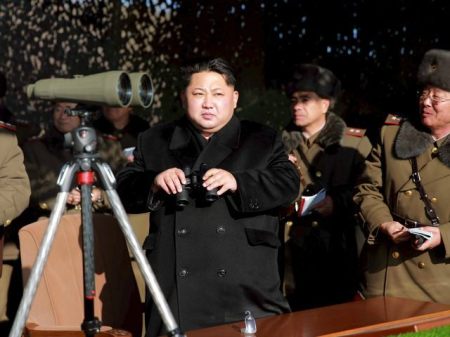
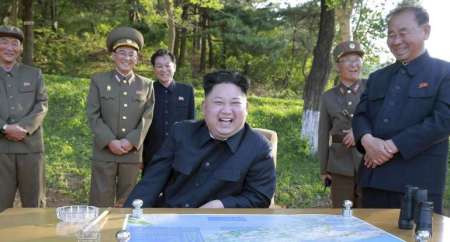
In this undated photo distributed by the North Korean government Monday, May 22, 2017, North Korean leader Kim Jong Un watches the test launch of a solid-fuel “Pukguksong-2” at an undisclosed location in North Korea. (Korean Central News Agency/Korea News Service via AP)

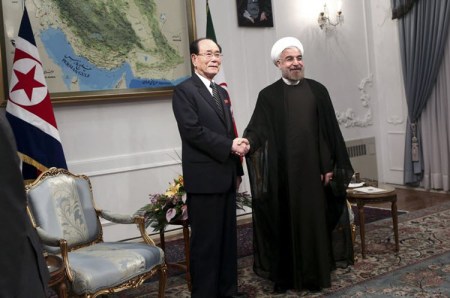
The threats from North Korea keep rising — not only its nuclear program, but such matters as its cyber warfare projects, plus the example Pyongyang continues to set of how a malign and predatory tyranny can survive by arming itself with the world’s most destructive weapons and threatening liberally to use them. We should have no doubt that Iran and others are taking notes.

What’s certain is this: None of this will be resolved by America writing off regime change as the real goal in Pyongyang while waiting to respond with another stack of UN sanctions, however neatly pre-negotiated, to North Korea’s next nuclear test.

******************************

Just last month, Secretary of State Rex Tillerson told the United Nations Security Council that the era of letting North Korea call the shots was over. Commenting on a record in which North Korea has carried out five nuclear tests since 2006, two of them just last year, Tillerson said: “For too long the international community has been reactive in addressing North Korea.” He added, “Those days must come to an end. Failing to act now on the most pressing security issue in the world may bring catastrophic consequences.”

Yet here we are, with Reuters reporting, based on a news conference held Friday in Beijing by senior State Department official Susan Thornton, that the U.S. is “looking at discussing with China a new Security Council resolution on pre-negotiated measures to reduce delays in any response to further nuclear tests or other provocations from the North.”

In other words, the U.S. is waiting to react to North Korea’s next nuclear test, which North Korean officials have already threatened to carry out, and for which preparations have been visibly underway.

With the variation that the diplomatic response (providing China agrees) would be “pre-negotiated,” this sounds disturbingly similar to the ritual that President Obama’s administration dolled up under the fatuous label of “strategic patience.” The result, on Obama’s watch, was that North Korea carried out four of its five nuclear tests to date, and accelerated its missile program to include over the past three years — as The Wall Street Journal reported recently — the launches of “more major missiles than in the three previous decades combined.”

The Obama ritual went like this: North Korea would carry out a forbidden nuclear test (in 2009, 2013, and two in 2016). The U.S. would turn to the UN Security Council, which after a period of closed-door wrangling would respond by approving yet another sanctions resolution, which would then be advertised by the U.S. as tough… tougher… toughest. Whatever.

Recall America’s former ambassador to the UN, Samantha Power, declaring after the passage of UN Security Council Resolution 2270 in March 2016 (in response to North Korea’s fourth nuclear test) that “this resolution is so comprehensive, there are many provisions that leave no gap, no window.” That resolution was followed last September by North Korea’s fifth nuclear test, to which the UN responded by adding to the gapless, windowless sanctions resolution #2270 the even more gapless and windowless resolution #2321.

One might reasonably ask: Why reserve all those ever tougher sanctions for North Korea’s next nuclear test, or the one after that? If gapless, windowless sanctions have yet more holes that need plugging, why not do it all now?

If I might hazard a guess, the obstacle is not solely that veto-wielding permanent Security Council members China and Russia have no serious interest in trying to throttle North Korea’s Kim regime. Even when they vote for those ever tougher UN sanctions, they have been, to put it generously, highly casual about enforcing them. On the evidence, China — despite its public expressions of disapproval and disappointment over each North Korean nuclear test — has nonetheless, for decades now, allowed North Korea to proceed. It is past time to ask quite seriously whether Beijing (never mind its public posturing) reached a quiet decision quite some years ago that China can live comfortably enough with a nuclear-armed North Korea that dedicates itself to bedeviling such leading democracies as South Korea, America and Japan.

Nor is the problem solely that sanctions, to whatever degree they are attempted, have virtually no chance of forcing North Korea into a good-faith deal to give up its long-established, deeply entrenched nuclear program. In previous talks and deals (1994, 2005, 2007, as well as President Obama’s attempted 2012 so-called Leap Day missile-freeze deal), Pyongyang racked up an unbroken record of lying, cheating, pocketing the gains and carrying on with its threats and WMD projects.

In the prime case in which sanctions did seem to get serious traction — when U.S. sanctions persuaded Macau in 2005 to freeze North Korea-linked accounts in Banco Delta Asia — North Korea went ahead in 2006 with its first nuclear test, then came to the bargaining table for a deal in 2007, and took to the cleaners the eager diplomats of President Bush’s “soft power” second term.  The antics of that era included State Department special envoy Chris Hill demanding the help of the U.S. Treasury and Federal Reserve to transfer back to North Korea, via the banking system (at North Korea’s behest), some $25 million in tainted funds that had been frozen at Banco Delta Asia in Macau; a U.S. handout of millions to pay Pyongyang for the Potemkin spectacle in 2008 of blowing up a dispensable cooling tower at North Korea’s Yongbyon nuclear complex; and the removal of North Korea from the U.S. government’s blacklist of terror-sponsoring states (a concession which to this day the State Department has yet to remedy). The 2007 deal fell apart as Bush was leaving office, and in May of 2009 North Korea welcomed Obama’s presidency by conducting its second nuclear test.

Today, with North Korea working at speed toward an ability to target the United States, the U.S. fallback is to try to pressure China, under threat of sanctions that would hurt China itself, to defang North Korea. That approach allows for plenty of employment in Washington, in the debates, design and attempts to apply such sanctions. But somewhere out there lies the question of how to sustain any such approach, on the ground (and the seas) in Asia, and where it might actually lead. Sanctions tend to erode over time, as their targets adapt. If North Korea is richly capable of the duplicities that have repeatedly foiled nuclear negotiators, China has vastly more reach and resources available for its own gambits. Even if the ever-tougher-sanctions approach leads to a deal, who or what then guarantees (the deep flaws of Obama’s Iran nuclear deal  come to mind) that once the strictures are loosened, North Korea, or China, would abide by that deal? (Forget the UN, which has to date failed abysmally to stop North Korea’s nuclear program, and which relies on individual member states to police their own enforcement of sanctions.)

The further fallback is the threat of U.S.-led military force, which is what the Trump administration is now turning to in a number of ways, including the deployment of a third aircraft carrier group as part of the “armada” Trump is sending to the Western Pacific. Part of the idea here is also to put China on notice that the U.S. is serious.

The problem here is that to be effective, military threats need to be credible. After eight years of Obama’s “patience,” following North Korea’s successes with its nuclear extortion racket going back to the early 1990s, the consistent signal from three U.S. presidents — Obama, Bush and Clinton — has been that the U.S. for all its vast firepower would rather be snookered at the bargaining table, or simply do nothing, than actually risk a military strike that could turn into a hot war with North Korea.

It doesn’t help that on May 19 Defense Secretary Jim Mattis told Pentagon reporters that any military solution to North Korea would be “tragic on an unbelievable scale,” so “our effort is to work with the U.N., work with China, work with Japan, work with South Korea to try to find a way out of this situation.” Nor does it help that on May 23, 64 Democratic lawmakers sent a public letter to Trump, asking for details of his plans for a negotiated solution of “the nuclear issue on the Korean peninsula,” and warning Trump against including in any such plans an “ill-advised military component.” If — after the agonies of the 1950-1953 Korean War, and in view of North Korea’s current military threat to Seoul and increasingly dangerous arsenal — the U.S. is not prepared to go to war again to stop North Korea, then the prudent course would be at least to keep quiet about it. Otherwise, the result is to neuter any U.S. threat of force, further emboldening North Korea.

Which brings us to the core problem, the grand dilemma looming behind all the machinations described above. There is really only one way out of this situation, only one real solution, and that is an end to the Kim regime in North Korea. On humanitarian grounds alone, the fall or overthrow of the Kim regime would be fully justified, and is long, long overdue. In view of North Korea’s rising threats to others, its growing arsenal, its record of peddling munitions to the likes of Syria and Iran, and its unbroken record of abusing any and all deals, there is no other answer. The Kim regime has to go.

But getting rid of the Kim regime is in itself risky. However it might happen, whether Kim’s regime might be destroyed by military force, throttled by sanctions, overthrown from within, or somehow shoved from power through some combination of these factors, no one knows exactly what might follow, or how things might then play out.

And so, with variations that have repeatedly failed to end the threat, one U.S. administration after another has defaulted to a “status quo” in which the effort is not to get rid of the Kim regime, but to manage it — as if it were some sort of highly unpleasant chronic medical condition.

Thus did  Tillerson tell the UN Security Council meeting last month, at its special meeting on North Korea, that “our goal is not regime change, nor do we desire to threaten the North Korean people or destabilize the Asia Pacific region.”

Newsflash: The Asia Pacific region is already being destabilized, by nuclear-arming North Korea itself, as well as China — with its own military buildup, its island-building territorial grabs offshore, and its threats to freedom of navigation. What we are witnessing is not a durable status quo, but a trajectory, in which a U.S. impulse for peace in our time keeps steering us toward cataclysm ahead. What Obama achieved with his “strategic patience” was to postpone the day of reckoning long enough to hand off a threat grown vastly worse to his successor.

How this gets resolved in any way favorable, or even remotely safe, for America and its democratic allies is a hideous conundrum. But the situation right now is very far from safe. The threats from North Korea keep rising — not only its nuclear program, but such matters as its cyber warfare projects, plus the example Pyongyang continues to set of how a malign and predatory tyranny can survive by arming itself with the world’s most destructive weapons and threatening liberally to use them. We should have no doubt that Iran and others are taking notes.

What’s certain is this: None of this will be resolved by America writing off regime change as the real goal in Pyongyang while waiting to respond with another stack of UN sanctions, however neatly pre-negotiated, to North Korea’s next nuclear test.

Russia And The North Korean Nukes – An Update

May 17, 2017

Russia And The North Korean Nukes – An Update, MEMRI, May 17, 2017

Official Russia’s position on the recent crisis sparked by the North Korean missile tests and the American warnings to Pyongyang ranged from evenhandedness to an approach condemning American unilateralism and muscle-flexing. Below is a survey of comments on the crisis and on North Korea’s nuclear program:[1]

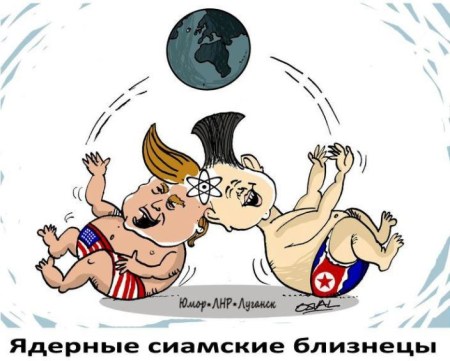
Caption: “Nuclear Siamese twins”

Source: twitter.com/sharzhipero, May 6, 2017; The logo on the bottom emphasizes that the cartoon was drawn in the Lugansk region of Eastern Ukraine that is controlled by pro-Russian separatists)

Russia Detects Launch Of Ballistic Missile From North Korea

On May 13, Russia’s Defense Ministry reported that Russian early warning systems had detected the North Korean missile launch at about 23:30 Moscow time. The Russian Defense Ministry’s statement read: “The missile early warning systems tracked the ballistic target during 23 minutes of its flight until it fell in the central part of the Sea of Japan (about 500 km away from the territory of Russia).” The statement also emphasized that the missile launch “posed no danger” for Russia, and that the Russian missile early warning systems and air defense alert were on routine combat duty.

The Russian news agency Tass reported routinely that North Korea had fired the ballistic missile from the north-west town of Kusong, where much of North Korea’s military industry is based. Tass also carried Japan’s assessment that the missile “flew about 800 km and fell in the sea outside Japan’s exclusive economic zone.”

(Tass.com, May 14, 2017)

Senator Ozerov: Missile Not Directed To Russia, But Russia’s Air-Defense Systems Remain On High Combat Alert

Senator Viktor Ozerov, who heads the Federation Council’s Defense Committee, said that Moscow understands that Russia is not the target of a North Korean attack, but he added: “Nevertheless, in order to keep ourselves safe of possible incidents, our Far Eastern air-defense systems in a high state of combat-readiness.”

(Ria.ru, May 14, 2017)

Putin: The West Should Stop Intimidating North Korea

Answering to media question about North Korea’s missile launch, Russian President Vladimir Putin also said that it was of “no immediate threat” to Russia. However, Putin added that Moscow “categorically opposes any expansion to the club of nuclear powers.” Putin said: “We have made our position clear to our partners, including the North Koreans. We consider this counterproductive, harmful and dangerous.”

On the other hand, Putin mentioned the need to resume dialogue with North Korea, and to “stop intimidating” it. Putin said: “Dialogue with North Korea must be resumed, attempts to intimidate the country must stop and a way to settle these matters peacefully must be found. Is this possible? I believe so, especially considering the positive experience of such dialogue with North Korea. As you may remember, there was a period when North Korea announced the termination of its nuclear program. Regrettably, the negotiating parties failed to muster the patience to translate this intention into reality. I believe we should resume these discussions.

“As for the latest missile launch, the Russian Defense Minister reported to me about it immediately, and the issue was later covered in the media. I have nothing more to say on this. This launch did not present a direct threat to Russia. However, such launches can provoke a conflict, which is not good at all.”

(Kremlin.ru, May 15, 2017)

Yuri Shvytkin, the deputy chair of the State Duma’s Defense Committee, also commented: “Our country is acting in the framework of the international law and… calls on North Korea to refrain from launching various missiles. Having said that, I personally think, that we have to force the U.S. to stop the muscle-flexing games against North Korea…The dispatch of a naval squadron as well as the U.S. president’s rather aggressive comments regarding North Korea, are triggering a defensive reaction… The U.S. should not unilaterally supplant the UN structure.”

(Ria.ru, May 14, 2017)

Russia’s Ambassador to China Andrei Denisov said: “Security in this part of Northeast Asia is complex, as both North Korea’s nuclear-missile program and the military presence of other countries, particularly the U.S., pose a threat to the area. Large-scale military exercises are becoming more and more intimidating, inducing North Korea and other countries to take measures to support their national security.”

(Tass.com, May 11, 2017)

Russian Diplomat: ‘The Reason For Tensions On The Peninsula Lies… Also In The Increased Military Activity Of The United States”

On May 8, at the First Session of the Preparatory Committee of the 2020 Review Conference of the Parties to the Treaty on the Non-Proliferation of Nuclear Weapons (Cluster II. Non-proliferation and IAEA safeguards), Ambassador Mikhail Ulyanov, head of the Russian delegation, said: “Russia rejects the [Democratic People’s Republic of Korea] DPRK’s self-proclaimed nuclear status. We openly declare to Pyongyang our conviction that the policy of nuclear missile capacity building will not contribute to the security of the country. On the contrary, it will have devastating consequences for the DPRK and for the region as a whole. We advocate Pyongyang’s strong commitment to the relevant UNSC decisions, cease of all nuclear and missile tests and return to the NPT regime. It is important though to prevent restrictions from narrowing the window of opportunities for the negotiations, as well as from escalating the humanitarian situation in the DPRK.

“Still we are convinced that the reason of tensions on the peninsula lies not only in Pyongyang’s nuclear and missile programs but also in the increased military activity of the United States and its allies in North-East Asia. It is evident that Pyongyang will not abandon its nuclear weapons as long as it feels that its security is directly threatened. And that is how it interprets regular maneuvers and exercises carried out by U.S.-centered military and political alliances in North-East Asia, alongside the escalation of the U.S. military presence, in particular, deployment of THAAD anti-ballistic missile systems in South Korea.

“The problems of the Korean Peninsula, including the nuclear issue, should be dealt with through an integrated solution to the whole spectrum of issues arising between the parties concerned so as to further create conducive environment for denuclearization. This requires de-escalation of overall military and political tensions, abandonment of further military infrastructure build-up, reduction of the ongoing maneuvers, and establishment of a trust-based climate among the States of the region.”

(Mid.ru, May 8, 2017)

Kremlin-Founded Think Tank’s Director: Russia-U.S. Relations Can Help Ease Asian-Pacific Tensions

Mikhail Fradkov, Director of the Kremlin-founded Russian Institute for Strategic Studies (RISS), said: “the Asian-Pacific direction today is one of the hottest in international relations. Unfortunately, it may appear that the region may literally become hot. What we see here is a snarl of potentially explosive issues, and we all need to join our forces to find peaceful solutions to them using only political means… It is extremely important to activate personal contacts between the Russian and the U.S. presidents during such critical moments in history like this one. Russian-American relations to a great extent identify the general level of security in the whole world.”

(Riss.ru, May 3, 2017)

RISS Analyst Konstantin Kokarev wrote: “The things that are currently happening in northeast Asia directly affect the national security interests of Russia. A targeted concentration of significant military forces of the US in the region and the statements by North Korean leader Kim Jong UN on his readiness for preventive strike with nuclear weapons can result in significant loss of life, permanently and seriously undermine the overall stability, interaction and cooperation in the region. This is a highly undesirable scenario.

“There is only one way out, which to seek solution of the problem exclusively through negotiations and compromise involving all the stakeholders. Russia has consistently advocated the early resumption of six-party talks, peace-building and mutually beneficial cooperation in the region, including in a trilateral format between Russia, the DPRK and the Republic of Korea.”

(Riss.ru, April 28, 2017)

Senator Kosachev: Passing The U.S. Bill On Enforcing N. Korea Sanctions On Foreign Territory Is A ‘Declaration Of War’

Russia has reacted to a bill adopted by the U.S. Congress, tightening sanctions against North Korea. If the law is passed, the U.S. president will have to provide Congress with a complete annual report, covering a period of five years, listing the ports and airports involved in the violation of sanctions against North Korea by any country. In particular, this refers to Vladivostok, Nakhodka and Vanino, as well as ports in China, Iran, Syria and other countries.

Commenting on the bill, head of the Federal Council’s Committee for International Relations, Senator Konstantin Kosachev said: “The realization of this [U.S.] bill includes a proposed force scenario in which the U.S. Navy would conduct compulsory inspections of all ships. Such a scenario is simply unthinkable because it means a declaration of war.” The bill has to be passed by the U.S. Senate and then signed by the U.S. president. Kosachev expressed his hope that Kosachev expressed the hope that the bill won’t pass.

The Deputy Chairman of the State Duma’s Committee for Defense and Security, Frants Klintsevich, also commented: “What immediately draws attention is the list of nations where U.S. congressmen want to have special control over sea ports. These are Russia, China, Iran and Syria. The United States is again trying to expand its jurisdiction all over the globe. It is as if they were telling Russia, China, Iran and Syria that these nations are suspects in crime, which is nonsense, according to international law.”

(Uawire.org, May 5, 2017; .Rt.com, May 5, 2017)

_______________________

[1] See MEMRI Special Dispatch No. 6891, Popular Pro-Kremlin Presenter Says Trump Is More Dangerous Than Kim Jong-Un, April 24, 2017.

Why Only Trump Can Win in North Korea

May 15, 2017

Why Only Trump Can Win in North Korea, Front Page Magazine, Daniel Greenfield, May 15, 2017

(Please see also, Chinese media: ‘China’s intervention not needed when only N.K.’s nuke facilities are hit.’ — DM)

Three options lie before us. We can walk away, withdraw all our forces, limit the potential risk and see what develops. We can destroy North Korea’s nuclear capabilities and as much of the regime infrastructure as we can manage. Or we can continue kicking the can down the road. That is the existing policy and it is the worst of all the three because it exposes us to the most risk with the least upside.

********************************

America is facing the same old bad choices in North Korea.

Either we apply multilateral sanctions hoping that Kim Jong-un, unlike his dad, Saddam Hussein and the Supreme Leader of Iran, will be suitably impressed by having to smuggle his iPhones through three other countries.  Or we build a multilateral coalition to take out its military with minimal civilian casualties and then spend the next decade reconstructing and policing it into a proper member of the United Nations.

Is anyone surprised that after Iraq and Afghanistan, Americans have little appetite for either alternative?

How is it possible that we beat Nazi Germany and Imperial Japan in less time than it’s taking us to figure out that we can’t even trust the clods of dirt in Afghanistan? Let alone reach a peace deal with them.

But WW2 was a war. It may have been the last war in which we leveraged all the firepower at our disposal to smash an enemy. We don’t fight wars anymore. Instead we’re the world’s policeman.

The military and the police have very different functions. The military destroys a threat. The police keep order. What we’ve been trying and failing to do in Afghanistan is keep order. It’s what we want to do in North Korea. Get that obnoxious kid next door to stop testing nukes every time he has a bad day.

The vocabulary is a dead giveaway. When we call a country a “rogue state” instead of an “enemy”, we’re not saying that it’s a deadly threat to us, but that it’s not behaving the way a member of the global community should. But being a “rogue state” is only a crime to globalists. Our problem isn’t that North Korea is failing to abide by the United Nations Convention on the Treatment of Radishes. It’s the nukes.

To solve a problem, you have to clearly define it because your solution will follow your formulation.

To globalists, the problem is an anti-social withdrawal from the global community. The solution is global “shunning” sanctions followed by a return to the loving arms of the global community.

That’s why the Iran nuke deal disaster happened. The diplomats didn’t care a radioactive fig about Iran’s nukes. They were invested in Iran’s membership in the “international community”. And they got what they wanted. They once got North Korea to sign on the dotted line too. And if you stand downwind of the latest test site with a Geiger counter, you know how that worked out.

If we want to win wars, we should stop being the world’s policeman. And defend ourselves instead.

Multilateral sanctions and multilateral coalitions aren’t our only two options. They’re our only two options if we want to spend our time enforcing the will of an imaginary international community.

The international community is a failed illusion. We’ve sacrificed far too many lives and too much money trying to defend our national interests by the rules of a post-national global order. That tragic mismatch dragged us into a disastrous and horrifying series of stalemates and lost wars. These stalemates, like Afghanistan, never end for the same reason that the cops in Chicago can never just declare victory.

Keeping order is an endless job. Policing means accepting the way things are and trying to keep them from getting too far out of hand while hoping that social conditions will somehow improve.

Police officers serve the public. They are expected to die for civilians. That’s exactly what our soldiers have been expected to do in Iraq, Afghanistan and the other societies that we’ve been policing.

If there’s any president who can actually break the cycle and replace policing with war, it’s President Trump. Trump is the first president in a long time to express skepticism about international commitments and the global order. And to propose that we serve our own national interests instead of serving the international community. And that is what needs to happen in North Korea.

Our old reasons for being in Korea expired with the fall of Communism. South Korea just elected a leftist president who likes North Korea better than he likes us. But that sort of thing has been known to happen. Like American leftists, South Korean leftists believe the stalemate with North Korea is our fault.

They have the right to test out that theory.

Our concern with North Korea is not that it might endanger our shipments of Samsung phones, but that its nuclear weapons will endanger us. Any hostile country with nuclear weapons is a potential threat. But North Korea has repeatedly threatened to use its nuclear weapons and has exported its technology to Islamic terror states. Even if we could shrug at the former, we can’t afford to ignore the latter.

Nuclear weapons in the hands of terrorists is the great threat of this century. Imagine the Islamic terror attacks of the last few years if the Jihadists didn’t have to make do with guns, bombs and cars. If we don’t turn off that pipeline in North Korea, Iran and Pakistan, the day will come when we aren’t watching dozens, hundreds or thousands dying on television in the cities of the West, but millions.

Preventing that moment from happening in this century must be our primary strategic objective.

Our post 9/11 engagements drifted from strategic objectives in our national interest that were achievable by military means to international community building projects in which armed force was an obstacle to its diplomatic objectives. That is how Obama’s Afghan surge cost the lives of so many soldiers by tying their hands with rules of engagement that did not allow them to engage the enemy.

President Trump has the opportunity to change all that in North Korea. To win in North Korea, we have to stop thinking in globalist terms. That means discarding talk of “isolating” North Korea. The Norks are already as “isolated” as they’re going to get. Any nation with nuclear weapons and the ability to threaten the United States will always be able to find friends among our enemies.

The trouble with North Korea isn’t that it’s a “Rogue State”. There’s nothing wrong with being a rogue state. We ought to try being one for a change instead of asking the UN for permission to sneeze. The international community is not the problem with North Korea. Nor is international law the solution.

Once we define the problem, we can define the objective. The problem is that North Korea is a dangerous enemy because of its nuclear program. We have two options. Ignore or act.

Plenty of presidents have kicked the nuclear Nork can down the road. Now it’s Trump’s problem.

There will be those around him who will urge him down the same dead end of sanctions, multilateral conferences, condemnations and negotiations. The can will go on rolling down the road. And one fine day, it will go off. Or we can actually end the threat that the North Korean nukes pose to us.

We have grown used to constant military action everywhere around the world. And we have also come to expect that it won’t accomplish anything except to exact an endless cost in money and lives. But those are not wars. They are internationalist police and peacekeeping actions in which we bomb lightly and invade only to rebuild. We are the world’s beat cop with tanks and bombers. It has been a long time since we used the huge warfighting arsenal of our defense industry to actually make war.

Wars don’t have to be long. They do have to be decisive. Their goal isn’t to reunite a lost sheep in the international community, but to destroy the enemy. Since the Cold War ended, we have not truly contemplated a war of destruction. But if we intend to win again, now might be the time to start.

We have spent a great deal of time trying to achieve diplomatic objectives through military means and military objectives through diplomatic means. What we have not done is tackle military objectives through military means. North Korea is not a diplomatic problem, but a military one.

Three options lie before us. We can walk away, withdraw all our forces, limit the potential risk and see what develops. We can destroy North Korea’s nuclear capabilities and as much of the regime infrastructure as we can manage. Or we can continue kicking the can down the road. That is the existing policy and it is the worst of all the three because it exposes us to the most risk with the least upside.

President Trump is the best hope for dropping an existing policy so stupid that only an establishment could cling to it. As an outsider, he is instinctively skeptical of the way things are.

When Alexander the Great was told that to rule he would have to untie a complex knot, he used his sword to cut it apart. The Gordian Knot of our foreign policy looks complicated until you take a sword to it. We can spend the next century trying to make everyone love each other. Or we can fight to win.

Thae Yong-ho: Interview with a North Korean defector

May 9, 2017

Thae Yong-ho: Interview with a North Korean defector, Al Jazerra, May 9, 2017

(A video is at the link. Please see also, Krauthammer: U.S. does have cards to play against North Korea. — DM)

Thae Yong-ho, the former North Korean deputy ambassador to the UK, defected to South Korea with his family in 2016. He remains the highest-ranking diplomat ever to defect from North Korea.

In an interview with 101 East reporter Mary Ann Jolley in Seoul, he gives rare insights into the inner workings of the Kim Jong-un regime. Thae believes that a people’s revolution will one day bring an end to the Kim family’s dynastic rule.

The family members of defectors are often targeted by the North Korean regime.

Thae reveals that he does not know the fate of his siblings. “Even though I am physically and mentally free in South Korea, I still can’t get rid of this nightmare of my family members,” he says.

Al Jazeera: You’ve been a diplomat for many years, you’ve been loyal to the North Korean regime, what made you decide to defect?

Thae Yong-ho: There are a couple of reasons for my defection. First of all, it took me quite a long time to prepare this defection because it was quite a long time since I didn’t believe in this regime. And I did think that there was no hope for this regime, but in order to make the final decision, for making this kind of defection, it was not so easy, the decision. So it’s a little bit hard to say what is the triggering point.

Al Jazeera: When did you start to have doubts about the regime, was it after Kim Jong-un became the leader or had it begun before then?

Thae: Actually, you know, there was basic suspicion and doubt about the North Korean system and regime, but that kind of doubt did not lead me directly to the defection. But my frustration about the North Korean regime and the society actually started when Kim Jong-un decided to choose to continue the policy line of his grandfather, Kim Il-sung and his father Kim Jong-il.

Actually, when first Kim Jong-un came to power, I was hopeful that he may bring some change and organisation to North Korean society since he studied a long time abroad, he knew the world, so I was fairly hopeful. But later, Kim Jong-un decided to choose the continuation of the policy rather than bringing any change to North Korean society.

Especially in March 2013, he decided to openly continue the development of the nuclear programme of North Korea, that was his actual announcement of his decision to continue the policy line of his father and grandfather. And several months later, after this official announcement in December 2013, he executed his uncle and the people around him who actually yearned for change of North Korean society.

So, Kim Jong-un started not only to continue the main policy line and also he started to purge and execute the people who actually longed for change in this society. So, this kind of development pushed me further to finalise my conclusion of defection.

Al Jazeera: What was your greatest concern about defecting?

Thae: There are also family reasons. I am the father of two children and I am really worried about their future because I lived in that system for more than 50 years and I could very easily imagine what kind of life my sons would lead.

To be honest, my life in North Korea was nothing but the life of the slave, so I really didn’t want to hand over the same destiny and the life which I led to my sons’ generation. So, I really wanted to give them the freedom. I just wanted to see my sons to lead a normal life like other people.

Al Jazeera: What about your family in North Korea?

Thae: In North Korea, defection itself is really a great offence to the system and to the leadership, especially the families associated with defectors would be heavily punished, especially the families of higher-level defectors like me. So, of course, so far I’m not well-aware of the actual whereabouts of my family members and my brother and sister, but so far what I have seen about those happenings with my colleagues who defected in the past, I’m sure that my families could face a very heavy punishment because of me.

Al Jazeera: And that’s a heavy burden to carry …

Thae: Of course, even though I am physically and mentally free in South Korea, I still can’t get rid of this kind of nightmare of my family members.

Al Jazeera: Did you ever meet Kim Jong-nam?

Thae: I met him a couple of times in the late 1990s at the entrance of Koryo Hotel in Pyongyang, but I didn’t meet him face to face. What I learned was that he loved to be, and mix with, even some of the foreigners who were staying at the hotel.

Al Jazeera: What was your reaction when you heard Kim Jong-nam had been murdered?

Thae: On that morning, when I switched on the TV, the world media all of a sudden burst into breaking news, but to me it was not such a kind of surprise because according to the Kim Jong-un or North Korean regime, Kim Jong-nam was a kind of physical hurdle which should be eliminated … sooner or later.

Al Jazeera: Who do you believe killed him?

Thae: I think, in North Korean society, it is quite obvious that this kind of big incident can only be ordered by Kim Jong-un himself … Some media reported that maybe this is the outcome of a kind of royalty contest or competition. Kim Jong-nam is the half-brother of Kim Jong-un and nobody in our system can ever suggest to kill the half-brother of Kim Jong-un. So, this is very obvious fact that it is Kim Jong-un’s decision.

Al Jazeera: Why did Kim Jong-un want him dead?

Thae: North Korean society also like in South Korea has a very Confucian influence on society where the people should obey the instructions of the leader, children should respect their parents, and little brother should respect the elder brother. So, this is the long-term tradition and … Kim Jong-il made an official party policy line … the branches of a tree should be cut off in order to let the main trunk of the tree grow well. That is the main official terminology of the North Korean Workers party.

In other words, the first son of the family should inherit the family business. That is the usual practice, no matter whether in the North or South. So, Kim Jong-il was successful to be appointed as the heir to Kim Il-sung because of this party policy, because he was the first son. But if Kim Jong-un followed this policy, it is Kim Jong-un who should be eliminated because he is actually the branch of the tree, rather than the main trunk. It is Kim Jong-nam who is the first son …

Kim Jong-nam was a great psychological burden for Kim Jong-un to legitimise the leadership as the only successor of his father.

Al Jazeera: Kim Jong-nam made it clear that he didn’t want to be involved in politics, why then was he a threat to Kim Jong-un?

Thae: Kim Jong-un has been in power for five years, but until now he has been in difficulty legitimising his leadership. For instance, Kim Jong-un still hasn’t presented his age, his place of birth, where he spent his childhood, what’s the name of his mother. So, everything is in ambiguity in North Korean society about Kim Jong-un … He finds it difficult to convince the society and North Korea, most of the people even don’t know anything about the existence of Kim Jong-nam, the first son of Kim Jong-il, because his mother was not the official wife of Kim Jong-il. And the mother of Kim Jong-un was also not the official wife of Kim Jong-il. So these sons are not official offsprings of the official wife of Kim Jong-il, so it’s a kind of very great burden for the legitimacy.

And Kim Jong Nam, during his stay abroad, from time to time, met foreign media and so Kim Jong-un was very afraid of a spread of this kind of news of his existence from outside. So, I think it was a standing order for Kim Jong-un to get rid of Kim Jong-nam any time.

Al Jazeera: What do you make of the use of VX to kill Kim Jong-nam?

Thae: I think the North Korean agents thought that the Malaysian authority could not find the chemical component of the medicine they would use … Kim Jong-nam felt something strange, that’s why he approached the airport security police and explained what happened to his eyes and it was very fortunate that CCTV at the airport caught all these things.

So, the investigations were able to focus on his face and what chemicals, but otherwise if Kim Jong-nam just naturally continued his journey and fell down on his way to the airplane, it could be very difficult for the world and Malaysian authorities to find out what caused his death.

Al Jazeera: How has the use of a chemical weapon escalated the threat of North Korea to the rest of the world?

Thae: It is not a hidden story that North Korea has been stockpiling huge amounts of chemical weapons. Actually, chemical weapons is are the weapons of the poor countries. Any pharmaceutical or fertiliser factories can produce very sophisticated chemical weapons. So, North Korea has been producing the chemical weapons for quite a long time.

Al Jazeera: Do you think the fact that they’ve now used it on foreign soil to kill somebody suggests that they may not fear using it?

Thae: Of course, the Kim Jong-un regime is not only developing the nuclear weapons, actually the Kim Jong-un regime is ready to use it in this 21st century. So, Kim Jong-un may not hesitate to use any weapons if he feels threatened.

Al Jazeera: He’s executed family members, key members of the regime and now he’s murdered his own brother. What does that tell us about the brutality and cruelty of his regime in comparison to that of his father’s and grandfather’s?

Thae: Yes, the persecution and purge was also a frequent thing in North Korean society, even during the Kim Il-sung and Kim Jong-il period. But Kim Il-sung and Kim Jong-il never executed their family members. Kim Jong-un is different, because he doesn’t have any sense of solidarity among the family members and even the relatives because Kim Jong-un was a hidden boy. Not only in North Korean society, but he was also a hidden boy to the family members of his father and his grandfather.

Even up to now, Kim Jong-un cannot present a single photo with his grandfather because his grandfather, Kim Il-sung, didn’t know the existence of this grandson, Kim Jong-un. So, he doesn’t have any sense of solidarity with the rest of the family.

And to my impression, Kim Jong-un is in great fear of those officials around him because those officials are old and the ones who used to be followers of his grandfather and his father. Kim Jong-un is always sensitive whether he’s looked down upon by them as a young leader or whatever, so Kim Jong-un is a man with great paranoia.

I think on the surface, Kim Jong-un’s system looks very formidable, but I think Kim Jong-un’s system has already been in a slippery slope towards collapse. So, the only thing Kim Jong-un now relies on is the reign of terror, he just continues to execute officials.

For instance, a few months ago, he even purged the high-ranking officials of his security service network. So, if the system even purges officials of this secret, the security service then it proves that the system is in crisis.

Al Jazeera: What about the ordinary people? Has their life changed under Kim Jong-un?

Thae: The North Korean people these days are in great fear because Kim Jong-un even killed his uncle, and when he killed his uncle he made this execution open and public, so people saw enough. So, when people learnt that Kim Jong-un even went so far to kill his uncle, then that means that he could kill anyone. So people are in great fear, that’s the first thing. The second thing is that the North Korean people have been living in this kind of circumstances and environment for a long time. So, to some extent, they are indifferent to what’s going at a higher level of the society. They are just taking care of their own daily survival rather than thinking something big.

Al Jazeera: What could stop ther North Korean regime to stop developing nuclear weapons?

Thae: I think the only way to solve the nuclear threat, is the final elimination of Kim Jong-un and the regime. I think in order to eliminate Kim Jong-un’s regime, there can be several options even including the military ones, but the most realistic and effective ones is to disseminate the outside information in order to educate North Korean people for a popular uprising against the regime.

Humor | North Korea Agrees To Trade Away Nuclear Weapons For Krispy Kreme Franchise

May 9, 2017

North Korea Agrees To Trade Away Nuclear Weapons For Krispy Kreme Franchise, Duffel Blog, May 9, 2017

PYONGYANG — In a breakthrough negotiation amid escalating tensions on the Korean peninsula, North Korean leader Kim Jong-un has agreed to trade away all his nuclear weapons in exchange for a single Krispy Kreme franchise, sources confirmed today.

“I’m super proud of Ambassador Hailey for negotiating such a big, big deal,” President Donald Trump said. “I thought I was going to have to bomb the shit out of ‘em.”

Pundits had long speculated on what could get Kim Jong-un to give up his nuclear weapons. Many experts had recommended tougher sanctions, or trying to persuade China to become more involved, though none seemed to change Pyongyang’s behavior.

“Due an unusual translation error, Kim Jong-un originally thought that the USS Carl Vinson that was ordered to waters off Korea was actually a Carl’s Junior that was going to be built in Pyongyang,” one US official said, on condition of anonymity. “When he was informed that wasn’t the case, man was he pissed.”

The source added: “We had to find the one thing more important to Kim than the preservation of his regime. Turns out it was right there in front of us.”

His belly.

Management officials at JAB Holding Company, owners of Krispy Kreme, were initially concerned that the deal would include a ‘Doughnuts for Life’ clause for Kim Jong-un which could have cost the company millions — assuming the dictator didn’t eat himself to death in the process.

But the North Korean regime has agreed to take on all costs of production due to a convenient supply of slave labor that keeps manufacturing costs to a minimum and both sides happy about the terms of the deal.

Further Evidence of Iran-North Korea Military Connection

May 6, 2017

Further Evidence of Iran-North Korea Military Connection, Iran Focus, May 5, 2017

London, 5 May – Pentagon officials saw more evidence of North Korea’s assistance when Iran tried to launch a cruise missile from a midget submarine earlier this week. Intelligence reports claim the submarine was the same type that sank a South Korean warship in 2010, which was Pyongyang designed.

This was the first time Iran attempted to launch a Jask-2 cruise missile underwater, but the launch failed, according to U.S. defense officials. That North Korea and Iran are sharing expertise when it comes to their rogue missile programs has been long suspected by nonproliferation experts.

Perhaps most worrisome for the United States is that this occurred in the narrow and crowded Strait of Hormuz, where much of the world’s oil passes each day.

Jeffrey Lewis, a missile proliferation expert at the Middlebury Institute of International Studies at Monterey said, “The very first missiles we saw in Iran were simply copies of North Korean missiles, over the years, we’ve seen photographs of North Korean and Iranian officials in each other’s countries, and we’ve seen all kinds of common hardware.”

“In the past, we would see things in North Korea and they would show up in Iran. In some recent years, we’ve seen some small things appear in Iran first and then show up in North Korea and so that raises the question of whether trade — which started off as North Korea to Iran — has started to reverse,” Lewis added.

The ballistic missile Iran tested in late January was based on a North Korean design, the Pentagon said. Another missile launch conducted by Iran last summer, was similar to the most advanced missile Pyongyang has successfully tested to date, a North Korean Musudan.

North Korea’s Taepodong missile looks almost identical to Iran’s Shahab, according to defense analysts.

North Korea successfully launched a missile from a submarine for the first time in 2015, and officials believe Tehran is not far behind.

North Korea and Iran are the only countries in the world who deploy the Yono-class submarine. Midget subs are used in shallow waters, where they can hide. The 290-foot South Korean warship that sank in 2010 and killed more than 40 sailors, was ambushed in shallow water by a midget sub. However, North Korea denies involvement in the attack.

A U.S. defense official who declined to be identified stated, “When those midget subs are operating underwater, they are running on battery power—making themselves very quiet and hard to detect.”

During testimony at the House Armed Services Committee late last month, Admiral Harry Harris, the head of American forces in the Pacific said, “We are being taken to the cleaners by countries that are not signatories to the INF.” Harris warned that because the U.S. is a signatory to the Intermediate Range Nuclear Forces, or INF, treaty signed in 1987 between Russia and the United States, the United States has no land-based short range or medium range missiles. Iran and North Korea are under no such constraints.

The BM-25 Musudan ballistic missile has a maximum range of nearly 2,500 miles, and potentially puts U.S. forces in the Middle East and Israel within reach, if its problems are fixed.

It’s unclear to what extent North Korea is involved in the failed launch, apart from sharing their technology, according to officials.

Rex Tillerson, Secretary of State, tried to garner support for more United Nations sanctions against North Korea by hosting leaders from Southeast Asia in Washington on Thursday.

The White House put Iran “on notice” just days after Iran’s first ballistic missile test during the Trump administration.

North Korea: China ‘Dancing to the Tune of the U.S.’ with ‘Absurd’ Opposition to Nuclear Program

May 5, 2017

North Korea: China ‘Dancing to the Tune of the U.S.’ with ‘Absurd’ Opposition to Nuclear Program, BreitbartJohn Hayward, May 4, 2017

AFP PHOTO / KCNA via KNS REPUBLIC OF KOREA

North Korea is a bottomless fountain of apocalyptic threats against the U.S. and its allies, but on Wednesday, its state-run media lashed out against China with unprecedented fury, accusing the Chinese of “dancing to the tune of the U.S.” with “absurd and reckless remarks” about Pyongyang’s nuclear weapons program.

The North Korean outburst was prompted by a string of editorials in China’s similarly state-controlled media which “criticized the North’s nuclear weapons program and called for Beijing to cut off oil supplies if the North conducted another nuclear test,” as the New York Times summarizes them.

“One must clearly understand that the DPRK’s line of access to nukes for the existence and development of the country can neither be changed nor shaken, and that the DPRK will never beg for the maintenance of friendship with China, risking its nuclear program which is as precious as its own life, no matter how valuable the friendship is,” snarled the unusually harsh response from North Korea’s Rodong Sinmun newspaper. (“DPRK” is North Korea’s name for itself, the Democratic People’s Republic of Korea.)

“China should no longer try to test the limits of the DPRK’s patience. China had better ponder over the grave consequences to be entailed by its reckless act of chopping down the pillar of the DPRK-China relations,” the op-ed continued.

North Korea accused China of providing “lame excuses for the base acts of dancing to the tune of the U.S.” and betraying Pyongyang’s friendship “in order to avert a war which would bring danger to China.” It railed against “absurd and reckless remarks” from “ignorant politicians and media persons” in China.

“We didn’t cross the ‘red line’ of the (North Korea)-China relationship. China is violently stomping on and crossing it without hesitation,” declared another passage spotlighted by CNN.

The editorial specifically complained about “rubbish” in Chinese publications accusing North Korea of creating tensions in northeast Asia and giving the United States “excuses for deploying more strategic assets.”

On the contrary, China should “acknowledge in an honest manner that the DPRK has just contributed to protecting peace and security of China, foiling the U.S. scheme for aggression by waging a hard fight in the front line of the showdown with the U.S. for more than seven decades, and thank the DPRK for it,” according to the North Korean paper.

The New York Times notes that this broadside was not an unsigned editorial from the editors at large but was attributed to a specific author named Kim Chol.

Of course, no one would imagine such a provocative article could be published by any North Korean outfit without the blessing of dictator Kim Jong-un, but putting a single name on the piece gives North Korea a little wiggle room to disavow its harsh words if China objects too strongly or does whatever is needed to calm the Kim regime down. In either of those eventualities, it is a safe bet that someone in Pyongyang named “Kim Chol” will have a very bad day.

Another cushion for the blow noted by the NYT is that Kim Chol’s op-ed did not castigate the government of China or the Communist Party per se; the fiery criticism was directed at Chinese media – which, of course, is only slightly more independent of the government and ruling party than North Korean media.

North Korean editorialists have grumbled about Chinese policy before, but it usually takes the important precaution of leaving China’s name out of the editorials, referring vaguely to a “neighboring country.”

Indications that China might decide to handle North Korea’s outburst with kid gloves quickly appeared. The Chinese Foreign Ministry stressed both Beijing’s “consistent and clear” position on denuclearizing the Korean peninsula and “good-neighborly and friendly relations with the DPRK.”

China’s Communist Party organ, the Global Times, at first responded with some soothing noises about the marvelous friendship between Beijing and Pyongyang, slipping in a few barbs about the importance of denuclearization, China’s unwillingness to “allow its northeastern region to be contaminated by North Korea’s nuclear activities,” and a little reminder that North Korea would have been defeated by South Korea and the United States in the 1950s without Chinese intervention.

On Thursday, the Global Times directly addressed the Kim Chol editorial, very pointedly observing it was the first time China was specifically named in such a tirade.

“Overall, the editorial is nothing more than a hyper-aggressive piece completely filled with nationalistic passion,” sniffed the Global Times. “Pyongyang obviously is grappling with some form of irrational logic over its nuclear program.”

The editorial goes on to tell North Korean media to pipe down while officials in Beijing and Pyongyang hammer out their policy differences through “higher levels of dialogue with one another.” A half-dozen passages in the Global Times response boil down to condescending advice that North Korean is making its situation worse by publicly criticizing China.

“The direction of China-North Korea relations remains in the hands of China. Whether KCNA editorials mention China or Chinese media by name or not, those missions will not change the inherent logic and trend of a relationship that has been in place for over six decades. The more editorials KCNA publishes, the better Chinese society will be able to understand how Pyongyang thinks, and how hard it is to solve this nuclear issue,” the concluding paragraph reads.

Another commentary published by Rodong Sinmun on Wednesday warns Japan that it would be “blanketed with radioactive clouds if a nuclear war occurs on the Korean peninsula.”

“Not only those who try to harm us but their supporters will not be safe if any war breaks out,” this op-ed stated, adding that it would be a “piece of cake” for North Korea’s military to devastate Japan.

Congress to Pass Fresh Sanctions on North Korea as Nuke Threat Hits Critical Stage

May 3, 2017

Congress to Pass Fresh Sanctions on North Korea as Nuke Threat Hits Critical Stage, Washington Free Beacon, , May 3, 2017

This April 15, 2017 picture released from North Korea’s official Korean Central News Agency (KCNA) on April 16, 2017 shows Korean People’s Army (KPA) soldiers marching through Kim Il-Sung square during a military parade in Pyongyang marking the 105th anniversary of the birth of late North Korean leader Kim Il-Sung.THIS PICTURE WAS MADE AVAILABLE BY A THIRD PARTY. AFP CAN NOT INDEPENDENTLY VERIFY THE AUTHENTICITY, LOCATION, DATE AND CONTENT OF THIS IMAGE. THIS PHOTO IS DISTRIBUTED EXACTLY AS RECEIVED BY AFP. / (Photo credit should read STR/AFP/Getty Images)

Congress is expected to level fresh economic sanctions on North Korea this week as the threat of the hermit nation’s capability to strike the U.S. with a nuclear missile continues to escalate, according to conversations with members of the congressional leadership who told the Washington Free Beacon that the Kim Jong Un regime could have a nuclear weapon capable of striking the United States in “only a few years.”

House Majority Leader Kevin McCarthy (R., Calif.) confirmed that he has scheduled a vote in the House on new sanctions that will target North Korea’s slave labor trade and its shipping industry, which plays a central role in ferrying illicit arms and technology to and from the country. North Korea is a major supplier of nuclear technology on the black market, particularly to Iran, which has mimicked Pyongyang’s nuclear playbook.

The new sanctions come as congressional leaders debate how to handle North Korea’s growing nuclear threat, which went largely unaddressed by the former Obama administration.

North Korea is expected to perfect a nuclear missile capable of striking the U.S. homeland in about four years time, according to congressional sources.

“The North Korean threat is escalating—in about four years, experts estimate that North Korea will have the capability to reliably hit the continental United States with a nuclear weapon,” McCarthy told the Free Beacon. “America must use every tool at our disposal to keep our nation safe and preserve peace.”

McCarthy said that new sanctions are long overdue and can more easily win approval now that former President Barack Obama is out of office.

“This week, we will vote to increase sanctions on North Korea, targeting its shipping industry as well as those who employ North Korean slave labor abroad,” the lawmaker said. “The last administration’s long-practiced policy of strategic patience has made us less safe. We must increase the pressure on the Kim regime.”

In just the past year, North Korea has conducted two nuclear weapons tests and at least 26 ballistic missile flight tests.

The new sanctions, codified under the Korean Interdiction and Modernization of Sanctions Act, has already garnered approval from the House Foreign Affairs Committee and is expected to easily pass when it comes before the full House for a vote. The bill will then be taken up for action by the Senate, which has an appetite for such a bill.

Lawmakers are moving forward with two other resolutions aimed at highlighting North Korea’s escalating nuclear progress.

One resolution formally condemns Pyongyang’s development of several intercontinental ballistic missiles, which violated multiple international laws on such behavior.

A second resolution requires the State Department to determine whether North Korea is a state sponsor of terrorism. Such a designation still has not been made, despite the country’s threatening behavior and multiple nuclear missile launches.

“It is not a matter of if, but when Kim Jong-Un will be brazen enough to attack one of our allies, or even the United States,” McCarthy said in a statement on the two resolutions. “We must be honest and forthright abroad, making clear that North Korea’s ballistic missile testing is unacceptable and that the Kim regime is worthy of sanctions as it is undoubtedly a state sponsor of terrorism.”

One senior congressional source who spoke to the Free Beacon about the issue said that the Obama administration’s policy of trying to wait out the threat has proven ineffective.

“The policy of strategic patience has allowed North Korea to charge full steam ahead in developing its nuclear program,” said the source, who requested anonymity to discuss congressional deliberations on the issue. “Doing nothing has only allowed North Korean provocations to increase. I think everyone recognizes that.”

“Now, North Korea is only a few years away from being able to hit the United States with a nuclear bomb,” the source said. “The best response is to increase pressure on the Kim regime, including with new sanctions, leaving all options on the table to preserve peace and end the threat of a nuclear North Korea.”