Archive for the ‘North Korean missiles’ category

China to Obama: America Forced Norks to get Nukes and Must Negotiate a Deal

September 20, 2016

China to Obama: America Forced Norks to get Nukes and Must Negotiate a Deal, Dan Miller’s Blog, September 20, 2016

(The views expressed in this article are mine and do not necessarily reflect those of Warsclerotic or its other editors. — DM)

In an article titled North Korean Nukes, South Korea, Japan, China and Obama, posted the day after North Korea’s most recent nuke test, September 9th, I contended that China would not honor Obama’s request to make North Korea stop developing and testing nukes. China has remained a faithful ally of North Korea since the end stage of the Korean Conflict and “sees Obama, not as the representative of the world’s greatest power, but as a joke. He has no clout internationally and is a national embarrassment.”  NB: I had hoped to publish this article more than a week ago, but my internet was down or at best intermittent from September 13th until September 19th.)

I was right, but it’s a bit worse than I had thought.

On September 12th, an article was published by Xinhua titled China urges U.S. to take responsibility on Korean Peninsula nuclear issueXinhua is

the official press agency of the People’s Republic of China. Xinhua is the biggest and most influential media organization in China. Xinhua is a ministry-level institution subordinate to the Chinese central government. Its president is a member of theCentral Committee of China’s Communist Party.

According to Xinhua,

U.S. Defence Secretary Ashton Carter reportedly called for further pressure on the DPRK last Friday after the country carried out a new nuclear test and said China bears “responsibility” for tackling the problem. [Emphasis added.]

The essence of the Korean Peninsula nuclear issue is the conflict between the DPRK and the United States, spokesperson Hua Chunying said at a press conference. [Emphasis added.]

As a permanent member of the UN Security Council and a close neighbor of the DPRK, China has made unremitting efforts to maintain peace and stability on the Korean Peninsula and safeguard the international nuclear non-proliferation regime, Hua said.

A statement released by the Foreign Ministry of the DPRK Sunday said the United States compelled the DPRK to develop nuclear warheads, and the nuclear threat it has constantly posed to the DPRK for decades is the engine that has pushed the DPRK to this point. [Emphasis added.]

Blindly increasing the pressure and the resulting bounce-back will only make the nuclear issue on the Korean Peninsula “a firm knot,” Hua said, calling for responsibility from all relevant parties.

Hua reiterated that China will remain committed to resolving issues concerning the Peninsula through dialogue to realize long-term peace and stability.

China strongly urges all parties to speak and act cautiously with the larger picture in mind, avoid provoking each other and make genuine efforts to achieve denuclearization, peace and stability on the Korean Peninsula, Hua said.

. . . .

“We have seen the twists and turns in the situation on the Korean Peninsula since the six-party talks have stalled,” Hua said, noting that it proves that simple sanctions cannot solve the issue. [Emphasis added.]

Hua said the security concerns of parties on the Korean Peninsula must and can only be resolved in a way that serves the interests of all parties.

Any unilateral action based on one’s self-interest will lead to a dead end, and it will not help resolve one’s security concerns but will only aggravate the tension, complicate the issue, and make it more difficult to achieve relevant goals, Hua said. [Emphasis added.]

The six-party talks, involving China, the DPRK, the United States, the Republic of Korea (ROK), Russia and Japan, were a multilateral mechanism aimed at solving the Korean Peninusla nuclear issue. The talks began in 2003 and stalled in December 2008. The DPRK quit the talks in April 2009.

“Resuming the six-party talks is difficult, but we cannot give up easily ,” Hua said.

China will continue to keep close communication with relevant parties and call on them to return to the right track of solving issues related to the Korean Peninsula through dialogue and negotiation, the spokesperson said.

China clearly appears to be following the line of Kim Jong-un on why North Korea needs nukes:

https://www.youtube.com/watch?v=iJBJtohbLT0

The Obama administration cannot engage in successful negotiations with North Korea, for several reasons. They are, in no particular order: Obama will be gone in about four months; Kerry is Obama’s Secretary of State; The Obama-Clinton-Kerry Iran Scam gave the Islamic Republic everything it sought and, at best, left Iran on the highway to nukes. North Korea and Iran are different in at least one major respect: Iran claimed that it did not have nukes and had not tried to develop them; Supreme Leader Khamenei was claimed to have issued a fatwa against the acquisition, development and use of nukes — despite propaganda videos showing how Iran will use nukes against the “great and little Satan.” North Korea has and has tested five nukes. Kim brags about them and threatens to use them.

The nuke threat

38 North is a think tank largely devoted to obtaining and publishing reliable information about North Korea’s nuke and missile programs. An article there by , published on September 12th, concludes:

What are the greatest threats from the rapidly expanding North Korean nuclear program? Left unchecked, Pyongyang will likely develop the capability to reach the continental United States with a nuclear tipped missile in a decade or so. Much more troubling for now is that its recent nuclear and missile successes may give Pyongyang a false sense of confidence and dramatically change regional security dynamics. The likely ability of the DPRK to put nuclear weapons on target anywhere in South Korea and Japan and even on some US assets in the Pacific greatly complicates the regional military picture. That situation would be exacerbated if Pyongyang decides to field tactical nuclear weapons as its arsenal expands and its confidence in its nuclear arsenal grows.

More bombs and better bombs also increase the potential of accidents and miscalculations with greater consequences as the number and sophistication of bombs increase. Rendering the nuclear enterprise safe and secure in case of internal turmoil or a chaotic transition in the North becomes more difficult. We also cannot rule out that a financially desperate leadership may risk the sale of fissile materials or other nuclear assets, perhaps to non-state actors. [Emphasis added.]

So, what to do? The latest nuclear test demonstrates conclusively that attempting to sanction the DPRK into submission and waiting for China to exert leverage over Pyongyang’s nuclear program do not work. Increasing sanctions and adding missile defenses in South Korea to that mix will also not suffice and make China even less likely to cooperate. What’s missing is diplomacy as much as Washington may find it repugnant to deal with the Kim regime.

On September 20th, North Korea announced that it had tested a new long-range rocket engine, suggesting that it “can be used for an intercontinental ballistic missile (ICBM), which is capable, in theory, of hitting targets on the U.S. mainland.” The September 9th nuke test is claimed to have involved “a miniaturized nuclear warhead that could be mounted on a ballistic missile.” How close in North Korea to being able to nuke the U.S. mainland? I don’t know and don’t want to find out by having it happen.

Can diplomacy, even if undertaken by a new administration after Obama leaves office, be successful? Continued sanctions got Iran to engage in negotiations; both Iran and Obama’s America very much wanted the sanctions lifted so that Iran would become an honorable member of the community of nations. There are few if any significant sanctions to lift on North Korea and China will not impose or enforce any; China’s role has been to help North Korea evade sanctions.

In China Won’t Stop Kim Jong-un. The U.S. Must Stand Up to Both of Them, published by Slate Magazine on September 13,  had some perhaps useful suggestions:

[T]he United States should rally the same sort of campaign that revved up the pressure against Iran before those nuclear talks got underway. In other words, the international community should apply sanctions not only against North Korea but also against all institutions that do business with North Korea—an action that would affect some major Chinese banks, which provide it with energy supplies, other goods, and hard currency. [Emphasis added.]

Yes, this would stir tensions in U.S.-China relations; but so do a lot of other actions, many of them instigated by China (for instance, the dodgy territorial claims in the South China Sea), and in this case, any perceptions of American aggression would be offset, to some degree, by a realization—at least by some Chinese officials—that it’s time for Beijing to face up to its problem and reassess its strategic priorities accordingly. (Longtime China-watchers say that some of Xi’s senior comrades have been advocating tougher action against Kim.)

He also suggests that if an end is put to North Korea’s nuclear ambitions and work, America should agree to terminate its no longer necessary THAAD deployments in South Korea and Japan. Further, the next president

should take steps, especially with China, to prevent Pyongyang from deploying a nuclear missile; but if that proves fruitless, he or she should make very clear that North Korea’s use of nuclear weapons—or even a conventional invasion of South Korea (which might be accompanied by a brandishing of nukes to deter anyone from coming to Seoul’s aid)—will be regarded as an attack on the United States and will be dealt with accordingly. There should be no ambiguity about this. Kim Jong-un may be crazy, but his eccentricities have always been in the service of his survival—and he should understand that he’s putting his survival on the line. Daniel Sneider, associate director of Stanford University’s Shorenstein Asia-Pacific Research Center, thinks we should deploy more nuclear-capable aircraft on U.S. bases in Asia to drive this point home fiercely.

It seems worth noting that among the reasons to expect that a Russian-assisted attack on South Korea would be successful, which Kim Il-sung suggested to Stalin in 1950, was that Secretary of State Dean Atcheson had delivered an important address in which he listed the nations to the defense of which America would come if attacked. South Korea was not on the list. As I observed here in November of 2010,

When Kim il-Sung secretly visited Moscow between March 30 and April 25, he assured Stalin that his attack would succeed in three days: there would be an uprising by some two hundred thousand party members and he was convinced that the United States would not intervene. Secretary of State Dean Acheson’s January 12, 1950 speech was persuasive evidence. There, Secretary Acheson had omitted South Korea from a list of nations which the United States would defend if attacked. Stalin gave the go-ahead.

Conclusions

China has encouraged North Korean nuclearization and wants America and her allies, principally South Korea, to cease their “provocations” against the Kim regime. Yet Kim thrives on, and encourages his supporters by, engaging in provocations far more serious and dramatic than anything thus far done by America and South Korea. It seems likely that the North Korean nuke – missile problem will continue until Kim is (a) taken out and (b) replaced with someone less narcissistic and more interested in feeding his people than his ego. Whether such a replacement will emerge is unknown. However, if a Kim clone emerges instead, he seems likely to be more concerned than Kim about his prospects for a long and happy life, even with protection from China.
North Korean Nukes, South Korea, Japan, China and Obama

September 10, 2016

North Korean Nukes, South Korea, Japan, China and Obama, Dan Miller’s Blog, September 10, 2016

(The views expressed in this article are mine and do not necessarily reflect those of Warsclerotic or its other editors. — DM)

On September 9th, North Korea conducted its fifth nuke test, of its most powerful nuke thus far. Can Obama get China to help make North Korea stop developing and testing nukes? Nope. China sees Obama, not as the representative of the world’s greatest power, but as a joke. He has no clout internationally and is a national embarrassment.

China and North Korea – a very short history

Here’s a link to an article I posted on June 25, 2013 about the Korean conflict. To summarize, China and the Democratic People’s Republic of Korea (North Korea) have a long history of acting together. China views the Republic of Korea (South Korea), which borders North Korea to the south and is an American ally, as a threat. She does not want reunification of the Korean peninsula under a government favorable to America.

When, on June 25, 1950, North Korea invaded South Korea with Russian aircraft, weaponry, training and other substantial support, China did not assist North Korea. North Korean forces pushed the South Korean government, as well as the few American military advisers (then under the command of the Department of State), south to the Pusan perimeter. Following General MacArthur’s unexpected and successful Inchon invasion which began on September 15th, American and other United Nations forces pushed the North Korean forces back north: MacArthur sent his by then greatly augmented forces east to Wonson and eventually managed to push North Korean forces to the northern side of the Yalu River. However, Chinese forces struck back en masse and MacArthur’s forces were driven back to Seoul.

Ever since bringing to an end MacArthur’s successes in the Korean Conflict, China has supported North Korea. She has opposed, and has then declined to enforce, significant sanctions responsive to North Korean nuclear and missile development and testing. While China may acquiesce in weak UN resolutions condemning North Korean provocations, she rarely goes beyond that.

China, Japan and the two Koreas

China has a long memory and still resents, bitterly, the lengthy period prior to and during World War II when Japan occupied significant parts of China. Ditto South Korea, all of which was under Japanese occupation for a lengthy period prior to and during World War II. Although China has substantial trade with both South Korea and Japan, she is more hostile to Japan than is South Korea; the latter two have substantial mutual interests transcending trade.

Perhaps the most important current dispute between China on the one hand, and Japan-South Korea-America on the other, involves the plans of Japan and South Korea to defend against North Korean missiles by the installation of THAAD anti-missile weapons provided by America. China’s stated reason for opposition to the THAAD system is that it could be used against Chinese, as well as North Korean, missiles. Why does China assert this objection unless she hopes to fire missiles at one or both of them? If China fires missiles at Japan and/or South Korea, they have every right to destroy her missiles and to respond in kind with U.S. assistance if requested.

President Obama

condemned Pyongyang’s fifth nuclear test today in the “strongest possible terms as a grave threat to regional security and to international peace and stability” as outraged lawmakers from both parties called for tougher action to stop North Korea’s nuclear program. [Emphasis added.]

That may well be all that Obama does — despite the warnings of Rep. Adam Smith (D-Wash.), the top Democrat on the House Armed Services Committee, that

we have to make it absolutely clear that if they engage in any military activity, they will be destroyed. We have to have a credible deterrent. That seems to be the only thing that will stop North Korea from engaging in military action… We have sanctioned them, and we should keep sanctioning them, but it’s not going to stop them from developing the nuclear weapons.” [Emphasis added.]

Obama won’t do that:

In a statement Friday, President Obama vowed to “take additional significant steps, including new sanctions, to demonstrate to North Korea that there are consequences to its unlawful and dangerous actions.”

Obama did not suggest what He might have in mind, beyond historically ineffective sanctions and condemnations “in the strongest possible terms,” to let North Korea know that there will be “consequences.”

A September 9th article at the New York Times provides an unpleasant analysis of the options Obama now has, and which His successor will have, in dealing with North Korea.

A hard embargo, in which Washington and its allies block all shipping into and out of North Korea and seek to paralyze its finances, risks confrontations that allies in Asia fear could quickly escalate into war. But restarting talks on the North’s terms would reward the defiance of its young leader, Kim Jong-un, with no guarantee that he will dismantle the nuclear program irrevocably.

For more than seven years, President Obama has sought to find a middle ground, adopting a policy of gradually escalating sanctions that the White House once called “strategic patience.” But the test on Friday — the North’s fifth and most powerful blast yet, perhaps with nearly twice the strength of its last one — eliminates any doubt that that approach has failed and that the North has mastered the basics of detonating a nuclear weapon.

Despite sanctions and technological backwardness, North Korea appears to have enjoyed a burst of progress in its missile program over the last decade, with experts warning that it is speeding toward a day when it will be able to threaten the West Coast of the United States and perhaps the entire country. [Emphasis added.]

. . . .

Mr. Obama has refused to negotiate with the North unless it agrees first that the ultimate objective of any talks would be a Korean Peninsula without nuclear arms. But Mr. Kim has demonstrated, at least for now, that time is on his side. And as he gets closer to an ability to threaten the United States with a nuclear attack, and stakes the credibility of his government on it, it may be even more difficult to persuade him to give up the program.

 In a statement Friday, Mr. Obama condemned the North’s test and said it “follows an unprecedented campaign of ballistic missile launches, which North Korea claims are intended to serve as delivery vehicles intended to target the United States and our allies.”

“To be clear, the United States does not, and never will, accept North Korea as a nuclear state,” he said.

Many experts who have dealt with North Korea say the United States may have no choice but to do so. [Emphasis added.]

“It’s too late on the nuclear weapons program — that is not going to be reversed,” William Perry, the defense secretary under President Bill Clinton during the 1994 nuclear crisis with North Korea, said in August at a presentation in Kent, Conn. The only choice now, he argued, is to focus on limiting the missile program. [Emphasis added.]

Obama has taken no significant steps to limit Iran’s continuing missile development and testing program. How can He limit that of North Korea without Chinese cooperation?

Yet the latest effort to do that, an agreement between the United States and South Korea to deploy an advanced missile defense system in the South, has inflamed China, which argues the system is also aimed at its weapons. While American officials deny that, the issue has divided Washington and Beijing so sharply that it will be even more difficult now for them to come up with a joint strategy for dealing with the North. [Emphasis added.]

China has been so vocal with its displeasure over the deployment of the American system that Mr. Kim may have concluded he could afford to upset Beijing by conducting Friday’s test. [Emphasis added.]

Fueling that perception were reports that a North Korean envoy visited Beijing earlier this week.

North Korea almost certainly sees this as an opportunity to take steps to enhance its nuclear and missile capabilities with little risk that China will do anything in response,” Evans J.R. Revere, a former State Department official and North Korea specialist, said in a speech in Seoul on Friday. [Emphasis added.]

The breach between China and the United States was evident during Mr. Obama’s meeting with President Xi Jinping last week. “I indicated to him that if the Thaad bothered him, particularly since it has no purpose other than defensive and does not change the strategic balance between the United States and China, that they need to work with us more effectively to change Pyongyang’s behavior,” Mr. Obama said, referring to the Terminal High Altitude Area Defense system, as the advanced missile defense project is known. [Emphasis added.]

North Korea and Iran

Iran and North Korea have a long history of cooperation in developing nukes and missiles with which to deliver them. In the past, Iranian scientists have been present at North Korean nuke tests, and vice versa. They have also assisted each other in the development of nukes and missiles.

Iran and North Korea have substantial reasons to cooperate: by virtue of the Iran scam, Iran now has lots of money but is at least minimally restricted in its nuke development. North Korea has little usable currency, needs whatever it can get, and no attempts to halt or even to limit its nuke development have worked.

A missile fired recently by North Korea bore a striking resemblance to an Iranian missile.

Photos released by North Korea of its launch of long-range ballistic missiles are the latest proof of the close military cooperation between Pyongyang and Tehran, an Israeli expert in the field told the news site IsraelDefense on Tuesday.

According to Tal Inbar — head of Space and UAV Research Centre at the Fisher Institute for Air & Space Strategic Studies — what was new in the photos was the shape of the warheads attached to the Nodong missiles, known in Iran as the Shahab-3.

Until now, such warheads — first detected by Inbar in Iran in 2010 — have not been seen in North Korea. At the time, Inbar dubbed them NRVs (or, “new entry vehicles”), which became their nickname among missile experts around the world. [Emphasis added.]

Inbar told IsraelDefense: “The configuration that we saw [on Tuesday] is identical to what we saw in Iran six years ago. In principle, its penetrating body (warhead) is identical to that of Scud missiles, but is mounted on the Shahab-3, and creates a more stable entity than other Shahab/Nodong warheads.”

Inbar said this was the third time that something of this nature had appeared in Iran before it did in North Korea. “But we must remember that the two countries engage in close cooperation where military and space-directed missiles are concerned,” he said. “It is thus possible that both plans and technology are being transferred regularly from one to the other.” [Emphasis added.]

Are North Korea and Iran rational? According to this New York Times analysis, North Korea is.

North Korea’s actions abroad and at home, while abhorrent, appear well within its rational self-interest, according to a 2003 study by David C. Kang, a political scientist now at the University of Southern California. At home and abroad, he found, North Korean leaders shrewdly determined their interests and acted on them. (In an email, he said his conclusions still applied.) [Emphasis added.]

“All the evidence points to their ability to make sophisticated decisions and to manage palace, domestic and international politics with extreme precision,” Mr. Kang wrote. “It is not possible to argue these were irrational leaders, unable to make means-ends calculations.” [Emphasis added.]

Victor Cha, a Georgetown University professor who served as the Asian affairs director on George W. Bush’s National Security Council, has repeatedly argued that North Korea’s leadership is rational.

I submit that the same analysis, applied to Iran, produces the same result. Iran’s leaders know what they want, and are sufficiently rational to achieve it; they did. Obama, not the leader of a dictatorial theocracy, is sufficiently irrational to believe that what he wants for the Islamic Republic of Iran is what America needs it to have. It is not.

Obama and Iran

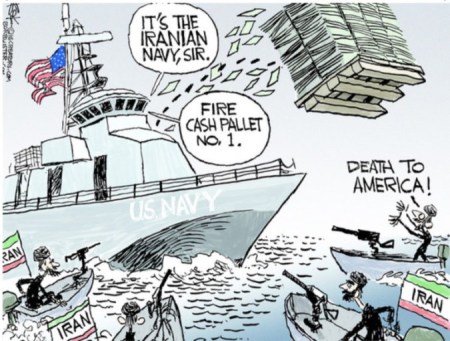
Obama’s Iran scam would be farcical were it not potentially deadly. He did not do what would have been best for America and the free world in general — increase sanctions until Iran complied fully with UN resolutions on missile testing, ceased Uranium enrichment and disposed of the means to do it, ceased all nuke research as well as all nuke cooperation with North Korea and ceased supporting all terrorist groups, including Hezbollah and Hamas. Instead, perhaps considering Himself above such trivia, Obama sought little more than what He considered His greatest achievement — His legacy:

iranian-navy-copy-1

Conclusions

If Obama were viewed internationally as the powerful leader of the world’s most powerful nation, He might be able to get China to clamp down, severely and successfully, on North Korea’s nuke and missile development. Were China to reject His overtures, He could arrange for it to wish that it had acceded. That’s not who Obama is, as demonstrated by, among His other actions, entering into the Iran Scam deal with Iran.

Perhaps Kim Jong-un needs to dress like an Iranian mullah to convince Obama to give him a “deal” similar to the one He gave to Iran. He had better hurry: that won’t work with President Trump.

A Big Blast in North Korea, and Big Questions on U.S. Policy

September 9, 2016

A Big Blast in North Korea, and Big Questions on U.S. Policy, New York Times

GENEVA — North Korea’s latest test of an atomic weapon leaves the United States with an uncomfortable choice: stick with a policy of incremental sanctions that has clearly failed to stop the country’s nuclear advances, or pick among alternatives that range from the highly risky to the repugnant.

A hard embargo, in which Washington and its allies block all shipping into and out of North Korea and seek to paralyze its finances, risks confrontations that allies in Asia fear could quickly escalate into war. But restarting talks on the North’s terms would reward the defiance of its young leader, Kim Jong-un, with no guarantee that he will dismantle the nuclear program irrevocably.

For more than seven years, President Obama has sought to find a middle ground, adopting a policy of gradually escalating sanctions that the White House once called “strategic patience.” But the test on Friday — the North’s fifth and most powerful blast yet, perhaps with nearly twice the strength of its last one — eliminates any doubt that that approach has failed and that the North has mastered the basics of detonating a nuclear weapon.

Despite sanctions and technological backwardness, North Korea appears to have enjoyed a burst of progress in its missile program over the last decade, with experts warning that it is speeding toward a day when it will be able to threaten the West Coast of the United States and perhaps the entire country.

“This is not a cry for negotiations,” said Victor Cha, who served in the administration of President George W. Bush and now is a North Korea expert at the Center for Strategic and International Studies in Washington. “This is very clearly a serious effort at amassing real nuclear capabilities that they can use to deter the U.S. and others.”

Mr. Cha said the usual response from Washington, Seoul and Tokyo — for another round of sanctions — was not likely to be any more successful at changing the North’s behavior than previous rounds. That means Mr. Obama’s successor will confront a nuclear and missile program far more advanced than the one Mr. Obama began grappling with in 2009.

Mr. Obama has refused to negotiate with the North unless it agrees first that the ultimate objective of any talks would be a Korean Peninsula without nuclear arms. But Mr. Kim has demonstrated, at least for now, that time is on his side. And as he gets closer to an ability to threaten the United States with a nuclear attack, and stakes the credibility of his government on it, it may be even more difficult to persuade him to give up the program.

 In a statement Friday, Mr. Obama condemned the North’s test and said it “follows an unprecedented campaign of ballistic missile launches, which North Korea claims are intended to serve as delivery vehicles intended to target the United States and our allies.”

“To be clear, the United States does not, and never will, accept North Korea as a nuclear state,” he said.

Many experts who have dealt with North Korea say the United States may have no choice but to do so.

“It’s too late on the nuclear weapons program — that is not going to be reversed,” William Perry, the defense secretary under President Bill Clinton during the 1994 nuclear crisis with North Korea, said in August at a presentation in Kent, Conn. The only choice now, he argued, is to focus on limiting the missile program.

Yet the latest effort to do that, an agreement between the United States and South Korea to deploy an advanced missile defense system in the South, has inflamed China, which argues the system is also aimed at its weapons. While American officials deny that, the issue has divided Washington and Beijing so sharply that it will be even more difficult now for them to come up with a joint strategy for dealing with the North.

China has been so vocal with its displeasure over the deployment of the American system that Mr. Kim may have concluded he could afford to upset Beijing by conducting Friday’s test.

Fueling that perception were reports that a North Korean envoy visited Beijing earlier this week.

“North Korea almost certainly sees this as an opportunity to take steps to enhance its nuclear and missile capabilities with little risk that China will do anything in response,” Evans J.R. Revere, a former State Department official and North Korea specialist, said in a speech in Seoul on Friday.

The breach between China and the United States was evident during Mr. Obama’s meeting with President Xi Jinping last week. “I indicated to him that if the Thaad bothered him, particularly since it has no purpose other than defensive and does not change the strategic balance between the United States and China, that they need to work with us more effectively to change Pyongyang’s behavior,” Mr. Obama said, referring to the Terminal High Altitude Area Defense system, as the advanced missile defense project is known.

But Mr. Obama noted that sanctions had failed at having much effect. That is largely because the Chinese have left open large loopholes that have kept the North Korean economy alive and, by some measures, enjoying more trade than anytime in years.

In a recent paper, two researchers concluded that sanctions so far “have had the net effect of actually improving” North Korea’s procurement capabilities for its weapons program. To evade sanctions, the North’s state-run trading companies opened offices in China, hired more capable Chinese middlemen and paid higher fees to employ more sophisticated brokers, according to Jim Walsh and John Park, scholars at M.I.T. and Harvard respectively.

The sanctions, Mr. Cha noted, “are supposed to inflict enough pain so the regime comes back to the negotiation table, and that’s clearly not working; or it’s supposed to collapse the regime until it starves, and that’s not working either.”

“Unless China is willing to cut off everything, which they don’t appear willing to do, the sanctions may be politically the right thing to do and a requisite response, but they are not the answer to the problem,” he said.

That means the choices facing Mr. Obama’s successor will be stark. One option is to choke off all trade, in part by telling banks that conduct transactions with North Korea that they will be shut out of dealing in dollars around the world — an effective tactic against Iran before last year’s nuclear deal. But that would enrage the Chinese, and probably cut into cooperation on other issues.

At the same time, an attempt to intercept all shipping could quickly escalate into a full-blown conflict, something neither Mr. Obama nor the South Koreans and Japanese have been willing to risk.

On the other hand, reopening negotiations, which Donald J. Trump has indicated he is willing to consider, could mean paying North Korea again to freeze nuclear activities that the Bush administration and the Clinton administration had already rewarded them for stopping years ago.

The nuclear program dates back to Mr. Kim’s grandfather, Kim Il-sung, the country’s founder, who emerged from the Korean War more than 60 years ago mindful that the United States had considered using nuclear weapons in that conflict and determined to get his own arsenal.

The missile program also has a long history, mostly to deliver conventional arms. But now the two are converging, as the North races to develop a weapon small, light and durable enough to be launched into space and survive re-entry into the atmosphere.

The explosive energy unleashed during the test on Friday, estimated at 10 to 12 kilotons of TNT, was nearly twice that of the North’s last test, conducted in January, said Yoo Yong-gyu, a senior seismologist at South Korea’s National Meteorological Administration.

And the fact that North Korea’s fifth test came only eight months after its fourth is another indication that it is making fast progress toward fitting its ballistic missiles with nuclear warheads, said Choi Kang, a senior analyst at the Asan Institute. The North had waited about three years between each of its previous tests.

North Korea’s advances have unnerved its neighbors in South Korea and Japan, and Mr. Trump’s suggestion that the two nations should pay more for the United States to defend them has not helped.

In both South Korea and Japan, a small but increasingly vocal minority hasbegun to advocate developing nuclear weapons to counter the North instead of relying on the United States.

Cheong Seong-chang, a senior analyst at the Sejong Institute in Seongnam, south of Seoul, argued that a South Korean nuclear program might distract the North from its efforts to build a long-range missile capable of delivering a nuclear warhead to the mainland United States.

“If South Korea arms itself with nuclear weapons, North Korea will regard the South Korean nuclear weapons, not the distant American nukes, as the most direct threat to its security,” Mr. Cheong said.

Israeli Expert: Warheads Used in North Korean Missile-Launch Latest Indication of Close Military Cooperation With Iran

September 7, 2016

Israeli Expert: Warheads Used in North Korean Missile-Launch Latest Indication of Close Military Cooperation With Iran, Algemeiner, Ruthie Blum, September 7, 2016

nklanchThe North Korean launch of the Nodong missiles with Iranian warheads. Photo: Screenshot.

Photos released by North Korea of its launch of long-range ballistic missiles are the latest proof of the close military cooperation between Pyongyang and Tehran, an Israeli expert in the field told the news site IsraelDefense on Tuesday.

According to Tal Inbar — head of Space and UAV Research Centre at the Fisher Institute for Air & Space Strategic Studies — what was new in the photos was the shape of the warheads attached to the Nodong missiles, known in Iran as the Shahab-3.

Until now, such warheads — first detected by Inbar in Iran in 2010 — have not been seen in North Korea. At the time, Inbar dubbed them NRVs (or, “new entry vehicles”), which became their nickname among missile experts around the world.

Inbar told IsraelDefense: “The configuration that we saw [on Tuesday] is identical to what we saw in Iran six years ago. In principle, its penetrating body (warhead) is identical to that of Scud missiles, but is mounted on the Shahab-3, and creates a more stable entity than other Shahab/Nodong warheads.”

Inbar said this was the third time that something of this nature had appeared in Iran before it did in North Korea. “But we must remember that the two countries engage in close cooperation where military and space-directed missiles are concerned,” he said. “It is thus possible that both plans and technology are being transferred regularly from one to the other.”

As was reported in The Algemeiner in July, American intelligence officials said that Iran attempted to launch a new type of ballistic missile based on North Korean technology. The test reportedly ended in failure when the North Korean BM-25 Musudan ballistic missile exploded shortly after lift-off.

In April, as The Algemeiner reported, former US Vice President Dick Cheney’s national security adviser John Hannah used the story of Israel’s 2007 bombing of the North Korean-built nuclear reactor in Syria to warn against Pyongyang’s behavior today. “The greatest threat we face from [Supreme Leader] Kim Jong Un is probably not a suicidal attack against the United States or our allies in Northeast Asia with nuclear missiles. Rather, the more likely danger is that North Korea’s tyrant sells part of his ever-expanding nuclear arsenal to other rogue actors that mean us harm,” Hannah wrote, going on to identify Iran and its Lebanese Shiite proxy Hezbollah as particularly worthy of monitoring.

North Korea Fires Submarine-Launched Ballistic Missile Towards Japan

August 24, 2016

North Korea Fires Submarine-Launched Ballistic Missile Towards Japan, Washington Free Beacon, August 24, 2016

dprk-missile-540x360Underwater test-fire of strategic submarine ballistic missile released by North Korea’s Korean Central News Agency on April 24, 2016 / REUTERS

SEOUL (Reuters)–North Korea fired a submarine-launched missile on Wednesday that flew about 500 km (311 miles) towards Japan, a show of improving technological capability for the isolated country that has conducted a series of launches in defiance of U.N. sanctions.

Having the ability to fire a missile from a submarine could help North Korea evade a new anti-missile system planned for South Korea and pose a threat even if nuclear-armed North Korea’s land-based arsenal was destroyed, experts said.

The ballistic missile was fired at around 5:30 a.m. (2030 GMT) from near the coastal city of Sinpo, where a submarine base is located, officials at South Korea’s Joint Chiefs of Staff and the Defense Ministry told Reuters.

The projectile reached Japan’s air defense identification zone (ADIZ) for the first time, Chief Cabinet Secretary Yoshihide Suga told a briefing, referring to an area of control designated by countries to help maintain air security.

The missile was fired at a high angle, South Korea’s Yonhap News Agency reported, an indication that its full range would be 1,000 km (620 miles) at an ordinary trajectory. The distance indicated the North’s push to develop a submarine-launched missile system was paying off, officials and experts said.

North Korea’s “SLBM (submarine-launched ballistic missile) technology appears to have progressed,” a South Korean military official told Reuters.

Jeffrey Lewis of the California-based Middlebury Institute of International Studies said the test appeared to be a success.

“We don’t know the full range, but 500 km is either full range or a full range on a lofted trajectory. Either way, that missile works.”

The launch came two days after rival South Korea and the United States began annual military exercises in the South that North Korea condemns as a preparation for invasion, and has threatened retaliation.

Beijing is Pyongyang’s main ally but has joined past U.N. Security Council resolutions against the North. It has been angered by what it views as provocative moves by the United States and South Korea, including their July decision to base the THAAD (Terminal High Altitude Area Defense) anti-missile system in South Korea.

China opposes North Korea’s nuclear and missile program as well as any words or deeds that cause tension on theKorean peninsula, its foreign minister, Wang Yi, said on Wednesday at a previously scheduled meeting with his Japanese and South Korean counterparts in Tokyo.

South Korea’s Foreign Ministry condemned the launch and warned of more sanctions and isolation for its rival that “will only speed up its self-destruction.”

“This poses a grave threat to Japan’s security, and is an unforgivable act that damages regional peace and stability markedly,” Japanese Prime Minister Shinzo Abe told reporters, adding that Japan had lodged a stern protest.

GROWING ISOLATION

North Korea has become further isolated after a January nuclear test, its fourth, and the launch of a long-range rocket in February which brought tightened UN sanctions.

It has launched numerous missiles of various types this year, including one this month that landed in or near Japanese-controlled waters.

Joshua Pollack, editor of the U.S.-based Nonproliferation Review, said claiming to have mastered SLBM technology is as much about prestige as a military breakthrough, a status enjoyed only by six countries including the United States, Russia, and China.

“I think it’s meant foremost as a demonstration of sheer technical capability and a demand for status and respect,” Pollack said.

South Korea believes the North has a fleet of more than 70 ageing, limited-range submarines–a mix of Chinese, Russian, and locally made boats. Acquiring a fleet of submarines large and quiet enough and with a longer range would be a next step for the North, experts said.

“They keep conducting nuclear tests and SLBMs together which means they are showing they can arm SLBMs with miniaturised nuclear warheads,” said Moon Keun-sik, a retired South Korean navy officer and an expert in submarine warfare.

North Korea said this year it had miniaturized a nuclear warhead to fit on a ballistic missile, but outside experts have said there is yet to be firm evidence to back up the claim.

Tensions on the Korean peninsula were exacerbated by the recent defection of North Korea’s deputy ambassador in London to South Korea, an embarrassing setback to the regime of North Korean leader Kim Jong Un.

Could North Korea Secretly Build an Iranian Bomb?

May 11, 2016

Could North Korea Secretly Build an Iranian Bomb? The National InterestPeter Brookes, May 10,2016

(Please see also, The Iran-North Korea Axis of Atomic Weapons? — DM)

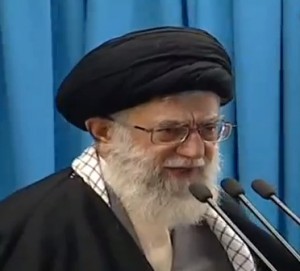
Khamanei-300x271

Editor’s Note: The National Interest and the Heritage Foundation have partnered for a multi-part occasional series examining various aspects of the Iran nuclear agreement. The below is part four of the series. You can read previous parts here: one, two and three.

Last summer’s Iran nuclear deal has been roundly criticized for a number of solid reasons, ranging from Tehran’s ability under the deal to continue advanced centrifuge research to lingering questions about the possible military dimensions of its nuclear program.

That’s all well established.

One issue that has been largely ignored—wittingly or unwittingly—is this: What if Iran were able to find a suitable partner to collude with on an ‘‘underground” nuclear weapons program, all while seemingly staying within the restrictions of the July 2015 nuclear deal?

In other words, Tehran could by all public accounts adhere to the P5+1’s (China, France, Germany/European Union, Russia, the United Kingdom and the United States) Joint Comprehensive Plan of Action (JCPOA). But concurrently, Iran could work clandestinely with another country to advance its nuclear weapons program, essentially circumventing the International Atomic Energy Agency’s inspections and monitoring of the nuclear program inside Iran.

What better candidate for covert cooperation than cagey North Korea?

First, there’s no doubt that North Korea has a nuclear weapons capability. It has conducted four—maybe soon five—tests (2006, 2009, 2013 and 2016), possibly using both plutonium and uranium as fissile material.

Next, some analysts believe Pyongyang may have already “miniaturized” or “weaponized” the underground testing device into a nuclear warhead, capable of being mated to a ballistic missile. Even if North Korea hasn’t achieved it yet, it’s working on it.

Pyongyang has also expanded its missile testing beyond land-based launches. It now has conducted at least two subsurface ballistic missile tests that may also be related eventually to its nuclear weapons program. Clearly, these North Korean capabilities—though not all proven—would benefit an Iranian nuclear weapons program.

Also important is that Pyongyang seems willing to share its nuclear know-how with others, as evidenced by its building of a nuclear facility for Damascus that was destroyed in an Israeli air strike in 2007. Though public evidence is scarce and, if available, gauzy, it’s quite reasonable to conclude with some confidence that Pyongyang and Tehran already have some sort of established security or defense relationship. For instance, in 2012, Iran and North Korea reportedly signed a science and technology (S&T) agreement. It’s fair to assume that any cooperation is defense-related.

Indeed, considering the sorry state of their respective economies, research and industrial bases, it’s hard to conceive of what sort of civilian S&T Pyongyang might offer Tehran—and vice versa, of course.

Lending credence to this idea is the report that, at the time of the S&T agreement’s signing, Iran’s Supreme Leader, Ayatollah Ali Khamenei, spoke of how Tehran and Pyongyang had “common enemies.” The United States quickly—and clearly—comes to mind.

The idea of collaboration should come as no real surprise, as it’s seemingly well-known that the Iran and North Korea are reported to have been cooperating at some level on ballistic missiles going back to at least the late 1990s. For instance, it’s long been asserted that some Iranian ballistic missiles (e.g., the Shahab) are based on North Korean ballistic-missile technology (e.g., the Nodong) or transfers (e.g., the Scud).

Equally alarming is the New York Times report suggesting that the 2013 North Korean nuclear test may have been conducted “for two countries.” That notion was raised by unattributed U.S. government sources and gives support to concerns that Pyongyang and Tehran may be cooperating on more than ballistic missiles. This wouldn’t be the first time such an allegation has been leveled at Tehran and Pyongyang informally, but perhaps the first time it’s been acknowledged by Washington, taking into account a source not willing to be identified.

Of course, the situation has changed dramatically with the JCPOA now in force. Iran now has more than a passing interest in moving forward with its nuclear weapons program—especially considering the evolving regional security situation—without losing the benefits that the agreement provides, such as the removing of crippling economic sanctions. From Iran’s perspective, the need for “nuclear networking” with North Korea is greater than ever.

Of course, it’s not just Tehran that is in need. Pyongyang is also needy for its own reasons, such as its self-imposed, collectivist economic woes and the increasing international economic sanctions it faces over nuclear and missile tests.

In addition, North Korea could use some technical assistance with its space launch program, where Iran is arguably more advanced, but which is integral—and critical—to Pyongyang’s intercontinental ballistic missile (ICBM) program.

Lastly, both countries despise the United States and some of its allies (e.g., South Korea and Israel). Accordingly, Iran and North Korea would benefit from the existence of another state that threatens America with nuclear-tipped ICBMs.

 In other words, there’s plenty of political and military motivation for these two rogue states to get together on nuclear and/or missile matters, arguably even more so today than last summer, before the JCPOA came into effect.

North Korea’s Sanctions Loophole

February 29, 2016

North Korea’s Sanctions Loophole, Wall Street Journal, February 28, 2016

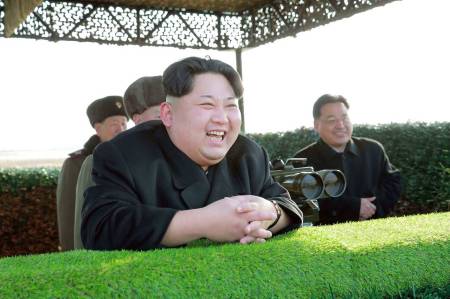
Happy KimThis undated picture released from North Korea’s official Korean Central News Agency on February 27, 2016 shows North Korean leader Kim Jong-Un smiling during the inspection of the test-fire of a newly developed anti-tank guided weapon at an undisclosed location. PHOTO: KCNA VIA KNS/AFP/GETTY IMAGES

The Obama Administration is touting the latest United Nations sanctions as a milestone against North Korea’s nuclear and missile programs. We’d like to believe it too, but a close look at the draft Security Council resolution offers many reasons to doubt.

The resolution would double the number of blacklisted North Korean individuals and state entities, adding Pyongyang’s atomic-energy and space agencies. Luxury goods banned from export to North Korea would grow to include watches, yachts and snowmobiles. A ban on sales of aviation fuel targets state-owned airline Air Koryo, while a ban on sales of rocket fuel targets Kim Jong Un’s missile program.

More significant are efforts to cut Pyongyang’s access to hard currency and smuggled weapons technology. The sanctions expand the list of banned arms and dual-use goods, and they require states to inspect all cargo transiting their territory to or from North Korea by sea, air or land. They would also squeeze North Korean mineral exports, including coal and iron ore, which in 2014 accounted for 53% of Pyongyang’s $2.8 billion in exports to China, per South Korean state figures.

Overall the blacklist of North Korean proliferators is growing by only 12 individuals and 20 entities to a total of 64; the U.N.’s former blacklist on Iran was far larger at 121. In any case, none of these matter if China won’t rigorously enforce them—which it has never done.

There are other loopholes and oversights. The nominal ban on North Korean mineral exports applies only to purchases that demonstrably fund illicit activities, rather than “livelihood purposes.” Yet money is fungible, so Chinese coal purchases excused on livelihood or humanitarian grounds will still channel hundreds of millions of dollars to the regime.

The sanctions also do nothing about the Chinese oil transfers that keep the Kim regime alive. Or Chinese purchases of textiles from mostly state-run North Korean factories that have quadrupled to $741 million a year since 2010 and recently ensnared Australian surf brand Rip Curl in a supply-chain controversy. Or the 50,000-plus North Korean laborers overseas, largely in China and Russia, earning some $230 million a year for their masters in Pyongyang.

U.S. officials say China has new incentive to back sanctions because it wants to block South Korea’s recent moves to deploy the U.S.-built Thaad missile-defense system. That may be why China wants to look cooperative, but the new sanctions aren’t enough to justify walking back on Thaad. China still views the North as a political buffer against South Korea, a thorn in the side of Japan and the U.S., and a diplomatic card to play at the U.N. So China has long played a double game of rhetorically deploring North Korea’s nuclear program while propping it up in practice.

The better way to squeeze the North is closer cooperation among Washington, Seoul and Tokyo to sanction Chinese banks that facilitate trade with Pyongyang. This worked a decade ago until the Bush Administration fell for more of China’s diplomatic promises. China won’t get serious about stopping North Korea until it sees that the U.S. and its allies are serious.

Satire but not funny|Kim Jong-un has replaced John Boehner as Speaker of the House

September 11, 2015

Kim Jong-un has replaced John Boehner as Speaker of the House, Dan Miller’s Blog, September 11, 2015

(The views expressed in this article are mine and do not necessarily reflect those of Warsclerotic or its other editors. — DM)

We have met the enemy and it is us: we have become too tired to be effective and hence are becoming indifferent. The charade on Capitol Hill continues, and not only about the nuke “deal” with Iran. Will the carnival end before it’s too late, or will Obama continue to win?

The House speaker is elected by all House members, not just those of the majority party. He need not be a member of the House. Boehner having resigned because a serious medical condition often reduces him to tears, one group of Democrats nominated Debbie Wasserman-Schultz to replace him. However, due to her support for Hillary Clinton, she fell out of favor with the White House so another group of Democrats nominated Kim Jong-un at Obama’s request. To avoid the appearance of confrontation, Republicans offered no candidates. Kim won by seventeen votes, becoming the first non-US citizen to hold the office thus far this month.

tearsofboehnerDebby


Reporting for duty!

REPORTING FOR DUTY!

The current upset was precipitated by Republican members’ disagreements with Boehner and other party leaders about how best to deal with the catastrophic Iran nuke “deal” without unnecessarily offending the President. Kim Jong-un is expected to substitute his own brand of leadership for Boehner’s leadership through ambivalence.

A majority also deemed Kim the best qualified to negotiate with Dear Leader Obama on behalf of the House because, as the undisputed leader of a rogue nuclear nation himself, he should be able to pull not only Obama’s strings but also those of the Supreme Leader of the Islamic Rogue Republic of Iran.

White House Press Secretary Josh Earnest declined comment on the situation beyond refusing to comment on whether Obama met privately with Kim to congratulate him. However, Obama is generally thought to have confirmed that He fully supports Kim’s way of governing his own Democratic Peoples’ Republic and — subject to the few pesky restraints still imposed by an antiquated Constitution that He has not yet found ways to sneak around — He does His best to emulate him. In that connection, Obama asked Kim for recommendations on antiaircraft guns to deal humanely with Jews and other traitors who oppose Him (Please see also, New York Times Launches Congress ‘Jew Tracker’ – Washington Free Beacon.)

Desiring to gain Obama’s total good will, Kim promised to have derogatory cartoons of Donald Trump and Hillary Clinton painted on all future North Korean nukes and missiles just before they explode. In return, Obama promised to issue executive orders granting North Korea the permanent right to declassify any and all U.S. documents it sees fit pertaining to the security of the United States and to obtain copies, gratis, from the Government Printing Office.

House Speaker Kim Jong-un will next meet with Supreme Leader Khamenei in Tehran to make two common sense proposals, with which Khamenei is certain to agree:

First, Kim will propose that a group of highly regarded North Korean nuclear experts — under his personal guidance and supervision — conduct all nuke inspections in Iran and draw all conclusions concerning any past or present Iranian nuclear program based on them exclusively. Those conclusions will be drawn on behalf of, and in lieu of any conclusions drawn by, the International Atomic Energy Agency (IAEA). The head of the IAEA, Yukiya Amano, immediately endorsed this plan as “splendid and totally consistent with any and all IAEA – Iran “secret deals.”

Second, Kim will propose that Khamenei promise not to nuke anyone until all sanctions have been permanently eliminated, unless he really wants to.

Obama is thought to have agreed with every aspect of the Kim plan and to have directed Secretary Kerry to tell Khamenei that if he agrees all sanctions will be eliminated permanently, via executive decree, and hence even more expeditiously than previously expected. Due to a successful Senate filibuster yesterday, Obama can issue the executive decree very soon; Today — Friday, September 11th — is being considered seriously due to the obvious symbolism of the date.

H/t Freedom is just another word

arming

The inevitable success of Kim’s mission will result in a win-win situation for nearly everyone, particularly the financially strapped IAEA, and the true Peace of Obama will prevail throughout all parts of the world that He considers worth saving. Remember — it’s all for the Children!

veto (1)Mushroom cloud


Addendum

하원 의장 김정은 의 문 사랑하는 북미 친구 , 그것은 오바마 대통령 아래에서 당신의 인생 이 곧 Amerika 민주주의 인민 공화국 이 될 것입니다 무엇 에 미래의 삶을 위해 잘 준비 것을 진심으로 희망 합니다. 배리 와 나는 제출 된 것을 기쁘게 사람들을 위해 가능한 한 오랫동안 지배 구조 의 우리의 양식 에 서서히 적응 을 하기 때문에 전환이 원활 하게 하기 위해 함께 열심히하고 고통 일했다 .

Translation:

Statement of House Speaker Kim Jong-un

My dear North American friends, it is my sincere hope that your life under President Obama has prepared you well for your future life in what will soon become the Democratic People’s Republic of Amerika. Barry [a.k.a. Barack] and I have worked long and hard together to acclimate you gradually to our transformed and transformational form of governance and hence to make the transition as smooth and painless as possible for those pleased to submit. Now, we will accelerate the progress.

Conclusions

It does not have to be that way. Here, in closing, are a few words from Daniel Greenfield.

We don’t have to give in to despair. If we do, we are lost. Lost the way that the left is lost. Lost the way that the Muslim world is lost.

We are not savages and feral children. We are the inheritors of a great civilization. It is still ours to lose. It is ours to keep if we understand its truths. [Emphasis added.]

We are not alone. A sense of isolation has been imposed on us as part of a culture war. The task of reconstructing our civilization and ending that isolation begins with our communication. We are the successors of revolutions of ideas. We need to do more than keep them alive. We must refresh them and renew them. And, most importantly, we must practice them.

We are not this culture. We are not our media. We are not our politicians. We are better than that.

We must win, but we must also remember what it is we hope to win. If we forget that, we lose. If we forget that, we will embrace dead end policies that cannot restore hope or bring victory.

What we have now is not a movement because we have not defined what it is we hope to win. We have built reactive movements to stave off despair. We must do better than that. We must not settle for striving to restore some idealized lost world. Instead we must dream big. We must think of the nation we want and of the civilization we want to live in and what it will take to build it.

Our enemies have set out big goals. We must set out bigger ones. We must become more than conservatives. If we remain conservatives, then all we will have is the America we live in now. And even if our children and grandchildren become conservatives, that is the culture and nation they will fight to conserve. We must become revolutionaries.

We must think in terms of the world we want. Not the world we have lost.

This is the America we live in now. But it doesn’t have to be.

It can be up to us, not to those who hate America and all for which she once stood.

Our World: The Republican fall guys

September 9, 2015

Our World: The Republican fall guys, Jerusalem Post, Caroline Glick, September 8, 2015

Whenever the Iranians leave, they can be depended on to blame US for their decision to vacate their signature. And the Democrats in turn will blame the Republicans for pushing the Iranians over the edge.

***********************

The ayatollahs will ride their nuclear pact with the Great Satan all the way to a nuclear arsenal and regional hegemony, repeating the cycles of brinksmanship, extortion, respite and brinksmanship that they learned from their North Korean teachers.

ShowImage (11)Kim Jong-un, North Korea leader. (photo credit:KNS / KCNA / AFP)

The Iran nuclear deal is presented as an international agreement between the major powers and Iran. But the fact is that there are really only two parties to the agreement – President Barack Obama and his Democratic Party on the one hand, and the Iranian regime on the other.

Over the past week or so, more and more Democrats have fallen into line behind Obama. At the same time, word is getting out about what Iran is doing now that it has its deal. Together, the actions of both sides have revealed the role the nuclear pact plays in each side’s overall strategies for success.

On the Iranian side, last Wednesday the National Committee of Resistance of Iran revealed that North Korean nuclear experts are in Iran working with the Revolutionary Guards to help the Iranians prevent the UN’s nuclear inspectors from discovering the scope of their nuclear activities.

The NCRI is the same opposition group that in 2003 exposed Iran’s until then secret uranium enrichment installation in Natanz and its heavy water plutonium facility in Arak.

According to the report, the North Koreans “have expertise in ballistic missile and nuclear work areas, particularly in the field of warheads and missile guidance.”

“Over the past two years the North Korean teams have been sharing their experiences and tactics necessary for preventing access to military nuclear sites,” NCRI added.

Although, as The Washington Times reports, NCRI’s finding have yet to be verified, it is unwise to doubt them.

North Korea has been assisting Iran’s nuclear program for nearly 20 years. The US began applying sanctions on North Korea for its ballistic missile proliferation activities in Iran 15 years ago. Iran’s Shahab and Ghadr ballistic missiles are modeled on North Korea’s Nodong missiles.

The Syrian nuclear installation that Israel reportedly destroyed in 2007 was a duplicate of the Yangbyon heavy water reactor in North Korea. The Deir al-Zour reactor was reportedly built by North Korean nuclear personnel and paid for by Tehran.

North Korea’s heavy involvement in Iran’s nuclear weapons program tells us everything we need to know about how Iran views the nuclear deal it signed with the Obama administration and its international partners.

For the past 22 years, the North Koreans have been playing the US and the international community for fools. Ever since February 1993, when inspectors from the International Atomic Energy Agency first discovered that North Korea was conducting illicit nuclear activities, Pyongyang has been using its nuclear program to blackmail the US.

The pattern repeats itself with maddening regularity.

First, the US discovers that North Korea is engaging in illicit nuclear activities. Over the years, these activities have gone from illicit development of plutonium-based nuclear bombs to expelling UN inspectors, to testing long-range ballistic missiles, to threatening nuclear war, to testing nuclear bombs and threatening to supply the bomb to terrorist groups.

Second, the US announces it is applying sanctions to North Korean entities.

Third, North Korea responds with more threats.

The sides then agree to sit down and negotiate the scaling back of North Korea’s nuclear activities. In exchange for Pyongyang’s agreement to talk, the US provides the hermit slave state with whatever it demands. US concessions run the gamut from sanctions relief, to cash payments, provision of fuel, assistance in developing “peaceful” nuclear sites at which the North Koreans expand their nuclear expertise, removal of North Korea from the State Department’s list of state sponsors of terrorism, the provision of formal US commitments not to use force to block North Korea’s nuclear progress, to more cash payments and sanctions relief.

The North then formally agrees to scale back its nuclear program and everyone is happy.

Until the next time it is caught cheating and proliferating.

And then the cycle starts again.

In each go around, the US expresses surprise at the scope of North Korea’s illicit nuclear and missile activities. In every cycle, US intelligence failed to discover what North Korea was doing until after the missiles and bombs were tested and UN inspectors were thrown out of the country.

Despite North Korean brinksmanship and ballistic missile warhead development, the US prohibits its ally South Korea from developing its own nuclear deterrent or even taking steps in that direction.

For their part, while negotiating with the Americans, the North Koreans have proliferated their nuclear technologies and ballistic missiles to Iran, Syria, Pakistan and Libya.

Given North Korea’s clear strategy of using nuclear blackmail to develop its nuclear arsenal and maintain the regime’s grip on power, you don’t need to be a master spy to understand what the presence of North Korean experts in Teheran tells us about Iran’s strategy for nuclear empowerment.

The ayatollahs will ride their nuclear pact with the Great Satan all the way to a nuclear arsenal and regional hegemony, repeating the cycles of brinksmanship, extortion, respite and brinksmanship that they learned from their North Korean teachers.

Given how well the strategy has worked for the psychotic North Koreans who have no economy, no allies and no proxies, it is clear that Iran, with its gas and oil deposits, imperial aspirations, terrorist proxies and educated population believes that this is the strategy that will launch it to world-power status.

This then brings us to the Democrats.

Depending on their pro-Israel protestations, the Democratic position in support of the deal ranges from optimism to pessimistic minimalism. On the side of the optimists, we have the Obama administration.

Obama, Secretary of State John Kerry and their advisors insist that the deal is fantastic. It blocks Iran’s path to the bomb. It opens the possibility of Iran becoming a positive actor on the world stage.

On the other end of the Democratic spectrum are the pessimists like New Jersey Senator Cory Booker and Congresswoman Debbie Wasserman-Schultz.

As they see it, the deal is horrible. It empowers and enriches Iran and legitimizes its nuclear program.

But still, they claim, the deal keeps Iran’s nuclear ambitions at bay for a few years by forcing Iran to submit to the much touted UN inspections regime.

So it is a good deal and they will vote in favor of it and then vote to sustain a presidential veto of a congressional decision to oppose it.

Obviously, the presence of North Korean nuclear experts in Tehran makes a mockery of the notion that Iran has any intention of exercising good faith with UN inspectors. But that isn’t the point.

The point is that the Democrats have no intention of doing anything to prevent Iran from becoming a nuclear power. They just don’t want to be blamed for Iran becoming a nuclear power. They want the Republicans to shoulder the blame. The purpose of the deal from their perspective to set the Republicans up to be blamed.

Obama and his Democratic followers insist that if Iran doesn’t act in good faith, the US will reimpose sanctions. Worse comes to worst, they insist, the US can just walk away from the deal.

This of course is utter nonsense.

Obama won’t walk away from his signature foreign policy. He will devote his energies in his remaining time in office to covering up for Iran. That is why he is breaking the law he signed and refusing to hand over the side deals regarding the farcical nature of UN inspections of Iran’s nuclear sites to Congress.

Moreover, after insisting that the deal is the best way to prevent a holocaust or that it is the only way a Jewish mother can protect the homeland of her people, Democratic lawmakers are not going to rush to acknowledge that they are lying. Now that they’ve signed onto the deal, they own it.

Of course, the Iranians are another story. While the Democrats will not abandon the deal no matter what, the Iranians signed the deal in order to abandon it the minute it outlives its usefulness. And that works just fine for the Democrats.

The Democrats know that the Iranians will use any step the Republicans take to try to enforce the deal’s verification regime or condition sanctions relief on Iranian abidance by the deal’s restrictions on its nuclear activities as an excuse to walk away from the deal. They also know the Iranians will remain in the deal as long as it is useful to them.

Since the Iranians intend to hide their nuclear activities, the Democrats assume Tehran will stay in until it is financially and militarily ready to escalate its nuclear activities.

The Democrats believe that timetable will extend well beyond the lifespan of the Obama administration.

Whenever the Iranians leave, they can be depended on to blame US for their decision to vacate their signature. And the Democrats in turn will blame the Republicans for pushing the Iranians over the edge.

You have to give credit to the administration and its Iranian chums. At least they are consistent. They have constructed an agreement that gives them both what they care about most. Iran, as always, wants to dominate the region and develop the means to destroy Israel and its Arab adversaries at will. The administration, as always, wants to blame the Republicans.

Israel and the Arabs understand the game that is being played. It is time for the Republicans to get wise to it.

Nuclear Fiascoes: From Diplomatic Failure With North Korea To Debacle With Iran

September 1, 2015

Nuclear Fiascoes: From Diplomatic Failure With North Korea To Debacle With Iran, Forbes, Claudia Rosett, August 31, 2015

(An excellent comparison of the machinations that led to the nuke “deal” with North Korea and those now leading to the “deal” with the Islamic Republic of Iran. — DM)

[B]oth Clinton and Bush purchased the transient gains of North Korean nuclear deals at the cost of bolstering a North Korean regime that has become vastly more dangerous. . . . Kim Jong Un bestrides a growing arsenal of weapons of mass murder, including chemical and biological, as well as nuclear, plus a growing cyber warfare capability. This is the legacy not least of North Korea’s skill at exploiting the feckless nuclear deals offered by U.S. presidents whose real achievements on this front were to hand off a monstrous and rising threat to the next administration.

Now comes the Iran nuclear deal, which President Obama has described as a perhaps once-in-a-lifetime “historic chance to pursue a safer and more secure world.” And from Israel’s Prime Minister Netanyahu, leader of America’s closest ally and Iran’s prime target in the Middle East, comes the warning that this deal is a “stunning historic mistake,” configured not to block Iran’s path to the bomb, but to pave the way.

Like the North Korea Agreed Framework, the Iran nuclear deal pivots narrowly on nuclear issues, as if ballistic missiles, terrorism, arms smuggling, gross violations of human rights, blatant declarations of destructive intent and the malign character of the regime itself were irrelevant to the promised “exclusively peaceful” nuclear program.

[I]f this Iran deal goes through, is that we are about to see the mistakes made with North Korea amplified on a scale that augurs not security in the 21st century, but a soaring risk of nuclear war.

************************

With Congress due to vote by Sept. 17 on the Iran nuclear deal, there’s a warning worth revisiting. It goes like this: The president is pushing a historic nuclear agreement, saying it will stop a terror-sponsoring tyranny from getting nuclear weapons. And up pipes the democratically elected leader of one of America’s closest allies, to say this nuclear deal is mortal folly. He warns that it is filled with concessions more likely to sustain and embolden the nuclear-weapons-seeking despotism than to disarm it.

This critic has more incentive than most to weigh the full implications of the deal, because his country is most immediately in harm’s way — though it has not been included in the nuclear talks. He notes that the nuclear negotiators have sidelined such glaring issues as human rights, and warns that Washington is naive, and the U.S. is allowing itself to be manipulated by a ruthless dictatorship.

No, the critic I’m referring to is not Israel’s Prime Minister Benjamin Netanyahu, though he has warned of precisely such dangers in the Iran nuclear deal. I am citing the warnings voiced 21 years ago by the then-President of South Korea, Kim Young Sam, as the Clinton administration bargained its way toward the 1994 nuclear deal with North Korea known as the Agreed Framework.

As it turned out, Kim Young Sam’s misgivings were right on target. The 1994 Agreed Framework did not stop North Korea’s pursuit of the bomb. Instead, it became a pit stop on North Korea’s road to the nuclear arsenal it is amassing today.

For all the differences between North Korea and Iran, there are parallels enough to suggest that the failed 1994 nuclear bargain with North Korea is an excellent guide to the future trajectory with Iran, if the U.S. goes ahead with the nuclear deal — the Joint Comprehensive Plan of Action — announced by the U.S., France, Britain, Germany, Russia, China and Iran on July 14 in Vienna.

Recall that in 1994, faced with the threat of North Korea producing plutonium for nuclear weapons, the U.S. sought a diplomatic solution. Taking a cue from an exploratory trip to Pyongyang by former President Jimmy Carter, the Clinton administration wooed North Korea with an offer of lightwater nuclear reactors to be used exclusively for the peaceful production of electricity. All Pyongyang had to do was give up its nuclear bomb program.

As this agreement was taking shape, South Korea’s Kim Young Sam laid out his concerns in an hourlong interview with the New York Times. In the resulting article, dated Oct. 8, 1994, the Times reported: “After weeks of watching in silent frustration as the United States tries to negotiate a halt to North Korea’s nuclear program, President Kim Young Sam of South Korea lashed out at the Clinton administration today in an interview for what he characterized as a lack of knowledge and an overeagerness to compromise.”

The Times article described Kim’s concerns that “compromises might prolong the life of the North Korean government and would send the wrong signal to its leaders.” Kim was quoted as denouncing the deal then in the making as a “half-baked compromise” which would lead to “more danger and peril.”

President Clinton rolled right past that warning. On Oct. 21, 1994, less than two weeks after Kim’s concerns hit the headlines, the U.S. signed the Agreed Framework with North Korea. Clinton praised the deal as “good for the United States, good for our allies, and good for the safety of the entire world.” Promising that the Agreed Framework would reduce the threat of nuclear proliferation, Clinton further lauded the deal as “a crucial step for drawing North Korea into the global community.”

South Koreans and their leaders, in the main, disagreed. But with South Korea dependent on the U.S. superpower for defense against North Korea, Kim Young Sam had little choice but to follow Clinton’s lead. Seoul damned the deal with faint praise. The Associated Press reported: “South Korean Foreign Minister Han Sung-joo said that even though the deal fell short of expectations, it met South Korea’s minimum policy goals.”

History now shows that the chief policy goals served by the Agreed Framework were those of Pyongyang, which racked up a highly successful exercise in nuclear extortion, and carried on, first secretly, then overtly, with its nuclear weapons program. As South Korea’s president had predicted, the Agreed Framework helped fortify Pyongyang’s totalitarian regime, rather than transforming it.

Some of the negotiators involved in that 1994 deal have since argued that while the North Korean agreement eventually collapsed, it did at least delay Pyongyang’s progress toward nuclear weapons. What they tend to omit from that select slice of history is that the Agreed Framework helped rescue a North Korean regime which in 1994 was on the ropes. Just three years earlier, North Korea’s chief patron of decades past, the Soviet Union, had collapsed. The longtime Soviet subsidies to Pyongyang had vanished. China did not yet have the wealth to easily step in. And just three months before the nuclear deal was struck, North Korea’s founding tyrant, Kim Il Sung, died. His son and heir, Kim Jong Il, faced the challenge of consolidating power during a period of famine at home and American superpower ascendancy abroad.

But in the game of nuclear chicken, it was America that blinked. In exchange for North Korea’s promise to freeze and eventually dismantle its nuclear weapons program, the U.S. agreed to lead a $4.6 billion consortium to build two lightwater reactors for North Korea, and provide shipments of free heavy fuel oil for heating and electricity production while the new reactors were being built. This was augmented by U.S. security guarantees, easing of sanctions and promises to move toward normalizing diplomatic relations, with generous food aid thrown in.

By the late 1990s, just a few years into the deal, North Korea had become the largest recipient of U.S. aid in East Asia. That did not curb Kim Jong Il’s hostile ways. The Pyongyang regime put the interests of its military and its weapons programs before the needs of its starving population. In 1998, North Korea launched a long-range missile over Japan, a test for which it was hard to discern any purpose other than developing a vehicle to carry nuclear weapons. By that time, as a number of former Clinton administration officials have since confirmed, the U.S. was seeing signs that North Korea was cheating on the nuclear deal by pursuing a secret program for uranium enrichment.

Instead of confronting North Korea, Clinton during his last two years in office tried to double down on his crumbling nuclear deal by pursuing a missile deal with Pyongyang. In 2000, that led to an exchange of high-ranking officials, in which the Clinton administration dignified North Korea with the unprecedented move of welcoming one of its top-ranking military officials, Vice Marshal Jo Myong Rok, to a 45-minute sitdown with Clinton at the White House. Clinton then dispatched Secretary of State Madeleine Albright, together with the administration’s special advisor for North Korea policy, Wendy Sherman, to Pyongyang (yes, the same Wendy Sherman recently employed by Obama as chief negotiator of the Iran nuclear deal). Sherman and Albright brought North Korea’s Kim Jong Il a basketball signed by star player Michael Jordan; Kim entertained them with a stadium flip-card depiction of a long-range missile launch. There was no missile deal.

North Korea continued raking in U.S. largesse until late 2002, when the Bush administration finally confronted Pyongyang over its nuclear cheating. North Korea then walked away from the 1994 deal (on which it had by then been cheating for years), withdrew from the Non-Proliferation Treaty (on which it had also been cheating) and began reprocessing plutonium from the spent fuel rods which despite the 1994 deal had never been removed from its Yongbyon nuclear complex. President Bush then made his own stab at nuclear diplomacy, via the Six-Party Talks. North Korea punctuated that process in Oct. 2006 with its first nuclear test. In 2007, the Bush administration led the way to a Six-Party denuclearization deal with North Korea, bull-dozing ahead even after it became clear that North Korea had been helping Syria build a secret copy of North Korea’s plutonium-producing Yongbyon reactor (destroyed in Sept. 2007 by an Israeli air strike). Once again, North Korea took the concessions, cheated on the deal and in late 2008 walked away.

Since Obama took office, North Korea has carried out its second and third nuclear tests, in 2009 and 2013; restarted its plutonium-producing reactor at Yongbyon; and in 2010 unveiled a uranium enrichment plant, which appears to have since at least doubled in size. Having equipped itself with both uranium and plutonium pathways to the bomb, North Korea is now making nuclear weapons, and developing increasingly sophisticated missiles — including long-range — to deliver them.

In sum, both Clinton and Bush purchased the transient gains of North Korean nuclear deals at the cost of bolstering a North Korean regime that has become vastly more dangerous. When Kim Jong Il died in late 2011, North Korea’s regime managed a second transition of power, to third-generation Kim family tyrant Kim Jong Un — who was described last year by the commander of U.S. Forces in Korea, General Curtis Scaparrotti, as “overconfident and unpredictable.” Kim Jong Un bestrides a growing arsenal of weapons of mass murder, including chemical and biological, as well as nuclear, plus a growing cyber warfare capability. This is the legacy not least of North Korea’s skill at exploiting the feckless nuclear deals offered by U.S. presidents whose real achievements on this front were to hand off a monstrous and rising threat to the next administration.

Now comes the Iran nuclear deal, which President Obama has described as a perhaps once-in-a-lifetime “historic chance to pursue a safer and more secure world.” And from Israel’s Prime Minister Netanyahu, leader of America’s closest ally and Iran’s prime target in the Middle East, comes the warning that this deal is a “stunning historic mistake,” configured not to block Iran’s path to the bomb, but to pave the way.

There are surely dissertations to be written on the intricate differences between the North Korea Agreed Framework and the Iran nuclear deal now before Congress. But important and alarming similarities abound.

Like the North Korea deal, the Iran deal dignifies a despotic, murderous regime, and provides its worst elements with relief from economic distress, via a flood of rejuvenating resources. In North Korea’s case, the main help arrived in the form of aid. In oil-rich Iran’s case, it comes in the far more lucrative form of sanctions relief, including access to an estimated $55 billion or more (by some estimates, two or three times that amount) in currently frozen funds held abroad.

Like the North Korea Agreed Framework, the Iran nuclear deal pivots narrowly on nuclear issues, as if ballistic missiles, terrorism, arms smuggling, gross violations of human rights, blatant declarations of destructive intent and the malign character of the regime itself were irrelevant to the promised “exclusively peaceful” nuclear program.

Like the North Korea deal, the Iran deal comes loaded with incentives for the U.S. administration to protect its own diplomatic claims of success by ignoring signs of cheating. Monitoring of nuclear facilities is shunted to the secretive International Atomic Energy Agency, which has no power of enforcement, and will have to haggle with Iran for access to suspect sites.

Like Clinton with North Korea, Obama chose to frame the Iran deal not as a treaty, but as an executive agreement, performing an end-run around vigorous dissent within Congress by submitting the deal pronto for approval by the United Nations Security Council. In the North Korean case, the Security Council gave its unanimous blessing in the form of a presidential statement. In the Iran case, the Obama administration drafted a resolution which the Security Council unanimously approved. Having hustled the deal directly to the U.N., despite legislation meant to ensure Congress a voice, Obama administration officials are now pressuring Congress to defer to the U.N.

To be sure, there are two highly significant differences between the 1994 North Korea deal and the 2015 Iran deal. Iran, with its oil wealth, location in the heart of the Middle East, messianic Islamic theocracy and global terror networks, is even more dangerous to the world than North Korea. And, bad as the North Korea deal was, the Iran deal is much worse. Along with its secret side agreements and its promises to lift the arms embargo on Iran in five years and the missile embargo in eight, this deal lets Iran preserve its large illicitly built nuclear infrastructure and carry on enriching uranium, subject to constraints that will be problematic to enforce, and are themselves limited by sunset clauses that even North Korea never managed to obtain at the bargaining table.

When Israel’s Netanyahu spoke this past March to a joint meeting of Congress, warning that the Iran nuclear deal would lead to “a much more dangerous Iran, a Middle East littered with nuclear bombs and a countdown to a potential nuclear nightmare,” Obama dismissed that speech as “nothing new.” That’s true, in the sense that we have heard similar warnings before. What’s new, if this Iran deal goes through, is that we are about to see the mistakes made with North Korea amplified on a scale that augurs not security in the 21st century, but a soaring risk of nuclear war.