Archive for the ‘Netanyahu’ category

That Kissinger Promise and Obama’s Fulfillment

May 30, 2016

That Kissinger Promise and Obama’s Fulfillment, The Jewish PressVic Rosenthal, May 30, 2016

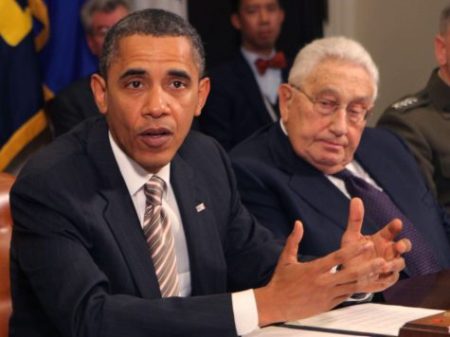
Obama-Kissinger-e1464550543436Pres. Obama seated with Henry Kissinger

{Originally posted to the author’s website, Abu Yehuda}

Old realpolitiker Henry Kissinger was in the news recently when he sat down with Donald Trump, to give him the benefit of his experience. It brought to mind Kissinger’s numerous attempts to get Israel out of the territories it conquered in 1967, before, during and – especially – after the Yom Kippur War.

Kissinger went to Iraq in December of 1975 to try to wean the regime away from the Soviet Union and improve relations with the US. In a discussion with Sa’dun Hammadi, the Iraqi Foreign Minister, Kissinger suggested that American support for Israel was a result of Jewish political and financial power, promised that the US would work to force Israel back to pre-1967 boundaries, and indicated that while the US would not support the elimination of Israel, he believed that its existence was only temporary. Here is an excerpt (the whole thing is worth reading):

I think, when we look at history, that when Israel was created in 1948, I don’t think anyone understood it. It originated in American domestic politics. It was far away and little understood. So it was not an American design to get a bastion of imperialism in the area. It was much less complicated. And I would say that until 1973, the Jewish community had enormous influence. It is only in the last two years, as a result of the policy we are pursuing, that it has changed.

We don’t need Israel for influence in the Arab world. On the contrary, Israel does us more harm than good in the Arab world. You yourself said your objection to us is Israel. Except maybe that we are capitalists. We can’t negotiate about the existence of Israel, but we can reduce its size to historical proportions. I don’t agree that Israel is a permanent threat. How can a nation of three million be a permanent threat? They have a technical advantage now. But it is inconceivable that peoples with wealth and skill and the tradition of the Arabs won’t develop the capacity that is needed. So I think in ten to fifteen years, Israel will be like Lebanon—struggling for existence, with no influence in the Arab world.  [my emphasis] …

Kissinger also promised that aid to Israel, which he presented as a result of Jewish political influence, would be significantly reduced. He indicated that legal changes in the US – he must have been referring to the creation of the Federal Electoral Commission in 1974 to regulate campaign contributions – would attenuate Jewish power and therefore American support for Israel. Naturally, he didn’t foresee the Israel-Egypt peace agreement, which permanently established a high level of military aid to both countries.

He further promised that the US would support a PLO-run Palestinian state if the PLO would accept UNSC resolution 242 and recognize Israel. This of course is what (supposedly) happened in the Oslo accords.

Kissinger insisted that “No one is in favor of Israel’s destruction—I won’t mislead you—nor am I.” But his hint that a smaller Israel might not survive is clear. Surely he understood that a pre-1967-sized Israel (within what Eban called “Auschwitz lines”) would have no chance of surviving, simply because of the strategic geography of the area.

Kissinger was wrong about the Arabs developing the capability to challenge Israel, but their place has been taken by soon-to-be-nuclear Iran and its proxies, who are significantly more dangerous than the Arab states ever were.

US policy, however, has kept more or less the same shape, except that the hypocrisy of insisting that the US supports the existence of Israel but in a pre-1967 size is even more glaring. The substitution of the PLO for the Arab states as the desired recipient of the land to be taken from Israel has barely made a ripple either in America or among the Arabs, suggesting that the policy is more about Israel giving up land than about the Arabs getting it.

The original motivation for Kissinger’s promises was supposedly the desire of the US to replace the Soviet Union as the patron of the Arab states. After the collapse of the USSR and the end of the Cold War in 1991, however, there was no change in policy. Although the Oslo Accords were initiated by left-wing Israelis, the US eagerly embraced them, and the so-called ‘peace process’ became a permanent stick to beat Israel with.

President Obama is especially adept at emphasizing support for Israel’s existence while at the same time demanding that Israel make concessions that would make her continued existence impossible. Apparently agreeing with Kissinger about Jewish power, Obama has worked to reduce the pro-Israel influence of American Jews in numerous ways, such as by providing access to the White House for groups like J Street and the Israel Policy Forum, while marginalizing traditional Zionist organizations like ZOA.

Kissinger’s almost anti-Semitic claim that US support for Israel is bought with Jewish money was probably untrue in 1975 and is even less so today, when a large proportion of American Jews, including wealthy ones, have chosen their liberal or progressive politics over Zionism. The coming struggle over the introduction of a pro-Palestinian plank into the Democratic platform is an indication that the party and with it, many of its Jewish supporters, is moving toward Obama’s position.

The Obama Administration’s program to extricate itself from the Middle East by empowering Iran as the new regional power has given a new impetus to the policy of shrinking Israel. Iran sees Israel as a major obstacle to its hegemony, for both geopolitical and religious/ideological reasons, and is committed to eliminating the Jewish state. Obama found it necessary to restrain Israel from bombing Iran’s nuclear facilities at least once (in 2012), and seems to be prepared to sacrifice Israel in order to achieve his goal of establishing Iranian regional dominance.

Some would go even further and say that Obama’s primary ideological goal is to eliminate Israel and the Iranian gambit is a means to this end, but that is highly speculative! Or maybe it’s a matter of two birds with one stone.

Henry Kissinger didn’t do us any favors, but I think the anti-Israel thread in American policy would have been strong enough without him, running from Truman’s Secretary of State George C. Marshall all the way to Obama’s stable of anti-Zionists like Rob Malley and Ben Rhodes.

Today Israel is long gone from the Sinai, more recently from Gaza, and probably only thanks to the disintegration of Syria, still holding the Golan Heights. I would like to believe that PM Netanyahu was correct when he said that Israel will never leave the Golan. Regarding Judea, Samaria and Jerusalem, I expect that we are about to begin a very difficult time, as the Obama Administration is likely to mount a campaign in its last days to fulfill Kissinger’s promise to the Arabs at long last.
Bibi’s foes seeking a Promised Land

May 21, 2016

Bibi’s foes seeking a Promised Land, DEBKAfile, May 21, 2016

Plitim_Koteret480

The unprecedented political and personal attacks on Friday night by opponents and former allies of Prime Minister Netanyahu and Defense Minister-designate Avigdor Lieberman, who used every possible media platform to warn that “the fascists are coming,” is more indicative of their personal and political situation than the domestic political reality of the State of Israel.

In their opinion, the appointment of Lieberman to defense minister, as his predecessor Moshe Ya’alon said, shows that extremism, violence and racism in Israeli society is undermining the country’s strength and is already having a detrimental effect on the IDF. Ya’alon also accused pro-government sections of disrespect for srael’s judges and its supreme court to the detriment of the rule of law. The Israeli media said Ya’alon’s statement marked the emergence of a new leader of what it called “the sane right-of-center camp.”

In other words, anyone who does not belong to that camp is not sane.

The right-of-center camp, if it comes into being, would be a major and important change in Israeli politics. Until now, the Israeli public has been led to believe that the left-of-center camp is the one that is sane. This time, even the Israeli media understand that the left has been completely discredited and that it is time to finally shift towards the right.

But that is not the main point. Rather, opponents of Netanyahu and Lieberman refuse to accept that large parts of Israeli society are tired of being “sane”, of the hypocrisy, of political correctness, and of local media outlets with such views.

With the increasing disappearance of relevant news in Israeli media outlets, what do we see and read each day? A procession of stories on organized crime families, con men, rapists, pedophiles, and small-time crooks, as well as lawyers with enormous egos who represent them.

Perhaps the prime minister was right when he said recently that the IDF should restart holding parades on Independence Day each year, as it did for more than 20 years, to maintain “sanity” and counterbalance the endless coverage on crime.   Large sectors of the Israeli public are sick and tired of the politicians, who pretend to be righteous men, and those who turn to the Supreme Court for the resolution of every problem.

There are also large parts of Israeli society that have lost faith in the Supreme Court and in the country’s justice system as a whole and do not always recognize it as  properly carrying forward the rule of law.

Thus, it would have been possible to relate more seriously to Ya’alon’s comments if he had called for far-reaching reform of Israel’s legal authorities.

After all, it must be said openly that not only has the judicial system failed in its war against corruption and crime, but there are already initial signs that the system is not immune to these threats, and that they have spread into the system itself.

Therefore, Ya’alon’s claims regarding the rule of law, and its effect on the IDF, is a sign that he is not capable of understanding what is truly happening in Israeli society and why there is opposition to his statement within parts of the society and the IDF, and will not have the influence that he wants to achieve.

It was also a combination of two different ideas: law, which is passed by the Knesset, and justice, which is determined by the authority of the courts that must follow the law.

Besides the hypocrisy, the attacks on Lieberman’s appointment are tinged with racism. The recent political developments indicate that the Russian immigrants who entered Israeli politics in the mid-1990s have finally reached the most influential positions in the government.

To call these politicians “fascists” and “Rasputin” indicates pointless.

Those who consider themselves “Israel’s elite” have lost power, and even worse have lost hope of regaining power, so they are allowing themselves to make wild accusations without any inhibitions.

The nightmare of the “sane” camp is if Saudi King Salman and Egyptian President Abdel Fattah al-Sisi, along with Netanyahu and Lieberman, will sit on the same podium and sign a cooperation agreement. But this is a reality that is happening every day, not just wishful thinking.

That is why the Israeli media did not publish a single word when Saudi multimillionaire and international businessman Walid Ben Talal last month opened the first Saudi embassy in Israel, located at 14 David Flusser street in Jerusalem. The international businessman is considered close to the king’s son, Deputy Crown Prince and Defense Minister Mohammed bin Salman.

Accusations of fascism onece hurled against the late Menachem Begin, who was never forgiven by Israel’s left for reaching power through the ballot box and then  t signing the historic peace treaty with Egypt in 1979.

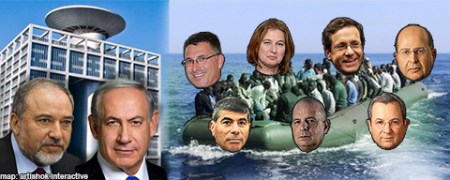
A number of high-profile political figures think that the rule by Benyamin Netanyahu is the worst thing that has happened in the history of the State of Israel. These include Ya’alon along with fellow ex-IDF chiefs of staff Gabi Ashkenazi and Benny Gantz, Zionist Camp party chairman Yitzhak Herzog, former Interior Minister Gideon Sa’ar, former Shin Bet domestic security service chief Yuval Diskin and former Foreign Minister Tzipi Livni.

In order to bring Netanyahu’s rule to an end, they have all gotten into the same “boat” and set off for the “promised land.”

There is just one problem. Where is the boat headed in the stormy waters of the Middle East?

This land didn’t exist in the past and it doesn’t exist now. That is why they pullback in every general elections. The result of this journey to the “promised land” will be the opposite of what they expect. The flood of attacks on Netanyahu and Lieberman will only strengthen them and increase their public support.

It should be said to Herzog’s credit that he was the first among this group of politicians to understand that the only method available to opponents of Netanyahu, Lieberman and the ruling Likud party is to rid themselves of the radical left and the destructive voices within their movements.

A determined struggle to achieve that goal would create an opposition with a positive action plan, and a good chance of taking power, for the first time in recent years.

Sisi and Mideast Peace

May 21, 2016

Sisi and Mideast Peace, American ThinkerC. Hart, May 21, 2016

Egyptian President Abdel Fatah al-Sisi’s speech on Tuesday, May 18, set ripples through Israel’s political establishment. Speaking in the southern city of Assiut, Sisi signaled to the Arab world, the Palestinians, and Israel that it is time for an historic breakthrough in peace negotiations.

Responding immediately to Sisi’s comments, Israeli Prime Minister Benjamin Netanyahu stated that he is open to working with Egypt and Arab states towards advancing the peace process, not only with the Palestinians but with the peoples of the Middle East region.

Netanyahu’s comments come on the heels of a visit to Israel by French Foreign Minister Jean-Mark Ayrault. The two men met but disagreed on how to advance peace.

France insists on hosting an international parley to force Israel and the Palestinians to come to the peace table. Israel is against the French initiative.

Netanyahu would like to go beyond the Israeli-Palestinian conflict and work directly with moderate Arab states on a comprehensive peace deal. Sisi could be instrumental in building an Arab coalition for peace which would dismiss or weaken the divisive French initiative, releasing Israel from conceding to European demands.

Former Israeli ambassador to Egypt, Zvi Mazel, is currently working as a Research Fellow at the Jerusalem Center for Public Affairs (JCPA). He is a Middle East expert who has represented Israel’s Ministry of Foreign Affairs as former Ambassador to Sweden and Romania, as well. This writer asked Mazel if Sisi’s comments were spontaneous or were released at this time for political reasons because he wants to strengthen Egypt’s position in the region by helping Israel.

“I don’t think there is a big design… I think that Sisi understands what is going on in the Middle East and he is identifying according to his view — a kind of possibility of advancing the peace process.”

Egypt, Saudi Arabia, the Gulf countries, and Israel have common enemies: Iran and Islamic State. Already there have been discreet diplomatic and business ties between Israel and these nations

According to Mazel, Sisi is also emerging as a strong respected leader among Egyptians despite the Western media’s portrayal of him as a dictator similar to former Egyptian President Hosni Mubarak.

“Sisi sees himself as a president quite stable among his people. I know that this is not the way they think in the Western media — New York Times and company. They see him as a kind of military dictator; absolutely not! He’s a good man. He’s not Mubarak. He’s Sisi.”

Mazel explains that Egypt is on the way to economic sustainable development. This is what Sisi has been focused on over the past two years and he is seeing success. Unemployment has gone down, despite the fact that almost 90 million people live in Egypt and the country is poor.

“He has started something quite positive, and Sisi thinks that the time has come for Egypt to be in the international arena.”

What that means, according to Mazel, is that Egypt’s current role is still minor. Sisi is asking Israelis and Palestinians to go forward, yet he, himself, does not have a plan. But, in the future, Egypt could emerge as a larger player in the region.

Mazel is pragmatic about the short-term. “It’s a positive step for Egypt, but it is not going to change the world.”

Current peace advances that are being prepared for release are not a positive development for Israel: (a) the French Initiative; (b) a document showing the obstacles to Israeli-Palestinian peace efforts soon to be reported by the Quartet; (c) the 2002 Arab Peace Initiative that, despite being outdated, is still considered a serious option by the Arab world.

In the coming days, the Arab League plans to meet and discuss the Israeli-Palestinian conflict. Mazel thinks that Sisi’s statement was good timing for that meeting, but otherwise, was not connected to a bigger scheme.

However, on Wednesday, May 18, American Secretary of State John Kerry arrived in Egypt one day after Sisi gave his emotional speech. Some analysts believe that the U.S. is behind Sisi’s bold words, in an effort to circumvent the French from becoming a new power broker in the Middle East.

The question is whether Sisi’s encouragement will lead to Israel courting the Arab nations and the Arab nations courting Israel, while by-passing the Palestinians. Mazel thinks that kind of change is slow in coming, because the Arabs continue to entrench themselves in old positions that favor Palestinian demands.

Refusing to sit down and negotiate with Israel, the Palestinians have insisted on preconditions which the Arab League has accepted. They demand that Israel agree on the right of return for so-called Palestinian “refugees” to Israeli land; that Israel withdraw to the 1967 borders; and, that Israel stop building in West Bank settlements (Judea and Samaria). Palestinian President Mahmoud Abbas also expects Israel to release hundreds of Palestinian prisoners, who have blood on their hands, serving time in Israeli jails because of terrorist attacks against the Israeli population.

So far, these unresolved issues have kept Abbas away from face-to-face negotiations with Netanyahu. However, his real diplomatic scheme is to get the international community to affirm the Palestinian position and force Israel to concede to Palestinian demands. Right now, Abbas sees the best venue to accomplish his goal as a French-sponsored future peace conference, followed by a stinging UN anti-Israel resolution.

Meanwhile, the future pressure on Israel will be to immediately stop settlement construction in order to get the peace process going. Mazel declares, “Absolutely not… we have to go on! Half a million people live there. And, they are the shield of Israel. We continue to build until there is peace.”

Mazel has a real problem with the demands of the Arab League, as well. “The Arab Peace Initiative is more or less the same as the Palestinian attitude. The ‘right of return’ is still there. It should be taken completely out. Most importantly, the Palestinians and the Arabs should recognize a Jewish State in Israel.”

Mazel is also not sure that Netanyahu’s insistence on widening his government, to provide greater stability, is a wise idea. Reportedly, Yisrael Beytenu Chairman Avigdor Liberman will soon become Israel’s new Defense Minister as Netanyahu brings several more ministers into his coalition. Mazel thinks this will not provide a wider diplomatic envelope; nor, will it help change European or Arab attitudes towards Israel; nor will it end the Boycott-Divestment-Sanctions (BDS) movement against Israel.

Then there is U.S. President Barack Obama’s failed Middle East policy, which includes his lackluster support of American allies in the region. Mazel says this policy cannot continue.

“It cannot be like that, because America is the most important power in the world… And, whoever will win the presidency, whether it will be Mrs. Clinton or Trump, both of them are in a certain way connected to the Middle East.”

Mazel believes that with 22 countries and more than 300 million people living in the region, the next U.S. president will be more engaged in leading the nations into greater stability.

In the meantime, currently 80% of the Egyptian people support Egyptian President Sisi. His nation has already made peace with Israel (along with Jordan). Helping Israel to extend an olive branch to other Arab countries will encourage Egypt to take up an important leadership role in a region that continues to be embroiled in major upheaval and violence.


Peace: A deceptive, dictatorial word

May 20, 2016

Peace: A deceptive, dictatorial word, Israel Hayom, Martin Sherman, May 20, 2016

No matter how many far-reaching compromises and gut-wrenching concessions Israel has made, they have never been enough to elicit any commensurate counter-concessions from the Arabs. Indeed, rather than satiate the Arab appetite, they have merely whetted it, with each Israeli gesture only leading to further demands for more “gestures.”

****************************

After a long absence, “peace” is back in the headlines, due in large measure to this week’s visit to Israel by French Foreign Minister Jean-Marc Ayrault, who came to try to promote a new French initiative that somehow, by as yet unspecified means, would resuscitate the moribund “peace process.”

Perversely planned to take place without either Israel or the Palestinians, the principal protagonists, the conference has now fortuitously been delayed to accommodate the schedule of U.S. Secretary of State Kerry, who apparently had better things to do than take part in yet another doomed charade to forge “peace” in the Middle East.

However, despite its ill-conceived rationale and dauntingly dim prospects, the planned summit can and should serve one constructive purpose: to focus attention not only on what the quest for the elusive condition of “peace” really entails, but on the even more fundamental question of what is actually meant, and what can realistically be expected, when we talk of “peace” as a desired goal, particularly in the context of the Middle East and particularly from an Israeli perspective.

Indeed, the need for such clarification becomes even more vital and pressing because of recent reports of possible Egyptian involvement in attempts to initiate “peace” negotiations with Arab regimes teetering on the brink of extinction and involving a perilous Israeli withdrawal to indefensible borders. All this in exchange for grudging recognition as a non-Jewish state by a partially no longer existent, partially disintegrating, Arab world.

A dictatorial word

It takes little reflection to discover that, in fact, “peace” is a word that is both dictatorial and deceptive.

It is dictatorial because it brooks no opposition. Just as no one can openly pronounce opposition to a dictator without risking severe repercussions, so too no one can be openly branded as opposing peace without suffering grave consequences to personal and professional stature.

Life can be harsh for anyone with the temerity to challenge the tyrannical dictates of the politically correct liberal perspectives. As British columnist Melanie Phillips remarked several years ago in an interview on Israel’s Channel 1: “Believe me, it [failing to abide by political correctness] has a very chilling effect on people, because you can lose your professional livelihood, your chances of promotion, you lose your friends.”

In a surprisingly candid admission, The New York Times’ Nicholas Kristof wrote that “universities are the bedrock of progressive values, but the one kind of diversity that universities disregard is ideological. … We’re fine with people who don’t look like us, as long as they think like us.”

This peer-imposed doctrinaire uniformity has had a debilitating impact on the quality of intellectual discourse in general, and on the question of “peace” in the Middle East in particular.

A New York Times opinion piece by Arthur C. Brooks cautioned: “Excessive homogeneity can lead to stagnation and poor problem solving.” Citing studies that found a “shocking level of political groupthink in academia, he warned that “expecting trustworthy results on politically charged topics from an ideologically incestuous community [is] downright delusional.”

A deceptive word

The considerable potential for defective analysis in the intellectual discourse on such a politically charged topic as “peace” also accounts for another detrimental attribute of the word.

Not only is it rigidly dictatorial, but, perhaps even more significantly, “peace” is a grossly deceptive word. It can be, and indeed is, used to denote two disparate even antithetical political situations. On the one hand, “peace” can be used to describe a state of mutual harmony between parties, but on the other hand it can just as aptly be used to characterize an absence of violence maintained by deterrence.

In the first meaning, “peace” entails a situation in which the parties eschew violence because they share a mutual perception of a common interest in preserving a tranquil status quo. In the second meaning, “peace” entails a situation in which violence is avoided only by the threat of incurring exorbitant costs.

The significance of this goes far beyond semantics. On the contrary. If it is not clearly understood, it is likely to precipitate calamitous consequences.

The perilous pitfalls of ‘peace’

It is crucial for practical policy prescriptions not to blur the sharp substantive differences between these two political realities. Each requires different policies both to achieve and, even more importantly, to sustain them.

The misguided pursuit of one kind of peace may well render the achievement — and certainly the preservation — of the other kind of peace impossible.

Countries with the mutual harmony variety of “peace” typically have relationships characterized by openness and the free movement of people and goods across borders. As in the relationship between Canada and the U.S., there is little or no effort needed to prevent hostile actions by one state against the other. Differences that arise are not only settled without violence, but the very idea of using force against each other is virtually inconceivable.

By contrast, in the second, deterrence-based variety of peace, such as those between the U.S. and USSR during the Cold War or between Iran and Iraq up to the 1980s, the protagonists feel compelled to invest huge efforts in deterrence to maintain the absence of war.

Indeed, whenever the deterrent capacity of one state is perceived to wane, the danger of war becomes very real, as was seen in the Iraqi offensive against an apparently weakened and disorderly Iran after the 1979 Islamic Revolution.

In this type of “peace,” there is no harmonious interaction between the peoples of the states. Movements across borders are usually highly restricted and regulated, and often prohibited.

It is not surprising to find that peace of the “mutual harmony” variety prevails almost exclusively between democracies, since its characteristic openness runs counter to the nature of dictatorial regimes.

The perils of pursuing one type of peace (mutual harmony) when only the other type (deterrence) is feasible were summed up over two decades ago by Prime Minister Benjamin Netanyahu in his acclaimed book “A Place Among the Nations: Israel and the World.” In it, he calls for making a clear distinction between the “peace of democracies” and the “peace of deterrence.”

“As long as you are faced with a dictatorial adversary, you must maintain sufficient strength to deter him from going to war. By doing so, you can at least obtain the peace of deterrence. But if you let down your defenses … you invite war, not peace,” he wrote.

Much earlier, in 1936, Winston Churchill underscored the dangers: “The French Army is the strongest in Europe. But no one is afraid of France. Everyone knows that France wants to be let alone, and that with her it is only a case of self-preservation. … They are a liberal nation with free parliamentary institutions. Germany, on the other hand, under its Nazi regime … [in which] two or three men have the whole of that mighty country in their grip [and] there is no public opinion except what is manufactured by those new and terrible engines — broadcasting and a controlled press fills unmistakably that part [of] … the would-be dominator or potential aggressor.”

Compromise counterproductive

To grasp the potential for disaster when a policy designed to attain a harmonious outcome is pursued in a political context in which none is possible, it is first necessary to recognize that, in principle, there are two archetypal configurations. In one, a policy of compromise and concession may well be appropriate; in the other, such a policy will be devastatingly inappropriate.

In the first configuration, an adversary interprets concessions as conciliatory, and feels obliged to respond with a counter-concession. Thus, by a series of concessions and counter-concessions, the process converges toward some amicably harmonious resolution of conflict.

However, in the second configuration, the adversary sees any concession as a sign of vulnerability and weakness, made under duress. Accordingly, such initiatives do not elicit any reciprocal gesture, only demands for further concessions.

But further concessions still do not prompt reciprocal moves toward a peaceable resolution. This process ill necessarily culminate either in total capitulation or in large-scale violence, either because one side finally realizes that its adversary is acting in bad faith and can only be restrained by force, or because the other side realizes it has extracted all the concessions possible by non-coercive means, and will only win further gains by force.

In such a scenario, compromise is counterproductive and concessions will compound casualties.

Whetting, not satiating, Arab appetites

Of course, little effort is required to see that the conditions confronting Israel today resemble the latter situation far more than the former. No matter how many far-reaching compromises and gut-wrenching concessions Israel has made, they have never been enough to elicit any commensurate counter-concessions from the Arabs. Indeed, rather than satiate the Arab appetite, they have merely whetted it, with each Israeli gesture only leading to further demands for more “gestures.”

If in any “peace” negotiations such compromises undermine Israeli deterrence by increasing its perceived vulnerability, they will make war, not peace, more imminent.

Indeed, it was none other than Shimon Peres, in recent years one of the most avid advocates of the land-for-peace doctrine (or dogma), who, in his book “Tomorrow is Now,” warned vigorously of the perils of the policy he later embraced.

After detailing how surrendering the Sudetenland made Czechoslovakia vulnerable to attack, Peres writes of the concessions Israel is being pressured to make today to attain “peace” : “Without a border which affords security, a country is doomed to destruction in war. … It is of course doubtful whether territorial expanse can provide absolute deterrence. However, the lack of minimal territorial expanse places a country in a position of an absolute lack of deterrence. This in itself constitutes almost compulsive temptation to attack Israel from all directions.”

e also warns: “The major issue is not [attaining] an agreement, but ensuring the actual implementation of the agreement in practice. The number of agreements which the Arabs have violated is no less than number which they have kept.” Since then, of course, their record has hardly improved.

Will Netanyahu 2016 heed Netanyahu 1993?

In 1996, shortly after Netanyahu was elected prime minister for the first time, Ari Shavit of Haaretz interviewed him on positions he had articulated in “A Place Among the Nations.”Shavit: “In your book, you make a distinction between … a harmonious kind of peace that can exist only between democratic countries, and peace through deterrence, which could also be maintained in the Middle East as it currently is. Do you think we need to lower our expectations and adopt a much more modest concept of peace?”

Netanyahu: “One of our problems is that we tend to nurse unrealistic expectations. … When people detach themselves from reality, floating around in the clouds and losing contact with the ground, they will eventually crash on the rocky realities of the true Middle East.”

Let us all hope that Netanyahu of today will heed the advice of Netanyahu of then. It is the only way Israel will be able to avoid the ruinous ravages of the deceptive and dictatorial word “peace.”

Perception as deterrence – Israel’s new Defense Minister

May 20, 2016

Perception as deterrence – Israel’s new Defense Minister, American ThinkerRon Jager, May 20, 2016

The recent news that Avigdor Liberman, a former Israeli Foreign Minister and head of the Yisrael Beiteinu party, a small right-wing party, will replace Moshe “Bogie” Ya’alon as the new Israeli defense minister  and has been portrayed by the Israeli media and their elitist opinion makers with dismay and stupefaction.  In Tel-Aviv, a city known for its progressive and leftist inclination, many muttered that the municipality should start opening up the air raid shelters as Lieberman’s appointment hit the airwaves. Lieberman, a politician feared and despised by the Israeli left, is being demonized and delitigitimized even before his appointed has gone into effect. Yet the potential appointment of Avigdor Lieberman as Defense Minister has thrown the whole Palestinian leadership and Israeli Arab politicians into a frenzy, making the reaction by Israel’s leftist elite seem mild. Claiming that Israel is adopting characteristics of a fascist regime and calling for the boycott of Israel; stating that “the Israeli government is sending a message to the world that Israel prefers extremism, dedication to the occupation and settlements over peace,” and encouraging blatant racism, are only a fraction of the derogatory and slanderous accusations against a veteran politician who has been democratically elected.

The potential appointment of Avigdor Lieberman to the position of Defense Minister may very well herald a new and more effective deterrence against the Palestinians’ desire to get up in the morning and murder a Jew. The Palestinian Arab perception of Lieberman as a person who believes in the sanctification of power, ruthlessness, violence, and ignorance with murderous potential can very well be exactly what will cause the Palestinians to adopt a more realistic assessment of what a negotiated settlement will look like.

This is their dilemma, and this is their choice. Either continue and deny reality, taking their chances with a Defense Minister who is perceived as having no problems with employing a strict crackdown wherever Palestinian terror erupts, who has no qualms about enforcing strict rules of engagement, making it crystal clear that Israel’s strategy is based on the adage of our Sages, “If someone rises to kill you, kill him first,” or begin to negotiate seriously and honestly to achieve a sustainable peace agreement with Israel. The perception of Avigdor Lieberman by the Palestinian Arabs could very well facilitate this change.

As Israel’s strategic deterrence and capabilities have been proven to be highly effective in recent years with land, sea, and air strategic capabilities becoming literally impenetrable, the main task facing Israel’s Defense Minister will be primarily in the Palestinian theatre. The Middle East, being a region highly susceptible to a cultural disposition to base one’s reaction on who how one perceives one’s enemy, may very well bring the Palestinian Arab leadership to fold their cards and start the arduous and unavoidable process of negotiating with Israel.

For the majority of the past eight years, President Obama and State Department “experts” have been treating the Israeli-Palestinian conflict as the central generator of political upheaval ravaging the Middle East. They do not realize just how marginal the conflict with the Palestinian Arabs has become or understand that as far as the Sunni Arab nations of the Middle East, the future Palestinian State, should it be established, will be just another failed Arab nation in perpetual conflict with its own people and with her neighbors.

As far as the Palestinian Authority (PA) that resides in Ramallah is concerned, the lack of legitimacy in the eyes of their own people is only exceeded by the widespread and institutionalized corruption by its leaders, sustained by international funding from the United States and the European Union. Having rejected over the years any possibility of a negotiated settlement, the PA leadership have proven without a doubt that they have no intention of reaching any agreement.. The only goal of the Palestinian Arab leadership has been to gain territories and use them for the next attack aimed at minimizing and weakening Israel. Apart from that, there is nothing: No democracy, no economy, no law and no future for the Palestinian Arabs other than being in a perpetual cycle of meaningless and unsuccessful conflict with Israel. Israel will continue to move ahead and forge alliances with Sunni Arab neighbors and the Palestinian Arabs will wallow in their misery as they continue to deny reality and believe in their own made-up propaganda narrative.

The unprecedented political changes having taken place in the Middle East in recent years mainly due to Obama’s irresponsible and failed strategic policy decisions have resulted in new emerging alliances between Israel and her neighbors. Despite the challenges that Iran continues to pose to Israel and the potential of her leaders who might use the conflict with Israel as a means of rallying political support in her war with the Sunni Arab nations, the threat of renewed conventional conflict between Israel and her Arab neighbors has been downgraded, while more realistic scenarios envision a greater focus on economic cooperation and regional stability. Although it is far too early to predict the success of the new political alliances and strategic order that will eventually emerge from the changes in the Arab world, the inherent asymmetry of the conflict between Israel and the Palestinian Arabs will maintain this conflict on low burner for the foreseeable future with sporadic eruptions of terror and limited missile attacks similar to what that the Israeli population has had to endure in recent years.


Obama’s Double Standard Toward Netanyahu

April 26, 2016

Obama’s Double Standard Toward Netanyahu, The Gatestone InstituteAlan M. Dershowitz, April 26, 2016

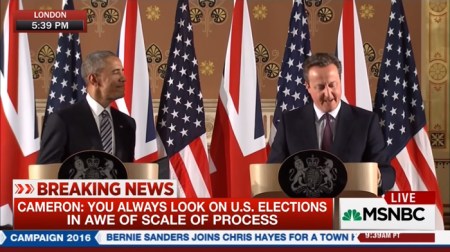
As President Obama winds up his farewell tour of Europe, it is appropriate to consider the broader implications of the brouhaha he created in Great Britain. At a joint press conference with Britain Prime Minister, David Cameron, President Obama defended his intrusion into British politics in taking sides on the controversial and divisive Brexit debate. In an op-ed, Obama came down squarely on the side of Britain remaining in the European Union — a decision I tend to agree with on its merits. But he was much criticized by the British media and British politicians for intruding into a debate about the future of Europe and Britain’s role in it.

Obama defended his actions by suggesting that in a democracy, friends should be able to speak their minds, even when they are visiting another country:

“If one of our best friends is in an organization that enhances their influence and enhances their power and enhances their economy, then I want them to stay in. Or at least I want to be able to tell them ‘I think this makes you guys bigger players.'”

Nor did he stop at merely giving the British voters unsolicited advice, he also issued a not so veiled threat. He said that “the UK is going to be in the back of the queue” on trade agreements if they exit the EU.

1562UK Prime Minister David Cameron and US President Barack Obama take a question at a press conference, on whether it is appropriate for Obama to say whether or not the UK should remain in the European Union, April 22, 2015.

President Obama must either have a short memory or must adhere to Emerson’s dictum that “foolish consistency is the hobgoblin of little minds.” Recall how outraged the same President Obama was when the Prime Minister of a friendly country, Benjamin Netanyahu, spoke his mind about the Iran Deal.

There are, of course, differences: first, Israel has a far greater stake in the Iran Deal than the United States has in whatever decision the British voters make about Brexit: and second, Benjamin Netanyahu was representing the nearly unanimous view of his countrymen, whereas there is little evidence of whether Americans favor or oppose Brexit in large numbers.

Another difference, of course, is that Obama was invited to speak by Cameron, whereas, Netanyahu was essentially disinvited by Obama. But under our tripartite system of government — which is different than Britain’s Unitary Parliamentary system — that fact is monumentally irrelevant. Netanyahu was invited by a co-equal branch of the government, namely Congress, which has equal authority over foreign policy with the president and equal authority to invite a friendly leader. Moreover, not only are the British voters divided over Brexit, but Britain’s Conservative Party itself is deeply divided. Indeed, the leading political figure in opposition to Britain remaining in the European Union is a potential successor to Cameron as leader of the Conservative Party. So these differences certainly don’t explain the inconsistency between Obama’s interference in British affairs and his criticism of Netanyahu for accepting an invitation from Congress to express his country’s views on an issue directly affecting its national security.

So which is it, Mr. President? Should friends speak their minds about controversial issues when visiting another country, or should they keep their views to themselves? Or is your answer that friends should speak their minds only when they agree with other friends, but not when they disagree? Such a view would skew the market place of ideas beyond recognition. If friends should speak about such issues, it is even more important to do so when they disagree.

A wit once observed that “hypocrisy is the homage vice pays to virtue.” It is also the currency of diplomacy and politics. That doesn’t make it right.

The President owes the American people, and Benjamin Netanyahu, an explanation for his apparent hypocrisy and inconsistency. Let there be one rule that covers all friends — not one for those with whom you agree and another for those with whom you disagree. For me the better rule is open dialogue among friends on all issues of mutual importance. Under this rule, which President Obama now seems to accept, he should have welcomed Prime Minister Netanyahu’s advocacy before Congress, instead of condemning it. He owes Prime Minister Netanyahu an apology, and so do those Democratic members of Congress who rudely stayed away from Netanyahu’s informative address to Congress.

A policy of hypocrisy

April 25, 2016

A policy of hypocrisy, Israel Hayom, Dr. Haim Shine, April 25, 2016

Judging by his approach to complex national and international issues, U.S. President Barack Obama is very frustrated. The frustration is natural for someone who made big promises, almost messianic ones, and is now leaving behind nothing more than a trail of shattered dreams. During his eight years in office, the United States has gone from being a leading superpower, a pillar of Western civilization, to a state that is hesitant, indecisive and alarmingly slow to respond. Its domestic economy is faltering, sowing uncertainty and insecurity among the large middle class.

Needless to say, the success enjoyed by Republican presidential candidate Donald Trump is an expression of a great number of Americans who grew up hearing about how their flag was raised on Japan’s Mount Suribachi on the island of Iwo Jima toward the end of World War II, and who are now watching with heartache as their beloved flag is being lowered to half-mast before being taken down altogether.

In an effort to gather up the pieces of his crumbling legacy, Obama set out on his final trip to the Middle East and Europe. America’s long-time allies feel betrayed. Their resentment is clear. Relationships between countries are not disposable. The Obama administration’s deference to Iran has had major implications on its ties with Saudi Arabia and the Gulf States. A divided Egypt is still paying the price for Obama’s support for the Muslim Brotherhood.

The state of Israel, which has led the struggle against a nuclear Iran for a long time, has by now come to terms with the fact that the United States was duped by the fake smiles of Iranian Foreign Minister Mohammad Javad Zarif and his friends in Tehran. Singing Passover songs in Hebrew won’t change the fact that Obama has not changed, after having sided entirely with the mendacious Palestinian narrative of victimhood.

Leaders in the Middle East cannot decide whether Obama is a naive president or one who is willing to sacrifice his fundamental values and his credibility just so he can leave behind what he sees as a positive sentence in the books of history — a sentence that will be erased with record speed.

Europe is also discouraged by the United States. Obama’s indecisiveness regarding the madness in Syria has allowed Russia to take significant steps in the Middle East and Europe. The failed efforts to confront the Syrian problem have contributed to the tsunami of migrants flooding Europe and all the resulting consequences for European society and its security. Add to this, of course, the financial crisis currently threatening to destroy the European Union, the seeds of which were sown in 1992 with the signing of the Maastricht Treaty in 1992.

It is against this backdrop that the British are expected to decide via referendum whether or not to remain a part of the European Union. During his recent visit to England, Obama spoke out strongly against Britain’s potential separation from the EU. This was a crude and disproportionate effort to meddle in another state’s affairs — an expression of his desire to evade blame for the collapse of the European Union. In his mind, British citizens are expected to forgo their opinions and best interests in favor of his legacy.

It is therefore unclear why Obama unleashed his fury at Prime Minister Benjamin Netanyahu when the latter made tireless efforts to convince Congress and the American public not be deceived by the dangerous nuclear deal. How much hypocrisy does it take to allow yourself to do things that you reprimand others for doing? Immanuel Kant saw this kind of behavior as a basic moral failure. Luckily for Britain’s citizens, Obama cannot veto their decision.

Top Senate Democrat chides Netanyahu over ‘untimely’ Golan remarks

April 22, 2016

Top Senate Democrat chides Netanyahu over ‘untimely’ Golan remarks, Jerusalem Post, April 22, 2016

(So Netanyahu should remain silent when Obama and Putin propose to give Golan to Israel’s long time enemy, Syria? — DM)

Sen. Ben Cardin, the top Democrat on the Senate Foreign Affairs Committee, counseled Israel to focus more on peace with the Palestinians.

Sen. Ben Cardin, the top Democrat on the Senate Foreign Affairs Committee, said declaring Israeli ownership of the Golan Heights was not “timely” while Syria was mired in civil war.

He counseled Israel to focus more on peace with the Palestinians.

“Syria is in a state of war, the whole area is in flux,” Cardin, D-Md., said Thursday when he was asked about Prime Minister Benjamin Netanyahu’s declaration this week that “the Golan Heights will forever remain in Israel’s hands.”

“I don’t think it’s timely to figure out what’s happening in the north when there is an active war in Syria,” Cardin said of Netanyahu.

“Ultimately you’re going to need to have some type of recognition factor and you don’t have a government you can negotiate with and talk with in Syria,” said Cardin, who was meeting foreign policy reporters during a break from Senate votes.

The Obama administration this week reiterated longstanding US policy that the strategic plateau captured by Israel in the 1967 Six-Day War was not part of Israel, and that its fate should be determined through negotiations.

“I would love to see a peace process and deal with the West Bank and Gaza,” he said. “And that to me is the most important chapter for Israel right now, is to advance the peace process toward a two-state solution for the Palestinians and Israelis. That to me is the most urgent need.”

Cardin is close to pro-Israel groups and has made clear in the past that he believes it is wrong to place the burden on Israel to renew talks, saying that the Palestinians must end incitement and return to talks with Israel suspended in 2014.

He was one of just four Senate Democrats who voted last year against the Iran nuclear deal, which Netanyahu vehemently opposed, and the senator was in the region just weeks ago, and met with Netanyahu.

Cardin also said he favors renewing the Iran Sanctions Act, due to expire this year, although Obama administration officials fear its renewal would rankle Iran and undercut the sanctions relief for nuclear rollback deal.

Cardin said there was broad agreement in Congress that the act needs renewing in order to keep in place sanctions that would be revived if Iran violates the deal. Obama administration officials say the president has the discretion to kick in sanctions should he need to.

The senator said he also hopes to pass new sanctions against Iran for testing ballistic missiles, a violation of UN Security Council resolutions. Current Republican proposals to renew the Iran Sanctions Act or to sanction Iran for its missile testing seem aimed at undercutting the Iran deal, Cardin said, a path he opposes even though he voted against the deal.

Column One: Our estranged generals

April 21, 2016

Column One: Our estranged generals, Jerusalem Post, Caroline B. Glick, April 21, 2016

(But, but if Israel accepts that weakness is strength and strength is weakness, as Obama and Europe have agreed, they will support Israel and a lasting peace will break out. Not. — DM)

IDF generalsIDF chief of staff Gadi Eisenkot (R), Defense Minister Moshe Ya’alon, and Prime Minister Benjamin Netanyahu. (photo credit:GPO)

It’s been a long time coming, but it finally happened.

The IDF General Staff has lost the public trust.

This is terrible for the General Staff. But it is more terrible for the country, because the public is right not to trust our military leaders. They have earned our distrust fair and square.

The final straw came in less than optimal circumstances.

But such is life. Things are never cut and dry. On Purim, Sgt. Elor Azaria killed a terrorist in Hebron as he lay on the ground, shot, following his attempted murder of one of Azaria’s comrades.

Still today, we don’t know whether Azaria acted properly or improperly. He claims that he believed the terrorist had a bomb beneath the heavy jacket he was wearing in the middle of a heat wave.

Azaria claims that he shot him because he feared that the terrorist – who was moving – was trying to detonate the bomb. This view was shared by emergency personnel at the scene caring for the wounded soldier.

But even before he had a chance to tell his story, IDF Chief of Staff Lt.-Gen. Gadi Eisenkot and Defense Minister Moshe Ya’alon had already declared Azaria guilty of murder. Based on an initial field investigation and a snuff film produced by the European-funded anti-Israel group B’Tselem, Eisenkot and Ya’alon excoriated Azaria and pronounced the soldier, who was decorated for his service just last year, a rotten apple.

Prime Minister Benjamin Netanyahu initially joined them in their condemnations. But when he realized that the public wasn’t buying it and that the evidence was far from cut and dry, to his credit, Netanyahu walked back his remarks.

Ya’alon and Eisenkot, in contrast, have refused to let the uncertainty of the situation affect them.

Their continued assaults on the soldier have compounded the damage. Their stubborn refusal to give Azaria the benefit of the doubt and admit that he may well have comported himself properly indicates that they have no idea how their statements are being viewed by the public, or worse, they may not care. They may simply be playing for another audience.

And here lies the beginning of the real problem.

For the public – including the five thousand citizens who came to the support rally for Azaria at Rabin Square on Tuesday – the critical moment was when the film of Azaria being led away from the scene in handcuffs was broadcast on the evening news. That image, of a combat soldier who killed a terrorist being treated like a criminal, was the breaking point for the public. Whether he was guilty or innocent was beside the point. The point was that his commanders – beginning with the defense minister and the chief of General Staff – were treating him like a criminal instead of a combat soldier on the front lines defending our country from an enemy that seeks our destruction.

This image, combined with Ya’alon’s and Eisenkot’s increasingly shrill and caustic condemnations of Azaria, was a breach of the social contract between the IDF and the public. That social contract says that we serve in the IDF. We send our children to serve in the IDF. And the IDF values us and values our sons and daughters as its own.

The sense that our generals are not on the same page as the rest of us has been gnawing at us since at least April 2002, in the aftermath of the battle in Jenin, during the course of Operation Defensive Shield.

Back then, fearing CNN and the UN, IDF commanders sent a reserve battalion into Jenin refugee camp, the epicenter of the Palestinian murder machine, without air cover and without armored vehicles. Thirteen reservists were killed in one day. Twenty-three soldiers were killed in the three-day battle.

The sense of alienation continued through the war in Lebanon four years later when the IDF conducted one of the most inept campaigns in its history. Soldiers were sent willy-nilly into battles with no strategic purpose because the General Staff wanted to “stage a picture of victory.”

This sense has been maintained in successive inconclusive campaigns in Gaza.

Now, with the General Staff’s decision to turn Azaria into a scapegoat at a time when it is failing to defeat the Palestinian terrorist wave in Judea and Samaria, that gnawing sense that something is amiss has become a certainty.

Our generals are not on the same page as the rest of us. In fact, they aren’t even reading the same book.

Our generals are motivated by three impulses and strategic assumptions that are not shared by the majority of Israelis.

The first of those is their willingness to sacrifice soldiers in battles, and, in the case of Azaria, in show trials, in the hopes of winning the support of the Europeans and other Western elites. This impulse is not simply problematic. It is insane, because for more than a decade, it has been continuously proven futile.

At least since the battle in Jenin, it has been abundantly obvious that the Europeans will never support us. The Europeans, along with the UN and the Western media, ignored completely the lengths Israel went to prevent Palestinian civilian casualties in Jenin. They accused us of committing a Nazi-style massacre despite the fact that not only wasn’t there a shred of evidence to back their wild allegations. There were mountains of evidence proving the opposite. The Palestinians were massacring Israelis and would have continued to do so, had the IDF not retaken their population centers and so ended their ability to strike us at will.

And yet, despite the trail of UN blood libels from Jenin to the Goldstone Report and beyond, despite the faked media images of purported IDF bombings of civilians in Lebanon and Gaza, despite the hostility of EU diplomats and politicians and the open anti-Semitism of the European media and public, our generals still care what these people think about us.

Eisenkot and his generals still believe that by giving soldiers sometimes life-threateningly limited rules of engagement, by forcing every battalion commander to have a legal adviser approve his targeting decisions, the Europeans will be convinced that they should stop supporting our enemies.

The second impulse separating our generals from us is that almost to a man, members of the General Staff want a Palestinian state to be established in Judea, Samaria and Jerusalem and they want that state to be joined in some way with Gaza.

After 15 years of Palestinian terrorism and political warfare, our security brass still believe that the PLO is Israel’s partner. It doesn’t matter to them that the PLO is driving the current wave of terrorism just as it drove all the previous ones.

This is the reason that Eisenkot and his ideologically driven generals insist that we leave the Palestinian population centers after we spent so much blood and treasure fighting our way into them 14 years ago.

This is the reason that while Eisenkot and his generals insist that the PA security services are helping us fight terrorism even though no help would be necessary if the PA wasn’t inciting terrorism.

The generals’ stubborn faith in the notion that Palestinian terrorists who seek the destruction of our country will magically be transformed into allies the minute we turn the keys to our security over to them, sets them apart from the vast majority of Israelis.

Most Israelis support a theoretical Palestinian state that is at peace with us. Most Israelis would be willing to give up substantial amounts of territory if doing so would bring peace with the Palestinians.

But most Israelis also recognize that the Palestinians are not interested in peace with us and as a consequence, it makes no sense to give them any land. Most Israelis recognize that you can’t trust the good intentions of leaders who tell their school-age children to stab our school-age children.

The third impulse separating our generals from the public is their embrace and glorification of weakness. On every front, for more than 20 years, members of the General Staff have embraced the notion that there is no military solution to any of the security threats facing the country.

Until the Syrian civil war, the generals believed that if we left northern Israel vulnerable to attack and invasion by giving the Assad dynasty the Golan Heights, then the Assads would be magically convinced to ditch their Iranian sponsors and make common cause with an Israel that could no longer defend itself.

They have opposed attacking Iran’s nuclear facilities, insisting that we can trust the US, even though it has been obvious for years that the US would take no action to prevent Iran from acquiring nuclear weapons.

As for the US, the IDF embraces strategic dependency on the US. They insist that we can trust the Americans even though the Obama administration sided with Hamas in Operation Protective Edge. They continue to argue that we can depend on American even though the Obama administration is actively enabling Iran to acquire nuclear weapons. Utterly foreign to them is the notion that Israel would strengthen its alliance with the US by acting independently against Iran’s nuclear facilities, because doing so would prove that Israel is not a strategic basket case but a regional power that commands respect.

They oppose destroying Hamas’s military capabilities.

As a consequence, they have conducted four campaigns in Gaza since the 2005 withdrawal that all lacked a concept of victory. And by the way, the General Staff enthusiastically supported the strategically irrational withdrawal from Gaza.

When the public gets angry at our generals for not striving to defeat Hamas, for instance, they look at us like we fell off of Mars. Why would they want to defeat Hamas? Their job is to contain Hamas. And they are doing their job so well that Hamas managed to dig a tunnel right under their feet.

What explains our generals’ embrace of positions that most Israelis reject? Why are they willing to sacrifice soldiers and embrace Orwellian notions that weakness rather than strength is the key to peace? It is hard to say. Perhaps it’s groupthink. Perhaps it’s the selection process. Perhaps it’s overexposure to Europeans or Americans. Perhaps they are radicals in uniforms. Perhaps it is none of those things.

But whatever the cause of their behavior, the fact is that behavior has alienated them from Israeli society. In treating Palestinian terrorists with more respect than it accords its own soldiers, the IDF General Staff is earning the public’s fury. And in their contemptuous dismissal of the public’s loss of trust, our generals – including Ya’alon – are demonstrating that they have become strangers to their own society. This of course is a calamity.

The IDF lost the public’s trust at Purim. Let us hope that at Passover, our generals will leave their bubble and begin repairing the damage they caused. They are not in Europe. They are here.

And they need to be with us.

IDF’s drill secures Netanyahu-Putin summit

April 18, 2016

IDF’s drill secures Netanyahu-Putin summit, DEBKAfile, April 18, 2016

1 (3)

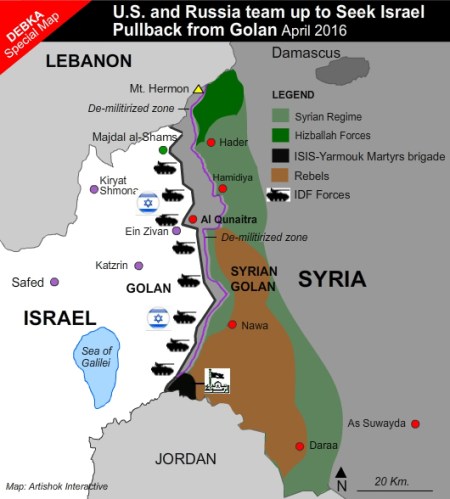
The IDF launched an unannounced military-air exercise in northen Israel Monday April 18. It will also be held in the Jordan valley, strategically located south of the Golan Heights and the Sea of Galilee. Despite the official explanation that the drills are part of the IDF’s training schedule for 2016, it is difficult not to see it as a follow-up to the Cabinet meeting on the Golan the previous day, including Prime Minister Benyamin Netanyahu’s declaration that “Israel will never withdraw from the Golan.”

Just as the Cabinet meeting was an “emergency” one, the exercise is not part of standard training, as an IDF statement claimed, but rather part of the overall picture of the war in Syria on the other side of the northeastern border.

The drill is mainly intended to prevent a possible attack by ISIS, Syrian, Iranian or Hizballah forces aimed at torpedoing Netanyahu’s discussions in Moscow with Russian President Vladimir Putin on Thursday, April 21.

DEBKAfile’s military sources report that the IDF exercise shows only half of the military picture in the area.
On the other side of the border, in the triangular pocket where the Israeli, Syrian and Jordanian borders meet, heavy fighting has been underway for several days between Syrian rebels and forces of the Yarmouk Martyrs Brigades and the al-Muthanna organization, which have both sworn allegiance to ISIS. The battles are taking place across from Israel’s Hamat Gader, south of the Sea of Galilee, which is the reason why the exercise is also being held in the Jordan Valley.

On the other side of the border, in the triangular pocket where the Israeli, Syrian and Jordanian borders meet, heavy fighting has been underway for several days between Syrian rebels and forces of the Yarmouk Martyrs Brigades and the al-Muthanna organization, which have both sworn allegiance to ISIS. The battles are taking place across from Israel’s Hamat Gader, south of the Sea of Galilee, which is the reason why the exercise is also being held in the Jordan Valley.

On the other side of the border, in the triangular pocket where the Israeli, Syrian and Jordanian borders meet, heavy fighting has been underway for several days between Syrian rebels and forces of the Yarmouk Martyrs Brigades and the al-Muthanna organization, which have both sworn allegiance to ISIS. The battles are taking place across from Israel’s Hamat Gader, south of the Sea of Galilee, which is the reason why the exercise is also being held in the Jordan Valley.

On Sunday, the leader and commander of Al-Muthanna was killed during the fighting. The goal of the rebel attack is to capture the Syrian villages in the territory held by ISIS, which threatens the Galilee and the Golan communities of Tel Katzir, Shaar Hagolan and Masada. Sources in Kuwait reported last week that Jordanian special forces and Israeli drones marked in the colors of the Jordanian air force are participating in the battles. The developments on the ground indicate that the goal of the attacking forces is to uproot ISIS from the Israeli and Jordanian border areas.

DEBKAfile’s sources provided the following exclusive details on April 17:   

The Israeli cabinet holds its weekly session Sunday April 17, on the Golan. Prime Minister Benyamin Netanyahu will visit Moscow on Thursday, April 21 to meet with Russian President Vladimir Putin and to launch the most important battle of his political career, and one of Israel’s most decisive contests of the last 10 years: the battle over the future of the Golan Heights.

DEBKAfile’s intelligence sources and its sources in Moscow report exclusively that Israel’s top political leaders and military commanders were stunned and shocked last weekend when they found out that US President Barack Obama and Russian President Vladimir Putin have agreed to support the return of the Golan to Syria. The two presidents gave their top diplomats, Secretary of State John Kerry and Foreign Minister Sergei Lavrov, the green light to include such a clause in a proposal being drafted at the Geneva conference on ending the Syrian civil war.

Israeli prime minister Benjamin Netanyahu seen during a security and defense tour in the Golan Heights, near the Northern Israeli border with Syria. April 11, 2016. Photo by Kobi Gideon/GPO *** Local Caption *** ??? ?????? ?????? ?????? ????? ?????? ?????. ????? ?????? ?????? ????? ?? ????? ??????? ???? ????? ?????? ?????? ?????

Israeli prime minister Benjamin Netanyahu seen during a security and defense tour in the Golan Heights, near the Northern Israeli border with Syria. April 11, 2016. Photo by Kobi Gideon/GPO

Israel captured the Golan from the Syrian army 49 years ago, during the Six-Day War in 1967 after the Syrian army invaded Israel.

In 1981, during the tenure of then Prime Minister Menachem Begin, Israel passed a law defining the Golan as a territory under Israeli sovereignty. However, it did not state that the area belongs to Israel.

While Israel was preparing for a diplomatic battle over the future of Jerusalem, Judea and Samaria, Obama and Putin decided to deal a diplomatic blow to Israel and Netanyahu’s government on an unexpected issue, the Golan.

It is part of an endeavor by the two powers to use their diplomatic and military cooperation regarding Syria to impose agreements on neighboring countries, such as Israel, Turkey, Saudi Arabia and Jordan.

For example, Washington and Moscow are trying to impose an agreement regarding the granting of independence to Syrian Kurds, despite Ankara’s adamant opposition. The two presidents are also pressuring Riyadh and Amman to accept the continuation of Syrian President Bashar Assad’s rule, at least for the immediate future.

DEBKAfile’s sources report that just like the other diplomatic or military steps initiated by Obama and Putin in Syria, such as those for Assad’s eventual removal from power, the two powers see a resolution of the Golan issue as a gradual process that may take a long time, perhaps even years. But as far as they are concerned, Israel will have to withdraw from the Golan at the end of that process.

It should be noted that Prime Minister Netanyahu is not traveling to Washington to discuss the Golan issue with Obama. The frequent trips by the prime minister, senior officials and top IDF brass to Moscow in recent months show where the winds are blowing in the Middle East.

However, Moscow is not Washington, and Israel has no lobby in the Russian capital defending its interests.

It should be made very clear that the frequent trips by senior Israeli officials to Moscow have not created an Israeli policy that can influence Putin or other senior members of the Russian leadership. Putin has made occasional concessions to Israel on matters of minimal strategic importance, but on diplomatic and military steps regarding Syria and Iran he has shown little consideration of Jerusalem’s stance.

It should also be noted that there has been no basis for the enthusiasm over the Russian intervention in Syria shown by Netanyahu, Israeli ministers and senior IDF officers.

All of the calls by a number of Russia experts, mainly those of ll of the calls by a number of Russia experts, mainly those of DEBKAfile, for extreme caution in ties with Putin have fallen on deaf ears among the political leadership in Jerusalem and the IDF command in Tel Aviv.

Amid these developments, three regional actors are very pleased by Washington and Moscow’s agreement to demand Israeli withdrawal from the Golan: Syrian President Assad, the Iranian leadership in Tehran and Hizballah leader Hassan Nasrallah.

Now, they do not need to risk a military confrontation with Israel over the Golan because Obama and Putin have essentially agreed to do the dirty work for them.