Archive for the ‘Netanyahu’ category

Yazidis ask Israel for help

January 29, 2015

Yazidis ask Israel for help, Al-MonitorJacky Hugi, January 28, 2015

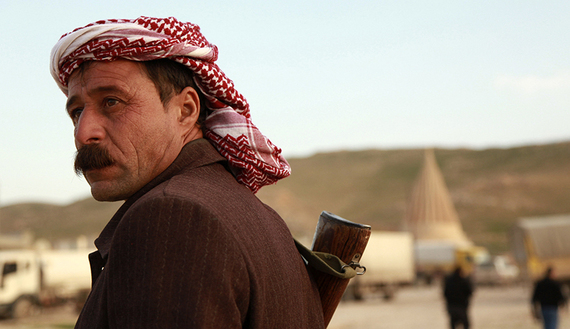
A man from the minority Yazidi sect stands guard at Mount Sinjar, in the town of SinjarA man from the minority Yazidi sect stands guard at Mount Sinjar, in the town of Sinjar, Dec. 20, 2014. (photo by REUTERS/Ari Jalal)

[I]t is an unusual overture of friendship for the government of Prime Minister Benjamin   Netanyahu, and it will be interesting to see if and how Israel takes up the gauntlet. Given the sensitivity of the matter, it is quite uncertain whether anyone will hear about it.

******************

“They have already killed many of us. What do we have to fear?” Lt. Col. Lukman Ibrahim responded when I asked him if he was afraid to openly communicate with an Israeli in a recent long-distance phone conversation from Tel Aviv to Sinjar, in northwestern Iraq, near the Syrian border. Ibrahim, a Yazidi militia officer, is hoping to obtain military aid from the State of Israel.

“The Arab countries do not recognize us, nor do they recognize you,” he said. “They are telling us that we are infidels. Why should we be afraid to talk to you, when even neighboring Arab countries have become our enemies? We regard you as a friendly state, with an opportunity for relations on the basis of neutrality and respect. We do not want more than that.”

Ibrahim, a journalist by profession, serves as an assistant to Marwan Elias Badl, one of the senior field commanders of the Sinjar Protection Forces, the Yazidi militia established ad hoc in August 2014 to halt the Islamic State (IS) onslaught against Yazidi population centers west of Mosul. The militia numbers some 12,000 fighters, most of them untrained, ordinary men who rushed to take up arms to thwart IS’ designs. A few of them are rank-and-file fighters, while some are officers with the Kurdish peshmerga. According to internal estimates, the IS militants killed thousands in their pogrom against the Yazidis. About 5,000 Yazidis are still being held by IS.

The Yazidis have no formal relations with Israel, nor an organized leadership. Yet they need aid, in particular military assistance, and they have chosen to make a public plea for help. “We appeal to the Israeli government and its leader to step in and help this nation, which loves the Jewish people,” said Ibrahim. “We would be most grateful for the establishment of military ties — for instance, the training of fighters and the formation of joint teams. We are well aware of the circumstances the Israelis are in, and of the suffering they have endured at the hands of the Arabs ever since the establishment of their state. We, too, are suffering on account of them.”

When asked what kind of weapons they needed, Ibrahim cited protective measures. “We are not acting against anyone,” he clarified. “And we do not covet other people’s land. We just want to protect ourselves. For example, [we need] armored [Humvees], machine guns and light weapons.”

Contact with Israel is a dirty business in this neighborhood, military contact all the more so. Be that as it may, in a reality where all levees have been breached and the worst appears to have already befallen the Yazidis, what could they possibly lose by seeking a rapport with Jerusalem?

The conversation with Ibrahim was not the only call with Sinjar. Majdal Rasho, a native of Sinjar, had settled in Germany and built his life there. He married and had a family, making a living as a manufacturing supervisor at a chocolate plant. In his spare time, he served as a photographer for TV stations broadcasting in the Kurdish language. He returned to Sinjar as a fighter, but also in his capacity as a video photographer for German TV networks.

“What I have seen here, I just can’t describe,” he said by phone from a battle zone. “Our people had no choice but to flee. We are not Arabs, nor are we Muslims. We see ourselves as sharing a fate with the Israelis, who went through similar pogroms. Those besieged on the mountain approached me and asked, ‘Maybe our Israeli brethren could lend a hand?’”

Yazidism is a religion with no more than a million followers. Its adherents are centered around Mosul and the Sinjar mountain range, in northern Iraq. Their largest diaspora in the West is in Germany, estimated to number some 100,000.

A common destiny with the Jews is a recurring theme in the Yazidis’ discourse. “What happened to us is the biggest genocide since the Holocaust of the Jews in Europe,” said Dr. Mirza Dinnay, a pediatrician based in Germany. “In the Holocaust, the goal was to annihilate an entire people, the Jews. IS has a similar plan — to exterminate an entire people, the Yazidis. No such extermination process had taken place in the past 500 years, with the exception of the Holocaust and what came to pass in Sinjar.”

Dinnay left Germany for Sinjar at the outbreak of the pogrom, leading a delegation of human rights activists. During one of the aid flights arranged by the Iraqi air force, a helicopter carrying food supplies and medication to the besieged Yazidis crashed. Some of the passengers aboard, among them Dinnay, were injured.

The communication between the Yazidis and the Israeli media has been coordinated by Idan Barir, 34, a researcher at the Tel Aviv University Yavetz School of Historical Studies. In the months since IS’ offensive against Yazidi population centers, Barir has become Israel’s top expert on the Yazidis, thanks to his extensive connections with members of the Yazidi community.

“I can think of a range of activities that Israel is experienced in that would not undermine the world order,” Barir told Al-Monitor. “For example, providing military assistance to the Yazidi forces in Sinjar who are crying out for cooperation and aid; setting up a field hospital for medical and psychological treatment of the casualties among the displaced in northern Iraq — not only Yazidis, by the way; sending humanitarian aid to displaced Yazidis in the refugee camps in Iraqi Kurdistan; absorption of a symbolic number of displaced Yazidis in Israel, with preference given to humanitarian, whether medical or mental, cases; incorporation of young Yazidis into military service in Israel; and support of civil initiatives aimed at strengthening and deepening ties between Israelis and Yazidis. It all depends on the decision made by the Israeli government, on its determination and goodwill.”

So far, Israel has not officially responded to such calls, which have yet to be fully formulated and have only recently began over the last few days. In fact, no formal request has come from the Yazidis for asylum as refugees. Barir is currently trying to find a way to reach decision-makers in Israel to pass on the messages from his faraway friends. Without a doubt, it is an unusual overture of friendship for the government of Prime Minister Benjamin Netanyahu, and it will be interesting to see if and how Israel takes up the gauntlet. Given the sensitivity of the matter, it is quite uncertain whether anyone will hear about it.

“It is a moral obligation to ring every bell and to do everything possible to stop the Yazidi tragedy,” said Attorney Zvi Hauser, the former Cabinet secretary in the most recent Netanyahu government (2009-13). “It is inconceivable that in the 21st century, someone’s attempt to eliminate an entire people, because of its faith and religion, is met with indifference.”

Hauser is the first senior figure in Israel who agreed to comment on the Yazidis’ call for help. As a private person, he refrained from reference to the Yazidis’ request for military aid, taking care to say nothing that might be interpreted as a promise. He believes, however, that Israel should favorably consider the Yazidis’ calls.

“The Yazidi narrative is evocative of ours. We, too, went through 2,000 years of existence without sovereignty, in the course of which we faced extermination schemes,” Hauser said. “Israel is a sovereign state, formed by an ethnic minority. It is the national manifestation of an ancient civilization. It would thus be appropriate to examine ways to establish relations and forge an alliance with them, if only to ensure a pluralistic Middle East. This issue has a universal aspect, as well. The development of human civilization is contingent on the diversity and multiplicity of [ethnic] groups and nations. Hence, the extinction of one of these would hurt not only the Yazidis, but also the entire fabric of human life.”


Obama targets Netanyahu, Iran targets Israel

January 29, 2015

Obama targets Netanyahu, Iran targets Israel, Israel Hayom, Richard Baehr, January 29, 2015

Obama will tell himself and anyone who wants to ‎hear that he has brought Iran back into the community of nations. ‎Obama, after all, is a rare man. How many others can make 118 ‎self-referential mentions in a half hour talk, as Obama did in India ‎this week?

Is it any wonder ‎why someone who stands for something, say a country’s security, ‎as Netanyahu does, gets under the skin of a man who is primarily ‎concerned with little more than his own greatness, and whose ‎presidency, in a word, has been a “selfie”?‎

**********************

There is a bit of difference between Iran and U.S. President Barack Obama when it comes to ‎Israel. Iran has never been reticent that its goal is to eliminate the State of Israel, ‎and Israelis too while they are it. Iran’s proxy terror army of Hezbollah ‎contributed their part on Wednesday, killing two Israeli soldiers and wounding seven with anti-tank ‎fire from southern Lebanon directed at an Israeli convoy. Obama seems more ‎interested, at least in the next two months, in eliminating one Israeli — namely, Prime ‎Minister Benjamin Netanyahu. ‎

It has been a remarkable two weeks in U.S.-Israel relations. The president ‎delivered his State of the Union address, in which he argued for staying the course ‎with negotiations with Iran over its nuclear program, overselling what has already ‎been achieved, as well as what might be achieved. He also threatened to veto new ‎sanctions legislation that might be passed by Congress, where some have called for ‎tougher sanctions to be applied to Iran if a satisfactory deal were not struck ‎between the P5+1 and the Iranians by June 30. Obama argued that passing such a ‎measure now would be a sign of bad faith and drive the Iranians from the ‎negotiating table. It was, of course, an odd prediction, since one area in which the ‎Iranians have shown remarkable consistency has been in negotiating with ‎European powers, or the now expanded negotiating group for over 10 years, ‎always without a satisfactory outcome. The Iranians seem to like being seen as ‎negotiating while their nuclear program advances.‎

Fact checkers awarded Obama a bunch of “pinocchios” for his latest effort, suggesting he was all ‎but lying on the matter. No, the Iranians have not dismantled any centrifuges (they ‎have more running than before), they have not removed any fissile material from ‎the country for safekeeping, they have not allowed inspections on demand, they ‎have not disabled their Arak heavy-water reactor, they have not agreed to end any ‎missile program they are working on for delivery of a nuclear bomb. ‎

‎”Our diplomacy is at work with respect to Iran,” Obama said, ‎‎”where, for the first time in a decade, we’ve halted the progress of ‎its nuclear program and reduced its stockpile of nuclear material.”

James Robbins, a senior fellow in national security affairs at the ‎American Foreign Policy Council, begged to disagree:‎

‎”But has Iran’s stockpile shrunk? Under a deal concluded last ‎November, Iran halted work on the most dangerous material, 20 ‎percent refined uranium. However, Iran is still making lower-grade ‎uranium. According to a report from the International Atomic ‎Energy Agency last November, Iran’s stockpiles of low-enriched ‎uranium gas and 5 percent enriched uranium were both growing. ‎Also, the agency cautioned that their figures only covered ‎‎’declared sites,’ the nuclear facilities Iran has publicly ‎acknowledged and allowed to be inspected.”‎

In the days after his address to Congress, the president repeated ‎his threats about vetoing new sanctions legislation, when meeting ‎with Democratic senators, several of whom, along with a few ‎Republican colleagues, had been lobbied on the matter by Britain’s ‎visiting Prime Minister David Cameron. The president upped the ‎ante, accusing Democratic Senator Robert Menendez of New ‎Jersey, a leader in the attempt to pass new sanctions, of not ‎thinking long-term, but just trying to make his donors (could ‎Obama have meant Jewish donors?) happy.

The idea of a foreign leader directly lobbying members of ‎Congress on an issue like the Iranian sanctions bill took on a new ‎life when House Speaker John Boehner invited Netanyahu to ‎address a joint session of Congress on the Iranian issue on ‎February 11. The White House predictably blew its lid, accusing ‎Boehner of breaking established protocol for such an invitation. (It ‎should have been coordinated with the White House.) The usual ‎Obama water carriers like Jeffrey Goldberg were quick to lambaste ‎Netanyahu for stage managing the invitation so as to embarrass ‎Obama, and in the process threaten U.S.-Israel relations. As Joel ‎Pollak describes Goldberg’s argument:‎

‎”In his most recent Atlantic column, he claims, for example, ‎that Obama worked ‘in tandem’ with Netanyahu to promote ‎sanctions on Iran: ‘Netanyahu traveled the world arguing for ‎stringent sanctions, and Obama did much the same.’‎

“That is simply factually untrue. Obama resisted Iran sanctions ‎for months, defying even a unanimous vote in the Democrat-‎controlled Senate. Not only was Israel frustrated, and ‎Congress, but Europe as well, which accused Obama of re-‎inventing the wheel, resetting diplomacy that had started ‎under (gasp) George W. Bush.‎

“In fact, Obama pushed the world towards a more lenient ‎position on Iran, allowing nuclear enrichment in defiance of ‎U.N. Security Council resolutions.”

And then there is this doozy:‎

‎”It is Netanyahu’s job, Goldberg says, as ‘the junior partner in ‎the Israel-U.S. relationship,’ to make concessions.”‎

When it comes to negotiating with Iran, Netanyahu does not ‎sit at the table with the Iranians, but Obama’s representatives ‎do. And it is U.S. negotiators who have been making ‎concessions month after month since the talks began, in what ‎appears to be a desperate attempt to salvage some deal they ‎can broadcast as having achieved a minimal set of objectives. ‎That objective has now been reduced to providing some ‎minimum breakout time for Iran to achieve nuclear weapons ‎capability if they ditch the deal. What will the West do in that ‎time if Iran moves towards the bomb? It is pretty clear, any ‎military response from Obama is out of the question.‎

The administration has further demonstrated its unhappiness ‎about Netanyahu’s impudence in scheming with ‎Boehner, by announcing that neither the president nor his secretary of state will meet with Netanyahu when he visits ‎Washington, a date now moved back three weeks to overlap ‎his visit to the annual American Israel Public Affairs Committee policy conference. The excuse, ‎couched in a diplomatic smokescreen, is that it would be ‎improper for the president to meet with a candidate for office ‎abroad so close to the time of that country’s election. That ‎would be equivalent to electioneering and interference in the ‎other country’s race. Presumably when President Bill Clinton ‎met with Israeli Prime Minister Shimon Peres just weeks ‎before his election contest with Netanyahu in 1996, at a time ‎when Israeli prime ministers were elected in a head-to-head ‎battle, electioneering was the furthest thing from Clinton’s ‎mind. ‎

The Obama team may not meet with Netanyahu when he ‎visits, but an experienced Obama campaign team from 2012 ‎is now in Israel working to defeat Netanyahu. That, in and ‎of itself, is nothing new for Israeli elections. Experienced ‎American campaign teams have aided Israeli candidates from ‎the Left and Right in recent decades. What is new is that the ‎current anti-Netanyahu campaign includes a State ‎Department funded group:‎

‎”U.S.-based activist group OneVoice International has partnered ‎with V15, an ‘independent grass-roots movement’ in Israel that is ‎actively opposing Netanyahu’s party in the upcoming elections, ‎Haaretz reported on Monday. Former national field director for Obama’s 2012 re-election campaign Jeremy Bird is also ‎reportedly involved in the effort.‎

“OneVoice development and grants officer Christina Taler said the ‎group would be working with V15 on voter registration and get-out-‎the-vote efforts but would not engage in overtly partisan activities. ‎She said OneVoice and V15 are still formalizing the partnership.”‎

Obama’s team has gone further to poison the waters for ‎Netanyahu, planting a story in Haaretz that the Mossad was ‎opposed to new sanctions legislation, a charge they publicly ‎rebutted.‎

The Goldberg article was designed to deliver a message that Israel ‎has two important objectives now — to keep Iran from going nuclear ‎‎(for which their best hope of course is to count on Obama to do the ‎job for them in negotiations), and second, to keep American close ‎and happy with Israel’s behavior. Netanyahu, according to Goldberg, is ‎killing the good vibes that presumably must have existed during the ‎Obama years by his recent behavior.‎

There is an alternative interpretation for what is going on. Obama is ‎really not terribly bothered by a nuclear Iran. A bad deal that looks ‎like it delays Iran’s entry to the nuclear club is therefore not a bad ‎option. It also allows Obama to check off one more box on his ‎achievements list before his formal request to have his likeness ‎carved into Mount Rushmore. Pakistan has a bomb. Israel has the ‎bomb. Why not Iran, the leading Shiite nation? Iran, after all, is now ‎our strategic partner, fighting with us to battle ISIS in Iraq. ‎

The latest evidence that Obama is now on the Iranian team is the ‎New York Times editorial calling for accepting that having Assad ‎hang on in Syria is the least bad result, so backing a non-ISIS ‎Syrian rebel team is a bad idea. The New York Times editorial ‎page is little more than a conveyance tool for White House ‎messaging at this point, and so this is now clearly Obama’s ‎posture. How can we fight alongside Iran in Iraq, but support a side ‎that is fighting Iran’s ally Assad in Syria?

Meanwhile, Hezbollah is stepping up its activities in the Golan. The ‎Iranian goal appears to be to establish a base in Syria where Israel ‎can be targeted by the Lebanese group, without getting an Israeli ‎response in Lebanon itself. What is clear is that Hezbollah and Iran ‎have Israel in their sights. If Iran gets the bomb, the retaliation ‎options for Israel when Hezbollah pressure is applied, will be much ‎more limited. There is no certainty that Iran subscribes to the ‎mutually assured destruction deterrence club.‎

But not to worry. Obama will tell himself and anyone who wants to ‎hear that he has brought Iran back into the community of nations. ‎Obama, after all, is a rare man. How many others can make 118 ‎self-referential mentions in a half hour talk, as Obama did in India ‎this week?

Is it any wonder ‎why someone who stands for something, say a country’s security, ‎as Netanyahu does, gets under the skin of a man who is primarily ‎concerned with little more than his own greatness, and whose ‎presidency, in a word, has been a “selfie”?‎

BUSTED: Obama Advisor Working To Defeat Nethanyahu Worked For Israel Hater

January 28, 2015

BUSTED: Obama Advisor Working To Defeat Nethanyahu Worked For Israel Hater
JANUARY 28, 2015 BY CHARLES C. JOHNSON Via Got News dot Com


(Correct me if I’m wrong, but I feel the impact of the White House campaign against Mr. Netanyahu’s re-election will fall short with the Israeli people. It’s truly sad it has come to this. – LS)

Off to try to defeat Nethanyahu, Obama advisor Jeremy C. Bird once worked for an anti-Israel activist condemned by the Anti-Defamation League.

Bird, then a student at Harvard’s Divinity School, worked for Edmund Hanauer, one of America’s most prominent anti-Israel activists, in 2002.

Bird worked for Hanaeuer while Hanaeuer wrote a virulently anti-Israel op-ed that accused Israel of “state terrorism” and “war crimes,” and called for the arrest and prosecution of Israeli soldiers.

Bird and Hanaeur also attacked Israel in speeches. Hanauer showed an anti-Israel film to a Harvard audience and gave a speech at Harvard in 2002. Bird also spoke about the Israeli-Palestinian conflict and introduced Hanaeur.

Here‘s the Harvard Crimson’s description of the event:

A viewing of a short documentary film on the Abu Ghneim Mountain Israeli Settlement Project opened the event. Hanauer later referred to the project as an example of Israeli expansion into Palestinian lands. It was followed by introductory remarks by Hanauer and Jeremy C. Bird, a second-year HDS student who has been working with Hanauer for the past year.

Bird said a “cycle of violence” has contributed to the tensions between Palestinians and Israelis. Rather than using violence themselves, both sides must peacefully campaign for justice, he added.

Bird got his political start in anti-Israel and anti-Netanyahu activism while he studying abroad. Bird also took an influential class with socialist professor and activist Marshall Ganz titled, “Organizing: People, Power, and Change.” In one of Bird’s first classes he worked asa community organizer in Boston.

Now Bird, fresh off losing Battleground Texas’s pro-Wendy Davis campaign, is off to Israel to defeat Benjamin Netanyahu with a State Department-funded group called “OneVoice.”

This is not Bird’s first time dealing with Israel.

“The first political rally I went to was at the University of Haifa for Ehud Barak, who was running against Benjamin Netanyahu for Prime Minister” Bird said to Wabash College, his alma mater. “I couldn’t understand what he was saying, but I noticed how many young people were there.”

“[Edmund] Hanauer is a long-time opponent of Israel and has written that ‘it is the moral obligation of Jews to oppose Zionism,’” wrote Abraham Foxman of the ADL in a letter to the editor to the New York Times in 1981.

An Israeli consulate official said that Hanauer had reached “new heights of venom and outright hate, possibly self-hate” in his pro-Palestinian writings.

In 2003 Hanauer, who died in 2006, falsely claimed in an article for the Boston Globe that Israeli soldiers were killing Palestinian children for sport.

John Bolton on WMAL 1-22-15

January 23, 2015

John Bolton on WMAL 1-22-15, via You Tube, January 22, 2015

(Audio only. Amb. Bolton speaks of PM Netanyahu’s address to Congress, no-go zones and Obama’s fantasies about Islamic terrorism, the Islamic State and Iran. — DM)


The death of an Iranian general on the Golan gave US Senators’ Iran sanctions bills military muscle

January 22, 2015

The death of an Iranian general on the Golan gave US Senators’ Iran sanctions bills military muscle, DEBKAfile, January 22, 2015

This was a dual threat: Israel would not stand by if Iranian and Hizballah forces moved into the Syrian Golan right up against its frontier. But in the wider context, Binyamin Netanyahu was signaling Obama in Washington and Khamenei in Tehran, that he no longer had any qualms about striking Iranian military targets if the two rulers failed to forge a workable, credible accord for keeping nuclear weapons out of Iranian hands.

The Israeli action added military muscle to the US Senate legislation on Iran –  in the face of Obama’s reluctance to embrace tactics he believes would be disincentives for Khamenei to play ball on the ongoing multilateral nuclear diplomatic track in Geneva.

*****************

netanyahu_us_congress_11.2.15Binyamin Netanyahu in former address to US Congress

It is hard to believe that the White House was caught by surprise over House leader John Boehner’s unusual invitation for Israeli Prime Minister Binyamin Netanyahu to address Congress on Feb. 11. After all, prior arrangements must have kept the Israeli embassy in Washington busy for weeks in a city, whose life blood is kept flowing by the mining and trading of information and secrets about friends and rivals alike.

All the same, it suited the four parties involved in this extraordinary event – Republican and Democratic lawmakers, the White House and Netanyahu – to pretend they were taken aback on Wednesday, Jan. 21 by the Speaker’s announcement of the prime minister’s coming address on “the grave threats radical Islam and Iran pose to our security and way of life.”

He accused President Barack Obama of “papering over” these threats over in his State of the Union speech a few hours earlier.

The White House said the invitation breached “typical protocol” but the administration would reserve judgment until they heard from Netanyahu about his plans.

The assumed air of astonishment greeting the invitation added an element of drama to the event. It also had the effect of further polarizing the camps for and against the Obama administration’s insistence on banking solely on diplomacy for containing Iran’s nuclear program.

Inevitable showdown

Obama and Netanyahu, who could never stand each other, have been at loggerheads for most of the six years of the former’s presidency over what is widely seen as the dead-end US Middle East policies he pursued in most major arenas such as Iraq, Yemen and Libya, the futile US air strikes against marching Islamist State soldiers, the unending Syrian conflict and the Palestinian issue.

The showdown building up for years between them may now be at hand. It will catch Obama and Secretary of State John Kerry fully engaged in a desperate pursuit of a comprehensive nuclear deal between Iran and the Six-World-Powers group. This deal could then be presented as an unquestioned success of Obama’s Middle East policies – indeed the only one.

Together with Iran’s President Hassan Rouhani and Foreign Minister Mohamed Zarif, US officials have roughed out a draft accord. But most American nuclear experts and Israel’s top political and military leaders view this paper as a bad agreement, because it would leave Tehran with the freedom and resources to jump back from low-grade enrichment to full-dress production of a nuclear bomb and missiles when international and economic circumstances were more convenient.

But Obama and Kerry are counting on the ayatollahs holding their horses until the end of 2016, when the US administration changes hands. The Iranian nuclear deal’s inevitable breakdown would then land squarely on the shoulders of the next president and secretary of state taking over in Washington, while Obama would have formally honored his commitment to prevent Iran from acquiring a nuclear bomb.

Khamenei between two compulsions

But this plan faces an outsize impediment: Rouhani and Zarif are holding back from putting pen to paper because of the strong objections posed by supreme leader Ayatollah Ali Khamenei and the Revolutionary Guards military chiefs.

Earlier this month, the issue reached boiling point in Tehran, DEBKAfile’s Iranian sources report: The Guards threatened to unseat Khamenei by a military coup if he let Rouhani and Zarif sign the draft into a comprehensive, binding nuclear accord.

Khamenei, never lost for a devious maneuver, began weaving between the two compulsions – American demands for more concessions to finalize the deal and demands by hardliners at home not to give way. The move he made was to throw a bone in the form of an offer to cut down on the number of centrifuges used in uranium enrichment.

Obama and Kerry hailed this as a breakthrough toward a deal, although the experts dismissed it as meaningless.

Obama propositions Netanyahu

On this basis, Obama phoned Netanyahu Monday night, Jan. 13, to ask him for Israel’s support for the evolving comprehensive nuclear accord with Iran.

In return, he offered closer US cooperation in various areas of interest to Israel, such as the Palestinian issue, if the prime minister would withhold or cool his support for US Senate sanctions legislation:

The Republican Mark Kirk and Democrat Robert Menendez seek to enact new sanctions on Iran if nuclear negotiations fail to meet their June 30 deadline for an accord.

Bob Corker, chairman of the Senate Foreign Relations Committee — supported by Republican Senators Lindsay Graham and John McCain — is pushing for legislation which does not contain sanctions but would require a Senate vote on any pact that is agreed upon in Geneva.

Netanyahu rejected Obama’s proposition.

The US President was therefore adamant in his State of the Union references to the Iranian nuclear issue: “New sanctions on Iran would all but guarantee that diplomacy fails, heightening the prospects of war.” He said.: “Between now and this spring, we have a chance to negotiate a comprehensive agreement that prevents a nuclear-armed Iran, secures America and our allies – including Israel – while avoiding yet another Middle East conflict.”

Obama did not elaborate on the parties who would take part in this hypothetical conflict, or explain why he limited himself to only two extreme scenarios – either a deal with Iran or tighter sanctions that would precipitate war.

Israel takes direct aim at Iran

It was no accident that two days before this speech, Obama had his answer from Israel. Sunday, Jan. 19, Israeli Air Force drones struck an Iranian-Hizballah military convoy near the Syrian Golan town of Quneitra. Six Iranian officers were killed, led by Gen. Mohamad Ali Allah Dadi, as well as the same number of high-ranking Hizballah operatives.

This was a dual threat: Israel would not stand by if Iranian and Hizballah forces moved into the Syrian Golan right up against its frontier. But in the wider context, Binyamin Netanyahu was signaling Obama in Washington and Khamenei in Tehran, that he no longer had any qualms about striking Iranian military targets if the two rulers failed to forge a workable, credible accord for keeping nuclear weapons out of Iranian hands.

The Israeli action added military muscle to the US Senate legislation on Iran –  in the face of Obama’s reluctance to embrace tactics he believes would be disincentives for Khamenei to play ball on the ongoing multilateral nuclear diplomatic track in Geneva.

It also explains why John Boehner invited Netanyahu to address Congress on Feb. 11.

However, until then, Iran, Hizballah, Syria and even Israel may not stand idle. And the Obama administration may also decide to round up its assets in a bid to spoil the prime minister’s run for re-election on March 17.

Mossad denies opposing harsher sanctions on Iran

January 22, 2015

Mossad denies opposing harsher sanctions on Iran, Ynet News, Itamar Eichner, January 22, 2015

Head of Israeli spy agency releases statement denying it was working with the Obama administration against Netanyahu on Iran issue.

In an unusual step, the Israeli spy agency Mossad released an official statement on Thursday afternoon in which it denied that it opposes imposing additional sanctions on Iran, as reported in a Bloomberg report earlier in the day.

The Mossad statement said, “Mossad chief Tamir Pardo met with a delegation of American senators on January 19, 2015. The meeting was held at the request of the senators and with the approval of the prime minister. Contrary to the report, the head of the Mossad did not say that he opposed additional sanctions on Iran. The Mossad chief emphasized in the meeting the remarkable efficacy of the sanctions imposed on Iran over the last few years in bringing Iran to the negotiating table.

“The Mossad chief stated that when negotiating with Iran, the ‘carrots and sticks’ approach needs to be taken and at present, there aren’t enough ‘sticks.’ The Mossad chief noted that without strong pressure, it would not be possible to bring to meaningful compromises from the Iranian side.

56024560100388640360noPardo and Netanyahu: On the same page (Photo: GPO)

“As for the use of the term ‘grenade’, the Mossad chief did not use that with regards to imposing sanctions, which, as mentioned, he considers to be the ‘sticks’ that would aid in achieving a good agreement. He used this term to describe the possibility of creating a temporary crisis in the talks, at the end of which the negotiations will be renewed under better terms. The Mossad chief specifically stated that the agreement currently being formulated with Iran is bad and might lead to a regional arms race.”

The Bloomberg report was published after US House Speaker John Boehner invited Prime Minister Benjamin Netanyahu to speak in front of Congress about the Iranian nuclear threat. Netanyahu has been urging the American administration to harden its sanctions policy. The Obama administration, Bloomberg reported, has been using the internal divide between the Mossad and Netanyahu to torpedo the bi-partisan proposal, penned by Senators Mark Kirk and Robert Menendez.

Meanwhile, Republican Senator Bob Corker, chairman of the Senate Foreign Relations Committee, has teamed up with Lindsay Graham and John McCain to propose a bill requiring the White House bring any deal with Iran to a vote in Congress.

The Obama administration opposes both measures and has warned the Senate to stay away from the delicate negotiations between Iran and world powers.

According to the report, Mossad officials have briefed the White House, as well as Republican legislators, on their opposition to the Kirk-Menendez bill, which would implement new sanctions on Iran if the negotiations fail to yield results by June 30 or the Islamic Republic fails to live up to its commitments.

Netanyahu, on the other hand, has expressed his support for the legislation, in particular, and sanctions on Iran, in general.

Evidence to Israeli interference in the Iran-US talks comes from comments made by Secretary of State John Kerry, who said an unnamed Israeli intelligence official had said the new sanctions bill would be “like throwing a grenade into the process.” When Menendez heard about the Mossad briefing, he demanded clarifications from Israel’s Ambassador to the US Ron Dermer.

White House: Boehner Invite to Netanyahu Breach of Protocol

January 21, 2015

White House: Boehner Invite to Netanyahu Breach of Protocol, New York Times, January 21, 2015

Earnest says they are reserving judgment about the invitation until they’ve had a chance to speak to the Israelis about what Netanyahu might say.

*********************

ABOARD AIR FORCE ONE — The White House says House Speaker John Boehner’s invitation for Israel’s prime minister to come to Washington is a breach of normal diplomatic protocol.

President Barack Obama’s press secretary, Josh Earnest, says the White House has not heard from Israelis about whether Benjamin Netanyahu plans to speak to Congress Feb. 11. Earnest says they are reserving judgment about the invitation until they’ve had a chance to speak to the Israelis about what Netanyahu might say.

Earnest says typical protocol is that a country’s leader would contact the White House before planning to visit the United States. But Earnest says they didn’t hear about Boehner’s invitation until Wednesday morning, shortly before the speaker announced it publicly.

Earnest was speaking to reporters traveling aboard Air Force One to Idaho on Wednesday.

Boehner invites Israeli PM Netanyahu to address Congress

January 21, 2015

Boehner invites Israeli PM Netanyahu to address Congress, The Washington TimesStephen Dinan, January 21, 2015

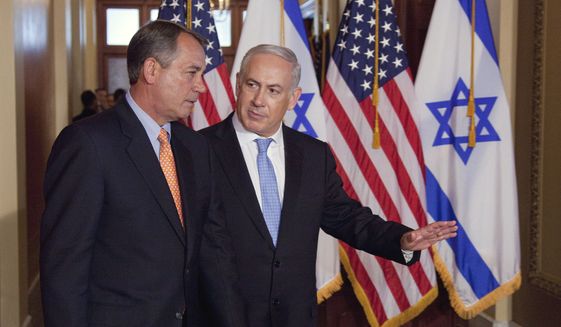
us-israel-iranjpeg-088fd_c0-0-3500-2040_s561x327FILE – In this May 24, 2011 file photo, Israeli Prime Minister Benjamin Netanyahu walks with House Speaker John Boehner of Ohio to make a statement on Capitol Hill in Washington. Boehner has invited Netanyahu to address Congress about Iran.

House Speaker John A. Boehner said Wednesday he’s invited Israeli Prime Minister Benjamin Netanyahu to speak to a joint session of Congress in February.

“In this time of challenge, I am asking the prime minister to address Congress on the grave threats radical Islam and Iran pose to our security and way of life,” Mr. Boehner said. “Americans and Israelis have always stood together in shared cause and common ideals, and now we must rise to the moment again.”

The invitation comes a day after President Obama told Congress he would veto any legislation imposing stiffer sanctions on Iran — a move that has bipartisan support on Capitol Hill, but which the president said would squelch chances for a deal to control Iran’s nuclear program, and could move closer to war.

The speech is slated for Feb. 11. Mr. Netanyahu has addressed Congress twice before, in 1996 and again in 2011.


IDF pulls units from locations bordering Gaza, ignoring rising Egyptian military and al Qaeda activity

January 4, 2015

IDF pulls units from locations bordering Gaza, ignoring rising Egyptian military and al Qaeda activity, DEBKAfile, January 4, 2015

Egyptian_troops_SinaiEgyptian troops battling terrorists in Sinai

Israelis living in a string of villages and towns bordering on the Gaza Strip protested in vain against Defense Minister Moshe Ya’alon’s decision to withdraw the military presence keeping them safe, especially since the summer war on Gaza.

Four significant security events in the last 48 hours on both sides of the border added to their concerns:

Their government, at its weekly cabinet meeting in Jerusalem Sunday, Jan. 4, set up a committee to expedite the transfer of the bulk of IDF facilities from the center of the country to the south.

At the same time, Israelis living in the south within range of the Hamas-ruled Gaza Strip saw the soldiers heading out and were advised to put their trust in local paramilitary “preparedness squads” taking over from the army. The local population believes that they are not up to the job of safeguarding them from more terrorist aggression – by missile, tunnel or intrusion.

Also Sunday, Egypt began expanding the security buffer zone along the 14km of the Gaza-Sinai-Israel border, doubling its breadth from one half to a whole kilometer. The mostly Palestinian inhabitants of this zone were evacuated.

Saturday, Jan. 3, Egyptian troops raided three towns in northern Sinai: Rafah (which is part located in the Gaza Strip), El Arish and Sheikh Zuweid, killing 7 militants of Ansar Beit al-Maqdis, which last month pledged allegiance to the Islamic State of Iraq and the Levant, and jihad against Egypt and Israel.

A few hours later, an Egyptian army explosives expert was killed and several soldiers injured when a large bomb planted on a road in Sheikh Zuweid blew up when they tried to dismantle it.

Saturday night, the IDF commander of the Gaza Division, Brig. Gen. Itay Virov tried to calm dwellers across from the Gaza Strip, who were up in arms about the withdrawal of their military safety net. He addressed members of Kibbutz Nahal Oz with a rare burst of frankness. He spoke of military policy, but his words no doubt reflected the strategic thinking of Prime Minister Binyamin Netanyahu, Defense Minister Ya’alon, the outgoing Chief of Staff, Lt. Gen. Benny Gantz, and his successor next month Maj. Gen. Gadi Eisenkott.

The general may be commended for laying the truth about official policy on the table. However, instead of calming his audience, he bared evaluations that may give the rest of the country sleepless nights as well.

Here are the high points of his Nahal Oz lecture:

  • Israel can’t deter Gazan Palestinians from making war, because they have no other options. So deterrence in this case is an empty value.
  • Israel deliberately avoided going all the way to remove Hamas from power in Gaza in the summer war because salafist jihadists and al Qaeda would have moved in to replace them. It was deemed better to rely on Egypt to grapple with the terrorist threat, including al Qaeda, rather than the IDF.
  • Brig. Virov termed the last Gaza operation a campaign based on the doctrine of prevention rather than a war of aggression.
  • The political wing of Hamas looks after the population and wants peace and quiet, whereas the military wing lost no time in restoring the tunnels Israel blew up, conducting scores of test launches of rockets, and training hard for the next round of combat with Israel.
  • Israel therefore has no option but to prepare for a replay of Defense Edge with operations 2, 3 or even 4. Hamas must be degraded militarily each time – but not so far as to be rendered incapable of buttressing the Hamas regime.
  • The conclusion drawn from Gen. Virov’s lecture was that the Netanyahu government has provided Hamas-Gaza with a political and military guarantee of safety.

Like all policies, even those well thought out, this one too carries a price tag.

The general spoke of Hamas in terms of an independent entity whose operations and impact are confined to the Gaza Strip. He refrained from mentioning that, as recently as December, both of Hamas’ branches, the military and the political, jumped aboard the Iran-led Iraqi-Syrian-Hizballah alliance. This Palestinian group is now subject to Tehran’s policy decisions and directives. This omission from Israel’s policy calculations could be dangerous. Clearly, an undefeated Hamas remains a lasting menace.

Tehran’s decisions regarding Hamas may have an overarching effect, possibly touching on the moves directed by President Barack Obama. (See our Jan. 1 article on Obama’s New Year gift to Israel and the Middle East.).

Israel’s policy of relying on the Egyptian army to contain Al Qaeda’s Sinai network also comes at a price.

For now, Israel has quietly consented to large-scale Egyptian military strength entering Sinai: One and a half divisions, including fighter squadrons and tank battalions, have taken up positions, nullifying the key demilitarization clause of their 1979 peace treaty.

And that’s just for starters.

A Sad State of Affairs: The Kerry Record

January 2, 2015

A Sad State of Affairs: The Kerry Record, World Affairs JournalJoshua Muravchik, November/December, 2014

(Kerry likely agrees with Obama as to his quite foreign foreign policies and, equally likely, we are stuck with both at least until Obama leaves the White House.

Kerry I'm an idiot

The most bothersome current aspects of Obama-Kerry foreign policies are the extent to which they trust Iran and how they deal with it and the P5+1 negotiating group. — DM)

John_Kerry_and_Benjamin_Netanyahu_July_2014 (1)

Although Kerry’s anti-American ideology has moderated to some degree from his fiery days as an antiwar leader, he has misrepresented but never repudiated his past. Especially consistent has been his inclination to see the best in America’s enemies, from Madame Binh to Comandante Ortega to Bashar Assad. Israelis were shocked this summer that Kerry came up with a plan molded by Turkey and Qatar to fit the interests of Hamas at their own expense. Had they known him and his record better, they might not have been.
***************

The Gaza war of July and August 2014 occasioned the sharpest frictions in memory between the United States and Israel, highlighted by a cease-fire proposal offered by Secretary of State John Kerry that Israel’s security cabinet rejected unanimously. Kerry’s plan envisioned a seven-day cease-fire, during which the parties would negotiate “arrangements” to meet each of Hamas’s demands about the free flow of people and goods into Gaza and the payment of salaries of Hamas’s tens of thousands of employees. As for Israel’s demands about destruction of tunnels and rockets and the demilitarization of Gaza, these were not mentioned at all, except in the add-on phrase that the talks would also “address all security issues.”

The document cited the important role to be played by “the United Nations, the Arab League, the European Union, the United States, Turkey, [and] Qatar.” Conspicuous by their absence from this list were Israel, Egypt, and the Palestinian Authority. These three had also not been invited to the Paris meetings where Kerry worked on his ideas with leaders of the countries and bodies mentioned.

Barak Ravid, diplomatic correspondent for the liberal Israeli newspaper Haaretz, wrote that the proposal “might as well have been penned by Khaled Meshal [head of Hamas]. It was everything Hamas could have hoped for.” The centrist Times of Israel’s characteristically circumspect editor, David Horovitz, branded Kerry’s initiative “a betrayal.” And left-leaning author Ari Shavit commented that “Kerry ruined everything. [He] put wind in the sails of Hamas’ political leader Khaled Meshal, allowed the Hamas extremists to overcome the Hamas moderates, and gave renewed life to the weakened regional alliance of the Muslim Brotherhood.”

Turkey and Qatar are the mainstays of that alliance and were chosen by Kerry as his principal interlocutors because they are Hamas’s main backers. This brought protests from the Palestinian Authority, led by President Mahmoud Abbas’s movement, Fatah, the secularist rival to Hamas. That group declared that “whoever wants Qatar and Turkey to represent them can emigrate and go live there. Our only legitimate representative is the PLO.”

The shock of Palestinian and Israeli leaders would have been less, however, if they had been more familiar with the record of John Kerry. Spurning America’s friends in pursuit of deals with their nemeses was perfectly in character for the secretary of state. The hallmark of his career has been to denigrate America itself, while supporting the claims of its enemies.

That career began in 1969, when, months after returning from a tour of duty in Vietnam, Kerry sought and received a military discharge so that he might run for Congress. His campaign as a peace candidate sputtered, but his authenticity as a Vietnam vet established him as a presence in the burgeoning antiwar movement. In May 1970, he traveled to Paris for an unpublicized meeting with Viet Cong representatives, and, perhaps at their suggestion, he joined up upon his return with Vietnam Veterans Against the War. VVAW was headed by Al Hubbard, a former Black Panther. Kerry was instantly given a top role, twinning with Hubbard as the public face of the organization.

At a VVAW protest in Washington, DC, in April 1971, Kerry joined other veterans in throwing away their military medals in front of news cameras. The entire demonstration was punctuated by Kerry’s appearance before the Senate Foreign Relations Committee, where he offered dramatic testimony about American atrocities in Vietnam based on accounts heard at a VVAW inquest a few months earlier. He spoke of veterans who said:

They had personally raped, cut off ears, cut off heads, taped wires from portable telephones to human genitals and turned up the power, cut off limbs, blown up bodies, randomly shot at civilians, razed villages . . . poisoned food stocks, and generally ravaged the countryside.

These acts, Kerry emphasized, “were not isolated incidents but crimes committed on a day-to-day basis with the full awareness of officers at all levels of command.”

When, at the behest of aghast senators, the Naval Criminal Investigative Service conducted a formal inquiry into the stories presented at the VVAW inquest, it reported that many of the VVAW witnesses cited by Kerry refused to cooperate, although promised immunity. Others were clearly crackpots, and several swore, and provided witness corroboration, that they had not participated at the inquest at all and had no idea who had appeared in their names. The entire exercise had been inspired and largely engineered by Mark Lane, whose book on the same subject earlier that year had been panned by New York Times columnist James Reston Jr. as “a hodgepodge of hearsay,” while that paper’s book reviewer, Neil Sheehan, who had reported from Vietnam and would soon break the Pentagon Papers, revealed that some of Lane’s “witnesses” had not served in Vietnam. (The political scientist Guenter Lewy documents these events in his 1978 book America in Vietnam.)

In August 1971, four months after his Senate appearance, Kerry made another trip to Paris, to meet with Madame Nguyen Thi Binh, foreign minister of the Viet Cong, this time in full view, for his first exercise in international diplomacy. He returned touting the “peace plan” of the Viet Cong, explaining: “If the United States were to set a date for withdrawal, the prisoners of war would be returned.” Although he frequently accused American leaders of lying, he took the Communist leaders’ statements at face value, asserting that their peace plan “negates very clearly the argument of the president [Nixon] that we have to maintain a presence in Vietnam to use as a negotiating [chip] for the return of those prisoners.”

Kerry’s dismissal of the statements of US leaders as lies and his credulity toward those of the Vietnamese Communists reflected a broader difference in attitude toward the two sides to the conflict. Ho Chi Minh, who had spent long years as a henchman of Stalin’s, serving the Comintern in several countries, was in Kerry’s admiring eyes “the George Washington of Vietnam” who aimed only “to install the same provisions into the government of Vietnam” that appeared in the American Constitution. America, in contrast, had itself strayed so far from those principles that it needed a “revolution” to restore them.

Kerry’s colleagues in VVAW undoubtedly shared this sentiment, and in November 1971, at a conference of its leadership in Kansas, the group considered just how far down the path of revolution it was willing to go. It debated, although ultimately rejected, a proposal to commence a campaign of terrorist violence and assassination of pro-war US senators. When he ran for president in 2004, Kerry denied he had been present at this conclave, but when FBI files secured by the Los Angeles Times under the Freedom of Information Act placed him there, he retracted that denial in favor of the statement that he had “no personal recollection” of it.

Is this plausible? Gerald Nicosia, author of a highly sympathetic history of the antiwar movement, reported, in May 2004, that “several people at the Kansas City meeting recently said to me or to mutual friends that they had been told by the Kerry campaign not to speak about those events without permission.” Why the urgency to cover up? And how would the campaign know who was there, that is, whose silence to seek, if Kerry had no recollection of the meeting? One of Nicosia’s interviewees, John Musgrave, said “he was asked by Kerry’s veterans coordinator to ‘refresh his memory’ after he told the press Kerry was in Kansas City. Not only is Musgrave outraged that ‘they were trying to make me look like a liar,’ but he also says ‘there’s no way Kerry could have forgotten that meeting—there was too much going on.’”

This puts it mildly: the event was memorably raucous, with debates over the proposals for violence and for napalming the national Christmas tree, furious factional fighting, the discovery of eavesdropping bugs in the building leading to a quick move to another location, and above all an angry showdown between Kerry and Hubbard over revelations that the latter had never been in Vietnam. This particular contretemps was punctuated by Hubbard’s dramatically pulling down his pants to show scars he claimed he sustained in Vietnam. The mayhem culminated in Kerry’s announcing his resignation from the group’s executive. And Kerry had “no personal recollection” of being there?

Although Kerry appeared as a speaker for VVAW for about a year following this resignation, he then faded from national view for a decade, climbing the ladder of local and state politics in Massachusetts before winning election to the US Senate in 1984. The Senate, he later said, “was the right place for me in terms of . . . my passions. The issue of war and peace was on the table again.” What put it on the table were the anti-communist policies of President Ronald Reagan, which Kerry deeply opposed. A year earlier, Reagan had ordered the invasion of Grenada, which Kerry scorned as “a bully’s show of force [that] only served to heighten world tensions and further strain brittle US-Soviet and North-South relations.”

In contrast, Kerry ran on a platform of the Nuclear Freeze, a popular movement opposing US plans to counterbalance a large Soviet nuclear buildup over the previous decade. Kerry made sure to score one hundred percent on a test of candidates’ positions presented by a group called Freeze Voter ’84, and he proposed to cut the defense budget by nearly twenty percent, including “cancellation of twenty-seven weapons systems” and “reductions in eighteen other[s],” according to the Boston Globe. He cited his own work with VVAW as a counterpoint: “We were criticized when we stood up on Vietnam. . . . But we’ve been borne out. We were correct. Sometimes you just have to stand and hold your ground.”

In the Senate, he secured a coveted seat on the Foreign Affairs Committee and turned his attention to the fraught issue of policy toward Central America, a small region that had assumed inordinate geopolitical importance by becoming one of the front lines in the Cold War. A Marxist-Leninist party, the Sandinista National Liberation Front, had seized power in Nicaragua and was aiding likeminded movements in El Salvador and other nearby states while the Reagan administration supported anti-Communist guerrillas inside Nicaragua, the so-called “Contras.”

Kerry lent his name to Medical Aid for El Salvador, which gave non-lethal aid to the Communist side in that civil war. On February 16, 1982, an Associated Press story quoted actor Ed Asner, leader of a Hollywood group that raised much of the funding for this project, as explaining that “medical supplies are to be purchased in Mexico and shipped clandestinely to the Democratic Revolutionary Front in El Salvador.” However, the issue of US aid to El Salvador’s anti-Communist government became overshadowed by debate about aid to the Nicaraguan “Contras.”

As the Senate neared a decisive vote, Kerry and Senator Tom Harkin undertook a dramatic maneuver to try to head off approval of the Reagan administration’s request for Contra funding. They flew to Managua, the Nicaraguan capital, for their own summit meeting with the country’s strongman, “Comandante” Daniel Ortega. The results resembled those of his 1971 meeting with Madame Binh. Ortega handed Kerry a “peace plan” according to which the US would first end all aid to the Contras, and the Sandinistas would then initiate a cease-fire and restore civil liberties. Kerry justified undercutting the US government in this way by faulting Reagan’s failure “to create a climate of trust” with the Sandinistas. He, in contrast, offered them trust in abundance, calling Ortega’s plan “a wonderful opening.” He took to the Senate floor to say, “Here, in writing, is a guarantee of the security interest of the United States.”

A year later, in 1986, in another Senate debate on Contra aid, Kerry voiced one of the odder claims about his Vietnam experience. Warning against the slippery slope of military involvement and against the duplicity of our own government, Kerry delivered a floor speech containing this assertion:

I remember Christmas of 1968, sitting on a gunboat in Cambodia. I remember what it was like to be shot at by Vietnamese and Khmer Rouge and Cambodians, and have the president of the United States telling the American people that I was not there; the troops were not in Cambodia. I have that memory which is seared—seared—in me.

The “seared” part was a nice touch, especially in view of the fact that the whole thing had not happened (although Kerry had been repeating the story since as early as 1979). In the course of Kerry’s 2004 presidential campaign, the Swift Boat Veterans for Truth, former crewmen on the type of vessel on which Kerry served who were angered by his antiwar activities, attacked this claim among other aspects of Kerry’s military history. In this case, however, unlike in response to some points raised by Kerry’s detractors, no shipmate of Kerry’s could be found to corroborate his version. Soon, his spokesmen began to hedge. One aide explained that Kerry’s boat had been “between” Vietnam and Cambodia. But the two countries are contiguous: there is no “between,” so another spokesman backed down further, explaining that Kerry had merely been “near” Cambodia.

Then, Douglas Brinkley, who authored a laudatory history of Kerry’s military service, issued another explanation, apparently at the behest of the campaign. On Christmas 1968, the moment of Kerry’s “seared” memory, he was fifty miles from Cambodia, said Brinkley, but his boat “went into Cambodia waters three or four times in January and February 1969.” Oddly, however, Brinkley’s book, which covered those two months in painstaking detail at a length of nearly one hundred pages, even to the extent of locating the sites of battles, made no mention of Kerry’s having crossed into Cambodia. And the campaign soon pulled the rug from under Brinkley by issuing a new claim, namely, that Kerry’s boat had “on one occasion crossed into Cambodia.” Three of Kerry’s shipmates, two of whom were supporting his campaign, categorically denied even this minimized claim.

In that, they are supported by no less a source than Kerry himself, in the form of a journal he kept while on duty. Substantial passages of it are reproduced in Brinkley’s book, and one of them reads:

The banks of the [Rach Giang Thanh River] whistled by as we churned out mile after mile at full speed. On my left were occasional open fields that allowed us a clear view into Cambodia. At some points, the border was only fifty yards away and it then would meander out to several hundred or even as much as a thousand yards away, always making one wonder what lay on the other side.

He was never to learn the answer because this diary entry was from his final mission.

Kerry was of course right to link Central America to Southeast Asia. They were both nodes in the Cold War, the epic struggle that defined international politics for forty years, including the first two decades of Kerry’s political engagement, from the time he returned from Vietnam in 1969 until the Berlin Wall came down in 1989. Whatever the rights and wrongs of America’s entry into Vietnam, or its actions in Central America or elsewhere, Kerry perverted the basic issue of the Cold War, always viewing America’s actions as bellicose and malign, while casting those of the Communists, like “George Washington” Ho Chi Minh, in the most favorable light.

To many, the Cold War’s benign denouement—the fall of the Wall and the USSR’s disappearance into the ash bin of history—vindicated Reagan’s approach, but Kerry appears to have entertained no second thoughts despite these outcomes. When it came to addressing post–Cold War issues, he remained reflexively averse to the exercise of American power. Kerry had lamented as “not proportional” Reagan’s 1986 bombing of Libyan dictator Muammar el-Qaddafi’s residence in response to a Libyan terror attack on US servicemen in Germany. The Middle East was also the scene of the first military showdown after the Cold War, when Saddam Hussein’s Iraq swallowed whole the neighboring state of Kuwait, in 1990. At the time, Kerry opposed the Bush administration’s request for authorization of military action, saying that those “of the Vietnam generation . . . come to this debate with a measure of distrust [and] a resolve . . . not [to be] misled again.” He concluded his Senate speech by reading a passage from an antiwar novel by the American Communist Dalton Trumbo.

With the Cold War’s end, and America’s demonstration of will and strength in driving Hussein’s forces from Kuwait, the defining issue of the 1990s became the wars of Yugoslavia’s dissolution. Here, the prime issue was whether or not to lift an international arms embargo that rendered Bosnia’s Muslims naked before their predators, the well-armed Serbs. As public opinion reacted to news accounts of the grisly results of this imbalance, the Senate voted to lift the embargo, over the objections of Kerry, who helped to lead the opposition.

With the terrorist attacks of September 11, 2001, the American public was awakened from its post–Cold War indifference toward foreign affairs. A fierce patriotism burst forth, and with it a determination to take down those who had attacked us. Thus, preparing for a 2004 presidential bid, Kerry moved to reconfigure his image. The antiwar veteran was suddenly replaced by the military hero, and the Democratic nominating convention was replete with uniforms and military gestures, highlighted by Kerry’s sharp salute to the assemblage while uttering the words, “reporting for duty.” Already, his rejected service medals had miraculously reappeared mounted and framed on his Senate office wall. Asked how that was possible, as he had been photographed throwing them away, Kerry explained that the medals he tossed were not his own but actually belonged to another veteran.

The dramatic reincarnation did not quite come off, as Kerry was dogged by Vietnam veterans, led by fellow Swift Boat crewmen, still furious at how he had blackened their names. And the awkwardness of his transformation was symbolized by his much-ridiculed explanation of his stance on funding the 2003 US invasion of Iraq: “I actually did vote for the $87 billion before I voted against it.”

In his later years in the Senate, Kerry made the issue of Syria his own. He took several trips to Damascus where, according to a June 2011 account in the Wall Street Journal, he “established something approaching a friendship with [Syrian dictator Bashar] Assad.” When Barack Obama came to office, he made Kerry his point man in efforts to improve US-Syrian relations. Kerry put his endorsement on diplomatic proposals he received in Damascus, including an offer by Assad to engineer a Palestinian unity government embracing Fatah and Hamas. The benefits to the US, not to mention Israel, of such unity were not self-evident, but in any event, talks between the two Palestinian factions were already under way, mediated by Egypt, which was closer to Fatah. Why it would be advantageous to switch the sponsorship to Syria, the ally of Hamas, was hard to grasp. Nonetheless, Kerry saw in Assad’s proposal the prospect of “a major step forward in terms of how you reignite discussions for the two-state solution . . . . Syria indicated to me a willingness to be helpful in that respect.” In all, as the Journal put it, “Kerry . . . became . . . Assad’s champion in the US, urging lawmakers and policymakers to embrace the Syrian leader as a partner in stabilizing the Mideast.”

In sum, although Kerry’s anti-American ideology has moderated to some degree from his fiery days as an antiwar leader, he has misrepresented but never repudiated his past. Especially consistent has been his inclination to see the best in America’s enemies, from Madame Binh to Comandante Ortega to Bashar Assad. Israelis were shocked this summer that Kerry came up with a plan molded by Turkey and Qatar to fit the interests of Hamas at their own expense. Had they known him and his record better, they might not have been.