Archive for the ‘Muslim Brotherhood’ category

Egypt’s Christians in the Shadow of the Muslim Brotherhood

August 11, 2015

Egypt’s Christians in the Shadow of the Muslim Brotherhood, Washington Free Beacon, August 11, 2015

(Please see also, WFB’s Bill Gertz discusses story on Obama support for Muslim Brotherhood on Steve Malzberg Show. — DM)

Copts view the Obama administration cynically. Egyptians now whisper that the American president who pleased Arab liberals with his speech “A New Beginning” at al-Azhar in 2009 is secretly funding the Muslim Brotherhood and purposefully neglecting the Islamic State. A group of Copts protested outside of the White House in February 2015, demanding more aggressive action against IS following the beheading of the 21 Copts.

Al-Ahram, the largest newspaper in Egypt, published reports in 2013 that the United States diplomatic mission in Egypt, led by Ambassador Anne Patterson, was discouraging Coptic Christians from participating in protests against Morsi. Even though Patterson adamantly denied the accusations, the report sowed more distrust among Copts.

Tensions between the Coptic community and the administration worsened when, in the same year, an Obama Homeland Security adviser named Mohamed Elibiary suggested Copts raising awareness of their persecution were promoting “Islamophobic” bigotry.

**************************
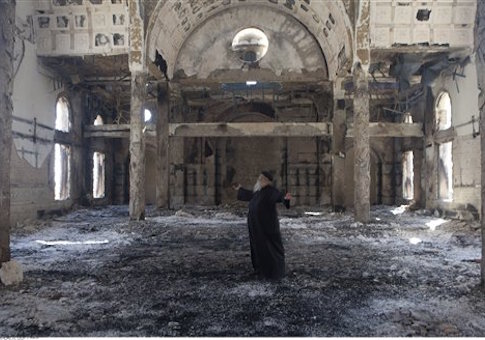
Christian Coptic Priest Father Samuel reacts as he stands inside the burned and heavily damaged St. Mousa church in Minya, Egypt / AP

In the nearly five years of turmoil that have followed the resignation of President Hosni Mubarak in 2011, no group in Egypt has suffered more than the 15 million Coptic Christians. Both a religious and ethnic minority, the Copts are descended from the native population of Egypt who lived and ruled there from the time of the pharaohs until the Roman conquest in 31 B.C. They are the largest Christian community in the Middle East today.

Copts have long been the target of discrimination and persecution in the majority-Arab nation. But this ancient people faced a terrifying new prospect in 2012: Muslim Brotherhood rule.

After Mubarak was ousted, the violence began almost immediately. Churches and schools were burned; peaceful protestors were massacred. When parliamentary elections were held nine months later, they were swept by the Muslim Brotherhood and other Islamist parties. When Mohamed Morsi won the presidential election in May 2012, the party’s victory looked complete. The same year, Morsi gave himself unlimited powers and the party drafted a new constitution inspired by Sharia law.

Morsi benefitted from the organizational advantage of the Muslim Brotherhood. Backed by imams preaching the benefits of religious rule, the previously banned political party was able to defeat the fractured coalitions of the pro-West, liberal, and secular candidates.

“They used thugs to carry out political intimidation against Christians,” a former member of Egyptian Parliament told the Washington Free Beacon. Chants celebrating the Brotherhood victory echoed through the streets of Cairo. “Morsi won! Copts out!”

Ousted president Mohamed Morsi / AP

During Morsi’s rule, Christians were murdered and tortured by the hundreds. Attacks and abductions of Christian children spiked significantly. “Most Americans do not know how vicious and bloody the Muslim Brotherhood is,” Ahmed, a 24-year old secular Muslim, said. “They really can’t understand.”

Pope Tawadros II, Egypt’s Coptic Christian leader, criticized Morsi for negligence after six Christians were killed when police and armed civilians besieged Egypt’s largest cathedral. “We want actions, not words,” the Pope said.

Public accusations of blasphemy also became ubiquitous. A Facebook post interpreted as undermining Islam could bring a mob of fundamentalists with rocks and Molotov cocktails to the homes of Christians, surrounding them with families trapped inside. Sham trials with no legal representation would follow. Anti-Christian terrorism was not punished, but the wrong words often landed Copts in prison, forcing the church to make public apologies and families to leave their towns and villages.

Lydia, an activist who provides relief supplies to torn Christian communities in Upper Egypt, and who requested that only her first name be used to preserve her safety and that of her colleagues, witnessed the Muslim Brotherhood offer the very poorest Egyptians social services that bought their allegiance. “When you have no food or money, you will listen to anyone who gives you the resources your family desperately needs,” Lydia said. “They brainwash the illiterate with extremism so they hurt Christians.”

Still, Morsi’s authoritarian rule—rewriting the constitution, disbanding the Egyptian parliament, tossing potentially obstructive judges into jail—was not long lived. Barely a year after he assumed office, a reported 35 million citizens took to the streets to protest his rule, leading the Egyptian military, under Gen. Abdel Fattah al-Sisi, to remove him from power in July 2013.
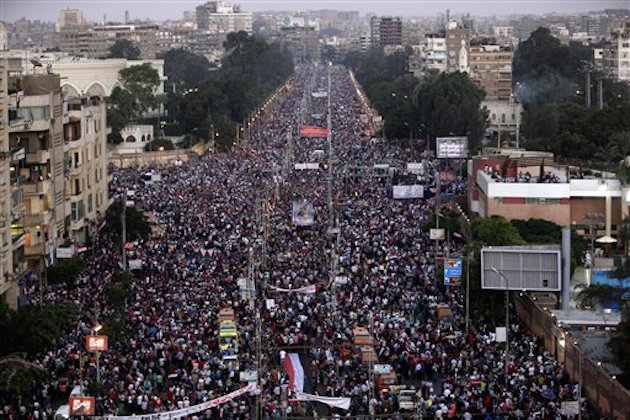
Egypt’s ousted President Mohammed Morsi protest at the presidential palace in Cairo, Egypt, Friday, July 26, 2013 / AP

Sen. James Lankford (R., Okla.) told the Free Beacon that had al-Sisi not responded, the promise of Egyptian Democracy would have died. “What it seemed the Egyptian people wanted was more opportunity to be able have some sort of functioning democracy, elections, input into their own government,” Lankford said. “It was the immediate understanding as soon as the Muslim Brotherhood was elected, that was the last election Egypt would have.”

In 2014, al-Sisi was elected Egypt’s new president. He won a solid electoral victory, giving him control of the Egyptian government with the responsibilities of forming a new constitution, a new parliament, and a new judicial system. The Coptic Church fervently supported al-Sisi’s candidacy because the new president promised Copts equality in citizenship, security in their communities, and the ability to build places of worship.

The new Egyptian president challenged the leaders of the Islamic world to push a more moderate message. In December 2014, hundreds of Christian and Muslim theologians gathered at al-Azhar, Egypt’s leading mosque and religious university, participated in a conference to fight “jihad” and promote inclusion. Al-Sisi ambitiously called for a “religious revolution” in January 2015, saying that clerics bear responsibility for the growing extremism in the Middle East.

As president, al-Sisi took many symbolic steps to integrate the Coptic community with the majority Sunni population. In a surprise to most Egyptians, al-Sisi attended a mass at Saint Mark Orthodox Cathedral in Cairo on Christmas Eve, a first for any Egyptian president. Al-Sisi regularly invites Pope Tawadros II to appear beside him when he announces major policy rollouts or requests public dialogue from senior advisers.

Al-Sisi also appointed two Copts as members of his cabinet. Under the constitution, the president of Egypt has the power to select 10 members of parliament. Political observers believe he will select Copts to fill a majority of those appointed seats to offer a more representative parliament.

“Our lives haven’t changed much but one positive result of the revolution is the Egyptian people have politically woken up,” said Hala, a Mubarak-era government official who also wished to be identified by her first name only because she fears political retribution. “We no longer accept what we are told. Egyptians are at least aware of the government’s actions and they are more aware of the troubles Copts face.”

But while al-Sisi’s administration provides a welcome change of tone toward the Coptic community, the day-to-day lives of Copts remain little changed from the Mubarak days.

Coptic Solidarity is a five-year-old public charity organization and advocacy group devoted to advancing equality for Copts in Egypt. Their efforts have helped raise awareness about the persecution Christians face in the Middle East. Alex Shalaby, an Egyptian businessman currently residing in the United States and Coptic Solidarity’s new president, believes Egypt under al-Sisi has continued many of the same practices as previous presidents Sadat, Mubarak, and Morsi.

“Discrimination is rampant, especially in Upper Egypt. We still see reconciliation tactics pressuring the closing of Christian churches and there are still very few Coptic government appointees, he explained. “Coptic Solidarity monitors all developments within Egypt and we are not able to say much has been accomplished in terms of real change to improve Coptic lives in the last 12 months.”

Human rights groups have been critical of al-Sisi’s record. Amnesty International’s Hassiba Hadj Sahraoui accused the president of “employing the same methods of torture and other ill-treatment used during the darkest hours of the Mubarak era.” The Egyptian government received heavy criticism after a court sentenced hundreds of Muslim Brotherhood members to death, intensifying its crackdown on Islamists.

Despite assurances from al-Sisi, sectarian violence still regularly occurs in the rural villages of Upper Egypt where the government has less control.

In Nasreya, Islamists responded to a video of five Christian students making fun of the Islamic State terrorist groups by demanding the students be turned over to the authorities for insulting the religion of Islam. Villagers hurled rocks at Copts and vandalized their property. No arrests were reported for the attacks but the teacher and students were imprisoned for days.

On March 26, 2015, in El Galaa another horde gathered to protest the building of a new church that served 1,400 Christians, also attacking Christian homes in a similar manner. The local government forced the new church to have no outer symbol of Christianity. In Mayana and Abu Qurqas villages, police raided churches, confiscated items from the altar, and shut down reconstruction work.

Lydia, the activist based in Upper Egypt, has witnessed firsthand the damage from these attacks. “I had to console a girl, nine years old, crying because she was afraid her parents were going to be kicked out of their own home,” she said.
“They are poor, illiterate, and now their home is burned and their own community has banned them. All because they are Christians,” she continued.

“The police don’t bother to protect Christians. They do the exact opposite in Upper Egypt,” Lydia said. “The local governments have been loaded with Islamists for years.”

But violence is not exclusive to the country’s outskirts. On June 30, 2015, the two-year anniversary of the popular uprising against Morsi, Islamists detonated bombs by the homes of well-known Christians. Additionally, The Fathers Church in Alexandria was firebombed on July 22, 2015. This summer’s assassination of Egypt’s Attorney General Hesham Barakat in a car bombing, reportedly carried out by a wing of the Muslim Brotherhood, served as an ugly reminder that Egypt’s violence has not passed.

An Egyptian policeman stands guard at the site of a car bombing that killed n Egyptian policeman stands guard at the site of a car bombing that killed Hesham Barakat / AP

Despite these problems, al-Sisi still enjoys support among prominent Copts. Amir Ramzy is a prominent Coptic judge and public figure in Egypt’s legal system, and a loyal defender of al-Sisi’s administration.

“We cannot remove prejudice overnight,” Ramzy said. “We must focus on changing the attitude of the people on the ground first.”

The judge pointed to the dire state al-Sisi found the country in when he took office as reason for slow progress.

“Egypt is fighting Islamists inside and outside our borders. Egypt is fighting a horrid economy with massive unemployment. Al-Sisi is taking on large projects to change these conditions,” Ramzy said. “It is difficult to control chaos and promote social change at the same time.”

The judge referred to the decades it took the United States to implement civil rights reforms. He asked for reasonable expectations out of Egypt’s new president and insists under al-Sisi the country is heading in the right direction. “Just one year after his election, Egypt has new roads, a new canal, new investments, and a new hope for the poor.”

Despite not being content with the pace of progress, Shalaby said al-Sisi is an improvement over his predecessor. As a retired executive, he said he understood national security and economic development should be the president’s priority. “Al-Sisi must do what is best for Egypt first. What is best for Egypt is what is best for Copts. What is good for Copts is good for Egypt.”

Abdel-Fattah al-Sisi / AP

Copts view the Obama administration cynically. Egyptians now whisper that the American president who pleased Arab liberals with his speech “A New Beginning” at al-Azhar in 2009 is secretly funding the Muslim Brotherhood and purposefully neglecting the Islamic State. A group of Copts protested outside of the White House in February 2015, demanding more aggressive action against IS following the beheading of the 21 Copts.

Al-Ahram, the largest newspaper in Egypt, published reports in 2013 that the United States diplomatic mission in Egypt, led by Ambassador Anne Patterson, was discouraging Coptic Christians from participating in protests against Morsi. Even though Patterson adamantly denied the accusations, the report sowed more distrust among Copts.

Egyptians publicly celebrated when Patterson left the country.

Tensions between the Coptic community and the administration worsened when, in the same year, an Obama Homeland Security adviser named Mohamed Elibiary suggested Copts raising awareness of their persecution were promoting “Islamophobic” bigotry. Elibiary, who generated controversy due to views perceived by some to be friendly to the Muslim Brotherhood, released a series of tweets with the R4BIA salute, perceived to be a symbol of hate by many in Egypt.

Elbiary later deleted his tweets and removed the symbol. Bishop Angaelos, Pope Tawadros II’s personal representative called the incident “disturbing.” Elbiary left the Obama administration under pressure from critics in 2014.

Following the ouster of Morsi, the United States canceled weapons deliveries to Egypt and halted all military aid. As the White House took its time to build a relationship with al-Sisi, Russian President Vladimir Putin visited the country and signed a nuclear agreement.

The White House announced in the spring of 2015 that weapons deliveries to Egypt would ultimately be resumed.

Despite the uneasiness in the country, Christians believe they will one day be equal citizens in their homeland. Such progress may be slow and painful, but amidst anxiety there is hope in Egypt.

Much of this hope is derived from the perception of al-Sisi’s decent treatment of the Copts. Ramzy, the judge, told theFree Beacon, “al-Sisi may not be perfect, but he is Copts’ best chance to promote ourselves from second class citizens. He should receive America’s support.”
Column One: Obama’s enemies list

August 6, 2015

Column One: Obama’s enemies list, Jerusalem Post, Caroline Glick, August 6, 2015

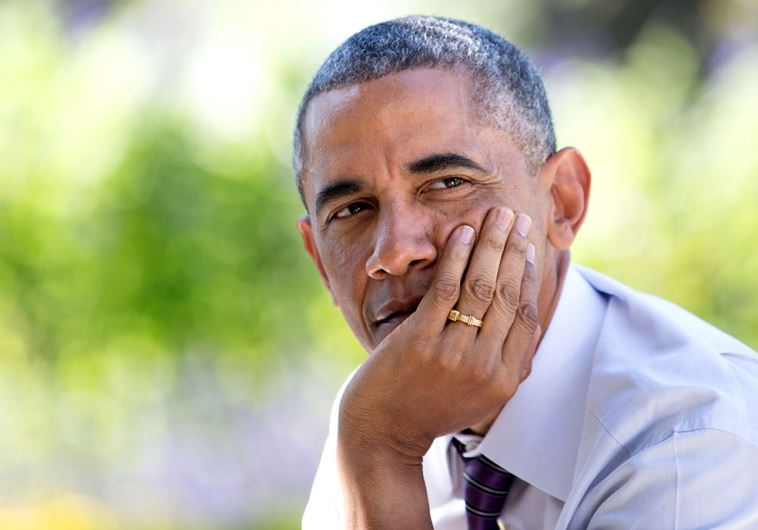
ShowImage (8)US President Barack Obama at the Rose Garden of the White House. (photo credit:OFFICIAL WHITE HOUSE PHOTO / PETE SOUZA)

[T]he real question lawmakers need to ask is whether the deal is good for America. Is Obama right or wrong that only partisan zealots and disloyal Zionists could oppose his great diplomatic achievement? To determine the answer to that question, you need to do is ask another one. Does his deal make America safer or less safe? The best way to answer that question is to consider all the ways Iran threatens America today, and ask whether the agreement has no impact on those threats, or whether it mitigates or aggravates them.

***********************

In President Barack Obama’s defense of his nuclear deal with Iran Wednesday, he said there are only two types of people who will oppose his deal – Republican partisans and Israel- firsters – that is, traitors.

At American University, Obama castigated Republican lawmakers as the moral equivalent of Iranian jihadists saying, “Those [Iranian] hard-liners chanting ‘Death to America’ who have been most opposed to the deal… are making common cause with the Republican Caucus.”

He then turned his attention to Israel.

Obama explained that whether or not you believe the deal endangers Israel boils down to whom you trust more – him or Prime Minister Benjamin Netanyahu. And, he explained, he can be trusted to protect Israel better than Netanyahu can because “[I] have been a stalwart friend of Israel throughout my career.”

The truth is that it shouldn’t much matter to US lawmakers whether Obama or Netanyahu has it right about Israel. Israel isn’t a party to the deal and isn’t bound by it. If Israel decides it needs to act on its own, it will.

The US, on the other side, will be bound by the deal if Congress fails to kill it next month.

So the real question lawmakers need to ask is whether the deal is good for America. Is Obama right or wrong that only partisan zealots and disloyal Zionists could oppose his great diplomatic achievement? To determine the answer to that question, you need to do is ask another one. Does his deal make America safer or less safe? The best way to answer that question is to consider all the ways Iran threatens America today, and ask whether the agreement has no impact on those threats, or whether it mitigates or aggravates them.

Today Iran is harming America directly in multiple ways.

The most graphic way Iran is harming America today is by holding four Americans hostage. Iran’s decision not to release them over the course of negotiations indicates that at a minimum, the deal hasn’t helped them.

It doesn’t take much consideration to recognize that the hostages in Iran are much worse off today than they were before Obama concluded the deal on July 14.

The US had much more leverage to force the Iranians to release the hostages before it signed the deal than it does now. Now, not only do the Iranians have no reason to release the hostages, they have every reason to take more hostages.

Then there is Iranian-sponsored terrorism against the US.

In 2011, the FBI foiled an Iranian plot to murder the Saudi ambassador in Washington and bomb the Saudi and Israeli embassies in the US capital.

One of the terrorists set to participate in the attack allegedly penetrated US territory through the Mexican border.

The terrorist threat to the US emanating from Iran’s terrorist infrastructure in Latin America will rise steeply as a consequence of the nuclear deal.

As The Wall Street Journal’s Mary Anastasia O’Grady wrote last month, the sanctions relief the deal provides to Iran will enable it to massively expand its already formidable operations in the US’s backyard. Over the past two decades, Iran and Hezbollah have built up major presences in Cuba, Venezuela, Nicaragua, Ecuador and Bolivia.

Iran’s presence in Latin America also constitutes a strategic threat to US national security. Today Iran can use its bases of operations in Latin America to launch an electromagnetic pulse attack on the US from a ballistic missile, a satellite or even a merchant ship.

The US military is taking active steps to survive such an attack, which would destroy the US’s power grid. Among other things, it is returning the North American Aerospace Defense Command (NORAD) to its former home in Cheyenne Mountain outside Colorado Springs.

But Obama has ignored the findings of the congressional EMP Commission and has failed to harden the US electronic grid to protect it from such attacks.

The economic and human devastation that would be caused by the destruction of the US electric grid is almost inconceivable. And now with the cash infusion that will come Iran’s way from Obama’s nuclear deal, it will be free to expand on its EMP capabilities in profound ways.

Through its naval aggression in the Strait of Hormuz Iran threatens the global economy. While the US was negotiating the nuclear deal with Iran, the Revolutionary Guards unlawfully interdicted – that is hijacked – the Marshall Islands-flagged Maersk Tigris and held its crew hostage for weeks.

Iran’s assault on the Tigris came just days after the US-flagged Maersk Kensington was surrounded and followed by Revolutionary Guards ships until it fled the strait.

A rational take-home message the Iranians can draw from the nuclear deal is that piracy pays.

Their naval aggression in the Strait of Hormuz was not met by American military force, but by American strategic collapse at Vienna.

This is doubly true when America’s listless response to Iran’s plan to use its Houthi proxy’s takeover of Yemen to control the Bab el-Mandab strait is taken into consideration. With the Bab el-Mandab, Iran will control all maritime traffic from the Persian Gulf and the Red Sea. Rather than confront this clear and present danger to the global economy, America abandoned all its redlines in the nuclear talks.

Then there is Iran’s partnership 20-year partnership with al-Qaida.

The 9/11 Commission found in its report that four of the 9/11 terrorists transited Iran before traveling to the US. As former Defense Intelligence Agency director Lt.-Gen. (ret.) Mike Flynn told Fox News in the spring, Iranian cooperation with al-Qaida remains deep and strategic.

When the US Navy SEALs killed Osama bin Laden in 2011, they seized hard drives containing more than a million documents related to al-Qaida operations. All but a few dozen remain classified.

According to Flynn and other US intelligence officials who spoke to The Weekly Standard, the documents expose Iran’s vast collaboration with al-Qaida.

The agreement Obama concluded with the mullahs gives a tailwind to Iran. Iran’s empowerment will undoubtedly be used to expand its use of al-Qaida terrorists as proxies in their joint war against the US.

Then there is Iran’s ballistic missile program.

The UN Security Council resolution passed two weeks ago cancels the UN-imposed embargoes on conventional arms and ballistic missile acquisitions by Iran. Since the nuclear deal facilities Iranian development of advanced nuclear technologies that will enable the mullahs to build nuclear weapons freely when the deal expires, the Security Council resolution means that by the time the deal expires, Iran will have the nuclear warheads and the intercontinental ballistic missiles required to carry out a nuclear attack on the US.

Obama said Wednesday that if Congress votes down his nuclear deal, “we will lose… America’s credibility as a leader of diplomacy. America’s credibility,” he explained, “is the anchor of the international system.”

Unfortunately, Obama got it backwards. It is the deal that destroys America’s credibility and so upends the international system which has rested on that credibility for the past 70 years.

The White House’s dangerous suppression of seized al-Qaida-Iran documents, like its listless response to Iran’s maritime aggression, its indifference to Iran’s massive presence in Latin America, its lackluster response to Iran’s terrorist activities in Latin America, and its belittlement of the importance of the regime’s stated goal to destroy America – not to mention its complete collapse on all its previous redlines over the course of the negotiations – are all signs of the disastrous toll the nuclear deal has already taken on America’s credibility, and indeed on US national security.

To defend a policy that empowers Iran, the administration has no choice but to serve as Iran’s agent. The deal destroys America’s credibility in fighting terrorism. By legitimizing and enriching the most prolific state sponsor of terrorism, the US has made a mockery of its claimed commitment to the fight.

The deal destroys the US’s credibility as an ally.

By serving as apologists for its worst enemy, the US has shown its allies that they cannot trust American security guarantees. How can Israel or Saudi Arabia trust America to defend them when it is endangering itself? The deal destroys 70 years of US nonproliferation efforts. By enabling Iran to become a nuclear power, the US has made a mockery of the very notion of nonproliferation and caused a nuclear arms race in the Middle East.

The damage caused by the deal is already being felt. For instance, Europe, Russia and China are already beating a path to the ayatollahs’ doorstep to sign commercial and military deals with the regime.

But if Congress defeats the deal, it can mitigate the damage. By killing the deal, Congress will demonstrate that the American people are not ready to go down in defeat. They can show that the US remains committed to its own defense and the rebuilding of its strategic credibility worldwide.

In his meeting with Jewish leaders Tuesday, Obama acknowledged that his claim – repeated yet again Wednesday – that the only alternative to the deal is war, is a lie.

Speaking to reporters after the meeting, Greg Rosenbaum, chairman of the National Democratic Jewish Council, which is allied with the White House, said that Obama rejected the notion that war will break out if Congress rejects the deal with veto-overriding majorities in both houses.

According to Rosenbaum, Obama claimed that if Congress rejects his nuclear deal, eventually the US will have to carry out air strikes against Iran’s nuclear facilities in order to prevent them from enriching uranium to weapons-grade levels.

“But,” he quoted Obama as saying, “the result of such a strike won’t be war with Iran.”

Rather, Obama said, Iran will respond to a US strike primarily by ratcheting up its terrorist attacks against Israel.

“I can assure,” Obama told the Jewish leaders, “that Israel will bear the brunt of the asymmetrical responses that Iran will have to a military strike on its nuclear facilities.”

What is notable here is that despite the fact that it will pay the heaviest price for a congressional defeat of the Iran deal, Israel is united in its opposition to the deal. This speaks volume about the gravity with which the Israeli public views the threats the agreement unleashed.

But again, Israel is not the only country that is imperiled by the nuclear deal. And Israelis are not the only ones who need to worry.

Obama wishes to convince the public that the deal’s opponents are either partisan extremists or traitors who care about Israel more than they care about America. But neither claim is true. The main reason Americans should oppose the deal is that it endangers America. And as a consequence, Americans who oppose the deal are neither partisans nor turncoats.

They are patriots.

The Iran Delusion: A Primer for the Perplexed

July 8, 2015

The Iran Delusion: A Primer for the Perplexed, World AffairsMichael J. Totten, Summer 2015

Totten_Iran

US foreign policy in the Middle East is focused on two things right now: containing ISIS and preventing Iran from acquiring nuclear weapons. These are both worthy goals, but if sanctions are lifted on Iran as part of a nuclear deal, whether or not it gets the bomb, Tehran will certainly have more money and resources to funnel to Hezbollah, the Assad regime, Iraq’s Shia militias, the Houthis in Yemen, and—perhaps—to Saudi Arabia’s disaffected Shia minority. The region will become even less stable than it already is. ISIS and al-Qaeda will likely grow stronger than they already are.

**************************

The chattering class has spent months bickering about whether or not the United States should sign on to a nuclear deal with Iran, and everyone from the French and the Israelis to the Saudis has weighed in with “no” votes. Hardly anyone aside from the Saudis, however, seems to recognize that the Iranian government’s ultimate goal is regional hegemony and that its nuclear weapons program is simply a means to that end.

What do these shatter zones have in common? The Iranian government backs militias and terrorist armies in all of them. As Kaplan writes, “The instability Iran will cause will not come from its implosion, but from a strong, internally coherent nation that explodes outward from a natural geographic platform to shatter the region around it.”

That’s why Iran is a problem for American foreign policy makers in the first place; and that’s why trading sanctions relief for an international weapons inspection regime will have no effect on any of it whatsoever.

Iran has been a regional power since the time of the Persian Empire, and its Islamic leaders have played an entirely pernicious role in the Middle East since they seized power from Mohammad Shah Reza Pahlavi in 1979, stormed the US Embassy in Tehran, and held 66 American diplomats hostage for 444 days.

In 1982, they went international. When the Israelis invaded Lebanon to dislodge Yasir Arafat’s Palestine Liberation Army, Iranian Revolutionary Guard Corps commanders forged a network of terrorist and guerrilla cells among their coreligionists in Lebanon’s Shia population.

Hezbollah, the poisoned fruit of these efforts, initially had no name. It was a hidden force that struck from the shadows. It left a hell of a mark, though, for an organization of anonymous nobodies when it blew up the American Embassy in Beirut and hit French and American peacekeeping troops—who were there at the invitation of the Lebanese government—with suicide truck bombers in 1983 that killed 368 people.

When Hezbollah’s leaders finally sent out a birth announcement in their 1985 Open Letter, they weren’t the least bit shy about telling the world who they worked for. “We are,” they wrote, “the Party of God (Hizb Allah), the vanguard of which was made victorious by God in Iran . . . We obey the orders of one leader, wise and just, that of our tutor and faqih [jurist] who fulfills all the necessary conditions: Ruhollah Musawi Khomeini. God save him!”

The Israelis fought a grinding counterinsurgency against Hezbollah for 18 years in southern Lebanon before withdrawing in 2000, and they fought a devastating war in 2006 along the border that killed thousands and produced more than a million refugees in both countries. Hezbollah was better armed and equipped than the Lebanese government even then, but today its missiles can reach Tel Aviv, Jerusalem, and even the Dimona nuclear power plant all the way down in the southern part of the country. 

Until September 11, 2001, no terrorist organization in the world had killed more Americans than Hezbollah. Hamas in Gaza isn’t even qualified as a batboy in the league Hezbollah plays in.

Hezbollah is more than just an anti-Western and anti-Jewish terrorist organization. It is also a ruthless sectarian Shia militia that imposes its will at gunpoint on Lebanon’s Sunnis, Christians, and Druze. It has toppled elected governments, invaded and occupied parts of Beirut, and, according to a United Nations indictment, assassinated former Lebanese Prime Minister Rafik Hariri.

Hezbollah is, for all intents and purposes, the foreign legion of Iran’s Revolutionary Guard Corps. The parts of the country it occupies—the northern Bekaa Valley, the Israeli border region, and the suburbs south of Beirut—constitute a de facto Iranian-controlled state-within-a-state inside Lebanon. 

After the United States demolished Saddam Hussein’s Sunni-dominated regime in 2003, Iran’s rulers duplicated their Lebanon strategy in Iraq by sponsoring a smorgasbord of sectarian Shia militias and death squads that waged war against the Iraqi government, the American military, Sunni civilians, and politically moderate Shias. 

Unlike Lebanon—which is more or less evenly divided between Christians, Sunnis, and Shias—Iraq has an outright Shia majority that feels a gravitational pull toward their fellow Shias in Iran and a revulsion for the Sunni minority that backed Hussein’s brutal totalitarianism and today tolerates the even more deranged occupation by the Islamic State, also known as ISIS. 

The central government, then, is firmly aligned with Tehran. Iran’s clients don’t run a Hezbollah-style state-within-a-state in Iraq. They don’t have to. Now that Hussein is out of the way, Iraq’s Shias can dominate Baghdad with the weight of sheer demographics alone. But Iran isn’t content with merely having strong diplomatic relations with its neighbor. It still sponsors sectarian Shia militias in the center and south of the country that outperform the American-trained national army. They may one day even supplant Iraq’s national army as the Iranian Revolutionary Guard Corps has more or less supplanted the Iranian national army. Iraq’s Shia militias are already the most powerful armed force outside the Kurdish autonomous region and ISIS-held territory.

When ISIS took complete control of the city of Ramadi, the capital of Anbar Province, in May of 2015, the Iraqi soldiers tasked with protecting it dropped their weapons and ran as they had earlier in Mosul, Tikrit, and Fallujah. So Iraq’s central government tasked its Iranian-backed Shia militias with taking it back. 

On the one hand, we can hardly fault Baghdad for sending in whatever competent fighting force is available when it needs to liberate a city from a psychopathic terrorist army, but the only reason ISIS gained a foothold among Iraq’s Sunnis in the first place is because the Baghdad government spent years acting like the sectarian dictatorship that it is, by treating the Sunni minority like second-class citizens, and by trumping up bogus charges against Sunni officials in the capital. When ISIS promised to protect Iraq’s Sunnis from the Iranian-backed Shia rulers in Baghdad, the narrative seemed almost plausible. So ISIS, after being vomited out of Anbar Province in 2007, was allowed to come back.

Most of Iraq’s Sunnis fear and loathe ISIS. They previously fought ISIS under its former name, al-Qaeda in Iraq. But they fear and loathe the central government and its Shiite militias even more. They’d rather be oppressed by “their own” than by “the other” if they had to choose. But they have to choose because Iran has made Iraq its second national project after Lebanon.

It doesn’t have to be this way. At least some of the tribal Sunni militias would gladly fight ISIS as they did in the past with American backing. If they did, residents of Ramadi, Fallujah, and Mosul would view them as liberators and protectors rather than potential oppressors, but Tehran and Baghdad will have none of it.

“All attempts to send arms and ammunition must be through the central government,” Adnan al-Assadi, a member of Parliament, told CNN back in May. “That is why we refused the American proposal to arm the tribes in Anbar. We want to make sure that the weapons would not end up in the wrong hands, especially ISIS.”

That may appear reasonable on the surface, but ISIS can seize weapons from Shia militias just as easily as it can seize weapons from Sunni militias. The real reason for the government’s reluctance ought to be obvious: Iraq’s Shias do not want to arm Iraq’s Sunnis. They’d rather have ISIS controlling huge swaths of the country than a genuinely popular Sunni movement with staying power that’s implacably hostile to the Iranian-backed project in Mesopotamia.

The catastrophe in Iraq is bad enough, but the Iranian handiwork in Syria is looking even more apocalyptic nowadays. ISIS wouldn’t even exist, of course, if it weren’t for the predatory regime of Bashar al-Assad, and the close alliance that has existed between Damascus and Tehran since the 1979 revolution that brought the ayatollahs to power.

Syria’s government is dominated by the Alawites, who make up just 15 percent of the population. Their religion is a heterodox blend of Christianity, Gnosticism, and Shia Islam. They aren’t Shias. They aren’t even Muslims. Their Arab Socialist Baath Party is and has always been as secular as the Communist Party was in the Soviet Union (and it was in fact a client of the Soviet Union). A marriage between an aggressively secular Alawite regime and Iran’s clerical Islamic Republic was hardly inevitable, but it’s certainly logical. The two nations had a common enemy wedged between them in Saddam Hussein’s Iraq, and both have been threatened by the region’s Sunni Arab majority since their inception. 

Hezbollah is their first child, and the three of them together make up the core of what analyst Lee Smith calls the Resistance Bloc in his book, The Strong Horse. The Party of God, as it calls itself, wouldn’t exist without Iranian money and weapons, nor would it exist without Damascus as the logistics hub that connects them. And it would have expired decades ago if Syria hadn’t conquered and effectively annexed Lebanon at the end of the Lebanese civil war in 1990.

Every armed faction in Lebanon, including Hezbollah, signed on to the Syrian-brokered Taif Agreement, which required the disarmament of every militia in the country. But the Assads governed Lebanon with the same crooked and cynical dishonesty they perfected at home, and as the occupying power they not only allowed Hezbollah to hold onto its arsenal, but also allowed Hezbollah to import rockets and even missiles from Iran.

“For Syria,” historian William Harris wrote in The New Face of Lebanon, “Hezbollah could persist as both a check on the Lebanese regime and as a means to bother Israel when convenient.”

The Party of God is now a powerful force unto itself, but it rightly views the potential downfall of the Assad regime as the beginning of its own end. The fact that Assad might be replaced by the anti-Shia genocidaires of ISIS compelled its fighters to invade Syria without an exit strategy—with the help of Iranian commanders, of course—to either prop up their co-patron or die.

Rather than going all-in, the Iranians could have cut their losses in Syria and pressured Assad into leaving the country. ISIS would be hiding under rocks right now had that happened. Hardly any Sunnis in Syria would tolerate such a deranged revolution if they had no one to revolt against. But the Resistance Bloc will only back down if it’s forced to back down. If ISIS devours Syria and Iraq as a result, then so be it.

And while the Resistance Bloc is fighting for its survival in the Levant, it’s expanding into the Arabian Peninsula.

The Shia-dominated Houthi movement took control of Yemen’s capital, Sanaa, earlier this year following the revolution that toppled former President Ali Abdullah Saleh, and its fighters are well on their way to taking the port city of Aden, in the Sunni part of the country.

The Houthis, of course, are backed by Iran.

They’re no more likely to conquer every inch of that country than Iran’s other regional proxies are to conquer every inch of anywhere else. Shias make up slightly less than half of Yemen’s population, and their natural “territory” is restricted to the northwestern region in and around the capital. Taking and holding it all is likely impossible. No government—Sunni, Shia, or otherwise—has managed to control all of Yemen for long. 

And the Saudis are doing their damnedest to make sure it stays that way. Their fighter jets have been pounding Houthi positions throughout the country since March.

Saudi Arabia is more alarmed at Iranian expansion in the region than anyone else, and for good reason. It’s the only Arab country with a substantial Shia minority that hasn’t yet been hit by Iranian-backed revolution, upheaval, or sectarian strife, although events in Yemen could quickly change that.

In the city and province of Najran, in the southwestern corner just over the Yemeni border, Shias are the largest religious group, and they’re linked by sect, tribe, and custom to the Houthis.

Not only is the border there porous and poorly defined, but that part of Saudi Arabia once belonged to Yemen. The Saudis conquered and annexed it in 1934. Najran is almost identical architecturally to the Yemeni capital, and you can walk from Najran to Yemen is a little over an hour. 

Will the Houthis be content to let Najran remain in Saudi hands now that they have Iranian guns, money, power, and wind at their back? Maybe. But the Saudis won’t bet their sovereignty on a maybe.

Roughly 15 percent of Saudi Arabia’s citizens are Shias. They’re not a large minority, but Syria’s Alawites are no larger and they’ve been ruling the entire country since 1971. And Shias make up the absolute majority in the Eastern Province, the country’s largest, where most of the oil is concentrated. 

Support among Yemen’s Sunnis for al-Qaeda in the Arabian Peninsula—the most dangerous branch of al-Qaeda on earth—is rising for purely sectarian reasons just as it has in Syria and Iraq. Iran can’t intervene anywhere in the region right now without provoking a psychotic backlash that’s as dangerous to Tehran and its interests as it is to America’s.

If Iranian adventurism spreads to Saudi Arabia, watch out. Everywhere in the entire Middle East where Sunnis and Shias live adjacent to one another will have turned into a shatter zone.

The entire world’s oil patch will have turned into a shatter zone.

US foreign policy in the Middle East is focused on two things right now: containing ISIS and preventing Iran from acquiring nuclear weapons. These are both worthy goals, but if sanctions are lifted on Iran as part of a nuclear deal, whether or not it gets the bomb, Tehran will certainly have more money and resources to funnel to Hezbollah, the Assad regime, Iraq’s Shia militias, the Houthis in Yemen, and—perhaps—to Saudi Arabia’s disaffected Shia minority. The region will become even less stable than it already is. ISIS and al-Qaeda will likely grow stronger than they already are.

We’re kidding ourselves if we think that won’t affect us. It’s not just about the oil, although until every car in the world is powered by green energy we can’t pretend the global economy won’t crash if gasoline becomes scarce. We also have security concerns in the region. What happens in the Middle East hasn’t stayed in the Middle East now for decades. 

The head-choppers of ISIS are problematic for obvious reasons. Their leader, Abu Bakr al-Baghdadi, said, “I’ll see you in New York,” to American military personnel when they (foolishly) released him from Iraq’s Camp Bucca prison in 2004. But the Iranian-led Resistance Bloc has behaved just as atrociously since 1979 and will continue to do so with or without nuclear weapons.

US involvement in Syria and Iraq is minimal now, but even the little we are doing makes little sense. We’re against ISIS in both countries, which is entirely fine and appropriate, but in Iraq we’re using air power to cover advances by Shia militias and therefore furthering Iranian interests, and in Syria we’re working against Iranian interests by undermining Assad and Hezbollah. Meanwhile, the nuclear deal Washington is negotiating with Tehran places a grand total of zero requirements on Iran’s rulers to roll back in their necklace of shatter zones.

We don’t have to choose between ISIS and Iran’s revolutionary regime. They’re both murderous Islamist powers with global ambitions, and they’re both implacably hostile to us and our interests. Resisting both simultaneously wouldn’t make our foreign policy even a whit more complicated. It would, however, make our foreign policy much more coherent.

Egyptian army backed by Apaches kills 63 Islamists in broad area between Sheikh Zuwaid and Rafah

July 6, 2015

Egyptian army backed by Apaches kills 63 Islamists in broad area between Sheikh Zuwaid and Rafah, DEBKAfile, July 6, 2015

(Please see also, The U.S. Must Help Egyptian President Sisi. — DM)

SinaiEgyptENG

An immense stretch of Sinai desert populated by half a million people is under siege, as the Egyptian army fights off a major offensive by the Islamic State’s Egyptian affiliate, the Sinai Province, against its positions in northern Sinai. The battle, which Monday, July 6, went into its sixth day, is being fought in an area bounded by the northern town of Sheikh Zuwaid, Rafah on the Gaza border, and up to Kerem Shalom and Nitzana on the Israeli border to the south. DEBKAfile’s military sources report a news blackout on the ongoing warfare except for Egyptian army handouts.

Egyptian security sources reported Monday that the latest round of helicopter strikes and ground operations had killed 63 Islamists in villages between Sheikh Zuwaid and Rafah, where four of their hideouts had been located. Our sources add that these air strikes are directed against civilian dwellings, especially in farming districts, where ISIS fighters are suspected of hiding out. No figures have been released by Cairo on civilian or Egyptian army casualties.

DEBKAfile describes the contest as an asymmetrical one between an army that depends heavily on aerial operations and ISIS terrorists, who have resorted mainly to guerilla warfare. By night, they flit swiftly on foot between the dunes to strike Egyptian army positions. By day, their foot soldiers trap Egyptian soldiers by setting up ambushes around those positions and on the roads of Sinai to keep Egyptian troops pinned down. Terrorist operations are a constant on their agenda.

The Egyptians respond with blanket air strikes which swoop on any moving object in the embattled area – whether by car or on foot

The hide-and-seek tactics employed by ISIS are sustainable in the long term, especially when the Islamists can rely on a constant influx of reinforcements, weapons and ordnance, the sources of which DEBKAfile disclosed in an exclusive report Sunday, July 5.

The Islamic State is rushing reinforcements to Egypt from Libya and Iraq for its battle with Egyptian forces in northern Sinai, which went into its fifth day Sunday, July 5, and other offensives, DEBKAfile’s intelligence and counter-terror sources report. After sustaining hundreds of casualties, both sides claim to have won the upper hand but the tenacious struggle is not over.

An Islamist manpower pool is provided by Egyptian extremists who crossed into Libya in the past and settled in bases around Benghazi.  Last week, ISIS summoned them to take up positions in Cairo and the Suez Canal and wait for orders to go into action. They crossed back with the help of smugglers. Those rings, dominated by the Muslim Brotherhood underground, with branches controlled by Hamas and Hizballah, bring illicit weapons and ammunition supplies to Sinai from Libya via Egypt.

President Abdel Fatteh El-Sisi is therefore obliged to earmark substantial military and intelligence resources for defending the Suez Canal and Cairo – more even than the Sinai front.

The other source of jihadi reinforcements is Iraq, They use another branch of the smuggling network which carries them through southern Jordan to the Gulf of Aqaba where they are picked up by smugglers’ boats and ferried across to the eastern coast of the Sinai Peninsula.

The IDF had more than one reason for its decision last Wednesday to close to traffic Rte 12, Israel’s main southern highway, which runs parallel to the Egyptian border up to Eilat: It was a necessary precaution lest ISIS turned its terrorists and guns against Israel from next-door northern Sinai. The other reason was to deter the Islamists coming from Iraq from trying to transit Israel and reach Sinai with the help of Bedouin smugglers operating on both sides of the Israeli-Egyptian border.

Our military sources estimate that some 1,000 jihadists are directly engaged in the North Sinai battle with the Egyptian army, but add that they could quickly recruit supplementary fighting manpower from Bedouin tribes near the warfront who already play ball with the terrorists.

Egyptian tacticians have strictly limited the army action on this front to air and helicopter strikes and local ground and armored forces. They are focusing on defending three Sinai enclaves, the northern district around Sheikh Zuweid, El Arish port and Rafah, and Sharm el-Sheikh in the south, to pin ISIS forces down in those places and prevent them from fanning out into areas controlled by the big Bedouin tribes.

When President El-Sisi visited the troops in northern Sinai Saturday, July 5, he disclosed that only one percent of the Egyptian army of 300,000 men was assigned to Sinai. He indicated that his army was perfectly capable of wiping out the Sinai terrorist threat in no time if all its might were to be thrown into the fray.

This strategy leaves ISIS with free rein in central Sinai. However, El-Sisis, like his predecessor Hosni Mubarak, is not prepared to go all out against ISIS in its “dens” any time in the near future, because he needs all his military resources and assets he can muster to defend the capital Cairo and the Suez Canal.
Neither the Islamic Army nor the Muslim Brotherhood or any other radical Islamists make any secrets of their next plans. ISIS has announced that it is setting its sights on Egypt’s pyramids, the Sphinx of Giza, and the country’s unique historic monuments in general, after its savage vandalism and looting of other precious world heritage sites.

In a new message released Friday, July 3, a number of radical Islamist leaders, including the ISIS “caliph” Abu Bakr al-Baghdadi, told their followers that the destruction of Egypt’s national monuments, such as the pyramids and the sphinx, was a “religious duty” that must be carried out by those who worship Islam, as “idolatry is strictly banned in the religion.”

This message has sharply ratcheted up the jihadist element of ISIS military confrontation with Egypt to a higher, more inflammatory level.

The U.S. Must Help Egyptian President Sisi

July 6, 2015

The U.S. Must Help Egyptian President Sisi, American ThinkerMichael Curtis, July 6, 2015

(Not much chance of that. General al-Sisi supported the large masses of Egyptians who wanted then President Morsi deposed. He was later elected President of Egypt. Morsi and his Muslim Brotherhood — which uses terrorism to gain and keep power — is an Obama favorite. Besides, al-Sisi’s efforts to reform Islam run counter to Obama’s delusion that Islam, as it is and has long been, is a wonderful religion of peace. — DM)

The silence was truly deafening. Not a sound from Archbishop Desmond Tutu or Alice Walker or the eager boycotters of Israel or the United Nations Human Rights Council about the brutal massacre of more than 70, perhaps 100, Egyptian soldiers and civilians by Islamist terrorists in the northern Sinai peninsula.

Since Israel, after the 1979 Egyptian-Israeli peace treaty, withdrew all its forces and all settlements — including Yamit — by 1982, the Sinai peninsula has been plagued by terrorist attacks, especially against tourists, by kidnappings, and by violence. After the 2011 Egyptian revolution and consequent uprisings, a major terrorist group emerged and became even more belligerent after the coup that deposed President Mohammed Morsi on July 3, 2013. This was Ansar Bayt al-Maqdis (ABM) that has claimed responsibility for numerous attacks against both Israeli interests and Egyptian personnel.

These assaults included an attack in July 2012 against a Sinai pipeline, a rocket strike in August 2012 on Eilat in south Israel, suicide bombings in el Tor in southern Sinai in May 2014, downing an Egyptian military helicopter in a missile attack, car bombings and hand grenades in Cairo, assassinations and attempted assassinations of Egyptian officials, beheading of four individuals in October 2014, an attack on a security checkpoint, and the June 29, 2015 murder in Cairo of Hisham Barakat, the Egyptian Prosecutor General, who in only two years in office had detained hundreds of members of the Muslim Brotherhood. He was the most senior Egyptian government official murdered.

In November 2014, ABM declared its allegiance to the Islamic State of Iraq and Syria (IS) and accepted the new self-appointed Caliph. It appears to have several hundred trained operatives and collaborators. There are different opinions about the actions of the Sinai Bedouin population, especially that of the largest of the 10 major tribes, the Tarabin tribe in northern Sinai, a tribe that is notorious for drug dealing, weapons smuggling, and human trafficking in prostitutes and African labor workers. Tarabin is said to have called for unification of all the tribes against the terrorists, but rumors of clashes appear to be untrue, and some even allege collaboration with the terrorists. What is true is that local Bedouin tribesmen, alleging discrimination by the state against them, have launched attacks against government forces in Sinai.

Over the last two years ABM, now regarding itself as a dedicated affiliate of IS, has tried to undermine the rule of Egyptian President Abdel Fattah al-Sisi. It has attacked Egyptian army posts, and security centers, and also the UN Multilateral Force in northern Sinai, that oversees the terms of the peace treaty between Egypt and Israel, and tried as well to infiltrate Israeli territory.

There had already been terrorist attacks on October 2014 and January 2015 when more than 30 were killed on each occasion in northeast Sinai. The most dramatic deed of ABM, which now seems to have changed its name to Province of Sinai, (POS) was the series of simultaneous coordinated attacks on July 1, 2015 on fifteen army centers of security forces and checkpoints in northern Sinai. The attacks, including three suicide bombers, killed at least 70 soldiers and civilians.

Evidently POS, imitating its mentor IS that has taken and now rules cities in Iraq and Syria, wanted to take over the city of Sheikh Zuweid, close to Israel, and cut off Rafah from al-Arish.

The danger to all of the democratic countries is immediate for a number of reasons. The first is that the success of the terrorists in their daring ambushes, control of the roads, taking police officers hostage, and planting mines in the streets, indicates not only their disciplined activity but also the influence of IS operatives directly and indirectly through training. IS in Iraq and Syria has operated in just this aggressive and disciplined fashion. All authorities responsible for security in the United States should be conscious of and take account of this highly organized success and of the threat of future similar attacks in the U.S. itself.

The second reason is that Hamas in Gaza is providing support to POS with weapons and logistical support, and even with Hamas terrorists taking part in operations. These have come from Hamas commanders in the Izz ad-Din al-Qassam Brigades that have been prominent for anti-Israeli attacks, including suicide bombings against civilians inside Israel. One particular active commander is Wael Faraj, who has smuggled wounded fighters from Sinai into Gaza.

A third problem is the obvious attempt to undermine and aim at the overthrow of President Sisi, a voice of sanity in the Muslim world. He has courageously criticized the extremists of his religion. In his remarkable speech at al-Azhar University in Cairo on January 22, 2015, he said that fellow Muslims needed to change the religious discourse and remove from it things that have led to violence and extremism. The Muslim religion, he said to imams, is in need of religious reform.

Since he assumed power on June 8, 2014, Sisi has attempted to stem the tide of terrorism by reinforcing the Sinai, restricting traffic, imposing curfews in the area, and demolishing homes of suspected terrorists in Rafah. He sought to create a buffer zone along the border with Gaza, and to destroy the tunnels built by Hamas. But clearly Sisi needs help to survive. It is imperative for the U.S. together with Israel to provide that help to the overwhelmed Egyptian army and intelligence services.

Israel is acutely aware of the danger. POS captured armored vehicles on July 1, 2015 that it can now use to penetrate the border fence between Sinai and Israel. That fence is unlikely to deter a trained terrorist group that now has combat experience. Israel responded by closing roads and two border crossings as a precautionary measure. But all the democratic countries, especially the United States, and also the United Nations because of its Multilateral Force, are now aware that the Islamist terror is at their doors as well as at the outskirts of Israel, and should act accordingly.


Obama: Muslim, Napoleon Bonaparte redux or worse

July 5, 2015

Obama: Muslim, Napoleon Bonaparte redux or worse, Dan Miller’s Blog, July 5, 2015

(The views expressed in this post are mine and do not necessarily reflect those of Warsclerotic or its other editors. — DM)

Napoleon sometimes claimed to be a Muslim. Obama often claims to be a Christian. Napoleon sought, and Obama seeks, power and glory through pretense. 

Obams as Napoleon

Napoleon Bonaparte

Napoleon’s life and history are summarized at Wikipedia. He supported the French Revolution and was appointed General of the Army of Italy at the age of twenty-five. Three years later, he commanded an expedition against Egypt. This post compares his and Obama’s religious and political efforts to gain the confidence of Muslims. The lengthy quotations provided in this section of the post are from Worlds at Warthe 2,500 year struggle between East and West, 2008, by Anthony Pagden.

While en route to conquer Egypt, Napoleon had his “Orientalists” compose a  “Proclamation to the Egyptians.”

It is worth taking a closer look at this document for it summarizes not only the French hopes for the ‘Orient’, but also the ultimate failure of both sides to come to any approximate understanding of each other. It began with a familiar Muslim invocation: ‘In the name of God, the Merciful, the Compassionate. There is no God but God. He has no son nor has he any associate in His Dominion’, which was intended to indicate clearly that the French were not Christians. It then went on to assure the Egyptian people that Napoleon Bonaparte, commander of the French army, and ‘on behalf of the French Republic which is based upon the foundations of Liberty and Equality’, had not come to Egypt, as the Mamluks had put it about, ‘like the Crusaders’ in order to destroy the power of Islam. Nothing, Napoleon assured his readers, could be further from the truth. Tell the slanderers that I have not come to you except for the purpose of restoring to you your rights from the oppressors, that I, more than the Mam-luks, serve God— may He be praised and Exalted— and revere his prophet Muhammad and the glorious Qur’an … And tell them also that all people are equal in the eyes of God and that the circumstances which distinguish one from another are reason, virtue and knowledge. 578 Having thus done his best to conflate the principle of human rights— in a language in which there exists no obvious translation for the word ‘right’ 579— with what the Orientalists had persuaded him were the basic tenets of Islam, the man whom Victor Hugo would later describe as the ‘Muhammad of the West’ continued,

O ye Qadis [judges], Shaykhs and Imams; O ye Sharbajiyya [cavalry officers] and men of circumstance tell the nation that the French are also faithful Muslims and in confirmation of this they invaded Rome and destroyed there the Holy See, which was always exhorting the Christians to make war on Islam. And then they went to the island of Malta from where they expelled the knights who claimed that God the Exalted required them to fight the Muslims. 580 [Emphasis added.]

It is hard to say how much Napoleon believed in all this. One of his generals later told a friend in Toulouse that ‘we tricked the Egyptians with our feigned love of their religion, in which Bonaparte and we no more believe in than we do in that of the late pope’. 582 But Napoleon’s personal beliefs were largely beside the point. The point was policy. Napoleon had always practised religious toleration because he knew that religious faiths could make deadly enemies. Toleration, however, was one thing; credence, even respect, was another. It is indeed highly unlikely that Napoleon had read much of the Qur’an he claimed to venerate. As he told Madame de Rémusant, the only holy book which would have been of any interest to him would have been one he had written himself. [Pagden, pp 326 – 327] [Emphasis added.]

Egyptians did not appreciate Napoleon’s Proclamation.

Just as most Muslims today have failed to be persuaded that Western social values can be made compatible with the Holy Law, the Shari’a, so too were the Egyptians who confronted Napoleon. We know something of how they reacted to Napoleon’s profession of love for Islam from the account of the first seven months of the occupation written by a member of the diwan— or Imperial Council— of Cairo named Abd-al Rahman al-Jabarti. Al-Jabarti was a well-read perceptive man who was not unimpressed by French skills and technology (he was particularly taken by the wheelbarrow) and ungrudgingly admired French courage and discipline on the battlefield, which he compared, glowingly, to that of the mujahedin, the Muslim warriors of the jihad. 585 But for all that he was a firm Muslim who could conceive of no good, no truth which did not emanate from the word of God as conveyed by the Prophet. He excoriated Napoleon’s declaration for its language, for its poor style, for the grammatical errors, and the ‘incoherent words and vulgar constructions’ with which it was strewn, and which often made nonsense out of what Napoleon had intended to convey— all of which was no tribute to the skills of Venture de Paradis or those of the French Arabists in the expedition. But al-Jabarti reserved his most searing criticism for what he repeatedly describes as French hypocrisy. The opening phrase of the declaration suggested to him not, as Napoleon had meant it to, a preference on the part of a tolerant nation for Islam; but rather that the French gave equal credence to all three religions— Islam, Christianity, and Judaism— which in effect meant that they had no belief in any. Toleration for a Muslim such as al-Jabarti was as meaningless as it would have been for any sincere believer. It was merely a way of condoning error. The years when some kind of rapprochement between Judaism and its two major heresies might have been possible were long since past. There could now be only one true faith, and any number of false ones. Napoleon could not claim to ‘revere’ the Prophet without also believing in his message. The same applied to the Qur’ an. You could not merely ‘respect’ the literal word of God. You had to accept it as the only law, not one among many. ‘This is a lie,’ thundered al-Jabarti; ‘To respect the Qur’an means to glorify it, and one glorifies only by believing in what it contains.’

Napoleon was clearly a liar. Worse he was also the agent of a society which was obviously committed to the elimination, not only of Islam, but of all belief, all religion. The invocation of the ‘Republic’, al-Jabarti explained to his Muslim readers, was a reference to the godless state which the French had set up for themselves after they had betrayed and then murdered their ‘Sultan’. By killing Louis XVI, the French had turned against the man they had taken, wrongly because their understanding of God was erroneous, but sincerely nevertheless, to be God’s representative on earth. In his place they had raised an abstraction, this ‘Republic’ in whose name Napoleon, who had come not in peace as he claimed but at the head of a conquering army, now professed to speak. Since for a Muslim there could be no secular state, no law which is not also God’s law, the French insistence that it was only ‘reason, virtue and knowledge’ which separated one man from another was clearly an absurdity. For ‘God’, declared al-Jabarti, ‘has made some superior to others as is testified by the dwellers in the Heavens and on the Earth.’ There are few things a believer, especially a believer in the fundamental sacredness of a script, dislikes more than a non-believer. To al-Jabarti the French seemed to be not would-be Muslims, but atheists. [Emphasis added.] [Id. at 329].

Obama

Napoleon, in his mix of religious and political doctrine, was a power-grubbing scoundrel and liar. How about Obama?

Obama has not claimed to be a Muslim and I don’t know what He is. To claim to be a Muslim would be politically inexpedient. However, He has proclaimed His respect and even reverence for Islam and for the “Holy” Qur’an.

In Obama’s June 4, 2009 Cairo address, He stated that Islam and (His) America,

overlap, and share common principles — principles of justice and progress; tolerance and the dignity of all human beings.

Islam has a proud tradition of tolerance. . . .  People in every country should be free to choose and live their faith based upon the persuasion of the mind and the heart and the soul.  This tolerance is essential for religion to thrive, but it’s being challenged in many different ways. [Emphasis added.]

“Tolerance? Egyptian President al-Sisi is remarkable among Muslim leaders for his efforts to promote religious tolerance. Obama appears to despise him for supporting massive public protests against President Morsi and eventually becoming president. Morsi was a Muslim Brotherhood supporter and Obama appears to cherish the Muslim Brotherhood terrorist organization.

Islam is not part of the problem in combating violent extremism — it is an important part of promoting peace.

And, as Obama tells us, the Islamic State and other such groups are not Islamic.

That sort of stuff didn’t work out well for Napoleon. Are Islamists more dedicated to religious tolerance now than in the days of Napoleon? It does not seem that they are. See, e.g., Iran, Saudi Arabia, Pakistan and other Islamic nations.

Shortly after the attack on the U.S. consular annex in Benghazi, Libya — where four Americans were murdered by Islamists — Obama told the United Nations General Assembly,

The future must not belong to those who slander the prophet of Islam.  But to be credible, those who condemn that slander must also condemn the hate we see in the images of Jesus Christ that are desecrated, or churches that are destroyed, or the Holocaust that is denied.

He sought power and glory by opposing those who offend “slander” Islam, including the maker of the You Tube video on which He and others in His administration blamed “spontaneous” September 11, 2011 “demonstrations” at the U.S. Benghazi annex.

I have made it clear that the United States government had nothing to do with this video, and I believe its message must be rejected by all who respect our common humanity. It is an insult not only to Muslims, but to America as well — for as the city outside these walls makes clear, we are a country that has welcomed people of every race and every faith.  We are home to Muslims who worship across our country.  We not only respect the freedom of religion, we have laws that protect individuals from being harmed because of how they look or what they believe. We understand why people take offense to this video because millions of our citizens are among them.

I know there are some who ask why we don’t just ban such a video.  And the answer is enshrined in our laws:  Our Constitution protects the right to practice free speech.

The Obama Administration promptly had the video removed from You Tube and jailed its maker on unrelated charges (see excerpts from Daniel Greenfield’s Barack Obama’s Unholy Alliance: A Romance With Islamism below.)

Obama, who claims to want a peaceful “two state solution” for the Israelis and  Palestinians, has said little if anything about the propensity of Israel’s “peace partner,” the Palestinian Authority, to slander Israel and Judaism on a daily basis while honoring those who murder Jews.

Obama’s romance with Islam

Daniel Greenfield recently wrote a Front Page Magazine article titled Barack Obama’s Unholy Alliance: A Romance With Islamism. Please read the whole thing; it’s long but well worth the time. Mr. Greenfield notes, in connection with the Benghazi attack,

When the killing in Benghazi was done, the Jihadists left behind the slogan “Allahu Akbar” or “Allah is Greater” scrawled on the walls of the American compound.[6] These were the same words that Obama had recited “with a first-rate accent” for the New York Times’ Nicholas Kristof. Obama had called it [the Islamic call to prayer] “one of the prettiest sounds on Earth.”[7] On that too, the murderers of four Americans agreed with him.

Those who disagreed and were to be denied a future included Mark Basseley Youssef, a Coptic Christian, whose YouTube trailer for a movie critical of Islam was blamed by the administration for the attacks.

Two days after Obama’s UN speech, Youssef was arrested and held without bail. The order for his arrest came from the top. Secretary of State Hillary Clinton had told Charles Woods, the father of murdered SEAL Tyrone Woods, “We’re going to have that person arrested and prosecuted that did the video.”

The ACLU, which had developed deep Islamist connections,[9] sent a letter to Hillary Clinton thanking her for her support of freedom of speech.[10]

The Supreme Court’s “Miracle Decision”[11] had thrown out a blasphemy ban for movies, but Obama’s new unofficial blasphemy ban targeted only those movies that offended Islam. The government had joined the terrorists in seeking to deny such movies and their creators a future.

At the United Nations, Obama had compared the filmmaker to the terrorists. He had used a Gandhi quote to assert that, “Intolerance is itself a form of violence.”[12] Americans who criticized Islam’s violent tendencies could be considered as bad as Muslim terrorists and if intolerance of Islam was a form of violence, then it could be criminalized and suppressed. That became the administration’s priority.

. . . .

At the National Prayer Breakfast, Obama attacked Christianity for the Crusades in the presence of the foreign minister of Sudan, a genocidal government whose Muslim Brotherhood leader had massacred so many Christians and others that he had been indicted by the International Criminal Court for crimes against humanity.[20] [21] And he told Christians that they were obligated to condemn insults to Islam.[22]

Women’s rights? Obama supports those that don’t offend Islam. Continuing with Mr Greenfield’s linked article,

In August 2013, Al-Wafd, a paper linked to one of Egypt’s more liberal parties which supports equal rights for women and Christians, accused Obama of having close ties to the Muslim Brotherhood. [60]

A year earlier, Rose El-Youssef magazine, founded by an early Egyptian feminist, had compiled a list of six Muslim Brotherhood operatives in the administration.[61][62]

Beyond Huma Abedin, Hillary’s close confidante and aide, the list included; Arif Alikhan, Assistant Secretary of Homeland Security for Policy Development; Mohammed Elibiary, a member of the Homeland Security Advisory Council; Rashad Hussain, formerly the U.S. Special Envoy to the Organization of the Islamic Conference and currently the Coordinator for Strategic Counterterrorism Communications; Salam al-Marayati, co-founder of the Muslim Public Affairs Council (MPAC); Imam Mohamed Magid, president of the Islamic Society of North America (ISNA) and Eboo Patel, a member of President Obama’s Advisory Council on Faith-Based Neighborhood Partnerships.

These were the types of accusations that the media tended to dismissively associate with the right, but both Egyptian publications were on the other side of the spectrum.

Egyptian liberals were the ones brandishing placards of a bearded Kerry in Taliban clothes or a photoshopped Obama with a Salafist beard. The protesters Obama had supposedly sought to support by calling for Mubarak to step down were crowding the streets accusing him of backing terrorists.

What made the Egyptian liberals who had seen America as their ally in pursuing reform come to view it as an enemy? The angry Egyptian protesters were accusing Obama of supporting a dictator; the original sin of American foreign policy that his Cairo Speech and the Arab Spring had been built on rejecting.

The progressive critiques of American foreign policy insisted that we were hated for supporting dictators. Now their own man was actually hated for supporting a Muslim Brotherhood dictator.

By 2014, 85% of Egyptians disliked America. Only 10% still rated America favorably.[63] It was a shift from the heady days of the Arab Spring when America had slid into positive numbers for the first time.[64]

Obama had run for office promising to repair our image abroad. As a candidate, he had claimed that other countries believed that “America is part of what has gone wrong in our world.” And yet the true wrongness was present in that same speech when he urged, “a new dawn in the Middle East.”[65]

That dawn came with the light of burning churches at the hands of Muslim Brotherhood supporters. Under Obama, America really did become part of what had gone wrong by supporting the Muslim Brotherhood. It is a crime that Obama will not admit to and that the media will not report on.

The Muslim Brotherhood was born out of Egypt and yet Egyptian views of it are dismissed by the media. Despite the Egyptian Muslim Brotherhood’s final orgy of brutality as President Mohammed Morsi clung to power, despite the burning churches and tortured protesters, it is still described as “moderate.”

Morsi, who had called on Egyptians to nurse their children on hatred of the Jews,[66] was a moderate. Sheikh Rachid al-Ghannouchi, the leader of Ennahda, the Tunisian flavor of the Muslim Brotherhood, who had called for the extermination of the Jews “male, female and children,”[67] was also a “moderate.” Sheikh Yusuf Al-Qaradawi, the spiritual guide of the Muslim Brotherhood, went one better with a fatwa approving even the murder of unborn Jews.[68] Qaradawi was another moderate.[69] [Emphasis added.]

. . . .

Obama sits at the center of a web of intertwined progressive organizations. This web has infiltrated the government and it in turn has been infiltrated by the Muslim Brotherhood.

Consider the case of Faiz Shakir, who went from the Harvard Islamic Society where he helped fundraise for a Muslim Brotherhood front group funneling money to Hamas, the local Muslim Brotherhood franchise, to Editor-in-Chief and Vice President at the Center for American Progress, heading up the nerve center of the left’s messaging apparatus, to a Senior Adviser to House Democratic Leader Nancy Pelosi and then Senate Minority Leader Harry Reid.[73] The next step after that is the White House.

Time magazine described the Center for American Progress as Obama’s idea factory, crediting it with forming his talking points and his government.[74] In an administration powered by leftist activists, the integration between the Muslim Brotherhood and the left resulted in a pro-Brotherhood policy.

Egyptian liberals had expected that the administration’s withdrawal of support for Mubarak would benefit them, but the American left had become far closer to the Muslim Brotherhood than to them. Instead of aiding the left, it aided the Brotherhood. The Egyptian liberals were a world away while the Brotherhood’s activists sat in the left’s offices and spoke in the name of all the Muslims in America.

The [American] left had made common cause with the worst elements in the Muslim world. It formed alliances with Muslim Brotherhood groups, accepting them as the only valid representatives of Muslim communities while denouncing their critics, both Muslim and non-Muslim, as Islamophobes. [Emphasis added.]

. . . .

When Obama declared to the UN that the future must not belong to those who criticize Islam’s brutality, bigotry and abuse of women, he was also defining whom it must belong to. If the future must not belong to those who slander Mohammed, it will instead belong to his followers and those who respect his moral authority enough to view him as being above criticism in image, video or word. [Emphasis added.]

With these words, Obama betrayed America’s heritage of freedom and announced the theft of its future. The treason of his unholy alliance with Islam not only betrays the Americans of the present, but deprives their descendants of the freedom to speak, write and believe according to their conscience.

Obama has placed the full weight of the government’s resources behind Islam. He has suppressed domestic dissent against Islamists like the Muslim Brotherhood while aiding their international goals.

Is Osama Obama worse than Napoleon?

Napoleon represented a nation which, during the French Revolution, had become largely secular. Obama’s America, under His “leadership,” is becoming largely secular. Napoleon sought, and Obama seeks, each in his own way, to promote himself as deserving the approbation of Islam. Napoleon sought power and glory by lying. Obama does much the same, but He most often lies to the denizens of His America.

In the years immediately following the French Revolution, France was considered a great nation. When Obama took office, America was as well. Although some still celebrate America’s freedoms from tyranny on Independence Day, during the Reign of Obama she has become less free and large numbers of “His people” have become increasingly dependent. It’s time to put America back the way she was.

Oh well. Please see also, Pulling down the slaver flags of Islam and Africa.

Postscript: I have read of no reported Independence Day incidents of workplace violence random violence Islamic terror attacks on Obama’s America. Might it be possible that Obama has convinced the (non-Islamic) Islamic State, et al, that, so long as He remains in power, terror attacks would interfere with His plans to promote Islam and otherwise to destroy the nation.

Researcher: ISIS Could Exist Without Islam Because There Is Christianity & Judaism

July 3, 2015

Researcher: ISIS Could Exist Without Islam Because There Is Christianity & Judaism, Truth RevoltTrey Sanchez, July 3, 2015

isis-fighters

“Dalia Mogahed may be the most influential person guiding the Obama Administration’s Middle East outreach.” For years she has been a frequent spokesperson in league with the most prominent Muslim Brotherhood front groups in America: CAIR, ISNA, ICNA, MAS, and MPAC.

******************

Dala Mogahed, a research director for the Institute for Social Policy and Understanding, said that ISIS could exist without Islam because extremist groups simply use “the local social currency” to carry out their terror and that could just as easily be Christianity or Judaism.

Mogahed is not merely some policy wonk for an obscure institute. As Hudson Institute fellow Lee Smith, author of The Strong Horse: Power, Politics, and the Clash of Arab, put it: “Dalia Mogahed may be the most influential person guiding the Obama Administration’s Middle East outreach.” For years she has been a frequent spokesperson in league with the most prominent Muslim Brotherhood front groups in America: CAIR, ISNA, ICNA, MAS, and MPAC. Check out her extensive profile here at the Freedom Center’s Discover the Networks resources site.

Speaking at a global terrorism forum at the Aspen Ideas Festival, Mogahed said, “[A] world without Islam would still have a group like ISIS — they would just be called something else that may be less catchy.” She added, “That is sometimes Christianity. That is sometimes Judaism. That is sometimes Buddhism. And it is sometimes secular ideologies.”

As The Atlantic points out, Mogahed is suggesting that the Qur’an is not the driving force behind ISIS’s violence but simply their desire for violence to begin with. “We start at the violence we want to conduct, and we convince ourselves that this is the correct way to interpret the texts,” Mogahed said.

Or she could just read from the Muslim holy book:

I will cast terror into the hearts of those who disbelieve. Therefore strike off their heads and strike off every fingertip of them.” — Qur’an (8:12)

ISIS’ Sinai Attacks Show Real Threat to Hamas

July 3, 2015

ISIS’ Sinai Attacks Show Real Threat to Hamas, The Clarion ProjectRyan Mauro, July 3, 2015

Hamas-640Hamas fighters (Photo: Video screenshot)

Should a full-blown war between Hamas and ISIS break out that makes Gaza look like Syria, the West mustn’t embrace Hamas as the better alternative. The minute differences between them should not be exaggerated out of a desire for a side to pick. They are the two manifestations of the same enemy.

*********************

The attacks on Egypt in the Sinai Peninsula by the Islamic State (ISIS) this week shows why its new vow to topple Hamas in the Gaza Strip should be taken seriously. Polls show that Palestinians have the highest level of sympathy for ISIS in the Arab world with the possible exception of Syria.

ISIS has killed at least 17 Egyptian security personnel (13 soldiers and 4 police officers) and injured 30 in coordinated attacks that reflect increasing sophistication.  The Egyptian military said 70 Islamist terrorists participated and five checkpoints were assaulted. ISIS claims it struck 15 sites all at once.

The Egyptian government immediately accused the Muslim Brotherhood of involvement as it has in the past. Egypt also claims Hamas, the Brotherhood’s Palestinian wing, is secretly supporting ISIS operations in the Sinai Peninsula. It has even threatened to attack Hamas in Gaza in response.

The Egyptian claims are questionable because of the open animosity between the two groups and ISIS’ new video pledging to conquer the Gaza Strip, but the Israeli military confirmed the links after Wednesday’s attacks. It identified two senior Hamas officials who advise ISIS and covertly arrange for hospital visits in Gaza for its injured operatives.

The Brotherhood denies involvement and its website has a statement urging Egyptians to reject violence, but the group’s double-talk is well-documented. It is simply false that the Brotherhood is completely non-violent and Brotherhood media outlets explicitly call for violence like that perpetrated by ISIS this week.

However, there does appear to be a division within the Brotherhood. Youth leaders and elements outside the country are advocating violent jihad, while the older generation repeatedly reaffirms the group’s non-violent stance in Egypt. It’s possible this is all a calculated deception. It’s also possible the rift is real and a faction would be willing to support ISIS against a common enemy.

One Brotherhood official, Mohamed Gaber, said it “seeks to use all expertise inside and outside the Brotherhood to achieve its goals at this stage,” referring to toppling the Egyptian government.

The Egyptian government’s crackdown on the Brotherhood makes it tempting for Hamas to support ISIS operations in the Sinai. Hamas may prefer a situation where its southern border is a battlefield between ISIS and Egyptian forces instead of a base for either. Plus, the Brotherhood uses every death as proof that Egypt’s crackdown is counter-productive and should end.

There are three possibilities: Claims of Hamas/Brotherhood links to ISIS in Sinai are simply wrong; the two groups simultaneously collaborate and fight with each other depending on circumstances; or there are elements within Hamas/Brotherhood that work independently with ISIS against the wishes of the leadership.

Whatever the truth is, the attacks in the Sinai show the threat to Hamas should be taken seriously.

A November 2014 poll found that the Palestinians are the most sympathetic population to ISIS in the Arab world. Only 4% view ISIS positively but if you include those who view it somewhat positively, it grows to nearly one-quarter of the population. However, another poll found that only 3% of Palestinians view ISIS’ gains positively and 88% view it negatively.

ISIS could capitalize on widespread dissatisfaction with Hamas and the situation in Gaza. ISIS’ message that Gaza is in bad shape because Hamas is not sufficiently implementing Sharia could resonate with Islamists who are struggling to understand why Hamas’ rule has not been blessed by Allah. The video also slams Hamas for being too soft on Israel.

A poll released last month shows that 50% of the population in Gaza—and an astounding 80% of the youth—want to leave. About 63% favor continuing rocket attacks on Israel. Another poll found that almost 25% would not vote if elections were held today.

Should a full-blown war between Hamas and ISIS break out that makes Gaza look like Syria, the West mustn’t embrace Hamas as the better alternative. The minute differences between them should not be exaggerated out of a desire for a side to pick. They are the two manifestations of the same enemy.

Israeli policymakers’ alarming over-reliance on Egypt to grapple with Hamas and ISIS

July 3, 2015

Israeli policymakers’ alarming over-reliance on Egypt to grapple with Hamas and ISIS, DEBKAfile, July 3, 2015

Sinai_fight_1.7.15Egyptian troops battle ISIS in Sinai

The statements coming from different Israeli spokesmen this week were not just at dangerous variance with the actual events but with one another, when it came to Egypt’s massive confrontation this week with ISIS close to Israel’s border, a fresh round of Palestinian West Bank anti-Israel terror and the ambivalent role played by Hamas extremists in all these events.

Coordinator of Government Activities in the Territories, Maj. Gen. Yoav Mordechai said in an Al Jazeera interview Thursday, July 2, that Israel had “clear evidence” of Hamas aiding the offensive the Islamic State’s Sinai affiliate launched against Egyptian positions in northern Sinai Wednesday.

The Israeli commander accused Hamas of giving “weapons and logistical support to the ISIS affiliate.”  He added “we have examples of Hamas commanders who actively participated in this assistance,” and named “Wael Faraj, a brigade commander of the military wing of Hamas…who smuggled wounded [ISIS fighters] from Sinai into Gaza,” and “Abdullah Kitshi …who trained operatives belonging to Wilayat Sinai.”

Asked about Israeli-Egyptian cooperation, Mordechai commented: “Egypt is a strong and independent country.”

The Defense Ministry’s strategic adviser Amos Gilead was more specific: He said Egypt was “a strong country of 90 million people with an army of half a million.” Gilead was sure that the Egyptians would do everything necessary for a determined war on ISIS.

Thursday, July 2, the day after the ISIS raid, the Egyptian military said it had killed 123 Islamic State gunmen in two days, 100 of which were killed on Wednesday. Egyptian bombers were then described as wiping out ISIS concentrations around the northern Sinai town of Sheikh Zuwaid. “The situation in northern Sinai is now under complete control,” said the Egyptian spokesman

All three officials were doing their best to put a good face on the Egyptian army’s reverses in its largest battle yet with ISIS, say DEBKAfile’s military sources. No one was ready to admit that the Islamic State’s Sinai branch had won this confrontation on points.

For two years, the Egyptian army has only chipped away at the edges of the threatening Islamist presence growing larger in the Sinai Peninsula, even through Israel suspended the restrictions of the 1979 peace accord and allowed Egypt to bring large military forces, tanks, artillery and helicopters into Sinai for a major campaign to expunge that presence. This has not happened although both the Egyptians and the IDF know the exact whereabouts of the Islamist terrorists’ bases.

Even while playing down the unwelcome outcome of the Wednesday battle, the IDF took the precaution of closing to traffic the main Israeli highway running parallel to the Egyptian border from Nitzana to the southern port of Eilat. The army in the south was also placed on high alert in case ISIS raiders crossed the border from Egyptian Sinai.

Then, on Friday afternoon, parts of southern Israel heard a red alert for rockets which the IDF estimated had come from Sinai, i.e. ISIS, rather than the Gaza Strip.

Israeli officials are at their most mixed up when they discuss Hamas – even after crediting that extremist Palestinian group with conducting a fresh surge of terrorist attacks on the West Bank and Jerusalem. In the past week, they murdered three Israelis – David Capra, Danny Gonen and Malachi Moshe Rosenfeld.

Yet, according to the mantra the IDF has taught accredited military correspondents, all Hamas wants is a long-term ceasefire so as to live in peace. They also trot out the official claims that the deadly attacks were the work of “lone wolves,” just as the persistent trickle of rocket fire from the Gaza Strip comes from “rogue” elements.

Israeli officials appear to have lost their way amid vain attempts to let Hamas off the terrorist hook.

Hamas’ own willingness to jump into bed with Egypt, Hizballah, Iran and ISIS – all at once – undoubtedly creates a confused picture about its shifting motives. However, Israeli policymakers must beware of falling into the dangerous trap of ambivalence and loss of focus.

President El-Sisi must realize by now that his army has missed the boat for a resounding one-strike victory against ISIS, because that enemy is no longer alone. Its association with Hamas is further bolstered by a secret pact with the Egyptian Muslim Brotherhood, the deadly foe of the El-Sisi administration.

Hamas, as the Brotherhood’s ideological offspring, in fact hosted Mahmud Izzat Ibrahim, head of the Brotherhood;s clandestine operational networks, which run from Libya through to Sinai.

This tripartite ISIS-Muslim Brotherhood-Hamas axis is currently in full momentum. Egypt is therefore in for a drawn-out bloody war.

Israeli policymakers would be foolish to depend on Cairo pull this red-hot iron out of the terrorist fire any time soon. They must find ways – the sooner the better – to grapple with the reality of a rampant Islamic State next door. ISIS is already in the process of overrunning the Gaza Strip; it is on the way to seizing expanding sections of the Sinai Peninsula. That territory will serve as a convenient base for Islamist raids against Israel.

If ISIS leaps further to hijack the coastal areas of Sinai, it may be necessary to fight a major war to preserve  the freedom of navigation in the Suez Canal and Israel’s southern exit through the Gulf of Aqaba.

German Intelligence Report Confirms CSP Report on Brotherhood Role in Anti-Israel Protests

July 2, 2015

German Intelligence Report Confirms CSP Report on Brotherhood Role in Anti-Israel Protests, Center for Security PolicyKyle Shideler, July 2, 2015

A recent article in the Jerusalem Post cites a recent German Intelligence report warning that hundreds of Hezbollah and Hamas operatives are present in Germany, and playing a role in stoking anti-Israel protests and tensions there. In particular the report, authored by Germany’s internal security agency known as Federal Office for the Protection of the Constitution (BfV) notes approximately 300 Hamas members present in Germany, and played a role in orchestrating anti-Semitic and pro-Hamas protests during Israel’s Operation Protective Edge:

“Hamas was successful” in mobilizing its organization and people outside of its core support to participate in anti-Israel protests, the BfV report said. There was “public anti-semitism at pro-Palestinian demonstrations” against Israel’s Operation Protective Edge, the agency said, adding, “It was noticeable that a large number of mostly young people with an immigrant background expressed themselves in an anti-Semitic and hate-filled way.”

This analysis by German intelligence serves as confirmation of a Center for Security Policy product produced during Operation Protective Edge, which cited the ability of Muslim Brotherhood front organizations to carry out mass protests on behalf of Hamas, some of which turned violent, in both Europe and the United States.

That report, entitled, “Command and Control The International Union of Muslim Scholars, The Muslim Brotherhood, and The Call for Global Intifada during Operation Protective Edge,” examined how instructions and messaging for Brotherhood activities flowed out of the pronouncements by Muslim Brotherhood chief jurist Yusuf Al-Qaradawi. The Center’s piece concluded:

An examination suggests that both the timing, and the content of numerous worldwide Gaza protests do indeed correspond with the timing and nature of the declarations issued by Yusuf al-Qaradawi and the International Union of Muslim Scholars, and echoed by formal Muslim Brotherhood channels regarding Operation: Protective Edge. In all cases there are signs of support for jihad, and specifically support for Hamas, and in many cases, the Muslim Brotherhood more generally. In cases where speakers’ statements could be acquired, there was a correlation with themes expressed by Qaradawi. In numerous cases protest organizers included groups with known ties to the global Muslim Brotherhood, and in some cases, direct ties to organizations established or affiliated with Qaradawi.

The Brotherhood’s apparatus has been designed, since the late 1980s, to quickly and rapidly support Hamas internationally, and it continues to fulfill that role.The BfV report should be taken to heart by Western intelligence agencies. Analysts should be encouraged to draw lessons from Hamas’ “successful” mobilization of political and public relations support, and recall that providing propaganda on behalf of a designated Foreign Terrorist Organization falls well within material support statutes.