Archive for the ‘Middle East’ category
August 10, 2015
Russian Warships Dock In Iran for War Training, Washington Free Beacon, Adam Kredo, August 10, 2015
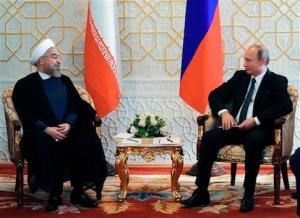 Hassan Rouhani, Vladimir Putin / AP
[Iranian] military leader [Fadavi] went on to claim that “Iranian Armed Forces are now at the highest level of preparedness” and that “only the dead body of the American troops realizes the power of the Islamic Revolution.”
********************
Two Russian warships have docked in northern Iran for a series of naval training exercises with the Islamic Republic, according to Persian-language reports translated by the CIA’s Open Source Center.
The two Russian ships docked in Iran’s Anzali port on Sunday and will hold “joint naval exercises during the three-day stay of the warships in Iran,” according to a Persian-language report in Iran’s state-controlled Fars News Agency.
“The [Russian] warships, Volgodonsk and Makhachkala docked in Anzali Port [near the Caspian Sea], in the fourth naval zone, on the afternoon of 9 August,” the report says.
The war exercises come just weeks after Iran and global powers inked a nuclear accord that will provide Iran with billions of dollars in sanctions relief in return for slight restrictions on the country’s nuclear program.
Russian and Iran have grown close in recent years, with delegations from each country regularly visiting one another to ink arms deals and other agreements aimed at strengthening Iran’s nuclear program.
Russia and Iran agreed earlier this year to begin construction on several new nuclear power plants. Russia has also agreed to sell Iran a controversial advanced missile defense system that can prevent attacks by Western powers.
The Russian fleet docked in Iran’s port “carrying a message of ‘peace and friendship,’” according to Iranian officials quoted by Fars. The fleet was “welcomed by Iranian naval commanders and staff.”
The Russian commander of the fleet is scheduled to hold meetings with “local political and military officials” in Iran’s northern provinces, according to Fars.
Levan Jagarian, Russia’s ambassador to Tehran, reportedly attended the docking ceremony and called for “for boosting mutual ties between the two countries in various fields,” according to the report.
The two nations went on to say that “expanding bilateral economic, political, and military cooperation is among the priorities of the visit.”
A Russian fleet also docked in northern Iran in October.
Last week, a senior Iranian naval commander warned the United States against ever taking military action on Iranian interests, claiming that the response would be “unpredictably strong.”
“The western media are mocking at the U.S. for speaking of ‘on the table options (against Iran)’ because the U.S. always utters some words without the ability to materialize them,” Iranian Revolutionary Guard Corps Naval Commander Ali Fadavi was quoted as saying by the country’s state-run press.
Iran is “ready to give such a powerful response to the slightest move of the U.S. that it won’t be able to make any other moves,” Fadavi was quoted as saying.
The military leader went on to claim that “Iranian Armed Forces are now at the highest level of preparedness” and that “only the dead body of the American troops realizes the power of the Islamic Revolution.
Michael Rubin, a former Pentagon adviser and expert on rogue regimes, said the Obama administration is fundamentally misreading Iran’s intentions in light of the recently inked nuclear accord.
“We’re witnessing a new great game, and Obama is so self-centered he keeps playing solitaire,” Rubin said. “Obama simply doesn’t understand that the world is full of dictators who seek to checkmate America. What he sees as compromise; they see as weakness to exploit.”
Referring to a visit last week to Russia by IRGC leader Qassem Soleimani, who is responsible for the deaths of Americans, Rubin said it is clear that Moscow and Tehran aim to build a tight military alliance.
“Visiting Russia to talk arms purchases and now this naval visit, it’s clear that Putin and Khamenei will waste no time to really develop their military cooperation,” he said.
An axis between Russia, Iran, and North Korea is beginning to emerge Rubin said, citing official releases that a North Korean delegation is currently visiting Russia to tour war games sites.
“The Russian warship visit combined with North Korea scoping out war game sites in Russia suggest a new Axis of Evil is taking shape with Russia the lynchpin between Iran and North Korea,” Rubin said. “As for the United States, rather than the leader of the free world, Obama and Kerry have transformed us in much of the world’s eyes as the pinnacle of surrender.”
Meanwhile, Obama admitted Monday that Iran’s nuclear breakout time will shrink to “a matter of months” once the nuclear accord expires in around 15 years.
Categories: Foreign policy, Ideology, Iran scam, Iranian Threats, Middle East, North Korea, Obama, Obama's America, Obama's legacy, P5+1, Peace in our time, Putin, Russia, U.S. Military
Tags: Foreign Policy, Ideology, Iran Scam, Iranian threats, Middle East, North Korea, Obama, Obama's America, Obama's legacy, P5+1, Peace in our time, Putin, Russia, U.S. military
Comments: Be the first to comment
August 9, 2015
The day after the deal, Israel Hayom, Prof. Eyal Zisser, August 9, 2015
(Please see also, Russia and US woo Saudis to help save Assad – albeit putting Israel and Jordan in danger from S. Syria.– DM)
[Soleimani] wanted Russia and Iran to agree on the division of the Middle East in a way that would serve their clients in the region (among them, Assad) and check their joint enemies (the Islamic State). After figuring that out, they probably moved on to the next topic: how to marginalize America in the region. As a means to both ends, Russia will continue to serve as Assad’s protector (despite his many crimes), all the while providing Iran with international backing. But above all it will send arms to Iran, to the Syrian regime, and if needed, to Hezbollah.
***********************
Over the weekend it transpired that Maj. Gen. Ghasem Soleimani, the commander of Iran’s Quds Force, had visited Moscow two weeks ago and met with President Vladimir Putin. The Quds Force, in case you forgot, is in charge of the Iranian Revolutionary Guards’ clandestine operations (including terrorism). The Quds Force is responsible for providing aid to Hezbollah and Hamas as well as to Syrian President Bashar Assad and the Houthi rebels in Yemen. In light of his direct involvement in terrorism, the international community imposed sanctions on Soleimani, including travel restrictions.
Only last week, at a hearing on Capitol Hill, U.S. Secretary of State John Kerry vowed that the U.S. will make sure the sanctions on Soleimani would stay in effect and that the Obama administration would counter Iran’s efforts to destabilize the Middle East. But no one takes Kerry seriously anymore. While Kerry continues to engage Iran’s unimportant Foreign Minister Mohammad Javad Zarif, the real wheeling and dealing is actually in Moscow.
Soleimani did not go to Moscow because he had tickets to the Bolshoi. Rather, he arrived because he wanted to discuss “the day after the nuclear deal” with Putin. Namely, he wanted Russia and Iran to agree on the division of the Middle East in a way that would serve their clients in the region (among them, Assad) and check their joint enemies (the Islamic State). After figuring that out, they probably moved on to the next topic: how to marginalize America in the region. As a means to both ends, Russia will continue to serve as Assad’s protector (despite his many crimes), all the while providing Iran with international backing. But above all it will send arms to Iran, to the Syrian regime, and if needed, to Hezbollah.
The Russians, unlike the Iranians, don’t consider Israel to be an enemy state. But as a famous Russian official once said: “When you chop wood, chips fly.” Israel has become the latest chip — the collateral damage. Soleimani’s visit is just the tip of iceberg. It shed light on the not-so-secret deals that are being negotiated in the wake of the “Vienna nuclear agreement.” Europe, as usual, is focused on profit and its corporate executives are already traveling in droves to Tehran to ink deals. There are also political deals Iran wants to secure, which are as important for Tehran. Their price, however, will be measured in blood rather than in euros or dollars.
No one in the Middle East, it seems, is keen on parsing each and every provision in the nuclear deal. Nor is there an attempt to see whether, in the grand scheme of things, it is will have been a worthwhile endeavor some 10 or 15 years from now, when its key elements expire. In this region, what counts is the way this agreement is perceived here and now — and what really matters to people is the way it is portrayed in the media. Under that criteria, Iran is the victor and America is the vanquished, because it caved to Iran. The deal, according to how the media has portrayed it, is a crushing political blow to Israel and the moderate Arab states, led by Saudi Arabia.
This knockout victory will likely produce a new Iranian-American partnership. At the very least, the two nations will mend fences. This will alienate many of Washington’s clients, who will have to look elsewhere for a more reliable ally. Egypt and the Saudis have already realized this and turned to Russia for aid and arms, figuring it would be more trustworthy than the “staff of this broken reed” (Isaiah 36:6).
Saudi Arabia is reportedly sending feelers to see if there is a deal to be had with Russia and Iran. Under the terms of the proposed deal, Saudi Arabia would withhold aid to the Syrian rebels if Iran ends its rogue presence in the state. Such a deal would secure Assad a victory over the insurgents, or a least ensure his regime survives.
The ongoing developments have caused panic, but not over the rising clout of Iran and Russia. The White House, it seems, is fretting over the possibility that Congress may vote against the Iran deal and further tarnish Obama’s image.
Categories: Arab nations, Assad, Diplomacy, Foreign policy, Gulf states, Hezbollah, Imperialism, Iran scam, Iranian proxies, Islamic State, Israel, Jordan, Middle East, Obama, Obama's America, Obama's legacy, P5+1, Putin, Russia, Saudi Arabia, Soleimani, Syria war
Tags: Arab nations, Assad, Diplomacy, Foreign Policy, Gulf states, Hezbollah, Imperialism, Iran Scam, Iranian proxies, Islamic State, Israel, Jordan, Middle East, Obama, Obama's America, Obama's legacy, P5+1, Putin, Russia, Saudi Arabia, Soleimani, Syria war
Comments: 1 Comment
August 6, 2015
Obama’s Strategy Of Equilibrium, Middle East Media Research Institute, Yigal Carmon and Alberto M. Fernandez, August 5, 2015
(The conflict between Shiite and Sunni factions has been going on since shortly after the death of Mohamed. Obama is not likely to bring reconciliation. — DM)
This article will analyze the strategy of creating an equilibrium between Sunnis and Shiites as a means to promote peace in the Middle East. It will examine the meaning of the strategy in political terms, how realistic it is, and what its future implications might be on the region and on the United States.
“It is worth noting that the first Islamic State created in the Middle East in the last 50 years was not the one created in the Sunni world in 2014 and headed by Abu Bakr al-Baghdadi.” Rather, it was the Islamic Republic of Iran created in 1979 by Ayatollah Ruhollah Khomeini and currently ruled by his successor, Supreme Leader Ali Khamenei, who maintains – even following the Iran deal – the mantra “Death to America,” continues to sponsor terrorism worldwide, and commits horrific human rights violations.
********************
Introduction
In an interview with Thomas Friedman of The New York Times (“Obama Makes His Case on Iran Nuclear Deal,” July 14, 2015), President Obama asked that the nuclear deal with Iran be judged only by how successfully it prevents Iran from attaining a nuclear bomb, not on “whether it is changing the regime inside of Iran” or “whether we are solving every problem that can be traced back to Iran.” However, in many interviews he has given over the last few years, he has revealed a strategy and a plan that far exceed the Iran deal: a strategy which aims to create an equilibrium between Sunnis and Shiites in the Muslim world.
President Obama believes that such an equilibrium will result in a more peaceful Middle East in which tensions between regional powers are reduced to mere competition. As he told David Remnick in an interview with The New Yorker, “…if we were able to get Iran to operate in a responsible fashion…you could see an equilibrium developing between Sunni, or predominantly Sunni, Gulf states and Iran in which there’s competition, perhaps suspicion, but not an active or proxy warfare” (“Going the Distance,” January 27, 2014).
In discussing the Iran deal, the President recalled President Nixon negotiating with China and President Reagan negotiating with the Soviet Union in order to explain the scope of his strategy for the Middle East and the Muslim world. President Obama seeks, as did Presidents Reagan and Nixon with China and the Soviet Union, to impact the region as a whole. The Iran deal, even if major, is just one of several vehicles that would help achieve this goal.
This article will analyze the strategy of creating an equilibrium between Sunnis and Shiites as a means to promote peace in the Middle East. It will examine the meaning of the strategy in political terms, how realistic it is, and what its future implications might be on the region and on the United States.
The Meaning Of The Equilibrium Strategy In Political Terms
Examining the strategy of equilibrium requires the recollection of some basic information. Within Islam’s approximately 1.6 billion believers, the absolute majority – about 90% – is Sunni, while Shiites constitute only about 10%. Even in the Middle East, Sunnis are a large majority.
What does the word “equilibrium” mean in political terms? In view of the above stated data, the word “equilibrium” in actual political terms means empowering the minority and thereby weakening the majority in order to progress toward the stated goal. However, the overwhelming discrepancy in numbers makes it impossible to reach an equilibrium between the two camps. Therefore, it would be unrealistic to believe that the majority would accept a policy that empowers its adversary and weakens its own historically superior status.
Implications For The Region
Considering the above, the implications of the equilibrium strategy for the region might not be enhancing peace as the President well intends; rather, it might intensify strife and violence in the region. The empowered minority might be persuaded to increase its expansionist activity, as can be already seen: Iran has extended its influence from Lebanon to Yemen. Iranian analyst Mohammad Sadeq al-Hosseini stated in an interview on September 24, 2014, “We in the axis of resistance are the new sultans of the Mediterranean and the Gulf. We in Tehran, Damascus, [Hizbullah’s] southern suburb of Beirut, Baghdad, and Sanaa will shape the map of the region. We are the new sultans of the Red Sea as well” (MEMRITV Clip No. 4530). Similarly, in a statement dedicated to the historically indivisible connection between Iraq and Iran, advisor to President Rouhani Ali Younesi stressed that, “Since its inception, Iran has [always] had a global [dimension]; it was born an empire” (MEMRI Report No. 5991).
In view of this reality, this strategy might create, against the President’s expectations, more bitterness and willingness on the part of the majority to fight for their status. This has already been realized; for example, when Saudi Arabia intervened in Yemen after facing the Houthi/Shiite revolution, which it perceived as a grave danger to its survival, and created a fighting coalition within a month to counter it. Similarly, Saudi Arabia has previously demonstrated that it regards Bahrain as an area where any Iranian attempt to stir up unrest will be answered by Saudi military intervention. According to reports, Saudi Arabia has been supporting the Sunni population in Iraq, and in Lebanon, a standstill has resulted because Saudi Arabia has shown that it will not give up – even in a place where Iranian proxy Hizbollah is the main power. Hence, the strategy of equilibrium has a greater chance of resulting in the eruption of regional war than in promoting regional peace.
Implications For The United States
Moreover, this strategy might have adverse implications for the United States and its interests in the Sunni Muslim world: those countries that feel betrayed by the strategy might, as a result, take action against the United States – hopefully only politically (such as changing international alliances) or economically. These countries might be careful about their public pronouncements and might even voice rhetorical support to U.S. policy, as the GCC states did on August 3, but the resentment is there.
Realpolitik Versus Moral Considerations
The analysis presented here is based on principles of realpolitik: in politics, one does not align with the minority against the majority. However, sometimes other considerations take precedence. Morality is such an example: the Allies could not refrain from fighting Nazi Germany because it was a majority power – ultimately, they recognized the moral obligation to combat the Third Reich. However, with regard to the Middle East, the two adversaries are on equal standing: the Islamic Republic of Iran is no different than the Wahhabi Kingdom of Saudi Arabia. President Obama and Secretary Kerry would be wrong to think that Mohammad Javad Zarif, the sophisticated partygoer in New York City, represents the real Iran. Zarif, his negotiating team, and President Rouhani himself, all live under the shadow and at the mercy of the Supreme Leader, the ayatollahs, and the IRGC.
“It is worth noting that the first Islamic State created in the Middle East in the last 50 years was not the one created in the Sunni world in 2014 and headed by Abu Bakr al-Baghdadi.” Rather, it was the Islamic Republic of Iran created in 1979 by Ayatollah Ruhollah Khomeini and currently ruled by his successor, Supreme Leader Ali Khamenei, who maintains – even following the Iran deal – the mantra “Death to America,” continues to sponsor terrorism worldwide, and commits horrific human rights violations.
Categories: Arab nations, Caliphate, Death to America, Foreign policy, Human rights, Ideology, Imperialism, Iran scam, Iranian proxies, Islamic State, Islamic supremacy, Islamic terrorism, Islamism, Khamenei, Middle East, Multiculturalism, Obama, Obama's affinity for Iran, Obama's America, Obama's legacy, Obama's motivations, P5+1, Religion, Shiite, Sunni
Tags: Arab nations, Caliphate, Death to America, Foreign Policy, human rights, Ideology, Imperialism, Iran Scam, Iranian proxies, Islamic State, Islamic supremacy, Islamic terrorism, Islamism, Khamenei, Middle East, Multiculturalism, Obama, Obama's affinity for Iran, Obama's America, Obama's legacy, Obama's motivations, P5+1, Religion, Shiite, Sunni
Comments: 1 Comment
August 6, 2015
Analysis: Arabs see US-trained anti-Islamist force as only fit to ‘play paintball’, Jerusalem Post, Ariel Ben Solomon, August 6, 2015
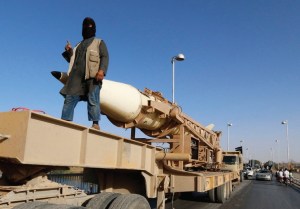 AN ISIS member rides on a rocket launcher in Raqqa in Syria two months ago. (photo credit:REUTERS)
The deal with Iran and the cooperation with Iranian forces against Islamic State, include “Shi’ite militias that are no less criminal.”
*********************
The Arab world perceives the dramatic failure of the small US-trained Syrian rebel force as a further indication that it cannot be a reliable ally against the Iran led Shi’ite axis.
A US defense official, who spoke to Reuters on condition of anonymity, said on Tuesday that at least five Syrian rebels it has trained are believed to have been captured by the Nusra Front.
That followed an attack by the Nusra Front on Friday thought to have killed one member of the so-called “New Syrian Forces,” in what would be their first battlefield casualty.
The incidents underscore the extreme vulnerability of the New Syrian Forces, a still tiny group estimated to number less than 60, who only deployed to the battlefield in recent weeks.
The Pentagon is far behind on its goals to train around 5,000 fighters a year.
Kirk Sowell, principal of Uticensis Risk Services, a Middle East-focused political risk firm, who closely follows Arab media summed it up this way on Twitter: “Pentagon: Arab media are laughing at you.”
Sowell posted a broadcast by pro-opposition Orient News, which expressed astonishment as to why the US would send in a force of only 50 to 60 fighters to help destroy Islamic State.
Aymenn Jawad al-Tamimi, a fellow at the Middle East Forum who closely follows Islamist opposition groups in Syria and Iraq, told The Jerusalem Post that “for many Sunni Arabs and Syrian Sunni Arab rebels in particular, this train-and-equip program has had no credibility from the outset.”
This is because the notion of fighting Islamic State while ignoring regime forces does not make sense for them, said Tamimi.
“US policymakers’ sense of reality on the ground is seriously in question with the apparent failure to anticipate a clash with the Nusra Front, which has a notable presence in the Azaz district into which the force of 50-60 men was inserted,” he continued.
Since the US has targeted Nusra Front in air strikes it is not surprising that the group would view a US backed group as a threat, he said.
Middle East researcher Ali Bakir, who also writes for Arab publications, told the Post on Wednesday that “no one in the Arab world takes this program seriously; I mean you would need around 50 to 60 people to play paintball but definitely not to fight Islamic State.”
“There is a profound general perception in the Arab world that the Obama administration is no less responsible than Iran and Russia in the Syrian crisis,” he said.
The deal with Iran and the cooperation with Iranian forces against Islamic State, include “Shi’ite militias that are no less criminal.”
This situation is increasingly seen in the Arab world as siding with the Shi’ites at the expense of the vast majority of Muslims, he asserted.
The US administration is more concerned about not jeopardizing the Iran deal than helping the Syrian people, Bakir added.
Categories: Arab nations, Department of Defense, Diplomacy, Dishonor, Foreign policy, Imperialism, Iran scam, Iranian proxies, Iraq war, Middle East, Obama, Obama's affinity for Iran, Obama's America, Obama's legacy, P5+1, U.S. Military
Tags: Arab nations, Department of Defense, Foreign Policy, Imperialism, Iran Scam, Iranian proxies, Iraq war, Islamic State, Middle East, Obama, Obama's affinity for Iran, Obama's America, Obama's legacy, P5+1, U.S. military
Comments: 1 Comment
August 5, 2015
Mark Moyar: Lurching without direction, Power Line, Mark Moyar, August 5, 2015
Because crisis management focuses on reducing symptoms rather than eliminating causes, its practitioners typically resort to half measures and token gestures. By demonstrating that the White House is “doing something,” symbolic actions often suffice to alleviate press scrutiny and public pressure for action, at least temporarily. They seldom remedy the problem that they were ostensibly addressing.
**********************
Mark Moyar is Visiting Scholar at The Foreign Policy Initiative and the author, most recently, of the important new book Strategic Failure: How President Obama’s Drone Warfare, Defense Cuts, and Military Amateurism Have Imperiled America. We invited Mark to write something for us bearing the subject of his book. He has responded with this column:
Last year, shortly before Barack Obama fired him, Secretary of Defense Chuck Hagel chided America’s President for “lurching from crisis to crisis without direction.” The treatment of foreign policy as an exercise in ad hoc crisis management has characterized Obama’s entire Presidency, as indeed it has every Democratic Presidency of the last half century. Fixated on domestic affairs and reluctant to assert American power overseas, Democrats from Lyndon Johnson to Barack Obama have viewed foreign policy challenges as nuisances to be kept off the front page of the New York Times, rather than problems to be solved through a coherent grand strategy.
Whereas a good strategy drives an active foreign policy, crisis management is inherently reactive. International problems reach the President’s attention mainly when they generate inordinate press coverage or cause a spike in unfavorable polling. Active adversaries, like North Vietnam in 1964 and Russia and ISIS in 2015, have consistently beaten a reactive United States to the punch and dodged the counterpunches.
Because crisis management focuses on reducing symptoms rather than eliminating causes, its practitioners typically resort to half measures and token gestures. By demonstrating that the White House is “doing something,” symbolic actions often suffice to alleviate press scrutiny and public pressure for action, at least temporarily. They seldom remedy the problem that they were ostensibly addressing.
In the case of Syria, Obama rejected recommendations from his cabinet to arm moderate Syrian rebels until 2013, by which time most of the moderate rebels had been killed or co-opted by extremists. He then decided to train and equip rebel forces in such small numbers and with such restrictions on their activities as to render them insignificant. When ISIS advances compelled Obama to restart American training of Iraqi forces, Obama put a ceiling on the number of U.S. trainers that limited throughput to 3,000 trainees per year, too few to make a difference in the war against ISIS or to lessen the influence of the 100,000 Iraqi Shiite militiamen whom the Iranians were training.
In Afghanistan, Obama authorized a troop surge, but began withdrawing troops much earlier than his generals advised, preventing completion of the military’s counterinsurgency campaign and discouraging Afghans from siding with the pro-American government. In Libya, Obama joined a NATO campaign against Muammar Gadhafi after international outrage about Gadhafi’s atrocities reached fever pitch, but his refusal to send American military forces to help secure the peace or protect American interests led to the collapse of central governance and the killing of the U.S. ambassador at Benghazi.
Of the recent additions to the administration’s list of token gestures and half measures, the most flagrant offender is Obama’s nuclear deal with Iran. Less well known is his response to the crisis of Russian expansionism. For more than a year, Eastern European allies and American critics—some of them within the Obama administration—have been calling for tougher American actions to discourage further Russian advances. Obama finally made his token gesture at the end of June, announcing that the United States would send American troops and heavy weaponry to several eastern European countries.
The joy that the initial announcement may have brought the eastern Europeans quickly faded when they saw the fine print, which was issued by U.S. ambassador to NATO Douglas Lute. The United States, Lute explained, was not going to deploy forces to eastern Europe on a permanent basis. “The tanks are empty, the … vehicles are empty, and will be parked, stored and maintained in training areas across the six Eastern most allies for training purposes,” Lute said. “Then the soldiers, on exercise after exercise, will be flown in.” One doubts that the Latvians will feel secure, or the Russians will feel deterred, by empty American vehicles and occasional visits from jet-setting American soldiers.
Many of Obama’s token gestures and half measures are clearly intended to keep simmering crises from boiling over until Obama leaves office. Administration spokesmen have repeatedly said that defeating ISIS will be a “multiyear” effort. The diluted U.S. military presence in Afghanistan is scheduled to last until the end of Obama’s term. Most of the fallout from Obama’s bad Iran deal will not hit ground until someone else occupies the White House. Obama and his proxies will no doubt craft stories explaining how his successor’s errors undid all of his foreign policy masterstrokes.
The President’s tokenism also serves one of the few national security objectives that Obama has pursued with any consistency, the diminution of American military power. The White House ramped up drone strikes in Pakistan and Yemen as a means of diverting the American people’s attention and showing that the United States could still do damage to terrorists without large military forces. While boasting about the number of people killed by drones, Obama quietly forced through drastic reductions in the armed services and withdrew American forces from critical regions. The drone strikes, in actuality, succeeded mainly in killing low-level fighters and antagonizing the Pakistani and Yemeni governments to the point that the United States eventually had to discontinue most strikes.
If one believes that Obama’s foreign policy should be driven by mitigation of immediate crises, particularly those that might detract from perceived domestic achievements such as Obamacare and environmental regulation, then there may be cause for optimism about the next year and a half. If, on the other hand, one believes that Obama’s foreign policy should be driven by protection of America’s enduring national security interests, then there is cause only for worry. Obama’s remaining months in office will give America’s enemies time and space to accumulate strength. The continuance of passivity and tokenism may even invite audacious provocations from enemies seeking to steal more sheep before a more vigilant shepherd comes along.
Categories: Domestic policy, Foreign policy, Iranian proxies, Islamic jihad, Islamic State, Islamic supremacy, Islamic terrorism, Middle East, Obama, Obama's America, Obama's legacy, Obama's motivations, P5+1, Strategy, U.S. Military
Tags: Domestic policy, Foreign Policy, Iranian proxies, Islamic Jihad, Islamic State, Islamic supremacy, Islamic terrorism, Middle East, Obama, Obama's America, Obama's legacy, Obama's motivations, P5+1, U.S. military
Comments: 1 Comment
August 5, 2015
Report: Iran orders Hezbollah not to retaliate now because finalizing nuclear deal, Jerusalem Post, Ariel Ben Solomon, August 5, 2015
Iran instructed Hezbollah not to respond to reported Israeli Air Force strikes last week because it wants to focus on finalizing the nuclear deal with world powers, a Saudi newspaper reported on Wednesday.
Tehran does not want an escalation now that could risk the release of funds that will flow in from frozen assets as sanctions relief kicks in as the deal is finalized, sources told Al-Watan.
The unconfirmed report could well be false and part of the ongoing media battle going on between Sunni states such as Saudi Arabia and the Iran Shi’ite axis.
Iran will get access to over $100 billion of assets frozen abroad, US officials say, equivalent to a quarter of its annual output. The inflow may start around the end of this year, after Tehran is certified in compliance with the deal.
The alleged Israel Air Force drone attack last week struck a vehicle on the outskirts of the Druse village of Hader, near the Golan Heights. The UK-based Syrian Observatory for Human Rights said that five people were killed in the attack – two members of Hezbollah and three from the Syrian National Defense Forces, a pro-government militia.
The observatory added that the cell was led and supervised by Kuntar, who was traded by Israel in 2008 in exchange for the bodies of two Israeli reservists killed by Hezbollah in 2006.
A second strike targeted a Lebanese military installation near the Syrian border, wounding six, according to Arab media reports.
Other sources told the Saudi paper that the Shi’ite group aims to cover up its inability to protect its fighters in Syria and particularly from Israeli attacks.
In January, Israel carried out a helicopter attack in Quneitra province that killed a top Iranian Revolutionary Guard general and several Hezbollah members including the son of the group’s late military commander, Jihad Mughniyeh.
Meanwhile, Hezbollah recently arrested a Lebanese engineer who was allegedly an Israeli spy and turned him over to Lebanese authorities, a security force told the Lebanese Daily Star newspaper in a report on Wednesday.
He was recruited and trained in Europe by Israelis, according to the source,
Categories: Arab nations, Foreign policy, Hezbollah, Iran scam, Iranian proxies, Israel, Middle East, P5+1, Saudi Arabia, Shiite, Support for terrorism
Tags: Arab nation, Foreign Policy, Hezbollah, Iran Scam, Iranian proxies, Israel, Middle East, P5+1, Saudi Arabia, Shiite, Sunni, Support for terrorism
Comments: 1 Comment
August 4, 2015
Contentions | Has Obama Read the Khamenei Palestine Book? Commentary Magazine, Jonathan S. Tobin, August 4, 2015
(Another interesting question would be, does Obama agree with any of Khamenei’s statements and, if so, which? — DM)
The Khamenei Palestine book is important not in and of itself but because the regime’s obsession with Israel is a key to its foreign policy. . . . But as much as Iran is focused on regional hegemony in which Sunni states would be brought to heel, as Khamenei’s Palestine illustrates, it is the fixation on Israel and Zionism that really animates their expansionism and aid for terror groups.
******************
It turns out President Obama isn’t the only world leader who writes books. His counterpart in Iran – Supreme Leader Grand Ayatollah Ali Khamenei — has also just published a new book. But while it may not be as introspective as Obama’s Dreams From My Father, it does tell us at least as much about the vision of the person in charge in Tehran (as opposed to Hassan Rouhani, the faux moderate who serves as its president) as the president’s best-selling memoir. As Amir Taheri reports in the New York Post, Palestine is a 416-page diatribe against the existence of the state of Israel and a call to arms for it to be destroyed. Supporters of the nuclear deal the president has struck with Khamenei’s regime may dismiss this book as merely one more example of the Supreme Leader’s unfortunate ideology that must be overlooked. But as the New York Times noted last week, the administration’s real goal here isn’t so much in delaying Iran’s march to a nuclear weapon (which is the most that can be claimed for the agreement) as it is fostering détente with it. Seen in that light, the latest evidence of the malevolence of the Islamist regime should be regarded as yet another inarguable reason for Congress to vote the deal down.
In his interview with The Atlantic’s Jeffrey Goldberg on May 21, President Obama was asked directly about the significance of Iran’s anti-Semitism and its commitment to destroying Israel. The president said the anti-Semitism of the Iranian leadership did not mean they weren’t also “interested in survival” or being “rational.” As far as he was concerned, the ideology of the regime was not something that would influence its decisions.
But everything Khamenei says and, even more importantly, everything the regime does, by funding terrorist groups at war with Israel such as Hamas and Hezbollah or by embarking on a ruinously expensive nuclear project that placed it in conflict with the West, speaks to its commitment to policies that Obama may think are irrational but which are completely in synch with what he called its “organizing principle.” Why would a nation so rich in oil need to risk international isolation or war seek nuclear power if not to help Khamenei fulfill his pledge to “liberate” what is now Israel for Muslims?
The president told Goldberg that the American military option would be a sufficient deterrent to ensure that Iran didn’t violate the nuclear pact or behave in an irrational manner. But since the president has ruled out the use of force in a categorical manner, it’s hard to see why the Iranians would fear it once the U.S. and Europe are doing business with them. Even if it was a matter of snapping back sanctions, assuming that such a concept is even possible? Once the restrictions are unraveled, it’s fair to ask why would they work then when the president repeatedly tells us additional sanctions won’t work now and require us to accept the current deal that doesn’t achieve the objectives that the administration set for the negotiations when they began.
The Khamenei Palestine book is important not in and of itself but because the regime’s obsession with Israel is a key to its foreign policy. Iran constitutes a grave threat to Neighboring Arab countries that are at least as angry about the president’s embrace of Tehran as the Israelis since their nuclear status would undermine their security. But as much as Iran is focused on regional hegemony in which Sunni states would be brought to heel, as Khamenei’s Palestine illustrates, it is the fixation on Israel and Zionism that really animates their expansionism and aid for terror groups.
As Taheri notes in his article on the book, Khamenei distinguishes his idée fixe about destroying Israel from European anti-Semitism. Rather, he insists, that his policy derives from “well established Islamic principles.” Chief among them is the idea that any land that was once ruled by Muslims cannot be conceded to non-believers no matter who lives there now. While the Muslim world seems to understand that they’re not getting Spain back, the territory that constitutes the state of Israel is something else. Its central location in the middle of the Muslim and Arab worlds and the fact that Jews, a despised minority people, now rule it makes its existence particularly objectionable to Islamists like Khamenei.
Khamenei’s book shows that not only is he serious about wanting to destroy Israel and uproot its Jewish population, he regards this project as a practical rather than a theoretical idea. The administration ignores this because it wants to believe that Iran is a nation that wants to, as the president put it, “get right with the world.” But what it wants is to do business with the world while pursuing its ideological goals. The nuclear deal is a means to an end for the regime and that end does not involve good relations with the West or cooperation with other states in the region, let alone coexisting peacefully with Israel.
What is curious is that this is the same administration that regarded the announcement of a housing project in Jerusalem by low-level Israeli officials as an “insult” to Vice President Biden. But it chooses to regard the “death to America” chants led by regime functionaries in Iran as well as a book by the country’s leader indicating that Obama’s ideas about its character are fallacious as non-events. The only explanation for this remarkable lack of interest in Iranian behavior is an ideological fixation on détente with Tehran that is every bit as hardcore as any utterances that emanate from the mouth or the pen of the Supreme Leader.
Taken out of the context of a vision of friendship with the Iranian regime, the nuclear deal makes no sense. Yet squaring that vision with Khamenei’s literary effort is impossible. Members of the House and Senate must take note of this conundrum and vote accordingly.
Categories: Diplomacy, Dishonor, Foreign policy, Ideology, Imperialism, Iran scam, Iranian anti-semitism, Iranian proxies, Iranian Threats, Israel, Jews, Khamenei, Middle East, Obama, Obama's affinity for Iran, Obama's America, Obama's anti-semitism, Obama's legacy, Obama's motivations, P5+1, Palestinians, Peace in our time, Peace process, Progressives, Settlements, Two state solution, U.S. Congress
Tags: Foreign Policy, Ideology, Imperialism, Iran Scam, Iranian antisemitism, Iranian proxies, Iranian threats, Israel, Jews, Khamenei, Middle East, Obama, Obama's affinity for Iran, Obama's America, Obama's antisemitism, Obama's legacy, Obama's motivations, P5+1, Palestinians, Peace in our time, Peace Process, Progressives, Settlements, Two state solution, U.S. Congress
Comments: 1 Comment
August 3, 2015
Army is breaking, let down by Washington, Stars and Stripes, Robert H. Scales, August 2, 2015
(Last year I also wrote a depressing article on the lamentable combat readiness of our military. It’s here at my blog and here at Warsclerotic. The situation has continued to deteriorate. How could Obama’s America help to protect freedom, particularly against an enemy whose name must not be mentioned, without a combat effective military — even if Obama wanted to do it? — DM)
 U.S. paratroopers with the 173rd Airborne Brigade load a M119A2 howitzer at the 7th Army Joint Multinational Training Command’s Grafenwoehr Training Area, Germany, July 28, 2015.
GERTRUD ZACH/U.S. ARMY
Last month, Gen. Ray Odierno, outgoing Army chief of staff, and Gen. Mark Milley, his successor, testified to the difficulties faced by the Army. I’d like to make the same points by telling a story.
When I was a boy, tonsillitis was a dangerous illness. In 1952, it kept me in Tokyo General Hospital for weeks. I shared a cramped ward with dozens of soldiers horribly maimed in Korea. The hospital had only one movie theater. I remember watching a Western sandwiched between bandage- and plaster-wrapped bodies. I remember the antiseptic smells, the cloud of cigarette smoke and the whispers of young men still traumatized by the horrors of the war they had just left.
My dad came from Korea to visit me, and I recall our conversations vividly. At the time he was operations officer for the 2nd Engineer Battalion. He told me how poorly his men were prepared for war. Many had been killed or captured by the North Koreans. During the retreat from the Yalu River, some of his soldiers were in such bad physical shape that they dropped exhausted along the road to wait to be taken captive.
“We have no sergeants, son,” he told me, shaking his head, “and without them we are no longer an Army.”
In the early ’70s, I was the same age as my Korean-era dad. I had just left Vietnam only to face another broken Army. My barracks were at war. I carried a pistol to protect myself from my own soldiers. Many of the soldiers were on hard drugs. The barracks were racial battlegrounds pitting black against white. Again, the Army had broken because the sergeants were gone. By 1971, most were either dead, wounded or had voted with their feet to get away from such a devastated institution.
I visited Baghdad in 2007 as a guest of Gen. David Petraeus. Before the trip I had written a column forecasting another broken Army, but it was clear from what Petraeus showed me that the Army was holding on and fighting well in the dangerous streets of Baghdad. Such a small and overcommitted force should have broken after so many serial deployments to that hateful place. But Petraeus said that his Army was different. It held together because junior leaders were still dedicated to the fight. To this day, I don’t know how they did it.
Sadly, the Army that stayed cohesive in Iraq and Afghanistan even after losing 5,000 dead is now being broken again by an ungrateful, ahistorical and strategically tone-deaf leadership in Washington.
The Obama administration just announced a 40,000 reduction in the Army’s ranks. But the numbers don’t begin to tell the tale. Soldiers stay in the Army because they love to go into the field and train; Defense Secretary Ash Carter recently said that the Army will not have enough money for most soldiers to train above the squad level this year. Soldiers need to fight with new weapons; in the past four years, the Army has canceled 20 major programs, postponed 125 and restructured 124. The Army will not replace its Reagan-era tanks, infantry carriers, artillery and aircraft for at least a generation. Soldiers stay in the ranks because they serve in a unit ready for combat; fewer than a third of the Army’s combat brigades are combat-ready.
And this initial 40,000-soldier reduction is just a start. Most estimates from Congress anticipate that without lifting the budget sequestration that is driving this across-the-board decline, another 40,000 troops will be gone in about two years.
But it’s soldiers who tell the story. After 13 years of war, young leaders are voting with their feet again. As sergeants and young officers depart, the institution is breaking for a third time in my lifetime. The personal tragedies that attended the collapse of a soldier’s spirit in past wars are with us again. Suicide, family abuse, alcohol and drug abuse are becoming increasingly more common.
To be sure, the nation always reduces its military as wars wind down. Other services suffer reductions and shortages. But only the Army breaks. Someone please tell those of us who served why the service that does virtually all the dying and killing in war is the one least rewarded.
My grandson is a great kid. He’s about the same age I was when I was recovering at Tokyo General. Both of his parents served as Army officers, so it’s no wonder that in school he draws pictures of tanks and planes while his second-grade classmates draw pictures of flowers and animals. The other day he drew a tank just for me and labeled it proudly “Abrams Tank!”
Well, sadly, if he follows in our footsteps, one day he may be fighting in an Abrams tank. His tank will be 60 years old by then.
At the moment I’d rather he go to law school.
Robert H. Scales, a retired Army major general, is a former commandant of the U.S. Army War College.
Categories: Domestic policy, Economy, Foreign policy, Freedom, History, Ideology, Islamic jihad, Islamic slaughter, Islamic State, Islamic supremacy, Islamic terrorism, Islamism, Korean conflict, Middle East, Obama, Obama's America, Obama's legacy, Rules of war, U.S. combat troops, Vietnam war
Tags: Domestic policy, Economy, Foreign Policy, Freedom, History, Ideology, Islamic Jihad, Islamic slaughter, Islamic State, Islamic supremacy, Islamic terrorism, Islamism, Korean conflict, Middle East, North Korea, Obama, Obama's America, Obama's legacy, U.S. combat troops, Vietnam war
Comments: Be the first to comment
August 3, 2015
Iran plans missile tests to flaunt defiance of Vienna deal and UNSC resolution, DEBKAfile, August 3, 2015
 Iran’s long-range ballistic Shahab-3
Before taking off from Cairo Sunday, Kerry issued this emphatic statement: “There can be absolutely no question that if the [Iran deal] is fully implemented, it will make Egypt and all the countries of this region safer.”
*********************
Shortly before US Secretary of State John Kerry was due in Qatar Monday, Aug. 3, Iran’s highest authorities led by supreme leader Ayatollah Ali Khamenei Sunday launched a public campaign to support Tehran’s noncompliance with the Vienna nuclear accord and UN Security Council Resolution 2231 of July 20, on its ballistic missile program. The campaign was designed by a team from Khamenei’s office, high-ranking ayatollahs and the top echelons of the Revolutionary Guards, including its chief, Gen. Ali Jafari.
It was kicked off with a batch of petitions fired off by the students of nine Tehran universities and Qom religious seminaries to Iran’s chief of staff Maj Gen. Hassan Firouzabadi, demanding immediate tests of long-range ballistic missiles to prove that the missile ban was invalid.
It was essential, said one student letter, “…to underline the necessity for protecting the country’s defense capabilities and ensuring continued development of Iran’s ballistic missile capability.”
The students, whose influence on public opinion is substantial, went on to argue: “Firing the ballistic missiles in military drills would discourage the US Congress, the Israeli Knesset and their regional Takfiri mercenaries (a reference to the Islamic State) from future strikes against the Islamic Republic.”
The Security Council Resolution, which unanimously endorsed the Joint Comprehensive Plan of Action (Vienna nuclear accord) signed by Iran’s Foreign Minister Mohammed Javad Zarif, called on Iran “not to undertake any activity related to ballistic missiles designed to be capable of delivering nuclear weapons, including launches using such ballistic technology until the date eight years after the JCPOA Adoption Day.”
Tehran retorted that none of its ballistic missiles were designed to deliver nuclear weapons, and so this provision was void. Shortly after its passage, the foreign ministry in Tehran issued an assurance that “…the country’s ballistic missile program and capability is untouched and unrestricted by Resolution 2231.”
On July 30, Ali Akbar Velayati, Khamenei’s senior adviser on international affairs and member of the Expediency Council, told reporters, “The recent UNSC Resolution on Iran’s defensive capabilities, specially (sic) its missiles, is unacceptable to Iran.”
DEBKAfile’s Iranian sources report that Tehran deliberately engineered this campaign’s timing for it to surface the day before the arrival of John Kerry, the live wire behind the Vienna Accord, in Doha, Qatar, Monday. He has defined his mission as an effort to ease the concerns of the Gulf and other Arab nations about the negative affect of the accord on their security.
Before taking off from Cairo Sunday, Kerry issued this emphatic statement: “There can be absolutely no question that if the [Iran deal] is fully implemented, it will make Egypt and all the countries of this region safer.”
This proposition may be harder than ever to sell to Iran’s neighbors once its ballistic missiles are launched over their heads.
Categories: Foreign policy, IAEA, Iran nuke inspections, Iran scam, Iranian missiles, Iranian nukes, Kerry, Khamenei, Middle East, Obama, Obama's America, Obama's legacy, P5+1, Red Lines, Supreme Leader
Tags: Foreign Policy, IAEA, Iran nuke inspections, Iran Scam, Iranian missiles, Iranian nukes, Khamenei, Middle East, Obama, Obama's America, Obama's legacy, P5+1, Red Lines, Supreme leader
Comments: 1 Comment
August 1, 2015
Hizballah presses elite Radwan Force for conquering Galilee into saving stalled Zabadani battle, DEBKAfile, August 1,2015
 New “ninja” uniforms for Hizballah’s Radwan Force
Hizballah’s elite Radwan Force was originally designed to push in from Lebanon and conquer the Israeli Galilee. DEBKAfile’s exclusive military sources report that on Thursday, July 30 Hassan Nasralla saw he had no option but to press this high-value contingent into service, to extricate the combined Hizballah-Syrian armies from their month-long failure to recapture the key town of Zabadani – or even breach the defenses set up by the Al-Qaeda affiliated rebel Nusra Front.
This standoff with heavy casualties over the key town, which commands the main Damascus-Beirut highway, has become a symbolic make-or-break duel between the Iran-backed Shiite Hizballah and Al Qaeda’s Sunni Nusra Front. Nasrallah loses it at the cost of his organization’s credibility as a formidable fighting force.
Defeat would make western Damascus and eastern Lebanon more vulnerable to attack. And for Iran’s Lebanese proxy, it would leave an embarrassing question hanging in the air: If Hizballah under Iranian command combined with Syrian troops and backed by heavy artillery fire and air strikes can’t win a relatively small battle against no more than 1,200 rebel fighters across a nine-km square battleground, how much are its leaders’ boasts worth when they claim unbeatable prowess for winning major battles, including a war on Israel?
To save face in this landmark showdown, Hizballah decided to press into battle its most prestigious unit, named for Al-Hajj Radwan, the nom de guerre of Hizballah’s renowned military chief Imad Mughniye, whom Israel took out in February 2008.
Eight months ago, the Radwan Force lost its senior commanders. An Israeli air strike on Jan. 18 targeted a group of high Iranian and Hizballah officers on a visit to Quneitra on the Syrian Golan. They were surveying the terrain before relocating this elite unit to confront IDF positions on the Israeli Golan border. Iranian Gen. Ali Reza al-Tabatabai and the Hizballah district commander Jihad Mughniye (son of Imad) lost their lives in the Israeli raid and the plan was provisionally set aside.
If the Radwan Force manages to haul Hizballah out of its impasse in Zabadani, it may next be assigned to take up battle positions on the Golan.
But for now, its mission in the battle for Zabadani has three dimensions:
1. To disarm the enemy by commando raids, a tactic to be borrowed from the rebels defending the town. On the night of July 24, the rebels preemptively struck Hizballah and Syrian army positions around the town and captured some of them. The decision to deploy Radwan appears to have come in response to that painful setback.
2. To pull off a quick battlefield success at Zabadani, in view of intelligence reports that the Nusra Front and the Islamic State of Iraq and the Levant in northern Syria were preparing together to open a second front in Lebanon, in order to relieve the rebel force pinned down in Zabadani.
The two groups plan to cross into Lebanon and start attacking pro-Hizballah Shiite populations in the Beqaa Valley and the North. They propose to cut through the Bequaa Valley and head up to the important northern Lebanese city of Tripoli on the Mediterranean coast.
3. Syrian President Bashar Asad is under extreme pressure for a battlefield success after admitting in a public speech last week to the loss of strategic territory to rebel forces and shrinking military manpower. He has earmarked a Zabadani victory – both as a turning-point for his flagging fortunes and for holding back the constant draining of his army by desertions and defections.
Our military sources reveal that, after Assad leaned hard on the Lebanese government and army to round up Syrian troops who went AWOL, Lebanese security forces went into action. They are picking up Syrian army deserters and putting them on buses driving in armored convoys into Syria. It doesn’t take much imagination to conjure up the fate of these unwilling returnees.
Categories: Al Qaeda, Assad, Defense of Israel, Golan, Hezbollah, IDF, Iran scam, Iranian proxies, Israel, Lebanon, Middle East, Nasrallah, Nursa Front, P5+1, Syria, Syria war
Tags: Al Qaeda, Assad, Defense of Israel, Golan, Hezbollah, IDF, Iran Scam, Iranian proxies, Israel, Lebanon, Middle East, Nasrallah, Nursa Front, P5+1, Syria, Syria war
Comments: 1 Comment
 Hassan Rouhani, Vladimir Putin / AP






 anneinpt
 artaxes
 danmillerinpanama
 davidking1530
 Peter Hofman
 Joseph Wouk
 Peter
Peter Louisiana Steve
 WarSclerotic
Recent Comments