Why There Is No Peace in the Middle East, Gatestone Institute, Philip Carl Salzman, October 14, 2017
Many Middle Easterners see the disasters around them, and blame outsiders: “It is the fault of the Jews”; “The British did this to us”; “The Americans are to blame.”[5] Many Western academics and commentators say the same, dignifying this counter-historic theory with the label “postcolonialism.” But given that tribal dynamics were dominant in the region for a thousand years since the foundation of Islam, and thousands of years before that, blaming outsiders for regional dynamics is hardly credible. Nonetheless, “postcolonialists” will claim that pointing to regional culture as the foundation of regional dynamics is “blaming the victim.” We in the West, unlike Middle Easterners, love “victims.” But what if Middle Easterners are victims of the limitations and shortcomings of their own culture?
***********************************
Peace is not possible in the Middle East because values and goals other than peace are more important to Middle Easterners. Most important to Middle Easterners are loyalty to kin, clan, and cult, and the honour that is won by such loyalty.
There was no group and no loyalty above the tribe or tribal confederation until the rise of Islam. With Islam, a new, higher, more encompassing level of loyalty was defined. All people were divided between Muslims and infidels, and the world was divided between the Dar al-Islam, the land of believers and peace, and Dar al-harb, the land of unbelievers and war. Following the tribal ideology of loyalty, Muslims should unite against infidels, and would receive not only honour, but heavenly rewards.
Honour is gained in victory. Losing is regarded as deeply humiliating. Only the prospects of a future victory and the regaining of honour drives people forward. An example is the Arab-Israel conflict, in the course of which the despised Jews repeatedly defeated the armies of Arab states. This was not so much a material disaster for the Arabs, as it was a cultural one in which honor was lost. The only way to regain honor is to defeat and destroy Israel, the explicit goal of the Palestinians: “from the [Jordan] river to the [Mediterranean] sea.” This why no agreement over land or boundaries will bring peace: peace does not restore honor.
We in the West, unlike Middle Easterners, love “victims.” But what if Middle Easterners are victims of the limitations and shortcomings of their own culture?
Living as an anthropologist in a herding camp of the Yarahmadzai tribe of nomadic pastoralists in the deserts of Iranian Baluchistan clarified some of the inhibitions to peace in the Middle East. What one sees is strong, kin-based, group loyalty defense and solidarity, and the political opposition of lineages, whether large or small.[1] This raised the question how unity and peace could arrive in a system based on opposition.
Peace is not possible in the Middle East because values and goals other than peace are more important to Middle Easterners. Most important to Middle Easterners are loyalty to kin, clan, and cult, and the honour which is won by such loyalty. These are the cultural imperatives, the primary values, held and celebrated. When conflict arises and conflict-parties form based on loyal allegiance, the conflict is regarded as appropriate and proper.
The results of absolute commitment to kin and cult groups, and the structural opposition to all others, can be seen throughout Middle Eastern history, including contemporary events, where conflict has been rife. Turks, Arabs and Iranians have launched military campaigns to suppress Kurds. Meanwhile, Christians, Yazidis, Baha’is and Jews, among others, have been, and continue to be ethnically cleansed. Arabs and Persians, and Sunnis and Shiites, each try to gain power over the other in a competition that has been one of the main underlying factors of the Iraq-Iran war, the Saddam Hussein regime, and the current catastrophe in Syria. Turks invaded Greek Orthodox Cyprus in 1974 and have occupied it since. Multiple Muslim states have invaded the minuscule Jewish state of Israel three times, and Palestinians daily celebrate the murder of Jews.
Some Middle Easterners, and some in the West, prefer to attribute the problems of the Middle East to outsiders, such as Western imperialists, but it seems odd to suggest that the local inhabitants have no agency and no responsibility for their activities in this disastrous region, high not only in conflict and brutality, but low by all world standards in human development.
If one looks to local conditions to understand local conflicts, the first thing to understand is that Arab culture, through the ages and at the present time, has been built on the foundation of Bedouin tribal culture. Most of the population of northern Arabia at the time of the emergence of Islam was Bedouin, and during the period of rapid expansion following the adoption of Islam, the Arab Muslim army consisted of Bedouin tribal units. The Bedouin, nomadic and pastoral for the most part, were formed into tribes, which are regional defense and security groups.[2]
Bedouin tribes were organized by basing groups on descent through the male line. Close relatives in conflict activated only small groups, while distant relatives in conflict activated large groups. If, for example, members of cousin groups were in conflict, no one else was involved. But if members of tribal sections were in conflict, all cousins and larger groups in a tribal section would unite in opposition to the other tribal section. So, what group a tribesmen thought himself a member of was circumstantial, depending on who was involved in a conflict.
Relations between descent groups were always oppositional in principle, with tribes as a whole seeing themselves in opposition to other tribes. The main structural relation between groups at the same genealogical and demographic level could be said to be balanced opposition. The strongest political norm among tribesmen was loyalty to, and active support of, one’s kin group, small or large. One must always support closer kin against more distant kin. Loyalty was rewarded with honour. Not supporting your kin was dishonourable. The systemic result was often a stand-off, the threat of full scale conflict with another group of the same size and determination acting as deterrence against frivolous adventures. That there were not more conflicts than the many making up tribal history, is due to that deterrence.
There was no group and no loyalty above the tribe or tribal confederation until the rise of Islam. With Islam, a new, higher, more encompassing level of loyalty was defined. All people were divided between Muslims and infidels, and the world was divided between the Dar al-Islam, the land of believers and peace, and Dar al-harb, the land of unbelievers and war. Following the tribal ideology of loyalty, Muslims should unite against infidels, and would receive not only honour, but heavenly rewards.
Honour is gained in victory.[3] Self-sacrifice in the attempt is lauded, but honour comes from winning. Having lost and being a victim is not an esteemed position in Arab society. Having lost in a political struggle results in loss of honour. This is felt deeply as a loss that should be corrected. Losing is regarded as deeply humiliating. Only the prospects of a future victory and the regaining of honour drives people forward. An example is the Arab-Israel conflict, in the course of which the despised Jews repeatedly defeated the armies of Arab states. This was not so much a material disaster for the Arabs, as it was a cultural one in which honour was lost. The only way to regain honour is to defeat and destroy Israel, the explicit goal of the Palestinians: “from the [Jordan] river to the [Mediterranean] sea.” This why no agreement over land or boundaries will bring peace: peace does not restore honour.
None of this is unknown to Arab commentators, who repeatedly refer to the tribal nature of their culture and society. Of course, today, few Middle Easterners live in tents and raise camels, but villagers and urbanites share the same tribal assumptions and values. According to the Tunisian intellectual Al-Afif al-Akhdar, the Arabs cherish their “deep-culture of tribal vengefulness” and consequent “fixated, brooding, vengeful mentality.”[4] Former Tunisian President Moncef Marzouki has said that “We need an ideological revolution; our tribal mentality has destroyed our society.”
Dr. Salman Masalha, an Israeli Druze literary intellectual, argues:
“The tribal nature of Arab societies is deeply embedded in the past, and its roots date back through Arab history to the pre-Islamic era. … Since Arab societies are tribal in nature, the various forms of monarchies and emirates are the natural continuation of this ingrained social structure in which tribal loyalty comes before all else.”
Mamoun Fandy, an Egyptian-born American scholar, wrote in the Saudi newspaper Asharq Al-Awsat:
“The Arabs, even after the arrival of Islam, were never “ideological” people who sought to develop an intellectual vision of ourselves and the outside world. Instead, we are the people of blood relations and family ties, or “Shalal” as we call it in Egypt. … Despite the fact that Islam was the greatest intellectual revolution in our history, we, as Arabs, have succeeded in adapting Islam to serve the tribe, the family, and the clan. Islamic history began as an intellectual revolution, and as a history of ideas and countries; however, after the beginning of the Orthodox Caliphate, it was transformed into a somewhat tribal state. The State of Islam became the Umayyad State, and after that the Abbasid, the Fatimid, and so on and so forth. This means that we now have a history of tribes instead of a history of ideas. … Has this tribal history, alongside tribal and family loyalties and the priority of blood relations over intellectual relations gone forever after the “Arab spring?” Of course not; what has happened is that the families and tribes have dressed themselves up in the cloak of revolutions in Yemen and in Libya, and in Egypt the opposition consists of tribes rather than concepts.”
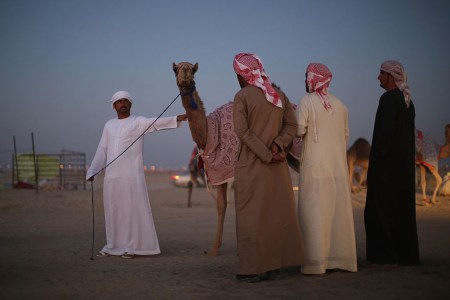
Pictured: Bedouin men in Abu Dhabi. (Photo by Dan Kitwood/Getty Images)
The history of the Middle East, the centuries of tribal wars, and the ongoing fissures in Arab society all testify to the Arab tribal culture and structural opposition. There may have been good reasons to stick with tribal culture and organization in pre-modern times: states and empires were despotic, exploitative, and heavily dependent on slave-labor, and tribal organization gave some people a chance to remain independent. In recent times, with the modern state model, governments in the Middle East have tried to establish states, but these have foundered on tribal loyalties and oppositions, which do not fit with constitutional states. Rulers in the region have all turned to coercion to maintain their positions, making all Muslim states in the region despotic.
Many Middle Easterners see the disasters around them, and blame outsiders: “It is the fault of the Jews”; “The British did this to us”; “The Americans are to blame.”[5] Many Western academics and commentators say the same, dignifying this counter-historic theory with the label “postcolonialism.” But given that tribal dynamics were dominant in the region for a thousand years since the foundation of Islam, and thousands of years before that, blaming outsiders for regional dynamics is hardly credible. Nonetheless, “postcolonialists” will claim that pointing to regional culture as the foundation of regional dynamics is “blaming the victim.” We in the West, unlike Middle Easterners, love “victims.” But what if Middle Easterners are victims of the limitations and shortcomings of their own culture?
Philip Carl Salzman is Professor of Anthropology at McGill University, Canada.
[1] Philip Carl Salzman, Black Tents of Baluchistan, Washington, DC: Smithsonian Institution Press, 2000.
[2] Philip Carl Salzman, Culture and Conflict in the Middle East, Amherst, NY: Humanity Books, 2008.
[3] Frank Henderson Stewart, Honor, Chicago: University of Chicago Press, 1994.; Gideon M. Kressel, Ascendancy through Aggression, Wiesbaden: Harrassowitz, 1996.
[4] Quoted in Barry Rubin, The Long War for Freedom: The Arab Struggle for Democracy in the Middle East (Hoboken, NY: Wiley, 2006), 80-81.
[5] Ayaan Hirsi Ali, Infidel, NY: Free Press, 2007, p. 47.







 anneinpt
 artaxes
 danmillerinpanama
 davidking1530
 Peter Hofman
 Joseph Wouk
 Peter
Peter Louisiana Steve
 WarSclerotic
Recent Comments