Archive for the ‘Lebanon’ category

IDF simulates war-to-win strategy vs Hizballah

September 5, 2017

IDF simulates war-to-win strategy vs Hizballah, DEBKAfile, September 5, 2017

The IDF Tuesday, Sept. 5, embarked on its biggest military exercise against Hizballah in 19 years, with a radically revised mission in the face of a greatly empowered enemy (tanks and drones as well as 100,000 rocket and missiles) which is now embedded in Syria, not just in Lebanon.

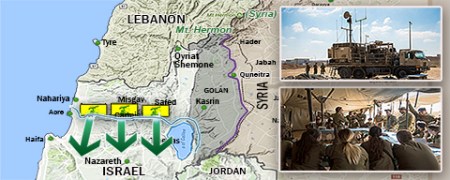
Tens of thousands of ground, air, sea and intelligence units, including reservists – the IDF’s entire northern array – will simulate a Hizballah thrust across the border to occupy two Israeli locales in Galilee and the Golan. They will conduct simultaneous defensive and offensive operations deep behind enemy lines. The game plan is not to aim for a ceasefire and respite for the enemy to prepare for the next round, as the 2006 Lebanon war ended. This time, Israel strategists have set themselves the goal of defeating Hizballah convincingly enough to smash its morale and infrastructure and end its belief that it can destroy Israel the next time round

The exercise’s three military objectives are clearly laid out:

1.  Two sectors are defined for repelling a deep Hizballah thrust into northern Israel; (see map)

(a)  Hizballah is expected to go for the Metulla-Misgav sector on the Lebanese border, as well as the “Fatma Road” linking the Galilee hills north of Kiryat Shemona along the Israeli-Lebanese border.

(b)  Zarit-Shetula in western Galilee north of Nahariya, which is close enough to the Lebanese border for Hizballah troops to reach by land and through tunnels.

Israeli forces will practice driving the enemy out of occupied towns and villages, often using the element of surprise.

2. Another major IDF force will storm across the border into Lebanon for an effort to rapidly and decisively defeat Hizballah on its home ground. The defensive operation apart, the IDF is resolved to inflict on the enemy intolerable losses of life, infrastructure and territory.

This fighting-to-win strategy draws heavily on the negative lessons of the 2006 war, DEBKAfile’s military sources report. Then, the IDF’s overreliance on air might for winning the war proved counterproductive. By the time ground troops were deployed to cross the border and challenge Hizballah, they were too few and too late.

3.  This time, the air force is practicing a different role in the conflict, in coordination with Israel’s heavily upgraded, multi-tier air defenses. They will not only be geared for contending with Hizballah’s vast 100,000 rockets and missiles, but also, for the first time, with a formidable fleet of assorted UAVs, which are designed to serve the enemy in multiple tasks: intelligence-gathering, delivering rockets and guided  drones packed with explosives.

Also for the first time, the IDF will prepare to order the evacuation of civilians, up to 75,000, from towns and village within close range of Hizballah fire. Their evacuation may take place by roads that are under enemy attack.

Iran/Hizballah noose tightens around Israel

September 1, 2017

Iran/Hizballah noose tightens around Israel, DEBKAfile, September 1, 2017

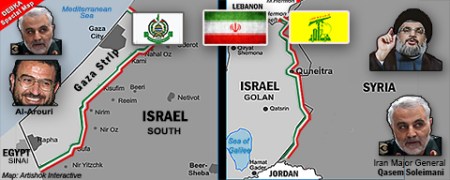
Seen from the strategic-military angle, Israel can be said to have regressed 11 years to 2006, when two foes were poised menacingly on its northern and southern borders. Israel was then compelled to fight a war against Hizballah in Lebanon. This time, the conflict could potentially flare up simultaneously on three fronts – Lebanon, Gaza and Syria.

********************************

Nikki Haley, the US Ambassador to the UN, challenged the international community to hold Iran to account on Thursday, Aug. 31, after the Islamic Republic showed its “true colors” by restoring its ties with the Palestinian extremist Hamas. In her statement, she described as “stunning” the Hamas leader’s boast that Tehran is again the biggest provider of money and arms. The breach between them followed the terrorist group’s refusal to side with Bashar Assad in the Syrian civil war.

“Iran must decide whether it wants to be a member of the community of nations that can be expected to take its international obligations seriously, or whether it wants to be the leader of a jihadist terrorist movement. It cannot be both,” Haley said in her statement.

Islamic Iran has long made that decision, as the ambassador knows very well from the intelligence reports she sees. But her brave words were meant as a wakeup call for the rapid advances made by Iran and Hizballah during August to impose their will on the Middle East, often with great stealth.

Haley will have learned about the Aug. 2 meeting in Beirut between Hamas’s military chief Salah al-Arouri and Iranian officials, following which Hizballah’s Hassan Nasrallah confirmed that the Palestinian rulers of the Gaza Strip were worthy of restored military and financial aid.

That deal was clinched at the highest level in Tehran, after Arouri and a delegation from Gaza were received by top Iranian officials, including Revolutionary Guards General Qassem Soleimani. He is not only commander of Iran’s Middle East warfronts, but also head of Al Qods, which runs Iran’s intelligence, subversion and terror networks.

These events and their ramifications were itemized in the latest issue of DEBKA Weekly, out Friday, Sept. 1.

It was Soleimani who assigned Hamas and its military arm with its next tasks. Since both parties are dedicated to violent tactics (terror) to achieve their ends, one of which is the destruction of the State of Israel, all that remains to be seen is the precise form the Iranian-backed Hamas-Hizballah partnership will take – and where. Those practicalities were aired at the secret sessions between Hamas and Al Qods in Tehran

Present at some of those sessions were also Soleimani’s secret agents and heads of the terrorist networks he runs across the Middle East and in the Gulf emirates.

The inauguration ceremony for Hassan Rouhani’s second term as Iran’s president on Aug. 5 provided a convenient cover for these get-togethers.

Nikki Haley’s warning to the international community was prompted by these dangerous events. Although her words were powerful, telling and timely, it is hard to see any sign of their being followed up by other parts of the Trump administration.

With the southern front against Israel in the bag, Iran and Hizballah this week put together its northern front, just two or three kilometers from Israel’s Golan border with Syria. This could not have happened without the Trump administration submitting to Russia’s demand to revise their de-escalation zone project for the Syrian Golan, so that Iranian and Hizballah forces are no longer required to distance themselves 40-50km from the zone, but only 8km.

Iran and Hizballah in Syria have in consequence been quietly shortening their distance from the Israeli border. But this week, they made a major leap forward, when the Russian monitors brought a group of Iranian and Hizballah officers all the way to Quneitra. There, they were given a base under Russian protection within sight of the Israeli Golan.

Tehran and its pawn therefore used the month of August to climb into position for drawing a noose around Israel and tightening it at will.

Prime Minister Binyamin Netanyahu this week boasted that his tenure was marked by relative calm. Israel, he said, had successfully avoided getting embroiled in any major war.

That is correct. However, his policy of preserving the calm and maintaining a purely defensive stance has carried a price. That price was totted up on Sept. 1. By then, Iran and Iran had been able to move unopposed into position on Israel’s borders with Syria and Lebanon in the north and had crept up to the Gaza border in the south.

Seen from the strategic-military angle, Israel can be said to have regressed 11 years to 2006, when two foes were poised menacingly on its northern and southern borders. Israel was then compelled to fight a war against Hizballah in Lebanon. This time, the conflict could potentially flare up simultaneously on three fronts – Lebanon, Gaza and Syria.

Brigitte Gabriel and Dave Rubin: Terrorism, The Muslim Brotherhood, and Linda Sarsour

July 9, 2017

Brigitte Gabriel and Dave Rubin: Terrorism, The Muslim Brotherhood, and Linda Sarsour via YouTube, May 19, 2017

(The transition of Lebanon from a vibrant homogeneous society into an Islamist state where Muslims, formerly friends of Christians and Jews, became violent enemies — about five minutes into the video — bodes ill for much of Europe. Although this video was posted on YouTube on May 19th, some of the content suggests that the interview occurred significantly earlier.  — DM


Congress blames State Department after draft sanctions bill leaked to pro-Hezbollah media

May 2, 2017

Congress blames State Department after draft sanctions bill leaked to pro-Hezbollah media, Al-Monitor

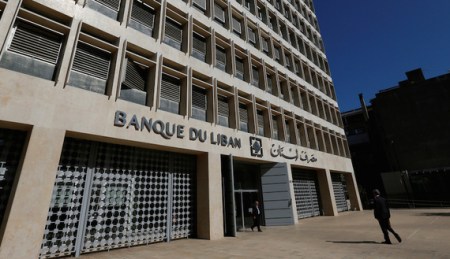
People walk outside Lebanon’s Central Bank in Beirut November 6, 2014. REUTERS/Jamal Saidi/File Photo – RTSEJDF

Congress is blaming the State Department and the US Embassy in Lebanon after draft sanctions legislation was leaked to the Lebanese media, setting off a political and diplomatic firestorm.

House Foreign Affairs Committee Chairman Ed Royce, R-Calif., began devising a new bill targeting Hezbollah last year amid concerns that the Barack Obama administration was slow-walking implementation of a previous effort that was signed into law in December 2015. Royce shared an early draft with State Department experts for their input, sources on and off Capitol Hill told Al-Monitor, but got burned when a media outlet close to Hezbollah got wind of it. 

The State Department has not officially acknowledged or denied being involved. Royce declined to comment.

As a result of the leak, numerous newspaper articles in Lebanon over the past month have picked apart — and possibly distorted — an unfinalized draft that only a handful of people in Washington have heard about and fewer still have seen. Even House Foreign Affairs ranking member Eliot Engel, D-N.Y., a natural ally on sanctions legislation, has yet to see the proposed draft, according to a Democratic aide. Sen. Marco Rubio, R-Fla., is working on a similar effort in the Senate.

Lebanese officials say destabilizing sanctions would be ill-advised while tiny Lebanon is struggling to absorb more than a million refugees from Syria.

“We are surprised by all the leaks about new sanctions,” Lebanese member of parliament Yassine Jaber, a former economy minister who met with administration officials during the congressional recess two weeks ago, told Al-Monitor in an email. “We don’t see a need for further legislation, we feel that all these leaks about further legislation to come, only hurts Lebanon, its economy and banking sector, at a moment of very high weakness and vulnerability.”

According to Lebanese media accounts, the 20-page draft bill has also caused a panic in Lebanon because of its potential political impact. While the 2015 bill unnerved a banking sector that is one of the pillars of the country’s economy, the new draft has government leaders fretful that Congress is now coming after them.

The Royce draft, Lebanese President Michel Aoun said last week during a meeting with the Washington-based American Task Force for Lebanon, “would harm Lebanon and its people greatly.” Critics are worried that the draft bill paves the way for sanctioning Lebanese allies and political parties that are close to Hezbollah, including Aoun, the Christian Free Patriotic Movement headed by his son-in-law and Foreign Minister Gebran Bassil, and the Shiite Amal Movement of parliament Speaker Nabih Berri.

In response, the Lebanese government is planning to send a delegation to Washington later this month of government officials, lawmakers and other dignitaries, possibly including Central Bank Governor Riad Salameh. The government hopes to have representatives of the private banking sector tag along to play up any potential threat to the financial sector, a Lebanese source told Al-Monitor, but the main concern appears to be with the bill’s political ramifications.

“This is more about the political groups of the speaker, etc., being nervous rather than the issues of the banks,” the source said. “Politicians — and the government, actually — are trying to get the private banks involved in their effort. I can tell you the private banks do not like that: They do not want to come with politicians here.”

The Association of Banks in Lebanon spent $200,000 in the first three months of this year to discreetly lobby Congress about the bill and other matters, according to lobbying records. The banks would prefer to wait until President Donald Trump fills in top spots at the Treasury Department before organizing their annual visit to Washington, the source said.

Hezbollah claims to get all its funding from Iran. US experts, however, have long suspected that much more comes from Lebanese expatriates, illegal activities and other sources, fueling Congress’ desire to crack down on as many funding streams as possible.

The Lebanese source, who has seen a draft of the bill, said it does not designate Hezbollah’s allies as terror groups. Rather, it would require the Trump administration to publicly report on their financial links to the Shiite militia, including estimates of the net worth of some top Lebanese officials.

“Obviously they don’t want their net worth to be mentioned,” the source said. “I totally see how Nabih Berri could be panicking even if his own party knows how much money he has.”


EXCLUSIVE – Arab Intelligence Source: Jihadists Are Wearing Down Hezbollah on Syria-Lebanon Border

April 29, 2017

EXCLUSIVE – Arab Intelligence Source: Jihadists Are Wearing Down Hezbollah on Syria-Lebanon Border, BreitbartAaron Klein and Ali Waked, April 29, 2017

ANWAR AMRO/AFP/Getty

Fighters of the Al Nusra Front, Al Qaida’s affiliate in Syria, or as the group now calls itself, Jabhat Fatah al-Sham, have recently been posing a serious challenge to Hezbollah in the border area between Lebanon and Syria, a senior Arab intelligence official told Breitbart Jerusalem.

“Dozens of Hezbollah fighters have been wounded in engagements over the last few weeks between the two sides,” the official stated. “The jihadists decided to switch their offensive from Syria to Lebanon. “

“In the area of Arsal and in other regions, they’ve continued to surprise Hezbollah and force the group to send many soldiers to the area.”

The challenge presented by the jihadists has forced Hezbollah to reconsider the positions of their troops in Syria and at home in Lebanon, according to the intelligence source. “According to intelligence reports, Hezbollah is taking the most recent engagements very seriously,” said the intelligence source.

“The slow stream of jihadists into Lebanon represents a disruption of the relative stability within the country’s borders, especially just before the beginning of the fasting month of Ramadan next month,” said the source.

“Hezbollah understands that Al Nusra and the jihadists are trying to turn the month of Ramadan into a bloody month for the Shi’ite organization and the communities supporting it, and so, we are witnessing the reduction in age of volunteers and fighters being recruited by the organization and they’re continuing to go down and even now we can see that 16-year-olds are among the fighters.”

The intelligence source also said that, as far as Hezbollah is concerned, “The threat from Al-Nusra isn’t nearing its strongholds in Lebanon. The increased troop presence on the border comes at a direct cost to troop numbers in Syria.

“In any case, Hezbollah already conducted a new assessment of the deployment of its forces in Syria due to the American airstrike, but now the fear is double.”

According to the source, “Hezbollah’s fundraisers and recruiters are investing far more effort than in the past.  If Ramadan passes without any special attacks, it should be a month of fundraising that will help the organization deal with the need to expand its recruitment of volunteers.”

The source added that “the main deliberation within Hezbollah concerns the need to prepare for a direct attack on the organization from Israel or even the U.S. The organization understands that Hezbollah is in the cross hairs of the American government as a source of disruption of U.S. interests in the area.”

“Hezbollah is fundraising, recruiting volunteers and fighting for public opinion. The organization is preparing for a very difficult summer.”

Lebanese Columnist Warns: Any Hizbullah Aggression Against Israel Will Be Disastrous For Lebanon More Than Anyone Else

April 3, 2017

Lebanese Columnist Warns: Any Hizbullah Aggression Against Israel Will Be Disastrous For Lebanon More Than Anyone Else, MEMRI, April 3, 2017

In an article titled “Does Hizbullah Threaten Israel or Us” in the  English-language Saudi daily Arab News, Lebanese columnist Diana Moukalled commented on the recent escalation in Hizbullah Secretary-General Hassan Nasrallah’s threats against Israel, including his threat to target Israel’s nuclear reactor in Dimona.[1] She assessed that this escalation in Nasrallah’s rhetoric is an attempt to make up for Hizbullah’s military losses in Syria and to garner popular support in light of the decline in Hizbullah’s and Iran’s global standing. She also noted that his threat to target the reactor is irresponsible because thousands of Palestinian and Israeli civilians live near it. Noting that Iran often uses Lebanon as an arena for its “adventures,” she warned that the current political climate might prompt Iran and Hizbullah to renew their aggression against Israel – which would be catastrophic for Lebanon, even more so than in previous confrontations.

The following are excerpts from her article:[2]

Diana Moukalled (image: twitter.com/dianamoukalled)

“Israel has reacted to recent statements by Hezbollah leader Hassan Nasrallah with a mixture of mockery and cynicism, as he said Hezbollah was ready to bomb the Dimona nuclear reactor or ammonia tanks. Israeli websites reported military discussions indicating that Israel believes Hezbollah is facing a dilemma over aid and funds due to the fighting in Syria.

“In the past, Israel dealt more seriously and carefully with Hezbollah threats and movements, but this has seemingly changed. I am in no way praising Israel, an occupying racist state, or minimizing its danger as an aggressor. Rather, this is an attempt to understand the whirlwind of rhetoric recently launched by Nasrallah, which affects Lebanese, Palestinians and others living mere kilometers from the Dimona reactor.

“Everyone, primarily Hezbollah, knows that the results of any war or military action against Israel will be catastrophic. Nasrallah may have learned this lesson, since the southern front with Israel has been calm since the end of the last war 11 years ago.

“As such, escalating rhetoric to target nuclear reactors — near to which thousands of Palestinian and Israeli civilians live, and would be harmed by substantial radioactive fallout — is at the very least irresponsible and no more than a popular mobilization attempt.

“But these empty slogans seem more necessary today than ever, as Nasrallah’s words seem to be an attempt to rebuild a combat position against Israel and make up for Hezbollah’s losses in Syria. This approach seems logical given the view that rapid political developments and the international consensus around Syria will lead to Hezbollah’s exit from the country. This would result in an Iranian response wherever it can do so.

“In a realistic characterization of current politics, now is not the time to make decisions, but to make a show of force and assemble cards to be presented while waiting for a clearer understanding of US regional policy. Continued escalation against Iran and its influence in Syria may lead to Tehran and Hezbollah reverting to a policy of confrontation, including against Israel. Where better than Lebanon as a gateway for new Iranian adventures?

“But the situation is not as it was during the 2006 war, as Israel says its response will be massive against Hezbollah and Lebanon if Hezbollah takes military action against it. This threat includes Israel’s preparedness to target all Lebanese territory. Lebanese President Michel Aoun’s comments that Hezbollah’s weapons complement the role of the army serve as a pretext for Israel to target the army as well.

“The appropriate conditions to target Hezbollah will come soon, but Israel is in no rush for military action as it is monitoring Hezbollah’s financial, moral and military depletion in Syria, amid Arab hostility toward Hezbollah, compared with support in 2006, due to its regional role at Iran’s behest. Any threat posed by Hezbollah will affect Lebanese before anyone else, and more severely than in previous wars and crises.”

____________________________

[1] In a February 16, 2017 address aired on Al-Mayadeen TV, Nasrallah called on Israel “not just to move the ammonia facility out of Haifa, but to dismantle the nuclear plant in Dimona,” saying: “They know what will become of them and of their [Zionist] entity if missiles hit that plant.” See MEMRI TV Clip No. 5896, “Hizbullah Secretary-General Nasrallah Threatens Missile Attack on Israeli Ammonia Facilities and Dimona Nuclear Plant,” February 16, 2017.

[2] Arab News (Saudi Arabia), February 26, 2017.

World Shrugs as Hizballah Prepares Massive Civilian Deaths

March 21, 2017

World Shrugs as Hizballah Prepares Massive Civilian Deaths, Investigative Project on Terrorism, Noah Beck, March 21, 2017

Like the terror group Hamas, Hizballah knows that civilian deaths at the hands of Israel are a strategic asset, because they produce diplomatic pressure to limit Israel’s military response. Hizballah reportedly went so far as offering reduced-price housing to Shiite families who allowed the terrorist group to store rocket launchers in their homes.

********************************

Hizballah leader Hassan Nasrallah recently warned Israel that his Iran-backed terror group could attack targets producing mass Israeli casualties, including a huge ammonia storage tank in Haifa, and a nuclear reactor in Dimona.

Also last month, Tower Magazine reported that, since the beginning of the Syrian civil war, Iran provided Hizballah with a vast supply of “game-changing,” state-of-the art weapons, despite Israel’s occasional airstrikes against weapons convoys.

In a future conflict, Hizballah has the capacity to fire 1,500 rockets into Israel each day, overwhelming Israel’s missile defense systems. Should such a scenario materialize, Israel will be forced to respond with unprecedented firepower to defend its own civilians.

Hizballah’s advanced weapons and the systems needed to launch them reportedly are embedded across a staggering 10,000 locations in the heart of more than 200 civilian towns and villages. The Israeli military has openly warned about this Hizballah war crime and the grave threats it poses to both sides, but that alarm generated almost no attention from the global media, the United Nations, or other international institutions.

Like the terror group Hamas, Hizballah knows that civilian deaths at the hands of Israel are a strategic asset, because they produce diplomatic pressure to limit Israel’s military response. Hizballah reportedly went so far as offering reduced-price housing to Shiite families who allowed the terrorist group to store rocket launchers in their homes.

But if the global media, the UN, human rights organizations, and other international institutions predictably pounce on Israel after it causes civilian casualties, why are they doing nothing to prevent them? Hizballah’s very presence in southern Lebanon is a flagrant violation of United Nations Security Council resolution 1701, which called for the area to be a zone “free of any armed personnel, assets and weapons” other than the Lebanese military and the U.N. Interim Forces in Lebanon (UNIFIL).

The resolution also required Hizballah to be disarmed, but the terror group today has an arsenal that rivals that of most armies. Hizballah possesses an estimated 140,000 missiles and rockets, and reportedly now can manufacture advanced weapons in underground factories that are impervious to aerial attack.

“Israel must stress again and again, before it happens, that these villages [storing Hizballah weapons] have become military posts, and are therefore legitimate targets,” said Yoram Schweitzer, senior research fellow at Israel’s Institute for National Security Studies (INSS).

Meir Litvak, director of Tel Aviv University’s Alliance Center for Iranian Studies, agrees, adding that global attention would “expose Hizballah’s hypocrisy in its cynical use of civilians as… human shields.”

Even a concerted campaign to showcase Hizballah’s war preparation is unlikely to change things, said Eyal Zisser, a senior research fellow at the Moshe Dayan Center for Middle Eastern and African Studies. Hizballah exploits the fact that “the international community is too busy and…weak to do something about it,” Zisser said. All of “these talks and reports have no meaning. See what is happening in Syria.”

Israel has targeted Hizballah-bound weapons caches in Syria twice during the past week. Syria responded last Friday by firing a missile carrying 200 kilograms of explosives, which Israel successfully intercepted.

If Hizballah provokes a war, Israel can legitimately attack civilian areas storing Hizballah arms if the Israel Defense Forces (IDF) first attempts to warn the targeted civilians to leave those areas, Litvak said. But “it will certainly be very difficult and will look bad on TV.”

While Sunni Arab states are generally united against the Shiite Iranian-Hizballah axis, Litvak, Zisser, and Schweitzer all agreed that Israel could hope for no more than silent support from them when the missiles fly.

Indeed, the “Sunni Arab street” is likely to be inflamed by the images of civilian death and destruction caused by Israel that international media will inevitably broadcast, further limiting support for Israel from Iran’s Sunni state foes.

Rather perversely, the Lebanese government has embraced the very terrorist organization that could cause hundreds of thousands of Lebanese civilian deaths by converting residential areas into war zones. “As long as Israel occupies land and covets the natural resources of Lebanon, and as long as the Lebanese military lacks the power to stand up to Israel, [Hizballah’s] arms are essential, in that they complement the actions of the army and do not contradict them,” President Michel Aoun told Egyptian television last month. Hizballah, he said, “has a complementary role to the Lebanese army.”

Aoun’s declaration means that Lebanon “takes full responsibility for all of Hizballah’s actions, including against Israel, and for their consequences to Lebanon and its entire population, even though the Lebanese government has little ability to actually control the organization’s decisions or policy,” said INSS Senior Research Fellow Assaf Orion.

MK Naftali Bennett, a veteran of Israel’s 2006 war with Hizballah, believes that Lebanon’s official acceptance of Hizballah and its policy of embedding military assets inside residential areas removes any constraints on Israeli targeting of civilian areas. “The Lebanese institutions, its infrastructure, airport, power stations, traffic junctions, Lebanese Army bases – they should all be legitimate targets if a war breaks out,” he said. “That’s what we should already be saying to them and the world now.”

In a future war, Hizballah is certain to try bombarding Israeli civilian communities with missile barrages. Israel, in response, will have to target missile launchers and weapons caches surrounded by Lebanese civilians.

But it need not be so. Global attention on Hizballah’s abuses by journalists and diplomats could lead to international pressure that ultimately reduces or even prevents civilian deaths.

Those truly concerned about civilians do not have a difficult case to make. Hizballah has shown a callous disregard for innocent life in Syria.

It helped the Syrian regime violently suppress largely peaceful protests that preceded the Syrian civil war in 2011. Last April, Hizballah and Syrian army troops reportedly killed civilians attempting to flee the Sunni-populated town of Madaya, near the Lebanese border. In 2008, its fighters seized control of several West Beirut neighborhoods and killed innocent civilians after the Lebanese government moved to shut down Hizballah’s telecommunication network.

Hizballah terrorism has claimed civilian lives for decades, including a 1994 suicide bombing at Argentina’s main Jewish center that killed 85 people . As the IDF notes, “Since 1982, hundreds of innocent civilians have lost their lives and thousands more have been injured thanks to Hizballah.”

If world powers and the international media genuinely care about avoiding civilian casualties, they should be loudly condemning Hizballah’s ongoing efforts – in flagrant violation of a UN resolution – to cause massive civilian death and destruction in Lebanon’s next war with Israel.

In-House Hizballah Missile Factories Could Add to Massive Arms Buildup

March 17, 2017

In-House Hizballah Missile Factories Could Add to Massive Arms Buildup, Investigative Project on Terrorism, Yaakov Lappin, March 17, 2017

This does not mean Hizballah is seeking a conflict with Israel now, but it does mean that should a new war erupt in the future, Israel’s civilian population will face unprecedented threats.

Israel’s defense establishment is making its own preparations accordingly, based on the understanding that this Iranian agent has developed into a full-fledged terrorist army.

*********************************

A recent report saying that Iran constructed underground missile factories in Lebanon for Hizballah would, if accurate, indicate a disturbing boost in the Shi’ite terror organization’s ability to self-produce weapons.

Already, the Israeli defense establishment sees Hizballah as a powerful and radical army rather than a ‘mere’ terror organization due to its deep and sophisticated weaponry (which surpasses that of most states), and its hierarchical command structure.

An ability to manufacture destructive rockets and missiles would mean that the militant Islamist Lebanese-Shi’ite organization is no longer entirely reliant on arms trafficking from its patron Iran and ally, the Assad regime in Syria.

The report, made available by the Middle East Media Research Institute (MEMRI), was published in the Kuwaiti daily Al-Jarida. It cites an aide to the commander of Iran’s Islamic Revolutionary Guards Corps (IRGC) as its source. The IRGC’s Quds Force is an elite unit that runs Iran’s extensive overseas operations to arm, finance, and strengthen Iran’s regional proxies.

According to the Kuwaiti report, the IRGC built the arms-making facilities more than 50 meters underground and fortified them against air strikes before handing control of them over to Hizballah three months ago.

The report is well within the realm of the possible, Ely Karmon, a Hizballah expert and a senior research scholar at the International Institute for Counter-Terrorism in Herzliya told the Investigative Project on Terrorism. He pointed to a 2015 statement made by the IRGC’s Aerospace Force commander, Brigadier General Amir Ali Hajizadeh, boasting that Tehran has provided “Syria, Iraq, Palestine and the Lebanese Hizballah resistance group with the needed know-how to produce missiles.”

“The IRGC’s Aerospace Force has developed to a stage in the field of missile industries that it can mass-produce different types of short- and mid-range missiles,” Hajizadeh said.

Assessing the latest Kuwaiti report, Karmon said that it is “possible that these Hizballah military factories are in the Quseyr area in Syria, and not in Lebanon.” Quseyr is an area of western Syria near Lebanon which has come under Hizballah control in recent years after being seized from Sunni rebel organizations.

Israel bombed targets in the area in the past, Karmon noted, likely as part of Israel’s covert program to selectively disrupt of Hizballah’s force build-up.

In November, Hizballah paraded its heavy weaponry in Quseyr – including tanks, armored personnel carriers, artillery guns, and missile launchers.

The Kuwaiti report also claimed that “a special department has been established at the IRGC’s Imam Hossein University [in Tehran] to train Lebanese and other experts, and hundreds of experts have already been trained… The manufacture of the missiles does not take place in one factory; different parts are built in different factories and then assembled together.”

The missile factories reportedly can produce surface-to-surface missiles with a range of over 500 kilometers – in other words, capable of hitting anywhere in Israel – surface-to-sea missiles, perhaps intended to hit Israeli ships and Israel’s offshore gas rigs in the Mediterranean Sea, armed drones, anti-tank missiles, and other weapons. The production sites can also be used to make machine guns, mortars, and anti-aircraft guns.

Since the end of the 2006 war with Israel, Hizballah stockpiled an arsenal totaling 120,000 missiles – one of the largest of its kind in the world. The vast majority of these arms were manufactured in Iran and Syria and smuggled into Lebanon. A growing number are guided rockets and missiles, which Hizballah could use to try to use to overcome Israeli air defenses and target sensitive targets.

Iranian weapons transfers continue regardless of whether Hizballah has access to its own missile factories. Israeli Prime Minister Benjamin Netanyahu provided details on “the ongoing Iranian attempt to transfer weapons, advanced weapons, to Hizballah, via Syria,” when he visited Russian President Vladimir Putin in Moscow earlier this month.

Reports say that Israel targeted such weapons again overnight, triggering Syrian surface-to-air missile fire at Israeli jets. At least one of those missiles reportedly was intercepted by Israel’s Arrow defense system.

Hizballah also is training elite terror cells to infiltrate Israel during the next war, and to temporarily ‘conquer’ northern Israeli communities in a bid to demoralize Israelis.

These preparations, it is safe to assume, are being closely monitored by Israel.

Hizballah’s deep involvement fighting for the Assad regime in Syria for four years also has boosted its power. The best form of training is combat itself, and its operatives have been exposed to Iranian commanders and technology on the battlefields of Syria.

Meanwhile, back in Lebanon, Hizballah has embedded the vast majority of its bases, rocket launchers, and command posts in civilian regions, including a massive maze of underground tunnels and subterranean compounds.

Yet all is not well in Hizballah’s camp despite its clear and growing power. Hizballah is facing a dramatic economic crisis due to a shortage of cash flow from Iran, which itself has not yet received all of the funds it was expecting to get after signing the nuclear deal.

Hizballah’s expenses are not only military and terrorist. They include many civilian and political activities in Lebanon, for which it is now struggling to pay. Additionally, the fact that it has sustained more than 1,500 casualties in Syria has demoralized sections of the traditional Lebanese Shi’ite support base.

Nevertheless, Hizballah is pushing to build up its massive offensive capabilities against Israel.

It seeks more accurate rockets and missiles, while its leader Hassan Nasrallah has repeatedly threatened to strike Israeli strategic targets such as ships carrying industrial ammonia to the Israeli city of Haifa, and Israel’s nuclear reactor in Dimona.

This does not mean Hizballah is seeking a conflict with Israel now, but it does mean that should a new war erupt in the future, Israel’s civilian population will face unprecedented threats.

Israel’s defense establishment is making its own preparations accordingly, based on the understanding that this Iranian agent has developed into a full-fledged terrorist army.

Kuwaiti Daily: Missile, Arms Factories Built By IRGC In Lebanon Have Recently Been Handed Over To Hizbullah

March 14, 2017

Kuwaiti Daily: Missile, Arms Factories Built By IRGC In Lebanon Have Recently Been Handed Over To Hizbullah, MEMRI, March 14, 2017

The Kuwaiti daily Al-Jarida reported on March 11, 2017, citing an aid to Mohammad Ali Jafari, commander of the Iranian Revolutionary Guards Corps (IRGC), that Iran established facilities for manufacturing missiles and other weapons in Lebanon and has recently handed them over to the management and oversight of Hizbullah. According to the daily’s source, the facilities are more than 50 meters underground and heavily shielded against aerial attacks. He also clarified that various parts of the missiles are manufactured in different factories and then assembled together.

The following is a translation of the report:[1]

The Al-Jarida report

With Iran facing growing pressures from the Donald Trump administration and the Israeli government under Binyamin Netanyahu, an aid to the IRGC commander told Al-Jarida that Iran has built factories [for manufacturing] missiles and [other] weapons in Lebanon and has recently turned them over to Hizbullah. In response to statements by Iranian Defense Minister Hossein Dehghan several days ago – who said that Hizbullah is capable of manufacturing missiles [that can] hit any part of Israel [but] gave no details or explanations – a knowledgeable source who wished to remain anonymous said that, after Israel destroyed an Iranian arms factory in Sudan several years ago that had supplied arms to Hizbullah, and after [Israel also] bombed an arms convoy that was intended to reach Hizbullah via Syria, the IRGC launched a project for establishing arms factories in Lebanon [itself]. [The source] also claimed that a special department has been established at the IRGC’s Imam Hossein University [in Tehran] to train Lebanese and other experts, and that hundreds of experts have already been trained.

“According to the source, the factories are more than 50 meters underground, and above them are several layers of shielding so that Israeli planes cannot hit them. Moreover, manufacture of the missiles does not take place in one factory; different parts are built in different factories and then assembled together. He added that the transfer of the factories to Hizbullah’s [management] was gradual but that they have been under full Hizbullah management and oversight for three months now.

“The source stressed that Hizbullah is able to manufacture several kinds of missiles, some with a range of over 500 km, including surface-to-surface and surface-to-sea missiles; torpedoes launched from light high-speed boats; spy drones and [attack] drones armed with weapons and rockets; anti-tank missiles, and fast armored boats. He clarified that weapons produced in these plants have been used in the Syria war and were proved to be effective. Anti-tank missiles managed to destroy car bombs that targeted Hizbullah fighters. He [also] noted that Hizbullah manufactures cannon, machine guns, anti-aircraft guns, mortars, and various [other] missiles and bullets, especially armor-piercing ones…”

_____________________________

[1] Al-Jarida (Kuwait), March 11, 2017.

The Significance, Ramifications, And Messages Of Hizbullah’s Show Of Military Force In Al-Qusayr, Syria

January 4, 2017

The Significance, Ramifications, And Messages Of Hizbullah’s Show Of Military Force In Al-Qusayr, Syria, MRMRI, Yael Yehoshua*, January 3, 2016

On November 13, 2016, Hizbullah marked its annual Martyr Day by holding its first military parade in a Syrian town, Al-Qusayr, which Hizbullah took over in 2013 following a long and bloody battle with rebel forces, and which has since become the main symbol of the organization’s involvement in the Syria war alongside the Assad regime. The parade featured hundreds of fighters in military uniforms, tanks, U.S.-made M113 armored personnel carriers, cannon, machine guns, and an armored regiment. Also marching was the Al-Radwan division, comprising some 10,000 fighters from Hizbullah’s “intervention forces” and “special forces” fighting in Syria, which constitute the spearhead of the organization in the country.[1]

By holding this parade at this time and at this location, Hizbullah was informing its rivals, locally and in the region – that is, political players in Lebanon, the Syrian rebels and their Arab supporters, and the West and Israel – that it is now a powerful cross-border military force that can control areas outside Lebanon’s borders. The parade did indeed cause a tremendous stir among Hizbullah supporters, as well as among the organization’s opponents.

This paper will review the significance and ramifications of the parade in Al-Qusayr and the messages that it sent.
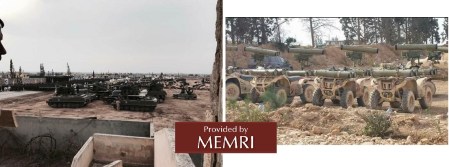
1295aPhotos from the parade. Arabipress.org, November 13, 2016; Addiyar.com, November 14, 2016
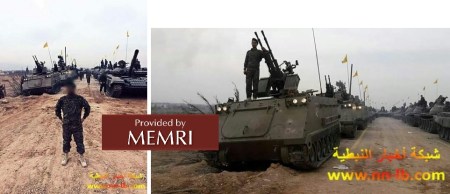
1295bPhotos from the parade. Nn-lb.com, November 13, 2016

Hizbullah Underlines Its Presence On Syrian Soil

Hizbullah’s holding the parade on Syrian soil, particularly in Al-Qusayr, is a symbolic yet highly significant act showing the organization’s control of part of Syrian territory. Al-Qusayr is the jewel in the crown of Hizbullah’s  military involvement in Syria and is seared into the memories of the Syrian rebels as an arena in which they were defeated by Hizbullah in 2013 after a bitter battle that lasted weeks and involved many losses on both sides. Moreover, Al-Qusayr is also Hizbullah’s gateway into Syria. After capturing it from the rebels, Hizbullah emptied it of its residents and turned it into a center for its headquarters and into a staging area for its fighters arriving from Lebanon, from which they leave for other battle fronts in Syria.

Also, holding the parade on Syrian soil as opposed to Lebanese soil is a blatant attempt by Hizbullah to highlight its presence in Syria and signal that this presence has become a known, established and certain fact. It may also reflect Hizbullah’s view of Al-Qusayr and its surroundings as its own military territory, and not as Syrian territory – with no consideration whatsoever for Syria’s sovereignty or for Lebanon’s position on this. [2] Hizbullah deputy secretary general Na’im Qassem hinted at this when he said, several days after the parade: “We are in Syria, and we do not need to give any explanation or justification for this. We stand alongside the Syrian army and the Syrian state.”[3]

Qassem’s statements were backed up by statements by Lebanese Army Gen. (ret.) Amin Hatit, who is close to Hizbullah: “Hizbullah’s presence in Syria is something basic… As far as we are concerned, there is no difference between Al-Qusayr and South [Lebanon].”[4]

By holding it on its Martyr Day, Hizbullah also intended the parade to convey a message to the Shi’ite public in Lebanon, which supports Hizbullah and is the source of its political power and its fighters, that despite its losses Hizbullah has remained strong. For Lebanese Shi’ites, many of whom have been killed and wounded in the past four years of Hizbullah’s fighting in Syria, and particularly in the ongoing battle for Aleppo, the parade was meant to boost morale and signal that the losses had not been in vain but had only further strengthened the organization and made it possible for it to become a regional power.

Hizbullah’s Transition From A Resistance Force To A Quasi-Regular Army

Hizbullah’s demonstration of its military strength by parading hundreds of its soldiers with tanks, cannon, machine guns, and so on also reflected its wish to send the message that it was now a well-trained and well-armed force, with new units, resembling an experienced regular army, and was no longer a resistance militia waging guerilla warfare against Israel.

This upgrade of its military and deterrence capabilities is the result of its military experience in Syria fighting the anti-regime rebels. In this context, Lebanese daily newspapers quoted Na’im Qassem making statements about Hizbullah’s military capability. The Lebanese Al-Mudun daily quoted Qassem as saying: “Hizbullah has added expertise, fighting capability, and military capabilities. This force is becoming more powerful and more developed, into something greater than resistance and less than a regular army.”[5] The Al-Safir daily quoted him as saying: “Now we have a trained army and the resistance is no longer based on methods of guerilla warfare. We are better armed and better trained, and we have advanced professional knowledge.”[6] It should be noted that an official Hizbullah communique denied that Qassem had called Hizbullah an army.[7]

It appears that Hizbullah’s show of strength at this time was because of achievements in the field by both it and its camp, the resistance axis. These achievements included the strengthening of Hizbullah, the Syrian army, and the militias that have been operating alongside the Syrian army since the beginning of Russia’s military involvement in Syria over a year ago along with the upsurge in the political status of Syrian President Bashar Al-Assad in the Arab world and in the West, and the bolstering of Iran’s regional and international status because of its increased military presence in Iraq and Syria and in the wake of the nuclear agreement and the election of the Hizbullah ally Michel Aoun to the Lebanese presidency.


Hizbullah As A Cross-Border Regional Force

Alongside the messages it sent locally, the parade was aimed at letting the region know that Hizbullah is a cross-border military force that is not bound by any particular territory and does not recognize the Syria-Lebanon border, or other borders between Middle East states, set by the Sykes-Picot agreement.

Hizbullah and its sponsor, Iran, which itself is striving to spread its Islamic Revolution and “Rule of the Jurisprudent” doctrine, do not consider geographic borders to be significant, and are deepening their penetration of many countries in the region. This approach is expressed by the military involvement of Iran and its agents in Syria, Iraq, and Yemen, and by Hizbullah’s complete military control of part of Syrian soil, including the Al-Qusayr region.

The military parade sent a message not only to the rebels in Syria, but also to their sponsors in the Arab and Muslim world – Saudi Arabia, Qatar, and Turkey – underlining that the resistance axis in Syria has the upper hand, and that Hizbullah will not hesitate to show its power anywhere it needs to in order to subjugate its opponents. On this matter, Lebanese Army Gen. (ret.) Amin Hatit said: “Had Hizbullah wanted to send a message to Lebanon, it would have held the demonstration there, not in Syria, and what it did in Al-Qusayr is a message to the region.”[8]

In an interview with the Iranian website Tasnim, which is close to Iran’s Islamic Revolutionary Guard Corps (IRGC), Qassem said: “If we want to look [at this] realistically, we see that Hizbullah has become a regional power. The way in which Hizbullah is confronting both the Zionist enemy and the takfiriyyoun [i.e. the Salafi-jihadi organizations]… shows that the organization is a regional power, and the changes in the region are proof of that.”[9]

Also, Nasser Qandil, editor of the pro-Syria Lebanese daily Al-Bina and an Assad associate, wrote in a November 16, 2016 article titled “Hizbullah – The New Middle East Army” that the organization is a cross-border force and that the borders between countries mean nothing to it. He stated that Hizbullah has become the “Middle East Army” because of its military capabilities and because it is a military force that crosses borders, and that it has achieved this by virtue of the popular organizations in the region that assist it, which comprise approximately a million fighters spread across the Middle East. These forces share its wars and its positions, and see Hizbullah secretary-general Hassan Nasrallah as a leader “with special status and as a source of authority for the wars in the Middle East.” He added that in actuality Hizbullah “has torn up Sykes-Picot” by transforming the areas of Syria that border Lebanon’s east and northeast into a “direct and vital continuation of the resistance.”

In this context, Qandil added that as Israel’s military strength and Saudi Arabia’s economic and political strength were waning, and as Al-Qaeda was failing, and as the U.S. was more preoccupied with domestic affairs and Russia was concerned about neutralizing other regional forces such as Turkey, “Hizbullah and the network of its allies is developing, becoming like a soft-[power] state that lives in the bosom of several countries. [Hizbullah] is not a rival [to the states on whose soil it exists], but complements them, living and developing at their consent as a deterrent force and as added strategic value. Thus, this force is becoming the most important fact emerging with the beginning of the 21st century… and no force in existence can threaten the growth of this new army of the Middle East that is deployed from Lebanon to Afghanistan, and from Aleppo to Bab Al-Mandeb.”[10]


Hizbullah As An Independent Force Operating Outside Lebanese Laws And Institutions

The Al-Qusayr military parade has great significance also vis-à-vis Lebanon. Hizbullah’s control in the Al-Qusayr region erases the Lebanon-Syria border and creates a single large, contiguous swath of territory from Syria to the northern Beqa’a, one of its strongholds in Lebanon, without the Lebanese government’s agreement and under harsh criticism from various political elements in that country.[11]

By holding the parade, Hizbullah has again proven, to Lebanon and to the entire world, that it is not subject to Lebanon’s laws and institutions, but that it operates according to its own interests and the interests of Iran and the resistance axis. As far as it is concerned, its presence in Syria depends solely on it, not on any decision by the Lebanese state. On this, Qassem said: “We stand alongside the Syrian army and the Syrian state, and without our intervention in Syria, the terrorists would enter every place in Lebanon. The issue of our involvement in Syria is no longer under discussion by Lebanese circles.”[12]

This message was discordant to Hizbullah’s opponents within Lebanon, who expressed harsh criticism of the Al-Qusayr parade. Ashraf Rifi, justice minister in Lebanon’s interim government, a bitter enemy of Hizbullah, said that this parade sends a message threatening Lebanon’s sovereignty. He tweeted: “Hizbullah has blatantly shown its military strength in occupied Syria… What will ‘the strong president’ [Michel Aoun] say about the armed militia that has become an army that is participating in the occupation of Syria, and dividing and killing its people?” He added that “Lebanon is in danger” and called on all the forces opposing the Iranian sponsorship of Lebanon to act together “to save Lebanon that Hizbullah has exploited with shari’a backing and has turned into a platform in service of Iran’s plans.”[13]

Other criticism came from Ali Al-Husseini, in his column in the Lebanese daily Al-Mustaqbal, associated with the March 14 Forces: “It is odd that this parade was held at the same time as preparations were being carried out by the Lebanese army for [Lebanon’s November 22] Independence Day… The message to Lebanon is that Hizbullah is an independent force that is not subjugate to the laws of the Lebanese state and does not want [Lebanon] to be independent… Hizbullah has established itself as an occupier and has declared Al-Qusayr and other regions [in Syria] to be under its control and its aegis from now on, and declared that negotiation on them in the future will be only with [Hizbullah] and according to its conditions.”[14]


Hizbullah As A Deterrent Force In Lebanon’s Internal Politics

Hizbullah’s parade, which also came several weeks after its ally Michel Aoun was elected Lebanon’s president,[15] and at the height of consultations for the establishment of a new government headed by Sa’ad Al-Hariri, head of the Al-Mustaqbal stream, was also a way of flexing its muscles at various forces in Lebanon’s political arena, particularly at President Aoun and his party which are still considered Hizbullah allies. This show of strength was aimed at reiterating that the organization had military power and that it would not agree to any changes to the political balance of power that were not in its favor, and would also not allow its weapons to be touched.

While Aoun’s election was considered a victory for Hizbullah and for the March 8 Forces that it heads, there is, according to reports in the Lebanese media, great apprehension in Hizbullah and in the March 8 Forces that Aoun will end his sweeping support for the resistance, and will moderate his stance, compromise, and lean more towards the center than he has in the past, and will show neutrality towards both the March 14 Forces and the March 8 Forces.

The cooperation between Aoun (who represents the majority of Christians in the country after forming an alliance with the Christian Lebanese Forces party led by Samir Geagea) and Al-Hariri (who represents the majority of Sunnis) – cooperation which led to Aoun’s election and to the appointment of Al-Hariri to establish the next government – is also of concern to the Shi’ite Hizbullah. Its main fear stems from the possibility of shifts in the political power balance in the country, because Aoun’s alliance with Hizbullah foe Geagea has created a powerful, cohesive Christian group that has shared out the government portfolios among its members, at the expense of the other Christian parties who belong to the March 8 Forces – and Aoun is likely to prioritize this powerful Christian group over his alliance with Hizbullah and his support for the resistance.

These apprehensions also increased following visits by Saudi and Qatari emissaries to Aoun, following which the latter promised that Saudi Arabia will be the first stop on his visits to Arab countries, and in light of his statement, as part of his wish to establish Lebanon as an independent actor, that Lebanon under his leadership would “adopt an independent policy and will not be subjugated to anyone.”[16]


Hizbullah As An Anti-Israel Deterrent Force From Both Lebanese And Syrian Territory

Hizbullah also used the parade to convey a message about its position on a war against Israel. In light of its military involvement in Syria fighting the rebels alongside the Assad regime, Hizbullah was accused by elements in and out of Lebanon of abandoning the path of resistance against Israel, and of having become an accessory to the Iranian plan to eliminate the Sunni presence in Syria. In response, with the parade, Hizbullah sought to clarify that establishing its might in Syria was part of the plan of the resistance that serves its war against Israel and intensifies its anti-Israel deterrence. On this topic, Na’im Qassem said that upgrading Hizbullah’s capabilities and transforming it into a real military force “is sufficient to deter the Israeli enemy.”[17]

That the parade was an attempt by Hizbullah to demonstrate its strength to Israel was also expressed by the fact that the main element marching in it was from the Al Radwan division, revealed here for the first time. According to a Lebanese source,[18] this division was thought up by the late Hizbullah chief of staff ‘Imad Mughniyeh, who was assassinated in 2008, and comprises some 10,000 fighters trained at Hizbullah bases specifically built for this purpose in Al-Qusayr. The division was initially established to invade Israel’s Galilee during the next conflict there, but is right now fighting the rebels in Syria and gaining combat experience, and Hizbullah considers it its spearhead in Syria. Having fighters from this division marching in the parade is a message to Israel that the Al-Radwan division, which it considers a deterring force against Israel, is complete and ready for action against it at a moment’s notice.

‘Abdallah Kamah wrote on the Lebanese website Alhadathnews.net: “At a time when the warriors of the Al-Radwan [division] are fighting and gaining combat experience in Syria, they see the Galilee as their strategic goal. In order to achieve this goal, we must prepare for a war [with Israel], which ‘Imad Mughniyeh had said ‘would be different from those that came before it.’ This difference opens the door to adopt new [combat] methods, because this campaign will not be the same as in the past, when it was conducted according to a scenario where the enemy invades and the resistance ambushes and charges, or fires rockets from groves and using mobile, manually-operated, ground-based launchers. Moreover, the next war, as Hizbullah showed yesterday, will be more offensive than defensive, and will include armored vehicles entering the occupied Upper Galilee.”[19] It should be mentioned in this context that in a February 2011 speech marking the third anniversary of Mughniyeh’s assassination, Hizbullah Secretary-General Hassan Nasrallah threatened Israel, and warned that in the next conflict he would order his men to take over the Galilee.[20]

Moreover, by holding the parade on Syrian soil, Hizbullah challenged Israel’s opposition to the establishment of Hizbullah forces in Syria, specifically in the Golan Heights. Increasing its presence in the Syrian Golan is part of the organization’s plan to expand the arena of conflict with Israel from southern Lebanon to the Golan Heights, and transform them into a single front that transcends political borders. Back in January 2016, Nasrallah stated that Hizbullah will no longer recognize either the rules of combat with Israel or the separation between the South Lebanon and Golan Heights fronts.[21] In May 2016, Ibrahim Al-Amin, head of the board of directors of the Lebanese daily Al-Akhbar, which is close to Hizbullah, stated that the organization had established a resistance infrastructure in the Syrian Golan Heights with the help of local residents.[22]

In an article published a few days after the parade, the political editor of the Lebanese daily Al-Safir implied that that one of the reasons Hizbullah is establishing itself in Syria is to open an additional front against Israel in the Golan Heights: “The weapons displayed by Hizbullah [at the parade] are weapons that [regular] armies have, and this is a clear message to Israel that the arena for every future campaign will absolutely not be limited to certain Lebanese borders and to a local population that either does or does not support [the resistance], but will rather be an arena that is more energetic, deeper, and broader – strategically, geographically, and militarily.”[23]

*Yael Yehoshua is Vice President for Research and Director of MEMRI Israel


[1] For more on the military parade, see MEMRI Special Dispatch No. 6677, Special Dispatch No. 6677, Hizbullah Military Parade In Syrian Town Of Al-Qusayr: Tanks, Cannon, And Machine Guns, November 14, 2016. It should be noted that the Lebanese army denied claims that the M113 APCs and other military equipment in the parade belonged to it. Al-Nahar (Lebanon), November 15, 2016.

[2] Al-Mudun (Lebanon), November 16, 2016.

[3] Al-Safir (Lebanon), November 16, 2016.
[4] Al-Nahar (Lebanon), November 14, 2016.

[5] Al-Mudun (Lebanon), November 16, 2016.

[6] Al-Safir (Lebanon), November 16, 2016.
[7] Alahednews.com, November 16, 2016.

[8] Al-Nahar (Lebanon), November 14, 2016.

[9] Tasnim (Iran), November 22, 2016.

[10] Al-Bina (Lebanon), November 16, 2016.

[11] For more on Lebanese criticism of Hizbullah’s involvement in the fighting in Syria, see MEMRI Inquiry & Analysis No. 980, Lebanon Openly Enters Fighting In Syria, June 13, 2013; Special Dispatch No. 6383, Lebanese Writer: Hizbullah Is No Longer A Resistance Organization, But An Occupier And Target For Resistance, April 12, 2016; Inquiry & Analysis No. 1147, Lebanese Elements Furious Over Hizbullah’s Activity In Golan, Shebaa Farms, Critical Of Nasrallah’s Statements About Uniting Lebanese, Syrian Resistance Fronts, March 11, 2016.

[12] Al-Safir (Lebanon), November 16, 2016.
[13] Twitter.com/Ashraf_Rifi, November 14, 2016.

[14] Al-Mustaqbal (Lebanon), November 15, 2016.

[15] See MEMRI Inquiry & Analysis No. 1276, Al-Hariri’s Choice Of Hizbullah Ally Aoun For Lebanese Presidency Is Another March 14 Forces Concession To Pro-Iran Axis, October 28, 2016.

[16] Al-Safir (Lebanon), November 12, 2016; Al-Akhbar (Lebanon), November 26, 2016.

[17] Al-Mudun (Lebanon), November 16, 2016.

[18] For example, Alhadathnews.net, November 15, 2016.

[19] Alhadathnews.net, November 15, 2016.

[20] Al-Akhbar (Lebanon), February 17, 2011. See MEMRI Special Dispatch No. 6051, The Emergence Of ‘Galilee Force’ – Palestinian Forces Fighting Alongside Syrian Regime, May 20, 2015.

[21] For Lebanese criticism of Nasrallah’s statement, see MEMRI Special Dispatch No. 5994, Lebanese Elements Furious Over Hizbullah’s Activity In Golan, Shebaa Farms; Slam Nasrallah’s Statements About Uniting Lebanese, Syrian Resistance Fronts, March 10, 2015; For more on Hizbullah and Iranian IRGC activity in the Syrian Golan on the Israeli border, see MEMRI Inquiry & Analysis No. 1138, Following Killing Of Hizbullah Operative Jihad Mughniyah, New Information Comes To Light Regarding Hizbullah, Iranian Activity In Syrian Golan On Israeli Border, January 28, 2015; MEMRI Daily Brief No. 1146, From The Mediterranean to the Golan, Iran Builds Active Front And Direct Military Presence On Israel’s Border To Deter Israel And Further Ideology Of Eliminating The Zionist Regime, February 16, 2015.

[22] For more on Hizbullah’s activity in the Golan, see MEMRI Special Dispatch No. 6039, Board Chairman Of Pro-Hizbullah Lebanese Daily: Hizbullah Has Established Resistance Infrastructure In Syrian Golan In Cooperation With Locals, April 30, 2015.

[23] Al-Safir (Lebanon), November 16, 2016.