Archive for the ‘Kurds’ category

Christians Burned Alive

January 10, 2015

Christians Burned Alive, Gatestone InstituteRaymond Ibrahim, January 10, 2015

Muslim Persecution of Christians, November 2014

“They picked them up by their arms and legs and held them over the brick furnace until their clothes caught fire. And then they threw them [alive] inside the furnace.” — Javeed Maseeh, family spokesman, concerning a Christian couple in Pakistan murdered on rumors they had burned verses from the Qur’an.

“I would appeal to your honor to put pressure on the government of Pakistan to end misuse of blasphemy laws against Christians, Ahmadiyyia and other religious minorities and condition US Aid on human rights and repeal of blasphemy laws.” — From a letter to U.S. President Barack Obama by Dr. Nazir S. Bhutti, President of the Pakistan Christian Congress, expressing surprise that the U.S. did not even bother to condemn the burning of Christians alive.

East Jerusalem: Despite constant and ever bolder attacks on a church, police refuse to respond to pleas for help from the Christian congregation.

Denmark: Muslim refugees are persecuting Christian refugees. “Christian asylum seekers are repeatedly exposed to everything from harassment to threats and physical abuse….” — Niels Eriksen Nyman, 10news.dk

“Young Christian men are made scapegoats to show police performance, while the real culprits are carrying out their illegal activities right under the police’s nose.” — Brother-in-law of “Mithu,” 35, Christian father of five, who was arrested in Pakistan on false charges and tortured to death in prison.

The youngest [slave] being the most expensive. 20-30 years old: 100,000 dinars [$86]; 10-20 years old: 150,000 dinars [$129]; 9 years old: 200,000 dinars [$172]. — The Islamic State.

The Islamic State called on its followers to take the jihad to Egypt.

Qaiser Ayub, a 40 year old professor of computer science in Pakistan, of Christian background, was arrested and charged with insulting Islam’s prophet Muhammad.

Both in the Islamic world and the Western world, Muslims continued to attack and slaughter Christians.

In Pakistan, “A mob accused of burning alive a Christian couple in an industrial kiln in Pakistan allegedly wrapped a pregnant mother in cotton so she would catch fire more easily, according to family members who witnessed the attack,” reported NBC News:

Sajjad Maseeh, 27, and his wife Shama Bibi, 24, were set upon by at least 1,200 people after rumors circulated that they had burned verses from the Quran, family spokesman Javed Maseeh told NBC News via telephone late Thursday. Their legs were also broken so they couldn’t run away.

“They picked them up by their arms and legs and held them over the brick furnace until their clothes caught fire,” he said. “And then they threw them inside the furnace.”

Bibi, a mother of four who was four months pregnant, was wearing an outfit that initially didn’t burn, according to Javed Maseeh. The mob removed her from over the kiln and wrapped her up in cotton to make sure the garments would be set alight.
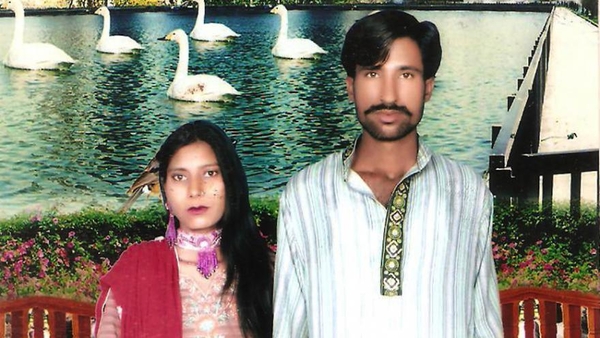
814Shama Bibi (left) and Sajjad Maseeh, a Christian couple and parents of four children, were burned to death by a Muslim lynch mob in Pakistan because of a false blasphemy accusation.

Discussing this latest atrocity against Pakistan’s Christian minorities, an AFP report states:

Blasphemy is a hugely sensitive issue in the majority Muslim country, with even unproven allegations often prompting mob violence.

Anyone convicted, or even just accused, of insulting Islam, risks a violent and bloody death at the hands of vigilantes.

A Christian woman [Asia Bibi] has been on death row since November 2010 after she was found guilty of making derogatory remarks about the Prophet Mohammed during an argument with a Muslim woman.

An elderly British man with severe mental illness, sentenced to death for blasphemy in Pakistan in January, was shot by a prison guard last month.

Two days after the Christian couple were burned alive, a policeman in Pakistan hacked a man to death for allegedly making blasphemous remarks against Islam.

About the Christian couple, Dr. Nazir S. Bhatti, President of the Pakistan Christian Congress, wrote a letter to U.S. President Obama expressing surprise that the U.S. did not even bother to condemn this crime:

It is surprising that neither US Administration under your honor nor US State Department even bothered to condemn this horrific crime of burning live of Christian couple by a mob living in country named Islamic Republic of Pakistan which is receiving billions of aid of US taxpayers.

I would appeal your honor to put pressure on government of Pakistan to end misuse of blasphemy laws against Christian, Ahamadiyyia and other religious minorities and condition US Aid to Pakistan on human rights and repeal of blasphemy laws.

Meanwhile, in America itself, in Oklahoma, Jimmy Stepney, a Muslim, stabbed Jerome Bullock, a Christian, after Stepney had said that Muslims need to “step up” beheadings. According to Koco5 News:

The [police] report went on to say Stepney had been making comments about beheading people.

“We were watching the news,” said Bullock. “He said he felt like more Muslims need to step up to the plate and do certain thing. He was talking about beheading people.”

The severity of the plight of Christians in the Middle East was further underscored by Dr. Alexander Yakovenko, Russian Ambassador to the United Kingdom, who wrote:

Russia is currently considering the possibility of initiating a draft decision of the UN Human Rights Council on the protection of Christians in the Middle East and North Africa. Russian experts are now working on this document.[…]

The scale of the problems demands the coordination of international efforts to protect Christians in the Middle East.

Further initiatives, new measures and relevant discussions aimed at finding durable solutions in this regard are strongly needed. Of course, we believe that Europe, including the UK, should make its contribution to these efforts, taking into account the Christian roots of the European civilization, which are now often forgotten for the sake of political correctness.[…]

The fate of the region’s religious minorities is of the greatest concern. The mass exodus of Christians, who have been an integral part of the Middle Eastern mosaic for centuries, is particularly troubling.

The rest of November’s roundup of Muslim persecution of Christians around the world includes (but is not limited to) the following accounts, listed by theme and country in alphabetical order, not necessarily according to severity:

Muslim Attacks on Christian Churches

Bangladesh: Two Christian pastors from the Faith Bible Church of God were arrested for preaching the Gospel to Muslims . They could face two years in prison if convicted for “hurting religious sentiments” and luring Muslims to convert by offering them money. The pastors deny both charges. Police arrested the pastors and 41 other people, including Muslims, after a throng of Muslims disrupted a house meeting. According to a witness: “More than 100 Muslims headed by local Jamaat-e-Islami party members and Muslim clerics gathered at the house and started barking questions at the pastors—why did they propagate Christianity in the locality and convert some of them,” and who gave them permission to preach to Muslims. “The pastors replied that it did not take any permission from any authority to propagate any religion and convert people to any religion. Suddenly the Muslims became apoplectic with rage, tried to pick a fight and started jabbing the pastors’ faces.”

Egypt: Father Timothy Shakar, priest of St. Mina Church in Port Said, confirmed that two homemade bombs were planted near the St. Mina Church but caused no injuries, or losses of life or property. Police searched other churches in the region for more bombs.

Germany: Nine men who had earlier broken into, vandalized, and robbed several Christian churches in the Cologne area—including by stealing money from the collection boxes and liturgical vessels—were caught during a massive raid. Apparently, all of the arrested are German by nationality, but Muslim by background and heritage. Some were also identified as “Salafis”—especially fundamentalist Muslims—connected to international terrorist organizations. Some had even raised hundreds of thousands of Euros from native Germans to support overseas “charities,” the proceeds of which actually went to terrorist groups such as ISIS.

Iraq: As cries of “Allahu Akbar” emanated from surrounding mosques, Islamic State militants blew up yet another Christian church — St. George’s Church and its associated nunnery in the city of Mosul — along with other non-Sunni sites. Separately, after breaking the cross from off the dome of the St. Ephrem Church dome (before and after pictures here) and selling its pews and other furnishings, the IS transformed the church into a mosque and council seat for the jihadis.

East Jerusalem: Despite constant and ever bolder attacks on a church, police refuse to respond to pleas for help from the Christian congregation. According to Morning Star News, “The attacks, driven by both intent to seize property and opposition to Christianity, have been mounted by young men with ties to Palestinian militants who for more than three months have been trying to force Living Bread Church from its rented building. Church pastor Karen Dunham and others have filed at least eight police reports about the assaults.” The most recent incident took place on November 5, when the gas tank of a car owned by a church volunteer was filled with sugar. On November 2, a car owned by one of the pastor’s relatives was stolen. And on October 16, three American Christians were injured while trying to repair a metal security door: A crowd of Palestinian men attacked them with box cutters, sticks, clubs and pepper spray. According to the church’s attorney, authorities “have their [the assailants’] pictures, they have their names, they even have their national ID numbers, and still they do nothing…. The level of brute force compared to the level of lack of response of the police force there is pretty shocking…. It almost seems like if someone is going to go in and murder her [Dunham], that no one is going to lift a finger.”

Malaysia: Approximately 70 local residents in Petaling Jaya protested the construction of a church. They claimed the growing number of Christian places of worship in the area is part of an attempt to evangelize and convert Muslims to Christianity. An NGO, the local branch of Pertubuhan Sahabat, supported the claims of the Muslims. They argued that there are three churches in the vicinity, although close to 70 percent of the residents in the area are Muslims. According to a spokesman, “Even before the church is built, flyers on Christianity have been distributed to our homes, and this could confuse our children and divert them from the path of Islam.” The vacant plot was previously occupied by squatters, a car park and several food stalls. Another local Muslim added “None of our neighbours are Christians, we can vouch for that… it is an insult to Muslims to allow a church to be built here, but none of our representatives seem to have the time to listen to us.” One demonstrator hurled large rocks at the temporary steel fence around the vacant plot.

Jihadi Slaughter of Christians

Kenya: Members of neighboring Somalia’s Islamic group Al Shabaab—”the Youth”—hijacked a bus carrying 60 passengers in the town of Mandera, near Kenya’s border with Somalia. They singled out and massacred 28 non-Muslims, the overwhelming majority of whom were Christian. According to an eyewitness, “When we got down, passengers were separated according to Somali and non-Somalis. The non-Somalis were ordered to read some verses of the holy Koran, and those who failed to read were ordered to lie down. One by one they were shot in the head at point blank range.”

Nigeria: On November 10, a suicide bomb attack on a Christian secondary school as students gathered for morning assembly killed at least 47 people. The Islamic group Boko Haram— meaning: “Western education is forbidden”—is believed to be behind the blast. In a separate incident, Christians from the predominantly Christian city of Mubi in Adamawa state were tortured and killed after Boko Haram took control of the town. Churches and homes were torched throughout the city, which was renamed Madinat al-Islam, or “the City of Islam.” In yet another separate incident, Boko Haram militants raided the mostly Christian town of Shani. According to a resident speaking to Reuters, “They rode on motorcycles and were more than 30 men. They started throwing bombs into houses… then the Boko Haram fired shots at people fleeing. They set ablaze the police station, houses and a telecom mast… I saw people fleeing, some bodies on the ground.” Reuters continues: “The Sunni jihadist movement is fighting to revive a medieval Islamic caliphate in Nigeria’s north.”

Pakistani Persecution

A few days after the Christian couple, mentioned earlier, was burned alive, a 35-year-old Christian father of five known as “Mithu” was arrested on false charges by police and tortured to death in prison. According to the deceased’s brother-in-law: “It was a fake allegation, because the raiding party failed to recover any contraband from Mithu’s person and his house… On the morning of Nov. 22, we were informed by Ilyas Gill, a local councilor, that Mithu had died in police custody because of heart failure…. Young Christian men are made scapegoats to show police performance while the real culprits are carrying out their illegal activities right under the police’s nose.” Morning Star News adds: “Area police routinely round up young, impoverished Christians on false charges of drug peddling and bootlegging, and then force their families to pay heavy bribes in return for their release… family elders had seen signs of torture on the body…”

Christian families in a Punjabi village were forced to flee after a Christian man married a Muslim woman—an act forbidden by Islamic law. According to the Pakistani report, “The Muslims in this village became enraged when this occurred and began threatening them…. When the news of the marriage was learned, the Muslims in Sahiwal attacked Shahab’s [the Christian husband’s] family as well as other Christian families in the village. The Muslims demanded that Ruksana [the Muslim wife] be returned immediately, according to Sharia which prohibits Muslim women from marrying a man from another religion…. the entire Muslim community was threatening to kill Shahab’s father and all of the village’s Christians…. The Christians’ pleas for help from the local police were all in vain.”

And Qaiser Ayub, a 40-year-old professor of Christian background, was arrested and charged with insulting Islam’s prophet Muhammad. The computer science professor had been a fugitive avoiding the police since 2011, when he was first accused of having written blasphemous comments on his blog.

Dhimmitude: Generic Contempt and Hostility

Denmark: In an apparent replication of the Islamic world’s modus operandi, Muslim refugees in the European nation are persecuting Christian refugees. According to 10news.dk, “Christian asylum seekers are repeatedly exposed to everything from harassment to threats and physical abuse by other refugees in the asylum centers, simply because they have converted from Islam to Christianity.” According to Niels Eriksen Nyman, who led the study, “There are certainly many more cases around the country than the ones we hear about in the church. I hate to say it, but I’m afraid that on some of the asylum centers there are some very unhealthy control mechanisms when the staff turns their back… I refuse to support Islamophobia, but we have a serious problem here.” Two recent examples: “An eight year old Christian at the Center Sandholm was bullied and beaten by the larger Arab boys on their way to school. Now the boy nolonger [sic] dares to go to school. On the island Bornholm, somebody had tampered with a Christian asylum seeker’s bike so that he crashed and broke both hands.”

Egypt: The Islamic State called on its followers to take the jihad to Egypt. Abu Mus’ab al-Maqdisi, a leader in the Islamic State, said in a statement titled “Advice to Egypt’s Mujahidin” that “It is necessary to take the battle to Cairo, until the Sinai is safeguarded from the apostates [reference to Egyptian government] and becomes a rear base [qaeda] from which to expand the jihad.” He also called on the jihadis in Egypt to “target the Copts,” the nation’s indigenous, Christian minority: “For targeting them, following them, and killing them is one of the main ways to serve the cause of our virtuous male and female hostages of the tyrants.”

Iraq: Christian homes in Tel Isqof were looted by Kurds who, after fighting the Islamic State, took control of the area on August 17. According to Agenzia Fides, “The city of Tel Isqof was occupied on August 7 by jihadist militias who already in June had conquered Mosul. Faced with the advancing of jihadists, the civilian population, mainly Christians, had fled to the autonomous Region of Iraqi Kurdistan, leaving the city deserted. Ten days later [on August 17], with a counter-offensive the Kurdish Peshmerga had regained control of the city. But it is precisely since then that [Christian] residents periodically return to the city to check the status of their homes, and acknowledge that the doors of a growing number of homes and businesses have been forced and property looted: money and jewelry, technical equipment and electronic instruments.” As in the Islamic State, most Kurds are Sunni Muslims.

Islamic State: IS issued a document breaking down the purchase prices of Christian and Yazidi women being sold as sex-slaves. Apparently these enslaved unfortunates are priced based on age— the youngest being the most expensive. The breakdown is as follows (with USD equivalency in brackets): 40-50 years old: 50,000 dinars [$43]; 30-40 years old: 75,000 dinars [$64]; 20-30 years old: 100,000 dinars [$86]; 10-20 years old: 150,000 dinars [$129]; 9 years old: 200,000 dinars [$172].

Spain: Real Madrid, a professional football (soccer) team, stripped the traditional Christian cross from its club crest as part of a deal with the National Bank of Abu Dhabi. “It is believed the European champions’ new crest, minus the Christian cross, was created so as not to offend Muslim sensibilities in the United Arab Emirates, where a marketing drive will take place,” wrote the Telegraph. Club president Florentino Perez said, “This agreement will help the club to keep conquering the hearts of followers in the United Arab Emirates.”

Syria: As of November, Raqqa, which once had approximately 1,500 Christian families, had only 23 Christian families remaining in it—the others were driven out or killed by the Islamic State. Those few remaining were unable to leave the city for lack of resources or for reasons of age and health. On November 16 they were told that they must pay $535, an exorbitant sum (human sex-slaves are being sold for as little as $43). “In all likelihood Christian families, impoverished by the war, will not be able to pay the tax and will have to leave their homes” or convert to Islam, as many elderly, debilitated Christians unable to flee have already done.

About this Series

While not all, or even most, Muslims are involved, persecution of Christians is expanding. “Muslim Persecution of Christians” was developed to collate some—by no means all—of the instances of persecution that surface each month.

It documents what the mainstream media often fails to report.

It posits that such persecution is not random but systematic, and takes place in all languages, ethnicities and locations.

Can Charlie Hebdo’s Spirit Include Israel?

January 9, 2015

Can Charlie Hebdo’s Spirit Include Israel? Algemeiner, Noah Beck, January 9, 2015

parisians-300x167Grieving Parisians gathered to mourn the victims of the Charlie Hebdo shooting. Photo: Screenshot, Vice News.

[H]ad Palestinian gunmen similarly attacked Israel’s most important daily newspaper and then escaped, would the event inspire such constant coverage or international sympathy? Israel has suffered countless massacres followed by a suspenseful manhunt for the Islamist terrorists; in each of these incidents, the world hardly noticed until Israel forcefully responded and Palestinians died (prompting global condemnation of Israel).

The best response to the Charlie Hebdo attack is to redouble the free expression Islamists meant to stifle. Similarly, the best response to Islamist attacks on the only Mideast democracy, Israel, is to increase support for it.

****************

The Islamist massacre at Charlie Hebdo has understandably captured global attention because it was a barbaric attack on France and freedom of expression. In a moment of defiant moral clarity, “je suis Charlie” emerged as a popular phrase of solidarity with the victims. Hopefully such clarity persists and extends to those facing similar challenges every day in the Middle East.

Christians and other religious minorities have been beheaded by Islamists for years, but it wasn’t until US journalist James Foley was beheaded that the West cared. The Islamic State raped and slaughtered thousands of Yazidis — leaving the surviving refugees stranded on Mount Sinjar — before the West took notice. But one Islamist besieging a cafe in Sydney, killing two, dominated global coverage for the entire 16-hour incident.

Western leaders and media must realize that religious minorities in the Middle East are the canary in the coalmine for the West when it comes to Islamist threats. And Israel provides the clearest early warning of all, precisely because — despite Israel’s location in a region of Islamists and dictatorships — the Jewish state has free elections, freedom of speech, a vigorous political opposition and independent press, equal rights and protections for minorities and women (who are represented in all parts of civil, legal, political, artistic, and economic life), and a prosperous free market economy.

But had Palestinian gunmen similarly attacked Israel’s most important daily newspaper and then escaped, would the event inspire such constant coverage or international sympathy? Israel has suffered countless massacres followed by a suspenseful manhunt for the Islamist terrorists; in each of these incidents, the world hardly noticed until Israel forcefully responded and Palestinians died (prompting global condemnation of Israel).

However, when there is an attack in Europe, North America, or Australia, there is widespread grief, solidarity, and an acceptance of whatever policy reaction is chosen. But when Israel is targeted, there is almost always a call for “restraint,” as happened last November after fatal stabbings by Palestinian terrorists in Tel Aviv and the West Bank.

If two Palestinians entered a European or North American church and attacked worshipers with meat cleavers, killing five people, including priests, the outrage would be palpable in every politician and journalist’s voice. But when Israelis were victims of such an attack, Obama’s reaction was spineless and tone deaf. Did Obama condemn the Charlie Hebdo massacre by noting how many Muslims have died at the hands of French military forces operating in Africa and the Middle East? Of course not. Such moral equivocation would be unthinkable with any ally or Western country except Israel.

Similarly, would Secretary of State John Kerry ever suggest that the Islamic State is somehow motivated by French policies (whether banning Muslim headscarves at public schools or fighting Islamists in Mali)? Obviously not. Yet Kerry did just that sort of thing with Israel when he suggested that the Islamic State is driven by the Israeli-Palestinian conflict.

And the media’s anti-Israel bias is well known but became even more obvious when they couldn’t get a simple story about vehicular terrorism against Israelis correct. Compare how The Guardian writes accurate headlines when France or Canada suffers an Islamist car attack but not when Israel does.

Consider all of the justifiable news coverage and outrage over the 2013 Boston bombings, and imagine if one of those happened every week. Would anyone dare suggest that the US make peace with any Islamists demanding changes to US policy? And yet Israel had such bomb attacks almost every week of 2002 and was invariably asked to restrain itself and make concessions to the very people bombing them (as happened again last summer, when Hamas fired thousands of rockets at Israel).

As Israeli Prime Minister Netanyahu has ruefully observed, “There is a standard for dictatorships, there is a standard for democracies, and there is still a third standard for the democracy called Israel.”

Even when compared to Western democracies, what other country gives incredibly forgiving medical care to terrorists and agrees to treat the children of those working to destroy it? Israel is where a Hamas family member finds refuge when he is a gay convert to Christianity but this is yet another inconvenient fact for the mainstream media (as is the fact that some Israeli Arabs supported the IDF’s 2014 war against Hamas). Why report what contradicts the one-sided, anti-Israel narrative that the media and groups like Human Rights Watch have adopted? That narrative is only reinforced on college campuses (leftist college history professors openly supported Hamas last summer). Nevertheless, US funding of anti-Israel groups continues to aggravate the misinformation problem.

Israel is still the country that everyone loves to hate. So it’s the cheap way to please Muslim voters in Europe and oil producers in the Gulf. But what happens to Israel eventually comes to the West, because Israel is an extension of the West. And just as surrendering Czechoslovakia failed to appease the expansionist appetite and murderous rampage of Nazi totalitarianism, so too will feeding Israel to Islamist totalitarianism fail to appease that movement. In the end, there is no set of concessions — short of civilizational surrender — that the Islamists will accept.

Nevertheless, an EU court decided to remove Hamas from the European Union’s terror list, even though Hamas is responsible for scores of terrorist attacks that have murdered hundreds of Israelis, North Americans, and Europeans, and has a charter calling for the destruction of Israel. And Western European countries have voted for Palestinian statehood at the UN and in their parliaments, effectively rewarding Palestinian terrorism and intransigence. Europe supports the Palestinian Authority as if Hamas couldn’t overthrow it in the West Bank as easily as Hamas did in Gaza Strip in 2007. How can Europe not know that Hamas has designs on the West Bank and that any Israeli withdrawal from that territory will only facilitate such a takeover? And how can Europe believe that Israel could ever make peace with Hamas, which has launched three unprovoked wars on Israel in the last five years (in the decade since Israel withdrew from Gaza)?

Moreover, if lofty concerns about self-determination and human rights are the true motivation behind Europe’s vocal support for Palestinian independence (despite its undemocratic and violent record), why is Europe deafeningly quiet on Kurdish statehood? Given that six million Jews were annihilated by a genocide on European soil, Europe’s hypocrisy on Israel should embarrass the continent even more.

Worse still, Europe’s gestures of appeasement only encourage the Islamists. The best response to the Charlie Hebdo attack is to redouble the free expression Islamists meant to stifle. Similarly, the best response to Islamist attacks on the only Mideast democracy, Israel, is to increase support for it.

Turkey: America’s unacknowledged problem

December 31, 2014

Turkey: America’s unacknowledged problem, Israel Hayom, Prof. Efraim Inbar, December 31, 2014

(The foreign policy of the Obama administration is difficult to understand. What might be the reasoning behind its apparently continuing support for Islamic Turkey, a bitter foe of Israel? What are the administration’s interests in the Middle East?– DM)

It is not clear why Washington puts up with such Turkish behavior. The Obama ‎administration seems to be unable to call a spade a spade. It refuses to acknowledge ‎that Turkey is a Trojan horse in NATO, and that Ankara undermines American interests ‎in the Middle East and elsewhere.‎

***************

Turkey is a NATO ally, and U.S. President Barack Obama has called Turkish President Recep Tayyip Erdogan his best friend. But Erdogan-led Turkey does not ‎behave as an ally or a friend of the U.S. This is not a new development.‎

Erdogan and his Islamist party, the Justice and Development Party (AKP), have ruled Turkey since 2002. Erdogan’s ‎Turkey has gradually distanced itself from the West, adopting domestic and foreign ‎policies fueled by Ottoman and Islamist impulses. ‎

Turkey has been on the road to an authoritarian regime for several years. Infringements ‎on human rights have gradually increased. In truth, Turkey has never had a political ‎system with checks and balances able to constrain attempts to consolidate power ‎around one politician. In recent years, Erdogan has weakened further the few ‎constitutional constraints against “Putinization” of the Turkish political system. ‎

The longer Erdogan rules, the more power-hungry he seems. His authoritarian ‎personality becomes clearer every day. The press is hardly free. Erdogan arrests even ‎Islamist journalists who are critical of his policies. His party has infiltrated the judicial ‎system and the police. Foci of power, such as the bureaucracy, the banking system, ‎industrial associations and trade unions, have been mostly co-opted by the AKP. ‎Opposition political parties are largely discredited. The military, once active in politics ‎as the defender of the Kemalist secular tradition, has been successfully sidelined. ‎

From a realpolitik perspective, the domestic political developments, deplorable as they ‎may be in Turkey, could be ignored by the democratic West as long as Ankara ‎continues to be a useful ally. Unfortunately, Turkey no longer qualifies as a trusted ‎ally. ‎

The most recent examples of nefarious Turkish behavior are its support of Islamic State and ‎Hamas. Turkey is playing a double game on the issue of Islamic State. It pretends to ‎cooperate with the U.S. policy in the attempt to contain radical Islam, but actually ‎Turkey supports the radical group. It allows passage of volunteers through Turkish territory to join ‎Islamic State in Iraq. The group gets logistical support via Turkey, and sends its wounded militants for ‎treatment in Turkey. Turkish military forces stood idly by the besieged city of Kobani, ‎just across the Turkish border, while the Islamists killed Kurdish fighters. Finally, ‎Turkey denies the American air force access to Turkish bases, forcing the U.S. to use far‎away bases when attacking Islamic State targets. ‎

Turkey is also openly supporting another radical Islamist organization, Hamas. ‎Despite the fact that the West regards Hamas a terrorist organization, Ankara regularly ‎hosts Hamas representatives to meet the highest Turkish dignitaries. Hamas, an ‎offshoot of the Muslim Brotherhood, has a rabid anti-American position. Moreover, ‎Salah al-Aruri, a senior Hamas operative, operates out of Istanbul. Recently, the ‎Turkish branch of Hamas was involved in a series of attempts to carry out terrorist ‎attacks against Israel, and in orchestrating a coup against the current leadership of the ‎Palestinian Authority.‎

Such behavior should not surprise policy makers in Washington. In 2003, Ankara ‎denied the request from Washington to open its territory so that the U.S. military could ‎attack Saddam Hussein’s forces from two separate fronts.‎

AKP-ruled Ankara also defied American preferences on Syria, a country allied with ‎radical Iran and on the American list of states supporting terrorism. In January 2004, ‎Bashar Assad became the first Syrian president ever to visit Turkey. In April 2009, the ‎two states conducted their first ever joint military exercise. No other NATO member ‎had such close relations with the authoritarian regime in Damascus, which has been ‎closely allied with Iran for several decades.‎

Turkey further deviated from the Western consensus in 2008 by hosting Sudanese ‎President Omar Hassan al-Bashir twice. Bashir, who was charged with war crimes and ‎genocide in Darfur, presided over an Islamist regime. ‎

Turkey even welcomed the president of the Islamic Republic of Iran, Mahmoud ‎Ahmadinejad, for a visit in August 2008. No Western country has issued such an ‎invitation to the Iranian leader. Additionally, Erdogan congratulated Ahmadinejad ‎immediately after his re-election in June 2009. When it comes to Iran’s nuclear threat, ‎Ankara, unlike its NATO allies, has refused to adopt the U.S. stance on harsher ‎sanctions, fearing in part the economic consequences of such steps. In June 2010, ‎Turkey voted at the U.N. Security Council against a U.S.-sponsored resolution meant to ‎impose a new round of sanctions on Iran.‎

Turkey also has consistently defied advice from Washington to tone down its anti-‎Israel statements and mend relations with an important American ally. All American ‎efforts in this direction have failed.‎

There is also a clear divergence between the U.S. and Turkey on important global issues ‎such as Russia and China. For example, U.S. wanted to send ships into the Black Sea via ‎the Bosporus Strait during the Georgia war in August 2008. Turkey flatly denied ‎several such requests on the pretext that the military vessels were too large. Moreover, ‎Turkey proposed the creation of a regional security framework involving Turkey, ‎Russia, Georgia, Armenia and Azerbaijan that left out a NATO role. More blatantly, ‎Turkey has failed to participate in the Western economic sanctions imposed on Russia ‎during the recent Ukraine crisis.‎

Dissonance exists also with regards to China. While the U.S. fears the rise of China, ‎Turkey sees this country as a potential economic partner and not a problem. It held ‎military exercises with China. Ankara even considered purchasing anti-aircraft systems ‎from Beijing, an incredibly brazen position for a NATO member.

It is not clear why Washington puts up with such Turkish behavior. The Obama ‎administration seems to be unable to call a spade a spade. It refuses to acknowledge ‎that Turkey is a Trojan horse in NATO, and that Ankara undermines American interests ‎in the Middle East and elsewhere.‎

ISIS sneaks behind US-backed Kurdish victories in Iraq to retake Baiji refinery city

December 22, 2014

ISIS sneaks behind US-backed Kurdish victories in Iraq to retake Baiji refinery city, DEBKAfile, December 22, 2014

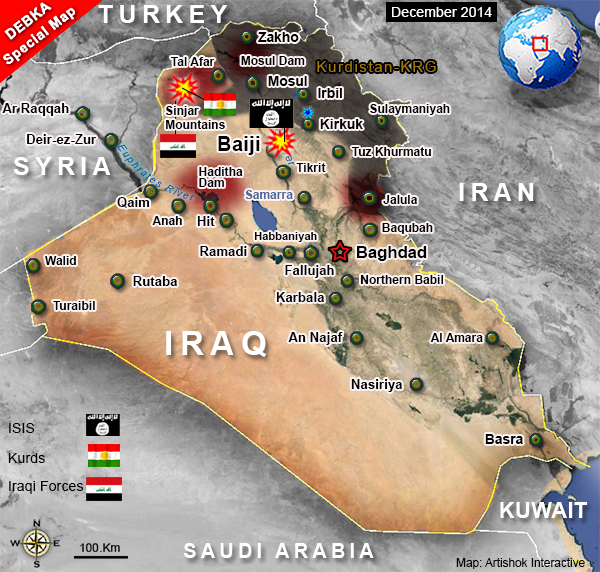
IraqBaiji

American, Kurdish and Iraqi officials have hailed as a “major victory” the release of thousands of distressed members of the Yazdi community, trapped for four months on on Mt. Sinjar in northern Iraq, since Islamic State thugs overran their town. Many more fled to Syria while Yazdi women were kidnapped.

This was a necessary rescue operation, but hardly a major victory, say DEBKAfile’s military experts. ISIS continues to maintain its grip on vast stretches of Iraq and Syria, defying the efforts of sparse US and coalition air strikes to dislodge them – beyond minor tactical withdrawals.

The town of Sinjar is not mentioned in the US and Kurdish releases, because large sections are still in jihadi hands.

Even less is heard about the situation on the northern Iraqi-Syrian border, where Abu Bakr Al-Baghdadi has achieved almost total supremacy.

But the most telling omission by the US-led allies is the fact that, while they focused on Mt. Sinjar, ISIS forces restored their siege of Baiji, Iraq’s main oil refinery center, after pushing Iraqi troops out.

This happened after a majority of the local Sunni tribes who fought alongside the Iraqi army up until November, switched sides.

The tribal chiefs complained that the Iraqi Prime Minister Haider al-Abadi, who was installed in Baghdad with Washington’s support last year, as a figure able to unite the country’s Sunni and Shiite communities for the war on ISIS, reneged on his promise of pay checks and weapons for the tribesmen who threw in their lot with the national army.

Instead, he is accused of aggravating disunity in the armed forces by firing Sunni officers and replacing them with officers loyal to Iraq’s pro-Iranian Shiite militias, who take their orders from Iranian Revolutionary Guards Corps commanders.

DEBKAfile’s military and counter-terrorism sources describe the current military state of play in Iraq as bizarre, fought on three more or less disconnected levels:

1.  In the north, a mixed Iraqi-Kurdish force, accompanied by US military advisers, is poised to attack the key town of Tal Afar, which lies 50 km west of Mosul.

Friday, Dec. 21, they took the town’s Iraqi military base that fell to ISIS in June. But, like in Sinjar, the assault force has not yet occupiedy the town.

This Tel Afar operation was a compromise in the disagreement the Iraqis and Kurds had with Washington. They asserted they were fully capable of recapturing Mosul from the Islamists, while the US military advisers disagreed and warned that this offensive was doomed to failure.

2.   While Iraqi and Kurdish peshmerga forces are concentrating their assaults on areas where ISIS forces are thin on the ground (like Mt. Sinjar), the jihadis are throwing strength into capturing and controlling the Iraqi and Syrian oil industries (like Baiji). They are by now accruing revenues running into $2 to 2.5 billion, despite falling crude prices. In fact they are dumping the looted oil for $25-30 per barrel, well below the world market prices.

3.  Washington is sparing too little attention for the ISIS outgrowths mushrooming outside Iraq and Israel – especially in Libya, Egypt and Egyptian Sinai.

In Iraq, Regionalism Another Casualty of Islamic State

December 6, 2014

In Iraq, Regionalism Another Casualty of Islamic State, World Politics Review, December 5, 2014

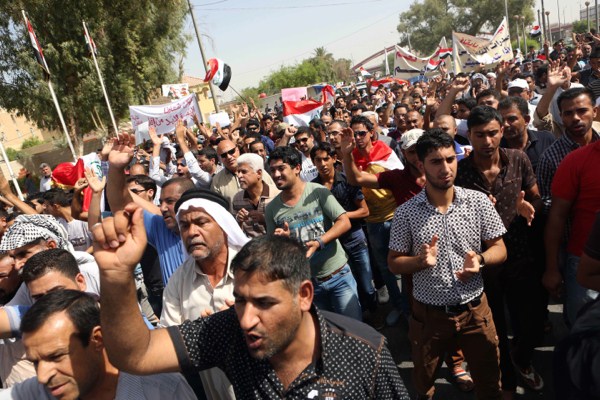
l_iraq_basra_12052014Residents chant slogans supporting the creation of Basra region, in front of the Basra provincial headquarters, Basra, Iraq, Sept. 27, 2014 (AP photo by Nabil al-Jurani)

As for regional governments, there will be no more of them. Iraqi Kurdistan will become independent at some point; it is a matter of when rather than if. The Sunni autonomy effort is dead, and the Shiite establishment will use all means fair and foul to ensure Basra is never autonomous. Right now the Sumer movement is mostly an Internet phenomenon without a mass street following, but were it to take off, it would destroy the state, not create an autonomous region.

*****************

The Iraqi government agreed Tuesday to a long-term oil wealth sharing deal with the Kurdistan Regional Government (KRG). In an email interview, Kirk Sowell, a political risk analyst who is the publisher of the biweekly newsletter Inside Iraqi Politics, discussed regionalism in Iraq.

WPR: What are the main non-Kurdish regional movements (i.e., potential autonomous regions) in Iraq, and what grievances are driving their regional aspirations?

Kirk Sowell: There are three. The first, chronologically speaking, is what might be called the “southernist tendency,” which has existed in two variants. One focused on Basra province, and another on combining Basra with the other southern oil producers, Maysan and Dhi Qar provinces. These were driven by a feeling of material deprivation, despite the wealth these provinces produce. The second is the Sunni Arab autonomy movement, driven by the abuses of former Prime Minister Nouri al-Maliki’s government, in particular illegal arrests. It started in Salah al-Din and Diyala provinces in late 2011 and made a second push through the Sunni protest movement of 2013. The third, newer tendency might be called “Sumerism,” and is essentially a Shiite effort to break the south and the center away from the Sunni Arabs and just have a state from the city of Samarra southward.

WPR: How have these movements been affected by the rise of the Islamic State, the post-Maliki political shifts in Baghdad and the oil revenue-sharing deal with the KRG?

Sowell: The southernist tendency has never really gotten off the ground. Referenda efforts have failed. The main party pushing it, the Islamist Fadhila, has lost seats, and its main secular proponent, Wael Abd al-Latif, failed to win a seat in Basra in the last election. The Sunni autonomy movement has essentially been destroyed by the jihadists’ dominance of more nationalist Sunni movements, and their leaders are now just trying to get more decentralized local control without full autonomy. The “Sumer” movement, on the other hand, was basically created by the jihadists’ unexpected success; its backers have lost patience with Sunni uprisings of any kind.

As for the potential Baghdad-Irbil oil deal, which is rather vague at points and will not be final until and unless it is passed into law, it is just a holdover deal until the Kurds are ready to declare independence. If it succeeds, the Kurds will have less need to rush that process, but it will not last forever.

WPR: What role can provincial and regional governments play in addressing Iraq’s challenges, including sectarianism, security and governance in general?

Sowell: Provincial governments could potentially play a role in improving governance, but their lack of independent revenue sources makes them dependent on Baghdad’s willingness to let them take control of service functions. So far a mixture of deliberate suppression and bureaucratic paralysis has frozen efforts at localization. Even where enshrined in statute, such as governors’ control over local security, Baghdad has held a firm grip, and it is unclear whether Prime Minister Hayder al-Abadi’s rhetorical support for a stronger provincial role will mean anything.

As for regional governments, there will be no more of them. Iraqi Kurdistan will become independent at some point; it is a matter of when rather than if. The Sunni autonomy effort is dead, and the Shiite establishment will use all means fair and foul to ensure Basra is never autonomous. Right now the Sumer movement is mostly an Internet phenomenon without a mass street following, but were it to take off, it would destroy the state, not create an autonomous region.

From Grief Over Kobane To Chaos: Istanbul’s Kurdish Riots

October 30, 2014

From Grief Over Kobane To Chaos: Istanbul’s Kurdish Riots, Vice News, October 30,2014

(Now Kurds in Turkey have a Marxist-Leninist martyr who was killed fighting the Islamic State in Kobane. — DM)

Uncertain Future for Kobane Prisoners: Turkey’s Border War (Dispatch 3)

October 21, 2014

Uncertain Future for Kobane Prisoners: Turkey’s Border War (Dispatch 3), You Tube, Vice News, October 20, 2014


Syria tribal revolt against Islamic State ignored, fueling resentment

October 21, 2014

Syria tribal revolt against Islamic State ignored, fueling resentment, Washington PostLiz Sly, October 20, 2014

(Aside from responding to anticipated domestic political pressure after the (non-Islamic) Islamic State beheaded an American, what are we doing in Iraq and Syria and why? Are we trying to win hearts and minds, to maintain the semblance of a coalition of the unwilling or merely to do “something?” — DM)

“When you see your relatives being slaughtered, you will be forced to accept compromises you would otherwise never have been prepared to accept,” he said. “And when you see the world has abandoned you, you will do nothing about it.”

******************

The cost of turning against the Islamic State was made brutally apparent in the streets of a dusty backwater town in eastern Syria in early August. Over a three-day period, vengeful fighters shelled, beheaded, crucified and shot hundreds of members of the Shaitat tribe after they dared to rise up against the extremists.

By the time the killing stopped, 700 people were dead, activists and survivors say, making this the bloodiest single atrocity committed by the Islamic State in Syria since it declared its existence 18 months ago.

The little-publicized story of this failed tribal revolt in Abu Hamam, in Syria’s eastern Deir al-Zour province, illuminates the challenges that will confront efforts to persuade those living under Islamic State rule — in Iraq as well as Syria — to join the fight against the jihadist group, something U.S. officials say is essential if the campaign against the militants is to succeed.

The Abu Hamam area has now been abandoned, and many of the bodies remain uncollected, offering a chilling reminder to residents elsewhere of the fate that awaits those who dare rebel.

Just as powerful a message for those living under the militants’ iron fist was the almost complete international silence on the bloodbath.

(Please go to the link for a video — DM)

The fiercest fighting in days shook the Syrian border town of Kobane, forcing more refugees to pour into Turkey for shelter from the violence. (Reuters)

News of the massacre coincided with President Obama’s decision to order airstrikes to turn back an Islamic State advance unfolding farther east in Iraq, toward the Kurdish regional capital of Irbil, as well as humanitarian airdrops to help desperate Iraqi Yazidis trapped on a mountain by the onslaught.

Many Syrians in the opposition are starting to complain about unequal treatment.

U.S. warplanes have carried out more airstrikes on Islamic State forces besieging the Kurdish town of Kobane on Syria’s border with Turkey than on any other single location in Iraq or Syria. And Washington announced Sunday that U.S. planes had airdropped weapons and medical supplies to the beleaguered Kurdish fighters there.

Yet even now, Washington has directed little effort toward helping Sunni Arabs who want to fight the militants but lack the resources to do so, said Abu Salem, who was among the Shaitat tribesman and rebel commanders who gathered recently in an apartment in the Turkish border town of Reyhanli to recount the killings of their clansmen.

“We saw what the Americans did to help the Yazidis and the Kurds. But they have done nothing to help the Sunnis against the Islamic State,” he said.

Abu Salem and the other men said they did not so much begrudge the efforts to help Kurds as wonder why no one had helped them when their community was under attack. The carnage inflicted on the Shaitat tribe has instilled in the Abu Hamam survivors a loathing for the Islamic State and the warped brand of Islamist politics for which it stands, said Abu Siraj, another of the tribesmen. A former lawyer, he, like most of the men, asked to be identified only by his nom de guerre because he fears being tracked even to Turkey by the jihadists.

“Now we hate everyone who prays,” he said. “Now we hate even beards.”

But finding support for efforts to organize against the militants is proving hard, he said, pulling out his mobile phone to show a photograph released that day of the trussed, decapitated body of a friend who had purportedly been caught attempting to throw a hand grenade against them.

“When you see your relatives being slaughtered, you will be forced to accept compromises you would otherwise never have been prepared to accept,” he said. “And when you see the world has abandoned you, you will do nothing about it.”

U.S. officials say the Kobane attacks were not intended to show preference for one community over another, but rather served as an opportunity to take aim at the large number of militant fighters who converged on the town to capture it. The Pentagon claims to have killed hundreds of Islamic State militants around Kobane, in keeping with the wider U.S. goal of targeting the Islamists’ infrastructure and resources in Syria to downgrade their ability to reinforce and finance their operations in Iraq.

The primary focus of the American strategy, Gen. Lloyd Austin, the U.S. Central Command leader, stressed last week, remains on Iraq, and on preventing the Islamic State from projecting power there.

“Iraq is our main effort, and it has to be,” he said at a news conference in Washington. “And the things we are doing right now in Syria are being done primarily to shape the conditions in Iraq.”

Such comments have reinforced perceptions among Syrians that the U.S.-led air war does not have their interests at heart. Differences over the purposes and direction of the war risk alienating the many rebel groups that were engaged in battling the Islamic State before the U.S. government intervened, said Steven Heydemann of the U.S. Institute of Peace.

“It’s already become an impediment,” he said. “I don’t think the administration has fully taken on board how much damage the way they’ve conducted this campaign has done to the relationships they’ve developed with some of these actors.”

‘We were finished’

The Sunni areas of Syria occupied by the Islamic State would seem to be a more likely venue for a revolt than Iraq, where the extremists’ extensive territorial gains this year were aided by local Sunni insurgents and tribes alienated by the discriminatory behavior of the Shiite-led Iraqi government.

In Syria, however, the Islamic State’s conquests came at the expense of local rebels who already had fought to eject their government and then found themselves outgunned and outmaneuvered by the newly emerging Islamist extremists.

The Shaitat tribe, along with many others in the oil-rich province of Deir al-Zour bordering Iraq, spent much of this year battling to retain control of their area against encroachments by the Islamic State, and they might have prevailed had the Islamic State not swept into the Iraqi city of Mosul in June, rebels say. The vast amounts of U.S. weaponry the Islamic State captured were trundled across the rapidly dissolving border with Syria, said Abu Salem, who commanded a rebel battalion in the area before he escaped to Turkey.

“After they took Mosul, we were finished,” he said.

Abu Hamam and a cluster of villages nearby were targeted. After the new armaments from Iraq arrived, “we realized we had no hope. We were surrounded. We wanted to save our people,” said Abu Abdullah, another of the Shaitat fighters, describing how they agreed to a truce with the militants in mid-July.

The Islamic State was permitted to enter the town and establish a garrison, but local leaders were left in charge, he said.

Relations quickly frayed. The crunch came, the tribesmen in Reyhanli said, when Islamic State fighters whipped a local man who was caught smoking a cigarette in the street, a crime under the Islamic State’s harsh interpretation of Islam. The man’s brother, incensed, shot at a passing Islamic State patrol, killing one of its fighters.

The brother was arrested and publicly beheaded, triggering an outpouring of rage. Residents marched on the Islamic State’s headquarters, forcing its fighters to flee. The militants then brought in reinforcements and began shelling the town, using artillery they had captured the previous month in Iraq.

After a three-day barrage, the Islamic State militants moved in. They rounded up all the surviving men and boys older than 15 they could find and set about systematically killing them, the fighters in Reyhanli said.

A photo essay on an Islamic State blog boasted of the different ways tribesmen were killed, including beheadings, mass shootings and a crucifixion. A video shows how the militants lined up scores of captives on a road, their hands bound, then set about clumsily decapitating them, one by one. The executioners, speaking in Tunisian, Egyptian and Saudi accents, taunted those not yet dead by swinging severed heads in front of their faces and telling them, “It’s your turn next.”

The tribesmen in Reyhanli, like many other rebel fighters in Deir al-Zour now living in Turkey or elsewhere in Syria, said they managed to slip away using fake identity cards or escape routes honed during their battle against the government.

They said they are plotting their return, to take revenge and fight — without counting on international support.

“We are tribal people. We will never forget to avenge,” said Abu Salem, the commander of the group. “But we will do it by ourselves, in our own way. We won’t take any help from anyone.”

U.S. Humanitarian Aid Going to ISIS

October 20, 2014

U.S. Humanitarian Aid Going to ISIS, Daily BeastJamie Dettmer, October 19, 2014

Not only are foodstuffs, medical supplies—even clinics—going to ISIS, the distribution networks are paying ISIS ‘taxes’ and putting ISIS people on their payrolls.

While aid is still going into ISIS-controlled areas, only a little is going into Kurdish areas in northeast Syria.

***************

GAZIANTEP, Turkey — While U.S. warplanes strike at the militants of the so-called Islamic State in both Syria and Iraq, truckloads of U.S. and Western aid has been flowing into territory controlled by the jihadists, assisting them to build their terror-inspiring “Caliphate.”

The aid—mainly food and medical equipment—is meant for Syrians displaced from their hometowns, and for hungry civilians. It is funded by the U.S. Agency for International Development, European donors, and the United Nations. Whether it continues is now the subject of anguished debate among officials in Washington and European. The fear is that stopping aid would hurt innocent civilians and would be used for propaganda purposes by the militants, who would likely blame the West for added hardship.

The Bible says if your enemy is hungry, feed him, and if he is thirsty, give him something to drink—doing so will “heap burning coals” of shame on his head. But there is no evidence that the militants of the Islamic State, widely known as ISIS or ISIL, feel any sense of disgrace or indignity (and certainly not gratitude) receiving charity from their foes.

Quite the reverse, the aid convoys have to pay off ISIS emirs (leaders) for the convoys to enter the eastern Syrian extremist strongholds of Raqqa and Deir ez-Zor, providing yet another income stream for ISIS militants, who are funding themselves from oil smuggling, extortion and the sale of whatever they can loot, including rare antiquities from museums and archaeological sites.

“The convoys have to be approved by ISIS and you have to pay them: the bribes are disguised and itemized as transportation costs,” says an aid coordinator who spoke to The Daily Beast on the condition he not be identified in this article. The kickbacks are either paid by foreign or local non-governmental organizations tasked with distributing the aid, or by the Turkish or Syrian transportation companies contracted to deliver it.

And there are fears the aid itself isn’t carefully monitored enough, with some sold off on the black market or used by ISIS to win hearts and minds by feeding its fighters and its subjects. At a minimum the aid means ISIS doesn’t have to divert cash from its war budget to help feed the local population or the displaced persons, allowing it to focus its resources exclusively on fighters and war making, say critics of the aid.

One of the striking differences between ISIS and terror groups of the past is its desire to portray the territory it has conquered as a well organized and smoothly functioning state. “The soldiers of Allah do not liberate a village, town or city, only to abandon its residents and ignore their needs,” declares the latest issue of the group’s slick online magazine, “Dabiq.” Elsewhere in the publication are pictures of slaughtered Kurdish soldiers and a gruesome photograph of American journalist Steven Sotloff’s severed head resting on top of his body. But this article shows ISIS restoring electricity in Raqqah, running a home for the elderly and a cancer treatment facility in Ninawa, and cleaning streets in other towns.

Last year, a polio outbreak in Deir ez-Zor raised concerns throughout the region about the spread of an epidemic. The World Health Organization worked with the Syrian government and with opposition groups to try to carry out an immunization campaign. This has continued. In response to a query by The Daily Beast, a WHO spokesperson said, “Our information indicates that vaccination campaigns have been successfully carried out by local health workers in IS-controlled territory.”

“I am alarmed that we are providing support for ISIS governance,” says Jonathan Schanzer, a Mideast expert with the Washington D.C.-based think tank Foundation for Defense of Democracies. “By doing so we are indemnifying the militants by satisfying the core demands of local people, who could turn on ISIS if they got frustrated.”

U.S. and Western relief agencies have been caught before in an aid dilemma when it comes to the war on terror. Last December, the Overseas Development Institute, an independent British think tank focusing on international development and humanitarian issues, reported that aid agencies in Somalia had been paying militants from the al Qaeda offshoot al-Shabab for access to areas under their control during the 2011 famine.

Al-Shabab demanded from the agencies what it described as “registration fees” of up to $10,000. And in many cases al-Shabab insisted on distributing the aid, keeping much of it for itself, according to ODI. The think tank cited al-Shabab’s diversion of food aid in the town of Baidoa, where it kept between half and two-thirds of the food for its own fighters. The researchers noted the al Qaeda affiliate developed a highly sophisticated system of monitoring and co-opting the aid agencies, even setting up a “Humanitarian Co-ordination Office.”

Something similar appears to be underway now in the Syrian provinces of Raqqa and Deir ez-Zor.

Aid coordinators with NGOs partnering USAID and other Western government agencies, including Britain’s Department for International Development, say ISIS insist that the NGOs, foreign and local, employ people ISIS approves on their staffs inside Syria. “There is always at least one ISIS person on the payroll; they force people on us,” says an aid coordinator. “And when a convoy is being prepared, the negotiations go through them about whether the convoy can proceed. They contact their emirs and a price is worked out. We don’t have to wrangle with individual ISIS field commanders once approval is given to get the convoy in, as the militants are highly hierarchical.” He adds: “None of the fighters will dare touch it, if an emir has given permission.”

That isn’t the case with other Syrian rebel groups, where arguments over convoys can erupt at checkpoints at main entry points into Syria, where aid is unloaded from Turkish tractor-trailers and re-loaded into Syrian ones.

Many aid workers are uncomfortable with what’s happening. “A few months ago we delivered a mobile clinic for a USAID-funded NGO,” says one, who declined to be named. “A few of us debated the rights and wrongs of this. The clinic was earmarked for the treatment of civilians, but we all know that wounded ISIS fighters could easily be treated as well. So what are we doing here helping their fighters, who we are bombing, to be treated so they can fight again?”

What becomes even more bizarre is that while aid is still going into ISIS-controlled areas, only a little is going into Kurdish areas in northeast Syria. About every three or four months there is a convoy into the key city of Qamishli. Syrian Kurds, who are now defending Kobani with the support of U.S. warplanes, have long complained about the lack of international aid. Last November, tellingly, Syrian Kurds complained that Syria’s Kurdistan was not included in a U.N. polio vaccination campaign. U.N. agencies took the position that polio vaccines should go through the Syrian Red Crescent via Damascus when it came to the Kurds.

The origins of the aid programs pre-date President Barack Obama’s decision to “degrade and defeat” ISIS, but they have carried on without major review. The aid push was to reach anyone in need. A senior State Department official with detailed knowledge of current aid programs confirmed to The Daily Beast that U.S. government funded relief is still going into Raqqa and Deir Ez-Zor. He declined to estimate the quantity. But an aid coordinator, when asked, responded: “A lot .”

The State Department official said he, too, was conflicted about the programs. “Is this helping the militants by allowing them to divert money they would have to spend on food? If aid wasn’t going in, would they let people starve? And is it right for us to withhold assistance and punish civilians? Would the militants turn around,. as al-Shabab did when many agencies withdrew from Somalia, and blame the West for starvation and hunger? Are we helping indirectly the militants to build their Caliphate? I wrestle with this.”

Western NGO partners of USAID and other Western agencies declined to respond to Daily Beast inquiries about international relief going to ISIS areas, citing the complexity of the issue and noting its delicacy.

Mideast analyst Schanzer dismisses the notion that ISIS can use an aid shutdown as leverage in its PR campaign: “I think this is false. In areas they control everyone understands they are a brutal organization. This is their basic weakness and by pushing in aid we are curtailing the chances of an internal revolt, which is the best chance you have of bringing down ISIS.”


Peshmerga head speaks of struggle against IS

October 18, 2014

Peshmerga head speaks of struggle against IS, Al-Monitor, Faraj Obaji, October 17, 2014

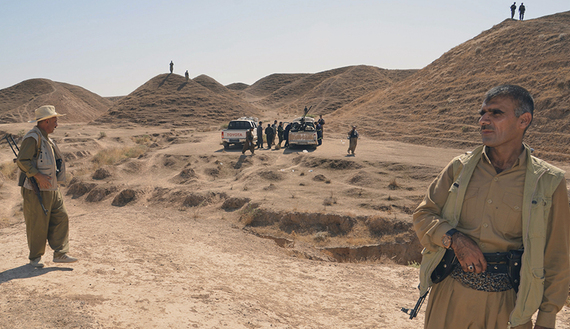
Kurdish peshmerga fighters stand guard around vehicles left behind by fleeing Islamic State militants during clashes in the al-Zerga area near Tikrit cityKurdish peshmerga fighters stand guard around vehicles with weapons and ammunition left behind by fleeing Islamic State militants during clashes in the al-Zerga area near Tikrit city in Salahuddin province, Oct. 8, 2014. (photo by REUTERS)

Commenting on the criticism of certain Kurdish parties inside Kobani, regarding the lack of support provided by KRG to the besieged city, he said, “Despite the differences with certain Kurdish political parties in the city, the KRG expressed its readiness to support our brothers in the city and we asked Washington and its allies to help the resisting Kurdish fighters.

“We helped them as much as possible, and the KRG’s president affirmed this. But, we cannot offer more. We are still waiting for international aid. The region initially includes 5 million people, add to that one and a half million displaced from Syria and the Iraqi provinces. We are helping them and taking care of them, and this is a huge burden.”

******************

Eliminating the Islamic State (IS) in Iraq does not seem to be an easy mission that will happen anytime soon; it seems rather impossible. The terrorist attacks against Iraq exposed how weak the Iraqi army is, how fragile its military structure and intelligence services are, and how it is unable to protect its country against any attack.

Some believe that the responsibility of the army’s failure to fight IS should be borne by the political authority ruling the country since 2004, which was unable to build an army based on a unified doctrine. Others consider the policies adopted by former Prime Minister Nouri al-Maliki faulty and the maliciousness allowed the terrorist group to enter the country, while the political conflicts between the central government and the Sunni leaderships provided an embracing environment for the group in Sunni provinces.

Secretary-General of the Ministry of Peshmerga Lt. Gen. Jabbar Yawar spoke to An-Nahar regarding the situation in Iraq in general, and in the Kurdistan Regional Government (KRG) in particular, in light of the IS threat, which occupied a number of Iraqi provinces, reaching the besieged Kobani.

The peshmerga harasses IS

The Kurdish military leader welcomed the international aid provided to the KRG, which is fighting a crucial battle against IS. He said, “The military aid which reached KRG saved it from falling into the hands of the terrorist group and allowed peshmerga forces to move from the negative defense position to the striker position, inflicting heavy losses on IS.”

Yawar does not hesitate to say, “The peshmerga forces’ position in the fight against IS is much better than the Iraqi army’s position. We are in a continuous fight along the 1,050-kilometer [650-mile] border of five Iraqi provinces, starting from Mosul to Erbil and passing through Kirkuk, Saladin and Diyala.”

He said, “The peshmerga forces have liberated the Mosul Dam and continues to liberate the rest of the regions that have fallen into the hands of IS, while creating plans to completely achieve this.”

The fall of Mosul and Anbar

Yawar attributed the fall of Mosul and Anbar to several reasons, most importantly, the fragility of the army in both provinces. He said, “The army in Mosul was fragile, and its six military units failed to withstand IS. There were also the political conflicts between the Sunni blocs and the government in Baghdad, which prevented these forces from fighting IS in Mosul, Saladin and parts of Kirkuk. These forces either handed over their advanced and heavy weapons to the group and fled, or joined and began to fight alongside IS.”

“The lack of a unified fighting doctrine among the army, and the shortage of air support, were all elements that contributed in the army’s quick collapse and IS’ occupation of a number of Iraqi provinces, especially the Sunni ones,” he said.

The difficulty in liberating Sunni regions

On the subject of the army’s situation in provinces in general, Yawar said that he found “a certain difficulty in liberating the Sunni-dominated regions from IS, such as Anbar, Saladin and Mosul, especially after it fell into the hands of the terrorists who took over its weapons on June 10.” He said that although they used all available means, the Iraqi forces were unable to liberate the city of Heet in Anbar and Tikrit, the center of Saladin province. “The situation on the field unfortunately proves that IS only controls the Sunni-dominated regions. We hope that our Sunni brothers, who are suffering the group’s injustice, will cooperate with the federal government and the KRG in order to eliminate this terrorist group,” he explained.

How did IS reach Erbil’s borders?

When asked how IS was able to reach KRG even though its intentions to occupy the region were obvious, Yawar answered with regret: “We knew before the group attacked Mosul on June 10 that it was up to no good in Iraq and Mosul. We were alerted by the joint committees and meetings that we used to hold in Baghdad, that there were some suspicious and dangerous movements on the borders with Syria. We were advised to strike them at an early stage, but we did not listen. The federal government and its former prime minister, Nouri al-Maliki, believed our proposals were political outbidding. Even when IS attacked Mosul, we asked them to allow us to support the federal forces there, but they told us that they were able to fight back themselves. Then Mosul fell, its residents fled and, due to Maliki’s faulty policy, IS was able to reach Baghdad’s borders.”

When asked why the terrorist group was able to reach Erbil, Yawar said, “When IS’ attack began, the peshmerga fought with all its strength, but it does not own advanced weapons such as the ones the group took from Mosul, because Maliki’s government never reinforced, trained or funded the peshmerga forces, although they are official governmental forces, according to the federal constitution.

“Despite all this, the peshmerga withstood IS from June 10 until the beginning of August. However, when we ran out of munitions and had no source of getting any, the group was able to penetrate our defense and move toward Erbil. Yet, thanks to Washington’s assistance and some of the countries participating in the international alliance, we were able to change the negative defense equation in Erbil and attack IS to liberate our lands,” he said.

Baghdad will not fall

The Kurdish leader ruled out the possibility of Baghdad falling for the time being, according to the available security data. “Until now, the Iraqi army can protect Baghdad and prevent the penetration of IS, which has spread in neighboring regions, such as Amiriya, Fallujah, Saqlawiyah and Ramadi,” he said.

We helped Kobani as much as we could

Commenting on the criticism of certain Kurdish parties inside Kobani, regarding the lack of support provided by KRG to the besieged city, he said, “Despite the differences with certain Kurdish political parties in the city, the KRG expressed its readiness to support our brothers in the city and we asked Washington and its allies to help the resisting Kurdish fighters.

“We helped them as much as possible, and the KRG’s president affirmed this. But, we cannot offer more. We are still waiting for international aid. The region initially includes 5 million people, add to that one and a half million displaced from Syria and the Iraqi provinces. We are helping them and taking care of them, and this is a huge burden.”

Yawar said, “The region has not been able to help Kobani like it should, due to its tough and complex geographic location, as it is 300 kilometers [185 miles] from the Syrian border, and it’s hard for aid to reach it. Kobani’s situation is geographically similar to Gaza or Sinjar.”

Raids

Yawar is not afraid that IS, which he believes is an extension of al-Qaeda in Afghanistan, will persist. He said, “The situation in Iraq and Syria today is similar to that of Tora Bora and Afghanistan. The airstrikes are beneficial for the peshmerga, Kobani and even for the Iraqi government, as they halt the advance of IS militants and drain them. These strikes also destroy IS warehouses and heavy weapons. But, to free these areas completely from IS, a comprehensive international operation should be put in place, like the one in Afghanistan, and there should be an actual training campaign for the Iraqi forces to defend themselves. However, I rule out the possibility of a foreign land intervention in Iraq, with the existing conflict between the ruling political parties.”

No Kurdish expansion

Political circles have been talking about a Kurdish expansion in an attempt to build the awaited state. In this regard, Yawar says, “We are part of the federal state, and neither of us expands into the other’s territories. Until now, there aren’t any official international borders between us and the federal state. We have some problems in many regions administratively. But the KRG and Baghdad are both facing IS threat. We should destroy it first, then resort to the constitution to solve the pending problems with the Baghdad government regarding the land, oil, the budget and Peshmerga.”