Archive for the ‘Khamenei’ category

Iran’s Forces Outnumber Assad’s in Syria

November 24, 2016

Iran’s Forces Outnumber Assad’s in Syria, Gatestone Institute, Majid Rafizadeh, November 24, 2016

Pursuing a sectarian agenda, Iranian leaders have also fueled the conflict by sending religious leaders to Syria to depict the conflict as a religious war.

Iran’s military forces and operations in Syria are significantly more than what has been generally reported so far.

The Syrian war has led to the rise and export of terrorism abroad as well as to one of the worst humanitarian tragedies, in which more than 470,000 people have been killed.

Iran has played a crucial role in maintaining in power President Assad, who has repeatedly used chemical weapons on civilians. Iran has promoted continuing the conflict.

2070

While, according to reports by Iran’s Islamic Revolutionary Guard Corps (IRGC), the Syrian military has fewer than 50,000 men, Iran has deployed more than 70,000 Iranian and non-Iranian forces in Syria, and pays monthly salaries to over 250,000 militiamen and agents. According to a report entitled, “How Iran Fuels Syria War,” published by the National Council of Resistance of Iran (NCRI), non-Iranian mercenaries number around 55,000 men; Iraqi militias are around 20,000 men (from 10 groups), Afghan militias are approximately 15,000 to 20,000 men, Lebanese Hezbollah are around 7,000 to 10,000 men, and Pakistani, Palestinian and other militiamen number approximately 5,000 to 7,000.

In addition, the composition of Iranian IRGC forces are around 8,000 to 10,000 men, and 5,000 to 6,000 from the regular Iranian Army.

The major Iranian decision-makers in the Syrian conflict are Supreme Leader Ayatollah Ali Khamenei and the senior cadre of the Revolutionary Guards. Iran’s so-called moderate leaders — including President Hassan Rouhani and Foreign Minister Javad Zarif — are also in favor of Iran’s military, advisory, financial, and intelligence involvement in Syria. Rouhani repeatedly announced his support for Assad and pledged to “stand by [Syria].”

Khamenei insists on using more military power in Syria:

“[I]n December 2015, Khamenei ordered the IRGC to stand fast in the Aleppo region. He reiterated that if they retreated, their fate would be similar to the Iran-Iraq war and the regime would ultimately be defeated in Syria. Thus, in January 2016, the IRGC doubled the number of its forces in Syria to about 60,000 and launched extensive attacks in the region. However, despite tactical advances in some areas, these forces have been unable to even take control of southern Aleppo. IRGC faced a deadlock. In March 2016, Khamenei ordered the regular Army’s 65th Division (special operations) to be deployed around Aleppo, and increased the number of other forces as well. Plans for a major offensive to capture Aleppo were set in motion. During attacks by the IRGC and the Iranian army in April 2016, dozens of the regime’s forces, including IRGC commanders and staff, Iranian army personnel and foreign mercenaries from Iraq, Lebanon and Afghanistan, were killed. Although the IRGC and the Iranian regime’s regular army forces have failed to change the balance of military power in Syria, Khamenei insists on sending more IRGC and army forces into the Syrian quagmire. Seeing no way forward, and no way back.”

Iran has also played critical role in pushing Russia to intensify its military involvement in Syria by providing air support, so that the IRGC and its allies could help Iran’s military make quick territorial gains.

Iran has spent approximately USD $100 billion on the Syrian war. The sanctions relief given to Iran as a result of the “nuclear agreement” has significantly assisted the Iranian leaders’ ability to continue the war.

Iran also pays salaries to non-Iranian militias to participate in the war: “The Tehran regime spends one billion dollars annually in Syria solely on the salaries of the forces affiliated with the IRGC, including military forces, militias, and Shiite networks.”

Iran, for example, pays nearly USD $1,550 a month to the IRGC’s Iraqi mercenaries who are dispatched to Syria for a month-and-a-half, and approximately USD $100-200 a month to the Syrian militia fighters from the Syrian National Defense.

Pursuing a sectarian agenda, Iranian leaders have also fueled the conflict by sending religious leaders to Syria to depict the conflict as a religious war.

“Iran’s ruling regime has deployed a vast network of its mullahs to Syria, where their warmongering stirs up the fighters. And much like during the Iran/Iraq War, religious zealots are also sent to Syria to fuel the flames of religious fervor among the IRGC’s Basiij fighters and Afghan and Iraqi mercenaries.”

Iran has divided Syria into five divisions and haד over 13 military bases including the “Glass Building” (Maghar Shishe’i), which is the IRGC’s main command center in Syria, located close to the Damascus Airport. The IRGC placed its command center near the airport because,

“the airport would be the last location to fall. IRGC forces airlifted to Syria are dispatched to other areas from this location. One of the commanders stationed at the Glass Building is IRGC Brig. Gen. Seyyed Razi Mousavi, commander of IRGC Quds Force logistics in Syria. Between 500 and 1,000 Revolutionary Guards are stationed there.”

Other Iranian bases are scattered across Syria including in Allepo, Hama, and Latakia.

Since Brig. General Hossein Hamedani was killed in Syria, the current command of Iran’s forces in Syria lies with the Command Council, whose members include: IRGC Brig. Gen. Esmail Qaani (deputy of Qassem Soleimani who is the commander of the Quds Force) and IRGC Brig. Gen. Mohammad Jafaar Assadi (aka Seyyed Ahmad Madani).

The Syrian conflict has become the “root cause” of terrorism, which does not recognize borders and has spread to Europe and America. Since the Syrian war is the epicenter of terrorism, fighting terrorist groups such as ISIS without resolving the Syrian conflict is fruitless.

Terrorist groups such as ISIS are the symptoms, and the Syrian war is the disease. We need to address the disease and the symptoms simultaneously.

The best strategic and tactical approach is to cut off the role of a major player in the conflict: i.e. Iran. Without Iran, Assad would most likely not have survived the beginning phase of the uprising.

Iran kept Assad in power and gave birth to terrorist groups such as ISIS. In other words, Iran and Assad are the fathers of ISIS. Iran and Assad also played the West by claiming that they are fighting terrorism.

Considering the military forces and money invested in Syria, Iran is the single most important player in the Syrian war, and has tremendously increased radicalization of individuals, militarization and terrorism. Iran benefits from the rise of terrorism because it expands its military stranglehold across the region. Iran is top sponsor of terrorism, according to the latest report from U.S. State Department.

Iran will not agree to abandon Assad diplomatically.

In order to resolve this ripe environment of conflict for terrorism in Syria, Iran’s financial and military support to Assad should be strongly countered and cut off.

Iranian Official: ‘If America Wants To Try Its Luck Against Us, [It Should Know That] We Are Completely Capable Of Mobilizing 9 Million Fighters… In Under 10 Days’; ‘We Have Warehouses Full [Of Missiles]… That Can Hit Tel Aviv’

October 3, 2016

Iranian Official: ‘If America Wants To Try Its Luck Against Us, [It Should Know That] We Are Completely Capable Of Mobilizing 9 Million Fighters… In Under 10 Days’; ‘We Have Warehouses Full [Of Missiles]… That Can Hit Tel Aviv’ MEMRI, October 2, 2016

In a September 25, 2016 speech to a Tehran political circle, Mohsen Rafighdoost, who was minister of the Iran’s Islamic Revolutionary Guard Corps (IRGC) during the 1980-88 Iran-Iraq War and who heads the Noor Foundation,[1] said that the secret of the victory of Iran’s Islamic Revolution was Iranians’ total obedience to the leader. He said that today the IRGC ground forces are “five times better” than the U.S. Army, and that the Iranian regime is capable of deploying nine million troops against it in less than 10 days.

Rafighdoost added that Iran’s missiles in Tehran and the northwest of the country can reach Tel Aviv, and expressed his yearning for Israel to launch a missile at Iran so that Iran could “flatten Tel Aviv.” He also said that Islamic Revolution founder Ayatollah Khomeini established Hizbullah in Lebanon to promote the Islamization of other countries,[2] and that today, in the era of Supreme Leader Ali Khamenei, the organization has become “a supreme force in the region.”

30165Mohsen Rafighdoost. Source: Wilayah.info, January 27, 2014.

Following are his September 25 statements:

“The IRGC’s Ground Forces Are Perhaps Five Times Better Than The American Army”

“The factor that led to our victory in the [Iran-Iraq] War is [the same] factor that led to our victory in the [Islamic] Revolution. The Imam [Khomeini], in France, would order a parade [to be held in Iran], and the people would hold a parade, even in remote villages.

“During the eight years of the imposed war, not only was not one inch of Iranian land surrendered to the enemy, but we also acquired deterrent capability. I believe that as long as the Islamic Revolution stands against the Western and Eastern camps, we will be under military sanctions. We must never think that the world will provide us with military aid. Thanks to the war and its martyrs, Iran currently has deterrent capability. After a while, the Imam [Khomeini] replaced the call of ‘war, war to victory’ with ‘war, war until the fitna is removed.’ At the time, we understood this call as meaning that ‘we must be so strong that the enemy will not even think of a military strike against Iran.’

“Today, Iran has deterrent capability. In recent years, the enemies have spoken of the option [of a military strike against Iran] as being on the table, but that was a lie. [Our] air force and navy are good, but it is [our] ground forces that finish the war. The IRGC’s ground forces are perhaps five times better than the American army.

“Despite all the enemy media and cultural propaganda against us, if America wants to try its luck against us, [it should know that] we are completely capable of mobilizing nine million fighters [against it]… on the [battle]front in under 10 days.”

“If Only A Single [Israeli] Shell Would Strike Anywhere In This Country – So That We Can Flatten Tel Aviv”

“We have warehouses full [of missiles] in Tehran, Zanjan [in northwest Iran] and Oshnavieh [in Western Azerbaijan Province in northwest Iran] that can strike Tel Aviv. If only a single [Israeli] shell would strike anywhere in this country, so that we can flatten Tel Aviv.”

In Khamenei’s Era, Hizbullah “Has Become A Supreme Force In The Region”

“In accordance with his secondary plan, the Imam [Khomeini] created Hizbullah in Lebanon. This plan was [aimed at] Islamizing other countries. Today, in the era of the Leader [Khamenei, Hizbullah] has become a supreme force in the region.

“Despite all the criminal [plots], Iranian security forces grow stronger every day. Some of the statements being put out there are made out of lack of awareness, and anyone who makes them is ignorant.[3]

“The secret to victory lies in wise and complete obedience to the leader [Khamenei]. During the time of the Imam [Khomeini], we obeyed him, and today we obey the leader [Khamenei].”[4]


Endnotes:


[1] Since 1999, Mohsen Rafighdoost has been director of the Noor Foundation, which reportedly owns significant real estate and has revenues of over $200 million from importing pharmaceuticals, sugar and construction materials.

[2] During the 1980s, Rafighdhoost was involved in the creation of Hizbullah in Lebanon and likely had knowledge of its terror activities in Beirut.

[3] A reference to Hashemi Rafsanjani’s August 20, 2016 call for investing in Iran’s economy instead of in its the military, as Japan and Germany did post-World War II. MEMRI is soon publishing a report on Rafsanjani’s statements and reactions to them.

[4] Khabaronline.ir, September 25, 2016.

In Contrast To Rohani Allegations In UNGA, Senior Iranian Officials Confirm U.S. Has Met Its Obligations Under JCPOA

September 24, 2016

In Contrast To Rohani Allegations In UNGA, Senior Iranian Officials Confirm U.S. Has Met Its Obligations Under JCPOA, MEMRI,  Y. Carmon and A. Savyon* September 23, 2016

Introduction

In his September 22, 2016 speech at the UN General Assembly, Iranian President Hassan Rohani accused that the U.S. is not meeting its obligations towards Iran under the JCPOA. He said: “The lack of compliance with the deal on the part of the United States in the past several months represents a flawed approach that should be rectified forthwith… Any failure on the part of the United States in implementing it (the deal) would constitute an international wrongful act and would be objected to by the international community.”[1] 

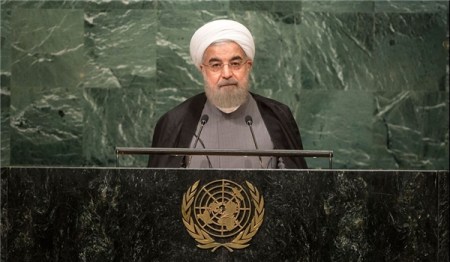
30061Rohani at the UNGA (Image: Farsnews.com, September 22, 2016)

Rohani’s statements, which are part of an Iranian attempt in recent weeks to create a false impression that the U.S. has not met its obligations towards Iran, are in stark contradiction to statements made by senior members of the Iranian negotiation team who explicitly admitted that the U.S. has in fact met its obligations under the JCPOA (see below).

This Iranian measure is a response to the refusal of Western banks to conduct transactions with Iran in dollars, despite the lifting of the nuclear sanctions in January 2016, because the initial sanctions imposed on Iran by Congress for human rights violations and for terrorism are still in force. As will be recalled, Iran refuses to negotiate with the West on issues of terrorism, on the grounds that these issues are internal sovereign matters.

Below is a MEMRI report on this issue published on August 15, 2016.

As the first year of the JCPOA is marked, and in light of Western banks’ rejection of Iranian transactions in dollars, Iranian Supreme Leader Ali Khamenei and his supporters in the West have launched a campaign to pressure the U.S. to lift the initial sanctions imposed on Iran by Congress for human rights violations and for terrorism. Their aim is to have these sanctions lifted without negotiations and without giving anything in return.

As will be recalled, Iran from the outset restricted the framework of the negotiations to the nuclear issue, and refused to allow them to include other issues such as human rights, terrorism, or missiles, which it considers internal sovereign matters. Therefore, the initial American sanctions concerning these areas remain in force.

A demand for lifting of all the sanctions, including the initial ones, was made by Supreme Leader Ali Khamenei in the months after the JCPOA was achieved in July 2015.[2] Perhaps Tehran thought that with the lifting of the nuclear sanctions, the entire sanctions regime would collapse, including those concerning human rights, terrorism, and missiles. But this did not happen. The U.S. Treasury Department is following the letter and the spirit of U.S. law, and is warning banks worldwide that the initial sanctions remain in force.[3]

In light of this situation, Iran and the supporters of its regime in the West are now working to create a false impression that the U.S. has not met its obligations towards Iran. They claim that, in order to fulfill its commitments towards Iran in the JCPOA, the U.S. is obligated to revoke or circumvent the initial sanctions imposed on Iran by Congress, which currently prevent banks from dealing freely with Iran.  For example, Tyler Cullis, member of the Iranian lobby in the U.S., the National Iranian American Council (NIAC), stated in a recent policy paper that “the United States is committed to ensuring that neither U.S. law nor policy is standing in the way of non-U.S. banks resuming correspondent banking relations with their Iranian counterparts… If U.S. laws or policies are interfering with Iran realizing the full benefit of the lifting of sanctions on Iran’s financial institutions, then the U.S. is required to take steps to ensure that those laws or policies no longer are running such interference. To do so could require additional changes to U.S. laws or policies governing the issue.”[4]

Iranian Deputy Foreign Minister and negotiating team member Majid Takhtravanchi also demanded that the U.S. take explicit steps to remove any obstacles currently preventing banks from dealing with Iran. He said on June 27, 2016,: “Two [contradictory] messages are coming out of Washington: The State Department says that there is no problem carrying out banking and financial transactions with Iran, while the OFAC says the opposite… We want the OFAC… to guarantee that there is no problem for the banks that are cooperating with Iran…”[5]

It should be mentioned that the Iranian implication that the U.S. has not met its obligations towards Iran stands in contradiction to explicit statements made recently by Iranian officials, mainly negotiation team members from Iran’s pragmatic camp, who confirmed that the U.S. had upheld its part of the JCPOA. Deputy Foreign Minister and senior negotiating team member ‘Abbas Araghchi said on a television special marking the first anniversary of the JCPOA: “Both sides have met their obligations under the JCPOA… In order to benefit from the JCPOA… we must carry out several steps because there are restrictions that are not connected to the JCPOA… The other side has implemented its obligations, and if it had not, that would have been a violation of the JCPOA, and we would have handled it in the Joint Committee…

“The JCPOA was meant to remove the obstacles of the sanctions from Iran’s economic path. [Indeed], these obstacles have been removed, but there are other obstacles, such as the initial sanctions by America, FATF [Financial Action Task Force on Money Laundering], and laws connected to money-laundering, which require time [to take care of].

“From the outset, [the other side] was not meant to lift the sanctions that are not connected to the nuclear issue; that is written even in the [2013] Geneva Joint Plan of Action [about the lifting of] ‘sanctions related to the nuclear [issue], because we were negotiating about the nuclear issue [alone]…

“The sanctions on the dollar and the use of the financial apparatus of America belong to the initial sanctions imposed long ago because of issues that are not nuclear-related… We raised the matter in the negotiations, but the Americans did not agree to lift these sanctions… and demanded additional concessions [from us] in matters that were part of our red lines…

“The Americans are serious about maintaining their initial sanctions; this is the essence of America. Iran is Iran and America is America, and as long as we do not negotiate on bilateral relations [with the U.S.], these sanctions will remain in force. The American Treasury Department tells [the banks worldwide] that these sanctions are in force, and has warned them not to get in trouble because of them. These sanctions are not related to the JCPOA.”[6]

Deputy Foreign Minister and negotiating team member Hamid Ba’idinejad said at a press conference marking the first anniversary of the JCPOA: “Up to this very moment, the members of the [Iranian] negotiating team believe that the JCPOA has not been violated [by the U.S.], and still believe that it is possible to solve the problems [concerning transactions in dollars] with discussions, recommendations, and talks… From the outset, the task set out [for the Iranian negotiating team] was to resolve the nuclear issue [alone]. So far, the Islamic Republic has made no decision to negotiate with America on [the other] issues in dispute…

“Our regime never expected us to achieve the lifting of the sanctions for human rights [in the framework] of the nuclear talks.”[7]

Expediency Council head Ali Akbar Hashemi Rafsanjani said: “America is telling [the banks worldwide] that it has not lifted the [initial] sanctions because this problem is related to human rights, terrorism, Palestine, and Lebanon. These [issues] too we could have solved.”[8]

However, after Khamenei warned, on August 1, 2016, that the U.S. had violated its commitments, the negotiating team heads fell into line with him, and began to state that the U.S. had indeed violated its obligations and to demand further changes in U.S. policies and laws.

A U.S. capitulation to these Iranian demands would be a blow to the authority of Congress, which imposed the initial sanctions, and to the separation of powers in the U.S. Moreover, it would constitute U.S. support for Iran’s ideological camp – Khamenei, Iran’s Islamic Revolutionary Guard Corps (IRGC), the Basij, and the ayatollahs connected to them – and not to the pragmatic camp, and would also stand in contradiction to President Obama’s commitment that the JCPOA deals only with the nuclear issue.


* Y. Carmon is President of MEMRI; A. Savyon is the director of MEMRI’s Iran Media Project


Endnotes:


[1] Farsnews.com, September 22, 2016.

[2] See MEMRI Special Dispatch No. 6151, Khamenei Declares That He Will Not Honor The Agreement If Sanctions Are Merely Suspended And Not Lifted, September 4, 2015.

[3] See MEMRI Inquiry and Analysis No. 1249, Post-JCPOA, The IRGC Is The Factor Stopping Iran From Integration Into The Western Economy, May 20, 2016.

[4] Niacouncil.org, August 2016.

[5] Tabnak (Iran), July 27, 2016.

[6] Fars (Iran), July 11, 2016.

[7] Fars (Iran), July 13, 2016.

[8] Fars (Iran), August 10, 2016.

Iran: The Return of Ahmadinejad and Co.

September 5, 2016

Iran: The Return of Ahmadinejad & Co., Gatestone InstituteMajid Rafizadeh, September 5, 2016

♦ Iran’s Supreme Leader and the senior cadre of the Islamic Revolutionary Guard Corps have been vocally critical of the nuclear deal. They fear further diplomatic and political rapprochement between the US and Iran, now that they have already achieved their objectives of the lifting of the four major rounds of the UN Security Council’s sanctions.

♦ After the nuclear deal was implemented, polls showed that 63% of Iranians expected to see improvements in the economy and living standards within a year. But currently, in a new poll, 74% of Iranians said there had been no economic improvements in the past year.

Iran’s former president, Mahmoud Ahmadinejad, saying he wants to “redefine revolutionary ideals” set up by the leader of Iran’s 1979 Islamic revolution, Ayatollah Ruhollah Khomeini, appears to be launching a campaign to run in the upcoming Iranian presidential elections, in February, 2017.

Ahmadinejad was well-known for his incendiary and provocative speeches, which included denying the Holocaust. At the end of his presidential term, from 2005 to 2013, his approval rating was extremely low, and he managed to drive away most constituents across political spectrum, including the topmost hardline leaders. He also became the first Iranian president since 1979 to be summoned by the parliament (Majlis) to answer questions regarding his activities and policies.

After all of this, the common conception among politicians, scholars and policy analysts was that Ahmadinejad would never return to politics. It seemed that his retirement plan focused on founding a university and teaching, but his plan to open a university failed.

Despite his low popularity among people, however, the “principalists” (ultra-conservatives) were still on his side, due to his fierce anti-US, anti-Western and anti-Israel policies and rhetoric, as well as the fact that he remains a major figure in the coalition of several conservative groups, the Alliance of Builders of Islamic Iran.

After Ahmadinejad’s presidency, Iran’s Supreme Leader, Ayatollah Ali Khamenei, appointed him to the Expediency Council, Iran’s highest political arbitration body, which arbitrates between the Guardian Council (the supervisory body over the parliament and elections) and the Islamic Consultative Assembly (parliament). The Expediency Council is predominantly made up of Iran’s hardline clerics, and functions as an advisory institution to the Supreme Leader.

Although it seems that Ahmadinejad did not have any intention of returning after being out of the international spotlight for two years, other factors show that he never really left. Domestically, Ahmadinejad remained politically active, trying to unify and lead the hardliners. Since he left office, he has continued holding meetings with former ministers in Tehran.

In the last few months, however, Ahmadinejad’s desire to launch his campaign more forcefully and determinedly has become clearer as, once again, he began attracting the international spotlight, such as when he wrote an open letter to US President Barack Obama, demanding the transfer of $2 billion to Iran.

To capitalize on the popular vote and the presidential elections of 2017, Ahmadinejad has been focusing on attracting constituents from around Iran by traveling to smaller cities and towns, giving lectures and speeches; supporters of Ahmadinejad have called for his return.

During his presidency, people enjoyed subsidies on items including petrol, natural gas and electricity, and his government distributed monthly cash handouts of about $17 to every person. These, as well as criticism of corruption, injustice, and capitalism, were appealing to the rural population and the less affluent.

Ahmadinejad has also been vehemently criticizing Hassan Rouhani, the current Iranian president, as incompetent, and questioning his economic and foreign policies, and pointing out that, “There will be bumps and satanic obstacles in our path… One should not forget that the US is our enemy.”

The latest poll by the Center for International and Security Studies at the University of Maryland revealed that “Ahmadinejad now represents the single largest threat to Rouhani’s re-election, and trails the once-popular incumbent by only eight points. Suddenly, the ex-president seems once again to be a real political contender.”

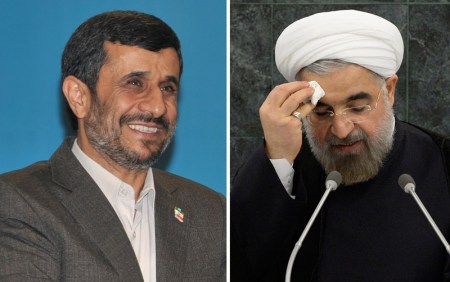
1839Mahmoud Ahmadinejad (left) can indeed be a viable contender against incumbent President Hassan Rouhani (right) in Iran’s 2017 presidential election, and is more likely the choice of the Supreme Leader and hardliners.

This is a ripe environment for him for several reasons.

First of all, the nuclear deal has become a popular issue among the hardliners. The Supreme Leader and senior cadre of the Islamic Revolutionary Guard Corps (IRGC) have been vocally critical of the nuclear deal. They fear further diplomatic and political rapprochement between the US and Iran, now that they have already achieved their objectives of the lifting of the four major rounds of the United Nations Security Council’s sanctions.

Ayatollah Khamenei warned against any relations with the US, and he also questioned the economic benefits of the nuclear agreement: “Weren’t the oppressive sanctions lifted so that the people would feel a change in their lives? Has there been a tangible effect on the people’s lives in the past six months?”

Second, the popularity of the nuclear deal has been on a decline among the population as well. After the nuclear deal was implemented, polls showed that 63% of Iranians expected to see improvements in the economy and living standards within a year. But currently, in a new poll, 74%of Iranians said there had been no economic improvements in the past year.

Ahmadinejad can indeed be a viable contender against Hassan Rouhani, and is more likely the choice of the Supreme Leader and the IRGC leaders, and the candidate favored by the hardliners and principalists.

Why Obama Turned His Back on the “Green Revolution” in Iran

August 25, 2016

Why Obama Turned His Back on the “Green Revolution” in Iran, Power LinePaul Mirengoff, August 25, 2016

Most readers, I’m pretty sure, recall that in the summer of 2009, after the dubious election of Mahmoud Ahmadinejad, Iranians began an uprising. They hoped for support of some kind from the United States. That that support didn’t come.

Instead, as Eli Lake reminds us, President Obama publicly downplayed the prospect of real change, saying that the candidates whom hundreds of thousands of Iranians were risking their lives to support did not represent fundamental change.

Contrast that with his laughable claim that the election of the puppet Rouhani years later showed that Iran had changed to the point where we should end sanctions as part of a nuclear deal.

Behind the scenes, Obama overruled advisers who wanted to do what America had done at similar transitions from dictatorship to democracy, and signal America’s support. He ordered the CIA to sever contacts it had with the green movement’s supporters — this according to a new book, The Iran Wars, by the Wall Street Journal’s Jay Solomon, which Lake discusses.

Obama’s approach to Iran’s “green revolution” stands in marked contrast to how the U.S. has reacted to other democratic uprisings. Lakes points out:

The State Department, for example, ran a program in 2000 through the U.S. embassy in Hungary to train Serbian activists in nonviolent resistance against their dictator, Slobodan Milosevic. Milosevic, too, accused his opposition of being pawns of the U.S. government. But in the end his people forced the dictator from power.

Similarly, when Georgian President Eduard Shevardnadze met with popular protests in 2003 after rigged elections, George W. Bush dispatched James Baker to urge him to step down peacefully, which he did. Even the Obama administration provided diplomatic and moral support for popular uprisings in Egypt in 2011 and Ukraine in 2014.

Egypt’s Mubarak was America’s staunchest ally in the Middle East other than Israel. Iran was (and is) our biggest enemy. Yet, Obama supported the overthrow of Mubarak but not the mullahs.

It has been clear to me for years that Obama failed to back the green revolution because he wanted to negotiate with the Iranian regime. Lake thinks so too:

Obama from the beginning of his presidency tried to turn the country’s ruling clerics from foes to friends. It was an obsession. And even though the president would impose severe sanctions on the country’s economy at the end of his first term and beginning of his second, from the start of his presidency, Obama made it clear the U.S. did not seek regime change for Iran.

(Emphasis added)

How much of an obsession?

As Solomon reports, Obama ended U.S. programs to document Iranian human rights abuses. He wrote personal letters to Iranian Supreme Leader Ayatollah Ali Khamenei assuring him the U.S. was not trying to overthrow him. Obama repeatedly stressed his respect for the regime in his statements marking Iran’s annual Nowruz celebration.

Obama’s obsession with dealing with the mullahs seems to have spilled over into his feckless Syria policy:

When he walked away from his red line against Syria’s use of chemical weapons in 2013, Solomon reports, both U.S. and Iranian officials had told him that nuclear negotiations would be halted if he intervened against Bashar al-Assad.

This was only the beginning of Obama’s disregard for his own red lines. As nuclear negotiations proceeded, the president and his Secretary of State demolished one red line after another. Lake provides the details, most of which we presented at or around the time of the deal.

What is the outcome?

“The Revolutionary Guard continues to develop increasingly sophisticated weapons systems, including ballistic missiles inscribed with threats against Israel on their nose cones,” Solomon writes in the book’s concluding chapter. “Khamenei and other revolutionary leaders, meanwhile, fine-tune their rhetorical attacks against the United States, seeming to need the American threat to justify their existence.”

Iran is also a key player in Iraq and Syria. It is the leading power in the Middle East and might well become the dominant one.

Would things have gone differently is the U.S. had backed the 2009 uprising? We’ll never know. Regime change might well have been a long shot, but its rewards would have been massive.

And the risk? Negligible, even if one likes the nuclear deal.

There’s no reason to believe that, in 2015, Iran would have turned down the super-generous nuclear deal Obama offered because of America’s stance in 2009. Either the deal is in Iran’s interests or it isn’t. If it is, the mullahs were always going to snap it up.

It is and they did — unfortunately for the U.S. and the Middle East.

Khamenei and IRGC’s Increasing Popularity

August 17, 2016

Khamenei and IRGC’s Increasing Popularity, Gatestone Institute, Majid Rafizadeh, August 17, 2016

♦ The same state-run media that shapes the Iranians’ views of the West also pushes them to favor hardline candidates.

♦ The new poll shows that Ayatollah Khamenei, his media outlets, and the Revolutionary Guards generals appear to be preparing the platform for a hardline President who will pull out of the nuclear agreement. The new poll also shows that so far their campaign has been successful.

The number of hardliners in Iran is on the rise, according to the latest poll. The Supreme Leader, Ayatollah Khamenei, appears to be preparing the social base so that a hardline president would replace President Hassan Rouhani after the sanctions are lifted by foreign powers. Khamenei seems to be achieving this by using Iranian media to slander the West and improve the image of hardline politicians. Iran’s former president, Mahmoud Ahmadinejad, appears to be getting ready to take Rouhani’s place, and is reportedly preparing his hardline platform to run in Iran’s 2017 presidential elections.

Rouhani’s popularity and standing are evidently not what they used to be. This seems to have come about largely because of changes in the economy. The overwhelming majority of Iranians believed in Rouhani’s economic promises when they elected him; after the nuclear deal was settled, 63% of Iranians believed that they would witness improvements in the economy and living standards within a year. However, a new report shows that 74% of Iranians said that there have been no economic improvements in the last year.

1545Iran’s Supreme Leader Ali Khamenei (left) appears to be preparing the social base so that a hardline president would replace President Hassan Rouhani (right).

A number of factors have slowed economic growth, including the high unemployment level, the state-owned and state-led economy, financial corruption at high levels, lack of an open market and business opportunities for the public, the increasing gap between the rich and poor, and the accumulation of wealth among the gilded circle in power and other major players — such as Supreme Leader Ayatollah Ali Khamenei, the Islamic Revolutionary Guard Corps (IRGC) and the connected elite business class — who hold control over major socio-political and economic sectors of Iran.

The Iranian government has also not done all that it could to help improve conditions. For example, after the flimsy and incomplete nuclear agreement, the Obama Administration immediately began transferring billions of dollars to Iran’s Central Bank. One of the payments included $1.7 billion transferred in January 2016. Of this sum, $1.4 billion came from American taxpayers. Iran immediately increased its military budget by $1.5 billion from $15.6 billion to $17.1 billion, rather than investing it for creating jobs.

Khamenei has already begun his campaign of blaming the West for Iranian economic problems. He fails to acknowledge the true reason that Iranians are not benefiting from the lifting of sanctions. Instead, as is his method of operation, he blames the West so that he himself is never blamed or held accountable in the eyes of the public. He stated recently “Weren’t the supposed sanctions lifted to change the life of the people? Is any tangible effect seen in people’s life after six months?” Although Iran’s oil exports have reached pre-sanctions levels, and although Iran is freely doing business on the state level, Mr. Khamenei claimed in a speech that, “the U.S. Treasury… acts in such a way that big corporations, big institutions and big banks do not dare to come and deal with Iran.”

An official from the State Department said that Iran should not blame the US for companies not doing business with Iran. Most likely, large corporations are just not yet prepared to make deals with Iran.

Khamenei’s rhetoric has a significant impact on public opinion in Iran. According to a poll, 75% of Iranians believe that the U.S. is to blame for Iran’s stagnant economy. They believe that the U.S. has been creating obstacles to Iranian business with Western companies, and to Iran’s ability to fully rejoin the global financial system.

It is true that since the nuclear deal, Iran’s unemployment rate has increased from roughly 10.8% to 12%. During the course of Rouhani’s presidency, the unemployment rate has increased by two percent. The government has also cut subsidies.

It is possible that Iran’s problems trading with American corporations and rebuilding its economy are due to other Iranian leaders’ rhetoric, the Iranian state-owned media narratives, and lack of clear understanding of the terms of the nuclear agreement among the general public. Approximately 65% of the population still watch only Iran’s domestic news channels to gain information about the latest news in comparison to the 25.4% who use internet, and 18.2% who watch satellite television. Notably, the states viewed most unfavorably by the Iranian public are the Islamic State (97.6% very unfavorable), Saudi Arabia (81.3% very unfavorable), and the United States. The overwhelming majority of Iranians, roughly 80%, believe that it is very important that their country should continue developing its nuclear program.

The same state-run media that shapes the Iranians’ views of the West also pushes them to favor hardline candidates. The new poll reveals that former president Mahmoud Ahmadinejad’s popularity is increasing. Ahmadinejad previously mentioned that he was retiring from politics, but the latest signs indicate that he is repositioning himself to lead the Islamic Republic again. During his presidency, people enjoyed subsidies on petrol, gas and electricity, and his government paid monthly cash handouts of approximately $17 to everyone. In the next presidential race, the poll shows that Ahmadinejad now trails Rouhani by only 8 percentage points compared to 27 points in May 2015.

Finally, another intriguing finding is that the person who has the highest level of respect, “very favorable,” among Iranians is General Qassem Soleimani, the head of IRGC-Qods Force (the external operations wing of the IRGC, which operates in foreign countries). His popularity has increased in the last year. This could be because he is portrayed by the Iranian media as the savior of the Shia in Iraq and Syria, a patriot, and the protector of Iranians from the Islamic State and other types of Sunni extremism. In general, the favorability of the high-profile, hardline and conservative politicians such as Muhammad Bagher Ghalibaf and Ali Larijani appears to have increased. These could threaten Rouhani’s reelection.

Khamenei, his media outlets, and the IRGC generals appear to be preparing the platform for a hardline President who will pull out of the nuclear agreement. The new poll also shows that so far, their campaign has been successful.

Not Just the Saudis: Iran’s Huge Role in 9/11 Also Covered Up

July 19, 2016

Not Just the Saudis: Iran’s Huge Role in 9/11 Also Covered Up, PJ MediaRobert Spencer, July 19, 2016

Iran and Saudi

“Satan in Flames” was the Iranian’s elaborate plot to hijack three passenger jets, each packed full of people, and crash them into American landmarks: the World Trade Center, which jihadis took to be the center of American commerce; the Pentagon, the center of America’s military apparatus; and the White House.

*************************

The 28-page section of the 9/11 report detailing Saudi involvement in the terror attack has finally been released (although with substantial portions still redacted). We now know why one president who held hands with the Saudi King and another president who bowed to him worked so hard all these years to keep these pages secret. The 28 pages confirm that the 9/11 jihad murderers received significant help from people at the highest levels of the Saudi government.

However, Saudi involvement in 9/11 was not the only subject of a cover-up: Iran’s little-noted role in 9/11 has been covered up as well.

As I detail in my new book The Complete Infidel’s Guide to Iran, on December 22, 2011, U.S. District Judge George B. Daniels ruled in Havlish, et al. v. bin Laden, et al., that Iran and Hizballah were liable for damages to be paid to relatives of the victims of the September 11, 2001 jihad attacks in New York and Washington.

Judge Daniels found that both the Islamic Republic and its Lebanese proxy had actively aided al-Qaeda in planning and executing those attacks. He found that Iran and Hizballah had cooperated and collaborated with al-Qaeda before 9/11, and continued to do so after the attacks.

Before 9/11, Iran and Hizballah were implicated in efforts to train al-Qaeda members to blow up large buildings. This training resulted in the bombing of the Khobar Towers in Saudi Arabia in 1996, the bombing of the U.S. embassies in Kenya and Tanzania in 1998, and the attack on the USS Cole in 2000.

Shortly after the Cole attack, the 9/11 jihad plot began to come together — and Iran was involved.

Former MOIS operative Abolghasem Mesbahi, a defector from Iran, testified that during the summer of 2001 he received messages from Iranian government officials regarding a plan for unconventional warfare against the United States. The plot was entitled Shaitan dar Atash (“Satan in Flames”).

“Satan in Flames” was the Iranian’s elaborate plot to hijack three passenger jets, each packed full of people, and crash them into American landmarks: the World Trade Center, which jihadis took to be the center of American commerce; the Pentagon, the center of America’s military apparatus; and the White House.

A classified National Security Agency analysis referred to in the 9/11 Commission report reveals that eight to 10 of the 9/11 hijackers traveled to Iran repeatedly in late 2000 and early 2001.

The 9/11 Commission called for a U.S. government investigation into Iran’s role in 9/11 — but none was ever undertaken.

So Kenneth R. Timmerman of the Foundation for Democracy in Iran was, in his words, “engaged by the Havlish attorneys in 2004 to carry out the investigation the 9/11 Commission report called on the U.S. government to handle.”

Timmerman noted that during the 9/11 hijackers’ trips to Iran, they were “accompanied by ‘senior Hezbollah operatives’ who were in fact agents of the Iranian regime.” Iranian border agents did not stamp their passports so that their having been inside the Islamic Republic would not arouse suspicion when they entered the United States. The CIA, embarrassed by its failure to recognize the import of these trips, tried to suppress this revelation.

However, Timmerman contends that even the available evidence is explosive enough. In his words, he reveals that the Islamic Republic of Iran:

  • Helped design the 9/11 plot
  • Provided intelligence support to identify and train the operatives who carried it out
  • Allowed the future hijackers to evade U.S. and Pakistani surveillance on key trips to Afghanistan — where they received the final order of mission from Osama bin Laden — by escorting them through Iranian borders without passport stamps
  • Evacuated hundreds of top al-Qaeda operatives from Afghanistan to Iran after 9/11 just as U.S. forces launched their offensive
  • Provided safe haven and continued financial support to al-Qaeda cadres for years after 9/11
  • Allowed al-Qaeda to use Iran as an operational base for additional terror attacks, in particular the May 2003 bombings in Riyadh, Saudi Arabia

The Ayatollah Khamenei knew about the plot. During the summer of 2001, he instructed Iranian agents to be careful to conceal their tracks. He told them to communicate only with al-Qaeda’s second-in-command — Ayman al-Zawahiri — and Imad Mughniyah of Hizballah.

Mughniyah was Iran’s key player in the 9/11 “Satan in Flames” plot. During the Havlish trial, former CIA agents Clare M. Lopez and Bruce D. Tefft submitted an affidavit stating:

Imad Mughniyah, the most notable and notorious world terrorist of his time, an agent of Iran and a senior operative of Hizballah, facilitated the international travel of certain 9/11 hijackers to and from Iran, Lebanon, Saudi Arabia, and Afghanistan, and perhaps various other locations for the purpose of executing the events of September 11, 2001.This support enabled two vital aspects of the September 11, 2001 plot to succeed: (1) the continued training of the hijackers in Afghanistan and Iran after securing their United States visas in Saudi Arabia, and (2) entry into the United States.

The Obama-era CIA went to great pains to try to ensure that information about Iran’s role in 9/11 did not come out in the Havlish case.

In August 2010, a CIA official pressured a Havlish witness to withdraw his testimony in exchange for a new identity, new passport, and new job.

In December of that year, another CIA operative approached a different Havlish witness, showed him documents stolen from the case, and took him to a U.S. embassy where he was subjected to five hours of interrogation. He was finally offered cash if he recanted his testimony. Says Timmerman:

After I reported those attempts at witness tampering to a Congressional oversight committee, they ceased.

Judge Daniels determined that Iran, Hizballah, the Islamic Revolutionary Guard Corps, the Iranian Ministry of Intelligence and Security, and other Iranian government departments — as well as the Ayatollah Khamenei himself and former Iranian president Ali Akbar Hashemi Rafsanjani — were all directly implicated in Iranian efforts to aid al-Qaeda in its 9/11 plot.

Daniels awarded the plaintiffs in the Havlish case $394,277,884 for economic damages, $94,000,000 for pain and suffering, $874,000,000 for mental anguish and grief, $4,686,235,921 in punitive damages, and $968,000,000 in pre-judgment interest for a total of $7,016,513,805.

The Havlish plaintiffs will not receive a check for that amount from the Islamic Republic of Iran neatly signed by the Ayatollah Khamenei. Still, the judgment provided a small bit of solace for the loss of life and years of trauma these families suffered as a result of the Islamic Republic’s war against the United States.

Most importantly, the judgment stands as an acknowledgment of Iran’s role in the 9/11 attacks.

Clearly, Iran is and has been at war with the United States, Over a period of many years, Iran has conducted that war on numerous unconventional fronts while threatening conventional attacks if its agenda is thwarted in any way.

For the Islamic Republic this war is very real, a principal focus of its energy and expenditures. But it appears that only one side is fighting.

This was underscored in March 2016, when it came to light that Iranian hackers who were accused of being tied to the Islamic Republic had attempted to hack into the operating system of the Bowman Avenue Dam north of New York City, as well as into financial conglomerates Bank of America, JP Morgan Chase, Citibank, and HSBC – and the New York Stock Exchange.

Said Attorney General Loretta Lynch:

These attacks were relentless, they were systematic, and they were widespread.

Such attacks, if they had been successful, could have caused catastrophic damage to New York City and the American economy. Yet true to form, the Obama administration only indicted the accused (none of whom it had in custody). He took no measures against the Iranian government.

After 9/11, the U.S. declared war on terror and entered Afghanistan and Iraq. But if Bush had really been serious about attacking jihad terror at its root, he would have invaded Saudi Arabia and Iran instead. Under Obama, the denial and willful ignorance have only gotten exponentially worse.

Breach of JCPOA to Trigger Iran’s Immediate Response: President

July 13, 2016

Breach of JCPOA to Trigger Iran’s Immediate Response: President, Tasnim News Agency, July 13, 2016

Rouhanh on breach

TEHRAN (Tasnim) – Iranian President Hassan Rouhani reaffirmed Tehran’s commitment to a nuclear deal with six countries, but warned that in case of the other side’s breach of the agreement, Iran will move to regain its previous nuclear achievements immediately.

“Should the (Group) 5+1 want to avoid honoring commitments one day, we will be fully ready, and our nuclear capabilities are in such conditions that we will be able to reach our favorable point in a short period of time,” President Rouhani said at a cabinet session on Wednesday.

The president insisted that the deal, known as the Joint Comprehensive Plan of Action (JCPOA), is good for all countries and serves international peace and security, warning that violation of the accord would be to the detriment of all parties and the first side to breach it will be a loser in the international arena.

Back in June, Leader of the Islamic Revolution Ayatollah Seyed Ali Khamenei also underlined Iran’s commitment to the nuclear deal with the Group 5+1 (Russia, China, the US, Britain, France and Germany), but made it clear that any violation of the deal by the US will trigger Tehran’s harsher response.

Imam Khamenei emphasized that Iran will never be the first side to violate the nuclear deal, but at the same time noted, “If the threats of tearing off the JCPOA made by the US presidential nominees are carried out, the Islamic Republic will set the JCPAO ablaze.”

Unconfirmed reports that Ayatollah Khamenei has died

June 26, 2016

Unconfirmed reports that Ayatollah Khamenei has died, DEBKAfile, June 25, 2016

According reports appearing in social media in the Gulf region Saturday evening, Iran’s supreme leader Ayatollah Ali Khameini has died. He was known to be gravely ill with cancer. Tehran has not so far posted word of his death.

Escalation In Political – And Perhaps Also Physical – Threats To Iranian Expediency Council Head Rafsanjani

June 8, 2016

Escalation In Political – And Perhaps Also Physical – Threats To Iranian Expediency Council Head Rafsanjani, MEMRI, June 8, 2016

In recent weeks, Iran’s ideological camp has stepped up its threats against pragmatic camp leader and Expediency Council chairman Hashemi Rafsanjani. The threats have included calls for prosecuting him – as it is, relatives of his are frequently imprisoned – and for defining him as a deviant, a traitor, and an accessory to, and torch-bearer today of, what the ideological camp terms “the 2009 fitna,” that is, the civil unrest following the presidential elections. It will be recalled that the leaders of this movement – former prime minister Mir-Hossein Mousavi and his wife, and former Majlis speaker Mehdi Karroubi – have been under house arrest since 2011.

When discussing Rafsanjani, ideological camp members’ statements are harsh, even violent.[1] This tone attests to the escalation in the regime’s antipathy towards the man considered to be the leader of the move towards openness vis-à-vis the U.S. and the West, which brought about the JCPOA – in contrast to the position of Supreme Leader Ali Khamenei, who considers the U.S. to be an enemy that Iran must not come to terms with it. It should be mentioned that the ideological camp considers the JCPOA a tool used by the pragmatic camp and by the U.S. to remove it from power.

Rafsanjani is perceived by the ideological camp as an existential threat to its regime and as constantly undermining the foundation of its control of the country’s institutions.[2] The current struggle between the ideological and pragmatic camps, and particularly the personal struggle between these camps’ respective leaders, has been ongoing for at least three years, and is currently at a high point (see MEMRI Inquiry & Analysis No. 1137, The Power Struggle Between Khamenei And His Camp And Rafsanjani And His Camp – Part XIV, January 21, 2015, and MEMRI Special Dispatch No. 5794, The Rafsanjani-Khamenei Struggle Escalates Into Open, Direct Confrontation, July 13, 2014).

Recently, Rafsanjani’s daughter Faezeh Hashemi was photographed meeting with a Baha’i activist with whom she had previously shared a prison cell. The meeting between the two women prompted the ideological camp to take immediate legal measures against Rafsanjani himself. The regime considers Bahaism to be a deviant and illegitimate cult, and its practitioners are persecuted and are denied civil and religious rights. It also considers Baha’is to be collaborators with Israel and the U.S. Although Rafsanjani distanced himself from his daughter’s actions, the ideological camp still considers them valid proof of his own treason.[3]

Due to the tremendous pressure on him, and the threats against him,[4] it appears that Rafsanjani had to relinquish his candidacy for head of the Assembly of Experts, even though he won the general elections for the assembly in February 2016.[5]

Even after his rival, Ayatollah Ahmad Jannati, was chosen to head the assembly, the attacks on Rafsanjani did not stop. The Tasnim news agency, which is affiliated with the IRGC, published an article predicting the death of Rafsanjani, describing him as the pawn of the British and of the BBC. It added that since he was not chosen assembly head and can no longer serve the British, they no longer need him, and he would be more useful to them dead.[6]

In light of these developments, MEMRI assesses that the Iranian regime may no longer stop at harassing Rafsanjani’s relatives and associates,[7] and that there is a possibility that it will now move to harming Rafsanjani directly.

Following are threatening comments and actual threats made against Rafsanjani in recent days:

IRGC Commander Threatens Rafsanjani

On May 24, 2016, at a cadet graduation ceremony attended by Supreme Leader Khamenei, Mohammad Ali Jafari, commander of Iran’s Islamic Revolutionary Guard Corps (IRGC), said: “Thanks to the Islamic Revolution and the awakening of mankind, monotheistic beliefs have spread in the region and in the world in this new age, and the garbage dump of Western culture has been set on the path of assured destruction. Nevertheless, some in the country who think a certain way are stealing glances at foreigners and speaking [highly] of the rotting values of Western cultures, in comparison with Iran’s noble religious values and culture.

“These [people] should know that the religious public in Iran, which is revolutionary and which nurtures martyrs, will not tolerate these thoughts, or those who have them, in Iran’s politics and culture. They must know that if they persist in their deviant path, they will meet with the same catastrophe as did those who preceded them in deviating from the straight path of the leader [Khamenei] and the Imam [Ayatollah Ruhollah Khomeini] and who remain infamous in the memory of the Iranian nation.

“The IRGC and the Basij accompany the spirit of revolution and values of the great Iranian nation, and will never allow some of the infiltration camps that are influenced by the West, that can be found within the apparatuses of the regime, to carry out deceptions or to force their foolish view on, and tarnish, the blessed life of the Islamic Revolution.”[8]

Kayhan Editorial: “The Baha’i And The New Infiltrators”

The May 18, 2016 editorial of the daily Kayhan, titled “The Baha’i and the New Infiltrators,” stated: “Ms. What’s-her-name [Rafsanjani’s daughter] travels with ease to America and England. While a BBC Persia reporter encounters visa problems with America, this lady does not. A few days before the election, she travels to America. Why? Do not assume the worst. Maybe she simply craved a McDonald’s sandwich.

“In July 2012, she pops over to England, saying that she is going to the Olympic Games, but her lawyer says that she went to visit her son, who was studying there… Something happens and her brother also arrives in London, remaining for several years on the pretext of visiting a certain university. Later, there come reports that he was involved in stepping up the sanctions [on Iran] as fuel for the green fitna…

“After her recent visit with one of the leaders of the Zionist-Baha’i channel, Mr. Hashemi Rafsanjani expressed – in three lines, no more – that Faezeh had made a mistake and must rectify it. She said that she had made no mistake, and that she had no regrets… [and Rafsanjani] distanced himself from the Baha’i cult… [that is] crooked and colonialist and that joined the leaders of the fitna in a collective project…

“Is it now time for you [addressing Rafsanjani] to renounce Baha’ism… or is it time for you to renounce those who are an organic part of the Baha’i [i.e. your daughter]… They [the Baha’i] denied [the existence of] the Mahdi [the Hidden Imam]… and, in London, they operated a computer room for the Green Movement…

“What should be done about a camp lacking in all cultural, political, and economic honor, which engages in forming [spy] rings and [political] parties, and in amassing capital? …

“We are currently in all-out cultural, political, and economic war with the historic enemies of the Iranian nation… The enemy came to the arena without fear… We must understand what operation is being planned by the enemy, and come to the arena without delay and without pleasantries.”[9]

Basij Commander Attacks Rafsanjani

On May 16, 2016, Basij commander Mohammad Reza Naqdi said: “Infiltration elements [meaning Rafsanjani] are amassing a fortune and creating [socioeconomic] classes, increasing poverty, and then pop up to express concern for the poor. These people are behind the unnecessary large-scale imports, and when [Iranian] companies go bankrupt and when national production grinds to a halt, they say we must facilitate relations with the foreigners and compromise with America so that our problems will be solved.

“They meet with Sunnis [referring to Rafsanjani’s past good relations with the Saudis] and create many expectations for them, and then approach a camp that has does not believe in Sunni-Shi’ite unity and collaborate with it against the regime.

“This group of infiltration elements sits down with the Baha’i at the expense of Islam, while at the same time asking, ‘What has the [Islamic] Revolution done for Islam?’ …

“This group calls Basij members extremists because they zealously defended Islam or because they shouted their criticism. Yet it recognizes America as good despite its evil, interprets its crimes favorably, and says that we must compromise and make friends with [the Americans].

“This group of infiltration elements is attempting to blur the difference between truth and lies, and to present someone else as the main enemy. For example, it has a plan to paint Saudi Arabia as the main enemy, while compromising with America and maintaining relations with it.”[10]

Judiciary Spokesman And Prosecutor General Criticizes Rafsanjani’s Daughter

On May 18, 2016, Judiciary spokesman and prosecutor-general Gholam-Hossein Mohseni-Eje’i said: “Faezeh Hashemi’s meeting with a member of the Baha’i cult is an ugly and condemnable act. We will deal with her in accordance with the law. As per my understanding, many people, including senior clerics and other known figures, have condemned this act. Even uglier was that her father spoke about this but that she did not apologize.”[11]

Assembly Of Experts Member And Tehran Friday Prayer Leader Criticizes Rafsanjani’s Daughter

In an interview with the Tasnim news agency, which is close to the IRGC, Assembly of Experts member and Tehran Friday prayer leader Ayatollah Ahmad Khatami said: “In fact, Baha’i is not a religion, but an espionage party. The world of arrogance has completely supported this espionage cult, and still does. A fatwa by all the ayatollahs regarding Baha’ism is clear and unequivocal – [according to this fatwa,] it is a deviant cult that is outside the Shi’a and must be treated as foreign.

“Recently, a certain political figure met one of the leaders of this cult. We must condemn any behavior that will cause a break in the barrier against relations with this devious cult. In the Islamic regime [of Iran], no one must bring about the revival of this hated cult, neither on the pretext of human rights or on any other [pretext]. Certainly, meeting with a member of this cult is complete deviation and cannot be acknowledged as just a mistake.”[12]


Endnotes:

[1] See, for example, statements by Combatant Clergy Assembly member Jafar Shajuni, who said that Rafsanjani and his relatives are “anti-revolutionary and burned.” Entekhab (Iran), May 18, 2016.

[2] See, for example, statements by Assembly of Experts member Ayatollah Heshmatzadeh Harisi, who, defending Rafsanjani prior to the assembly’s election of a new chairman, said he was not a traitor and that he did not seek to harm the Islamic Revolution. He added that even if Rafsanjani were to be elected Assembly of Experts head, he would not have the authority to enact constitutional changes regarding the status of the supreme leader. Entekhab (Iran), May 18, 2016.

[3] Many regime clerics have issued fatwas against the Baha’i.

[4] Combatant Clergy Assembly member Jafar Shajuni said on May 18, 2016: “The chairmanship of the Assembly of Experts should not fall into the hands of anti-revolutionists. Rest assured that it will not fall into the hands of Rafsanjani.” Entekhab(Iran), May 18, 2016.

[5] The Assembly of Experts chairmanship was ultimately given to Ayatollah Ahmad Jannati, who also heads the Guardian Council, even though he received the fewest votes in the Tehran constituency in the general elections for the assembly.

[6] Tasnim (Iran), June 6, 2016.

[7] See Rafsanjani’s harsh response following negative reports by Iran’s broadcast authority on him and the Islamic Azad University, which he owns. ILNA (Iran), May 19, 2016.

[8] ILNA (Iran), May 24 2016.

[9] Kayhan (Iran), May 18, 2016.

[10] Mehr (Iran), May 16, 2016.

[11] ISNA (Iran), May 18, 2016.

[12] Tasnim (Iran), May 18, 2016.