Leadership Lessons from Gen. James Mattis (Ret.), Marines via YouTube, October 13, 2016
Leadership Lessons from Gen. James Mattis (Ret.), Marines via YouTube, October 13, 2016
Military frantically Googling where Defense Secretary is in presidential order of succession, Duffel Blog, Paul Sharpe, December 2, 2016
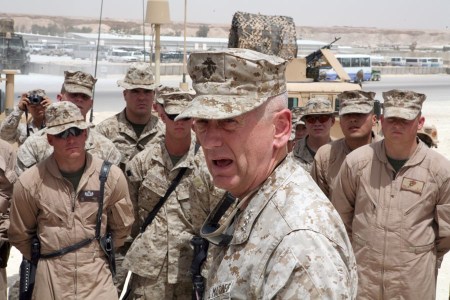
WASHINGTON — Millions of members of the U.S. military are frantically Googling where the Secretary of Defense sits in the line of succession to President of the United States, sources confirmed today.
The more than two million Google searches for terms such as “where is SecDef in succession order” and “can SecDef be promoted to president” came just hours after it was learned that retired Marine Gen. James Mattis would be named to lead the Department of Defense.
Mattis, 66, has been tapped by President-elect Donald Trump to head the department, which has been plagued by low morale and expensive cluster-fuck weapons systems, such as the F-35. He’s expected to easily boost morale, but attempting to fix DoD bureaucracy may be beyond even Mattis’ abilities.
When asked how Pentagon procurement could be fixed, for example, even God declined to answer. Instead, the Almighty referred all further questions to Lockheed Martin, Boeing, and General Dynamics.
If confirmed, Mattis would need to simultaneously take out the Treasury Secretary, Secretary of State, President pro tempore of the Senate, the Speaker of the House, the Vice President, and the President, in order to assume the highest office in the land.
According to sources, he already has a plan to do just that, which he wrote in 2003. He later stashed the plan in the drawer of his nightstand, on which his concubine places a breakfast shake mix of Jack Daniels and Creatine each morning. A person familiar with the plan said that Mattis mostly uses his bare hands, though he often carries multiple guns, knives, and sharp sticks on his person.
Experts say that Mattis dropping six people who have no military training would be a “walk in the park,” compared to his usual average of 12 kills per day. They went on to say that Mattis exterminating a bunch of tubby civilians would be roughly equivalent to him taking a bath or making toast, in terms of difficulty.
Survivors of Mattis’ wrath are expected to write about what he does to Washington, D.C. for the next 10,000 years.
Trump Selects James Mattis for Defense Secretary, Washington Free Beacon, Adam Kredo, December 1, 2016
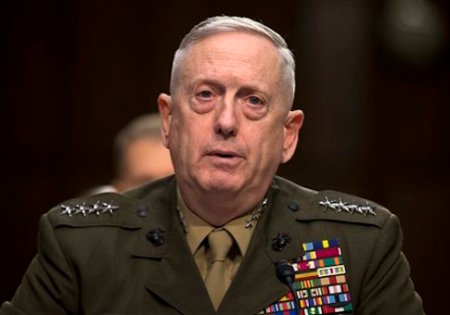
Marine Gen. James Mattis, commander, U.S. Central Command (AP Photo/Evan Vucci)
President-elect Donald Trump’s selection of Gen. James Mattis as the next secretary of defense is sending shockwaves through the defense community, where insiders are praising the retired Marine Corps general as a plain spoken realist who has the leadership ability to rebuild America’s military, according to conversations with multiple sources.
Mattis, former commander of U.S. Central Command, is known for being outspoken about combat and America’s need to reassert authority across the globe to challenge threats from extremism and radical rogue regimes.
Trump’s selection of Mattis follows those of Rep. Mike Pompeo (R., Kan.) as the next CIA director and retired Gen. Michael Flynn as national security adviser, picks that have won plaudits from observers and mark a clear ideological shift from the Obama administration.
Foreign policy insiders and congressional sources told the Washington Free Beacon that Mattis has proven himself on the battlefield and earned respect among his peers.
“Mattis is not someone who is going to prioritize wishful thinking over the reality of the world we face,” said Michael Rubin, a former Pentagon adviser and expert on rogue regimes.
Rubin said Mattis has the experience necessary to implement tough reform while keeping America’s fighting force nimble and well equipped.
“But it’s not enough for the next defense secretary to face down our enemies. He must also face down the huge bloated bureaucracy which the Pentagon has become,” Rubin said. “His predecessors have all taken the easy way out–enjoying the perks of office without carrying out substantive reform. The United States needs the most powerful military in the world capable of projecting force globally. It does not need the most bloated bureaucracy, capable of projecting powerpoints for hours a day.”
Michael Ledeen, a onetime consultant to the National Security Council and State and Defense Departments, as well as a former special adviser at the State Department, also had high praise for Mattis, who he described as a consummate Washington outsider.
“He hates Washington, really hates it,” Ledeen said, describing this as a positive trait for a defense secretary. “He’s the best possible. The choices [by Trump] have been pretty good, I must say.”
The selection of Mattis also earned praise in Congress from Republican sources who work on foreign policy issues.
“General Mattis is exactly the type of leader we need after eight years of failed leadership under President Obama,” said one senior GOP aide. “He would serve our country well by reaffirming fractured alliances and pushing back against our enemies. I am encouraged to see President-elect Trump considering him to run the Pentagon.”
Another senior Republican Senate staffer who handles Middle East issues said that Mattis’ extensive combat experience makes him a perfect fit for the role.
“As a Marine, General Mattis served our nation honorably and fearlessly,” the source said. “We should expect no less if Mattis, as a civilian, is now asked to serve as secretary of defense.”
Raheem Kassam, editor of Breitbart London and a Trump world insider, said that the selection of Mattis sends a positive sign to America’s closest allies, including Britain.
“Mattis is revered the world over,” said Kassam, who had speculated about Mattis getting picked weeks before his name emerged in the running. “This is one appointment that even British liberal and conservatives agree upon. And frankly, it is about time America projected the ‘don’t f— with us’ attitude that he so well embodies.”
How James Mattis As Defense Secretary Could Bust Our Deathly Political Correctness About Islam, The Federalist, M.G. Oprea, November 31, 2016
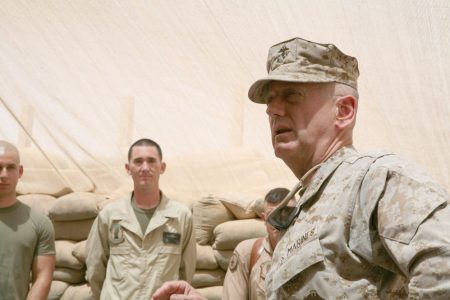
Is political Islam in America’s best interests? This question should be central to our strategy of fighting ISIS and Islamist terrorism in general. Yet it’s one that many political leaders would rather not answer, because of our politically correct climate. But since Trump’s transition team announced last week that it’s considering retired Gen. James Mattis for secretary of defense, this reluctance might fade.
In a speech given at the Heritage Foundation last year, Mattis spoke about America’s position vis à vis political Islam. Rather than equivocating on the matter in order to avoid saying something uncomfortable or politically incorrect, Mattis simply pointed out that America needs to make a decision about its stance toward this ideology.
Recall that political Islam, or Islamism, is a movement within Islam: it works toward the increasing implementation of Islamic law and values in all areas of life—usually via state control—in order to make Islam a dominant force in the world.
Mattis’ suggestion—which sounds like a basic element of defense strategy—has been surprisingly neglected in the years since 9/11. The U.S. tends to deal with Islamism on a case-by-case basis. And so long as any particular group or political entity doesn’t have a direct and obvious link to terrorism, we tend to give them a pass. Even then, this is sometimes too high of a bar, as is the case with the Muslim Brotherhood and associated groups.
No one wants to delve into the question of Islamism because it has become a politically charged issue, one that often leads to accusations of bigotry and Islamaphobia. As Islam is increasingly treated as a protected class by America’s progressive Left, any scrutiny of any faction within Islam is considered off limits. This is done in the name of tolerance, but is in fact a highly intolerant position. But it’s successfully scared off politicians and military personnel, who tend to make vague and noncommittal statements on the topic.
This makes Mattis’ statements all the more notable. He’s simply urging the U.S. to make a decision. And what’s more, he’s arguing that this decision ought to be based on what we believe is in our best interest:
“Is political Islam in the best interest of the United States?…If we won’t even ask the question then how do we even get to the point of recognizing which is our side in the fight? And if we don’t take our own side in this fight we’re leaving others adrift.”
But if the U.S. can’t identify what is in its best interests, or refuses to pursue those interests out of an oversized sense of political correctness, there’s no way to forge a comprehensive global defense strategy. As Mattis points out, if we won’t even talk about political Islam with a critical eye, how can we figure out which side we’re on, and make decisions from that point? Neglecting the question not only hurts our interests—it leaves our allies unsure of where we stand and how we will proceed when Islamist movements gain traction in their countries.
Mattis also points out that ISIS is counting on Americans not having a debate on whether political Islam is good for America. If we don’t examine this question, we can’t create a cohesive strategy, and our fight against ISIS’s self-proclaimed Caliphate (or other groups like them) will ultimately fail.
This is the opposite of what some Islamist apologists and those on the left insist, which is that ISIS wants us to talk about the connections between Islam and violence, in order to make Muslims feel like the West is at war with their entire religion. Then, so the thinking goes, Muslims will turn on the West.
As it is, ISIS has largely won this battle. Any serious strategic discussion about the relationship between political Islam and American national interests has been deemed illegitimate and offensive by the political Left. See, for example, the scrubbing of terms related to Islam from Department of Homeland Security training materials.
Mattis’ appointment as Defense Secretary would be a marked change not only from the Obama administration, but also from the Bush years. Both administrations were reluctant to substantively engage in a debate on the merits or threats of political Islam.
Since giving this speech at Heritage, ISIS has experienced significant territorial losses. But the question Mattis raises has not lost its relevance. It will be central to many of the Trump administration’s foreign policy challenges. Political Islam remains, and will remain, a problem for the West both in terms of domestic security and global strategy. Whether it’s the Muslim Brotherhood’s activities in the U.S., or political Islam in a post-Arab Spring Middle East, the U.S. needs to know where it stands on this issue.
Mattis concludes that political Islam is not, in the end, good for America. But he acknowledges that what’s most important is that we have a discussion about it—so that we can develop a broader strategy for how to deal with Islamism in the world. Without a cohesive strategy, there is little hope of checking the destructive influences of political Islam both at home and abroad.




 anneinpt
 artaxes
 danmillerinpanama
 davidking1530
 Peter Hofman
 Joseph Wouk
 Peter
Peter Louisiana Steve



 WarSclerotic
Recent Comments