Archive for the ‘Israeli settlements’ category

Trump’s envoy: The new administration ‘won’t tell Israel what policies to adopt’

December 16, 2016

Trump’s envoy: The new administration ‘won’t tell Israel what policies to adopt’, Times of IsraelEric Cortellessa, December 16, 2016

WASHINGTON — Sitting in a conference room together 13 years ago, David Friedman told his friend Donald Trump that he just purchased an apartment in Jerusalem.

Trump, the real estate tycoon, was immediately curious to know the particulars. “How big was it? How much did it cost?” Friedman recalled him asking, describing the conversation during an interview last month with The Times of Israel. When Friedman cited the price, Trump was surprised.

“That’s really a lot of money,” he responded, according to Friedman’s recollection. “For that kind of money, why wouldn’t you buy a place in East Hampton? Why do you have to go all the way to Israel for a second home?”

The Long Island native’s answer was probably one that the man soon to be president was not expecting. “The world has been fighting over every inch of Jerusalem for the past 3,000 years,” Friedman told Trump. “There’s nobody fighting over East Hampton.”

Trump’s eyes then “opened up,” Friedman said, “and that initiated a decade-plus conversation about Israel.”

Now, in 2016, that exchange seems to have been more fateful than it initially seemed to Friedman, who was announced on Thursday as President-elect Trump’s nominee to be the next US ambassador to Israel.

And the first move Friedman made in that official capacity was to indicate that Trump plans to follow through on his campaign pledge to move the US embassy from Tel Aviv to Jerusalem, breaking decades of precedent under both Republican and Democratic administrations, and underlining an apparent inclination to do what other presidential candidates have promised but declined to deliver once they took office: recognize the holy city as Israel’s capital.
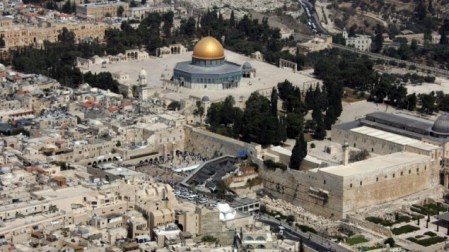
domeoftherockAn aerial view of the Dome of the Rock, left, in the compound known to Muslims as al-Haram al-Sharif and to Jews as Temple Mount, in Jerusalem’s Old City, and the Western Wall, center, the holiest site for Jews, October 2, 2007. (AFP/Jack Guez)

Official US policy has long been to insist that the status of Jerusalem can only be determined through a negotiated settlement between the parties, as both Israelis and Palestinians claim it as their capital.

In a statement Thursday, Friedman, a Hebrew-speaker, declared he was “deeply honored and humbled” that his friend of 15 years selected him to represent America to the Jewish state, and he also left the world with a zinger when he said he looked forward to doing his new job “from the US embassy in Israel’s eternal capital, Jerusalem.”

But Friedman’s declared appetite to move the embassy is not the only reason liberal Jewish organizations have responded to his nomination with something close to horror. The 57-year-old bankruptcy lawyer has also been an outspoken and active supporter of the settlement movement, and has argued that Israel doesn’t face a “demographic threat” to its Jewish character if it fails to separate from the Palestinians.

Friedman serves as president of American Friends of Bet El Institutions, an organization that supports the large West Bank settlement near Ramallah, and over the last year, he has excoriated groups who express criticism of Israel’s settlement policy.

friedman-c2-305x172David Friedman, Donald Trump’s adviser on Israel, talks to Channel 2 News on September 12, 2016. (screen capture: Channel 2)

In June, Friedman accused J Street supporters of being “far worse than kapos” in a column for the right-wing, pro-settlement Israel National News website, using the term for Jews who aided Nazis during the Holocaust. Speaking before the Brookings Institution’s annual Saban Forum earlier this month, he refused to walk back his comparison.

Now that he is slated to become the United States’ top diplomat in Israel — so long as the US Senate confirms his appointment — he will assume one of the most delicate positions in American foreign policy, mediating the US relationship with a close ally in an increasingly unstable region, and after eight tumultuous years of ties between the administration of President Barack Obama and the government of Prime Minister Benjamin Netanyahu.

Last month, Friedman spoke with The Times of Israel about what Trump’s policies and priorities would be toward the Jewish state if he won. Here is what he said.

‘No daylight’ between the US and Israel

When it comes to the US-Israel relationship, Friedman insisted that Trump would represent a sharp break from his predecessor — including in that there would be “no daylight between Israel and America,” a phrase also used in the transition team’s announcement of his selection on Thursday, which indicates a policy of keeping differences out of the public sphere.

“Donald Trump wants to be as supportive of Israel as possible,” Friedman told The Times of Israel. “He doesn’t view Israel as a client state that you just kind of issue directives to. He views Israel as a partner, one of America’s key partners in a global war against Islamic terrorism, so he wants Israel … to be as strong and secure as possible.”

Unlike Obama, who made Israeli settlement construction in the West Bank a fundamental issue of criticism throughout his presidency, Trump will not “put his finger on the scale or tell Israel what policies they should adopt,” Friedman said, adding that his new boss “doesn’t see Israel as in need of any particular correction at this point.”

That principle, he indicated, covers both how Trump will treat the settlement issue and the manner in which Israel seeks to reach an agreement with the Palestinians. The Trump administration will not “dictate to Israel where it can and cannot build” in the West Bank, according to Friedman.

Trump, for his part, has not publicly stated a position on settlements or detailed what kind of a stance he would take. The most common view among Washington’s foreign policy community, and emphatically within the Obama administration, is that, to keep the two-state option alive and ensure Israel’s future as a Jewish and democratic state, the US should try to limit settlement activity to the principal blocs that Israel is expected to retain under any permanent accord.

For his part, Friedman said that a Trump administration “doesn’t see much opportunity for progress until the Palestinians renounce violence and accept Israel as a Jewish state. That’s really a prerequisite.”

One criticism Friedman had of the current president was that Obama saw Israel as “strong” and the Palestinians as “weak,” and thus he believed it was up to the Israelis to take the risks necessary for peace. “Strong vs. weak is less relevant to Trump than the ‘relative conduct of the parties’,” Friedman said.

According to Friedman, Trump was influenced by seeing a video last spring of a stage production put on at a Hamas-affiliated school in Gaza. “Half the kids were dressed up as Israeli soldiers or traditional garb and the other half were dressed up as shahids, and the kids playing terrorists took their fake knives and stabbed all the Jews,” Friedman said of the film. “Fake blood poured on the stage, and the parents all applauded this. In a first grade class.”

knifeA young Palestinian girl attacks ‘Israeli soldiers’ with a knife in a play held in Gaza as part of the ‘Palestine Festival for Children and Education,’ April 2016 (Channel 2 news)

Trump, he said, sees that kind of incitement as “unacceptable and an insoluble impediment to peace.”

But didn’t Trump say he wanted to be neutral?

In February 2016, then-Republican presidential hopeful Trump called Israeli-Palestinian peace “probably the toughest agreement of any kind to make,” but vowed to give it “one hell of a shot.”

He also pledged he would do that by being “sort of a neutral guy,” when pressed by MSNBC’s Joe Scarborough over whether he ascribed fault to either side for failing to reach an accord. “A lot of people have gone down in flames trying to make that deal. So I don’t want to say whose fault is it,” he said. “I don’t think it helps.”

Trump took immediate heat for this promise on the campaign trail, and seemed to indicate a walk-back during his speech at the 2016 AIPAC Policy Conference and elsewhere, but he has not explicitly rescinded this posture.

Friedman argued, however, that his language has been misunderstood. “What he was really referring to was trying to sponsor negotiations that would take place without preconditions,” he said. “That was what he viewed as neutrality, and that’s frankly been the view of the Israeli government for some time.”

Friedman cited Obama’s demand in his first term that Netanyahu place a moratorium on all West Bank settlement construction, as a trust-building measure, to be “an example of the absence of neutrality, but it’s in favor of the Palestinians against the Israelis.”

And what about that two-state solution?

As one of Trump’s top two Israel advisers at the time, along with Jason Dov Greenblatt, Friedman said the candidate had not yet decided exactly how he’d go about handling Israel’s conflict with the Palestinians, but that he would be open to new ideas, including embracing avenues outside the two-state framework.

Friedman stated that, in his discussions with Trump, “a two-state solution is not a priority. I don’t think he is wed to any particular outcome. A two-state solution is a way, but it’s not the only way.”

Unlike the last three presidents, who have tried to push both parties into negotiating a compromise, Trump will let the Israel make its determinations without pressure from the US, said Friedman.

“A Trump administration will try to be helpful with the Israelis bringing stability to the region, to make it as quiet as possible, as peaceful as possible, and ultimately to come up with a long-term solution,” he said. “As far as what that solution is, Trump will be guided by the Israelis’ view, very much so, and will not be seeking to impose any particular path upon the Israeli government.”
UN Committee to Vote on Blacklist Against Israel-Linked Companies

December 10, 2016

UN Committee to Vote on Blacklist Against Israel-Linked Companies, The Jewish PressHana Levi Julian, December 10, 2016

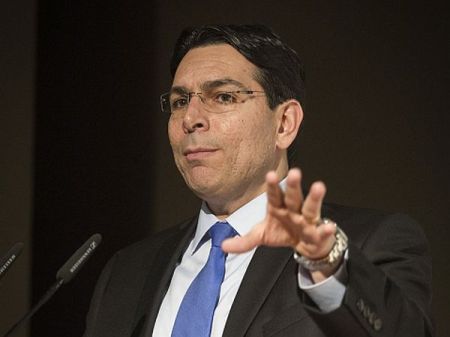
Israeli Ambassador to the UN, Danny Danon, speaks at the Conference for Fighting Anti-Semitism, at the Begin Center in Jerusalem, on January 31, 2016. Photo by Hadas Parush/Flash90 *** Local Caption *** ??? ???? ????? ????? ???? ??? ????????? ??????? ???? ????

Israeli Ambassador to the UN, Danny Danon, speaks at the Conference for Fighting Anti-Semitism, at the Begin Center in Jerusalem, on January 31, 2016. Photo by Hadas Parush/Flash90

A budget and administration committee within the United Nations is set to vote next week on a blacklist against firms with ties to Israel.

The UN “Fifth Committee” is scheduled to vote on funding for the blacklist, which names Israeli and international firms with offices located in post-1967 areas of Jerusalem, Judea, Samaria and the Golan Heights.

The black list was initiated this past March in a resolution approved in 32-0 vote (15 abstentions) by member states at the UN Human Rights Council in Geneva. According to a report published Friday in Haaretz, the resolution required UN ‘human rights officials’ to create a database of “all business enterprises” that have enabled or profited from the growth of Israeli settlements.

Proposed and sponsored by the Palestinian Authority and the Arab nations, it includes a condemnation of ‘settlements’ and a call for companies not to work with Israeli communities in post-1967 areas.

The blacklist, to be updated annually, is expected to become a useful tool for activists in the anti-Semitic Boycott, Divest and Sanctions (BDS) movement, according to Israeli Ambassador to the UN, Danny Danon.

Israel’s mission to the UN will publicly oppose the list, Danon said. The envoy added that he intends to organize a task force comprised of international pro-Israel organizations and other partners to fight the move.

“We will not be silent in the face of this shameful initiative,” said Danon. “The UN’s intent to mark Jewish businesses and international companies with ties to Israel, so that they can boycott them, reminds us of dark times in history.

“The Human Rights Council has already become notorious as an anti-Semitic and anti-Israel entity.

“But it’s unacceptable for the UN itself to continue to support this despicable decision,” Danon added.

The Hostility and Hypocrisy of Left-Wing Israeli NGOs

October 31, 2016

The Hostility and Hypocrisy of Left-Wing Israeli NGOs, Investigative Project on Terrorism, Noah Beck, October 31, 2016

1884

Israeli human rights group B’Tselem recently appeared before a special session of the United Nations Security Council, excoriating Israel and pleading with the body to act against Israel’s settlements.

In 1975, the UN famously declared that “Zionism is racism” and, four decades later, the organization continues to hound Israel. In each of the last four years, as the Syrian bloodbath claimed hundreds of thousands of lives, there were at least five times as many resolutions condemning Israel as those rebuking the rest of the world.

The UN’s cultural body, UNESCO, recently passed a motion ignoring any Jewish (or Christian) historical ties to East Jerusalem holy sites, referring to the Temple Mount and Western Wall only by their Muslim names and condemning Israel as “the occupying power.” It turns out that some of Israel’s left-wing NGOs worked to help produce the UNESCO motion.

Given the UN’s chronic hostility, efforts by Israeli NGOs to persuade the UN to act against Israel are arguably treasonous. Indeed, one attorney and activist for Israel’s left-leaning Labor party filed a police complaint alleging treason against B’Tselem, arguing that the NGO has harmed state sovereignty, tried to give land away to a foreign entity, and taken steps that could cause a war.

Israeli democracy is extremely tolerant, to the point of allowing its members of parliament to openly support terrorism and terrorist groups. Last March, several Israeli Arab Knesset members condemned Arab states for labeling Hizballah a terrorist organization, even though it has been at war with Israel for decades and regularly threatens new hostilities.

Last February, members from the Joint (Arab) List paid a solidarity visit to relatives of Palestinian terrorists security forces killed to stop them from murdering Israelis. In 2014, MK Hanin Zoabi (Balad) drew praise from Hamas by asserting that the kidnappers of three missing Israeli youths were “not terrorists.” Hamas’s connection to the young men’s abduction and murder helped to spark the third war between Israel and Hamas in Gaza.

Thus, Israel already has plenty of dissenting voices and activists without foreign intervention. Nevertheless, foreign interests have identified Israeli NGOs as the soft underbelly of Israeli democracy and have leveraged them to promote their own agendas. The problem became so acute that a watchdog, NGO Monitor, was formed in 2002 to track the self-hostility being funded largely by European and other foreign sources. As the organization notes: “NGOs lack a system of checks and balances, and…provide accountability to their funders and activist members, and not to the citizens or societies whose lives are directly impacted by their activities.”

NGO Monitor also notes that, even though most of the foreign government funding for these Israeli NGOs is “formally designated for ‘educating the Israeli public’ and ‘changing public opinion’ (both in violation of the norms on non-interference in other democracies), these Israeli NGOs are very active externally, in the delegitmization and political warfare against Israel.”

These left-wing Israeli NGO’s receive money from about two dozen foreign governments, and some private organizations. That includes millions of dollars from billionaire George Soros.

In Catch the Jew, author Tuvia Tenenbom exposed how foreign-funded “human rights” and “cultural” organizations in Israel tend to serve as vehicles for attacking Israel. By presenting himself to interview subjects as “Tobi the German,” Tenenbom elicits some surprising confessions. For example, the New Fund for Cinema and TV, a foreign-funded Israeli cultural NGO, told him that that about 80 percent of political documentaries made in Israel are co-produced by Europeans. That includes a documentary called “10%—What Makes a Hero,” which equates Israel’s military with the Nazis. Such films would be too scandalous to be produced in Germany, but German-sponsored NGOs can safely pay left-wing Israelis to make such movies.

Some foreign funders of Israeli NGOs have even unwittingly enriched Hamas. Last August, Hamas allegedly siphoned off “tens of millions of dollars” from World Vision, a U.S.-based charity, and used the funds for weapons purchases, tunnel construction, and other military activities.

The Knesset passed a law in July requiring disclosure of foreign funding sources for NGOs that get more than half of their money from overseas. The law is “clearly aligned with the American Foreign Agents Registration Act (FARA),” wrote legal scholar Eugene Kontorovich.

“Israel is unique in the sheer scale of the foreign government sponsorship of domestic political groups,” he wrote. “For example, the European Union alone has in recent years given roughly 1.2 million Euro a year for political NGOs in the US and roughly an order of magnitude more in Israel—a vastly larger per capita amount.”

The Obama administration opposes foreign influence only when that influence promotes a dissenting view. President Obama opposed Prime Minister Benjamin Netanyahu’s speech to the U.S. Congress against the Iranian nuclear deal, but was happy to give a speech to the UK parliament against Brexit. The Obama administration critiqued Israel’s NGO-funding-disclosure law, even though it sent U.S. taxpayer money to an Israeli NGO working to oust Israel’s prime minister.

The same hypocrisy seems to prevail among Israel’s foreign-funded NGOs. They ostensibly exist to promote democracy and peaceful co-existence, but are conspicuously silent when Palestinian institutions violate those ideals. Such silence enables abuse by Palestinians and promotes a distorted and incomplete picture of the complex reality in which Israelis operate. Foreign-funded Israeli NGOs remained silent  after the Palestinian Authority arrested Palestinians who visited a Sukkah in a symbolic peace event promoting coexistence.

“These organizations are silent when the Palestinian leadership pays salaries to the families of terrorists, glorifies murderers and calls streets and city centers after them,” Netanyahu said. “These organizations prove again and again that they are not actually interested in human rights, but only in shaming Israel and libeling it around the world.”

If Israel’s left-wing NGOs truly are committed to democracy and peace, why haven’t they condemned the PA’s efforts to prevent “normalization” with Israel? In 2014, Jibril Rajoub, the deputy secretary of the Fatah Central Committee and the head of the Palestinian Supreme Council for Sport and Youth Affairs, condemned a coexistence-promoting soccer match between Israeli and Palestinian youths on a southern kibbutz, as “a crime against humanity.”

Last week, a Palestinian newspaper came under intense criticism for publishing an interview with Israeli Defense Minister Avigdor Liberman. The Jerusalem-based newspaper Al-Quds was denounced by Hamas, the Palestinian Journalists’ Syndicate, and the supposedly “moderate” PA. The “chilling effects” and anti-peace message implicit in the harsh reactions to the interview have yet to catch the attention of any left-wing NGOs supposedly working for peace and democracy.

Palestinians: Abbas “The Jew”

October 7, 2016

Palestinians: Abbas “The Jew”, Gatestone Institute, Khaled Abu Toameh, October 7, 2016

The unprecedented outcry over Abbas’s participation in the funeral of an Israeli leader is further proof of the degree to which Palestinians have been radicalized.

This is what happens when you unleash a tidal wave of hate against Israel and its leaders in the media, mosques and public rhetoric. In light of this brainwashing, how do you expect your people to respond when you, in any way, associate with an Israeli leader?

If attending the funeral of an Israeli leader, especially one who devoted the past two decades of his life to peace between Israel and the Palestinians, draws such condemnation, it is easy to imagine the result of a Palestinian leader making a peace overture to Israel.

Even if the current condemnation eventually dies down, it will have sent a message to future Palestinian leaders: “No peace with Israel, not in our time, and not in any time.”


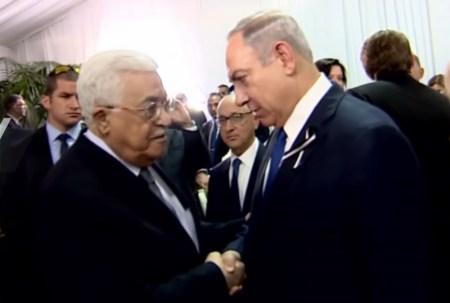
Palestinian Authority (PA) President Mahmoud Abbas is facing a barrage of criticism for attending the funeral of former Israeli President Shimon Peres in Jerusalem. The fury directed towards Abbas comes as no surprise to those who are familiar with the unrelenting campaign of anti-Israel incitement that has been taking place for many years in Palestinian society.

If attending the funeral of an Israeli leader, especially one who devoted the past two decades of his life to peace between Israel and the Palestinians, draws such condemnation, it is easy to imagine the result of a Palestinian leader making a peace overture to Israel.

President Abbas is now receiving a dose of his own medicine. This is what happens when you unleash a tidal wave of hate against Israel and its leaders in the media, mosques and public rhetoric. This is what happens when you inform your people that Israeli leaders are “war criminals” who ought to be prosecuted before the International Criminal Court. This is what happens when you drive into your people that Jews are desecrating with their “filthy feet” Islamic holy sites in Jerusalem. This is what happens when you accuse Israel of “ethnic cleansing”, “extra-judicial executions” and “poisoning” Yasser Arafat.

In light of this brainwashing, how do you expect your people to respond when you, in any way, associate with an Israeli leader?

1928Palestinian Authority President Mahmoud Abbas shakes hands with Israeli Prime Minister Binyamin Netanyahu at the funeral of Shimon Peres, a former president of Israel, on September 30. Abbas is facing a barrage of criticism for attending the funeral, with members of his own party calling it “treason.” (Image source: Ruptly video screenshot)

It is hard to believe that Abbas and his cronies were surprised by the current wave of reprobation. But the degree of vitriol was perhaps not predicted.

Abbas is now getting it from all quarters. The denunciations are coming not only from his political foes in Hamas, Islamic Jihad and the Popular Front for the Liberation of Palestine (PFLP), but also from groups and figures belonging to his ruling Fatah faction.

Palestinians say that the 81-year-old Abbas, who is now in his 11th year of his four-year term in office, is facing his most serious challenge to leadership. And there are no signs that the recriminations are subsiding. On the contrary, each day brings with it yet another flood of reproof, prompting Palestinian Authority officials in Ramallah to issue a stiff warning to those who are exploiting the situation to “incite” against Abbas. However, the threats have failed to deter his critics from proceeding with their attacks on him and calling on him to step down.

One of those who have already paid a price for criticizing Abbas’s attendance of the Peres funeral is Lieutenant Colonel Osama Mansour, who holds a senior position in the PA’s Military Liaison Apparatus. In a post on Facebook, the PA officer strongly condemned Abbas’s move:

“If you alone decided to participate in the funeral of the killer of our sons, then you erred. And if you took the decision on the basis of what you were told by your advisors, then they have misled you.”

Hours after the post appeared on Facebook, Mansour was suspended from his job. Later, he was arrested by PA Military Intelligence Service officers who raided his house and conducted a search, during which they destroyed furniture, according to his family. A PA court has since ordered Mansour remanded into custody for fifteen days.

The suspension and subsequent arrest of the officer sparked a new wave of rage against Abbas and his security forces. Palestinians took to social media to protest the crackdown on the officer, hailing him as a hero and denouncing Abbas as a “dog” and Israeli “collaborator.” Some suggested that the officer was worthy of being appointed as a minister in the PA Cabinet for his courageous remarks.

But the move against the senior officer did not deter many Abbas loyalists from coming out against him for going to the funeral of Peres.

Fatah’s “Youth Movement,” known in Arabic as Al-Shabiba, issued a statement calling on Abbas to “apologize” to the Palestinians for committing a “grave mistake.” Abbas’s participation in the funeral was “humiliating and degrading” for the Palestinians and a form of “treason,” according to the statement. The group pointed out that Abbas’s move was in violation of Fatah’s regulations, which envisage the “full liberation of Palestine and eliminating Israeli occupation economically, politically, militarily and culturally.” Addressing Abbas, the group stated:

“Mr. President of the State of Palestine, Mahmoud Abbas. You have committed a crime against our people by equating the executioner with the victim. We will not allow treason to become a viewpoint.”

Several senior Fatah officials sought to distance themselves from Abbas’s decision to attend the funeral of Peres by claiming that they had not been consulted beforehand.

One of them, Tawfik Tirawi, who previously served as commander of the Palestinian Authority’s General Intelligence Service in the West Bank, announced that he was personally opposed to Abbas’s gesture. He clarified that Abbas did not seek the opinion of the Fatah leadership before he went to the funeral:

“Had I been personally consulted as a member of the Fatah Central Committee, I would have made it clear that I am against participation in principle, because this is a funeral of a Zionist who wallowed, from head to toe, in the blood of our people and other Arabs.”

Tirawi went on to describe Peres as the “engineer of the Israeli nuclear project which is designed to foil any plan to retrieve our land.”

The widespread protests against Abbas’s decision to participate in Peres’s funeral took a violent turn on October 3, when PA policemen used force to break up a peaceful demonstration in Ramallah. Organized by the PFLP, the protest was yet another sign of the strong sentiments many Palestinians harbor not only against Abbas, but also Israel.

Palestinian lawyer Muhanad Karajeh, who works for a Ramallah-based human rights organization, reported that he was asked by the organizers to be present in order to document the event. The lawyer stated he was severely beaten by PA security officers during the protest. “I was repeatedly beaten in the face and different parts of the body,” he recounted. “I know some of the officers personally. They tore my suit although I told them I am a lawyer. They humiliated me and cursed me and my profession.”

In a desperate act to counter the spreading protests, Abbas’s aides organized impromptu marches in support of the Palestinian Authority president. The PA leadership summons Fatah activist-thugs to take to the streets whenever it feels the heat. Carrying photos of Abbas and the yellow Fatah flags, scores of Fatah members marched in the streets of Ramallah in a show of force and as a message of warning to those who would censure Abbas. “We stand behind our historic leadership and President Abbas,” declared top Fatah activist Osama Qawassmeh. “Fatah is a red line and it is facing a conspiracy.”

On social media, the attacks on Abbas were quite ruthless. Palestinian activists circulated cartoons ridiculing Abbas. One of them depicted Abbas as a rabbi in Israeli military uniform and a Jewish skullcap weeping next to Peres’s grave. Another cartoon featured an Arab laying a wreath on a boot next to Peres’s photo.

On Twitter, activists launched hashtags called, “Offering Condolences On the Death of Peres is Treason” and “Normalization is Treason.”

Hamas was not silent about Abbas’s “treason.” Mahmoud Zahar, one of the leaders of the Islamist movement in the Gaza Strip, opined that according to Islamic teachings, Abbas qualifies as a Jew. “We hope that he will join Peres in Hell,” Zahar said. “Abbas is an Israeli product. The man who claims to represent all the Palestinian people has stood up against all Palestinians and Arabs.”

A large group of Palestinian and Arab academics, journalists and political activists signed a petition calling on Abbas to apologize for attending the Peres funeral, characterizing the move as an “historic and political mistake.” At least 150 Palestinians and Arabs signed the petition, which stressed that Abbas’s decision came as a “shock” to Palestinians.

The protests have, meanwhile, spread to Palestinian refugee camps in the West Bank, Gaza Strip and neighboring Arab countries. At the Balata refugee camp near the West Bank city of Nablus, thousands of Palestinians chanted slogans calling for the removal of Abbas from power. The protest came during a funeral of a Palestinian man who had been shot dead a week earlier by Palestinian Authority policemen.

The unprecedented outcry over Abbas’s participation in the funeral of an Israeli leader is further proof of the degree to which Palestinians have been radicalized. Frustration with Abbas and his policies is not new. More and more Palestinians have in recent years expressed rage over his “lenient” policies towards Israel. A particular bone in their throat is the continued security coordination between PA security forces and Israel. They perceive this cooperation with the Israelis as “treasonous”. Many Palestinians are also angry with Abbas for his refusal to share power and pave the way for the emergence of new leaders.

The blame for the radicalization of the Palestinian people lies squarely at the feet of Abbas and the rest of the PA. If you promote boycotts of Israel, expect to be attacked when you break that boycott by associating with any Israeli, alive or dead. Protests tend to subside, but even if the current condemnation eventually does die down, it will have sent a message to future Palestinian leaders. The message is: “No peace with Israel, not in our time, and not in any time.”

Between obvious and oblivious

September 25, 2016

Between obvious and oblivious, Israel Hayom, Smadar Bat Adam, September 25, 2016

Imagine if U.S. President Barack Obama, in his last speech before the U.N. General Assembly last week, would have opened by saying: “Eight years ago, when I was sworn in to office, I didn’t know much about the conflict in the Middle East or its origins. With the naivete of a novice, but with a great deal of desire to do good things for the world, I saw conflicts across the globe in black and white. I was sure that anywhere occupation existed, the job of the most powerful Western democracy was to draw the push the occupier back and liberate the occupied.”

Imagine that he would have finished by declaring: “Ladies and gentlemen, I was wrong. I didn’t believe in the existence of an occupied people who don’t yearn for peace. I couldn’t accept that there were people for whom destroying the occupier was more important than independence. After all, it goes against logic that the occupier isn’t the aggressor, but is the one defending himself.”

Now imagine that he would have added, “Today, when the entire world is under the threat of Islamist jihad, I understand. Israel is not the problem. Israel is the symptom. And the settlements are not the obstacle to peace; rather the obstacle is the refusal of the Palestinians, particularly of their leadership, to recognize the fact that Israel is the land and national home of the Jewish people. And the terror which Israel suffers is the same terror determined to kill anyone who doesn’t share its beliefs, which is why we should all stand by the State of Israel.”

Picture Obama expressing, even in milder terms, what many Europeans are already saying openly: “Obviously most Muslims are not involved in terrorism, but all terrorists are Muslim.” And think what a commotion that would have caused at the United Nations; and how those words could have disarmed U.N. Secretary-General Ban Ki-moon, who always has an accusatory finger ready to point at Israel.

In reality, however, what we heard were the familiar refrains: “Surely, Israelis and Palestinians would be better off if Palestinians reject incitement and recognize the legitimacy of Israel, but Israel recognizes that it cannot permanently occupy and settle Palestinian land.”

There is something of a start here. How joyous, indeed. Regardless, let’s just say it would be nice if the Palestinians would “reject incitement” — just as long as no one, heaven forbid, accuses them of doing the inciting. As for the Israelis, their guilt is clear. They are the occupier. Those who didn’t get it from the speech got it from Obama’s comments to Prime Minister Benjamin Netanyahu, albeit in a softened tone, during their much publicized meeting: “The U.S. is concerned about the settlements.”

It’s possible that Obama did not have the time (or the inclination) to learn what most people in the American intelligence community already know, that there is a clear link between Palestinian terrorism and global Islamic terrorism. And it’s quite possible, for various reasons, that this is the legacy he wishes to leave behind. It is also important, of course, to remember that his administration did give Israel a military aid package unprecedented in scope. He has emphasized the unbreakable bond between the countries and the deep concern for the wellbeing of Israel.

Meanwhile, perhaps we should stop focusing on the outgoing president’s swan song and instead help his successor understand this administration’s fundamental error: rejecting the premise that terrorism against Israel is part of fundamentalist Islam’s war of civilizations against the West. Let us hope that in a year’s time this will all be obvious, and we won’t have to imagine anymore. As Herzl would say: If you will it …

Obama’s Parting Shot at Israel

September 22, 2016

Obama’s Parting Shot at Israel, Front Page MagazineAri Lieberman, September 22, 2016

unobama

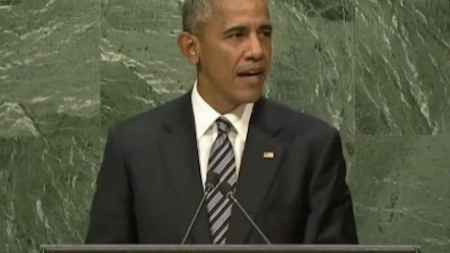
Obama’s last address before the UN General Assembly was typically and predictably condescending, hypocritical, disingenuous and vainglorious. He used the opportunity to perform some electioneering and take a swipe at Donald Trump. “Today, a nation ringed by walls would only imprison itself,” he said in a not too subtle reference to Trump’s promised plans to secure the southern border with the construction of a wall and restrict immigration from high-risk countries.

France, a NATO ally that has partnered with the U.S. to combat the Taliban in Afghanistan and Islamic extremism in Mali, was also derided. Though he did not mention France by name, he criticized “liberal societies” for their “opposition to women who choose to cover themselves.” This of course was a veiled reference French laws banning Burkas and Burkinis, items of Islamic clothing that are oppressive to and denigrate women.

Of course, Obama made no mention of the Paris and Nice massacres. Nor did he note that as a result of Muslim violence, 70 percent of Europe’s Jews won’t be attending synagogue during the Jewish High-Holy Days. Obama did of course heap praise on Indonesia, a Muslim nation that discriminates against minorities and the LGBT community, still maintains so-called “blasphemy” laws, and imposes draconian Sharia law in some districts. This year, a 60-year old Christian-Indonesian woman was given 28 lashes for selling alcohol. This is the model nation that the president touts before the world community.

The vainglorious president also took the opportunity to tout his disastrous Iran deal, noting that the United States “resolved the Iranian nuclear issue through diplomacy.” Obama, however, failed to note that he inked the worst deal in U.S. diplomatic history and likely the worst deal since the 1938 Munich Accord. He also omitted the fact that the infusion of $150 billion into Iran’s anemic economy will enable the mullahs to continue to sow misery throughout the region.

Of course, no Obama speech would be complete without the perfunctory assault on Israel. What better place to attack the Jewish state than before a body that is today’s greatest purveyor of anti-Semitism, where anti-Israel invective flows like water and where the Jewish state is incessantly vilified?

Recognizing of course that referring to Jews as “apes and pigs” is a national Palestinian pastime, Obama reminded the Palestinians to play nicely before directing his invective against Israel.

“Surely, Israelis and Palestinians will be better off if Palestinians reject incitement and recognize the legitimacy of Israel, but Israel recognizes that it cannot permanently occupy and settle Palestinian land,” he said.

There are two egregious problems with Obama’s statement. First, it is insufficient for the Palestinian Authority to merely “recognize the legitimacy of Israel.”

Israel has made clear that the PA must recognize Israel as a Jewish state. The PA has rejected this demand outright because they envision a future Palestinian state, exclusively for Palestinians, in Judea/Samaria and an entity that calls itself “Israel” composed of Jews as well as Palestinian Muslims, thereby negating the Jewish character of the state.

That represents the crux of the problem. Palestinian Muslims will never recognize the indigenousness of Jews in their ancestral land. Any peace agreement without such recognition is inherently flawed and sets the stage for more bloody conflict. In terms of strategy, there is absolutely no difference between the PA and Hamas. Both aspire to the ultimate goal of establishing a Muslim Arab state from the River to the Sea. The only difference is tactics. The PA has adopted a more practical and deceitful approach toward achieving their ultimate objective (though every once in a while they slip and reveal their true colors) while Hamas is frighteningly and brutishly honest.

The second problem is that Judea and Samaria is neither “occupied” nor is it “Palestinian land.” It is a territory that is the subject of a bonafide dispute between two parties with competing claims.

From a legal perspective, Israel’s claim has more merit. In 1947, the UN General Assembly voted to partition Israel/Palestine into separate Jewish and Arab states. General Assembly resolutions have no binding legal authority. The Jews accepted partition, but the Arabs rejected it. Had they accepted it, the matter would have been settled and an agreement would have validated the GA resolution and made it legally binding under international law.

During the War of 1948 that followed, Jordan seized Judea and Samaria as well as the eastern portion of Jerusalem and annexed these territories. Only Pakistan fully recognized Jordan’s illegal annexation, while England’s recognition was limited to Judea and Samaria. The territory was occupied by Jordan for 19 years and during those 19 years, Jewish institutions were reduced to rubble while Jewish headstones in the Mount of Olives cemetery were used to build latrines for the Jordanian army.

In June 1967, Jordan’s monarch, fed on a steady diet of fantasy-like falsehoods of Israel’s impending demise, attacked Israel with Hawker Hunter jets and artillery. Israel responded to the provocation and liberated Jerusalem as well as Judea and Samaria in a matter of days.

The UN considers war and conquests therefrom to be illegal, but Article 52 of the UN Charter provides an exception to the illegality of war in cases involving self-defense. The Six-Day War was as clear as they come in terms of self-defense. Israel acquired these lands through defensive conquest. Never in the history of mankind has a nation been compelled to return territories — acquired in the course of a defensive war — to an aggressor entity.

Following the war and after many months of haggling, the UN Security Council, which has the power to establish international law, passed Resolution 242. The resolution called upon Israel to withdraw from “territories occupied in the recent conflict.” Notably, the word “all” was deliberately omitted thus giving implicit recognition to Israeli territorial conquests. One can reasonably argue that Israel has fully complied with Resolution 242 by virtue of its withdrawal from the Sinai Peninsula, Gaza, some 40 percent of Judea and Samaria and Quneitra on the Golan Heights, and that no further territorial withdrawals are required.

I would be remiss if I didn’t note that two Jewish commonwealths existed on territories now claimed as “occupied” hundreds of years before Mohammedan colonizers set foot on the land. It would be more precise to refer to the territories as “re-occupied,” in deference to the indigenous inhabitants of the land.

Obama likely knows all this but couldn’t resist taking a parting shot at Israel. That he would choose to do it in a forum that is infamous for its anti-Semitic vitriol speaks volumes of the man.

Israel’s PM seeks role in Russian-US duo in Syria

June 6, 2016

Israel’s PM seeks role in Russian-US duo in Syria, DEBKAfile, June 6, 2016

PutinBibi2-480 (1)

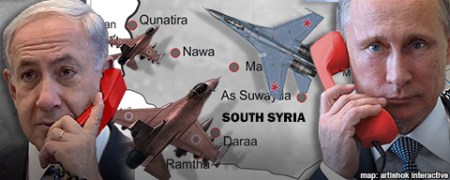
During his 48-hour trip to Moscow (Monday and Tuesday June 6-7), Prime Minister Binyamin Netanyahu will try and talk President Vladimir Putin into cutting Israel into the military teamwork evolving between Washington and Moscow for combating the Islamic State in Syria. As a quid pro quo, he will offer to elevate Moscow to senior broker in the Israeli-Palestinian dispute, with Moscow or Geneva selected as the venue for direct Israeli-Palestinian talks, if they occur – and with US participation. Netanyahu is also keen on a role for Egypt’s Presidents Abdek-Fattah al-Sisi.

DEBKAfile sources in Jerusalem and Moscow report exclusively that the floating of this deal was the reason why Russia’s Foreign Minister Sergey Lavrov abstained from attending the Mid East conference staged last weekend by France’s President Francois Hollande in Paris. The UK and German foreign ministers followed the Russian lead and stayed away.

And Friday, June 3, on the day of the Paris meeting, Russian Deputy Foreign Minister Mikihail Bogdanov, who is in charge of Kremlin Middle East policy, offered a formula for resolving the problem of Israeli settlements on the West Bank.  That formula was very similar to the land swaps plan proposed by Defense Minister Avigdor Lieberman a few years ago.

It consisted essentially of the transfer to the Palestinian state of parts of Israel with dense Arab populations, in return for Palestinian recognition of Israeli sovereignty over the Israeli communities of Judea and Samaria.

In comments to Tass news service, Bogdanov said that Moscow is willing to host an Israeli-Palestinian peace conference, and also offered to mediate between the rival Palestinian factions, including Abu Mazen’s Fatah and the radical Hamas which rules the aza Strip.

While some Israeli politicians see the French initiative as offering President Barack Obama a handle for settling accounts with PM Netanyahu before he leaves the White House at the end of the year, Moscow and Jerusalem are concocting a parallel strategy – not merely to block the Franco-American move, but also to lift Washington’s drive for an Israeli-Palestinian accord from Paris to Moscow.

DEBKAfile sources say that this maneuver is based on the early stages of military and political coordination between Washington and Moscow in the Syrian arena, including the fight against ISIS.

No such coordination exists between Washington and Paris.

Netanyahu envisages the tightening military cooperation between Russia and Israel for Syria, along with Israel’s active participation in the airstrikes against ISIS, as becoming integral to American-Russian understandings, and extending also to the Israeli-Palestinian issue.

Moscow and Jerusalem both estimate that an offer of US-Russian-Arab guarantees to the Palestinians, underwritten by Egypt and Saudi Arabia, can move the negotiations forward.

The Old Generals’ Old Plan

May 31, 2016

The Old Generals’ Old Plan, Front Page MagazineCaroline Glick, May 31, 2016

al-aqsa_martyrs_brigade

Originally published by the Jerusalem Post

The Israeli Left is a one trick pony. As it sees things, all of Israel’s problems – with the Palestinians, with the Arab world, with Europe and with the American Left – can be solved by giving up Judea and Samaria and half of Jerusalem (along with Gaza which we gave up already).

Once Israel does this, the Left insists, then the Palestinians, the Arab world, Europe and Bernie Sanders voters will love us as they’ve never loved us before.

The events of the past quarter century have shown the Left’s position to be entirely wrong. Every time Israel has given the Palestinians land, it has become less secure. The Arabs have become more hostile.

The West has become more hostile. The Palestinians have expanded their demands.

Because of their negative experience with the Left’s policy, most Israelis reject it. This is why the Right keeps winning elections.

Given the failure of its plan, the Left could have been expected to abandon it and strike out on a different course. But it didn’t. Instead it has tried to hide its continued allegiance to its failed withdrawal strategy by pretending it is something else.

A central component of the Left’s concealment strategy is its use of former generals.

Over the past quarter century, and particularly since the Palestinians began demonstrating in 2000 that they have no interest in a state living side by side with Israel, the Left has carted out retired generals at regular intervals to proclaim that continued allegiance to the Left’s failed policy of withdrawal is not irrational.

Every couple of years, a new initiative of former generals – often funded by the EU – is published.

Each in turn uses whatever the popular memes of the day may be to repackage their call for withdrawal from Judea and Samaria and the partition of Jerusalem.

The media, itself dominated by the Left, backs these initiatives. The retired war heroes are paraded before the cameras and presented to the public as responsible adults who have grudgingly entered the political fray, despite their aversion to it, because of their patriotism. Just as they heeded the call of duty and led forces in wars of earlier generations, so today, we are told, they heed the call again, in yet another last-ditch effort to save the country.

Just in time for Avigdor Liberman’s swearing in as defense minister, a new group of old generals released a new version of their old, discredited plan.

A group calling itself “Commanders for Israeli Security” has mobilized an impressive roster of 214 generals that have signed on to a new position paper called “Security First: Changing the rules of the game, a plan to improve Israel’s security-diplomatic position.”

The group has a great website replete with a highend web commercial that has been flooding social media feeds for the past several days. The ad shows a person ripping up a “Peace Now” bumper sticker and replacing it with a call for “Security now, peace later.”

Their plan, the ad proclaims, will improve Israel’s security, strengthen its international position, repair the cleavages in Israeli society and set the conditions for future negotiations with the Palestinians.

Unfortunately, like every leftist plan to date, if the generals get their way and the government takes their advice, the results will be precisely the opposite of what they promise. As has been the case with every other well-packaged withdrawal plan, Israel’s security will be harmed. Our international position will be wrecked. Bernie Sanders voters along with the Europeans will expand their devotion to bashing Israel. And the Sunni Arab states that now flock to us will again abandon us.

The generals’ new package involves opening their plan with a hawkish call for continued Israeli security control over Judea and Samaria, until the Palestinians decide to make peace with us.

But as we soon see, that was just throat clearing.

Having established their sober-mindedness, the generals turn to the Left’s unchanging fantasy.

They call for the government to formally relinquish Israel’s sovereign rights over the vast majority of Judea and Samaria and eastern Jerusalem.

They call for the government to permanently stop respecting the property rights of Jews in the areas of Judea and Samaria outside of the security perimeter.

The more than one hundred thousand Jews who live in those areas, they insist, must be denied all right to property, save the right to sell whatever they now own.

They must not be allowed to build anything – no new houses; no new communities; no new infrastructure.

As for the communities inside the perimeter, the generals insist that those should be permitted to continue respecting Jewish property rights, within limits, albeit. For instance, those communities must not be permitted to expand beyond their current construction boundaries. In other words, Jews can build up, but not out.

Jerusalem, which they believe should never have been unified in 1967, should be effectively partitioned.

The generals call for the municipal government to stop administering the city as a unified mixed Jewish and Arab city. Instead, they say, the city should set up a separate governing authority for Arab neighborhoods in eastern, northern and southern Jerusalem. That separate authority should be responsible for all planning and zoning activities in Arab neighborhoods as well as the education system and every other aspect of the daily lives of the Arabs of the city.

Gaza, which has been operating as a Hamas state since 2007, is also brought in from the cold. The generals call for the government to continue to supply Gaza with everything that Hamas demands – water, electricity, employment in Israel, a Hamas-controlled port. They even call for Israel to allow Europe to pay the salaries of Hamas terrorists.

Moreover, the generals recommend that the government announce that Gaza, Judea and Samaria and partitioned Jerusalem are one political entity, despite the fact that they aren’t.

The generals insist that by taking these steps, Israel will prove its devotion to peace and keep the dream of a Palestinian state alive. As a consequence, they say, the Palestinians will be happy and stop trying to murder Israelis. The Arab world will line up to sign peace treaties with Israel. Europe along with Bernie Sanders’ voters will bury the hatchet and embrace Israel.

The problem with the generals’ newest plan and the ones its replaces is that they all ignore basic facts.

There is no Palestinian constituency for peace with Israel. The more Israel offers the Palestinians, the less interested they are in settling.

By announcing that Israel renounces its claims to Judea, Samaria and Jerusalem, and treating the Jews east of the 1949 cease-fire lines as second class citizens, the generals will not only widen Israel’s social cleavages. They will tell the Palestinians that they are right to feel contempt for us. The worse they behave, the more we will offer them. The more Jews they murder, the more the Jews will turn against one another.

As for improving Israel’s international position, it is hard to understand why the generals refuse to learn the lessons of the Gaza withdrawal. Despite the fact that Israel uprooted 24 Jewish communities in Gaza and northern Samaria, and removed its military forces from the area, without exception, the international community insists that Israel still “occupies” Gaza. How can the generals expect the world to act more fairly towards a more limited withdrawal plan from Judea and Samaria and Jerusalem? As for Gaza, Operation Protective Edge brought out into the open the fact that Egypt, Saudi Arabia, the UAE and other Arab states support Israel in its war against Hamas. They do so because they fear Islamic State and Iran more than they hate Israel, whose power they trust.

If Israel announces its intention of leaving Judea and Samaria, which the Arabs know will become a Hamas enclave faster than Gaza did, the Arab faith in Israel’s power will diminish. As a consequence, if Israel follows the generals’ advice our relations with the Sunnis will worsen, not improve.

It is a tragedy for Israel that the generals have allowed the Left to use them in this way. Their role in perpetuating Israel’s destructive adherence to the devastating two-state policy model diminishes their past contributions and endangers Israel’s future.

Secretary-General Of Palestinian Presidency Delivers Speech On Behalf Of President ‘Abbas: In Fighting For Palestine, Our People ‘Loves Death More Than Life’

May 24, 2016

Secretary-General Of Palestinian Presidency Delivers Speech On Behalf Of President ‘Abbas: In Fighting For Palestine, Our People ‘Loves Death More Than Life’ MEMRI, May 24, 2016

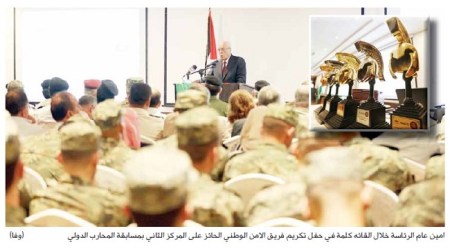
On May 22, 2016, Palestinian Presidency Secretary-General Al-Tayeb ‘Abd Al-Rahim delivered a speech on behalf of Palestinian President Mahmoud ‘Abbas to a group of Palestinian National Security Forces. The speech was part of a ceremony celebrating their second-place win in the international 8th Annual Warrior Competition, which took place in Jordan on May 2-6, 2016.[1]

In his speech, ‘Abd Al-Rahim condemned attempts to intimidate the Palestinian people and divert it from its path, and called such attempts futile, as “our [Palestinian] people loves death more than life.” He added that the National Security Forces victory was a step on the way to establishing an independent Palestinian state, and rejected the notion of establishing a separate independent entity in Gaza, or a state with temporary borders in the West Bank alone.

The following are excerpts from the speech:

28164Abd Al-Rahim speaking at the ceremony (Al-Ayyam, PA, May 23, 2016)

“Today we celebrate the Palestinian man, who suffers a lack of means and opportunity, but has will power and is determined to keep the Palestinian flag flying so that it [the flag] remains in the hearts of peace-loving and liberty-loving peoples. We were very happy with this victory [in the Warrior Competition], and the honorable president and commander-in-chief, president Abu Mazen [Mahmoud ‘Abbas], has expressed his esteem for the brothers who won this award and his pride in their achievements. Many commanders in Arab military institutions have also expressed their pride in this new Palestinian man, who is always new and always renewing [himself].

“The occupation wagered that we would forget our cause and that, as the generations passed, we would dissolve into the societies around us… However, the occupation was the first to realize that each new generation was more determined and had a stronger desire to achieve the goals that the martyrs had died for in the distant and the near past and [are still dying for] in the present. Our blood is still being spilled at the roadblocks and the checkpoints by the gangs of settlers and the extremist soldiers of the occupation, some of whom have acknowledged that they do not act according to moral standards when facing our people and children…

“Occupiers are always destined to fail. This fact should be in our minds forever. We must always cling to hope. Our morale will not be influenced or shaken by anything. We will not grow soft or deviate towards personal interests for the sake of dubious goals such as establishing a state or an emirate in Gaza, or establishing a state with temporary borders in the West Bank. We must always tirelessly stick to our truth, and our faith in victory must never falter. It is the faith in our hearts that will lead us to our rights and to the realization of our righteous and legitimate goals…

“Every achievement is a step on the road to establishing an independent state and strengthens our belief that the future is ours, that tyrants will disappear, and that the aggressors will end up in the trash bin of history. Indeed, they are trying to intimidate us today with people who threatened to strike Gaza or the Aswan Dam [a reference to incoming Israeli defense minister Avigdor Liberman], but these threats are hollow as we are a people who loves death more than life when it fights for Palestine.”[2]

Endnotes:

[1] The Annual Warrior Competition is a combat-oriented competition held at the King Abdullah II Special Operations Training Center (KASOTC) in Amman (Warriorcompetition.com).

[2] Al-Hayat Al-Jadida (PA), May 23, 2016.

Trump: Israel should keep building in Judea and Samaria

May 3, 2016

Trump: Israel should keep building in Judea and Samaria, Israel National News, Ari Soffer, May 3, 2016

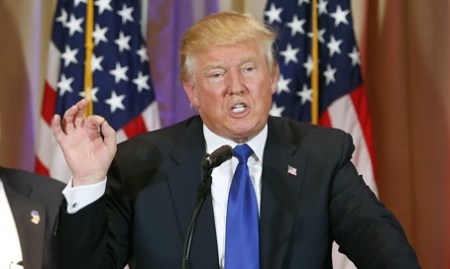
Trump keep on buildingDonald Trump Reuters

Republican presidential frontrunner Donald Trump has said Israel should continue building in Judea and Samaria, insisting the Jewish state should “keep moving forward” in response to Arab terrorism.

Speaking to the UK’s Daily Mail, Trump emphasized his support for the State of Israel, and appeared to veer away from previous comments in which he declared that he would stay “neutral” on the Arab-Israeli conflict.

Trump referenced the “thousands of missiles being launched into Israel,” by Arab terrorists prior to the 2014 Gaza war, asking rhetorically: “Who would put up with that? Who would stand for it?”

He also said he would sharply depart from the policies of the current White House, which has put enormous pressure on Israel to halt all construction – in Jewish areas only – in Judea and Samaria.

Asked if he similarly thought a building freeze was a good idea, Trump responded: “No, I don’t think it is, because I think Israel should have – they really have to keep going. They have to keep moving forward.”

Watch:

https://www.youtube.com/watch?v=zLZA7ASKZwo

“No, I don’t think there should be a pause,” the GOP frontrunner added, while leveling criticism against the Obama administration for its treatment of Israel.

“Look: Missiles were launched into Israel, and Israel, I think, never was properly treated by our country. I mean, do you know what that is, how devastating that is?”

He did repeat his intention to negotiate a peace deal, however, but cautioned he would only do so if he believed the deal would be a permanent one.

“With all of that being said, I would love to see if peace could be negotiated. A lot of people say that’s not a deal that’s possible. But I mean lasting peace, not a peace that lasts for two weeks and they start launching missiles again. So we’ll see what happens,” Trump continued.

He also underlined his good personal relationship with Israeli Prime Minister Binyamin Netanyahu – despite the latter’s criticism of him last year for his comments about banning Muslim immigration, which eventually scuppered the billionaire’s planned visit to Israel.

Trump praised Netanyahu as “a very good guy,” and again attacked Obama for his hostile treatment of the Israeli leader.

“I don’t know him that well, but I think I’d have a very good relationship with him,” Trump said of Netanyahu, for whom he made an endorsement video during last year’s Israeli general election.

“I think that President Obama has been extremely bad to Israel.”

Trump also repeated his oft-stated astonishment over Jews who continue to support Obama despite his hostility towards Israel.

“I don’t even understand where – I have Jewish friends that support Obama. I tell them all the time, I say, ‘What are you doing? The Iran deal is a disaster for Israel,'” he said.