Archive for the ‘Israeli security’ category

Obama Setting up yet Another Fight with Israel

March 1, 2016

Obama Setting up yet Another Fight with Israel, Front Page Magazine, Daniel Greenfield, March 1, 2016

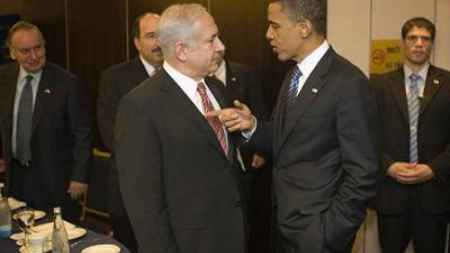
obama_netanyahu_1

Flashback to ’10. Biden visited Israel.

Obama, Biden and Hillary decided to use the visit to stage an incident with Netanyahu. They claimed that a housing project (which was never built) in Jerusalem passing one stage of a multi-stage review was a calculated and deliberate “insult” to the United States.

Biden refused to come down. Then he did and the results were ugly. Hillary Clinton spent hours screaming at Netanyahu over the phone.

The whole point of this was to stage a fight with Israel as part of a plan to discredit Netanyahu.

Six years later, Obama is pulling the same stunt all over again.

Ahead of US Vice President Joe Biden’s trip to the Holy Land next week, the American administration is “hysterical” about the possibility of Israeli authorities embarrassing him by announcing the construction of new housing during his visit, the Hebrew news site nrg reported on Monday.

According to the exclusive report, the level of anxiety in Washington is so high on this score that senior administration officials are sidestepping proper diplomatic channels and directly appealing to Israeli public figures to prevent an incident similar to that which occurred during Biden’s visit six years ago.

The “level of anxiety” is similar to that experienced by Brer Rabbit asking not to be thrown into the briar patch. This is set dressing for the fight Obama wants to pick.

Israel is not a dictatorship. Prime Ministers actually have less power than presidents. Which means it’s quite possible that somewhere, some part of Israel’s bureaucracy will review and approve something in one of the many parts of Israel that Obama doesn’t want to see any Jews living in.

And, I highly suspect, that Obama Inc. already knows where and when, and has scheduled the visit for just that when.

At the time, Netanyahu apologized to Biden, claiming he had not been aware that the municipal committee tasked with deciding on such matters would be meeting during the visit. Since the “Ramat Shlomo incident,” Netanyahu has demanded that all announcements of construction in Jerusalem be run by him first – something that nrg claimed has dramatically slowed the building process.

However, according to nrg, Biden has indicated a lack of confidence that a similar incident will not occur during his upcoming visit, and therefore a number of phone calls have purportedly been made from Washington to Israel’s housing and interior ministries, as well as to Jerusalem’s City Hall, to “beg” that no such announcements be made next week. However, the same Israeli representatives were told, according to nrg, that “construction in the Arab section of the city would be welcome.”

So aside from crippling construction for Jerusalem, itself an objective, Obama Inc. is adding stress to the situation even though it’s entirely up to the White House to regard some committee somewhere signing a piece of paper as an “insult”.

So this is a game. It’s the kind of game that people play in abusive relationships. Which is what Obama’s relationship with Israel is.

Report: Israel’s northern border violated daily

February 28, 2016

Report: Israel’s northern border violated daily, Israel National News, David Rosenberg, February 28, 2016

Lebanon borderIDF patrol along border with Lebanon Flash 90

Israel’s border with Lebanon is violated on a daily basis, according to a new report by the Israeli Mission to the United Nations.

The report also shows the degree to which UN resolutions are ignored and even tolerated – despite the presence of United Nations observers. In 2015 alone, there were fully 2,374 documented violations of the most recent UN ruling on the Israel-Lebanon border, UN Security Council Resolution 1701.

Israel’s Ambassador to the UN, Danny Danon, conveyed the statistics to the UN Secretary General and Security Council. Danon condemned the rampant violations of the border area and the UN’s tacit acceptance of Hezbollah control.

“The government of Lebanon is not acting and armed Hezbollah operatives are roaming freely throughout the south Lebanon in violation of the UN,” Danon said. “Hezbollah has free reign in South Lebanon and instead of reacting forcefully to their violations, the UN is ignoring the problem.”

Hezbollah, which has de facto autonomy in southern Lebanon, maintains regular armed patrols along the Blue Line – the UN’s demarcation between Israel and Lebanon – well within the United Nations Interim Force in Lebanon (UNIFIL) security zone. The number of Hezbollah patrols along the border in 2015 was estimated at 653.

More disturbing, the report revealed that Israel’s northern border is violated on a daily basis. During 2015 alone, infiltrators breached the border 589 times.

Another 1,079 incidents of armed individuals – presumably Hezbollah fighters – openly operating in the UNIFIL security zone were recorded.

The report noted two Hezbollah terror attacks on Israel in 2015, and 51 violent protests targeting Israeli forces along the border.

IDF Racing to Restructure Itself for New Middle East Warfare

February 24, 2016

IDF Racing to Restructure Itself for New Middle East Warfare, Investigative Project on Terrorism, Yaakov Lappin, February 23, 2016
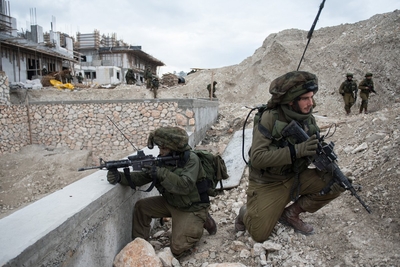
1362Photo Credit: IDF Spokesperson

The Israel Defense Forces (IDF) is in a race against time, and it is a race that is relevant to how other Western powers will also deal with the rise of radical, armed, Islamic groups proliferating across the Middle East.

As the IDF’s commanders look around the region, they see heavily armed, hybrid, Islamic sub-state foes that are replacing states. The traditional threat of hierarchical armies is fading quickly away, into obscurity.

The Sunni and Shi’ite jihadist entities on Israel’s borders – Hamas, Hizballah, ISIS-affiliated groups in Syria, Jabhat Al-Nusra, as well as elements of Iran’s IRGC forces – are all building their power and preparing for a future unknown point in time when they will clash with Israel.

The IDF is preparing, too, but it is not only counting how many soldiers, tanks, fighter planes, and artillery cannons it can call up in the next round. The IDF is in a race to adapt to 21st century Middle Eastern warfare, which bears no resemblance to how wars were fought in the 20th century.

In this new type of conflict, enemies appear and vanish quickly, use their own civilians as cover, bombard Israeli cities with projectiles, seek out the weakest link in Israel’s chain, and send killing squads through tunnels to attack Israeli border villages.

In this type of clash, the enemy looks for a ‘winning picture’ at the start of any escalation. This means landing a surprise blow that will knock Israeli society off balance, at least for a short while.

To be clear, all of the hostile sub-state actors currently are deterred by Israel’s considerable firepower and are unlikely to initiate a direct, all-out attack right now.

The price they would pay for such action is deemed too high, for now.

Yet, opportunities and circumstances can suddenly arise that would alter these calculations, and put these terrorist organizations on a direct collision course with the IDF.

Israel has fought four conflicts against Hamas and Hizballah in the past 10 years, and emerged with the conclusion that the era of state military versus state military warfare is over.

Acknowledging this development is one thing; the organizational transformation that must follow is quite another. Israel did not want to enter any of the past four conflicts that were forced upon it, but since they occurred, they have aided in the IDF’s adaptation process, which has been as complex as it has been painful, and is far from over.

“What you have to do against an enemy like this, and it is a great difficulty for militaries, including the IDF, is to operate in a combined, cross-branch [air force, ground forces, navy] manner, and to keep it [operations] focused. Focus the ground maneuver and firepower, on the basis of the intelligence you get,” a senior IDF source said earlier this month in Tel Aviv, while addressing the challenges of adaptation.

Taking southern Lebanon, the home base of Hizballah, as an example, the area has well over 100 Shi’ite villages that have been converted into mass rocket launching zones.

With one out of every 10 Lebanese homes doubling up as a Hizballah rocket launching site (complete with roofs that open and close to allow the rocket to launch), Hizballah has amassed over 120,000 projectiles – some of them GPS guided – with Iran’s help. This arsenal, pointed at Israel, forms one of the largest surface to surface rocket arsenals on Earth.

Would sending several military divisions into such an area be sufficient for Israel in stopping the rocket attacks? Without focused intelligence, the military source argued, the answer is a resounding no. Israel’s reliance on intelligence has never been more paramount in the age of sub-state, radical enemies.

“The urban areas swallow up our forces. If we can’t focus the maneuver, no amount of forces will be sufficient in dealing with this issue. It must be focused, and the information that must direct this focus is real-time intelligence,” the source said.

The IDF’s Military Intelligence Directorate has the mammoth task of building up a battle picture and a database of targets ahead of any conflict. After a conflict erupts, it must start the process all over again within a few days, when the entire map of threats changes in the modern dynamic battlefield.

This is a far cry from the old intelligence work that looked at enemy tank divisions and infantry formation.

IDF planners believe that any future conflict with a hybrid, terror-guerrilla military force will consist of five stages. An “opening picture” – that surprise blow intended to shock Israelis – will mark the start of hostilities, in which Israel must deny the adversary its “winning picture.” This will be followed by an exchange of firepower. After a few days, Israel would need to call up reserves, and then launch a ground offensive. Throughout this period, the Israeli home front would absorb heavy rocket fire, while the Israel Air Force would pound enemy targets. The IAF could fire thousands of precision-guided munitions every 24 hours, if it deploys its firepower to the maximum, as it would in an all-out clash with Hizballah.

Israeli air defense systems like Iron Dome could soften the blow to the home front significantly, but this is truer with respect to Gazan rockets than against the downpour of Hizballah rockets and missiles, which would overwhelm air defenses.

The ground offensive must destroy “70 to 75 percent of [enemy] capabilities,” the source said. “If there are 100 missiles and two operatives on the other side, and you kill the operatives, than the missiles become irrelevant.”

The last phase is the end stage, and it is unlikely that an entity like Hamas or Hizballah would wave a white flag when hostilities conclude, even if most of their capabilities have been destroyed.

The era of clear-cut military victories, like Israel experienced in the 1967 Six Day War, is gone, the source said.

With this reality in view, the IDF’s steps to adapt itself to modern threats include the ability to gather huge quantities of intelligence and deliver them, in real-time, to the forces that need them most in the battlefield, right down to the level of a battalion commander.

This requirement includes establishing an “operational Internet,” an internal IDF network that allows battalion commanders to access Military Intelligence target data in their area, and direct their units accordingly.

It would also allow field commanders to communicate directly with a fighter jet pilot or drone operator, or even a missile ship commander, for the type of cross-forces cooperation the IDF thinks will be most effective in shutting down threats.

As a result, the IDF’s C4i Branch has spent recent years overcoming many hurdles and objections and integrating the command and control networks of the air force, navy, and ground forces. It then directly linked them up to Military Intelligence.

By the end of this year, the first IDF division will have a “military Internet” network, complete with applications and browsers, up and running.

“I don’t want a squad commander walking around with a screen in his hand. He has to be aware of his soldiers. [But] the battalion commander should certainly have this,” the source said.

In 2014, the IDF did not do a good enough job in detecting, in real-time, the location of Hamas rocket launches in Gaza. It got away with this failure because of the effectiveness of the Iron Dome anti-rocket batteries. But against Hizballah’s much larger arsenal, no amount of air defenses will be sufficient, and the IDF therefore is working on improving its rocket detection and accurate return fire abilities.

“In the next stage [of our development], if you detect the rocket launch areas and the centers of activity of the enemy, and transmit them [to your own forces], you can learn the enemy’s patterns better,” the officer said.

Knowing the enemy has never been more important for Israel’s ability to defend itself against the jihadist entities that are replacing states in the Middle East. As these radical Islamist organizations prepare for the day of battle, Israel does the same, through updating its old 20th century battle doctrines and bringing them up to speed with its rapidly changing and chaotic environment.
Abu Mazen rebuffs Kerry’s appeal to cool Palestinian terror against Israelis

February 23, 2016

Abu Mazen rebuffs Kerry’s appeal to cool Palestinian terror against Israelis, DEBKAfile, February 23, 2016

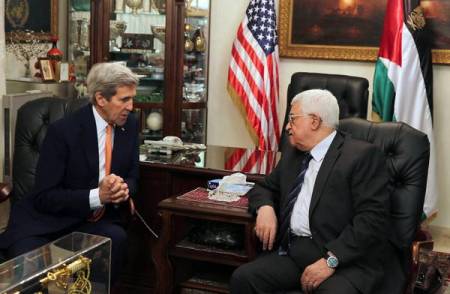
epa05173718 Visiting US Secretary of State John Kerry (L) and Palestinian President Mahmoud Abbas (R) speak to each other during their meeting in Amman, Jordan, 21 February 2016. Kerry arrived in Amman on 20 February for an official visit during which he also will meet Jordan's King Abdullah II to discuss the latest developments in the Middle East. EPA/JAMAL NASRALLAH / POOL

epa05173718 Visiting US Secretary of State John Kerry (L) and Palestinian President Mahmoud Abbas (R) speak to each other during their meeting in Amman, Jordan, 21 February 2016. Kerry arrived in Amman on 20 February for an official visit during which he also will meet Jordan’s King Abdullah II to discuss the latest developments in the Middle East. EPA/JAMAL NASRALLAH / POOL

US Secretary of State John Kerry came away empty-handed from his latest meeting with Palestinian Authority Chairman Mahmud Abbas (Abu Mazen) in Amman on Sunday, February 21,- which shouldn’t have surprised him as it was par for the course.  DEBKAfile’s Middle Eastern sources report that Kerry was finally persuaded that Abbas would not give Israel an inch on any political or security-related matters. The Palestinian leader has never swerved from his conviction that it was the duty of the international community to force Israel to present the Palestinians with a state of their own – without direct negotiations. 

To this end, Kerry found Abu Mazen clinging to the initiative put forward by French President Francois Hollande, for an international conference that will establish a Palestinian state, while letting the Palestinians off the hook of talks with Israel.

France in fact warned Israel that without progress towards a two-state solution of the conflict, Paris would go ahead and recognize a Palestinian state on its own.

The Palestinian leader is determined to campaign on behalf of the French initiative in the coming month, undeterred by the US Secretary’s repeated warning that Washington will not go along with it, even if France puts it before the UN Security Council.

But Kerry was most of all taken aback to find himself rebuffed by Abu Mazen when he asked him to make a speech or issue some statement calling on the Palestinians to halt their terrorist attacks against Israel now entering their fifth consecutive month. Al his efforts to persuade the Palestinian leader to tamp down the violence were in vain.

A senior member of Kerry’s entourage told DEBKAfile’s sources: “Abbas obviously thinks that terrorism in its present form serves his policy, although he won’t admit as much in public.” The source described the US Secretary’s mood after this encounter as “disappointed and shocked.”

DEBKAfile’s military sources note that Abbas is treading a very fine line. While he finds a measure of violence useful for letting the Palestinians vent their resentments, he nonetheless instructs his security services to partially cooperate with Israel so that Palestinian violence does not get out of hand and make him their next target.

And before him is the constant sight of the consequences of Israel’s withdrawal from the Gaza Strip, the rise of Hamas rule. This must be prevented from happening on the West Bank avoided at all costs.

Notwithstanding this reality, the age-old controversy dogging Israeli politics erupted again this week, when the IDF military intelligence chief, Maj. Gen. Herzl Halevi, was quoted (or misquoted) as commenting some weeks ago at a security cabinet session that diplomatic traction between Israel and the Palestinians might cool the current wave of terror,

This theory, disproved each time a new round of peace talks sparked a fresh outbreak of Palestinian terror in the last three decades, was strikingly refuted once again in the Kerry-Abbas meeting in Amman.

Recent leaks from Israel’s security cabinet, although often taken out of context, show that intelligence evaluations are too often wide of the mark – both on the Palestinian issue and the prospects of the Syrian conflict.

This may have something to do with Prime Minister Benyamin Netanyahus delay in appointing a new National Security Council Director to take over from Yossi Cohen who has been appointed Mossad Director.
Netanyahu, it appears, is not happy with the intelligence evaluations put on his table and may decide to dispense with yet another evaluator.

Netanyahu, it appears, is not happy with the intelligence evaluations put on his table and may decide to dispense with yet another evaluator.

Also short on substance were the remarks made by Defense Minister Moshe Ya’alon on Feb. 22 from the deck of the American destroyer, the USS Carney, which is anchored at the port of Haifa in the framework of the joint US-Israeli Juniper Cobra 2016 missile defense.

Yaalon said, “The United States and Russia, both of which are currently active in the Syrian civil war, recognize Israel’s freedom to act in defense of its interests.”

While the two powers may indeed recognize this freedom in principle, Israel will be certain to avoid any action that makes it liable to being accused of damaging the chances of a ceasefire going into effect in Syria on Feb. 27. Both the US and Russia will also make sure that no outside power, whether Turkey, Saudi Arabia or Israel, intervenes militarily in the Syrian conflict whatever their security interests may be.

Special Israeli emissary to Moscow over Russian Syria air strikes near border

February 17, 2016

Special Israeli emissary to Moscow over Russian Syria air strikes near border, DEBKAfile, February 17, 2016

Israel_near_border_16.2.16

In view of the crisis building up on the southern Syrian-Israeli border, Prime Minister Binyamin Netanyahu decided immediately on his return home from Berlin early Wednesday, Feb. 17, to send a special  emissary to Moscow to ask for clarifications. Tuesday, Intensified Russian air strikes came to within 6 km of the Israeli border, sparking a growing exodus of Syrian refugees heading towards the Qoneitra border crossing to Israel.

DEBKAfile’s sources reveal that the envoy is Dr. Dore Gold, director-general of the Foreign Ministry and one of the prime minister’s few trusted confidantes.

It was still not clear whom Gold will meet in the Russian capital, but it is assumed that it will be one of Moscow’s senior decision-makers in the loop on its military operation in Syria.

The fact that Netanyahu decided to dispatch a top diplomat rather than a senior military or intelligence officer is a sign that the prime minister is not of one mind with the IDF’s intelligence assessments of the situation on the ground.

Netanyahu’s concerns grew after after the Russian air force on Tuesday widened its massive bombing of southern Syria from the city of Daraa to the Golan town of Quneitra, in order to help the Syria army’s 7th armored division push the rebels east, so they will not attempt to cross the border and seek shelter in Israel.

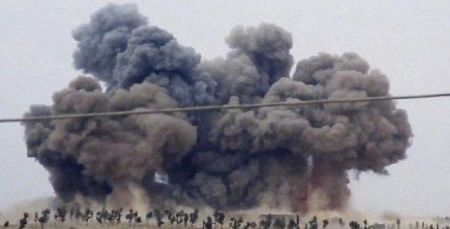
DEBKAfile’s military sources report that that 12 of the 15 targets bombed by the Russian air force across from the Israeli border were new rebel positions that had not been attacked before, even by the Syrian army. Military sources monitoring the war said Tuesday night that there is no doubt that the Russians are in the process of wiping out the rebel positions along the Israeli border by means of an offensive comparable to their operations in the northern Aleppo sector.

Our sources report that Israel’s concerns grew when, as the Russians bombing raids neared the Israeli border, Syrian officials threatened Jordan with serious consequences if Amman gave the Saudi air force a base for attacking eastern or southern Syria.

The threats began Tuesday, after Jordanian forces took over the Syrian-Jordanian border crossings formerly held by Syrian rebels, as a measure to stem the volume of Syrian refugees in search of sanctuary in the Hashemite Kingdom. But this step was interpreted by the Syrians and their Russian ally as clearing the way for Saudi intervention in the Syrian conflict using Jordan as a jumping-off base.

Meanwhile, Western military sources reported a sub substantial presence Tuesday of both Russian and Israeli warplanes in the skies over and around southern Syria.

Report: Hizballah Has Russian Technology Capable of Downing Israeli Jets

February 16, 2016

Report: Hizballah Has Russian Technology Capable of Downing Israeli Jets, Investigative Project on Terrorism, February 16, 2016

Hizballah is using advanced radar technology to “lock on” to Israeli aircraft flying reconnaissance missions over Lebanon, according to Israel’s Walla news service and reported by i24 News.

The new technology enables Hizballah to identify Israeli jets and fire missiles at them, Israeli security sources said.

“The connection between Hizballah, Russia and Syria have greatly changed the rules of the game in the region…Hizballah is indicating to Israel that it is ready for the next stage,” said an Israeli security official, quoted in Walla.

Israeli fighter jets are capable of detecting radar that threatens them, allowing pilots to alter their course. Nevertheless, the reports signal a troubling development that could hinder Israel’s freedom of movement in airspace across the northern border and its ability to effectively monitor Hizballah.

Following the 2006 war between Israel and Hizballah, the terrorist organization began acquiring sophisticated anti-aircraft systems and other advanced weapons from Syria and Iran. A recent report suggests that Hizballah is using Iranian anti-tank missiles in Syria that could be used against Israel in a future confrontation.

In light of these developments, Israel has allegedly targeted Hizballah weapons convoys on several occasions coming into Lebanon from Syria over the past few years. Nevertheless, the terrorist organization continues to build up its weapons arsenal and consolidate a base of operations on the Syrian Golan in order to attack the Jewish state.

Last month, Hizballah field commanders with operatives fighting in Syria told the Daily Beast that Russia is providing the terrorist organization with advanced weaponry amid enhanced coordination among both actors. The report outlines that Hizballah is acquiring long-range tactical missiles, anti-tank systems, and laser guided rockets from the Russians.

Gen. Dvornikov: Russia’s combined C-in-C and top diplomat in Syria

January 10, 2016

Gen. Dvornikov: Russia’s combined C-in-C and top diplomat in Syria, DEBKAfile, January 10, 2016

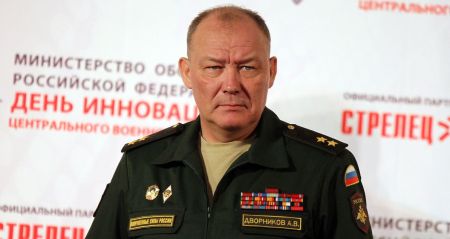
Colonel_General_Alexander_Dvornikov

[T]he Russian general walks on eggs in a job that requires him to collaborate militarily with Iran and Hizballah, on the one hand, and uphold the understandings Putin reached with Prime Minister Binyamin Netanyahu, on the other, over Israeli Air Force actions against terrorists and their conflictive interests in the southern Syrian regions bordering on Israel.

********************

It was in August, 2015, on the eve of the massive Russian military intervention in Syria, that President Vladimir Putin selected Col. Gen. Alexander Dvornikov, 54, as chief of Russia’s military operation in Syria and Iraq, DEBKAfile’s military and intelligence sources report. He resolved a fierce debate among Russia’s top officials and generals over the officer to lead the what was to be the most high-powered venture of the Putin presidency. Many favored a senior air force officer, conceiving the campaign as focusing mainly on air strikes. They proposed Col. Gen. Victor Nikolaevich Bondarev, chief of Aerospace Defense Forces, a branch established just four months ago.

Putin overruled them, having decided that the diplomatic and ground components were to be just as important as the future aerial campaign. He picked Gen Dvornikov, whom he first met 26 years ago in Berlin during the last moments of the dying Soviet empire. In 2015, he judged the general as being the right man for the job he had in mind, by virtue of his extensive military experience in running the 2000-2003 North Caucasus wars against Islamic terror groups, as chief of staff and a motorized infantry division commander.

In his new posting, Gen. Dvornikov was given control of the twin Russian commands in Damascus and Baghdad. They function as two halves of the same war room.

At the Damascus headquarters, he has three partners: the Syrian Chief of Staff Gen. Ali Abdullah Ayyoub, the Iranian Revolutionary Guards Gen. Key Parvar and the commander of Hizballah forces in Syria, Mostafa Bader el-Din. Until his mysterious disappearance in November, Gen. Qassem Soleimani, Iranian commander in Syria and Iraq, would put in an occasional appearance at high command conferences.

The two command centers’ operations are fully coordinated and keep the single overall commander, Col. Gen. Dvornikov, on top of events and in control of decisions 24/7 – a key position of enormous authority and extreme diplomatic sensitivity for juggling Moscow’s opposition allies and interests.

The Saudi government, which operates, arms and funds a number of Syrian rebel militias, regards the Russian general as the ultimate nemesis of its interests in Syria, because he expends as much force on fighting those militias as in striking the Islamic State.

After the Hizballah super terrorist Samir Quntar was assassinated on Dec. 20, the Saudis engineered a press leak showing how Gen. Dvornikov was turned away from the door of the Iranian command headquarters in Damascus when he came to offer condolences for the death of one of their top agents. The Iranians were furious with the Russian commander for allowing Israeli air planes free rein to fire rockets into Quntar’s secret hideout in Damascus.

That incident was an illustration of how the Russian general walks on eggs in a job that requires him to collaborate militarily with Iran and Hizballah, on the one hand, and uphold the understandings Putin reached with Prime Minister Binyamin Netanyahu, on the other, over Israeli Air Force actions against terrorists and their conflciting interests in the southern Syrian regions bordering on Israel.

The mountainous Arab Israeli gun problem has spiralled beyond control

January 7, 2016

The mountainous Arab Israeli gun problem has spiralled beyond control, DEBKAfile, January 7, 2016

Neshek_ArabsCENTER480

The mountainous quantities of illegal weapons, run-of-the-mill and exotic, in the hands of Israeli Arabs have grown to unmanageable proportions. No Israeli civilian police, or even military force, has the scale of manpower required to mount raids in Israeli Arab population centers – ranging from Galilee in the North, the Triangle and Jaffa in the Center and the Bedouin of the Negev – for a comprehensive campaign to impound them – not even if backed by tanks and commando units.It is pointless to call on all 1.5 million Arab, Bedouin, Druze and Circassian minority citizens to voluntarily surrender their guns. Almost every individual has at least one shooter. The accumulation would not shame any Middle East militia.

The authorities’ inability to deal effectively with this arsenal is not only shocking but has also made the Israeli underworld rich. And even more alarming, it provides a profitable link between terrorist organizations and both Israeli and Palestinian crime mobs and drug dealers. The failure to enforce order in some parts of the population, while other communities abide by the law, has created two parallel societies living by different rules.

The official data on the quantity of guns loose and unaccounted for are sketchy, bu the variety is hair-raising: grenade launchers; AT-3 Sagger and BGM-71 TOW antitank missiles; M-16 and Kalashnikov automatic rifles, submarine guns – mostly Uzis; heavy and light machine guns and mortars; explosive devices for remote detonation;  concussion, gas and stun grenades; diverse ammunition; magazines; IDF uniforms; protective and bulletproof vests; night vision equipment; and much more.

The approximate black market price list we have obtained includes handguns – 15,000 shekels; grenades – 2,500 shekels; M-16 automatic rifles – 50,000 shekels; explosive devices (depending on size and power) 15,000-25,000 shekels; hand grenade – 500 shekels.

Arab Israeli leaders, especially their representatives in the Knesset, have vocally and repeatedly appealed to the police to collect the weapons loose in Arab villages and cities. They see their prevalence as a major cause of the violence and disorder rampant inside those communities. This is no doubt true, but there is also an element of hypocrisy in their demand, in view of their own failure to address – and even exploit – the underlying causes of the epidemic

1. Israeli Arabs customarily resort to the use of guns rather than the law to resolve their disputes and conflicts of interest.

2. It has finally been admitted that 90% of the weapons in illegal hands today were stolen from Israeli army depots, some by traffickers in uniform. Those soldiers were not averse to flogging arms to gangs capable of turning against their own units.

According to DEBKAfile’s defense and counterterrorism sources, the remaining 10 percent, mostly handguns and submachine guns, are manufactured on underground production lines in the West Bank, Gaza or even within the Green Line in Israel. A small amount of the weapons is smuggled by land from the Sinai, Jordan and Lebanon.

Neshek_ArabsNORTH480

3. The IDF’s failure to properly guard its weapons and ammunition depots is stunning, scarcely illuminated by the figures the IDF has presented to various parliamentary committees:  From 2010 to 2015, an average of only 100 weapons per year were officially stolen from army bases, military vehicles and the homes of soldiers.

However, army and police officers familiar with the figures say the number is tenfold, more like 1,000 pieces of weaponry stolen year by year.

Officers and enlisted men whose weapons were stolen receive only light penalties. However, robbing arms depots has become endemic, with Bedouin in the south making the Negev training bases their “home ground.”
They follow IDF units on exercises and steal anything lying about, even cooking utensils and sleeping bags.

There is a sour joke in IDF tank and artillery battalions, that every maneuver has its “camp followers” of Bedouin gun and ammunition thieves.

4.  Internal Security Minister Gilad Erdan, addressing the problem in a Knesset debate on Jan. 6, said that a comprehensive police roundup of illegal guns in Arab communities would immediately raise the charge that Israel was persecuting the Arab minority. He was answering charges of negligence hurled by Arab Knesset Member Ahmad Tibi.

5. The symbiosis that has developed between regular crime mobs and terrorists further boosts the illicit gun traffic. The availability of weapons encourages serious crimes. The “crime families” most notorious for their uncontrolled use of gunfire are to be found embedded in the Arab community, including the mixed towns of Lod, Jaffa and the Arab Triangle towns. Some of these mob chiefs may also contribute their violent services to Palestinian terrorist organizations.

Their activities certainly have a detrimental effect on the majority of their societies who are law abiding and uninvolved in criminal pursuits.

The problem could become more dangerous if the Bedouin, Druze or Circassian communities decided to rise up against Israeli majority rule, because their sons enlist for service in the IDF, the police and the prisons service. They are armed from head to toe, highly trained as soldiers and may be infected with the religious or national fanaticism sweeping the region.

In any case, there is no chance of the illegal guns and arms in every Arab home and gang arsenal being relinquished voluntarily. It is no good looking to national Arab leaders to lead any effort to collect them, because its much more convenient and politically profitable to blame Israel’s national authorities for the violence fostered by a culture that has made gun possession rife and a status symbol.

Did Hizballah dig a special tunnel to get bomb into Israel?

January 6, 2016

Did Hizballah dig a special tunnel to get bomb into Israel?, DEBKAfile, January 6, 2016

Israeli Minister of Defense Moshe 'Boogie' Ya'alon (2R) seen during a visit in the Golan Heights, Northern Israel, on January 5, 2016. Photo by Ariel Hermoni/Ministry of Defense *** Local Caption *** ?? ?????? ??? ????? ???? ??? ????? ??? ?????
Israel’s military chiefs on Golan

The mystery of how Hizballah managed to plant the bomb, which blew up against an IDF patrol, without causing casualties, Tuesday, Jan. 5, in the Shebaa Farms district of Mt Hermon – on the Israeli side of the ceasefire line – is perplexing Israel’s military chiefs. It brought Defense Minister Moshe Yaalon, Deputy Chief of Staff Maj. Gen. Yair Golan (former OC Northern Command) and his successor Maj. Gen. Aviv Kochavi to the Golan the next day for a close inspection of the Syrian and Lebanese border defenses.

They found no fault with the meticulous preparations and counter-measures the contingents on the spot had made for an attack, which Hizballah leader Hassan Nasrallah had said was “inevitable” after the assassination of Samir Quntar in Damascus on Dec. 20.

But, in addition, to the lookout posts scattered along the border, was a countermeasure that had been rated impermeable: an “electronic sterile area” abutting the electronic border fence, which has been strewn with hi-tech sensors and other devices designed to act as tripwires for the smallest intrusion.

The fact that Hizballah was able to plant a bomb on the Israeli side of the border proved that this elaborate system did not work.

The Shiite terrorist group, Iran’s Lebanese proxy, has long been known to maintain a commando unit known as the “Redwan Force,” especially trained for eventual incursions into Israel on missions of assault and the capture of Israeli locales with hostages.

But its ability to outsmart an electronically sterile barrier was quite another matter. It is of the utmost urgency for IDF tacticians to seriously rethink the defensive measures in place on the northern borders with Syria and Lebanon, before Hizballah strikes again.

But first of all, they must find out how it happened. Some Lebanese sources are throwing out hints of a secret tunnel dug by Hizballah, through which the “Quntar Brigade” was able to sneak the bomb onto the IDF patrol route, although it failed to cause casualties. No trace of a tunnel has so far been reported.

At the time of the incident, Israeli public and media attention was wholly taken up with the Dizengoff gunman, who murdered three Israelis on Jan. 1 and is still at large six days later.

Since Hizballah’s Shebaa Farms attack was swiftly countered by massive IDF artillery fire, it was soon over and the episode relegated to back pages. However, the defense minister and IDF chiefs cannot afford to treat it lightly. They are convinced that Hizballah has not concluded its campaign of “revenge” and may reuse the same method for further attacks. No stone is therefore being left unturned to discover how Hizballah smuggled a bomb onto Israeli terrain – over or under the border – and the preparations for an attack remain high.

At the end of his Golan inspection visit, the defense minister said: “The IDF is alert and fully prepared for every eventuality, just as it was for the Mt Dov (part of Mt. Hemon) attack. The forces are ready to respond whenever and however necessary and, if need be, their response will be powerful indeed.”

Has the gunman who brought ISIS terror to Tel Aviv fled to Syria?

January 2, 2016

Has the gunman who brought ISIS terror to Tel Aviv fled to Syria?, DEBKAfile, January 2, 2016

TelAviv_Terror480

Saturday night Jan. 2, Israeli police and security services knew everything about the gunman who Friday sprayed automatic bullets on passersby on Tel Aviv’s favorite recreation street, killing two people and injuring eight – except where to find him. They gave his name as Nashat Melhem, 29, from the Israeli Arab village of Ar’arah in the eastern Wadi Ara district.

He was actually filmed in the act of shooting into a milling street crowd outside a Dizengoff café, before getting clean away. The clips were sported by all the media. The Shin Bet internal security service obtained a court gag order for controlling the release of information about the investigation and the related probe into the murder of an Israeli Arab taxi driver, Amin Shaaban, aged 42, an hour before after the Dizengoff shooting. His body was found outside the beachside Mandarin hotel in North Tel Aviv.

This led to the inference that Melhem’s murder spree was planned with accomplices and that they or Melhem murdered the cab driver to cover their escape route – possibly to the Palestinian territories by a car parked near the hotel, or even by sea aboard a boat waiting off the nearby beach.

Judging from the information and images released, DEBKAfile’s analysts have reached the following conclusions:

1. Melhem was not a random killer, but a terrorist who planned his attack in detail including his escape..

2. This was no solo operation. This type of modus operandi requires accomplices.

3. Their identities and whereabouts are as deeply mystifying as his.

4.  His family’s attempts to depict the gunman as disturbed and unstable don’t detract from the stark fact that he was responsible for the first undoubted Islamic State terror attack on the most popular high street in Israel, trendy Dizengoff. Like the jihadist killers in Tunis, France and San Bernardino, California, Melhem did not wait for direct orders from Abu Bakr al-Baghdadi to kill Jews: He was inspired by al-Baghdadi’s ideology.

5. The Tel Aviv attack had all the hallmarks of the outrages the Islamic State perpetrated in France in recent years – e.g., the 2012 murder by Mohammed Merah of four Jews in Toulouse; the atrocity of Yassin Salhi who displayed his boss’s severed head on the fence of an American gas factory (and this week took is own life in a French prison); and the Nov. 13 massacre of 130 victims in Paris.

French intelligence and security services had all these perpetrators on their watch lists at some time before they committed their acts of terror, but found their hands tied for apprehending the killers in time to stop them.

6. Israeli security and intelligence services appear to be in a similar situation to their French counterparts.  They too knew enough about Nashat Melhem to appreciate that he needed holding in check, but did nothing about it.

7. For his escape, Melhem or his backers may have studied the tricks of the notorious female terrorist Hayat Boumeddiene, who helped plan the deadly attacks at the Charlie Hebdo Paris office and the kosher market before escaping to Syria via Turkey and announcing she had reached her destination with the Islamic State forces.

8. Israeli authorities come up against the first almost certain ISIS attack in Tel Aviv, while yet unable to figure out how to extinguish the wave of Palestinian terror, which has surged since September – with daily stabbings, motor, shooting and other attacks – but dates back in fact to June 2014, when Hamas terrorists murdered the three Israeli teens, Gil-ad Shaar, Naftali Frenkel and Eyal Yifrah, after snatching them at the Gush Etzion intersection.

9. The panicky response to the Tel Aviv shooting was evidence of bewilderment. Instead of a disciplined pursuit of the killer, a disorderly pack of hundreds of security officers with drawn guns raced through Dizengoff, Raines and Spinoza streets with their weapons drawn, followed by crowds of photographers and onlookers.

It took much too long for authority to take charge, and meanwhile the shooter made good his escape.