Archive for the ‘Israel’ category

Column One: Managing Obama’s war against Israel

March 27, 2015

Column One: Managing Obama’s war against Israel, Jerusalem Post, Caroline Glick, March 26, 2015

ShowImageUS President Barack Obama meets with Prime Minister Benjamin Netanyahu at the White House, October 1, 2014. (photo credit:REUTERS)

As Max Boot explained Wednesday in The Wall Street Journal, the administration’s animosity toward Israel is a function of Obama’s twin strategic aims, both evident since he entered office: realigning US policy in the Middle East toward Iran and away from its traditional allies Israel and the Sunni Arab states, and ending the US’s strategic alliance with Israel.

Obama has reached a point in his presidency where he is prepared to give full expression to his plan to end the US’s strategic alliance with Israel.

He thinks that doing so is both an end to itself and a means of succeeding in his bid to achieve a rapprochement with Iran.

*********************

On Wednesday the Jerusalem Municipality announced it is shelving plans to build 1,500 apartments in the Har Homa neighborhood. Officials gave no explanation for its sudden move. But none was needed.

Obviously the construction of apartments for Jews in Jerusalem was blocked in the hopes of appeasing US President Barack Obama.

But is there any reason to believe he can be appeased? Today the White House is issuing condemnations of Israel faster than the UN.

To determine how to handle what is happening, we need to understand the nature of what is happening.

First we need to understand that the administration’s hostility has little to do with Israel’s actions.

As Max Boot explained Wednesday in The Wall Street Journal, the administration’s animosity toward Israel is a function of Obama’s twin strategic aims, both evident since he entered office: realigning US policy in the Middle East toward Iran and away from its traditional allies Israel and the Sunni Arab states, and ending the US’s strategic alliance with Israel.

Over the past six years we have seen how Obama has consistently, but gradually, taken steps to advance these two goals. Toward Iran, he has demonstrated an unflappable determination to accommodate the terrorism supporting, nuclear proliferating, human rights repressing and empire building mullahs.

Beginning last November, as the deadline for nuclear talks between the US and its partners and Tehran approached, Obama’s attempts to accommodate Tehran escalated steeply.

Obama has thrown caution to the winds in a last-ditch effort to convince Iranian dictator Ali Khamenei to sign a deal with him. Last month the administration published a top secret report on Israel’s nuclear installations. Last week, Obama’s director of national intelligence James Clapper published an annual terrorism threat assessment that failed to mention either Iran or Hezbollah as threats.

And this week, the administration accused Israel of spying on its talks with Iran in order to tell members of Congress the details of the nuclear deal that Obama and his advisers have been trying to hide from them.

In the regional context, the administration has had nothing to say in the face of Iran’s takeover of the Bab el-Mandeb Strait and the Gulf of Aden this week. With its Houthi-proxy now in charge of the strategic waterway, and with its own control over the Straits of Hormuz, Iran is poised to exercise naval control over the two choke points of access to Arab oil.

The administration is assisting Iranian Shi’ite proxies in their battle to defeat Islamic State forces in the Iraqi city of Tikrit. It has said nothing about the Shi’ite massacres of Sunnis that come under their control.

Parallel to its endless patience for Tehran, the Obama administration has been treating Israel with bristling and ever-escalating hostility. This hostility has been manifested among other things through strategic leaks of highly classified information, implementing an arms embargo on weapons exports to Israel in time of war, ending a 40-year agreement to provide Israel with fuel in times of emergency, blaming Israel for the absence of peace, expressing tolerance and understanding for Palestinian terrorism, providing indirect support for Europe’s economic war against Israel, and providing indirect support for the BDS movement by constantly accusing Israel of ill intentions and dishonesty.

Then there is the UN. Since he first entered office, Obama has been threatening to withhold support for Israel at the UN. To date, the administration has vetoed one anti-Israel resolution at the UN Security Council and convinced the Palestinians not to submit another one for a vote.

In the months that preceded these actions, the administration exploited Israel’s vulnerability to extort massive concessions to the Palestinians.

Obama forced Benjamin Netanyahu to announce his support for Palestinian statehood in September 2009. He used the UN threat to coerce Netanyahu to agree to negotiations based on the 1949 armistice lines, to deny Jews their property rights in Jerusalem, Judea and Samaria, and to release scores of terrorist murderers from prison.

Following the nationalist camp’s victory in last week’s election, Obama brought to a head the crisis in relations he instigated. He has done so for two reasons.

First, next week is the deadline for signing a nuclear agreement with Iran. Obama views Netanyahu as the prospective deal’s most articulate and effective opponent.

As Obama sees it, Netanyahu threatens his nuclear diplomacy with Iran because he has a unique ability to communicate his concerns about the deal to US lawmakers and the American people, and mobilize them to join him in opposing Obama’s actions. The letters sent by 47 senators to the Iranian regime explaining the constitutional limitations on presidential power to conclude treaties without Senate approval, like the letter to Obama from 367 House members expressing grave and urgent concerns about the substance of the deal he seeks to conclude, are evidence of Netanyahu’s success.

The second reason Obama has gone to war against Israel is because he views the results of last week’s election as an opportunity to market his anti-Israel and pro-Iranian positions to the American public.

If Netanyahu can convince Americans to oppose Obama on Iran, Obama believes that by accusing Netanyahu of destroying chances for peace and calling him a racist, Obama will be able to win sufficient public support for his anti-Israel policies to intimidate pro-Israel Democratic lawmakers into accepting his pro-Iranian policies.

To this end, Obama has announced that the threat that he will abandon Israel at the UN has now become a certainty. There is no peace process, Obama says, because Netanyahu had the temerity to point out that there is no way for Israel to risk the transformation of Judea and Samaria into a new terror base. As a consequence, he has all but made it official that he is abandoning the peace process and joining the anti-Israel bandwagon at the UN.

Given Obama’s decision to abandon support for a negotiated peace between Israel and the Palestinians, modes of appeasement aimed at showing Israel’s good faith, such as Jewish building freezes, are no longer relevant. Scrapping plans to build apartments in Jewish neighborhoods like Har Homa will make no difference.

Obama has reached a point in his presidency where he is prepared to give full expression to his plan to end the US’s strategic alliance with Israel.

He thinks that doing so is both an end to itself and a means of succeeding in his bid to achieve a rapprochement with Iran.

Given this dismal reality, Israel needs to develop ways to minimize the damage Obama can cause.

Israel needs to oppose Obama’s policies while preserving its relations with its US supporters, including its Democratic supporters. Doing so will ensure that it is in a position to renew its alliance with the US immediately after Obama leaves office.

With regards to Iran, such a policy requires Israel to act with the US’s spurned Arab allies to check Iran’s expansionism and nuclear progress. It also requires Israel to galvanize strong opposition to Obama’s goal of replacing Israel with Iran as America’s chief ally in the Middle East and enabling it to develop nuclear weapons.

As for the Palestinians, Israel needs to view Obama’s abandonment of the peace process as an opportunity to improve our diplomatic position by resetting our relations with the Palestinians. Since 1993, Israel has been entrapped by the chimerical promise of a “two-state solution.”

By late 2000, the majority of Israelis had recognized that there is no way to achieve the two-state solution. There is no way to make peace with the PLO. But due to successive governments’ aversion to risking a crisis in relations with Washington, no one dared abandon the failed two-state strategy.

Now, with Obama himself declaring the peace process dead and replacing it with a policy of pure hostility toward Israel, Israel has nothing to gain from upholding a policy that blames it for the absence of peace.

No matter how loudly Netanyahu declares his allegiance to the establishment of a Palestinian state in Israel’s heartland, Obama will keep castigating him and Israel as the destroyer of peace.

The prevailing, 23-year-old view among our leadership posits that if we abandon the two-state model, we will lose American support, particularly liberal American support. But the truth is more complicated.

Inspired by the White House and the Israeli Left, pro-Israel Democrats now have difficulty believing Netanyahu’s statements of support for the establishment of a Palestinians state. But those who truly uphold liberal values of human rights can be convinced of the rightness of Israel’s conviction that peace is currently impossible and as a consequence, the two-state model must be put on the back burner.

We can maintain support among Republicans and Democrats alike if we present an alternative policy that makes sense in the absence of an option for the two-state model.

Such a policy is the Israeli sovereignty model. If the government adopts a policy of applying Israeli sovereignty over Judea and Samaria in whole – as I recommend in my book The Israeli Solution: A One- State Plan for Peace in the Middle East, or in part, in Area C, as Economy Minister Naftali Bennett recommends, our leaders will be able to defend their actions before the American people, including pro-Israel Democrats.

Israel must base its policy of sovereignty on two principles. First, this is a liberal policy that will ensure the civil rights of Palestinians and Israelis alike, and improve the Palestinians’ standard of living.

Second, such a policy is not necessarily a longterm or permanent “solution,” but it is a stable equilibrium for now.

Just as Israel’s decision to apply its laws to united Jerusalem and the Golan Heights in the past didn’t prevent it from conducting negotiations regarding the possible transfer of control over the areas to the Palestinians and Syrians, respectively, so an administrative decision to apply Israeli law to all or parts of Judea and Samaria will not block the path for negotiations with the Palestinians when regional and internal Palestinian conditions render them practicable.

The sovereignty policy is both liberal and strategically viable. If the government adopts it, the move will rebuild Israel’s credibility and preserve Israel’s standing on both sides of the aisle in Washington.

Never before has Israel had to deal with such an openly hostile US administration. Indeed, until 2009, the very notion that a day would come when an American president would prefer an alliance with Khamenei’s Iran to its traditional alliances with Israel and the Sunni Arab states was never even considered. But here we are.

Our current situation is unpleasant. But it isn’t the end of the world. We aren’t helpless. If we act wisely, we can stem Iran’s nuclear and regional advance. If we act boldly, we can preserve our alliance with the US while adopting a policy toward the Palestinians that for the first time in decades will advance our interests and our liberal values on the world stage.
Obama Admin Threatens U.S. Allies for Disagreeing with Iran Nuke Deal

March 27, 2015

Obama Admin Threatens U.S. Allies for Disagreeing with Iran Nuke Deal, Washington Free Beacon, March 27, 2015

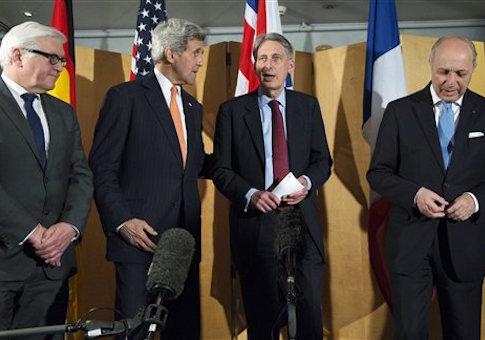
Iran Nuclear TalksFrom left, German Foreign Minister Frank Walter Steinmeier, U.S. Secretary of State John Kerry, British Foreign Secretary Philip Hammond and French Foreign Minister Laurent Fabius talk after Hammond made a statement about their meeting regarding recent negotiations with Iran over Iran’s nuclear program in London, England, Saturday, March 21 / AP

LAUSANNE, Switzerland—Efforts by the Obama administration to stem criticism of its diplomacy with Iran have included threats to nations involved in the talks, including U.S. allies, according to Western sources familiar with White House efforts to quell fears it will permit Iran to retain aspects of its nuclear weapons program.

A series of conversations between top American and French officials, including between President Obama and French President Francois Hollande, have seen Americans engage in behavior described as bullying by sources who spoke to the Washington Free Beacon.

The disagreement over France’s cautious position in regard to Iran threatens to erode U.S. relations with Paris, sources said.

Tension between Washington and Paris comes amid frustration by other U.S. allies, such as Saudi Arabia and Israel. The White House responded to this criticism by engaging in public campaigns analysts worry will endanger American interests.

Western policy analysts who spoke to the Free Beacon, including some with close ties to the French political establishment, were dismayed over what they saw as the White House’s willingness to sacrifice its relationship with Paris as talks with Iran reach their final stages.

A recent phone call between Obama and Hollande was reported as tense as the leaders disagreed over the White House’s accommodation of Iranian red lines.

Amid these tensions, U.S. Ambassador to France Jane Hartley met with her French counterpart, Gerard Araud, Monday to discuss a range of issues.

Benjamin Haddad, who has advised senior French political figures on foreign policy issues, said leaders in Paris have not been shy about highlighting disagreements they have with the White House.

“Fance, like other European countries, has negotiated for more than 10 years and endured most of the sanctions’ burden,” said Haddad, a research fellow at the Hudson Institute.

“The French want a deal, but they see no rush and repeat that Iranians need a deal more than we do, and that we shouldn’t fix artificial deadlines that put more pressure on us than Iran.”

One source in Europe close to the ongoing diplomacy said the United States has begun to adopt a “harsh” stance toward its allies in Paris.

“There have been very harsh expressions of displeasure by the Americans toward French officials for raising substantive concerns about key elements of what the White House and State Department negotiators are willing to concede to Iran,” said the source, who spoke on condition of anonymity. “That is because the clarifications expose just how weak the Americans’ deal is shaping up to be.”

“The meeting between the French ambassador in Washington and the president’s envoy to Paris—not a diplomat but a big fundraiser for his campaigns—comes amid these very harsh words that were spoken privately about the ambassador’s recent comments on the seeming American desperation for a deal, and the tough words that President Obama had for President Hollande in their phone call.”

Strategic differences remain between the United States and its allies over how a final deal should look, the source said. The French remain opposed to a recent range of concessions made by the Obama administration.

“We may agree that denying Iran a nuclear weapon ability is the goal, but apparently the view of what one can leave Iran and assure that is very different,” the source said.

“Clearly these are the differences that must be discussed. I don’t see France suddenly deciding that America is right and French objections to weakness are wrong, nor that silence is preferable to transparency.”

Haddad said the French are hesitant to rush into an agreement.

“The French want a robust deal with clear guarantees on issues like [research and development] and inspections to ensure that Iranians won’t be able to reduce breakout time during the duration of the agreement (also an issue of discussion), or just after thanks to research conducted during the period,” he said. “That is also why they disagreed on lifting sanctions.”

He also said the French “don’t trust Iran and believe an ambiguous deal would lead to regional proliferation.”

Another Western source familiar with the talks said the White House is sacrificing longstanding alliances to cement a contentious deal with Iran before Obama’s term in office ends.

“The President could be hammering out the best deal in the history of diplomacy, and it still wouldn’t be worth sacrificing our alliances with France, Israel, and Saudi Arabia—key partners in Europe, the eastern Mediterranean, and the Gulf,” the source said. “But he’s blowing up our alliances to secure a deal that paves Iran’s way to a bomb.”

A State Department spokesperson declined to comment on the issue.

Meanwhile, talks between the United States and Iran reached a critical juncture Thursday, as Secretary of State John Kerry met with his Iranian counterpoint to hash out differences over key points concerning Iran’s nuclear program.

The sides are hoping to reach a framework agreement by March 31 amid reports that Iran is demanding Saudi Arabia immediately halt airstrikes in Yemen, where Iran-aligned forces are working to bring down the Western-backed government.

The issue could complicate the talks as the United States attempts to balance its regional alliance with Iran in Iraq against competing interests with traditional allies in Saudi Arabia.

U.S. negotiators have reportedly softened their stance in recent days on a range of issues relating to Iran’s continued production of nuclear materials. One of Iran’s nuclear sites in Fordow could continue to operate, according to the Associated Press.

Saudi Arabia puppet of US, Israel: Houthi leader

March 26, 2015

Saudi Arabia puppet of US, Israel: Houthi leader, Press TV (Iranian), March 26, 2015

(The positions of Obama’s friends in Iran. How soon will he bow, apologize and make more concessions to Iran to atone for his sins? — DM)

bbc72135-d3b0-4924-91b3-4c85d14cbc21Tribal gunmen loyal to the Houthis Ansarullah shout slogans against Saudi Arabia during a gathering in the capital Sana’a on March 26, 2015.

The leader of Yemen’s Houthi fighters has heaped scorn on Saudi Arabia for conducing unjust and heinous attacks on Yemeni people, saying the Arab kingdom is serving as a puppet for the United States and the Israeli regime.

Abdul-Malik al-Houthi made the remarks in a televised address on Thursday in reaction to Saudi Arabia’s “unjustified” deadly attacks targeting Yemeni people in the capital, Sana’a.

Saudi Arabia is a puppet at the disposal of superpowers, the Houthi leader said, adding that Riyadh is putting in action the US-Israeli conspiracy in Yemen.

He noted that the US-Israeli plot in Yemen aims to break up the chaotic country and deprive people of security and freedom.

Al-Houthi said the Saudi invasion of Yemen came after their agents, including al-Qaeda terrorists and the ISIL Takfiri terrorists, failed to execute their plots in Yemen.

He said the “criminal” attacks uncovered the “tyrannical” nature of the Saudi regime.

Al-Houthi warned that Saudi Arabia would face consequences should it push ahead with its aggression against Yemen, saying, “We will confront the criminal forces and their tools in the country.”

“You think you can kill Yemeni people, but this is because of your stupidity,” he said. “This unjustified aggression shows the hostility and arrogance of this regime. The attacks are reflecting the inhumanity of the aggressor.”

Al-Houthi said the “aggressors” should keep in mind that the Yemeni people are “committed to defending their country and revolution” by relying on God.

On Thursday, Saudi warplanes carried out fresh airstrikes against Yemen, hitting the northern cities of Sa’ada and Ta’izz in the south.

Airstrikes also targeted arms depots in the Malaheez region in Sa’ada near the border with Saudi Arabia.

Saudi warplanes started bombing the positions of the Ansarullah fighters and launched attacks against the Sana’a International Airport and the Dulaimi airbase early on Thursday.

Despite Riyadh’s claims that it is attacking Ansarullah positions, Saudi warplanes have flattened a number of homes near the Sana’a airport. Based on early reports, the Saudi airstrikes on Yemen have so far claimed the lives of 18 civilians with more deaths feared, Yemeni sources said.

The Saudi invasion of Yemen has drawn condemnation from many countries such as Iran, Russia, Iraq and Syria, as well as the Lebanese resistance movement, Hezbollah.

The blatant invasion of Yemen’s sovereignty by the Saudi government comes against a backdrop of total silence on the part of international bodies, especially the United Nations. The world body has so far failed to show any reaction whatsoever to the violation of the sovereignty of one of its members by Riyadh.

Daylight: The Story of Obama and Israel

March 26, 2015

Daylight: The Story of Obama and IsraelEmergCmteForIsrael via YouTube, March 3, 2012

(A flashback to Obama’s 2009 candidacy — Israel is good and great and I support her completely — through March of 2012. Obama’s animosity toward Israel has increased dramatically since then. Now, Israel has more support from many Arab nations than does Obama.  Hat tip to Joop klepzeiker.– DM)


Gulf states, abandoned against Iran

March 26, 2015

Gulf states, abandoned against Iran, Israel Hayom, Dr. Reuven Berko, March 26, 2015

(At least the Gulf States are awakening. That’s a good start. — DM)

The West’s weakness and apathy toward Iran and the perilous predicament it has created in Yemen again prove the flimsy nature of those security and defense treaties. This lesson justifies Israel’s approach, which is based on the ability to defend itself on its own. In the meantime, following the Houthi takeover, Saudi Arabia has decided to deploy a massive military force along the border with Yemen. The first shot is in the chamber and the finger is already on the trigger.

**********************

Shiite Iran’s increasing involvement in Iraq, Syria and Lebanon, while exploiting the Shiite elements of the population in those target countries, is causing a great deal of concern among leaders of Arab Gulf states. The trauma of Iran’s attempt to topple the regime in Bahrain, where most of the population is Shiite, under the claim that Bahrain is Iran’s 14th province, is still fresh in their minds. The Iranian goal of using Bahrain as a bridgehead from which to spread across the Arabian Peninsula is still in play, despite Iran’s first effort being blocked in March 2011, when some 1,000 Saudi troops and 500 policemen from the United Arab Emirates entered Bahrain to save its regime.

Ever since Saddam Hussein’s sudden invasion of Kuwait, the Gulf states — Saudi Arabia, Oman, Kuwait, Qatar, Bahrain and the UAE — realized the need for a type of “Al Jazeera defense force” to pose a strategic deterrent against Iranian machinations on the peninsula. Their effort has not been a success. Through its latest intervention, via the mobilization of Shiite Houthi tribesmen to capture key targets in Yemen, including the primary port cities and airports in the south of the country leading to control of the Gulf of Aden, Iran is clearly reiterating its ambition of acquiring the straits of Hormuz and Bab el-Mandeb, which will allow Iran to paralyze the Red Sea and Persian Gulf waterways.

Arab stagnation combined with the West turning a blind eye to this Iranian aggression, alongside the willingness of Western powers to sign a deal allowing Iran to acquire a nuclear bomb, is causing sleepless nights among those Arab leaders who are again pushing the need to upgrade the capabilities of the “Al Jazeera defense force.”

Considering the lack of trust in the West and Yemen’s expected fall to the Houthis, the leaders of the Arab Gulf states are again working, feverishly, to build the military capability to curb Iran. As early as December 2009, with the goal of protecting the integrity of Arab territories situated in the Arabian Peninsula, the Arab League decided to establish a massive, unified, heavily funded, rapid-reaction military force comprising hundreds of thousands of troops and naval capabilities, capable of posing a deterrent and striking a decisive blow on the battlefield. Morocco and Jordan were also added to this coalition, as strategic depth, but the initiative ultimately failed to gain traction.

The recent gathering of these partner states in Riyadh gave birth to a multitude of agreements, including support and aid to Egypt, which is considered the strongest true military force in the Sunni Arab Middle East. Additionally, Saudi Arabia has lobbied for Pakistani support in the aftermath of Yemen’s inevitable fall, or worse, when Iran completes its nuclearization with American consent.

As the West falls victim to the fraud peddled by Mohammad Javad Zarif, Iran’s foreign minister, the Arabs (and Israel) have no illusions about Iran’s true intentions. Even as the Bahrain crisis was unfolding, the threats issued by many of Iran’s highest-ranking defense establishment officials — whether in the regime, the military or the Shura (parliament) — reflected the hostile nature of Iran’s foreign policy, and removed any doubt in the minds of neighboring Arab leaders.

Many of the Gulf states with signed security and defense pacts with the West, namely the United States, are currently feeling abandoned. Ever since the events in Bahrain, and to a greater degree following the recent developments in Yemen, the realization is growing in the Gulf that Iran’s aggressive goals and ambitions regarding the Arabian Peninsula have not changed and that they must take care of themselves.

The Arabs have recently come to the realization that not only will they not receive aid from the West in their hour of need, but that the West is forging a deal with Iran at their expense — a deal that will pose the greatest threat to their security. The situation that has been created provides an opportunity for Israel, even if clandestinely, to play a part in the geostrategic plans being formulated by states in the region, and which could help lead to an agreeable deal on the Palestinian issue — which is rather secondary in the current pan-Arab context.

The West’s weakness and apathy toward Iran and the perilous predicament it has created in Yemen again prove the flimsy nature of those security and defense treaties. This lesson justifies Israel’s approach, which is based on the ability to defend itself on its own. In the meantime, following the Houthi takeover, Saudi Arabia has decided to deploy a massive military force along the border with Yemen. The first shot is in the chamber and the finger is already on the trigger.

Ben Shapiro: Obama’s Faith in Iran

March 26, 2015

Ben Shapiro: Obama’s Faith in Iran, Truth Revolt via Front Page Magazine, March 26, 2015


TRANSCRIPT:

President Obama has made it one of his chief missions to reach out to the Islamic Republic of Iran. His attempt to cut a nuclear deal with Iran – a deal that would leave Iran with a huge number of centrifuges intact and a crippling sanctions regime against it largely removed – is merely the latest signal that the President has faith that the Iranian dictatorship can be an ally to the United States. In 2009, Obama said this:

My administration is now committed to diplomacy that addresses the full range of issues before us, and to pursuing constructive ties among the United States, Iran and the international community.  This process will not be advanced by threats.  We seek instead engagement that is honest and grounded in mutual respect. You, too, have a choice.  The United States wants the Islamic Republic of Iran to take its rightful place in the community of nations.

In 2009, Iran began shooting dissenters in the streets.

Obama said this particular shooting was “heartbreaking” and blathered about the arc of the moral universe bending toward justice. Then he went back to catering to the mullahs.

In 2011, Obama did virtually nothing when Iran began filling the vacuum left by the United States in Iraq. This week, Obama signaled that he was ready to cut a deal with Iranian-backed Syrian dictator Bashar Assad – a man he said “had to go” after Assad used weapons of mass destruction on his own people in 2011. Earlier this year, the Obama State Department labeled the radical Iranian-backed Houthis in Yemen – a group that burns American flags and screams “Death to the Jews” – a “legitimate political constituency.” This week, Obama celebrated the Iranian holiday of Nowruz at the White House, with Michelle Obama gushing, “I think it’s so fitting we’re holding this celebration here today.”

How wrong is Obama about Iran?

Let’s look back at history. In 1979, after Jimmy Carter let the Shah of Iran fall, the Ayatollah Khomeini took over. The new regime promptly popularized the slogan “Death to America,” and took Americans at the embassy hostage. Every Friday for the last 37 years, massive prayer sessions led by the mullahs chant that slogan. Here’s one from last year, as our friends at MEMRI reveal:


Murals like this one are not uncommon across Tehran.

It’s not just sloganeering. The bombing of the US Embassy in Beirut in 1983 was carried about by Hezbollah, a Shiite Iranian proxy group. The United States believes that Hezbollah was behind the bombing of US Marine barracks in Beirut that same year as well, and Reagan reportedly thought about bombing Iranian Revolutionary Guard stations in retaliation. The continuous kidnapping of Americans ended up leading to the Iran-Contra scandal when the Reagan administration began smuggling weapons to the Iranians in an attempt to free American hostages. During this period, the Iranian regime used child soldiers; the president encouraged those above the age of 12 to volunteer. A reported 95,000 children under the age of 18 were wounded or killed in the war.

Iran provided significant material support for the 9/11 hijackers. According to the 9/11 Commission Report:

Senior managers in al Qaeda maintained contacts with Iran and the Iranian-supported worldwide terrorist organization Hezbollah, which is based mainly in southern Lebanon and Beirut. Al Qaeda members received advice and training from Hezbollah. Intelligence indicates the persistence of contacts between Iranian security officials and senior al Qaeda figures after Bin Ladin’s return to Afghanistan…we now have evidence suggesting that 8 to 10 of the 14 Saudi “muscle” operatives traveled into or out of Iran between October 2000 and February 2001….In sum, there is strong evidence that Iran facilitated the transit of al Qaeda members into and out of Afghanistan before 9/11, and that some of these were future 9/11 hijackers.

The Commission concluded, “We believe this topic requires further investigation by the U.S. government.” No further investigation ever took place.

During the Iraq War, the Iranian government heavily facilitated the rise of Shiite militias dedicated to the murder of American troops. In Afghanistan, they provided material support to the Taliban to assist in the murder of American troops. All of this continued during the Obama administration. Obama’s own Chairman of the Joint Chiefs of Staff, Admiral Mike Mullen, said in 2011 that Iranian-backed militas were “killing our troops” in Iraq. He said that Iranian officials “know about it.” “Iran is playing an outsized role,” Mullen said. “That has to be dealt with. It’s killing our people.”

Obama’s solution: pull out of Iraq and hand the country over to Iran, which had already helped turn the country into shambles with its allied leader, Nouri Al-Maliki, cleaning security forces of Sunnis. His replacement is an even more pro-Iranian leader, Haider al-Abadi.

Even as the Iranian economy suffers from global sanctions and Saudi attempts to undercut Iranian oil prices, Iran’s expansionism grows. Iraq. Syria. Lebanon. Yemen. The Saudis live in fear. So do the Jordanians and the Egyptians.

Iranian power over the past three decades has meant thousands of dead Americans. But Obama keeps pushing for Iranian power nonetheless. Which means thousands more dead Americans in our future.

US Declassifies Document Revealing Israel’s Nuclear Program

March 25, 2015

US Declassifies Document Revealing Israel’s Nuclear Program, Israel National News, Ari Yashar, Matt Wanderman, March 25, 2015

DimonaDimona nuclear reactor circa 1960sNational Security Archive/Flash 90

In a development that has largely been missed by mainstream media, the Pentagon early last month quietly declassified a Department of Defense top-secret document detailing Israel’s nuclear program, a highly covert topic that Israel has never formally announced to avoid a regional nuclear arms race, and which the US until now has respected by remaining silent.

But by publishing the declassified document from 1987, the US reportedly breached the silent agreement to keep quiet on Israel’s nuclear powers for the first time ever, detailing the nuclear program in great depth.

The timing of the revelation is highly suspect, given that it came as tensions spiraled out of control between Prime Minister Binyamin Netanyahu and US President Barack Obama ahead of Netanyahu’s March 3 address in Congress, in which he warned against the dangers of Iran’s nuclear program and how the deal being formed on that program leaves the Islamic regime with nuclear breakout capabilities.

Another highly suspicious aspect of the document is that while the Pentagon saw fit to declassify sections on Israel’s sensitive nuclear program, it kept sections on Italy, France, West Germany and other NATOcountries classified, with those sections blocked out in the document.

The 386-page report entitled “Critical Technological Assessment in Israel and NATO Nations” gives a detailed description of how Israel advanced its military technology and developed its nuclear infrastructure and research in the 1970s and 1980s.

Israel is “developing the kind of codes which will enable them to make hydrogen bombs. That is, codes which detail fission and fusion processes on a microscopic and macroscopic level,” reveals the report, stating that in the 1980s Israelis were reaching the ability to create bombs considered a thousand times more powerful than atom bombs.

The revelation marks a first in which the US published in a document a description of how Israel attained hydrogen bombs.

The report also notes research laboratories in Israel “are equivalent to our Los Alamos, Lawrence Livermore and Oak Ridge National Laboratories,” the key labs in developing America’s nuclear arsenal.

Israel’s nuclear infrastructure is “an almost exact parallel of the capability currently existing at our National Laboratories,” it adds.

“As far as nuclear technology is concerned the Israelis are roughly where the U.S. was in the fission weapon field in about 1955 to 1960,” the report reveals, noting a time frame just after America tested its first hydrogen bomb.

Institute for Defense Analysis, a federally funded agency operating under the Pentagon, penned the report back in 1987.

Aside from nuclear capabilities, the report revealed Israel at the time had “a totally integrated effort in systems development throughout the nation,” with electronic combat all in one “integrated system, not separated systems for the Army, Navy and Air Force.” It even acknowledged that in some cases, Israeli military technology “is more advanced than in the U.S.”

Declassifying the report comes at a sensitive timing as noted above, and given that the process to have it published was started three years ago, that timing is seen as having been the choice of the American government.

US journalist Grant Smith petitioned to have the report published based on the Freedom of Information Act. Initially the Pentagon took its time answering, leading Smith to sue, and a District Court judge to order the Pentagon to respond to the request.

Smith, who heads the Institute for Research: Middle East Policy, reportedly said he thinks this is the first time the US government has officially confirmed that Israel is a nuclear power, a status that Israel has long been widely known to have despite being undeclared.

The Myth of Netanyahu’s Racism

March 23, 2015

The Myth of Netanyahu’s Racism, Front Page Magazine, Daniel Greenfield, March 23, 2015

Benjamin Netanyahu

Israel’s cultural conflict is a complex one. It doesn’t just pit Jews against Arabs or Muslims against Jews, it pits Arab Druze against European Jewish leftists and Aramean Christians against Arab Muslims. The left prefers cheap shots to actually understanding the complexities of a country that can’t be summed up with a keffiyah and a protest sign. After their election defeat, Obama and the media have decided to reduce Israel to Netanyahu and Netanyahu to the devil. It’s the easy way out, but it fails to take account of men like Ayoub Kara or Father Naddaf, of the Likud landslide in Arab-al-Naim and of Lieberman’s wins in Arab towns and villages. The Jews and Arabs are more complex than the left would like them to be.

***********************

Netanyahu’s conservative Likud Party got its best numbers not in Jerusalem, where it only won a quarter of the vote, or Sderot, the city under siege where it still got less than half, or Maaleh Adumim, a city of some 40,000 known as a “settlement” because it is located in ’67 Israel where it also took less than half.

Its best numbers appear to have come from Arab-al-Naim, a Bedouin settlement, where it scored three-quarters of the vote.

The residents were uninterested in any of the accusations of racism being aimed at Netanyahu by the media. Instead they were interested in housing. As one resident put it, “I used to sleep in a cave with my goats. Now I ask my daughter what wallpaper she wants in her room.”

Netanyahu’s election comment about Arabs being bused in to vote has been seized on as a useful excuse to explain how the media’s poll numbers that showed Netanyahu losing align with the actual results by claiming that a rash of racist Israelis rushed to vote. But that fails to explain why the exit polls were still badly wrong. A more realistic explanation is that the media’s polling was biased against Netanyahu. But it’s easier for the media to accuse Netanyahu of racism than admit to its own biases.

When Netanyahu warned about Arabs being bused in, he obviously was not talking about his own Arab voters, but the Joint Arab List whose MKs include Ahmed Tibi, who claimed that Hamas is not a terrorist organization, Tibi’s brother-in-law, Osama Sa’adi, who represented Hamas terrorists, Haneen Zoabi, who met with Hamas officials and defended the kidnapping and murder of three Israeli teens and Jamal Zahalka, who attended a Hamas rallyand claimed that Israel would be destroyed.

Also on the list is Masud Ghanim, a Muslim Brotherhood member who called for replacing Israel with an Islamic Caliphate and stated that he supports Hezbollah.

The Joint Arab List is composed of several parties. Hadash has its roots in the Israeli Communist Party. Despite the name, it rejects Israel and its only remaining Jewish MK is Boris ‘Dov’ Khenin, the son of David Khenin the party’s co-founder and General Secretary of the Communist Youth Union. Balad was founded by Azmi Bishara who fled Israel after being investigated as an enemy spy. Balad had already been suspended for calling for war against Israel. The United Arab List emerged out of the local Muslim Brotherhood franchise and is stacked with Muslim Brotherhood members.

The Muslim Brotherhood believes that the Islamic apocalypse requires exterminating the Jews.

The Joint Arab List unites Communists with Islamists into one big political terrorist organization. The reasons why Netanyahu and Israelis would be concerned about its members picking up seats are obvious. Imagine Communists sitting in the Senate during the Cold War and Al Qaeda members sitting there now. As Arab al-Naim shows, the issue was not ethnicity; it was Islamic terrorism.

The media’s cries of racism fail to explain places like Arab-al-Naim where the Arab vote helped Netanyahu. Or the Arab-Druze town of Abu Sinan where Lieberman’s Yisrael Beiteinu (Israel Our Home) party, despite its media image as right-wing, captured almost 14 percent of the vote. But then again the “xenophobic” and “racist” party has Hamad Amar, a Druze IDF veteran, in the sixth place on its list.

In Netanyahu’s Likud Party, Druze lawmaker Ayoub Kara returned to the Knesset, Israel’s parliament. If Obama thinks that Netanyahu is far right, he hasn’t met Ayoub Kara who urged protesters, “Say ‘No!’ to Barack Hussein Obama and ‘Yes!’ to the nation of Israel.”

“Everyone understands that withdrawing from land will yield us nothing but a ‘red carpet’ at the ‘peace treaty’ signing ceremony,” he said during the campaign.

Netanyahu didn’t win Kara’s village of Isifya. The center-right Kulanu party running on a program of social development and economic reform did. The Likud barely placed, but Yisrael Beiteinu scored 10 percent of the vote.

While there is an Arab bloc, the Arab vote is also a lot more complicated than it seems.

There are Arab Christians who define themselves as Aramaic rather than Arab and minority groups such as the Druze and the Bedouin who have a different relationship with Israel than the stone-throwing Keffiyah-wearer prized by European protest tourists.

From the earliest days of the reborn state, entire clans and ethnic groups aligned for or against Israel. Thus the Al-Husayini clan, which gave the world Hitler’s Mufti and Arafat, led the campaign against Israel while the Abu Ghosh family maintained friendly relations with the Jews. Druze and Bedouin serve in the Israeli army and there is a growing movement of Arab Christians who have decided to serve as well.

Netanyahu has met with Father Gabriel Naddaf who has led the movement, and Naddaf identifies as Aramaic, rather than Arab, while encouraging other Christians to reclaim an Aramaic heritage. In Jish, the Maronite Christian center of the Aramean revival, the United Arab List won decisively, but Lieberman’s Yisrael Beiteinu scored 11 percent. 5 people even cast votes for Yachad. Shas, the party of Middle Eastern Jews, came in sixth.

The media has accused Netanyahu of offering a bigoted appeal by warning about Arab voters being bused in. It doesn’t care to dwell on the subject of which group would be most moved by such an appeal. That would reveal certain inconvenient facts about the relationships of the Israeli left.

The Israeli left remains a project of European Ashkenazi Jews. The Middle Eastern Mizrahi Jews were refugees from Muslim persecution and want a strong leadership that protects the country. The left gets a fraction of its vote from Middle Eastern Jews. Netanyahu gets half his votes from them.

The Israelis most likely to respond to anti-Muslim rhetoric are refugees from Muslim countries. The lefty activists most likely to condemn them as racist colonizers emigrated from Russia and Germany.

Meretz, Israel’s farthest left party, has an Arab MK. It has no Mizrahi MKs. Yisrael Beiteinu has a Druze and a Mizrahi MK. Israel’s right is more fundamentally diverse than its left and its stronger stand on Islamic terrorism helps it pick up support from Jewish and non-Jewish minorities.

Lieberman does better than Netanyahu among some Arab voters because he projects strength. When he talks about cutting off the heads of traitors, he’s speaking with a vocabulary that is entirely familiar in the region. Nobody in the Middle East picks the weak horse and those Arabs who support Israel prefer the bellicose Lieberman to the more moderate Netanyahu.

“Even in a hundred years’ time, the Middle East will not speak Yiddish and the answer to terror is a deterrent penalty,” Ayoub Kara said.

Those Arabs that support Israel want to see a strong country and they don’t wring their hands when conservative Israeli politicians say politically incorrect things. The Joint Arab List wants to see it gone and those who vote for them are no more likely to spare the Jewish State no matter how softly it speaks.

Israel’s cultural conflict is a complex one. It doesn’t just pit Jews against Arabs or Muslims against Jews, it pits Arab Druze against European Jewish leftists and Aramean Christians against Arab Muslims. The left prefers cheap shots to actually understanding the complexities of a country that can’t be summed up with a keffiyah and a protest sign. After their election defeat, Obama and the media have decided to reduce Israel to Netanyahu and Netanyahu to the devil. It’s the easy way out, but it fails to take account of men like Ayoub Kara or Father Naddaf, of the Likud landslide in Arab-al-Naim and of Lieberman’s wins in Arab towns and villages. The Jews and Arabs are more complex than the left would like them to be.

For Obama, Bibi’s words matter while Iran’s don’t

March 22, 2015

For Obama, Bibi’s words matter while Iran’s don’t, Times of IsraelShmuley Boteach, March 22, 2015

(Please see also, Iranians Chant “Death to America” While Negotiations Continue. — DM)

President Obama says that Bibi’s words matter when it comes to a Palestinian state. “We take him at his word when he said that it wouldn’t happen during his prime ministership,” he told The Huffington Post. The President used Netanyahu’s statement as cause for a “reassessment” of American ties with Israel.

White House spokesman Josh Earnest echoed the sentiment in last Thursday’s White House briefing that the Prime Minister’s words could bring punishment. “Words matter,” he said. There could be “consequences” for Netanyahu’s statements. “Everybody who’s in a position to speak on behalf of their government understands that that’s the case, and particularly when we’re talking about a matter as serious as this one.”

So let’s get this straight. When foreign leaders speak, it matters. What they say is consequential. Bibi’s going to have to pay for his remarks.

But I have one question. Why doesn’t any of this apply to Iran? Why, on Saturday Ayatollah Ali Khameini uttered the words “Death to America” even as John Kerry was expressing optimism the very same day that the United States would come to a nuclear accord with Iran!

Suddenly, Iran’s words don’t matter?

Taking this further, the most hair-raising aspect about the growing American rapprochement with Iran is that it has all happened while Iran has continued to repeatedly threaten the annihilation of the Jewish people. Ayatollah Khameini has called Jews dogs and tweeted as recently as this past November that “there is no cure for Israel other than annihilation.”

Now, if words matter, how can the United States continue to speak to his government while they are openly threatening a second holocaust? Why did President Obama and John Kerry not establish a repudiation of these genocidal words and threats as a precondition for any talks?

The hypocrisy is startling. And it leads to a more important point.

By now it’s clear to all that President Obama positively loathes Prime Minister Netanyahu more any other world leader. His hostility to the Prime Minister has become so pronounced that the President can no longer disguise or control it.

Am I the only one that finds it just a touch unseemly for the leader of the free world to hate the leader of the only free country in the Middle East?

The President has a good relationship with Erdogan, the tyrant of Turkey, who has destroyed his nation’s democracy and allows fighters to pass through his nation to join ISIS. President Obama traveled to Saudi Arabia to pay his personal condolences upon the passing of arch-misogynist King Abdullah of Saudi Arabia, a man who wouldn’t even allow women to drive a car. And he utters not an unkind word about Ayatollah Khameini, the world’s foremost terrorist.

But he hates Netanyahu. Go figure.

For years we Americans have heard that our President is cerebral and unflappable. That he famously remains cool under the most challenging circumstances. It turns out that this is true for every world leader except one, Benjamin Netanyahu, who makes the President’s blood boil.

Don’t we deserve to know why?

If the two leaders merely had bad personal chemistry, I could understand. They’re not the best of friends. Fine. But for Obama the hatred of Netanyahu has become positively visceral, personal, and irrepressible.

My own belief is this. President Obama is desperate for some foreign policy victories. There’s a year-and-a-half left to his Presidency and the world is on fire. From Iran to Boko Haram to ISIS to Putin to Hezbollah to Al Qaida and Hamas, bad guys are running amok under this president. American Foreign policy is a shambles.

The only ally President Obama can truly expert pressure on for a deal that would give him the lasting foreign policy legacy he needs and craves is Israel. And in the past Israeli Prime Ministers have proven so utterly malleable. American Presidents have squeezed them like lemons.

But Bibi refuses to be squeezed. He won’t play ball. He won’t withdraw from Judea and Samaria and allow “Hamastan” on his eastern border the way it is in Gaza. He won’t shut up about America’s capitulation to the Iranian mullahs that would leave them with a military-grade nuclear program. He won’t go quietly into the nuclear night while America appeases one of the most violent and vile regimes on earth.

This darned Bibi guy just won’t bend.

And our President finds the intransigence so utterly frustrating.

He prayed and hoped that someone else might win the Israeli election. And some of the President’s top political operatives went and worked for Herzog. But, huff and puff as he might, the President could not blow Bibi’s house down.

So now he’s stuck with him. A stick-necked Prime Minister, getting in the way of the President’s peace deals with Iran and the Palestinians.

And with no way of getting rid of the Israeli nuisance, all the President can do is continue to give interviews that express his dislike and frustration, not realizing that we’re reaching a point where the President is beginning to look positively un-Presidential and where is enmity is becoming unbecoming.

It’s called democracy, Mr. President. Bibi won. And it’s time for the world’s foremost democracy, the United States of America, to live with it and work with the man who has the mandate of the Israeli people, just as you have the mandate of the American people.


Unstated Factor in Iran Talks: Threat of Nuclear Tampering

March 22, 2015

Unstated Factor in Iran Talks: Threat of Nuclear Tampering, New York Times, 

JP-SABOTAGE-master675Foreign Minister Mohammad Javad Zarif, center, said someone had tried to sabotage an Iranian reactor’s cooling system. Credit Laurent Gillieron/European Pressphoto Agency

[R]eaching an accord is quite different than reaching a state of trust. Inside Iran, there will be pressure to keep making slow progress on a nuclear program that is central to the ambitions of the Iranian Revolutionary Guard Corps and thousands of scientists who have labored for years. And in the uneasy alliance among Israel, the United States and Europe there will be continued debate about whether to supplement diplomatic pressure with covert action to keep Iran from getting to the threshold of being able to build a weapon.

*********************

WASHINGTON — In late 2012, just as President Obama and his aides began secretly sketching out a diplomatic opening to Iran, American intelligence agencies were busy with a parallel initiative: The latest spy-vs.-spy move in the decade-long effort to sabotage Tehran’s nuclear infrastructure.

Investigators uncovered an Iranian businessman’s scheme to buy specialty aluminum tubing, a type the United States bans for export to Iran because it can be used in centrifuges that enrich uranium, the exact machines at the center of negotiations entering a crucial phase in Switzerland this week.

Rather than halt the shipment, court documents reveal, American agents switched the aluminum tubes for ones of an inferior grade. If installed in Iran’s giant underground production centers, they would have shredded apart, destroying the centrifuges as they revved up to supersonic speed.