Archive for the ‘Israel’ category

Israel’s Revenge Is That “We Are Still Here”

June 7, 2015

Israel’s Revenge Is That “We Are Still Here” The Legal Insurrection, June 7, 2015

My wife and I are back, after an intense two weeks in Israel.

From the Lebanese to Gaza borders, from the Mediterranean Sea to Judea and Samaria, from the cool evenings of Jerusalem to the heat of the Negev Desert, from an apartment in the Jewish Quarter of the Old City of Jerusalem to Bedouin villages in the north and south, from university campuses to military bases, from faculty to students, from Jews to Muslims … I can’t say we saw it all, but we saw a lot.

I’ve documented most of our big events in daily posts, with the exception of our emotional meetings with the families of Edward Joffe and Leon Kanner, students killed in the 1969 Supersol supermarket bombing by Rasmea Odeh; that post is coming, but I still have new photos, documents and information I have to work through.

Here are my 5 Big Takeaways from the trip:

1. Our Revenge Is That “We Are Still Here”

Near the start of our trip, we visited Moshav Avivim straddling the Lebanese border, where we met Shimon Biton, a survivor of the 1970 bazooka attack on a school bus by the Popular Front for the Liberation of Palestine.

Biton, who was six and one-half years old, lost his father in the attack, and himself was shot point blank range by the terrorists when they realized he survived the bazooka attack.  Ten days before we met Biton, he was reunited for the first time in 45 years with the nurse who helped save him.  (Featured Image)

When we asked whether he ever wanted revenge, Biton told us that the revenge was that “we are still here and building for another 70 families.”

Moshav-Aviviv-Shimon-Biton-e1432683043370[Shimon Biton, Moshav Avivim, Israel]

When we related that story to numerous people we met along the rest of the trip, heads vigorously shook up and down.  It struck a chord, since almost every Israeli has a relative or friend impacted by terror.

Despite several decades of terrorism, particularly intense during the Second Intifada, and a world campaign against it, the People of Israel are still there.

The will to resist is underestimated.  Israel has a longer-term view, and a history.  It will not give in to boycotts, or Obama, or outside pressure that puts its security at risk.

2. “I don’t like Bibi, BUT….”

For whatever the reason, most of the people with whom we interacted self-identified as center-left or left.

There was no shortage of criticism of Israeli Prime Minister Benjamin Netanyahu: He’s egotistical, he doesn’t keep his tough promises, he is only interested in his own political survival, he’s a liar, his pre-election comment about Arab voting was shameful, and so on.

Yet with only a couple of exceptions, the negative comments always were followed with a big BUT.
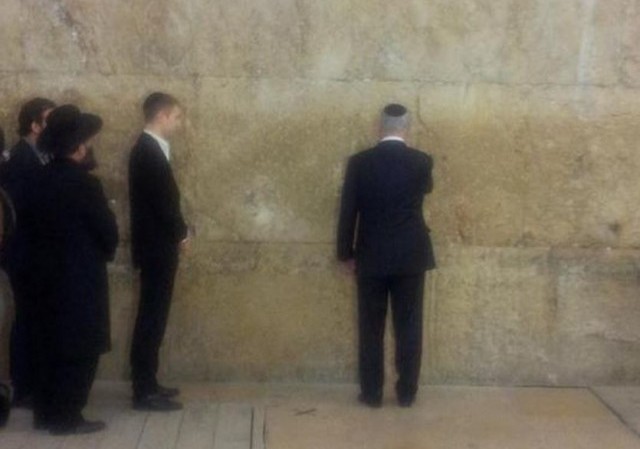
Benjamin-Netanyahu-at-Western-Wall-post-election-2015-e1426681806959[Israeli Prime Minister Benjamin Netanyahu at Western Wall after 2015 election victory.]

But he is the only Israeli politician who has the stature to handle the world pressure; but I don’t envy the position he is in with so many forces against us; but [opposition leader Yitzhak “Bougie” Herzog] Bougie is weak and no one will fear him; and so on.

These opinions pretty much were reflected in polling and the election results — Many people may not like Netanyahu, but he is the only Israeli politician capable of standing up for Israel in a hostile world.

3. I don’t like Obama, no BUTs about it

Polling in Israel shows Obama is hugely unpopular.  Our anecdotal interactions with Israelis confirmed that polling.

I  can’t recall anyone, from left to right, who had anything nice to say about Obama.  The most consistent theme was that Obama is naive and weak, and that naivitee and weakness had resulted in disaster in the Arab world as it encouraged the most aggressive Islamist elements.

They see Syria falling apart with al-Qaeda or ISIS groups likely to control large parts of the country; or if not, then Iran in control. There are no good outcomes for Israel’s Golan Heights border. Along the Lebanese border there is Hezbollah, and in Gaza Hamas and increasingly even more radical Salafist-ISIS groups.

Against this background of being surrounded by a sea of increasing threats resulting from Obama administration policy, not a single person thought the Iran nuclear deal made any sense, or trusted the Obama administration on it.

In other words, Israelis live in the real world, not the world of Obama’s delusional hope.  And they don’t appreciate Obama taking risks with their lives.

4. Are we really that popular in the United States?

The anti-Israel Boycott, Divestment and Sanctions movement was a frequent topic of conversation, almost always brought up by us as part of describing the type of coverage at Legal Insurrection.  This coincided with what I consider an irrational panic the past two weeks in the Israeli press and political discourse about BDS (more on that in a later post.)

I tried to explain that there is a complete disconnect between the BDS movement in the U.S. and the vast majority of Americans.  Gallup and Pew polling shows Israel at or near historical highs in terms of Israel’s favorability both abolutely and relative to favorability of Palestinians.  The gap between those who pick Israel over Palestinians when the question forces a choice, also is historically high.

Virtually every Israeli we met was shocked that Israel is actually so popular in the United States.  Even Israelis who have extensive American contacts and visit the U.S.

That’s not all so surprising.  Both the U.S. and Israeli media focus on the negative, though for different reasons.  The U.S. media long has had in implicit anti-Israel bias, compounded by the rise of left-leaning new media, while the Israeli media competes for readers with a “sky is falling” outlook.

(added) Israel’s enormous popularity among Americans is a strategic asset.  That strategic asset needs to be used more effectively to minimize the damage from the narrow but influential slices of the American population — radical faculty, some students, and mainstream journalists — who have explicit or implicit anti-Israel biases. The American people as a whole are the “Israeli Lobby.”

5. The Next War is Only a Matter of Time

While we were in Jerusalem, Israel underwent a national defense drill, including sirens warningof incoming rockets.

Our tour along the Gaza border, particularly near Sderot, also reflected preparation for the next round of rocket fire through reinforcing key civilian infrastructures, such as schools.
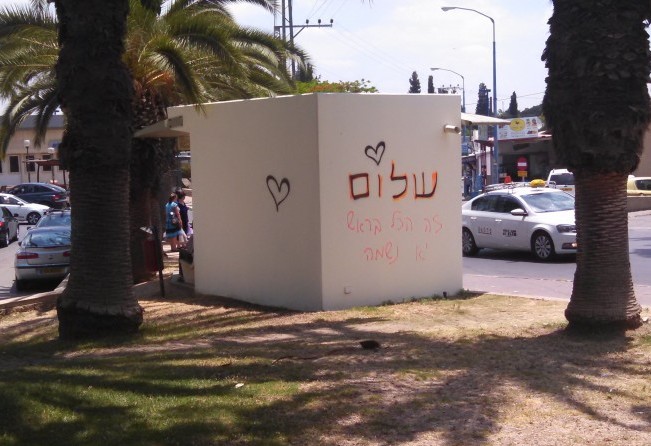
Sderot-Israel-bomb-shelter-street-e1433110130989[Sderot, Israel, street bomb shelter with “Shalom” grafitti]

There was a pervasive feeling that the calm cannot last.  And sure enough, while we were there and just after we left, rockets were fired from Gaza to Israel by Salafists suffering from a Hamas crackdown, and groups competing with Hamas for control.

That’s the logic of the region in which Israel lives: Radical groups retaliate against each other by firing rockets at … Israel.

The next war is coming.  Every Israeli knows it. It’s only a matter of time.

*  *  *  *  *

Those are my big takeaways.  I hope you enjoyed the coverage.

We will be back in Israel, hopefully next year.

Two major Mid East escalations: Yemeni rebels fire Scuds at Saudi air base. ISIS warns Syrian rebels

June 6, 2015

Two major Mid East escalations: Yemeni rebels fire Scuds at Saudi air base. ISIS warns Syrian rebels, DEBKAfile, June 6, 2015

us_patriot_missiles_saudi_arabia_6.6.15US Patriots stationed in Saudi Arabia

Saudi military sources reported Saturday, June 6, that Patriot air defense batteries had intercepted Scud missiles fired by Yemen Houthi rebels against the kingdom’s largest air base at Khamis al-Mushait in the south west. It is from there that Saudi jets take off to strike the Yemeni rebels. DEBKAfile’s military sources report that the Patriot anti-missile systems, which were activated for the first time, were manned by American teams. This was the first direct US military intervention on the Saudi side of the Yemen conflict.

It was also the first time that Houthi rebels or their allies had fired Scud missile into the oil kingdom. Our sources add that the launch was supervised by Hizballah officers. They were transferred by Tehran to Yemen to ratchet up the conflict – although US, Saudi, Yemeni government and Houthi representatives meeting secretly in Muscat Friday agreed to attend a peace conference in Geneva this month.

Nonetheless, through Friday night and Saturday morning, Houthi forces and allied military units kept on battering at Saudi army and National Guard defense lines, in an effort to break through and seize territory in the kingdom’s southern provinces. The insurgents were evidently grabbing for strategic assets to strengthen their hand at the peace conference.

Iran’s supreme leader Ayatollah Ali Khamenei is also juggling his chips on the deteriorating Syrian warfront. In the coming hours, he is widely expected to announce the activation of the mutual defense pact signed between Iran and Syria in 2006, under which each signatory is committed to send military troops if necessary to defend its partner.

Thursday, June 4, Khamenei fired sharp verbal arrows at the Obama administration: “The United States tolerates extremist groups in Syria and Iraq and even helps them in secret,” he charged.

Our military sources add that although various Mid East publications, especially in Lebanon, are reporting that Iran has already sent units in numbers ranging from 7.000 to 15,000 troops to Syria, none have so far landed, except for the Shiite militias brought over at an earlier stage of the Syrian conflict. The expected Khamenei announcement may change this situation.

ISIS was not waiting. Saturday morning, the group issued a warning to the Syrian rebel forces fighting in the south – the Deraa sector of southern Syria near the meeting point of the Jordanian and Israeli borders and the Quneitra sector opposite the Israeli Golan. They were ordered to break off contact with the US Central Command Forward Jordan-CF-J which is located north of Amman, and the IDF operations command center in northern Israel. Any Syrian rebels remaining in contact with the two command centers would be treated as infidels and liable to the extreme penalty of beheading, the group warned.

The impression of ominous events brewing in the regime was rounded off Friday night by an unusual announcement by the Israeli army spokesman that Iron Dome anti-missile batteries had been deployed around towns and other locations in the south, although no reference was made to any fresh rocket attacks expected from the Gaza Strip. DEBKAfile adds: The first batteries were arrayed Thursday night, June 4, at vulnerable points in southern Israel – from the southernmost Port of Eilat on the Gulf of Aqaba to the western Port of Ashdod on the Mediterranean.

Iran Will Walk

June 5, 2015

Iran Will Walk, The Gatestone InstituteLawrence A. Franklin, June 5, 2015

(What if the article is otherwise correct but Obama agrees to a “deal” anyway? — DM)

  • The Islamic Revolutionary Guard Corps (IRGC), the Praetorian Guard of Iran’s regime, controls most of the economy, as well as the black-market, alternative economy. The IRGC therefore actually benefits from sanctions; it is private firms, such as those involved in international commerce, that suffer. Why would IRGC operatives want to see the playing field made more level by private investment, transparency and a competitive economy?
  • Sanctions never hurt the regime’s ruling class; lifting them only helped the regime solidify its power over its people.
  • The objective of these two demands [an immediate lifting of all sanctions and no, or severely limited, inspections] is either to have them accepted, or to render it untenable for the Obama administration to offer Congress any deal that could be accepted – thereby shifting blame for the collapse of the talks to the U.S.
  • The U.S should also be on guard against the mullahs’ belief that the Obama administration is weak both politically and its aversion to using force. The mullahs might find great pleasure in humiliating Obama, as they did President Jimmy Carter, by dragging out hostage crisis negotiations by running out the clock until his term was over. They clearly believe that the Obama administration, simply to say it got “a deal,” is ready to sign anything.

From Washington to Riyadh, not to mention Jerusalem, statesmen are gritting their teeth at the possibility of a U.S.-Iran nuclear deal that seems overly generous to the theocratic-terror state of the Islamic Republic.

1008Representatives of the P5+1 countries pose with Iranian Foreign Minister Javad Zarif after nuclear negotiations in Lausanne, Switzerland on April 2, 2015. (Image source: U.S. State Department)

Most intelligence analysts and journalists assume that because Iran’s leadership endorsed the negotiations and has been the beneficiary of several key concessions by the P5+1 (the five permanent members of the UN Security Council, plus Germany), that an agreement is imminent. Forecasters have been predicting what the likely consequences of such a deal would be: negative.

But what if the Iranians walk?

Sanctions never hurt the regime’s ruling class; lifting them only helped the regime to solidify its power over its people.

A nuclear deal combined with an improvement in the commercial and business relations with the West would be inimical to IRGC interests.

The Islamic Revolutionary Guard Corps (IRGC), the Praetorian Guard of the regime, controls most of the economy as well as the black-market, alternative economy. IRGC-controlled conglomerates operate outside the law and reap huge profits through their control of the black market. The IRGC therefore actually benefits by sanctions; it is the private firms, such as those involved in international commerce, that suffer.

Furthermore, IRCG naval vessels, and private ships under their control, have been engaging in sanctions-breaking deliveries of imports across Persian Gulf waters to Dubai. The IRGC then sells the products at a profit by filtering them through the many foundations they control in Iran.

The most recent example of IRGC’s skirting of sanctions involved the illegal acquisition of aircraft through front-organizations with offices in both Europe and the Arabian Peninsula. Mahan Air, an IRGC front, was able to purchase 15 used commercial aircraft for $300 million. Another front, al-Naser Air, was about to purchase two more aircraft, this time from a U.S. owner. Israeli intelligence, however, passed details of the planned sale to the U.S. government, and on May 21, the deal was scuttled by the Office of Export Enforcement of the Department of Commerce.

Why would IRGC operatives want to see the playing field made more level by private investment, transparency and a competitive economy?

Moreover, if a nuclear deal indicated improved relations with the United States, Iranian hardliners, whether clerical revolutionaries or intelligence operatives, might fear seeing their ideological legitimacy erode. The Iranian regime’s only remaining fig leaf of legitimacy is its anti-American animus, with its accompanying pledge to “protect” Iran’s interests against the U.S.-Israel-Sunni “alliance.”

Improved relations with Washington might raise false hopes among Iran’s citizens that the regime may ultimately improve its woeful record on human rights. There remains only a thin patina of clerical control over Iranian society; if the hoped-for social and political reforms were not implemented, the result could produce a destabilizing political environment, harmful to the interests of the regime.

Another fallacy embraced by many “inside-the-beltway” analysts is that, as the Supreme Leader Ayatollah Khamenei endorsed the negotiations, a legitimate deal is now probable.

The once all-powerful Office of the Supreme Leader no longer calls all the shots. The current Iranian regime resembles a military junta or a security state as much as a theocracy. While the reach of Ayatollah Khamenei, through his network of representatives, still penetrates all dimensions of Iranian society, he does not have the final decision on key security matters. The regime’s strategic assets, for instance, such as its ballistic missile programs, are firmly under the control of the IRGC. Decisions related to Iran’s expansionist presence in the region are made by IRGC Quds Force Commander Qasem Soleimani. The role of Khamenei’s representative to the IRGC resembles more that of a handler than of an action officer.

The principal task for the regime is to find a way to back out of the negotiations while avoiding the blame. Iran’s efforts at disengagement may already have been underway for the past few weeks; the pace of decoupling from the talks seems to be accelerating. Iran has been increasing its demands apparently in the hope that they will either be accepted, or else rejected like the “poison pills” they are — such as inspectors no longer being allowed on its military sites.[1]

Another way to make the talks no longer palatable for the Obama administration was to create a hostile incident with the United States in the Persian Gulf, as it has tried to do by aggressively tailing American warships. Iranian ships affiliated with the IRGC Navy also seized a commercial ship, the Maersk Tigris, in the Strait of Hormuz, and temporarily detained both vessel and crew. Then, on May 14, IRGC boats fired several shots across the bow of a Singapore flagged vessel, but it escaped unharmed.

By this type of reckless comportment, the IRGC Navy appears intent on producing a clash with American naval vessels in the Gulf waters. Western negotiators have only to recall the presidency of Mohammad Khatami, when the IRGC and Iran’s Ministry of Intelligence and Security operated independently after they felt that the reformers had gone too far, thus threatening hard-liner control of the regime. The IRGC may have decided that Rouhani along with his American-educated Foreign Minister Zarif have reached a similar tipping point. This independent IRGC initiative is being executed even though a deal would release Iranian monetary assets that would in turn boost the sagging economy.[2]

Iran’s combative posture in Gulf waters against international shipping is also a direct challenge to international maritime law, which guarantees freedom of navigation through the world’s shipping lanes such as the Strait of Hormuz. A key principle of U.S. foreign policy is to enforce this freedom of navigation, if it is challenged by any foreign power, as one also hopes the U.S. will do in the South China Sea.

Iranian military and political spokesmen have also raised the temperature of their anti-American and anti-Israeli rhetoric of late. Leading members of the regime, including its Supreme Leader, Ali Khamenei, keep repeating, “Death to America” as well as its theological “obligation” to destroy Israel. While the Obama administration has alleged that these threats are just for “internal consumption,” an old Persian saying goes: “They spit in his eye and he calls it rain.”

Mojtaba Zolnour, Ayatollah Khamenei’s Deputy Representative to the IRGC, stated that the Islamic Republic of Iran, “has the divine permission to destroy Israel.” This media assault on Israel was designed to widen the divergence between the Obama administration and the Israeli government regarding the efficacy of the framework of a nuclear agreement negotiated so far.

Additionally, various Iranian principals have drawn “lines in the sand” designed to cause the Americans to disengage from the talks, such as the assertion that Iran will never accept inspection of its declared military sites. Another is Tehran’s repeated statement that it will not accept a gradual lifting of sanctions. Iranian leaders have insisted on immediate and irreversible lifting of all sanctions immediately after a nuclear deal is signed. The objective of these two demands is either to have them accepted, or to render it untenable for the Obama administration to offer Congress any deal that could be accepted — thereby shifting the blame for the collapse of the talks to the U.S.

Regime hard-line representatives to the majlis [Iranian Parliament] have already been mobilizing members to denounce the talks as detrimental to Iran’s national sovereignty. Eighty majlismembers signed a petition on May 12, calling upon the regime to suspend the nuclear talks until Washington halts its rhetorical threats against Iran. Hardliners in the majlis and elsewhere within the regime’s bureaucracy will likely continue to lobby against any deal.

Western analysts should be looking for the Iranian regime’s hard-line media outlets to increase domestic commentary condemning alleged U.S. deception in the negotiations as a reason to abandon the talks.

The death knell for the nuclear negotiations could come from newspapers such as Kayhan, a pro-regime newspaper run by Hossein Shariatmadari, and often characterized as a Khamenei mouthpiece.

The regime’s Friday-prayer Imams in key Iranian cities might also start opposing the talks. The themes of their noonday khutbahs [sermons] are likely to appeal to Iranian people’s patriotism, and suggest that it is more important for Iran to endure continued sanctions rather than submit to intrusive monitoring that offends Iran’s sovereignty.

Finally, hardliners who oppose any possibility of Iran’s improved relations with the U.S. may launch personal attacks on Iran’s negotiators to the nuclear talks, and, in an effort to discredit them, challenge their loyalty to the Iranian revolution. Their point of attack on Foreign Minister Mohammad Javad Zarif’s loyalty might be his alleged obsequious behavior to Secretary of State John Kerry. Zarif, on account of his many years of residency and education in the United States, can be depicted as an Americanized Iranian.

The United States should also be on guard against the mullahs’ belief that the Obama administration is weak — both politically and in its reluctance to use force. The mullahs might find great pleasure in humiliating Obama as they did President Jimmy Carter, when they dragged out hostage crisis negotiations by running out the clock until his term was over. They clearly believe that the Obama administration, simply to say it got “a deal,” is ready to sign anything.


[1]Iran’s powerful Guard rejects inspection of military sites” by Ali Akhbar Dareini, Associated Press, 19 April 2015. Deputy Chief of the IRGC General Hossein Salami is quoted and several more statements by IRGC officials since have repeated the same prohibitive statements regarding Iran’s military sites.

[2]U.S. to Award Iran $11.9 Billion Through End of Nuke Talks,” Washington Free Beacon, 21 January 2015. In the first of many subsequent denunciations, Senator Mark Clark of Illinois attacked the Obama administration’s plan to free Iran’s frozen assets if nuclear deal is reached.

Barack Obama: Born-Again Jew

June 5, 2015

Barack Obama: Born-Again Jew, Front Page Magazine, Daniel Greenfield, June 5, 2015

were

The Yiddish description of a hypocritical fraud is “As Kosher as a pig’s foot.” Obama supporters who partake of his particular set of Jewish values are unlikely to be familiar enough with the Bible to understand the significance of a pig’s split hoof, the Midrashic tale of the pig that stretches out its cloven hooves and squeals, “See how Kosher I am” or even the Kosher status of a pig.

But those Jews who do, recognize “The First Jewish President” for the Kosher pig hoof that he is.

*********************

Obama introduced himself to the nation as the son of black and white parents. He has gone back and forth between Christianity and Islam like a philanderer in a bar.

Now he has added a third religion and race to complete his identity politics trinity.

At the last White House Chanukah dinner, he claimed to have a Jewish soul. At a synagogue speech last month, he called himself “an honorary member of the tribe”. Now his former senior advisor has quoted him as saying, “I think I am the closest thing to a Jew that has ever sat in this office.”

Of course Barack Obama has also been Irish. He stated, “I consider myself an honorary Italian, because I love all things Italian”. Newsweek dubbed him “The First Woman President” in 2008 for “bending gender conventions” and promoted him to “The First Gay President” four years later. Cabinet Secretary Lu and Congressman Honda argued that he was “The First Asian American President”.

If you make up an ethnic group or race, by tomorrow Barack Obama will be a member of it. By next week, he will be lecturing it on why it isn’t living up to their shared values.

Obama’s Jewish toadies, like his multicultural frog pond toadies of all races and ethnicities, have been trying to sell Barack Obama as a “Born-Again Jew” for seven years.

His left-wing mentor Abner Mikva claimed during the original campaign, “When this all is over, people are going to say that Barack Obama is the first Jewish president.” But Abner hedged his bets, baptizing Obama in a Mikvah by urging him to study the speaking patterns of Baptist preachers instead.

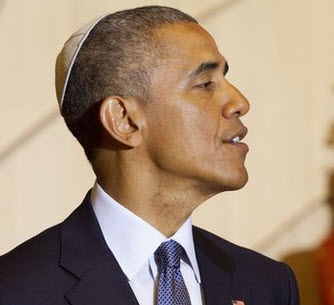
New York Magazine put Obama on the cover under a photoshopped Kippah as “The First Jewish President” and whined inside that, “Barack Obama is the best thing Israel has going for it right now. Why is that so difficult for Netanyahu and his American Jewish allies to understand?”

And that’s always the conclusion. Photoshop a Kippah on Obama’s head, dub him an honorary Jew and then use that to excuse his attacks on Israel.

Jerry Seinfeld accused his dentist of converting to Judaism to be able to tell Jewish jokes. Obama undergoes an honorary conversion to be able to bash Israel.

As an “honorary member of the tribe” he is entitled to all the anti-Semitic jokes and all the anti-Semitic policies he wants. When he signs off on nukes for Iran and a PLO state cut through the heart of Jerusalem accompanied by demands for the ethnic cleansing of half-a-million Jews, it’s as “The First Jewish Anti-Israel President” who cares about the Jewish State so much that he has to destroy it.

When Peter Beinart switched his career from the New Republic hawk who after September 11 wrote “The left has proved remarkably creative over the years at blaming virtually any Middle Eastern malfeasance…on the Jewish State” to the Daily Beast’s Israel basher who could blame bad weather or a lost sock in a dryer on Israel, he declared that he was bashing Israel because he was a “Liberal Zionist”.

Beinart, among others, has argued that Obama only bashes Israel because he too is a liberal Zionist.

Jeffrey Goldberg, the White House’s choice for heading up its media anti-Israel campaign to relay vital tidbits like the fact that the administration thinks Netanyahu is “Chickens__t” has been pushing the “Jewish Obama” meme the hardest. After his latest agonized interview with Obama featuring the kind of journalism usually only found when teen girls interview their movie idols for Tiger Beat, he explained that “The First Jewish President” only hated Israel because he was “The First Woody Allen President”.

Or as he put it, “Obama’s impatience with Israel, and his dislike of Netanyahu, is rooted in the fact that he is a very specific kind of Jew – an intellectual, Upper West Side, social action-oriented, anguished-about-Israel liberal values Jew.”

Not the bad kind of Jew who peers through a rifle scope on the Golan or pores over a Bible.

Obama’s finest Jewish toady was reassuring liberal Jewish tribals that the man in the White House didn’t hate Israel because he was one of “them”, but because he was one of “us”. Obama’s hatred of Israel is in the finest tradition of neurotic Manhattan liberals who can’t decide whether to bemoan Israel’s descent into nationalistic warmongering or take nude photos of their adopted Asian stepdaughters.

Or, as Woody Allen preferred it in the late nineties, both.

In his synagogue speech, Obama made the pitch that he embodies Israel’s classic leftist values of the Kibbutz and its Labor politicians. His disagreements with Israel are based on “our shared values”. He was turning the language of values commonality so often used by American politicians into appropriation.

Not only was Obama the country’s first Jewish president, but he is also its first Israeli president. He can’t be anti-Israel, because he represents Jewish and Israeli values better than Netanyahu.

The correct Jewish term for Obama contending that he is more Jewish than the Jews is “Chutzpah”.

Goldberg foresees a “civil war” between the Woody Allens and the Benjamin Netanyahus. “A civil war… between an American Jewry that has been nurtured on the values of the Civil Rights Movement, and an Israeli Jewry that has been taught, harshly, that the Middle East is not a place of mercy.”

As entertaining as it might be to watch a boxing match between Woody Allen and Netanyahu, he has missed the real civil war.

Obama does embody the Jewish values of a Goldberg or a Beinart because their Jewish identity is synonymous with the left. He equally embodies the Catholic values of Irish or Italian leftists or the Cherokee values of Elizabeth Warren. When your religious values have no religion in them, when your culture is a punchline and you want to sacrifice your heritage for an inspiring speech, then why not?

While Goldberg claims that the “anguished-about-Israel liberal values Jew” is the dominant Jewish archetype, demographics are reducing it to a minority in New York within a generation.

Even the Upper West Side is turning Modern Orthodox. And Woody Allen, whom I witnessed yelling at a white-bearded Orthodox Rabbi over the Palestinians a few decades ago, came out in defense of Israel during the last war and suggested that a lot of the criticism of Israel is disguised anti-Semitism.

When you’ve lost Woody Allen, then you’ve lost your “anguished-about-Israel liberal values Jew” vote.

The civil war has already been fought and won. Jews in the UK are voting conservative and support Netanyahu. So do the majority of Canadian and Australian Jews. Being anguished about values is a luxury for those whose synagogues aren’t being bombed and whose children aren’t being beaten.

When you have something to really agonize about, then you stop agonizing about your values.

The liberal Jews “nurtured on the values of the Civil Rights Movement” are dying out and are being replaced by Jews nurtured on the values of the Bible. They see no contradiction between Jewish values and a Jewish State because their values come not from the Torah of Tikkun Olam, but the Torah of Moses and Joshua, of King David and King Solomon, of Maimonides and the Maccabees.

Obama appears confident that American Jews will accept him as more Jewish than the Jewish State, but Romney picked up the most Jewish votes since Reagan and Jewish midterm support for Democrats fell 21 percent in eight years. As his pal Bill Ayers, who recently called for a boycott of Israel, could tell him, “You don’t need a Weatherman. To know which way the wind blows.”

Goldberg insists that “Obama is asking Israel (pleading with Israel, in fact) to be… more Jewish.”

And Obama’s way of trying to make Israel more Jewish is by denouncing Jews for building houses in Jerusalem. Similarly “Liberal Zionists” denounce Netanyahu for wanting Israel to be a “Jewish State” because they want it to live up to the Jewish values of Barack Obama, Bill Ayers and Jeremiah Wright.

It’s all a matter of definitions.

To the Goldbergs, making Israel more Jewish means making it less Jewish. By surrendering land to terrorists, expelling Jews from their homes, dividing up Jerusalem and giving up on a Jewish State, Israel will become more “Jewish”. And when its last Jewish Prime Minister, Mohammed Hussein Osama, informs them that Jewish values demand the end of Israel, they will applaud him for his Jewishness.

The other way of being Jewish is by having Jews live in a Jewish State where they speak the Jewish language and live lives based on thousands of years of Jewish tradition, heritage and religion.

The left’s values are self-nullifying. They destroy whatever they touch. The American left must destroy America for the sake of “American values”. The Catholic left must destroy the Catholic Church. The Jewish left must destroy Jews. Its idea of Jewish values is unmaking Jews, Judaism and the Jewish State.

The left has boldly appropriated Jewish values and identity. It has tried to pass off its politics as Tikkun Olam and the Democratic Party as the new synagogue. The Judaization of Obama is the last effort by a discredited ideology to fool its followers into believing that its anti-Jewishness is Jewish.

The Yiddish description of a hypocritical fraud is “As Kosher as a pig’s foot.” Obama supporters who partake of his particular set of Jewish values are unlikely to be familiar enough with the Bible to understand the significance of a pig’s split hoof, the Midrashic tale of the pig that stretches out its cloven hooves and squeals, “See how Kosher I am” or even the Kosher status of a pig.

But those Jews who do, recognize “The First Jewish President” for the Kosher pig hoof that he is.

WAKE UP EUROPE ISRAEL IS FIGHTING YOUR WAR

June 4, 2015

WAKE UP EUROPE ISRAEL IS FIGHTING YOUR WAR, You Tube, June 1, 2015

H/t joopklepzeiker

Who Is Blocking Palestinian Elections?

June 4, 2015

Who Is Blocking Palestinian Elections? The Gatestone InstituteKhaled Abu Toameh, June 4, 2015

  • Fatah is afraid that Hamas’s chances of winning the elections, especially in the West Bank, are very high. Hamas is not willing to relinquish control over the Gaza Strip, certainly not to Abbas and the Palestinian Authority, who were expelled from there in 2007.
  • Each party cares only about its own interests, while at the same time lying to the world that it is all Israel’s fault. Hamas continues to invest enormous resources in digging new tunnels, in preparation for a new war with Israel.
  • All this is being done with the help of anti-Israel governments around the world, and groups such as the Boycott, Divestment and Sanctions (BDS) movement, whose only goal is to delegitimize Israel and demonize Jews rather than to help the Palestinians.

One year after Palestinian Authority (PA) President Mahmoud Abbas announced the establishment of the Palestinian Fatah-Hamas “national consensus” government, the two rival parties remain as far apart as ever.

The “national consensus” government, headed by Prime Minister Rami Hamdallah, was formed after a series of “understandings” between Fatah and Hamas on the basis of previous “reconciliation” agreements between the two sides.

A year later, it has become obvious that the “national consensus” government has failed to achieve its main objectives: the reconstruction of the Gaza Strip; ending the conflict between Hamas and Fatah, and preparing for new presidential and parliamentary elections.

Fatah and Hamas can only blame each other for the failure of the latest attempt to end their dispute and do something good for their people. There is no way this time that they could lay the blame on Israel.

The two parties had a chance to cooperate on the reconstruction of the Gaza Strip in the aftermath of last year’s military confrontation between Israel and Hamas. The international community even offered to assist in the mission, but Fatah and Hamas chose to continue fighting each other at the expense of Palestinians in the Gaza Strip. Until today, the two rival Palestinian parties have not been able to reach agreement on a mechanism for the transfer of funds from international donors to the Gaza Strip.

Fatah claims that Hamas wants to steal the money, while Hamas is already accusing Fatah and the Palestinian Authority government of working to lay their hands on the funds.

Fatah and Hamas agreed back then that the Hamdallah government would remain in office for only six months — the period needed to prepare for long overdue presidential and legislative elections in the West Bank and Gaza Strip. But the “interim” government has just completed its first year in power, while the chances of holding new elections under the current circumstances are non-existent.

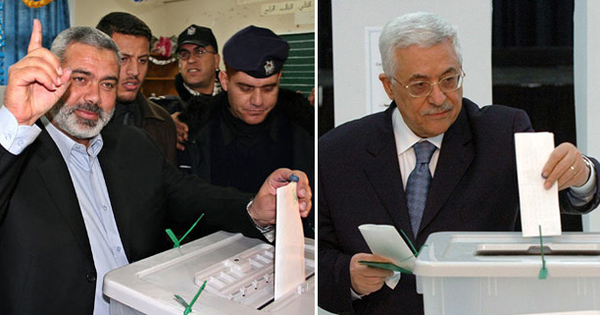
1096One man, one vote, one time? Hamas leader Ismail Haniyeh (left) and Fatah leader Mahmoud Abbas (also president of the Palestinian Authority) are pictured voting in the last election for the Palestinian Legislative Council, which took place in 2006.

Again, the two sides do not seem to be interested at all in sending Palestinians to the ballot boxes. Each side has many good reasons to avoid holding new elections in the West Bank and Gaza Strip.

First, Fatah and Hamas do not trust each other, and each side is convinced that the other would try to steal the vote. How can there be free and democratic elections while Hamas and Fatah continue to arrest and torture each other’s supporters in the Gaza Strip and West Bank?

Second, Fatah is afraid that Hamas’s chances of winning the elections, especially in the West Bank, are very high. That is because many Palestinians still do not trust Abbas and Fatah, whom they accuse of maintaining close security ties with Israel. Moreover, many Palestinians remain disillusioned with Fatah because of its failure to combat financial and administrative corruption and pave the way for the emergence of new leaders.

There is no way that Hamas and Fatah can cast the blame on Israel regarding the issue of elections. If they were really interested in holding new elections, they could do so with the help of the international community, as was the case with previous votes in 2005 and 2006. Israel even helped the Palestinian hold those elections.

When several Hamas candidates from east Jerusalem ran in the January 2006 parliamentary election, Israel did nothing to stop them. Israel even opened its post offices in the city to allow Arab voters from the city (who hold Israeli-issued ID cards) to vote in the election.

Charges made by some Palestinians and anti-Israel groups around the world, to the effect that Israel is responsible for “foiling” efforts to achieve Palestinian unity, are baseless. Although the Israeli government initially opposed the Fatah-Hamas “reconciliation” deal that was reached in 2014, it has not stopped the Palestinian prime minister and some of his cabinet members from visiting the Gaza Strip to pursue the implementation of the accord. In fact, Prime Minister Hamdallah has since visited the Gaza Strip twice, after receiving permission from Israel to go through the Erez border crossing.

Recently, ten Palestinian ministers were forced to leave the Gaza Strip, after Hamas placed them under house arrest in their hotel and banned them from meeting with locals. The ministers entered the Gaza Strip through the Erez border crossing. They came to the Gaza Strip to help solve the problem of thousands of Hamas government employees who have not received salaries for more than a year, and to discuss issues related to the reconstruction of the Gaza Strip.

So while Israel facilitated the visits by Hamdallah and his ministers to the Gaza Strip, it was Hamas that expelled them and prevented them from carrying out their duties. Had Israel expelled the ministers from the Gaza Strip or stopped them from entering the area, the country would have been condemned by the international community for “blocking” efforts to achieve Palestinian unity and rebuild the Gaza Strip.

Today, it has become unavoidably clear that Fatah and Hamas, and not Israel, are responsible for the ongoing plight of the Palestinians in the Gaza Strip. The two parties are unlikely to resolve their differences in the near future, further exacerbating the misery of their people. Each party cares only about its own interests, while at the same time lying to the world that it is all Israel’s fault. Hamas is not willing to relinquish control over the Gaza Strip, certainly not to Abbas and the Palestinian Authority, who were expelled from there in 2007. As for Abbas, he does not seem to be interested in regaining control over a problematic area such as the Gaza Strip, where most of the population lives under the poverty line and in refugee camps.

Yet instead of being honest with their people and admitting their failure to improve their people’s living conditions, Hamas and Fatah continue to wage smear campaigns against each other and, at the same time, also against Israel.

The campaigns that Hamas and Fatah are waging against Israel, particularly in the international community, are designed to divert attention from their failure to provide their people with basic services or any kind of hope.

While ignoring the plight of the Palestinians in the Gaza Strip, the Palestinian Authority leaders were prepared to invest huge efforts and resources in trying to have Israel suspended from the International Federation of Association Football (FIFA). It is as if the Palestinians had solved all their major problems and all that they needed to do now was to stop Israeli soccer players from playing in international matches.

Hamas, for its part, continues to invest enormous resources in digging new tunnels, in preparation for another war with Israel. The money that is being invested in the tunnels and the purchase and smuggling of weapons could benefit many families who lost their homes during the last war. But Hamas, like the Palestinian Authority, does not care about the misery of the Palestinians in the Gaza Strip. They want to fight Israel to the last Palestinian. And this is all being done with the help of anti-Israel governments around the world, and groups such the Boycott, Divestment and Sanctions (BDS) movement, whose only goal is to delegitimize Israel and demonize Jews rather than to help the Palestinians.

Israel’s Glass: Half Full or Half Empty?

June 3, 2015

Analysis: With Syria crumbling, Israel’s security situation has never been better

By YOSSI MELMAN 06/03/2015 17:11 Via The Jerusalem Post

IDF Tanks
Israeli soldiers stand atop tanks in the Golan Heights near Israel’s border with Syria. (photo credit:REUTERS)

(A nation divided will not stand. – LS)

The deputy IDF chief’s assertion that the Syrian civil war has improved Israel’s security shows that the country we once knew no longer exists as a single, sovereign entity.

Deputy IDF Chief of Staff Maj.-Gen. Yair Golan said Tuesday that Israel’s security situation on the northern border has improved as a result of the Syrian civil war, which has served to drain the blood of Hezbollah.

On the surface, these appear to be trivial remarks, which have been repeated by military experts and analysts over the past several years. But to hear them from such a senior military authority is refreshingly new.

As far as Prime Minister Benjamin Netanyahu and Defense Minsiter Moshe Ya’alon are concerned, these comments verge on heresy. If our security situation has improved, does the IDF really need additions to its budget? And what about the approach taken by Netanyahu, who continues to warn, on every possible occasion, of the threat of Iran, Hezbollah, and Islamic State?

Indeed, Israel’s strategic situation has never been better. Arab states that were once armed to the teeth, such as Libya and Iraq, have fallen apart. Egypt is a military and intelligence ally of Israel in its fight against Hamas the Sinai terror threat.

Syria, prior to the civil war, 50 months ago, was the greatest threat to Israel, and even then, to those who knew the truth, the country did not serve as that much of a serious threat. Today, Syria no longer actually exists as one sovereign, political entity, but rather it is broken up into territories. A small region in the northeast is the Kurdish enclave. Half of the country’s land, most of which is desert, mainly in the east, is controlled by Islamic State. In northern Syria and in the South on the border with Israel, in the Golan Heights, control is largely in the hands of the Nusra Front (the al-Qaida affiliate which has been made more moderate by funding from Qatar). The rest, which includes Damascus, the center of Aleppo, Homs and the coastal strip on the ports of Latakia and Tartus, in which Assad’s Alawite minority resides, remain in control of the regime. Soon, a new Druse enclave is also likely to be formed in the area of Druse Mountain in southeast Syria, near the approach to the Jordan border.

The Syrian Army is crumbling. Iran is providing reinforcements to save what remains of the Assad regime, with the understanding that their is a limit to how much they can demand that Hezbollah serve as cannon fodder in a war to save Assad.

The situation in Syria has fallen into chaos. The US Embassy Syria tweeted on its official account Tuesday that the Syrian Air Force was striking rebel positions in the Aleppo area, helping Islamic State, which is also fighting against the regime, but is mainly focusing its efforts against its adversaries among the opposition to Assad.

It is difficult to logically explain what is happening in Syria, and who is against who. There is a feeling that everyone is against everyone. With this being the case, any speculative report or rumor spreads wings and wins immediate headlines, which is how it was reported Tuesday in the Lebanese media that the Israeli Air Force again struck targets in Lebanon. Hezbollah-affiliated al-Manar television was quick to deny the reports, and Israel, as is its custom, neither confirmed nor denied the reports.

Anything is possible. It could be an Israeli attack or a false report. Nothing reported on the Syrian civil war is out of the realm of possibility.


Egypt Says NY Times Promoting Muslim Brotherhood Agitprop

June 3, 2015

Egypt Says NY Times Promoting Muslim Brotherhood Agitprop, The Clarion ProjectRyan Mauro, June 3, 2015

(Obama has spread and relied upon much the same meme as the NY Times and Washington Post. — DM)

New-York-Times-Building-IP_1The New York Times building in New York City

If the New York Times values objective reporting, then it must mention the Brotherhood’s calls to violence in its coverage as well as the many other instances of violence that the group has been involved in.

*********************

The Egyptian ambassador to the U.S. has written a public letter toThe New York Times protesting “its unquestioning adoption of Moslem Brotherhood’s propaganda” and false characterization of the Islamist group as non-violent.

Ambassador Mohamed Tawfik’s letter was written around the same time that the Egyptian embassy released three videos of calls to violence made on Muslim Brotherhood television networks based in Turkey.

The networks’ coverage promoted explicit calls for killing Egyptian police officers and attacking foreign companies and embassies. A threat was also made to carry out regional attacks against the interests of countries who support the Egyptian government.

Egypt is infuriated at the Times as well as the Washington Post for repeatedly asserting that the Brotherhood is non-violent. In response to the Times suggestion that the Egyptian government’s prosecution of the Brotherhood is pushing it towards terrorism, the Egyptian ambassador writes:

This statement demonstrates, at best, a complete misunderstanding of the roots of radicalism. At worst, it amounts to a justification for violent extremism. Today, terrorists in Egypt are part of a network of extremists who are bound by a singular distorted ideology, and by a shared goal of taking our region back hundreds of years. They are inspired by the radical teachings of the former Moslem Brotherhood leader Sayyid Kutb [Qutb]. Terrorists in Egypt share the same evil goals as terrorists in Iraq, Syria and Libya.

Indeed, Ambassador Tawfik is correct that the New York Times separates Islamists from terrorists and extremists. The Times editorial condemns “relentless and sweeping crackdown on Islamists, under the baseless contention that they are inherently dangerous.”

The New York Times described sentencing to death of former President Morsi and 100 other Brotherhood members as “deplorable.” It describes the Brotherhood as having renounced violence in the 1970s.

However, Morsi and the defendants were sentenced for his involvement in prison breaks in 2011 that freed 20,000 inmates, including Morsi himself. The Egyptian government says the attacks were well-orchestrated and involved participation by the Muslim Brotherhood, Hamas and Hezbollah.

Tawfik chastises the Times for failing to mention that the prison break was a violent operation that resulted in the deaths of prison guards and inmates and freed members of Hamas and Hezbollah.

The Egyptian ambassador also excoriated the Washington Post in February for “toeing the Muslim Brotherhood line” and advised it to be more balance in order to “save whatever is left of your credibility in the Arab world.”

Egyptian President El-Sisi came into power after the popularly-supported military intervention in July 2013 overthrew the Muslim Brotherhood government. The move had the support of a broad spectrum of Egyptian society with public endorsements from secular-democratic activists, the Grand Sheikh of Al-Azhar University and the leader of the Coptic Orthodox Church.

The overthrow came after Morsi (whose election itself was marred bycharges of voter fraud) seized far-sweeping powers for himself, essentially negating any semblance of a democratic government.

El-Sisi is often characterized as an anti-democratic strongman; a depiction that his government is now challenging.

He argues that these strongman tactics are necessary because a democratic transition cannot be completed without stability, economic development and a confrontation with Islamism (also known as Political Islam). He asks the West to understand that there is a “civilizational gap between us and you” and it will take time to modernize.

A study commissioned by the Egyptian government criticized its heavy-handedness but concluded that banning Islamist parties is required for the country’s stability and democratic development. It recommended a program to separate politics and religion.

The Egyptian government sees the Islamic State (ISIS) as a natural outgrowth of the Muslim Brotherhood. Its website warns that the Muslim Brotherhood has a network of fronts in America that are disguised as civil society organizations.

El-Sisi called for a reformation in Islamic interpretation in January 2014 and made a dramatic call on the Islamic religious establishment to address problematic teachings this January that received widespread media coverage. He has explicitly said that Egypt should be “a civil state, not an Islamic one” and defined the ideology of the enemy as Political Islam in an interview on FOX News Channel.

El-Sisi is also confronting Islamist terrorism internationally, in addition to its fight against Islamic State in the Sinai Peninsula. His government is an enemy of Hamas and is as minimally anti-Israel as can be expected of an Arab leader.

Egypt has conducted airstrikes on ISIS in Libya and is materially supporting the Libyan government in its civil war against Islamist forces. Egypt and Libya are complaining about a lack of American backing. A new Egyptian-backed offensive is said to be in the works.

El-Sisi is assembling an Arab rapid-reaction force of 40-50,000 troops that can quickly be deployed to fight Islamic State and other terrorists. Egypt is also taking part in the Arab military intervention against the Iranian-backed Houthi rebels in Yemen.

El-Sisi also made a historic visit to a Coptic Christian church during mass on Christmas Eve. He challenged the Egyptian honor culture when he apologized to a woman who was raped in Tahrir Square.

Major American media outlets have fallen for the falsehood that the Muslim Brotherhood is non-violent. It is true that the Egyptian government is often criticized for its human rights record, but coverage of those accusations should not automatically exempt the Brotherhood and other Islamists from blame.

If the New York Times values objective reporting, then it must mention the Brotherhood’s calls to violence in its coverage as well as the many other instances of violence that the group has been involved in.

Egyptian Muslim Brotherhood Videos Call for Violence

June 2, 2015

Egyptian Muslim Brotherhood Videos Call for Violence, The Clarion ProjectRyan Mauro, June 2, 2015

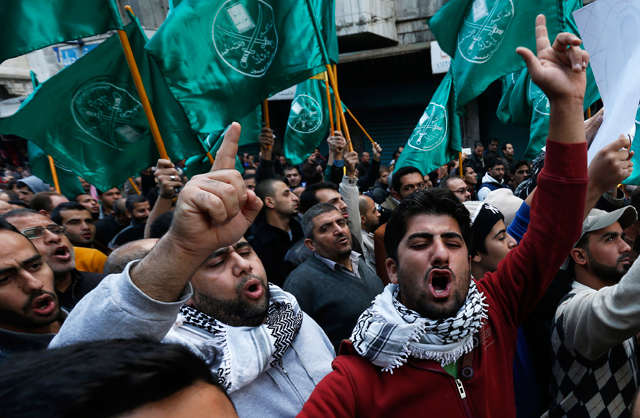
Egypt-Muslim-Brotherhood-Supporters-Flags-IPMuslim Brotherhood supporters in Egypt (Photo: © Reuters)

Egypt has released three videos of Muslim Brotherhood television networks in Turkey advocating violence against the Egyptian police, foreigners, embassies and interests in the region connected to countries that support President El-Sisi.

On Thursday, the Brotherhood’s English-language website announced a decision for revolution “with all its means and mechanisms” against the Egyptian government. The announcement references a declaration signed by 150 Islamic scholars that is less ambiguous in calling for jihad, also published in English.

The first video is from the Muslim Brotherhood’s Rabaa TV network launched in Turkey in 2013. The Egyptian government says the host in the video is a member of the Al-Gama’a Al-Islamiyya terrorist group.

The host is seen reading a statement from the “Revolutionary Youth Coalition;” a group that is almost certainly a Brotherhood front established to give itself plausible deniability while inciting and orchestrating terrorism. The vague terminology is an attempt to give its cause greater legitimacy by appearing more inclusive and broad-based.

The Brotherhood station reads the statement that demands the departure of all foreign Arabs, foreign Africans, embassy personnel, foreign companies and tourists by the end of (last) February. All governments must end their support for the Egyptian government “or else all of their interests in countries of the Middle East will be exposed to severe assaults or will be put in situations that nobody wants.”

The threat warns that henceforth there will be “no concessions or mercy.”

The second video is dated February 24 and is from a satellite network named Misr Alaan that the Egyptian government says was founded by the Brotherhood last year. The Arab press says it was launched from Turkey with Brotherhood sponsorship.  The network’s staff said its purpose is to reach a broader audience than the other Islamist channels in Turkey.

The video comes with an English translation that shows the host of a show explicitly urging the murder of Egyptian police and unspecified revolutionaries to rout the Egyptian soldiers who aid the police in the confrontation. His instructions are clear: “Kill them.”

“I say to the wives of all officers and the sons of all officers: Please be aware, your husbands will be dead. Your children will be orphans,” the host says while adding the sons of police officers may be kidnapped and claiming that the revolutionaries have the home addresses of the police.

The third video, also from Misr Alaan, shows a statement being read by a spokesman calling in from the “Revolutionary Punishment Movement,” continuing the pattern of using new, non-descriptive titles.

The speaker is asked about his group and he only says that it is a youth movement involved in the revolutions since the beginning, referring to the ousting of Egyptian President Mubarak. He condemns the arrests of female members of the group and declares there will be “reciprocal treatment.”

The speaker calls for the kidnapping and killing of Egyptian security personnel by the “lions” of this revolution. He then gives out the names of specific police officers to target without any interruption from the host.

On Thursday, May 28, the Brotherhood’s English-language website carried a statement by spokesperson Mohamed Montaser announcing “a final decision, after consulting its popular base, that the revolutionary option with all its means and mechanisms is its strategic choice from which there will be no retreat.”

The announcement appears to be a response to a reported rift within the Brotherhood between the older and more pragmatic leadership and the more militant youth advocating violence and disruption to society. It reiterates the legitimacy of the Brotherhood leadership and claims that it is inclusive of the youth.

The statement does not explicitly discuss the topic of violence but it certainly does not make the case for non-violence. It gives every reason for an Islamist to believe that violent jihad against the Egyptian government is now permissible.

The intention to inspire violence is detectable in how the Brotherhood references a declaration signed by 150 scholars that declares the Egyptian government to be an “enemy of Allah” waging “war against Islam.” The listed offenses qualify it as a target for violent jihad.

“It is an Islamic duty of the whole Muslim Ummah, rulers and peoples alike, to resist this regime and to seek to break it using all legitimate means in order to safeguard the fundamentals of the Ummah and to maintain the higher objectives of Islam,” it says.

The declaration most clearly instigates violence in points 4 and 6 regarding retribution for acts against the Brotherhood and for forcibly freeing prisoners:

“4. Rulers, judges, officers, soldiers, muftis, media persons, politicians and any other party proven beyond any doubt to be involved in the crimes of violating honor, bloodshed and illegal killing, even if through inciting such acts, are considered, from Islamic perspective, murderers to whom all rulings related to the crime of murder are applicable. They must receive qisas (retribution punishment) within the Islamic Law limits.”

“6. The nation must do its best to free any person, especially women, detained as a result of opposing the coup and demanding respect of the nation’s will and freedom. No effort should be spared to release them using the means approved by Islam.”

The Brotherhood is aware of what it’s calling for. If it didn’t want violent jihad, it would add a disclaimer about the declaration only authorizing non-violence. Instead, there’s only a mention of civil disobedience as a tactic without any kind of rejection of violence in point 13:

“13. We demand all forces opposing the coup and all free people, inside and outside Egypt, to combine efforts in resistance of this criminal regimes and to use all appropriate means such as civil disobedience and any other tool to purge the country of the coup’s tyranny and crimes and to stand up for the martyrs’ cause.”

The declaration is especially significant because brings the Brotherhood a step closer towards officially supporting violence in Egypt; a direction it’s been moving towards in its Arabic content.

In January, the Brotherhood announced a “new phase…where we recall the meanings of jihad and prepare ourselves, our wives, our sons, our daughters, and whoever marched on our path to a long, uncompromising jihad, and during this stage we ask for martyrdom.”

Any doubt as to whether the Brotherhood meant violence is put to rest by what follows:

Imam al-Banna [the founder of the Brotherhood] prepared the jihad brigades that he sent to Palestine to kill the Zionist usurpers and the second [Supreme] Guide Hassan al-Hudaybi reconstructed the ‘secret apparatus’ to bleed the British occupiers.”

The call to violence in Arabic was shortly followed by one in English titled, “Egypt Muslim Brotherhood Reiterates Commitment to Non-Violence.”  The contradiction is reflective of a long-standing patternwhere the Brotherhood speaks more diplomatically in English and more “jihadist” in Arabic. Contrary to assertions that the Brotherhood officially abandoned violence, the group has consistently endorsed and engaged in violent jihad since its supposed “moderation.”

The newly-released videos are just a sample of the proof that the Brotherhood’s “moderate” persona is a contrived mirage.

Obama Assures Iran It Has Nothing to Fear

June 2, 2015

Obama Assures Iran It Has Nothing to Fear, Commentary Magazine, June 1, 2015

(Obama seems to have been talking about Iranian efforts to militarize nukes, not peaceful uses such as medical or generation of electricity. If, as claimed, Iran has no intention of getting, keeping or using nukes why try to halt it? Why bother even to negotiate?– DM)

“A military solution will not fix it. Even if the United States participates, it would temporarily slow down an Iranian nuclear program but it will not eliminate it.”

****************

At this point, there is virtually no one in Israel or the United States who thinks it is remotely possible that the Obama administration would ever, under virtually any circumstances, use force against Iran. Though President Obama and his foreign policy team have always claimed that “all options,” including force, are always on the table in the event that Iran refuses to back down and seeks to produce a nuclear weapon, that is a threat that few took seriously. But President Obama has never been quite as explicit about this before as he was in an interview with Israel’s Channel 2 in which he reportedly said there is no military option to stop Iran. If Obama wanted to telegraph Iran that it could be as tough as it likes in the talks over the final text of the nuclear deal being negotiated this month this statement certainly did the job. Though they had little worry about Obama’s toughness or resolve, the ayatollahs will be pleased to note that the president no longer even bothers to pretend he is prepared to do whatever is necessary to stop Iran’s nuclear ambition.

According to the Times of Israel, Obama said:

“A military solution will not fix it. Even if the United States participates, it would temporarily slow down an Iranian nuclear program but it will not eliminate it.”

Though he continued to use rhetoric that left force as an option, the implicit threat of American action if a nuclear weapon were a possibility has lacked credibility since the president began his second term. Once he embarked upon secret back-channel talks in which, one by one, he abandoned his previous pledges about forcing Iran to shut down its program in concessions and virtually every other U.S. position on the issue, force was never a real possibility. The signing of a weak interim deal in November, 2013, and then the framework agreed upon this spring signaled the end of any idea that the U.S. was prepared to act. That is especially so because the current deal leaves Tehran in possession of its nuclear infrastructure and with no guarantees about inspections or the re-imposition of sanctions in the event the agreement collapsed. The current deal, even with so many crucial details left unspecified makes Iran a U.S. partner and, in effect, the centerpiece of a new U.S. Middle East policy that essentially sidelines traditional allies like Saudi Arabia and Israel that are directly threatened by Iran.

Moreover, it must be conceded that the use of force against Iran would be problematic even for the United States and its vast military resources. As for Israel, despite a lot of bold talk by some in the Jewish state, there has always been skepticism that its outstanding air force had the ability to sustain an air campaign for the length of time that would be required to make a difference. Nevertheless, the notion that force would not be effective in forestalling an Iranian bomb is mistaken. Serious damage could put off the threat for a long time and, if sanctions were kept in place or made stricter as they should have been to strengthen the West’s bargaining position, the possibility of an Iranian nuke could have been put off for the foreseeable future.

Yet, while talk about using force has been largely obsolete once the interim deal was signed in 2013, for the president to send such a clear signal that he will not under any circumstances walk away from the current talks, no matter what Iran does, is significant.

After all, some of the most important elements of the deal have yet to be nailed down. Iran’s Supreme Leader, Grand Ayatollah Ali Khamenei has publicly stated that he will never allow the sort of inspections that would make a deal verifiable. He has also demanded that sanctions be lifted permanently on the day the agreement is signed, and that there should be no provision for them to be snapped back. Nor are the Iranians conceding that their stockpile of nuclear fuel be taken out of their hands.

So if Obama is to get the “verifiable tough agreement” he told Channel 2 he seeks, the U.S. must somehow convince the Iranians to back down on all these points. That’s going to be difficult since the past two years of negotiations with Obama have taught them to wait for him to give up since he always does so sooner or later. The president’s statement makes it clear that, no matter how obdurate the Iranians remain, he will never walk away from the talks. And since this deal is the lynchpin of his foreign policy legacy, they know very well that all they have to do is to be patient.

Iran already knows that the deal in its current form allows them two clear paths to a bomb. One is by cheating on its easily evaded terms. The other is by waiting patiently for it to expire, the sunset provision being another astonishing concession by Obama.

If a tough deal were even a possibility, this would have been the moment for the president to sound tough. But throughout this process, the only toughness the president has shown has been toward Israel as he sought to disparage and dismiss its justifiable worries about his course of action. Merely saying now, as he does in the Channel 2 interview, that he understands Israel’s fears is mere lip service, especially since it comes along with a virtual guarantee to Iran that it needn’t worry about a U.S. strike under any circumstance.

With only weeks to go until the June 30 deadline for an Iran deal, there is no question that Obama’s statement makes an unsatisfactory final text even more certain than it was before. That’s good news for Tehran and very bad news for an Israeli people who have no reason to trust the president’s promises or believe in his good intentions.