Archive for the ‘Islamic supremacy’ category

Islamophobia: Fact or Fiction?

August 15, 2015

Islamophobia: Fact or Fiction? The Gatestone Institute, Denis MacEoin, August 15, 2015

  • Edward Said leaves us with the impression that all prejudice is only on the part of the West.
  • To the traditionally minded, news of such things as man-made laws based on objective evidence, free speech, equal justice under law, democracy, elections, freedom for women, freedom of religion and respect for the “other,” and so on, may have come as a sort of horror. Despots recoiled from the very thought of democracy. Religious leaders fumed at secular education, the freedom to question and say what one liked, even about religion.
  • “It is the nature of Islam to dominate, not to be dominated; to impose its law on all nations and to extend its power to the entire planet.” — Hasan al-Banna’, Founder of the Muslim Brotherhood, 1928.
  • The vast amount of what is called “Islamophobia,” however, is not that at all. Fair criticism is not phobic, responses to Islamic terrorism are reasonable reactions to violence.
  • Based on news reports of Muslims murdering other Muslims and killing Christians, there is, ironically, probably more Islamophobia among Muslims for each other than there is from Westerners toward Muslims. There is also probably more “Infidelophobia” by Muslims toward non-Muslims than by non-Muslims toward Muslims.
  • Again this year, the Organization of Islamic Cooperation held a conference calling for a universal blasphemy law — legislation it has repeatedly tried to pass for over a decade, with the help of U.S, Secretary of State Hillary Clinton. The aim is not to protect other religions (about which Muslims blaspheme without cessation), but to block any criticism of Islam.
  • Sometimes it seems as if Islam ceases to be treated as just another religion and becomes a religion intolerant of all others and unduly protective of its own rights and privileges. In democratic states, Islam is evidently already the only religion that may not be criticized, even though criticism of religion has for centuries been a cornerstone of free speech and transparency that are essential elements in democracy. These freedoms really matter, yet not one Muslim country can claim to implement or protect them, especially freedom of religion.

On July 9th, the European Commission against Racism and Intolerance, within the Council of Europe, published its annual report for 2014. The report identifies a dramatic increase in antisemitism, Islamophobia, online hate speech and xenophobic political discourse as main trends in 2014. It also indicates that “Islamophobia is reported in many countries, counteracting integration efforts for inclusive European societies. According to the report the rise of extremism and in violent Islamist movements has been manipulated by populist politicians to portray Muslims in general as unable or unwilling to integrate and therefore as a security threat.”

This is, of course, troubling, and it is right for the Commission to treat it as a growing problem. But just how widespread is the issue, and to what extent is it readily identifiable?

Some claims of Islamophobia have their roots in the perception of increasing Muslim violence within Europe; some are based on existing racist attitudes, and some are derived from Muslim perceptions of victimhood and charged sensitivities. The latter is the main reason why defining Islamophobia is not as simple as describing anti-Semitism, anti-immigrant prejudice, or anti-black racism.

To understand this more clearly, it is necessary to slip back briefly to the past.

In 1978, Palestinian-American professor Edward Said (1935-2003) published a book,Orientalism, which changed the way many people thought about the Middle East and Islam. Said’s book, deeply flawed, nevertheless became a bestseller translated into thirty-six languages. Those of us who were the first to read it – teachers and students in Islamic and Middle East Studies – were taken in by its façade of intellectual impartiality and the sense we all had that it opened our eyes to our own work in an original way. It was, to use Thomas Kuhn’s celebrated phrase, a paradigm shift that changed our understanding of our researches and the meaning they had, for we were precisely the ‘orientalists’ Said so tartly scolded. Some of moved away in later years, but many are still mesmerized by that smooth prose and challenging flair.

It wasn’t long before Said’s appeal moved into other disciplines and to other regions far from the Middle East. Orientalism even laid the foundations for a new item on the academic curriculum: “Post-colonial Studies.” The subject, now taught in universities in many countries, has produced a vast literature, has its own academic journals and numerous associations and institutes. Said, like Franz Fanon, Gayatri Spivak, Derek Gregory and others, remains a core figure, andOrientalism a central text.

According to Said, Westerners, by virtue of not being Muslims, have always falsified and distorted their writings about Islam and Muslims. Said claimed to see deeply-ingrained prejudice in the works of French, British, Russian and other Orientalist scholars and writers. To him, Orientalism was (and is) a tool of the colonial powers, assisting their mission supposedly to administer and subdue the peoples of the East. Since former colonies have achieved independence, he contends that the former imperialists still exert pressure on the ex-colonies in order to control them. Israel is regarded by most Marxists, socialists, and even many liberals as an entity created to colonize the Arab Middle East and is often condemned, even by people who are supposedly educated and should know better, in abrasive terms as a malign extension of the West.

Perhaps the best-known sentence in Said’s book is: “[S]ince the time of Homer every European, in what he could say about the Orient, was a racist, an imperialist, and almost totally ethnocentric.” As Bernard Lewis has been heard to remark, “If that were true, the only reports of marine biology would have to be by fish.” But for Said and his followers, the world is divided between Western guilt and Eastern victimhood.

What is missing from Said’s work is any attempt to deal with the long history of Islamic empires,[1] the conquest of, and permanent rule over, non-Muslim states and peoples, and the often distorted ways in which Muslim writers have sought to interpret and explain Christian, Jewish, Hindu and other worlds. Said leaves us with the impression that all prejudice is only on the part of the West.

Said continues to have admirers, most in academic departments of English or multicultural studies, but as time passes, more and more scholars are calling his views into question. Writers such as Bernard Lewis, Ibn Warraq, Efraim Karsh, and Robert Irwin have exposed a string of faults in Said’s narrative, from factual errors to staggering bias.[2]

Despite his bias, distortion of facts, and openly documented deceptions, many of Said’s followers, who are unwilling or unable to do their own work, see him as an intellectual to students and teachers who adhere to an anti-establishment, anti-Western, and socialist world view.

For many, his book, Orientalism played a role in delegitimizing the West and furthering causes such as multiculturalism or anti-Zionism. In the meantime, however, not surprisingly, the book’s influence spread, into the Islamic world and the smaller world of Muslim communities in the West. Better-educated Muslims read and digested Said’s message, in a manner rather different from Western readers, many or most of whom were atheists and agnostics. For Muslim readers, Said’s message that the West was hostile to Islam became the first strong antidote to their sense of failure. Muslims saw themselves as backward but now believed they were the victims of a Western conspiracy to deny them the fruits of their great civilization. To disparage the West became, for many, a religious imperative.

For religious Muslims, it was becoming increasingly important to deal with the stresses caused by their economic, political, and military subordination to a flourishing West, coupled with their own lack of progress in the non-Muslim world and at home. The repeated defeat of multinational Arab armies by the “despicable” Jews of Israel stood, and for millions of Muslims still stands, as a symbol of their need to reassert themselves on the world stage — as Iran is trying to do today.

For many Muslim immigrants, adjusting to their new environment is difficult, possibly even more than for other newcomers to the West, from Africa, say, or India. Their religious leaders often tell them that Muslims are superior to all unbelievers.[3] Their history tells them a story of almost uninterrupted conquest, when bands of early Muslims came out of the deserts of Arabia to fight and destroy the two great empires of the day, the Byzantines and the Iranian Sasanids. The same history tells Muslims how Islam spread to the ends of the known world and how for centuries Islamic civilization was superior to all others.

But with the re-emergence of Europe and the gradual subjection of the Muslim world to “infidel” powers, much of that sense of superiority evaporated. From the late nineteenth century, Muslim reformers repeatedly called for a revival of Muslim thought and practice. Renewal (tajdid) was, for more secularist rulers such as the founder of modern Turkey, Mustafa Kemal Atatürk (1881-1938), to be achieved by a process of secularization. But for religious thinkers such as Rashid Rida, it meant a revival of the faith as a reaction to the achievements and power of the West, and a reassertion of Islamic superiority.

It may not have been European military might alone that dismayed Muslims. It may also have been the West’s universities, science, parliaments, laws, police, press, advocacy for liberty and free speech, attire, culture, and all the psychological and material benefits that have accrued to us.[4]

This cultural collision might well have been difficult for some Muslims to take in. After all, had God not promised them victory, not just for a time, but until the entire world was conquered for the faith? And had God not fulfilled his promise? Conquest had followed conquest, empire had succeeded empire, and on the back of these advances, a great civilization had come into being, with all its variants across the globe. For centuries, Muslims, many uninformed about what the changes in Europe, had, as Lewis argues, indulged a sense of political and religious supremacy. And for centuries they appeared justified in this belief.

But things changed, and not for the better. In 1798, Napoleon conquered Egypt, with ease. Even though his forces remained only a short time, that conquest was the first chink in the armor of Islam. During the nineteenth and twentieth centuries, the British and French occupied and colonized much of the Middle East and Africa. Having been the undisputed masters of their realm for so long, and having ruled so effortlessly over the Jews and Christians who lived among them as second-class citizens, Muslims had grown complacent.

If it was irksome to become subordinate to non-believers, worse was to follow. The West did not just possess superior military might; it soon became clear that Westerners were far from the infidels of popular imagination.

Several countries – Turkey and Iran, notably, which never became fully colonized – started to send students and diplomats to European countries, chiefly Britain and France. In Europe these travellers were introduced to ways that may have made the West seem superior: parliaments, constitutions, manmade laws based on objective evidence, universities with academic freedom, free speech, equal justice under law, democracy, elections, high-quality schools, a general lack of corruption in public affairs and commerce, growing freedoms for women, freedom of religion and respect for the “other,” and so on.

To the traditionally minded, news of such things may have come as a sort of horror. Despots recoiled from the very thought of democracy. Religious leaders fumed at secular education, rights for women, the freedom to question and to say what one liked, even about religion.

But younger, modernizing minds were released from the shackles of the past. From the late nineteenth century, pressure for secular reform began to appear, and for a time it seemed as if important events lay on the horizon. The Young Turks in the Ottoman Empire and the reformist anti-clerical movement in Iran seemed to usher in better times and freer lives.

But despite this apparent Muslim Spring and the appetite for reform it inspired, the doors to change quickly slammed down again throughout most of the Islamic world. In Iran, the secularizing but brutal Pahlavi dynasty provoked the Iranian Revolution of 1979, led by the Ayatollah Khomeini. Out of that, as the Islamists sought to quell dissent and impose their own theocratic rule, emerged Iran’s current totalitarian and theocratic regime.

Muslims have constructed a variety of responses to these events. A common one, from the late nineteenth-century, was to stress the innate and absolute rightness of Islam in the conduct of all human affairs. During the 1920s, this Salafi thinking from Saudi Arabia took on a new life through the Muslim Brotherhood in Egypt. Its motto is: “Allah is our objective; the Qur’an is our Constitution; the Prophet s our leader; jihad is our way; dying for the sake of Allah is our wish.” Its political slogan – seen until recently on banners in the poorer parts of Cairo – is: “Islam is the solution” (for every problem). The movement’s founder, Hasan al-Banna’, is widely quoted as saying, “It is the nature of Islam to dominate, not to be dominated; to impose its law on all nations and to extend its power to the entire planet.”[5]

This response leads directly to the holy war currently being waged against the West (including Israel) by radical Muslims, through organizations such as al-Qaeda, the Taliban, Islamic Jihad, Hezbollah, Hamas, and, even more brutally, the Islamic State (Da’ish).

A second response, devoid of the tactic of violence, was to seek to reform Islam itself from within. These reformers, (such as Muhammad ‘Abduh or Rashid Reza), were Salafis who aimed, not at the modernization of Islam, but in the other direction: at its return to the values, mores and practices of seventh-century Arabia — the time when Muslims lived with, and were guided by, Muhammad and the first three generations of his followers. Their aim is bold: to purify Muslims of the accretions their religion has taken on down through the centuries.

There is an old Islamic juristic principle: innovation (bid’a) is heresy, and leads to hellfire. Valiant as this response may seem to be, it has clearly been unable to stem the tide of rapidly expanding modernity. What it did achieve, even while affording them access to the latest technology, was to drag Muslims backwards.

While science and technology have left a powerful mark on Muslim societies (best summed up in Iran’s nuclear program), they are often deployed within a context of old-fashioned religious beliefs that are not innovative in any way. Thus, for example, before and during the Islamic Revolution in Iran (1978-79), cassette tapes were used to powerful effect by the revolutionaries. And today, even the most backward-thinking Islamist groups all advance their cause for a return to basics through the internet and the use of social media.

A third tactic has been to place the blame on the West for each and every misfortune that assails the Islamic world. This applies, not just to military interventions such as Iraq or Afghanistan, but to economic failure; a fall in oil prices; the “immorality” of young people; the conversion of Muslims to Christianity, atheism, or anything that is not Islam; women’s rights; the creation and perpetuation of Israel; young people questioning their parents and other free speech; the failure of Muslim immigrants to Europe to flourish, and whatever else takes one’s fancy.

The psychological truth behind all this is plain to see: It is a form of Freudian projection: taking the qualities about oneself that one does not like and projecting them onto others. This defense against an affront to our good opinion of ourselves can also be one of many forms of denial, whereby someone with problems denies he has any and instead happily pins the blame for whatever goes wrong in his life on others.

For many Muslims – as for all of us – responses such as these play a particularly important role in making sense of what seems a hostile world. If Muslims thought that Islam itself had failed, that God’s promise of eventual triumph across the earth had been left unfulfilled (or worse, that it was hollow in the first place), then the psychological ramifications could be shattering.

For conservative Muslims, the greatest catastrophe would be if, as a result of Westernization, millions in the Islamic world would lose their faith. Societies, held together by mutual belief would fall apart. Better by far to blame outsiders. And, even better, to find that the outsiders responsible for all our woes have all the time been the Jews and Christians whom Scripture instructs Muslims to despise for plots against the true faith.

Out of this tortuous medley comes what some call “Islamophobia.” It is evidently not enough to cite Westerners as the agents of Islamic decline. They must, according to that view have a motive, and this Western motive is supposedly uncovered in an active hatred of Islam. It is a hatred, the claim seems to go, born of a jealousy already there at the time of the Prophet, when the Jews, they allege, “conspired” against him. This hatred was supposedly there again in the Crusades, when the Christian Church sought to dislodge Islam from its commanding heights around the Levant and beyond; and also during the colonial and post-colonial periods, not just abroad but also at home, within the borders of Islam itself, as in Morocco, Algeria, Libya, Egypt, India, Mali and elsewhere in Africa, and in Indonesia, Malaya, the Philppines, and Central Asia.

Although the term “Islamophobia” may go back as far as 1916 in French, and seems to have been introduced to English by Edward Said himself in 1985, its use has grown rapidly in the UK and the United States. Today, it is employed in vague and sloppy ways, often conflated with claims of a victimhood similar to racism.

The vast amount of what is called “Islamophobia,” however, is not that at all. Fair criticism is not phobic; responses to Islamic terrorism are reasonable reactions to violence just as we react against all other forms of terrorism. If you read Muslim or pro-Muslim accounts of Islamophobia, they find fault with just about everything that implies a negative view of something Islamic, whether texts, history, or customary practices. Curiously, the same people who complain about Islamophobia seem never to complain about Muslim anti-Semitism or hatred for homosexuals or other violations of human rights.

In that sense, many have constructed a hate crime that only exists sporadically, within small groups like the UK’s fading English Defense League or in comment pages remarks by individuals, few of whom seem well- educated or polite. The Council for American-Islamic Relations (CAIR), for instance, has a website called Islamophobia.org, but the offenses do not seem nearly as ubiquitous or as hateful as Muslims claim, and often seem to have occurred as a reaction to some kind of “Infidelophobia.”

Based on news reports of Muslims murdering other Muslims and killing Christians, there is, ironically, probably more Islamophobia among Muslims toward each other than there is from Westerners toward Muslims. There is also probably more “Infidelophobia” by Muslims toward non-Muslims than by non-Muslims toward Muslims.

What true Islamophobia exists does so only on the margins of Western society. It reveals itself in the racist protests of the English Defence League; in the Reverend Terry Jones calling his bookIslam is of the Devil and his threats to burn the Qur’an; and in comments on some anti-Islamic websites.
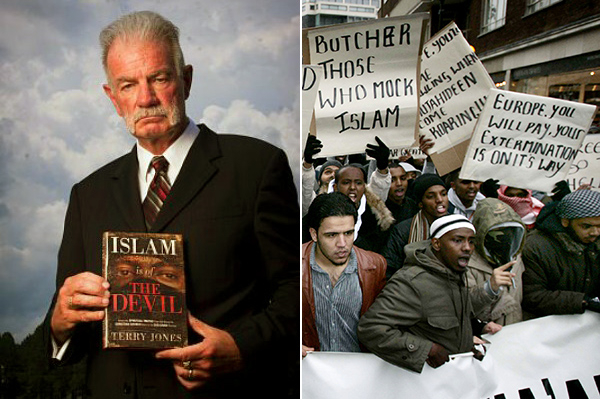
1207Fair criticism is not phobic; responses to Islamic terrorism are reasonable reactions to violence just as we react against all other forms of terrorism. What true Islamophobia exists does so only on the margins of Western society. It reveals itself in the Reverend Terry Jones calling his book Islam is of the Devil and his threats to burn the Qur’an.

For all that, some haters make themselves quite visible; even so, they represent only a small number of the public, most of whom do not even know they exist. Most people are simply critical of what they see daily about Islam: violent acts across the globe, threats against freedom and democracy, hatred preached in mosques and Islamic centers – all justified as matters ordained by the Islamic faith.

Others are disturbed by the negative impact of Muslim immigration on Western societies. In America, the destruction of the twin towers and the attacks on the Pentagon on 9/11 were calculated to bring to the surface growing fears about the harm that growing Muslim radicalism could cause.

The accusation of Islamophobia has come to be a knee-jerk reaction to any, even wrongly-perceived, criticism of Islam. For centuries, Muslims have guarded their customs and their religion from criticism, and this has led to severe problems: a lack of safe arenas in both the Muslim world and within Muslim communities in the West, where Muslims may analyse and debate religious issues without fear of severe retribution for stepping across lines, such as declarations that intellect and logic are unIslamic; the prohibition of free speech, the use of murder to silence anyone who steps too far out of line, dissidents or apostates for instance. No healthy society can survive with such restrictions.

The West has thrived on its citizens’ freedom to challenge received ideas, to speak openly in debate, and to criticize without fear of reprisal. Accusations of Islamophobia are bandied about by Muslim organizations in Europe and North America, such as the Muslim Council of Britain (MCB) or the Council on American Islamic Relations (CAIR). Some of their concerns are genuine. Physical attacks on Muslims just because they are Muslims are totally unacceptable in any civilized society.

On the other hand, it often appears as if any questioning of Islam or Muslims, however minor, is inflated and rebutted by a charge of Islamophobia. Sometimes such questions are interpreted as criticism, and lead to the suppression of free debate and an exchange of ideas. It then seems as if Islam is no longer treated as just another religion and becomes a religion intolerant of all others and unduly protective of, and assertive of, its own rights and privileges.

Islamophobia also sometimes seems conflated with blasphemy. Almost any statement or act deemed disrespectful of Islam, when uttered or committed by a non-Muslim, may be counted by some as a form of hatred for Islam itself, and regarded as subject to punishment or, as we have seen recently, murder and attempted murder. In February, American-Bangladeshi secularist Avijit Roy was hacked to death in Dhaka, as were Washiqur Rahman in March, Anantaa Bijoy Das in May, and Niloy Neel on August 6. In France, the editors of a magazine , Charlie Hebdo, and the organizers of a Draw Muhammad exhibition in Garland Texas. Incidents such as those occurred apart from the unprovoked murder of Jews outside a religious school in Toulouse France, and in a kosher French grocery store.

In the West, blasphemy is no longer considered a crime worth rebuke, let alone capital punishment, even if many Christians or Jews deplore it as a mortal sin. Freedom of speech has become so vital to the functioning of a healthy, open society that even gross disrespect as shown in Andres Serrano’s controversial photograph, “Piss Christ”, though often protested, may be placed on public display without legal opposition.

For some Muslims, however, there appears to be a heightened sensitivity over anything that seems scandalous to the religious eye. On November 25 2007, for example, Sudanese mobs called for an English teacher, Gillian Gibbons, at a British school in Khartoum to be put to death because the young children in her classroom had decided to name their teddy-bear the popular name, Muhammad. She was reported for blasphemy and charged under the Sudanese Criminal Act with “insulting religion.” On 30 November approximately 10,000 protesters took to the streets in Khartoum some of them waving swords and machetes, demanding Gibbons’s execution after imams denounced her during Friday prayers. During the march, chants of “Shame, shame on the UK”, “No tolerance – execution” and “Kill her, kill her by firing squad” were heard. In this extreme case, Muslims around the world, including the Muslim Council of Britain, protested. Ms. Gibbons was granted a presidential pardon and returned to Britain. Had she not been a British teacher, her fate might not have had the same fortunate outcome. None of those who called for her death was brought to book for any breach of human rights.

More serious cases have included the Satanic Verses affair; the Danish cartoons controversy; the 2004 murder of the Dutch film-maker, Theo van Gogh, the 2007 controversy over a sketch by Swedish cartoonist Lars Vilks; or the attempted murders of the cartoonist Kurt Westergaard, or Lars Vilks; and the recent court cases against the Dutch MP, Geert Wilders. But there have been dozens of other cases, many of which have ended in imprisonment, flogging, and, on several occasions, murder. It makes little difference if the “blasphemer” is a non-Muslim or a Muslim, a journalist or an academic. Any perceived show of disrespect for Islam, the Prophet, the Qur’an or Muslim customs and beliefs contravenes a long-established principle that Jews and Christians living under Muslim rule must always act in a spirit of humility towards Muslims and Islam. Invoking blasphemy against non-Muslims who live beyond the realm of Islam, in countries not under Islamic rule, is supposed to be outside the original scope of Islamic law. Nevertheless these also now seem to be areas open to charges of Islamophobia.

Again this year, the Organization of Islamic Cooperation held a conference calling for a universal blasphemy law — legislation it has repeatedly tried to pass for over a decade, with the help of U.S, Secretary of State Hillary Clinton. The aim is not to protect other religions (about which Muslims blaspheme without cessation), but to block any criticism of Islam.

More troubling is that several European countries have been suborned by Muslim protests to bring their own citizens to court on charges of insulting Islam for their books, films, or speeches. In Austria, Elisabeth Sabaditsch-Wolff has stood trial for her remarks about Islam; Geert Wildersand Gregorius Nekschot have been tried in the Netherlands, and Wilders is now being charged by Austria; in 2002 Michel Houellebecq was charged in Paris for having called Islam stupid; in 2010, Queensland’s Anti-Discrimination Commission condemned Michael Smith for having criticized the burka, and forced him to go for “mediation” with one Omar Hassan, the Muslim who had complained about him. More recently, Lars Hedegaard, head of the Danish Free Press Society, was put on trial on similar charges. Mark Steyn and Ezra Levant in Canada were taken to task for their remarks about Islam.

Islamophobia is now a crime determined as much by Western courts and tribunals as by Muslims. As this trend grows in democratic states, Islam is, apparently, the only religion that may not be criticized, even though criticism of religion has for three centuries been a cornerstone of free speech and transparency that are essential elements in democracy and the rule of reason through open-minded, deductive processes.

Many of these accusations of blasphemy may seem trivial to the Western observer. A teddy bear, some cartoons, an article about the role of women in Islam that led to a 20-year sentence for Afghan journalist Parwiz Kambakhsh (the sentence was originally death) or the inadvertent touching by a Christian teacher of a bag that may have held a copy of the Qur’an. This last is a particularly gruesome story in which something totally trivial unleashed mob violence and resulted in the violent death of a young Christian woman, Christianah Oluwatoyin Oluwasesin, at the government school where she taught in Gombe, Nigeria.

In Pakistan, last November, a young Christian couple, Shama Bibi and Sajjad Masih were burned alive in a brick kiln for the alleged desecration of a Qur’an. This year, Saudi blogger Raif Badawiwas sentenced to 1000 lashes and ten years’ imprisonment for “insulting Islam.” Asia Bibi, a Pakistani Christian woman arrested in 2009 on a spurious charge of blasphemy remains in prison in poor health, beaten by the guards charged with protecting her under a sentence of death.

For many Muslims, however, these are not trivial occurrences at all. In a case in Malaysia in 2009, a ruling was made that non-Muslims might not use the word “Allah” to refer to God. The decree was upheld in a 2015 ruling by the country’s Supreme Court. The argument against the use of Allah was not frivolous. The government’s religious advisor, Abdullah Muhammad Zin, argued that as Christians, for example, believed in the Trinity; that Jesus was the Son of God; that God had died on the cross, and so on, it would represent a huge blasphemy to the one, indivisible and true Muslim God. There were arguments – and many Muslims made them at the time – that the ban was somewhat ridiculous: Arab Christians use “Allah” as a matter of course, as in “insha’allah,” [if God wills; hopefully]. It is clear, however, that that the motive for such a ruling was not frivolous in the way it certainly seems to Westerners, but a striking indication of the Islamic obsession with exerting power over non-believers even in what appear to Westerners to be minor things.

It is in cases such as this that a genuine rift can be seen between the West and Islam. The situation has been significantly blurred by political correctness from Western multiculturalists and those Muslims who adopt their tactics to argue that all cultures are equal and that any non-Muslim criticism of Islam is Islamophobic.

Such blurring misses the point. One of the most precious things for Westerners is freedom, hence our emphasis on human rights — which can only be guaranteed in free, open societies — and where the exercise of rights depends entirely on the preservation of freedom. Thus, free speech; freedom to criticize; freedom of the press; religious rights (above all, the rights to apostasize, convert or choose no religion); separation of church and state; political freedom, and freedom from arbitrary application of the law. These freedoms really matter, yet not one Muslim country can claim to implement or protect them, especially freedom of religion.

For Muslims, liberty of conscience and action, even within the constraints of the law, is anathema. A Muslim is, quite literally, one who submits, just as “Islam” means, literally, “submission.” Whether this means submission to God or to the Islamic state or to the clerics who define what is, and what is not, Islamic, the result is individual submission, voluntary or coerced, to the laws of the shari’a, the body of ordinances that constitute the totality of what a Muslim must believe and how he or she should act. Freedom does not enter into it. A man is not at liberty to pray or not as he sees fit: the law says he must pray five times a day, and he must be punished if he does not. Enforcement of this law reached its most explicit form when a Somali cleric decreedthat anyone who did not pray five times a day must be beheaded. That is far from typical, but it does show how easily a simple matter of dereliction may be transformed into a major criminal offence.

Here is where the enforcement of shari’a law, taking offence at blasphemy, and fear of Islamophobia come together. For a Muslim to utter something blasphemous, or to do something that infringes the dignity of the faith, leads directly to criminality or, in many jurisdictions, to apostasy. And the penalty for apostasy is, for the most part, death.

The reason for this seems to be that Islam is rooted in a dichotomy.[6] In the Qur’an, the world is depicted in stark black-and-white terms. There are the People of the Right Hand and the People of the Left hand. The former, who are Muslims, are the People of Paradise; the others, non-Muslims, are the People of Hellfire. There is belief and unbelief; there is no grey area between. There is Islam and there is all that is not Islam; all things are measured by this reckoning.

In the classical Islamic formulation, the entire world is divided between Dar al-Islam, (the Realm of Submission) and Dar al-Harb, (the Realm of War.) Thus, these twin realms co-exist in a state of potential or actual war, not just ideologically but also militarily.

From this perspective, the modern Western world presents an unwanted challenge to the realm of Islam.

At present, the West cannot be conquered, although many extremists, such as the fighters who serve with ISIS, believe that conquest is exactly what will happen in the end. Such a victory would embody the triumph of belief over unbelief, as it did in past centuries, when Muslims ruled most of the known world — but at a horrendous cost for mankind.

Worse still, Muslims living in the West are thought by conservative Muslims to be at risk of apostasy, seduced as they might be by the allurements, physical and intellectual, of non-Islam. Behind the face of apostasy, Islamists proclaim, lies the grinning skull of Satanic lures of debauchery set for the unwary. Freedom to change one’s religion, a core feature of the Universal Declaration of Human Rights, fills the traditionalist Muslim heart with horror; it portends the possibility that the realm of Islam may end up as nothing more than another province in the empire of non-Islam.

The absence of Islam does not necessarily threaten most religions: a healthy secular society, for instance – of which Israel is one of the best examples – tolerates and supports highly religious people, lightens the tax burden on churches, synagogues and temples, protects holy places, supports religious schools, and so forth.

But Islam in its full sense cannot exist outside the political and legal realms because it is not merely a religion but a system of government and law. For Islamists, their religion must govern, control, and legislate. If Muslims abdicate those responsibilities, they might as well be considered apostates.

Doubtless Islamophobia exists, just as anti-Semitism and anti-Christianity exist — and it should be resisted. But it is neither as widespread nor as penetrating as it is so often proclaimed to be.

In a piece just published by Sydney University research student Hussain Nadim, this crisis of identity is central:

The idea that the “problem lies not with Islam, nor even with some of the Muslims but with the environment Muslims are currently in” has no legs, since Sikhs and numerous other migrant communities are in equal if not lower socio-economic and political conditions than Muslims all over the world but without the radicalization and terrorism prevalent in their communities.

This tendency amongst the Muslim community leaders to remain in denial about the problem with religion is what is driving the identity crisis leading to radicalization among Muslim youth. Why is it so hard to accept that there is, in fact, a problem with Islam, as Egypt’s President, Abdel Fattah al-Sisi has said, at least in the way many are using the faith to hurt others?

Its real meaning is not so much active hostility on the part of Westerners as a need for many Muslims to assert their identity in the face of a world made up of unbelief, and the concomitant resistance to coercive expressions of it.

________________________________-

[1] See Efraim Karsh, Islamic Imperialism, London, 2009

[2] See, for example, Bernard Lewis, ‘The Question of Orientalism‘, The New York Review of Books, 24 June 1982, available through: Ibn Warraq, Defending the West: A Critique of Edward Said’s ‘Orientalism’, USA, 2007] Robert Irwin, For Lust of Knowing: The Orientalists and their Enemies, London, 2007] Efraim Karsh, ‘Did Edward Said Really Speak Truth to Power?‘, Middle East Quarterly, Winter 2008, pp. 13-21. See also Daniel Martin Varisco, Reading Orientalism: Said and the Unsaid, Washington, 2008; Alexander Lyon Macfie (ed.) Orientalism: A Reader, Edinburgh, 2000

[3] See, for example, the statement by Fautmeh Ardati of Hizbut Tahrir, when she speaks of ‘the superiority of Islamic values over Western values’. Cited in Savage Infidel, 20 September 2010. See also Shaykh Salih al-Munajjid, Superiority of Islam over Infidelity.

[4] For a comprehensive study of this situation, see Bernard Lewis, What Went Wrong? Western Impact and Middle Eastern Response, London, 2002. It is also important to study the writings of three Egyptian exponents of Islamic revival, Rashid Rida (1865-1935), Hasan al-Banna’ (1906-1949), the founder of the Muslim Brotherhood, and Sayyid Qutb (1906-1966), the Brotherhood’s leading ideologue. Nor should we neglect the theories of Indo-Pakistani Islamist Abu A’la Mawdudi (1903-1979).

[5] Cited Lawrence Wright, “The Looming Tower: Al-Qaeda and the Road to 9/11,” Vintage Books (New York), 2007, page 29.

[6] This characteristic of Islam was originally revealed in great detail in a magisterial study by M. M. Bravmann, The Spiritual Background of Early Islam.

Iran’s and Obama’s co-dependent mushroom clouds

August 15, 2015

Iran’s and Obama’s co-dependent mushroom clouds, Dan Miller’s Blog, August 15, 2015

(The views expressed in this article are mine and do not necessarily reflect those of Warsclerotic or its other editors. — DM)

Courtesy of Obama, Iran’s mushroom clouds will be produced by detonating atomic bombs. Obama’s mushroom clouds, with help from His friends, have already been and continue to be detonated. They thrive in the absence of light and contain copious quantities of bovine fecal matter.

This limerick, if applied to Obama, makes sense:

Last night I saw upon the stair
A little man who wasn’t there.
He wasn’t there again today.
Oh how I wish he’d go away!

I. Obama gave Iran its mushroom cloud

Several conservative media recently focused on Obama’s claim, made in His August 5, 2015 address praising His “deal,” that Iran had agreed to negotiate only after President Rouhani replaced Mahmoud Ahmadinejad on August 3, 2013:

it was diplomacy, hard, painstaking diplomacy, not saber rattling, not tough talk, that ratcheted up the pressure on Iran. With the world now unified beside us, Iran’s economy contracted severely, and remains about 20 percent smaller today than it would have otherwise been. No doubt this hardship played a role in Iran’s 2013 elections, when the Iranian people elected a new government, that promised to improve the economy through engagement to the world. [Emphasis added.]

A window had cracked open. Iran came back to the nuclear talks.

Obama did not mention that Rouhani could neither have run for office nor been elected without the backing of Iran’s Supreme Leader Khamenei. As far as I have been able to determine, neither Obama nor Kerry has said anything denying, acknowledging or explaining Senator Kerry’s “negotiations” with Iran which, as I noted here on August 13th, had begun in 2011, long before Ahmadinejad left office in 2013.

During those early “negotiations,” Kerry had already conceded Iran’s right to enrich Uranium, that the nuclear dossier would be closed and that the Possible Military Dimensions (“PMDs”) of Iran’s nuclear program would be ignored resolved.

Although Obama has claimed otherwise, the timing of P5+1 negotiations vis a vis  Rouhani’s arrival in office makes little sense. Rouhani sought and got — courtesy of Kerry’s earlier concessions — at least as many concessions from the Obama-led P5+1 farce as Ahmadinejad could have got. Perhaps he got more, due to erroneous perceptions that Rouhani was a moderate and that Iran had changed course for the better. Such perceived changes also led to hopes that Iran would become a helpful U.S. Middle East ally.

Here’s an excerpt from a Front Page Magazine about Obama’s claim:

In 2013, Hassan Rouhani was, for lack of a better word, “elected” president of Iran replacing the noxious Mahmoud Ahmadinejad. Rouhani, a grandfatherly-like figure with an affable smile, appeared to be, at least outwardly, more moderate than his predecessor, but in reality expressed the same rancid, xenophobic views. He was quoted as saying that “the beautiful cry of ‘Death to America’ unites our nation,” and referred to Israel as a “wound,” “a festering tumor” and the “great Zionist Satan,” among numerous other reprehensible pejoratives.

Israel’s Prime Minister Benjamin Netanyahu, in an address to the United Nations, dryly noted that while Ahmadinejad was a wolf in wolf’s clothing, Rouhani was a wolf in sheep’s clothing, but both were wolves nonetheless. What’s more, real power in Iran vests not with the nation’s president, but with its Supreme Leader, Ali Hosseini Khamenei, a pernicious man who seems incapable of addressing crowds without inserting at least one “death to America” reference somewhere in the speech. Indeed, just four days after signing the Joint Comprehensive Plan of Action (JCPOA) he addressed a large crowd and repeated the tired banalities of “death to America” and “death to Israel.” Khamenei is also solely responsible for vetting and approving presidential candidates which means that he found Rouhani to be an acceptable contender and that speaks volumes about what kind of character Rouhani is. [Emphasis added.]

. . . .

Despite the given realities about the Islamic Republic and its malevolent nature, Obama attempted to sell the American public on the nonsensical notion that the election of Rouhani ushered in a new period of Iranian enlightenment and moderation and afforded the U.S. an opportunity for meaningful engagement with the mullahs on their nuclear program. On that premise, he led the American public to believe that it was only after the election of the “moderate” Rouhani that the U.S. chose to engage Iran. [Emphasis added.]

What really rankles, as noted in my August 13th article, is that in 2011 Kerry, representing Obama, led the way for Iran to get what it wanted.

Kerry had representatives of The Sultanate of Oman deliver a letter he had written to Iranian officials recognizing Iran’s Uranium enrichment rights and suggesting secret negotiations. Omani officials discussed the letter with Iranian officials and, when the Iranians appeared skeptical, the Omani official suggested,

Go tell them that these are our demands. Deliver [the note] during your next visit to Oman.’ On a piece of paper I wrote down four clearly-stated points, one of which was [the demand for] official recognition of the right to enrich uranium. I thought that, if the Americans were sincere in their proposal, they had to accept these four demands of ours. Mr. Souri delivered this short letter to the mediator, stressing that this was the list of Iran’s demands, [and that], if the Americans wanted to resolve the issue, they were welcome to do so [on our terms], otherwise addressing the White House proposals to Iran would be pointless and unjustified. [Emphasis added.]

“All the demands presented in this letter were related to the nuclear challenge. [They were] issues we had always come up against, like the closing of the nuclear dossier, official recognition of [the right to] enrichment, and resolving the issue of Iran’s past activities under the PMD [possible military dimensions] heading. After receiving the letter, the Americans said, ‘We are definitely and sincerely willing, and we can resolve the issues that Iran mentioned.’” [Emphasis added.]

The Possible Military Dimensions of Iran’s nuke program are no longer of interest to the Obama administration, if they ever were. On June 16, 2015, the New York Times reported that Kerry said

a full accounting of Iran’s possible past atomic weapons research is not necessarily critical to reaching a nuclear deal with Tehran. His comments came amid concerns the Obama administration is backing down on demands that Iran resolve concerns about previous work as part of an agreement that would curb its nuclear program in exchange for sanctions relief. [Emphasis added.]

. . . .

We know what they did,” Kerry said. “We have no doubt. We have absolute knowledge with respect to certain military activities they were engaged in. What we’re concerned about is going forward. It’s critical to us to know that going forward, those activities have been stopped and that we can account for that in a legitimate way.” [Emphasis added.]

Without knowing what Iran had been doing where, there is no viable way to know what it continues to do. Reliable information of that nature will not be available. Under the apparent terms of its secret deals with Iran, Iranians, not members of the IAEA, will inspect and take samples at military sites used by Iran for nuke weaponization. “Details” of the inspections will not be disclosed.

Kerry also claims to know “exactly” what the secret IAEA – Iran deals say, even though he has neither read nor seen them. In the video provided below, Kerry acknowledges just that beginning at about 10:00.

What aspect(s) of Iran’s nuke weaponization does Kerry have “absolute knowledge” about and how did he get it? The IAEA appears to have accumulated far less information than Kerry claimed to have on June 16th concerning Iran’s nuke militarization. Continuing to quote from the New York Times article linked above,

Much of Iran’s alleged work on warheads, delivery systems and detonators predates 2003, when Iran’s nuclear activity first came to light. But Western intelligence agencies say they don’t know the extent of Iran’s activities or if Iran persisted in covert efforts. An International Atomic Energy Agency investigation has been foiled for more than a decade by Iranian refusals to allow monitors to visit suspicious sites or interview individuals allegedly involved in secret weapons development. [Emphasis added.]

The November 14, 2013 Joint Plan of Action recognized Iran’s right to enrich Uranium for “peaceful purposes” — the reason asserted by Iran for enrichment. Iran’s need to enrich Uranium was mainly premised on its need to generate electricity. However earlier this month, Iran’s Deputy Foreign Minister and senior nuclear negotiator called Iran’s nukes for electricity program “a big loss” economically but necessary to defend the country’s honor.

In a leaked off-the-record meeting with journalists Saturday, Abbas Araqchi stressed that “if we want to calculate the expenses of the production materials, we cannot even think about it.” But, he said, “we paid this price so we protect our honor, independence and progress, and do not surrender to others’ bullying.”

Yet, he explained, “If we value our nuclear program based only on the economic calculations, it is a big loss.” [Emphasis added.]

. . . .

Due to the pressure from above, . . .  the original report was removed by the national broadcasting service, which stated that the publication of Araqchi’s statements was a “misunderstanding.”

Please see also, The Iranian Nuke Deal Depends on This One Myth.

The November 13, 2013 Joint Plan of Action left open only where, how and how much Uranium Iran could enrich. It substantially ignored the nuclear dossier (i.e., nuke weaponization), Iran’s principal but denied reason for enrichment. It should, therefore, have come as no surprise that the 2015 “deal,” in conjunction with the secret deals between Iran and the International Atomic Energy Agency (IAEA), did the same, eliminating any chance that the IAEA might learn what Iran had been doing and whether it continues to do it.

II. Related matters

According to March 31, 2015 article at National Public Radio,

Even before he became president, Barack Obama was imagining the possibilities of a diplomatic breakthrough with Iran. His willingness to reverse decades of official U.S. hostility was one of the things that set Obama apart on the campaign trail.

. . . .

Limited though it may be, the administration’s negotiation with Iran has shaken traditional allies such as Israel and Saudi Arabia. Meanwhile, through its action and inaction elsewhere in the Middle East, the U.S. has left both friends and enemies uncertain about what it will do next.

. . . .

The White House insists a nuclear deal with Iran would defuse the biggest threat to the region.

The Wilson Center’s Miller agreed a negotiated deal that stops or even stalls Iran’s nuclear program is preferable to the likely alternative of military action. But he dismisses as wishful thinking any expectation that Iran’s diplomatic rehabilitation will produce a new, more stable Middle East.

On August 15th, Iran’s Tasnim News Agency published an article stating that

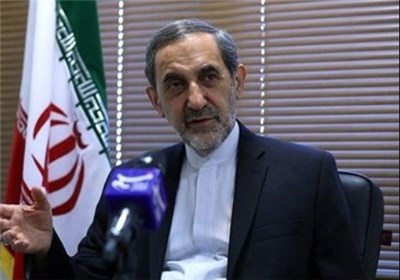
Iran’s Secretary-General of World Assembly of Islamic Awakening Ali Akbar Velayati praised the recent conclusion of nuclear talks between Iran and six world powers, saying that with the deal, Tehran has more strength to support its friends in the Middle East region. [Emphasis added.]

. . . .

Velayati, who is also the head of the Strategic Research Center of Iran’s Expediency Council, stressed the need for the consolidation of the anti-Israeli Resistance Front in the region. [Emphasis added.]

This is the Iranian mushroom cloud provided by Obama and Kerry:

Mushroom cloud

III. Obama’s own mushroom cloud

Here is a photo of Obama’s mushroom cloud with one of His supporters standing contentedly in front of it:

cow manure

Obama’s mushroom cloud, made of bovine fecal matter which Obama et al have asked us to swallow, has grown like Topsy. It’s full of many more lies than merely that He waited until Rouhani became Iran’s president to being nuke negotiations. His other lies, and those of His friends, are even less digestible. Here are just a few from Washington Free Beacon Supercuts to serve as aperitifs.


IV. Conclusions

games

The mushroom cloud detonated by Obama and Friends (“OAFs”) likely means that the “deal” with Iran will soon go into full effect. It will enable Iran to present us with its own nuclear mushroom cloud. It will also be of substantial assistance in furthering Iran’s hegemonic efforts to destabilize the Middle East.

Some mushrooms are good to eat. Obama’s cloud is full of toxic mushrooms. Perhaps they have made Obama, Iran and His other friends drunk with power; they are deadly for the rest of us.

Velayati: Iran More Powerful to Back Regional Allies after Nuclear Deal

August 15, 2015

Velayati: Iran More Powerful to Back Regional Allies after Nuclear Deal, Tasnim News Agency, August 15, 2015

(Great! More jobs for jihadists. Obama should like that. — DM)

139405101138017015791263

TEHRAN (Tasnim) – Secretary-General of World Assembly of Islamic Awakening Ali Akbar Velayati praised the recent conclusion of nuclear talks between Iran and six world powers, saying that with the deal, Tehran has more strength to support its friends in the Middle East region.

Speaking at the opening ceremony of the 6th gathering of General Assembly of Ahl-ul-Bayt World Assembly here in Tehran on Saturday morning, Velayati, who is also the head of the Strategic Research Center of Iran’s Expediency Council, stressed the need for the consolidation of the anti-Israeli Resistance Front in the region.

“The Islamic Republic of Iran will always support the current (Resistance Front) and of course, with the nuclear agreement, it will have more power to side with its friends in the region,” he noted.

Iran and the Group 5+1 (Russia, China, the US, Britain, France and Germany) on July 14 reached a conclusion on a lasting nuclear agreement that would terminate all sanctions imposed on Tehran over its nuclear energy program after coming into force.

The Iranian official further pointed to the most important reasons behind regional crises, saying that despite the claims made by certain countries, the crises do not have religious or sectarian nature.

Velayati added that the regional problems has its roots in the plots hatched by Islam’s enemies, who are seeking to misuse some religious differences and portray a violent image of Muslims.

The 6th General Assembly of Ahl-ul-Bayt World Assembly was inaugurated with a speech by Iranian President Hassan Rouhani.

About1.800 foreign guests from 130 countries along with senior Iranian political and cultural figures have participated in the four-day event.

Britain: The “Struggle of Our Generation”

August 10, 2015

Britain: The “Struggle of Our Generation”, The Gatestone InstituteSamuel Westrop, August 10, 2015

  • “We’ve got to show that if you say ‘yes I condemn terror — but the Kuffar are inferior’, or ‘violence in London isn’t justified, but suicide bombs in Israel are a different matter’ — then you too are part of the problem. Unwittingly or not, and in a lot of cases it’s not unwittingly, you are providing succour to those who want to commit, or get others to commit to, violence.” — Prime Minister David Cameron.
  • In a series of religious rulings published on its website, the Islamic Network charity advocated the murder of apostates; encouraged Muslims to hate non-Muslims; stated that when non-Muslims die, “the whole of humanity are relieved;” and described Western civilisation as “evil.”
  • The Charity Commission’s solution, however, was to give the charity’s trustees booklets titled, “How to manage risks in your charity,” and warn them not to do it again.

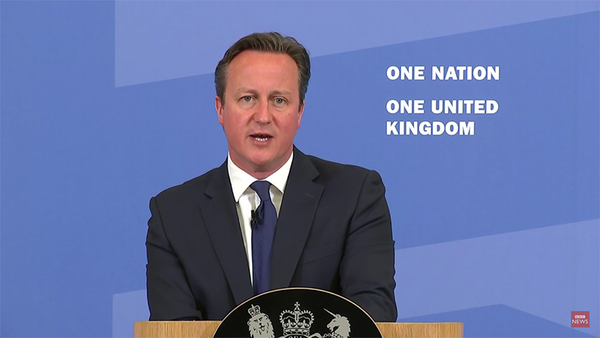
On July 20, Prime Minister David Cameron outlined his government’s plans to counteract Islamic extremism, which he described as the “struggle of our generation.”

In a speech before Ninestiles School, in the city of Birmingham, Cameron articulated a view of the Islamist threat that, just a couple of years ago, few else in British politics would have dared to support.

In a report for BBC Radio 4, the journalist John Ware described Cameron’s speech, and the government’s proposed counter-extremism measures, as “something no British government has ever done in my lifetime: the launch of a formal strategy to recognize, challenge and root out ideology.”

Cameron’s speech was wide-ranging. It addressed the causes, methods and consequences of Islamist extremism.

1199(Image source: BBC video screenshot)

We must recognize, Cameron reasoned, that Islamist terror is the product of Islamist ideology. It is definitely not, he argued, “because of historic injustices and recent wars, or because of poverty and hardship. This argument, what I call the grievance justification, must be challenged. … others might say: it’s because terrorists are driven to their actions by poverty. But that ignores the fact that many of these terrorists have had the full advantages of prosperous families or a Western university education.”

“Extreme doctrine” is to blame — a doctrine that is “hostile to basic liberal values … Ideas which actively promote discrimination, sectarianism and segregation. … which privilege one identity to the detriment of the rights and freedoms of others.” This is a doctrine “based on conspiracy: that Jews exercise malevolent power; or that Western powers, in concert with Israel, are deliberately humiliating Muslims, because they aim to destroy Islam.”

People are drawn to such extremist ideas, Cameron argued, because:

“[Y]ou don’t have to believe in barbaric violence to be drawn to the ideology. No-one becomes a terrorist from a standing start. It starts with a process of radicalisation. When you look in detail at the backgrounds of those convicted of terrorist offences, it is clear that many of them were first influenced by what some would call non-violent extremists.

“It may begin with hearing about the so-called Jewish conspiracy and then develop into hostility to the West and fundamental liberal values, before finally becoming a cultish attachment to death. Put another way, the extremist world view is the gateway, and violence is the ultimate destination.”

To counteract the extremist threat, Cameron concludes, the government will “tackle both parts of the creed — the non-violent and violent. This means confronting groups and organisations that may not advocate violence — but which do promote other parts of the extremist narrative.”

Further, no longer will extremist groups be able to burnish their moderate credentials by pointing to ISIS as the Islamic bogeyman:

“We’ve got to show that if you say ‘yes I condemn terror — but the Kuffar are inferior’, or ‘violence in London isn’t justified, but suicide bombs in Israel are a different matter’ – then you too are part of the problem. Unwittingly or not, and in a lot of cases it’s not unwittingly, you are providing succour to those who want to commit, or get others to commit to, violence.

For example, I find it remarkable that some groups say ‘We don’t support ISIL’ as if that alone proves their anti-extremist credentials. And let’s be clear Al-Qaeda don’t support ISIL. So we can’t let the bar sink to that level. Condemning a mass-murdering, child-raping organisation cannot be enough to prove you’re challenging the extremists.”

Rather radically for a Western leader, Cameron also asserted that, “simply denying any connection between the religion of Islam and the extremists doesn’t work… it is an exercise in futility to deny that. And more than that, it can be dangerous. To deny it has anything to do with Islam means you disempower the critical reforming voices; the voices that are challenging the fusing of religion and politics…”

Cameron’s speech was groundbreaking. No previous Prime Minister in past decades would have dared to make such statements. This is not to say, however, that it is without fault.

Cameron is not just talk. An “Extremism Analysis Unit” has been set up within the Home Office, which will serve to tackle Islamist extremism, including “non-violent” groups. According to the journalist John Ware, the new body is currently preparing lists of extremist preachers and groups.

More importantly, a variety of new legislation is being brought before Parliament. However, some of the proposed laws, critics argue, are draconian. “Banning Orders” will outlaw designated “extremist groups.” “Extremism Disruption Orders,” meanwhile, will restrict designated “extremists” from appearing on television, or publishing without the authorities’ approval. And “Closure Orders” will allow the government to close any institution deemed guilty of promoting extremism.

Cameron has correctly and radically diagnosed the problem of Islamic extremism. His solutions, however, do not appear promising.

A more useful next step would be for the government to tackle its own relationships with extremist groups. Britain’s registered charities offer a particularly vivid example of Islamist extremism going unchallenged.

In 2014, I wrote about the Islamic Network, a group that describes itself as “a da’wah[proselytizing] organisation which aims to promote awareness and understanding of the religion of Islam.”

In a series of religious rulings published on its website, the Islamic Network charity advocated themurder of apostates; encouraged Muslims to hate non-Muslims; stated that when non-Muslims die, “the whole of humanity are relieved;” and described Western civilisation as “evil.” Further, the Islamic Network directed a great deal of hatred towards the Jews. Its website claimed: “The Jews strive their utmost to corrupt the beliefs, morals and manners of the Muslims. The Jews scheme and crave after possessing the Muslim lands, as well as the lands of others.”

In spite of these views, the Islamic Network is a registered charity, which means it is entitled to subsidy from the taxpayer.

As a result of revealing the material published on the Islamic Network’s website, as well as several complaints submitted to the Charity Commission, the government opened an inquiry into the charity. After a year of deliberation, the Charity Commission published its report, which concluded that the Islamic Network had indeed published extremist material.

The Charity Commission’s solution, however, was to give the charity’s trustees booklets titled, “How to manage risks in your charity,” and warn them not to do it again.

Britain may finally have a government that understands the problem of Islamist extremism, but if government bodies fail to challenge extremist charities such as the Islamic Network, then what use is this enlightenment?

The Islamic Network is but one of many dozens of examples. Why is the British organizationInterpal, for example, still allowed to be a registered charity? Interpal is a designated terrorist organization under United States law. Its trustees regularly meet with senior leaders of the terror group Hamas. In 2013, for instance, Interpal trustee Essam Yusuf took part in a ceremony with the Hamas leader Ismail Haniyeh, at which they expressed praise for Hamas’ military wing, the Al Qassam Brigades, and glorified “martyrdom.”

Or what of Islamic Relief, one of Britain’s largest charities? Established by the Muslim Brotherhood, Islamic Relief’s directors have included Ahmed Al-Rawi, a Muslim Brotherhood leader who, in 2004, supported jihad against British and American troops in Iraq; and Essam El-Haddad, who is accused by an Egyptian court of divulging Egyptian state secrets to Hamas, Hezbollah and Iran, and using Islamic Relief to finance global terrorism.

Despite Islamic Relief’s links to Islamist extremism, the charity continues to receive millions of pounds from the British government.

David Cameron’s speech on July 20 should be applauded. If another political party had won the recent general election, no such speech would have been made. But before the Prime Minister turns his hand to censorship, perhaps the government should address extremist groups closer to home.

The profs who love Obama’s Iran deal

August 10, 2015

The profs who love Obama’s Iran deal, Front Page MagazineCinnamon Stillwell, August 10, 2015

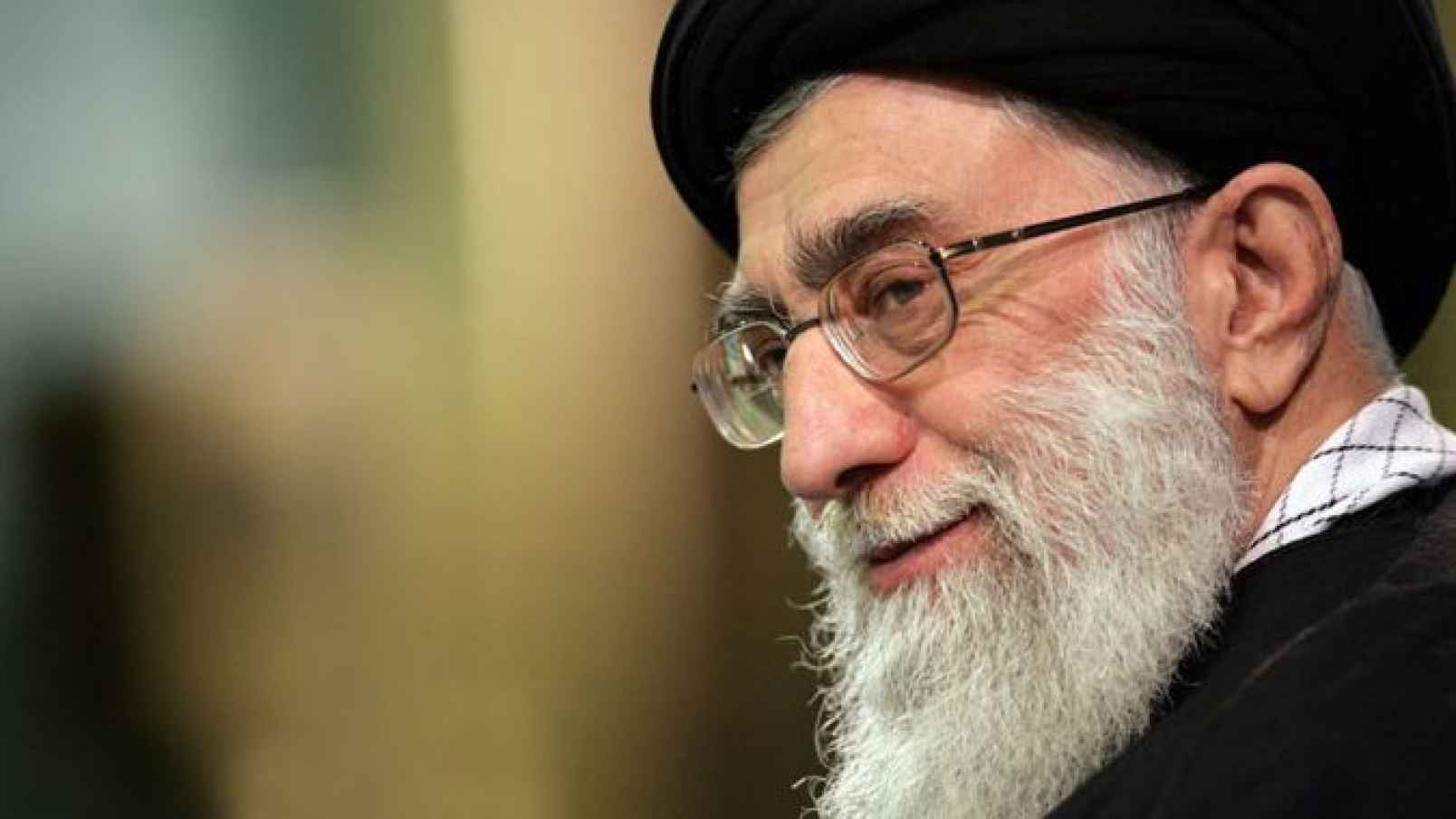
1.29.13-ayatollah-ali-khamenei

Meet the Mullahs’ academic cheerleaders.

Who supports the Obama administration’s increasingly unpopular Joint Comprehensive Plan of Action (JCPOA) aimed ostensibly at curbing Iran’s nuclear program? Many of its strongest proponents come from the field of Middle East studies, which boasts widespread animus towards the U.S. and Israel along with a cadre of apologists for the Iranian regime determined to promote ineffectual diplomacy at all costs.

University of California, Riverside creative writing professor Reza Aslan concedes that his generation of Iranian-Americans “feel[s] far removed from the political and religious turmoil of the Iranian revolution” before falling in line with the Iranian regime’s propaganda: the deal will “empower moderates in Iran, strengthen Iranian civil society and spur economic development,” and create “an Iran that is a responsible actor on the global stage, that respects the rights of its citizens and that has warm relations with the rest of the world.” “Warm relations” are the least likely outcome of the increase in funding for Iran’s terrorist proxies Hamas and Hezbollah that even President Obama admits will follow the easing of sanctions.

Flynt Leverett, an international relations professor at Pennsylvania State University, whitewashes these terrorist groups as “constituencies” and “communities” which the Iranian regime “help[s] organize in various ways to press their grievances more effectively,” effective terrorism being, for Leverett, a laudable goal.  Characterizing the regime as “a rising regional power” and “legitimate political order for most Iranians,” he urges the U.S., through the JCPOA, to “come to terms with this reality.”

Diablo Valley College Middle East studies instructor Amer Araim’s seemingly wishful thinking is equally supportive of Tehran’s line: “it is sincerely hoped that these funds will be used to help the Iranian people develop their economy and to ensure prosperity in that country.” Meanwhile, Hooshang Amirahmadi, an Iranian-American international relations professor at Rutgers University, attempts to legitimize the regime by delegitimizing the sanctions: “The money that will flow to Iran under this deal is not a gift: this is Iran’s money that has been frozen and otherwise blocked.”

Others deny the Iranian regime intends to build a nuclear bomb. University of Michigan history professor Juan Cole has “long argued that [Iran’s leader Ali] Khamenei is sincere about not wanting a nuclear weapon” because of his “oral fatwas or legal rulings” indicating that “using such weapons is contrary to Islamic law.” His unwarranted confidence in the regime leads him to conclude:

[T]hey have developed all the infrastructure and technical knowledge and equipment that would be necessary to make a nuclear weapon, but stop there, much the way Japan has.

Evidently, Cole has no problem with a tyrannical, terrorist-supporting regime that seeks regional hegemony on the threshold of becoming a nuclear power.

Likewise, William Beeman, an anthropology professor at the University of Minnesota, maintains that, “It was . . .  easy for Iran to give up a nuclear weapons program that never existed, and that it never intended to implement.” Like Cole, he uncritically accepts and recites the regime’s disinformation: “Iran’s leaders have regularly denounced nuclear weapons as un-Islamic.”

Beeman—who, in previous negotiations with the Iranian regime, urged the U.S. to be “unfailingly polite and humble” and not to set “pre-conditions” regarding its nuclear program—coldly disregards criticism of the JCPOA for excluding conditions such as the “release of [American] political prisoners” and “recognition of Israel,” calling them “utterly irrelevant.” No doubt the relatives of those prisoners and the Israeli citizens who live in the crosshairs of the regime’s continued threats of annihilation would disagree.

A number of academics have resorted to classic anti-Semitic conspiracy mongering to attack the deal’s Israeli and American opponents, calling them the “Israel Lobby.” Muqtedar Khan, director of the Islamic Studies Program at the University of Delaware, accuses “the Israeli government and all those in the U.S. who are under the influence of its American lobbies” of obstructing the deal, claiming that, “The GOP congress is now being described as the [Israeli Prime Minister Benyamin] Netanyahu congress.”

Hatem Bazian, director of the Islamophobia Research & Documentation Project at the University of California, Berkeley, takes aim at “pro-Israel neo-conservatives,” “neo-conservative warmongers,” “AIPAC,” and (in a mangled version of “Israel-firster”) “Israel’s first D.C. crowd” for “attempting to scuttle the agreement.” Asserting a moral equivalence between the dictatorial Iranian regime and the democratically-elected Israeli government, Bazian demands to know when Israel’s “pile of un-inspected or regulated nuclear weapons stockpile” will be examined before answering, “It is not going to happen anytime soon!” That Israel has never threatened any country with destruction, even after being attacked repeatedly since its rebirth, is a fact ignored by its critics.

The unhinged Facebook posts of Columbia University Iranian studies professor and Iranian native Hamid Dabashi reveal in lurid language his hatred of Israel:

It is now time the exact and identical widely intrusive scrutiny and control compromising the sovereignty of the nation-state of Iran and its nuclear program be applied to the European settler colony of Jewish apartheid state of Israel and its infinitely more dangerous nuclear program! There must be a global uproar against the thuggish vulgarity of Netanyahu and his Zionist gangsters in Israel and the U.S. Congress to force them to dismantle their nuclear program–systematically used to terrorize and murder Palestinian people and steal the rest of Palestine!

Elsewhere, Dabashi attacks adversaries of the JCPOA, including “Israel, Saudi Arabia, the U.S. Neocons, and their treacherous expat Iranian stooges masquerading as ‘Opposition,’” calling them a “terrorizing alliance,” a “gang of murderous war criminals,” and “shameless warmongers.”

Willful blindness to Iran’s brutal, terrorist-supporting regime, moral equivocation, and an irrational hatred for Israel and the West characterize the fawning support enjoyed by the mullahs from these and other professors of Middle East studies. In place of objective, rigorously researched plans for countering Iran’s aggression and advancing the safety of America and its allies, they regurgitate the crudest propaganda from Teheran. Until their field of study is thoroughly reformed, their advice—such as it is—should and must be utterly ignored.

“Death to America” Falling on Obama’s Deaf Ears

August 10, 2015

“Death to America” Falling on Obama’s Deaf Ears, American ThinkerEileen F. Toplansky, August 10, 2015

(Please see also, It’s Not Just Iran’s Hardliners Saying ‘Death to America.’  — DM)

The Iranian curriculum is based on an Iranian-style Islam called the New Islamic Civilization (NIC).  The battle between good and evil, which is to be waged on a global scale, “is the responsibility of each Iranian citizen,” and “it begins with defense.”  America is seen as “arrogant,” and “any kind of freedom of speech, political debate or appreciation of Iranian culture or values other than those espoused by the regime are intolerable[.]”

[T]reating Iran as a normal country instead of one that inculcates acts of aggression is extraordinarily dangerous.

**********************

We are well past the point where we can ever believe Obama the man because, as those prescient about Obama’s background instinctively understood, whatever was taught  Obama the child is what is now being reflected in his dangerous anti-American actions.

Thus, the 17th-century Jesuit-inspired quotation of “give me the child, and I will mold the man” remains true.

This is why the idea that one can trust the Iranians is not only naive, but extraordinarily dangerous, given the education of their children.  In the May 2015 Special Interim Report entitled “Imperial Dreams: The Paradox of Iranian Education” by Eldad J. Pardo, the incessant propagandizing and intimidation of Iranian students is proof positive that they are being primed to attack those whom their leaders deem the enemy.  The first page of the report shows the map of a “New Dreams of World Power” with Iran at the center.  Underneath this map is a picture of “Iranian children preparing for martyrdom.”

Lest one think this is unthinkable, recall the fact that Iran and its proxies regularly send their children as suicidal bombers.  Thus, as Pardo recounts, the Iranian education curriculum includes “the ambition to impose Iranian hegemony on the world; a culture of militarism and jihad; blind obedience and martyrdom; and hostility and paranoia toward foreigners.”

In fact, “jihad war is unending,” and “the frenzied rush toward the end-of-time’s ‘horrifying battle'” is the lifeblood of continuous jihad.

The backdrop to all this education is the idea that Iran is committed to “total struggle for the creation of a just world order” and that such a “condition will remain until the coming of the Mahdi, the Shiite Messiah[.]”  The messianic ideal here is quite different from what most Westerners believe; that it is ignored will be a fatal mistake.  And Obama knows this, which is why Americans must stomach, yet again, his “compendium of demagoguery, historical revisionism and outright lying.”

Iranian students understand that “possible martyrdom on a massive scale and for which they practice from the first grade – could be launched as part of an Iranian ‘attack on countries ruled by oppressive governments.'”  Moreover, Iranian students study about “dissimulation” (taqiyya) and “misleading the enemy.”  They learn that “in time of need, dissimulation and  temporary pacts – even with ‘un-Godly, idolatrous governments’ – are proper (but only until such time as the balance of power should change).”  The idea of sacrifice is “constantly instilled in them,” as evidenced by the Teacher’s Guide for Persian, Grade 3 text.  Never is there any concern with the “human wave assault,” which includes many sacrificed schoolchildren.  Instead, enthusiasm for military participation is promoted in the first grade, for six-year-olds.

Surely Obama’s many Muslim Brotherhood advisers would have informed him of taqiyya, and since Obama early on learned the tenets of Islam, this is part of his worldview.  Whether one believes he is a pathological liar or not, the fact remains that Obama defends the Iranian deal with falsehoods and slurs.  Moreover, he recently exploited American college students at American University, much as his Iranian counterparts abuse their own children with incessant misinformation and propaganda.

The Iranian educational curriculum makes much of the Aryan-Shiite basis of Iranian identity wherein the Allies, and not Nazi Germany, are vilified, and, of course, the Holocaust is completely avoided.  Hence, the unremitting cries of “Death to Israel” fall on ears already primed to hate the Jew.  Furthermore, in echoes of Nazism, “children are instructed not to obey their parents in matters regarding martyrdom,” and pictures of soldiers are amply sprinkled in the textbooks.

This is of little concern to Obama, who has been surrounded by anti-Semites for many years.  The anti-Jewish hatred does not disturb him, nor does it deter him.  While Caroline Glick asserts that Obama maintains that “an anti-Semite is someone who refuses to recognize the 3,000-year connection between the Jews and the Land of Israel,” and “an anti-Semite is also someone who refuses to recognize the long history of persecution that the Jewish people suffered in the Diaspora,” this is hardly a ringing endorsement of ensuring that no harm will come to the Jewish people.  Acknowledging a connection to a piece of land is not the same as making certain that that land is not blown to smithereens.

The Iranian curriculum is based on an Iranian-style Islam called the New Islamic Civilization (NIC).  The battle between good and evil, which is to be waged on a global scale, “is the responsibility of each Iranian citizen,” and “it begins with defense.”  America is seen as “arrogant,” and “any kind of freedom of speech, political debate or appreciation of Iranian culture or values other than those espoused by the regime are intolerable[.]”

In essence, the “school textbooks prepare the entire Iranian population for a constant state of emergency, requiring Iranians to foment revolutions throughout the world, particularly across the Middle East, while evil arrogant enemies – who hate Iran and Islam – scheme against them.”  In fact, texts emphasize the martyrdom of women as well as cyber warfare tactics.  Most importantly, “students learn that no checks are needed on the Supreme Leader’s authority, including his right to sanctify new weapons” (italics mine).  Blind obedience to the Supreme Leader is mandatory.

In a Grade 11 Iranian text, students are enjoined to understand that jihad “covers a range of meanings including killing, massacring, murdering and fighting,” and jihad “permits its use against anyone, anywhere.”  There is “defensive jihad,” which refers to an “enemy transgressing the border or city of the Muslims, or defense of one’s own or other’s life, honor and property.”  Thus, as Muslims gain in number in American cities, it is clear that defensive jihad can be used, especially since defensive jihad is seen as a warfare that is “gradual” and that can be “military and sometimes cultural,” since it “sometimes aims at conquering a land or part of it and sometimes aims at political-economic control.”

Then there is “internal jihad,” which “represents a war with outlawed people who implement rebellion and disobedience as well as armed uprisings.”  Western ideas of freedom will be relegated to the dustbin of history, and those who desire it will be annihilated.

Finally there is “elementary jihad,” which at first glance sounds familiar to Western ears.  It is “defined as an attack on countries ruled by oppressive governments that do not allow free religious activities or freedom to listen to the call of religion.”  But there is no freedom of religion in Iran.  It can be only Islam.  There is no room for any other ideas.  And, in fact, “non-Islamic moral constraints” have no impact as Hezb’allah, Iran’s Lebanese proxy, or any other Islamic-inspired group engages in jihad.

Thus, as Jeffrey Herf writes, treating Iran as a normal country instead of one that inculcates acts of aggression is extraordinarily dangerous.  This is a war of ideas – whose will remain supreme?  In essence, Obama is painting a bull’s-eye on America, and not on Iran, who continues the “Death to America” chant on a regular basis.  And while Mona Charen claims that “Obama doesn’t take the Iranian chant seriously,” I, for one, beg to disagree.


UK: Anjem Choudary Charged With Supporting Islamic State

August 9, 2015

UK: Anjem Choudary Charged With Supporting Islamic State, The Gatestone InstituteSoeren Kern, August 9, 2015

(With which of Choudary’s precepts do the Mad Mullahs of Iran disagree? — DM)

  • A recent BBC poll found that 45% of British Muslims believe extremist clerics who preach violence against the West are not “out of touch” with mainstream Muslim opinion.
  • “Allah said very clearly in the Koran ‘Don’t feel sorry for the non-Muslims.’ So as an adult non-Muslim… if he dies in a state of disbelief then he is going to go to the hellfire… so I’m not going to feel sorry for non-Muslims.” — Anjem Choudary.
  • “Under the Shari’ah, the false Gods that people worship instead of Allah will be removed, like democracy, freedom, liberalism, secularism etc.” — Anjem Choudary.
  • “We are Muslims first and Muslim last. Passports are no more than travel documents. If you are born in a barn that doesn’t make you a horse!!” — Anjem Choudary.
  • Choudary urged his followers to quit their jobs and claim unemployment benefits so that they could have more time to plot holy war against non-Muslims. He said Muslims are entitled to welfare payments because they are a form of jizya, a tax imposed on non-Muslims in countries run by Muslims… as a reminder that non-Muslims are permanently inferior and subservient to Muslims.
  • Choudary says he is not afraid of going to prison, which he describes as a fertile ground for gaining more converts to Islam. “If they arrest me and put me in prison…” he warned, “I will radicalize everyone in prison.”

Anjem Choudary, one of the most outspoken and provocative Islamists in Britain today, has been remanded in custody, charged with the terrorism offense of encouraging people to join the Islamic State.

The charge is related to Choudary sending messages to his nearly 33,000 followers on Twitter, allegedly encouraging them to join the Islamic State — the radical Sunni Islamist group that has taken control over large parts of Syria and Iraq, and has threatened to attack targets in Europe and North America.

The effort to prosecute Choudary — well known for his relentless efforts to implement Islamic Sharia law in the UK — indicates that the British government intends to follow through on its recent pledge to crack down on radical Islam in the country.

It remains to be seen, however, if Choudary’s detention will serve as a deterrent to other Islamists in Britain. A recent BBC poll found that 45% of British Muslims believe extremist clerics who preach violence against the West are not “out of touch” with mainstream Muslim opinion.

Choudary was originally arrested in September 2014 during police raids in London, as part of an ongoing Metropolitan Police investigation into Islamist-related terrorism. He was subsequently released on bail while police continued their investigation.

On August 5, Choudary, 48, and an associate, Mohammed Rahman, 32, appeared at Westminster Magistrates’ Court and were charged with repeatedly violating Section 12 of the Terrorism Act 2000 between June 2014 and March 2015.

Addressing the court, Sue Hemming, the head of special crime and counter-terrorism at the Crown Prosecution Service, said:

“It is alleged that Anjem Choudary and Mohammed Rahman invited support for ISIS [also known as the Islamic State] in individual lectures which were subsequently published online. We have concluded that there is sufficient evidence and it is in the public interest to prosecute Anjem Choudary and Mohammed Rahman.”

When asked by the judge to indicate how he would plead, Choudary said: “Cameron and the police are guilty.” The judge replied that he took that to mean that he would be pleading not guilty. Choudary will remain in police custody until August 28, when he is set to appear at the Old Bailey, the Criminal Court of England and Wales. If convicted, Choudary faces up to ten years in prison.

Until now, Choudary, a lawyer by training, has managed to avoid prison by treading the fine legal line between the inflammatory rhetoric of Islamic supremacism and the right to free speech. He has never been convicted of any offense.

Choudary is the former leader of the Muslim extremist group, al-Muhajiroun (Arabic: “The Emigrants”). Al-Muhajiroun, which celebrated the terrorist attacks on the United States in September 2001, was banned in January 2010.

Since then, al-Muhajiroun has repeatedly reinvented itself under an array of successor aliases. These include, among others: Islam4UK, Call to Submission, Islamic Path, Islamic Dawa Association, London School of Sharia, Muslims Against Crusades and Need4Khalifah, all of which have also been banned.

A study published by the London-based Henry Jackson Society in September 2014 found that one in five terrorists convicted in Britain over more than a decade have had links to al-Muhajiroun.

A report published by the British anti-extremist group Hope Not Hate in November 2013 concluded that al-Muhajiroun was “the single biggest gateway to terrorism in recent British history.”

Al-Muhajiroun is said to have also played a major role in radicalizing Michael Adebolajo, who was found guilty of murdering (and attempting to decapitate) the British soldier Lee Rigby outside London’s Woolwich Barracks in May 2013.

Choudary said Rigby would “burn in hellfire” as a non-Muslim, and also praised Adebolajo as a “martyr.” He said:

“Allah said very clearly in the Koran ‘Don’t feel sorry for the non-Muslims.’ So as an adult non-Muslim, whether he is part of the Army or not part of the Army, if he dies in a state of disbelief then he is going to go to the hellfire.

“That’s what I believe so I’m not going to feel sorry for non-Muslims. We invite them to embrace the message of Islam. If they don’t, then obviously if they die like that they’re going to the hellfires.”

720Islamist preacher Anjem Choudary (right) praised one of the murderers of British solider Lee Rigby (left) as a “martyr” and said Rigby would “burn in hellfire” as a non-Muslim.

Police say that Choudary’s rhetoric has become more incendiary since June 2014, when the Islamic State proclaimed itself to be an Islamic Caliphate, a theocracy ruled according to Sharia law. Since then, police say, Choudary has repeatedly crossed the legal threshold for criminal prosecution for encouraging terrorism, such as justifying the beheading of the American journalist, James Foley, and the British aid worker, Alan Henning.

Choudary believes that the leader of the Islamic State, Abu Bakr al-Baghdadi, is “the caliph of all Muslims” and that Shariah law will eventually “be in command even in America and in Britain and in China and in Russia and everywhere else.”

The expansion of the Caliphate, the global implementation of Sharia law and Islamic supremacism are common themes in Choudary’s Twitter universe, where — through a daily barrage of anti-Western tweets — he repeatedly admonishes his nearly 33,000 followers to avoid assimilating into British culture.

In one tweet, Choudary wrote:

“Eventually the whole world will be governed by Shari’ah & Muslims will have authority over China Russia USA etc. This is the promise of Allah.”

He also tweeted:

“Under the Shari’ah, the false Gods that people worship instead of Allah will be removed, like democracy, freedom, liberalism, secularism etc.”

In another tweet, Choudary wrote:

“A Muslim always prefers: Shari’ah over Democracy, Submission over Freedom, Khilafah over Secularism, Jihad over oppression, Allah over [Prime Minister David] Cameron!”

Again, he tweeted:

“Cameron needs to accept that Islam is the fastest growing religion/way of life in Britain today & that one day Shari’ah will be implemented!”

On July 14, Choudary tweeted:

“The Khalifah [Caliphate] must ensure that no non-Muslim criticizes Islam or tries to convert Muslims to their own false belief, only Islam is propagated.”

On July 10, he tweeted:

“When the Shari’ah comes to UK/France/US/Russia/China we’ll ban Alcohol, Gambling, Fornication, Pornography, Usury, Democracy, Freedom, The UN etc.”

On July 6, Choudary wrote:

“The only time Muslims, Christians & Jews lived together peacefully with their honor protected in Europe was under the Shari’ah in Spain.”

After the July 2015 shootings of American servicemen by a Muslim in Chattanooga, Tennessee, Choudary tweeted:

“There’s a conflict in the world between those who believe Sovereignty belongs to Allah & those who believe it belongs to Obama! #Chattanooga.”

And again:

“The cycle of violence that we find ourselves in can be resolved. Muslims, Christians & Jews can live peacefully under Shari’ah! #Chattanooga.”

Choudary, who was born in the UK, has also explained how he feels about his British citizenship:

“We are Muslims first and Muslim last. Passports are no more than travel documents. If you are born in a barn that doesn’t make you a horse!!”

Choudary, who is married and has four children, enjoys a comfortable lifestyle that is being paid for, year after year, by British taxpayers. In 2010, the newspaper The Sun reported that he takes home more than £25,000 (€35,000; $38,000) a year in welfare benefits.

In February 2013, Choudary urged his followers to quit their jobs and claim unemployment benefits so that they could have more time to plot holy war against non-Muslims. He said Muslims are entitled to welfare payments because they are a form of jizya, a tax imposed on non-Muslims in countries run by Muslims. According to Sharia law, the jizya is a reminder that non-Muslims are permanently inferior and subservient to Muslims.

In a video, Choudary said:

“We [Muslims] take the jizya, which is ours anyway. The normal situation is to take money from the kuffar [non-Muslim]. They give us the money. You work, give us the money, Allahu Akhbar. We take the money.”

Meanwhile, Choudary’s Twitter followers have threatened violence unless he is released. In one tweet, a supporter used the hashtag #FreeAnjemChoudary with a picture of Big Ben and the flag of the Islamic State. Another tweet said: “The black days is coming to Britain if it doesnt [sic] release the Muslims.” Yet another said: “O Allah! Whoever has harmed them, then harm him, n whoever has shown enmity to them, then show enmity to them.” And another: “The shariah of Allah is the only solution for UK. #democracy is rotten.”

According to data compiled by an online analytics company, the hashtag #FreeAnjemChoudary was shared nearly 600 times in first the 24 hours after Choudary’s detention, potentially reaching 700,000 people. The data shows that most of Choudary’s supporters are living in the West: 69% of Choudary’s supporters are tweeting from Britain, Canada and the United States, and another 10% tweeting from Australia.

Choudary says he is not afraid of going to prison, which he describes as a fertile ground for gaining more converts to Islam. “If they arrest me and put me in prison, I will carry on in prison,” he warned. “I will radicalize everyone in prison.”

Column One: Obama’s enemies list

August 6, 2015

Column One: Obama’s enemies list, Jerusalem Post, Caroline Glick, August 6, 2015

ShowImage (8)US President Barack Obama at the Rose Garden of the White House. (photo credit:OFFICIAL WHITE HOUSE PHOTO / PETE SOUZA)

[T]he real question lawmakers need to ask is whether the deal is good for America. Is Obama right or wrong that only partisan zealots and disloyal Zionists could oppose his great diplomatic achievement? To determine the answer to that question, you need to do is ask another one. Does his deal make America safer or less safe? The best way to answer that question is to consider all the ways Iran threatens America today, and ask whether the agreement has no impact on those threats, or whether it mitigates or aggravates them.

***********************

In President Barack Obama’s defense of his nuclear deal with Iran Wednesday, he said there are only two types of people who will oppose his deal – Republican partisans and Israel- firsters – that is, traitors.

At American University, Obama castigated Republican lawmakers as the moral equivalent of Iranian jihadists saying, “Those [Iranian] hard-liners chanting ‘Death to America’ who have been most opposed to the deal… are making common cause with the Republican Caucus.”

He then turned his attention to Israel.

Obama explained that whether or not you believe the deal endangers Israel boils down to whom you trust more – him or Prime Minister Benjamin Netanyahu. And, he explained, he can be trusted to protect Israel better than Netanyahu can because “[I] have been a stalwart friend of Israel throughout my career.”

The truth is that it shouldn’t much matter to US lawmakers whether Obama or Netanyahu has it right about Israel. Israel isn’t a party to the deal and isn’t bound by it. If Israel decides it needs to act on its own, it will.

The US, on the other side, will be bound by the deal if Congress fails to kill it next month.

So the real question lawmakers need to ask is whether the deal is good for America. Is Obama right or wrong that only partisan zealots and disloyal Zionists could oppose his great diplomatic achievement? To determine the answer to that question, you need to do is ask another one. Does his deal make America safer or less safe? The best way to answer that question is to consider all the ways Iran threatens America today, and ask whether the agreement has no impact on those threats, or whether it mitigates or aggravates them.

Today Iran is harming America directly in multiple ways.

The most graphic way Iran is harming America today is by holding four Americans hostage. Iran’s decision not to release them over the course of negotiations indicates that at a minimum, the deal hasn’t helped them.

It doesn’t take much consideration to recognize that the hostages in Iran are much worse off today than they were before Obama concluded the deal on July 14.

The US had much more leverage to force the Iranians to release the hostages before it signed the deal than it does now. Now, not only do the Iranians have no reason to release the hostages, they have every reason to take more hostages.

Then there is Iranian-sponsored terrorism against the US.

In 2011, the FBI foiled an Iranian plot to murder the Saudi ambassador in Washington and bomb the Saudi and Israeli embassies in the US capital.

One of the terrorists set to participate in the attack allegedly penetrated US territory through the Mexican border.

The terrorist threat to the US emanating from Iran’s terrorist infrastructure in Latin America will rise steeply as a consequence of the nuclear deal.

As The Wall Street Journal’s Mary Anastasia O’Grady wrote last month, the sanctions relief the deal provides to Iran will enable it to massively expand its already formidable operations in the US’s backyard. Over the past two decades, Iran and Hezbollah have built up major presences in Cuba, Venezuela, Nicaragua, Ecuador and Bolivia.

Iran’s presence in Latin America also constitutes a strategic threat to US national security. Today Iran can use its bases of operations in Latin America to launch an electromagnetic pulse attack on the US from a ballistic missile, a satellite or even a merchant ship.

The US military is taking active steps to survive such an attack, which would destroy the US’s power grid. Among other things, it is returning the North American Aerospace Defense Command (NORAD) to its former home in Cheyenne Mountain outside Colorado Springs.

But Obama has ignored the findings of the congressional EMP Commission and has failed to harden the US electronic grid to protect it from such attacks.

The economic and human devastation that would be caused by the destruction of the US electric grid is almost inconceivable. And now with the cash infusion that will come Iran’s way from Obama’s nuclear deal, it will be free to expand on its EMP capabilities in profound ways.

Through its naval aggression in the Strait of Hormuz Iran threatens the global economy. While the US was negotiating the nuclear deal with Iran, the Revolutionary Guards unlawfully interdicted – that is hijacked – the Marshall Islands-flagged Maersk Tigris and held its crew hostage for weeks.

Iran’s assault on the Tigris came just days after the US-flagged Maersk Kensington was surrounded and followed by Revolutionary Guards ships until it fled the strait.

A rational take-home message the Iranians can draw from the nuclear deal is that piracy pays.

Their naval aggression in the Strait of Hormuz was not met by American military force, but by American strategic collapse at Vienna.

This is doubly true when America’s listless response to Iran’s plan to use its Houthi proxy’s takeover of Yemen to control the Bab el-Mandab strait is taken into consideration. With the Bab el-Mandab, Iran will control all maritime traffic from the Persian Gulf and the Red Sea. Rather than confront this clear and present danger to the global economy, America abandoned all its redlines in the nuclear talks.

Then there is Iran’s partnership 20-year partnership with al-Qaida.

The 9/11 Commission found in its report that four of the 9/11 terrorists transited Iran before traveling to the US. As former Defense Intelligence Agency director Lt.-Gen. (ret.) Mike Flynn told Fox News in the spring, Iranian cooperation with al-Qaida remains deep and strategic.

When the US Navy SEALs killed Osama bin Laden in 2011, they seized hard drives containing more than a million documents related to al-Qaida operations. All but a few dozen remain classified.

According to Flynn and other US intelligence officials who spoke to The Weekly Standard, the documents expose Iran’s vast collaboration with al-Qaida.

The agreement Obama concluded with the mullahs gives a tailwind to Iran. Iran’s empowerment will undoubtedly be used to expand its use of al-Qaida terrorists as proxies in their joint war against the US.

Then there is Iran’s ballistic missile program.

The UN Security Council resolution passed two weeks ago cancels the UN-imposed embargoes on conventional arms and ballistic missile acquisitions by Iran. Since the nuclear deal facilities Iranian development of advanced nuclear technologies that will enable the mullahs to build nuclear weapons freely when the deal expires, the Security Council resolution means that by the time the deal expires, Iran will have the nuclear warheads and the intercontinental ballistic missiles required to carry out a nuclear attack on the US.

Obama said Wednesday that if Congress votes down his nuclear deal, “we will lose… America’s credibility as a leader of diplomacy. America’s credibility,” he explained, “is the anchor of the international system.”

Unfortunately, Obama got it backwards. It is the deal that destroys America’s credibility and so upends the international system which has rested on that credibility for the past 70 years.

The White House’s dangerous suppression of seized al-Qaida-Iran documents, like its listless response to Iran’s maritime aggression, its indifference to Iran’s massive presence in Latin America, its lackluster response to Iran’s terrorist activities in Latin America, and its belittlement of the importance of the regime’s stated goal to destroy America – not to mention its complete collapse on all its previous redlines over the course of the negotiations – are all signs of the disastrous toll the nuclear deal has already taken on America’s credibility, and indeed on US national security.

To defend a policy that empowers Iran, the administration has no choice but to serve as Iran’s agent. The deal destroys America’s credibility in fighting terrorism. By legitimizing and enriching the most prolific state sponsor of terrorism, the US has made a mockery of its claimed commitment to the fight.

The deal destroys the US’s credibility as an ally.

By serving as apologists for its worst enemy, the US has shown its allies that they cannot trust American security guarantees. How can Israel or Saudi Arabia trust America to defend them when it is endangering itself? The deal destroys 70 years of US nonproliferation efforts. By enabling Iran to become a nuclear power, the US has made a mockery of the very notion of nonproliferation and caused a nuclear arms race in the Middle East.

The damage caused by the deal is already being felt. For instance, Europe, Russia and China are already beating a path to the ayatollahs’ doorstep to sign commercial and military deals with the regime.

But if Congress defeats the deal, it can mitigate the damage. By killing the deal, Congress will demonstrate that the American people are not ready to go down in defeat. They can show that the US remains committed to its own defense and the rebuilding of its strategic credibility worldwide.

In his meeting with Jewish leaders Tuesday, Obama acknowledged that his claim – repeated yet again Wednesday – that the only alternative to the deal is war, is a lie.

Speaking to reporters after the meeting, Greg Rosenbaum, chairman of the National Democratic Jewish Council, which is allied with the White House, said that Obama rejected the notion that war will break out if Congress rejects the deal with veto-overriding majorities in both houses.

According to Rosenbaum, Obama claimed that if Congress rejects his nuclear deal, eventually the US will have to carry out air strikes against Iran’s nuclear facilities in order to prevent them from enriching uranium to weapons-grade levels.

“But,” he quoted Obama as saying, “the result of such a strike won’t be war with Iran.”

Rather, Obama said, Iran will respond to a US strike primarily by ratcheting up its terrorist attacks against Israel.

“I can assure,” Obama told the Jewish leaders, “that Israel will bear the brunt of the asymmetrical responses that Iran will have to a military strike on its nuclear facilities.”

What is notable here is that despite the fact that it will pay the heaviest price for a congressional defeat of the Iran deal, Israel is united in its opposition to the deal. This speaks volume about the gravity with which the Israeli public views the threats the agreement unleashed.

But again, Israel is not the only country that is imperiled by the nuclear deal. And Israelis are not the only ones who need to worry.

Obama wishes to convince the public that the deal’s opponents are either partisan extremists or traitors who care about Israel more than they care about America. But neither claim is true. The main reason Americans should oppose the deal is that it endangers America. And as a consequence, Americans who oppose the deal are neither partisans nor turncoats.

They are patriots.

Nuclearizing Iran, Sabotaging Arabs

August 6, 2015

Nuclearizing Iran, Sabotaging Arabs, The Gatestone InstituteBassam Tawil, August 6, 2015

(Please see also, Obama’s Strategy Of Equilibrium. — DM)

  • Obama’s solution? To let Iran have legitimate nuclear bombs in a few years, along with intercontinental ballistic missiles to deliver them to the U.S. — or perhaps from America’s soft underbelly, South America, where Iran has been acquiring uranium and establishing bases for years. Or perhaps launched from submarines off America’s coast, which would make the identity of the attacker unknowable and a response therefore impossible. Incredibly, America’s politicians do not even seem to seem to be concerned about that.
  • We have just sacrificed Sunni stability for American ideology: empty slogans fed to us by clueless, if well-meaning, American officials.
  • As we watched one stable Arab regime fall after another, we have allowed ourselves to be destroyed from within by these bungling diplomats — from America, Europe, China and Russia. Instead of keeping our eyes on the real threat, we exhausted ourselves in wasteful, unending battles against the Jews — meanwhile letting the Iranian menace slip out of sight.
  • Obama really does deserve a Nobel Prize, but it should have been awarded by the Ayatollah Khamenei, the Supreme Leader of Iran, in gratitude for America’s surrender.

“Nation building” seems to have fallen into disrepute in the West, but it should not. It is vitally important — as the successes of Germany, Japan and South Korea attest.

Over the past few years, in our foolishness, we in the Middle East swallowed the deceptive bait of “democracy” dangled before us, even though we knew that it could not, in the misguided way it was presented, be implemented in the Middle East.

The idea was superb, but here in the Middle East, possibly in being impatient to “get credit” before the diplomats’ term of office were over, no one ever took the time to establish the institutions of democracy — equal justice under law, freedom of speech, property rights, the primacy of the individual rather than the collective, separation of religion and state — to show us in the Middle East how democracy actually operates, and to allow those institutions to take rootbefore ever holding an election.

So eager were Western leaders to take credit right away that they refused “let the rice bake.” Had the West introduced democratic elections to Japan and South Korea (where they eventually worked brilliantly) in the same way it muscled democracy into Iraq, it would never have taken root in those countries either. Had the Germans had been asked to vote right after World War II, they would most likely have reelected the Nazis — that was what they knew. It took seven years to re-educate the public to understand and accept a Konrad Adenauer.

What seems clear is that we have sacrificed Sunni stability for empty slogans — and for clueless, if well-meaning, American officials. As we watched one stable Arab regime fall after another, we allowed American ideology to destroy us from within. Instead of keeping our eyes on the real threat, we exhausted ourselves in wasteful, unending battles against the Jews — meanwhile letting the Iranian menace slip out of sight.

If we try to look at the positive side of the Iran nuclear agreement, it is just possible that Obama looked at the Sunni Arab states, fractured and at each other’s throats, and at the ruthless terrorist groups gaining ground in the expanding battle zones, and decided that we were too fractious for the U.S. to protect.

Sunni states such as Saudi Arabia, Qatar and Turkey have been worsening the situation in the Arab world by funding Sunni terrorist organizations, thereby putting it on a course of complete chaos. Despite Arab wealth and power, we have been dealing almost exclusively with the marginal issue of Palestine and the Jews, to excuse our inability to be effective in giving U.S. President Barack Obama what he really needs: regional stability.

Obama sees Iran and its terrorist organizations, which are all unified, organized and obedient, opposing the Sunni Arabs. Obama may be betting on Iran to bring order to the Middle East.

Imagine if we and our fundamentalist Sunni terrorist organizations had actually focused on stopping the Iranians in Syria, Iraq, Lebanon and Yemen. Imagine if we had abandoned, even momentarily, the dream of the Muslim Brotherhood (what the West calls “political Islam”) ruling the world. Imagine if we had stopped our stupid, useless acts of hatred, and could instead have focused on our common enemy, Iran. Our situation now would be immeasurably better. We would not be deviating from the teachings of Muhammad, because first we have to focus on the near enemy and then on the distant one. Iran is nearer and more dangerous than Europe and the United States, so Iran should have been — and still should be — the first Sunni target. We might have led Obama to adopt a different approach than allowing Iran to acquire a nuclear bomb in ten years or sooner — but we did not, because of our weakness and distraction with marginal “causes.” Thus Obama, from a desire to stabilize the Middle East, seems to be betting on the strong horse, Iran.

The truth, however, may be somewhat different. It is entirely possible that Obama, who won the Nobel Peace Prize, is employing a policy of “divide and conquer.” In the U.S., instead of trying to improve how children in the inner cities are being educated, he has been busy stoking racial and economic conflict. The Arabs are becoming increasingly suspicious that he is a historic “divide and conquer” manipulator. He may deliberately be creating fitna (civil strife) in the Arab world by whipping up conflict with Iran, so that America will one again look like the big power-broker — but at the expense of the Arabs.

We Arabs are expert conspiracy theorists, and interpret every political agenda as a hidden plot, but one only has to look at the Obama administration’s fawning support for the Muslim Brotherhood in Turkey and Egypt, and how America supported the fall of Mubarak, and it immediately becomes obvious that the U.S. is trying to manipulate the fate of the Arabs.

Anyone following America’s rejection of, and now only reluctant support for, the reformist regime of Egyptian President Abdel Fattah el-Sisi understands that the Americans prefer what they consider “backward Arabs”: those controlled by regressive Islam.

That is the reason we see Obama’s policies as backing both the Sunni Muslim Brotherhood and the theocrats in Iran. The ideologies of both the Muslim Brotherhood and Iran’s mullahs would lead to most dangerous and regressive fate of both Sunni and Shiite Muslims around the world, as well as Americans at home — and these are the Muslims most loved by the current American administration. Or maybe, as many of us say here on the street, Obama is just trying to “get even” with the West and bring it to its knees, for being white, “imperialist” and non-Muslim. Obama’s solution? To let Iran have legitimate nuclear bombs in a few years, with the intercontinental ballistic missiles to deliver them to the U.S. — or perhaps from America’s soft underbelly, South America, where Iran has been acquiring uranium and establishing bases for years. Or perhaps launched from submarines off America’s coast, which would make the identity of the attacker unknowable and a response therefore impossible. Incredibly, America’s politicians do not even seem to seem to be concerned about that.

Obama really does deserve a Nobel Prize, but it should have been awarded by the Ayatollah Khamenei, the Supreme Leader of Iran, in gratitude for America’s surrender.

1190Perhaps President Obama’s Nobel Prize should have been awarded by the Ayatollah Khamenei, the Supreme Leader of Iran, in gratitude for America’s surrender.

Obama’s Strategy Of Equilibrium

August 6, 2015

Obama’s Strategy Of Equilibrium, Middle East Media Research Institute, Yigal Carmon and Alberto M. Fernandez, August 5, 2015

(The conflict between Shiite and Sunni factions has been going on since shortly after the death of Mohamed. Obama is not likely to bring reconciliation. — DM)

This article will analyze the strategy of creating an equilibrium between Sunnis and Shiites as a means to promote peace in the Middle East. It will examine the meaning of the strategy in political terms, how realistic it is, and what its future implications might be on the region and on the United States.

“It is worth noting that the first Islamic State created in the Middle East in the last 50 years was not the one created in the Sunni world in 2014 and headed by Abu Bakr al-Baghdadi.” Rather, it was the Islamic Republic of Iran created in 1979 by Ayatollah Ruhollah Khomeini and currently ruled by his successor, Supreme Leader Ali Khamenei, who maintains – even following the Iran deal – the mantra “Death to America,” continues to sponsor terrorism worldwide, and commits horrific human rights violations.

********************

Introduction

In an interview with Thomas Friedman of The New York Times (“Obama Makes His Case on Iran Nuclear Deal,” July 14, 2015), President Obama asked that the nuclear deal with Iran be judged only by how successfully it prevents Iran from attaining a nuclear bomb, not on “whether it is changing the regime inside of Iran” or “whether we are solving every problem that can be traced back to Iran.” However, in many interviews he has given over the last few years, he has revealed a strategy and a plan that far exceed the Iran deal: a strategy which aims to create an equilibrium between Sunnis and Shiites in the Muslim world.

President Obama believes that such an equilibrium will result in a more peaceful Middle East in which tensions between regional powers are reduced to mere competition. As he told David Remnick in an interview with The New Yorker, “…if we were able to get Iran to operate in a responsible fashion…you could see an equilibrium developing between Sunni, or predominantly Sunni, Gulf states and Iran in which there’s competition, perhaps suspicion, but not an active or proxy warfare” (“Going the Distance,” January 27, 2014).

In discussing the Iran deal, the President recalled President Nixon negotiating with China and President Reagan negotiating with the Soviet Union in order to explain the scope of his strategy for the Middle East and the Muslim world. President Obama seeks, as did Presidents Reagan and Nixon with China and the Soviet Union, to impact the region as a whole. The Iran deal, even if major, is just one of several vehicles that would help achieve this goal.

This article will analyze the strategy of creating an equilibrium between Sunnis and Shiites as a means to promote peace in the Middle East. It will examine the meaning of the strategy in political terms, how realistic it is, and what its future implications might be on the region and on the United States.

The Meaning Of The Equilibrium Strategy In Political Terms

Examining the strategy of equilibrium requires the recollection of some basic information. Within Islam’s approximately 1.6 billion believers, the absolute majority – about 90% – is Sunni, while Shiites constitute only about 10%.  Even in the Middle East, Sunnis are a large majority.

What does the word “equilibrium” mean in political terms? In view of the above stated data, the word “equilibrium” in actual political terms means empowering the minority and thereby weakening the majority in order to progress toward the stated goal. However, the overwhelming discrepancy in numbers makes it impossible to reach an equilibrium between the two camps. Therefore, it would be unrealistic to believe that the majority would accept a policy that empowers its adversary and weakens its own historically superior status.

Implications For The Region

Considering the above, the implications of the equilibrium strategy for the region might not be enhancing peace as the President well intends; rather, it might intensify strife and violence in the region. The empowered minority might be persuaded to increase its expansionist activity, as can be already seen: Iran has extended its influence from Lebanon to Yemen. Iranian analyst Mohammad Sadeq al-Hosseini stated in an interview on September 24, 2014, “We in the axis of resistance are the new sultans of the Mediterranean and the Gulf. We in Tehran, Damascus, [Hizbullah’s] southern suburb of Beirut, Baghdad, and Sanaa will shape the map of the region. We are the new sultans of the Red Sea as well” (MEMRITV Clip No. 4530). Similarly, in a statement dedicated to the historically indivisible connection between Iraq and Iran, advisor to President Rouhani Ali Younesi stressed that, “Since its inception, Iran has [always] had a global [dimension]; it was born an empire” (MEMRI Report No. 5991).

In view of this reality, this strategy might create, against the President’s expectations, more bitterness and willingness on the part of the majority to fight for their status. This has already been realized; for example, when Saudi Arabia intervened in Yemen after facing the Houthi/Shiite revolution, which it perceived as a grave danger to its survival, and created a fighting coalition within a month to counter it. Similarly, Saudi Arabia has previously demonstrated that it regards Bahrain as an area where any Iranian attempt to stir up unrest will be answered by Saudi military intervention. According to reports, Saudi Arabia has been supporting the Sunni population in Iraq, and in Lebanon, a standstill has resulted because Saudi Arabia has shown that it will not give up – even in a place where Iranian proxy Hizbollah is the main power. Hence, the strategy of equilibrium has a greater chance of resulting in the eruption of regional war than in promoting regional peace.

Implications For The United States

Moreover, this strategy might have adverse implications for the United States and its interests in the Sunni Muslim world: those countries that feel betrayed by the strategy might, as a result, take action against the United States – hopefully only politically (such as changing international alliances) or economically. These countries might be careful about their public pronouncements and might even voice rhetorical support to U.S. policy, as the GCC states did on August 3, but the resentment is there.

Realpolitik Versus Moral Considerations

The analysis presented here is based on principles of realpolitik: in politics, one does not align with the minority against the majority. However, sometimes other considerations take precedence. Morality is such an example: the Allies could not refrain from fighting Nazi Germany because it was a majority power – ultimately, they recognized the moral obligation to combat the Third Reich. However, with regard to the Middle East, the two adversaries are on equal standing: the Islamic Republic of Iran is no different than the Wahhabi Kingdom of Saudi Arabia. President Obama and Secretary Kerry would be wrong to think that Mohammad Javad Zarif, the sophisticated partygoer in New York City, represents the real Iran. Zarif, his negotiating team, and President Rouhani himself, all live under the shadow and at the mercy of the Supreme Leader, the ayatollahs, and the IRGC.

“It is worth noting that the first Islamic State created in the Middle East in the last 50 years was not the one created in the Sunni world in 2014 and headed by Abu Bakr al-Baghdadi.” Rather, it was the Islamic Republic of Iran created in 1979 by Ayatollah Ruhollah Khomeini and currently ruled by his successor, Supreme Leader Ali Khamenei, who maintains – even following the Iran deal – the mantra “Death to America,” continues to sponsor terrorism worldwide, and commits horrific human rights violations.