Archive for the ‘Islamic State’ category

US continues to insist airstrikes support Iraqi forces, not Shiite militias

March 26, 2015

US continues to insist airstrikes support Iraqi forces, not Shiite militias, Long War Journal, Bill Roggio, March 26, 2015

(Perhaps it’s just Obama’s unrequited love for Iran and his need to get any nuke deal that Iran will give him. — DM)

US government officials and top military commanders are so eager to destroy the Islamic State that they are crawling into bed with the flip side of the jihadist coin: the fanatical Shiite militias backed by Iran that are terrorist organizations and ultimate destabilizers of Iraq in their own right.

*****************

Combined Joint Task Force-Operation Inherent Resolve (CJTF-OIR), the US-led Coalition that is launching airstrikes against the Islamic State in Iraq and Syria, announced that it conducted 17 strikes against Islamic State fighters entrenched in Tikrit. US commanders continue to insist that they are supporting Iraqi security forces, and not the Iranian-backed Shiite militias who make up more than two-thirds of the fighting force in the Tikrit offensive.

The 17 airstrikes targeted “an ISIL [Islamic State] building, two ISIL bridges, three ISIL checkpoints, two ISIL staging areas, two ISIL berms, an ISIL roadblock and an ISIL controlled command and control facility,” according to a press release. The US military continues to refer to Islamic State as ISIL, the outdated acronym for the Islamic State of Iraq and the Levant (Syria).

The airstrikes launched “in support of Iraqi Security Forces in Tikrit commenced last night after a request from the Government of Iraq,” CJTF-OIR stated. The 17 targets hit in the last 24 hours were “approved by the Iraqi Ministry of Defense.”

US military officials have previously said that support for the Tikrit offensive was being withheld because of the massive presence of the Iranian-backed militias and Iranian military units and advisers.

Despite this previous acknowledgment, Lieutenant General James Terry, the commander of CJTF-OIR, skips over the presence of Shiite militias in the Tikrit operation [emphasis mine] in the latest statement.

“The ongoing Iraqi and Coalition air strikes are setting the conditions for offensive action to be conducted by Iraqi forces currently surrounding Tikrit,” said Lt. Gen. James Terry. “Iraqi Security Forcessupported by the Coalition will continue to gain territory from Daesh [a vaguely pejorative Arabic acronym for the Islamic State].” [Emphasis in original — DM]

Pretending that US airpower isn’t supporting the Iranian-backed Shiite militias obviously doesn’t make it so.

US military officials’ denials that they are serving as the air force for Iranian-backed Shiite militias that are responsible for killing hundreds of American soldiers before US forces withdrew from Iraq in December 2011 becomes even more perplexing once you understand that many of the top leaders of these militias have been designated by the US as terrorists. And one of these militias (Hezbollah Brigades) is listed as a Foreign Terrorist Organization. [See LWJ report, US begins airstrikes against Islamic State in Tikrit, supports Shiite militias.]

US government officials and top military commanders are so eager to destroy the Islamic State that they are crawling into bed with the flip side of the jihadist coin: the fanatical Shiite militias backed by Iran that are terrorist organizations and ultimate destabilizers of Iraq in their own right.

Ben Shapiro: Obama’s Faith in Iran

March 26, 2015

Ben Shapiro: Obama’s Faith in Iran, Truth Revolt via Front Page Magazine, March 26, 2015


TRANSCRIPT:

President Obama has made it one of his chief missions to reach out to the Islamic Republic of Iran. His attempt to cut a nuclear deal with Iran – a deal that would leave Iran with a huge number of centrifuges intact and a crippling sanctions regime against it largely removed – is merely the latest signal that the President has faith that the Iranian dictatorship can be an ally to the United States. In 2009, Obama said this:

My administration is now committed to diplomacy that addresses the full range of issues before us, and to pursuing constructive ties among the United States, Iran and the international community.  This process will not be advanced by threats.  We seek instead engagement that is honest and grounded in mutual respect. You, too, have a choice.  The United States wants the Islamic Republic of Iran to take its rightful place in the community of nations.

In 2009, Iran began shooting dissenters in the streets.

Obama said this particular shooting was “heartbreaking” and blathered about the arc of the moral universe bending toward justice. Then he went back to catering to the mullahs.

In 2011, Obama did virtually nothing when Iran began filling the vacuum left by the United States in Iraq. This week, Obama signaled that he was ready to cut a deal with Iranian-backed Syrian dictator Bashar Assad – a man he said “had to go” after Assad used weapons of mass destruction on his own people in 2011. Earlier this year, the Obama State Department labeled the radical Iranian-backed Houthis in Yemen – a group that burns American flags and screams “Death to the Jews” – a “legitimate political constituency.” This week, Obama celebrated the Iranian holiday of Nowruz at the White House, with Michelle Obama gushing, “I think it’s so fitting we’re holding this celebration here today.”

How wrong is Obama about Iran?

Let’s look back at history. In 1979, after Jimmy Carter let the Shah of Iran fall, the Ayatollah Khomeini took over. The new regime promptly popularized the slogan “Death to America,” and took Americans at the embassy hostage. Every Friday for the last 37 years, massive prayer sessions led by the mullahs chant that slogan. Here’s one from last year, as our friends at MEMRI reveal:


Murals like this one are not uncommon across Tehran.

It’s not just sloganeering. The bombing of the US Embassy in Beirut in 1983 was carried about by Hezbollah, a Shiite Iranian proxy group. The United States believes that Hezbollah was behind the bombing of US Marine barracks in Beirut that same year as well, and Reagan reportedly thought about bombing Iranian Revolutionary Guard stations in retaliation. The continuous kidnapping of Americans ended up leading to the Iran-Contra scandal when the Reagan administration began smuggling weapons to the Iranians in an attempt to free American hostages. During this period, the Iranian regime used child soldiers; the president encouraged those above the age of 12 to volunteer. A reported 95,000 children under the age of 18 were wounded or killed in the war.

Iran provided significant material support for the 9/11 hijackers. According to the 9/11 Commission Report:

Senior managers in al Qaeda maintained contacts with Iran and the Iranian-supported worldwide terrorist organization Hezbollah, which is based mainly in southern Lebanon and Beirut. Al Qaeda members received advice and training from Hezbollah. Intelligence indicates the persistence of contacts between Iranian security officials and senior al Qaeda figures after Bin Ladin’s return to Afghanistan…we now have evidence suggesting that 8 to 10 of the 14 Saudi “muscle” operatives traveled into or out of Iran between October 2000 and February 2001….In sum, there is strong evidence that Iran facilitated the transit of al Qaeda members into and out of Afghanistan before 9/11, and that some of these were future 9/11 hijackers.

The Commission concluded, “We believe this topic requires further investigation by the U.S. government.” No further investigation ever took place.

During the Iraq War, the Iranian government heavily facilitated the rise of Shiite militias dedicated to the murder of American troops. In Afghanistan, they provided material support to the Taliban to assist in the murder of American troops. All of this continued during the Obama administration. Obama’s own Chairman of the Joint Chiefs of Staff, Admiral Mike Mullen, said in 2011 that Iranian-backed militas were “killing our troops” in Iraq. He said that Iranian officials “know about it.” “Iran is playing an outsized role,” Mullen said. “That has to be dealt with. It’s killing our people.”

Obama’s solution: pull out of Iraq and hand the country over to Iran, which had already helped turn the country into shambles with its allied leader, Nouri Al-Maliki, cleaning security forces of Sunnis. His replacement is an even more pro-Iranian leader, Haider al-Abadi.

Even as the Iranian economy suffers from global sanctions and Saudi attempts to undercut Iranian oil prices, Iran’s expansionism grows. Iraq. Syria. Lebanon. Yemen. The Saudis live in fear. So do the Jordanians and the Egyptians.

Iranian power over the past three decades has meant thousands of dead Americans. But Obama keeps pushing for Iranian power nonetheless. Which means thousands more dead Americans in our future.

The Kobani Precedent

March 25, 2015

The Kobani Precedent, [Bary] Rubin Center, March 25, 2015

(Whose side are “we” on in Iraq? Not the Kurds. Why not? Do “we” prefer an Iranian theocracy with nukes?– DM)

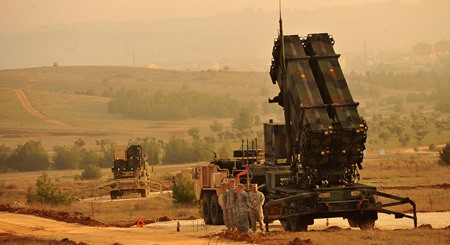
???????????????????U.S. Service members stand by a Patriot missile battery in Gaziantep, Turkey, Feb. 4, 2013, during a visit from U.S. Deputy Secretary of Defense Ashton B. Carter, not shown. U.S. and NATO Patriot missile batteries and personnel deployed to Turkey in support of NATO’s commitment to defending Turkey’s security during a period of regional instability. (DoD photo by Glenn Fawcett)

Unlike in Syria . . . in Iraq the US relates to the official government, mistakenly, as an ally.  This is leading to a potentially disastrous situation  whereby US air power is currently partnering with Iran-supported Shia militias against the Islamic State.

The most powerful of these militias have a presence in the government of Iraq. But they do not act under the orders of the elected Baghdad government, but rather in coordination with their sponsors in the Qods Force of the Iranian Revolutionary Guards Corps.

The Kurds, because of the existence among them of a secular, pro-western nationalist politics with real popular appeal, have unsurprisingly emerged as the only reliable partner.    On both the Shia and the Sunni sides, the strongest and prevailing forces are anti-western.

This reality is denied both by advocates for rapprochement with Iran, and by wishful-thinking supporters of the Syrian rebellion.  But it remains so.

*****************

Recently,  I attempted to undertake a reporting trip into the Kurdish Kobani enclave in northern Syria.  It would not have been my first visit, neither to Syria nor to Kobani.  For the first time, however, I found myself unable to enter.  Instead, I spent a frustrating but, as it turns out, instructive four days waiting in the border town of Suruc in south-east Turkey before running out of time and going home.

The episode was instructive because of what it indicated regarding the extent to which Kurdish control in the enclaves established in mid 2012 is now a fact acknowledged by all neighboring players, including the enemies of the Kurds.  This in itself has larger lessons regarding US and western policy in Syria and Iraq.

But I am getting ahead of myself.  First, let me complete the account of the episode on the border.    My intention had been to enter Kobani ‘illegally’ with the help of the Kurdish YPG and local smugglers.  This sounds more exciting than it is.    I have entered Syria in a similar way half a dozen times over the last two years, to the extent that it has become a not very pleasant but mundane procedure. This time, however, something was different.  I was placed in a local center with a number of other westerners waiting to make the trip. Then, it seemed, we were forgotten.

The westerners themselves were  an interesting bunch, whose varied presence was an indication of the curious pattern by which the Syrian Kurdish cause has entered public awareness in the west.

There was a group of European radical leftists, mainly Italians, who had come after being inspired by stories of the ‘Rojava revolution.’  A little noted element of the control by the Syrian franchise of the PKK of de facto sovereign areas of Syria has been the interest that this has generated in the circles of the western radical left.  These circles are ever on the lookout for something which allows their politics to encounter reality, in a way that does not bring immediate and obvious disaster.  As of now, ‘Rojava,’ given the leftist credentials of the PKK, is playing this role.  So the Europeans in question  wanted to ‘contribute’ to what they called the ‘revolution.’

Unfortunately, their preferred mode of support was leading to a situation of complete mutual bewilderment between themselves and the local Kurds.   Offered military training by their hosts, the radical leftists demurred.  They would not hold a gun for Rojava before they had seen it and been persuaded that it did indeed represent the peoples’ revolution that they hoped for.

Instead, they had a plan for the rebuilding of Kobani along sustainable and environmentally friendly lines, using natural materials  In addition, the health crisis and shortage of medicines in the devastated enclave led the radicals to believe that this might offer an appropriate context for popularizing various items of alternative and naturopathic medicine about which they themselves were enthusiastic.  (I’m not making any of this up).

All this had elicited the predictable reaction from the Kurds, who were trying to manage a humanitarian disaster and a determined attempt by murderous jihadis to destroy  them.  ‘Perhaps you could do the military training first and then we could talk about the other stuff?’ suggested Fawzia, the nice and helpful representative of the PYD who was responsible for us.  This led to further impassioned and theatrical responses from the Italians.

Apart from this crowd, there was a seasoned Chilean war reporter who looked on the leftists with impatience.  He was looking to get down to the frontlines south of Kobani, where the YPG was trying to cut the road from Raqqa to Aleppo at an important point close to the Euphrates.

Also, there was a polite and friendly lone American, a Baptist Christian, who had come to volunteer his services to the YPG.  That was us.

But as the days passed, it became clear that none of us appeared to be getting anywhere near Kobani any time soon.

The reasons given for the delay were plentiful, and unconvincing.  ‘It is the weather,’ Fawzia would say vaguely, ‘too much mud.’  But the presence of mud on the border in February was hardly a new development, so this couldn’t be the reason.

Finally, frustrated at the lack of information, I called a PKK friend based in Europe and asked for his help in finding out why we weren’t  moving.  He got back to me a little later.  ‘It seems the Turkish army is all over the border, more than usual. That’s the reason,’ he told me.

This was more plausible, if disappointing.  After four days on the border, I was out of time and set off back for Gaziantep and then home.  The Italians went to Diyarbakir to take part in a demonstration.  The Chilean and the American volunteer stayed and waited.

When I got back to Jerusalem, all rapidly became clear.  News reports were coming in about a large operation conducted by the Turkish army through Kobani and into Syria.  The operation involved the evacuation of the Turkish garrison at the tomb of Suleiman Shah, south of the enclave.  The American volunteer sent me a picture of the Turkish tanks on tank transporters driving though Suruc at the conclusion of the operation.

This operation was astonishing on a number of levels.

Despite stern Turkish denials, it could only have been carried out on the basis of full cooperation between the Turkish armed forces and the Kurdish fighters of the YPG in Kobani.  Obviously, any unauthorized entry of Turkish troops into the Kurdish canton would have meant an armed battle.

During the fight for Kobani last year, the Turkish government was very clearly quite content for the enclave to fall.  The Turkish army waited on the border, as the prospect of a generalized slaughter of the Kurds in Kobani came close to realization.

But of course, the slaughter didn’t happen.  In the end, the partnering of US air power with the competent and determined forces of the YPG on the ground delivered the first real defeat to the forces of the Islamic State in Syria.

This effective partnering has continued, and has now become the main military element in northern Syria in the battle against IS.

The combination of the YPG and the USAF is now nudging up to a second strategic achievement against the jihadis – namely, the cutting of the road from Tel Hamis to the town of al-Houl on the Iraqi border.   This road forms one of the main transport arteries linking the Islamic State’s conquests in Iraq to its heartland in the Syrian province of Raqqa.  If the links are cut, the prospect opens for the splitting of the Islamic State into a series of dis-connected enclaves.

The YPG-US partnership is particularly noteworthy, given that the YPG is neither more nor less than the Syrian representative of the PKK.  The latter, meanwhile, is a veteran presence on the US and EU lists of terror organizations.  Despite a faltering peace process, the PKK remains in conflict with Turkey, a member of NATO.

But the reality of the Kurdish-US alliance in northern Syria has clearly now been accepted by the Turks as an unarguable fait accompli, to the extent that they are now evidently willing to work together with the armed Syrian Kurds, where their interests require it.

It is an astonishing turnabout in the fortunes of the Kurds of Syria, who before 2011 constituted one of the region’s most brutally oppressed, and most forgotten minority populations.

This raises the question as to why this reversal of fortune has taken place.

Why is the YPG the chosen partner of the Americans in northern Syria, just as the Kurdish Pesh Merga further east is one of the preferred partners on the ground in Iraq?

The answer to this is clear, but not encouraging.  It is because in both countries, the only reliable, pro-western and militarily effective element on the ground is that of the Kurds.

Consider:  in northern Syria, other than the forces of the Islamic State, there are three other elements of real military and political import.  These are the forces of the Assad regime, the al-Qaeda affiliated Jabhat al-Nusra and the YPG.

In addition, there are a bewildering variety of disparate rebel battalions, with loyalties ranging from Salafi Islamism to Muslim Brotherhood style Islamism, to non-political opposition to the Assad regime.  Some of these groups operate independently.  Others are gathered in local alliances such as the Aleppo based Jabhat al-Shamiya (Levant Front), or the Syria-wide Islamic Front, which unites Salafi factions.

Despite the reported existence of a US staffed military operations room in Turkey, the latter two movements are either too weak, or too politically suspect (because of their Islamist nature), to form a potential partner for the US in northern Syria.

Nusra is for obvious reasons not a potential partner for the US in the fight against the Islamic State.  And the US continues to hold to its stated  goal that Bashar Assad should step down.  So the prospect of an overt alliance between the regime and the US against the Islamic State is not on the cards (despite the de facto American alliance with Assad’s  Iran-supported Shia Islamist allies in Iraq).

This leaves the Kurds, and only the Kurds, to work with.  And the un-stated alliance is sufficiently tight for it to begin to have effects also on Turkish-Kurdish relations in Syria, as seen in the Suleiman Shah operation.

But what are the broader implications of this absence of any other coherent partner on the ground?

The stark clarity of the northern Syria situation is replicated in all essentials in Iraq, though a more determined attempt by the US to deny this reality is under way in that country.

In Iraq, there is a clear and stated enemy of the US (the Islamic State), a clear and stated Kurdish ally of the west (the Kurdish Regional Government and its Pesh Merga) and an Iran-supported government which controls the capital and part of the territory of the country.

Unlike in Syria, however, in Iraq the US relates to the official government, mistakenly, as an ally.  This is leading to a potentially disastrous situation  whereby US air power is currently partnering with Iran-supported Shia militias against the Islamic State.

The most powerful of these militias have a presence in the government of Iraq. But they do not act under the orders of the elected Baghdad government, but rather in coordination with their sponsors in the Qods Force of the Iranian Revolutionary Guards Corps.

It is possible that the current partnering with Shia Islamist forces in Iraq is the result of a general US attempt now under way to achieve a historic rapprochement with Iran, as suggested by Michael Doran in a recent essay.  Or it may be that this reality has emerged as a result of poor analysis of the realities of the Levant and Iraq, resulting in a confused and flailing policy.  But either way, the result is an astonishing mess.

In northern Syria, the obvious absence of any partners other than the Kurds has produced a momentary tactical clarity.  But as the larger example of Iraq shows, this clarity is buried in a much larger strategic confusion.

This confusion, at root, derives from a failure to grasp what is taking place in Syria and in Iraq.

In both countries, the removal or weakening of powerful dictatorships has resulted in the emergence of conflict based on older, sub-state ethnic and sectarian identities.  The strength and persistence of these identities is testimony to the profound failure of the states of Syria and Iraq to develop anything resembling a sustainable national identity.  In both Syria and Iraq, the resultant conflict is essentially three-sided.  Sunni Arabs, Shia/Alawi Arabs and Kurds are fighting over the ruins of the state.

Because of the lamentable nature of Arab politics at the present time, the form that both Arab sides are taking is that of political Islam.   On the Shia side, the powerful Iranian structures dedicated to the creation and sponsorship of proxy movements are closely engaged with the clients in both countries (and in neighboring Lebanon.)

On the Sunni Arab side, a bewildering tangle of support from different regional and western states to various militias has emerged.  But two main formations may be discerned. These are the Islamic State, which has no overt state sponsor, and Jabhat al-Nusra, which has close links to Qatar.

In southern Syria, a western attempt to maintain armed forces linked to conservative and western-aligned Arab states (Jordan, Saudi Arabia) has proved somewhat more successful because of the close physical proximity of Jordan and the differing tribal and clan structures in this area when compared with the north.  Even here, however, Nusra is a powerful presence, and Islamic State itself recently appeared in the south Damascus area.

The Kurds, because of the existence among them of a secular, pro-western nationalist politics with real popular appeal, have unsurprisingly emerged as the only reliable partner.    On both the Shia and the Sunni sides, the strongest and prevailing forces are anti-western.

This reality is denied  both by advocates for rapprochement with Iran, and by wishful-thinking supporters of the Syrian rebellion.  But it remains so.  What are its implications for western policy?

Firstly, if the goal is to degrade the Islamic State, reduce it, split it, impoverish it, this can probably be achieved through the alliance of US air power and Kurdish ground forces.  But if the desire, genuinely, is to destroy the Islamic State, this can only be achieved through the employment of western boots on the ground.  This is the choice which is presented by reality.

Secondly, the desire to avoid this choice is leading to the disastrous partnering with Iraqi Shia forces loyal to Iran.  The winner from all this will be, unsurprisingly,  Iran. Neither Teheran nor its Shia militias are the moral superiors to Islamic State. The partnering with them is absurd both from a political and an ethical point of view.

Thirdly, the determination to maintain the territorial integrity of ‘Syria’ and ‘Iraq’ is one of the midwives of the current confusion.  Were it to be acknowledged that Humpty cannot be put back together again, it would then be possible to accurately ascertain which local players the west can partner with, and which it can not.

As of now, the determination to consider these areas as coherent states is leading to absurdities including the failure by the US to directly arm the pro-US Pesh Merga because the pro-Iranians in Baghdad object to this, the failure to revive relations with and directly supply Iraqi Sunni tribal elements in IS controlled areas for the same reason,  and the insistence on relating to all forces ostensibly acting on behalf of Baghdad as legitimate.

Ultimately, the mess in the former Syria and Iraq derives from a very western form of wishful thinking that is common to various sides of the debate in the west.  This is the refusal to accept that political Islam, of both Shia and Sunni varieties, has an unparalleled power of political mobilization among Arab populations in the Middle East at the present time, and that political Islam is a genuinely anti-western force, with genuinely murderous intentions.

For as long as that stark reality is denied, western policy will resemble our Italian leftist friends on the border, baffled and bewildered as they go about proposing ideas and notions utterly alien to and irrelevant to the local situation.

The reality of this situation means that the available partners for the west are minority nationalist projects  such as that of the Kurds (or the Jews,) and traditional, non-ideological conservative elites – such as the Egyptian military, the Hashemite monarchs, and in a more partial and problematic way, the Gulf monarchs.  Attempts to move beyond this limited but considerable array of potential allies will result in the strengthening of destructive, anti-western Islamist forces in the region, of either Sunni or Shia coloration.

As for the Syrian Kurds, they deserve their partnership with US air power, and the greater security it is bringing them.

The American Baptist volunteer, to conclude the story, made it across the border and is now training with the YPG.  He, at least, has a clear sense of who is who in the Middle East.  Hopefully, this sense will eventually percolate up to the policymaking community too.

Iran gathers power in Iraq as US further sidelined

March 18, 2015

Iran gathers power in Iraq as US further sidelined, Al-MonitorMohammed A. Salih, March 17, 2015

(The Iraqi – Iranian effort to retake Tikrit has been “stalled” for several days. — DM)

SULAIMANIYAH, Iraq — While the United States has invested trillions of dollars and thousands of lives since 2003 to bring Iraq into its orbit, today it is Iran that appears to have achieved that goal, albeit with far less costs in terms of money and lives, observers and analysts of Iraqi affairs agree.

There appears to be no better demonstration of Iran’s success in having firmly established its hegemony across Iraq than in the current operation to retake the Sunni-dominated province of Salahuddin in central Iraq. The operation to push out Islamic State (IS) militants from Tikrit and its surrounding areas in Salahuddin is being carried out by a ragtag force of Shiite Popular Mobilization Units (PMUs), the Iraqi army and some local Sunni tribes.

The largest military campaign so far against IS, the Salahuddin operation has been noted for the heavy involvement of Iranian military advisers and the conspicuous absence of the US military. While the United States has in the past aided similar operations by the Iraqi military and PMUs in areas such as Amerli and Baiji, no US warplanes are now dropping bombs in Salahuddin.

“The Iranians have checkmated the Americans, and I think the Americans now understand this,” Hayder al-Khoei, an Iraq expert at the London-based Chatham House, told Al-Monitor. “What’s interesting about the Salahuddin operation is that the Iraqis and the Iranians are proving to Americans: We don’t need your airstrikes.”

When IS swept large parts of northern and central Iraq in June, the jihadist group appeared unstoppable. During a forum last week in Sulaimaniyah, a city in Iraqi Kurdistan, Brett McGurk, US deputy assistant secretary of state for Iraq and Iran, admitted that a few days after IS’ onslaught in mid-June, his government’s assessment was that Baghdad might fall within 72 hours.

“Iran proved, despite its difficult economic conditions, that it is prepared … and stood by us in any way it could to defend our country and our Islam and common beliefs, and by that I don’t mean the Shiite sect but the genuine human values that govern in this region,” said Hussein al-Shahristani, Iraq’s minister of higher education and a powerful Shiite politician, during the forum. “Iraqis will not forget this favor.”

Iraqi leaders say Iran has provided around $10 billion worth of weaponry to their forces. Iranian military advisers have also not been shy to advertise their role in the battle to retake the key city of Tikrit, the hometown of their former No. 1 enemy, former leader Saddam Hussein.

Gen. Qasem Soleimani, head of the Iran’s Islamic Revolutionary Guard Corps’s (IRGC) elite Quds Force, has made no secret of his pivotal role on the front lines of Salahuddin. He is said to have been deeply involved in planning and executing the current battle.

Many of the major Shiite armed groups such as the Badr Brigades, Asaib Ahl al-Haq and Kataib Hezbollah are known to have been founded, trained and funded by the IRGC. It’s these forces that play the critical role in pushing back IS jihadists, according to media reports.

US military officials have expressed their concerns over Iran’s strong role in Salahuddin, fearing this could further alienate Sunni Arabs and Washington’s efforts to get them onboard to fight against IS. Amid all this, many observers are asking whether the United States was even invited to join the Salahuddin campaign.

“The Iranians and their Iraqi proxies wanted to demonstrate their power and that they can fight in any battlefield, whether it is in the … mixed sectarian areas or in Sunni-only areas such as the Tigris River Valley [in Salahuddin],” Michael Knights, a fellow at the Washington Institute for Near East Policy specialized in the military affairs of Iraq and Iran, told Al-Monitor.

The US absence in the Salahuddin theater comes despite Washington’s attempts to coordinate the “liberation” of Sunni areas from IS. A date was even announced by Pentagon officials for an operation to retake Mosul from IS. But by conducting the Salahuddin operation, Shiite paramilitary groups and their Iranian backers sent a message of their own.

“[Iran and Shiite forces] are the most significant partners to the Iraqi state. They planned this operation to ensure they would get [to Tikrit] first, before the Americans,” Knights added. “It’s a big propaganda victory for the PMUs.”

Knights said that the operation was initially planned without Iraqi Prime Minister Haider al-Abadi’s involvement. Official Iraqi army units were added only later, when Abadi got wind of the planning for the operation. Around 20,000 Shiite forces and 3,000 Iraqi soldiers are taking part in the Salahuddin assault, according to top US Gen. Martin Dempsey.

If the operation succeeds, most of the credit will go to PMU leaders such as Hadi al-Ameri and Abu Mahdi al-Muhandis and Quds Force Cmdr. Soleimani, Knights said.

The emergence of IS appears to have further consolidated Iranian clout in Iraq, as Iran’s generals and sponsored militias have taken the lead in fighting off IS in areas the jihadist group seized from the Iraqi army last summer.

Even though many believe much of the US arms assistance for Iraq ends up in the hands of the pro-Iranian Shiite paramilitary groups, these forces make little secret of their disdain for the United States, often peddling conspiracies that the United States and other countries deliver military aid to IS.

While Iran has jockeyed for influence in Iraq since 2003, the withdrawal of US troops from Iraq in late 2011 paved the way for a stronger Iranian role in Iraq. The Syrian crisis next door brought Tehran and Baghdad even closer together as both sides shared an interest in saving President Bashar al-Assad’s regime and preventing the rise of a Sunni-dominated order there.

Now, as Iraq continues to slide even further into Iran’s hemisphere of influence, many in Washington are questioning US arms deliveries to Baghdad. Concerns about military aid to Iraq have been amplified due to gross human rights violations committed by Shiite PMUs and Iraqi troops.

Kenneth Pollack, an expert on Middle East politics and military affairs with the Washington-based Brookings Institution, believes the United States should continue a strong relationship with Baghdad.

“I think the Americans drawing back will be the worst thing to do. That will drive the government in Baghdad even more deeply into the arms of the Iranians,” Pollack told Al-Monitor. “If Iraq is going to move to a place where Iran has less influence, it’s going to take a long time.”


Hero of the Middle East: The Israeli Messenger

March 18, 2015

Hero of the Middle East: The Israeli Messenger, The Gatestone InstituteBassam Tawil, March 18, 2015

In its evident, inexplicable eagerness to sign just about any deal with Iran to allow it nuclear weapons capability, the U.S. State Department has removed Iran and its proxy, Hezbollah — two of the world most undisguised promoters of terror — from its Foreign Terrorist Organizations List.

Iran’s President, Hassan Rouhani, has even openly admitted that Iran’s diplomacy with the U.S. is an active “jihad.” How much plainer does a message have to get?

The Islamists have nothing but contempt for Europe’s weakness.

The West needs to paralyze Iran, rather than appease it.

A series of significant defeats to Islamist organizations will counter the effects of their efforts to entice young people to join them, especially ISIS.

In these terrible times, critical for the future of our region, Netanyahu spoke to the representatives of the American people, despite the objections of many Israelis and Americans. He was willing to accept personal, political and diplomatic setbacks in order to look after his people’s security.

We are all also hoping that that the government of Israel will focus even more on bringing the Arabs of Israel into the Israeli fold. Otherwise a “fifth column” could form and harden that will drive them into the open and waiting arms of Hamas and other terrorist groups.

Arab-Israeli politicians might also focus more on helping such an effort, rather than, as many Arab politicians do, lash out and blame others for what is wrong — a lazy, destructive substitute for actually helping improve the lives of their people.

Ever since Israel’s Prime Minister, Benjamin Netanyahu, came back from his recent visit to the United States, it has repeatedly been shown that he was right to stand before Congress and issue his warnings. Tehran’s Ayatollahs have not only held a naval exercise in the Strait of Hormuz, where they targeted a simulated a U.S. Navy aircraft carrier, they also displayed new missiles that could paralyze all the shipping in the Gulf.

Iran has already surrounded the oilfields of the Middle East, and is openly increasing its efforts to bring down the “Big Satan,” the United States. Iran’s President, Hassan Rouhani, has even openly admitted that Iran’s diplomacy with the U.S. is an active “jihad.” How much plainer does a message have to get?

Iran has not only taken over Yemen, Lebanon and Syria It is also in the process of taking over — presumably with the help of its negotiations with the U.S. — Bahrain, Iraq, Libya and parts of South America, especially Venezuela, with its vast reserves of uranium, and Bolivia, now with a suspected nuclear installation.

In its evident, inexplicable eagerness to sign just about any deal with Iran to allow it to achieve nuclear capability, the U.S. State Department has removed Iran and its proxy, Hezbollah — two of the world’s most undisguised promoters of terror — from its Foreign Terrorist Organizations List, presumably at Iran’s request.

After Republican Senators sent a letter to Iran warning that any agreement with the U.S. would have to be endorsed by Congress, the Iranians used it to claim that the United States is so weak it is about to fall apart. The king of Saudi Arabia said that if the U.S. did not halt Iran’s nuclear program, Saudi Arabia would begin enriching its own uranium, to acquire a nuclear potential equal to that of Iran.

Ashraf Ramelah, president of the Christian human rights organization Voice of the Copts, asked House Speaker John Boehner to invite Egyptian President Abdel Fattah el-Sisi to address Congress, to warn America of the mistake it clearly intends to make. The members of the Arab League met in Riyadh to warn America of the approaching disaster.

U.S. Secretary of State John Kerry recently hinted that the agreement with Iran was not particularly urgent, and claimed that should the talks fail, the United States had alternatives.

Apparently with the sole objective of embarrassing Netanyahu, no one in the U.S. administration was willing to admit that he was right, or that unfortunately there were many American individuals and organizations actively intervening in the Israeli elections, with the goal of toppling Netanyahu. The U.S. Administration clearly wanted to replace him with Yitzhak Herzog, who is weak — another link in the chain of American foreign policy failures, from Allende and the Shah of Iran to Mubarak, all victims of the political and diplomatic elite’s ignorance and lack of political common sense.

The lesson President Obama has not yet learned from his experience with Arabs is that anyone who deliberately ignores or applauds when his own fanatic Muslim nationals (or guests) kill “infidels” will eventually be repaid with the killing of his own non-extremist Muslims. That is exactly what is going to happen in Iran, Turkey, Qatar, Lebanon and other countries that support terrorism.

The Western world should be wary, and not be tempted into breathing a sigh of relief because the Muslim Brotherhood condemned the burning of the Jordanian pilot. The Muslim Brotherhood, which consistently preaches the murder of innocents of every stripe, is currently trying to cover its tracks regarding murder carried out in the name of Islam through the taqiyya, which permits Muslims to lie to “protect” Islam — in this case against the global wave of outrage against Islamist terrorism. Perhaps they condemn the burning alive of the pilot because, according to Islam, only Allah can burn someone to death. But behind their pious declarations they are overjoyed by his death, and continue inciting their followers to murder more of those they have designated as “infidels,” while every day designating still more.

That Hamas and ISIS identify with one another, collaborate and have almost identical goals was made clear recently by the arrests Hamas operatives in the Palestinian Authority on the grounds that they vandalized the memorial set up in Ramallah for the murdered Jordanian pilot.

In their misguided, fumbling experiments, EU officials, along with the Arab League foreign ministers, are forming a united front to fight Islamist terrorism, while including the very countries known consistently to support it. These include Turkey, which mainly supports ISIS, and Qatar, which supports the Islamist terrorist organizations in the Sinai Peninsula and the Gaza Strip.

Despite the fact that the Muslim Brotherhood and the other Islamist terrorist organizations thrive in Arab states — although in some they have been outlawed — the West, especially the Obama Administration, doggedly refuses to outlaw them and insists they are peace-loving religious organizations. For some intriguing reason, the leaders of the Western world find it impossible to see the relationship between the Muslim Brotherhood and the Islamist terrorist organizations it fosters.

Obama’s behavior underlies the conspiracy theory, common in the Middle East, that he is a Muslim Brotherhood mole.

The U.S. Administration refuses to recognize the dangerous game Turkey is playing by ignoring the West’s sanctions on Iran. Despite the fact that Turkey is a member of NATO, it has, in fact, upgraded and improved its trade agreements with Iran.

The European Union, in its cowardice and folly, has removed Hamas, the Muslim Brotherhood’s Palestinian branch, from its list of designated terrorist organizations. Europe refuses to change its stance, even though barely a week ago, Egypt designated the entire Hamas movement a terrorist organization. Hamas supports ISIS in the Sinai Peninsula and within Egypt itself, as they attack government, security and civilian targets.

The Islamists have nothing but contempt for Europe’s weakness, and in the meantime, ISIS’s wave of success in Iraq and Syria, and its brand as “powerful,” encourage young, impressionable Muslims to join its ranks.

In the meantime, in the wake of rising Islamist sentiment in the Muslim communities of Europe and the U.S., imams and Islamist activists have been falling over themselves to reassure the public. They have opened mosques to casual visitors, in an effort to allay their fears and downplay the threat, as if a Westerner on a guided tour could possibly understand the degree of propaganda and incitement churned out behind closed doors, in classrooms and libraries.

* * *

The wages America pays Iran, in return for questionable aid it may or may not receive in the fight against ISIS, only serve to strengthen the Ayatollahs and their collaborators — Russia, Syria and Hezbollah — and ease the sanctions against Iran to make it stronger, enabling further expansion. And that is before Iran achieves nuclear weapons capability. What about after?

The saga will likely end with an agreement ending the sanctions on Iran, permitting it to build its nuclear bomb “for peaceful purposes,” while in the meantime Iran will have taken over Yemen, completed its new line of “defensive” missiles, of the sort that will be able to reach Europe and be loaded onto submarines.

The soon-to-be-signed agreement between Iran and the United States not only abandons the Sunni Arab states and Israel to their fates; it also paves the way for an inevitable nuclear arms race involving Sunni states, carried out in the vain hope that they will be able to contain the Shi’ites before they launch a nuclear Armageddon on the Middle East.

There is also the rumored approaching death of Iran’s Supreme Leader Ali Khamenei. Thus, any agreement signed with the Iranians won’t be worth the paper it is printed on, because no one knows who will replace him and if his replacement will agree to honor any commitments signed by the previous regime.

Instead of strengthening moderate Sunni states such as Egypt and the Gulf States, both of which are exploring an innovative, moderate, contemporary Islam, America has chosen to support the Muslim Brotherhood, which has fooled it into thinking it is not doing its utmost to weaken those moderate states.

The U.S. is driving a wedge into the unity of the Sunni Arab world and weakening its efforts to counter Iran.

To misrepresent the agreement with Iran, the Obama Administration enlisted European countries to create a smokescreen and media white noise, labeling Israel’s failure to reach a peace agreement with the Palestinians as the only important issue problem the Middle East.

They are using Europe to turn Israel into a leper, as if it is Israel’s bound duty to accept American dictates because of its dependence on the American veto in the UN. Obama’s National Security Advisor, Susan Rice, instead of focusing on the catastrophically serious Iranian threat, recently made the hostile statement that Israel must now resolve the Palestinian issue.

The efforts Israeli Prime Minister Benyamin Netanyahu has made to convince Congress not to support the agreement with Iran were brutally attacked by the White House, which is apparently only open to hearing opinions that agree with it.

968Israel’s Prime Minister Benjamin Netanyahu speaks before the U.S. Congress, March 4, 2015. (Image source: C-SPAN video screenshot)

Despite reservations regarding Netanyahu’s hard line in Israel’s negotiations with Palestinians, many of us in the Middle East are of the opinion that he is another real hero of the Middle East.

Many people here are also hoping that as the Arab Israeli vote was the third largest bloc in the yesterday’s election, perhaps now the government of Israel will focus more on bringing the Arabs of Israel even closer and more comfortably into the Israeli fold. Otherwise, there is the serious possibility that a “fifth column” could form and harden, one that will drive the Arab Israelis into the open and waiting arms of Hamas and other terrorist groups.

We also hope that the Arab Israeli politicians will focus more on such an effort, rather than, as many Arab politicians do, lashing out and blaming others for what is wrong — a lazy, destructive substitute for actually helping improve the lives of their people.

In these terrible times, critical for the future of our region, Netanyahu spoke to the representatives of the American people, despite the objections of many Israelis and Americans. He was willing to accept personal, political and diplomatic setbacks in order look after his people’s security.

Throughout history, prophets have often been without honor in their own countries, and have been rejected by the very people who should pay attention to them. There is, it seems, in every culture, a deep and real wish to kill the messenger.

The West would do well to understand that anyone really interested in fighting terrorism needs to outlaw the Muslim Brotherhood movement — all its branches, wherever they are. Even more, it needs to paralyze Iran, rather than appease it.

The West’s dark, contradictory dealings with Turkey, Qatar, Iran and other shadowy regimes serve the growth of Islamist terrorist organizations. They destroy the chance for any success against radical Islam.

The fight against Islamist organizations needs to be creative, deliberate and continuous, to keep them from gaining even one victory either on the ground or in their propaganda campaigns. The Muslim public must not view them as attractive, or see joining them a sign of success. A series of significant defeats to Islamist organizations will counter the effects of their efforts to entice young people to join them, especially ISIS.

It is sad that in the face of the coming catastrophe, Western leaders — either blind, naïve or malevolent — are going to make a deal and appease Iran, just as a deal was made to appease Hitler in 1938.

Grand Gas Project Signifies Futility of Anti-Iran Sanctions: President

March 17, 2015

Grand Gas Project Signifies Futility of Anti-Iran Sanctions: President, Tasnim News Agency (Iranian), March 17, 2015

(Iran claims to have done quite well with sanctions, or what sanctions remained after November of 2013, despite all the money it has been spending in Iraq and Syria, not to mention terrorism elsewhere. Why, then, the demand that all sanctions be removed instanter? Will Kerry ask? Not likely.– DM)

139312261516169584940403

TEHRAN (Tasnim) – Iranian President Hassan Rouhani described the inauguration of the 12th development phase of the massive offshore South Pars gas field as a testimony to the ineffectiveness of the Western sanctions against Iran.

“The inauguration of the 12th phase illustrates that sanctions, pressures, and illegal and inhumane measures cannot push the (Iranian) nation back,” President Rouhani said in a Tuesday ceremony in the southern province of Bushehr for the official coming into service of the giant gas field’s 12th phase.The president explained that Iran’s gas production now exceeds 100 million cubic meters, stressing that such a great job has been accomplished while the country has been slapped with the cruel sanctions.Iran has also experienced economic growth and inflation reduction with the sanctions being in place, Rouhani added.

According to Oil Minister Bijan Namdar Zanganeh, the 12th phase, which has been totally designed and developed by the local experts, has cost more than $7.5 billion.

The 12th phase can produce 80 million cubic meters of gas and 120,000 barrels of gas condensates on a daily basis, bringing the country $17.5 million in revenue every day.

Zanganeh has also hailed the new phase as a helpful source of revenue while Iran is hit by “cruel economic sanctions” and the global oil price decline has diminished the country’s financial resources.

The 12th phase extends over an area of approximately 205 square kilometers along Iran-Qatar joint border. Located at a distance of 105 kilometers from the coast, the 12th phase alone contains about 5 percent of the whole gas reserves in the South Pars filed.

South Pars is part of a wider gas field that is shared with Qatar. The larger field covers an area of 9,700 square kilometers, 3,700 square kilometers of which are in Iran’s territorial waters (South Pars) in the Persian Gulf.

UPDATE: US intel report scrapped Iran from list of terror threats

March 16, 2015

US intel report scrapped Iran from list of terror threats, Times of Israel, March 16, 2015

(This is to clarify and expand upon an earlier article on the same subject, also posted today. — DM)

An annual report delivered recently to the US Senate by James Clapper, the director of National Intelligence, removed Iran and Hezbollah from its list of terrorism threats, after years in which they featured in similar reports.

The unclassified version of the Worldwide Threat Assessment of the US Intelligence Communities, dated February 26, 2015 (PDF), noted Iran’s efforts to combat Sunni extremists, including those of the ultra-radical Islamic State group, who were perceived to constitute the preeminent terrorist threat to American interests worldwide.

In describing Iran’s regional role, the report noted the Islamic Republic’s “intentions to dampen sectarianism, build responsive partners, and deescalate tensions with Saudi Arabia,” but cautioned that “Iranian leaders—particularly within the security services—are pursuing policies with negative secondary consequences for regional stability and potentially for Iran.

“Iran’s actions to protect and empower Shia communities are fueling growing fears and sectarian responses,” it said.

The United States and other Western nations, along with a coalition of regional allies, both Sunni and Shiite, has been launching attacks against Islamic State targets in Iraq and Syria in recent months. The Sunni group, also known by its acronyms IS, ISIS and ISIL, is an offshoot of al-Qaeda that has carved out a self-proclaimed caliphate across large swaths of Syria and Iraq, both of whose governments are allied with Iran’s.

The Shiite Lebanese group Hezbollah, which is funded and mentored by Tehran, has been fighting the Islamic State, independently of the American-led campaign, both in Syria and Iraq.

Meanwhile, the US has been engaged in marathon talks with Iran in an effort to reach an agreement on its nuclear program. Tehran, according to the National Intelligence threat assessment, has “overarching strategic goals of enhancing its security, prestige, and regional influence [that] have led it to pursue capabilities to meet its civilian goals and give it the ability to build missile-deliverable nuclear weapons, if it chooses to do so.”

The report said that it was unclear whether or not Iran would eventually decide to build nuclear weapons, but noted that should the Iranian government decide to pursue such a course, it would face no “insurmountable technical barriers to producing a nuclear weapon.” It lingered on Iran’s pursuit of intercontinental ballistic missile technology as a likely delivery system for a nuclear weapon, and delineated Iranian threats in the realms of counterintelligence and cyber warfare.

According to one Israeli think tank, the removal of Iran and its proxy Hezbollah from the list of terror threats, where they featured in previous years, was directly linked to the campaign against the Islamic State.

063_464519556-e1425017740218-305x172Director of National Intelligence James Clapper in Washington, DC, February 26, 2015 (photo credit: Evy Mages/Getty Images/AFP)
 

“We believe that this results from a combination of diplomatic interests (the United States’ talks with Iran about a nuclear deal) with the idea that Iran could assist in the battle against the Islamic State in Syria and Iraq and maybe even in the battle against jihadist terrorism in other countries,” the Meir Amit Intelligence and Terrorism Information Center said in an analysis of the report (Hebrew PDF). It also noted the Iran and Hezbollah were both listed as terrorism threats in the assessment of another American body, the Defense Intelligence Agency.

“Islamic Revolutionary Guard Corps-Qods Force (IRGC-QF) and Lebanese Hezbollah are instruments of Iran’s foreign policy and its ability to project power in Iraq, Syria, and beyond,” that assessment, also submitted to the Senate of February 26, said in its section on terrorism. “Hezbollah continues to support the Syrian regime, pro-regime militants and Iraqi Shia militants in Syria. Hezbollah trainers and advisors in Iraq assist Iranian and Iraqi Shia militias fighting Sunni extremists there. Select Iraqi Shia militant groups also warned of their willingness to fight US forces returning to Iraq.”

Israel, as well as Sunni allies of the US, has often warned that Iran, through Hezbollah and other proxies, has been sowing instability in the region. An escalating dispute between Jerusalem and Washington over the terms of an eventual agreement on Iran’s nuclear program has seen Israeli official rail against the relatively conciliatory tone adopted by US officials toward Iran, in light of the shared interest in combating the Islamic State.

In a polarizing speech before a joint session of Congress on March 3, Prime Minister Benjamin Netanyahu sought to persuade American lawmakers of the folly of signing an agreement with Iran, and, comparing its leaders to those of the Nazi regime of World War II, cautioned that it “poses a grave threat, not only to Israel, but also [to] the peace of the entire world.”

Iran has made bellicose statements toward Israel, threatening to destroy the Jewish state, often citing Israeli talk of attacking its nuclear facilities, which it maintains are for peaceful purposes.

Hezbollah, which is based to Israel’s north in Lebanon and the Syrian Golan Heights, has largely refrained from attacking Israeli targets since the bloody Second Lebanon War of 2006, although there have been skirmishes along the border.

In one recent confrontation, Israel struck first, purportedly destroying a Hezbollah unit near the front line of the Golan Heights. Among the seven dead on January 18 were an Iranian general, a top Hezbollah commander and the son of another former commander in chief. Some two weeks later, Hezbollah took revenge, killing two Israeli soldiers and wounding seven in a cross-border attack.


US intel. scraps Iran, Hezbollah from terrorist threats list

March 16, 2015

US intel. scraps Iran, Hezbollah from terrorist threats list, Iran Daily, March 16, 2015

(True or false? I have seen nothing to confirm the report in the “legitimate media,” but that’s not surprising. Here, thanks LS, is a link to the cited report. Iran appears to remain on the list (at page 14). Hezbollah appears, but as a victim of Sunni “extremists” in Lebanon.– DM)

image_650_365

The US National Intelligence has removed Iran and the Lebanese resistance movement, Hezbollah, from its list of “terrorist threats.”

US Director of National Intelligence James Clapper scrapped Iran and Hezbollah from the list in an annual report recently delivered to the US Senate, citing their efforts in fighting terrorists, including the ISIL Takfiri group, Press TV reported.

The unclassified version of the report titled “Worldwide Threat Assessment of the US Intelligence Communities,” which was released on February 26, 2015, noted Iran’s efforts to battle extremists, including those of the ISIL terrorist group, who were perceived to constitute the greatest terrorist threat to American interests worldwide.

Highlighting Iran’s regional role, the report pointed to the Islamic Republic’s “intentions to dampen sectarianism, build responsive partners, and deescalate tensions with Saudi Arabia.”

Iran has “overarching strategic goals of enhancing its security, prestige, and regional influence [that] have led it to pursue capabilities to meet its civilian goals,” the report said.

The report also said that Hezbollah is countering ISIL Takfiri terrorists in Syria and Iraq.

The ISIL Takfiri terrorists have taken control of swathes of territory in Iraq and Syria since last year.

Iran has repeatedly stressed that it will not interfere militarily in Iraq and Syria, but the Islamic Republic continues to provide support to both countries against ISIL in the form of defense consultation and humanitarian aid.

American Embassy in Saudi Arabia Closed Amid Rising ISIS Threat

March 15, 2015

American Embassy in Saudi Arabia Closed Amid Rising ISIS Threat, ISIS Study Group, March 14, 2015

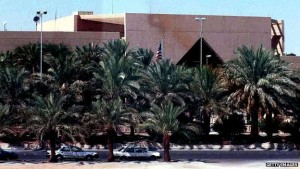
The US State Department (DoS) announced the cancellation of all consular services for Sunday and Monday due to “heightened security concerns” that our sources in-country say has to do with an increased threat from the Islamic State (IS) to abduct western oil workers in the eastern part of the country. Specifically, an IS cell operating in the eastern part of the country has become increasingly active since last SEP 14. Much of this is the spillover we discussed in our previous article titled, “Iranian Regime Consolidates Yemeni Gains, Forming Houthi Intel Proxy.” As the IRGC-Qods Force and its proxies increase their OP-Tempo inside Saudi Arabia, so has IS. We are aware of specific threats targeting two oil workers, a French citizen and a US citizen. There’s also a separate VBIED threat targeting either the consulate in Dharhan or the embassy itself (we’re still working to identify the target location).

US shuts down Saudi embassy amid security fears
http://www.bbc.com/news/world-middle-east-31893070

US Embassy Warns Oil Workers of Saudi Arabia Kidnap Threat
http://abcnews.go.com/International/wireStory/us-embassy-warns-oil-workers-saudi-arabia-kidnap-29636051

US Embassy in Saudi Arabia halts operations amid ‘heightened security concerns
http://www.foxnews.com/politics/2015/03/14/us-embassy-in-saudi-arabia-halts-operations-amid-heightened-security-concerns/?intcmp=latestnews&utm_source=feedburner&utm_medium=twitter&utm_campaign=Feed%3A+feedburner%2FidRmZ+%28FOXNews.com%29

Saudi Arabia Travel Warning
http://travel.state.gov/content/passports/english/alertswarnings/saudi-arabia-travel-warning.html

Iranian Regime Consolidates Yemeni Gains, Forming Houthi Intel Proxy
http://isisstudygroup.com/?p=5580

Shia Proxy Threat to US ISIS Strategy in Saudi Arabia
http://isisstudygroup.com/?p=1837

riyadh-300x169Source: BBC

In our piece titled “The Islamic State’s Arabian Peninsula Campaign,” we discussed how IS was forced into conducting operations inside the Saudi kingdom due to increased targeting by Saudi security forces and the IRGC-Qods Force. We saw that in the early-JAN 15 attack on a Saudi border post along the Iraqi border that IS took responsibility for in a video put out by their Anbar, Iraq-based media outlet. The individuals responsible for the attack were part of the Abdullah bin Sayid al-Sarhan attack network. This same network was also responsible for the deaths of five Shia locals under suspicions of being proxies for the IRGC-Qods Force back in NOV 14. The network was also responsible for a separate attack on two US citizens and a Danish national. This is the same part of Eastern Saudi Arabia that the French and American national IS is planning to abduct are located.

The Islamic State’s Arabian Peninsula Campaign
http://isisstudygroup.com/?p=4558

ISIS Claims Attack On Saudi Arabia Border, Signals Strategy Change In Militant Infiltration
http://www.ibtimes.com/isis-claims-attack-saudi-arabia-border-signals-strategy-change-militant-infiltration-1773754

Masked gunmen kill five in Saudi Arabia
http://www.theguardian.com/world/2014/nov/04/masked-gunmen-kill-five-saudi-arabia

saudiborderIS fighters along the Saudi-Iraq border Source: International Business Times

The Saudis have detained over 150 IS fighters, facilitators and financiers over the past year. IS has already established a presence along the Iraq-Saudi border despite the ongoing project to erect a wall along the border. That presence enables them to send fighters and weapons across the border to and from the country at will, although Saudi military patrols have increased in recent months to interdict these smuggling operations. There are also elements of AQAP that have defected to the new IS-affiliate in Yemen, which suggests that the areas along the Southern border may be in play as well. Also keep in mind that Baghdadi specifically threatened Saudi Arabia in a NOV 14 video on “the next battlegrounds.” The current IS effort in Yemen, like their Iranian counterparts, appears to be connected to their operations in Saudi Arabia. We expect the threat to our fellow Americans and our country’s interests will continue to be threatened as the violence escalates on the Arabian Peninsula from IS, AQAP and the Iranian regime. We will continue to monitor develops in the country and update accordingly…

Saudi Arabia arrests first ISIS-related terror cell (this article has pics in it)
http://www.aawsat.net/2014/05/article55332025

Islamic State sets sights on Saudi Arabia
http://www.bbc.com/news/world-europe-30061109

ISIS gaining ground in Yemen, competing with al Qaeda
http://www.cnn.com/2015/01/21/politics/isis-gaining-ground-in-yemen/

Links to Other Related Articles:

Filipinos Among Arrested in Saudi Terror Sweep

Large-Scale Saudi Security Sweep Detains 88

Possible Cracks to The AQ Armor.

ISIS-Sinai Is packing large water tankers with explosives

March 14, 2015

ISIS-Sinai Is packing large water tankers with explosives, DEBKAfile, March 14, 2015

(Please see also, IDF braces for Islamic State attack on Israel-Egypt border. — DM>

Egyptian military sources report that the ISIS Sinai affiliate has been discovered rounding up a large fleet of water and fuel tankers and big lorries and packing them with explosives for large-scale terrorist attacks on Egyptian and Israeli targets. The group which calls it’s the Sinai Province of the Islamist Caliphate tried the method out on March 4, using an explosives-packed water tanker to storm an Egyptian military compound in the Kawthar district of the northern Sinai town of Sheikh Zuweid. On March 10, they seized another water tanker at al-Towil east of El Arish, and on March 11, in the same area, they captured two large trucks of the Egyptian electricity company and pushed the drivers out.
Thursday, March 13, Col. Arik Hen of the IDF’s 80th Division said the military was on the alert for a major coordinated ISIS attack on Eilat from Sinai and the sea.