Archive for the ‘Islamic State’ category

Russian hands-off warning to US, Saudis, Turks amid crucial Aleppo battle

February 6, 2016

Russian hands-off warning to US, Saudis, Turks amid crucial Aleppo battle, DEBKAfile, February 6, 2016

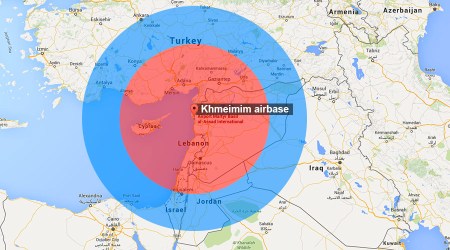
S-400_range_map_25.11.15 (1)

The five-year Syrian civil war, faces its most critical moment. Saturday, Feb. 6, a combined force of Syrian army and Hizballah troops and an Iraqi Shiite militia under Iranian officers, were led by Russian air and Spetsnaz (special forces) officers into pressing forward to encircle 35,000 rebels trapped in Aleppo, the country’s largest city. As they tightened the siege, 400,000 Syrian civilians were also trapped and forced to bear heavy Russian air bombardment and savage artillery fire from the ground forces closing in on the city.

Rebel supply routes were cut off Thursday and Friday when Syrian and Hizballah forces captured the Azaz Corridor connecting Aleppo and all of the northern province of Idlib to the Turkish border.

Tens of thousands of refugees fleeing from the beleaguered town are massing at Bab al-Salama, the last Turkish border crossing to be closed against them. This is the largest Syrian refugee exodus since the start of the civil war.

The rebels under siege are painfully short of weaponry for fighting off the massive, combined offensive, DEBKAfile’s military sources report. Their only remaining recourse is to surrender or be ground into submission as the conquering force knocks over their positions and takes over street after street.

Once the combined forces fighting with Bashar Assad’s army take Aleppo and northern Syria, the opposition will have suffered its heaviest defeat since the war began. The rebels groups’ capacity to continue fighting the regime will be gravely diminished.

Their desperate plight – and the fresh surge of Syrian refugees in unmanageable numbers – cut short the conference in Geneva for a settlement of the Syrian conflict, before it got underway – and prompted reactions from sponsors of rebel groups.

In Riyadh, Brig, Gen. Ahmed Asiri, adviser to Saudi Defense Minister Muhammed Bin Salman, announced Friday that Saudi Arabia is ready “to participate in any ground operations that the international coalition launches against ISIS.” This offer was taken as a veiled response to the SOS from the rebel stronghold in Aleppo.

In Washington, State Department circles, in a briefing to US media, said the time had come to establish a no-fly security zone in northern Syria. They said: “Once a zone were established we do not believe Russia would challenge the stronger US and NATO forces, particularly if they were operating mainly from Turkey.”

The next day, Friday, Moscow came back with a sharp response: Russian Deputy Defense Minister Anatoly Antonov said: “Russian air defense systems enable early detection of threats to Russian aircraft flying combat missions over Syria and provide adequate measures to ensure flight safety.”

This was a reminder of the sophisticated air defense S-400 and S-300 missile systems Russia installed at its Syrian air base after the Turkish air force downed a Russian warplane in November.

Syrian Foreign Minister Walid al-Moallem put it more crudely: “Any foreign troops entering Syria would return home in wooden coffins.”

He advised armed opposition groups fighting the government offensive in the area to lay down their weapons because, he said, “government advances signal that the five-year-old Syria war is nearing its end.”

Saturday, US Secretary of State John Kerry urged Russia to implement a ceasefire in Syria, saying its bombing campaign was killing women and children in large numbers and “has to stop.” He told reporters on his return from a trip to Europe: “Russia has indicated to me very directly they are prepared to do a ceasefire,” adding “The Iranians confirmed in London just a day and a half ago they will support a ceasefire now.”

DEBKAfile’s military sources have seen no sign of any ceasefire or even a slowdown in the Russian-led Syrian-Iranian Aleppo offensive.

Iran and Russia in first major falling-out over Syrian war and Assad

February 5, 2016

Iran and Russia in first major falling-out over Syrian war and Assad, DEBKAfile, February 5, 2016

P.V

While diplomats from 70 countries talked in London about how to raise $9 bn for projects to rehabilitate Syria’s refugees and rebuild their war-ravaged country, its future was further clouded this week by an argument that flared between the main arbiters, Russia and Iran.

Ali Akbar Velayati, Iranian supreme leader Ayatollah Ali Khamenei’s foreign affairs advisor, spent three days in Moscow Feb. 1-4 haranguing Russian leaders, including President Vladimir Putin, whom he saw twice, on the differences that had cropped up in their long political and military cooperation for propping up the Assad regime.

The Iranian official went home without resolving those differences, DEBKAfile’s sources report exclusively. Left pending were not just the next stage of the war but also the fate of President Bashar Assad.

Velayati told Iranian reporters on his plane: “We are against stopping the war,” and “The war must be continued until all (Syrian) terror cells are eradicated.”

He did not elaborate, but DEBKAfile’s Iranian and Moscow sources point out that he was underlining Tehran’s concerns about Moscow’s reported plans for the Assad regime, in which Iran is heavily invested, and the slowdown of Russia’s air campaign against every last rebel group.

Most of all, Iran’s leaders were troubled to find that Russia, by dint of its proactive military intervention, had maneuvered itself into position for calling the shots for Syria.

They are particularly distrustful, according to our sources, over Moscow’s complicated deals with Washington on the Syrian question and the dialogue Russia is holding with the Persian Gulf states, led by Saudi Arabia. The Iranians fear that Putin is calibrating his offensive against rebel groups according to the pace of these interchanges and may therefore scale back strikes on pro-American or “moderate” rebels, or even refrain from subduing them.

Tehran also looks askance at the improved relations Moscow is fostering with its rivals in the region, Riyadh and Abu Dhabi. Last week, Russian Foreign Minister Sergei Lavrov visited the two Arab capitals to allay their concerns for the Syrian rebel groups they support. He promised the Saudis not to harm them, so long as they did not get in the way of the joint Russian-Syrian steps in their country.

Given the Russian moves, the Syrian war looks increasingly to Tehran as unlikely to end in President Assad’s favor.

Lavrov seemed to confirm this Iranian concern on Feb. 2 when, during his visit to Oman he said, “Russian air strikes will not cease until we truly defeat the terrorist organizations ISIL and Jabhat al-Nusra, And I don’t see why these air strikes should stop.”

The Iranians immediately jumped on his omission of all other rebel groups but the two Islamists as the enemy, confirming their suspicions that Moscow was now acting in Syria on its own account. This was the cause of raised tempers in Velayati’s second meeting with the Russian president in Moscow.

The Iranian official demanded the expansion of Russian military operations to cover more inclusive rebel targets. Putin shot back that if Iran wants to ramp up war operations, it should send its own troops into the fray – and not just generals.

He touched on a sore point:  Iran’s Revolutionary Guards Corps don’t have troops available for fighting in Syria. And so, Velayati’s mission to Moscow ended on an acrimonious note.

The Russian Federation’ Strategic Equation in Syria

February 4, 2016

The Russian Federation’ Strategic Equation in Syria, Israel DefenseGiancarlo Elia Valori, February 4, 2016
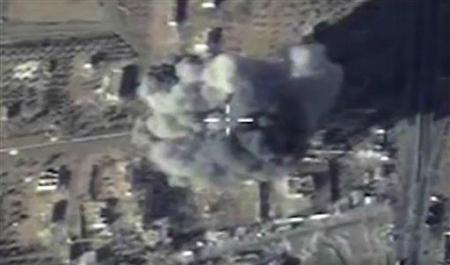
Bombs away

According to Western sources, ISIS has recently reduced its size by 40% overall and by 20% in Syria, while it had lost only 14% of its territory throughout 2015 when the Caliphate’s ISIS expanded – without recovering the same amount of territory – in Eastern Syria.

Another area where the Caliph Al Baghdadi has lost much of his territorial control is the area along the border with Turkey – while the Caliphate has arrived up to the areas along the border with Jordan, the traditional area of smuggling and transit of its militants. Areas towards the Lebanese border and in the Palmira region are reported to be under ISIS control.

Hence, so far, both the US Coalition’s and the Russian-Syrian pressures do not seem to be sufficient to definitively destabilize Al-Baghdadi’s Caliphate, despite its current territorial losses.

Therefore ISIS is likely to restructure itself in the form of a first-phase Al Qaeda, as indeed it already appears to do.

This means that ISIS could create – or has already done so – a small and centralized organizational structure, with informal peripheral networks in Europe, North Africa and Central Asia, with a view to organizing mass terrorist actions and blocking the Western resistance against the jihad, as well as finally disrupting the European security forces.

Nevertheless, why the Russian-Syrian actions and the other US-led action do not work fully?

Firstly, we must analyze the Caliphate’s weapons: it has acquired most of the stocks abandoned by the Iraqi and Syrian armies, including sufficiently advanced weapons to counter the Russian and the Coalition’s weapon systems.

Absolute technological superiority is not needed. The will to fight and the higher mobility of the Caliphate’s armies are more than enough.

In essence, ISIS can avoid attacking the best equipped areas of both coalitions, while it can predict and avoid the West’s points of attack thanks to a joint and unified command/control center located far from the lines. Said center employs the same technologies as the anti-jihadist forces, as well as similar logics of action. Mimicking the enemy is an effective way of fighting it.

Furthermore, mobility replaces technological superiority and currently nobody – except for the Russian Federation – wants to fight “for Gdansk”, which today means fighting for Damascus.

A Caliphate’s conventional strategy “from the weak to the strong” – just to use the same terminology as the philosophers of war, Beaufre and Ailleret – where the Western weakness is twofold: both on the ground, where ISIS is much more mobile and causes politically unacceptable damage to the West (with the exception of Russia and the Kurdish and Yazidi militias) and within the Western public, slackened off by the fairy tale of “good” immigration which blocks the European governments’ reactions on the necessary presence of Western troops on the ground.

Not to mention the fact that ISIS has taken possession, on its own territory, of the Hamas line in Gaza: a very thick and dense network of underground tunnels, which protects from air attacks and allows the economic activities needed to support the organization.

Another primary goal of the Caliph Al Baghdadi is to saturate Western police forces and making them actually unusable since they are already scarce in number and weapons, while Europe dies in “multiculturalism”.

This is a primary goal of ISIS which, in the future, will certainly attack – probably also territorially – some areas in European countries “from the weak to the strong”.

The bell tolls for us, too – just to make reference to John Donne’s verse, which became famous as the title of Ernest Hemingway’s novel on the Spanish Civil War, which in fact paved the way for World War II.

Hence, we will soon have a core of militant jihadists not necessarily trained in Syria, but connected via the Internet, and a vast network of “fellow travelers” who can serve as cover, logistical support, recruitment area, political and media manipulation for the more gullible or fearful Westerners.

This will be – and, indeed, it already is – the structure of Al Baghdadi’s Caliphate in Europe.

The “branches” of Al-Baghdadi’s Caliphate are equally efficient: in the Barka province in Libya – and now in the Sirte district with the agreement between the ISIS and Gaddafi’s tribes – as well as Jund-al-Kilafah in Algeria, Al Shaabab in Somalia, Boko Haram in Northern Nigeria, Jundallah in Pakistan and Abu Sayyaf in Malaysia.

The void of Western inanity is immediately filled by ISIS, which does not know international law, but only a miserably manipulated Koran.

Hence, a mechanism similar to communicating vessels is in place: the more the ISIS crisis deepens on its territory of origin, the more threatening and powerful the peripheral groups become.

While, at the same time, in Europe we are witnessing some mass radicalization maneuvers which rely on Al Qaeda’s old techniques: at first, the more or less crazy “Manchurian candidates”, who played havoc in small areas.

Later – as today – mass actions, like that in front of the Cathedral and train station in Cologne, which will certainly bring good results to the Caliph in the future; then again real, visible and very effective terrorist attacks. Not to mention similar mass actions in Hamburg and Zurich.

Finally, when and how it will be logistically possible, we will witness the creation of small “Caliphates” in Europe, in the areas which the enormous long-term stupidity of EU leaders has left fully in the hands of Islamic mass immigration that has seized neighborhoods and cities.

The war against the Caliphate is and will be a very long war and the West – probably with the only exception of the Russian Federation – has in no way the political and psychological ability, nor the power to fight it with a view to winning it.

The West will die of soft power, as well as of a lot of talk with Islamists who do not want to hear it – all convinced of their alleged cultural, religious and military superiority.

Years of peacekeeping, “stabilization” and peace-enforcing have turned the European Armed Forces – already largely undersized at that time – into traffic guards and organizers  of elections – always rigged – just to be as quick as possible and go away without disturbing the sleep of European peoples.

The very size of the European Armed Forces, considered individually or in a ramshackle coalition “against terror”, is not even comparable with those of the United States or Russia, after decades of equally unreasonable reduction of investment in the military and in the public safety sectors, even after the first Al Qaeda attacks.

On the contrary, Russia has implemented a thorough reform of its Armed Forces in 2008, after the war with Georgia, and it has worked much more on the “human factor” than on technology which, however, has not been neglected.

So far the Russian forces in Syria have deployed artillery groups and other ground forces while, according to reports coming from Russian sources, Russia is deploying batteries of S-400 anti-aircraft missiles again on Syrian territory, over and above providing “Buk” anti-aircraft missile systems to the Arab Syrian Army.

The S-400 missile – also known as “Growler”, according to the NATO designation – is an anti-aircraft missile which intercepts aircrafts flying up to 17,000 kilometers per hour, while “Buk” (also known as SAM 17) is a surface-to air missile system (also known as “Gainful” according to the NATO designation) with radars for the acquisition of targets, which are the enemy cruise missiles and strike aircrafts.

Nevertheless, why does Russia deploy such an advanced anti-aircraft structure if ISIS has no planes?

The simple answer to this question is because Russia wants to reduce and eventually eliminate Western raids, often objectively inconclusive or scarcely effective, also due to the lack of a network for target acquisition.

Conversely, Russia wishes to take Syria as a whole, after destroying or minimizing Al Baghdadi’s Caliphate.

President Putin needs a victory in Syria – firstly because the defeat of Al Baghdadi’s Caliphate avoids the jihadist radicalization of the over twenty million Muslim residents and citizens of Russia.

If the Russian and Central Asian Islam takes fire, Russia can no longer control – militarily or economically – the energy networks towards Europe and the Mediterranean region, which is the central axis of its geoeconomy.

Moreover, Vladimir Putin wants to become the only player of the Syrian crisis because, for Russia, ousting the West from a NATO neighboring country, which is pivotal for control over the Mediterranean region, means to become – in the future – one of the two players or even the first player  in the Mare Nostrum, with strategic consequences which are unimaginable today.

Finally, the Russian anti-aircraft missile systems are needed to wipe out the aircrafts of the powers not coordinating with Russia and to strengthen military cooperation with the countries which have accepted the Russian air superiority.

For example Israel which, for the time being, offsets by Russia the de facto breaking of military and strategic relations with the United States and the political anti-Semitism mounting in Europe.

Furthermore, Putin also holds together – in a hegemonic way – Iran, Bashar al-Assad’s Syria and the Lebanese Hezbollah, thus setting himself up as a mediator and power broker between the Shi’ite bloc and the West when, in all likelihood, the clash between the Sunnis and the “Party of Ali” will become disastrous and fatal for European security.

Furthermore, the Russian President wants to push the United States away from the Middle East definitively, regardless of the United States maintaining or not their preferential relations with Saudi Arabia.

Finally, within the UN Security Council, Russia will do its utmost to capitalize on its hopefully future victory against ISIS, by exchanging it with the achievement of other Russian primary interests: the management of the Arctic; the forthcoming militarization of the Shanghai Cooperation Organization; the regionalization of NATO eastward and possibly a new military agreement with China, which would make the composition of the UN Security Council completely asymmetrical.

Not to mention the great attraction which Russia would hold for a Eurasian peninsula left alone by the United States and devoid of acceptable defenses in the Southeast.

In this case, the Eurasia myth of the Russian philosopher and strategist, Alexander Dugin, would come true very quickly.
Iraqi Journalist Comes Out Against Claim That ISIS Has Nothing To Do With Islam

February 1, 2016

Iraqi Journalist Comes Out Against Claim That ISIS Has Nothing To Do With Islam, MEMRI, February 1, 2016

(Mr. Boula’s comments relate to Sunni Salafist Islam as practiced in Saudi Arabia and elsewhere. He does mention Shiite Islam as practiced in Iran. Perhaps that has something to do with the pro-Iranian bent of the newspaper for which he writes. — DM)

In an article titled “Does Terror Truly Have No Religion?” in the pro-Iranian Iraqi newspaper Al-Akhbar, Iraqi journalist Fadel Boula came out against the claim, which is frequently heard in the Arab world and outside it, that the terror of the Islamic State (ISIS) and its ilk is completely unrelated to Islam. He pointed out that these terror organizations are motivated by an extremist Salafi ideology and claim that their atrocities represent Allah’s will and directives.

The following are excerpts from his article:[1]  

26614Fadel Boula (image: Al-Akhbar, Iraq)

“[Does terror truly have no religion?] This slogan is uttered regarding terror, as though [terror] reflects a picture that is completely unrelated to its perpetrators’ religious affiliation, and as though there are no religious goals or values behind it, but only a state of insanity that causes those afflicted with it to run amok, unaware of what they are doing or what [they seek] to achieve by their actions – [actions] that disgust not only human beings but [even] the beasts of the jungle.

“The terror that is shaking the world today is not a natural disaster like a tornado, a thunderstorm or an earthquake, and it is not perpetrated by savage tribes. It is perpetrated by people who enlist [because they are] inspired by a religious ideology. [These people] advocate enforcing and spreading [this ideology as a set of] dogmatic principles that must be imposed by the force of the sword, and which [mandate] killing, expulsion and destruction wherever they go.

“Since its inception, this movement of terror has espoused a Salafi ideology that champions religious extremism, and brainwashed people of all ages have rallied around its flag, [people who were] trained to kill themselves and kill others in order to attain martyrdom.

“The terror organizations that act in the name of religion were born when [the mujahideen] declared Islamic jihad against the Soviet forces in Afghanistan. It was the Saudi sheikh Osama bin Laden who laid the cornerstone for the first [terror] cell, which he named Al-Qaeda. Later he called to launch a war in the name of religion, and young believers, influenced by fatwas of extremist [clerics], especially Saudi ones, flocked from the Muslim lands [to Afghanistan].

“[Then, Abu Mus’ab] Al-Zarqawi formed a branch of Al-Qaeda in Iraq, which, calling itself ‘the Islamic State in Iraq,’ recently settled in the city of Mosul and united with its counterpart in Syria. Thus, a scary organization [namely ISIS] suddenly appeared, which advertises itself as the bearer of Islam’s message and banner. [Emulating the early] Islamic conquests, [this organization] invaded Iraq and Syria and appointed a Caliph for the Muslims: Abu Bakr Al-Baghdadi, who settled in Mosul and showed its people what [it is like] to be ruled by a government [that is a throwback to] 1,400 years ago, in terms of the treatment [they received] and the plunder of their lands. The invaders attacked the populace of Mosul and eastern Syria, arrested them by the hundreds, and took a sword to their necks, and later singled out the Christians among them and offered them two options: either convert to Islam or pay the poll tax, as happened to their forefathers when the Arabs attacked their lands in the days of the Caliph ‘Umar Al-Khattab [583-644 AD]. When [the Christians] rejected this humiliation, [ISIS] seized their property, expelled them from their historic home, the province of Ninveh, and sent them to wander destitute under the skies, seeking rescue and safety.

“As for the Yazidis, their plight was and remains an historic disaster that was inflicted upon them by the God-fearing Caliph [Al-Baghdadi] when he applied to them the verse pertaining to infidels, namely offering them two options: to [either] embrace Islam, or die and have their money, women and children seized. We keep seeing images of innocent people being killed and beheaded by these terrorists, who butcher their victims while crying out “in the name of Allah the merciful” and “Allah akbar.” All these crimes are [ostensibly] carried out with Allah’s approval, and they are perpetrated by those who praise Allah day and night and who pray fervently and do everything according to His will.

“When the terrorists blew up the World Trade Center and several airplanes, killing thousands of victims, Osama bin Laden, surrounded by his people, said on television: ‘This is a victory from Allah.’ And now ISIS is bragging about killing innocent people in Paris, saying that it was ‘done with Allah’s approval,’ and threatening that the next attack will be in the U.S., Allah willing. And [Sheikh Yusouf] Al-Qaradhawi and others like him pray and hope that, in the wake of this terrorist momentum, a day will arrive when Muslims inundate Europe and subdue it to Islam. Is this not enough to convince [us] that terror [does] have a religion?”


Endnotes:


[1] Al-Akhbar (Iraq), November 18, 2015.

Mideast Christian Suffering, U.S. Denial

January 31, 2016

Mideast Christian Suffering, U.S. Denial, Gatestone Institute, Raymond Ibrahim, January 31, 2016

♦ Escaped eyewitnesses have reported that ISIS places Iraqi and Syrian Christians in cages or coffins and sets them on fire.

♦ ISIS persecution of Christians “fits the definition of ethnic cleansing.” — Simon-Skjodt Center for the Prevention of Genocide, at the U.S. Holocaust Memorial.

When a 1,400-year-old Iraqi Christian monastery was destroyed by the Islamic State (ISIS) most of the world condemned the demolition — except for spokesman for the U.S. military’s Operation Inherent Resolve, Col. Steve Warren.

“Thousands [of Iraqi Christians] have been killed, hundreds of thousands have been forced to flee,” said CNN’s Wolf Blitzer in an interview with Col. Warren the other week. “There is legitimate fear — you’re there in Baghdad — that the long history of Christians living peacefully, productively in Iraq, is coming to an end. How worried should we be about the Christian community in Iraq?”

Col. Warren’s response: “Wolf, ISIL doesn’t care if you’re a Christian … We’ve seen no specific evidence of a specific targeting towards Christians.”

Except that roughly two-thirds of Iraq’s 1.5 million Christian citizens have been killed or forced to flee the country by ISIS and its jihadi predecessors over the past decade. This has nothing to do with their religious identity?

In Iraq and everywhere else it has conquered, ISIS has, at a minimum, rigorously enforced on pain of death Islam’s dhimmi laws, which require Christians to pay extortion money (jizya) for “protection,” and agree to live by a set of degrading rules.

Often, ISIS fighters skip these formalities and simply torture to death Christians who refuse to convert to Islam. ISIS then releases the footage online for propaganda purposes. Most notable are two videotaped mass executions of 21 Egyptians and 30 Ethiopians in Libya last spring, but there have been many lesser-known instances. When, in 2014, a group of Iraqi Christian children refused to renounce Christ and said, “No, we love Jesus,” ISIS decapitated [them] and mangled their bodies.

Also, last summer in Aleppo, Syria, ISIS tortured, mutilated, publicly raped, beheaded and crucified 12 Christians for refusing to convert. Escaped eyewitnesses have reported that ISIS places Iraqi and Syrian Christians in cages or coffins and sets them on fire.

ISIS kidnaps Christians and demands ransom payments for their release. It forces female captives into sexual slavery. A 12-year-old girl, raped by an Islamic State fighter, was told that “what he was about to do was not a sin” because she “practiced a religion other than Islam.”

ISIS has sent operatives disguised as refugees into U.N. refugee camps in Jordan to kidnap young Christian girls to sell or use as slaves.

The Islamic State seems committed to expunging all physical traces of Christianity in areas it conquers. It has demolished dozens of ancient churches — up to 400 churches have been destroyed during the war in Syria alone — not to mention countless crucifixes, statues, graves, and other relics. The Islamic State has ordered the University of Mosul to burn all books written by Christians, and decreed that the names be changed of all Christian schools in Mosul and the Nineveh Plain. Some schools have been there since the 1700s.

ISIS’s destruction of a 1,400-year-old monastery is nothing new. Last summer, ISIS set fire to a 1,800 year-old church in Mosul and bulldozed a 1,600-year-old monastery in Homs as a response to “worshipping a God other than Allah.”

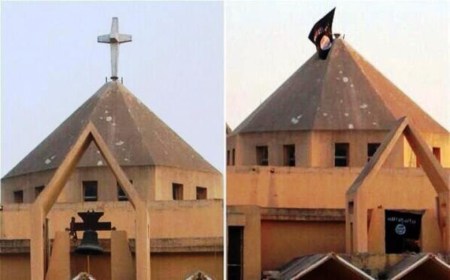
1181 (1)The Syriac Orthodox Church of St. Ephrem in Mosul, Iraq, before if the captured by the Islamic State (left), and after.

In short, Christians are absolutely experiencing “specific targeting” by the Islamic State. ISIS also kills Muslims who get in its way, but only non-Muslims — chief among them Christians — are enslaved, raped, and sometimes forced to convert to Islam on pain of death. Although Islamic law, or Sharia, legitimizes the killing, enslavement, and rape of non-Muslims, it prohibits treating fellow Muslims that way, unless they are deemed takfir [excommunicated] or apostates.

Few informed observers dispute that the Iraqi Christian community is severely threatened by ISIS. According to the Simon-Skjodt Center for the Prevention of Genocide, at the U.S. Holocaust Memorial, ISIS persecution of Christians “fits the definition of ethnic cleansing.” David Saperstein, the United States ambassador at large for religious freedom, also acknowledges that it is “primarily Christians” being persecuted for their faith in Iraq.

For the official spokesman of the U.S. military’s fight against ISIS to make such remark is deeply disconcerting. But what if Col. Warren is not to blame — what if he is just a military man doing his best to comply with demands from politicians up at the top not to acknowledge the suffering of Middle East Christians?

IDF Preparing for Arrival of ISIS on Syrian Border

January 30, 2016

IDF Preparing for Arrival of ISIS on Syrian Border, Investigative Project on Terrorism, Yaakov Lappin, January 29, 2016

934

As conflict and mayhem continue to rage across Syria, the Israel Defense Forces (IDF) is preparing to encounter the threat of ISIS and al-Qaida forces right on its borders, and could encounter such threats in the coming months.

The preparations come as the Syrian civil war shows no sign of letting up. This is a conflict that has led to the violent deaths of 300,000 Syrians, and the displacement of more than 10 million others, 4.5 million of whom have fled the country.

Today, the IDF’s Military Intelligence Directorate views Syria as a former state that has broken apart into multiple ‘Syrias.’ The Assad regime controls barely 30 percent of Syria and is fully reliant on the foreign assistance of Russia, Hizballah, and Iran. Sunnis and Shi’ites wage daily war on one another.

It is worth examining the wider recent events in the multifaceted Syrian conflict, and place the IDF’s preparations in their broader regional perspective.

In Syria’s murderous kill-or-be-killed environment, Salafi-jihadist doctrines flourish, in the form of ISIS, which views Shi’ites (including the Assad regime and Hizballah) as infidels who must be destroyed.

ISIS cells have operated recently in Lebanon too, targeting Shi’ite Hizballah’s home turf of Dahiya in southern Beirut with two large bombings in November that claimed over 40 lives, while ISIS in Iraq continues to target Shi’ites.

Today, ISIS has between 30,000-50,000 members who are dedicated to expanding their caliphate and killing all those who disagree with their doctrine, including even fellow Sunni jihadi members of al-Qaida’s branch in Syria, the Al-Nusra Front, which has 8,000-12,000 members.

ISIS continues to use its territory in Syria and Iraq to plot major, mass-casualty terrorist attacks in Western cities. At the same time, its budgetary future looks uncertain, as oil funds have decreased significantly following allied air strikes on oil facilities. In the past year, 45 percent of ISIS’s $1.3 billion budget came from oil, far less than the oil revenue in 2014.

Unlike ISIS, al-Qaida believes in following a phased, slower plan in setting up a caliphate, and the two jihadist organizations have been at war with each other for more than two years in Syria.

Shi’ites led by Iran are fighting to stop the Salafi-jihadis’ spread. Under the command of Iranian Revolutionary Guard Corps (IRGC)-Quds Force unit commander, Qassem Suleimani, Iranian fighting forces and advisers moved into Syria. Iran has sustained more than 300 casualties there thus far.

Hizballah, too, is heavily involved in Syria’s battles, losing an estimated 1,300 fighters and sustaining 10,000 injuries – meaning more than half of its conscripted fighting force has been killed or wounded. Iran and its proxies are using the mayhem to try to spread their own influence in Syria.

Near Israel’s border with Syria, the Al-Yarmouk Martyrs Battalions, which is affiliated with ISIS, has set up many posts.

An estimated 600 members of the group control a population of around 40,000 Syrians. Al-Yarmouk is at war with al-Qaida’s Jabhat Al-Nusra, which maintains a few thousand members in the Syrian Golan near Israel.

Jabhat Al-Nusra’s membership is mostly derived of local Syrians, who tend to be more hesitant to start a war with Israel that would result in their areas, and relatives, being badly affected. Yet 10 to 15 percent of its membership comes from abroad, and have no commitment to the area. These foreign fighters have no qualms about precipitating attacks on Israel. At the moment, however, Jabhat Al-Nusra is bogged down by its fight with Al-Yarmouk.

ISIS has officially put Israel in its sights, and its leader, Abu Bakr Al-Baghdadi, declared his intention at the end of December to attack Israel.

The IDF is taking the threat seriously and is preparing for a range of possible attacks, including strategic terror attacks, cross-border raids, the sending of bomb-laden armored vehicles into Israel, and rocket, missile, small-arms, and mortar fire on the Israeli Golan Heights.

One possibility is that the heavily armed Al-Yarmouk group, which is facing the southern Golan Heights, might follow an Islamic State directive to attack Israel.

In 2014, Al-Yarmouk became an ISIS representative, swearing allegiance to it, though it is not fully subordinate to it.

Al-Yarmouk’s late leader, known as Al Khal (“the uncle”), was killed in November in an attack by Jabhat Al-Nusra. Before his violent end, Al Khal only partially committed himself to ISIS, and turned down ISIS requests to send fighters to Iraq.

Al-Yarmouk’s response to Jabhat Al-Nusra’s attacks came in December, when it assassinated a Jabhat Al-Nusra commander in his armored vehicle, just 400 meters from the Israeli border.

Al-Yarmouk subscribes to the Salafi jihadist ideology and has shoulder-held missiles, tanks, and other weapons looted during raids on the Assad regime military bases.

But Israel is also preparing for the possibility of encountering ISIS itself, not just an affiliate group.

ISIS proper is currently situated 40 kilometers from the Israeli border in southern Syria. One possibility is that Russian airstrikes will cause ISIS forces to ricochet southwards, towards Israel.

The IDF is gathering intelligence on all armed groups near its border, exhausting many resources to assess their capabilities, and intentions.

Israel watched as Shi’ite Hizballah came from Lebanon to block Sunni jihadist advances towards Lebanon in recent months, and as Russian airstrikes blocked the advance of the rebels northwards, to Damascus.

The IDF remains in a heightened state of alert along the Syrian border, though it is also working to avoid the creation of easy targets for the array of predatory forces on the other side.

As part of its preparations, the IDF’s Northern Command has given more autonomy to regional field commanders to enable faster responses to surprise attacks by reducing the initial chain of command during emergencies.

Inter-branch cooperation between intelligence, ground forces, and the air force has also been tightened.

Additionally, the IDF has fortified its border fence with Syria, adding electronic sensors to better be able to detect and respond to a potential attack in time.

The underlying assumption within military circles is that, sooner or later, ISIS will turn its guns on Israel, and the IDF does not intend to be caught off guard when that happens.

Obama’s Fake Syrian Peace Talks Falling Apart

January 29, 2016

Obama’s Fake Syrian Peace Talks Falling Apart, Front Page Magazine, Daniel Greenfield, January 29, 2016

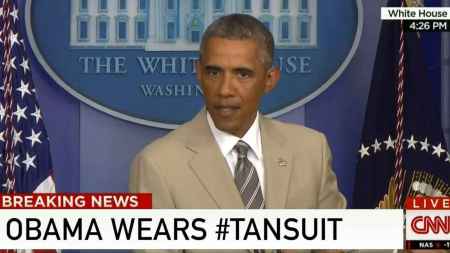
obama-wears-tan-suit-149481242256_6

The peace talks strategy for Syria comes out of Iran and Russia, two countries determined to keep Assad in power. Obama wanted the peace talks in order to rig a fake settlement that would come apart once he was out of office. But the only people fooled by this were stupid enough to get their news from CNN and their talking points from Think Progress. The Sunni side only participated to the extent that they could wreck the talks and extract some demands. They have no intention in signing on to Assad staying in power or to letting Obama get away with a fake solution that does just that.

And, oh yes, no one actually thinks Obama has any credibility.

As the Obama administration pushes for peace in Syria, its credibility is crumbling among Syrian opposition leaders, many of whom increasingly doubt the U.S. is serious about ending the rule of dictator Bashar Assad.

Because he isn’t.

If the talks peter out or collapse, that will further undermine President Barack Obama’s foreign policy legacy, which already has been tarnished by the endless bloodshed in Syria

It’s okay. Obama will blame Tom Cotton or Bush or Israel. Or someone. And the media will go along with it.

“A number of the opposition has expressed the feeling that the U.S. is not acting as an honest broker and that they’ve lost both trust and faith in the ability of the United States to deliver on a political settlement in Syria,” said Andrew Bowen, a senior fellow at the Center for the National Interest who has contacts among Syrian opposition groups.

Obama signed on with Iran. So he’s about as much of an honest broker as any other foreign agent.

“Kerry did not make any promises, nor did he put forward any initiatives,” said Khaled Khoja, president of the opposition Syrian National Coalition, in onestatement questioning U.S. intentions. “He has long been delivering messages similar to those drafted by Iran and Russia, which call for the establishment of a ‘national government’ and allowing Bashar al-Assad to stay in power and stand for re-election.”

Well yes. What else do you expect Kerry to do? This is the only thing he’s been doing since he got to the Senate and even beforehand with the Viet Cong. Traitors gotta traitor.

Among the numerous reports floating around — some of them highly speculative — are those that allege Kerry warned opposition leaders they could lose international support if they didn’t attend Friday’s talks. The reports come as the U.S. has appeared to be backing away from its demand that Assad must leave office by signaling its support for the notion of a transitional period.

And that period will come to an end once Obama is out of office.

But all this is theater anyway as the groups with the most fighters on the ground, including Al Qaeda and ISIS, are not represented. Most of the Islamists aren’t either. So this is just the Muslim Brotherhood, whose actual strength is weak, throwing a tantrum. Even if the Sunni groups signed some sort of deal it would be as worthless as the fake elections Hillary still talks up in Libya

Kent State Honored Prof After His Support for Terror Known

January 26, 2016

Kent State Honored Prof After His Support for Terror Known, Clarion ProjectRyan Mauro, January 26, 2016

(What if Prof. Pino, who works in the history department, had posted diatribes against the “Palestinian Resistance” and praised Israel? Would the university have reacted in comparable fashion? — DM)

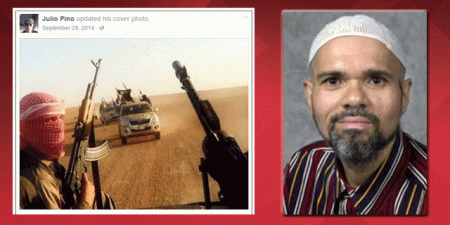
Julio-Pino-Facebook-Cover-HPKent State Professor Julio Pino (right) changed his cover photo on Facebook to the picture on the left. Under he wrote “jokingly,” “Keep it a secret: that’s me on the left!”

[A]ll we hear from the university is that this is free speech and that he’s a “well-respected teacher in the classroom” so he will keep his job. He’s teaching two classes now and plans on returning in the fall—that is, unless the people of America compel KSU to change those plans.

**************************

The Kent State University student newspaper recently reported that a terrorism-supporting professor, Julio Pino, received two Faculty Excellence Awards in 2003 and 2010. His open support for terrorism, specifically suicide bombings in Israel, became known in 2002. In the years after, he was even linked to a website dedicated to assisting Al-Qaeda and other terrorists in killing people.

Kent Wired reports that he began teaching for the school in 1992 and earned tenure in 1998. He converted to Islam in 2002 and began openly supporting terrorism two years later. As our research reporton Pino documents, he wrote a letter praising a Palestinian suicide bomber in Israel as a “shining star” and asked Allah to “protect the soldiers of Islam fighting in Palestine.” He also objected to the terminology of “suicide bombers,” preferring to use “martyrdom bombers” because he doesn’t believe their acts constitute suicide, which is prohibited in Islam.

The next year, he was honored with a Faculty Excellence Award.

In 2007, it was learned that Pino was writing for a pro-Al-Qaeda website with the stated objective of assisting violent jihadists in acts of terrorism. As you can seen [sic] in our screenshots, the website’s homepage read at the time:

“We are a jihadist news service, and provide battle dispatches, training manuals and jihad videos for our brothers worldwide. All we want is to get Allah’s pleasure. We will write ‘jihad’ across our foreheads and the stars.”

A colleague at the university, Dr. Mike Adams, discovered Pino’s deep involvement in the website (Pino was most likely acting as the website’s main administrator). Adams writes: “[We] traced the emails. They were being sent directly from the Kent State office of Professor Julio Pino. Both veiled threats and general advocacy of violence were sent from his public university office.” [emphasis mine]

Pino was forced to admit to his involvement in the website. He kept his job despite walking right up to the edge of material support for terrorism. In 2009, Pino was interviewed by the Secret Service. Dr. Adams also published an email allegedly sent by Pino that praised the 9/11 hijackers.

The next year, he was honored with a Faculty Excellence Award.

His overt behavior escalated, including shouting “Death to Israel” at a visiting former Israeli diplomat. Now, it’s known that he’s been under FBI investigation for the past year and a half for possibly recruiting students for ISIS. The FBI has taken the extraordinary step of interviewing over 20 of his students.

And all we hear from the university is that this is free speech and that he’s a “well-respected teacher in the classroom” so he will keep his job. He’s teaching two classes now and plans on returning in the fall—that is, unless the people of America compel KSU to change those plans.

Report: Islamic State, Al-Qaida, Muslim Brotherhood Discuss ‘Mega-Merger’ in Libya

January 25, 2016

Report: Islamic State, Al-Qaida, Muslim Brotherhood Discuss ‘Mega-Merger’ in Libya, Breitbart,  Aaron Klein and Ali Waked, January 25, 2016

(Here’s a video of an interview with Islamic reformist Dr. Zuhdi Jasser about the current situation in Libya. H/t Counter Jihad Report.

— DM)

Peshmerga-sinjar-afp-640x480

TEL AVIV – The Libyan branches of the Islamic State, Al-Qaida, and the Muslim Brotherhood are in discussions to complete a “mega merger,” the London-based A Sharq al Awsat newspaper reported.

Leaked documents have revealed that Libya’s biggest Islamist organizations are considering an alliance and the establishment of a joint council of sages, the Arabic language daily reported.

The prospective move comes in the wake of reports of an imminent international effort to form a unity government that would bring Libya’s numerous parties and militias together.

The paper said the Muslim Brotherhood is considering a united Islamic front even though the movement is officially in favor of forming a unity government. However, sources within the movement told the paper that their support for the international endeavor is merely tactical, and they’re waiting for it to collapse.

Negotiations between the three Islamic groups began because of reports of a rapprochement between the internationally recognized government based in Tobruk and the unrecognized government in the capital Tripoli, the paper said.

The groups wish to send a message to the forces coalescing around a unity government that they are not opposed by IS alone, but “all the Islamist opposition elements speak in one voice and should be treated as such,” a source said.

According to the documents, Muslim Brotherhood leaders said that Egyptian President Abdel Fatah al-Sisi’s regime “isn’t supported by the Americans because of his close relations with Russia. They can’t wait to see him leave the scene.”

The parties agreed to form a joint Shura (advisory) council and territories that are currently under Islamic control will be divided between them, echoing a similar agreement that is already underway in Benghazi.

Al-Qaida’s representative was quoted as saying that the move would inspire Islamists in Algeria and Egypt to follow suit.

This follows Breitbart Jerusalem’s own exclusive reporting on mediation efforts between the Muslim Brotherhood-aligned Hamas in Gaza and Salafists aligned with the Islamic State.

Breitbart Jerusalem previously reported that Shadi al-Menai, one of the leaders of Wilayat Sinai, the Islamic State branch in Sinai, visited Gaza in a bid to mediate between Hamas and local Salafi groups after clashes erupted, resulting in the arrests of dozens of jihadists by Hamas forces.

Earlier this month, a leading Salafi source revealed that Menai mediated a deal whereby Hamas would give the Gaza Salafi opposition groups more leeway in exchange for Wilayat Sinai’s help in bypassing the Egyptian army’s restrictions on smuggling rocket parts into Gaza

This is not the first report of Hamas-IS cooperation in arms smuggling.

A Middle East think tank charged last month that there is information Hamas has been paying off the Islamic State’s Sinai branch to smuggle weapons into Gaza. “Over the past two years, IS Sinai helped Hamas move weapons from Iran and Libya through the peninsula, taking a generous cut from each shipment,” stated a report by the Washington Institute for Near East Policy.

Despite the rapprochement between Hamas and IS-Sinai, tensions between the ruling faction and Salafi opposition groups in Gaza are rampant.

The Army of Islam, a Salafi group that aspires to become IS’s sole representative in Palestine, recently released an acerbic video in which it blames Hamas for straying from Sharia law and cooperating with anti-Islamic players, including Shi’ite Iran.

A new US-Russian-Turkish military buildup over Syria: In unison or at odds?

January 25, 2016

A new US-Russian-Turkish military buildup over Syria: In unison or at odds? DEBKAfile, January 25, 2016

TurkishAirBase480

The US and Russia are in the process of a military buildup in the Kurdish areas of northern Syria. It is ranged along a narrow strip of land 85 km long, stretching from Hassakeh in the east up to the Kurdish town of Qamishli on the Syrian-Turkish border. Facing them from across that border is a parallel buildup of Turkish strength. This highly-charged convergence of three foreign armies athwart a tense borderland is reported here by DEBKAfile’s military sources. It is too soon to determine whether the three armies are operating in sync or at odds, especially in view of the bitter relations between Moscow and Ankara.

US Forces 

American Special Operations troops and Air Force attack helicopters landed first at Remelan airport. They are the first US troops to operate from a ground base in Syria, accommodated in living quarters built for them in advance by a US engineering corps unit. The airport runway has been widened for US warplanes.

American Special Operations troops and Air Force attack helicopters landed first at Remelan airport. They are the first US troops to operate from a ground base in Syria, accommodated in living quarters built for them in advance by a US engineering corps unit. The airport runway has been widened for US warplanes.

Russian Forces

Next came two Russian military missions on Jan. 16.  One group, led by a general and consisting of air force and Special Operations officers, is preparing to take over a small abandoned base in Syrian army-controlled territory just 80 km from the new US facility at Remelan, and adapt it for Russian use.

The other group, which consists of intelligence officers – some from Russia’s FSB federal security service, the FSB – indicates that Moscow has decided it is high time for professionals to protect the classified information moving around the Russian Task Force in Syria and safeguard it from reaching the wrong hands. .

The abandoned base is less than 3.5 km from the Turkish border, and would act as a Russian barrier between US forces in northern Syria and the Turkish border contingents.

Turkish Forces

This Russian deployment set off alarm bells in Ankara, and so the Turkish army responded with the third troop buildup, arraying tanks and mobile artillery on the border across from Qamishli.

Over the weekend, Turkish President Tayyip Erdogan stated, “We have said this from the beginning: we won’t tolerate such formations (in northern Syria) along the area stretching from the Iraqi border up to the Mediterranean.”

At the same time, US Vice President Joe Biden said Saturday, Jan. 23, that  the U.S. and Turkey are prepared for a military solution against ISIS in Syria should the Syrian government and rebel-opposition forces fail to reach a peace agreement during its upcoming meeting in Geneva.

However, Ankara views its war on terror as focused on both Kurdish separatists and ISIS, which is subjecting Turkey to multi-casualty attacks.

DEBKAfile’s military and intelligence sources note that Turkey’s military options are very limited. Its leaders know they dare not put a foot wrong because the Russian force in Syria is just waiting for an opportunity to avenge the downing of a Russian Su-24 warplane by the Turkish air force on November 24.

Another group of actors stirring the pot in northern Syria is the Kurds, particularly the YPG militia, the only fighting force in Syria capable of defeating ISIS, which has been reinforced by the Iraqi autonomous Kurdish region’s Peshmerga, as well as the outlawed Turkish PKK Kurdish organization.

At this stage, it is impossible to determine how this triple buildup will play out tomorrow – how far the US and Russia are in concert, at what point they may decide to vie for footholds in the Kurdish region of northern Syria and how far the Turks are clued into the joint US-Russian strategy for bludgeoning ISIS.