Archive for the ‘Islamic reformation’ category

CAIR To Donald Trump: The Constitution Says Government Can’t Study or Criticize Radical Islam

August 18, 2016

CAIR To Donald Trump: The Constitution Says Government Can’t Study or Criticize Radical Islam, BreitbartNeil Munro, August 16, 2016

(Please see also, Dr. Jasser discusses Donald Trump’s call for “extreme vetting” as part of plan to stop ISIS, — DM)

Boston-marathon-Bombing-AP-640x480

An Islamic group tied closely to jihadi terror groups is complaining that Donald Trump will violate the constitution by helping Americans better understand the nature of radical, jihad-promoting Islam.

“One of my first acts as President will be to establish a Commission on Radical Islam – which will include reformist voices in the Muslim community,” Trump declared  in a reformist foreign policy speech on Monday.

“The goal of the commission will be to identify and explain to the American public the core convictions and beliefs of Radical Islam, to identify the warning signs of radicalization, and to expose the networks in our society that support radicalization … [and] we will pursue aggressive criminal or immigration charges against anyone who lends material support to terrorism,” he said.

That promise of legal charges is a direct threat to the jihad-linked Council on American-Islamic Relations, which has many material links to domestic and foreign groups that support Islamic war. CAIR has been declared a terrorist organization by the United Arab Emirates and was named by federal prosecutors as an unindicted co-conspirator in a Hamas-funding operation. 

CAIR responded to Trump’s speech by suggesting that rhetorical and religious support (although not actions) for Islamic jihad terrorism is a constitutional right, both for Americans and for would-be immigrants who wish to introduce jihad and other Islamic ideas into the United States.

Trump’s proposal for a ‘commission’ that would identify for Americans the tenets of ‘radical Islam’ crosses the line into government interference in religious beliefs. Will a Trump administration entangle itself in interpretation of [Islamic] religious principles? Who will Trump appoint to decide what constitutes ‘radical Islam’? His current stable of Islamophobic [sic] advisers indicates that this commission would be packed with anti-Muslim bigots.

This government promotion of a state version of a particular religion would violate the First Amendment and put America on a path to a society in which those in power get to choose which beliefs are ‘correct’ and which are ‘incorrect.’

CAIR is so closely entwined with Islamists and with jihadis that court documents and news reports show that at least five of its people — either board members, employees or former employees — have been jailed or repatriated for various financial and terror-relatedoffenses.

Breitbart News has published evidence highlighted by critics showing that CAIR was named an unindicted co-conspirator in a Texas-based criminal effort to deliver $12 million to the Jew-hating HAMAS jihad group, was founded with $490,000 from HAMAS, and that the FBI bans top-level meetings with CAIR officials. “The FBI policy restricting a formal relationship with CAIR remains … [but] does not preclude communication regarding investigative activity or allegations of civil rights violations,” said an Oct. 2015 email from FBI spokesman Christopher Allen.

In 2009, a federal judge concluded that “the government has produced ample evidence to establish the associations of CAIR… with Hamas.”

The United Arab Emirates has included CAIR on its list of Muslim Brotherhood groups. CAIR has posted its defense here.

Trump’s call for a better understanding of Islam is part of his plan to reorient U.S. foreign policy to crush and delegitimize political Islam.

That is why one of my first acts as President will be to establish a Commission on Radical Islam – which will include reformist voices in the Muslim community who will hopefully work with us. We want to build bridges and erase divisions.

The goal of the commission will be to identify and explain to the American public the core convictions and beliefs of Radical Islam, to identify the warning signs of radicalization, and to expose the networks in our society that support radicalization.

This commission will be used to develop new protocols for local police officers, federal investigators, and immigration screeners…. Finally, we will pursue aggressive criminal or immigration charges against anyone who lends material support to terrorism. Similar to the effort to take down the mafia, this will be the understood mission of every federal investigator and prosecutor in the country.

To accomplish a goal, you must state a mission: the support networks for Radical Islam in this country will be stripped out and removed one by one.

Immigration officers will also have their powers restored: those who are guests in our country that are preaching hate will be asked to return home

…. But just like we couldn’t defeat communism without acknowledging that communism exists – or explaining its evils – we can’t defeat Radical Islamic Terrorism unless we do the same.

This also means we have to promote the exceptional virtues of our own way of life – and expecting that newcomers to our society do the same.

Pride in our institutions, our history and our values should be taught by parents and teachers, and impressed upon all who join our society. Assimilation is not an act of hostility, but an expression of compassion.

Our system of government, and our American culture, is the best in the world and will produce the best outcomes for all who adopt it.

This approach will not only make us safer, but bring us closer together as a country. Renewing this spirit of Americanism will help heal the divisions in our country. It will do so by emphasizing what we have in common – not what pulls us apart.

Jihad is part of orthodox Islam, which also opposes the separation of religious law and the state. That makes it very different from Christianity, which theologically postpones the enforcement of religious law into the afterlife and so can theologically co-exist with secular governments, such as the United States government.

Islam’s twinning of  jihad with religious piety explains the relative frequency of bloody jihad violence throughout the Muslim world, especially when inflicted on non-Muslims in the United States, Paris, Germany snd many other countries.

Also, Islam’s focus on Earthly rule, says critics, means that it is a hybrid idea that combines religion (which gets the protection of the First Amendment) with a violent political movement that can be constitutionally suppressed.

For example, Islam’s politicized ‘sharia law’ endorses the murder of Islam’s critics and of ex-Muslims — repeatedly, endlessly, forcefully — and its recommendations are deemed divine commandments by numerous killers and would-be killers.

Also, the Koran — which observant Muslims say is a list of verbatim commands from their deity, Allah — tells Muslims to “Fight those who do not believe in Allah or in the Last Day and who do not consider unlawful what Allah and His Messenger have made unlawful and who do not adopt the religion of truth from those who were given the Scripture – [fight] until they give the jizyah [penalty tax] willingly while they are humbled.”

Islamic scriptures say that Islam’s reputed founder, Muhammad, personally ordered or supported the death of many enemies, including at 10 critics and poets, who were the pre-modern equivalent of modern journalist and writers — such as the machine-gunned cartoonists at the Paris-based Charlie Hebdo magazine. Traditionalist or orthodox Muslims says Muhammad is a perfect model of behavior and should be emulated by Muslims today.

In contrast, some Western Muslims are trying to develop a modern, pacific Islam that emphasizes the long-discarded early and relatively peaceful commandments in Islam.

Dr. Jasser discusses Donald Trump’s call for “extreme vetting” as part of plan to stop ISIS

August 17, 2016

Dr. Jasser discusses Donald Trump’s call for “extreme vetting” as part of plan to stop ISIS, Fox News via YouTube, August 16, 2016

(Please see also, Donald Trump’s Outreach to Moderate Muslim Leaders Highlights Clinton Failure in Egypt. — DM)


Donald Trump’s Outreach to Moderate Muslim Leaders Highlights Clinton Failure in Egypt

August 17, 2016

Donald Trump’s Outreach to Moderate Muslim Leaders Highlights Clinton Failure in Egypt, BreitbartTera Dahl, August 17, 2016

al sisi(1)AFP

In his foreign policy speech on Monday, Donald Trump stated that he would “amplify the voice” of moderate Muslim reformers in the Middle East, saying, “Our Administration will be a friend to all moderate Muslim reformers in the Middle East, and will amplify their voices.”

He also said that he would work with Egypt, Jordan and Israel in combating radical Islam, saying, “As President, I will call for an international conference focused on this goal. We will work side-by-side with our friends in the Middle East, including our greatest ally, Israel. We will partner with King Abdullah of Jordan, and President Sisi of Egypt, and all others who recognize this ideology of death that must be extinguished.”

He said that, as President, he would establish a “Commission on Radical Islam,” saying, “That is why one of my first acts as President will be to establish a Commission on Radical Islam – which will include reformist voices in the Muslim community who will hopefully work with us. We want to build bridges and erase divisions.”

His comments about cooperating with Egypt, Israel and Jordan were highlighted in the Arab world’s media, with headlines reading “Donald Trump Announces Plan to Cooperate with Egypt, Jordan, Israel to Combat Radical Islam” and “Trump vows to work with Egypt’s Sisi to ‘stop radical Islam’ if elected.”

Under the Obama Administration, US policy has not been friendly towards our Muslim allies such as Egypt. Hillary Clinton recently said in a primary debate with Bernie Sanders that, in Egypt, you basically have an “army dictatorship”.

Egypt is one of the most catastrophic foreign policy failures of the Obama Administration and Hillary Clinton’s State Department. President Obama started his outreach to the Egyptian Muslim Brotherhood when he delivered his 2009 Cairo speech. The US Embassy invited 10 members of the Muslim Brotherhood to attend the speech, undermining US ally Mubarak – who had rejected to previous U.S. efforts to reach out to the Brotherhood.

The Obama Administration, and Clinton’s State Department, again undermined President Mubarak in 2011 when they urged him to step down and pressured Egypt to hold elections “immediately” after the 2011 revolution. This policy favored the Muslim Brotherhood to win elections since they were the most organized at the time.

Then-Secretary of State Hillary Clinton met with Muslim Brotherhood President Mohammed Morsi in Cairo offering “strong support” for the Islamist President, saying, “I have come to Cairo to reaffirm the strong support of the United States for the Egyptian people and their democratic transition… We want to be a good partner and we want to support the democracy that has been achieved by the courage and sacrifice of the Egyptian people.”

The Obama Administration embraced the Muslim Brotherhood government in Egypt, but when millions of Egyptians took to the streets one year later, calling for early elections against the Muslim Brotherhood government, the Obama Administration did all they could to undermine their efforts.

Over 30 million Egyptians took to the streets on June 30, 2013 calling for the removal of the Muslim Brotherhood from power. After one year of being in power, the Brotherhood was taking Egypt towards an Iranian theocracy and the Egyptian people stood against political Islam. The 2011 Egyptian Constitution had no impeachment mechanism included, so the only democratic way to remove the Brotherhood was signing a petition and taking to the streets in the masses. Millions of Egyptians took to the streets again in July, supporting then Defense Minister General el-Sisi and the Egyptian military in their efforts to fight terrorism.

The Obama Administration condemned the Egyptian military and police after the removal of the Muslim Brotherhood and punished Egypt by freezing military and economic aid to Egypt. This was done while the Egyptian military had launched a major offensive to “crush terrorist activity” in the Sinai that had built up during the Muslim Brotherhood government. Egypt had to fight terrorism alone – not only without support from the US – but with pressure to succumb to the requests from the US Administration to release the Muslim Brotherhood members from prison and reconcile.

The pressure from the Obama Administration against the removal of the Morsi regime emboldened the Muslim Brotherhood and they waged an Islamist insurgency, not only in the Sinai but on the streets of Cairo. The Muslim Brotherhood specifically targeted theChristian community and burned down over 65 Christian Churches and hundreds of Christian shops.

The Obama Administration sent U.S. Deputy Secretary of State William Burns to Egypt for “U.S. mediation efforts” and met with Khairat el-Shater, the deputy leader of the Muslim Brotherhood, who was in jail at the time and sentenced for life in prison. Our State Department, under John Kerry, sent a representative to Egypt pressuring the Egyptian government to release terrorists from jail.

The Obama Administration also sent Senators McCain and Graham to Egypt to ask the Egyptian government and military to find an agreement with the Muslim Brotherhood. They asked the Egyptian government to “sit down and talk” to the Muslim Brotherhood, who had waged war on the Egyptian people.

Since being democratically elected in 2014, winning with 97% of the vote, Egyptian President al-Sisi has made history speaking out for equality between Muslims and Christians. He was the first President in Egyptian history to visit the Coptic Christian Christmas mass service in January 2015. During his speech at the Christmas mass, he emphasized the need to look at each other as “Egyptians” and not as Muslim or Christian. He said, “We will love each other for real, so that people may see.” President Sisi again visited the Coptic Christmas mass in January 2016 where he vowed to rebuild the Christian churches that were destroyed by Islamists in 2013 after the Muslim Brotherhood were removed from power.

President Sisi has called for “Islamic reform” within Islam numerous times. During a speech to Islamic scholars in 2015, marking the anniversary of Muhammad’s birth, President Sisi urged reform of Islamic discourse and called on Islamic scholars to send Christmas greetings to Christians. In the televised speech to Islamic scholars, President Sisi stated, “We talk a lot about the importance of religious discourse… In our schools, institutes and universities, do we teach and practice respect for the others? We neither teach or practice it.”

The Egyptian government has also addressed the ideology by banning thousands of radical clerics from preaching in the mosques that are not licensed.

Recently, the government of President al-Sisi introduced a textbook for Egyptian public schools that requires Egyptian pupils to memorize the provisions of the 1979 Egypt-Israel peace treaty and delineate the “advantages of peace for Egypt and the Arab states”. This is a major reform taken from the Egyptian government in normalizing and strengthening relations between Israel and Egypt.

President Sisi should be considered a key ally of America as he is leading Egypt towards democracy and also is leading the fight against global jihad, both militarily and politically, in countering radical Islamic ideology. Instead, he has yet to be invited to the United States from President Obama.

Hillary Clinton has been critical of Trump’s position towards Russia, but policies implemented under the Obama Administration have pushed Egypt towards Russia and have alienated our strongest Arab ally for over 40 years. Egypt and Russia signed a$2billion arms deal after the United States abandoned them during their fight against terrorism. Russia also is providing Egypt with $25 billion to build Egypt’s first nuclear power plant.

Donald Trump in his speech recognized the need to support our Muslim allies in the global war on terrorism. This is critical in defeating global jihad. We cannot afford another four years of a policy of alienating our allies and emboldening our enemies as we have seen under the Obama Administration.

CAIR Met With Congress 325 Times in 2016

July 13, 2016

CAIR Met With Congress 325 Times in 2016, Clarion ProjectRyan Mauro, July 13, 2016

Cair-Nihad-Awad-Ibrahim-Hooper-HP_31 (1)CAIR founder and executive director Nihad Awad (right) with Ibrahim Hooper, national communications director and spokesperson.

The Council on American-Islamic Relations (CAIR), a group identified by the Justice Department as a Muslim Brotherhood entity and designated as terrorists by the United Arab Emirates, boasts of having 325 meetings with members of Congress or their staff over the last year.

The group says it also enjoyed $3 million worth free advertising through media appearances this year alone, resulting in 50 million views of its work.

A 2007 court filing by federal prosecutors notes how two of CAIR’s founders were wiretapped at a secret Muslim Brotherhood/Hamas meeting in Philadelphia in 1993, where they participated in a robust discussion of how to use deception to influence American public opinion in a direction favorable to the Islamist cause. It states:

From its founding by Muslim Brotherhood leaders, CAIR conspired with other affiliates of the Muslim Brotherhood to support terrorists … the conspirators agreed to use deception to conceal from the American public their connections to terrorists.

CAIR’s fundraising video boasts that there were 14,000 mentions of CAIR on radio or television this year alone, and that it has a database of 1.6 million media contacts to use. The organization said it has 65 trained spokespeople, 29 offices and 35 full-time lawyers.

The White House’s director of community partnerships said in 2012 that there had been “hundreds” of meetings between U.S. government agencies and CAIR. However, CAIR was curiously left out of President Obama’s Countering Violent Extremism Summit in 2015, even though other Islamists were invited.

After participants were made known, CAIR attacked President Obama’s event as Islamophobic.

CAIR’s power can give the impression that it is the leader of the Muslim-American community, but it is, in reality, the manifestation of a well-funded and well-organized Brotherhood network that has been building up its presence in the U.S. since the 1960s. CAIR was born out of this network in 1994 and has prospered with plentiful foreign financing.

A 2011 Gallup poll found that CAIR is most popular Muslim-American organization but only about 12% of Muslim-Americans say CAIR is the organization that most represents them, despite its strong name recognition, media presence and infrastructure.

CAIR’s boasts are a reminder of its power to intimidate, pressure and influence. However, since close to 90 percent of the Muslim-American community says CAIR does not represent them, there is a leadership gap that can be filled by a non-Islamist Muslim group whose values and record more closely reflect those of the Muslim-American community.

Muslims who are against Islamism have a steep hill to climb in competing with CAIR and its allies, but we must remember that they have low name identification and are attacked and excluded by their Islamist competitors who have had much more time and resources to develop.

If CAIR can accomplish all this, then imagine what a genuinely moderate organization could accomplish with time and resources.

A Ramadan Piece: The “Other” Islam

July 5, 2016

A Ramadan Piece: The “Other” Islam, Gatestone InstituteSalim Mansur, July 5, 2016

(A fascinating history of the battle between political Islam and non-political Islam. The battle continues. — DM)

♦ Abrahamic monotheism as represented in Judaism, Christianity, and Islam, precedes and stands apart from politics as an ethical vision that transcends history. It was a vision which invited people to embrace their common humanity as created and gifted by one omnipotent deity, and to follow a revealed code of ethics for righteous living, holding the promise of peace with an end to interminable conflicts that divided people into warring tribes.

♦ Thoughtful Muslims, for nearly a century before the demise of the Ottoman Empire and the abolition of the Caliphate, had been writing about the need for an Islamic reform. Europe’s cultural advancement following the Reformation and Enlightenment held up a mirror for the Islamic world to follow in similar direction to similar ends. There was a consensus among Muslims that Islam was not intrinsically opposed to the modern world, and a readiness to follow in the footsteps of the West.

♦ This is the “other” Islam. This is submission to truth, whose most righteous exemplar was Abraham when his faith was tested by his Deity, according to the Hebrew Bible, to sacrifice his son. And this is the faith of Sufis who took Muhammad’s message to people in places far removed from the desert confines of Arabia. It is simply, as the Qur’an reminds (30:30), deen al-fitrah, the natural religion, or inclination, of man to know his Creator. There is no return of this “other” Islam; it never went missing.

The cover of the January 1976 issue of Commentary magazine announced its main story, “The Return of Islam,” by Bernard Lewis. The year of publication coincided with the coming end of the fourteenth century of Islam, and the anticipation of a new Islamic century beginning in 1979. Forty years later this essay by Lewis, widely recognized and respected as the most eminent scholar on the Middle East and Islam alive today, came to be celebrated as the first warning of the coming upheaval inside the world of Islam.

Lewis’s essay was a corrective to viewing the Middle East and its people, Arabs and Muslims, in terms of Western values. “Modern Western man,” wrote Lewis, “being unable for the most part to assign a dominant and central place to religion in his own affairs, found himself unable to conceive that any other peoples in any other place could have done so… [or to] admit that an entire civilization can have religion as its primary loyalty.” This meant, Lewis continued, the “inability, political, journalistic, and scholarly alike, to recognize the importance of the factor of religion in the current affairs of the Muslim world”.

Recent events have proven that Lewis was correct in pointing to this critical flaw in much of Western understanding of Islam and Muslims. But the title of the essay was unfortunate and misleading; there was no “return of Islam” for Muslims, since at no point in Islamic or Muslim history had Islam been missing, or dormant.

Instead of the “return of Islam,” it was the return of political Islam, or Islamism. Lewis’s essay was a timely review of Muslim history in terms of political Islam. But political Islam is but one facet of Islam. It is a recurring mistake to see political Islam as the defining feature of Islam that obscures Islam’s spiritual dimension, which is more vital than the coarse authoritarian features of political Islam.

In antiquity, politics was inseparable from religion. It might be said that politics was the handmaiden of religion. A ruler among people in ancient times was a chief priest, or a demigod. This feature of the ancient world in which religion and politics were bound together could be described as “theopolitics”, and Islam was as much influenced in its history by theopolitics as were Judaism and Christianity.

Lewis wrote:

“The three major Middle Eastern religions are significantly different in their relations with the state and their attitudes to political power. Judaism was associated with the state and was disentangled from it; its new encounter with the state at the present time raises problems which are still unresolved. Christianity, during the first formative centuries of its existence, was separate from and indeed antagonistic to the state with which it only later became involved. Islam from the lifetime of its founder was the state, and the identity of religion and government is indelibly stamped on the memories and awareness of the faithful from their own sacred writings, history, and experience.”

A lot of history is compressed in this passage, and so some misreading of that history is inevitable. Lewis went on to discuss Islam as being entwined with political Islam since its inception. “Islam was associated with power from the very beginning,” wrote Lewis, “from the first formative years of the Prophet and his immediate successors.” Consequently, in Islam “religion is not, as it is in Christendom, one sector or segment of life, regulating some matters while others are excluded; it is concerned with the whole of life—not a limited but a total jurisdiction.”

The problem with Lewis’s view of Islam is that he uncritically accepted the theology of political Islam. This theology was constructed during the three centuries after the Prophet Muhammad when, in the course of events between the seventh and the tenth century of the Common Era, Arabs came to rule a vast empire. It was consistent with the temper of late antiquity, and it put a stamp on Islam ever since that most Muslims have accepted without questioning.

Abrahamic monotheism as represented in Judaism, Christianity, and Islam, however, precedes and stands apart from politics as an ethical vision that transcends history. It was a vision which invited people to embrace their common humanity as created and gifted by one omnipotent deity, and to follow a revealed code of ethics for righteous living, holding the promise of peace with an end to interminable conflicts that divided people into warring tribes.

It was the resistance of pagans and polytheists to Judaism, Christianity, and Islam at their origins that compelled their early followers in the course of their respective histories to seek in politics protection for their religious beliefs. In Judaism and Islam, the founders — Moses and Muhammad — combined in their personalities the roles of prophet, warrior, and statesman. The life of Jesus, in this respect, was different.

In Moses’s case, he never entered the promised land, and it was left to his successors to eventually found a state for the Jews. In the instance of Muhammad, there is the question that has divided Muslims ever since his death: was his prophetic mission primarily to establish an Islamic state that would define, for Muslims for all times, Islam as the ideal arrangement in which religion and politics were one and indivisible?

The answer to this question was surrounded in controversy right from the moment of the Prophet’s last illness before his death. The controversy over his succession, and what such succession meant, tore apart the immediate followers of the Prophet, and incited tribal warfare, fratricide and schisms that since then have provided the backdrop to Muslims in respect to their own understanding and practice of Islam as religion and politics.

Islam as the Abrahamic vision of man’s relation with God was supplanted by the theology of political Islam. The process began in the midst of the Prophet’s last illness and accelerated with his death. The majority Sunni sect in Islam coalesced around the view that the immediate successors of the Prophet, elected or chosen, ought to be the closest companions of Muhammad, and their rulings in the formative stage of Muslim history became the standard by which subsequent generations of Muslims innovated the requirements of ruling an empire.

Those Muslims who dissented from the majority view represented by Sunni Islam were the Shi’a, or the party of Ali. Ali was a cousin of the Prophet, raised from his childhood in the Prophet’s household and, hence, the closest companion of Muhammad. Ali was also the Prophet’s son-in-law by marriage to Fatima, his only surviving child. The Shi’a Muslims believed Ali was the designated successor of the Prophet because of their familial ties, but he was forcefully denied the succession by those who usurped it immediately following the Prophet’s demise. Shi’a Islam evolved as the main minority sect with its own theopolitics within Islam.

The first Muslims were Arabs of the desert, the Bedouins, among whom Muhammad was born. Their tribalism persisted despite the Prophet’s warnings and it shaped Islam from the first hour of the post-Prophetic history. Sectarianism within Islam was the unavoidable outcome of clan and tribal conflicts among the first Muslims, and the Sunni-Shi’a divide became the main cleavage as a result, setting the template of further divisions as sects proliferated over time in the history of Islam.

Less than a century after the Prophet’s death in 632 C.E., his followers, the Bedouin Arabs, became the rulers of an empire that stretched from the Iberian Peninsula in the West to the Indus River in the East. There was nothing in the Qur’an, or in the traditions of the Prophet, to instruct these Arabs on the mechanics of administrating an empire. They took to imitating the rulers of Persia, whom they defeated, and adopted the administrative manuals of both Byzantine and Persian officialdom to rule the lands and peoples they conquered. And in order to provide legitimacy in the name of Islam to Arab rule in Damascus and later in Baghdad, the ulema(religious scholars) worked out the details of law and society, the Sharia, derived from the Qur’an and the Prophetic traditions.

The origin of Islamic culture and civilization lies in the empire that Bedouin Arabs, through the force of arms, established in a very short period. This was also the origin of political Islam, which came to represent the dominant face of Islam as theopolitics.

The fight that erupted, with the news of the Prophet’s demise, among his closest companions over succession related to temporal power that the Prophet had exercised, and not his role as a Messenger of God (Rasul Allah). This fight culminated in 680 C.E. with the defeat of the Prophet’s grandson, Husayn, killed and decapitated in the field of Kerbala, close to the banks of the Euphrates in Iraq, by the army sent out by Yazid I, the Ummayad Caliph of the rapidly expanding Islamic empire.

The event in Kerbala was a watershed in the history of Islam. Ethnic Arabs, recently converted to Islam, delivered Husayn’s cruel end. Ever since, this crime, as sordid as the crucifixion of Jesus, has stained Muslim history with the mark of Cain.

After Kerbala, it could no longer be said that Islam, as Abrahamic monotheism, guided politics ethically along the path of justice and mercy. Instead, the politics that surfaced upon the death of the Prophet hardened after the killing of Husayn, and politics henceforth came to define Islam as faith, culture, and society.
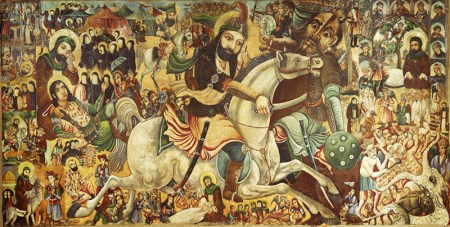
699In the Battle of Kerbala, depicted in Abbas Al-Musavi’s painting, Husayn, the son of Ali and grandson of Muhammad, was killed along with his family and all his followers by the armies of the Umayyad Caliphate. It was the most crucial moment in the split between Shi’a and Sunni Islam. (Image source: Brooklyn Museum)

The Ummayads in Damascus, the imperial capital, were the first dynastic rulers among Arabs in Islamic history. The founder of the dynasty, Muawiyyah, seized power following the murder of Ali, the fourth Caliph and the cousin and son-in-law of the Prophet. With the Ummayads the institution of the Caliphate, which was an innovation to fill the void of leadership among the Arabs in Medina following Muhammad’s death, adopted the pomp and pageantry of the Persian and Byzantine rulers. The Caliphate, from that first century of Islamic history until its abolition in 1924 by Mustafa Kemal Ataturk, the founder of modern Turkey, was the embodiment of Oriental Despotism.

Those Muslims who witnessed the tribal conflicts erupt after the Prophet’s demise and recoiled in revulsion from politics turned inward in seeking union with the divine mystery, as mentioned in the Qur’an. They sought solace in the spiritual dimension of Islam and emulated the Prophetic tradition of withdrawal from the world through prayer and meditation. They became the founders of the Sufi, or mystical, tradition in Islam. This was the “other” face of Islam, distinct from political Islam.

The physical expansion of the Islamic empire was carried forth by the armies of the Caliphs. But the spread of Islam as a faith tradition was a slow process, carried forth by Sufi missionaries belonging to various fraternal orders and independent of political rulers of the world of Islam.

There is a world of difference in conversion brought about at the point of sword of conquering armies, and conversion that results from the communion of hearts and minds among people. The latter is more genuine and transformative than the former in every religion. The Qur’an itself — verse 49:13 — warned the Prophet that the acceptance of Islam by the Arabs of the desert was one of submission in the face of defeat, and that belief had not entered their hearts. This verse might be read as forewarning of crimes Muslims would commit through history in the cause of political Islam, beginning with the killing of Husayn in Kerbala.

Political Islam from its outset was an inquisition. It began with Abu Bakr, the first Caliph, when he subverted the Islamic principle stated in the Qur’an — “there is no compulsion in religion” (2:256) — and declared war on those Arab tribes who withheld their loyalty from him following the death of the Prophet. The “Ridda Wars,” or the “Wars of Apostasy,” launched by Abu Bakr inaugurated political Islam, and since then, the precedent he set for Muslim-on-Muslim violence has plagued Islamic history into our times.

The role of the a’lem (pl. ulema; religious scholars) was instrumental in the making of political Islam. The ulema provided legitimacy to the Ummayad Caliphs in Damascus in the period of intra-tribal conflicts that had led to the killings of the three Caliphs (Umar, Uthman, and Ali) after Abu Bakr and then the massacre in the field of Kerbala.

The consensus of the ulema — accepted by those who eventually came to represent the majority Sunni Muslims (the word “Sunni” derived from Sunna, meaning following the path or tradition of the Prophet) — was that political and social order however provided and maintained was preferable to fitnah (disorder). This consensus provided doctrinal legitimacy to the Caliphs. In return, the Caliphs recognized the special function of the religious scholars and jurists in the drafting, codification, and implementation of Sharia, or Islamic laws.

As a result of this bargain between men wielding swords and men wielding pens, the foundational arrangement of political Islam was firmly established. It was an arrangement consistent with the thinking prevalent in antiquity that religion (deen in Arabic) prescribed the totality of human affairs. This meant, as it was understood by the ulema in the formative period of Islamic history, that the primary function of state and government (dawlat in Arabic) was the establishment of the rule of Sharia. As Ann K.S. Lambton in her study, State and Government in Medieval Islam(1981), observed:

“The law precedes the state and is immutable at all times and under all conditions. The state is there to carry out the law. To disobey a law or to neglect a law is not simply to infringe a rule of the social order: it is an act of religious disobedience, a sin, and as such involves a religious penalty.”

Once the bricks and mortar of political Islam were set in the making of the Islamic civilization, Islam as the official doctrine of the state and empire clearly demarcated the norm as prescribed in the Sharia and made the ulema its official guardians. The Islamic state was a nearly perfect embodiment of a closed totalitarian system designed by men towards the end of the first millennium of the Common Era, and any suggestion of change or adoption of new idea in matters of either religion or politics was condemned as bid’ah (heresy deserving punishment).

But Muslim dissidents who viewed the doctrine of political Islam, or what might also be referred to as “official” Islam, as an aberration, went underground and kept the “other” Islam free from the shackles of politics. Beneath the hardened features of political Islam, the “other” Islam of Sufis provided solace to Muslims by tending to their humanity in the light of God’s most favoured attributes of mercy and compassion.

The “other” Islam, unlike political Islam, is not bound by time and space. It is directed to man’s inner yearnings for that which is eternal. It plunges in search of the inner meaning of the Qur’an as the Word of God, and the assuredness that God’s mercy is not denied to any of His creations. The Qur’an states, “We are nearer to man than his jugular vein” (50:16), reassuring man that he is not alone and God is not some distant uncaring deity.

Whereas the defining characteristic of political Islam was religion inseparable from politics, in “other” Islam politics was the corruption of religion and the dissolution of belief. Hence, from the perspective of “other” Islam, the Sharia as the corpus of Islamic laws codified by the ulema and sanctioned by the Caliphs was a poor, even corrupt, representation of the divine Sharia (in Arabic, a “path”) imprinted in the hearts of all believers as the path to acquiring God’s infinite grace.

ii.

Political Islam and the Islamic civilization it inaugurated was time-bound as a theopolitical system constructed in a certain historical period or context. It was a construct of late antiquity and the early medieval era. Since it was a fixed and closed system, it was invariably given to decay and dissolution.

During the Middle Ages, the Islamic civilization flourished just as other civilizations had. As Abdus Salam (1926-1996) — a physicist of Indo-Pakistani origin and the first Muslim scientist awarded the Nobel Prize for Physics in 1979 — observed in one of his lectures, the world of Islam and the world of Christianity (Europe) were more or less at a similar stage of development around the middle of the seventeenth century.

The evidence of this relative equality of the two civilizations, Salam suggested, could be seen in their technological achievements represented by the two monuments, the Taj Mahal in Agra, India, and St. Paul’s Cathedral in London, England, completed about the same time. Some two decades later, Salam observed,

“there was also created — and this time only in the West — a third monument, a monument still greater in its eventual import for humanity’s future. This was Newton’s Principia, published in 1687.”

Newton’s monument had no counterpart in India, or anywhere else in the Muslim world.

The Renaissance, the Age of Enlightenment and the Scientific Revolution, led by men of astounding intellect from Leonardo da Vinci to Galileo and Newton, propelled Europe out of the medieval age into the making of the modern world. But Islamic civilization, held together by political Islam, descended into a death spiral. A century after Newton published his major work, the Ottoman Empire was turning irreversibly into a pale shadow of a civilization that once had threatened the powers of Europe at the gates of Vienna.

In the aftermath of September 11, 2001 attacks in New York and Washington by the Islamist terrorists of al Qaeda, Bernard Lewis published What Went Wrong? (2002). It was Lewis’s effort to answer why, and how, the world of Islam had failed to accommodate the imperatives of the modern world.

“In most of the arts and sciences of civilization, medieval Europe was a pupil and in a sense a dependent of the Islamic world,” wrote Lewis.

“And then, suddenly, the relationship changed. Even before the Renaissance, Europeans were beginning to make significant progress in the civilized arts. With the advent of the New Learning, they advanced by leaps and bounds, leaving the scientific and technological and eventually the cultural heritage of the Islamic world far behind them.”

The civilizational success of political Islam in late antiquity and the early medieval era ironically carried within it the seeds of its own decline and demise. World War I eventually put an end to the anachronism that the Ottoman Empire had become, and the abolition of the Caliphate was a formal effort to bury political Islam for good.

Thoughtful Muslims, for nearly a century before the demise of the Ottoman Empire and the abolition of the Caliphate, had been thinking and writing about the need for an Islamic reform. Europe’s cultural advancement following the Reformation and Enlightenment held up a mirror for the Islamic world to follow in similar direction to similar ends.

In India under British rule, for instance, there were a significant number of Muslims who painfully recognized the malaise of Islamic societies and offered remedy for their advancement into the modern world. Among them the notable were Sir Sayyid Ahmad Khan (1817-98), the founder of the Aligarh University; Syed Ameer Ali (1849-1928), jurist and historian; and Muhammad Iqbal (1877-1938), poet and philosopher.

One of the most important works was published in 1925 by Ali Abd al-Raziq (1888-1966), an Egyptian scholar and jurist at Al-Azhar University in Cairo. In his seminal work, titled al-Islam wa ‘Usul al-Hukm (Islam and the Fundamentals of Authority), al-Raziq pointed out that there was no basis in the Qur’an and the Sunnah (traditions) of the Prophet for the institution of the Caliphate.

Al-Raziq was not someone from outside the ranks of the ulema, or a lay scholar unfamiliar with the intricacies of Islamic jurisprudence and theology in the construction of Sharia. He was a student of Muhammad Abduh (1849-1905) at al-Azhar, when Abduh had been appointed the Grand Mufti of Egypt.

Al-Raziq’s main contention was based on the distinction between spiritual and temporal authority. He indicated that the confusion among Muslims in the period after the Prophet arose from their inability to distinguish between the Apostolic role of Muhammad and the authority he derived as the Messenger of God (Rasul Allah), and the Caliphate as a temporal institution. Al Raziq wrote:

“Muhammad was but an apostle, sent on behalf of a religious summons, one pertaining entirely to religion and unmarred by any taint of monarchy or of summons to a political state; and he possessed neither kingly rule nor government, and he was not charged with the task of founding a kingdom in the political sense, as this word and its synonyms are generally understood.”

Al-Raziq was denounced by his peers. He was made to appear before the Council of the Greatest Ulema of Al-Azhar to hear the judgment against him, as his license to teach and practice law was revoked. Egypt was then ruled under Britain’s supervision, which likely saved al-Raziq from even more severe punishment.

But al-Raziq had stripped away the argument of traditional Islam on the sanctity of the Caliphate, and with it went the idea of Sharia being sacred. In the half-century following the abolition of the Caliphate by Mustafa Kemal, Muslims under European rule gained their independence as new states emerged in the Middle East and elsewhere in the world of Islam.

This period in the middle decades of the last century was a period of intense expectations on the part of Muslims for progress in their living conditions. A massive effort was invested to make the transition from the world of pre-Newtonian knowledge and learning to the modern world of science, industry and democracy.

There was a consensus among the rich and the poor that Islam was not intrinsically opposed to the modern world. There was a readiness among Muslims to follow in the footsteps of the West.

This consensus was reflected in a well-known and widely circulated aphorism attributed to Muhammad Abduh. On returning to Cairo from a visit to Europe, Abduh told his students, “I travelled in the West and found Islam, but no Muslims; I have returned to the East and find Muslims, but not Islam.”

The transition into the modern world, however, proved immensely complex and difficult. Europe’s transition had required several generations and a couple of centuries to break away from the feudal age into the modern age. The resistance from those invested in the ancien arrangements of society and culture was immense, and wars that followed were fierce.

Something similar to the European experience was unavoidable for Muslims in their effort to break from the hold of their traditional culture. And not unlike the wars in Europe, wars within the world of Islam since the 1970s are symptoms of the Muslim struggle to transit into the modern world.

iii.

The abolition of the Caliphate in 1924 was the formal announcement of political Islam’s death. But it refused to die, even as it was laid to rest. Its twitching was felt in the deep dark interior of the world of Islam, in remote and unwelcome places such as Nejd inside Arabia.

Here in Nejd, the medieval theology of Ibn Taymiyyah had struck roots. It had impressed an eighteenth-century itinerant preacher in the region, Abdul Wahhab (1703-92), who turned Ibn Taymiyyah’s extremist thinking into an even more rigid and austere doctrine, hostile to all things inimical to the Bedouin tribal culture of his time and environment.

Abdul Wahhab’s version of political Islam impressed a local tribal chief, and the marriage of convenience between the preacher and the tribal leader gave birth to the first Saudi state in the interior of Arabia. But when it sent tribal warriors to raid towns inside the frontiers of the Ottoman Empire, it provoked the Caliph of Islam in Istanbul, on whose orders this nascent state of the Wahhabi ruler was destroyed.

But the eventual collapse of the Ottoman Empire provided the conditions for the rebirth of the Saudi state as a kingdom under Abdul Aziz ibn Saud in the 1920s. Fortune, in the guise of great power politics, smiled upon him. He seized the support offered by the British, in return for influence in a region of strategic importance. The discovery of oil made the Saudi kingdom a prize to be protected by the Western powers, first Britain and later the United States, with far reaching consequences for the rest of the world, and even more so for the world of Islam and Muslims.

Any modernizing revolution is hugely disruptive. The movement from one stage of social development to another is not linear; it is, instead, filled with zigzags and reversals at every stage of the process toward an uncertain future.

When a people, however, pushes back against this process of change in their midst, or seeks to abort it, this reactionary effort pins its hopes on longing for an idealized past. The Newtonian revolution and the emergence of modern Europe made political Islam anachronistic. Wahhabism, as the official doctrine of the Saudi kingdom, was much more than a return of the most extreme version of political Islam in the early decades of the last century. It was, and remains, a demented effort of the most backward people within the world of Islam to remain culturally tied to antiquity, or jahiliyya (the age of ignorance), which Islam at its origin derided and rejected.

Political Islam in whatever version — Wahhabism, Khomeinism, Ikhwanism (the Muslim Brotherhood) and their derivatives — has no answer for Muslims on how to make their historic transition into the modern world. It can continue to rage against the modern world until its civilized inhabitants, including Muslims, have had enough of its destructiveness and obliterate it.

Then that vision of Abrahamic monotheism, which Muhammad was mysteriously directed to deliver to his people, will be emancipated from political Islam.

This message Muhammad was given admonished Arabs for their lack of faith, provided them with ethics for living honorably, told them in no uncertain term that the God of Abraham made no distinction among nations and people who believe in Him, and that on the Day of Final Reckoning, they need have no fear if they strive in doing what is right.

This is the “other” Islam. This is submission to truth, whose most righteous exemplar was Abraham when his faith was tested by his Deity, according to the Hebrew Bible, to sacrifice his son. And this is the faith of Sufis who took Muhammad’s message to people in places far removed from the desert confines of Arabia. It is simply, as the Qur’an reminds (30:30), deen al-fitrah, the natural religion, or inclination, of man to know his Creator. There is no return of this “other” Islam; it never went missing.

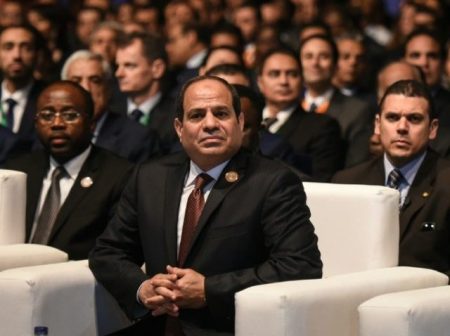
Dr. Jasser joins Intelligence Report discussing the importance of identifying radical Islam

July 2, 2016

Dr. Jasser joins Intelligence Report discussing the importance of identifying radical Islam, AIFD and Fox News via YouTube, July 1, 2016

Stop Importing Jihadists: Sharia Supremacists Have No Right to Enter the U.S.

June 29, 2016

Stop Importing Jihadists: Sharia Supremacists Have No Right to Enter the U.S., BreitbartJim Hanson, June 29, 2016

[T]he practice of Sharia is simply not compatible with life in the U.S. It is also the dividing line between Medieval Islam, with its abhorrent practices such as death for homosexuals; stoning for victims of rape; forced marriages and genital mutilation for girls; and Modern Islam, which could properly be called post-Sharia.

********************

Donald Trump lit off a firestorm with his call for a ban on all Muslims entering the United States. The deadly threat of Islamist terror and the migrant violence in Europe make a ban on Muslim immigration seem like a reasonable solution.

But we have Muslim allies, the King of Jordan for example, who would be affected by such an action. So if banning all Muslims is not the perfect solution, how can we deal with the ones who are a serious problem without alienating our allies?

The Center for Security Policy just released a white paper detailing how to do that entitled “Stop Importing Jihadists: Making Sharia-Supremacism a Bar to Immigration and Naturalization.” It explains how existing laws can be used to stop allowing Muslims from coming to this country who do not share our American values. This does not mean all Muslims, but it is a significant number who believe the totalitarian Islamist code called Sharia should be placed above the U.S. Constitution.

U.S. citizens have rights. But clearly, there are no rights for non-citizens to visit or migrate to the United States. It is a privilege. We need to make sure that anyone coming here doesn’t believe their mission is to bring with them an antiquated and barbaric system to impose on us. We have the authority under current law to stop members of totalitarian ideologies from infiltrating and working to subvert our free system.

The problem is not Muslims per se; it is Islamic Supremacists who push the totalitarian ideology called Sharia. Unfortunately, this is a significant number of Muslims worldwide; a Pew International poll shows more than half of them believe Sharia should be the law of their land. Most also believe this law should apply to non-Muslims, as well. That could hardly be more un-American and we have every right to tell those folks “That’s not how we do things here.”

There are differing versions of Sharia, but they agree that the practice of all aspects of life is governed by the unassailable word of Allah and not one single bit of it may be questioned. That includes an ironclad prohibition on any man-made law superseding Sharia and a requirement for believers to actively work to impose it everywhere. This makes it impossible for a Sharia-adherent Muslim to swear an oath to obey the U.S. Constitution or any other country’s governing document. There can be no agreement to render unto Caesar that which is Caesar’s, Caesar must submit to Allah.

That single fact makes it prudent to restrict immigration by anyone who holds those beliefs. We have done this previously to stop totalitarian communists and fascists from infiltrating with a mind to undermine our society from within. That subversion is actually the very goal articulated by groups such as the Muslim Brotherhood for its operations here in the United States: “The Ikhwan [Muslim Brotherhood] must understand that their work in America is a kind of grand jihad in eliminating and destroying the Western civilization from within and ‘sabotaging’ its miserable house.”

It makes perfect sense to say to a group that wants to destroy us “from within” that “you are not welcome to come in.”

The dividing line we need to use for making policy is Sharia; the practice of Sharia is simply not compatible with life in the U.S. It is also the dividing line between Medieval Islam, with its abhorrent practices such as death for homosexuals; stoning for victims of rape; forced marriages and genital mutilation for girls; and Modern Islam, which could properly be called post-Sharia. The problem is Modern Islam does not truly exist yet. There are Muslims who do not practice or believe in the barbaric acts Sharia requires, but they are technically apostates, defectors of Islam, and the penalty for leaving is death.

The current state of play has members of the medieval form acting as the loudest voices of the “Muslim” community. Those who wish to practice a modern version do so at their own peril: they face shunning at best and death at worst. The medieval practitioners are aided in this effort by vast support; even the U.S. government has embraced them both abroad, by supporting groups like the Muslim Brotherhood, and here at home, in the form of the Council on American-Islamic Relations (CAIR) and others.

Our U.S. government has a responsibility to safeguard this country and our way of life. That includes banning those who wish to destroy us from entering the United States. We must add Sharia to the list of totalitarian ideologies that trigger this prohibition. This will help all Americans including Modern Muslims who just want to live in peace in the land of the free.

Dr. Jasser discusses his testifying before the U.S. Senate & reacting to bombings in Turkey

June 29, 2016

Dr. Jasser discusses his testifying before the U.S. Senate & reacting to bombings in Turkey, Fox News via YouTube


ISIS is a Footnote: The Real Threat is Sharia and Islamic Supremacism

June 29, 2016

ISIS is a Footnote: The Real Threat is Sharia and Islamic Supremacism, CounterjihadShireen Qudosi, June 29, 2016

Dr. Zuhdi Jasser, a top North American Muslim Reformer, sees Muslim reformers “as the most essential head of spear in the battle against Islamic theocracy.” The largest collective of Muslim Reformers are presently in the United States.

“Ideas of freedom can happen in the laboratory of America,” adds Dr. Jasser. The West offers Muslim voices for humanity a level of freedom that is unmatched in any other part of the world, making Western Muslim reformers critical in this battle against radical Islam — particularly because truthful conversations on faith are painted as persecution, courtesy of the regressive left.

**********************

The battle against radical Islam isn’t an ‘over there’ fight confined to the wastebin landscape of some forgotten town. It’s a ubiquitous problem that takes place on American soil in two forms. The first is through direct jihadi attacks as we most recently saw in Orlando; the second takes the form of political warfare.

Yesterday, the battle of ideas took place on the floor of a Senate hearing spearheaded by Senator Ted Cruz. The “Willful Blindness” hearing, attended by Dr. Zuhdi Jasser,Philip Haney, and Andrew McCarthy among others, offered testimony to better understand barriers to combating radical Islam.

Other witnesses included soft-Islamist Farhana Khera, President and Executive Director of Muslim Advocates, who refused to admit that jihad or radicalization had absolutely anything to do with radical Islam. In fact, Senator Cruz’s attempt to engage Khera in dialogue yielded a minimum of 6 instances of denial within five minutes, with Khera defaulting to a regressive left narrative that the conversation is somehow empowering ISIS.

National security consultant Chris Gaubatz debunks the myth of an all-powerful and seeing ISIS:

“The global Islamic movement is made of terrorist groups and nation states; all seeking to impose sharia.”

ISIS is a footnote at best, not the bogeyman that Islamists try to threaten free speech with. The real threat is sharia and a mindset of Islamic supremacism.

Testimony was also provided by Michael German, a fellow of the Brennan Center for Justice and a former FBI Special Agent. German sees radical Islam as a problem but not in the context we would assume is logical based on the facts and common sense. In the same line of thinking as Khera, German denounces a theological association with violent acts of terror under a political doctrine.

German’s reasoning fails. He is neither expert in nor a student of Islamic theology. Had he an objective mind and trained scholar in both academic and traditional Islam, he would see that Islam has become a highly political system that forms and orchestrates national movement. The version of radical Islam adopted by terror groups is not that different than the version of Islam adopted by Islamic states – and to go further – the version of Islam that Islamists identify with. All versions ultimately hold Islam as supreme, paving the way for what is an undeniable theological supremacy. In other words, Islamic supremacy. And that understanding of Islam is adopted by billions of adherents.

In the same vein of thought as Islamists, German believes “radical Islam” is used to smear a faith group. He further argues “collective national security [is not achieved] by undermining security of others.” For German, “Ideas cannot be killed and ideologies cannot be destroyed.” He points to Nazi ideology that while defeated, was not destroyed.

However, radical Islamic ideology can be challenged and destroyed…from within. A growing movement in partnership with allies is already underway by Muslim reformers. Reformers are the new wave of Muslim scholars appearing nearly a millennia after the original Muslim free thinkers, the Mu’tazilites. The waves of movement in Islamic critical thought from the time of the Prophet, through his passing, and till today, shows that Islam is not the monolith German and Khera try to depict.

Andrew McCarthy, a former Chief Assistant U.S. Attorney, understands Islam has seen a struggle to define itself from its earliest days. As McCarthy points out, Muslims “have not settled the question what is an authentic Islam.”

Dr. Zuhdi Jasser, a top North American Muslim Reformer, sees Muslim reformers “as the most essential head of spear in the battle against Islamic theocracy.” The largest collective of Muslim Reformers are presently in the United States.

“Ideas of freedom can happen in the laboratory of America,” adds Dr. Jasser. The West offers Muslim voices for humanity a level of freedom that is unmatched in any other part of the world, making Western Muslim reformers critical in this battle against radical Islam — particularly because truthful conversations on faith are painted as persecution, courtesy of the regressive left.

For McCarthy, the focus needs to shift to the supremacist interpretation of Islam that is fundamentally at odds with Western values. A clash of civilizations between Islam and the West is not a case of multiculturalism where room can be made for both. Islamic supremacism in its nature allows for only one ideology: its own.

So while German underscores that radical Islam is not a problem – that it is a misnomer – McCarthy points to history which shows us something entirely different. He summarizes that a struggle in Islam has been “ongoing for fourteen centuries supported by centuries of scholarship,” adding that “Islam is less a religion than a political radicalization with a religious veneer.”

McCarthy doesn’t see this as something the U.S. can fix, but it is something that we need to understand and not obscure – particularly because as Chris Gaubatz added, “We can kill every member of Al-Qaeda tomorrow, but it won’t end.”

Zuhdi Jasser added that America has “a sophisticated whack-a-mole system” of combatting terrorism. These are key assessment recognizing that ultimately we need to target the ideology and develop a system that moves beyond a fear of might trigger ISIS – a running theme for both Khera and German.

Khera along with German were both supported by Senator Dick Durbin who brought up a failed ongoing argument that needs to die: Westboro and the KKK are no more Christian than ISIS is Islamic. A cheap, tired trick, it shows a fundamental lack of knowledge about both Islam and Christianity.

Westboro and KKK are not acting in the footsteps of Jesus. However, ISIS is in many ways following the post-Medina violent warring behavior of its prophet, Muhammad. If we’re to see whether something is Islamic or Christian, we need to look at the verses and the leadership. Christianity did not have a violent Jesus and the teachings of Christ himself do not advocate violence. On the other hand, Islam has a violent version of Muhamad, which however justified in whatever context, is still violent and includes violent rhetoric that justified jihadi and supremacist agendas.

Germans builds on the back and forth highlighting Nazi Germany was defeated in part by criminalizing the ideology, something he feels can’t be done with Islam because the ideology can’t be scrubbed. I would argue we’ve already scrubbed so much: over 900 instances of references to jihad and Islam from official documents in what is a systematic purge of intelligence in a critical war.

Let’s go further still and get to the actual problem: the ideology. We need to do the same to political and violent doctrines in Islam, while supporting alternate voices found in reformers who are well on their way by outrightly challenging the theology or through grassroots efforts calling for modernized adaptations.


When Hate is Promoted by Religious Leaders, Why Blame the Followers?

June 27, 2016

When Hate is Promoted by Religious Leaders, Why Blame the Followers? Gatestone InstituteRaheel Raza, June 27, 2016

♦ Imam Abdullah Hakim Quick then goes on to connect being gay with Zionism — his anti-Semitic sentiments at their best. All this while standing at a pulpit. If this is not a crime of hate, then what is? Does this imam have nothing positive to speak about in his sermon, besides spreading the Islamist agenda of hate and bigotry?

♦ For years we have warned of the messages of hate emanating from the pulpit. We have spoken of the two different messages being given — one to the public and one in private.

♦ Why then do we act surprised when the Omar Mateens of the world take up arms and ruthlessly gun down an entire group of gays? This is what they are being taught by the likes of Imam Quick. They are acting out the hate that has been instilled in their minds and hearts.

♦ In the aftermath of the bloodbath created by Omar Mateen at the Pulse nightclub in Orlando, Florida, a plethora of opinions, ideas and causes have been spoken about. At the same time, a very disturbing picture about a specific aspect of this hateful ideology of Islamists has emerged. In my opinion, there is no doubt that Mateen was an Islamist influenced by the jihadist agenda of fanatic hate for the gay communities.

For those of us reform-minded Muslims who have been battling the rise in radical Islamist agendas for the past decade, this development is no surprise. In our declaration, we say right at the top:

“We reject bigotry, oppression and violence against all people based on any prejudice, including ethnicity, gender, language, belief, religion, sexual orientation and gender expression.”

Why did we include this line in our message? Because we know of the hate that is directed towards the LGBTQ communities in Muslim lands. In Iran, thousands of gays have been executed; in Afghanistan, the Taliban bury them alive; in Saudi Arabia they are liable for death, and in other Muslim countries they are persecuted and abused if they admit to the preference.

One can always say that this is happening out there someplace else. We in North American pride ourselves on freedom of expression and tolerance towards those following a different lifestyle. We would never expect hate against others to be promoted in a liberal democracy.

However, not everyone in Canada thinks as we do. In our own hometown of pluralistic Toronto, hate against the LQBTQ community is alive and well.

Abdullah Hakim Quick is a Toronto imam who writes on his website:

“I have always stood against racism and ethnocentrism. I have been a lifelong advocate of women’s rights and for decades have encouraged the empowerment of young people. I pioneered the first social service agency for Muslims in Toronto, Canada (I.S.S.R.A.) whose doors were open to all — rich and poor, Muslim and non-Muslim, gay or straight. As a counselor I learned first-hand of the terrible violence inflicted upon gay people by bullies and I publicly spoke out against it….”

Yet in a YouTube video, the same Imam Quick says:

“… they said ‘What is the position of Islam on homosexuality?’ — they asked me this. This is a newspaper, right. So I said ‘Put my name in the paper. The position is death.’ And we cannot change Islam.”

Furthermore, Quick goes on openly to ridicule the Toronto gay community known as Salaam Canada. Many of them are my friends and I respect them. They have suffered at the hands of Islamists and felt they were safe in a city like Toronto. Not so anymore, and my heart goes out to them.

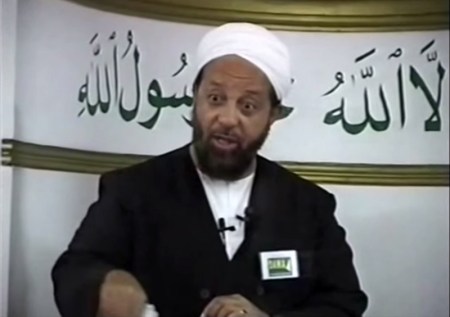
1668Abdullah Hakim Quick, a Toronto imam, makes a speech where he gives his answer to the position of Islam on homosexuality: “The position is death.” (Image source: TIFRIB video screenshot)

Mr. Quick then goes on to connect being gay with Zionism — his anti-Semitic sentiments at their best. All this while standing at a pulpit. If this is not a crime of hate, then what is? Does this imam have nothing positive to speak about in his sermon?

The point is that not only is he lying on his website, but he is spreading the Islamist agenda of hate and bigotry. He is also spouting an opinion that is not in the Quran. While the Quran (like other Abrahamic scriptures) does not condone homosexuality, there is no injunction to kill gays. However, because he is an imam and an imam is supposed to be knowledgeable, no one challenges him. Therefore, his opinion on gays (derived from sharia and concocted hadeeth perhaps) is that death is the solution for gays.

He’s not the only one. Not long ago, Florida religious scholar Shaykh Farrokh said gently but with conviction in a speech “death is the sentence. There’s nothing to be embarrassed about. Death is the sentence.” He goes on to explain that killing gays is an act of compassion.

Why then do we act surprised when the Omar Mateens of the world take up arms and ruthlessly gun down an entire group of gays? This is what they are being taught by the likes of Imam Abdullah Hakim Quick. They are acting out the hate that has been instilled in their minds and hearts.

For years, we have warned of the messages of hate emanating from the pulpit. We have spoken of the two different messages being given — one to the public and one in private. Well, we live in a world where the two are meshed and the culprits need to be exposed. It is time Muslims knew what their religious leaders are saying and promoting from the pulpit.

Is this what we want our youth to hear? If not, what are we doing about it?