Archive for the ‘Islamic jihad’ category

Aiding Islamic Terrorists Is Our Foreign Policy

February 20, 2015

Aiding Islamic Terrorists Is Our Foreign Policy, Front Page Magazine, Daniel Greenfield, February 20, 2015

s3tttf7n-14138040081-370x350

In the White House, Obama has tried to shape an Islamist future for the Middle East, favoring Islamist governments in Turkey and Islamist movements such as the Muslim Brotherhood. He saw his role as paving the way for the next generation of regional regimes that would be explicitly Islamist.Obama’s foreign policy in the region has been an elaborate exercise in trying to draw up new maps for a caliphate. The inclusion of terrorist groups in this program isn’t a mistake. It’s not naiveté or blindness. It’s the whole point of the exercise which was to transform terrorist groups into governments.

Obama’s foreign policy in the region has been an elaborate exercise in trying to draw up new maps for a caliphate. The inclusion of terrorist groups in this program isn’t a mistake. It’s not naiveté or blindness. It’s the whole point of the exercise which was to transform terrorist groups into governments.

******************

Obama says that we are not fighting a war on Islam. What he leaves out is that under his administration the United States is fighting in a civil war that is taking place within Islam.

It’s not a conflict between the proverbial moderate Muslim and the raging fanatic. That was an outdated Bush era notion. Instead Obama has brought us into a fight between Muslim governments and Muslim terrorists, not on the side of the governments we were allied with, but on the side of the terrorists.

It’s why Egypt is shopping for French planes and Russian nukes. Yemen’s government was run out of town by Obama’s new Iranian friends in a proxy war with Saudi Arabia. And the Saudis are dumping oil.

Iran and Qatar are the regional powers Obama is closest to. What these two countries have in common, is that despite their mutual hostility, they are both international state sponsors of Islamic terrorism.

Obama’s diplomats will be negotiating with the Taliban in Qatar. Among the Taliban delegation will be the terrorist leaders that Obama freed from Gitmo. And Iran gets anything it wants, from Yemen to the bomb, by using the threat of walking away in a huff from the hoax nuclear negotiations as leverage.

In Syria and Iraq, Obama is fighting ISIS alongside Islamic terrorists linked to Al Qaeda and Iran. In Libya, he overthrew a government in support of Islamic terrorists. His administration has spoken out against Egyptian air strikes against the Islamic State Jihadists in Libya who had beheaded Coptic Christians.

At the prayer breakfast where he denounced Christianity for the Crusades was the foreign minister of the Muslim Brotherhood government of Sudan that has massacred Christians. Unlike Libya, where Obama used a false claim of genocide to justify an illegal war, Sudan actually has committed genocide. And yet Obama ruled out using force against Sudan’s genocide even while he was running for office.

The United States now has a strange two-tier relationship with the Middle East. On paper we retain a number of traditional alliances with old allies such as Egypt, Israel and Saudi Arabia, complete with arms sales, foreign aid and florid speeches. But when it comes to policy, our new friends are the terrorists.

American foreign policy is no longer guided by national interests. Our allies have no input in it. It is shaped around the whims of Qatar and Iran; it’s guided by the Muslim Brotherhood and defined by the interests of state sponsors of terror. Our foreign policy is a policy of aiding Islamic terrorists.

It’s only a question of which terrorists.

Obama’s familiar argument is that ISIS and Al Qaeda fighters shouldn’t be called Islamic terrorists. Not even the politically correct sop of “Radical Islam” is acceptable. The terrorists are perverting Islam, he claims. The claim was banal even before September 11, but it bears an entirely new significance from an administration that has put Muslim Brotherhood operatives into key positions.

The administration is asserting the power to decide who is a Muslim. It’s a theological position that means it is taking sides in a Muslim civil war between Islamists.

This position is passed off as a strategy for undermining the terrorists. Refusing to call the Islamic State by its name, using the more derogatory “Daesh,” denying that the Islamic terrorists are acting in the name of Islam, is supposed to inhibit recruitment. This claim is made despite the flood of Muslims leaving the West to join ISIS. If any group should be vulnerable to our propaganda, it should be them.

But that’s not what this is really about.

According recognition to a state is a powerful diplomatic tool for shaping world politics. We refuse to recognize ISIS, as we initially refused to recognize the USSR. Obama resumed diplomatic ties with Cuba. His people negotiate and appease the Taliban even though it was in its own time just as brutal as ISIS.

Obama is not willing to recognize ISIS as Islamic, but he does recognize the Muslim Brotherhood as Islamic. Both are violent and murderous Islamists. But only one of them is “legitimate” in his eyes.

Those choices are not about terrorist recruitment, but about building a particular map of the region. Obama refuses to concede that ISIS is Islamic, not because he worries that it will bring them more followers, this is a tertiary long shot at best, but because he is supporting some of their rivals.

The White House Summit on Countering Violent Extremism has brought a covert strategy out into the spotlight. Despite its name, it’s not countering violence or extremism.

The new director of the Center for Strategic Counterterrorism Communications, the axis of Obama’s CVE strategy, is Rashad Hussain who appeared at Muslim Brotherhood front group events and defended the head of Islamic Jihad. In attendance was Salam Al-Marayati of the Muslim Public Affairs Council, yet another Muslim Brotherhood linked group, who had urged Muslims not to cooperate with the FBI and defended Hamas and Hezbollah.

In Syria, the United States is coordinating with Assad and backing the Syrian rebels, who have their own extensive ties to the Muslim Brotherhood and even Al Qaeda. This could be viewed as an “enemy of my enemy” alliance, but this administration backed the Brotherhood before it viewed ISIS as a threat. Top Democrats, including Nancy Pelosi and John Kerry, had focused on outreach to Assad under Bush.

They’re not allying with Assad and the Brotherhood to beat ISIS. They’re fighting ISIS to protect the Brotherhood and their deal with Iran.

In the White House, Obama has tried to shape an Islamist future for the Middle East, favoring Islamist governments in Turkey and Islamist movements such as the Muslim Brotherhood. He saw his role as paving the way for the next generation of regional regimes that would be explicitly Islamist.

The Arab Spring was a deceptive code name for a clean sweep that would push out the old leaders like Mubarak and replace them with the Muslim Brotherhood and other likeminded Islamists. Islamic terrorism, at least against the United States, would end because their mission had been accomplished.

Stabilizing unrest by putting the destabilizers in charge wasn’t a new idea. Carter helped make it happen in Iran. And the more violent an Islamic terrorist group is, the more important it is to find a way to stop the violence by putting them in charge. The only two criteria that matter are violence and dialogue.

So why isn’t Obama talking to ISIS? Because ISIS won’t talk back. It’s impossible to support a terrorist group that won’t engage in dialogue. If ISIS were to indicate any willingness to negotiate, diplomats would be sitting around a table with headchoppers in less time than it takes a Jordanian pilot to burn.

And that still might happen.

Obama isn’t trying to finish off ISIS. He’s keeping them on the ropes the way that he did the Taliban. Over 2,000 Americans died on the off chance that the Taliban would agree to the negotiations in Qatar. Compared to that price in blood, the Bergdahl deal was small potatoes. And if Obama is negotiating with the Taliban after all that, is there any doubt that he would negotiate to integrate ISIS into Iraq and Syria?

Obama’s foreign policy in the region has been an elaborate exercise in trying to draw up new maps for a caliphate. The inclusion of terrorist groups in this program isn’t a mistake. It’s not naiveté or blindness. It’s the whole point of the exercise which was to transform terrorist groups into governments.

Stabilizing the region by turning terrorists into governments may sound like pouring oil on a fire, but to progressives who believe in root causes, rather than winning wars, violence is a symptom of discontent. The problem isn’t the suicide bomber. It’s our power structure. Tear that down, as Obama tried to do in Cairo, and the terrorists no longer have anything to fight against because we aren’t in their way.

Bush tried to build up civil society to choke off terrorism. Obama builds civil society around terrorists.

Obama does not believe that the terrorists are the problem. He believes that we are the problem. His foreign policy is not about fighting Islamic terrorists. It is about destroying our power to stop them.

He isn’t fighting terrorists. He’s fighting us.

Humor: Organizing for Action will help lead Obama’s war on violent extremism

February 19, 2015

Organizing for Action will help lead Obama’s war on violent extremism, Dan Miller’s Blog, Senator Ima Librul, imaginary guest author, and Dan Miller, February 19,2015

(The views expressed in this article are mine and those of my (imaginary) guest author, Senator Ima Librul. They do not necessarily reflect the views of Warsclerotic or any of its other editors. — DM)

Editor’s note: This is another post by my (imaginary) guest author, the Very Honorable Ima Librul, Senator from the great State of Confusion Utopia. He is a founding member of CCCEB (Climate Change Causes Everything Bad), a charter member of President Obama’s Go For it Team, a senior member of the Senate Foreign Relations Committee and Chairman of the Meretricious Relations Subcommittee. 

Senator Librul is also justly proud of his expertise in interfaith dialogue, on the basis of which he has explained to the entire world that Islam is the religion of peace, grossly distorted by the non-Islamic Islamic State and other textual deviants. He was recently awarded the Obama Foundation’s cherished award for exemplary political correctness on the basis of his interfaith outreach. We are humiliated honored to have a post of this caliber by a quintessential Librul such as the Senator. Without further delay, here is the Senator’s article.

*********************

The Non-Islamic Islamic State and its equally non-Islamic cohorts can be defeated only through the heroic efforts of community organizers: they are needed to help members and potential recruits find jobs and happiness. Our Dear Leader Obama cannot do everything Himself, even with His pen and His phone.

Organizing for Action logo 1

A spokesperson for the State Department recently announced that murdering affiliates of the non-Islamic State and other violent non-Islamic organizations will not end violent extremism. Instead compassion, particularly in providing suitable jobs and pathways to happiness and ultimately to true enlightenment, are needed.

Our Dear Leader is working tirelessly on just that, but even He needs help.

CAIR and Muslim Brotherhood

Many violent right wing terrorists — substantial numbers of them extremist Christians and Jews — have complained that our Dear Leader has sought help from benign Islamic organizations, such as the Council on American-Islam Relations (CAIR) and Muslim Brotherhood affiliates, to help win His war on violent extremism. Those organizations, and their members, have been among the victims of violent Islamophobia for years. Along with their successful efforts to organize Muslim communities, they have begun to emulate our Dear Leader in dealing with the curse of Islamophobia.

Islamophobia is the worst threat (other than climate change) now facing humanity and can cause even peaceful but depressed Muslims to become violent; even to become extremists. It can also enrage others, who also claim to be Islamic but are not, to intensify their violent extremism. Similarly, falsely characterizing violent extremists as Islamic gives them a false patina of legitimacy and encourages poor, ignorant savages Muslims to accept them as truly Islamic and hence to join them. That is among the reasons why our Dear Leader has steadfastly refused to do so.

candy-war

CAIR, various Muslim Brotherhood affiliates and Organizing for Action are joining with our Dear Leader to fight on our behalf. We already know that CAIR is dedicated to thwarting Islamophobes who falsely accuse Islam of being violent and that the Muslim Brotherhood is dedicated only to promoting true brotherhood for all. Hence, the focus of this article will be on Organizing for Action.

Organizing for Action

The membership of this highly valued organization is diverse, but many members have been involved since early childhood. The following video is so inspiring that I find myself in tears every morning when I watch it to give me the strength I need to continue my fight against all evil forces.

As they and other kindred spirits have matured, their devotion to our Dear Leader has increased. They are now, and will continue to be, at the forefront of Organizing for Action. They applaud His righteous stand against Islamophobia and will now extend their efforts beyond what little is left of the Obama Nation’s borders to bring peace and understanding to those most in need.

The Non-Islamic State and its non-Islamic cohorts have mistakenly taken refuge in grossly distorted perceptions of Islam to justify their senseless, random violence. Only by  awakening their adherents to the need to promote social justice, social progress and community service will they be led to the proper understanding of the Religion of Peace. The best way to accomplish this is by teaching them useful skills — vegan cookery, nursing, barbering, knife sharpening, business management, computer programming and Islamic sign language, for example. As they become increasingly aware of the benefits these skills will provide to them and to others, they will support their own governments in providing freedom, security, prosperity and health care for all. Free, or at least affordable, government mandated health care for all will come to be seen as their most urgent need. They will also gain the skills needed to implement their own versions of health care. No longer poor, sick and depressed they will become our friends.

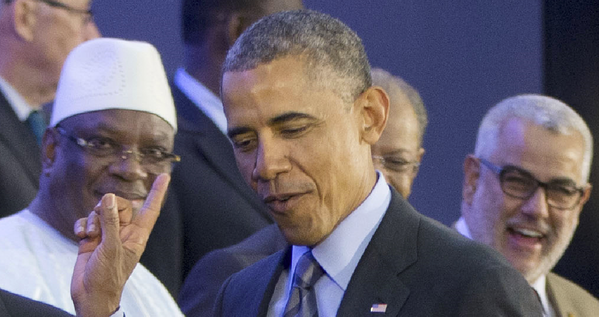
Although fluency in the use of Islamic sign language will be very important, most Organizing for Action volunteers have not learned much Arabic. Sign language is easier, and our Dear Leader Himself will provide much of the necessary instruction. Here is a recent photo of Him expressing His vision of true Islamic peace to other Islamic leaders.

194109_5_

Here is a close up of His beautiful gesture:

194113_5_

Here is a photo of random Muslims returning His gesture of peace that passeth all understanding:

issi-finger-salute

Although our Dear Leader has tried to use similar but different sign language in dealing with His disloyal opposition — violent right wing tea party terrorists all — they have rejected His conciliatory efforts.

194111_5_

We are truly blessed to have Dear Leader Obama in charge of our national destiny; all patriotic Americans must give Him their unstinting support. He is the way, the truth and the light unto all ages; all who oppose Him must convert or be silenced.

Editor’s comments:

deceased victim of IS

Senator Librul has done a masterful job of presenting his and Obama’s views of Islam and how best to deal with it. Absurd, but that’s their custom.

jobs for jihadists

In the following video, Pat Condell explains a big factor in Muslim unemployment:

Would better job skills ameliorate any of these problems?

As observed in a February 18th Wall Street Journal article titled The radicals are waging a war of ideas the West refuses to fight,

Above all, we need to recognize that the strength of radical Islamists is directly correlated to their battlefield success, and the growing perception that they are the strong horse against moderate Muslim leaders. Communist ideology lost its appeal when it was seen to fail against the prosperity and freedom of the West. Islamic State will lose its allure when it is defeated and humiliated in the arena it cares about most, which is the battlefield. Mr. Obama and other Western leaders must summon the will to win the war on the ground, or they will find themselves in permanent retreat in the war of ideas. [Emphasis added.]

After we and our allies had defeated Nazi Germany and Japan militarily, we tried to rebuild them substantially in our own image. Recognizing that Russia had been, at best, a temporary ally of convenience, and that our real allies lacked the necessary resources, we alone rebuilt Japan. The decision to exclude Russia — which wanted to “help” — from Japan was General MacArthur’s baby. Our reconstruction of Japan was far more successful than the reconstruction of Germany, which became Communist East and democratic West Germany. The points are, (1) first defeat them militarily and only then help them to recover and prosper; (2) don’t allow our enemies to “help.”

Islam is itself “extreme.” It is based on the Hadith, Sharia law and the Koran as Allah “dictated” it to Mohamed as he became a powerful warlord. Since Muslims believe that the Koran is the word of Allah, only Allah can change or interpret it. Not even Obama can do it. Hence, under the doctrine of abrogation, Allah’s later words rejected and displaced earlier conciliatory and contradictory passages, which therefore warrant no Muslim adherence. Nor is Islamic violence “random” or “senseless.” It is directed, purposefully, against those viewed as its enemies — non-Islamists and other Islamists of different brands. Until those in control of western governments realize at least these three points — and behave accordingly —  we will continue to lose the battle against Islam.

Truly secular Muslims are not a significant part of the root problem; religious Muslims are. Yet Obama’s convocation of Muslim leaders includes few if any secular Muslims. By proclaiming that the Islamic State and its cohorts in their war against what’s left of Western civilization are not Islamic, Obama will not precipitate an Islamic reformation. Similarly, no matter how often I may state that my stallion is a mare, I will not succeed in milking it; at best, I will only irritate it. More likely it will try to kill me; if I persist, it may well succeed. On balance, I need to reject any notion that I can milk my stallion and recognize it for what it is.

Senator Librul maintains that Islam is the religion of peace. It is, in its own way. Islamic peace comes through submission to whatever brand of Islam is in power; without submission there is no peace. Leaving aside the problems this presents for Christians, Jews, and other non-Muslims, the various brands of Islam are hostile to each other and seek submission of those others through violence. Until, if ever, non-secular Muslims become secular or cease to exist that problem will persist. Nothing in Obama’s “war on violent extremism” is calculated, or likely, to achieve that end– even assuming that that is what He wants to happen.

UPDATE, with a hat tip to Iburt at Counter Jihad Report.

Obama defends Islam at all cost

February 18, 2015

Obama defends Islam at all cost, American ThinkerCarol Brown, February 18, 2015

Think about it. Have you ever heard Obama criticize Islam? I never have.

[W]hen three individuals who were Muslim were recently shot in North Carolina in a crime that local police have not identified as a hate crime, Obama stated: “No one in the United States of America should ever be targeted because of who they are, what they look like, or how they worship.”

****************

How President Obama responds to events around him appears to be dictated by a highly specific set of rules, all of which fall within under broad umbrella of disdain for America. In this way, every word he speaks (and those he refuses to say) and every action he takes (as well as those he avoids) unfolds in a predictable, if not also menacing manner.

  • Demonize the wealthy. (Unless the wealthy person is a Democratic Party supporter.)
  • Blame white people and the United States for bad things that have happened, are happening, and may happen to black people. (Unless a black person is the victim of jihad, in which case Obama will not use the event to stoke racial hatred. Protecting Islam trumps the chip on his shoulder regarding black victimhood.)
  • Defend Islam while never defending any other religion. Toward that end, denigration of Christians and/or Jews is permitted.

It seems like a long time ago that Colleen Hufford was the victim of a savage jihadist attack when a devout Muslim sliced off her head. But it was just a few months ago. And if you recall, after the attack Obama had no comment. None.

At least not about Colleen Hufford. Or jihad. He did, however, have a comment that was so important the message was hand-delivered and read aloud to members of the Islamic Society of Greater Oklahoma City where Obama expressed his sympathy for what a rough month the Muslim community had following the attack while offering thanks to all of them.

Beyond that, Obama remained silent on the matter, deferring to the FBI.

Of course he did not follow that script after Michael Brown was shot in Ferguson. Oh no. Obama, Eric Holder, and all the rest weighed in immediately and kept weighing for what seemed like forever.

Standard operating procedure for the Obama administration – something we saw on full display when earlier this month Jen Psaki would not say that the terror attack that killed four Jews at a kosher market in France was an act of anti-Semitism. Instead, the administration claimed the entire affair was random and deferred to French authorities to determine the pesky details of motive and truth.

Once again, just as the administration deferred to the FBI after Hufford was slain, they deferred to some other party – in this case the French authorities. And this may well sound official to those who lack critical thinking. It may even come across as sound, wise, appropriate, and even presidential.

But of course it’s all hogwash. The knee jerk over-reaction to certain things, the under-reaction to other things, and the distraction techniques they employ are all by design.

And the design was crystal clear when, earlier this month, as part of Obama’s desperate drive to absolve Islam of any responsibility for the murderous brutality that is unfolding around the world, he had the audacity to say that the media overstates the threat of terrorism. He accused the media of exploiting terrorism because “if it bleeds, it leads.”

He spoke as if referring to ambulance chasing coverage by a tabloid magazine. It was appalling to realize this man-child was talking about coverage of genocide. Of institutionalized kidnapping, rape, torture, and all manner of barbarity under the banner of the religion he seems to love so very dearly.

Depraved does not even begin to describe Obama’s words.

When reality does not fit his script, there is no depth to which he will not sink. We have seen this play out over and over again. His determination to turn the public eye away from the awful truth before us is relentless.

It is sick. And it feels sick to be exposed to it, to him, and the abject evil he seems to embody.

This sickness has been playing out for years, though with two years left to his presidency, Obama seems to be pulling out all the stops as he utilizes a variety of ways to defend Islam. Including when he does and does not jump to conclusions.

As Daniel Greenfield recently wrote in Front Page Magazine: “When Muslims kill Americans, then Obama is all about not jumping to conclusions.”

Greenfield noted that after the Boston Marathon bombing Obama stated: “We still do not know who did this or why and people shouldn’t jump to conclusions before they have all the facts.” And after the Fort Hood massacre, Obama stated: “We don’t know all the answers yet and I would caution against jumping to conclusions until we have all the facts.” And yet, when three individuals who were Muslim were recently shot in North Carolina in a crime that local police have not identified as a hate crime, Obama stated: “No one in the United States of America should ever be targeted because of who they are, what they look like, or how they worship.”

Then, last week, ISIS beheaded 21 Egyptian Coptic Christians in Libya. And just as Obama refused to acknowledge that four Jews who were murdered in the kosher market in Paris were targeted because they were Jews, Obama refused to identify the faith of the victims in Libya, as if they were targeted because they were Egyptian. The full statement put out by the White House reads:

The United States condemns the despicable and cowardly murder of twenty-one Egyptian citizens in Libya by ISIL-affiliated terrorists. We offer our condolences to the families of the victims and our support to the Egyptian government and people as they grieve for their fellow citizens. ISIL’s barbarity knows no bounds. It is unconstrained by faith, sect, or ethnicity. This wanton killing of innocents is just the most recent of the many vicious acts perpetrated by ISIL-affiliated terrorists against the people of the region, including the murders of dozens of Egyptian soldiers in the Sinai, which only further galvanizes the international community to unite against ISIL.

This heinous act once again underscores the urgent need for a political resolution to the conflict in Libya, the continuation of which only benefits terrorist groups, including ISIL. We call on all Libyans to strongly reject this and all acts of terrorism and to unite in the face of this shared and growing threat. We continue to strongly support the efforts of the United Nations Special Representative of the Secretary-General Bernardino Leon to facilitate formation of a national unity government and help foster a political solution in Libya.

“Twenty-one Egyptian citizens.” Never mind that the video ISIS made of the barbaric murders identified the victims by their faith. Per a report at Reuters:

A caption on the five-minute video read: “The people of the cross, followers of the hostile Egyptian church.” Before the killings, one of the militants stood with a knife in his hand and said: “Safety for you crusaders is something you can only wish for.”

(“Crusaders.” Where have I heard that reference in the recent past?)

Obama’s omission of the victims’ religion was not the only glaring confirmation of the nature of the man-child in the oval office. His statement that ISIS “is unconstrained by faith, sect, or ethnicity” was also telling since ISIS is absolutely constrained by (and motivated by) faith: the Islamic faith.

Once again, Obama used words (those said and those not said) to suggest that the daily jihadist bloodbath is some mysterious, amorphous, inexplicable horror. And in this way, he defends Islam by not implicating it in any of the hell on earth we are bearing witness to.

Think about it. Have you ever heard Obama criticize Islam? I never have.

Col. Ralph Peters had a pointed comment on this very thing recently when he said: “Look at the facts. The only religion this president is willing to come out and defend is Islam.”

It’s so patently obvious. And yet the media scarcely raises the issue.

Meanwhile, when Chris Matthews interviewed State Department Spokesperson Marie Harf Monday, she went on record saying that we can’t win the war by killing ISIS.

Why not? And what, pray tell does she suggest? She suggests that we try to figure out the root cause for why people join ISIS.

OK. That shouldn’t be too hard. Except we’re dealing with the Obama administration, so of course the glaring truth will be avoided at all cost. And so the hypothesis for the root cause is: poverty, lack of jobs, and lack of opportunity.

I have an idea. How about we tell the truth? How about if we say what the root cause is? How about if we point to the Quran and read some relevant excerpts so everyone can connect the dots? And how about if, in addition to identifying the root cause, we also kill as many terrorists as we possibly can?

Every time there is a terror attack, every time the violent teachings of the Quran play out on the world stage, every time the media engages in malpractice by not doing their research and informing the public, and every time the president of the United States defends Islam, the entire world is that much more at risk – each and every one of our lives is put in increased danger.

Whoever would have imagined that the President of the United States would be facilitating terror? And whoever would have imagined that such a person would be elected not once. But twice.

None of this may be news to most readers. But it will likely be news to some. Please help others understand.

May the victims of jihad rest in peace and may their deaths not be in vain.


Airborne Girl’s Guide to Islam & Its Abuse of Women

February 18, 2015

Airborne Girl’s Guide to Islam & Its Abuse of Women, Blackfive, February 18, 2015

Right in time for President Obama’s extremist-riddled Countering Violent Extremism Summit comes an honest report on the horrific treatment of women in Islamic states. It starts with the abuse she suffered personally at the hands, and gun barrels, of our supposed allies the Saudis during the First Gulf War. But the real issue is the infiltration of this oppressive and backwards culture into free western society. For every “strong” woman telling the press how wearing a veil empowers her, there are dozens in the shadows being beaten, forced into arranged marriages and dying in “honor” killings.


Sen. Ted Cruz at Defeat Jihad Summit

February 14, 2015

Sen. Ted Cruz at Defeat Jihad Summit, You Tube, February 12, 2015


“Extremist” Islam is not extreme.

February 13, 2015

“Extremist” Islam is not extreme, Dan Miller’s Blog, Dan Miller, February 13, 2015

(The views expressed in this article are mine and do not necessarily reflect those of Warsclerotic or its other editors. — DM)

“Extremist” Muslims believe that the Koran and the Hadith must be taken literally and that Sharia law, rather than “man made” law, must control everyone. Secular Muslims seem to disagree or not to be very interested. “Extremist” Roman Catholics believe that birth control, abortion and pre-marital sex are sinful and oppose governmental support for them. Secular Roman Catholics seem to disagree or not to be very interested. 

“Extremist” Muslims are “literalist,” because they believe that the Koran is the word of Allah as faithfully transcribed by Mohamed, his messenger, and that there is no room for interpretation. The many conflicting verses in the Koran present a problem.

Rather than explain away inconsistencies in passages regulating the Muslim community, many jurists acknowledge the differences but accept that latter verses trump earlier verses. Most scholars divide the Qur’an into verses revealed by Muhammad in Mecca when his community of followers was weak and more inclined to compromise, and those revealed in Medina, where Muhammad’s strength grew. [Emphasis added, footnotes omitted.]

Classical scholars argued that anyone who studied the Qur’an without having mastered the doctrine of abrogation would be “deficient.” Those who do not accept abrogation fall outside the mainstream and, perhaps, even the religion itself.  [Emphasis added.]

Islamist literalism coupled with abrogation now has temporal, and often fatal, consequences for non-Muslims as well as for “apostate” Muslims because, as Mohammad grew stronger, his words became stronger and more violent toward apostates and other non-believers.

According to an article titled “What is Islam?” Revisited by Father James V. Schall, S.J., posted at Catholic World Report on January 8th,

Islam considers itself the only true religion. It has a “narrative” of itself that all branches of Islam hold, although they differ somewhat on how it is to be achieved. [Emphasis added.]

. . . .

In the Quran, there is no mention of the Trinity or Incarnation, except explicitly to deny them. It is blasphemy to believe in them, as well as to question anything connected with the Quran. Allah intends the whole world to observe the Sharia, the Muslim legal code, observing its letter. As soon as it can, this law is imposed in every Muslim land or smaller community, even in democratic states. No distinction between Islam and the state exists. Everyone is born a Muslim. If he is not a Muslim, it is because his parents or teachers corrupted him. It is impossible to convert from Islam to another religion, without grave, often lethal, consequences. [Emphasis added.]

It is not against the Quran to use violence to spread or enforce Islamic law. Those Islam conquers, even from its beginnings till now, it either kills, forces conversion, or imposes second class citizenship. The Islamic State, now so much to the forefront, seems to have the correct understanding of what the Quran intends and advocates.  [Emphasis added.]

. . . .

Dialogue is looked upon as a sign of weakness unless it can be used to further Muslim goals. In the case of the killings that Coren lists, if they are looked upon as legitimate means, there is no need either to talk about them or to cease their presumed effectiveness in spreading Islam. One cannot really appeal to the Quran to cease these killings, as there is ample reason within it to justify them as worthy means. Had it not been possible to justify these means in the Quran, the whole history of Islam would be different. Indeed, it probably never would have expanded at all. [Emphasis added.]

Similarly, “extremist” Christians can be characterized as “literalist” because they believe, for example, that Jesus was literally conceived immaculately and literally ascended bodily into Heaven. These views now have no deadly temporal consequences for Christians or anyone else.

As for the crusades and the inquisition, which Obama used to try to divert our attention from Islam,

Obama - crusades

Islam is the only religion the textual core of which actively and unequivocally defames other religions.

Blasphemy

Soon after Muslim gunmen killed 12 people at Charlie Hebdo offices, which published satirical caricatures of Muslim prophet Muhammad, the Organization of Islamic Cooperation (OIC)—the “collective voice of the Muslim world” and second largest inter-governmental organization after the United Nations—is again renewing calls for the United Nations to criminalize “blasphemy” against Islam, or what it more ecumenically calls, the “defamation of religions.”

To ban “defamation” of Islam —  in reality to ban accurate factual analyses of its core tenets — is to engage in jihad via lawfare with the help of non-Islamic nations, including Obama’s America, while violent Islamic jihad against all religions except “true” versions of Islam continues apace.

Yet the OIC seems to miss one grand irony: if international laws would ban cartoons, books, and films on the basis that they defame Islam, they would also, by logical extension, have to ban the entire religion of Islam itself—the only religion whose core texts actively and unequivocally defame other religions, including by name. [Emphasis added.]

For example,

Consider Christianity alone: Koran 5:73 declares that “Infidels are they who say God is one of three,” a reference to the Christian Trinity; Koran 5:72 says “Infidels are they who say God is the Christ, [Jesus] son of Mary”; and Koran 9:30 complains that “the Christians say the Christ is the son of God … may God’s curse be upon them!”

. . . .

[T]he Christian Cross, venerated among millions, is depicted—is defamed—in Islam: according to canonical hadiths, when he returns, Jesus (“Prophet Isa”) will destroy all crosses; and Muhammad, who never allowed the cross in his presence, once ordered someone wearing a cross to “throw away this piece of idol from yourself.” Unsurprisingly, the cross is banned and often destroyed whenever visible in many Muslim countries.

Reforming Islam

Egyptian President al-Sisi — who appears to be a fairly secular Muslim — told Muslim clerics in Cairo on New Years Day (on or about the date when Mohamed’s birthday is celebrated) that Islam needs to be reformed, substantially. He “accused Islamic thinking of being the scourge of humanity—in words that no Western leader would dare utter.” Following his address,

Sisi went to the St. Mark Coptic Cathedral during Christmas Eve Mass to offer Egypt’s Christian minority his congratulations and well wishing. Here again he made history as the first Egyptian president to enter a church during Christmas mass—a thing vehemently criticized by the nation’s Islamists, including the Salafi party (Islamic law bans well wishing to non-Muslims on their religious celebrations, which is why earlier presidents—Nasser, Sadat, Mubarak, and of course Morsi—never attended Christmas mass). [Emphasis added.]

(Under the Coptic calendar, Christmas falls on January 7th.)

Obama, who continues to oppose al-Sisi and recently met with supporters of the Muslim Brotherhood, ignored al-Sisi’s words and deeds. So did a spokesperson for His State Department which, in January

met with a delegation aligned with the Egyptian Muslim Brotherhood . . . . It is understood that the group, which included a leading Brotherhood-aligned judge and a Muslim Brotherhood parliamentarian, discussed their ongoing efforts against the current Egyptian government of President Abdel Fattah el-Sisi. [Emphasis added.]

El-Sisi came to power after he deposed the Muslim Brotherhood’s Islamist government in a popularly backed coup. After only one year of Muslim Brotherhood rule, 15 million people came out onto the streets demanding an end to their rule.

The Muslim Brotherhood’s stated goal is the recreation of an Islamic caliphate, although they follow a policy of the gradual implementation of sharia law. [Emphasis added.]

The Muslim Brotherhood, and “extremist” Islam in general, are Obama’s friends and advisers. They are also now the largest and most destructive enemies of western civilization; Obama assists them at every opportunity.

Meanwhile, a Muslim Brotherhood affiliate, Hamas, is busily training thousands of youth to attack Israel, the only free and democratic nation, as well as the only outpost of western civilization, in the Middle East.

On February 10th, a Jordanian columnist wrote, consistently with President al-Sisi’s remarks, that

“The escapism that mainstream Islam has nothing to do with those atrocities does not hold water anymore because Wahabism and Islam have become indistinguishable. To understand the crisis of Muslims today, one has to remember that Wahabism exists in several textbooks containing the alleged sayings of the Prophet Mohammad, or books of  ‘Hadith,’ revered by so many. What we must confront is the undeniable fact that it is from many stories found in these books that the unprecedented cruelty of groups such as the so-called Islamic State and Jabhat Al-Nusra emanates. [Emphasis added.]

. . . .

“There is obviously a propensity towards eliminating ‘the other’ imbedded deep within Wahabist ideology. It is not only foolish to deny this fact, it is also dangerous, for we would be covering the cancerous tumour with a bandage. What we cannot deny is that many of the Wahabist textbooks are the same operating manuals that Islamist butchers use to justify their savagery. For example, very few people know that while [the Jordanian pilot] Muath was being set on fire in that macabre video, the voiceover was a recitation of an Ibn Taymiyah fatwa deeming the incineration of unbelievers a legitimate act of jihad. Ibn Taymiyah is not some obscure scholar on the fringe of Sunni Islam. In the Sunni world, he is universally venerated with the title ‘Sheikh of Islam,’ elevating him to an almost infallible clerical status. [Emphasis added.]

“If we really want to defend Islam as a religion of mercy, if we really want to be believed when we proclaim the innocence of this religion, we need to do more than just repeat this meaningless mantra about us having nothing to do with [ISIS]. We have to muster the courage to identify the specific texts that actually defame Islam, denounce them and permanently cleanse Islamic tradition of them.” [Emphasis added.]

Until “extremist” Islam reforms itself, as al-Sisi (and a few other Muslims) contend that it  must, Islam in all of its manifestations will remain an existential threat to what’s left of western civilization. If Islam manages to reform itself Obama — who considers Islam to be just peachy now — will, once again, be shown to have been on the wrong side of history.

Nuclear Iran

Unfortunately, Obama’s place on the wrong side of history may become apparent long before Islam is reformed, when Iran gets (or is permitted to keep) and uses “the bomb.” Iran, and perhaps Obama, have availed themselves of the Islamic doctrine of taqiyya, which

allows Muslims to have a declared agenda, and a secret agenda (Jihad, slaughter, and mayhem) during time of weakness, this is called Taqiyya.” To put it in simpler words, it is the “art” of deception, or more correctly, of deceiving non-Muslim infidels. [Emphasis added.]

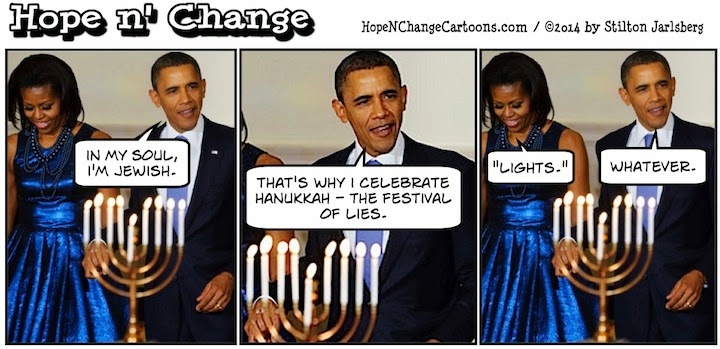
Barack Mitsvah

As noted in a Gatestone Institute article titled Iran speeding to nuclear weapons breakout, Prime Minister Netanyahu is a lone voice crying in the wilderness.

[H]e is one of the two world leaders in the West telling the truth, warning of what is to come (Geert Wilders of the Netherlands is the other). This burden of responsibility for his people (how many of us wish our leaders had even a bit of that?) has earned him only the venom of the Obama  Administration, who see him as trying to spoil their strategy of leading by procrastination. [Emphasis added.]

It is also becoming increasingly clear that the Obama Administration’s policy consists of running after Iran, in order to concede everything it wants, just to be able wave a piece of paper not worth the ink on it, claiming there is “a deal.” Iran, for its part, would probably prefer not to sign anything, and most likely will not. Meanwhile, both sides continue strenuously to claim the opposite. [Emphasis added.]

Iran seems likely to get and use, or to keep and use, nuclear weapons by virtue of the essentially bilateral Iran – US nuclear negotiations. Please see also The Iran scam continues, which I wrote in January of last year. The situation has worsened since then, with substantial concessions to, and few if any of significance by, Iran.

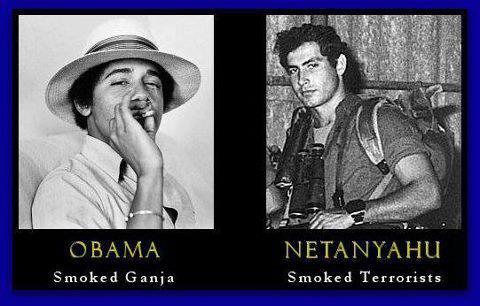
Obama and Netanyahu

The U.S. concessions have, in part, been in exchange for Iran’s “help” in defeating the Islamic State and hence becoming the major power in the Middle East.

Iran would be the hegemon of the Middle East. Some states would ‎accept Tehran’s authority, striking deals and kowtowing in order to survive. Europeans would ‎accommodate Iran, based on its control of the flow of Gulf oil. Israel and Saudi Arabia, nations ‎that Iran’s rulers have threatened to wipe from the map, would be left to fend for themselves.‎ [Emphasis added.]

. . . .

Doran cites evidence that in the first year of Obama’s first term, there were more ‎White House meetings on Iran than any other national security concern. Detente with Iran was ‎seen as “an urgent priority,” but the president “consistently wrapped his approach to that priority ‎in exceptional layers of secrecy” because he was convinced that neither Congress nor the ‎American public would support him.‎ [Emphasis added.]

A year ago, Doran further reports, Benjamin Rhodes, a member of the president’s inner ‎circle, told a group of Democratic activists (unaware that he was being recorded) that a deal with ‎Iran would prove to be “probably the biggest thing President Obama will do in his second term ‎on foreign policy.” He made clear that there would be no treaty requiring the Senate’s advice and ‎consent.‎ [Emphasis added.]

The president believes that “the less we know about his Iran plans, the better,” Doran ‎concludes. “Yet those plans, as Rhodes stressed, are not a minor or incidental component of his ‎foreign policy. To the contrary, they are central to his administration’s strategic thinking about ‎the role of the United States in the world, and especially in the Middle East.” ‎ [Emphasis added.]

Obama’s plans may well blow up in His face and, of greater importance, ours. Iran, particularly with the help of Russia and North Korea, will be able to do it. Here is a

short animated film being aired across Iran, [which] shows the nuclear destruction of Israel and opens with the word ‘Holocaust’ appearing on the screen, underneath which a Star of David is shown, Israel’s Channel 2 reported on Tuesday.

Don’t worry; be happy

Obama what me worry kid

Here’s the Revolting Truth from Andrew Klavan, which debunks everything bad ever said about Obama. Sort of.

Oh. And He’s not a narcissistic jerk either.

ALL of My policies are the best ever

ALL of My policies are the best ever

Basis in Islamic Jurisprudence (Shariah) and Scripture for Execution of Jordanian Pilot

February 4, 2015

Basis in Islamic Jurisprudence (Shariah) and Scripture for Execution of Jordanian Pilot, Counter Jihad Report, February 4, 2015

(Please visit Counter Jihad Report frequently for information about Islam and Jihad. It is an invaluable source.

When the Islamic State and its cohorts are branded as “non-Islamic” and as “having nothing to do with any religion,” we substitute fantasy for reality. We cannot, and therefore will not, defeat an enemy whose rightful context we are unwilling even to mention. — DM)

Obama refers to this “bankrupt ideology” that has come, apparently, out of nowhere. King Abdullah, in Washington, is apparently amazed and flabbergasted at these people, who have absolutely nothing to do with Islam. And the rest of the world’s leaders are also horrified, and amazed, and presumably puzzled, as to this “ideology” that comes out of nowhere, that has “nothing to do with Islam” and for which no texts, not a single sentence, can be found that is not in the Qur’an, or not in the Hadith, or not in essence discoverable in the biography (Sira) of Muhammad, beginning with that of Ibn Ishaq.

This menace, and this misinformation about that menacee, and this growing mistrust of those all over the West who have a duty to instruct as well as protect us, will not go away. It will not lessen. It will only get worse.

**************

Terror Trends Bulletin, by Christopher Holton, Feb. 3, 2015:

“Indeed, those who disbelieve in Our verses – We will drive them into a Fire. Every time their skins are roasted through We will replace them with other skins so they may taste the punishment. Indeed, Allah is ever Exalted in Might and Wise.”

Quran Sura 4:56

In the burning scene video the Islamic State gave the Islamic edict straight from the top Islamic authority of Ibn Taymiyya’s jurisprudence:

“So if horror of commonly desecrating the body is a call for them [the infidels] to believe [in Islam], or to stop their aggression, it is from here that we carry out the punishment and the allowance for legal Jihad”

Ibn Taymiyya was one of the most esteemed Sunni Islamic scholars of all time. He is considered one of the originators of the Hanbali school of Shariah. He originated the practice of declaring Jihad on Muslims who did not follow the Shariah based on the belief that they were not true Muslims, despite their claims to the faith.

taymiyya

***

“Healing The Chests Of Believers,” And The Duty To Instruct As Well As Protect

NER,  by Hugh Fitzgerald

That was the title, that was the theme, that was the point, of the video of the burning alive of Moaz Al-Kasasbeh. Obama refers to this “bankrupt ideology” that has come, apparently, out of nowhere. King Abdullah, in Washington, is apparently amazed and flabbergasted at these people, who have absolutely nothing to do with Islam. And the rest of the world’s leaders are also horrified, and amazed, and presumably puzzled, as to this “ideology” that comes out of nowhere, that has “nothing to do with Islam” and for which no texts, not a single sentence, can be found that is not in the Qur’an, or not in the Hadith, or not in essence discoverable in the biography (Sira) of Muhammad, beginning with that of Ibn Ishaq. Perhaps someone should offer a sufficiently high reward — say, $25 million, the price the American government put on the head of Osama bin Laden — to anyone who can come forward with the presumably fictional quotes from Qur’an and Hadith that the Islamic State relies on.

If you happen to google — it takes about 30 seconds — “heal the chests of believers” or a variant, you will find what I found, in Sura 9, ayat 14.

Read here.

For a story about setting fire to someone regarded as an enemy — a Jew of the Khaybar Oasis, because he didn’t want to give up all of his property to Muhammad and his marauding followers at Khaybar — who was set alight, and then decapitated, google “Kinana” and, if you need to, “Ibn Ishaq,” and you will discover that Kinana first had his chest set alight. And then he was decapitated. And his propoerty taken. And his wife Safiya taken by Muhammad to be his sex slave. Youu can read more about it, in Ibn Ishaq and in the Hadith, here.

Obama — and other Western leaders — cannot continue this attempt to hide from those to whom they have a duty not only to protect, but to instruct — what is in the Qur’an, Hadith, and Sira. They think they can continue this indefinitely. They apparently think it is possible to “keep the support” — what support, really? — of our “staunch allies” in the Middle East such as Saudi Arabia, and also “keep the support” — what support, really? — of Muslims in the West, and yet not lose the support of non-Muslims who in ever greater numbers will be alarmed, as they find out what is being kept from them, and will, already do, distrust their governments, distrust much of the media, and wonder why they cannot be properly informed so that they may, in turn, vote for candidates who understand the problem abroad, and the problem within our countries too.

This menace, and this misinformation about that menacee, and this growing mistrust of those all over the West who have a duty to instruct as well as protect us, will not go away. It will not lessen. It will only get worse.

Pakistan: Between Civility and Fanaticism

January 31, 2015

Pakistan: Between Civility and Fanaticism, The Gatestone InstituteSalim Mansur, January 31, 2015

(The history of Pakistan, “the land (or home) of the pure,” may provide insights into the future of Egypt and other Islamic nations. — DM)

A country made for Muslims has turned into a nightmare for Muslims.

The wish of Mohammad Ali Jinnah, the father of Pakistan, was that the country evolved into a modern democratic state where Muslims, as a majority population, could feel at ease.

But the modernizers who succeeded the colonial authorities in taking power aroused expectations that were simply beyond their abilities to deliver.

But religious authorities were agitating, warning the bewildered masses that these defeats were divine punishments for betraying the true message of Islam by not faithfully abiding by its requirements.

Qutb in his writings recast the division in the world from the classic Muslim one between the House of Islam and the House of War, to one between Islam and jahiliyya, a condition of paganism that preceded the coming of Islam to Arabia. Jahiliyya has now become all-pervasive in the modern world, supposedly sparing none, including Muslims, except for that small coterie of Muslims who took flight [hijra] from the corrupted world and prepared for jihad [armed struggle].

Together, Hasan al-Banna, Abul A’la Maududi and Sayed Qutb fashioned political Islam as a closed system, in opposition to all other competing ideologies.

The theology of takfir — declaring other Muslims apostates or unbelievers; excommunication — obsessed with “unbelief,” has provided the politics of jihad [armed struggle] with the theological justification that arms any Muslim to freelance as a soldier of Allah.

The strategic requirement for advancing global jihad was to convince Muslims that they are liable to be found committing heresy if they support non-Muslim or infidel authorities, such as the United States and its allies, or if they wage war against Muslims, such as members of al-Qaeda.

The theology of takfir and jihad has now come full circle. Many Pakistanis, when they disagree, now find themselves trapped in denunciations that they are unbelievers.

It is from these madrasas that the jihadi fighters come forth as cannon fodder for an endless jihad that has become a growth industry in Pakistan. The entire political elite in Pakistan has profited, just as the Iranian elite continues profiting by doing the same.

For many, being “pure” required separating oneself from non-Muslims.

“The Taliban were not providing strategic depth to Pakistan, but Pakistan was providing strategic depth to the Taliban.” — Ahmed Rashid, foremost scholar of the Taliban.

The recent massacre of school children by Taliban jihadists in a Peshawar army school just lowered even further the bar of atrocities carried out under the banner of Islam in Pakistan. As authorities floundered in the face of mounting violence, with serious implications for new wars in the region, the 2014 Global Terrorism Index ranked Pakistan third behind Iraq and Afghanistan among countries most impacted by terrorism. In addition, the “failed states index” elevated the status of Pakistan to being among the top dozen failed states of the world.

According to the intelligence report of the last conversation before the murders, monitored by Pakistan’s security agency, one of the jihadists informed his handler, “We have killed all the children in the auditorium.” He then asked, “What do we do now?” The handler answered, “Wait for the army people, kill them before blowing up yourself.”[1]

When the mayhem was over, 132 children were dead, among 145 people killed by the jihadists.

The Peshawar massacre has once again, just as in 1971, opened a window onto internal fault lines rupturing the country: those of ideology, ethnicity, sectarianism, and class. Of these, the most severe is the rupture over ideology — between those who insist that the country is insufficiently Islamic and those who fear that religious extremism has brought the country to ruin. This ideological fault line also intensifies the other divisions.

There is not only the immense risk of Pakistan’s nuclear arsenal getting into the hands of Islamist terrorists, but that Pakistan has more or less turned into a safe-haven for them. For religious extremists of Islam, Pakistan has become a secure fortress, from which they can wage their global jihad.

The injunction against the deliberate killing of children has, unfortunately, often been breached in times of war; the Peshawar massacre of children by militants of Tehreek-e-Taliban Pakistan [TTP] were, apparently, revenge killings for the loss of their women and children as a result of Pakistan’s military operations in North Waziristan, along the border with Afghanistan.

The TTP leaders, however, went further. They defended their revenge killing in the name of Islam, as a jihad against their enemies. Umar Khorasani, a spokesman for the TTP, justified the massacre by comparing it to the massacre by the Prophet Muhammad of the Jewish tribe of Banu Qurayza, in which children were also killed.

In offering this justification, Khorasani’s reference to Sahih Bukhari — one of the authoritative sources for Sunni Muslims on the traditions (Sunnah) of the Prophet — carried the message that those who even question the religious legitimacy of the killings would be held responsible for igniting any violence against them by the Pakistani Taliban and their supporters, on the charge of having insulted the Prophet. Such a denunciation by the Taliban of their opponents is consistent with Pakistan’s blasphemy law; it forbids any remark that might be taken as insulting the Prophet or the Quran, with the maximum penalty of death, under which some members of the minority religious communities have been indicted — often unfairly — and held in prison.

The Peshawar massacre and the manner in which the TTP offered its justification for it, have roped the Pakistan’s political and military elite into a fix on how to refute Taliban’s interpretation of Islam’s sacred texts, without getting drawn into a potentially deadly conflict that would only deepen sectarian and ideological differences even more.

If the country is not to slide deeper into the lethal mix of Taliban-type fanaticism and armed globaljihad, the elite need to respond forcefully. The prospect, however, is gloomy.

The Pakistani Taliban is the creature of the ruling elite, especially the directorate of the Inter-Services Intelligence [ISI]. There is also a problem of widespread pride, nurtured by the elite over the past four decades, in Pakistan’s identity as an Islamic state. And since the identity of the elite is closely bound with the ideology of the religious establishment — and not merely with that of the Taliban — it follows that the various Islam-oriented parties and their supporters will fight to preserve their Islamist ideology.

The impasse in which Pakistan finds itself needs explaining. Pakistan was established on the basis of religion, on Islam, and the claim that Muslims in an undivided British India deserved a state of their own to preserve their religion and culture, for fear of losing both if ruled by the Hindu majority population once the British departed from the subcontinent.

The argument to have a separate state based on religion was flawed. But that flaw would only become apparent during the break-up of Pakistan in 1971 — despite the shared belief in Islam.

The circumstances under which India was partitioned in August 1947 still remains contentious, given the subsequent history of wars fought by the successor states, the unsettled nature of the Kashmir conflict, and the break up of Pakistan in 1971 as a reminder that this could happen again.

The pressure for partitioning India in 1947 largely succeeded because an exhausted Britain, after the Second World War in 1945, did not have the stomach to suppress the communal violence escalating between those who supported a separate Pakistan, and their opponents who insisted on keeping India united.

The seeds of religious extremism — adherence to Islam as the line of demarcation, using violence, if necessary, against non-Muslims — were embedded in the initial demand made to Britain for creating Pakistan.

The father of Pakistan, Mohammed Ali Jinnah (1876-1948), exploited this demand. He persuaded the British authorities to partition India. Jinnah himself was a nominal Muslim with a taste for things British. He was an Anglophile who barely spoke Urdu, the vernacular language of Muslims of northern India. He married a non-Muslim woman, the daughter of a wealthy Parsi (Zoroastrian) industrial magnate of Bombay (now Mumbai); and he died a little over a year after Pakistan had been launched in a sea of immense communal violence that accompanied its beginning.

For Jinnah, ironically, religion had been a matter of personal choice. He had taken to Islam as a lawyer, not as a theologian. He had been persuaded, against his earlier political inclinations as an Indian nationalist, that the Muslims in India deserved to have a state of their own in the eventuality that Britain granted India independence. His wish[2] was that the country evolve into a modern democratic state where Muslims, as a majority population, could feel at ease, as opposed to the unease they had felt as a minority population in an undivided India.

As Jinnah said to the assembled politicians of the new country, “Now I think we should keep in front of us as our ideal and you will find that in course of time Hindus would cease to be Hindus and Muslims would cease to be Muslims, not in the religious sense, because that is the personal faith of each individual, but in the political sense as citizens of the State.”[3]

But Jinnah was old, gravely ill, and probably could not even imagine that the forces of religious extremism he had unleashed would devour his vision of Pakistan as simply a peaceful homeland for the Muslims of India.
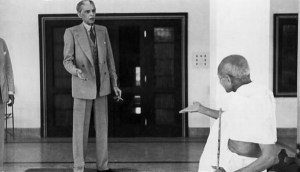
910Mohammed Ali Jinnah, the founder of Pakistan, in conversation with India’s Mahatma Gandhi

It did not take long, however, for all the various contradictions of ethnicity, language, sect, and class, to surface soon after Pakistan’s birth, between the Muslim refugees from India and the people who had been born there.

The country was also physically divided into two halves, separated in the middle by over a thousand miles of northern India. The demand for a Pakistan based on Islam had carried emotional appeal, but what Pakistan would mean as a Muslim state had not been given much thought.

Then there was a problem with Kashmir. Jinnah, according to biographers, felt cheated by the British. Kashmir, with a Muslim majority population, but ruled by a hereditary Hindu prince, was left to India, instead of Pakistan. Jinnah was prepared to force Kashmir’s union with Pakistan. But after pressure from the British military officers still in command of British India’s joint armed forces, Jinnah dropped his plans.[4]

Much of the divisiveness within Pakistan resulted in the inability of politicians to draft and ratify a constitution for nearly a decade – unlike India, where, after independence, a republican constitution for a parliamentary system of government was drafted, ratified, and adopted in fewer than thirty months.

In Pakistan, the irresolvable differences were over the nature of the Islamic state, its ideals and objectives, and how such a state was to be organized.

There were, on one side, modernist or reform-oriented Muslims, educated within the Western liberal tradition, with Jinnah as their model. They believed the Quran and the Sunnah (traditions of the Prophet) could be reconciled through liberal-reformist interpretation with the requirements of a modern democratic and representative form of government.

The religious establishment, on the other side, with its traditionalist-minded ulema (religious scholars), was insistent that the law of the land could be based only on the Quran and the Sunnah, which provided the complete and unalterable social and political code for an Islamic society. They required, therefore, that Shariah – Islamic law compiled in the 9th-12th centuries C.E. – was made the law of the land.

Then there was Abul A’la Maududi (1903-79), with the title of Maulana (a learned scholar), bestowed by his followers, as the founder and leader of Jamaat-i-Islami – the South Asian counterpart of Ikhwan-i-Muslimin (the Muslim Brotherhood), founded by the Egyptian, Hasan al-Banna (1906-49). Maududi went even farther by demanding that the constitution recognize the sole sovereignty of Allah, and the state as His agent, be limited only to implementing the Shariah.

Ultimately the difference in these two views was unbridgeable. As a result, holding the country together by authoritarian means became unavoidable.

Men in uniform replaced feckless politicians. General (later made Field Marshal) Ayub Khan, a military chief, seized power in October 1958, and set the pattern of military rule for the country. During the decade he ruled, he imposed on the country a constitution of his making; supervised economic development; invested in the defense establishment; worked to undermine the religious establishment; and in 1965 launched a poorly conceived war against India over Kashmir, which backfired. He was eventually forced, in the midst of political unrest across the country, to hand over power in 1969 to yet another general.

The military rule of Ayub Khan’s successor, General Yahya Khan, ended dismally in December 1971 with the break-up of Pakistan. It was preceded by an election for a national assembly in 1970, which Yahya Khan had arranged with the express purpose of handing power to a civilian government. But when a political party from East Pakistan won the largest number of seats in the assembly and was poised to form a government, Yahya Khan reneged on his promise. The people in East Pakistan (now Bangladesh) – estranged from those in West Pakistan (now Pakistan) over ethnic and language differences, and grievances over socioeconomic disparities – rose in opposition to military rule. The situation rapidly deteriorated, a civil conflict turned into a bloody military repression and massacre of unarmed people by the military. It ended with Pakistan declaring war against India, and the surrender of the Pakistani army to Indian forces in Dhaka, the capital of East Pakistan (now independent Bangladesh), on December 16, 1971.

After this humiliating defeat, Pakistanis in general were demoralized and the military discredited. In these circumstances, Zulfikar Ali Bhutto and the party he founded, the Pakistan People’s Party, maneuvered to fill the void. Bhutto belonged to the wealthiest landlord family in the province of Sind; as a young lawyer-politician, he had been appointed a junior minister in the military regime of Ayub Khan. His later disagreements with Ayub Khan’s policies, following the 1965 war fought by Pakistan and India over Kashmir, forced him out of the government and into opposition against military rule.

In the 1970 election Bhutto’s party had emerged with second largest number of seats in the national assembly, behind the party from East Pakistan. Bhutto claimed this as his mandate to form a civilian government, with himself as president, to replace military rule.

In 1973 he presented the country with its third constitution, and had it adopted by the national assembly. But, as the old differences over the nature of an Islamic state and the place of the Shariah resurfaced, the constitution failed to win the support of the religious establishment.

Bhutto was a populist and a demagogue. Although he was one of the most powerful feudal landlords in Pakistan, he nevertheless appealed for electoral support from students, workers and peasants by posing as a defender of the poor and oppressed in society, and, as an ally of China’s then supreme leader Mao Zedong, by embracing the left-wing politics of anti-imperialism. There was showmanship here, and some grandstanding as a leader of a third world nation. It was at this time – and soon after India tested a nuclear device in 1974 – that he determined that Pakistan must acquire nuclear capability of its own. His populism however would not save him from the wrath of the religious establishment.

But, as the country searched for an identity in the aftermath of 1971, Bhutto was temperamentally unsuited to calm the tensions around him. The Muslim religious leaders and their followers distrusted him as another liberal-secularist; he tried to appease them by meeting their demand in declaring as non-Muslims those belonging to the minority Ahmediyya sect within Islam.

In 1977, the military under General Zia ul-Haq staged a comeback, removed Bhutto from office and put him under arrest. While in prison he was indicted for plotting the murder of his political opponent, and put on trial. The court found him guilty, his appeal was denied, and he was hanged in April 1979.

Zia ul-Haq, the third military dictator to take power, ruled until his death in a mysterious plane crash in August 1988. He was a devout orthodox Sunni Muslim, and, unlike his two military predecessors – Ayub Khan and Yahya Khan – he publicly showed respect for Muslim religious leaders and their various organizations. He sought their support, and embraced their religiously directed political agenda to turn Pakistan officially into an Islamic society (Nizam-i-Islam).

ii.

The decades of sixties and seventies in the twentieth century were times of social and political unrest in the West. There was a crisis of values as the young questioned the dominant secular politics mostly concerned with material gain and economic well being, while America’s involvement in the war in Vietnam became increasingly divisive at home. The youth in general defied the authorities on both the Soviet and Western sides of the Cold War. They pushed counter-cultural movements and sought “enlightenment” through sexual freedom, drugs, music, and experimenting with the rites of non-European cultures.

In the Muslim world, the situation was vastly different. The thin veneer of modernity barely penetrated the surface of a world steeped in traditional culture. Islam as understood and practiced for generations sustained the vast majority of people at the edge of poverty. Colonialism had made only a small difference, once independence came, in preparing Muslim societies to meet the immense challenge the modern world posed for them. A tiny segment of the population had received a modern liberal education and had risen in the ranks of colonial administrations as junior civil servants, technocrats, and military officers. On their shoulders fell the task, as in Pakistan after 1947, to lead the country forward and somehow meet the swelling demands of the people for the promise of a better life.

The political leadership of the newly independent states generally looked to the West in terms of their own respective economic and social developments. Within the Muslim world – apart from the few oil-rich Arab states on the Gulf – there was a general consensus among those who held power that there was no alternative to the path for development as historically charted by the advanced Western countries, irrespective of whether those countries were capitalist democracies or socialist.

But the modernizers who succeeded the colonial authorities in taking power – the men in uniform who seized power through military coups due to the fecklessness of politicians, as in Egypt (Colonel Gamal Abdel Nasser) or in Pakistan (General Ayub Khan) – aroused expectations that were simply beyond their abilities to deliver.

The sixties and the seventies of the last century were the decades when the political roof caved in over the heads of the Muslim world’s modernizers. The immediate cause was military defeat. In the Arab world, the June war of 1967 with Israel was a catastrophic defeat for Egypt under Nasser; and, similarly, for Pakistan the December 1971 war with India was a colossal humiliation in which the army lost half the country when East Pakistan, with support of the Indian military, seceded to become an independent Bangladesh.

On the political margins of these Muslim countries, religious parties were agitating, warning the bewildered masses that these defeats were divine punishments for betraying the true message of Islam by not faithfully abiding by its requirements.

These were the decades when old theological debates from the medieval past of the Muslim world re-surfaced and were widely disseminated. Muslims were repeatedly told by religious scholars that to reverse their humiliations, they needed to return to their authentic past, to emulate the ways of their revered ancestors (salaf) and the companions of the Prophet, and to establish the rule of Islam.

In the Arab world, the Muslim Brotherhood of Hasan al-Banna and Syed Qutb (1906-66), and in Pakistan the Jamaat-i-Islami of Maulana Maududi, gained in popularity with a populace increasingly frustrated with its own political authorities.

In Egypt, Syed Qutb, as one of the leaders of the Muslim Brotherhood that declared a jihadagainst Nasser’s military-led government, was sent to the gallows. In death, Qutb became a martyr-scholar for a whole new generation of Muslims who were searching for meaning in the midst of cultural despair and political authoritarianism.

An earlier generation before 1967 in the Middle East – as elsewhere in Asia and Africa – had sought answers in the revolutionary politics of Marx and Lenin; had supported the Vietnamese communists in their war against the United States, and had admired Mao Zedong and the Chinese revolution.

In the period after 1967, and before the 1973 October war that brought the Arab oil-producing states to quadruple the price of oil and turn it into a political weapon, it was the writings of Syed Qutb that appealed to the young in the Middle East. Hasan al-Banna and the Muslim Brotherhood had turned Islam into a political doctrine – Islamism – as a total answer to all the problems of the Muslim world. Qutb had described the solution in terms of an Islamic state implementing Shariah as the fundamental law of the land. Al-Banna’s message was also directed at the lslamic ummah,the whole Muslim nation.

Qutb in his writings refined and deepened the message of al-Banna. In a significant departure from other Muslim thinkers of his time, Qutb recast the binary division in the world made by Muslim traditionalists, one between Dar al-Islam (House of Islam) and Dar al-Harb (House of War), into one between Islam and jahiliyya (a condition of barbarism or paganism) that had preceded the coming of Islam in Arabia.

Qutb developed this concept of jahiliyya as one of the key explanations for the decline of Islam in the world, and the miserably broken condition of Muslims in it. In his ultimately extreme view, and one that caught the imagination of his most devoted followers, jahiliyya had become all pervasive in the modern world, sparing none, including Muslims, except for that small coterie of Muslims who understood the situation, took flight (hijra) or withdrew from the corrupted world, and prepared for jihad (holistic struggle, including warfare) in the cause of Islam.

Qutb’s views were in part influenced by the writings of Abul A’la Maududi, in the extent to which Maududi had revived the theological views of medieval Muslim jurists on matters of God’s sovereignty in human affairs. Maududi’s innovation was in insisting that Islam was a complete system of faith and politics, in other words a totalitarian ideology promoting a social revolution, and the necessity of jihad as the instrument for realizing God’s plan on earth.

Together, Hasan al-Banna, Maududi, and Syed Qutb had fashioned political Islam as a closed system, in opposition to all other competing ideologies confronting Muslims. It was at once simple, rigidly based on the Quran and the Sunnah (traditions) of the Prophet, and provided Muslims with an armed doctrine of jihad to quell their doubts, overcome their fears, and direct them towards the objective of establishing an Islamic state or gaining martyrdom in the pursuit of it. When the Islamic revolution did successfully occur, however, it was in Iran, and in February 1979.

The Iranian followers of a religious leader in exile, Ayatollah Khomeini (1902-89), seized control of the popular uprising and eventually turned Iran into a theocratic Islamic republic.

Iran had been a monarchical regime, and the anti-monarchist revolution, even though Iranians followed the minority Shi’ite version of Islam, caught the imagination of the majority Sunni Muslims on either side of its borders. The leader of the Palestinian movement, Yasser Arafat, for instance, travelled to Tehran and embraced the founder of Iran’s Islamic revolution, Ayatollah Ruhollah Khomeini, as the leader of anti-imperialist revolution.

If Iranians could topple the Shah of Iran, an ally of the United States, then it was not unimaginable that Muslims elsewhere could also overthrow similarly pro-American or pro-Soviet authoritarian regimes that they felt had been repressing them into a state of jahiliyya. As a result, the year 1979 – the beginning of the fifteenth century in the Islamic calendar – became a pivotal year in the Muslim world.

Earlier, in November 1979, there had been a failed attempt by a small group of Saudi Wahhabi extremists to ignite a movement against the ruling House of Saud. They seized the grand mosque in Mecca, at the center of which stands the Ka’aba (the ancient cube-like structure), and held the grand mosque for several days until French paratroopers flushed them out. Although this effort was doomed to fail, it signified unrest within the most conservative Arab state, and the messianic wish for an even stricter version of Islam than the one practiced by Saudi rulers.

Then, at the end of 1979, came the Soviet invasion of Afghanistan. The occupation of a Muslim country by an infidel power became a magnet around which to rally Muslim jihadists, and encourage them to head for Afghanistan and join Afghan mujahideen (freedom fighters) in theirjihad against a military superpower.

iii.

Zia ul-Haq (1924-88), an army general who was then president, turned Pakistan into a frontline state in the decade long Afghan war. Zia viewed the Afghan war as the opportunity to reverse the humiliation of 1971, rebuild the morale of the army, and make Pakistan the key ally of the United States in the war against Soviet Communism.

Under Zia’s direction Islamabad forged a new strategic partnership with President Ronald Reagan’s Washington and the Saudi monarchy to help the Afghan mujahideen (freedom fighters) liberate their country from Soviet occupation.

But the blowback from the Afghan war in time has turned Pakistan from a cockpit of global jihadinto a land increasingly torn and bloodied by armed warriors of Islam.

On seizing power, Zia reached out to the religious establishment and made Islamization of Pakistan his military regime’s domestic priority. He believed the country suffered from a crisis of identity, for which it had paid dearly in 1971. Although the country had been established on the basis of Islam, Zia would regularly remind the people in public speeches and interviews, that the political leadership had failed to establish an Islamic-based society.

Zia’s solution was to encourage an Islamic identity to replace, or supersede, ethno-linguistic and sectarian identities that had weakened and divided the country. Accordingly, the measures he adopted were to make the fundamental law of the land, the Constitution, conform to the dictates of the Quran and the Sunnah, and implement the requirements of the Shariah in society. To push for the Islamization of the country, Zia established the Federal Shariah Court and the Shariah Appellate Bench of the Supreme Court.

What Zia could not have foreseen was how the Afghan war would become the petri-dish of Islamist theology and jihadi politics. As Arabs attracted by the appeal of jihad congregated in and around Peshawar, Afghanistan and the Afghan war became the cradle of the global jihadistmovement. The actual contribution of these “Afghan Arabs” in defeating the Soviet Union was negligible, but it was here they found a safe haven to engage in arcane theological debates that shaped the thinking and politics of those who had been radicalized through the writings of Syed Qutb and Maududi.

The Afghan war may be divided into three phases. The first was the war against the Soviet forces, ending with their full withdrawal in February 1989. The Soviet withdrawal marked the beginning of the second phase until 9/11. During this period, the war turned into an internal struggle among the various tribal groups and factions for the control of Afghanistan. Despite the fall of Kabul, the capital, to Afghan Taliban warriors under Mullah Omar in September 1996, this internal conflict raged on. The third phase began after the 9/11 terrorist attacks on New York and Washington, and led to the U.S. sending forces into Afghanistan to search out and destroy the al Qaeda leadership and network.

In Pakistan during the summer and fall of 1988 after the airplane crash that killed Zia, one could see that although the first phase of the Afghan war was winding down, the country was on edge and the military and security forces were everywhere. In Islamabad, at the Institute of Strategic Studies, one could hear the elite opinion about the Afghan war: that the Soviet defeat had been brought about by Pakistan, and that, despite risks, Zia’s bold vision had turned out right.

In helping the Afghan mujahideen liberate their country, Pakistan had acquired strategic depth in its confrontation with India. The victory also celebrated undoing the defeat of 1971, and providing the military establishment with experience in conducting asymmetrical warfare against an enemy larger in size and resources. Pakistan has always been obsessed with India, and the Afghan war gave its men in uniform new confidence on how to engage with India in Kashmir.

The build-up of the military with the offshore money that flowed into Pakistan from Saudi Arabia in aid of the Afghan war further entrenched the special place it occupies in the country. The observation first made by Sir John Morrice James, Britain’s High Commissioner to Pakistan during the rule of Ayub Khan – that re-arming the military by the Americans “was to risk creating a situation where it would not be so much a case of Pakistan having an army as of the Army having Pakistan”[5] – seemed uncannily true at the end of the Zia era. Since Pakistan’s independence in 1947, and at the end of the first phase of the Afghan war, the military had ruled Pakistan for more than half the period, and the men in uniform, given their self-important role as the guarantor of the country’s security, had acquired a sense of entitlement.

During subsequent visits, it seemed as if the victory in the Afghan war that gave most Pakistanis pride and the right to boast was an illusion. War had laid waste to Afghanistan. Virtually the entire Afghani population within the country – as well as in the neighboring countries of Pakistan and Iran – had been turned into refugees. Pakistan had become home for several million Afghan refugees, mostly of Pashtun/Pathan ethnicity, indistinguishable from Pathans on the Pakistani side of the frontier. With these refugees, the war inside Afghanistan was imported across the border into Pakistan, and the struggles of the Afghan mujahideen against Soviet occupation of their country invariably began to change the political landscape inside Pakistan.

The Afghan Taliban emerged from the ranks of its own refugee population in Pakistan. Their struggles against the Soviet forces in their country in turn persuaded their ethnic brethren, the Pakistani Pathans, to join them. In time, the distinction between Afghani and Pakistani Taliban dissolved even as the frontier between the two countries became irrelevant.

Ahmed Rashid, the world’s foremost expert on the Taliban, observed:

“Throughout Afghan history no outsider has been able to manipulate the Afghans, something the British and the Soviets learnt to their cost. Pakistan, it appeared, had learnt no lessons from history while it still lived in the past, when CIA and Saudi funding had given Pakistan the power to dominate the course of the jihad. Moreover, the Taliban’s social, economic and political links to Pakistan’s Pashtun borderlands were immense, forged through two decades of war and life as refugees in Pakistan. The Taliban were born in Pakistani refugee camps, educated in Pakistanimadrassas and learnt their fighting skills from Mujaheddin parties based in Pakistan. Their families carried Pakistan identity cards.”[6]

The Pakistani military, through its ISI intelligence services, had raised, trained, and armed the Taliban to be its proxy inside Afghanistan. The ISI provided key material and logistic support to the Taliban leader, Mullah Omar through the 1990s right to the present. In addition, the ISI’s deep connection with the Taliban, approved at the highest levels of the Pakistani military leadership, became the preferred approach for raising and supporting other Islamist militias to wage secret warfare against India in Kashmir. The ISI’s investment in Taliban was made for returns to its own liking, when needed, in terms of Pakistan’s strategic interests. So the idea of Afghanistan as a strategic depth for Pakistan, was made by Pakistan’s political establishment into an article of faith not to be doubted.

Ahmed Rashid also noted, however, that “the backwash from Afghanistan was leading to the ‘Talibanization’ of Pakistan. The Taliban were not providing strategic depth to Pakistan, but Pakistan was providing strategic depth to the Taliban.”[7] This was shown in the Afghan war, after September 11, 2001, when American and the allied forces under NATO/ISAF (North Atlantic Treaty

Organization/International Security Assistance Force) command found how difficult it was – and still is – to pacify Afghanistan when the Taliban have continued to operate out of safe havens inside Pakistan. The leaders of both the Pakistani and Afghani Talibans are able to slip back and forth across the border to hide with ease.

The Taliban were raised, on both sides of the border, in the Deobandi school of fundamentalist Islam, different in tradition from what the “Afghan Arabs” brought with them to Pakistan.

The “Afghan Arabs” are Arabs who headed for Afghanistan in 1979 following the Soviet invasion of that country. Osama bin Laden and his entire al Qaeda crew, for instance, came to be referred to as “Afghan Arabs” to distinguish them from native Afghans and this is why the quotes. The “Afghan Arabs” introduced the doctrine of takfir [excommunication] theology to non-Arab Muslimjihadis, especially the Afghani and Pakistani Talibans in their pursuit of global jihad.

The Deobandi school, originating out of the nineteenth century Darul Ulum Deoband – an Islamic school that took its name from the town, Deoband, located in north India where it was foundedcirca 1867 – has been, since it was established, the flag-bearer of jihadi movements in India and Central Asia.

The religious scholars at Deoband, were practitioners of taqlid (imitation): of strictly adhering to the authoritative interpretations of the traditional four schools of fiqh (jurisprudence) in Sunni Islam. They insisted that Muslims follow the Shariah-code as required by their faith and tradition.

The “Afghan Arabs” brought with them to Afghanistan and Pakistan the more rigid teachings of the medieval jurist, Ibn Taymiyya (1263-1328), especially his stringent pronouncements on apostasy and jihad.

The mainline consensus of Sunni Muslim jurists on what constitutes Muslim belief, in accordance with the Shariah’s minimal requirement, is the utterance of the Shahada, or the formula of the Islamic creed: “There is no god other than Allah and Muhammad is His Messenger.” The saying of obligatory prayers, keeping the fast during the month of Ramadan, making pilgrimage at least once in lifetime, and giving charity (zakat) have been traditionally considered the key pillars of Islam, as stipulated in the Quran, and abiding by them is evidence of Muslim piety.

Ibn Taymiyya ruled, however, that such minimal requirement was insufficient, especially when a Muslim ruler failed to implement the Shariah, and when any Muslim failed to engage in jihad(armed struggle) to demand the rule of Shariah. From such a standpoint, as Ibn Taymiyya underscored, when a Muslim ruler transgressed the Shariah-code, or set aside the rule of Shariah in territory under his control, he turned into an infidel, or apostate, and thereupon became a legitimate object for jihad.

Ibn Taymiyya’s medieval excursions into jurisprudence and theology, once revived, became the hallmark of the new generation of Arab Islamists. They made takfir (declaring someone to be an apostate or an unbeliever, excommunication) a signature instrument of their jihad, and readily used such pronouncements to attack their opponents.

The most striking example of this from recent history was in pronouncing takfir on President Anwar Sadat for signing the peace agreement with Israel. That act turned him into an object ofjihad, which eventually brought about his public assassination in October 1981.

Ibn Taymiyya’s hard line extremist thinking was a result of the upheaval in Arab lands during the Mongol invasion of the thirteenth century. His views were a marginal innovation in medieval Islamic theology, but nonetheless became the signature of the contemporary jihadis, the “Afghan Arabs.” In mainline traditional Sunni jurisprudence, the ulema (religious scholars) stressed the importance of obeying Muslim rulers and in avoiding fitnah (disorder or internecine warfare) as a major sin.

The theology of takfir, declaring other Muslims apostates, was, and is, riddled with Muslim-on-Muslim violence. From the earliest decades of Islamic history, Muslim extremists have given a theological justification for their violence against Muslims with whom they disagree, such as Shiites, and other minority sects.

Consequently, in contemporary times within the Muslim world, the fear or apprehension of early Muslim jurists – based on lessons, drawn from the earliest phase of Islamic history, of fratricide and tribal conflicts – has become widespread.

iv.

The theology of takfir, obsessed with “unbelief,” has provided the politics of jihad with the sort of theological justification that arms any Muslim to freelance as soldier of Allah.

A soldier, for instance, in the security detail of Salman Taseer – the governor of Punjab and Pakistan’s largest province with an estimated population of around one hundred million – shot him dead in January 2011 to punish him for his efforts to amend the blasphemy law in the penal code. Furthermore, Pakistani lawyers praised his murderer.

The law was first introduced in the colonial period, and the Zia regime further broadened its scope, as part of the Islamization process, by requiring anyone accused of insulting the Prophet or desecrating the Quran to be imprisoned ahead of an investigation.

After the swift defeat of the Taliban by American forces in Afghanistan in 2001, the “Afghan Arabs” of the al-Qaeda network were on the run in search of sanctuary. Many of them, including Osama bin Laden and his deputy, Ayman al-Zawahiri, found safe haven in the Pathan tribal areas of Waziristan within Pakistan, and dug in there for the long struggle of the global jihad. They indoctrinated the Taliban and other elements of the Pakistani jihadi militias based in Punjab with their highly polarized doctrine of takfir theology, culled from the writings of Ibn Taymiyya. (Among the most well known militias besides the Pakistani Taliban are the fiercely anti-Shia and Deobandi trained jihadists of Sipah-e-Sahaba and Lashkar-e-Jhangvi; the Jaish-e-Mohammad operatives in Kashmir; and jihadists of Laskar-e-Taiba, funded by the ISI, and accused of plotting the 2001 attack on the Indian parliament in New Delhi, and of carrying out the 2008 attack in Mumbai.)

For the jihadi theorists among “Afghan Arabs,” the strategic requirement for advancing globaljihad was to convince Muslims that they are liable to be found committing heresy if they support non-Muslim or infidel authorities, such as the United States and its allies, or if they wage war against Muslims, such as members of al Qaeda network.

The “Afghan Arabs” also sought to convince their jihadi allies among Muslims in the Afghanistan-Pakistan region, especially the Islamists among them, to declare their co-religionists apostates if they were found unwilling to establish Shariah rule in society and assist the global jihad.

The logic behind the doctrine of takfir theology for “Afghan Arabs” – as they instructed the Pakistani Islamists – was straightforward: Once Islamists in Pakistan – with many inside the military, and especially those inside the ISI – became convinced that Pakistan could not be considered any longer an Islamic state due to its role as a junior partner of the United States in the war against the global jihad – represented by Islamist organizations, such as al Qaeda – then the Pakistani Islamists would likely lead a revolt. A successful revolt in Pakistan would then make the country the most important base of global jihad.

The theology of takfir has borne fruit within Pakistan. The assassination in 2007 of Benazir Bhutto – a former prime minister and opposition leader and daughter of Ali Bhutto (hanged by the military in 1979) – and then of Salman Taseer, the governor of Punjab, in 2011, were two high profile jihadi executions. Since 2001, there has been a steady toll of victims from jihadi violence inside Pakistan. Taliban and jihadi militias have directed terrorist attacks and suicide missions against the minority Shia population; against Ahmediyyas, declared non-Muslims; against Christian and Hindu minorities; against Sufi shrines and Sufi Muslims (those devoted to a mystical tradition of spiritual Islam) as heretics; and even against Pakistani military targets, such as the naval base in Karachi in May 2011 and an air force installation in Peshawar in December 2012.[8]

In nearly four decades of strife, warfare, and jockeying for power inside Afghanistan, with the epicenter in the mountainous areas bordering on Pakistan, a culture of jihad and takfir took root. The Pakistan army, answerable to no higher authority than itself, contributed to the making of this culture. The Pakistan army is in part responsible for creating the jihadi militias, which have become monsters that cannot be entirely controlled by the ISI. It is also widely believed that the ISI and some segment of the military establishment are in league with Islamists, and supportive of the goals of global jihad.

The fecklessness and corruption of politicians and civilian authorities work to the advantage of the military establishment, still viewed by a majority of the people as the one institution – in spite of the record – trusted to maintain Pakistan’s security.

Because of Pakistan’s rivalry with India and the unwillingness of the Pakistani population, pushed by Islamist rhetoric, to negotiate with India a peaceful settlement of the Kashmir conflict – which, with rising civilian casualties has worsened over the years as a result of jihadi organized terrorism – the military establishment is unlikely to end its support for jihadi militias operating inside Kashmir from bases inside Pakistan. Similarly, by hanging onto the illusion of Afghanistan as some sort of strategic depth for Pakistan, the military will not disband the Pakistani Taliban.

The Islamization of Pakistan has given more official encouragement and “teeth” to Islamists armed with the theology of takfir. These Islamists have shown, that, when squeezed too hard by the military or civilian authorities, they are ready to bite with attacks on military installations, such as one on the naval base in Karachi, or by assassinations, such as in the killings of Salman Taseer and Benazir Bhutto.

Large segments of the Pakistani population live in poverty. The most impoverished region is in the tribal areas of northwest Pakistan, and home to the Taliban. For a vast majority of the people, basic needs in terms of medicine, clean water, nutrition, education and jobs are barely met by the state. The insult to the human dignity of those more or less abandoned to endless destitution is compounded by the lifestyle of the rich and the privileged. The people in the military are the most privileged among the Pakistanis, and resentment against them is not far below the surface of a society seething with tensions.

The Taliban attack on the Peshawar army school, and the murder of the children there, most of whom came from military homes, went beyond revenge. It signified class-based hostility against a system of privilege for a tiny minority. There are over one hundred specially built army schools, such as the one in Peshawar, for children of the military establishment and the civilian elite, to provide for modern education.

In contrast, there are nearly 14,000 madrasas (religious seminaries) where, under the supervision of Deobandi scholars, a Quran-based education of rote learning and memorization, ill-equipped for modern needs, is provided to an estimated two million children of the poor. It is from these madrasas that the jihadi fighters come forth as cannon fodder for an endless jihad that has become a growth industry in Pakistan. The entire political elite in Pakistan has profited, just as the entire Saudi elite has profited by funding the Islamists, and just as the entire Iranian elite continues to profit by doing the same.

Politics in Pakistan has carried in its blood stream the virus of religious fanaticism right from the outset of its creation. The name chosen for the country at birth, “Pakistan,” in Urdu means “the land (or home) of the pure.” For many, the significance of being a Pakistani came to mean striving, as Muslims, to be “pure,” and that a true believer required separating themselves from non-Muslims. But this mentality turned full circle. Infected by the theology of takfir and the politics of jihad, Pakistanis, when they disagree, now find themselves trapped in denunciations that they are unbelievers. A country made for Muslims has now turned into a nightmare for Muslims. The children killed in the Peshawar army school by Taliban were innocent of the politics of their elders, even as these children were their sad victims.


[1] Ismail Khan, “We have killed all the children… What do we do now?” Reported in Dawn(Karachi), 18 December 2014.

[2] As he indicated in his address to Pakistan’s Constituent Assembly meeting for the first time in Karachi in August 1947

[3] See Stanley Wolpert, Jinnah of Pakistan (New York: Oxford University Press, 1984), pp. 337-340.

[4] See Wolpert, Jinnah, pp. 347-354.

[5] Cited in Shuja Nawaz, Crossed Swords: Pakistan, its Army, and the Wars Within (Karachi: Oxford University Press, 2008), p. 200.

[6] Ahmed Rashid, Taliban: Militant Islam, Oil and Fundamentalism in Central Asia (New Haven & London: Yale University Press, 2000), p. 185.

[7] Rashid, Taliban, p. 187.

[8] See Declan Walsh, “Pakistani commandos regain control of Karachi military base,” in The Guardian (UK), 23 May 2011, for report on the attack on the naval base in the port city of Karachi; and see Ismail Khan, “Audacious attack on Peshawar PAF base,” in Dawn (Karachi), 16 December 2012 for report on the attack on the air force base in Peshawar.

Obama and cognitive dissonance

January 26, 2015

Obama and cognitive dissonance, Dan Miller’s Blog, January 26, 2015

(The views expressed in this article are mine and do not necessarily reflect those of Warsclerotic or its other editors. — DM)

It has been argued that Obama’s cognitive dissonance is demonstrated by His dealings with Iran and His other disruptive efforts in the Middle East.  Perhaps the contrary is more accurate.

Basis of His foreign policies?

Basis of His foreign policies?

An article at Front Page Magazine by Bruce Thorton is titled The Dangers of Obama’s cognitive dissonance (also at Warsclerotic). It argues that Obama mistakenly believes that Iran and “we” want many of the same things and that He acts on that belief.

The heart of this mistake is the belief that whatever their professed beliefs, all peoples everywhere are just like us and want the same things we want. Since our highest goods are peace and prosperity, we think other nations’ privilege the same things. If peoples behave differently, it’s because they are warped by poverty or bad governments or religious superstitions, and just need to be shown that they can achieve those boons in rational, peaceful ways, especially by adopting liberal democracy and free-market economies. Once they achieve freedom and start to enjoy the higher living standards economic development brings, they will see the error of their traditional ways and abandon aggression and violence, and resolve conflicts with the diplomacy and negotiation we prefer. [Emphasis added.]

The Islamic Republic of Iran most likely does want peace and prosperity, but on its own terms.

Iran hangings by crane

Iran wants Islamic “peace” — the peace of universal submission to (a Shiite?) Allah — and at least sufficient prosperity to force its will on others who do not want “peace” of that sort. If Iran gets (or gets to keep) nuclear weapons, along with increasingly longer range missiles, it will be in an increasingly improved position to do that.

Obama may well have very similar goals for Iran. His demands that the P5+1 process continue despite Iran’s persistent refusals to make significant concessions, even as it continues to enhance its nuclear war machine, and His disposition to give Iran whatever concessions it wants, suggest that His and Iran’s objectives are similar. There is support for an alternative, that Obama is simply delusional. However, unless His closest, most trusted and therefore most important advisors are at least equally delusional, that alternative makes little sense. Although she appears to be a despicable person, Valerie Jarrett seems quite competent at what she does on His behalf. Others fall on their swords, fall into line and salute or leave.

Obama’s “extraordinary disconnect” in foreign policy was recently highlighted on CBS’ Face the Nation.

John Bolton said much the same.

Is it more likely that Obama merely fails to understand what’s happening, or that He understands and likes it? His State of Union address was full of foreign policy nonsense, much of it about Iran. However, it seems to have worked quite well with the large segment of the American public which neither understands nor cares about foreign affairs (except amusing affairs of a salacious nature) and believes that He strives mightily to give them the “free stiff” they believe they want, without understanding the economic hardships it has brought and will bring to them. If members of the public who already worship Him (and that includes most of the “legitimate news” media) continue to do so, it may well make little if any difference to Him or to His closest advisors whether those who disagree with Him still like, or continue to like, Him.

Leftist beliefs

After all, as we learned at the Democrat National Convention that nominated Obama for a second term, “we all belong to the Government,” it’s “one big happy family” and Obama is the head of “our family.”

In the final analysis, it may make little difference whether Obama is incompetent and delusional or is competent, understands His plans for Iran and the rest of the world far better than the rest of us and has perverse conceptions of evil and good.

Both theories are worth considering because both can help us to understand what He does, why He does it and what He intends to accomplish. However, delusional actions and intentions are difficult for those who are not delusional to understand and therefore to challenge. Actions and intentions that are, instead, based on a rational thought process — but one that views evil as good and good as evil — are easier to understand and therefore to challenge.

As I have watched Obama and His accomplishments over the years, I have come to lean toward the notion that He is competent, evil, understands what He is trying to achieve and likes it.

The Dangers of Obama’s Cognitive Dissonance

January 26, 2015

The Dangers of Obama’s Cognitive Dissonance, Front Page Magazine, January 26, 2015

ol-450x253

The worst crisis we face is the relentless progress Iran is making toward creating nuclear weapons, a development that would set off an arms race in the Middle East and destabilize an already chaotic region. The Islamic Republic has already extended its malign influence into Syria, Lebanon, and Yemen, creating a Shi’a crescent that threatens our allies in the region, especially Israel, Jordon, Egypt, and Saudi Arabia. If a failed gangster-state like North Korea can demand so much international attention just because it possesses nuclear weapons, think what Iran––with 3 times the population and the world’s 3rd largest oil reserves––could do. Oil won’t stay cheap forever.

Obama, in short, can say that “all options are on the table” all he wants, but the mullahs know he will not take military action against them, nor help Israel to. They know that Obama has withdrawn from the region, and at best will make only token gestures of engagement, like the current bombing campaign against ISIL. They know his ultimatums and “red line” threats are empty. They know he wants a deal more than they do, so he can burnish his legacy. Thus the Iranians are spinning out the negotiations, cadging extensions, pocketing concessions without reciprocating, and giving Obama just enough hope to think he can achieve what he thinks will be a Nixon-goes-to-China foreign policy coup, but will in fact will go down in history as a humiliating and dangerous blunder like Chamberlain’s Munich debacle.

*********************

There are many moments from the past 6 years that demonstrate the criminal incompetence of this president and his administration. But for me, Obama’s interview with GloZell––whose claim to YouTube fame comes from eating Cheerios in a bathtub filled with milk––represents best the essential emptiness, triviality, and sheer dumbness of this president. Imagine Franklin D. Roosevelt in 1938 being interviewed by a carnival geek, and you can gauge just how low the most consequential political office in the world has sunk.

This interview, remember, took place the same time as problems requiring urgent presidential attention were escalating. Libya imploding, Iran inching toward a nuclear bomb, ISIS expanding in Syria and holding ground in northern Iraq, Iranian military assets active in Iraq, Yemen falling to an Iranian proxy terrorist group, another Iranian client, Bashar al Assad, strengthening his hold over Syria––and that’s just the Middle East. And don’t forget, the GloZell farce followed hard on Obama’s State of the Union address, a congeries of wishful thinking, narcissistic braggadocio, and outright-lies, a preposterous catalogue in which generous sprinklings of first-person-pronoun fairy dust transmuted every failure into an achievement.

It is the contradiction between fact and fiction, evident in every line of the president’s speech, that typifies progressives in general. This cognitive dissonance may simply be nothing more than the grubby machinations of those who will say and do anything for political power and the wealth and influence it brings. In other words, they know they are hypocrites. But it also could be something more dangerous than a venal character and moral corruption. One gets the feeling that many progressives actually believe what they say, that they are reciting the mantras of their ideological cult, no matter how contrary to reality or their own actions. What’s more important is that whatever the source, this failure to acknowledge reality, to think critically, and to respect intellectual coherence is dangerous to all of us, especially in the many foreign policy crises that have mushroomed on Obama’s watch.

And the worst crisis we face is the relentless progress Iran is making toward creating nuclear weapons, a development that would set off an arms race in the Middle East and destabilize an already chaotic region. The Islamic Republic has already extended its malign influence into Syria, Lebanon, and Yemen, creating a Shi’a crescent that threatens our allies in the region, especially Israel, Jordon, Egypt, and Saudi Arabia. If a failed gangster-state like North Korea can demand so much international attention just because it possesses nuclear weapons, think what Iran––with 3 times the population and the world’s 3rd largest oil reserves––could do. Oil won’t stay cheap forever.

But in the face of this threat, Obama has appeased the mullahs under the guise of diplomatic “engagement” and negotiations, the time-proven way to avoid action while pretending to do something. Indeed, so besotted is he by his faith in diplomacy that he has threatened to veto a Congressional bill that would strengthen his negotiating position by toughening economic sanctions, the best non-lethal shot we have for changing the Iranians’ behavior, given the current decline in their oil revenues. But what we see here is a problem that transcends any one president or Secretary of State, for it reflects the intellectual error and failure of imagination peculiar to modernity.

The heart of this mistake is the belief that whatever their professed beliefs, all peoples everywhere are just like us and want the same things we want. Since our highest goods are peace and prosperity, we think other nations’ privilege the same things. If peoples behave differently, it’s because they are warped by poverty or bad governments or religious superstitions, and just need to be shown that they can achieve those boons in rational, peaceful ways, especially by adopting liberal democracy and free-market economies. Once they achieve freedom and start to enjoy the higher living standards economic development brings, they will see the error of their traditional ways and abandon aggression and violence, and resolve conflicts with the diplomacy and negotiation we prefer.

The problem with this scenario is not that other peoples don’t want freedom and prosperity, or are incapable of achieving them. Rather, it is that they often have other goals more important than the ones we prize. Like religion, for example, or national honor, or revenge. We may think such motives are irrational avatars from an uncivilized past, but they are still drivers of action in individuals and nations alike. They may be, to quote Orwell on the Nazis, “ghosts” out of the premodern world, but they’re still “ghosts which need a strong magic to lay them.”

Of course, if weaker than an enemy or rival, such a people may conceal these motives, and pretend to play by the rules of the more powerful, until they are strong enough to use force to achieve their aims. In such situations, diplomatic engagement becomes a tactic for achieving through words what cannot be gained through deeds. As Robert Conquest said of our Cold War negotiations with the Soviets, “The Soviets did what their interests required when the alternative seemed less acceptable, and negotiation was merely a technical adjunct.”

History shows the truth of this insight, from the Munich Conference in 1938, to the many arms reduction treaties with the Soviet Union, which we know the Soviets and now the Russians have serially violated. More pertinent for Iran is the sorry history of the diplomatic attempts to prevent North Korea from developing nuclear weapons. For decades we indulged in cycles of concessions, agreements, conferences, and violations that all ended up with the North announcing it had gone nuclear. The failure to learn from that recent history is evident in Obama’s current reprise of that sordid dance in his engagement with Iran.

This is not to say that diplomacy can’t ever work. But to be effective, negotiation has to start with a clear understanding of the other side’s motives. One must avoid the “trap,” as Conquest called it, “of thinking that others think, within reason, like ourselves. But this trap is precisely the error that must be avoided in foreign affairs.” The rulers of Iran may lust after wealth and secular power, the default materialist motives recognized by the West. But that greed can coexist with their messianic, apocalyptic strain of Shi’a Islam, and the acceptability of violence in service to their faith that characterizes traditional Islam.

Thus when Muslim warriors tell us, as they have for 14 centuries, that they love death as we love life; when they proclaim, as Mohammed, Iran’s Ayatollah Khomeini, Osama bin Laden, and the Fort Hood jihadist did, “I was instructed to fight all men until they say there is no god but Allah,” we’d better listen and take them seriously, rather than brush aside such profound religious beliefs as mere camouflage for materialist motives. Yet so blind is Obama to this truth, that he and his officials stubbornly refuse even to utter a phrase like “Islamic extremist,” since he has decided that all the Muslim violence roiling the world every day has “nothing to do with Islam.”

Second, diplomacy can work only when backed by a credible threat of force. The other side must believe that mind-concentrating violence will punish them for negotiating in bad faith and violating agreements. In the case of Iran, the mullahs must believe that we will put to the test their love of death and longing for paradise. But our long history with the Islamic Republic has proved the opposite. Iran has never been punished for taking our embassy staff hostage in 1979, for instigating the murder of 241 of our soldiers in Beirut in 1983, or for training and funding the terrorists who have killed our troops in Iraq and Afghanistan, or for being the world’s leading promoter of terrorist violence.

Obama, in short, can say that “all options are on the table” all he wants, but the mullahs know he will not take military action against them, nor help Israel to. They know that Obama has withdrawn from the region, and at best will make only token gestures of engagement, like the current bombing campaign against ISIL. They know his ultimatums and “red line” threats are empty. They know he wants a deal more than they do, so he can burnish his legacy. Thus the Iranians are spinning out the negotiations, cadging extensions, pocketing concessions without reciprocating, and giving Obama just enough hope to think he can achieve what he thinks will be a Nixon-goes-to-China foreign policy coup, but will in fact will go down in history as a humiliating and dangerous blunder like Chamberlain’s Munich debacle.

So much is obvious. Yet in his State of the Union speech Obama astonished even his loyal media retainers when he asserted that his negotiations have “halted the progress of its [Iran’s] nuclear program and reduced its stockpile of nuclear material.” In reality, Iran continues to enrich uranium and is building new nuclear reactors, not to mention constructing missile sites and nuclear facilities in Syria. International inspectors are still barred from numerous sites in Iran, and so the West has no real idea of how many facilities exist there. This means that even if an agreement is signed, it will be worthless if it leaves Iran with the knowledge and technology needed to make nuclear bombs at a time of its choosing. And it means that someday we all will pay the price for our president’s cognitive dissonance.