Russia’s military intervention in Syria has expanded radically in two directions.DEBKAfile’s military and intelligence sources report that China sent word to Moscow Friday, Oct. 2, that J-15 fighter bombers would shortly join the Russian air campaign that was launched Wednesday, Sept. 30. Baghdad has moreover offered Moscow an air base for targeting the Islamic State now occupying large swathes of Iraqi territory
Russia’s military intervention in Syria has five additional participants: China, Iran, Iraq,Syria and Hizballah.
The J-15 warplanes will take off from the Chinese Liaoning-CV-16 aircraft carrier, which reached Syrian shores on Sept. 26 (as DEBKAfile exclusively reported at the time). This will be a landmark event for Beijing: its first military operation in the Middle East as well the carrier’s first taste of action in conditions of real combat.
Thursday night, China’s foreign minister Wang Yi, made this comment on the Syrian crisis at a UN Security Council session in New York: “The world cannot afford to stand by and look on with folded arms, but must also not arbitrarily interfere (in the crisis).”
A no less significant development occurred at about the same time when Iraqi Prime Minister Haider al-Abadi, speaking to the US PBS NewsHour, said he would welcome a deployment of Russian troops to Iraq to fight ISIS forces in his country too. As an added incentive, he noted that this would also give Moscow the chance to deal with the 2,500 Chechen Muslims whom, he said, are fighting with ISIS in Iraq.
DEBKAfile’s military sources add that Al-Abadi’s words came against the backdrop of two events closely related to Russia’s expanding role in the war arena:
1. A joint Russian-Iranian-Syrian-Iraqi war room has been working since last week out of the Iraqi Defense Ministry and military staff headquarters in Baghdad to coordinate the passage of Russian and Iranian airlifts to Syria and also Russian air raids. This command center is also organizing the transfer of Iranian and pro-Iranian Shiite forces into Syria.
2. Baghdad and Moscow have just concluded a deal for the Russian air force to start using the Al Taqaddum Air Base at Habbaniyah, 74 km west of Baghdad, both as a way station for the Russian air corridor to Syria and as a launching-pad for bombing missions against ISIS forces and infrastructure in northern Iraq and northern Syria.
Russia has thus gained a military enclave in Iraq, just as it has in Syria, where it has taken over a base outside Latakia on the western coast of Syria. At the same time, the Habbaniyah air base also serves US forces operating in Iraq, which number an estimated 5,000.
In an article published in the Hizbullah-affiliated Lebanese daily Al-Akhbar on October 1, 2015, the chairman of the newspaper’s board of directors, Ibrahim Al-Amin, predicted that Russia’s air campaign in Syria will be merely a prelude to a larger military offensive involving ground operations by the Syrian Army, Iran, Hizbullah, and even the Iraqi Popular Mobilization Forces. Al-Amin is known to have close ties to Hizbullah, and in the past he has proven a reliable source on matters relating to the Iran-Syria-Hizbullah axis.
Ibrahim Al-Amin (source: Siyese.net)
The following is the translation of the article:
“…This is the first test for the granddaughter of the Eastern dynasty [i.e. Russia] since World War II, and it is the first field test of whether America’s unipolar position in the world over the past quarter century has truly been broken. Above all, this is a repositioning of Russian military force in the direct labor market of the regions of ‘cold’ confrontation with the U.S.-led West… Today we find ourselves before the best opportunity of putting Syria on a path to a true solution, even if it be prefaced by fire.
“As for the facts, the Russian air force carried out the first missions of a working program laid out in detailed form in an existing plan of cooperation between Moscow and its allies in the war in Syria and Iraq. This is a plan that is coordinated down to the finest details with the two allies Syria and Iran, and consequently with Hizbullah [as well]… What happened yesterday, and which will soon reach its culmination, is a necessary preface to a larger military action that will include a land component undertaken by other forces in the alliance. To put it more directly, [Russia’s] aerial bombardment of [the rebels’] command and control centers, major weapons arsenals, and artillery positions will be a preface to a military operation carried out by the Syrian army on the ground, with direct support from Iran and Hizbullah, and even from the Iraqi Popular Mobilization Forces… It may be emphasized that Russia’s activity yesterday means clearly that all the discussions in New York didn’t change an iota in the military plan of action…
“The signs of surprise and astonishment on [the faces of] the Americans, the Westerners, the Israelis, the Turks, and the Saudis are an additional proof of the weakness of the prior coordination regarding the fate of the initiatives surrounding the Syria crisis. In fact, the step taken by Russia is a kind of dare to all those who employed every violent means they could against the Syrian regime. If they decide to broaden the confrontation, they will be forced to deal with the new realities, which today are openly represented by the Russian military presence, and tomorrow will be represented by an open Iranian military presence as well…
“This must not hide from our eyes the picture of the complicated reality, which tells us that the joy felt by the regime elements in Syria must not turn into any slackening, not on the part of the regime itself, and not on the part of all those who fight alongside it. It would be naive to consider the Russian strikes sufficient to counter the enemies. It would rather be realistic to profit from the support of Russia – which is a supporting actor, and is not [itself] a member of the axis of resistance – in order to prepare to wage harsh and decisive battles in a number of places in Syria. This is a matter that requires raising the level of readiness and mobilization, and the creation of operative means of benefitting from the Russian military arsenal that is present in or coming to Syria.
“Yesterday Russia turned a new page in the history of the world. However far its military action in the field reaches, it is the political and strategic results that will remain more important. These results will invite those who delude themselves in thinking that America is still the leader of the world and controller of its fate to revise their stance. Those who do not want to change their minds, let them stay as they wish, but they should take into account that they must rely on themselves more than at any time in the past. This goes for Syria, Iraq, Palestine, and even the Arabian Peninsula and North Africa!”
President Obama’s address to the U.N. General Assembly on Monday morning was a rambling journey through a fantasy world where his foreign policy hasn’t been an unmitigated disaster.
Perhaps the most bizarre moment came when he tried to tout his Libyan adventure as a success.
There was plenty of tough-guy posturing that intimidated absolutely no one. The Russian and Iranian delegations were especially good at looking bored and unimpressed when he called upon them to do this-or-that because The World supposedly demanded it. Obama hasn’t figured out he’s the only leader at the U.N. eager to sacrifice his nation’s interests to please The World.
Obama made the weird decision to vaguely threaten Russia over its invasion of Ukraine by claiming that The World would not stand idly by and allow it… when that’s exactly what The World, and especially First Citizen of the World Barack Obama, has been doing. He essentially pleaded with Iran to stop supporting terrorist proxies and pursuing its aggressive regional ambitions, and focus on their economy instead. (Of course, in Obama’s vigorous imagination, the U.S. has been enjoying an economic boom under his stewardship, instead of an endless grinding non-recovery and limp, sporadic growth, after Obama’s spending doubled the national debt in a single presidency.)
It was bad enough that the President talked about American troops coming home from Iraq and Afghanistan as the triumphant conclusion of an effective policy, rather than the hideous blunder that allowed ISIS to create a terror state, al-Qaeda to rise from the ashes, and the Taliban to begin planning its return to power. At the same moment Obama was speaking, the Taliban was conducting a major offensive in Afghanistan, on par with the importance of ISIS taking Mosul in Iraq. Obama’s pitifully small “New Syrian Force” of U.S.-backed rebels just handed a good deal of its American equipment over to al-Qaeda, and no one really knows what became of the unit itself. Their predecessors were destroyed by al-Qaeda’s Nusra Front in Syria, with less than half a dozen survivors still on the field.
When Obama boasted of the Libyan operation as the successful removal of a tyrant, jaws must have hit the floor around the room. Libya is an unholy disaster, a wasteland of warlords fighting to keep ISIS off their turf. It’s a key gateway for the incredible migratory tide blasting out of Africa and the Middle East and now surging across Europe. And yet, Obama portrays it as [a] laudable example of tyrant removal… while modestly admitting that “our coalition could have, and should have, done more to fill a vacuum left behind.”
Of course he blamed everyone else in the “coalition” for the disaster in Libya. He’s Barack Obama. The day may come when he takes responsibility for something, but today is not that day, and tomorrow isn’t looking good either.
The scary thing about Obama is that he believes so completely in the power of his own rhetoric.
He thinks he can reshape reality with his words. When he scolds the Iranians for their “Death to America!” rhetoric by saying bloodthirsty chants don’t create jobs, he’s asking Iran to live up to the silly talking points he foisted off on the American people to cover the Iranian nuclear deal. He’s commanding Iran to act like the enlightened, responsible nation-state he gambled the future of Israel, America, and much of the Western world on.
The Iranians, on the other hand, see no reason to knock off the “Death to America!” chants, disband their theocracy, and begin spending their days arguing about stimulus bills. Belligerence has gotten them everything so far. They’ve been rewarded for it… by Barack Obama. They’ve got $150 billion in sanctions relief coming their way. They can afford to send a few guys to sit in the U.N. General Assembly with pissy expressions on their faces while Obama rambles on about how geo-political crime does not pay. They know for a fact it pays, quite handsomely. The Iranians are already using their Obama loot to reinforce terror proxies like Hamas and Hezbollah, and secure Bashar Assad in power.
Ah, yes, Bashar Assad… the dictator Obama still blathers on about removing from power, even as his own diplomatic apparatus gets used to the idea Assad is not going anywhere. The only really good part of Obama’s speech was when he spent five seconds glaring at the Syrian ambassador before launching into his denunciation of barrel bombs and chemical weapons. But you know what? That Syrian ambassador gets paid enough to take a few seconds of hairy eyeball from the ineffectual American president. The Russians are smoothly replacing American influence across the Middle East, in partnership with Iran. The new order is taking shape. Obama isn’t going to reverse that process by telling aggressive, bare-knuckle conquerors they should be ashamed of themselves.
The other dangerous thing about this delusional President is his belief in the “judgment of history.”
He’s constantly hitting on the idea that all of the world’s villains are on the wrong side of history, and will find themselves buried in the sands of time any day now. It’s a dodge, a way of Obama evading responsibility. Bashar Assad is going to remerge from the Wrong Side of History in pretty good shape. ISIS is very comfortable there, as is Iran. Qaddafi didn’t assume room temperature because History caught up with him. Vladimir Putin has a lovely view of Crimea from the wrong side of history. The history of Europe is being reshaped by the tramping of a million “refugee” feet.
In every example, Obama clings to the idea that he can change the world by talking and scoring debate points, while his adversaries seize territory and control the course of events. It’s not as though Obama has some deep-seated reluctance to use deadly force – there have been a lot of deaths by drone strike since he won that Nobel Peace Prize. What Obama lacks is commitment. His foreign policy is all about gestures and distractions. He cooks up half-baked plans that will blow up a terrorist here and there, so he can’t be accused of doing “nothing,” but he won’t do anything that could cost him political capital at home. Even Libya was half-hearted and calculated for minimum risk, which is why the place went to an even deeper Hell after Qaddafi was overthrown.
Obama talks as if he’s taken action against numerous crises, but all he ever did was talk about them. The men of action are stacking up bodies, and raising flags over conquered cities, while this President is writing speeches and trying to win applause from editorial boards. The men of action know that Obama’s promises all have expiration dates, his vows of action always have escape clauses, and no matter how he loves to boast that he heads up the most powerful military the world has ever seen, he’s done everything he can to make it weaker.
President Obama is still clinging to a romantic vision of the “Arab Spring” as a flourishing of democracy, despite all evidence to the contrary. He’s giving the same foreign policy speeches he gave in 2009 because he can’t bear to live in the world he made. He talks about filling vacuums and voids… but those voids are already filled, by hard characters with plans to make the most of the extraordinary opportunity Barack Obama afforded them.
Former DIA Director Lt. General Michael Flynn and Ambassador Robert Joseph discuss their concerns about the exclusion of Iran’s ballistic missile program from the nuclear agreement currently being negotiated with Tehran and their belief that this deal will not stop or slow Iran’s pursuit of nuclear weapons.
What little we know about the resulting classified 18-page report is that it used euphemisms to call for aiding Islamist takeovers in parts of the Middle East. Four countries were targeted. Of those four, we only know for certain that Egypt and Yemen were on the list. But we do know for certain the outcome.
Obama’s insistence that human rights be made a core national security interest paved the way for political and military interventions on behalf of Islamists. Obama had never been interested in human rights; his record of pandering to the world’s worst genocide plotters and perpetrators from Iran to Turkey to Sudan made that clear. When he said “human rights”, Obama really meant “Islamist power.”
********************
Behind the rise of ISIS, the Libyan Civil War, the unrest in Egypt, Yemen and across the region may be a single classified document.
That document is Presidential Study Directive 11.
You can download Presidential Study Directive 10 on “Preventing Mass Atrocities” from the White House website, but as of yet no one has been able to properly pry number 11 out of Obama Inc.
Presidential Study Directive 10, in which Obama asked for non-military options for stopping genocide, proved to be a miserable failure. The Atrocities Prevention Board’s only use was as a fig leaf for a policy that had caused the atrocities. And the cause of those atrocities is buried inside Directive 11.
With Obama’s typical use of technicalities to avoid transparency, Directive 11 was used to guide policy in the Middle East without being officially submitted. It is possible that it will never be submitted. And yet the Directive 11 group was described as “just finishing its work” when the Arab Spring began.
That is certainly one way of looking at it.
Directive 11 brought together activists and operatives at multiple agencies to come up with a “tailored” approach for regime change in each country. The goal was to “manage” the political transitions. It tossed aside American national security interests by insisting that Islamist regimes would be equally committed to fighting terrorism and cooperating with Israel. Its greatest gymnastic feat may have been arguing that the best way to achieve political stability in the region was through regime change.
What little we know about the resulting classified 18-page report is that it used euphemisms to call for aiding Islamist takeovers in parts of the Middle East. Four countries were targeted. Of those four, we only know for certain that Egypt and Yemen were on the list. But we do know for certain the outcome.
Egypt fell to the Muslim Brotherhood, which collaborated with Al Qaeda, Hamas and Iran, before being undone by a counterrevolution. Yemen is currently controlled by Iran’s Houthi terrorists and Al Qaeda.
According to a New York Times story, Obama’s Directive 11 agenda appeared to resemble Che or Castro as he “pressed his advisers to study popular uprisings in Latin America, Eastern Europe and Southeast Asia to determine which ones worked and which did not.”
The story also noted that he “is drawn to Indonesia, where he spent several years as a child, which ousted its longtime leader, Suharto, in 1998.”
The coup against Mubarak with its coordination of liberals, Islamists and the military did strongly resemble what happened in Indonesia. The most ominous similarity may be that the Muslim mobs in Indonesia targeted the Chinese, many of whom are Christians, while the Muslim mobs in Egypt targeted Coptic Christians.
Both were talented groups that were disproportionately successful because they lacked the traditional Islamic hostility to education, integrity and achievement. Islamist demagogues had succeeded in associating them with the regime and promoted attacks on them as part of the anti-regime protests.
Chinese stores were looted and thousands of Chinese women were raped by rampaging Muslims. Just as in Egypt, the protesters and their media allies spread the claim that these atrocities committed by Muslim protesters were the work of the regime’s secret police. That remains the official story today.
Suharto’s fall paved the way for the rise of the Prosperous Justice Party, which was founded a few months after his resignation and has become one of the largest parties in the Indonesian parliament. PJP was set up by the Muslim Brotherhood’s local arm in Indonesia.
His successor, Bacharuddin Jusuf Habibie, was more explicitly Islamist than Suharto and his Association of Muslim Intellectuals (ICMI) conducted a campaign against Christians, Hindus and Buddhists. It helped purge non-Muslims from government while Islamizing the government and Indonesia’s key institutions.
Habibie had been the Chairman of ICMI and ICMI’s Islamists played a key role in moving Suharto out and moving him in. It was obvious why Obama would have considered the Islamization of Indonesia and the purge of Christians under the guise of democratic political change to be a fine example for Egypt.
While we don’t know the full contents of Directive 11 and unless a new administration decides to open the vaults of the old regime, we may never know. But we do know a good deal about the results.
In its own way, PSD-10 tells us something about PSD-11.
Obama’s insistence that human rights be made a core national security interest paved the way for political and military interventions on behalf of Islamists. Obama had never been interested in human rights; his record of pandering to the world’s worst genocide plotters and perpetrators from Iran to Turkey to Sudan made that clear. When he said “human rights”, Obama really meant “Islamist power”.
That was why Obama refused to intervene when the Muslim Brotherhood conducted real genocide in Sudan, but did interfere in Libya on behalf of the Brotherhood using a phony claim of genocide.
Positioning Samantha Power in the Office of Multilateral Affairs and Human Rights at the National Security Council was part of the process that made over the NSC from national security to servicing a progressive wish list of Islamist terrorist groups that were to be transformed into national governments.
Power, along with Gayle Smith and Dennis Ross, led the Directive 11 project.
Secret proceedings were used to spawn regime change infrastructure. Some of these tools had official names, such as “The Office of The Special Coordinator For Middle East Transitions” which currently reports directly to former ambassador Anne Patterson who told Coptic Christians not to protest against Morsi. After being driven out of the country by angry mobs over her support for the Muslim Brotherhood tyranny, she was promoted to Assistant Secretary of State for Near Eastern Affairs.
“The Office” is still focused on “outreach to emergent political, economic and social forces in Egypt, Tunisia, and Libya” even though counterrevolutions have pushed out Islamists in Egypt and Tunisia, while Libya is in the middle of a bloody civil war in which an alliance of the Muslim Brotherhood and Al Qaeda controls the nation’s capital.
The men and women responsible for Directive 11 were making it clear that they had learned nothing.
Directive 11 ended up giving us the Islamic State through its Arab Spring. PSD-11’s twisted claim that regional stability could only be achieved through Islamist regime change tore apart the region and turned it into a playground for terrorists. ISIS is simply the biggest and toughest of the terror groups that were able to thrive in the environment of violent civil wars created by Obama’s Directive 11.
During the Arab Spring protests, Egyptian Foreign Minister Ahmed Aboul Gheit had told Hillary Clinton that his government could not hand over power to the Muslim Brotherhood. “My daughter gets to go out at night. And, God damn it, I’m not going to turn this country over to people who will turn back the clock on her rights.”
But that was exactly what Hillary Clinton and Obama were after. And they got it. Countless women were raped in Egypt. Beyond Egypt, Hillary and Obama’s policy saw Yazidi women actually sold into slavery.
Directive 11 codified the left’s dirty alliance with the Muslim Brotherhood into our foreign policy. Its support for Islamist takeovers paved the way for riots and civil wars culminating in the violence that birthed ISIS and covered the region in blood.
Tehran is believed to be preparing to dispatch a substantial Revolutionary Guards (IRGC) special operations unit to Syria to tackle the separate rebel and ISIS advances closing in on the Assad regime, Western and Arab intelligence sources report. They say the Syrian army is already setting aside an area in northern Syria for the Iranian troops to take up position.
If this happens, DEBKAfile’s military sources note that it would be the Revolutionary Guards first direct intervention in the nearly five-year Syrian war. Up until now, Tehran has carefully avoided putting Iranian boots on the ground in both Syria and Iraq. The only place where Iranian forces are directly engaged in battle is at Iraq’s main refinery town of Baiji, where small infantry and artillery units have been trying – without success thus far – to dislodge ISIS forces from the refinery complex.
In the other Syrian and Iraqi war arenas – and elsewhere – Tehran follows the practice of using local Shiite militias as surrogates to fight its wars, providing them with training and arms. The Guards have also brought Shiite militias over from Pakistan and Afghanistan.
That Tehran is about to change course to save Bashar Assad was indicated in a surprise statement Tuesday, June 2 by Gen. Qassem Soleimani, supreme commander of Iranian forces fighting outside the country. After urgent consultations in Damascus with President Assad and his military chiefs, the Iranian general said enigmatically that “major developments” are to be expected in Syria “in the next few days.” Another source quotes him more fully as saying: “In the next few days, the world will be pleasantly surprised [by the arrangements] we [the IRGC] working with Syrian military commanders are currently preparing.”
DEBKAfile, which Sunday, May 31, exclusively disclosed Soleimani’s post-haste arrival in Damascus, now reports from its military sources that Hizballah military chiefs were summoned to Damascus to attend those consultations. On his way to the Syrian capital, those sources also reveal that the Iranian general stopped over at the Anbar warfront in western Iraq near the Syrian border.
The IRGC expeditionary force, according to Gulf sources, will have to initial objectives to recover Jisr al-Shughour in northwestern Syria and Palmyra. The first has been taken over by Syrian rebels of the Army of Conquest, a band of Sunni militias sponsored by the United States, Saudi Arabia, Turkey and Qatar; the second was captured by the Islamic State last month.
The recovery of the two cities and their return to Syrian government control would deflect the immediate threats posed by opposition and Islamist forces to the highways from Homs to Damascus and the Mediterranean port of Latakia. This, in turn, would relieve the Assad regime of much of the military pressure threatening its survival.
In Yesterday’s article titled “Arabian Pensinsula Violence Escalates After Second IS Bombing in Saudi Arabia,” we stated that our sources in the region have been reporting back that movement appears to be underway towards targeting westerners – mainly Americans. Specifically, we’ve been informed that the Qods Force may have directed Hezbollah, Kitaib Hezbollah (KH) and the Houthis to begin making plans for conducting William Buckley-style abductions Americans in Iraq, Saudi Arabia and Yemen. Furthermore, reporting from various media outlets have already begun covering the Americans taken hostage by the Houthis and a Hezbollah plot disrupted in Cyprus. None of these are a “coincidence.” Its all by design and timed with the nuclear weapons negotiations. Why do this if the Obama administration is prepared to give them everything without having to sacrifice anything on their end? It all comes down to the fact that the Iranian regime views the US government is weak – and they will be able to be much more “assertive” by escalating their belligerence. Thus far the Obama administration has done nothing to prove otherwise.
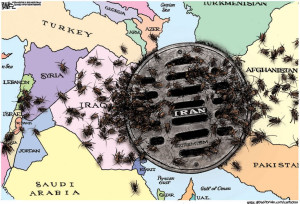
The Middle East roach infestation has originated from Iran – so who will turn on the light to make them scatter?
Source: http://www.ibdeditorials.com/cartoons
We’ve been warning about the Qods Force working to expand their influence in Yemen and model the Houthis after Lebanese Hezbollah. In “Iranian Regime Consolidates Yemeni Gains, Begins Work on Forming Houthi Intel Proxy” we laid out how such work has already been underway. Furthermore, a consistent theme we’ve been touching on in our Arabian Peninsula reporting has been how intelligence collection against US State Department (DoS) personnel and American citizens in the country had dramatically increased with the influx of Hezbollah and Iranian military personnel into the country – so none of this is “new,” although the Obama administration would like to make you think it is, and that the Qods Force doesn’t exercise any control over the Houthis. The inconvenient truth is that they do, and the man calling the shots in the country is Qods Force External Operations Division (Department 400) BG Aboldreza Shahlai.
Check out the following links for additional info on the Qods Force/Houthi/Hezbollah targeting of Americans in Yemen and the greater Arabian Peninsula:
GCC SOF Teams Alerted For Deployment, AQAP Gains Strength and Iran Preps For Attacks Against Saudi Arabia http://isisstudygroup.com/?p=6056
Regarding BG Aboldreza Shahlai, we first introduced him to our readers in our 04 APR 15 article titled, “AQAP and Qods Force Make Their Moves in Yemen as Saudis Struggle to Maintain Coalition.” At the time our sources inside the country had came across information on the presence of a senior Qods Force External Operations Division official had set up shop in the Sadah-area and tasked with overseeing overall operations in the country. We followed this up with an article a month later (“Failed State: Saudi Coaltion Increases Ground Presence as Iran Begins Targeting the Kingdom, US”) revealing his identity. Most westerners have never heard of the guy, but Iranian expats opposed to the regime know all about him. Shahlai was the architect of the Qods Force’s lethal aid program to Shia proxy forces in Iraq during OIF and was also one of the primary planners for the 2007 attack on the Karbala Provincial Joint Coordination Center (PJCC) that killed five US Servicemen. Known as “Suleimani’s Fist,” he holds considerable influence in the Qods Force commander’s inner-circle for advocating “outside the box” solutions to problems – most of which call for directly targeting America and Israel abroad. He was also the mastermind of the plot to assassinate the Saudi Ambassador to the US in New York City that involved his contacts within the Mexican drug cartel known as Los Zetas. His family member Mansur Arbabsiar was the lead-facilitator for the operation. Perhaps more important is Shahlai’s close ties to Abdul Malik al-Houthi and establishment of alternate weapons smuggling routes coming from Africa.
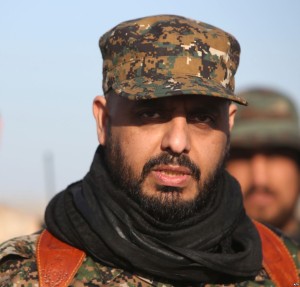
Asaib al-Haq leader Qais al-Khazali worked closely with BG Shahlai during OIF and was a participant in the 2007 attack on the PJCC – he’s now on the front-lines fighting the Islamic State (IS) in Northern Iraq
Source: voanews.com
BG Shahlai’s Yemen assignment is a good indicator that the Iranian regime intends to carry out a campaign targeting American, Israeli and to lesser extent Saudi nationals. With this and Shahlai’s relationship with the Houthis in mind, nobody should be in the least bit surprised that four of our fellow Americans are being held hostage in Yemen. The Houthis have already proven to be very efficient proxies for the Iranians inside Yemen. That said, we will likely see them conducting more operations increasing in complexity and scale within the next 6-9 months across the border into Saudi Arabia itself. They’re already conducting rocket attacks against Saudi border towns and outposts.
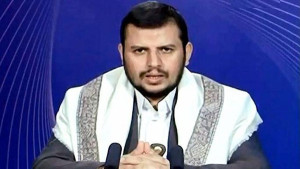
Abdul Malik al-Houthi: Close personal friend to BG Shahlai
Source: al-Arabiya
Its the same situation in Iraq, where we’ve heard from our Baghdad-based contacts reports of an attack being planned by Kataib Hezbollah (KH) targeting the US Embassy. Again, this should surprise no one with the high concentration of Qods Force personnel and proxy forces present inside the country and the capital in particular. We’ve also heard that KH has sympathizers within the Iraqi Security Force (ISF) ranks who are being tapped to assist in the attack. There’s also a considerable anti-air threat in and around BIAP these days coming from both IS and KH fighters. Fortunately, the American forces on the ground are already well aware of this – whether DoS or the Obama administration actually takes the threat serious is another matter entirely.
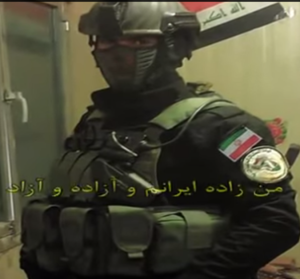
ISOF troopers don’t even try to hide their support of the IRGC-Qods Force Ramazan Corps anymore – a huge red flag for any US military personnel being deployed to Iraq these days
Source: The ISIS Study Group
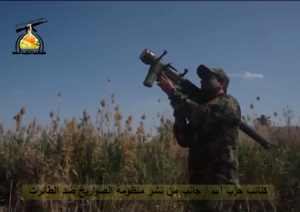
Now why would KH need MANPADs since IS has no Air Force? Perhaps the Qods Force supplied them to KH in order to target someone else?
Source: The ISIS Study Group
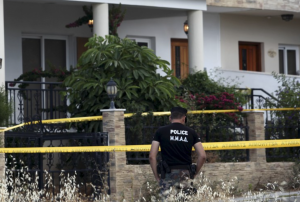
Unfortunately these operations aren’t limited to just the Middle East. Security forces in Cyprus recently arrested a man reportedly involved in a line of Hezbollah operations targeting Israeli interests in Europe. When the Cypriot police arrested him, they also confiscated close to two tons of “suspicious materials” in his basement. Although no additional details on the materials has been made public as of this writing, our source informed us that the materials are for producing explosives (ammonium nitrate was the he saw mentioned). The guy they detained was born in Lebanon but had a Canadian passport, which tends to fit the profile of the kind of personnel Hezbollah’s special operations wing and the Qods Force prefers to recruit into their ranks.
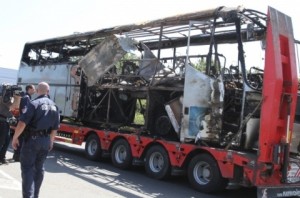
Qods Force and Hezbollah operations have spiked considerably since 2009 with attacks being executed in places like Bulgaria, India and Thailand along with the disrupted plot that was planned for New York City mentioned earlier. Of these, the NYC and Burgas, Bulgaria plots had the direct involvement of BG Shahlai. The telltale signs are how both plots called for using some of his preferred methods of using third parties to do the dirty work and targeting westerners in areas not known for Iranian activity. In fact, the attack in Burgas also involved a Lebanese Arab in possession of Canadian travel documents. The bombings in New Delhi and Bangkok utilized personnel from the IRGC-Qods Force Department 5000 – which is the equivalent to the US Army’s 1st Special Forces Group in that both units are geographically aligned to the Asia/Pacific region.
The 2012 Bombing in Burgas, Bulgaria
Source: Reuters
Bibi Netanyahu was absolutely right to visit America and appear before Congress to air his concerns about the Iranian threat. The events that have occurred over the last few months have added strength to his concerns. Unfortunately, the Obama administration has been downplaying the Iranian threat and the American mainstream media let them get away with it by not holding their feet to the same fire that they did to the Bush administration. Sure, a few American media outlets have finally begun asking some national security questions of substance, but far too many seem to be concerned with covering Bruce Jenner’s hormone therapy and President Obama’s March Madness brackets than they are about things that will have a profound impact on our way of life a lot sooner than people think.
The American media needs to start asking the Obama administration, “why are we seeing such a surge in external operations by the IRGC-Qods Force and their proxies if the current engagement strategy with the Iranian regime is “working,” as they claim?” Indeed members of our staff have worked the Iranian problem-set for some time, but it doesn’t require a whole lot in the way of burning calories to connect the dots between this surge in external operations and the ongoing negotiations over Iran’s nuclear weapons program. Had the media truly cared to search for the truth instead of protect an administration they’ve compromised their journalistic integrity for, they would’ve already put out several articles and investigative specials on the subject. If they want to save face and salvage what’s left of their credibility, then we recommend they do some digging on the current threat to the US Embassy in Baghdad coming from KH and their ISF supporters based in the Green Zone. We can assure you that DoS is fully aware of the threat coming from Shia militias that are now being painted to the American people as “the good guys.”
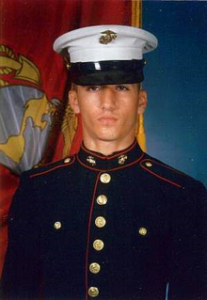
They should also start peppering John Kirby and Marie Harf about the recent counter-terror raid in Cyprus and hammer them about whether the administration ever thought about demanding that the Iranian regime release our citizens in Yemen and US Marine veteran Amir Hekmati during these nuclear weapon talks. We assess that the Qods Force and their proxies are going to continue escalating their actions against our people and our allies for as long as they think they can get away with it. Don’t buy into the Administration’s talk that the regime can’t “control” the Qods Force, because if they say that they’re either lying, extremely ignorant or both. How so? The IRGC as a whole is made up only the most loyal followers of Ayatollah Khameini’s militant ideology. The IRGC-Qods Force are the “most loyal” of those serving in the IRGC – with GEN Suleimani answering only to Khameini. More importantly, the Shia proxy forces won’t take action against the US and its allies unless given authorization to do so by their Qods Force handlers. Make no mistake, this is only the beginning. There will be more attacks coming down the pipe from these guys. Our current national security strategy and foreign policy has set our country on a collision course – is anybody truly paying attention? More importantly, is this administration willing to sacrifice American lives for the appearance of obtaining “peace” with an Iranian regime that has no interest in pursuing normal relations? Something to think about.
Amir Hekmati: Prisoner of Iran
Source: The ISIS Study Group
If you want to know what the Iranian regime is all about, then check out our Inside Iran’s Middle East series:
Members of Iraqi security forces gather around a military vehicle on March 28 outside the western entrance of Tikrit during a military operation to retake the northern Iraqi city from Islamic State group jihadists. (Photo: Ahmad Al-Rubaye/AFP)
The militants gained ample arms, ammunition and other equipment when multiple Iraqi divisions fell apart in the country’s north, abandoning gear and shedding uniforms in their haste to flee.
IS has used captured Humvees, which were provided to Iraq by the United States, in subsequent fighting, rigging some with explosives for suicide bombings.
*********************
BAGHDAD — Iraqi security forces lost 2,300 Humvee armored vehicles when the Islamic State jihadist group overran the northern city of Mosul, Prime Minister Haider al-Abadi said on Sunday.
“In the collapse of Mosul, we lost a lot of weapons,” Abadi said in an interview with Iraqiya state TV. “We lost 2,300 Humvees in Mosul alone.”
While the exact price of the vehicles varies depending on how they are armored and equipped, it is clearly a hugely expensive loss that has boosted IS’ capabilities.
Last year, the State Department approved a possible sale to Iraq of 1,000 Humvees with increased armor, machine guns, grenade launchers, other gear and support that was estimated to cost $579 million.
Clashes began in Mosul, Iraq’s second city, late on June 9, 2014, and Iraqi forces lost it the following day to IS, which spearheaded an offensive that overran much of the country’s Sunni Arab heartland.
The militants gained ample arms, ammunition and other equipment when multiple Iraqi divisions fell apart in the country’s north, abandoning gear and shedding uniforms in their haste to flee.
IS has used captured Humvees, which were provided to Iraq by the United States, in subsequent fighting, rigging some with explosives for suicide bombings.
Iraqi security forces backed by Shiite militias have regained significant ground from IS in Diyala and Salaheddin provinces north of Baghdad.
But that momentum was slashed in mid-May when IS overran Ramadi, the capital of Anbar province, west of Baghdad, where Iraqi forces had held out against militants for more than a year.
Usama al-Nujaifi, one of Iraq’s vice presidents and the former parliamentary speaker, pointed out that recent missteps by the militias has squandered incipient good will for Sunni reconciliation. Yesterday, during a parliamentary session, the Sunni governor of Diyala province was fired—and replaced with a Shia. “This is a real threat and a very negative message to Iraqis. This is considered a break to the rules and it contradicts what has been agreed,” Nujaifi said. “The majority in Diyala are Sunnis.”
**********************
The latest planned attack on the terror army could be playing right into their hands.
The Obama administration is being slammed from all sides for its failing strategy against ISIS—and rightly so. But amid all the scorn, one question has yet to be asked about the resiliency of the terror army, which, actually goes to the heart of its decade-old war doctrine. Namely: does ISIS actually win even when it loses?
This isn’t an academic issue. America’s allies in the ISIS war are gearing up for a major counteroffensive against the extremist group. That assault that could very well play right into ISIS’ hands.
Having superimposed its self-styled “caliphate” over a good third of Iraq’s territory, in control of two provincial capitals, ISIS is today in strongest position it has ever been for fomenting the kind of sectarian conflagration its founding father, Abu Musab al-Zarqawi, envisioned as far back as 2004.
Zarqawi’s end-game was simple: by waging merciless atrocities against Iraq’s Shia majority population (and any Sunnis seen to be conspiring with it), Zarqawi’s jihadists would have only to stand back and watch as radicalized Shia militias, many of whose members also served in various Iraqi government and security roles, conducted their own retaliatory campaigns against the country’s Sunni minority. Internecine conflict would have the knock-on effect of driving Sunnis desperately into the jihadist fold, whether or not they sympathized with the ideology of al-Qaeda in Iraq, Zarqawi’s franchise and the earliest incarnation of what we now call the Islamic State.
Indeed, in the mid-2000s, the Jordanian jihadist nearly got what he wished for by waging spectacular terror attacks against Shia civilians and holy sites, such as the Golden Mosque in Samarra, a strategy which quickened devolved Iraq’s violence from a primarily anti-American insurgency into all-out civil war. The only stopgap for a truly apocalyptic or nation-destroying result was the presence of nearly 200,000 U.S. and coalition troops. Today, however, absent such a foreign and independent military presence, the main actors left in Iraq are the same extremists —Shia militias and ISIS.
This fact was only driven home last week after thousands of U.S.-trained Iraqi Security Force personnel, including the elite counterterrorist Golden Division, fled from Ramadi, allowing the city fall to a numerically modest contingent of ISIS jihadists. Having been initially instructed by Iraq’s Prime Minister Haider al-Abadi to refrain from defending the city (no doubt at the prompting of Washington) the Hashd al-Shaabi, the umbrella organization for these Shia militias, now say they are prepping a massive counteroffensive to retake Ramadi. It promises to be a drawn-out and highly fraught counteroffensive, pitting paramilitaries—which have been accused of war crimes and atrocities by Human Rights Watch, Amnesty International and United Nations Human Rights Commission—against genocidal ISIS militants.
Many Iraqis fear, with good reason, that this counteroffensive will also extend to Sunni civilians who will now be branded “collaborators” of ISIS, as they have in previous Hashd-led operations. The result: torture, extrajudicial killing, and ethnic cleansing. Nothing would better serve the ISIS narrative or legitimate its claim to be the last custodian and safeguard of Sunni Muslims in the Middle East. Such an outcome might even precede the eventual disintegration of the modern state of Iraq into warring ethno-religious enclaves. That this was ISIS’s plan all along adds yet another grim paragraph to the obituary of American-hatched adventurism in the Middle East.
True, Hashd al-Shaabi has routed ISIS elsewhere before, namely in Amerli and Jurf al-Sakhar and Tikrit. In the aftermath, the militia was accused of committing human rights abuses, but those accusations didn’t tear the country apart.
The difference with Ramadi, however, is one of both scale and symbolism. This city of close to 200,000 is dead center in the Sunni heartland of Iraq, where ISIS has the home advantage. Ramadi was also, not coincidentally, the cynosure of the so-called “Anbar Awakening,” which saw hundreds of thousands of Sunni tribesmen rise up against ISIS’s predecessor, al-Qaeda in Iraq, in a cautious but fruitful partnership with American soldiers in the mid-2000s, a grassroots counterinsurgency whose gains were then solidified by the “surge” orchestrated by U.S. commander General David Petraeus. This time, absent any American combat forces, there are Shia Islamists who have never before tread into Ramadi. Many Iraqis dread the consequences.
“Iraq is not unified,” Iraq’s former Deputy Prime Minister Rafe Essawi, a senior Sunni political leader originally from Anbar, told The Daily Beast. “50 percent of the country belongs either to Kurds or ISIS, and 50 percent belongs to the Shia militias backed by Iran. We said too many times to our friends the Americans that we do not need to see the militias in Ramadi because this will lead to sectarian conflict.”
Yet the Americans have little on offer by way of an alternative. U.S. training efforts are still months off from fielding military units able to join the fight. With Iraq’s future resting on them, Hashd is seen as the only ready bulwark against further ISIS encroachments, though its conduct in Anbar may paradoxically purge the province of ISIS’s hard power while underwriting its soft version.
The Ramadi offensive hardly got off to a promising start. On Tuesday, Hashd spokesmen announced that the name for their Anbar offensive was, “Labeyk Ya Hussein,” a slogan roughly translated as “At your service, Hussein,” in tribute to a venerated Shia religious figure. The connotations were therefore of holy war — not exactly the multi-sectarian, pan-Iraqi message Baghdad has preferred to telegraph to international audiences.
On Wednesday, in response to criticism from U.S. officials and some Iraqi leaders—including demagogic Shiite cleric Muqtada al-Sadr (who has fallen out with Iran and has since platformed himself as a nationalist politician)—the operation’s name was changed to to more universal: “Labeyk Ya Iraq.” But the public relations rethink has not addressed underling concerns about the Hashd’s intentions, nor allayed Sunni anxieties.
“I think the careful examiner of the facts on the ground will see de facto borders are being drawn whether by design or by circumstance,” said one former Iraqi official who spoke to The Daily Beast on the condition of anonymity. “The militias have effectively cleared the Baghdad belts to the south of Sunnis, and with the Ramadi operation I expect the same will happen westward but it will entail a lot more fighting and possibly much more instability.”
This is because the war for the future Iraq isn’t being waged first and foremost by Iraqis but by their self-interested next-door neighbor, Iran, led by its elite Revolutionary Guards Corps-Quds Force, a U.S.-designated terrorist entity in its own right.
Iraq’s sectarian division, whereby Sunnis have been forced out of Shia-controlled areas under the auspices of fighting ISIS, reflects the fact that the Hashd operates more according to Tehran’s geo-strategic and ideological interests, the former official said. “I feel that Iran and some of its erstwhile allies have reached a realization that they have lost a significant ally in Syria and therefore need to buffer the ‘Shia’ zones in Iraq to protect them while paying lip service to the notion of a unified state.”
It certainly does not help matters that America’s unacknowledged ally in the anti-ISIS coalition is the IRGC-QF, whose commander, Major General Qassem Suleimani, not only blamed U.S. incompetence for the fall of Ramadi this week but labeled the United States an “accomplice” of the jihadists—a conspiratorial view of ISIS’s secret patronage widely shared amongst the Hashd rank-and-file.
The scenario described by Essawi and the ex-official is more common among the Sunni political class that either Washington or Baghdad care to acknowledge. Whether it is credible will depend on how the Hashd conducts itself on hostile terrain and whether it can break with precedence of collective punishment. If the militias act as a nationalist reserve army, under the command and control of Haider al-Abadi—something the White House has insisted as a precondition of U.S. air support—then they may be able to recruit Sunnis to their efforts, or at least earn their respect and admiration.
Essawi argues that Hashd has so far relied on coercion rather than a savvy hearts-and-minds approach for winning over Sunnis. “The Sunni tribes used to be against ISIS after [their] crimes,” he said. “Definitely there are some local supporters of ISIS, but the tribes generally speaking —almost all of them — are committed to fight. It is the government that refuses to strengthen them. So some very weak tribes have been coerced into accepting this bad choice: it’s either Hashd al-Shaabi or ISIS.”
Saleh al-Mutlaq, a Sunni deputy prime minister under Abadi, disagreed.
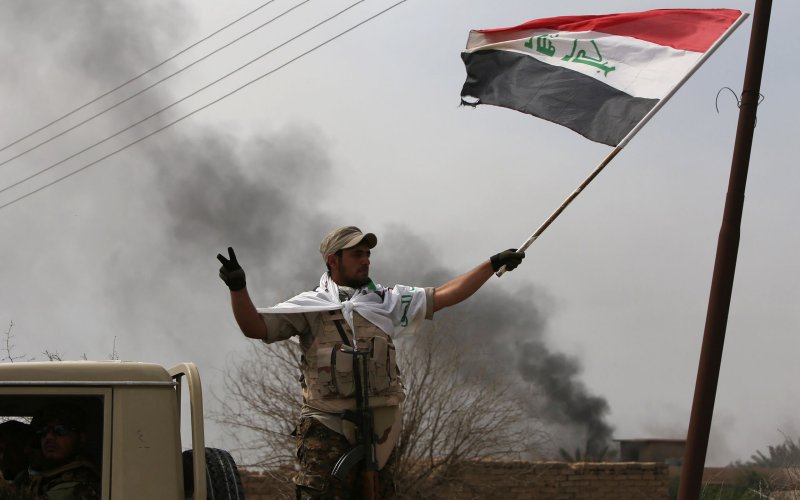
He emphasized that the Hashd should henceforth operate under the Iraqi flag rather than the host of competing standards their constituent militias currently brandish (including those bearing the images of Iranian ayatollahs Khomeini and Khamenei). But Mutlaq is hopeful of greater Sunni support for the Hashd. He pointed out that there are currently volunteer camps established near Ramadi to incorporate Sunnis volunteers and Iraqi policemen who fled the city into the broader counteroffensive.
“The government will give them training and weapons,” a statement issued by Mutlaq’s office read, without offering specifics. As for Shia sloganeering deemed alienating the Anbari support base, he doesn’t think this has had too dire an impact. “The Sunnis were conflicted about the intervention from the Hashd al-Shaabi because they were worried about reprisal attacks. But the Hashd is less harmful than ISIS. At least, these people are Iraqis and we can deal with them later on, but we can’t with ISIS.”
Nevertheless, Mutlaq wonders just what form a pro-government success may take and what happens the day after ISIS is routed from Ramadi. “His concern is whether Ramadi will undergo demographic changes,” his office said. “Will Sunnis be forced to relocate to others areas and will there will be any revenge attacks and conflicts between the Hashd and the tribes?”
Usama al-Nujaifi, one of Iraq’s vice presidents and the former parliamentary speaker, pointed out that recent missteps by the militias has squandered incipient good will for Sunni reconciliation. Yesterday, during a parliamentary session, the Sunni governor of Diyala province was fired—and replaced with a Shia. “This is a real threat and a very negative message to Iraqis. This is considered a break to the rules and it contradicts what has been agreed,” Nujaifi said. “The majority in Diyala are Sunnis.”
ISIS is counting on such political heavy-handedness to indemnify its own savagery. “It is that enemy, composed of Shiites joined by Sunni agents, who are the real danger with which we are confronted, for it is our fellow citizens, who know us better than anyone,” Zarqawi wrote in a 2004 letter, correctly foreseeing that the U.S. military occupation would be fleeting and incidental to the future of Iraq.
In other words, he wanted the Shia militias, principally the Badr Corps — now first among equals in the Hashd— to commit anti-Sunni atrocities as payback for Zarqawi’s own scorched-earth war against the Shia. “If we manage to draw them onto the terrain of partisan war, it will be possible to tear the Sunnis away from their heedlessness, for they will feel the weight of the imminence of danger and the devastating threat of death wielded by these Sabeans.”
If Iraq does fall apart, it will have been because Zarqawi’s apocalyptic plan got realized a decade after his death.
Iranian troops in fight to evict ISIS from Baiji refinery
Hassan Nasrallah Saturday, May 23, called his Lebanese Shiite Hizballah movement to the flag, because “we are faced with an existential crisis” from the rising belligerence of the Islamist State of Iraq and the Levant. His deputy, Sheik Naim Qssem, sounded even more desperate: “The Middle East is at the risk of partition” in a war with no end in sight, he said. “Solutions for Syria are suspended. We must now see what happens in Iraq.”
The price Iran’s Lebanese proxy has paid for fighting alongside Bashar Assad’s army for four years is cruel: some 1,000 dead and many times that number of wounded. Its leaders now understood that their sacrifice was in vain. ISIS has brought the Syrian civil war to a new dead end.
This week, a 15-year old boy was eulogized by Hizballah’s leaders for performing his “jihadist duty” in Syria.
Clearly, for their last throw in Syria, the group, having run out of adult combatants, is calling up young boys to reinforce the 7,000 fighting there.
The Syrian president Bashar Assad is in no better shape. He too has run dangerously short of fresh fighting manpower. Even his own Alawite community has let him down. Scarcely one-tenth of the 1.8 million Alawites have remained in Syria. Their birthrate is low, and those who stayed behind are hiding their young sons to keep them from being sent to the front lines.
Assad also failed to enlist the Syrian Druze minority to fight for his regime, just as Hizballah’s Nasrallah was rebuffed when he sought to mobilize the Lebanese army to their cause. This has left Hizballah and the Syrian ruler alone in the battlefield with dwindling strength against two rival foes: ISIS and the radical Syrian opposition coalition calling itself Jaish al-Fatah – the Army of Conquest – which is spearheaded by Al Qaeda’s Nusra Front and backed to topple Assad by Saudi Arabia, Qatar and Turkey.
Nasrallah tried to paint a brave picture of full mobilization to expand the war to all parts of Syria. However, Sunday, May 24, a key adviser to Assad admitted that his regime and its allies were being forced to regroup.
Their forces were withdrawing from the effort to shift the Islamists from the land they have conquered – about three-quarters of Syrian territory – and concentrating on defending the cities, Damascus, Homs and Latakia, home to the bulk of the population, as well as the strategic Damascus highway to the coast and Beirut. Hizballah needed to build up the Lebanese border againest hostile access.
But Syrian cities, the Lebanese border and the highway are still under threat – from Syrian rebel forces.
The Iraqi army, for its part, has been virtually wiped out, along with the many billions of dollars the US spent on training and weapons. There is no longer any military force in Iraq, whether Sunni or Shiite, able to take on ISIS and loosen its grip on the central and western regions.
The Kurdish peshmerga army, to whom President Barack refused to provide armaments for combating the Islamists, has run out of steam. An new offensive would expose the two main towns of the semi-autonomous Kurdish Republic – the capital Irbil and the oil city of Kirkuk – to the depredations of the Islamist belligerents.
A quick scan of Shiite resources reveals that in the space between the Jordan River and the Euphrates and Tigris, Iran commands the only force still intact in Iraq – namely, the Iraqi, Afghan and Pakistani Shiite militias, who are trained and armed by the Revolutionary Guards.
This last remaining fighting force faces its acid test in the battle ongoing to recover Baiji, Iraq’s main oil refinery town. For the first time, Iranian troops are fighting in Iraq, not just their surrogates, but in the Baiji campaign they have made little headway in three weeks of combat. All they have managed to do is break through to the 100 Iraqi troops stranded in the town, but ISIS fighting strength is still not dislodged from the refinery.
The Obama administration can no longer pretend that the pro-Iranian Shiite militias are the panacea for the ISIS peril. Like Assad, Tehran too is being forced to regroup. It is abandoning the effort to uproot the Islamists from central and western Iraq and mustering all its Shiite military assets, such as the Badr Brigade, to defend the Shiite south – the shrine towns of Najef and Karbala, Babil (ancient Babylon) and Qadisiya – as well as planting an obstacle in the path of the Islamists to Iraq’s biggest oil fields and only port of Basra.
The Shiite militias flown in by Tehran from Pakistan and Afghanistan have demonstrated in Syria and Iraq alike that they are neither capable nor willing to jump into any battlefields.
The upshot of this cursory scan is that not a single competent army capable of launching all-out war on ISIS is to be found in the Middle East heartland – in the space between the 1,000km long Jordan and the Euphrates and Tigris to the east, or between Ramadi and the Saudi capital of Riyadh to the south.
By Sunday, May 24, this perception had seeped through to the West. US Defense Secretary Ashton Carter, remarked: “What apparently happened was that the Iraqi forces just showed no will to fight.” The former British army chief Lord Dannatt was more down to earth. Since the coalition air force campaign had failed to stop ISIS’s advance, he said “it was time to think the previously unthinkable” and send 5,000 ground troops to fight the Islamists in Syria and Iraq.
The next day, Monday, Tehran pointed the finger of blame for the latest debacles in Iraq at Washington. Al Qods Brigades chief Gen. Qassem Soleimani was quoted by the English language Revolutionary Guards mouthpiece Javan as commenting: “The US didn’t do a damn thing to stop the extremists’ advance on Ramadi.”






 anneinpt
 artaxes
 danmillerinpanama
 davidking1530
 Peter Hofman
 Joseph Wouk
 Peter
Peter Louisiana Steve
 WarSclerotic
Recent Comments