Archive for the ‘Iranian Threats’ category

Iran Deal: The Great Bamboozle Festival

July 18, 2015

Iran Deal: The Great Bamboozle Festival, Gatestone InstituteDouglas Murray, July 18, 2015

(Would Chamberlain, in the context of British military weakness but in otherwise comparable circumstances, have made a similar “deal” with Hitler and declared “peace in our time?”  — DM)

  • A generous person might say that this is unimportant — that in Iran, chanting “Death to America” is like throat-clearing.
  • Surely only an uncharitable person would wonder why Iran’s rulers are buying the technology they would need to repel any attack on their nuclear project at the same time as they are promising the Americans that they are not developing nuclear weaponry.

What exactly is it that the Obama administration thinks has changed about the leadership of Iran? Of all the questions which remain unanswered in the wake of the P5+1 deal with Iran, this one is perhaps the most unanswered of all.

There must, after all, be something that a Western leader sees when an attempt is made to “normalize” relations with a rogue regime — what Richard Nixon saw in the Chinese Communist Party that persuaded him that an unfreezing of relations was possible, or what Margaret Thatcher saw in the eyes of Mikhail Gorbachev, which persuaded her that here was a counterpart who could finally be trusted.

After all, the outward signs with Iran would seem to remain unpromising. Last Friday in Tehran, just as the P5+1 were wrapping up their deal with the Iranians, the streets of Iran were playing host to “Al-Quds Day.” This, in the Iranian calendar, is the day, inaugurated by the late Ayatollah Khomeini, when anti-Israel and anti-American activity come to the fore even more than usual. Encouraged by the regime, tens of thousands of Iranians march in the streets calling for the end of Israel and “Death to America”. Not only Israeli and American flags were burned — British flags were also torched, in a touching reminder that Iran is the only country that still believes Britain runs the world.

The latest in a long line of “moderate” Iranian leaders, President Hassan Rouhani, turned up at one of these parades himself to see the Israeli and American flags being burned. Did he intervene? Did he explain to the crowd that they had got the wrong memo — that America is now our friend and that they ought at least to concentrate their energies on the mass-burning of Stars of David? No, he took part as usual, and the crowds reacted as usual.
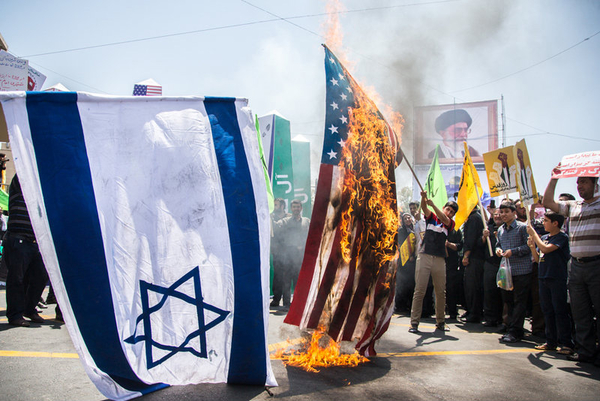
1153Participants in Tehran’s Quds Day rally burn U.S. and Israeli flags, on July 10, 2015. (Image source: ISNA)

It was the same just a few weeks ago, when the Iranian Parliament met to discuss the Vienna deal. On that occasion, after some authorized disputation, the Iranian Parliament broke up, with the representatives chanting “Death to America.”

A generous person might say that this is unimportant — that in Iran, chanting “Death to America” is like throat-clearing. This is just what we are being told — that these messages are “just for domestic consumption,” and don’t mean anything.

Putting aside what they say for a moment, what is it about Iran’s actions that have changed enough to persuade the U.S. government that the Iranian regime might be a regime in transition?

Internally there has been no let-up in the regime’s campaign of oppression against their own Iranian people: hanging people for a range of “crimes,” from being gay to being a poet found guilty of “blasphemy,” continue.

Iran has hanged more than a thousand of these internal “enemies” in the last eighteen months alone, as negotiators sat in Vienna thrashing out a deal. In the wider region, Iran remains the most voraciously ambitious, and perhaps the only successfully outgoing, regional power. In the years since the “Arab Spring” began, only Iran has been able significantly to extend its reach and grip in the region. It now has a vastly increased presence and influence in Yemen, Iraq, Syria and Lebanon. It continues to arm its terrorist proxies, including Hezbollah, which in turn continues to increase its build-up of rockets and other munitions on the northern border of Israel.

Iran has not released the four American hostages it continues to hold — Pastor Saeed Abedini, for the crime of converting to Christianity; Washington Post journalist Jason Rezian, on the patently nonsensical charges of espionage; former U.S. Marine Amir Mirza Hekmati, who went to Iran to visit his grandmother; and retired DEA and FBI agent Robert Levinson, who was abducted eight years ago and has not been heard from since early 2013. This, in spite of last-minute requests from Iran to lift a ban on conventional weapons, acceded to by the members of the P5+1, wasting yet another abandoned opportunity actually to get something in return for their total surrender.

From the outside, it would seem that very little has changed in the rhetoric of Iran and very little has changed in the regime’s behavior. That is why the mystery of what change the U.S. administration and its partners see in the eyes of the Ayatollahs is so doubly curious.

Because the nature of the deal makes it exceptionally important that there is some change. In the next decade, in exchange for the supposed “managed inspections” of limited Iranian sites, the Ayatollas are going to enjoy a trade explosion with a cash bonanza of $140 billion unfrozen assets, just to start them off. Throughout that same decade, there will be a lifting of restrictions on — among other things — the sale and purchase by Iran of conventional arms and munitions. Iran will finally be able to purchase the long-awaited anti-aircraft system that the Russians (also of course present at the table in Vienna) want to sell them. This system — among the most advanced surface-to-air missile systems — will be able to shoot down any American, Israeli or other jets that might ever come to destroy Iran’s nuclear project. And surely only an uncharitable person would wonder why Iran’s rulers are buying the technology they would need to repel any attack on their nuclear project at the same time as they are promising the Americans that they are not developing nuclear weaponry.

And it is even more important that the signs of hope located by the U.S. administration are correct, because after all, barring an internal uprising — which the Vienna deal makes more unlikely than ever (having strengthened the diplomatic and financial hand of the regime) — it is safe to say that over the next decade and beyond the Mullahs will remain in charge in Iran.

In the U.S., Germany, France and Britain, by contrast, who knows who will be in charge? In Britain, the Labour party may have romped to victory with, at its head, Jeremy Corbyn MP (currently Labour leadership contender) — a man who has openly and repeatedly praised Hamas and Hezbollah as his “friends.” That would certainly change the dynamics.

But put aside such a potentially unlikely situation and assume that Britain and America simply do politics as usual. In ten years, there will have been four U.S. governments overseeing the implementation of this deal and scrutinizing the inspections-compliance of the Iranian regime.

In the UK, there will have been at least two new governments. Who is to say that all these different governments — of whatever party or political stripe — will pay the same attention, know what to look out for, and feel as robust about totally unenforceable “snapback sanctions” and other details of the implementation of this deal as the signatories to the deal appear to expect? Is it possible that the Iranians actually know this?

Perhaps, after all, there is something in the eyes of the Ayatollahs. Maybe US Secretary of State John Kerry and President Barack Obama really have looked into the Iranian leaders’ eyes and seen a smile. But whether it is for the reason they appear to believe is, of course, quite another matter.

Exclusive Interview – Former Israeli Ambassador Michael Oren

July 17, 2015

Exclusive Interview – Former Israeli Ambassador Michael Oren, Blackfive, July 16, 2015

Why do some in the press want to discredit Oren’s roots?  Possibly because the Ambassador is publicly warning that the Obama Administration is setting a dangerous precedent concerning the Iranian nuclear deal.  As Daniel Silva profoundly wrote in his latest book, The English Spy, “Now the president’s confronted with a world gone mad, and he doesn’t have a clue as to what to do about it.”

***************************

The following interview and book review is a special for BlackFive readers provided by Elise Cooper.  You can read all of our book reviews and author interviews by clicking on the Books category on the right side bar.

Former Israeli Ambassador Michael Oren’s latest book Ally is a riveting description of the relationship between Israel and the United States.  Readers get a behind the scenes look at how the Obama Administration has a one sided point of view. Through his numerous notes and direct insight he tells of the struggles Israel has had with the Obama Administration, especially regarding the Iranian nuclear deal.  He warns that Israel is in existential danger, that his only agenda is a reality check regarding this administration’s policies toward Israel. Blackfive.net interviewed him about his book and the Iranian nuclear deal.

He gave an exclusive to Blackfive.net, stating that he only tells those people “who come to work with me about this clip.  I ask them to watch it so that they will understand me.”  The clip (https://www.youtube.com/watch?v=ImtrifoxW4c) is about the Battle of the Bulge with interviews from participants including Oren’s father, Lester Bornstein, a US Army Corps Engineer whose duty was to clear roads and build bridges during World War II.  Yet, in the Ardennes Forest in France on December 16, 1944, Lester along with his friend Jimmy Hill became infantrymen to help fend off the German advance, which had taken the American military off guard.  He and his friend bravely disabled the first German tank in line, forcing a halt in the advance.

Oren, born in America, feels a kinship with America’s culture, principles, and spirit.  He remembers his father telling the family war stories and during his first combat mission in the war, Operation Peace for the Galilee, thought of his father’s experience, wondering “how I would conduct myself under fire.”

Throughout the book Oren emphasizes the closeness he feels with both America and Israel.  Yet, some in the media like Newsweek’s Jonathan Broder attempt to discredit him by writing, “The American-born Oren, who renounced his U.S. citizenship and now serves as a lawmaker in Netanyahu’s right-wing coalition, transforms from a measured historian into a breathless polemicist.” This is anything but the truth. Oren noted, “By Federal law any American who officially served a foreign county had to renounce their US Citizenship. My loyalties to the United States and the Jewish State are mutually validating.”

He wrote in the book how his love for America is filled with gratitude. “From the time that all four of my grandparents arrived on Ellis Island, through the Great Depression, in which they raised my parents, and the farm-bound community in which I grew up, America held out the chance to excel. True, prejudice was prevalent, but so, too, was our ability to fight it. Unreservedly, I referred to Americans as ‘we.’ The United States and Israel, are both democracies, both freedom-loving, and similarly determined to defend their independence. One could be — in fact, should be — a Zionist as well as a patriotic American, because the two countries stood for identical ideals.” Except now Israel is being thrown under the bus with the Iranian nuclear deal.

Why do some in the press want to discredit Oren’s roots?  Possibly because the Ambassador is publicly warning that the Obama Administration is setting a dangerous precedent concerning the Iranian nuclear deal.  As Daniel Silva profoundly wrote in his latest book, The English Spy, “Now the president’s confronted with a world gone mad, and he doesn’t have a clue as to what to do about it.”

Oren noted to blackfive.net about another irrational period in history and compared it to the current situation; “Lets remember one infamous example, when the Nazis pursued their insane ends.  Even during the last days of World War II, as the Allied armies liberated Europe, they diverted precious military resources to exterminating Jews.  The Israeli position is that this Iranian regime is irrational. Unlike Israel, which is in Iran’s backyard, the US is not threatened by the proximity of national annihilation. This is about our survival as a people. It’s about our children and grandchildren. What may look like an academic debate here in America is for us in Israel a matter of life and death.”

Asked if he agrees with the quote from former CIA Director Michael Hayden, who said of Iran, “the enemy of our enemy is still our enemy,” Oren told blackfive.net, that Americans should not forget that Iran “wants to wipe Israel off the face of the earth, something they have been calling for the last thirty years.  Let’s not forget they also attempted to blow up the Israeli Embassy in Washington DC and assassinate the Saudi Ambassador. Iran and its terrorist groups have killed more Americans than any other terrorist group outside of Al Qaeda.  This does not even include those in the American military who were killed by Iran during the Iraq War.  They are not friends.”

But a true friend, an ally, is defined by Oren as assisting “in saving American lives on and off the battlefield. On an ideological level, an ally is a country that shares America’s values, reflects its founding spirit, and resonates with its people’s beliefs. And an ally stimulates the U.S. economy through trade, technological innovation, and job creation. The two countries I love need to unite on issues vital to both and yet they remain separated ideologically and even strategically. However, on issues of security, anybody in the Israeli military, in the intelligence community, will tell you that security relations between Israel and the United States are better now than probably any other time in the past.”

In the Middle East Israel is America’s staunchest ally. Even though the Obama Administration appears not to recognize this, Americans do. A recent Gallup Poll shows that two out of three Americans sympathize with Israel, with support for Israel in the United States rising, not declining.

Ambassador Oren wrote this book, Ally, to send a clear message, “A friend who stands by his friends on some issues but not others is, in Middle Eastern eyes, not really a friend. In a region famous for its unforgiving sun, any daylight is searing.” Ally is a must read, because it alerts people that Israel faces the greatest challenge they have faced since World War II.

We Should Go to War With Iran, Not Give Them a Peace Deal | PJTV

July 15, 2015

We Should Go to War With Iran, Not Give Them a Peace Deal | PJTV, July 14, 2015


Iran Has a New Cage

July 14, 2015

Iran’s Rouhani says ‘God has accepted nation’s prayers’

Via Yahoo News 7-14-2015


Hmmm. [Source: Unknown]

(I chose this short post because it demonstrates the lack of news reporting by our press coming OUT of Iran. Like most, I sat painfully as I watched Obama announce his ‘victory’ over Iran. The coverage was detailed and in real time. Surprisingly, one of the networks, which one escapes me now, actually went live for Rouhani’s announcement to the Iranian people, in Farsi of course. The translator struggled along and said something that struck me. She translated Rouhani saying, ‘Iran has a new cage.’ No one seemed to notice. Then it struck me. What else is he telling his people and how does it reconcile with what the western press is telling us. We may never know. Therein lies the real news, in my humble opinion. – LS)

Tehran (AFP) – Iranian President Hassan Rouhani said in a live televised address Tuesday that “God has accepted the nation’s prayers”, hailing a nuclear deal with world powers that will lift sanctions.

Rouhani spoke minutes after US President Barack Obama’s comments on the agreement struck in Vienna were also broadcast live on state television.

Iranian official: ‘We will take 1,000 Americans hostage’ if US comsiders military action

July 13, 2015

Iranian official: ‘We will take 1,000 Americans hostage’ if US comsiders military action, BreitbartAdelle Nazarian, July 13, 2015

(“Iran won’t back down from acquiring nuclear missiles.” But Khamenei claims that Iran has no desire for nuclear weapons. Who is kidding whom? — DM)

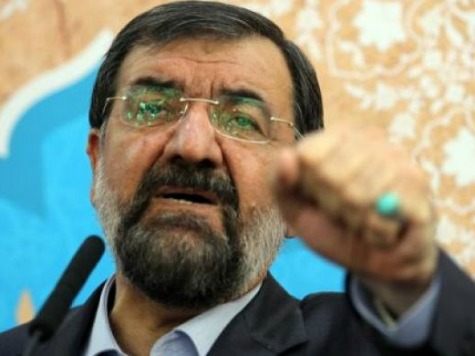
Mohesen-Rezaei-gettyATTA KENARE/AFP/Getty Images

Rezaei then went on to suggest that Iran will not back down from acquiring nuclear missiles.

*************

Iran’s secretary of the Expediency Discernment Council and recently-returned head of the Iranian Revolutionary Guards Corps (IRGC) Mohesen Rezaei says Iran is prepared to take 1,000 Americans hostages and demand millions of dollars in ransom for each of them if the United States even considers waging war against Iran.

In an interview with Iran’s State TV IRIB on Saturday, Rezaei made this solemn vow:

I am promising you, I promise the people of Iran, that as a soldier of Iran and a revolutionary militant, if America even thinks about taking military action against Iran, they can rest assured that in the first week we will take 1,000 Americans hostage and demand millions of dollars in ransom for each of their releases. That will likely help solve our economic issues as well. We are warning them in advance so that they can get this thought out of their minds.

Rezaei then went on to suggest that Iran will not back down from acquiring nuclear missiles. “If tomorrow Israel decides to attack Iran, shouldn’t Iran be able to respond to them [with nukes]?”

Pulling no punches in the interview, Rezaei referred to President Barack Obama as “weak” and said Iran blames him for causing the mess it is in, noting that it is time for President Obama to fix it. He also referred to John Kerry as an “orphaned child” (yateem in Farsi) who returns to the negotiating table with “sorry expressions” each time he receives a call from Washington, pleading for changes to what was previously discussed.

He said, “Of course it was Obama who caused the situation in Iran because even George W. Bush, as strong as his stances were, did not dare to impose last year’s sanction on Iran” during the course of his presidency. Rezaei was referring to the oil sanctions imposed by Congress in 2012, which was actually introduced and pushed by Republicans and passed as a bipartisan bill with the help of a handful of Democrats. In reality, Obama was against imposing oil sanctions on Iran, but a veto-proof majority tied his hands. Nonetheless, he appears to be receiving both the credit and criticism for the move.

Back in Tehran… Khamenei adds red lines, Rouhani tries to resign, Jaafari hints at “fait accompli” soon

July 12, 2015

Back in Tehran… Khamenei adds red lines, Rouhani tries to resign, Jaafari hints at “fait accompli” soon, DEBKAfile, July 12, 2015

(To the extent accurate, this is a fascinating account of what happened on June 29th, when Rouhani returned to Tehran for “consultation.” — DM)

ROUHANI-JAFARIPresident Rouhani vs Ali Jaafari

Iran’s top leaders remain ambivalent about whether or not to sign the comprehensive nuclear accord with the six world powers in Vienna as 22 agonizing months of negotiation falter on the brink. The all-powerful supreme leader Ayatollah Ali Khamenei’s latest comment was far from helpful. Saturday, July 11, he said publicly: “The US is the true embodiment of global arrogance,” the fight against which “could not be interrupted” even after the completion of the nuclear talks. He also boasted that the Islamic Republic had “managed to charm the world” by sticking with those negotiations.

DEBKAfile’s Iranian sources report that Khamenei’s remarks reflect the struggle between the pro- and anti-nuclear deal factions at the highest level of the Iranian leadership. For now, President Barack Obama’s odds of less than 50 percent on a final accord may well describe the balance in Tehran.

On June 29, President Hassan Rouhani was planning to resign when he asked the supreme leader to receive him first. He was upset by Foreign Minister Mohamed Zavad Zarif’s recall from Vienna to Tehran for a tough briefing. Zarif had warned the president that the talks were doomed unless Iran gave some slack. The foreign minister said that the six foreign ministers were preparing to leave Vienna in protest against Iran’s intransigence.

Rouhani when he met Khamenei warned him that Iran was about to miss the main diplomatic train to its main destination: the lifting of sanctions to save the economy from certain ruin.

The supreme ruler was unconvinced: He referred the president to the conditions for a deal he had laid down on June 23 and refused to budge: Sanctions must be removed upon the signing of the final accord; international atomic agency inspectors were banned at military facilities, along with interviews with nuclear scientists; and the powers must endorse Iran’s right to continue nuclear research and build advanced centrifuges for uranium enrichment.

Rouhani hotly stressed that those conditions had become a hindrance to the deal going through and insisted that sanctions relief was imperative for hauling the economy out of crisis.

Khamenei disputed him on that point too. He retorted that the revolutionary republic had survived the eight-year Iranian-Iraqi war (1979-187) with far fewer resources and assets than it commanded at present.

For back-up, the supreme ruler asked two hardliners to join his ding-dong with the president: Defense Minister Hosseim Dehqan and Revolutionary Guards chief Mohammad Ali Jaafari.

Both told Rouhani in the stiffest terms that Tehran must not on any account bow to international pressure for giving up its nuclear program or the development of ballistic missiles.

In a broad hint to President Rouhani to pipe down, Khamenei reminisced about his long-gone predecessor Hassan Bani-Sadr (president in 1980-1981) who was not only forced out of office but had to flee Iran, and the former prime minister and presidential candidate Mir Hossein Moussavi, who has lived under house arrest for six years since leading an opposition campaign.

The supreme leader then set out his thesis that the danger of Iran coming under attack had declined to zero, since Europe was in deep economic crisis (mainly because of Greece) and because the US president had never been less inclined to go to war than he is today.

Jaaafri added his two cents by commenting that after a succession of fiascos, Obama would go to any lengths to reach a nuclear deal with Iran as the crowning achievement of his presidency.  The Revolutionary Guards chief then added obliquely: “Before long we will present the West with a fait accompli.”

He refused to elaborate on this when questioned by the president, but it was taken as a reference to some nuclear event.

Rouhani left the meeting empty-handed, but his letter of resignation stayed in his pocket.

The next day, when Zarif landed in Vienna to take his seat once more at the negotiating table, he learned about a new directive Khamenei had sent the president, ordering him to expand ballistic missile development and add another five percent to its budget – another burden on Iran’s empty coffers.

Khamenei’s office made sure this directive reached the public domain. Zarif too was armed with another impediment to a deal. Khamenei instructed him to add a fresh condition: The annulment of the sanctions imposed against Iran’s missile development and arms purchases.

Iran Reminds the World How Much They Love Us

July 10, 2015

Chanting ‘Death to America, Israel,’ millions march in Iran on al-Quds Day

By Times of Israel staff, AP and AFP July 10, 2015, 12:08 pm


Iran’s version of a friendly gesture. [Source: Unknown]

(I’d burn the Iranian flag but it’s not worth my time. Like most folks, I’m busy earning a living, providing for my family, and making a promising future for my children and grandchildren. – LS)

Protesters burn US, Israeli flags at annual rallies; condemn Saudi Arabia over Yemen conflict

Millions of Iranians took part in anti-Israel and anti-US rallies across Iran on Friday, chanting “Down with America” and “Death to Israel” on Al-Quds Day, internationally observed annually on the last Friday of the month of Ramadan.

The controversial holiday was proclaimed in 1979 by Iran’s Ayatollah Ruhollah Khomeini as a religious duty for all Muslims to rally in solidarity against Israel and for the “liberation” of Jerusalem. Tehran says the occasion is meant to express support for Palestinians and emphasize the importance of Jerusalem for Muslims.

Iranian President Hassan Rouhani attended the protest on Friday but did not speak at the main rally in Tehran, which coincided with seemingly deadlocked nuclear talks between Iran and world powers led by the United States.

Large demonstrations were also held in Iraq and Lebanon.

Some protesters in Tehran burned Israeli and American flags. Posters showed Israeli Prime Minister Benjamin Netanyahu, Saudi King Salman and US President Barack Obama in flames.

Iranian protesters set dummies depicting US President Barack Obama and Israeli Prime Minister Benjamin Netanyahu on fire on top of an Israeli flag during a demonstration to mark the Quds (Jerusalem) International day in Tehran on July 10, 2015.

Using the al-Quds Day hashtag, supreme leader Ayatollah Ali Khamenei tweeted: “There are two sides in oppression: oppressor & the oppressed. We back the oppressed and are against oppressors.”

At a mock checkpoint, several men and a woman dressed in Israeli army uniforms shouted at people who wanted to pass and pushed them back, threatening them with batons and guns.

“We are all here to see the freedom of Quds. The people of Palestine are oppressed and their lands occupied,” said Ahmad Moghadam, a 67-year-old clerk.

“We stand behind Palestine until its people are freed.”

Iranian military commanders also attended, with General Yahya Rahim Safavi, a senior adviser to Khamenei, saying the al-Quds march was different this year because of a worsening regional security situation.

Iran has backed Iraqi forces against IS and Syrian government forces against rebels including Al-Qaeda affiliate Al-Nusra Front.

“Terrorist groups such as Daesh and Al-Nusra, with the support of the Zionists and Saudi’s cruel war against the oppressed people of Yemen… have created a new situation in the region and the world,” the official IRNA news agency quoted Safavi as saying.

Fereshteh Ashuri, 23, a law student, said: “We still recognize Israel as the enemy of Islam. I tell Israel to stop daydreaming and rest assured that you will collapse.”

The annual event drew massive crowds, despite the scorching temperatures in Tehran, which were set to climb to 97 degrees Fahrenheit. Rallies were held in cities throughout the country.

Arch-rival Saudi Arabia was also publicly condemned at the mass rallies over its air campaign against the Iran-backed Houthi rebels in Yemen since March, AFP reported, with the main slogan of the event denouncing the killing of children in “Gaza and Yemen.”

The crowd in Tehran chanted “Down with US, Israel and the House of Saud,” and carried placards that declared “Zionist soldiers kill Muslims” and “the Saudi family will fall.”

Demonstrators also set fire to a large effigy representing the Islamic State, labeled “Saudi’s doll.”

It was later burned along with American, Israeli and British flags, a common gesture at public demonstrations ever since the Islamic revolution of 1979.

The rallies come as Iran and six world powers hold talks in Vienna aimed at working out a deal to limit Iran’s nuclear program in exchange for easing tens of billions of dollars in economic penalties on the Islamic Republic.

Earlier this week, a top Iranian general said Iran will never view the US positively, even if a deal is signed with world powers over the Islamic Republic’s nuclear program.

The commander of the Iranian ground forces, Brigadier General Ahmad Reza Pourdastan, declared Sunday that a rapprochement was out of the question, as the enemy is “exploiting nations and putting them in chains,” the semi-official Iranian FARS News Agency reported.

“The US might arrive at some agreements with us within the framework of the Group 5+1 [the US, Russia, China, Britain and France plus Germany], but we should never hold a positive view of the enemy,” Pourdastan said.

“Our enmity with them is over principles and rooted in the fact that we are after the truth and nations’ freedom, but they seek to exploit nations and put them in chains,” he added.

Know Comment: Sham smiles all around

July 10, 2015

Know Comment: Sham smiles all around, Jerusalem PostDavid M. Weinberg, July 9, 2015

Supreme Leader 1Iran’s supreme leader, Ayatollah Ali Khamenei. (photo credit:AFP PHOTO)

Decoupling allows Obama to smile and sell sham narratives about Iran, even as Khamenei rebuffs and humiliates America. With a smile, of course.

*************************

With four deadlines come and gone, it’s probably safe to predict that there won’t be a grand package deal with Tehran this weekend, or at all. Instead, we’ll get a lot of smiles, and agreement to continue talking indefinitely, “for as long as the talks are useful,” without closure on Iran’s nuclear weapons drive.

Meanwhile, Ayatollah Khamenei’s centrifuges will continue to spin, Iran’s adventurism in the region will proceed unchecked, and President Obama won’t have to reveal to Congress the deep concessions he has already deposited in Iran’s pocket.

American analyst Michael Ledeen puts it bluntly: Khamenei doesn’t want to sign anything. He has two fixed principles: No “new relationship” with the Great Satan, and relentless pursuit of the atomic bomb. But since Obama won’t take an Iranian “no” for a definitive answer, the default American position will be a new form of “creative appeasement.”

Iran will promise to try really, really hard to be nice, and Obama will pay for this. Iran will continue to get its monthly sanctions relief payoff, while Obama will get Iranian smiles.

This will allow Obama to give another interview in which he blathers about meeting Iran’s “legitimate needs and concerns” and about his hopes that Iran will become “a very successful regional power.” After all, Obama will yet tell us, Iran “is one of the oldest and grandest civilizations in the world” – or something obsequious like that.

Who could have imagined, just a few years ago, that the president of the United States of America would wish the mullahs well in their quest for regional hegemony? What strategic thinker would have believed that the US would actively enter a de facto alliance with Shi’ite Iran (in Iraq, Syria and the Gulf) at the expense of America’s traditional Sunni allies and its ally in Israel? The metamorphosis of Iran, in pro-Obama elite opinion circles, from terrorist state into US partner is a long-brewing triumph for a certain set of pro-Iranian apologists and anti-Israel lobbyists in Washington.

Writing in The Wall Street Journal this week, Sohrab Ahmari showed how the National Iranian American Council advanced the argument that Iran deserves strategic respect, and placed its people in the Obama National Security Council.

Indeed, US think tanks played a prominent role in paving the way toward a climb-down from Obama’s declared policy of halting Iran’s nuclear drive.

Start with Thomas R. Pickering, the former under secretary of state for political affairs (and US ambassador to Russia, the UN and Israel), who showed up in Israel in 2012 as the head of “The Iran Project.” Peddling a “nuanced and sophisticated” view of Iran, he counseled an “engagement” strategy.

In a lecture at the Begin-Sadat Center for Strategic Studies, Pickering asserted that the US must end its confrontation with Iran over nuclear weapons. Sanctions, he said, were only “contributing to an increase in repression and corruption within Iran,” and were “sowing the seeds of longterm alienation between the Iranian people and the US.” What about the use of military force to crush the Iranian nuclear bomb program? Well, military force should be the very last resort taken by the US, Pickering told us, “and probably not at all.”

Next was the Center for a New American Security.

Its 2013 report, primarily authored by former Obama administration deputy assistant secretary of defense for the Middle East Colin H. Kahl, outlined “a comprehensive framework to manage and mitigate the consequences of a nuclear- armed Iran.” In other words, stopping the Iranian nuclear effort was already a passé discussion.

Then came the Atlantic Council, which called for Washington to “lessen the chances for war through reinvigorated diplomacy that offers Iran a realistic and face-saving way out of the nuclear standoff.” That’s diplomatic-speak for a containment strategy.

Then the Rand Corporation concluded that a nuclear-armed Iran would not pose a fundamental threat to the US and its regional allies. “An Iran with nuclear weapons will still be a declining power,” it said. “Iran does not have territorial ambitions and does not seek to invade, conquer, or occupy other nations.”

In his last article before dying in 2013, the leading realist theorist Ken Waltz of Columbia University even argued that Iran should get the bomb. It would create “a more durable balance of military power in the Middle East,” he wrote in the establishment journal Foreign Affairs.

The writing has been on the wall. Both Washington’s retreat from confrontation with Iran and its shift toward appeasement of Iran were there for those willing to see.

Obama has even invented a fancy term – “decoupling” – to obscure the magnitude of American collapse before Iran.

“Decoupling” means that the nuclear talks can take place in a virtual vacuum, without reference to Iranian behavior in any other field or arena – as if Iran were Iceland. There is just no coupling or link between Iran the nuclear power and Iran the aggressive adversary.

Decoupling means that Obama can be forgiven for failing to constrain Iranian terrorism. It means that Iran can get nuclear sanctions relief without having to scale back its hegemonic and subversive muckraking around the region.

The suave concept allows Obama to “decouple” the ayatollahs’ unpleasant anti-Semitic and genocidal rhetorical outbursts from Iran’s “responsible” (sic) understandings with the West on nuclear matters. It also allows Obama to ignore Iran’s human rights abuses.

Decoupling allows Obama to smile and sell sham narratives about Iran, even as Khamenei rebuffs and humiliates America. With a smile, of course.

A Vow of Terror

July 9, 2015

Iran ‘Shouts Hatred’ for Israel, Backs Palestinian Terror

BY: Adam Kredo July 8, 2015 Via The Washington Free Beacon


We will bury you. [Source: AP]

(Lest we forget who the real enemy is. – LS)

Support for terror, hatred of Jews comes as nuke deal inches closer

VIENNA—Iranian President Hassan Rouhani urged the entire country to “shout its hatred for the Zionists” and back Palestinian efforts to seize territory from Israel, according to comments made Wednesday in celebration of Quds Day, which marks the last Friday in Ramadan and has historically been used to tout Palestinian violence against the Jewish state.

As Iranian and Western negotiators in Vienna meet around the clock in a bid to strike a final nuclear accord, the Iranian president expressed his support for the Palestinian cause and urged the Islamic Republic to unite in its hatred of Israel.

“People will tell the world on the Quds Day that the Muslim nations will never forget Palestine and occupation of this territory,” Rouhani was quoted as saying on state-run television by the Fars News Agency.

Rouhani went on to state “that the Iranian nation will shout its hatred for the Zionists on the Quds Day,” according to Fars’ report.

“The Islamic Ummah will actually shout the call of unity on the Quds Day,” the leader added.

Iran’s Foreign Ministry—the head of which is currently in Vienna leading efforts to strike a nuclear deal—also released a statement explaining the need to confront “the Zionists.”

“Reaching this goal” of retaking Jerusalem from the Israelis “needs confronting the Zionist regime’s aggression and expansionism and empowerment of Palestinians to resist against such measures, since resistance is the only way to restore their rights and free the Palestinian territories and the Holy Quds,” the Iranian Foreign Ministry said in its statement.

“Based on the guidelines of Supreme Leader of the Islamic Revolution (Ayatollah Seyed Ali Khamenei) the Islamic Republic of Iran believes that peace and tranquility will not be established in the Middle-East region but by full restoration of the oppressed Palestinian people’s rights, and the Palestinian nation will continue its legitimate and legal fight to restore its rights,” the statement added.

In related remarks, the General Staff of the Iran’s Armed Forces vowed to continue backing terror organizations and remain aggressive in fighting Israel.

“The Iranian nation will remain in the frontline of support for the Islamic resistance and freedom of Quds [also known as Jerusalem],” the official was quoted as saying.

Meanwhile, a senior U.S. official who briefed reporters in Vienna on Tuesday indicated that the talks could end in a stalemate.

“Quite frankly, I’m astonished by the speculation in the press about the likelihood of getting to an agreement soon,” the official told reporters. “I just put that down to the fact that you all would like to go home.”

Differences still remain on several key issues, including the extent of Iran’s future nuclear work and the timing of sanctions relief.

If decisions on these issues are made in the coming days, “we’ll get a deal. If they’re not, obviously we won’t,” the official said.