Archive for the ‘Iranian proxies’ category

Iranian Regime Celebrates Its Victory In The Nuclear Agreement

September 4, 2015

Iranian Regime Celebrates Its Victory In The Nuclear Agreement, MEMRI, September 4, 2015

After Iran and the P5+1 announced the JCPOA on July 14, 2015, top Iranian officials, headed by Supreme Leader Ali Khamenei, said that the country was a superpower with standing equal to that of the U.S., and that this status would become even stronger because of the agreement. They boasted of Iran’s might and said that it had forced the superpowers to surrender to it and its demands.

Following are highlights from these statements:

Iranian Defense Minister: The Superpowers Surrendered To Iran And “Obeyed The Iranian Rights”

At an armed forces general command ceremony on August 30, 2015, Iranian Defense Minister Hossein Dehghan said: “Today, Iran has attained such status that the superpowers have surrendered to it, because of its majesty, its steadfastness, its resistance, and its unity. Despite their great pride, the regime of the arrogance [the West, led by the U.S.] sat humbly behind the negotiating table and obeyed the rights of the Iranian nation.”[1]

Leader Khamenei: “Those Who Levelled Sanctions Against Us Yesterday Are Dying Today – Because Iran Has Become The Region’s Foremost Military Power”

On August 24, 2015, the website of Iranian Supreme Leader Ali Khamenei published a poster titled “The Iron Fist,” symbolizing Iran’s might following the agreement. The text on the poster states: “Those who levelled sanctions against us yesterday are dying today, because Iran has become the region’s foremost military power. The Islamic Republic of Iran has proven that it works diligently to defend itself. The entire nation unites as a solid fist, standing fast against the aggressors who lack all reason.” The poster features a fist adorned with Iranian flags breaking through clouds; the fist is made up of military equipment, including missiles, jets, ships, tanks, and so on.[2]

24758

IRGC Website Javan: “Iran Is Becoming A Power… Equal To America In The World”

On July 15, 2015 the Javan website, which is affiliated with Iran’s Islamic Revolutionary Guard Corps (IRGC), claimed that Iran has become a superpower with standing equal to that of the U.S., and that this is why the U.S. agreed to conduct a dialogue with Iran in nuclear talks: “In his speech following the agreement between Iran and the P5+1, Obama stated: ‘This deal is also in line with a tradition of American leadership. It’s now more than 50 years since President Kennedy stood before the American people and said, “Let us never negotiate out of fear, but let us never fear to negotiate.” He was speaking then about the need for discussions between the United States and the Soviet Union.’[3]

“This speech clearly shows the sunset of American power and that [the U.S.] has been downgraded from a superpower to an ordinary power. First, Obama considers diplomacy and negotiations to be America’s leadership tradition, while its record indicates that since it emerged in the international arena during World War I, it has chosen no path but military force. The wars in Korea, Vietnam, Iraq, and Afghanistan, the bombing of Hiroshima and Nagasaki, and the dozens of other crimes in Latin America show that America’s leadership tradition has never been diplomacy. Superpowers see themselves as too big to waste their time in negotiations and diplomacy with third-world or smaller countries. They are used to determining how others should behave by waving their finger, and fulfilling their interests by way of military assault. America’s diplomatic record includes several rounds of talks with the former Soviet Union. Therefore, we can say that from World War II to 1990, America’s leadership tradition championed diplomacy or negotiations only vis-à-vis powers of equal standing…

“Obama’s statements defending negotiating with Iran can lead to one of two conclusions: Either America views Iran and its deterrence as equal to those of the former Soviet Union… or America does not have the status it once did…

“What has happened now is that the U.S. Secretary of State [John Kerry] has abandoned all his duties and his life to negotiate with Iran – to haggle, to capitulate, to call on the Europeans to help in the talks, and he does not consider Iran to be like Vietnam, Korea, Afghanistan, and Iraq. So what really happened here?

“In his televised speech on April 5, 2015, following the Lausanne agreement, Obama said that of the three options – attack, sanctions, and negotiations – he saw no other option but negotiations, and even before that he said, ‘If I could have, I would have dismantled Iran’s entire nuclear [project].’ The other side of the ‘if I could have’ coin is ‘I can’t.’ How can we understand this ‘I can’t?’ After all, America has a military presence in 50 places around the globe, including in the Persian Gulf…

“America’s conduct in the absence of the Soviet Union shows that Iran is becoming a power that is second to, or even equal to America in the world. [Therefore,] America does not have the courage to attack it militarily or even to conduct bilateral talks [with it], so it is being helped by three European countries [France, Britain, and Germany].

“It is not unreasonable that America believes that our military capabilities do not surpass its own, but it fears [Iran’s] soft power, which is stronger than military bombardment… This soft power has two main avenues: an covenant between the nation and the Imam [Ayatollah Ruhollah Khomeini]… and an alliance with the countries of the region [that is based on] emotion and faith. The Iraqi nation is an example of this alliance; there, America sacrificed 4,400 troops and ousted Saddam [Hussein], but the friends of the Islamic Revolution [of Iran] sat on Saddam’s throne and did not in any way allow [the Americans] to seize power there. This soft power cannot carry out a military assault, which is why the Islamic Revolution’s increasing might has caused America to transform itself, due to fear, from a stupid enemy into a relatively clever one.”[4]

Senior Khamenei Advisor In IRGC: Nuclear Agreement Will Improve Iran’s Status And Might

Yadollah Javani, senior advisor to Khamenei in the IRGC, wrote in the July 27, 2015 editorial of the IRGC weeklySobh-e Sadeq: “Will war break out between Iran and America? This cannot be decisively answered with a yes or no. But we can prove that in past years, the U.S. was incapable of carrying out, and could not work up the courage to carry out, a military assault on Iran. In the past decade, the Americans and Zionists have repeatedly threatened to attack Iran, but due to their deep concerns regarding the implications of a possible war against [Iran], they have not followed through with their threats… Therefore, American officials announced that Iran’s nuclear dossier would only be resolved by diplomatic means.

“After the [April 2, 2015] Lausanne statement, U.S. President Obama announced that war or increased sanctions would not subdue Iran or destroy its nuclear industry. Throughout all these years the Americans threatened to attack Iran militarily, but both they and others, including the Iranian nation, knew full well that this threat was mainly psychological warfare, and that America could not start another war in West Asia.

“With its record of empty military threats, the Americans once again began to boast about the issue of a military assault on Iran, after the conclusion of the Vienna talks and the signs of an emerging nuclear agreement between Iran and the P5+1. The military threat has come from Obama, U.S. Secretary of State John Kerry, Defense Secretary Ashton Carter, and other American officials in recent days; they have all stressed the option of military force against Iran in the future…

“So far the Americans have not attacked, because of Iran’s deterrence, which is steadily increasing. A decade ago, the Americans were stronger than they are today, and the Islamic Republic of Iran was weaker. In the past decade, the power of America and its allies in the region has eroded, while the power of the Islamic Republic and its allies has only increased. Therefore, the regional upheavals during the past decade have worked in Iran’s favor, and to the detriment of the U.S.. Thanks to the nuclear agreement, this process will not take a turn for the worse for Iran, but could only add special might to it.

“This is precisely the cause of the concern regarding the nuclear agreement that has been expressed by officials of the Zionist regime and of America’s other allies in the region, such as the Al-Saud regime. Therefore, the boasting by America, following the acknowledgement of a nuclear Iran by the agreement between Iran and the P5+1, comes from necessity, and reflects America’s attempt to maintain the façade of its status as a world superpower.

“However, the truth is that the time of this superpower has passed, and America must accept the facts of the new world. The world’s balance of power is shifting, and a new international political order is being shaped. [This new world order] includes the acknowledgement of a nuclear-fuel-cycle-Iran with decisive deterrent capabilities in the region by the world’s six main powers…”[5]


__________________

Endnotes:

[1] Tasnimnews.com (Iran), August 30, 2015.

[2] Farsi.khamenei.ir, August 24, 2015.

[3] Whitehouse.gov, July 14, 2015.

[4] Javan (Iran), July 15, 2015.

[5] Sobh-e Sadeq (Iran), July 27, 2015.

What the axis of evil owes Obama

September 4, 2015

What the axis of evil owes Obama, Israel Hayom, Ruthie Blum, September 4, 2015

His presidency has been paved not with failures, but with a string of the most successfully orchestrated disasters in history. For this, the “axis of evil” Obama so stringently denies owes him a great debt of gratitude.

********************

On Wednesday, U.S. President Barack Obama fulfilled a lifelong dream he has spent nearly seven years in office trying to realize.

It is a very different dream from that of Martin Luther King Jr., whom Obama invokes whenever it feeds his own visions of a particular form of grandeur.

This is not to say that rising from modest means to becoming the head of the United States and, by extension, the leader of the free world, is not already about as grand as one can get. But it is America’s greatness — not Obama’s — that enabled him to make it to the White House in the first place.

His ability to pull it off a second time, in spite of a bad economy and the sweeping radicalization of the Middle East, is a measure of how well he had already implemented the methods of his mentor, “Rules for Radicals” author Saul Alinsky, of infiltrating the country’s institutions and destroying them from within.

Indeed, the previously imperfect, but still functional, systems he tackled to chip away at the fabric of society were health, education, welfare and, of course, the family unit. He even set back the very societal strides that allowed for the election of a black president, creating an environment in which race relations took a sharp turn for the worse.

All of this made America ripe for the picking of its enemies.

This is where Obama’s foreign policy comes into play. Like the chisel he took to domestic affairs, Obama strived to strip the United States of its global superpower status. The crowning moment of this endeavor took place in July in Vienna, when the tireless efforts of the U.S.-led P5+1 to persuade the Islamic Republic of Iran to sign an agreement Obama desperately wanted finally paid off.

According to the agreement, Iran will be able to continue to develop and hone its nuclear weapons program, unfettered by the financial constraints of economic sanctions, and increase the flow of funds to its strategically placed terrorist proxies the world over. In exchange, Russia and China, two laughable members of the P5+1, get to do dubious deals with the mullahs in Tehran; Europe, inundated with refugees from Muslim countries, gets phony guarantees about its short-term safety; and Obama gets to tell himself he has finally earned the Nobel Peace Prize he was awarded about five minutes into his presidency.

This week, he scored his ultimate coup — over Congress. Faced with a majority of the House and Senate opposing the deal, Obama announced that if it did not pass when put to a vote in September, he would exercise his presidential veto power and force it down the throats of the American people.

The only thing that could have prevented this from happening was a veto-override majority. Alas, one was not to be had. By Wednesday, the fate of the deal was sealed by the Obama camp.

Obama deserves full credit for this and the other disasters he has wreaked.<

Where Iran is concerned, one need only look back in time to the early months of Obama’s first term to grasp what he was up to then, and how it led to where we are today.

On June 12, 2009, a rigged election in Iran reinstated then-President Mahmoud Ahmadinejad. Though opposition candidate Mir-Hossein Mousavi clearly had come out ahead of the incumbent, the latter declared victory and hailed his reign as the “will of the people.”

Millions of Iranians took to the streets to protest the false claims on the part of the regime they had intended to replace with what they believed would be a more democratic one.

During these demonstrations, in the course of which Iranians begged the U.S. to help them, a young woman named Neda was gunned down, and the photo of her bullet-ridden body and haunted eyes became the key symbol of the Iranian people’s wish to be free of the repression the Islamic Revolution of 1979 had imposed on them.

Viewing these events from behind his desk in the Oval Office, Obama was “impartial.” He had entered the White House only five months earlier, pledging to overturn his predecessor’s policies. Among these was George W. Bush’s position on radical Muslim regimes and groups in general, and on Iran specifically.

Claiming that the only way to rid Iran of its nuclear and hegemonic ambitions would be by extending goodwill gestures to its leaders, Obama abandoned the term “axis of evil,” which Bush had coined to define state sponsors of terrorism, Iran being a prime example.

Convinced, as well, that the U.S. had become a pariah among nations for being a capitalist, imperialist bully, Obama set about to show the world that America was in no way superior to other countries and cultures.

His wife, Michelle, shared this dim view of her country. Her response to her husband’s electoral victories in a series of Democratic primaries was to say it was the first time in her adult life that she was proud to be an American.

It was neither ignorance nor oversight, then, which caused Obama to abandon the genuine freedom-seekers in Iran, and try to engage the vicious ayatollahs. It was part of his plan, born of a twisted ideology that America was to blame for the hatred it inspired among despots — so ridiculous a notion that it allows for ignoring the plight of truly terrorized populations, prey to the tyrannical oppression of their leaders.

It is also at the core of his appalling attitude towards Israel. As a traditional ally of the U.S., with shared values, it, too — in Obama’s eyes — is to blame for the enmity it arouses.

It is impossible to get into Obama’s head to determine whether he actually believes the nuclear pact he is signing with the devil is the lesser of all evils.

One thing is clear, however: His presidency has been paved not with failures, but with a string of the most successfully orchestrated disasters in history. For this, the “axis of evil” Obama so stringently denies owes him a great debt of gratitude.

Should Israel and its Arab neighbors form an alliance against Iran?

September 3, 2015

Should Israel and its Arab neighbors form an alliance against Iran? The Hill, Eli Verschleiser, September 3, 2015

Could a nuclear deal with Iran accomplish more than decades of diplomacy in the Middle East and, rather ironically, create new alliances between Israel and Arab neighbors?

That’s a key question as we gear up for the battle on Capitol Hill over President Barack Obama’s controversial pact with Tehran to limit uranium enrichment in return for lifting of sanctions. Critics say the agreement paves the way for a double reward of Tehran— a huge influx of cash and an eventual, unfettered path toward nuclear arms.

Neither the Saudis, the Kuwaitis, nor the United Arab Emirates or for that matter any of the other Persian Gulf states are too excited about the prospect of a nuclear-armed Iran. The role of Iran in the conflicts in Iraq and Syria, and the rise of Islamic State terror and the Muslim Brotherhood, have become a much bigger problem for Arab leaders than the tired conflict with Israel. Those countries have a Sunni majority, while Persian Iran is led by rival Shia Muslims.

Iran, of course, is also a major oil rival for the Gulf States and became more powerful following the fall of Saddam Hussein’s Iraq.

The Saudis have been publicly moderate on the deal but said to be privately angry over it. Epitomizing the old Middle East adage that the enemy of my enemy is my friend, the Saudis were reported to have offered Israel the ability to use their airspace to strike at Iran. This is a crucial step in keeping a military option on the table as it would save time and fuel if such a strike were necessary. “The Saudi authorities are completely coordinated with Israel on all matters related to Iran,” a European official was quoted as saying in an Israeli TV report.

Clearly momentum for alignment with Israel in some form is building.

“To all those who think the Persian state, and the regime of the Rule of the Imprudent… the dictatorial fascist Persian regime which controls it, is a friendly country, whereas Israel is an enemy country, I say that a prudent enemy is better than an imprudent one.”

Those words were written by Abdallah Al-Hadlaq in the official newspaper of Kuwait, Al-Watan.

It is not the first time the author has expressed support for ties with Israel. As far back as 2009 he called on his government and other Gulf states to put aside their differences with Jerusalem and forge an alliance against Iran.

But the fact that his column was published in a government daily in a country without full press freedom speaks volumes.

“The state of Israel and its various governments have waged more than five wars with the Arabs, yet never in the course of these wars did Israel think to use its nuclear weapons against its Arab enemies,” Al-Hadlaq wrote. “Conversely, if the Persian state, with its stupid, rash and fascist regime that hides behind a religious guise, ever develops nuclear weapons, it will not hesitate to use nuclear bombs against the Arab Gulf states in the first conflict that arises.”

Were the Saudis to show leadership in rallying other Sunni-led states against Iran it could have a significant impact on a new order in the Middle East.

Furthermore the new coalition could collectively work wonders to get rid of ISIS, as Jordan’s King Abdullah recently declared in a CNN interview that the war against ISIS ‘is our war’. The Iranian nuclear threat and the ISIS threat can top the agenda in this new coalition.

“Iran does have enough politico-military and economic potential to counter-balance Saudi led “Sunni” states in the Middle East and beyond,” wrote Salman Rafi Sheikh in an essay for the magazine Eastern Outlook last March. “It is precisely for this very reason that Saudi Arabia’s anxiety about an agreement has fueled a flurry of intense diplomacy in recent days to bolster unity among “Sunni” states in the Middle East in the face of “shared threats”, especially those emanating from Iran.”

Rafi Sheikh, a research-analyst of International Relations and Pakistan’s foreign and domestic affairs, noted that “this deal is most likely to send political jolts across the entire Middle Eastern political landscape, with Saudi Arabia and Israel standing as the most sensitive areas to bear its shocks; and as such, are most likely to clutch their hands into an alliance against Iran, and by default, against the US ambitions as well.”

There is great potential for Saudi Arabia’s King Salman to rally Gulf states as well as Turkey, Egypt and Jordan to stand up to an Iran that will only become more emboldened with the huge influx of post-sanctions billions and new political bona fides that will make Tehran bolder.

Increased security cooperation as Iran bides its time for an eventual bomb –after the agreement period, or in the worst-case scenario, in violation of the agreement — may eventually lead to more nuclear proliferation in the region.

Will that mean a nuclear pact between Israel and its former enemies? That will be a fascinating development that could never have been imagined even a decade ago.

And it will truly be a sad irony if, after nearly 70 years of a solid relationship between the United States and Israel, the Jewish state had to turn to despotic regimes with little or no human rights to solidify its security position, feeling far less than confident that Washington has its back than it has in the past.

However this may simply be the beginning of an Arabic Israeli accord where both groups can begin to understand and accept each other.

Kerry Promises Israel, Saudis Money In Wake of Iran Nuclear Deal

September 2, 2015

Kerry Promises Israel, Saudis Money In Wake of Iran Nuclear Deal, Washington Free Beacon, , September 2, 2015

U.S. Secretary of State John Kerry takes a drink during a news conference after the closed-door nuclear talks with Iran, in Vienna, Austria, Monday, Nov. 24, 2014. Facing still significant differences between the U.S. and Iran, negotiators gave up on last-minute efforts to get a nuclear deal by the Monday deadline and extended their talks for another seven months. The move gives both sides breathing space to work out an agreement but may be badly received by domestic sceptics, since it extends more than a decade of diplomatic efforts to curb Iran's nuclear prowess. (AP Photo/Ronald Zak)  (AP Photo/Ronald Zak)

“No amount of conventional weapons can neutralize the threat posed by the mullahs acquiring nuclear weapons,” the [congressional] source said. “This type of appeasement is a slap in the face to our closets allies and a wink-wink to the dictators in Tehran.”

****************

Secretary of State John Kerry on Wednesday moved to reassure Congress that Israel and America’s Gulf State allies would be fully taken care of in the wake of the Iran nuclear deal, which Kerry acknowledged would not stop Iran’s support for terrorism, according to a letter sent by the secretary of state to lawmakers.

Just moments after the White House secured enough votes to override a congressional veto of the Iran deal, a letter from Kerry appeared in the inboxes of congressional offices across Capitol Hill.

Kerry admits that, despite the deal, Iran will continue to back terrorist groups across the globe and promises to boost military support and funding to Israel and Gulf states such as Saudi Arabia, according to a copy of the letter obtained by the Washington Free Beacon.

The letter comes in response to concerns among lawmakers, Israel, and other Gulf region allies that the nuclear accord will boost the Islamic Republic’s support for terrorism, while leaving traditional U.S. allies on the defense.

“Important questions have been raised concerning the need to increase security assistance to our allies and partners in the region and to enhance our efforts to counter Iran’s destabilizing activities in the region,” Kerry writes. “We share the concern expressed by many in Congress regarding Iran’s continued support for terrorist and proxy groups throughout the region, its propping up of the Assad regime in Syria, its efforts to undermine the stability of its regional neighbors, and the threat it poses to Israel.”

The Obama administration, Kerry claims, is under “no illusion that this behavior will change following implementation of the JCPOA,” or Joint Comprehensive Plan of Action.

“The president has made clear that he views Israel’s security as sacrosanct, and he has ensured that the United States has backed up this message with concrete actions that have increased US military, intelligence, and security cooperation with Israel to their highest levels ever,” the letter states.

Kerry then goes on to outline the ways in which the Obama administration will enhance security cooperation with Israel and Gulf State allies.

Israel, for instance, will be the first country in the region to get a U.S.-made next-generation F-35 fighter aircraft in 2016.

An additional $3 billion in U.S. aid also will go to secure Israel’s missile defense programs, such as the Iron Dome system. The administration also stands ready “to enhance” funding to next-generation missile defense systems, such as Arrow-3 and David’s Sling.

The administration, Kerry writes, recently “offered Israel a $1.89 billion munitions resupply package that will replenish Israel’s inventories and will ensure its long-term continued access to sophisticated, state of the art precision guided munitions.”

The administration will additionally work to secure a new 10-year “Memorandum of Understanding” with the Jewish state that “would cement for the next decade our unprecedented levels of military assistance,” Kerry writes.

Kerry also proposes to collaborate with Israel on “tunnel detection and mapping technologies to provide Israel new capabilities to detect and destroy [terrorist] tunnels before the could be used to threaten Israeli civilians.”

President Barack Obama has further proposed to Prime Minister Benjamin Netanyahu that the two governments “begin the process aimed a further strengthening our efforts to confront conventional and asymmetric threats.”

Gulf States, such as Saudi Arabia and the United Arab Emirates (UAE), also will benefit from increased arms shipments and new security deals, according to Kerry.

The administration is “working to expedite the delivery of capabilities needed to deter and combat regional threats, including terrorism and Iran’s destabilizing activities in the region,” Kerry writes.

In July, for example, the administration notified Congress of new arms sales to Saudi Arabia and the UAE “that will provide long-term strategic defense capabilities and support for their ongoing operations,” the letter states.

Another goal is to strengthen ballistic missile defense capabilities in the region. This goal, Kerry says, “is a strategic imperative and an essential component to deterring Iranian aggression against any GCC member state.”

One senior Congressional aide who received the letter said that it is a clear attempt by the administration to placate regional fears about the deal.

“Let’s not be fooled about what the letter represents. This desperate move to placate Israel and our Gulf partners is a tacit acknowledgment that Iran will expand its international terror regime thanks to the nuclear agreement,” the source said. “If this is such a good deal, why does the administration feel compelled to immediately offer arms packages as compensation to our regional allies?”

“No amount of conventional weapons can neutralize the threat posed by the mullahs acquiring nuclear weapons,” the source said. “This type of appeasement is a slap in the face to our closets allies and a wink-wink to the dictators in Tehran.”

Israel Navy’s defense of Mediterranean gas fields hinges heavily on upgraded Barak and intelligence

September 2, 2015

Israel Navy’s defense of Mediterranean gas fields hinges heavily on upgraded Barak and intelligence, DEBKAfile, September 2, 2015

noble_energyIsraeli elite unit practices defense of gas field

The Israeli Navy Wednesday, Sept. 2, staged a defensive exercise, which centered on the elite Shayetet 13 unit silently and smoothly driving off the terrorists who had “captured the Yam Tethys Mediterranean gas field, off the coast of the southern Israeli port of Ashkelon. This demonstration and the weapons used exposed but a small part of the IDF’s scope and capabilities. The key, say our military experts, is intelligence – strategic and tactical – for early warning of enemy plans of attack and its actions in real time – whether by sabotage or long-range missile or drone.

Navy commander Brig. Ram Rotberg, leading a tour of military correspondents, outlined the potential threats addressed by the latest defense doctrines. They include the Russian Yakhont anti-ship missile which is in hands of Hizballah and the Syrian army, with a range of 300 km, a speed of 2 mach and the ability to cruise as low as ten meters, way under most radar systems, with a payload of 300 kg of explosives.

Another is the Iranian Ababil drone, believed to have been upgraded with navigation capabilities and the ability to carry tens of kilos of explosives. Iran is also ceaselessly developing new missiles and rockets, some of which are no doubt being supplied to the Lebanese Hizballah and the Palestinian Hamas.

The counter-measures and weapons unveiled in the Navy drill Wednesday were as follows:

1. The Barak 8 multi-purpose seaborne missile defense system (sea-to-sea, sea-to-air, sea-to-coast and sea-to-missile) has been upgraded to offer the gas rig the same sort of protection as Iron Dome provides on land. It is designed to intercept surface to sea missiles, ballistic missiles with GPS guidance systems and primitive rockets. It is 4.5 meters long, weighs 275 kg, has a speed of two mach, and effective range of around 100 km and carries a 75 kg payload of explosives.

Last year, a Barak 8 was reported to have intercepted a Russian Yakhont during a war game.

2.  A system of sensors installed on and below the sea’s surface to detect terrorists attempting to climb onto the gas rigs, and an active-passive obstacle field around the installation.

3. UAV’s and spy balloons will be on 24/7 patrol over the gas rigs.

4. Additional missile systems are available or in the works for supplementing the current defenses. They include Rafael’s Spyder surface-to-air missiles and David’s Sling.

The Fiction of Political Islam

September 2, 2015

The Fiction of Political Islam, The Gatestone InstituteBassam Tawil, September 2, 2015

  • To this day, the Obama administration mourns the fall of Egypt’s Islamist President Morsi, and turns a cold shoulder to forward-looking President el-Sisi, who is (sometimes) trying to take Egypt into the 21st century and extricate Egypt from its economic and societal crisis.
  • Muslim Brotherhood terrorism against the Egyptian regime is a perfect example of how this “political movement” is in reality a terrorist movement whose objective is the violent overthrow of Egypt’s government. The White House, fully aware of the facts, continues hosting senior Muslim Brotherhood officials and shows them respect during consultations about the American Islamic community and U.S. policy in the Middle East.
  • Events in Sinai prove there is no such thing as “political Islam.” There is a radical Islamist leadership that represents itself to the gullible West as “moderate,” preaches violence from mosques, cloaks itself in ideological-religious tradition, and employs Islamist terrorists to attack civilians and Egyptian government targets.
  • It is hard not to conclude, looking at President Obama’s record (ignoring protesters of 2009 in Iran; “I’ve got a pen, and I’ve got a phone”; the dictatorial way the Iran deal is bypassing the democratic process) that in his heart-of-hearts, he is far more committed to supporting extremist Islamist regimes — whether the mullahs of Iran or the Muslim Brotherhood — than to supporting democracy, individual freedoms or human rights.
  • The Europeans are more aware of the situation but woke up too late. As hundreds of thousands of migrants from Muslim lands continue to pour over Europe’s open borders, there is little doubt that radical Islam is poised to take over the West. Islamic communities and terrorist cells continue to mushroom throughout the cities of Europe.
  • The world is beginning to understand that the catastrophes of the Middle East have nothing to do with the resolution of the Palestinian issue but are caused by the innate homicidal tendencies of the Arab rulers and the regional Islamist terrorist organizations.

Hamas is in trouble. Its relations with Egypt are going from bad to worse, and the influx of money, primarily from Qatar, Saudi Arabia and the mosques in the Western world — where charity (zakat) was collected to finance anti-Israel terrorism — has dwindled to almost nothing. So has the flow of arms and explosives from Iran, Libya, Sudan and Lebanon. The resulted is the weakening of Hamas rule in the Gaza Strip, making it ever more difficult for Hamas to continue its ongoing subversion of the Palestinian Authority (PA) in the West Bank and its non-stop attempts to overthrow President Mahmoud Abbas to take over the West Bank and establish there the sort of Islamic emirate it established in the Gaza Strip.

Hamas’s military buildup was halted when the President Mohamed Morsi’s radical Muslim Brotherhood regime in Egypt was toppled and General Abdel Fattah el-Sisi was elected President. Morsi, it will be recalled, strangely received support from President Obama until he was ousted. The Obama administration supported him despite Morsi enabling for the flow of money and arms to Hamas in Gaza to continue unhampered through the tunnels in the Sinai Peninsula. The weapons were used not only to attack Israel, but also to sabotage peace talks between Israel and the Palestinians and, indirectly, to attack the Palestinian Authority.

The Islamist terrorism festivities ended when President el-Sisi clamped down on the Islamists in Egypt, destroyed the tunnels and sealed Egypt’s border with Gaza. Since el-Sisi has been president of Egypt, Muslim Brotherhood rule has ended and the tunnels have been destroyed. It is hard to fathom why, to this day, the Obama administration mourns the fall of the Islamist Morsi administration and turns a cold shoulder to forward-looking el-Sisi, who is (sometimes) trying to take Egypt into the 21st century and extricate Egypt from its economic and societal crisis.

Since el-Sisi has been in power, money and arms no longer flow through the tunnels into the Gaza Strip; instead they began to flow in the opposite direction, from the Gaza Strip into Egypt’s Sinai Peninsula. Since the Muslim Brotherhood and its affiliated terrorist organizations, Hamas among them, have not accepted defeat, there has been an increase in terrorist attacks targeting the Egyptian regime both inside the country proper and in the Sinai Peninsula. The terrorist campaign receives ongoing support from the Izz al-Din al-Qassam Brigades, Hamas’ military-terrorist wing, and the ISIS-affiliated Ansar Bayt al-Maqdis. Both continuously attack the Egyptian police and army in the Sinai Peninsula, murder Egyptian officials and target Egyptian institutions.

The endless terrorist campaign in Egypt has proven yet again that the claim of a political Islam, separate from the terrorist organizations, is simply a lie. Muslim Brotherhood terrorism against the Egyptian regime is a perfect example of how the “political movement” tries to represent itself as dealing only with the da’wah [proselytizing], while in reality it is a terrorist movement whose objective is the violent overthrow of el-Sisi’s administration. The White House, fully aware of the facts, continues hosting senior Muslim Brotherhood officials and shows them respect during consultations about the American Islamic community and U.S. policy in the Middle East.

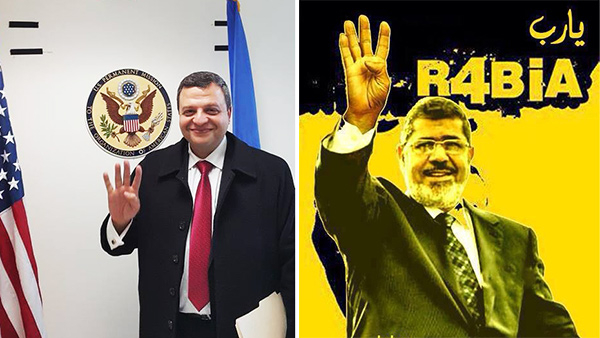
919 (1)While being hosted by the State Department on a visit to Washington in January 2015, Muslim Brotherhood judge Waleed Sharaby (left) flashed the organization’s four-finger “Rabia” sign. At right, ousted Egyptian President Mohamed Morsi (from the Muslim Brotherhood) displays the Rabia sign.

The events in the Sinai Peninsula prove there is no such thing as “political Islam.” There is a radical Islamist leadership that represents itself to the gullible West as “moderate,” preaches violence from the mosques, cloaks itself in ideological-religious tradition, and employs a hard core of Islamist terrorists to carry out attacks on civilians and Egyptian administration targets.

In the meantime, the real victims are the Egyptians. The Muslim Brotherhood’s terrorism has paralyzed Egypt’s tourist industry, as foreigners fear to visit Egypt’s antiquities. And now there are terrorist threats to the New Suez Canal, a project initiated and carried out under the leadership of General Sisi to turn both banks of the two canals into an international logistics, commercial and industrial area.

The Islamists’ plans are clear. First, they want to leverage violence, murder and countless Egyptian army casualties into establishing an autonomous terrorist enclave in the Sinai Peninsula. Then they will try to overthrow the Egyptian government and reinstate an Islamist Muslim Brotherhood regime headed by Morsi. That is exactly what their offshoot, Hamas, did in the Gaza Strip when it liquidated Palestinian Authority officials and established an Islamic emirate. The writing on the wall is still illegible as far as the U.S. government is concerned. Or else the Obama administration is still in the thrall of extremist Islam and its Muslim Brotherhood leaders. The two main ones are Turkey’s Recep Tayyip Erdogan, who has just called new elections so that he can try again to acquire enough seats in parliament to amend Turkey’s constitution to award himself a one-man Sultanate, an absolute dictatorship-for-life to go along with his new palace. The other is Mohamed Morsi, whom Obama apparently is still backing.

It is hard not to conclude, looking at the U.S. president’s record (ignoring the protesters of 2009 in Iran; “I’ve got a pen, and I’ve got a phone” and the dictatorial way the Iran deal has been short-circuited to bypass the democratic process) that in his heart-of-hearts, he is far more committed to supporting extremist Islamist regimes — whether the mullahs of Iran or the Muslim Brotherhood — than to supporting democracy, individual freedoms or human rights.

The Europeans are more aware of the situation but unfortunately woke up too late. As hundreds of thousands of migrants from Muslim lands continue to pour over Europe’s open borders, there is little doubt that radical Islam is poised to take over the West. Islamic communities and terrorist cells continue to mushroom and gather strength throughout the cities of Europe.

From the beginning of the wave of attacks in Egypt, senior Egyptian security officials threatened Hamas. Egypt warned Hamas to stop training, arming and sending its terrorists to collaborate with ISIS operatives in attacks against the Egyptian army. Hamas steadfastly denies any involvement, even as it continues collaborating with ISIS against Egypt.

As far as Hamas is concerned, destroying the Egyptian army is essential, because its continued actions along the Rafah border and in Sheikh Zuweid in the northern Sinai Peninsula prevent Hamas from acquiring money and stockpiling weapons to fight Israel, which weakens its subversion against Mahmoud Abbas and its plans to take over the West Bank.

Despite profuse denials, at the end of August 2015, four operatives from Hamas’s military-terrorist wing, the Izz al-Din al-Qassam Brigades, were taken off a bus by armed Egyptians on the way from Rafah through the Sinai Peninsula to Cairo. Hamas immediately accused Israeli intelligence of responsibility and warned the Egyptian authorities that “the abduction of its operatives will not go unpunished.”

In response, Dina Ramez, a co-host on Egypt’s official TV station, called Hamas out on its lies and denials of its terrorist activities in the Sinai Peninsula against the Egyptian regime. She asked Hamas, “If you are not involved in terrorism, what were your senior Izz al-Din al-Qassam Brigades operatives doing in Sinai?” and called them “cockroaches.”

Sources in Hamas called her a “whore,” and called Egypt a loser country defeated by Israel, using a peace treaty to sell Palestine to the enemy. Was that really the way to thank Egypt for everything it has done for the Palestinians, sacrificing its army and soldiers for us? It is a sad situation for the Palestinians and for our leadership.

What have we Palestinians gained from Hamas’s military actions against Egypt? What have we gained from our solidarity with Islamist organizations fighting against Assad in Syria, or joining organizations such as the “Palestinian Liberation Army” fighting for Assad? Why are we killing each other in the Ain al-Hilweh refugee camp? Why do we refuse everything the Israelis offer us?

Anyone who remembers history remembers the ungrateful path trodden by the Palestinians against the Kingdom of Jordan, when our leaders, headed by Arafat, tried in 1970 to overthrow King Hussein, despite the refuge Jordan offered us during the catastrophes of the Nakba in 1948 and the Naksa in 1967. Then we did the same thing in Lebanon, to where we fled from Jordan. The PLO relocated its headquarters to Beirut, and went on to turn Lebanon into a terrorist country and the lives of the Lebanese into a nightmare. If the Israelis had not invaded Lebanon in 1982, and forced the PLO to relocate to Tunisia (where its behavior was also criminal), the Palestinians definitely would have destroyed Lebanon.

The Middle East is in chaos, and Palestinian factionalism and ingratitude continue to inflame the dissolution of the Arab states and the internal Palestinian division between Hamas in Gaza and the Palestinian Authority in the West Bank.

The world is beginning to understand that the catastrophes of the Middle East have nothing to do with the resolution of the Palestinian issue, but are caused by the innate homicidal tendencies of the Arab rulers and the regional Islamist terrorist organizations.

The only person left who believes the Israeli-Palestinian nonsense is President Barack Obama, even though he is witness to the murders, rapes, beheadings and the millions of refugees, next to which the Palestinian issue is an old, irrelevant and very tired joke.

Why won’t Obama stop lying about Iran’s military budget?

September 2, 2015

Why won’t Obama stop lying about Iran’s military budget? Front Page Magazine, Daniel Greenfield, September 2, 2015

ofp

Obama claimed that ISIS was only a “jayvee” team even as it was capturing Iraqi cities. Now he wants us to believe that Iran is just another “jayvee” team even as it’s taking over Iraq, Syria and Yemen.

Like the rest of his Iran deal talking points, the one about Iran’s tiny military budget is false, and not only is it false, but his claim about how small Iran’s military budget keeps changing.

A few weeks ago, in a speech at American University, he was  claiming that “The defense budget of the United States is more than $600 billion. To repeat, Iran’s is about $15 billion.”

“Iran’s defense budget is $30 billion. Our defense budget is closer to $600 billion. Iran understands that they cannot fight us,” Obama had told the New York Times in April.

Just now, he told the Forward, “As I pointed out repeatedly, Iran’s annual defense budget is about $15 billion.”

What is Iran’s military budget? Read Obama’s lips. It’s either $15 billion or $30 billion.

Either Iran’s military budget changes every time Obama gives a speech or he’s playing with numbers to make it seem small. If $30 billion still seems big, how about $15 billion? And if $15 billion is still too big, get ready for the $7.5 billion Iranian defense budget. How can you be worried about that?

Obama is borrowing a trick from the Manchurian Candidate. No one is talking about how big Iran’s military budget is, but debating how small it is. And how small is it?

Iran’s military is at over 500,000 in strength. The Basji militia claims to be able to mobilize millions more. It has a nuclear weapons program and some of the most advanced indigenously developed weapons programs in the region. Iran is currently involved in wars in Syria and Iraq. Its proxy armies have carved up Lebanon and Yemen, and are slavering over Bahrain.

Not bad for $15 billion or $30 billion or whatever Obama is claiming it is this week.

Of course Iran’s budget isn’t $15 or $30 billion. It spent $11 billion on the Bushehr reactor alone. Its nuclear program cost upward of $100 billion. Obama’s deal requires him to claim that the program is peaceful, but who really believes that a country sitting on a mountain of gas and oil blew that much money just to lower the cost of electricity a little bit?

How much money is Iran really spending to expand its territory and influence?  Iran is allegedly spending billions a month to back Assad’s military campaign. The total may come to as much as $35 billion a year.

That’s more than more than twice as much as Obama’s current estimate of its military budget.

The Hezbollah terror group has received billions from Iran over several years. Islamic Jihad in Israel gets between $100 and $150 million a year.  Iran cut off aid to Hamas due to the Sunni-Shiite shift. Since then relations are slowly being restored, but it’s unclear how much money this will mean for the terror group. In 2007, Iran had pledged $250 million in aid. It’s unknown how much money Iran is spending on its Houthi terrorists in Yemen or how much money it’s spending on Shiite militias in Iraq and Syria.

In 2007, a senior Hezbollah terrorist captured by the US claimed that Iran was providing $3 million a month to Shiite terror groups to attack Americans in Iraq. Considering that the Shiite militias now dominate Baghdad and other parts of Iraq and number in the tens of thousands, it’s a safe bet that the bill for maintaining Tehran’s terrorist army in Iraq has gone up a whole lot since then.

It’s unknown how much Iran is spending on its Shiite militias in Syria, but the NDF reportedly has 100,000 men and is being trained and financed by Iran.

And this is just the visible ground forces.

Iran also has an international terrorist network which it has used to carry out terror attacks everywhere from Argentina to Thailand to Saudi Arabia to Paris. No country since the USSR has anything like it in its scope and organizations like that cost money. We can’t even begin to guess how much Iran spends on it.

But there are hints. The investigation into Iran’s bombing of the Jewish Community Center in Argentina was stymied by bribery attempts and climaxed in the assassination of Alberto Nisman, the Special Prosecutor who had accused President Kirchner of a cover-up in return for business deals with Iran.

That sort of arrangement doesn’t come cheap. Iran is willing to spend a lot of money to maintain a global terror network and then to clean up after it.

So what is Iran’s real military budget?

It has the biggest ballistic missile arsenal and the only known nuclear weapons program in the region. It has the largest number of active military personnel in the region and its militias control large sections of four other countries. It has indigenously developed fighter jets and a global terrorist network. It has drone bases, submarines and is the “the holder of the largest chemical weapons stockpile” in the area.

This doesn’t come cheap and you can’t have all that on the military budget of Colombia. If you believe Obama, then Iran has a smaller military budget than Israel and Saudi Arabia even though the military spending in both countries is largely focused on countering threats from Iran. If you believe Obama, Iran is no match for any of its neighbors, and yet it’s conquering or terrorizing them one by one.

But with Obama, the devil is usually in the details. He emphasizes the “defense budget”, but despite its official claims, Iran doesn’t play defense. It goes on the offensive. Its constitution states that its military is an “ideological army” built to fulfill “the ideological mission of jihad in Allah’s way; that is, extending the sovereignty of Allah’s law throughout the world.”

Or as the Ayatollah Khomeini said, “Islam makes it incumbent on all adult males… to prepare themselves for the conquest of [other] countries so that the writ of Islam is obeyed in every country in the world.”

Iran doesn’t have a defense budget. Like Nazi Germany or the USSR, its entire system is militarized. A portion of its money goes to the business of government. A portion of that exists officially as a defense budget, most of which is swallowed up by Iran’s Revolutionary Guard (IRGC). The IRGC is a terrorist group with its own army and air force that is involved in wars across the region.

None of these numbers really mean anything because Iran’s accounting would make the mafia blanch. Iran is an oligarchy built on a complex network of organizations. State-owned enterprises, generals, Islamic foundations and terrorist bosses move money around using everything from oil to heroin.

The official budget means even less than it does in Russia. It’s just a number you read in the newspaper.

The IRGC controls construction companies, nuclear plants, airports, banks and ports. Imagine if GE, HSBC and Berkshire Hathaway were all one entity and had their own army. That’s the IRGC. Its annual revenue is estimated to be higher than Obama’s estimate for Iran’s entire defense budget.

Iran doesn’t have a defense budget. Its economy is its military budget. The IRGC controls at least a third of the country’s GDP and the vast majority of its exports. It claims a majority of the official defense budget, but unofficially it controls a majority of Iran’s economy.

It’s also responsible for exporting terrorism worldwide.

Obama’s claims about Iran’s tiny defense budget, which shrinks every time he gives a speech, are a lie. He claims that the “Gulf States, combined, spend about eight times” as much as Iran does. In fact, Iran spends at least as much if not more because most of its military budget is as black as night.

Ever since he struck a deal with Iran’s terror regime, he’s been knowingly passing on misinformation from that regime. And Obama can’t even seem to keep the phony budget numbers he’s using straight.

Obama has told many lies about his Iran deal. But this is more than just another lie. Minimizing Iran’s military spending to make it look as harmless as possible endangers American national security. There are already reports that Obama worked to tamper with ISIS intelligence materials to make the terror group look weak. It was his insistence that ISIS was only a jayvee team that let it take over cities.

Now he wants to convince Americans that Iran is just another jayvee team we shouldn’t take seriously. Pay no attention to the nukes or the worldwide terror rings. Its fake military budget is so small.

Obama deserves to be called out for every lie he has told about his disastrous Iran deal. But it’s important to our national security to call him out for his big lie about Iran’s little military budget.

Khamenei: U.S.Is The Enemy’; ‘We Must Combat The Plans Of The Arrogance With Jihad For The Sake Of Allah

September 1, 2015

Khamenei: U.S.Is The Enemy’; ‘We Must Combat The Plans Of The Arrogance With Jihad , MEMRI, September 1, 2015

(Does Iran’s Supreme Leader refer to Obama’s America or to the United States? There’s a difference. — DM)

On August 17, 2015, just over a month after the announcement of the JCPOA in Vienna, Iranian Supreme Leader Ali Khamenei said in a speech at a conference held by the Iranian Shi’ite Ahl Al-Bayt organization that the U.S. is the embodiment of the enemy of the Islamic peoples and of Iran. It must be fought with military, cultural, economic, and political jihad, he said, adding that Islamic Iran is not interested in reconciling with it. He further claimed that the U.S. is attempting to divide the Islamic world into Shi’ite and Sunni camps that will wage a religious war against each other, and in this way gain it will be able to gain control over the peoples of the region.[1]

Iran, he stressed, stands behind the resistance axis, opposes the division of Syria and Iraq, and will continue to support anyone who fights Israel.

Following are excerpts from a report on the speech that was posted on Khamenei’s website (Leader.ir):

“[Khamenei said:] ‘We must combat the plans of the arrogance [i.e. the West, led by the U.S.] with jihad for the sake of Allah.’ The Leader pointed to ‘America’s efforts to exploit the results of the nuclear talks and exert economic, political, and cultural influence in Iran’ and to the plots of the power-hungry order aimed at sowing conflict and gaining influence in the region. The Leader called for ‘adopting the correct plans in order to wisely and consistently fight this plot, in an offense against it and a defense against it.’

“[Khamenei said:] ‘Jihad for the sake of God does not only mean military conflict, but also means cultural, economic, and political struggle. The clearest essence of jihad for the sake of God today is to identify the plots of the arrogance in the Islamic region, especially the sensitive and strategic West Asian region. The planning for the struggle against them should include both defense and offense.

“[He continued:] ‘The plots of the arrogance in the region have continued for a century, but [its] pressure and plotting increased after Iran’s Islamic Revolution [1979], in order to prevent [this Revolution] from spreading to other countries. For 35 years, the regime in Iran has been subjected to threats, sanctions, security pressure, and various political plots. The Iranian nation has grown accustomed to this pressure. After the Islamic awakening movement blossomed in recent years in North Africa [i.e. the Arab Spring], the enemy greatly stepped up its plots in the West Asian region because of its panic.

“‘The enemies thought that they could suppress the Islamic awakening movement, but it cannot be suppressed. It continues, and sooner or later it will prove itself as reality.

“‘The power-hungry order led by the United States of America is the perfectly clear embodiment of “the concept of the enemy.” America has no human morality. It carries out evil crimes under the guise of flowery statements and smiles. The enemy’s plot is two pronged: creating conflict and [exerting] influence. [The enemy sows conflict] among governments, and, worse, among the nations. At this stage, they are using the Shi’a and the Sunna to create conflict among the nations. Britain is an expert in sowing conflict; the Americans are its apprentices.

“‘Establishing violent despicable criminal takfiri circles, which the Americans have acknowledged establishing, is the main means of sowing conflict, ostensibly religious conflict, among [the Muslim] nations. Sadly, some innocent and ignorant Muslims have been fooled by this plot, and have been tricked by the enemy and fallen into its trap. Syria is an obvious example of this. When Tunisia and Egypt, with Islamic slogans, ousted their infidel governments, the Americans and Zionists decided to use this formula to eliminate the countries of the resistance, turning their attention to Syria. After the events in Syria began, some ignorant Muslims were tricked by the enemy and dragged Syria to its current situation. What is happening today in Iraq, Syria, Yemen, and other countries, which some people insist on calling “a religious war,” is in no way a war of religion [i.e. Sunni vs. Shi’ite], but a political war. The most important duty today is to remove these conflicts.

“‘I have explicitly stated that Iran reaches out in friendship to all the Islamic governments in the region, and that we have no problem with Muslim governments. Iran has friendly relations with most of its neighbors. Some still have conflicts with us; they are stubborn, and carry out nefarious acts, but Iran aspires to good relations with its neighbors and with the Islamic governments, especially with the governments in the region. The basis for Iran’s conduct comprises the principles laid out by Imam Khomeini, which he used to bring about victory for the Islamic Revolution, and he led it to a phase of stability.

“‘One of the principles of the [Islamic] regime [in Iran] is to be “forceful against the disbelievers, merciful amongst themselves [Koran 48:29].” On the basis of Imam Khomeini’s lesson, we do not wish to reconcile with the arrogance, but we aspire to friendship with our Muslim brothers. When we support [any of] the oppressed, we ignore the religious element; we provide the same aid to our Shi’ite brothers in Lebanon and to our Sunni brothers in Gaza. We see the Palestinian issue as the chief issue of the Islamic world.

“‘There must be no exacerbation of the conflict in the Islamic world. I oppose any conduct, even by Shi’ite circles, that creates conflict. I condemn the insults against the sanctities of the Sunna.

“‘The U.S. has aspired for decades to infiltrate the region and regain its lost reputation. The Americans wish to infiltrate Iran with the [JCPOA] agreement, whose fate in Iran and in the U.S. is still unknown. But we have decisively blocked this path, and we will do anything to keep them from infiltrating Iran economically, politically, and culturally.

“‘Iran’s regional policy is the opposite of America’s. While [America] seeks to divide the countries of the region and to create statelets that obey it, this will not happen. Some were amazed by statements I made in the past about America’s attempt to divide Iraq, but today the Americans themselves honestly acknowledge this. The Americans’ clear goal is to divide Iraq, and, if they can, Syria as well. But the territorial integrity of the countries of the region – Iraq and Syria – is very important to Iran.

“‘Iran supports the resistance in the region, including the Palestinian resistance, and we will support anyone who struggles against Israel and strikes at the Zionist regime. Iran’s chief policy is a struggle against America’s policy of division and its sowing of conflict. We do not recognize the Shi’a that is based in London and works in the service of the arrogance.

“‘In contrast to unfounded claims, Iran is not interfering in Bahrain and Yemen, but will continue to support the oppressed. The massacre of oppressed Yemenis and the destruction of that country must be strictly condemned. Promoting some [Saudi] political goals via foolish methods results in ongoing crimes against the Yemeni people.

“‘There are also painful events in Pakistan and Afghanistan. Muslims must be wise and vigilant, and thus they will solve these problems.

“‘The Islamic Radio and Television Union [organization in Iran] is an important center in the struggle against the dangerous empire of the sophisticated American-Zionist media mafia. We must strengthen and grow this movement…

“‘The future of the region belongs to the Muslim nations. Islam’s might is clear and will be maintained because of the presence of the fighting men and women.'”[2]

_________________

Endnotes:

[1] It should be noted that in the main Friday sermon in Tehran on August 28, 2015, prayer leader Ayatollah Kazem Seddiqi advised the officials in the government of Iranian President Hassan Rohani not to be misled by the West and the U.S. following the JCPOA, because they are “cannibals, liver-eaters, and anti-religion.” Fars, Iran, August 29, 2015.

[2] Leader.ir, August 18, 2015.

Rocket from Gaza follows IDF-Palestinian clash in West Bank town of Jenin

September 1, 2015

Rocket from Gaza follows IDF-Palestinian clash in West Bank town of Jenin, DEBKAfile, September 1, 2015

Palestinian rocket fire from the Gaza Strip put southern Israel on red alert before dawn Tuesday. Sept 1 in the wake of a major clash that erupted in the West Bank refugee camp of Jenin Sunday night. The circumstances of that episode are not entirely clear. Israel playing the Jenin encounter down, whereas the Palestinians are presenting it as “the biggest battle of the third initifada.” An Israeli soldier and five Palestinians were injured.

It began, DEBKAfile’s military sources report, when a large combined force of the IDF, Shin Bet and Police Special Operations, riding in dozens of vehicles, entered the Jenin camp Monday night to round up Islamic Jihad and Hamas terrorist suspects. In the Al-Hadaf district, they surrounded the homes of Bassam Al-Saeedi, reputed Jihad chief on the West Bank, and Majdi Abu al-Hejja, a local Hamas military arm operative.

At some point, Israeli rocket fire badly damaged Al-Saeedi’s house.

The IDF sources say it was a single small rocket, without explaining why it was fired. The IDF spokesman first reported “a heavy exchange of fire” around the building. Early Monday, the word “heavy” was dropped from the briefing to reporters and finally, there was no reference to any exchange of fire at all.

The Palestinians claim that the Jihad leader was not at home at the time of the raid and so escaped his pursuers.  But there is no word on either side about the fate of any occupants of building and whether any were killed.

Did the IDF decide to knock the building down in response to gunfire coming out of it? Or was it a warning to the Islamic Jihad and other Palestinian terrorist groups to halt their latest spate of violence or lose their homes?

Another mystery is how Bassam Al-Saeedi came to be away from home, confounding the information reaching the Shin Bet? Did he get a tip-off of the impending Israeli raid for his arrest?

If armed Palestinian groups on the West Bank have taken to posting spotters outside their areas to forewarn them of approaching Israeli forces, this would ratchet up their operational tactics to the military level observed by fellow Hamas and the Islamic Jihad groups in the Gaza Strip.

While Bassam Al-Saheedi escaped arrest, the Hamas operative Majdi Abu al-Hejja and his brother were captured and taken away for interrogation.

In weighing in heavily for a preventive detention operation against suspected terrorist leaders Sunday night, Israeli security chiefs were almost certainly acting on a decision to avert any possible terrorist action for  disrupting the opening of the school year Monday, Sept. 1. The level of Palestinian violence on and from the West Bank and Jerusalem has risen sharply in recent weeks.

Thirteen years ago, at the peak of the Palestinians’ Second intifada, Israel launched a major assault on the Jenin refugee camp. Thirteen Israeli soldiers were lost in this major battle on April 5, 2002. Since then, the refugee camp has claimed to hold the flag of armed Palestinian resistance to Israel and its army. Security forces arriving there to detain suspects routinely come under a hail of rocks and firebombs. However, the current clash of arms represented a sharp escalation in the Israeli-Palestinian confrontation on the West Bank.

Saudi king wants Obama to tackle Iranian ‘mischief’

August 31, 2015

Saudi king wants Obama to tackle Iranian ‘mischief,’ Al-Monitor, August 31, 2015

U.S. US Secretary of Defense Ashton Carter meets with Saudi Arabia's King Salman bin Abdul-Aziz Al Saud (R) at Al-Salam Palace in Jeddah, Saudi Arabia, July 22, 2015. (photo by REUTERS/Carolyn Kaster) Read more: http://www.al-monitor.com/pulse/originals/2015/08/saudi-king-washington-visit-iran-deal.html#ixzz3kPeQtHQK width= U.S. Defense Secretary Ash Carter meets with Saudi Arabia’s King Salman bin Abdul Aziz (R) at Al-Salam Palace in Jeddah, Saudi Arabia, Wednesday, July 22, 2015.

King Salman bin Abdul-Aziz Al Saud’s three-day visit, strategically scheduled just days before Congress votes on the agreement, offers the Saudi leader a powerful platform to insist that the United States help combat Iranian “mischief.” The king is seeking assurances in the fight against Iran’s proxies across the region, as well as with elements of the nuclear deal itself.

The visit “underscores the importance of the strategic partnership between the United States and Saudi Arabia,” White House spokesman Josh Earnest said Aug. 27.

“The president and the king will discuss a range of issues and focus on ways to further strengthen the bilateral relationship, including our joint security and counterterrorism efforts,” Earnest said. “They will also discuss regional topics, including the conflicts in Yemen and Syria, and steps to counter Iran’s destabilizing activities in the region.”

Despite deep reservations about the deal, sources close to the Saudi government say that unlike Israel, the kingdom quickly concluded that it could not be defeated in Congress and that no better alternatives were likely to emerge.

Riyadh, however, has repeatedly made clear that its support is conditioned on a tough inspection regime and snapback sanctions. Salman may seek further assurances on those aspects of the deal in light of recent reports that allege that Iran will be allowed an unusual amount of autonomy with regard to inspections of its military installation at Parchin.

“The agreement must include a specific, strict and sustainable inspection regime of all Iranian sites, including military sites, as well as a mechanism to swiftly re-impose effective sanctions in the event that Iran violates the agreement,” the Saudi Embassy in Washington said after the deal was announced.

Most of the discussion is expected to center on non-nuclear issues, however.

Salman and President Barack Obama, who will meet Sept. 4 at the White House, are expected to further flesh out Washington’s promise of increased military support for the Gulf Cooperation Council countries — including a potential missile defense shield — as discussed during the US-GCC Camp David summit in May. That meeting, which was skipped by four of the top six regional leaders — including Salman — aimed to reassure the Gulf nations of America’s commitment to their security amid the perceived rapprochement with Iran.

“This is an opportunity to reset this relationship when there are some pretty considerable concerns on both sides,” said David Weinberg, a Gulf analyst with the Foundation for Defense of Democracies. “It comes in the context of the United States trying to reassure the Gulf states about the Iran deal, as well as to focus on this Camp David agenda in terms of concrete US security assistance. It’s reasonable to assume that that’s going to be a big focus of the trip as well.”

Much of the conversation is expected to focus on military hardware: The Saudis are seeking upgrades to their F-15s along with other advanced weaponry, but Israel is said to have raised concerns during Defense Secretary Ashton Carter’s recent visit to the region. Congress may object to such sales if lawmakers deem that they would undermine Israel’s so-called qualitative military edge.

The Saudis will be interested “in how much the White House will invest itself so that it can get the technology that it wants,” former Obama National Security Council Middle East adviser Prem Kumar told Al-Monitor. They will want to see if the White House “will spend some political capital on the Hill.”

Another topic of interest is the proposed creation of a GCC-wide “rapid reaction force” to take on external threats. The White House paid lip service to the idea in its joint statement from the Camp David summit, but the idea has failed to gain traction among concerns by Qatar and Oman that it would be dominated by the Saudis.

“In terms of GCC-wide reassurance, the Saudis are interested to hear what the US is prepared to do to support the GCC rapid reaction force, the joint Arab defense force, if that is going to materialize,” Kumar said.

Beyond military requests, Salman is likely to seek US backing for his more muscular approach to foreign policy compared with his predecessor. That includes beefed-up US support for his campaign against the Houthis in Yemen and a renewed focus on getting rid of President Bashar al-Assad in Syria.

For Riyadh, said former Saudi Embassy political analyst Fahad Nazer, a nuclear Iran “is more of a long-term issue. They’re concerned about the here-and-now.”

“The Saudis at this point have kind of parted ways with their traditional behind-the-scenes diplomacy and trying to mediate between warring factions,” Nazer said. “[They’ve realized] it’s time for them to take the helm of ensuring their own interests.”

In Yemen, “The Saudis want the US to get more involved, beyond intelligence and logistical support to the Saudi-led coalition,” said Kumar, now vice president with the Albright Stonebridge Group. Already, the Pentagon in recent weeks has more than doubled its advisers on the ground providing targeting intelligence for airstrikes and helping the Saudis roll back the Houthis, according to the Los Angeles Times.

Those battlefield successes have led some Saudi cheerleaders to argue that the intervention in Yemen offers a “template” for similarly emboldened leadership in Syria. While Nazer and others doubt Riyadh will go that far, the Saudis have recently announced their own proposal to withdraw support for Sunni rebels if Iran removes its forces and Hezbollah fighters with a view to parliamentary and presidential elections under UN supervision.

“I think there are a couple concrete things” on the Saudi wish list, Kumar said. “First is to increase support for the Syrian opposition, in some form or other. Safe zones, maybe direct pressure on the [Assad] regime, that would not necessarily undercut diplomatic initiatives.”

The king’s visit isn’t just about politics, however. He will be accompanied by a large entourage of ministers and business executives, and some of them are expected to stay on after the royal visit.

The US-Saudi Arabian Business Council has announced a daylong investment forum with the ministers of finance as well as commerce and industry.