Archive for the ‘Iranian proxies’ category

IDF, Russian, Iranian forces on war alert for Hizballah attack on Israel – and backlash

December 31, 2015

IDF, Russian, Iranian forces on war alert for Hizballah attack on Israel – and backlash, DEBKAfile, December 31, 2015

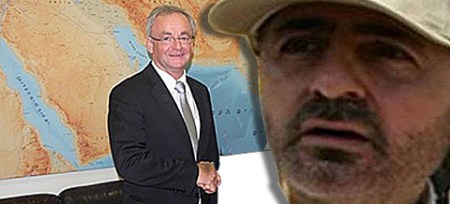
Gerhard-Conrad

The IDF and all of the armies involved in the Syrian civil war, namely those of Russia, Syria and Iran, went on their highest war alert on Thursday, Dec. 31 when all their intelligence organizations reported that Hassan Nasrallah could not be stopped from attacking Israel, in revenge for the assassination of Samir Quntar in Damascus on December 20.

More than one intermediary visited Beirut to avert the Hizballah attack and its deadly fallout, including a former senior officer of the German BND foreign intelligence service. According to DEBKAfile’s intelligence sources, Gerhard Conrad, late of the BND and incumbent director of the European Union’s Intelligence and Situation Center, was given this urgent mission by Chancellor Angela Merkel.

He came away from a meeting with Nasrallah on Dec. 29, with the news that the Hizballah chief was not open to persuasion and the attack was already underway.

Conrad has excellent connections in the Arab world, especially in Syria and Lebanon. Seven years ago, he acted as intermediary between Israel and Hizballah for negotiating the recovery of the bodies of two fallen IDF soldiers, Eldad Regev and Ehud Goldwasser, in exchange for the handover of that same Hizballah high-up Samir Quntar and other jailed and convicted Arab terrorists.

The German spy-diplomat then established personal connections with a shadowy figure, Wafik Safa, who is in charge of Hizballah’s intelligence and security network and a close crony of Nasrallah.

Conrad used those connections again in 2011 to broker the release of Gilead Shalit from Hamas captivity.

It was Safa he arranged for him to meet Nasrallah in Beirut Tuesday. He found the Hizballah chief unshakeable in his determination to make Israel pay for Quntar’s death, even at the cost of a painful backlash against the Shiite group’s terrorists in Syria and Lebanon.

He was unmoved by the warning issued by Israel’s chief of staff, Lieut. Gen. Gady Eisenkott, on Monday, just hours before the Conrad mission.  Eisenkott said, “Just as we have proven in the past, we know how to strike anyone who wishes to harm us. Our enemies know they will suffer grave consequences if they try to undermine our security.”

Upon receipt of the German emissary’s report on the meeting, Eisenkott, his deputy, Maj. Gen. Yair Golan, and OC Northern Command, Maj. Gen. Aviv Kochavi, inspected the preparedness of the IDF’s northern border defenses for all contingencies.

They took into account a scenario, whereby Nasrallah would take advantage of the stormy weather forecast for the weekend in Syria, Lebanon and Israel, to strike Israel, in the knowledge that the heavy rain and snow would impede Israeli air force activity and give the Hizballah operation a tactical edge.

Russian military and Iranian Revolutionary Guard forces in Syria have taken into account that a Hizballah attack will not go unanswered by Israel and that the IDF would most likely hit back at Hizballah on Syrian soil, thus ushering in the New Year with a new whirlwind.

Assad again controls Damascus thanks to Russian air strikes and intelligence

December 26, 2015

Assad again controls Damascus thanks to Russian air strikes and intelligence, DEBKAfile, December 26, 2015

Allous_Killed_25.12.15

Less noticed, was the UN plan to remove at the same time several thousands ISIS fighters from the Syrian capital and transport them to their Syrian headquarters. The latter project has not been trumpeted for good reason: It implies UN recognition of ISIS as a party in the Syria war.

***************************

The Russian air strike that Friday, Dec. 25, killed Zahran Aloush, founder of the most powerful Syrian rebel group Jaysh al-Islam and his deputy, gave President Bashar Assad a big break in the Syrian war, thanks to his powerful backer, Vladimir Putin.

This grave loss will accelerate the breakup of Syrian rebel strongholds in and around Damascus. It will also hasten the evacuation under a UN-sponsored ceasefire of at least 2,000 rebels from the Damascus region. Less noticed, was the UN plan to remove at the same time several thousands ISIS fighters from the Syrian capital and transport them to their Syrian headquarters. The latter project has not been trumpeted for good reason: It implies UN recognition of ISIS as a party in the Syria war.

For nearly five years, the war seesawed back and forth, with neither the Syrian army nor the insurgents gaining the upper hand for long, even after Tehran threw its Lebanese proxy, Hizballah,  into the fray to bolster Assad’s army.

Interventions by the US, Saudi Arabia, Qatar, the UAE, Jordan and Israel were too trifling and hesitant to tilt the balance in favor of the anti-Assad insurgent militias. Weapons supplies were inferior and tardy and kept the rebels heavily outgunned by the Syrian army’s tanks, helicopters and fighter jets, and helpless against the Iranian-made barrel bombs dropped by the Syrian air force.

The Obama administration was the architect of this uneven support strategy, going so far as to constrain the rebels’ other foreign backers against giving them the resources for carrying the day, aside from local victories.

This strategy had the effect of prolonging the vicious conflict – until it was cut short by two events:

1. In the summer of 2014, the Islamic State of Iraq and the Levant arrived in full force to capture the northern Iraqi city of Mosul, scattering seven Iraqi armed divisions to the four winds, and grabbing  their sophisticated American weapons, along with their arsenals, that were crammed with good American tanks, armored personnel carriers, and an assortment of surface, antitank and antiair missiles.

Part of this booty was diverted to ISIS Syrian headquarters in Raqqa.

2.  A year later, in late September 2015, President Vladimir Putin embarked on a massive buildup of Russian military strength in Syria – notably, his air and missile forces – for direct intervention in the war.

In contrast to President Barack Obama, who sought to keep his hand on the conflict by a complicated system of dribbling arms to select Syrian rebel groups, Putin went all out with massive military and strategic backing to assure the Syrian ruler and his Iranian ally of victory.

The Russian strategy is now becoming evident:  It is to drive the rebels out of the areas they have captured around the main cities of Latakia, Aleppo, Idlib, Homs, Hama and the capital, Damascus, giving them two options: join the opposition front around the table for negotiating an end to the war, or total eradication – even though Moscow and Washington have yet to agree which of the rebel militias belong around that table.

According to Moscow’s scale of priorities, the fight against the Islamic State must wait its turn until after Bashar Assad’s authority as president is fully restored and his country returns to his army’s control.

But on the way to this objective, Putin has run up against a major impediment: the failure of Iranian, Shiite militia, Hizballah and Syrian army ground forces keep up with his pace. The plan was for Russian air strikes and missiles to clear rebels out of one area after another and for pro-Assad ground troops to storm in and take over.

But these troops are proving too slow to press the advantage given them by the Russians.

Last week, the Russians decided to use their intelligence assets to speed things up. They borrowed an Israeli counter-terror tactic to start targeting key rebel chiefs for liquidation.

The death of the Jaysh al-Islamc commander as the result of a Russian airborne rocket strike on Friday was an intelligence feat rather than a military one. Just as Israel last Sunday used its clandestine assets in Damascus to precisely target the Hizballah-Iranian arch terrorist Samir Quntar at his home in the Jaramana district, so the Russians directed their agents on the ground to mark the secret meeting of Jaysh al-Islam commanders at Marj al-Sultan at the precise moment for taking them down.

This blow to the rebel movement, plus the mass-evacuation of its fighters from the Syrian capital, are major steps towards bringing the Syrian capital back under the control of the Syrian dictator.

Leftist Media Ignore Islamic Terrorists Groups

December 22, 2015

Leftist Media Ignore Islamic Terrorists Groups, Front Page MagazineDr. Majid Rafizadeh, December 22, 2015

tg

It is intriguing that mainstream media has focused on violent terrorist acts of the Islamic State (IS or ISIS), a radical Sunni Islamist group, while they are deliberately avoiding raising awareness about other Islamist terrorist groups that are as brutal as ISIS, if not worse.

The other groups that I am referring to are primarily the Iranian-backed radical Islamist militias.

Brutal terrorist groups such as Kataib al-Imam Ali (KIA) are not any less violent than ISIS when it comes to the aggressive and horrific tactics they use against civilians. In fact, they are known for showing videos of cut-off heads and bodies burned over open fires. This particular group, which is backed by Iran, originated from the Muqtada al-Sadr’s Mahdi Army. Shebl al-Zaidi is the secretary-general of Kataib al-Imam Ali and he is known for his sectarian and vicious tactics.

Another militia group that is known locally for its violent attacks is Asa’ib Ahl al-Haq. It reportedly receives approximately $2 million a month from the Islamic Republic.

There exist more than 100 of these Islamist terrorist groups and they are increasing on a daily basis as they branch out.

One reason behind the liberal media outlets’ failure to shed light on non-ISIS terrorist groups is that they do not want to criticize Iran. These outlets are heavily influenced by the Obama administration’s leniency toward the Islamic Republic. If President Obama views Iran as a constructive state actor, then the media put aside standards of professional journalism and follow in the footsteps of the President.

One of the crucial tenets of Journalism in Western democracies is that it should not be influenced, intimidated or guided by ruling politicians. Being independent and raising public awareness by presenting different ideas and facts is what makes a media outlet an informative outlet and a platform for advancing democracy.

If a Western media outlet is following what the White House likes or despises, then what is the difference between these outlets and Iran’s state media outlets, which are the mouthpieces of the ruling clerics?

In addition, media outlets and journalists seem to prefer simplicity to complexity. It is much easier for those journalists to talk about the Islamic State and their horrific acts rather than engaging in rigorous research on other stealth terrorist and radical militia groups. Unfortunately, a lot of reporters are not knowledgeable in this field and they prefer to do the easier task. It is easier for them to write about ISIS in the length of space and time they are given than to research all other Islamist terrorist groups.

The ultimate goal of these groups is to enter the political establishment of the state and inform decision-making from the top. Hezbollah succeeded at this in Lebanon and other Iran-backed Iraqi Shiite militia groups did the same on Iraq.

Furthermore, leftist media outlets appear to view these radical Islamist groups as “legitimate” groups because they are funded by a nation-state (in this case, Iran). Many of these groups report directly to General Soleimani or Iran’s Supreme Leader, Ayatollah Ali Khamenei. As a result, if a similar violent act is committed by one of these Iranian-backed groups, the mainstream media outlets are less likely to criticize them harshly.

Finally, in order to survive as news organizations, these outlets are more driven by the need to make a profit, than the need to raise awareness, As a result, they focus on increasing their ratings and attracting high numbers of readers and advertisers, rather than providing credible information to the public.

In spite of the fact that there are many Islamist terrorist groups around the world committing atrocities against civilians, only ISIS has received the attention of the liberal media. There seems to be a symbiotic relationship between these outlets and ISIS. On the one hand, ISIS receives the publicity it needs from liberal media outlets. On the other hand, these networks increase their ratings, viewers, readers, advertisement revenues, and therefore their profit.  It is incumbent on media outlets to bring to the world the stories of non-ISIS Islamist terrorist groups as well, and put a spotlight on the sufferings of the multitudes of forgotten people, who are affected by these terrorist groups.

Column One: Rubio, Cruz and US global leadership

December 18, 2015

Column One: Rubio, Cruz and US global leadership, Jerusalem Post, Caroline Glick, December 17, 2015

For the first time in a decade, Americans are beginning to think seriously about foreign policy; But are they too late?

At some point between 2006 and 2008, the American people decided to turn their backs on the world. Between the seeming futility of the war in Iraq and the financial collapse of 2008, Americans decided they’d had enough.

In Barack Obama, they found a leader who could channel their frustration. Obama’s foreign policy, based on denying the existence of radical Islam and projecting the responsibility for Islamic aggression on the US and its allies, suited their mood just fine. If America is responsible, then America can walk away. Once it is gone, so the thinking has gone, the Muslims will forget their anger and leave America alone.

Sadly, Obama’s foreign policy assumptions are utter nonsense. America’s abandonment of global leadership has not made things better. Over the past seven years, the legions of radical Islam have expanded and grown more powerful than ever before. And now in the aftermath of the jihadist massacres in Paris and San Bernadino, the threats have grown so abundant that even Obama cannot pretend them away.

As a consequence, for the first time in a decade, Americans are beginning to think seriously about foreign policy. But are they too late? Can the next president repair the damage Obama has caused? The Democrats give no cause for optimism. Led by former secretary of state Hillary Clinton, the Democratic presidential hopefuls stubbornly insist that there is nothing wrong with Obama’s foreign policy. If they are elected to succeed him, they pledge to follow in his footsteps.

On the Republican side, things are more encouraging, but also more complicated.

Republican presidential hopefuls are united in their rejection of Obama’s policy of ignoring the Islamic supremacist nature of the enemy. All reject the failed assumptions of Obama’s foreign policy.

All have pledged to abandon them on their first day in office. Yet for all their unity in rejecting Obama’s positions, Republicans are deeply divided over what alternative foreign policy they would adopt.

This divide has been seething under the surface throughout the Obama presidency. It burst into the open at the Republican presidential debate Wednesday night.

The importance of the dispute cannot be overstated.

Given the Democrats’ allegiance to Obama’s disastrous policies, the only hope for a restoration of American leadership is that a Republican wins the next election. But if Republicans nominate a candidate who fails to reconcile with the realities of the world as it is, then the chance for a reassertion of American leadership will diminish significantly.

To understand just how high the stakes are, you need to look no further than two events that occurred just before the Wednesday’s Republican presidential debate.

On Tuesday, the International Atomic Energy Agency voted to close its investigation of Iran’s nuclear program. As far as the UN’s nuclear watchdog is concerned, Iran is good to go.

The move is a scandal. Its consequences will be disastrous.

The IAEA acknowledges that Iran continued to advance its illicit military nuclear program at least until 2009. Tehran refuses to divulge its nuclear activities to IAEA investigators as it is required to do under binding UN Security Council resolutions.

Iran refuses to allow IAEA inspectors access to its illicit nuclear sites. As a consequence, the IAEA lacks a clear understanding of what Iran’s nuclear status is today and therefore has no capacity to prevent it from maintaining or expanding its nuclear capabilities. This means that the inspection regime Iran supposedly accepted under Obama’s nuclear deal is worthless.

The IAEA also accepts that since Iran concluded its nuclear accord with the world powers, it has conducted two tests of ballistic missiles capable of carrying nuclear weapons, despite the fact that it is barred from doing so under binding Security Council resolutions.

But really, who cares? Certainly the Obama administration doesn’t. The sighs of relief emanating from the White House and the State Department after the IAEA decision were audible from Jerusalem to Tehran.

The IAEA’s decision has two direct consequences.

First, as Iranian President Hassan Rouhani said Wednesday, it paves the way for the cancellation of the UN’s economic sanctions against Iran within the month.

Second, with the IAEA’s decision, the last obstacle impeding Iran’s completion of its nuclear weapons program has been removed. Inspections are a thing of the past. Iran is in the clear.

As Iran struts across the nuclear finish line, the Sunni jihadists are closing their ranks.

Hours after the IAEA vote, Turkey and Qatar announced that Turkey is setting up a permanent military base in the Persian Gulf emirate for the first time since the fall of the Ottoman Empire a century ago. Their announcement indicates that the informal partnership between Turkey and Qatar on the one side, and Hamas, the Muslim Brotherhood and Islamic State on the other hand, which first came to the fore last year during Operation Protective Edge, is now becoming a more formal alliance.

Just as the Obama administration has no problem with Iran going nuclear, so it has no problem with this new jihadist alliance.

During Operation Protective Edge, the administration supported this jihadist alliance against the Israeli-Egyptian partnership. Throughout Hamas’s war against Israel, Obama demanded that Israel and Egypt accept Hamas’s cease-fire terms, as they were presented by Turkey and Qatar.

Since Operation Protective Edge, the Americans have continued to insist that Israel and Egypt bow to Hamas’s demands and open Gaza’s international borders. The Americans have kept up their pressure on Israel and Egypt despite Hamas’s open alliance with ISIS in the Sinai Peninsula.

So, too, the Americans have kept Egyptian President Abdel Fattah al-Sisi at arm’s length, and continue to insist that the Muslim Brotherhood is a legitimate political force despite Sisi’s war against ISIS. Washington continues to embrace Qatar as a “moderate” force despite the emirate’s open support for the Muslim Brotherhood, Hamas and ISIS.

As for Turkey, it appears there is nothing Ankara can do that will dispel the US notion that it is a credible partner in the war on terror. Since 2011, Turkey has served as Hamas’s chief state sponsor, and as ISIS’s chief sponsor. It is waging war against the Kurds – the US’s strongest ally in its campaign against ISIS.

In other words, with the US’s blessing, the forces of both Shi’ite and Sunni jihad are on the march.

And the next president will have no grace period for repairing the damage.

Although the Republican debate Wednesday night was focused mainly on the war in Syria, its significance is far greater than one specific battlefield.

And while there were nine candidates on the stage, there were only two participants in this critical discussion.

Sens. Marco Rubio and Ted Cruz faced off after weeks of rising contention between their campaigns.

In so doing, they brought the dispute that has been seething through their party since the Bush presidency into the open.

Rubio argued that in Syria, the US needs to both defeat ISIS and overthrow President Bashar Assad.

Cruz countered that the US should ignore Assad and concentrate on utterly destroying ISIS. America’s national interest, he said, is not advanced by overthrowing Assad, because in all likelihood, Assad will be replaced by ISIS.

Cruz added that America’s experience in overthrowing Middle Eastern leaders has shown that it is a mistake to overthrow dictators. Things only got worse after America overthrew Saddam Hussein and supported the overthrow of Muammar Gaddafi and Hosni Mubarak.

For his part, Rubio explained that since Assad is Iran’s puppet, leaving him in power empowers Iran. The longer he remains in power, the more control Iran will wield over Syria and Lebanon.

The two candidates’ dispute is far greater than the question of who rules Syria. Their disagreement on Syria isn’t a tactical argument. It goes to the core question of what is the proper role of American foreign policy.

Rubio’s commitment to overthrowing Assad is one component of a wider strategic commitment to fostering democratic governance in Syria. By embracing the cause of democratization through regime change, Rubio has become the standard bearer of George W. Bush’s foreign policy.

Bush’s foreign policy had two seemingly contradictory anchors – a belief that liberal values are universal, and cultural meekness.

Bush’s belief that open elections would serve as a panacea for the pathologies of the Islamic world was not supported by empirical data. Survey after survey showed that if left to their own devices, the people of Muslim world would choose to be led by Islamic supremacists. But Bush rejected the data and embraced the fantasy that free elections lead a society to embrace liberal norms of peace and human rights.

As to cultural meekness, since the end of the Cold War and with the rise of political correctness, the notion that America could call for other people to adopt American values fell into disrepute. For American foreign policy practitioners, the idea that American values and norms are superior to Islamic supremacist values smacked of cultural chauvinism.

Consequently, rather than urge the Islamic world to abandon Islamic supremacism in favor of liberal democracy, in their public diplomacy efforts, Americans sufficed with vapid pronouncements of love and respect for Islam.

Islamic supremacists, for their part stepped into the ideological void without hesitation. In Iraq, the Iranian regime spent hundreds of millions of dollars training Iranian-controlled militias, building Iranian-controlled political parties and publishing pro-Iranian newspapers as the US did nothing to support pro-American Iraqis.

Although many Republicans opposed Bush’s policies, few dared make their disagreement with the head of their party public. As a result, for many, Wednesday’s debate was the first time the foundations of Bush’s foreign policy were coherently and forcefully rejected before a national audience.

If Rubio is the heir to Bush, Cruz is the spokesman for Bush’s until now silent opposition. In their longheld view, democratization is not a proper aim of American foreign policy. Defeating America’s enemies is the proper aim of American foreign policy.

Rubio’s people claim that carpet bombing ISIS is not a strategy. They are right. There are parts missing from in Cruz’s position on Syria.

But then again, although still not comprehensive, Cruz’s foreign policy trajectory has much to recommend it. First and foremost, it is based on the world as it is, rather than a vision of how the world should be. It makes a clear distinction between America’s allies and America’s enemies and calls for the US to side with the former and fight the latter.

It is far from clear which side will win this fight for the heart of the Republican Party. And it is impossible to know who the next US president will be.

But whatever happens, the fact that after their seven-year vacation, the Americans are returning the real world is a cause for cautious celebration.
To Strike or Not to Strike, That is the Question

December 17, 2015

To Strike or Not to Strike, That is the Question, The Investigative Project on Terrorism, Paul Alster, December 16, 2015

1310 (1)

[C]ould there still be a window of opportunity, unpalatable as much of the international community might find it, of Israel launching a pre-emptive strike against what is widely perceived as a massive and increasing threat to its security?

**********************

Israeli estimates of the number of missiles terrorist powerhouse Hizballah has in Lebanon increased last summer from 100,000 to 150,000. The Shi’ite army continues to gain strength, unhindered by the token presence of United Nations troops in what was supposed to be a de-militarized zone following the 2006 Second Lebanon War.

Hizballah’s promises of capturing the Galilee – that have inspired a feature-length Lebanese movie on the subject – are oft-repeated. The imminent release (as a result of the P5+1 nuclear deal) of billions of dollars to its guardian angel and guiding hand, the Islamic Republic of Iran, promise more money and materiel will be placed at the disposal of an organization that has already fought two vicious wars against the Jewish state, a state whose existence it refuses to recognize.

Hizballah’s growing strength, and its acquisition of advanced weapons, (undoubtedly aided of late by Russian air strikes in support of the Syrian army), has Israeli leaders thinking hard about how long they can allow such a build-up to go unchecked, and whether there is a growing case for something more than sporadic cross-border interventions to temporarily stem Hizballah’s growing firepower.

“We operate in Syria from time to time to prevent it turning into another front against us,” Israeli Prime Minister Benjamin Netanyahu acknowledged Dec. 1 at the Galilee Conference in Acre. “We act, of course, to prevent the transfer of deadly weaponry from Syria to Lebanon.”

His surprise comments came on the back of two reported airstrikes on Syrian weapons convoys – attributed to the IAF – apparently destined for Hizballah.

Two days later, Defense Minister Moshe Ya’alon again highlighted the increasing danger posed by Iran’s overt support of the Hizballah, telling members of the U.S. Congress, “We are very worried about Iran’s presence in Syria… This regime generates terrorism and undermines many of the regimes in the Middle East, and this is not good news for the region, not only Israel.”

Reports last week of Iran completing a second medium-range ballistic missile test in contravention of U.N. Security Council resolutions did little to ease Israeli fears. On Dec. 10, in another indication of the urgency with which it views the Iran-Hizballah threat, Israel successfully tested its Arrow 3 missile defense system, an extra layer of defense on top of the Iron Dome, David’s Sling, and the Arrow 2 system that may well prove critical in defending against the Iranian-made Shihab 3 longer ranger missiles.

In an exclusive interview with the Investigative Project on Terrorism, a senior IDF official – who for security reason must remain anonymous – spelled out the likely scenario should Hizballah live up to its promises and attack Israel from the north. He did not discuss the likelihood of an Israeli pre-emptive strike against Hizballah, but painted a sometimes grim assessment of what the Israeli public can expect.

“The next war will be different. As an Israeli citizen, father to two boys in the army, I really hope we will find a solution to peace in the area… but we have to deal with this,” the IDF official explained. “I believe that in the next war we will see that Hizballah and Hamas will both launch missiles. They have the same interest here.”

Earlier this month, subsequent to this interview taking place, Israel’s Channel 2 news reported that Shadi el-Meni, the Islamic State leader in the Sinai Peninsula, met with Hamas leaders to discuss increased weapons supplies to the Gaza-based terrorists. The ideological differences between the two sides seemingly set aside in the pursuit of preparing an enhanced assault on Israel.

The IDF officer suggested that during the 2014 Gaza War more than 70 percent of the Israeli population was covered by the Iron Dome as it intercepted missiles coming from the Hamas-controlled enclave. But with rockets raining down from Israel’s north and south, Iron Dome’s use would be limited. There will be occasions when civilians will not be protected when defending strategic installations take priority.

“We understand that Iron Dome next time will not do the same work,” he said, “because you will not always put it on populations; you will put it in strategic locations that we need to defend like chemical factories, and gas [installations], of course.”

Israel’s third largest metropolitan area, Haifa, is home to a huge Mediterranean port and a major Israeli naval base. Defending such a massive target will be “very hard” he said. “We have Iron Dome, the Arrow and the Patriot as well, but when you have 150,000 missiles from Lebanon, you cannot assume that every missile they will launch will [be intercepted]. This is what we need to explain to the Israeli population. A lot of [apartment blocks], a lot of industrial zones, a lot of factories will be targeted, and at the same time Hamas will launch from Gaza. This is our understanding.”

He suggested there will be sustained bouts of simultaneous rocket attacks in the north, although there is no doubt that Hizballah’s arsenal offers the capability to reach as far as Tel Aviv and Jerusalem.

“I think the enemy has [learned] very well. Today we see Hizballah fighting in Syria. Hizballah a few years ago said they are just defensive, now we see they are an offensive force. After the [2014] operations near Israel’s Gaza border, we understand that kibbutzim near the [Lebanese] border may be ‘evacuated and moved back.’ We think it is possible [Haifa] will be without electricity for 72 hours,” he continued. “No phones. No talking to your family. We have practiced evacuations to shelters and built civilians rescue teams in the towns and villages.”

Civilian teams have trained to help get people into shelters and in emergency response in Jewish towns and Arab villages alike. Haifa, for example, is home to a wide variety of communities, including around 30,000 Israeli Arabs, (both Muslim and Christian), Druze, and followers of the Baha’i faith.

“We assume everything Hizballah sees in Syria they can try to bring into Lebanon, so I assume that they will try to bring missiles such as Scuds and try and launch them all over Israel. In [the Haifa] district what we will see is the 122mm – they have thousands of these Katyushas that have a range of up to 45 kms – and that would take them from the [Lebanese] border to Tirat HaCarmel [on the south side of Haifa]. This is the main problem for the first days of the war.”

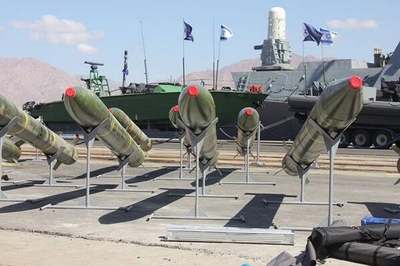
“Hizballah has advanced weapons. You don’t need to be in uniform to know that if they take the C-802 that they launched at Eilat in 2006 they will try launching it [again]. They have very good, advanced weapons, anti-tank missiles – a huge stockpile.”

And, under the cover of missile fire, the senior IDF officer said he has little doubt Hizballah will attempt some degree of land invasion.

“I think that there are maps of this,” he said. “We understand this when [Hizballah leader Hassan] Nasrallah says he will be in the Galilee and will take it from Israel. I don’t think that he will [achieve] it. So, they will take Metula, or Shlomi, or Hanita for a few hours and they’ll raise a flag. Okay, so they will launch thousands of rockets. It will be hard, but Israel will continue to exist. With Hizballah fighting in Syria in offensive attacks with tanks, infantry, UAV’s, you understand they are building a very powerful military with much practical experience.”

During the long and bloody fight against ISIS, Al Nusra and others in Syria, Hizballah has picked up large amounts of weaponry from the battlefield, weapons manufactured around the globe, some likely from the U.S. who have armed the Free Syrian Army. Whatever they captured could be fired on Israel when the war everyone expects finally breaks out.

With the exception of its border with Jordan, Israel faces non-state actors at all points of the compass. Hizballah in south Lebanon, Hizballah, ISIS and the Al Nusra Front in Syria, Hamas and Islamic Jihad in Gaza, and ISIS and al-Qaida in Sinai. There are also signs that the Fatah-run Palestinian Authority is increasingly vulnerable to radical Islamists from Hamas or ISIS as the stabbing terror spree against Israelis continues into a third month.

Could the awful Paris attacks in November have finally brought Europeans around to understanding the Israeli predicament in facing terror organizations on virtually all sides?

“I think that all over the world we have problems with radical Muslims. What we see… is a common enemy. These radical terror organizations have similar tactics and I hope the world will understand what Israel has [faced] in the last decades. I think maybe we don’t know how to explain our story [very well]. I hope that maybe now they will understand what a threat the world has, facing non-state actors and terrorist organizations – and we know it is Iran that gives money to Hizballah and tries to give them missiles to hit every place in Israel.”

The best opportunity for Israel to intervene might have presented itself last summer, when Hizballah appeared to be on the ropes.

“One can conclude that Israel may see an auspicious opportunity to make a preemptive attack to destroy Hezbollah’s massive ordnance in southern Lebanon, stockpiled since the 33-day Israel-Hezbollah war in 2006,” Iranian-Canadian political analyst Shair Shahidsaless wrote at the Huffington Post in June.

That was before the game-changing Russian entry into the conflict that has seen the balance of power sway back towards Assad and Hizballah. But could there still be a window of opportunity, unpalatable as much of the international community might find it, of Israel launching a pre-emptive strike against what is widely perceived as a massive and increasing threat to its security?

The Islamic Revolutionary Guards’ troubling transformation

December 8, 2015

The Islamic Revolutionary Guards’ troubling transformation, Front Page MagazineDr. Majid Rafizadeh, December 8, 2015

ip

Despite the guidelines of the nuclear deal and contrary to President Obama’s claim that Iran will temper its foreign policy, Iran’s Supreme Leader, Ayatollah Ali Khamenei, is actively transforming the Islamic Republic’s Revolutionary Guard Corps’ operation. This will have significant impact on regional geopolitics and US national security.

The Islamic Republic used to deploy the Quds Force, which has been designated as a supporter of terrorism by the State Department and is a paramilitary arm of Iran’s Islamic Revolutionary Guards. Its purpose is to engage in irregular warfare operations, extraterritorial interventions, foreign policy missions, and interference in the affairs of other countries. The Quds Force has an estimated 10,000 to 15,000 personnel.

Recent developments clearly indicate that Iranian leaders are transforming the whole Revolutionary Guard Corps (IRGC) into an organization that operates like the Quds Force in order to achieve Iran’s Islamist, ideological, geopolitical and strategic goals, as well as its expansionist objectives.

Unlike the Quds Force, the IRGC has an estimated 100,000-200,000 military personnel. IRGC also funds, arms, trains, and controls other domestic and foreign militia groups such as Iran’s paramilitary Basij militia, which has approximately 90,000 personnel, Hezbollah, with an estimated 20,000-30,000 fighters, as well as several other Shiite militia groups in Iraq, Yemen, and throughout the region.

Iranian news media outlets used to downplay the  IRGC’s role in other nations. But recently, Iran’s official news agency, Fars news, reported that several members of the Revolutionary Guard — including Mostafa Sadrzadeh, Milad Mostafavi, and Brigadier General Reza Khavari, the senior commander of IRGC’s Fatemiyoun Division — were among other fighters who were killed in the northern Syrian city of Aleppo. So far more than 100 IRGC fighters have been killed in Syria.

Iranian media and officials once characterized IRGC involvement in Syria as limited to advisory roles, providing tactical assistance, engaging in strategic planning, and providing intelligence.

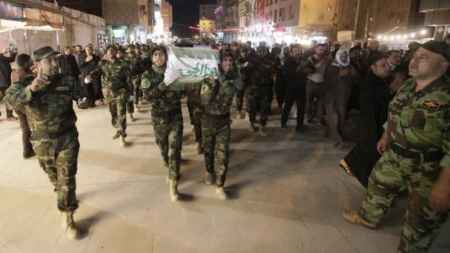
But in the last few weeks, reports of public funerals have risen, putting the Quds Force in the public eye.  Even the Supreme Leader has become more public. He tweeted about one of the Iranian fighters who died in Syria, posted a picture of him with the “martyred” family, and pointed out that “Gen. Hamedani devoted the final years of his fruitful life to fighting against anti-Islam Takfiris and fulfilled his martyrdom wish in the same front.”

Iran is increasing the amount of its IRGC fighters in Syria, with a concentration of forces in the critical cities of Allepo, Latakia, and Damascus, to prevent the fall of these strategic locations to the opposition.

While Iranian leaders project the image that they are fighting the Islamic State, Iranian forces are not positioned close to any IS stranglehold. Instead, they appear to be battling Syrian rebel groups, including the Free Syrian Army, in an attempt to force them to retreat, preventing them from capturing more territories in Allepo, Latakia and Damascus.

There are several reasons behind this tactical and IRGC organizational shift. First of all, the policy of the Obama administration is to appease Iran. This is made clear by its weak stance toward Iran. This allows Iran’s interventionist operations to be strengthened, and has empowered and transformed Tehran’s military organizations.

Secondly, The Islamic Republic pushed for Russia’s military assistance and involvement in Syria. The setbacks that Assad’s army and the Quds Force encountered in early 2015, mainly due to rise of the Islamic State and rebel groups advancements, propelled the Iranian Revolutionary Guard Commander Qassem Soleimani to visit Putin and ask for military help.

Nevertheless, Russia’s military superiority and interventions in Latakia did overshadow and bring into question Iran’s influence in Syria. By resorting to the IRGC and public acknowledgments of Iranian fighters operating on the ground in Syria, the Islamic Republic strives to reassert its presence in Syria.

In addition, the increasing Russian airstrikes are coordinated with the rising deployment of IRGC fighters on the ground. This inevitably will lead to a rise in Iranian casualties. Throughout these shifts, Assad has become increasingly dependent on Iran’s IRGC and Russia.

Furthermore, before the rise of the Islamic State, Iran played down its military role in the region because Tehran did not have a legitimate excuse to justify its presence in Syria. Iranian leaders were also worried about a direct confrontation with the West and other regional powers. They attempted to prevent the scuttling of nuclear negotiations. But after the nuclear deal was reached, and after the Islamic State grabbed global headlines, the Islamic Republic’s policy shifted in order to transform the IRGC’s function.

In the pursuit of hegemonic ambitions, Iran seizes any opportunity to reassert its regional supremacy, power and preeminence. By transforming the IRGC into a foreign offensive and interventionist force in other countries, by essentially making IRGC a regional military empire, and by announcing publicly that IRGC troops are present in Syria, Iran is demonstrating its hegemonic, Islamist, and powerful role in the region.

Although some policy analysts and scholars argue that the increasing death toll of Iranian fighters might change the IRGC’s decision to support the Syrian dictator, it is not likely that there will be any change in Iran’s policy of backing Assad. Tehran’s stakes in keeping Assad’s regime in power are high. Iran can afford several more years of assistance for the Syrian army and will continue to provide military, financial, advisory and intelligence support.

In closing, it is clear that the Islamic Republic is transforming the whole ideological and militaristic empire of the IRGC into an interventionist force which will operate in foreign countries for the purpose of fulfilling expansionist and Islamists objectives.

Oh by the way, Turkey is trying to get into a war w/Iraq

December 6, 2015

Oh by the way, Turkey is trying to get into a war w/Iraq, Front Page Magazine, Daniel Greenfield, December 6, 2015

hqdefault_1

Open question: What does Turkey’s deranged Islamist leader have to do to be disavowed by NATO, Europe and the US?

Erdogan armed terrorists in Syria, but pretty much everyone is doing that. He nearly began a war with Russia. Now Iraq keeps ordering Turkish troops off its soil. But they’re there at the supposed request of Sunnis militias around Mosul. Possibly to fight ISIS. But considering Turkey’s track record and Baghdad’s protests, probably not.

It’s a given that Baghdad, which has become a puppet regime for Iran, would oppose arming Sunni militias. Its preferred means of operation is through Iranian trained Shiite militias.

Since Turkey is really in Syria to overthrow Assad, it looks like its version of the Sunni-Shiite conflict is spreading to Iraq. Essentially Turkey is advancing into a war with the Shiite axis of Iran-Syria and its Russian patron, not to mention all the various Shiite terror militias.

I won’t object if Sunni and Shiite terrorists and their state sponsors shoot and bomb each other. Especially if it’s Turkey and Iran, but as long as Turkey is in NATO, its lunatic tyrant trying to revive the Ottoman Empire has the ability to drag us into his wars.

And that’s an obvious problem.

Turkey should not be in NATO. And only a madman would consider it for EU membership.

But Erdogan’s migrant games have forced Germany to come crawling to him offering cash and EU membership acceleration.

Obama, who was once closest to Erdogan, is obviously not about to cut him off no matter what he does. But the United States is now in the strange position of having a ridiculously confused presence in a Muslim civil war.

Obama is backing Sunni Jihadists in Syria and Shiite Jihadists in Iraq. He refuses to arm Sunni militias in Iraq, but stands by while Turkey carries out what is effectively an illegal invasion of Iraq. (Remember that one the next time Kerry squeals about Jews living in Jerusalem.) He backs Kurdish militias that Turkey is bombing. He’s trying to appease Iran and Turkey at the same time and it can’t work.

The only thing Obama has managed to do is shove the United States in the middle of a Muslim civil war while making occasional noises about un-Islamic ISIS.

Russia brings over heavy T-90 tanks to boost three Syrian warfronts

December 6, 2015

Russia brings over heavy T-90 tanks to boost three Syrian warfronts, DEBKAfile, December 6, 2015

russian-tank-army-t-90-Syria_12.15

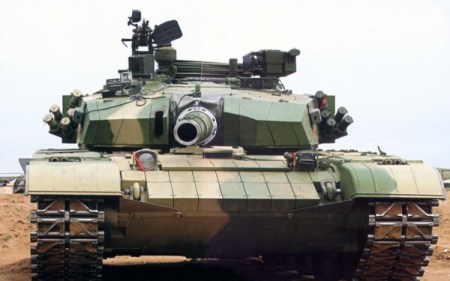
On Wednesday, Dec. 2, Russia started transferring dozens of advanced T-90 tanks to Syria, DEBKAfile’s military and intelligence sources report. They were moved immediately to two Syrian army fronts fighting rebel forces at the two most important cities, Aleppo and Damascus, and are expected to be sent to beef up the combined Syria, Iranian, Hizballah army poised to recover Palmyra from the Islamic State.

The shipment to the capital was delivered into the hands of the 4th armored division, Syria’s republican guard commanded by Gen. Ali Maher Assad, the younger brother of President Bashar Assad.

The attack on Palmyra in country infested by ISIS forces was scheduled to have begun two weeks ago but was delayed for the arrival of the heavy Russian tanks, among other reasons.

The T-90 weighs 46.5 tons and has a range of 375 kilometers, with an average speed of 45 km per hour under battle conditions or 65 km per hour on roads. It has three layers of defensive systems: composite armor plates on the turret; Kontact-5 third-generation explosive reactive armor on its front, sides, and turret that reduces penetration by kinetic energy bombs; and the “Shtora,” or curtain, an electro-optical active protection system that enables the tank to jam the systems of antitank missiles.

The T-90 also has 12 smoke mortars, a 125 mm cannon and AT-11 Sniper guided antitank missiles. The tank has proven itself in battle in recent years in Russia’s wars in Georgia and Chechnya against forces not unlike the Syrian rebels.

Until last week, Russia kept only a few T-90 tanks in Syria, mainly to protect its military bases around Latakia.

The new shipment, say Western military sources which are monitoring Russian movements, will eventually replace a large part of the Syrian army’s fleet of around 500 operational tanks, mostly T-72s – at least half of which are positioned to defend the capital.

But the pace of delivery will be dictated above all by the time needed for Russian instructors to retrain Syrian tank crews from scratch in the use of T-90s in battle conditions.

It should be noted meanwhile that, while the Syrian rebels have antitank missiles able to take out the T-72, they do not have advanced missiles capable of stopping the much heavier, reactively armed T-90. But  the Islamic State does, having captured US-made antitank missiles from the Iraqi armored divisions put to flight in June 2014. Some of those advanced missiles may be presumed to have been passed to ISIS forces in Syria.

For now, the Russian general staff shows no sign of preparing for a wide-scale operation against ISIS in Syria, so the newly-delivered T-90s are not immediately threatened from that quarter.

As far as Israel is concerned, the main worry is that Russian instructors will also be assigned to train Iranian and Hizballah tank crews in the use of the advanced T-90. Once they get hold of these tanks, they will be able to attain their objective of beefing up the Iranian-Hizballah front against Israeli defenses from southern Syria and the Syrian Golan.

Israeli finds cause for concern in the constant expansion of the Russian military presence and involvement in Syria. Preparations for a very long stay are signified by new developments every few days. A permanent Russian military presence in Syria would give Iran and Hizballah cover for a standing military buildup in Syria. This would confront Israel’s vital strategic interests with a major challenge.

Israel extremely nervous over Russian operations on its Golan border

December 2, 2015

Israel extremely nervous over Russian operations on its Golan border, DEBKAfile, December 2, 2015

Netanyahu_speaks_with_Putin_Paris_30.11.15

Moscow may be giving Hizballah and Iran an umbrella for achieving their longstanding design to displace the Syrian rebels with Revolutionary Guards and Hizballah forces and deploy them along Israel’s Golan border.

**********************

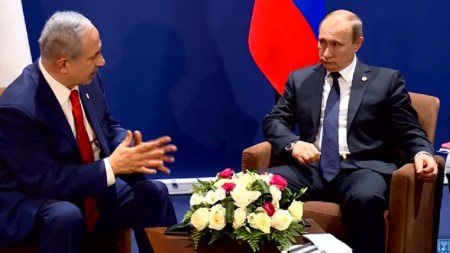
On the outside, Israel is all smiles and full of praise for way the coordination with Moscow is working for averting clashes between its air force and Russian warplanes over Syria. This goodwill was conspicuous in the compliments Prime Minister Binyamin Netanyahu and President Vladimir Putin traded when they met on the sidelines of the Paris climate summit Monday, Nov. 30.

But the first disquieting sign appeared Tuesday, Dec. 1. Senior Russian and Israeli officers were due to meet in Tel Avid to discuss strengthening the cooperation between the two army commands. But no word from Moscow or Jerusalem indicated whether the meeting had taken place.

DEBKAfile’s military sources report that this week, the show of optimism is giving way to an uneasy sensation in the offices of the prime minister, Defense Minister Moshe Ya’alon and the IDF Chief of Staff Lt. Gen. Gady. They suspect an ulterior motive behind Russia’s military movements in southern Syria, especially its air strikes against Syrian rebels, just across from Israel’s Golan border.

In particular, Moscow may be giving Hizballah and Iran an umbrella for achieving their longstanding design to displace the Syrian rebels with Revolutionary Guards and Hizballah forces and deploy them along Israel’s Golan border.

This suspicion gained ground when Tuesday, Dec. 1, the day after the Putin-Netanyahu encounter, the combined Iranian-Syrian-Hizballah units expanded their thrust from the southern Syrian town of Deraa to the Golan town of Quneitra, within sight of Israel’s defense positions.

All that day, heavy battles raged over the rebel-held line of hills running from a point just south of Quneitra to the Israeli-Syrian-Jordanian border junction. The combined force was supported by Russian air strikes and heavy tanks and artillery, seen for the first time in this war arena.

When the fighting resumed Wednesday, the IDF placed its Golan units on high alert and an extra-vigilant eye was trained on this battle.

The Iranian-Syrian-Hizballah side is gaining a distinct advantage from the deep feud dividing rebel ranks. The Islamic State and the al-Qaeda-affiliated Syrian Nusra Front forces are tearing into each other with suicide bombers and explosive cars. Tuesday, an ISIS-rigged bomb car blew up at Nusra headquarters near Quneitra (see photo).

ISIS_car_bomb_in_Quneitra_nusra_1.12.15

But this also means that an Islamic State force has come dangerously close to the Israeli border.

However, even more perils are in store if Bashar Assad’s army backed by Iran, Hizballah and Russia manages to capture the hills opposite the Golan:

1. Two years of unrelenting Israeli military and intelligence efforts to keep Hizballah and Iranian forces away from its Golan border will have gone to naught.

2.  Hizballah will open the door for Iranian Revolutionary Guards officers to set up a command center right up to the Israeli border.

3.  Israel’s steadfast policy and military action to prevent advanced Iranian weapons reaching Hizballah in Lebanon via Syria will be superseded. On the Golan, Hizballah will have gained direct access to any weapons it wants directly from Syria and be able to deploy them at far shorter distances from Israeli targets than from their firing positions in Lebanon.

4.  Vladimir Putin attaches extreme importance to recovering southern Syria from the rebel forces backed by the US and Israel, because he regards the threat to the Assad regime as great from the south as it is from the north or the center.

5.  Israel faces a grave dilemma between keeping up its “honeymoon” with Moscow by giving way on its essential security interests, or taking the bull by the horns and keeping the enemy at bay, whatever the cost to the understanding reached with Putin.

Officials in Jerusalem point out that the threat to Golan peaked just hours after the Russian leader met the prime minister in Paris. Putin is conducting a hands-on policy on Syria and keeps close track of the slightest occurrence on the battlefield. He must have been perfectly aware of the state of play on the Golan when he met Netanyahu, but nonetheless kept it out of their conversation.

The French connection

November 17, 2015

The French connection, Israel Hayom, Ruthie Blum, November 17, 2015

When Islamist leaders condemned Friday night’s Paris attacks, which left more than 132 people dead and hundreds of others critically wounded, you just had to laugh through your tears.

Terror masters in Iran, Turkey, Syria and the Palestinian Authority actually had the gall to talk as if they themselves are not responsible for the ongoing murder of innocent people.

But hypocrisy, mendacity and lying as a matter of course are not the only reasons for their public expressions of solidarity with France during this frightful hour. In fact, what really bothers them is the fear that a rival group may be beating them at their own game. And hell hath no fury like a scorned, power-hungry radical Muslim with hegemonic aims and weapons with which to achieve them.

Such monsters, some in suits and ties to throw you off, are able to get away with playing the West for fools — particularly when the so-called leader of the free world keeps kowtowing to them, while espousing denial as a policy. Indeed, in the immediate aftermath of the bloodbath in Paris, U.S. President Barack Obama made a statement that put a smug smile on the faces of jihadists everywhere.

In the first place, he called the carnage “an attack on all of humanity and the universal values that we share.” This is an amazing assertion, since I don’t even share Obama’s values, let alone those of a great portion of “humanity” inside and out of Washington, D.C. You know, like the multimillions of anti-Semites, Christian-killers, women-subjugators and child-abusers who are trying to win the war over the world’s character and soul.

Secondly, the president said he didn’t “want to speculate at this point in terms of who was responsible for this.”

Right, responded radical Muslims in the privacy of their bunkers and bomb factories, for all Obama knew, the shootings and explosions in a theater, restaurants and at a soccer stadium could have been carried out by disgruntled Buddhists.

By the time he arrived in Antalya to attend the G-20 economic summit less than 48 hours later, even the U.S. president could no longer plead ignorance. So he had to address the issue of Islamic State tentacles spreading every which way, in spite of his having announced a few days earlier that its threat had been “contained.”

Even members of the left-leaning media were challenging his claim that the way he’s been fighting the al-Qaida spin-off is still the right one. And this, while sidling up to Turkish President Recep Tayyip Erdogan, whose recent landslide re-election was a dark day for people with those ostensibly “universal” values Obama had mentioned.

The good news here is also the bad.

Effectively combating Islamic State is actually irrelevant in the wider context, as counterterrorism expert Sebastian Gorka has been trying to explain for years.

That Friday night’s multiple attacks in Paris were carried out by terrorists affiliated with ISIS is “wholly irrelevant,” Gorka — national security editor at Breitbart and military affairs fellow at the Foundation for the Defense of Democracies — told me this weekend. “All members of the global jihadist movement, be they Sunni or Shia, Arab, Persian or converts, are driven by the same desire: the need to kill the kuffar [infidels] for the glory of Allah. All attacks, be they 9/11, 7/7, Mumbai, Amman, Paris or the recent stabbings in Israel, are tied together by the connective tissue of jihadist ideology.”

He stressed, “It is time for us to realize — and demand of our leaders that they act accordingly — that we face an existential threat, which, over the long term, could be as dangerous as Hitler’s Third Reich. This is a war between good and evil. And only one side will prevail in the end.”

I still harbor hope that the former will emerge victorious. But this cannot happen unless certain conditions are met. These include: getting the nuclear-deal-obsessive Democrats out of the White House; making Europe understand that it should be labeling undesirable Islamists, not Israeli products; and raising children in the West to grasp that the blessed ability to live in a free society means being prepared to die defending it against its detractors and destroyers.