Archive for the ‘Iranian proxies’ category

Iran’s Plans to Control a Palestinian State

May 9, 2016

Iran’s Plans to Control a Palestinian State, Gatestone Institute, Khaled Abu Toameh, May 9, 2016

(Please see also, Op-Ed: Trump’s “peace through strength”  for  USA also applies to Israel. — DM)

♦ The Iran nuclear deal, marking its first anniversary, does not appear to have had a calming effect on the Middle East.

♦ Iran funnels money to Hamas and Islamic Jihad because they share its desire to eliminate Israel and replace it with an Islamic empire. The Iranian leaders want to see Hamas killing Jews every day, with no break. Ironically, Hamas has become too “moderate” for the Iranian leadership because it is not doing enough to drive Jews out of the region.

♦ More Palestinian terror group leaders may soon perform the “pilgrimage” to their masters in Tehran. If this keeps up, the Iranians themselves will puppeteer any Palestinian state that is created in the region.

The Iran nuclear deal, marking its first anniversary, does not appear to have had a calming effect on the Middle East. The Iranians seem to be deepening their intervention in the Israeli-Palestinian conflict in general and in internal Palestinian affairs in particular.

This intervention is an extension of Iran’s ongoing efforts to expand its influence in Arab and Islamic countries, including Iraq, Yemen, Syria and Lebanon and some Gulf states. The nuclear deal between Tehran and the world powers has not stopped the Iranians from proceeding with their global plan to export their “Islamic Revolution.” On the contrary, the general sense among Arabs and Muslims is that in the wake of the nuclear deal, Iran has accelerated its efforts to spread its influence.

Iran’s direct and indirect presence in Iraq, Syria, Yemen and Lebanon has garnered some international attention, yet its actions in the Palestinian arena are still ignored by the world.

That Iran provides financial and military aid to Palestinian groups such as Hamas and Islamic Jihad has never been a secret. In fact, both the Iranians and the Palestinian radical groups have been boasting about their relations.

Iran funnels money to these groups because they share its desire to eliminate Israel and replace it with an Islamic empire. Like Hezbollah in Lebanon and the Houthis in Yemen, Hamas and Islamic Jihad agreed to play the role of Tehran’s proxies and enablers in the Israeli-Palestinian conflict.

1162 (1)Iran used to funnel money to Hamas and Islamic Jihad because they share its desire to eliminate Israel and replace it with an Islamic empire. Relations between Iran and Hamas foundered a few years back, when Hamas leaders refused to support the Iranian-backed Syrian dictator, Bashar Assad. Pictured above: Hamas leader Khaled Mashaal (left) confers with Iranian “Supreme Leader” Ali Khamenei, in 2010. (Image source: Office of the Supreme Leader)

But puppets must remain puppets. Iran gets nasty when its dummies do not play according to its rules. This is precisely what happened with Hamas and Islamic Jihad.

Relations between Iran and Hamas foundered a few years back over the crisis in Syria. Defying their masters in Tehran, Hamas leaders refused to declare support for the Iranian-backed Syrian dictator, Bashar Assad. Things between Iran and Hamas have been pretty bad ever since.

First, the Assad government closed down Hamas offices in Damascus. Second, Assad expelled the Hamas leadership from Syria. Third, Iran suspended financial and military aid to Hamas, further aggravating the financial crisis that the Gaza-based Islamist movement had already been facing.

Islamic Jihad got it next. Iranian mullahs woke up one morning to realize that Islamic Jihad leaders have been a bit unfaithful. Some of the Islamic Jihad leaders were caught flirting with Iran’s Sunni rivals in Saudi Arabia and other Gulf countries. Even worse, the Iranians discovered that Islamic Jihad was still working closely with their erstwhile allies in the Gaza Strip, Hamas.

Iran had had high hopes for Islamic Jihad replacing Hamas as Tehran’s darling, and major proxy in the Palestinian arena. But here were Islamic Jihad leaders and activists working with their cohorts in Hamas, in apparent disregard of Papa Iran.

The mullahs did not lose much time. Outraged by Islamic Jihad’s apparent disloyalty, Iran launched its own terror group inside the Gaza Strip: Al-Sabireen (The Patient Ones). This group, which currently consists of several hundred disgruntled ex-Hamas and ex-Islamic Jihad members, was meant to replace Islamic Jihad the same way Islamic Jihad was supposed to replace Hamas in the Gaza Strip — in accordance with Iran’s scheme.

Lo and behold: it is hard to get things right with Iran. Al-Sabireen has also failed to please its masters in Tehran and is not “delivering.” Palestinian sources in the Gaza Strip say that Iran has realized that the investment in Al-Sabireen has not been worthwhile because the group has not been able to do anything “dramatic” in the past two years. By “dramatic,” the sources mean that Al-Sabireen has neither emerged as a serious challenger to Islamic Jihad or Hamas, and has not succeeded in killing enough Israelis.

So Iran has gone running back to its former bedfellow, Islamic Jihad.

For now, Iran is not prepared fully to bring Hamas back under its wings. Hamas, for the Iranians, is a “treacherous” movement, thanks to its periodic temporary ceasefires with Israel. The Iranian leaders want to see Hamas killing Jews every day, with no break. Ironically, Hamas has become too “moderate” for the Iranian leadership because it is not doing enough to drive Jews out of the region.

That leaves Iran with the Islamic Jihad.

In a surprise move, the Iranians this week hosted Islamic Jihad leader Ramadan Shalah and senior officials from his organization, in a renewed bid to revive Islamic Jihad’s role as the major puppet of Tehran in the Gaza Strip. Islamic Jihad officials said that the visit has resulted in the resumption of Iranian financial aid to their cash-strapped organization. As a result of the rift between Islamic Jihad and Iran, the Iranians are said to have cut off nearly 90% of their financial aid to the Palestinian terror organization.

Some Palestinians, such as political analyst Hamadeh Fara’neh, see the rapprochement between Iran and Islamic Jihad as a response to the warming of relations between Hamas and Turkey. The Iranians, he argues, are unhappy with recent reports that suggested that Turkey was acting as a mediator between Hamas and Israel.

Other Palestinians believe that Iran’s real goal is to unite Islamic Jihad and Al-Sabireen so that they would become a real and realistic alternative to Hamas in the Gaza Strip.

Whatever Iran’s intentions may be, one thing is clear: The Iranians are taking advantage of the nuclear deal to move forward with their efforts to increase their influence over some Arab and Islamic countries. Iran is also showing that it remains very keen on playing a role in the Israeli-Palestinian conflict — one that emboldens radical groups that are bent on the destruction of Israel and that share the same values as the Islamic State terror group.

Iran’s latest courtship of Islamic Jihad is yet another attempt by the mullahs to deepen their infiltration of the Palestinian arena by supporting and arming any terror group that strives to smash Israel. For now, it seems that Hamas’s scheme is working, largely thanks to the apathy of the international community, where many believe that Iran has been declawed by the nuclear deal.

But more Palestinian terror group leaders may soon perform the “pilgrimage” to their masters in Tehran. If this keeps up, the Iranians themselves will puppeteer any Palestinian state that is created in the region. Their ultimate task, after all, is to use this state as a launching pad to destroy Israel. And the Iranians are prepared to fund and arm any Palestinian group that is willing to help achieve this goal.

Iran reconciles with Islamic Jihad: DEBKAfile sources

May 6, 2016

Iran reconciles with Islamic Jihad: DEBKAfile sources, DEBKAfile, May 6, 2016

The full renewal of aid came after Iran, under Hizballah pressure,  partially renewed the support in March. Hizballah is interested in maintaining its close ties with Islamic Jihad in order to ensure influence on Palestinian affairs and a foothold in Gaza.

**************************

After a two-year rift between Islamic Jihad and Iran that resulted in the halting of Tehran’s military and financial aid to the terrorist organization, a reconciliation agreement was reached this week between the two sides in the Iranian capital, DEBKAfile‘s sources report. The dispute began when Islamic Jihad refused to back Iran’s policy of support for Syrian President Bashar Assad, and rejected Iran’s request to send members of the organization in Syria and Lebanon to fight alongside pro-Iranian militias in Syria.

The reconciliation was reached when Islamic Jihad leader Ramadan Shalah arrived in Tehran with a large delegation from the organization’s leadership and met Iran’s supreme leader Ayatollah Ali Khamenei.

The renewal of Iran’s financial aid to Islamic Jihad was announced during the meeting.

DEBKAfile: The main mediator between the two sides was the leadership of Hizballah in Lebanon. The full renewal of aid came after Iran, under Hizballah pressure,  partially renewed the support in March. Hizballah is interested in maintaining its close ties with Islamic Jihad in order to ensure influence on Palestinian affairs and a foothold in Gaza.

During a public appearance in Tehran, Islamic Jihad leader Shalah said “defending Palestine is defending Islam.” In other words, Iran, not ISIS, is the defender of Islam.

Iranian Daily ‘Kayhan’: Iran Asked Russia To Intervene In Syria; Moscow Must Not Reach Any Agreement On Syria With Washington At Assad’s And Iran’s Expense; Tehran Is Providing Assad With Strategic Weapons

April 27, 2016

Iranian Daily ‘Kayhan’: Iran Asked Russia To Intervene In Syria; Moscow Must Not Reach Any Agreement On Syria With Washington At Assad’s And Iran’s Expense; Tehran Is Providing Assad With Strategic Weapons, MEMRI, April 27, 2016

In its April 11, 2016 editorial, the Iranian daily Kayhan, the mouthpiece of Iran’s ideological camp which is led by Iranian Supreme Leader Ali Khamenei, discussed Russia’s interests in Syria and the Middle East, and Iran-Russia relations. The editorial warned Moscow not to reach a secret agreement with Washington at the expense of Syrian President Bashar Al-Assad and Iran in exchange for Washington’s lifting its pressure on Russia over Ukraine and Crimea. It also underlined that such an agreement would in any case be doomed to failure, because it would not have Tehran’s knowledge or agreement, and stated that Tehran is opposed to Russia’s federal plan for Syria.

Noting that while it is important to Russia, Syria is not strategic to it as it is to Iran and Hizbullah. Russia’s might in the region stems solely from its protection of the Iran-Hizbullah-Syria resistance axis, it said, adding that if Moscow sells out Assad and Syria, it will become a minor player in the region, like France and the U.K.

The editorial revealed that the Russian military had entered Syria in October 2015 at Tehran’s request, and acknowledged that major parts of northern and southern Syria are directly controlled by Hizbullah and Iran. It added that Tehran has for some time been providing Assad with strategic weapons, and that Russia had withdrawn from Syria because its presence there was no longer needed.

The following are excerpts from the editorial:

“What Part Does Syria Play In Russian Foreign Policy?”

“…What part does Syria play in Russian foreign policy? Is it great or small? To what extent is Russia’s Syria policy based on cooperation with the West? Great or small? Is Russia’s security situation such that it would prefer to trade Syria for Ukraine – meaning that Russia will receive Ukraine and give Syria to the West? What weight does Russia have in Syria – meaning how much does Russia really influence the Syrian security issue? And on this matter, historically, in the past 50 years, was Syria, or was it not, part of the Eastern Bloc and [after the collapse of the Soviet Union] one of Russia’s satellite states?

“What is the extent of the military relations between Russia and Syria? How dependent is the Syrian army on Russian arms? What was Russia’s aim in becoming [physically] involved in Syria’s security situation this past October? What agreement was arrived at between the U.S. and Russia at the Geneva talks?

“Isn’t Russia’s becoming a main focal point at the Geneva talks, and isn’t its secret agreement with the U.S., aimed at weakening Iran’s role [in Syria] and placing the fate of Iran’s allies in the hands of Moscow-Washington agreements?

“According to this, and in light of the fact that it is clear what the outcome of the secret Kremlin-White House talks will be, what was the point of our five-year effort to protect the Syrian government, and our sacrifice of beloved martyrs? And, ultimately, in light of its past reputation, can Russia’s game be trusted?…”

“All Russia’s Might Lies In Its Preservation Of Iran, Hizbullah, And Syria; If It Does Not Do This, [Russia] Will Become A Minor Player, Like France And England”

“Syria plays a major part in Russia’s foreign policy… Syria and its Mediterranean coast is the only point in the Middle East and North Africa that has [physical] contact with the southern reaches of NATO territory. To some extent, these places are under Russian control, and any plan that impacts Russia’s ongoing presence in this sensitive region is certainly contrary to Russia’s interests and national security.”

“On the other hand, there is no way Russia can trust that any agreement with the West that rejects Assad will not also reject Russian influence. Therefore, we can say that in terms of geopolitics and strategic interests, there is no possibility that an agreement between Russia and the West about the current Syrian government would be achieved – unless the Russians make a mistake in the talks. But even if this happens, there is a possibility for rectification [of such a mistake by Russia], thanks to the good Iran-Russia relations. Additionally, in the past year or two, we have seen at least two such mistakes that were subsequently rectified.”

“Regarding Russian control over Eastern Ukraine and the Crimea, and Russian military control of the Black Sea: There is no reason for Russia to bring Syria in [to the equation] in order to obtain Ukraine. At this time, in the Ukrainian issue, the Westerners and the Western government in Kiev are apprehensive about Russia’s influence and about Russia’s military and security expansion in Eastern and Southern Ukraine. Therefore, the statement that is brought up in Iran – i.e. that Russia wants to trade Syria for Ukraine, is not compatible with reality.

“What weight does Russia carry in Syria? Undoubtedly, Russia is one of the countries that influence the Syrian issue. Russia’s military presence in the ports of Latakia and Tartus, as well as the Russia-Syria military agreements, give Russia prominent status. But in comparison with the status of Iran and Hizbullah, [Russia’s] status is not considered strategic.

“In principle, in some strategic matters, there are strategic points of contention between Russia and Syria – but there are no such disputes between Damascus and Tehran… Russia’s influence in Syria is not so great that [Russia] can make decisions on behalf of the Syrian government and its allies in the region… that is, Russia has no strategic relations either with the Syrian government or with the main rebels such as Jabhat Al-Nusra and ISIS, which would allow it to establish a particular situation in Syria. All Russia’s might lies in its preservation of Iran, Hizbullah, and Syria. If it does not do this, [Russia] will become a minor player, like France and England.”

“Major Parts Of The Line Of Defense And The Operations Of North And South Syria Are Now Directly In Hizbullah’s And Iran’s Hands”

“Over the past 50 years, Syria was never recognized as part of the Eastern Bloc, and never expressed solidarity with it, despite its good relations with the Soviet Union and Russia. Perhaps the main reason there was no such alliance is Russia’s active relations with the Zionist regime. In any event, Syria was not defined as part of Russia’s [interests], and has, since the beginning of the victory of [Iran’s Islamic] Revolution, been part of the resistance front and an ally of Iran – and now too it owes its existence to Iran’s special and influential aid.

“In contrast to Russia, that has nothing in Syria that belongs to it, major parts of the line of defense and the operations of north and south Syria are now directly in Hizbullah’s and Iran’s hands. If Russia reaches an agreement with a third country that is unacceptable to Iran, such an agreement will surely fail – because in the past 30 years, every decision made for the resistance states and movements in which Iran had no part failed.

“Syria has no absolute dependence on Russian arms, and Iran has been providing Syria with strategic weapons for a long time. Therefore, in the [second Lebanon] war, the Assad government gave its Russian weapons to Hizbullah in Lebanon, without fearing that this would violate either the military protocols [that were in place] with Russia or the Russians’ conditions. Russia also did not succeed in expressing serious opposition [to this move]. Therefore, if Moscow was Syria’s only source of weapons, Assad would not have been able to unilaterally violate the agreement.”

“On The First Of October 2015, Russia [Physically] Entered The Syrian Security Issue, After Iran Officially Asked It To Do So”

“On the first of October 2015, Russia [physically] entered the Syrian security issue, after Iran officially asked it to do so. Two days after a visit [to Moscow] by a high-ranking Iranian delegation, Moscow sent its air forces and missile defense systems into the war against terrorist elements in Syria, and five and a half months later, it withdrew part of its military forces from Syria. This was because the Islamic Revolutionary Guard Corps (IRGC)   agreement with Putin was in force for five months at most. After the end of the [Russia-Iran] agreement, Russia withdrew only some of its forces from Syria.

“[It was at] Iran’s invitation that Russia entered Syria, when such a [military intervention] was necessary and worthwhile, and [Russia] withdrew part of its forces when even withdrawing them all would not have harmed the [Assad] government and the Syrian security apparatuses one bit. In this case, Iran’s conclusion was that the Russian forces should return [to Russia].

“The truth is that last summer, because of the advance of the terror elements in Idlib, Shaykh Maskin, Sakhaneh, and Tadmor, terror elements were enthused, and Syria needed a psychological shock; additionally, prior to Russia’s entrance, the sensitive region of Zabadani was taken by Hizbullah.

“This shock [i.e. Russia’s entrance into Syria] was implemented in early October, and it gave the [Syrian] army, and the forces connected to it, their second wind, and they carried out the Nasser 2 operation in the western part of the city of Aleppo and also determined the fate of the war in Syria. Therefore, when the Russians withdrew their forces [from Syria], there was no longer any need for their presence. So it is not at all correct to say that Iran and Syria were surprised when this happened.

“For Syria, there is a need for diplomatic talks, and Iran always stresses [the need for] this alongside military operations. Iran has had a useful presence in most [of these talks] particularly in the two recent rounds of talks held in Munich and Geneva. Here, Russia’s role was two-pronged: First, in the developments in the [war] arena; in this matter [Russia] is fully coordinating with Iran. Second is Russia’s special plan, the main point of which is [Syria’s] federalization. Iran has neither rejected nor approved [this plan], but it recognizes it as premature, and as not serving the interests of the participants in the diplomatic talks in Geneva.”

New Palestinian pact-for-terror

April 25, 2016

New Palestinian pact-for-terror, DEBKAfile, April 25, 2016

TerrorTunnels480

Israel embarked on a P. R. campaign to play down the extent of the threat which surfaced in one day in the discovery of Hamas tunnel near Kibbutz Sufa, and the suicide bombing of Jerusalem bus No. 12 on April 18, with 20 people injured. The police initially claimed for example that the explosion was due to a technical problem with the engine. But the two developments actually represented a sharp and serious escalation of the Palestinian wave of terror against Israel.

Neither of the operations was carried out by “lone wolves” but rather by large terror networks. The secret tunnel discovered in the Gaza border area was built by the Hamas military wing, the Izaddin al-Qassam brigades, while the suicide bombing in Jerusalem was carried out by the Hamas infrastructure in Judea and Samaria, specifically its operatives in the Bethlehem area.

Each of these terror networks poses a different challenge to Israel.

In Gaza, the Hamas political leadership is no longer in contact with the heads of its military wing. Neither the top commanders nor the regional commanders of the brigades obey any Hamas political body. They only heed three sources:

1. The Hamas military command framework headed by Mohammad Deif and Marwan Issa.

2. Iranian or Hizballah intelligence services, which maintain contacts with them and often provide funds or weapons.

3. The ISIS affiliate in the Sinai, with which the Hamas military wing maintains operational ties.

There is an equally serious problem in Judea and Samaria. Over the past few weeks, the Hamas terror networks have started to make contact with sleeper cells from Fatah’s Tanzim paramilitary force that have the knowledge, ability, means and experience for major terrorist attacks against Israel, such as the Jerusalem bus bombing.

This dormant wing of Mohammad Abbas’s Fatah has began to show signs of life and willingness to return to the path of terror.

These contacts began immediately after publication of a letter from jailed Tanzim leader Marwan Barghouti to members of the force that called on them to start coordinating their operations against Israel with Hamas. Nobody has bothered to explain how a senior terrorist jailed in a high-security Israeli prison succeeded in smuggling such a letter out.

The link between part of the Tanzim and the Hamas terror networks is no less dangerous than the tunnel discovered near Kibbutz Sufa, and it presages an escalation of terror operations in the future.

The only way to prevent a major deterioration of the security situation is to strike targets of the Izzadin al-Qassam brigades. There is no need to launch a total war against Hamas or to occupy Gaza.

But instead of responding as needed, Israel’s government and security establishment have released pictures of digging equipment that has finally succeeded in locating a single Hamas infiltration tunnel out of the many that exist, and claimed that those responsible for the Jerusalem bombing have yet to be identified. At the same time, senior officials and IDF officers continue to assert that Hamas is not seeking escalation.

Unfortunately, this can only mean a resurgence of the wave of terror.

Our World: Obama’s nuclear contrition

April 12, 2016

Our World: Obama’s nuclear contrition, Jerusalem Post, Caroline B. Glick, April 4, 2016

On Monday, State John Kerry visited Hiroshima. While there meeting with this G-7 counterparts, Kerry strongly hinted that his visit was a precursor to a visit to the site of the first nuclear bombing by President Barack Obama next month.

The irony of course is that for all his professed commitment to ridding the world of nuclear weapons, Obama is responsible for drastically increasing the chance of nuclear war. Indeed, Obama’s own actions lend easily to the conclusion that he wishes to do penance for America’s decision to attack Hiroshima and Nagasaki with nuclear bombs, (and so end World War II with far fewer dead than a land invasion of Japan would have required), by enabling America’s enemies to target the US and its allies with nuclear weapons.

Obama views his nuclear deal with Iran – the so-called Joint Comprehensive Plan of Action – as his greatest foreign policy achievement.

Unfortunately for his legacy building and for global security, for the past several weeks news stories have made clear that critics of Obama’s nuclear deal with Iran – who claimed that far from preventing Iran from acquiring nuclear weapons, the deal would enable Iran to develop them in broad daylight, and encourage Iran to step up its support for terror and regional aggression – were entirely correct.

All of the warnings sounded by Prime Minister Binyamin Netanyahu and other leaders have been borne out. All of the warnings sounded by the leaders of the Persian Gulf kingdoms were correct.

Every major commitment Obama made to Congress and to US allies in the wake of the deal have been shown in retrospect to have been false.

Obama told Congress that while the deal did require the US to drop its nuclear sanctions against Iran, the non-nuclear sanctions would remain in place. In recent weeks, media reports have made clear that the administration’s commitment to maintain non-nuclear sanctions on Iran has collapsed.

This collapse is most immediately apparent in the administration’s helpless response to Iran’s recent tests of ballistic missiles.

When Obama and his advisers sold the nuclear deal to Congress last summer, they promised that the binding UN Security Council resolution that Ambassador Samantha Power rushed to pass to anchor the nuclear deal maintained the previous UN ban on Iranian ballistic missile development.

This, it works out, was a lie. The resolution significantly waters down the language. Given the weak language, today the Russians convincingly argue that Iran’s recent tests of ballistic missiles did not violate the UN resolution.

Then and now, Obama and his advisers argued that ballistic missiles are not part of the mullahs’ nuclear project. This claim, which made little sense at the time, makes no sense whatsoever today.

Ballistic missiles of course are the Iranians’ delivery systems of choice for their nuclear warheads.

This fact was driven home last week when the Iranian media reported the opening of a high explosives factory in Tehran. Iranian Defense Minister Hossein Dehgan participated in the opening ceremony.

According to nuclear experts, HMX or octogen high explosives are suitable for building nuclear triggers. In other words, Tehran just built, in a very public manner, a new facility for its military nuclear program. As Iran’s Tasnim news service explained, HMX is a “high explosive used almost exclusively in military applications, including as a solid rocket propellant.”

Last week at his nuclear conference, Obama said that Iran has been abiding by the letter, but not the spirit of the nuclear deal. But this is another lie. Last summer Obama insisted that the deal would prevent Iran from developing and building nuclear weapons by imposing an intrusive, unlimited inspections regime on all of Iran’s nuclear sites.

But this was a lie. As Eli Lake noted in Bloomberg News last week, in contravention of Obama’s explicit commitments to Congress, Iran is refusing to permit UN nuclear inspectors access to its military nuclear sites.

Not only were UN inspectors barred last fall from visiting the Parchin nuclear military site where the Iranians are suspected of developing nuclear warheads. The UN’s International Atomic Energy Agency admitted recently that far from expanding its access to Iran’s nuclear sites, the deal severely limited it. Out of fear that Iran will walk away from the deal, the US is allowing Iran to block IAEA inspectors.

So while the US gave up its right to unlimited inspection of Iran’s nuclear installations, and consequently has little way of knowing what is happening inside them, the US stands back and allows Iran to develop the means to deliver nuclear warheads which the US cannot know whether or not Iran possesses because it cannot access Iran’s nuclear facilities.

But for Obama, none of this is a reason to stop canceling the sanctions on Iran’s nuclear program. Indeed, as Obama sees things, Iran’s non-compliance with the letter of the deal seems to be a reason to cancel the non-nuclear sanctions as well.

Take the dollarization of the Iranian economy.

Obama administration officials pledged to Congress that in the aftermath of the deal, Iran would remain barred from using US financial institutions and so barred from trading in the dollar.

Yet, in what Omri Ceren from the Israeli Project refers to as a “one-hop, two-hops” process, the administration is allowing Iran to use foreign banks to gain access to the US dollar and dollarize is transactions.

Following his visit to Hiroshima, Kerry traveled to the Persian Gulf where the US’s spurned Arab allies and commanders of the US navy’s Fifth Fleet demonstrated to him how Iran has been emboldened by the deal.

Since it was concluded, they noted, Iran has stepped up its support for terrorism and its regional aggression. The leaders of Saudi Arabia, Bahrain, the UAE and other states told Kerry that since the deal was concluded Iran’s support for terrorism and insurgencies has expanded in Yemen and Syria. Naval commanders reported on the four shipments of illicit Iranian arms the navy commandeered en route to Yemen.

Although slightly embarrassed, Kerry was unmoved. He merely maintained Obama’s line that Iran is keeping the letter of the agreement if ignoring its spirit. He insisted that there are moderates in the regime that support the deal – although they have no power.

Then, as The New York Times reported, Kerry said the US would “continue to lift the economic sanctions against Iran that it agreed to as part of the nuclear accord, even while imposing new ones to counter Tehran’s missile launches, an effort now underway at the UN Security Council.”

But again, Russia has blocked further sanctions against Iran. Moreover Russia is doubling down on its deal to sell advanced SU-30 fighters to the Iranian air force. With the S-30, Iran will be able to end Israel’s air superiority and threaten all of its neighbors in the Persian Gulf.

As to air forces, Iran’s Hezbollah proxy have inherited a US-trained one.

According to testimony Middle East expert Tony Badran gave before the House Foreign Affairs Committee last week, the Lebanese Military Forces, generously supported by the US, is now a junior partner to Hezbollah.

As Badran put it, “The partnership between the Lebanese Armed Forces (LAF) and Hezbollah has grown to such an extent that it is now meaningful to speak of the LAF as an auxiliary force in Hezbollah’s war effort.”

At Hiroshima Monday, Kerry and his fellow foreign ministers signed a declaration reaffirming their “commitment to seeking a safer world for all and to creating the conditions for a world without nuclear weapons.”

They went on to pat themselves on the back for their nuclear deal with Iran, which they insisted showed that the Nuclear Non-Proliferation Treaty – which the Iran deal effectively gutted – remains “the cornerstone of the international non-proliferation architecture.”

Several commentators have urged Obama not to visit Hiroshima. But really, what would it matter? Obama’s lies about his nuclear deal launched the world on a course where the worst regimes now know that all they need to do to get immunity for their aggression is to develop nuclear weapons while the Obama administration hectors US allies to deplete their own nuclear arsenals.

Visiting Hiroshima and symbolically apologizing for the US strikes that ended World War II would be far less devastating to the cause of international peace than the war Obama ensured by permitting the world’s most prolific sponsor of terrorism to acquire a nuclear arsenal.

The Perils of Not Listening to Iran

April 7, 2016

The Perils of Not Listening to Iran, Gatestone InstituteShoshana Bryen, April 7, 2016

♦ The Iranian firing of a missile within 1500 yards of U.S. aircraft carrier Harry S. Truman in December, and the kidnapping and photographing of a U.S. Navy ship and crew (the photographs were a violation of the Geneva Convention) were test cases. Other than an apparent temper tantrum by Secretary Kerry, there was no American response. Oh, actually, there was. Mr. Kerry absolved his friend Iranian Foreign Minister Javad Zarif of responsibility.

♦ The Iranians were confident that the Americans could be counted on not to collapse the whole discussion over violations along the edges. Their model was American behavior in the Israeli-Palestinian “peace process.” The Palestinians violate agreements and understandings with impunity because they know the Administration is more firmly wedded to the process than the specific issues on the table.

Supporters of President Obama’s Iran deal (JCPOA) are starting to worry — but that is because they believed him when his lips moved. They heard “snapback sanctions” and pretended those were an actual “thing.” They are not, and never were. They heard Treasury Secretary Jack Lew say the U.S. would never allow Iran access to dollar trading because of the corruption of the Iranian banking system and Iranian support for terrorism — and they wanted to believe him. And sanctions? The administration said that sanctions related to non-nuclear Iranian behavior — support for terrorism, ballistic missile development, and more — would be retained.

Supporters believed Secretary Kerry when he said sanctions on Iran would be lifted only by a “tiny portion,” which would be “very limited, temporary and reversible… So believe me, when I say this relief is limited and reversible, I mean it.” They all but heard him stamp his loafer.

The mistake was not just listening to the administration say whatever it was Democrats in Congress wanted to hear, while knowing full well that once the train left the station it would never, ever come back. The bigger mistake was not listening to Iran. The Iranians have been clear and consistent about their understanding of the JCPOA.

Days before Congress failed to block the JCPOA, Maj. Gen. Hassan Firouzabadi, Chief of Staff of the Iranian Armed Forces, outlined Iran’s red lines.

  • To block “infiltration” of “Iran’s defense and security affairs under the pretext of nuclear supervision and inspection… Iranian military officials are not allowed to let the foreigners go through the country’s security-defense shield and fence.”
  • “Iran’s military officials are not at all allowed to stop the country’s defense development and progress on the pretext of supervision and inspection and the country’s defense development and capabilities should not be harmed in the talks.”
  • “Our support for our brothers in the resistance [Hezbollah, Assad, Yemeni Houthis, Hamas, Shiites in Iraq] in different places should not be undermined.”
  • A final deal should be a “comprehensive one envisaging the right for Iran to rapidly reverse its measures in case the opposite side refrains from holding up its end of the bargain.”
  • “Iran’s national security necessitates guaranteed irreversibility of the sanctions removal and this is no issue for bargaining, trade, or compromise.”
  • “Implementation… should totally depend on the approval of the country’s legal and official authorities and the start time for the implementation of undertakings should first be approved by the relevant bodies.”
  • Iran would not be limited in transferring its nuclear know-how to other countries of its choosing.

The Iranians deliberately and openly conflated what the Administration claimed would be limited sanctions relief related to specific Iranian actions on the nuclear program with the larger issues of sanctions for other Iranian behavior. The Iranians were confident that the Americans could be counted on not to collapse the whole discussion over violations along the edges. Their model was American behavior in the Israeli-Palestinian “peace process.” The Palestinians violate agreements and understandings with impunity because they know the Administration is more firmly wedded to the process than the specific issues on the table.

The Iranian firing of a missile within 1500 yards of U.S. aircraft carrier Harry S. Truman in December, and the kidnapping and photographing of a U.S. Navy ship and crew (the photographs were a violation of the Geneva Convention) were test cases. Other than an apparent temper tantrum by Secretary Kerry, there was no American response. Oh, actually, there was. Mr. Kerry absolved his friend, Iranian Foreign Minister Javad Zarif, of responsibility, noting, “it was clear” that the footage did not come from the Iranian Ministry of Foreign Affairs. He blamed the Iranian military, as if they do not work together.

Iran’s announcement that it would pay $7,000 to each family of Palestinian terrorists killed by Israel “to enable the Palestinian people to stay in their land and confront the occupier,” elicited the disclosure that Mr. Kerry was “extremely disturbed.”

Iran’s ballistic missile test in November, in violation of UN Security Council Resolutions, prompted U.S. Ambassador to the UN Samantha Power to say, “The U.S. is conducting a serious review of the reported incident,” and if the reports were confirmed, the Obama administration would bring the issue to the UN and “seek appropriate action.”

By February, however — after yet another ballistic missile test, in which the missiles carried explicit threats to Israel, Mr. Kerry said he was prepared to let the matter drop. “We’ve already let them know how disappointed we are.”

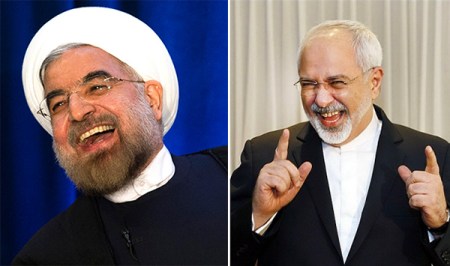
1323 (1)Iran’s firing of a missile within 1500 yards of a U.S. aircraft carrier in December, and its kidnapping and photographing of a U.S. Navy crew were test cases. Other than an apparent temper tantrum by Secretary of State John Kerry, there was no American response, except that Kerry absolved his friend Iranian Foreign Minister Javad Zarif of responsibility. Pictured above: Iranian President Hassan Rouhani (left) and Foreign Minister Javad Zarif (right).

Responding to Senator Lindsay Graham’s suggestion that Congress might increase sanctions against Iran, Mr. Kerry replied, “I wouldn’t welcome [that] at this time given the fact that we’ve given them a warning and if they decide to do another launch then I think there’s a rationale.”

Kerry may not have to wait long.

Just this week, Iranian Deputy Chief of Staff Brig-Gen Maassoud Jazzayeri was quoted by the FARS News Agency reiterating, “The White House should know that defense capacities and missile power, specially at the present juncture where plots and threats are galore, is among the Iranian nation’s red lines and a backup for the country’s national security and we don’t allow anyone to violate it.”

Now, he is believable.

Congress is beginning to breathe fire, but it is not yet clear what it can or will do in the face of the Obama Administration’s executive actions. Last week, angry congressmen were reduced to threatening to “name and shame” American companies that do business with Iran because they cannot figure out how to stem the tide of the Obama Administration’s indulgence of Iranian provocations. That reaction is not even close to good enough.

Primary distractions from Iran

April 5, 2016

Primary distractions from Iran, Israel Hayom, Ruthie Blum, April 5, 2016

Ahead of Tuesday’s Wisconsin presidential primaries, U.S. Speaker of the House Paul Ryan was in Israel, the destination he chose for his first foreign trip since assuming his post at the end of October.

In meetings with Israeli leaders — and in an interview with Times of Israel editor David Horovitz — Ryan reaffirmed his commitment to the Jewish state and his opposition to the nuclear deal with Iran. He also stated, in no uncertain terms, that — contrary to increasing rumor and pressure — he is not going to end up becoming the Republican nominee at what threatens to be a contested GOP convention. Nobody really believes he means it, however, because he had been equally adamant about not wanting the position he is currently occupying.

But, while distraught Americans from both parties are obsessing over whether Donald Trump can win the nomination — and if he does, whether he can beat likely Democratic rival Hillary Clinton — the Obama administration is being given a free pass to get away with murder, figuratively. More literally, it is enjoying the benefit of the doubt caused by the distraction of the public away from the havoc the White House and State Department are continuing to wreak, which is enabling the actual death of a lot of people in the present, and a whole lot more in the future.

The terrorism of the Islamic State group is only a tiny part of this, though it seems to be the only jihadist organization that gets a rise out of Westerners, whom it makes no bones about targeting for mass murder. Indeed, as the suicide bombings in Brussels on March 22 indicated, Europeans and Americans only wake up when a lot of people with whom they can identify get slaughtered senselessly. That this kind of thing is going on routinely everywhere else in the world barely elicits a yawn.

But as evil as ISIS is, it is still small fry compared to the Islamic Republic of Iran, the world’s greatest state sponsor of terrorism, with tentacles reaching far and wide. And now, thanks to the Obama administration, it also has multibillions of dollars at its disposal with which to build its nuclear arsenal. Nor does it hide its ambitions to wipe Israel off the map and its loathing for America, the “great Satan.”

Iran’s supreme leader, Ayatollah Ali Khamenei, has made this clear to the point of warning his own underlings to follow suit.

“Those who say the future is in negotiations, not in missiles, are either ignorant or traitors,” he said last week.

How has the Obama administration responded to this and previous Iranian muscle-flexing, abduction of American sailors, celebration of U.S. abdication and assertion that nothing Tehran does violates the nuclear agreement?

It has conceded to Iran on every point. Or worse.

As was revealed in a piece by Adam Kredo in The Washington Free Beacon on Monday, “Congress is investigating whether the Obama administration misled lawmakers last summer about the extent of concessions granted to Iran under the nuclear deal, as well as if administration officials have been quietly rewriting the deal’s terms in the aftermath of the agreement.”

Rep. Mike Pompeo (R-Kansas) told Kredo that “the gap between [the administration’s] promises … and today’s scary reality continues to widen. We are now trying to determine whether this was intentional deception on the part of the administration or new levels of disturbing acquiescence to the Iranians.”

He was referring to issues such as Iran’s ballistic missile testing, which the administration initially said constituted a violation of nuclear-deal codifier U.N. Resolution 2231, and then backtracked. Perhaps even more disturbing were statements from the Treasury Department indicating that international business transactions with Iran could be done in dollars — releasing the ban in place on Iran’s access to the U.S. financial system.

In other words, not only was the deal America made with the devil a dangerous one to begin with, but apparently, we don’t know the half of it.

This sentiment was expressed in an op-ed in The Wall Street Journal on Sunday by United Arab Emirates Ambassador to the U.S. Yousef Al Otaiba, who wrote that, in spite of President Barack Obama’s claim about the world being safer place as a result of the nuclear deal, “The Iran we have long known — hostile, expansionist, violent — is alive and well, and as dangerous as ever.”

It is this sorry situation, and the Democrats who brought us here, that Americans must keep in mind come November, no matter who the Republican candidate is.

U.S. Seizes More Iranian Weapons at Sea

April 4, 2016

U.S. Seizes More Iranian Weapons at Sea, Investigative Project on Terrorism, April 4, 2016

A U.S. naval vessel intercepted a large Iranian weapons shipment, seizing massive quantities of arms and sophisticated weaponry destined for Yemen, the Pentagon announced Monday.

The seizure occurred in the Arabian Sea on March 28, officials said, marking the third interception of an Iranian weapons shipment in recent weeks. The ship was carrying 1,500 AK-47 rifles, 200 rocket-propelled grenade launchers, and 21 .50-caliber machine guns. They were en route to Houthi insurgents battling in Yemen’s civil war at Iran’s behest.

The U.S. Navy let the crew go after seizing the weapons, in line with current rules of engagement, according to a U.S. official speaking with Fox News.

This incident marks another major development in a string of recent Iranian provocations, indicating growing belligerence among the Islamic Republic’s decision makers.

Last month, Iran tested missiles in violation of a United Nations Security Council resolution associated with the nuclear deal, which prohibits Iran from developing its ballistic missile program for eight years.

Iran also continues to expand its presence throughout the Middle East in line with its regional hegemonic ambitions.

On Monday, Iranian General Ali Arasteh said that the Islamic Republic deployed special forces to Syria as “advisers.” Last month, Arasteh revealed that Iran may deploy commandos and snipers from its regular armed forces as military advisers in Iraq and Syria.

Iran expert Ali Alfoneh told the Jerusalem Post that “the regular army has begged for some time to get involved in Syria because it would be a source of prestige and funding.”

The deployment indicates a shift in the army’s constitutional mission focused on ensuring Iran’s territorial integrity, writes Iran expert Amir Toumaj of The Long War Journal.

These developments support critics of the nuclear deal who argue that financial sanctions relief emboldens Iran to increase its sponsorship of terrorism throughout the region and worldwide.

The Fourth Strategy

March 11, 2016

The Fourth Strategy,  Front Page Magazine, Caroline Glick, March 11, 2016

mideast-lebanon-bulga_horo

Originally published by the Jerusalem Post

This week we learned that Lebanon is no more. It has been replaced by Hezbollah’s Iranian colony in Lebanon.

Two weeks ago, Saudi Arabia listed Hezbollah as a terrorist organization and canceled its $3 billion aid package to the Lebanese military. The Gulf Cooperation Council followed suit. Rather than support the move by his sponsors and allies, Saad Hariri, the head of the anti-Hezbollah March 14 movement, flew to Syria to meet with Hezbollah leaders.

Saudi Arabia’s decision to end its support for the Lebanese Armed Forces (LAF) doesn’t mean that Saudi Arabia is making peace with Hezbollah.

It means that the Saudis are no longer willing to maintain the fiction that with enough support, the LAF will one day challenge Hezbollah’s effective control of Lebanon.

Hezbollah and its bosses in Tehran don’t seem too upset about the Sunnis’ decision to acknowledge that Hezbollah is a terrorist group. And they are right not to care. In essence, the Saudi move is simply an admission that they have won. Lebanon is theirs.

Hezbollah’s isn’t the dominant force in Lebanon because it has better weapons than the LAF.

Unlike the LAF, Hezbollah has no air force. It has no armored divisions.

Hezbollah is able to dominate Lebanon because unlike the LAF and the March 14 movement, Hezbollah is willing to destroy Lebanon if doing so advances its strategic goals.

This has all been fairly clear for more than a decade. But it took the war in Syria to force the truth above the surface.

And now that it is clear to everyone that Lebanon has ceased to exist and that the country we once knew is now an Iranian colony, the time has come for Israel to reckon with the lessons of its own misadventures in our neighbor to the north.

Since the mid-1990s, Israel has implemented three strategies in Lebanon and in Syria. All of them originated on the Left. All of them failed.

The first strategy was appeasement.

From the mid-1990s until the Syrian war began five years ago, Israel’s strategic framework for understanding Syria was appeasement. Initially, the notion was that Syria was our enemy because we control the Golan Heights. If we surrendered the Golan to Syria, we would have peace in exchange.

In the years leading up to the Syrian war, our leaders embraced the idea that Syria was the weakest link in the Iranian axis. If we gave the Golan Heights to Syria, they said, then the Assad regime would withdraw from the Iranian axis.

As it turned out, these positions had no basis in reality. Appeasement failed.

Then there was unconditional surrender – or disengagement. Then-prime minister Ehud Barak implemented this strategy when he removed IDF units from the security zone in south Lebanon in May 2000.

From the mid-1990s on, Yossi Beilin was the chief advocate of unconditional surrender in Lebanon. The logic of surrender was similar to that of appeasement – of which he was also a principal architect and advocate.

The surrender strategy in Lebanon was based on the idea that Hezbollah fought the IDF in south Lebanon because the IDF was in south Lebanon. If the IDF were to leave south Lebanon, Hezbollah was have no reason to fight us anymore.

So if we were gone, Beilin argued, Hezbollah would stop fighting, ditch terrorism and Iran, and become a normal Lebanese political party.

The war with Hezbollah in 2006 destroyed the credibility of the surrender strategy. But the Left didn’t despair. They simply replaced surrender with the strategy of internationalization.

The internationalization strategy forms the basis of UN Security Council Resolution 1701 that set the cease-fire terms at the end of the war with Hezbollah. IDF soldiers, who left Lebanon without victory, were replaced by UN forces from UNIFIL. UNIFIL forces were supposed to block Hezbollah’s reassertion of control over south Lebanon by facilitating the LAF’s takeover of the border with Israel. While UNIFIL was protecting the LAF on the ground, the LAF itself would be empowered by a massive infusion of US and Saudi aid.

Saudi Arabia’s belated recognition that Hezbollah dominates the LAF, and controls Lebanon, makes clear that like appeasement and disengagement, internationalization is an utter failure.

To a certain degree, Israel’s serial strategic blundering did have one ameliorative effect. Through them, Hezbollah has become so powerful that it now poses a threat to the great powers. So Russia in Syria now needs to curb it. So, too, it is so powerful that Iran is loath to waste it on a war with Israel that it will lose when it is fighting to win the war in Syria.

For now then, Hezbollah is not an immediate threat. This is the case despite Hezbollah chief Hassan Nasrallah’s recent threat to bomb Haifa’s chemical depots and cause a fireball with the cataclysmic effect of a nuclear bomb.

But that doesn’t mean that the lessons of our repeated strategic mistakes in Syria and Lebanon shouldn’t be applied today. They should be applied, but toward another, more immediate foe – the Palestinians, toward whom Israel has applied the same failed policies, one after another, with similarly destructive outcomes.

After the first intifada ground to a halt in 1991, Israel adopted the Left’s first strategy. The so-called peace process with the PLO, which began in 1993, was an attempt to implement a strategy of appeasement. We would gradually give the PLO Judea, Samaria, Gaza and Jerusalem.

In return, the PLO would stop supporting terrorism and live at peace with Israel.

The failure of the appeasement strategy led to the second intifada. The second intifada caused Israel to adopt the Left’s second strategy – unconditional surrender.

Israel’s 2005 disengagement from Gaza failed just as spectacularly as its 2000 disengagement from Lebanon. Not only did it lead to the Hamas takeover of Gaza in 2007. It led to the further radicalization of the PLO and Palestinian society as a whole. The latter became convinced that terrorism worked. The former became convinced that the only way to garner public support was by being just as anti-Israel as Hamas.

Today, the center-left parties – the Zionist Union and Yesh Atid – cling to the failed strategy of disengagement. The far Left, together with the Arab political parties, have already moved on to the internationalization strategy. In the Palestinian context, the goal of the internationalization strategy is the collapse of Israeli sovereignty.

This strategy was in evidence this week with Peace Now head Yariv Oppenheimer’s outrageous claim Wednesday that in killing the terrorists who were in the midst of murdering innocents in Petah Tikva and Tel Aviv, civilians and security forces carried out summary executions.

Oppenheimer, whose group is funded by foreign governments, did not make the claim because he wished to build his support base at home. He demonized his fellow citizens to advance his paymasters’ goal of delegitimizing Israeli sovereignty by among other things, criminalizing Israel’s right to self-defense.

The goal of this delegitimization campaign is to make it impossible for Israel to function as a coherent nation-state and for it instead to become a powerless ward of Europe and the US.

In the face of both the rise in Palestinian terrorism and of efforts by Oppenheimer and his comrades to use Palestinian terrorism as a means to cause the collapse of Israeli sovereignty, the government is at a loss. Its paralysis doesn’t owe to a lack of will. Rather it is the consequence of the government’s difficulty in contending with the coalition of powerful domestic and foreign actors that together make it all but impossible for Prime Minister Binyamin Netanyahu and his ministers to abandon the Left’s failed strategies and embark on a new strategic course.

Perhaps the most poignant and infuriating expression of the government’s distress is its constant demand that PLO chief Mahmoud Abbas condemn Palestinian terrorism.

On seemingly a daily basis our leaders voice the demand that the man who heads a regime that indoctrinates its youth – including its young children – to murder Jews condemn his own actions.

Beyond being irrational, the demand is both defeatist and self-defeating. By demanding action from Abbas, we legitimize him and empower him. But so long as Israel refuses to abandon the appeasement strategy, and continues to accept that there is a peace process that can be resuscitated, the government will be unable to stop treating Abbas as legitimate and moderate.

So, too, so long as the Knesset fails to take serious, concerted action against the nonprofit groups funded by hostile foreign governments and foundations, the government will be unable to take effective action against the radical Left and its partners from the Joint (Arab) List that openly support both Palestinian terrorists and Hezbollah.

Just as Oppenheimer’s remarks weren’t directed toward the domestic audience, but to his European sponsors, so the Arab Knesset members who this week announced their opposition to Saudi Arabia’s decision to label Hezbollah a terrorist group, were directing their remarks toward their supporters – and Hezbollah’s sponsors – in Qatar.

While adopting in turn every failed strategy the Left could invent and recycle, for the past generation, Israel has avoided implementing the only strategy that has ever worked. That is the strategy of sovereignty – or, more broadly, of governing territories necessary for our defense.

From 1982 through 2000, Israel restrained Hezbollah and prevented it from taking over Lebanon by maintaining security control over the security zone in Lebanon. For 28 years, Israel prevented the Palestinians from becoming a terrorist society dedicated to the destruction of the people of Israel, by exerting security and civil authority over Judea, Samaria and Gaza through its military government and its civil administration.

And it worked. By fighting our enemies rather than empowering them, we weakened them.

The image of the first intifada that convinced us to legitimize the PLO was the teenager with a slingshot.

The image of the second intifada that convinced us to run away from Gaza was a bombedout bus.

So far, the image of the third intifada is a girl wielding scissors attempting to stab Jews. And we still haven’t figured out our response to her, although the Left would like us to run away or collapse.

It is time to let this image guide us though.

The girl with the scissors is not empowered. She is both dangerous and pathetic. She is both an enemy and a victim. You cannot destroy her. You can only punish her and then raise her up. In other words, you need to govern her.

Governing enemies is unpleasant. It brings no instant gratification. Instead it promises only thankless, Sisyphean efforts. In other words, governing your enemies is the price you pay to be free.

Turkey and Saudi Arabia hit back for the Obama-Putin Syrian pact

March 5, 2016

Turkey and Saudi Arabia hit back for the Obama-Putin Syrian pact, DEBKAfile, March 5, 2016

Zaman_4.3.16Headline of last issue of Turkey’s Zaman before government takeover

Turkey and Saudi Arabia have taken separate steps to break free from Washington’s dictates on the Syrian issue and show their resistance to Russia’s highhanded intervention in Syria. They are moving on separate tracks to signal their defiance and frustration with the exclusive pact between Presidents Barack Obama and Vladimir Putin which ostracizes Riyadh and Ankara on the Syrian question.

Turkey in particular, saddled with three million Syrian refugees (Jordan hosts another 1.4 million), resents Washington’s deaf ear to its demand for no-fly zones in northern and southern Syria as shelters against Russian and Syrian air raids.

Last year, President Reccep Erdogan tried in desperation to partially open the door for a mass exit of Syrian refugees to Europe. He was aghast when he found that most of the million asylum-seekers reaching Europe were not Syrians, but Muslims from Africa, Afghanistan and Pakistan, in search of a better life in the West. Most of the Syrians stayed put in the camps housing them in southern Turkey.

Even the Turkish intelligence agency MIT was hard put to explain this setback.  According to one partial explanation, organized crime gangs of Middle East dope and arms smugglers, in which ISIS is heavily represented, seized control of the refugee traffic heading to Europe from Libya, Iraq and Syria.
This human traffic netted the gangs an estimated $1 billion.

Turkey was left high and dry with millions of Syrian refugees on its hands and insufficient international aid to supply their needs. No less painful, Bashar Assad was still sitting pretty in Damascus.

Finding Assad firmly entrenched in Damascus is no less an affront for Saudi Arabia. Added to this, the Syrian rebel groups supported by Riyadh are melting away under continuing Russian-backed government assaults enabled by the Obama-Putin “ceasefire” deal’

The oil kingdom’s rulers find it particularly hard to stomach the sight of Iran and Hizballah going from strength to strength both in Syria and Lebanon.

The Turks threatened to strike back, but confined themselves to artillery shelling of Syrian areas close to the border. While appearing to be targeting the Kurdish YPD-YPG militia moving into these areas, the Turkish guns were in fact pounding open spaces with no Kurdish presence. Their purpose was to draw a line around the territory which they have marked out for a northern no-fly or security zone.

Saturday, March 5, President Erdogan proposed building a “new city” of 4,500 square kilometers on northern Syrian soil, to shelter the millions of war refugees. He again tried putting the idea to President Obama.

The Saudi Defense Minister, Deputy Crown Prince Mohammed bin Salman put together a more high-risk and comprehensive scheme. Its dual purpose is to hit pro-Iranian Hizballah from the rear and forcied [Sic] the two big powers to treat Riyadh seriously as a player for resolving the Syrian imbroglio.

The scheme hinged in the cancellation of a $4 billion Saudi pledge of military aid to the Lebanese army, thereby denying Hizballah, which is a state within the state and also dominates the government, access to Saudi funding. But it also pulled the rug from under Lebanon’s hopes for combating ISIS and Al Qaeda’s Nusra Front, which have grabbed a strip of Lebanese territory in the northern Beqaa Valley.

The Saudi action, by weakening the Lebanese military and its ability to shore up central government in Beirut, risks tipping Lebanon over into another civil war.

The London Economist commented that this Saudi step against Lebanon seems “amateurish.” Under the young prince (30), “Saudi Arabia sometimes acts with bombast and violence that makes it look like the Donald Trump of the Arab World,” in the view of the magazine.

But the Saudi step had a third less obvious motive, a poke in the eye for President Obama for espousing Iran’s claim to Middle East hegemony. Resentment on this score is common to the Saudi royal house and the Erdogan government.

As a crude provocation for Washington, the Turkish president ordered police Friday, March 4, to raid Turkey’s largest newspaper Zaman, after an Istanbul court ruling placed it under government control.

The newspaper released its final edition ahead of the raid declaring the takeover a “shameful day for free press” in the country. A group of protesters outside the building was dispersed with tear gas, rubber bullets and water cannons.

Zaman is owned by the exiled Muslim cleric Felhullah Gulen, who heads the powerful Hizmet movement, which strongly contests Erdogan government policies. A former ally of the president, the two fell out years ago. In 1999, after he was accused of conspiring to overthrow the government in Ankara, Gulen fled to the United States.

Today, the exiled cleric runs the Hizmet campaign against the Turkish president from his home in Pennsylvania, for which he has been declared a terrorist and many of his supporters arrested.

The takeover of Zaman was intended both as a blow by Ankara against Muslim circles opposed to the Erdogan regime and as an act of retaliation against the United States, for harboring its opponents and sidelining Turkey from Obama administration plans for Syria.

Oddly enough, the Turkish president finds himself in a position analogous to Egyptian President Abdel-Fatteh El-Sisi, who is at war with the Muslim Brotherhood, a movement which enjoys Obama’s support.

Israeli Prime Minister Binyamin Netanyahu has his own dilemmas. Struggling to keep his balance while walking a tight rope on the Syrian situation between Israel’s longstanding ties with Washington and handling the Russian tiger lurking next door, he is in no hurry to welcome Erdogan’s determined overtures for the resumption of normal relations.

Turkey is in trouble with both major world powers and, after living for five years under hostile abuse from Ankara, Israel does not owe Erdogan a helping had for pulling  him out of the mess.