According to the Internet Webster synonyms for renegade are “defector” and “deserter.” I applied the term to Kristol because of his efforts to launch a third party campaign to block the nominee of his party, split the conservative vote, and ensure the election of a Democrat whose party had provided a path to nuclear weapons to the Jews’ mortal enemy (and America’s as well).
***************************
I have been accused of being a provocateur all my life – when I was a leftist in the 60s proclaiming (God help me) that Vietnam was the fulfillment of the American dream; when I left the left declaring that, “the beginning of political morality is anti-Communism;” when I said that identity politics “owed more to Mussolini than to Marx;” when I opposed reparations for slavery 137 years after the fact because it was “bad for blacks and racist too;” and when I organized “Islamo-fascism Awareness Weeks on a hundred college campuses across the country. Now I have provoked a firestorm on the Internet through a Breitbart article that called Bill Kristol a “renegade Jew.”
According to the Internet Webster synonyms for renegade are “defector” and “deserter.” I applied the term to Kristol because of his efforts to launch a third party campaign to block the nominee of his party, split the conservative vote, and ensure the election of a Democrat whose party had provided a path to nuclear weapons to the Jews’ mortal enemy (and America’s as well). I picked the emotional term “renegade” because I wanted to shock Kristol and his co-conspirators into realizing the gravity of their actions.
However, I had no idea that this would provoke the reaction it did. A veritable tsunami of attacks were directed at Breitbart and myself from Kristol’s supporters on the “neo-conservative” right and from die-hard enemies of the Republican nominee in all political quarters. Even the Anti-Defamation League, which had once attacked me over my anti-reparations campaign) chimed in, calling the title of my piece “inappropriate and offensive.” This was actually pretty mild considering others were denouncing it as “disgraceful” and “an anti-Semitic slur.”
How by the way is the characterization “anti-Semitic slur” even possible? Are Jews immune to defecting from causes? When I publicly repudiated the radical cause, thirty years ago, the first attack on me appeared in the Village Voice under the title, “The Intellectual Life and the Renegade Horowitz.” It was written by Paul Berman, who years later became a somewhat chastened radical himself. Berman’s attack stung me – as I hoped my charge would sting Kristol and cause him to reconsider his course. But the epithet didn’t bother anybody but me. My current critics would stigmatize me not only as a defector from the conservative cause but as a double agent who never really left the left. After my Breitbart article appeared, Commentary editor (and Kristol relative) John Podhoretz sent me a one-line email: “Once a Stalinist always a Stalinist,” while Commentary writer Jonathan Tobin in a piece titled “Breitbart ‘Renegade Jew’ Disgrace,” suggest: “You can take the boy out of the Bolsheviks but you can’t take the Bolshevik out of the boy.”
Like many of the attacks on Trump, these squalid responses with their flimsy intellectual content call to mind a famous remark of Lionel Trilling’s, made more than 60 years ago. Conservatives, he wrote, did not “express themselves in ideas but only in action or in irritable mental gestures that seek to resemble ideas.” It is not that Kristol or his defender Tobin haven’t had worthy and defensible ideas. They have. But this makes it even sadder to see the flimsy arguments they trot out to discredit Trump and to defend Kristol’s indefensible campaign. Criticisms of Trump’s personal attacks on his Republican rivals are reasonable. But not when they fail to take into account the 60,000 political ads that were aired by those same rivals whose purpose was to destroy him. (The ads were not, should anybody have missed them, about policies and issues.)
I have no quarrel with people who have doubts about what Trump would do if elected. It is the task of the candidate to allay those doubts. For reasonable critics Trump’s announcement of his prospective Supreme Court nominees should be important steps along the way. My quarrel is not with Trump skeptics, but with the effort to nullify the vote of the Republican electorate – a politically active and informed, and conservative segment of that electorate. Kristol’s third party effort exudes an elitist contempt for the will of the people, which is particularly unbecoming in a crowd that prides itself on being “constitutional conservatives.”
Finally, I am disturbed by the failure of the nullifiers to consider the perils of the choices our country now faces. For the life of me I cannot understand how my friends in the conservative movement cannot have qualms about derailing the candidacy of the Republican Party’s pro-Israel, pro-military, pro-American nominee, and electing the candidate of a party that has built its foreign policy around making Islamist Iran the number one power in the Middle East, providing its jihadists with a path to nuclear weapons, putting $150 billion into their terrorist war chest and turning a blind eye to their circumvention of international restrictions so that they can build ballistic missiles capable of destroying the Jewish state and causing incalculable damage to the United States.
♦ It appears that several major Palestinian terror groups have begun to prepare for mega-terror attacks on Israel.
♦ The authoritative rules of war do not equate “proportionality” with how many people die in each side of a conflict. In war, no side is ever required to respond to aggression with only the equivalent measure of force. Rather, the obligations of proportionality require that no side employ any level of force that is greater than what is needed to achieve a legitimate political and operational objective.
♦ Under pertinent international law, the use of one’s own people as “human shields” — because such firing from populated areas is intended to deter Israeli reprisals, or to elicit injuries to Palestinian civilians — represents a codified war crime. More specifically, this crime is known as “perfidy.” This is plainly an attempt to make the IDF appear murderous when it is compelled to retaliate, but it is simply a Palestinian manipulation of legal responsibility. Under law, those Arab residents who suffer from Israeli retaliations are incurring the consequences of their own government’s war crimes.
♦ International law is not a suicide pact. Instead, it offers a universally binding body of rules and procedures that allows all states to act on behalf of their “inherent right of self-defense.”
Already, calls from various directions have begun to condemn Israel for its recent retaliatory strikes in self-defense at Gaza.[1] The carefully-rehearsed refrain is all-too familiar. Gazan terrorists fire rockets and mortars at Israel; then, the world calls upon the Israel Air Force (IAF) not to respond.
Although Israel is plainly the victim in these ritualistic cycles of Arab terror and required Israeli retaliations, the “civilized world” usually comes to the defense of the victimizers. Inexplicably, in the European Union, and even sometimes with the current U.S. president, the Israeli response is reflexively, without thought, described as “excessive” or “disproportionate.”
Leaving aside the irony of President Obama’s evident sympathies here — nothing that Israel has done in its own defense even comes close to the indiscriminacy of recent U.S. operations in Afghanistan[2] — the condemnations are always unfounded. Plainly, Hamas and allied Arab terror groups deliberately fire their rockets from populated areas in Gaza at Israeli civilians. Under pertinent international law, this use of one’s own people as “human shields” — because such firing from populated areas is intended to deter Israeli reprisals, or to elicit injuries to Palestinian civilians — represents a codified war crime. More specifically, this crime is known as “perfidy.”
“Perfidy” is plainly an attempt to make the IDF appear murderous when it is compelled to retaliate, but it is always simply a Palestinian manipulation of true legal responsibility. Hamas’s intent might be to incriminate the Israelis as murderers of Gaza’s civilians. Legally, however, the net effect of Arab perfidy in Gaza is to free Israel of all responsibility for Arab harm, even if it is Israeli retaliatory fire that actually injures or kills the Gazan victims. Under law, those Arab residents who suffer from Israeli retaliations are incurring the consequences of their own government’s war crimes. Palestinian suffering, which we are surely about to see again in stepped-up, choreographed Arab propaganda videos, remains the direct result of a relentlessly cruel, insensitive, and criminal Hamas leadership.
Significant, too, although never really mentioned, is that this Hamas leadership, similar to the PA and Fatah leadership, often sits safely away from Gaza, tucked away inconspicuously in Qatar. For these markedly unheroic figures, “martyrdom” is allegedly always welcomed and revered, but only as long as this singular honor is actually conferred upon someone else.
Moreover, the authoritative rules of war do not equate “proportionality” with how many people die in each side of a conflict. In war, no side is ever required to respond to aggression with only the equivalent measure of force. Rather, the obligations of proportionality require that no side employ any level of force that is greater than what is needed to achieve a legitimate political and operational objective.
If the rule of proportionality were genuinely about an equivalent number of dead, America’s use of atomic weapons against Japanese civilians in August 1945 would represent the greatest single expression of “disproportionality” in human history.
It appears that several major Palestinian terror groups have begun to prepare for mega-terror attacks on Israel. Such attacks, possibly in cooperation with certain allied jihadist factions, could include chemical and biological weapons of mass destruction. Over time, especially if Iran, undeterred by the July 2015 Vienna Pact, should agree to transfer portions of its residual nuclear materials to terror groups, Israel could then have to face Palestinian-directed nuclear terrorism.
One message is clear. If Israel, pressured by outside forces, allows Palestinian terror from Gaza to continue unopposed, the state could become increasingly vulnerable to even greater forms of Arab aggression.
Also important to keep in mind is that nuclear terror assaults against Israel could be launched from trucks or ships, not only from rockets and missiles.
What about Israel’s active defenses? In its most recent defensive operations, Protective Edge and Pillar of Defense, Israel accomplished an impressively high rate of “Iron Dome” interceptions against incoming rockets from Gaza. Still, it would be a mistake to extrapolate from any such relatively limited successes to the vastly more complex hazards of strategic danger from Iran. Should Iran “go nuclear” in ten years or sooner, that still recalcitrant Islamic regime could launch at Israel missiles armed with nuclear warheads.
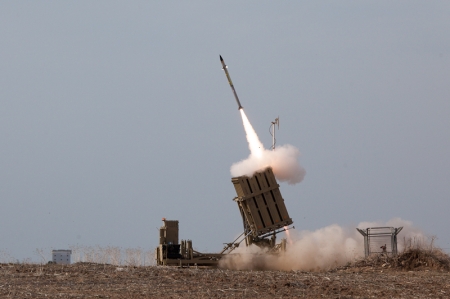
In its most recent defensive operations, Israel accomplished an impressively high rate of “Iron Dome” interceptions against incoming rockets from Gaza. Still, it would be a mistake to extrapolate from any such relatively limited successes to the vastly more complex hazards of strategic danger from Iran. (Image source: IDF)
Sun Tzu, the ancient Chinese military thinker, already understood — long before the nuclear age — that too great a reliance on defense is always misconceived. Today, Arrow, Israel’s core ballistic missile defense (BMD) interception system, would require a 100% rate success against offensive nuclear missiles. At the same time, such a rate is impossible to achieve, even if enhanced by Rafael’s new laser-based defenses. Israel must therefore continue to rely primarily on deterrence for existential nuclear threats.
Although unacknowledged, Israel has always been willing to keep its essential counterterrorism operations in Gaza consistent with the established rules of humanitarian international law. Palestinian violence, however, has remained in persistent violation of all accepted rules of engagement — even after Israel painfully “disengaged” from Gaza in 2005.
Both Hamas and the Palestinian Authority still speak indignantly of “the Occupation?” But where, precisely, is this “occupation?” After all their agitated umbrage about Israeli “disproportionality,” shouldn’t the Palestinians and their allies finally be able to answer that core question? There are no Israelis in Gaza.
International law is not a suicide pact. Instead, it offers a universally binding body of rules and procedures that allows all states to act on behalf of their “inherent right of self-defense.”[3] When terrorists groups such as Hamas openly celebrate the “martyrdom” of Palestinian children, and when Hamas leaders unhesitatingly seek their own religious redemption through the mass-murder of Jewish children, unfortunately these terrorists retain no legal right to demand sanctuary.
In response to endless terror attacks from Gaza, Israel, with countless leaflets, phone calls, “knocks on the roof,” and other warnings to its attackers, has been acting with an operational restraint unequaled by any other nation and according to binding rules of war. In these obligatory acts of self-defense there has not yet been the slightest evidence of disproportionality.
____________________________________
[1] Speaking in Beirut on Channel 10 News, on May 7, 2016, Hezbollah leader Hassan Nasrallah accused Israel of “attacking Gaza,” continuing: “Unfortunately, the Arab world is silent about the situation in Gaza. … these actions must be condemned.” Cited in Israel National News, “Nasrallah calls for condemnation of Israeli ‘Attacks’ on Gaza,” May 7, 2016. Interesting, too, is that Nasrallah, a Shiite leader, is speaking here in strong support of Sunni Hamas.
[2] See Alissa J. Rubin, “Airstrike Hits Doctors Without Borders Hospital in Afghanistan,” The New York Times, October 3, 2015. This is an account of the October 2015, U.S. destruction of a crowded hospital in the embattled city of Kunduz. The Pentagon confirmed the strike, which it called “collateral damage,” and President Obama offered condolences to the victims in what he termed a “tragic incident.” Doctors Without Borders was awarded the Nobel Peace Prize in 1999.
[3] See, especially, Article 51 of the United Nations Charter.
On Sunday, the Islamic Republic announced the arrest of eight women whose photographs were featured on Instagram. The models reportedly failed to adhere to stifling Islamic style dress codes rigorously enforced by Iran’s oppressive mullahs. More specifically, they posed without wearing religiously sanctioned head scarves designed to cover exposed hair.
Following her arrest, one of the models was forced to appear on Iranian TV in the presence of two prosecutors. Wearing a black head scarf and matching black gloves, she was recorded – almost certainly under duress – sanctioning the government’s Orwellian-like actions, warning other Iranian women that they “can be certain that no man would want to marry a model whose fame has come by losing her honor.” As an aside, when Iranian navy pirates operating off Farsi Island kidnapped 10 U.S. Navy sailors in the Arabian Gulf in January, they forced a female sailor into Sharia compliance, requiring her to don a hijab.
The arrests come in the midst of a yet another government crackdown on social media and dissent. The anti-social media operation, ominously codenamed “Spider II” has thus far netted dozens of models, photographers, makeup artists and other dangerous enemies of the state. Also arrested was Iranian blogger Mahdi Boutorabi who reportedly covered Iran’s rigged 2009 elections. It appears that periodically, the mullahs get bored or insecure and conjure up ways to make the lives of their citizens more miserable.
But the Islamic Republic’s absurdity doesn’t end there. Iran’s Revolutionary Guard bizarrely accused reality star (and not much else) Kim Kardashian-West of being behind the nefarious plot to undermine or otherwise taint the morals of Iran’s young women.
Mostafa Alizadeh, a spokesman for the Revolutionary Guard’s Organized Cyberspace Crimes Unit stated that, “Ms. Kim Kardashian is a popular fashion model so Instagram’s CEO tells her, ‘make this native.’” He added that “There is no doubt that financial support is involved as well. We are taking this very seriously.”
In February, Iranian authorities engaged in a similar crackdown, targeting a benign rock group known as “Confess.” Authorities charged the group’s members with “blasphemy,” writing “satanic” lyrics and meeting with forbidden foreign radio stations. The charge of “blasphemy” carries a punishment of execution. Others in the Islamic Republic have been arrested and sentenced to lashings for merely appearing in a YouTube video while dancing and lip syncing to Pharrell’s hit song “Happy.”
Conspiracy theories and political and religious oppression are the norm in the Islamic Republic. Let us dispel with the notion that there are “moderate” forces within the Iranian government working to change things for the better. Power in that tyrannical regime vests with two entities – Iran’s “Supreme Leader,” the Holocaust-denying Ayatollah Khamenei and his thuggish henchmen of the Iranian Revolutionary Guard Corps and the Basij militia.
The Obama administration and its “echo chamber” (as Obama shill Ben Rhodes puts it) would like us to think that there are moderate elements and reformers with whom we can deal. That notion is an absolute farce but continues to gain credence in some leftist circles with vested interests in propagating this false narrative. For example, while the New York Times reported the arrest of the Iranian models, it made sure to qualify its reportage by informing its readers that the crackdown was the work of “hard liners.”
In the meantime, while Ben Rhodes is creating his spin and John Kerry is thanking the Iranians for kidnapping and mistreating U.S. Navy sailors, the mullahs of the Islamic republic continue to crack down on dissent and execute human rights activists, continue to advance their ballistic missile program (in defiance of UNSC resolutions) and continue to cut a path of misery and destruction in the Mideast, from Syria to Yemen.
The administration has done its best to convince the American public that Iran can be trusted to keep agreements. This rests on the false and dangerous narrative that there exists a power struggle in Iran between moderate reformers who have the support of the people and an assortment of hard line religious extremists and anti-Western zealots. Narratives running counter to this fantasy-like version of events are dismissed by the administration.
Even worse, it has now come to light that the Obama administration has asked the Iranians not to publicize their illicit ballistic missile activities for fear of unsettling opponents of the Joint Comprehensive Plan of Action (JCPOA). Meanwhile John Kerry is quietly attempting to encourage various European banking institutions to do business with the Iranians despite the fact that the IRGC controls vast swaths of Iran’s economy.
No matter how much spin the Obama administration attempts to place on the merits of the JCPOA and no matter how much it attempts to cover its tracks, it cannot hide the fact that the Islamic Republic is a pernicious regime that cannot be trusted and represents a malignancy that sooner or later will have to be confronted. The only question that remains is whether Iran will have nuclear bombs when that time arrives.
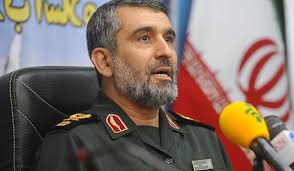
Amir Ali Hajizadeh, commander of the Aerospace and Missile Force of Iran’s Islamic Revolutionary Guard Corps (IRGC), said at a conference of religious students in Qom on May 14, 2016:
Hajidazeh. Source: Farsnews.com.
“The arrogance [i.e. the U.S.] is trying to create [among us] the belief that Iran is at a crossroads, and that it has no choice but to compromise with America or be eternally subjected to American pressure and the problems that stem from that… At the same time, within Iran the belief has taken root that it is not possible to solve [Iran’s] problems without America…
“If we stand fast against this move by the Americans, who have stolen the funds of the [Iranian] nation, they will abandon this habit [of thievery]. But if we compromise with them, the[ir] thievery will end up [taking] $40-$50 billion of Iran’s assets and its blocked funds. The Americans understand only the language of force; they do not understand the language of reason. They cannot be trusted. We must face them down firmly, and we must act. If we do not, we will witness daily their exaggerated and evil demands.
“At this time, the Americans are telling [us]: ‘Don’t talk about missile affairs, and if you conduct a test or maneuver, don’t mention it.’ If we agree to this, they will advance another step, and say: ‘Don’t conduct [a missile test] at this time, and also don’t do it in the Persian Gulf region.’ After that, they will tell us: ‘Why do you need your missiles to have a range of 2,000km [anyway?]?’
“After that, they will tell [us]: ‘Next, we will check whether your missiles can really carry nuclear weapons. Bring us the details [of the missiles].’ After that, they will say: ‘We need to set up cameras.’ And, finally, they will say: ‘Either saw [the missiles up into pieces] or, like [Libyan dictator Mu’ammar] Gadhafi, load them onto a ship and hand [them] over to us.’
“They are clearly deluding themselves. Nothing like this will ever happen.”[1]
(The views expressed in this article are mine and do not necessarily reflect those of Warsclerotic or any of its other editors. — DM)
A recent article by David Samuels at the New York Times Magazine, based on an interview with Obama’s foreign policy guru Ben Rhodes, purported to explain how, and about what, the Obama administration lied to get public support for the Iran Scam. According to the article, the principal Obama lie involved who was the Iranian president when the negotiations with Iran began. It’s much deeper and worse than that. As Paul Harvey would say, “Here’s “the rest of the story.”
Iranian President Rouhani was elected on June 15, 2013 and assumed office on August 3d. According to Rhodes,
negotiations started when the ostensibly moderate Hassan Rouhani was elected president, providing an opening for the administration to reach out in friendship. In reality, as Samuels gets administration officials to admit, negotiations began when “hardliner” Mahmoud Ahmadinejad was still president. [Emphasis added.]
There is no necessary inconsistency — about a month and a half elapsed between Rouhani’s election and becoming the Iranian president. However, that is of little if any consequences.
Mr. Rosen, interviewed in the above video, touches, very briefly, on other problems with the Iran scam. Back in the world of reality, “we” had been negotiating with Iran during Ahmadinejad’s presidency for a couple of years, during which “we” gave Iran everything it requested. This article is intended to provide substantially more information and analysis of what happened and why during “our” secret bilateral negotiations with Iran.
The Negotiations
According to interviews with Iranian vice president and Atomic Energy Organization head Ali Akbar Salehi, translated and published by the Middle East Media Research Institute (MEMRI) on August 17, 2015, secret bilateral negotiations between the Obama and Iranian regimes had begun much earlier and included Obama’s Assistant Secretary of State, William Burns. During those negotiations, the U.S. conceded that Iran’s right to Uranium enrichment would be respected, that Iran’s missile programs would be left out of any deal and that its efforts to develop nuclear warheads and other devices would be ignored. Obama had essentially caved in to Iran’s demands even before the existence of negotiations was acknowledged.
In an interview published in the daily Iran on August 4, 2015 under the title “The Black Box of the Secret Negotiations between Iran and America,” Iranian vice president and Atomic Energy Organization head Ali Akbar Salehi, who is a senior member of Iran’s negotiation team and was foreign minister under president Ahmadinejad, revealed new details on the secret bilateral talks between Iran and the U.S. that started during Ahmadinejad’s second presidential term. According to Salehi, U.S. Secretary of Energy Dr. Ernest Moniz, whom Salehi knew from his period as a doctoral student at MIT, was appointed to the American negotiation team at Salehi’s request, a request which the Americans met within hours. [Emphasis added.]
Salehi added that Khamenei agreed to open a direct channel of negotiations between Iran and the U.S. on the condition that the talks would yield results from the start and would not deal with any other issue, especially not with U.S.-Iran relations. Following this, Salehi demanded, via the Omani mediator Sultan Qaboos, that the U.S. recognize Iran’s right to enrich uranium, and received a letter from Qaboos expressing such American recognition, which he relayed to Ahmadinejad. [Emphasis added.]
The secret bilateral Iran-US negotiations had begun with a letter for Iran delivered to an Omani official. Salehi told an Omani intermediary.
‘I am not sure how serious the Americans are, but I will give you a note. Tell them that these are our demands. Deliver it on your next visit to Oman.’ I wrote down four clear issues, one of which was official recognition of rights to [uranium] enrichment. I figured that if the Americans were sincere in their offer, then they must agree to these four demands. Mr. Suri gave this short letter to the mediator, and stressed that these were Iran’s demands. [He added that]if the Americans wished to solve this issue, they were welcome to, otherwise dealing with White House proposals would be useless and unwarranted…
“All the demands in the letter were related to the nuclear challenge. These were issues we have always come against, such as closing the nuclear dossier [in the Security Council], official recognition of [Iran’s] right to enrich [uranium], and resolving the issue of Iran’s actions under the PMD [Possible Military Dimensions]. After receiving the letter, the Americans said: ‘We are certainly willing and able to easily solve the issues Iran has brought up.’ [Emphasis added.]
The first meeting between the Iranian and American negotiating teams began following eight months of coordination. Iran
sent a team to Oman that included the deputy foreign minister for European and American affairs, Mr. [Ali Asghar] Khaji, as well as several CEOs. The Americans were surprised in the first meeting and said, ‘We cannot believe this is happening. We thought Oman was joking. We aren’t even prepared for these talks with you.’
“Q: What was the level of the team that the Americans dispatched?
“A: It included Assistant Secretary of State William Burns. They said: ‘We only came to see if Iran was truly willing to negotiate.’ Our representative gave them the required response and eventually there were talks on this issue. The initial result was achieved and the ground was prepared for further coordination. [Emphasis added.]
“Q: How were the Americans convinced that the Iranian diplomats who were dispatched had the necessary authority?
“A: [Until] that phase, Iran and America had not been allowed to sit opposite each other at the negotiating table. The fact that Iran had sent a deputy foreign minister to the talks indicated its seriousness. The Americans also noticed how seriously [Iran was taking] the issue. At that meeting, Khaji pressed the Americans to set up a roadmap for the negotiations, and eventually the talks of a roadmap were postponed to the second meeting. At the second meeting, Khaji warned the Americans: ‘We did not come here for lengthy negotiations. If you are serious, you must officially recognize enrichment, otherwise we cannot enter into bilateral talks. But if you officially recognize enrichment, then we too are serious and willing to meet your concerns on the nuclear matter as part of international regulations.‘
International regulations were later agreed upon by the P5+1 negotiators, in the form of the Iran – IAEA secret deals concerning nuke inspections and a UN resolution dealing with Iranian missiles. Neither was included in the Joint Cooperative Plan of Action.
“Of course, at that time we were [still] exchanging various information with the Americans via the [Omani] mediation, and this is documented at the Foreign Ministry. We did not do it in the form of official letters, but rather unofficially and not on paper. The Omani mediator later came to Iran, held talks with us, and then later spoke to the Americans and told them our positions, so that the ties were not severed. But there was no possibility for direct talks.
“Thus, a real opportunity was squandered because, at the time, the Americans were genuinely prepared to make real concessions to Iran. Perhaps it was God’s will that the process progressed like that and the results were [eventually] in our favor. In any case, several months passed and Obama was reelected in America [in November 2012]. I thought that, unlike the first time, we must not waste time in coordinating [within regime bodies], so with the leader’s backing and according to my personal decision, I dispatched our representatives to negotiate with the Americans in Oman. [Emphasis added.]
“Q: Didn’t you have another meeting with the leader about the process and content of the talks?
“A: No. Obviously during the process I wrote a letter to the leader detailing the problems. He said ‘try to solve them.’ He was always supportive but told me to ‘act in a manner that includes necessary coordination [within the regime]. In this situation, I dispatched Khaji to the second meeting in Oman (around March 2013) and it was a positive meeting. Both sides stayed in Oman for two or three days and the result was that the Omani ruler sent a letter to Ahmadinejad saying that the American representative had announced official recognition of Iran’s enrichment rights. Sultan Qaboos sent the same letter to the American president. When Ahmadinejad received the letter, several friends said that this move would be fruitless and that the Americans do not keep [their] commitments. [But] we had advanced to this stage. [Emphasis added.]
. . . . We [then ] prepared ourselves for the third meeting with the Americans in order to set up the roadmap and detail the mutual commitments. All this happened while Iran was nearing the presidential elections [in June 2013]. At that time, the leader’s office told me that I had to cease negotiations and let the next government handle the talks after the results of the elections were known.
. . . .
“Q: What was the Americans’ position in the first meetings between Iran and the P5+1 held during the Rohani government [era]?
“A:After the Rohani government began to operate – along with the second term of President Obama – the new negotiations between Iran and the P5+1 were started. By then, Kerry was no longer an American senator but had been appointed secretary of state. As a senator, Kerry had been appointed by Obama to be in charge of handling the nuclear dossier, and then [in December 2012] he was appointed secretary of state. [Emphasis added.]
“Before that, the Omani mediator, who had close relations with Kerry, told us that Kerry would soon be appointed [U.S.] secretary of state. During the period when the secret negotiations with the Americans were underway in Oman, there was a situation in which it was easier to obtain concessions from the Americans. After the Rohani government and the American administration [of Obama’s second term] took power, and Kerry become secretary of state, the Americans spoke from a more assertive position. They no longer showed the same degree of eagerness to advance the negotiations. Their position became harder, and the threshold of their demands rose. At the same time, on the Iranian side, the situation [also] changed, and a most professional negotiating team took responsibility for negotiating with the P5+1. [Emphasis added.]
As to the reluctance of the American side to make concessions after Kerry had replaced Clinton as the Secretary of State, it must be remembered that “we” had already made all or most of the concessions Iran sought.
Another positive point was that [President] Rohani oversaw the dossier, knew its limits, and as a result succeeded in producing a good strategy to advance the nuclear dossier. At the same time, Rohani took responsibility for everything. Many may have reservations and ask why we were putting ourselves in danger, but Rohani’s willingness to take responsibility was very high. There are those who say, from a political standpoint, that he was willing to take a very great risk, because, had the negotiations not achieved certain results, and had the best results not been achieved, he would have faced waves of criticism. But he took upon himself the risk of [such] criticism. In any event, he agreed to take this responsibility, and, God be praised, even God helped him, and he emerged [from the negotiations] with his head held high.” [Emphasis added.]
At some point, the negotiations broke down over “technical issues.” Salehi, a technical expert as well as a diplomat, found a way to resolve those issues.
A . . . condition was that American experts would come to Iran and talk to me. I said that as vice president I would not enter into a discussion with their experts, because as far as the protocol was concerned, this would create a bad situation and they would say that Iran would capitulate in any situation. This was not good for Iran, but I was willing to quit and to come to the talks not as vice president but as the foreign minister’s scientific advisor. Larijani said ‘he’s right.’ The next day, Fereydoun asked me to come to his office and asked me who my [American] counterpart was. I said, the [U.S.] Department of Energy. Fereydoun called Araghchi and said, ‘Tell [U.S. Under Secretary of State for Political Affairs] Ms. [Wendy] Sherman that Salehi is joining the negotiations provided that the American secretary of energy also joins the negotiators.‘ Araghchi and Sherman were the liaison between Iran and America. Araghchi said in this conversation with Fereydoun that on such short notice it was unlikely that they [i.e. the Americans] would send their secretary of energy. I heard [Fereydoun’s conversation with Araghchi]. In short, Fereydoun asked and Araghchi contacted Sherman and a few hours later a report that they welcomed Iran’s proposal arrived. [Emphasis added.]
“Q: How many hours did it take before they [the Americans] said yes?
“A: It didn’t take long. I went to see Fereydoun in the evening and the next day they responded. This was because of the time difference [between Tehran and Washington].
“Q: The general perception was that because Moniz was brought into the negotiating team, you were brought into the Iranian team?
“A: [On the contrary,] Moniz came because of me. In any case, in February [2015] I joined [the negotiations], and praise God, matters moved forward with Moniz.
“Q: Did you and Moniz study together?
“A: Moniz knew me more than I knew him. I saw him at the annual IAEA meeting. When I was a doctoral student at MIT, he had just been accepted as a staff member. He is five years older than me.
“Q: Did you take one of his classes?
“A: No. He knew me because my doctoral studies advisor was his close friend and right hand man in scientific fields. Even now he is an advisor on many of Moniz’s scientific programs. Many of my fellow students are now experts for Moniz. One of them was Mujid Kazimi, who is of Palestinian origin. He recently died. He was two years older than me but we were friends in college. After graduating, he became the head of the MIT Department of Nuclear Science and was a prominent figure who carried out many programs with Moniz.
“Q: How did Moniz treat you initially?
“A: In light of our prior acquaintance, he was excited. We’ve known each other for years and he treated [me] very well. Our first meeting was in public.
“Q: How did you feel when you heard Moniz was coming [to the talks]?
“A: I was very happy. I was assured. I said that the prestige of the Islamic Republic remained intact [because] an Iranian official would not speak to an American expert but rather would negotiate with a high-ranking American official. This was very important. Second, as I said before, he could make a decision [while] an expert could not. We had a very interesting group meeting. The American experts were same ones who had dealt with disarmament vis-à-vis the Soviet Union.
“I said [to Moniz]: ‘I cannot accept your offer for various reasons.’ One American expert said, ‘We do not accept the basic assumption of your calculations.’ I said, ‘Tell us what is the basic assumption of [your] calculations so we can work from there.’ He said ‘we can’t do that.’ I said to them, ‘If you don’t accept our estimation, then tell us [yours]. You say that you cannot because this [exposes] your process. If we show [our] calculation, you will know our working secrets.’ So then I said ‘ok, what do we do now?’ The meeting stagnated.
“Later I thought about it… and said ‘Mr. Moniz, I am here with full authority from my country. Anything I sign will be acceptable to my country. Do you have full authority as well, or does any result achieved here need to be asked and clarified with officials from other countries?’ He said ‘no, I have full authority.’
“Q: Did you have full authority?
“A: Yes. In the scientific discussions, I knew the level of [Iran’s] demands. I said, ‘Mr. Moniz, you made an offer to Iran, and Iran rejects it. I want to ask you a question. If you can answer it [then] I will have no problem with your offer.’ I continued and said: ‘Show me one place on earth where enrichment is taking place using the method you are demanding of us. If you can give me even a single example then I will sign on the spot and we will become the second country to enrich in this method.’ He looked [at me] and then announced that the meeting was over, and we spoke. We had the first private meeting that lasted two or three hours. He said: ‘Mr. Salehi, when I was called [out of the negotiating room, it was because] Obama wanted to speak to me. Now I am free [to continue]. What you said is acceptable [but] there are practical problems with your offer.’ I said, ‘Do you agree? Then I relinquish that proposal.’ Eventually. we reached mutual understandings on this issue. I said ‘let’s start from the top.’ This diplomatic challenge should be published in a memoir so that everyone can understand how we reached 6,000 centrifuges. It is a very nice story… [Emphasis added.]
The Aftermath
Ultimately, Iran’s right to enrich Uranium was fully recognized in the Joint Plan of Action (JPOA) and in the subsequent Joint Cooperative Plan of Action (JCPOA). As to the missile aspects of the “possible military dimensions” of Iran’s nuclear program, neither document dealt with Iranian missiles. That was left up to the United Nations Security Council to deal with in its resolution approving the nuke “deal.” In light of Russia’s warm relations with Iran, Russia would most likely veto any proposed Security Council resolution finding Iran in violation of its missile provisions.
The “verification” mechanism was included only in separate and secret “side deal(s)” solely between Iran and the IAEAwhich members of the U.S. Congress were not permitted to see during the pseudo-approval process. According to Kerry, he was not permitted to see them either, but the details were “fully explained” to him.
Here’s a video of Secretary Kerry under questioning about the side deals:
Questions might have been better directed to this Kerry clone; more candid answers might have been provided.
Any pretense that the IAEA will have “any time, anywhere” access to Iran’s military sites was mere rhetoric, as acknowledged by US Under Secretary of State Wendy Sherman on July 16th
“I think this is one of those circumstances where we have all been rhetorical from time to time,” Sherman said in a conference call with Israeli diplomatic reporters. “That phrase, anytime, anywhere, is something that became popular rhetoric, but I think people understood that if the IAEA felt it had to have access, and had a justification for that access, that it would be guaranteed, and that is what happened.” [Emphasis added.]
Ms. Sherman was right about the rhetorical nature of administration assertions, but wrong about IAEA access, of which there will apparently be little or none pursuant to the secret deals between Iran and the IAEA.
In an interview on Al Jazeera TV last week Ali Akbar Velayati, Security Adviser to Iran’s Supreme Leader, stated that
United Nations nuclear inspectors from the International Atomic Energy Agency would not be given access to Tehran’s sensitive military nuclear sites.
. . . .
“First, allow me to emphasize that the issue of the missiles and of Iran’s defensive capabilities were not part of the negotiations to begin with,” Velayati said. [Emphasis added.]
“No matter what pressure is exerted, Iran never has negotiated and never will negotiate with others – America, Europe, or any other country – about the nature and quality of missiles it should manufacture or possess, or about the defensive military equipment that it needs. This is out of the question.” [Emphasis added.]
. . . .
Reza Najafi, Iran’s ambassador and permanent envoy to the IAEA, stated over the weekend that “no country is permitted to know the details of future inspections conducted by the IAEA.” [Emphasis added.]
Najafi’s statement could mean (a) that no details about inspection methodology will be disclosed, (b) that no details about inspection results will be disclosed or (c) both. If inspection methodologies — who did the inspections as well as when, where and how, are not disclosed, what useful purpose will they serve, other than for Iran? If details of the results of inspections are not disclosed, that will also be the case. How, in either or both cases, will the members of the P5+1 negotiating teams have sufficient information to decide whether to “snap back” sanctions — if doing so is now even possible — or anything else? [Emphasis added.]
Conclusions
One can only hope that our next president will dispose of the Iranian “deal” as a treaty which Obama refused to submit to the Congress as the Constitution requires or at least ostentatiously ignore it and grant no more concessions.
Otherwise, be not afraid; Obama the Great One — the smartest person in any room and the best President ever — has made us safe. How can one possibly be safer alive than dead?
Iran held its annual military parade on April 17 to mark National Army Day.DEBKAfile’s military and Iranian sources said it was the most unimpressive in recent years. Iran usually displays its most advanced missiles and other weapons systems, but this year it only showed components of the S-300 antiaircraft system acquired from Russia, demonstrating that Moscow had held back on the entire missiles and will apparently continue to do so in the near future.
On show only were parts of the S-300 radar system, an empty command structure without the launching systems, and a crane used to lift the missiles onto the launchers.
Western military experts who monitored the parade said no other country would display such a miserably inadequate collection of missile system parts, and it emphasizes that Iran did not receive the missiles but only useless components, of the supporting technical system.
The military experts said the other weapons systems displayed at the parade showed that the country’s two main fighting forces are tired and worn out. This follows three years of fighting in Syria by the Revolutionary Guard Corps, and only four months of fighting by units from Iran’s standing army that have had no significant achievements on the battlefield despite massive air support by Russia. It also seems like a very large percentage of those killed and wounded has come from the Revolutionary Guard.
DEBKAfile’s military sources report that during the Teharn parade, Iranian Gen.Mohamed Reda Zada was seriously wounded on the front near Aleppo in northern Syria. Zada was the latest of a long list of high-ranking Iranian casualties of the war. The Revolutionary Guard arranged for a special plane to fly him back to Tehran the same day, and he is now in a military hospital where doctors are fighting for his life.
Meanwhile, despite the lifting of sanctions following Iran’s nuclear deal with the world powers, Tehran has not only been unable to acquire advanced weapons, but has also failed to recover its frozen assets from US and European banks.
US Secretary of State John Kerry notice on April 19 shortly before his meeting in New York with Iranian Foreign Minister Mohammad Javad Zarif, that Tehran had only recovered about $3 billion of its frozen assets since the agreement was reached last year.
Kerry ridiculed the American politicians, particularly Republicans, as well as others, such as Israeli Energy Minister Yuval Steinitz, who estimated that Iran would enjoy a windfall of between $100 billion and $150 billion worth of assets.
DEBKAfile’s sources say that there are two reasons why Tehran has only recovered such a comparatively small amount of funds:
1. Although EU member states and the UN have lifted their sanctions, the US has not done so. The Obama administration is having difficulty passing bills in Congress for cancellation of the sanctions, while the Congress is preparing to impose new sanctions over Iran’s continuing tests of nuclear-capable ballistic missiles.
2. The majority of the Iranian funds are in banks outside the US. Since Washington has yet to lift its sanctions, these banks, which conduct the majority of their transactions in the US, are afraid to release the frozen funds and do business with the Iranians because the US could eventually take action against them.
In other words, the losses incurred by international banks for doing business with Iran would be grater than their profits.
US officers at missile battery near Tel Aviv Ziv Koren flash90
Iran’s recent ballistic missiles tests, which have led to concern and consternation in Israel, apparently have the United States military worried as well.
In late February the US military took part in a five day joint military exercise with Israel code named “Juniper Cobra”.
The central focus of the exercise was coordinating responses to a potential ballistic missile attack.
Since then, however, security officials have revealed that the US military has serious concerns about the possibility of missile attacks by Iran, Hezbollah, or Hamas, and is taking additional precautions to protect American assets in Israel.
Speaking to Walla News, these officials said the US is constructing a secret army base in central Israel.
The new base, which is being built in response to the Iranian missile threat, is reportedly designed to withstand ballistic missile attacks.
According to the report the base, which is already in advanced stages of construction, will be fully manned at all times and prepared for emergency situations.
The base is linked to the US army’s radar facility in Dimona.
In March Iran conducted a series of ballistic missile tests, the first since October 2015.
Iran’s ballistic missiles, which are capable of reaching Israel and can be fitting with nuclear warheads, have prompted partial American sanctions, with some American lawmakers calling for harsher measures to punish the Iranian regime.
♦ The Iranian firing of a missile within 1500 yards of U.S. aircraft carrier Harry S. Truman in December, and the kidnapping and photographing of a U.S. Navy ship and crew (the photographs were a violation of the Geneva Convention) were test cases. Other than an apparent temper tantrum by Secretary Kerry, there was no American response. Oh, actually, there was. Mr. Kerry absolved his friend Iranian Foreign Minister Javad Zarif of responsibility.
♦ The Iranians were confident that the Americans could be counted on not to collapse the whole discussion over violations along the edges. Their model was American behavior in the Israeli-Palestinian “peace process.” The Palestinians violate agreements and understandings with impunity because they know the Administration is more firmly wedded to the process than the specific issues on the table.
Supporters of President Obama’s Iran deal (JCPOA) are starting to worry — but that is because they believed him when his lips moved. They heard “snapback sanctions” and pretended those were an actual “thing.” They are not, and never were. They heard Treasury Secretary Jack Lew say the U.S. would never allow Iran access to dollar trading because of the corruption of the Iranian banking system and Iranian support for terrorism — and they wanted to believe him. And sanctions? The administration said that sanctions related to non-nuclear Iranian behavior — support for terrorism, ballistic missile development, and more — would be retained.
Supporters believed Secretary Kerry when he said sanctions on Iran would be lifted only by a “tiny portion,” which would be “very limited, temporary and reversible… So believe me, when I say this relief is limited and reversible, I mean it.” They all but heard him stamp his loafer.
The mistake was not just listening to the administration say whatever it was Democrats in Congress wanted to hear, while knowing full well that once the train left the station it would never, ever come back. The bigger mistake was not listening to Iran. The Iranians have been clear and consistent about their understanding of the JCPOA.
To block “infiltration” of “Iran’s defense and security affairs under the pretext of nuclear supervision and inspection… Iranian military officials are not allowed to let the foreigners go through the country’s security-defense shield and fence.”
“Iran’s military officials are not at all allowed to stop the country’s defense development and progress on the pretext of supervision and inspection and the country’s defense development and capabilities should not be harmed in the talks.”
“Our support for our brothers in the resistance [Hezbollah, Assad, Yemeni Houthis, Hamas, Shiites in Iraq] in different places should not be undermined.”
A final deal should be a “comprehensive one envisaging the right for Iran to rapidly reverse its measures in case the opposite side refrains from holding up its end of the bargain.”
“Iran’s national security necessitates guaranteed irreversibility of the sanctions removal and this is no issue for bargaining, trade, or compromise.”
“Implementation… should totally depend on the approval of the country’s legal and official authorities and the start time for the implementation of undertakings should first be approved by the relevant bodies.”
Iran would not be limited in transferring its nuclear know-how to other countries of its choosing.
The Iranians deliberately and openly conflated what the Administration claimed would be limited sanctions relief related to specific Iranian actions on the nuclear program with the larger issues of sanctions for other Iranian behavior. The Iranians were confident that the Americans could be counted on not to collapse the whole discussion over violations along the edges. Their model was American behavior in the Israeli-Palestinian “peace process.” The Palestinians violate agreements and understandings with impunity because they know the Administration is more firmly wedded to the process than the specific issues on the table.
The Iranian firing of a missile within 1500 yards of U.S. aircraft carrier Harry S. Truman in December, and the kidnapping and photographing of a U.S. Navy ship and crew (the photographs were a violation of the Geneva Convention) were test cases. Other than an apparent temper tantrum by Secretary Kerry, there was no American response. Oh, actually, there was. Mr. Kerry absolved his friend, Iranian Foreign Minister Javad Zarif, of responsibility, noting, “it was clear” that the footage did not come from the Iranian Ministry of Foreign Affairs. He blamed the Iranian military, as if they do not work together.
Iran’s announcement that it would pay $7,000 to each family of Palestinian terrorists killed by Israel “to enable the Palestinian people to stay in their land and confront the occupier,” elicited the disclosure that Mr. Kerry was “extremely disturbed.”
Iran’s ballistic missile test in November, in violation of UN Security Council Resolutions, prompted U.S. Ambassador to the UN Samantha Power to say, “The U.S. is conducting a serious review of the reported incident,” and if the reports were confirmed, the Obama administration would bring the issue to the UN and “seek appropriate action.”
By February, however — after yet another ballistic missile test, in which the missiles carried explicit threats to Israel, Mr. Kerry said he was prepared to let the matter drop. “We’ve already let them know how disappointed we are.”
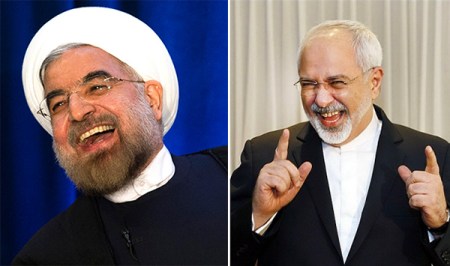
Iran’s firing of a missile within 1500 yards of a U.S. aircraft carrier in December, and its kidnapping and photographing of a U.S. Navy crew were test cases. Other than an apparent temper tantrum by Secretary of State John Kerry, there was no American response, except that Kerry absolved his friend Iranian Foreign Minister Javad Zarif of responsibility. Pictured above: Iranian President Hassan Rouhani (left) and Foreign Minister Javad Zarif (right).
Responding to Senator Lindsay Graham’s suggestion that Congress might increase sanctions against Iran, Mr. Kerry replied, “I wouldn’t welcome [that] at this time given the fact that we’ve given them a warning and if they decide to do another launch then I think there’s a rationale.”
Kerry may not have to wait long.
Just this week, Iranian Deputy Chief of Staff Brig-Gen Maassoud Jazzayeri was quoted by the FARS News Agency reiterating, “The White House should know that defense capacities and missile power, specially at the present juncture where plots and threats are galore, is among the Iranian nation’s red lines and a backup for the country’s national security and we don’t allow anyone to violate it.”
Now, he is believable.
Congress is beginning to breathe fire, but it is not yet clear what it can or will do in the face of the Obama Administration’s executive actions. Last week, angry congressmen were reduced to threatening to “name and shame” American companies that do business with Iran because they cannot figure out how to stem the tide of the Obama Administration’s indulgence of Iranian provocations. That reaction is not even close to good enough.
The Islamist state of Iran’s blatant aggression and provocative attitudes have reached an unprecedented level.
After the nuclear deal, and Obama’s appeasement policies towards Iran, the ruling Islamists of the country have become very public and vocal about their ideological objectives.
Most recently, the Fars News Agency, the Islamic Republic’s state-controlled news outlet, quoted Iranian Deputy Chief of Staff, Brigadier General Maassoud Jazzayeri, warning the United States to stay away from Iran’s redlines―one of which is Iran’s ballistic missiles.
In addition, Brigadier General Amir Ali Hajizadeh was also quoted by the ISNA agency as stating, “The reason we designed our missiles with a range of 2000 km is to be able to hit our enemy the Zionist regime from a safe distance.” Iran has increased its short–and medium–range ballistic missiles, and currently boasts the largest ballistic missile stockpile in the Middle East.
But what will Obama’s response to these threats be? Most likely there would be more bowing to the ruling clerics of Iran and giving them more carrots. Iranian theocrats have learned that intransigence works with Obama.
There is a simple rule that if you reward a student or your kid for bullying and breaking the rules, you will be encouraging his/her bad behavior, which can ultimately become dangerous for everyone around that person. In addition, if you show students your weakness–such as being willing to give them extra points so that they give you good reviews at the end of the year–they will take advantage of that, or as the Persian proverbs goes: “they will milk you to the end.”
And this is exactly what Iran is doing and how President Obama is encouraging the Islamic Republic’s aggression. Iranian leaders have become cognizant of the fact that intransigence absolutely works with the White House, and threatening Obama with pulling out of the nuclear deal will lead to Obama offering more concessions to the mullahs.
There is a basic rule in Iran’s politics and in Iran’s Supreme Leader’s philosophy: concessions means weakness. Once someone shows you his/her weakness, you have to speed up getting more concessions from him or her until there is nothing left to get from them.
Here is a chain of events that can easily help us understand how we got here with Iran. It also helps predict how President Obama and the White House will respond to Iran’s recent aggression and threats to the US and Israel.
When the nuclear negotiations were initiated, Obama announced his terms. Iran’s Supreme Leader, Khamenei, gave an inflammatory speech, lashing out at the US. Obama’s response was to increase the number of centrifuges that Iran can hold and give Tehran more leverage in uranium enrichment. Obama also agreed not to include issues such as Iran’s ballistic missiles, human rights or the fate of those Americans imprisoned in Iran during the negotiations.
Now Khamenei knew the game. He used another shrewd tactic by giving another speech threatening the US that he will pull out of the negotiations if certain conditions were not met. Obama’s response was to immediately allow the Islamic Republic to receive all sanctions relief (including the removal of United Nations Security Council’s sanctions), even before Iran finishes its 10-year obligations. Obama also gave Iran a green light to become a nuclear state by enriching uranium at a level that they desire, spinning as many centrifuges as they like, and buying arms with no limits, after the 10-year period.
Khamenei and the IRGC leaders wanted to more forcefully milk the cow, as the Persian proverb goes. Iran launched its ballistic missiles in violation of the JCPOA (UNSCR 2231 Annex II, paragraph three), which states that Iran should not undertake any ballistic missiles activity “until the date eight years after the JCPOA Adoption Day or until the date on which the IAEA submits a report confirming the Broader Conclusion, whichever is earlier.”
President Obama ignored it. Iran launched ballistic missiles several times more. President Obama issued a superficial statement criticizing Iran. Khamenei immediately gave his Nowruz speech heavily lashing out at the United States, the “Great Satan,” and implying that he will pull out of the nuclear deal.
To appease the ruling clerics of Iran, Obama immediately backed off his statements by breaking the promises that he made to the Congress when he was trying to get his nuclear deal through. In other words, he is now preparing to give Iran access to the US’s banking and financial system, and he has already lifted sanctions against Iran that are not related to the nuclear program, but to Iran’s ballistic missiles, terrorism and human rights violations. Iran was also removed from the list of countries for which there is a travel ban, although it is prominent sponsor of terrorism.
Thanks to Obama’s weak leadership and appeasement policies towards the mullahs, Iran is already publicly attacking several countries in the region directly or through its proxies Hamas, Hezbollah, Badr, Kataeb Imam Al Ali, Harakat Al Islam, etc. Iran would have never dared to be so intransigent and aggressive when the UNSC sanctions were previously imposed on Iran. However, sanctions are being completely lifted, thanks to Obama.
Iran has a history spanning over 2,500 years and it goes without saying that that the mullahs are among the shrewdest politicians. They can smell weakness from thousands of miles away and they know how to exploit it. Obama’s weakness–that he fears his so-called crowning foreign policy achievement (the nuclear deal) might fall apart–has led to Iran’s bullying, and has driven his carrots-but-no-stick policy towards Tehran. It appears that Obama is indeed focused on scoring superficial records in his name, such as the nuclear deal or visiting Cuba. But there is no doubt that his so-called “accomplishments” will be forgotten soon. The things that are important are the lives that have been lost, the human rights violations, and the escalation of regional conflicts on the part of Iranian leaders thanks to Obama’s decisions.
Ahead of Tuesday’s Wisconsin presidential primaries, U.S. Speaker of the House Paul Ryan was in Israel, the destination he chose for his first foreign trip since assuming his post at the end of October.
In meetings with Israeli leaders — and in an interview with Times of Israel editor David Horovitz — Ryan reaffirmed his commitment to the Jewish state and his opposition to the nuclear deal with Iran. He also stated, in no uncertain terms, that — contrary to increasing rumor and pressure — he is not going to end up becoming the Republican nominee at what threatens to be a contested GOP convention. Nobody really believes he means it, however, because he had been equally adamant about not wanting the position he is currently occupying.
But, while distraught Americans from both parties are obsessing over whether Donald Trump can win the nomination — and if he does, whether he can beat likely Democratic rival Hillary Clinton — the Obama administration is being given a free pass to get away with murder, figuratively. More literally, it is enjoying the benefit of the doubt caused by the distraction of the public away from the havoc the White House and State Department are continuing to wreak, which is enabling the actual death of a lot of people in the present, and a whole lot more in the future.
The terrorism of the Islamic State group is only a tiny part of this, though it seems to be the only jihadist organization that gets a rise out of Westerners, whom it makes no bones about targeting for mass murder. Indeed, as the suicide bombings in Brussels on March 22 indicated, Europeans and Americans only wake up when a lot of people with whom they can identify get slaughtered senselessly. That this kind of thing is going on routinely everywhere else in the world barely elicits a yawn.
But as evil as ISIS is, it is still small fry compared to the Islamic Republic of Iran, the world’s greatest state sponsor of terrorism, with tentacles reaching far and wide. And now, thanks to the Obama administration, it also has multibillions of dollars at its disposal with which to build its nuclear arsenal. Nor does it hide its ambitions to wipe Israel off the map and its loathing for America, the “great Satan.”
Iran’s supreme leader, Ayatollah Ali Khamenei, has made this clear to the point of warning his own underlings to follow suit.
“Those who say the future is in negotiations, not in missiles, are either ignorant or traitors,” he said last week.
How has the Obama administration responded to this and previous Iranian muscle-flexing, abduction of American sailors, celebration of U.S. abdication and assertion that nothing Tehran does violates the nuclear agreement?
It has conceded to Iran on every point. Or worse.
As was revealed in a piece by Adam Kredo in The Washington Free Beacon on Monday, “Congress is investigating whether the Obama administration misled lawmakers last summer about the extent of concessions granted to Iran under the nuclear deal, as well as if administration officials have been quietly rewriting the deal’s terms in the aftermath of the agreement.”
Rep. Mike Pompeo (R-Kansas) told Kredo that “the gap between [the administration’s] promises … and today’s scary reality continues to widen. We are now trying to determine whether this was intentional deception on the part of the administration or new levels of disturbing acquiescence to the Iranians.”
He was referring to issues such as Iran’s ballistic missile testing, which the administration initially said constituted a violation of nuclear-deal codifier U.N. Resolution 2231, and then backtracked. Perhaps even more disturbing were statements from the Treasury Department indicating that international business transactions with Iran could be done in dollars — releasing the ban in place on Iran’s access to the U.S. financial system.
In other words, not only was the deal America made with the devil a dangerous one to begin with, but apparently, we don’t know the half of it.
This sentiment was expressed in an op-ed in The Wall Street Journal on Sunday by United Arab Emirates Ambassador to the U.S. Yousef Al Otaiba, who wrote that, in spite of President Barack Obama’s claim about the world being safer place as a result of the nuclear deal, “The Iran we have long known — hostile, expansionist, violent — is alive and well, and as dangerous as ever.”
It is this sorry situation, and the Democrats who brought us here, that Americans must keep in mind come November, no matter who the Republican candidate is.









 anneinpt
 artaxes
 danmillerinpanama
 davidking1530
 Peter Hofman
 Joseph Wouk
 Peter
Peter Louisiana Steve
 WarSclerotic
Recent Comments